



Abstract
This article explores the different trade union responses to the growth of precarious work in the retail sector in Estonia, Poland and Slovenia in the context of the global economic crisis. The empirical research is based on interviews with trade union leaders and case studies of large multinational hypermarket chains. The analysis of sector-level union responses suggests the crisis has not deeply changed their path-dependent character. The most effective union tactics, involving political mobilization and sector-level collective bargaining aimed at halting the growth of precarious work, were observed in Slovenia’s neocorporatist system of industrial relations. By contrast, company-level collective bargaining and mobilization were more advanced in the two neoliberal systems, Estonia and Poland. In all three countries, the most important innovations were union-led campaigns aimed at increasing public awareness about precarious work.
Introduction
Looking at the cyclical nature of economic development and its effects on labour markets, it would seem that in times of economic crisis, the bargaining power of labour decreases, with rising unemployment making it easier for employers to replace more expensive, often unionized employees with lower-paid employees working on ‘non-standard contracts’. In line with this assumption, one of the global effects of the economic and financial crisis since 2008 has been the further expansion of precarious employment as a result of state policies aimed at relaxing employment regulations, and austerity measures adopted in the private and public sectors (ILO, 2012: viii). By precarious employment we mean, in accordance with Kalleberg (2009: 2), ‘employment that is uncertain, unpredictable, and risky from the point of view of the worker’. The emergence of these kinds of job was in all probability ‘delayed’ in central and eastern European (CEE) countries, where standard full-time employment was more often the norm as a result of their socialist legacy. For instance, in 2002 the share of temporary and part-time jobs in the retail sector was still much lower in the prospective new Member States of the EU than in the EU-15 (Caprile, 2004). Although a similar difference between the new Member States and the EU-15 was noted with respect to part-time work in 2009 (Aumayr, 2010), the share of temporary jobs in 2009 in some CEE countries (e.g. Poland and Slovenia) was already higher than in the EU-15 (Eurostat Labour Force Survey). It may therefore be argued that there was some perceived room for an increase in precarious jobs in retail and other sectors in the 2000s. Following the argument on post-communist in-excess labour (Ost, 2009), one could even go as far as to claim that the emergence of precarious work meant that CEE companies had finally overcome their ‘post-communist’ status.
So, how did this ‘last step’ take place? Was it indeed inevitable, and how did trade unions respond to the expansion of precarious work? We argue that the already existing trend towards precarious work was accelerated by the economic crisis. Nevertheless, its scope was mitigated by existing industrial relations frameworks. We make this claim based on our retail sector case study. Retail is a sector where employee representation and collective bargaining are generally less developed than other sectors but where precarious jobs are widespread (Adam, 2011; Grugulis and Bozkurt, 2011). Existing comparative research suggests that retail sector employers are prone to using non-standard employment as a response to increasing cost-driven competition in the sector. The forms of atypical employment (e.g. ‘mini-jobs’, part-time employment and temporary agency work) reflect national labour market regulations. Hence, the guiding question of this article – how did trade unions respond both at company and sector levels to the further expansion of non-standard, precarious employment during the economic downturn in various institutional settings in CEE countries?
We argue that the retail sector is a good example for analysing trade union tactics with regard to precarious work in the context of the global financial and economic crisis for several reasons. First, the CEE retail sector was not as hard hit by the crisis as other sectors and quickly began to recover after 2009. In this context, it could be expected that the adoption of various cost-saving measures by employers, including non-standard forms of employment, did not just represent a strategy for coping with the crisis but also of leveraging the ‘crisis discourse’ to reduce labour costs and thus promote future competitiveness. Secondly, given the low level of unionization in the retail sector, the effects of any negotiated crisis-related measures to maintain employment and counter precarious work were likely to be limited, compared for instance to the manufacturing sector (see Glassner et al., 2011). Thirdly, the study enables us to explore the more general mechanisms underlying both the emergence of collectively bargained responses and unilateral union tactics, including recruitment and organizing, renewal and changes in internal union structures, as well as political responses and new forms of societal engagement (see Gumbrell-McCormick, 2011).
Addressing the above issues, we start out by presenting an overview of the methodology used in our empirical research in Estonia, Poland and Slovenia. We then go on to discuss industrial relations and employment practices in the retail sector in these three countries before (2008) and during the crisis (2009, 2010). Next, we explore the responses of trade unions to precarious employment during the economic downturn, first at sectoral level and then at company level, looking at six multinational hypermarket chains. In the conclusion, we discuss the effects of collective bargaining and employers’ and trade union actions on changing/continuing employment practices in the retail sector during the economic downturn.
Methodology
To understand how industrial relations systems have shaped union responses to the crisis and precarious work in the retail sector, we build on the typology of post-communist political economies (Bohle and Greskovits, 2007). The capitalist regimes that emerged in the CEE countries after the end of state socialism range from ‘neoliberal’, as characterized by the Baltic States (represented here by Estonia), via the ‘embedded neoliberal regime’ of the Visegrad countries (represented here by Poland) to the ‘neocorporatist’ regime of Slovenia. The former two are characterized, among other things, by the dominance of decentralized, single-employer bargaining. By contrast, Slovenia represents a system dominated by multi-employer bargaining at sectoral level. Existing research suggests that the crisis may have engendered different responses in different capitalist regimes. As argued by Glassner et al. (2011: 303), ‘collective bargaining responses to the crisis have been much more frequent in multi-employer bargaining systems than in single-employer bargaining systems, both at sectoral and company level.’ We ask whether such differences were also to be seen in the retail sectors of the countries studied.
Empirical data for this study came from three sources. First, to understand the role of industrial relations systems, we conducted expert interviews with leaders of the major trade union federations active in the retail sector. These were supplemented by interviews with a number of national and, where appropriate, regional union leaders. In the years 2009–2012, 14 interviews were conducted in the three countries, involving the following trade unions: NSZZ Solidarność, FZZPSPHiU (within OPZZ) and the Workers’ Initiative (Poland); EAKL and its retail sector affiliates ESTAL and ETKA (Estonia); and ZSSS with its retail sector affiliate SDTS and STS-KS 90 (affiliated to KS ’90) (Slovenia). Our second source was the secondary data found in existing industrial relations reports on the retail sector published by Eurofound (Adam, 2011; Aumayr, 2010; Caprile, 2004) as well as information on the sector’s employment and economic performance from Eurostat Structural Business Statistics, Labour Force Surveys and national statistical offices in Estonia, Poland and Slovenia. Thirdly, semi-structured interviews with company-level trade union leaders (at least two per company), existing press reports and annual corporate reports of the companies studied were used for constructing company case studies. All company data were made anonymous at the explicit request of a number of our informants.
For our empirical analysis we selected six large multinational hypermarket chains in the food retail segment. While the retail sector in these three countries is for the most part made up of SMEs, our focus was on the big transnational retailers, as they are controlling an increasing share of the market and setting the global employment trends in the sector (Dicken, 2011). In selecting the cases for our sample, we had the following criteria in mind: that the company needed to be a large multinational company (MNC) belonging to the leading food retailers in the given national context and that it needed to have an active trade union enabling collective bargaining to take place. Focusing on MNCs, in most of which trade unions have been recently established, we expected to find more innovative approaches to tackling the challenges of the crisis and precarious work than in the case of the older unions with their declining membership in large post-communist stores. The case studies were also diversified in terms of the extent to which the MNCs were affected by the crisis, allowing us to explore the choices made by management and unions in different conditions.
Industrial relations and employment practices in the retail sector: crisis?
The retail sector is often characterized as the low-paid sector, where such non-standard forms of employment as part-time work, temporary work and self-employment are commonplace and where employee representation is less developed than in other sectors (Adam, 2011; Czarzasty, 2010; Carré et al., 2010). Faced with increasing competition, retailers worldwide are cutting costs through recourse to new technologies (e.g. self-scanning), organizational changes (e.g. new shop layouts), increased customization and new employment practices. To bypass existing regulations on local labour standards, such as minimum wages at national or sectoral levels, employers can be expected to use non-standard forms of employment as an ‘exit’ option from the costs related to standard employment (Carré et al., 2010: 255), helping them to face up to the challenges of an increasingly competitive business environment exacerbated by the crisis. To verify this expectation, we will briefly discuss pre-crisis employment conditions and crisis-related developments in the retail sector.
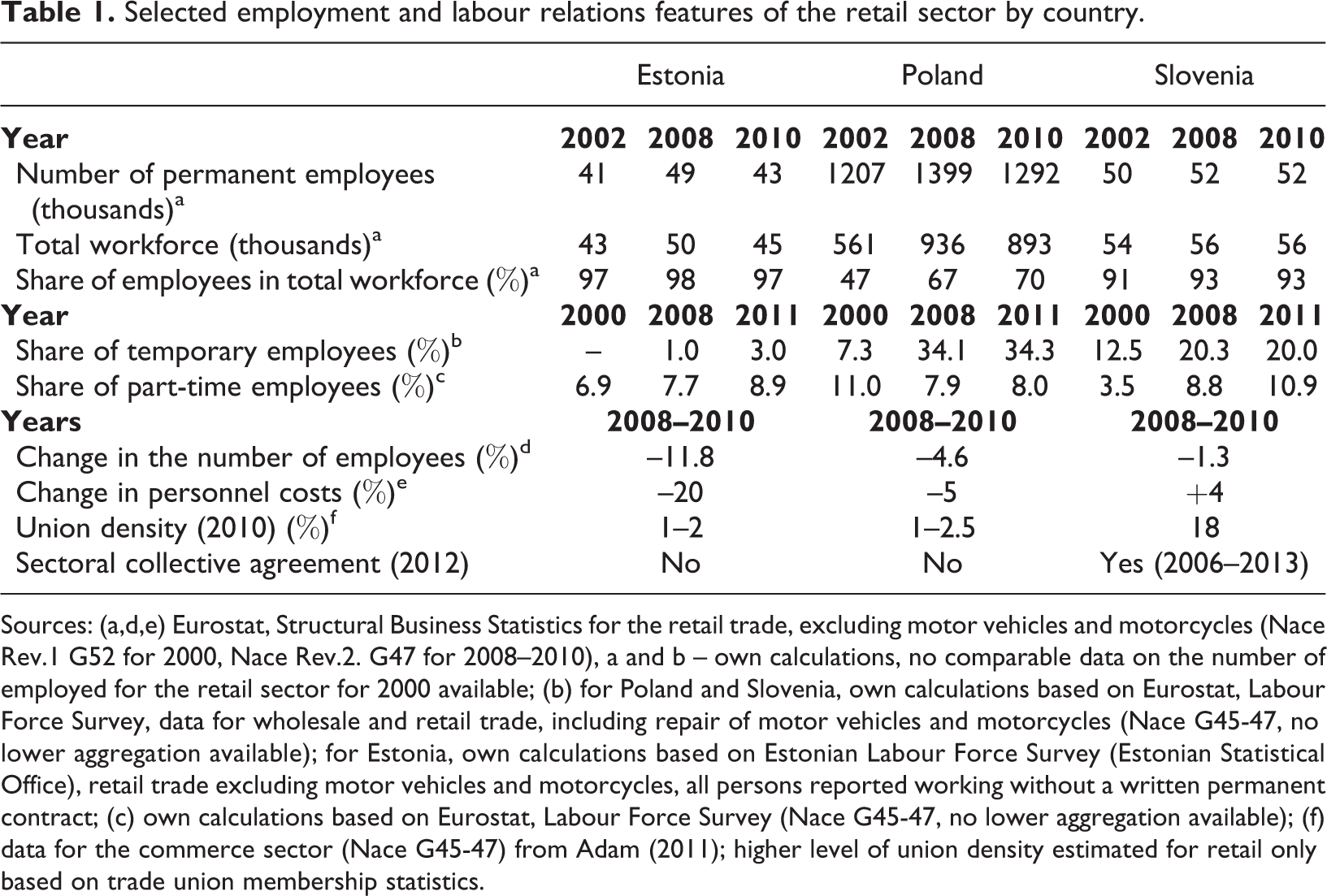
Though pre-crisis employment conditions in the retail sector in Estonia, Poland and Slovenia had some common features, there were also country-related institutional differences. In the 1990s and 2000s, the number of workers employed in the sector had been continuously increasing. This trend ended in 2008 (Adam, 2011). Moreover, the retail sector is characterized by a relatively high level of women workers and an over-representation of young people. The share of employees in the total workforce, indicating the relevance of non-standard employment, ranged in 2002 from 97 per cent (Estonia) to 91 per cent (Slovenia) and 47 per cent (Poland) (Table 1).Yet, except for the self-employed in small local shops, the extent of numerical flexibility involving temporary and part-time employment in the retail sector was still much lower in the CEE countries than in the EU-15 countries in 2002 (Caprile, 2004). For instance, in retail 7.7 per cent of women and 6.7 per cent of men worked on temporary contracts in the (prospective) new Member States, compared to 12.7 per cent of women and 12.0 per cent of men in the EU-15 countries in 2002 (Caprile, 2004). Thus, the precarization in the sector was reflected in chronically low wages, irregular work schedules, continuous work intensification and some violations of health and safety regulations.
Selected employment and labour relations features of the retail sector by country.
Sources: (a,d,e) Eurostat, Structural Business Statistics for the retail trade, excluding motor vehicles and motorcycles (Nace Rev.1 G52 for 2000, Nace Rev.2. G47 for 2008–2010), a and b – own calculations, no comparable data on the number of employed for the retail sector for 2000 available; (b) for Poland and Slovenia, own calculations based on Eurostat, Labour Force Survey, data for wholesale and retail trade, including repair of motor vehicles and motorcycles (Nace G45-47, no lower aggregation available); for Estonia, own calculations based on Estonian Labour Force Survey (Estonian Statistical Office), retail trade excluding motor vehicles and motorcycles, all persons reported working without a written permanent contract; (c) own calculations based on Eurostat, Labour Force Survey (Nace G45-47, no lower aggregation available); (f) data for the commerce sector (Nace G45-47) from Adam (2011); higher level of union density estimated for retail only based on trade union membership statistics.
The growth of part-time and temporary employment began in the mid-2000s. This was combined with the adoption of changes to labour codes promoting more flexible employment in 2002–2003 in Poland, in 2006 in Slovenia and in 2009 in Estonia. In Estonia and Poland, low unemployment levels, the higher labour market bargaining power of workers in the mid-2000s and the out-migration of workers in the wake of EU enlargement (see Meardi, 2012) led to a shortage of qualified workers willing to work in the low-paying jobs. Filling the gaps, retail companies began to experiment more with non-standard forms of employment. In Estonia and Slovenia, this meant an increase in the share of part-time workers in the wholesale and retail sectors between 2000 and 2008. In Poland, non-standard employment meant a sharp increase in the share of temporary employees (in wholesale and retail) from 7.3 per cent in 2000 to 34.1 per cent in 2008, a figure way above the EU-15 average (12.8 per cent in 2008). A similar tendency was also observed in Slovenia, where the number of temporary workers in wholesale and retail increased from 12.5 per cent in 2000 to 20.3 per cent in 2008 (see Table 1).
Both before and during the crisis, industrial relations in the retail sector clearly reflected and constantly revealed institutional differences between the three countries studied (Table 1). In neocorporatist Slovenia, retail sector wages are regulated by sectoral collective agreements (the first one was signed in 2006) binding for all companies in the sector. Union density in the Slovenian retail sector is relatively high (more than 18 per cent), though still lower than in the economy overall. In neoliberal Estonia and Poland, two countries with decentralized, single-employer bargaining, there are no sectoral-level collective agreements, company-level collective agreements are very rare, and trade union density is no higher than 1–2 per cent. Until recently, eroding trade unions were mostly present in old, ‘post-communist’ cooperative shops. This situation began to change in the late 1990s (in Poland) and the mid-2000s (in Estonia), with trade unions organizing campaigns targeting large hypermarket chains. Even so, up to 2008, it was only in Estonia that union organizing led to a company-level collective agreement, and in just one store. In Poland, ‘cooperation agreements’ were signed between unions and employers in three hypermarket chains enabling trade union access to employees within the enterprises.
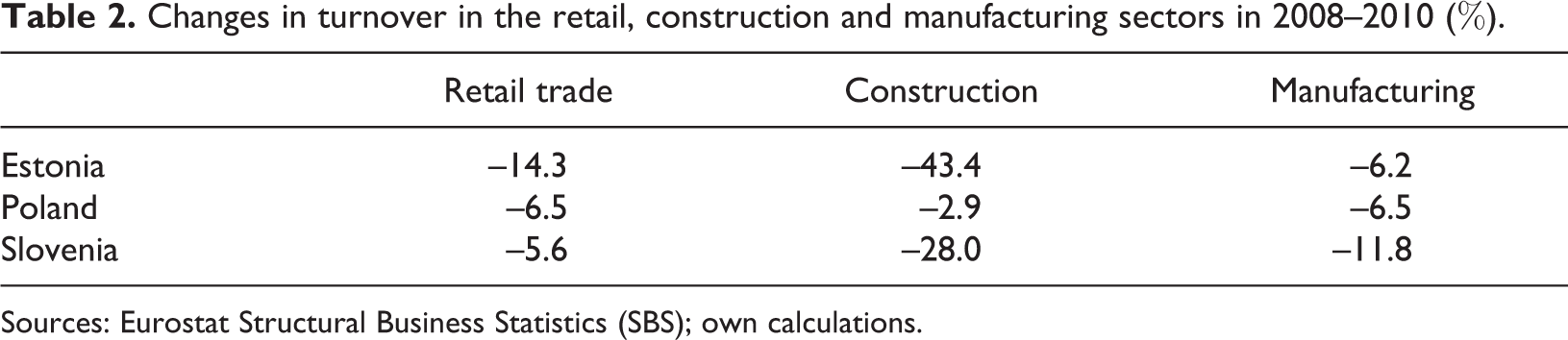
The effects the economic and financial crisis had on retail in the CEE countries are illustrated by two main observations. First, in terms of turnover (see Table 2), the crisis hit retail much the same way as it hit manufacturing, though much less than construction (except for Poland where the sector was buoyed up by public infrastructure projects in preparation of the UEFA Euro 2012). The crisis mostly hit small retailers, while at the same time discount stores and multinational convenience stores were seen expanding across the region, putting competitive pressure on both small retailers and larger shops (PMR, 2011). The steady increase in retailers offering lower-priced everyday products may be explained by falling purchasing power in these countries during the crisis, leading to a growth in demand for discounted products.
Changes in turnover in the retail, construction and manufacturing sectors in 2008–2010 (%).
Sources: Eurostat Structural Business Statistics (SBS); own calculations.
Secondly, the trade union activists we interviewed emphasized that the crisis has been used by employers as an ‘excuse’ further to cut labour costs, intensify work and flexibilize employment in their companies. In terms of numbers of employees, Estonia experienced the highest job losses in the retail sector of the three countries studied (around 11.75 per cent in 2008–2010), followed by Poland (4.63 per cent) and Slovenia (1.26 per cent, see Table 1). Available Eurostat data (Table 1) on retail personnel costs in Poland and Estonia show that they dropped faster in 2008–2009 than the overall decline in the number of employees, suggesting that the crisis led to the reduction of employment costs in these two countries.
In Poland, the main effects the crisis had on sector employment conditions included further growth in temporary agency work (up to 50 per cent of staff in some hypermarkets) and a slight increase in the share of part-time work (Table 1). The share of workers on fixed-term contracts in the commerce sector stood at the very high level of 34.3 per cent in 2011 (compared to 26.9 per cent nationwide). The anti-crisis legislation of July 2009 made it possible to conclude an unlimited number of fixed-term contracts for a period of up to 24 months, creating an opportunity further to flexibilize employment. In Estonia, the dismissal of workers hired in the context of the pre-crisis labour shortages, many of whom were Russian-speaking, was facilitated by the new Employment Contracts Act implemented in June 2009 despite trade union opposition. The act simplified dismissal procedures and made it easier to conclude fixed-term contracts. The crisis also contributed to a 2.3 per cent decline in average wages in the retail sector between 2009 and 2010. Nationwide, the share of employees on fixed-term contracts increased, from 2.1 per cent in 2007 to 4.5 per cent in 2012 (Eurostat). The share of part-time employees in the commerce sector increased to 8.9 per cent in 2011 (Table 1).
In Slovenia, the strategy of cutting labour costs seems to have been applied less. Personnel costs grew between 2008 and 2010 due to an annex to the collective agreement raising the minimum wage in 2009. However, in the Slovenian context, the crisis also led to deterioration in employment conditions through the reduction of the number of full-time workers after mass retirements in 2010 and their replacement by employees on temporary or part-time contracts (mostly students). The share of part-time employees grew over the crisis period to 10.9 per cent. Our interviewees pointed out that temporary contracts were widely used, up to 25 per cent in some stores (20 per cent in the commerce sector as a whole in 2011, see Table 1).
Trade union responses to the crisis and precarious work: sectoral level
The analysis suggests that the expansion of precarious work in the retail sector in Estonia, Poland and, to a lesser degree, in Slovenia was institutionally mediated. The low level of union membership in retail in Estonia and Poland reflects more general features of single-employer collective bargaining systems, resulting in greater job insecurity than in the multi-employer collective bargaining system found in neocorporatist Slovenia. Did trade union responses to the further expansion of precarious work in the course of the economic crisis also reflect these institutional differences? We distinguish three possible scenarios (Gumbrell-McCormick, 2011; Kalleberg, 2009; Kretsos, 2011). First, trade unions could focus on countering the expansion of precarious work via sector-level collective bargaining and tripartite negotiations. Secondly, they could remain passive, avoiding the issue of precarious work in their agendas. Thirdly, without collective bargaining leverage, they could act unilaterally to tackle the problem of precarious work during the crisis by legislative lobbying and political campaigns, community and social movement unionism, comprehensive and/or grass-roots membership campaigns and revisions of internal union structures. Thus, the guiding question for this section is: which ‘negotiated’ and ‘unilateral’ measures addressing the problems of precarious work during the crisis were used by CEE trade unions in the retail sector, and why these and not others?
Exploring the first mentioned scenario, Glassner et al. (2011: 311–312) provide a list of negotiated measures to protect jobs that were used during the crisis in other sectors. They include short-time work schemes, actions to prevent or mitigate job losses (e.g. employee leasing), support for redundant workers (e.g. training courses), wage moderation and greater flexibility or decentralization of wage setting. As expected, such negotiated measures were almost absent in the single-employer collective bargaining systems in Poland and Estonia due to limited union power and lacking employer representativeness at sectoral level as well as rather ineffective, or ‘illusory’ (Ost, 2011) social dialogue at national level. In neocorporatist Slovenia, developments took a different direction. The minimum wage for the retail sector was raised in 2009 via an annex to the sectoral collective agreement. In 2011, trade unions also managed to negotiate a further annex harmonizing the wage increases of all wage grades in accordance with the new minimum wage. It is also worth noting that other measures such as vocational training or short-time work schemes were not included in negotiations.
In the absence of effective collective bargaining instruments to tackle the issue of precarious work, retail sector trade unions resorted to other, unilateral and mobilization-based tactics. Nationwide political campaigns against the expansion of precarious employment during the crisis were initiated by unions in Poland and Slovenia and, to a lesser degree, in Estonia. However, the only truly successful campaign was in Slovenia, where union pressure contributed to voting down the law on temporary work (mini-jobs) in 2011 in a nationwide referendum. In Poland, retail trade unions organized demonstrations and actions against temporary (‘junk’) contracts in 2011–2012 and NSZZ Solidarność campaigned nationwide to set the minimum wage at 50 per cent of the national average, all without success. In Estonia, the minimum wage remained frozen at €278 from 2008 till 2012 despite ongoing tripartite negotiations and union pressure to raise it.
Another tactic involved union membership drives, directly or indirectly addressing the problems of low-paid and unstable employment. In this case, we can talk about the path-dependent development of pre-crisis union strategies. In Estonia and Slovenia, the retail sector trade unions made use of earlier amendments to their statutes allowing for the individual membership of employees in micro-companies, the ones hit most by the economic downturn. In Estonia, ETKA professionalized its approach to membership recruitment, employing trade union organizers and joining a new project of the Baltic Organizing Academy financially supported by Nordic trade unions (Nordic In). In Poland, centrally-led trade union organizing campaigns by NSZZ Solidarność in the retail sector gained new momentum with the campaign in the Kaufland hypermarket in 2010. This resulted in gaining over 1 000 employees in one year (2010), a monthly pay increase of €25–50 and the transformation of existing temporary contracts into open-ended contracts for all employees. NSZZ Solidarność did not however directly target those working on temporary (‘junk’) contracts outside the scope of labour legislation in its organizing approach.
The use of mass media and public campaigns constituted a further tactic. In August 2011, NSZZ Solidarność launched a ‘hyper-exploitation’ webpage (hiperwyzysk.pl), allowing retail sector employees anonymously to voice their concerns about issues of pay and working conditions in their companies. The union widely publicized its protests against Sunday work, work intensification and job cuts in several hypermarket chains. Information campaigns were also launched by ETKA in Estonia, targeting companies cutting wages and, with the support of EAKL, the new Employment Contract Act that made lay-offs easier. Similarly, mass media were mobilized by trade unions (spearheaded by the national-level confederation ZSSS and its sectoral affiliates, including SDTS) in Slovenian campaigns against mini-jobs.
It can be argued that attracting the attention of the general public to the negative aspects of low-paid and unstable jobs has been the main symbolic innovation on the part of trade unions in the countries studied. It signifies a qualitative change, moving away from the earlier strategies of CEE trade unions which rarely opposed the expansion of flexible employment (Trappmann, 2011). However, other union strategies remained rather path-dependent, dominated by (rather limited) ‘negotiated’ responses in Slovenia and unilateral actions in Estonia and Poland, mostly related to company-centred union organizing, a feature also present before the crisis. Social movement unionism and new, community-based forms of worker organization, which in other contexts were used to represent workers deprived of standard employment contracts (Kalleberg, 2009; Kretsos, 2011), were almost absent in the countries studied, except for experiments conducted by small, radical unions in Poland (e.g. the anarcho-syndicalist All-Poland Trade Union Workers’ Initiative).
Company trade union tactics to tackle the problems of precarious workers
As a result of sectoral union weakness in Poland and Estonia and the dominance of single-employer bargaining systems in these countries, we expected that employers would have more leeway unilaterally to reduce labour costs compared to the multi-employer collective bargaining system in Slovenia (Glassner et al., 2011: 315). A closer look at the selected multinational companies in the food retail segment enabled us to examine this expectation. The companies selected include EER1 and EER2 (names anonymized) in Estonia, PLR1 and PLR2 in Poland, and SIR1 and SIR2 in Slovenia. Each company belongs to the top five retailers in terms of profits and employment in the food retail segment in the countries studied. Their business situation during the years of the crisis was typical for large, multinational retail companies as such, i.e. their performance was only moderately and temporarily impacted by the economic downturn in 2008–2011. Even so, their management boards decided to make use of the crisis to reduce employment costs and secure a competitive advantage for the future. This, in turn, contributed to the further expansion of precarious jobs.
The unilateral measures adopted by management in the companies studied included (1) direct temporary salary reductions (in EER1) or indirect reductions (in SIR1, via cutting variable pay components not regulated by company-level collective agreement); (2) work intensification as a result of increasing sales floorspace (in all cases), rising norms for employees to qualify for performance bonuses (PLR2), the introduction of just-in-time principles (PLR1), and extended working hours (EER1); (3) non-negotiated lay-offs, including 11 people in EER1 and the replacement of around 12 000 of PLR1 permanent staff by temporary agency workers; (4) unilateral and accelerated expansion of temporary contracts replacing standard employment, especially in the Slovenian and Polish cases.
Trade union responses to management strategies were basically threefold: (1) monitoring the implementation of sectoral-level collective agreements (dominant in Slovenia); (2) developing company-level collective bargaining resulting in new or renewed collective agreements (dominant in Estonia); (3) undertaking unilateral actions to counter atypical employment in the context of the lack of collective agreements (dominant in Poland). In Slovenia, the role of trade unions was basically degraded to dealing with individual breaches of the sector-level collective agreement. Actions targeting work intensification and non-standard employment were limited. In terms of wage negotiations, unions were more successful in SIR1. With the aid of a media campaign spurred by the publication of anonymous letters written by employees, trade union representatives negotiated an annex to the company-level agreement, increasing variable wage components. In SIR2, negotiations on a company-level collective agreement were stalled due to the irreconcilable positions of both sides.
In the case of EER1 and EER2 in Estonia, the crisis intensified company-level collective bargaining, which was also supported by sectoral trade union federations. Initial experiences with crisis-related collective bargaining in EER1 were rather negative, with management deciding unilaterally to cut wages in 2010 (despite the regulations in the collective agreement, in place since 2008) and ignoring trade union attempts to negotiate one-time wage cuts in 2010 in exchange for higher wages in 2011 through an annex to the collective agreement. Partially as a result of the mass-media campaign initiated by ETKA (sectoral union), the company did however restore wages to pre-crisis levels in 2011 and renewed its collective agreement. In EER2, trade union leaders stated that the crisis had had no effect on internal negotiations. Yet, it was during the period of crisis that the union and management entered into negotiations on a collective agreement, representing a new element of employment relations in EER2 not existing before the crisis. The agreement was concluded in November 2011 and included provisions more generous than national legal requirements (e.g. in terms of bonuses and holidays). Separate wage negotiations started in autumn 2011 and were concluded in April 2012 with an average wage increase of 10 per cent. Overall, in both Estonian cases, the issue of precarious work was addressed more in terms of wages than employment contracts.
In the case of two MNC subsidiaries in Poland, no collective agreements existed before the crisis and none were concluded during the crisis, mainly due to employer fears of losing their competitiveness. With significant support from the NSZZ Solidarność Commerce Section, trade unions resorted to public protests in front of hypermarkets and mass media campaigns, highlighting the growth of ‘junk jobs’ in PLR2 and the replacement of permanent PLR1 workers by employees hired via temporary agencies. In PLR1, the union did manage to negotiate with management a number of measures alleviating precarious employment, most notably the transformation of 5 000 fixed-term contracts into open-ended contracts in 2011 and a new policy guaranteeing open-ended contracts for PLR1 employees who had been with the company longer than 15 months (from January 2011). In PLR2, trade unions in cooperation with NGOs exerted continuous pressure on the company to raise wages. As a result, the current minimum wage (PLN1 870 gross) in PLR2 discount stores is the highest of all retail chains. The PLR2 unions also sent an open letter to UEFA president, Michel Platini, accusing the company, one of the sponsors of the Polish football team during the European Football Cup 2012, of misusing short-term contracts to get rid of union activists. Although the PLR2 union campaign against the short-term job contracts has not as yet brought any tangible results (compared to PLR1), it does provide a background for future action by publicizing the issue of ‘junk jobs’ in PLR1.
Conclusions
This article looked into trade union responses to the effects of the economic and financial crisis on the retail sector in Estonia, Poland and Slovenia. Our analysis suggests that the situation offered by the crisis gave retail companies greater leeway to accelerate, deepen and justify the further expansion of low-paid and unstable employment. This expansion took place despite the crisis only having a limited impact on the profits of the leading, mostly multinational retail companies in CEE. In accordance with earlier research (Carré et al., 2010; Glassner et al., 2011; Kalleberg, 2009), the extent and forms of increased employment precariousness were shaped by the opportunities trade unions had to counteract it in a given national industrial relations context. As argued by Kalleberg (2009: 15), ‘the degree to which employers can shift risks to employees depends on workers’ relative power and control’. Thus, in exploring trade union approaches to the problem of precarious work, we expected to find more sector-level collective bargaining responses in the multi-employer bargaining system of neo-corporatist Slovenia and more unilateral union actions and company-level responses in the case of the single-employer systems of Poland and Estonia.
Our analysis partially confirms this expectation. The crisis did not mark any radical discontinuity, but rather the continuation of earlier trade union approaches to the problems of precarious work. The most important tactics involved company-centred trade union organizing (Poland, Estonia) and sector-level collective bargaining (Slovenia). As expected, sector-level collective bargaining was absent in the retail sector in the neoliberal systems of Poland and Estonia. However, even in the case of neocorporatist Slovenia, the ‘integrative’ type of sectoral collective bargaining (Glassner et al., 2011) with its ability to provide win-win solutions for workers and employers (such as requalification or working time adjustments to save jobs) was not used. Moreover, collective bargaining focused on wage issues rather than on problems of unstable employment.
In the two single-employer bargaining systems, Poland and Estonia, more tangible trade union achievements were noted at company level than in the case of Slovenia, reflecting successful company-level collective bargaining (dominant in Estonia) and/or public protests and campaigns (dominant in Poland, but also present in Estonia). Results included pay increases, transformations of temporary contracts into more secure, open-ended contracts, or, in Estonia, the signing and/or extension of collective agreements in transnational retail companies. In Slovenia virtually no progress in company collective bargaining was observed, with employers tending to adhere to the minimum provisions of sector-level collective agreements and adopting a much more voluntaristic approach in areas not regulated at higher levels.
Although trade union tactics regarding precarious work did not dramatically change during the crisis, it would be misleading to claim that they remained entirely locked in their earlier approaches. The most important innovations were the use of mass media and political campaigns against ‘junk jobs’ (in Poland), ‘mini-jobs’ (in Slovenia) and the new, more ‘flexible’ Employment Contracts Act (in Estonia). Addressing the expansion of unstable employment as not fully justified by the economic situation of employers, these campaigns added a new element to the public discourse in CEE countries. Even though their immediate effects might still be limited (especially in Poland and Estonia), the issue of precarious work has certainly gained a more prominent place in trade union agendas compared to the pre-crisis situation (Trappmann, 2011). It remains to be seen to what extent this qualitative change will be translated into new strategies to tackle the problems of precarious work in the future.
Footnotes
Acknowledgements
The authors thank Vera Glassner and two anonymous reviewers for their critical, but useful comments on earlier drafts of this article.
Funding
This work was supported by the European Trade Union Institute [project code 1151-086-31], the subsidy of the Foundation for Polish Science within a grant from Iceland, Liechtenstein and Norway through the European Economic Area Financial Mechanism [grant number HOM/2009/8B], and by the Estonian Research Council [grant number PUT106].