




Abstract
This article reviews the negotiated responses to the crisis at different levels of social dialogue in the Baltic countries. The Baltic countries form a relatively coherent group of small open economies that can be classified as belonging to the neoliberal type of central and eastern European capitalism. Their responses to the crisis were consistent with such classification: flexible labour markets absorbed the main impacts of the crisis through rapid increases in unemployment, as well as nominal and real drops in wages. A negotiated response was either not sought at all by governments or was of minor importance at all levels of interaction between the social partners. If anything, national-level social dialogue deteriorated, remaining at a low level even after the crisis had peaked. Based on qualitative examples from Estonia and Lithuania we show that, at company level, responses to the crisis varied.
Introduction
The aim of this article is to describe negotiated responses to the 2008–2009 economic crisis in the Baltic countries, representatives of a type of neoliberal political economy found in central and eastern Europe (Bohle and Greskovits, 2007). The main focus is on social dialogue outcomes at national level and collective bargaining outcomes at sector and company level.
Labour market institutions in the neoliberal central and eastern European (CEE) economies are weak, labour markets deregulated, and hiring and firing easy. There is no co-determination and, in general, pay and conditions are flexible. The classification of Baltic countries as liberal market economies (LME), as opposed to coordinated market economies (CME) (Hall and Soskice, 2001), is subscribed to by a number of authors (e.g. Adam et al., 2009; Feldman, 2006; Bohle and Greskovits, 2007; Nölke and Vliegenthart, 2009). Nölke and Vliegenthart (2009) and Bohle and Greskovits (2007) see the Baltic countries as forming a group of neoliberal market economies with many important features in common. Baltic countries typically enjoy relatively high levels of FDI and penetration by transnational corporations. The latter have a preference for LME industrial relations systems over CME ones, even when the home country has CME institutional arrangements (Sippola, 2009).
Two important considerations when looking at crisis responses are (a) the Baltic countries’ desire to join the European monetary union (Estonia is already a member) and (b) the fact that their currencies have been pegged to the euro in anticipation of this. These considerations dictate the need for flexible labour markets as the primary adjustment mechanism to economic fluctuations, limiting the scope for monetary and fiscal policy measures (Pissarides, 2008; Calmfors, 1998). Baltic labour market institutions are thus required to support labour market flexibility as a way of underpinning general economic growth (or recovery). The current system of individualized and plant-level bargaining featuring low union density and low collective bargaining coverage supports labour market flexibility, in line with the general economic and monetary mechanism of a liberal market economy. This in turn would lead one to expect a low level of negotiated responses to the crisis.
The analysis of the national level is based on websites, press releases issued by social partners and European Industrial Relations Observatory reports. The company-level analysis is based on recent research into collective labour relations in Estonia 1 (Kallaste et al., 2011). This research was designed to gather detailed qualitative information about industrial relations attitudes and ideas from different labour market participants. A total of 128 in-depth interviews were conducted at the end of 2010 and beginning of 2011, of which 99 were with social partners (43 employee and 56 employer representatives). An additional review of the transcripts was undertaken with the aim of analysing the character of crisis-related negotiated responses. Although the crisis and the negotiated responses as such were not the specific objectives of this research, the interview timeframe saw many interviewees referring to experience gained during the crisis. In addition, a key social partner representative in Lithuania was interviewed in April 2012 for the specific purpose of obtaining an opinion on negotiated responses from a trade union perspective.
The article has the following structure: first, the general industrial relations set-up in the Baltic countries is described, looking at how this was affected by the economic crisis and the austerity programmes adopted by governments in response. Secondly, the existence and nature of negotiated responses at different levels in the Baltic countries are discussed. Finally, we attempt to predict the prospects for collective bargaining at the various levels described.
Industrial relations
The trade union density and collective bargaining indicators confirm low union membership and low bargaining coverage (see Table 1), typical for industrial relations in neoliberal economies. Union density and bargaining coverage are lower in the Baltic countries than in all other CEE countries, and company-level bargaining is predominant.
Union density and collective bargaining coverage in CEE countries (%).
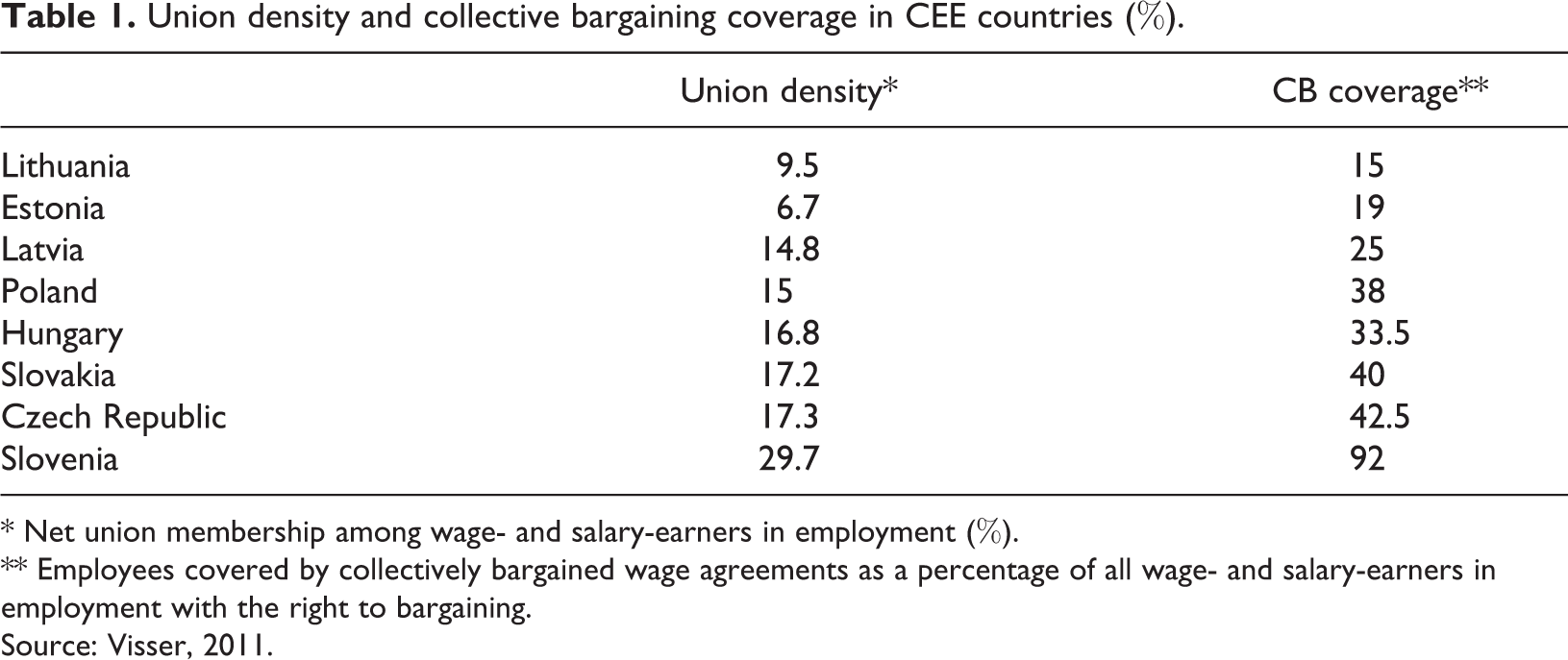
* Net union membership among wage- and salary-earners in employment (%).
** Employees covered by collectively bargained wage agreements as a percentage of all wage- and salary-earners in employment with the right to bargaining.
Source: Visser, 2011.
In the three Baltic countries both employers’ organizations and trade unions remain limited in the scope of their representativeness, with the possible exception of the Latvian trade union confederation, and fragmented into competing entities. As a consequence, there are only very few sectoral trade union agreements, and bipartite bargaining is limited in extent (Vatta, 2001: 129–130). The majority of smaller companies, major foreign multinationals and many of the larger domestic companies play little or no role in the affairs of employers’ confederations.
Sectoral dialogue has only minor importance in all Baltic countries. There are two extended 2 sector-level collective agreements in Estonia (health care and transport), and several covering a whole sector but which are concluded with a single public sector employer such as a ministry (e.g. rescue workers, primary and secondary school teachers). There was just one sector-level contract concluded in 2009 in Lithuania (with journalists) but otherwise little progress has been made in this respect.
Collective agreements in the Baltic countries concern only a few companies and cover only a small proportion of employees. However, there are some specific groups of companies, for the most part larger companies, where a significant share of workers is covered. In Estonia 39 per cent of companies with over 250 employees were covered by a collective agreement in 2009 (by contrast only 6 per cent of companies with five or more employees were covered) (Statistics Estonia). In Latvia the 2006 wage structure survey revealed that there were fields of activity where collective pay agreement coverage was half or more of the workforce: public administration (50 per cent), transport, storage and communication (54 per cent), education (69 per cent), and health and social work (69 per cent) (Statistics Latvia).
Economic crisis
Following the collapse of the Soviet Union at the beginning of the 1990s, all three Baltic countries adopted ‘open market’ policies of economic and social reconstruction. Transformation from a planned to market economy was successful, with fairly high economic growth rates enabling the three countries to make considerable progress towards achieving the EU average level, up from one-third of the EU-27 average in 1995 to 50–60 per cent in 2010. Even though their GDP has grown, the Baltic countries remain among the countries with the lowest per capita GDP in the EU, on a par with Bulgaria, Romania, Poland and Hungary.
The unwelcome corollary of high GDP growth rates, based largely on the development of unsustainable economic sectors (construction in particular) and financed by external liquidity during the boom years 2004–2008, was the relative sharpness of the slump occasioned by the crisis, significantly worse than that experienced by the EU as a whole (see Figure 1). All three countries experienced a sharp economic downturn, with collapsing output, a severe ‘correction’ in property prices, and rapidly declining average income and consumer consumption levels, as well as widespread unemployment. This decline was largely halted in most of the EU in 2010 and in Latvia in 2011. Recovery in the Baltic countries has been promising, with GDP growth again significantly higher than the EU-27 average. In 2011 annual GDP growth in Estonia reached 7.6 per cent, in Latvia 5.5 per cent and in Lithuania 5.9 per cent, compared to the EU-27 average of just 1.5 per cent.
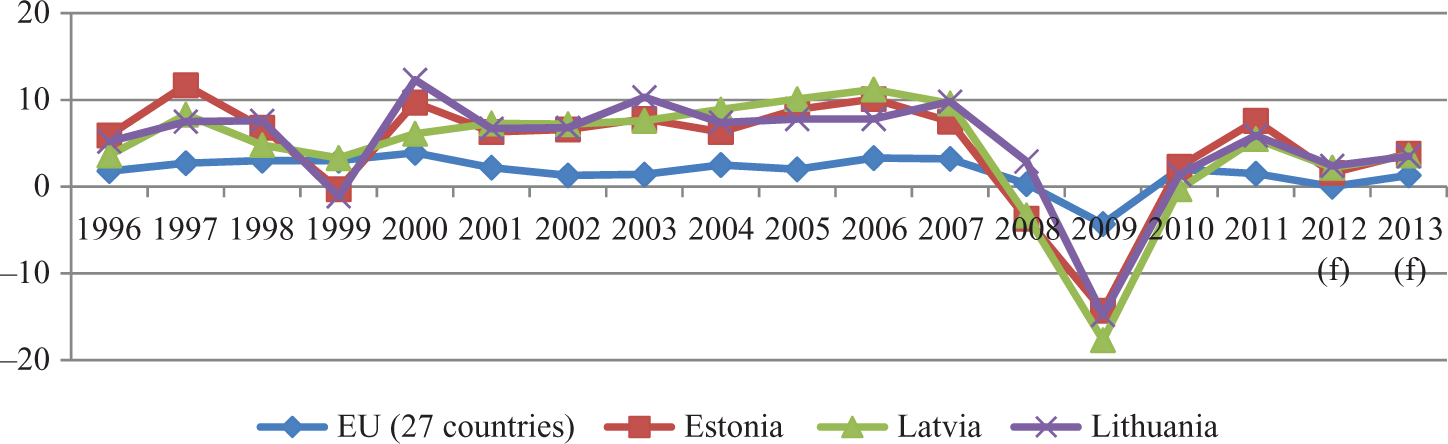
Real GDP growth year-on-year (%).
An economic shock of this scale had a considerable impact on the labour market. In 2010, official unemployment rates in the Baltic countries were the second-highest in the EU after Spain, reaching 17–19 per cent. Youth unemployment rates soared to over 30 per cent in all three Baltic countries.
In addition to the sharp increase in unemployment and the decrease in employment, both the real and nominal wages of those still in employment during the crisis declined. Coming in the wake of extraordinary wage growth during the boom years 3 , the decline of both nominal and real wages is to be seen as an indication of the labour market’s extraordinary flexibility, a typical feature of the neoliberal type of capitalism.
This gloomy picture of the labour market was accompanied by a drop in profits as export markets collapsed. Yet despite the decline in employment and wages, employee compensation as a share of GDP actually grew during the crisis, indicating that even though the labour market situation was adverse, employees’ relative position had improved (even if most of those still in work did not see it that way).
It is evident that the crisis response involved major adaptation of the economy in general, and of the labour market in particular. The open economy with its liberal market-oriented system led to greater economic volatility, with a steeper downturn and faster recovery in economic growth, though not fully reflected in employment and wages.
Austerity measures
In 2008 the fiscal position deteriorated rapidly and there was a risk of losing access to financial markets needed to finance growing deficits. Prevailing monetary policy, pegging the Baltic currencies to the euro did not permit the use of devaluation as a mechanism for increasing competitiveness (Di Tella et al., 2012), meaning that the countries had little choice but to undertake budget consolidation measures.
‘The fiscal reversal was a significant surprise for all’ (Deroose et al., 2010: 6). Though the fiscal surplus built up during the boom years enabled Estonia to respond somewhat differently to the economic crisis than Latvia and Lithuania, all three Baltic countries introduced wide-ranging austerity measures to reduce government deficits incurred by pre-crisis spending and the rapid decline of government revenues during the crisis. Total general government expenditure was cut by 3–8 per cent in 2009 and a further 3–7 per cent in 2010 compared to the previous year (Eurostat). Thus general government budget expenditure in 2010 was lower than in 2008, by 10 per cent in Estonia, 12 per cent in Latvia and 7 per cent in Lithuania.
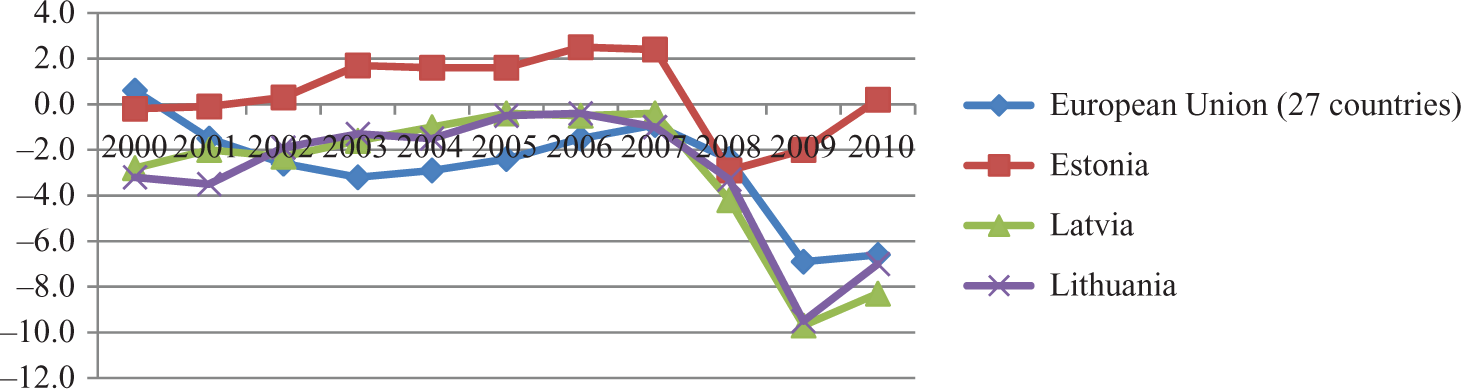
Government net lending (+)/net borrowing (–) as % of GDP.
Measures were implemented in all three countries to reduce public sector wages and employment, reform social security and increase budget revenues. In 2009 and 2010, public sector wages were cut by more than the average private sector wage cuts, dropping by 18 per cent in 2009 and by a further 9 per cent in 2010 in Latvia and around half of that in Estonia and Lithuania. Latvia experienced above-average public sector employment cutbacks (20 per cent in 2010) whereas Estonia and Lithuania only saw minor reductions. The public sector, especially in Estonia and Lithuania, thus absorbed the crisis mainly through wage cuts, while the rest of the economy bore the brunt of job cuts.
Government budget consolidation included social security reforms aimed at cutting spending, and increased taxes. With slight differences from one country to the next, the social security reforms included reductions and reforms of maternity and child allowances and other benefits. Unemployment and health benefits were reduced. In all three countries there were plans to cut old-age pensions. However, existing pension levels were maintained in Latvia and Estonia, as cuts would have been in contradiction to existing statutory regulations. In Estonia old-age pensions were even raised. The distribution of the cuts put the burden of austerity measures more on families with children than on other groups of society, as shown by Callan et al. (2011) for Estonia.
Cuts in public sector wages, employment and social security were accompanied by increases in taxes. VAT and excise taxes were increased in all Baltic countries, with VAT going up from 18 per cent to 21 per cent in Lithuania and Latvia and from 18 per cent to 20 per cent in Estonia. In addition, in Latvia corporate income tax and property tax rates were increased in 2009, and the tax-exempt minimum personal income threshold reduced by almost two-thirds, thereby increasing personal income tax (The Government of Republic of Latvia, 2010; The Government of Republic of Latvia, 2011). In Estonia, unemployment insurance contributions were raised while the minimum social insurance contribution was also raised (Eesti Vabariik, 2010). Severe austerity measures accompanied by tax increases had profound societal impacts.
Austerity measures were passed without any major opposition. Even though there were protests by trade unions and other groups such as farmers, pensioners and students, there was no sustained social unrest or concerted public opposition to the governments’ austerity programmes.
Negotiated responses to the crisis at national level
In the face of the economic tsunami that hit the Baltic countries with force in the latter half of 2008, traditional tripartite consultative processes were simply swept aside as likely to impose unacceptable delays. Nevertheless each Baltic country saw some form of tripartite agreement being concluded in the course of 2009 (see also Carley and Marginson, 2011). While a ‘negotiated’ response was sought at national level, the picture was not as uniform across the Baltic countries as might have seemed at first. The respective agreements were:
Estonia: in March 2009 a tripartite agreement was signed on training/retraining measures for both the employed and the unemployed (Sotsiaalministeerium, 2009);
Latvia: in June 2009 agreement was reached on ways of cutting the budget deficit by LVL500m (€771.4m) (The Cabinet of Ministers of the Republic of Latvia, 2009);
Lithuania: in October 2009 tripartite agreement was reached on austerity measures for the coming year (Lithuania National Agreement, 2009).
In Estonia the agreement between employers, unions and the government mainly concerned measures tackling hindrances to the training/retraining of the employed and the unemployed (e.g. when finding a job while still receiving state-funded vocational training, a person would still be able to finish their training; part-time working was allowed for a one-year period when combined with continuous training (CVET); vocational training financed by the Unemployment Insurance Board could be extended over a one-year period if necessary, etc.) (Sotsiaalministeerium, 2009). In Latvia and Lithuania, on the other hand, the agreements were on wider political measures.
The Estonian agreement had nothing to do with the core austerity measures. In practice, the agreement received only minor attention, as there were continuing heated debates over the government’s breach of previous agreements concerning unemployment insurance payments and contributions. The government abrogated the tripartite agreement on the new labour law reached in 2008, and its promises to extend the eligibility criteria for and raise levels of unemployment benefit were simply abandoned. This step, taken unilaterally, simply overrode the tripartite social dialogue process. In response, trade union efforts were directed at getting the government to withdraw the proposed reductions in unemployment benefits and to re-enter consultations with the social partners before pursuing further changes. At first, the unions called on the government to postpone adoption of the new labour law until the economy had recovered, since previous concessions granted with a view to promoting ‘flexicurity’ in relation to redundancies had now become hostage to the economic downturn. The trade union confederation (EAKL), like its counterparts elsewhere in Europe, argued that the government should concentrate on increasing government revenues and boosting purchasing power as a way out of the crisis (EAKL, 18 February 2009). Their key demand was that all future changes concerning social protection should be made on the basis of tripartite consultation (EAKL, 16 February 2009). Several specific demands were stipulated by trade unions with regard to increasing purchasing power (increase of the tax-free income threshold, payment of wages through unemployment insurance funds in cases of company hardship, no increase in unemployment insurance contributions), along with a few funding proposals (e.g. social security contributions levied on company dividends).
In the face of further crisis measures adopted by the government, a strike was organized by four unions, with some 1 800 employees from 15 companies downing tools on 16 June 2009. Predictably, the trade unions demands were ignored by the government. Looking at the (re)training agreement in the context of the wider erosion of social dialogue during spring 2009, it becomes clear that the agreement had no major impact and was not to be seen as an indicator of consultative social dialogue. Other more important agreements concluded previously on possible measures for coping with the crisis were not taken into account, even after protest actions. Austerity measures were not discussed with the unions.
The tendency to ignore tripartite social dialogue continued and indeed intensified after economic recovery began. For example, despite opposition from employers and unions, the reserves of the Unemployment Insurance Fund were consolidated into the general state budget and unemployment contributions were not lowered. With their opinions ignored, the employers and trade unions withdrew their representatives from the board of the Unemployment Insurance Fund and from the Health Insurance Board (Tööandjate Keskliit, 2011; EAKL, 2011).
In short, tripartite dialogue in Estonia remained subject to government direction, both during and after the crisis. Substantive social dialogue has been almost completely ignored, with the government unilaterally pursuing its austerity policies.
A similar situation prevailed in Latvia during the crisis. The Latvian government was forced to seek a US$7.3bn bailout from international lenders and was required by the IMF and the European Commission to impose very severe austerity measures. The state budget thus became the major issue of tripartite social dialogue (Karnite, 2009). Tripartite discussions on the austerity budget took place during the crisis and as a result a first tripartite agreement was signed in October 2008. The 2008 agreement was deemed to be ‘too optimistic’ in terms of the scale of cuts necessary and was revised in 2009. Despite the agreement signed in the middle of 2009, the social partners were dissatisfied, with trade union protests both preceding and immediately following signature of the agreement.
The agreement reached in 2008 included wage freezes and an increase in certain social benefits (Karnite, 2009). In June 2009 after long discussions the social partners reached agreement to cut the budget deficit by LVL500m (€771.4m) (The Cabinet of Ministers of the Republic of Latvia, 2009). The agreement included measures aimed at raising revenues (an increase of dividends from state-owned companies, higher excise taxes, a cut in the tax-exempt minimum income per person, higher gambling levies) and a reduction in public expenditure (a lower public sector wage bill, reform of state agencies, containment of public sector administrative costs, cuts in pensions and family allowances) for the 2009 budget (The Cabinet of Ministers of the Republic of Latvia, 2009). The agreement only covered a short period and did not prevent subsequent trade union protests (for example immediately after the adoption of the amended budget in mid-June 2009). No consensus was reached between the social partners on the 2010 and 2011 budgets (Curkina, 2010).
Social dialogue is thus biased towards the government. Even after having discussed the situation with the social partners, the government did not take their opinions into account (Karnite, 2011a). Social dialogue in Latvia in the context of the crisis is best summed up as follows: ‘The Latvian government has been including social partners in its decisions over austerity measures by allowing them to make the case against cutbacks in certain areas’ (Eurofound, 2011: 12, emphasis added). However, having made their case, substantive impacts have been negligible and, even in the aftermath of the crisis, promised wage increases for example for teachers have failed to materialize. Social dialogue has been significantly absent, provoking renewed threats of protest and strike action ( Baltic Times, 2012).
In Lithuania, after initial opposition on the part of the social partners to the government’s austerity measures and policies, a national tripartite agreement was signed in October 2009. Trade union opposition had included several protest and strike actions (Blažienė, 2009a, 2009b) and even a hunger strike (Blažienė, 2009c). Compared to the Estonian tripartite agreement, the Lithuanian agreement was essentially wider and less purely declaratory, with clear numerical references and a deadline for full implementation set to the end of 2010. Its terms covered government expenditure, including cuts in public sector wages (base rates were left unchanged), reductions in social benefits (pensions, maternity/paternity benefits), structural issues such as a reform of health care and education, an economic stimulus package and energy policy, as well as a new emphasis on combating undeclared work in the shadow economy (Lithuania National Agreement, 2009). Against a background of trade union and even small business protest, the government undertook not to adopt unilateral decisions raising taxes or introducing new ones.
In November 2011, as crisis measures continued into their third year, the three main trade union confederations announced their readiness for united protest action. In a submission to the government, the trade unions stated that ‘Lithuanian trade unions oppose the economic, financial and social policy which has been pursued by the ruling majority and its Government, and which has impoverished many Lithuanian people, forcing them to emigrate. The trade unions are indignant about continuous proposals to liberalize labour relations: the simplification of dismissal procedures, non-payment of severance pay, extension of working time. The Lithuanian trade unions assert that the right to strike is only formally valid in this country, and trade union leaders are exposed to harassment and intimidation’ (Blažienė, 2012). This latter claim was given particular force by a court decision prohibiting a strike in a brewery on the grounds that it was an ‘essential service’. The trade unions subsequently unsuccessfully lodged a complaint with the ILO (Documents in authors’ possession).
In the first phase of the crisis, such key Labour Code reforms as making it easier for employers to dismiss workers seemed to have been successfully resisted. However, following the expiry of the previous tripartite agreement, no new substantive agreement has been signed, and the government is now again proposing new changes to the Labour Code. These include cuts in benefits, a reduction of notice periods for dismissal and of dismissal compensation, and a reduction of holiday leave. The latter would be at an employer’s discretion. The government has also proposed altering the structure of the tripartite bodies, attempting to dilute the power of trade unions by introducing various ‘civil society’ representatives.
It therefore seems that although the semblance of social dialogue may have initially prevailed following trade union action in response to austerity measures, it did not produce any longer-term substantive results. Indeed, the crisis hardly raised social dialogue to a new level in Lithuania as has been the suggested outcome according to Carley and Marginson (2011: 95). In fact, during the crisis even the government’s formal representation on the tripartite council was downgraded from deputy-minister level to that of departmental heads.
In sum, the governments in the Baltic countries have made certain superficial concessions seemingly upholding social dialogue, while at the same time preserving the core thrust of their austerity programmes. In the case of Estonia, the greater weakness of organized labour has prevented even the semblance of social dialogue arising. At the same time, the protest actions undertaken by trade unions in all Baltic countries during the crisis were not very successful in mobilizing more broadly-based societal opposition.
Negotiated responses at sector and company level
The classification of Baltic industrial relations as ‘neoliberal’ implies that the prevalent way of responding to the crisis would be unilateral decisions by employers. Carley and Marginson (2011) suggest that where the main level of bargaining is at single-employer level (as is the case in the Baltic countries), there is more unilateral employer action than with multi-employer bargaining. This is confirmed for Lithuania by Blažienė (2011), who points out that during the crisis, even in companies where there were collective bargaining arrangements or a collective agreement in place, employers tried to avoid fulfilment of agreements in order to increase their ability to absorb the impacts of the economic downturn. Nevertheless, not more than a handful of agreements were actually cancelled.
In Estonia, in the two sectors with extended collective agreements, unions made a number of unsuccessful attempts to start dialogue during the crisis. In Lithuania, the one sector-level agreement was renewed annually, even during the crisis (Blažienė, 2011). There is no information on any sector-level negotiated response in Latvia. Generally speaking, the fairly low overall level of collective bargaining coverage and the very few sectors concerned meant that there was no negotiated response to the crisis sought at a sectoral level, except perhaps to put previous social dialogue arrangements on hold.
At company level, the successfully negotiated cases found in Estonia (see e.g. Carley and Marginson, 2011: 102, 113) included trade-offs such as the substitution of a decrease in wages for unpaid leave and the freezing of certain collective agreement items (e.g. agreed wage increases).
Negotiations where, though no agreement was reached, there was mutual consensus on postponing bargaining, could be regarded as ‘successful’ responses. These refer mainly to situations where collective bargaining had already begun, but, because of the economic crisis, had been abandoned due to the fact that union demands were considered inappropriate in the context of the changed economic situation, with both parties preferring to retain the previous agreement.
The crisis created a situation where high unemployment and decreasing economic activity reduced workers’ chances of finding a new job, meaning that, generally speaking, employees were in a weaker position to bargain with their employer. However, the presence of an existing and valid collective agreement gave employees stronger bargaining power. Where an agreement had been concluded with additional benefits for the employees, unions had no incentive to renegotiate these benefits in subsequent agreements as they had a particular vested interest in retaining the status quo.
4
The spokesperson of the Estonian employers’ federation summed this up from an employer standpoint:
‘And suddenly, when the economic crisis began, the trade union was not interested anymore in a new agreement. The old rates remain in effect and it is very comfortable for the union to just sit back and wait, not answer mails and to watch from the sidelines, even though the company really tried to reach agreement on a new contract.’ (Estonian employers’ confederation) ‘Our strategy was to prolong existing agreements during the crisis. In this case we win. Making a new agreement, we lose.’ (Lithuanian trade union representative)
Qualitative research does not enable any conclusions to be made about the scope or typicality of either strategy. In any event, collective agreements are not very common in the Baltic context. However, contrary to the expected liberal market bargaining outcomes, we do see instances of companies where trade unions possess sufficient power to enforce their preferred strategy, albeit in an attempt to maintain rather than advance their position.
Conclusion
The Baltic countries are small neoliberal CEE economies that faced higher than EU-average economic fluctuations both during and after the crisis. It could be assumed that labour relations in a neoliberal economy leave little room for trade unions and collective bargaining.
At national level, the social partners strove to retain some semblance of tripartite social dialogue. Meaningful social dialogue was missing, with governments generally taking unilateral decisions and trade unions excluded from decision-making. Sectoral social dialogue was largely absent and accordingly a recognizable sector-level negotiated response was missing. At company level there were different responses to the crisis, whether in terms of negotiated response, unilateral employer actions or even ‘unilateral’ union decisions. However, there were few occasions where trade unions were able to impose their conditions on employers. Evidently, there are companies within the general liberal market-based system where antagonistic labour relations generate acceptable outcomes for both parties, at least temporarily and where the imposition of pure market logic by employers is viewed as potentially counterproductive. However, such responses are not typical and any forecast for the longer term is difficult, suggesting a continuing disjuncture between national and company levels, and sectoral agreements constituting ‘the absent middle’.
One salient feature is that the high rates of labour force outmigration especially in Latvia and Lithuania may gain importance in the future, influencing employers’ willingness to make concessions in order to retain labour, in particular skilled workers. Emigration and the possibility of emigration increases employee bargaining power and competition for labour (Kaminska and Kahancová, 2011). At the same time, however, the legal framework for industrial relations in the Baltic countries is subject to arbitrary state intervention, as seen by the abolition of a union’s ability to maintain previous status quo agreements in Estonia. There is now also the possibility to end collective agreements, after prior notice has been given by the employer. These developments suggest that the future for union revitalization in the post-crisis Baltic context is now even more uncertain than it was before the ‘hard landing’ of 2008.
Footnotes
Funding
This work was supported by the Swedish Council for Working Life and Social Research (FAS) [grant number: 2011-0338] East-West labour migration, industrial relations and labour standards in a Swedish-Baltic context [Svensk modell och baltisk rörlighet: harmonisering eller social dumpning? En studie av arbetsmigration mellan Baltikum och Sverige].