



Abstract
The European sectoral social dialogue is rapidly becoming a pillar of European governance. It enables professional relationships to form in Member States, respecting each country’s autonomous rights, in line with the subsidiarity principle. European sectoral social dialogue is created through the initiative of the European social partners, that is, representative groups of employers and employees in the relevant sector. The dialogue materializes through the formation of a sectoral social dialogue committee as an official discussion and negotiation forum. Creating a sectoral social dialogue committee in the sports sector is a difficult process because of the specific characteristics of sport, the involvement of young people, the lack of social dialogue at national level in sport, as well as problems with the representativeness of employers’ and employees’ organizations and sectoral segmentation.
Introduction
Since the 1990s the European Union has promoted economic and social policies that support the development of social dialogue. These policies help create professional relationships. They cover a relatively wide range within which consultation can be interprofessional, sectoral (Keller and Weber, 2011; Lethbridge, 2011) or both. These forms of governance make it possible to establish links between various stakeholders of professional sectors, promoting communication between key figures. Hence, the European sectoral social dialogue (ESSD) has gradually become a genuine legislative activity (Mias, 2004), laying down the foundations for the job market. Today, this institutional innovation (Didry, 2009) seeks to achieve an autonomous collective negotiation within professional sectors.
The ESSD is considered a pillar of the European social model. It enables professional relationships to form in Member States, in a demarcated sector, at the same time as respecting the principle of subsidiarity. 1 With regard to the diversity of structure of each professional sector in the 27 EU member countries, this dialogue supplements national practice in terms of social dialogue and industrial relationships. The ESSD also identifies social partners (employers and employees in the sector), growth and best practices in terms of employment. It is progressively becoming an important characteristic of work relationships in Member States.
The social dialogue’s success is demonstrated by its ambition to act collectively and to represent efficiently its interests at European level. Social partners of the dialogue share this same objective. This discussion forum enables committees to respond actively to EU policies. The European Commission facilitates the European social dialogue by ensuring balanced support is provided to all social partners, employers and employees (European Commission, 2010).
To summarize, the ESSD produces results of practical relevance for businesses and workers and contributes substantially to EU governance. This political will establishes new employment and workplace regulations. These regulations are to be observed by the participants in the growing number of sectoral social dialogue committees (SSDCs) (Pochet et al., 2009). There are currently 40 committees, representing 145 million workers and more than six million businesses (European Commission, 2010).
Created by the European Commission in 1998, these committees serve as central bodies of consultation, joint action and negotiation. Nevertheless, it is the European Commission that determines the creation, representativeness and functions of new SSDCs. Social partners must make an agreed request to the Commission. The Commission will support the creation of a new committee as soon as the following conditions are met.
Social partners must belong to specific sectors and be organized at European level. (This means setting up European organizations, as well as recruiting employers and employees in the sector concerned.)
These European employer and employee organizations must each be composed of organizations themselves. This composition is considered an integral part of the social dialogue in Member States. They are able to negotiate agreements and be representative of several Member States.
There must be adequate structures that allow effective participation in both consultation processes and in the committees’ work.
The ESSD facilitates European governance, in other words ‘the rules, processes and behaviours that affect the way in which powers are exercised at European level, particularly in terms of openness, participation, responsibility, effectiveness and coherence’ (European Commission, 2001: 8). Marginson and Keune state that an ESSD is a ‘multi-level’ European governance that can be considered ‘a constellation of horizontal and vertical relationships’ (Marginson and Keune, 2012: 9–10) that help constitute this framework.
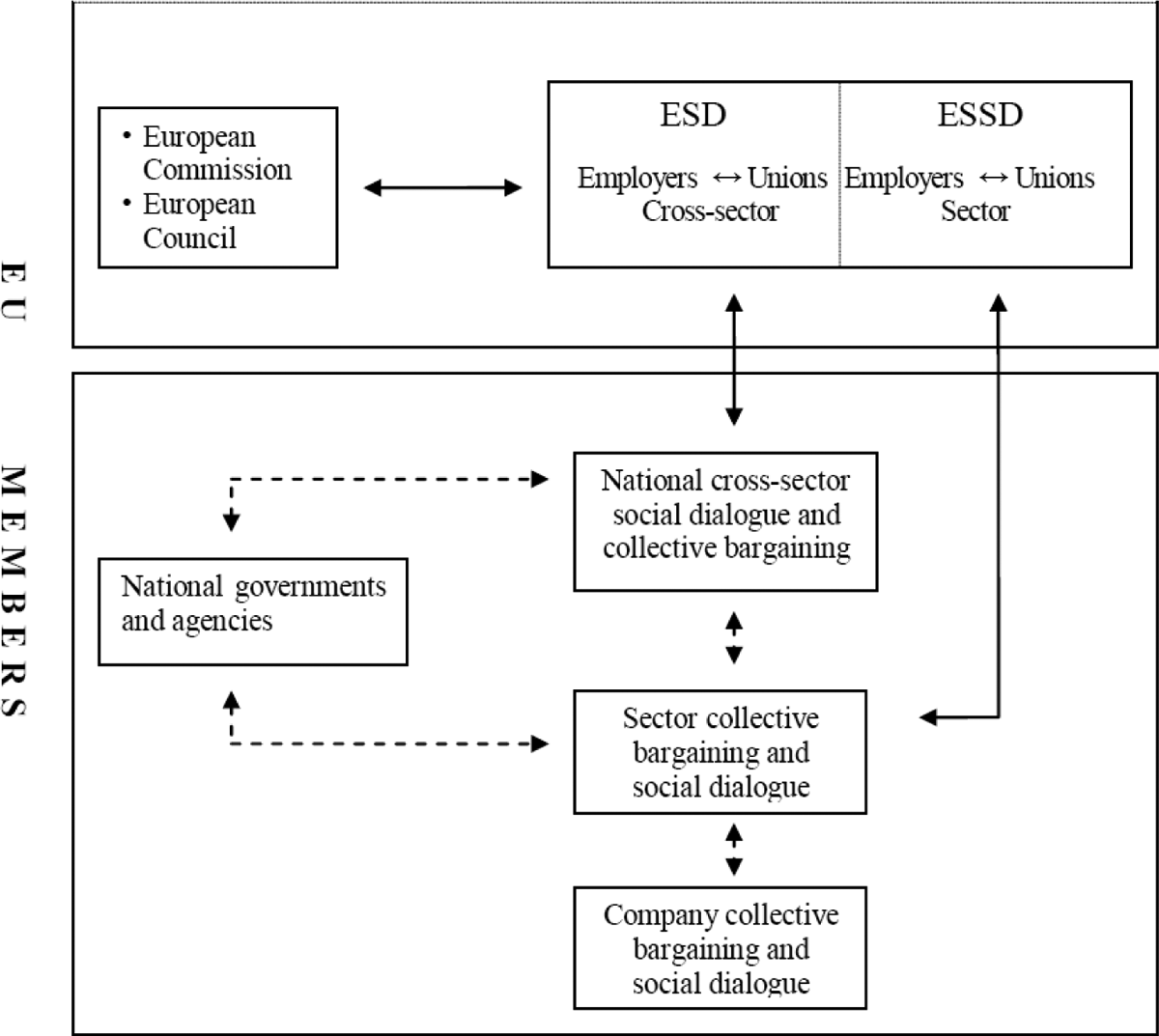
The European sectoral social dialogue.
This article is structured on the formation process of an SSDC (and hence on the three obstacles that need to be tackled). The sports sector, which has experienced unprecedented economic growth for about 15 years (Camy et al., 2004), is the sector to be studied. From volunteer work to sports professionals, professional activities encompass a wide diversity of structures and types of employment. When analysing the formation of an SSDC in the sports sector numerous factors need to be taken into account: societal, cultural, educational and public health challenges, the specific characteristic of sport (Presidency Conclusions, 2000), but also the diversity of economic consequences and of the jobs created by the sector. Within the enormous sports sector a complex set of economic drivers (members of the sporting community, private and public associates) is evolving, which can be divided into three sub-sectors. The first sub-sector is professional sport, the economic activity of which is linked to the requirements of high-level sporting competitions. The second is composed of sports associations, grouping together training, initiation and amateur competitive activities. Leisure activities make up the last sub-sector and group together recreational activities, fitness and outdoor leisure activities.
The European social dialogue in the sports sector is as multi-faceted as it is single-layered. Its situation is unique – to the extent that the formation of a specific professional football committee 2 has replaced the formation of a more general SSDC, which was initially negotiated. A series of questions emerge from the heart of this institutional dynamic. For example, what are the identifiable phases and the difficulties that need to be tackled while creating social dialogue in the sports sector? How does the decision-making process work at both national and EU level? Which European social partners (employers and employees) are representatives of this sector? How can all the key figures in each of the sectors manage to create an SSDC?
Social dialogue in the European sports sector is the focus of discussion and social confrontation during which stakeholders may agree on a temporary formal pattern (Strauss, 1978). Our sociological viewpoint on this dialogue is based on a pragmatic tradition. Following the actors – to use William James’ formulation (2005) – and taking their experiences seriously presumes that we understand the meaning they give to their actions and that we link them to the judgements, criticisms or constraints that they have to face in the course of a consultation and negotiation field such as that of the SSDC. Our epistemological position makes it possible to grasp the way the participants manage to overcome the sets of constraints inherent in the new mode of governance promoted by the sectoral social dialogue. It is also through these constraints that weigh on the conditions of production of a collective negotiation that the participants undergo, manage and discuss the national sense of identity, the specificities of the sports sector and the legislative, Community, human, material or economic imperatives (see Table 1).
Summary of projects led by European social partners in the sports sector with the aim of creating an SSDC (and the fulfilment of the three requirements of the European Commission for forming such a committee).

Method
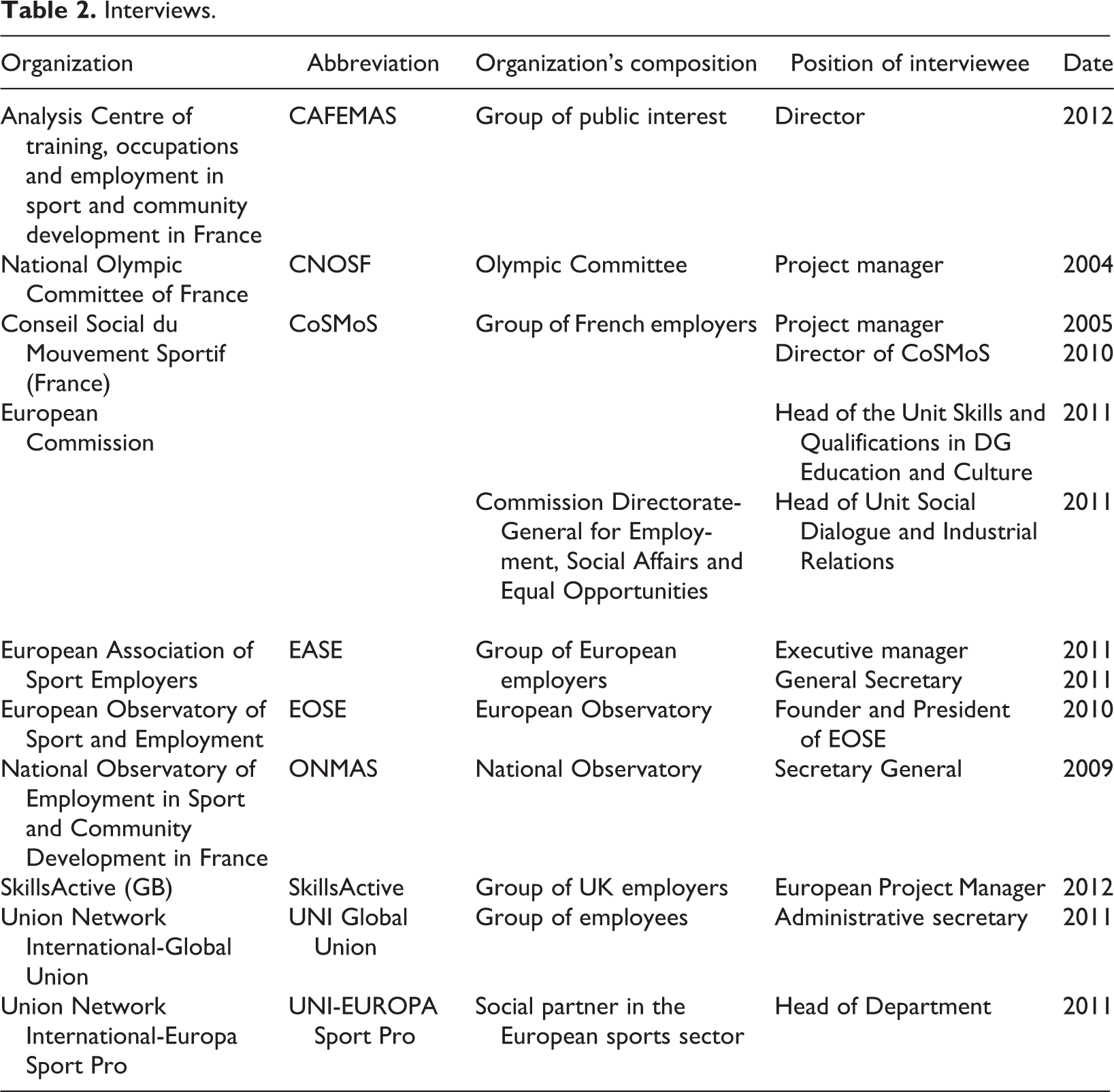
Our analysis is based primarily on two ethnographic surveys. The first was led by CoSMoS 3 (Social Council for the Sports Movement) in 2004/2005 and lasted seven months. The second one was led by EOSE 4 (European Observatory of Sport and Employment) in 2009 and lasted three months. Our observations have enabled us to understand how the European sports sector works and to identify the role of all the key figures involved in the dialogue. This practical experience of social dialogue has facilitated initial contact with the participants concerned. First and most importantly, we interviewed the main social partners (employees and employers) in the sports sector in France and in Europe. We met French government officials in charge of training and employment in the sector, as well as representatives of French and European observatories of sport and employment. To understand the key figures’ concerns, we conducted semi-structured interviews. These testimonies are supplemented with a series of public talks from people in charge of employment in the European Commission.
Interviews.
Results. Foundations of the European social dialogue in the sports sector
Need to create a European association of sports employers
It was not until the 1990s that employment and social policies in the sports sector started to attract the European Union’s attention. During the formation of the sectoral social dialogue in 1998 (European Commission, 1998), EOSE initiated an evaluation process to examine what the SSDC structure had to offer for the sports sector. The initial challenge was to establish, at EU level, social governance capable of coordinating professional qualifications and jobs emanating from the professional sector. The results gathered by EOSE stressed the uncertainty of social partners likely to join this initiative. There was no European organization representing all employers in the sports sector. Consequently, a sport-specific sectoral dialogue committee could not be formally established due to the lack of employer representatives. EOSE also emphasized the boundary ambiguity of the sector, as well as the diversity of the public policies conducted by Member States.
In November 2002, this observation was confirmed by the European Observatory. 5 During the subsequent debates, the main participants involved in standardizing the sector’s activities were asked to think about the creation of a European employers’ organization. CoSMoS – which represents employers in France – was convinced of the importance of a European social dialogue. In addition, the employer organization wanted to maintain its view of the sports sector, a concept which it had developed in France. 6 Its ambition was to establish a single consultative forum that brought together sports associations, professional sport and sport dealers in the same professional sector. Following first discussions, CoSMoS quickly became the project representative, tackling the problems established by the European Observatory. It soon convinced three other national employer organizations, the WOS (Netherlands), the Arbetsgivaralliansen (Sweden) and Skills Active (United Kingdom), to form a European association. Following the amalgamation of these organizations, the European Association of Sport Employers (EASE) was created in January 2003 under the aegis of French law and of CoSMoS.
Even if the formation of EASE marked a change in the sectoral social dialogue’s configuration, its power of action was relatively limited due to the lack of financial autonomy and human resources. In order for EASE to continue it was obliged to be controlled by CoSMoS, which in effect focuses on national negotiations. This proximity proved to be beneficial for EASE because the CoSMoS executive board had an in-depth knowledge of constructing infra-European social dialogues. This experience 7 enabled EASE not only to act more quickly at EU level, but also to promote dialogue with other employer organizations in the EU. Subsequently, EASE had to establish its own representation with the European Commission, which inevitably required more affiliated members. This representativeness is therefore based on ‘identity legitimacy’ (Hege, 2000); in other words, on the formation of a collective identity.
The sports sector must be acknowledged by European employee organizations
As for the employees, they have access to their much greater experience of representation compared to the employers. They therefore face different problems with regard to creating a social dialogue in the sports sector. To face the challenges of the global economy, the representative trade unions of the third sector formed an international group: the UNI (Union Network International). This union, formed in 2000, is the result of the merger of four international trade union organizations, each coming from the world of media and communication, including Media Entertainment International (MEI).
However, during the creation of EASE, there was little real dialogue between the numerous trade unions active in the sports sector. These trade unions barely acknowledged either national or supranational organizations. They preferred to remain autonomous in order to prevent the emergence of a profession-based identity, such as ski instructors, professional football players and so on. This is why, when a new group of employers suggested the development of a European social dialogue, only one European multi-sector structure, EURO-MEI, was capable of representing part of the employees in the sector. Although it primarily covers the media, entertainment and arts sectors, it does have some trade unions from the German, Austrian, Belgian, Spanish, French, Italian and Swedish sports sectors.
For employees, creating such a dialogue inevitably requires the re-classification of the sports sector as a well-developed section in the international group. To accomplish this, in 2003–2004 EURO-MEI had to be restructured; however, it was suffering from a lack of financial and human resources. To overcome this constraint the employee representatives decided to take advantage of the four merged international organizations. During the first exchanges with EASE, UNI-EUROPA soon realized the importance of negotiating and discussing the specific characteristic of sport in the field of work. From then on, it decided to support EURO-MEI and to work together with them. This alliance, justified by UNI-EUROPA’s affiliation with the European Trade Union Confederation, enabled EASE to be acknowledged as a European social partner and to collaborate actively with around 10 SSDCs.
Consequently, even though UNI-EUROPA and EURO-MEI took advantage of feedback from the social dialogue, most of the active national trade unions in the sports sector were not yet affiliated with them. Like the employers, the employees were searching for a collective identity. This came through the development of the sports branch into two sub-sectors. The first, UNI-EUROPA-Sport, was originally much more interested in the processes of structuring and professionalization in the active leisure sector. However, in 2008, in order to resolve certain issues in professional sport, such as anti-doping, betting and film rights, UNI-EUROPA approached the European Elites Athletes Association 8 in order to benefit from their expertise in this domain. In March 2010, the regional centre of UNI decided officially to form a sector specific to professional sport: ‘UNI-EUROPA Sport PRO’.
ESSD formation: a series of projects to meet the three requirements laid down by the European Commission
In 2003, the instigators of the social dialogue faced the difficulty of financing their actions. At the time, EURO-MEI did not consider sport a fully professional sector and EASE lacked the maturity to develop a policy that would do justice to its ambitions. Both the employer and employee representatives were then forced to turn to the subsidies allocated for the development of social dialogues in the EU. This financing quickly became a necessity for the institutional process. Since then, the progress of the process has been determined by the European Commission’s approval to finance all or some of the projects managed by EASE and/or EURO-MEI.
By becoming indispensable for the professionalization of the sports sector, the projects respond to and even adapt the successive phases leading to the effective implementation of a European social dialogue, the aim of which is to create an SSDC in sport.
Difficulty of evaluating the sports sector in each Member State: the BSDSS project (2003–2004)
In order to form a basis for ESSD, EASE and EURO-MEI had to list what already existed in the EU with regard to institutional, regulatory and legislative frameworks relating to social relations in the sports sector. More precisely, this inventory involved identifying all the social partners at national and European level, as well as knowing exactly how each Member State dealt with the sports sector.
To begin this review phase, the first project – ‘Building the Social Dialogue in the sports sector’ (BSDSS) – was launched nine months after the formation of EASE in 2003. To complete this process successfully, the European Commission granted a one-year global financing to EURO-MEI, EASE and EOSE, in support of the new employer representative. Among other benefits, this collaboration facilitated initial contacts thanks to the network of various National Observatories established in the EU.
At the end of the project in August 2004, the task of identifying the key figures likely to participate in the consultations remained very difficult and incomplete. In contrast to other sectors, the European Commission defines the sports sector in broad terms. 9 Changing economic conditions affect performance within the sector, as explained by an employee representative: ‘There are sports associations, private firms or commercial companies. And I am not talking about professional sport’ (D Quirion (UNSA-Sport), 4 May 2010). More precisely, the sector covers professional sport with an inclination towards the production of shows, sports associations and federations led primarily by a network of ‘volunteers’. To a lesser extent, it covers social sport (physical activities for persons with disabilities) grouping appropriate physical activities. According to NACE, it also includes sports and leisure activities where each activity has its own specificities regarding employment, such as fitness, nautical or equestrian activities.
Given the fragmentation and diversity of the sports sector, the main concern for EASE and EURO-MEI was to define the orientation of their dialogue. Apart from establishing a precise evaluation of the professional sector in Europe, this first task allowed them to start discussing ways to prefigure the dialogue. For the study developers, the need for social regulation in the sports sector meant that an SSDC operating as a single functional unit needed to be created.
Towards a general mobilization of the sector in favour of creating a sport SSDC: the RBT project (2006–2008)
In 2006, the European Commission agreed to subsidize a new project: ‘Row the BoaT’ (RBT). Its main objective was to increase the number of social partners willing to commit to promoting the European social dialogue. EASE and EURO-MEI had to continue their previous evaluation work listing every EU employee and employer organization in the sports sector (sports associations and professional sports, fitness and outdoor leisure activities). In the end, this survey turned into a database called ‘Cards of the 100’, in which 160 employees’ organizations and 80 employers’ organizations are mentioned. For the promoters of the European dialogue, two findings soon became major constraints on the process. First, the managers at EASE had problems widening their representativeness in the EU. The employer association found that there were very few national organizations that wanted to join the European collective. One member of the management team at EASE explained that ‘employers, [generally associations or small businesses] were not culturally interested in a social dialogue and did not see the importance of joining employer organizations to negotiate a national collective agreement’ (M Leroux, 2007). 10 Employers were not even involved in national employer organizations and this explains the difficulties EASE faced when trying to involve them in a European dialogue. The second finding was the extreme diversity of national dialogues.
From then on, the initial objectives of the RBT project turned into an attempt to motivate the entire sector to support the project. The work of EASE and EURO-MEI became based on the establishment of debate and dialogue consisting of three different levels. The first level concerned ‘social partners selected through national standards who were affiliates at European level’. They were invited to discuss the structure of the sports sector and the negotiation topics, which would be agreed upon in future SSDCs in sport. The second level included representative organizations exclusively established at national level. For both European associations, the challenge was then to convince the national trade unions of the importance of their collective in order to increase their representativeness at European level. The process was complicated by poor communication and a lack of understanding of what a ‘social dialogue’ actually entailed. In this respect, the project remained a long-term goal because neither European association provided substantive evidence. As for the last level, it included the Member States in which a national dialogue was non-existent or only just emerging. The initial ambition was to help employers’ and employees’ organizations in four countries – pinpointed as ‘targets’ 11 – to form their own representative organizations. After estimating the feasibility of this task, the promoters of the European dialogue considered that it was possible to put their experience to good use and ‘professionalize’ the sports sector, including the creation of social dialogue in the sports sector in the ‘targeted’ countries.
The RBT project provided an in-depth knowledge of the European social dialogue in the sports sector; and the project is a founding element of a deliberative process. The final conference of this project 12 was the first informal social dialogue meeting during which EURO-MEI and EASE acknowledged each other as European social partners. This acknowledgement officially opened up negotiations, in particular concerning the necessary preliminary measures for the formation of the SSDC.
The negotiation phase: a turning point in the creation of the SSDC in sport: the CC project (2008–2009)
Following the first two projects, the European social partners were aware of the next step they had to consider before creating an SSDC in the sports sector. In order to facilitate mutual understanding, it was necessary to initiate detailed discussions on general themes. There are two reasons for this. First, it was the European Commission’s request, and secondly it was necessary to envisage the emergence of an independent negotiation process. ‘The idea was to show the Commission that we had identified the social partners and that we were next going to discuss with our partner, UNI-EUROPA, the content of the dialogue’ (E Coconnier, EASE representative, 26 March 2010). This enabled UNI-EUROPA-Sport and, especially, EASE to use this first collective agreement to gain the acceptance of other national and European trade unions, hence increasing their representativeness. Indeed, ‘it is important to welcome new members: if we have no concrete evidence, it is tricky to affiliate other organizations solely on the basis of a concept’ (M Leroux, EASE General Secretary, 22 July 2011). This double challenge was accomplished on 1 July 2008 with the ‘Contents and Contact’ (CC) project, which is essentially based on the organization of negotiation forums.
Two conferences were held to test the ability of European employer groups and employee unions to discuss and negotiate ‘soft issues’, topics selected to facilitate an agreement. Topics remained general so that social partners could use their experience acquired with regard to similar negotiation topics in national social dialogues. Both European collectives also insisted on respecting the fundamental principle of subsidiarity
13
established by the EU:
The social dialogue does not have the right to standardise situations but rather to combine them. (Coconnier, 2011)
Beyond these declarations, what emerged from these debates was a common will to set up ‘good governance’ in the sports sector, which would enable preoccupations to be shared. This would make it possible to support and even to give advice to the various EU countries on creating their national social dialogue. Beyond these premises of harmonization, ‘the declarations are powerful signs that will encourage the European Commission to grant the formation of an SSDC. They act as major proof of our ability to engage in collective negotiations’ (M Leroux, EASE General Secretary, 22 July 2011). The Commission’s decision to grant an SSDC is based both on the form – that is, the representativeness of European employers’ and employees’ organizations – and on the substance, namely their ability to initiate a dialogue, to negotiate and to sign common declarations.
On 27 May 2009 in Brussels, a meeting was held on the informal social dialogue and this brought the CC project to an end. The discussions had led to the signing of the ‘common declaration on European social dialogue in the sports sector’. The European social partners gave various reasons to justify this endorsement. This common declaration makes it possible to secure work relationships and to favour professionalization in this area of activity. More specifically, it facilitates workers’ mobility in the sports sector in Europe (which is 7 per cent against an average of 3 per cent).
Five stages were presented during this meeting, which, once carried out, ended in the effective implementation of a social dialogue. The first step 15 was to meet the requirements detailed in the EU’s representativeness questionnaire. Hence ‘the results from this questionnaire will serve to gather “evidence” on UNI-EUROPA’s representativeness in the sport and active leisure activities sectors’ (B Ségol, UNI-EUROPA regional secretary, Belgium, December 2009). 16 The trade unions were then subjected to procedural constraints in an attempt to validate their representativeness, a problematic process. This ‘evidence’ rested on quantitative criteria, such as the number of members, but also qualitative criteria, such as experience and age. Validating this questionnaire enables the European Commission legally to acknowledge the organizations as European social partners in a business sector and also to pursue the consultative process.
A crucial and recurring objective: the significant and rapid increase of EASE’s representativeness: the IMPACT project (2010–2011)
At the end of the 2000s, European social partners demonstrated their abilities to initiate collective negotiations in the sports sector. The European Commission ‘admitted that the social partners had been identified, that the content had been tackled, and even that the declarations we had signed could be considered documents signed within the framework of a formal social dialogue’ (E Coconnier, EASE representative, personal communication, 26 March 2010). Nevertheless, the lack of representativeness remained a major problem with regard to forming a social dialogue, especially for the employer association which, since its creation in 2003, had only increased from five to eight members – a very low number at European level. For this reason, the employer representatives feared that they would not meet the Commission’s requirements.
In order to reduce the uncertainty that threatened the future of the committee, EASE undertook a new project called ‘IMPlement, Affiliate, CreaTe’ (IMPACT). This allowed them to acquire new European subsidies, which meant they could take the necessary steps to strengthen the representativeness of their association. Even though the employees’ organizations were not directly involved in this new project, they still had the same concerns. As a matter of fact, UNI-EUROPA had enough affiliated members in various countries, but they were not necessarily active in a national social sport-specific dialogue. The recognition of UNI-EUROPA as a social partner in the sector depended on its ability to strengthen or recognize the importance of workers in the various Member States. Also, if the European Commission’s requirement for representativeness was not met by either the employers’ organization (EASE) or the employees’ organization (UNI-EUROPA) in principle an SSDC could not be created.
There was a common ambition to search for possible solutions to overcome their low representativeness. This objective was then tackled based on the three consultation levels established during the RBT project. The first two levels were centred mainly on EASE’s political will to increase quickly the number of their members.
The first level corresponded to the countries in which there was no national social dialogue and no affiliation with EASE. A lack of affiliation with EASE tends to shift the problems of representativeness onto the sports associations, more specifically to the NOC (National Olympic Committees). This change of perspective is at the core of the IMPACT project since the NOC encourage the formation of national employer organizations in the EU. By taking France, the Netherlands and Sweden as examples, ‘the NOC can act as a true relay with sporting institutions in countries where they play a key role in the organization of sports and could, consequently, promote the creation of representative organizations of employers’ (Coconnier, 2011).
The second level concerned the countries whose social partners in the three sub-sectors were established at national level, but unaffiliated at European level. EASE then had to convince them of the impact of an SSDC in sport, which would be, in the short term, the official place for European collective negotiation. By emphasizing its representativeness, the signed common declarations and the existence of an informal social dialogue, EASE had to provide ‘evidence’ of its legitimacy as a social partner.
Finally, the last level corresponded to the EU countries that were the most advanced in terms of European social dialogues. EASE and UNI-EUROPA exchanged ideas on the possibilities of widening the new recommendations that were collectively signed at national level. They also considered defining the area of the sports and the leisure sports activities sectors in order to structure future SSDCs. Through these active dialogues, unions showed that they were able to be autonomous when negotiating on behalf of the sports sector at both national and European levels.
As expressed by the employer and employee representatives, the formation of an ESSD in the sports sector was ‘a real marathon’, during which constraints had to be overcome in order to create a long-lasting social dialogue. Despite the lack of manpower and money, the partners were clearly identified and the first negotiations initiated. However, as we will see below, initially several difficulties arose at the outset of the formation of this SSDC.
The football SSDC covers the whole sector
Through the adoption of the White Paper on Sport (European Commission, 2007), in which the European Commission ‘encourages and approves all efforts aiming to establish European social dialogues in the sector’, 17 the year 2007 marked the strategic orientation of the role of sport in Europe. In this respect, it is primarily the initiatives undertaken by professional sport that are regarded as the turning point of the reconfiguration process. In order to acquire a certain level of autonomy, football was planning to establish its own consultation and negotiation framework. This increased fears of a fragmentation of the sports sector.
Separately from the business steps taken to create an SSDC, the key figures in European football embarked on establishing another SSDC (Parrish, 2011). Nevertheless, they were weighed down with other concerns since they were, involuntarily, already involved in a EU policy. In addition to the European directives that followed the Bosman case, professional football was also forced to reorganize the professional relationships relating to footballers’ freedom of movement. National and international organizations of clubs and footballers all seemed to agree on the creation of a consultative structure because it allowed the anticipation of arguments before they entered the configuration process (Chateauraynaud and Torny, 1999). Hence, as Philippe Piat, President of the FIFPro 18 recalled, ‘the social dialogue remains the only solution proven to protect players’ rights and to prevent them from constantly going to court’ (Agency France Press, January 2007). On behalf of the employers, Philippe Diallo (UCPF) added that ‘the European social dialogue offers the possibility to find a legal basis that cannot be disputed’ (verbal trial, National Office of CoSMoS, June 2007). The European Commission White Paper on Sport in July 2007 gave the professional football initiative significant support. This White Paper reaffirmed interest in an SSDC and the appropriate social partners participating autonomously in the regulation of footballers’ activities in the EU.
On 10 December 2007 a sector-specific social dialogue was formed through the international grouping of footballers, European league and employer associations. At the time, there was strong demand for the creation of this dialogue. The SSDC was officially created on 1 July 2008, when employer and employee representatives set out the procedural and operating rules. Its presidency is held by the European sports federation UEFA, which defines the rules for football. The federation is therefore involved in the social dialogue. The sectoral dialogue is very restricted since it is only involved with professional players and not with the sport’s economy. In relation to other political and institutional policies of sectoral committees, these characteristics confirm once again the particularity of sport in professional relationships.
The test for European social partners: the implementation of a temporary sport SSDC from 2012 onwards
The reconfiguration of professional relationships in European football has caused the sports sector to pull apart. This consultative forum replaced the one envisaged by European associations whose growth had been substantially slowed down due to EASE’s lack of representativeness. Nevertheless, the European Commission did not want the sector to be broken up by the multiplication of SSDCs in different sporting activities. Instead, it aspired to create more global committees. Social partners of professional football and of the sports sector agreed on this objective as it would enable everyone to observe the progress in their respective dialogues. The football SSDC is the driving force in the process of creating a dialogue in sport as it allows both European associations to take advantage of an SSDC already in operation.
On 29 September 2010, EASE and UNI-EUROPA officially submitted a request to the Commission to create a sport and active leisure SSDC. They also enclosed questionnaires on representativeness filled out by their national members. Although the European Commission found the employers’ organization (EASE) to lack representativeness as well as disparities between the three sub-sectors and national social dialogues, it is aware of the initiatives and efforts made by both European associations to accomplish this common project. Also, this initiative is seen to contribute significantly to the development of the societal, economic and organizational dimensions of sport. Therefore, the European Commission decided on a two-year trial period before taking a decision. This would constitute a transitional step towards the decision on a social dialogue in the sports sector. ‘This trial period will enable the initiative to pass from an informal to a formal level’ (Jean-Paul Tricart, European Commission, Informal Social Dialogue Meeting, 17 June 2011, Brussels). This change took place in December 2012 in Brussels when the provisional SSDC was discussed. The session marked distinctly the launch of the trial period. Ending in 2014, this trial period, on the one hand, will give the European Commission the opportunity to revise its judgement and to understand the organizations’ perception of such a committee’s future. On the other hand, it will also allow the organizations to become more representative.
Conclusion
The progressive formation of sectoral social dialogues marks a breakthrough in the sports sector in terms of European governance. The emergence of these frameworks, whether national or European, represents a reconfiguration involving both multiple and diverse key figures. In this sense, EU countries, like sports federations and professional leagues, are no longer in a supreme position but become key figures alongside employees’ and employers’ organizations in the regulation of the professional sector. This led Marie Leroux to say that ‘in sport, sport federations are going to have to work together with social partners, as is currently the case in France’ (General Secretary, EASE, France, July 2011). We are witnessing a form of power-sharing regarding professional relationships in this area of activity.
The social dialogue represents a new form of governance which embodies transformation and change with regard to European legislation. The politics and economy of the different sectors should be significantly improved following consultation with social partners. The European Commission has made this consultation compulsory to discuss different propositions and actions. Indeed, the social partners’ role is vital in achieving the strategic objectives concerning full employment and social cohesion laid down by the Lisbon Treaty in 2009.
We have seen that the Commission has approved the formation of an SSDC for a trial period of two years. The SSDC must not only engage in a formal social dialogue, but also – most importantly – must be able to increase EASE’s representativeness. In 2014, the Commission will seal the sports sector’s fate based on the results of the investigation currently in progress and on the social partners’ ability to make the committee work effectively. In summary, ‘the vessel built by EASE and UNI-EUROPA Sport is complete and now we must tackle it’ (Walter Palmer, UNI-EUROPA-Sports-, Informal Social Dialogue Meeting – 17 June 2011, Brussels). They are likely to encounter some difficulties in the process.
More generally, as with football’s social partners, the concept of a sporting identity promoted by EASE is not unanimously shared in the sporting community. The sectoral autonomy desired by the European Commission necessitates the combination at local level of two social dialogue committees, which are in different economic situations. For the moment it therefore seems problematic to envisage a single committee which would facilitate operating procedures concerning the harmonization of professional relationships in the sports sector.
Footnotes
Funding
This research received no specific grant from any funding agency in the public, commercial, or not-for-profit sectors.