



Abstract
Against the background of the general decline in union membership in Western countries, this study analyses factors influencing an individual’s choice whether to join a trade union. The focus is on the effects of workplace union density and individual political attitudes. Micro data covering the entire Danish workforce combined with European Social Survey data enable for the first time the statistical analysis of the effect workplace union density has on union recruitment. Workplace union density is used to measure the power of social custom in workplace union membership, constituting an instrumental motive for joining the union. Self-placement on a political left-right scale measures political attitude which is assumed to constitute a value-rational motive. The statistical results indicate that workplace union density is the main predictor of whether or not an employee is going to join a union, even when other variables such as gender, occupation and industry worked in are taken into consideration. In addition, the results indicate that political attitude is also an important factor.
Introduction
With union membership declining in Western countries since the 1980s (Visser, 2006), the question of why some wage-earners are members of trade unions while others are not has attracted considerable attention over the last decades. In general, four approaches to the study of variations in union membership and density can be identified: 1) looking at structural and institutional changes (Green, 1992; Ebbinghaus and Visser, 1999; Kjellberg, 2011), 2) looking at differences between those who are union members and those who are not (Parkes and Razavi, 2004; Ibsen et al., 2011; Kirmanoğlu and Başlevent, 2012), 3) looking at why wage-earners leave unions (Andrews and Naylor, 1994; Groot and van den Berg, 1994; Ibsen et al., 2012; Cregan, 2013), and 4) looking at why wage-earners join unions (McCracken and Sanderson, 2004; Cregan, 2013). This article fits into the fourth category, seeking to identify which factors affect union recruitment and how they do so.
We operationalize the process of joining a union as a transition from a non-member status observed at one point in time to a union member status observed at another point in time. We then compare individuals who changed their status from non-member to member (i.e. joined a union) with individuals who maintained non-member status (i.e. did not join a union). This comparison allows us to analyse the relationship between various variables related to the individuals and their workplaces and to the transition from non-member to member status.
In this article, the focus will be on the possible significance of workplace union density and political attitudes when wage-earners are in the process of deciding whether or not to join a trade union. It may seem paradoxical that there are only few empirically informed studies of the effect of union density at workplace level, given that the causes and effects of union density are a major discussion topic. The explanation for the small number of quantitative studies of the cause and effect of union density is that we have little reliable data on union density at workplace level.
To address this issue, this article uses unique data on union membership status, union density at workplace level and other objective individual as well as workplace characteristics covering the entire Danish labour market in the period 2001–2007. In addition, we have also been able to merge our data with that of rounds 1–3 of the European Social Survey, providing variables measuring subjective views of individuals for a specific subpopulation. This means that the same dataset provides both high-quality variables from Statistics Denmark covering several objective characteristics for circa 3.7 million individuals and circa 150 000 workplaces in the period 2001–2007, as well as variables from the European Social Survey rounds in 2002, 2004 and 2006 measuring attitudes among a subpopulation of 3 617 individuals. The register data and the data from the European Social Survey are linked on an individual level using the Danish Central Personal Register. All data is analysed anonymously.
In addition to the impact of workplace union density and political attitudes on union recruitment, other factors such as job mobility and income will be included in the empirical analysis and in the subsequent discussions. The results of the empirical analysis point to a number of factors influencing individuals’ decisions to take up union membership. In theoretical terms, we find that both rational choice explanations as well as explanations stressing the importance of value rationality are valid.
Our focus is on Denmark. Danish trade unions are relatively strong, with 67 per cent of the Danish labour force unionized in 2007 (Jensen, 2012). 1 However, union density among the traditional trade unions belonging to the union confederations LO, FTF and AC has begun to decline, slipping from 71 per cent in 1995 to 61 per cent in 2010 (Due and Madsen, 2009; Due et al., 2010: 84; Toubøl and Gielfeldt, 2011: 15 ff). In 2010 the traditional trade union confederations (LO, FTF and AC) had 1 428 897 members, while the alternative Christian trade union, KRIFA, had 110 000 members (Jensen, 2012). 2 This downward trend is most pronounced among unions organizing skilled and unskilled labour (Jensen, 2012: 67 ff; Toubøl and Gielfeldt, 2011:15 ff) and indicates that Danish trade unions are facing the same recruitment problems as do most trade unions in the West. In this light, this article aims to investigate the general theoretical explanations of why people join trade unions.
The Danish industrial relations system can be characterized by its strong emphasis on collective bargaining and the strong position of the labour market parties. Most regulation relating to working conditions is handled by the trade unions and the employers’ associations through collective bargaining, with the government and the state usually reluctant to legislate on such issues as wages, working hours, rules on dismissals, etc. This is a core attribute often stressed in the literature on the Danish industrial relations model, and leads to the trade unions being important institutional players in the Danish labour market and in the Danish industrial relations system.
In Section 2, we go on to describe the various theories on union membership and recruitment. Section 3 presents data and variables and some preliminary descriptive indications of the variables’ relation to union recruitment. In Section 4, we present our statistical model and the results of the analysis. Section 5 discusses our findings in relation to various theoretical explanations, while in Section 6 we offer conclusions and implications.
Overall our article contributes to the analysis of why workers join trade unions in three new ways. First, we focus on the process of joining trade unions. At the individual level, we analyse the characteristics of those employees who join a trade union, comparing them with those choosing not to. This contrasts with most other studies, which focus on union members leaving their trade unions. When the focus is on entry, the data are very often limited (either qualitative or aggregate data from national statistics focusing on structural factors). Secondly, we focus on how existing workplace organization rates influence the likelihood of an employee joining a trade union. Thirdly, by combining register and survey data, we are able to analyse how norms and subjective attitudes among employees influence their decision whether or not to join a trade union, while also taking a number of other factors into consideration.
Theories on union recruitment and union density
Extensive literature exists on trade union density and recruitment. In our context we will confine ourselves to presenting some of the dominant perspectives relevant to the aspects analysed in this article.
Trade union density and shifts in density are usually explained within two overall frameworks of understanding. First, there is a research tradition focusing on the structural determinants of trade union membership and density. These studies highlight developments in employment structure, the business cycle and other forms of macro-structural change. Shifts in employment structure, for example from production to service industries, are used to explain changes (most often declines) in trade union density (Ebbinghaus and Visser, 2000; Bryson et al., 2011). Within this overall framework we also find positions focusing more on the institutional characteristics of the labour market (Ebbinghaus and Visser, 1999). This is the case in a number of studies of the so-called Ghent effect on trade union membership (Scruggs, 2002; Böckerman and Uusitalo, 2006; Van Rie et al., 2011). The Ghent effect is also relevant for Denmark as trade unions here are the main administrators of the unemployment benefit system. The fact that Denmark has a Ghent system affects overall trade union density in a positive way. These studies analyse how such national institutions such as the unemployment benefit system influence the likelihood of employees becoming union members of trade unions. Other areas of focus within this institutional perspective are the effects of changes in collective bargaining structures, changing employment conditions and other national factors affecting membership. Within these studies, the focus is mainly on different types of macro societal structures and how they influence membership recruitment rates and trade union density (Riley, 1997).
The second overall framework for understanding trade union membership focuses more specifically on the individual employee and his interest in joining or leaving a trade union (Schnabel and Wagner, 2007; Fazekas, 2011; Ebbinghaus et al., 2011). These individual characteristics are used to explain the likelihood of whether different social groups are members of a trade union. Differences between men and women, between young and old, between skilled and unskilled workers, etc. are used to explain trends in union membership (Schnabel and Wagner, 2007).
Studies of this type, being more micro-oriented, focus on individual motives for and interest in trade union membership and are often based on individual-level data. As we also primarily use individual-level data in this article, we will briefly present some of the theories and lines of argument put forward in this type of study.
Micro-sociological theories of why employees join trade unions can be divided into two types of explanation: interest-based and norm-based motives (or reasons) (Visser, 2002). Employees join trade unions because they have an interest in joining. They gain certain benefits by joining that they otherwise would not have. Such benefits include higher wages, greater job security, etc.
This is the basic assumption within the rational choice type of theories. These theories often have Olson (1965) as a central point of reference and stress the free-rider problem. The second set of micro-sociological theories argues that norms and values have an autonomous influence on employees’ likelihood of joining a trade union. Originally taking Coleman (1990) as a starting point, studies in this tradition assert that the normative motives can be interpreted within a rational choice framework.
When focusing on the question of how trade union density at workplace level influences employees’ decisions to join a trade union, we would expect that the likelihood of joining will correlate with the level of union density at the workplace – the higher the density, the greater the likelihood that employees will join the trade union. This can be explained by ‘social custom theory’ (Booth, 1985; Visser, 2002), a theory arguing that trade unions produce not only ‘material goods’ such as higher wages and job security that can motivate employees to join a trade union, but also social norms stipulating that employees should be members of a trade union. 3 These norms put pressure on non-union members, prompting them to join the union in order to avoid the sanctions that follow from violating the norms. The higher the density at workplace level, the stronger the norm, and the lower the costs among union members to sanction violation of the norm: Even ‘[p]eople who do not believe in the custom may nevertheless refrain from disobedience because of the consequences of loss of reputation among the rest of the community’ (Visser, 2002: 407).
The fact that we would expect workplace union density to influence the likelihood of employees joining a union says nothing however about the size of this effect compared to other factors influencing union density. In this study, we analyse the effects of workplace density while controlling for a number of other factors.
Within the motivation-oriented theories on trade union membership, we can also identify a number of studies stressing the importance of an employee’s own normative and attitudinal characteristics (Riley, 1997; Schnabel and Wagner, 2007). With trade unions often connected with left-wing policy and parties, some studies have highlighted a correlation between employees’ political attitudes and the likelihood of them becoming union members. As pointed out by Riley, ‘various studies on the relationship between left-wing ideology and union membership consistently showed a significant positive correlation between the two variables’ (Riley, 1997: 277). Attitudes and political orientation are also expected to influence employee willingness to join a trade union.
As outlined above, it is thus possible to identify a number of different theories answering the question of ‘Why do people join trade unions?’. As mentioned, we can distinguish between more structural and more motivation-oriented explanations. However, it should be stressed that there is not necessarily a conflict between the two types of theory. In fact, they can be seen as complementing each other. Though the actual choice of joining or not joining a trade union is motivated by the interests and norms of the individual employees, it is influenced by and embedded in the overall institutional and structural settings of the given society. Certain institutional arrangements (such as a Ghent system for unemployment benefits or a strong industrial sector) will increase the advantages of becoming a union member. In this sense, it is possible to combine the macro- and the micro-oriented explanations presented above (Fazekas, 2011).
In this article, we focus on the motivational aspects of employees’ decision-making with regard to union membership. To narrow this down, our focal interest is on the relationship between the decision to join a union or not and 1) sanctioning norms creating social customs at the workplace and 2) general ideological and political attitudes. In the empirical analysis and discussion of this decision-making process we will however also include the effects of a number of other variables.
Union density is assumed to create a number of incentives for joining a union that can be conceptualized within a rational choice theoretical framework. From this perspective, the act of joining a union is an instrumental one motivated by the prospect of increased utility. This utility can come in various forms, creating both negative and positive incentives. A negative incentive, for instance, is the prospect of being relieved of the anxiety caused by peer pressure, itself a workplace social custom. With higher union density, social custom and thereby the anxiety caused by peer pressure increases. A positive incentive could be to gain access to various goods offered by the union.
Political attitude is used to measure a ‘value-rational’ incentive for joining a union, to be understood with reference to identity. In the case of an individual with a left-wing attitude and believing that employees in a certain workplace should unite in trade unions, the act of joining the union is not instrumental but value-rational. The act is not the result of a conscious weighing-up of the pros and cons of joining the union. If the value-rational incentive is strong enough, the individual would join the union despite being aware of the price to pay, for instance in the form of discriminatory treatment against unionized employees on the part of the employer.
Data and variables
Data stem from two sources: Statistics Denmark’s register data and the European Social Survey (ESS). 4 These data, as already mentioned, have been merged on an individual level using social security numbers. This enables us to add substantial amounts of highly reliable information to what we already know about the individuals in the ESS. In the following, we define the sample and present the variables.
The sample is defined by five criteria: 1) all actively employed persons in Denmark in the 2001–2007 period (excluding the self-employed and CEOs) 2) who were employed at a workplace with two or more employees and 3) who had an annual income between DKK50 000 and 1 000 000 and 4) who participated in ESS rounds 1, 2 or 3, and 5) at the time they joined a trade union or participated in the ESS aged 16 to 65. This definition leaves us with a total of 809 cases covered by all of the variables in the model (see Table 1).
Descriptives for the variables included in the statistical model.

* The original scale in the European Social Survey questionnaire goes from 0–10.
Source: Register data from Statistics Denmark and European Social Survey rounds 1 to 3 delivered by CSSR. Authors’ calculation.
Dependent variables and focal variables
The purpose of the statistical analysis is to identify variables increasing or decreasing the likelihood of employees joining a union. In this respect, our dependent variable is whether an employee joined a trade union in the 2001–2007 period.
The binary Joined a union? dependent variable reflects whether the individual joined a union (1) or not (0). In Denmark, union dues are tax-deductible, with trade unions annually reporting the membership fees paid by their members to the tax authorities. Statistics Denmark has access to these records, and has generated variables telling us whether a given individual paid any union dues in any one year. Because it is the trade unions who report these member payments to the authorities and not the individuals, the data are considered highly reliable. If an individual did not pay any membership fee in year X but did so in the following year Y, we conclude that the individual joined a trade union in year Y. If the individual did not pay any membership fees at all in the period 2001–2007, the individual is considered a non-member.
Our first focal variable is Workplace union density, generated from Statistics Denmark’s register data. This variable is constructed by dividing the number of union members by the total number of ordinary wage-earners at any one workplace (all employees minus owners and CEO’s/the self-employed). All actively employed persons in Denmark are included in this calculation, and not just those of the ESS sample.
However, the 809 individuals in our sample have been excluded from the calculation of workplace union density. Otherwise, their behaviour with regard to their choice of joining a union or not, the explanandum, would contribute to the workplace union density variable, the explanans. Hence, the workplace union density variable going from 0 to 100 per cent measures the union density among the workplace colleagues of the 809 individuals in the sample.
The fact that workplace union density is not constant during the period 2001–2007 has to be taken into consideration. The theoretical assumption is that individuals are influenced by workplace customs. Workplace union density is assumed to reflect the strength of such a sanctioning custom, creating an incentive for the individual to join the union, i.e. the higher the workplace union density, the stronger the incentive to join the union. Therefore, it does not make much sense to analyse the relation between union density at time X and the event of joining a union at time Y. The two time periods have to be synchronized. To deal with this, the workplace union density value is assigned to the year the individual joined a union. If the individual did not join a union, we assign the workplace union density of the ESS interview year. This procedure is applied in all cases of variables measuring something that varies over time.
A number of other studies have stressed the importance of trade union presence at workplace level for trade union recruitment, as seen in the ones based on European Social Survey data (Ebbinghaus et al., 2011; Kjellberg, 2009; Schnabel and Wagner, 2007). However, these studies are unable to identify the actual rate of unionization at workplace level 5 , as the ESS data only allow an evaluation of whether there is a trade union present at a workplace. In these studies we do not know how many employees are actually organized and how the level of organization correlates with the likelihood of employees joining a trade union. Workplace union density measures information at a higher level than the individual one, in this case the workplace group level. In this respect, it provides a good example of how the combination of ESS and register data enables us to add group-level information, rarely available in surveys.
Table 2 describes the relationship between the Workplace union density and Joined a union? variables. The relationship is positive in the sense that the higher the union density the larger a proportion joins a union. This positive relationship is moderate, as indicated by the gamma-coefficient of 0.4525, and the two variables are not independent, as indicated by the significant χ2-value.
The positive relationship between the two variables is shown in Figure 1, in which a linear trend line has been added. From this descriptive representation, the relationship can be said to be roughly linear, even though it is far from perfect. Nonetheless, the descriptive analysis indicates, as expected, a positive relationship between the variables, giving us reason to proceed with more rigorous statistical testing of this apparent relationship.
The relationship between workplace union density and joining a union.

Source: Register data from Statistics Denmark and European Social Survey rounds 1 to 3 delivered by CSSR. Authors’ calculation.

Share of wage-earners who join a union by workplace union density.
It should be noted that other studies (Schnabel and Wagner, 2007) have also focused on the influence of trade union presence at workplace level on the probability of recruiting new members. In a study based on ESS data, they show that ‘trade union presence’ at workplace level correlates to a great extent with union density. Schnabel and Wagner state that ‘the simulations show that in Austria, the probability of being a union member increases from 9.7 to 44.4 percent if there is a union on the workplace’ (Schnabel and Wagner, 2007: 28–29). They are however unable to analyse the effects of existing levels of unionization at workplace level because the ESS datasets do not include this variable.
Our second focal variable is the ESS variable Placement on left-right scale with its range of 1 (far-left) to 11 (far-right). We treat this variable as a continuous scale. This variable is taken to measure any attitudinal or normative inclination to join a trade union. Trade unions have historically been strongly associated or even synonymous with the left, while their ‘opponents’, the employers, historically have a similar relation with the right. Therefore, if an individual’s normative inclination is a factor when deciding whether or not to join the union, it is reasonable to expect it to be measurable as a person’s self-positioning on the political left-right scale.
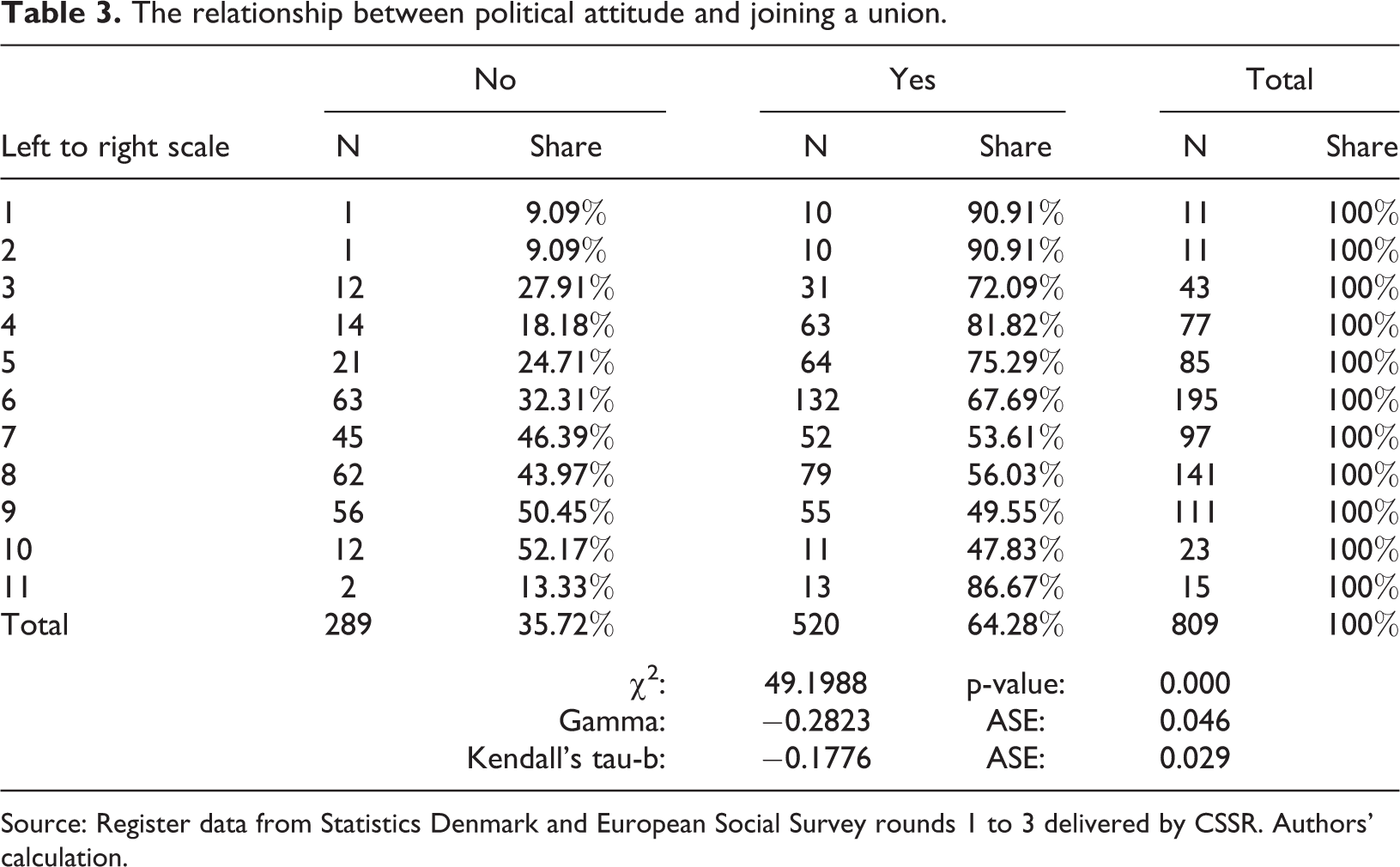
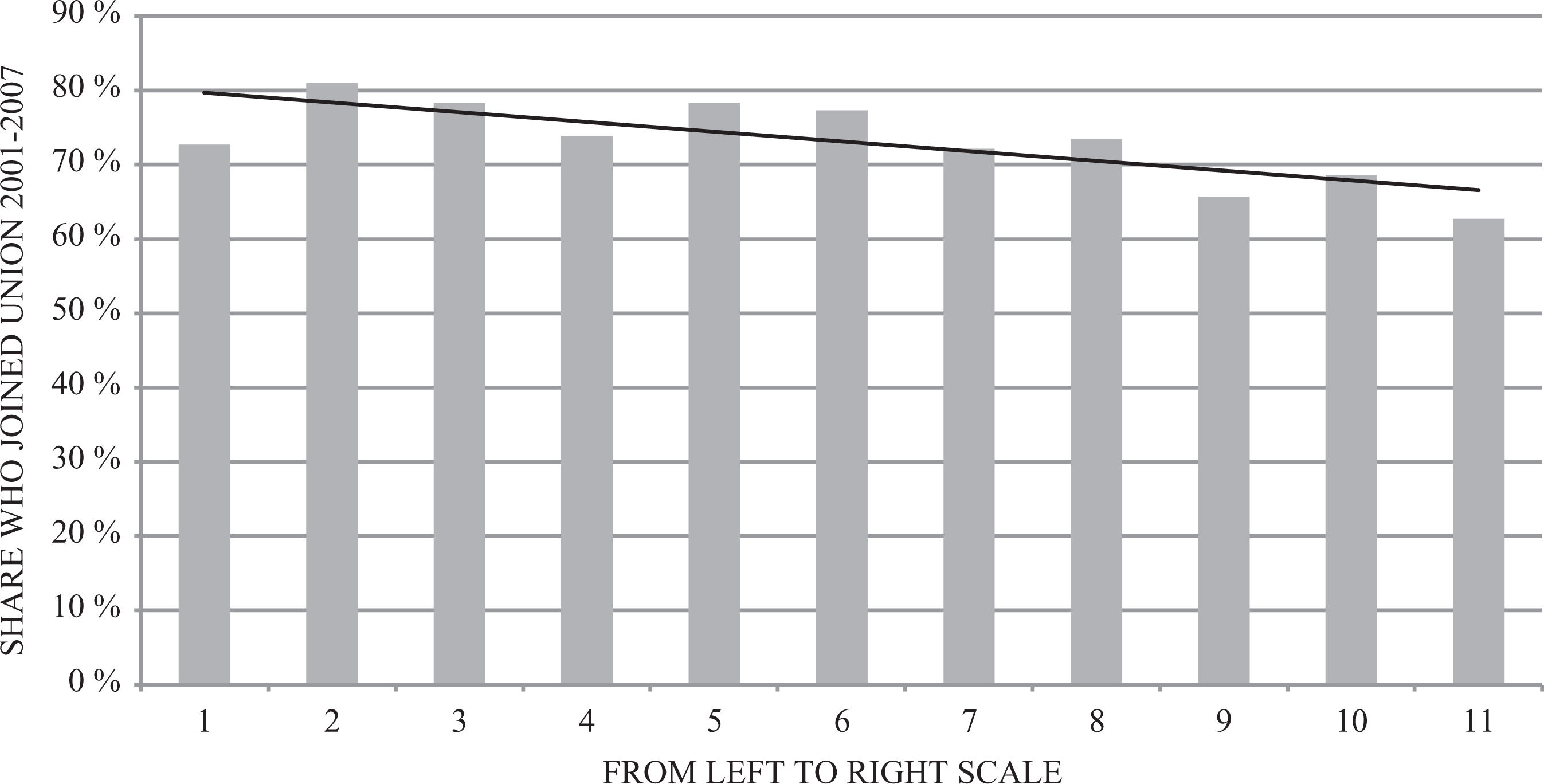
Table 3 describes the relationship between political attitude and joining a union. Though the picture is not as clear-cut as in the case of workplace union density, a weak negative relationship is however indicated by the gamma coefficient of -0.2823, meaning that the further to the right side of the scale, the smaller the proportion of wage-earners joining a union. The variables are not independent of each other, as indicated by the significant χ2-value.
As can be seen in Figure 2, the relationship is roughly linear, with the major exception of those who position themselves on the far right of the political spectrum (grade 11). This group shows the second greatest tendency to join a union. However, the group consists of only 15 individuals, indicating that this deviation from the general trend is most probably due to sampling errors. This suspicion gains strength on account of the fact that such a deviation cannot be detected if we consider the relationship between union membership and political attitude (see Table 6 and Figure 4 in the Appendix). Here, the grade 11 group is the group with the smallest share of union members (62.71 per cent compared to the general mean of 74.03 per cent union members). Therefore, in the following statistical analysis, we exclude the 15 individuals in the grade 11 group, as otherwise the statistical models would tend to underestimate the actual effect of political attitude on the choice of joining a union.
The relationship between political attitude and joining a union.
Source: Register data from Statistics Denmark and European Social Survey rounds 1 to 3 delivered by CSSR. Authors’ calculation.
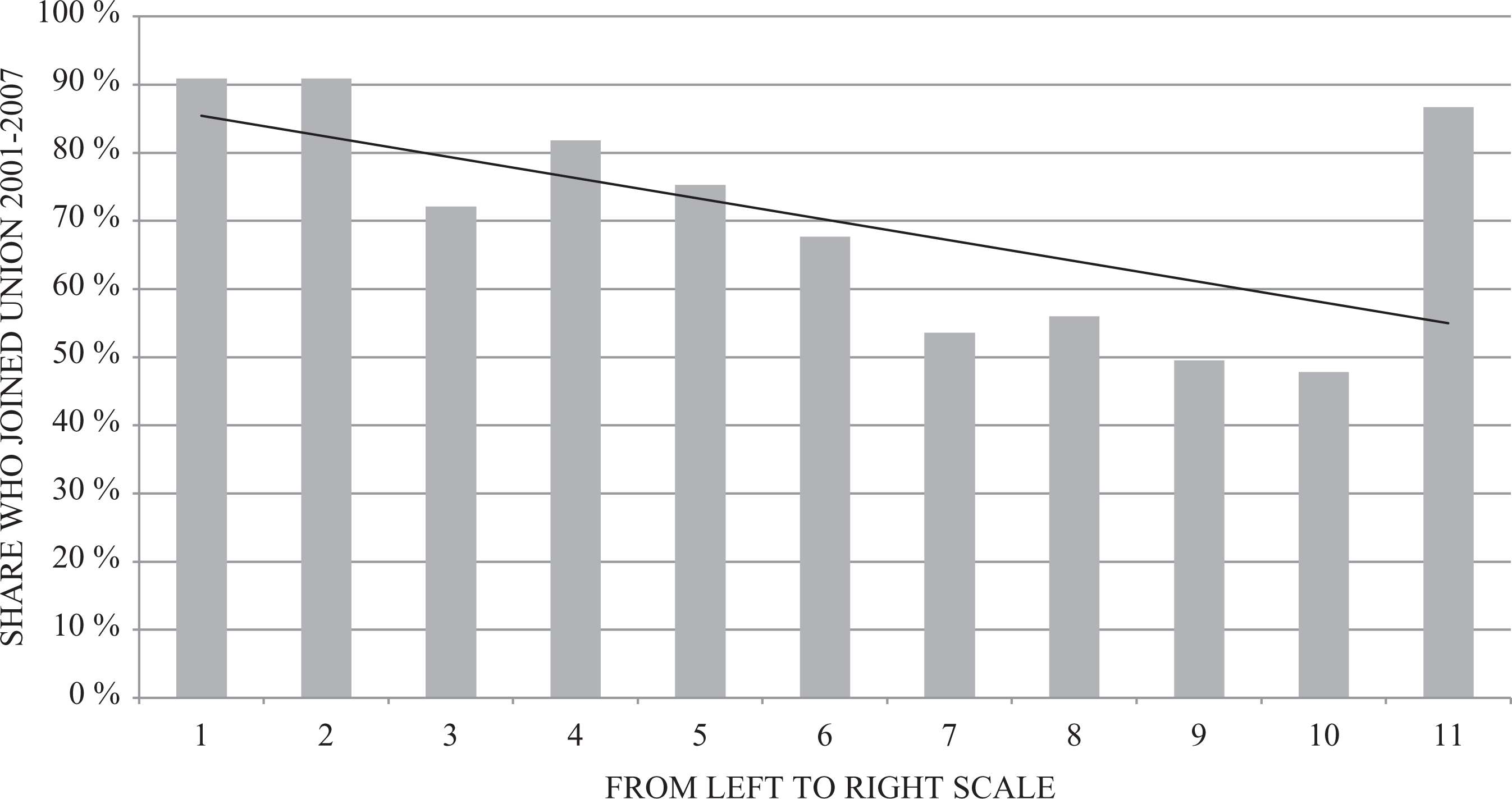
Share of wage-earners who join union by political left-right scale.
Despite the deviation of the grade 11 group from the general trend, the descriptive analysis indicates a weak negative though still significant relationship between the variables, confirming our theoretical expectation and giving us reason to proceed with more rigorous statistical testing of whether this apparent relationship is spurious or not.
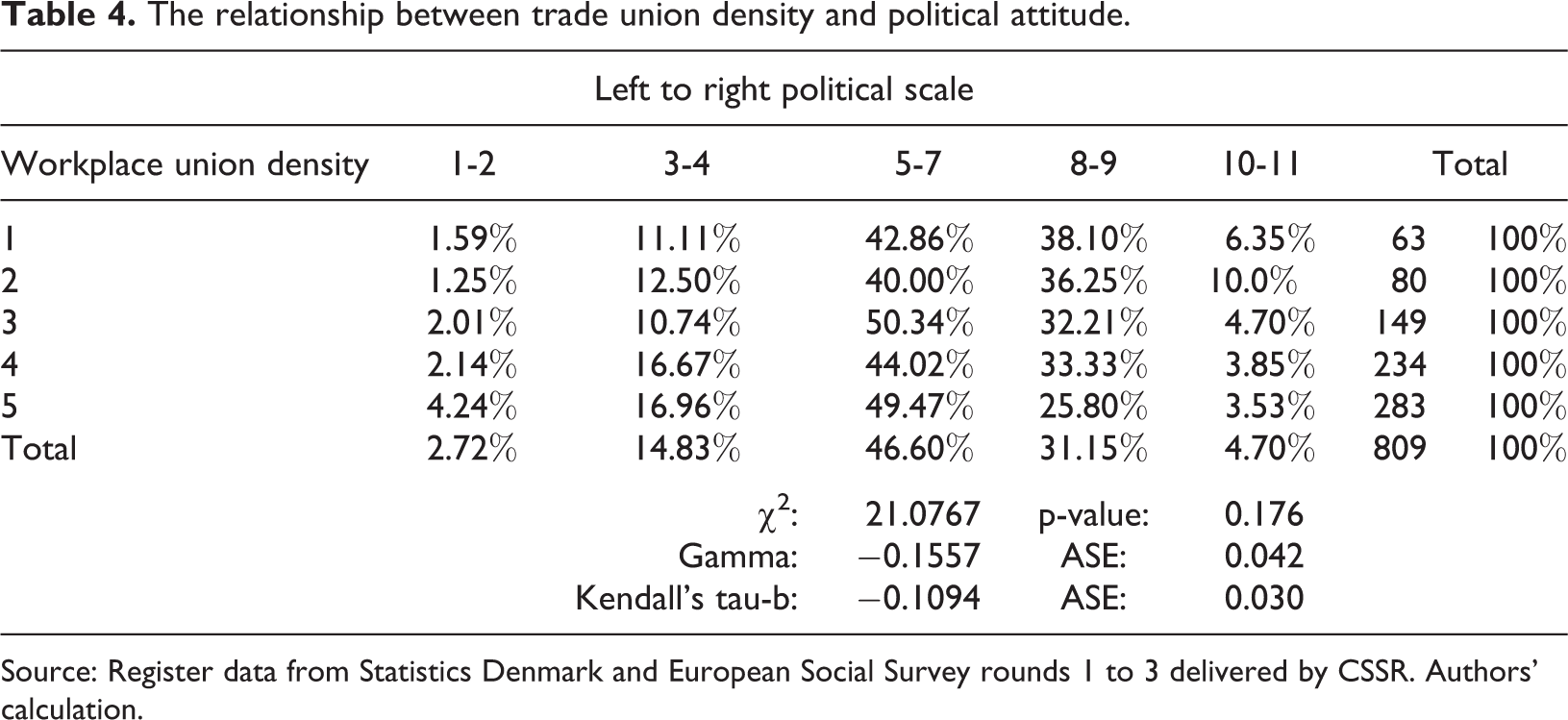
Finally, we consider the relationship between the two focal variables. In this research design, the two variables are taken to measure two different effects. Though we theoretically distinguish between these two effects, in reality, they could be intertwined. For instance, the social custom created by high union density could also involve being left-wing in addition to being a union member. If this is the case, it is not political attitude causing members to join, but high union density.
In answer to this question we have tested whether the two variables are independent of each other. Table 4 presents the two-way table of workplace union density by quintiles and the political scale reduced to five categories. These reductions are carried out to enable valid statistical testing of the relationship between the variables. A weak negative relationship is indicated by the gamma coefficient of -0.1557, meaning that the higher the union density the more left-wing. However, this correlation cannot be trusted, as the χ2-value is not statistically significant. We therefore conclude that the two variables are independent of each other, and that high union density does not cause the individuals in our sample to be more left-wing (or right-wing for that matter).
The relationship between trade union density and political attitude.
Source: Register data from Statistics Denmark and European Social Survey rounds 1 to 3 delivered by CSSR. Authors’ calculation.
Control variables
To analyse the specific effects of our two focal variables – union density at workplace level and political attitude (left- or right-wing orientation) – we control for a number of other factors that could be expected to influence an employee’s likelihood of joining a trade union.
The control variables are Workplace size (measured by the number of employees at the workplace), Sector (private or public), Newly employed at the workplace, Gender, Age, Country of origin, Years of education and Income. Our final model is a fixed-effect model in which we establish the results across 10 occupational categories and 21 industrial categories. These are included as dummy variables, and their model estimates only are reported in the appendix.
The choice of control variables is guided by what the literature has found to be central variables when it comes to explaining high or low levels of trade union membership. Regarding the control variables, some of them relate to personal characteristics (gender, age, etc.), while others reflect workplace characteristics (workplace size, sector). Finally, other control variables relate to an employee’s skill level and work experience (education, newly employed, etc.).
Workplace size is often highlighted as one of the most important factors influencing the likelihood of seeing high or low levels of union density in a company or workplace, correlating positively with union density in a number of studies (Riley, 1997). One explanation for this observation is that the costs of organizing are lower in large workplaces than in small workplaces, ‘We expect the probability of union membership to rise with establishment size because a union’s costs of recruiting and organizing should be lower in larger units’ (Schnabel and Wagner, 2007: 22).
Demographic factors such as gender and age are often also used as variables in studies of trade unionism. And they are also included as control variables in our analysis. There seems however to be no clear evidence of any correlation (Riley, 1997). Or to be more precise, correlation depends very much on other circumstances. The importance of gender and age are interrelated with other factors, and the effects are dependent on the overall structure of the labour market. Women, for example, tend not to be as unionized as men when working in the secondary sector (Doeringer and Piore, 1975; Reich et al., 1973). However, when women work in the public sector they often have a higher likelihood of being member of a trade union than men, as noted by Schnabel and Wagner (2007: 24). If we look at the membership profile of trade unions, younger employees generally seem to be less frequently unionized than older ones. This observation has been stressed in many studies, although there seem to be no real longitudinal studies of cohort effects. Ebbinghaus et al. write: ‘In general, the relation between age and unionization is expected to be concave: membership tends to be low among younger workers, increases with age and falls when employees exit from work’ (Ebbinghaus et al., 2011: 110). However, despite the overall union density being lower among young employees, we would expect the event of joining a union to be more frequent among young employees than older ones because people are faced with the decision whether or not to join a union when young and entering the labour market.
Education and occupational position can also be expected to influence the likelihood of a given employee being a member of a trade union. Therefore, they are used as control variables in our analysis. In our model, the level of education is operationalized as the number of years of schooling, including elementary school. When controlling the effects of occupational position, however, we use a fixed-effect model, meaning that we do not estimate the direct effects of one occupational position compared to another one. We do however neutralize the effects of occupation in the overall statistical model. Generally speaking, we would expect employees with low or very high levels of education to be less organized than employees with a medium level of education. This expectation is in line with observations found in the literature. As stated by Ebbinghaus et al.: ‘Employees with low (less than secondary) or high (tertiary) education are often reported to be less unionized than those with medium-level (secondary) education.’ (Ebbinghaus et al., 2011: 111). We also use income as a control variable in our analysis, assuming that it similarly reflects such effects as education and occupational status.
Statistical models
The statistical tool is a multivariate logistic fixed-effect regression model which predicts the likelihood of joining a union. The final model has two focal variables (workplace union density and political attitude), seven control variables and is fixed across 10 occupations and 21 industries figuring as 31 dummy variables in the model. 6
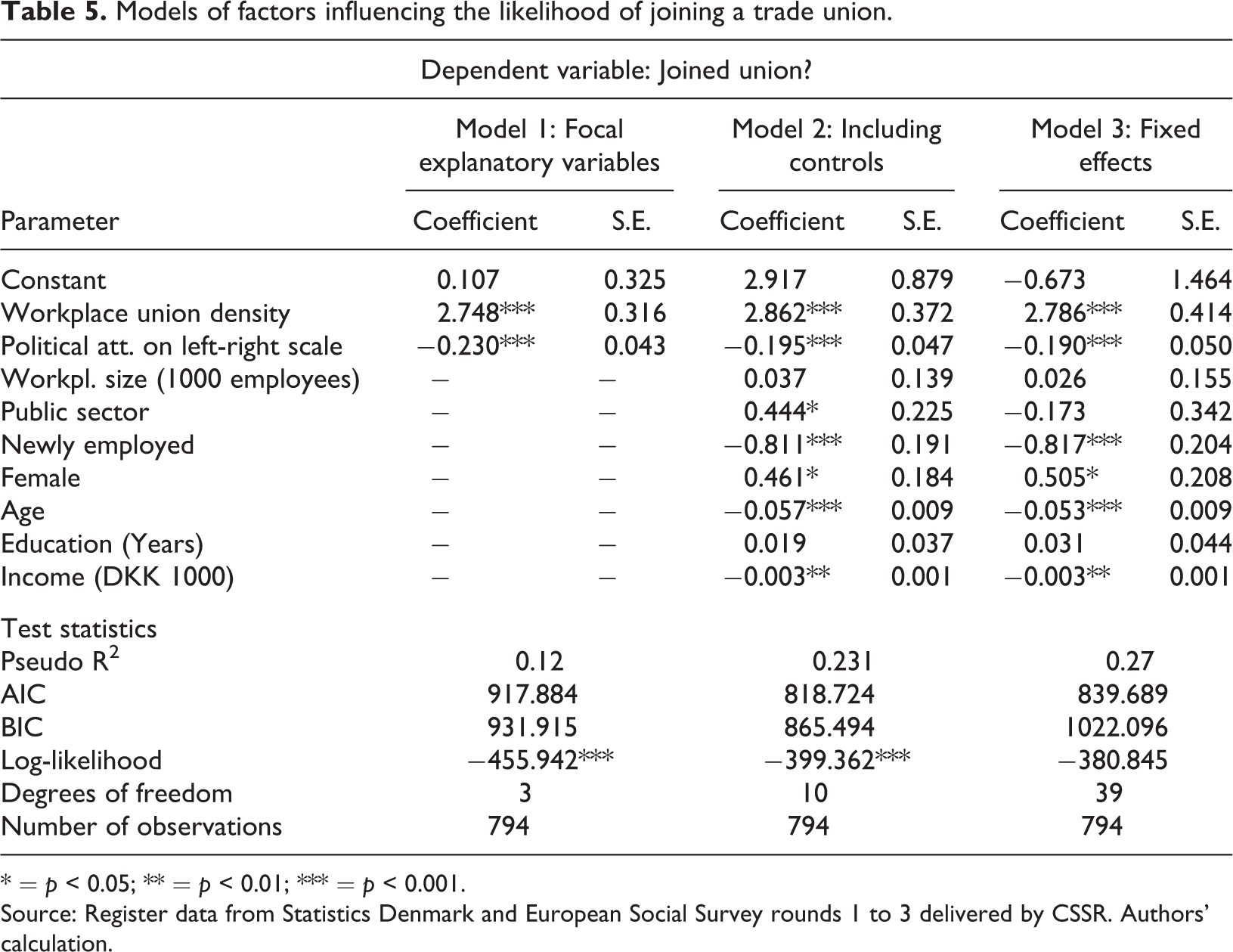
In Table 5, we list three different models aimed at predicting how likely it is that an individual will join a trade union. We start by comparing the models before turning to a more in-depth presentation of the estimated effects of first focal variables and then control variables.
Models of factors influencing the likelihood of joining a trade union.
* = p < 0.05; ** = p < 0.01; *** = p < 0.001.
Source: Register data from Statistics Denmark and European Social Survey rounds 1 to 3 delivered by CSSR. Authors’ calculation.
Model 1 has only two predictors, i.e. our focal variables. In both cases, the estimated effect is statistically significant, and the direction of the effect is – as we would expect – based on the descriptive analysis of the relation between the variables: higher workplace union density increases the likelihood of an individual choosing to join a trade union; and the more right-wing the political attitude, the less likelihood of an individual joining a trade union. Considering the size of the coefficients, union density seems to be a more important predictor than political attitude.
In Model 2, we add all the control variables. The picture with regard to our focal variables is the same as in Model 1. Union density is the most powerful predictor, and political attitude loses its bite somewhat but is still significant, predicting that the more right-wing an individual, the less likely that he or she will join a union.
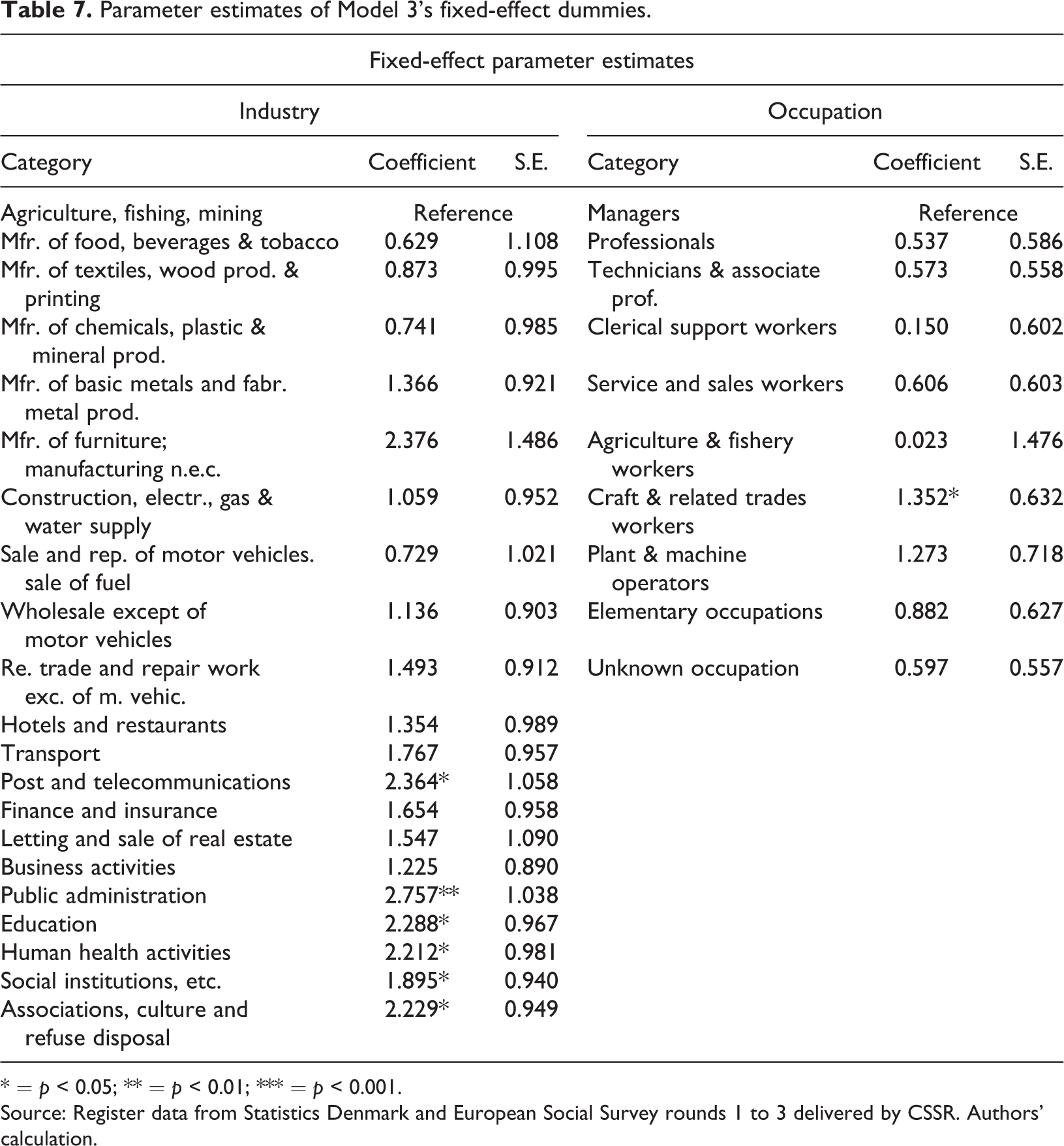
Model 3 is the fixed-effect model, in which the effects of an employee’s category of occupation and industry are cancelled out by the inclusion of dummy variables (See Table 7 in the Appendix for the estimates). The general picture remains the same, with a few exceptions.
The public sector unionization estimate changes from positive and significant to negative and insignificant when the occupational and industrial dummy categories are added. Hence, Model 3 shows that it is less likely for public sector employees to join a union than private sector employees, the opposite of Model 2. However, the Model 3 estimate is insignificant and should therefore not be trusted. The estimated effect of union density decreases slightly, as does the effect of political attitude. Only minor changes can be observed with regard to the control variables. Otherwise, the introduction of the fixed-effect dummies does not change much, as is also indicated by the change in log-likelihood not being significant, meaning that the fixed-effect model does not fit better than Model 2.
Discussion of the results
The most powerful predictor is workplace union density, one of our two focal variables. In all three models, the coefficient expressing the estimated difference between 0 per cent and 100 per cent density is large. This confirms the initial descriptive analysis of the relationship between the focal variables and dependent variables. However, political attitude is also statistically significant and quite powerful. The coefficient expresses the change caused by one step to the right on the 10-point scale measuring political attitude. 7 These results should be seen in the light of the cross-national study by Schnabel and Wagner (2007) using ESS data, where the correlation between political attitude and trade union membership was not confirmed and was found to be insignificant for the majority of countries analysed.
Figure 3 provides a graphical representation of the effects of workplace union density and political attitude as predicted by Model 3. As accounted for earlier, the two variables are statistically independent.
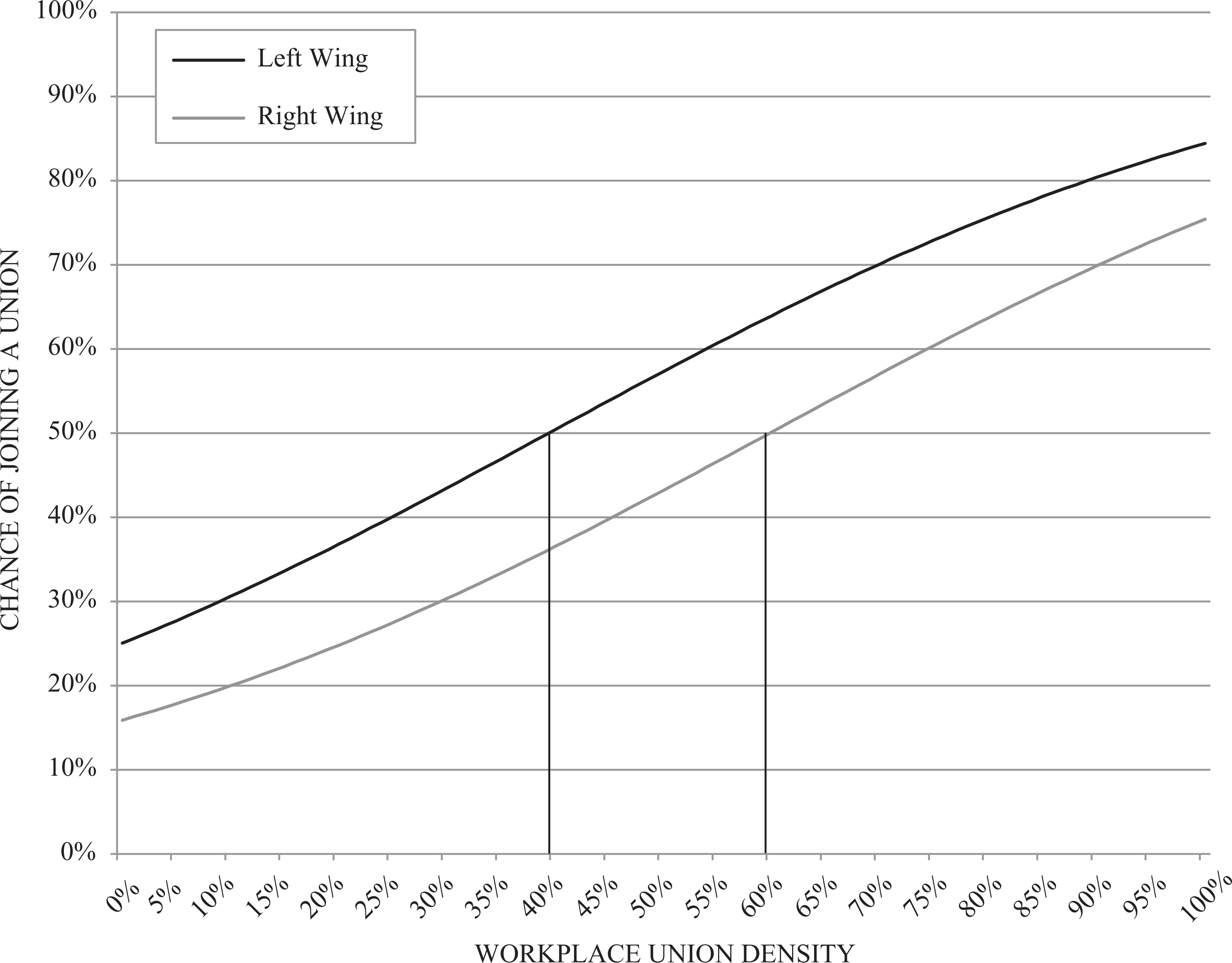
Chance of joining a union by union density and political attitude.
Share of trade union members by political left-right scale.
We have constructed a standard person (see Figure 3 notes for details) whose likelihood of joining a union varies only by union density and political attitude. Union density is measured by the horizontal axis, and the likelihood of joining a trade union by the vertical axis. The two logistic regression lines represent a left-wing standard person and a right-wing standard person. The left-wing has been assigned the 25 percentile score of 5 on the political left-right scale, while the right-wing has been assigned the 75 percentile score of 8. The gap between the two lines thus expresses a 3-point change on the political attitude scale, going from 1 to 10.
The modeled effect of union workplace density on the predicted likelihood of joining a union is fairly linear. Starting at around 20 per cent likelihood, the effect accelerates slightly with union density between 0 per cent and 50 per cent. It then flattens out, ending at around 80 per cent likelihood at 100 per cent union density.
With regard to the effect of political attitude, the two drop lines illustrate the difference in workplace union density between the points where the two standard persons reach a 50 per cent likelihood of joining a union. The left-wing standard person has a 50 per cent likelihood of joining a trade union around the point of 40 per cent union density, whereas for the right-wing person this point is 60 per cent. Thus, the difference on the horizontal axis is circa 20 percentage points. This example illustrates that even though the effect of workplace union density is the primary predictor, the effect of political attitude is quite powerful.
Turning to the control variables, we find that workplace size measured by the number of employees is insignificant. This contrasts with the findings of many other studies (Riley, 1997; Schnabel and Wagner, 2007). However, another study of the factors determining union membership using Danish data also finds that workplace size is insignificant (Ibsen et al., 2011: 16).
We also observe an insignificant estimate for the sector dummy. This is surprising, as union density and rate of recruitment are much higher in the public sector than in the private sector: within our sample, 78.63 per cent of public sector workers belonged to a union, compared to 57.68 per cent of private sector workers. However, this result is consistent with prior studies (Ibsen et al., 2011: 16; Ibsen et al., 2012: 159). There are three possible explanations for our results. It might simply be that the high level of union density and union recruitment in the public sector is due solely to workplace union density. In this perspective, there is nothing special about the public sector that would generate a higher union recruitment rate. The only factor is that pre-existing workplace union density is higher in the public than in the private sector, thus generating a higher union recruitment rate. Gender might explain this. Models 2 and 3 both show that women join unions to a greater extent than men. These estimates are statistically significant. The proportion of women within the public sector is much bigger than in the private sector, with 68 per cent of the public sector employees being women in 2007 compared to 37 per cent in the private sector. The observed higher recruitment rate in the public sector might therefore be due to the high proportion of women and not due to any specific public sector characteristic. The estimate changes after adding the occupational and industrial control variables. This suggests that the higher recruitment rate in the public sector may be due to specific characteristics of the public sector industries and occupations. For instance, the public sector is dominated by highly trained and specialized occupations with a strong vocational identity and collective tradition.
With regard to the age variable, we observe that younger people are more likely to join a union than older ones. As discussed above, this is as expected, as most people enter the labour market at a young age and are faced with the decision of whether or not to join a union. In addition, if you do not choose to join a union early on in your career, the probability of changing this decision as you grow older is low.
Finally, our results show that education does not play any role, no matter whether the occupational controls are included, as in Model 3, or not included, as in Model 2. This is surprising when comparing our findings with those in the international literature (Ebbinghaus et al., 2011). We would expect larger differences between different groups on the labour market. Income, on the other hand, has a significant effect in both Model 2 and Model 3 – the higher the income, the lower the likelihood of joining a union. This result is in line with other studies of union membership which find that those with the highest incomes are less likely to be union members than those with middle incomes (Ibsen et al., 2012).
Conclusion
Focusing on the motivational aspects of employees’ decision-making with regard to union membership, we have sought to analyse the factors influencing this decision-making process. Our overall focus has been on determining whether joining a trade union can be seen as a result of a social custom at workplace level or as a result of political or ideological values. These two explanatory factors are related to the classical Weberian sociological discussion about whether social action is driven by instrumental or value-rational forms of action. We have tried to establish an analytical and statistical framework that allow us to analyse these different types of motives, controlling for a number of other factors usually mentioned in the literature on trade unionism. The use of register data from Statistics Denmark has enabled us inter alia to measure union density at workplace level. These data have been merged with European Social Survey data measuring political attitudes among employees.
We conclude that the most important factor motivating non-union members to join a union is whether their colleagues at the workplace are members of a trade union. Where workplace union density is high, it is highly likely that a non-union member will decide to join the union. Thus, the existing level of trade union membership at workplace level has a major influence on union recruitment.
Our analysis also indicates that political attitude plays a significant role in whether non-union members decide to join the relevant trade union. Left-wingers tend to join a trade union more often than right-wingers, even when taking a number of other factors into account. In this respect, the analysis confirms our overall theoretical expectations.
Summarizing the findings, our study indicates that instrumental motives created by workplace social customs seem to carry more weight than value-rational motives when employees decide whether or not to join a union. Therefore, in answer to the article’s overall question, ‘Why do people join trade unions?’, we can conclude that they do so primarily because it is expected of them by their colleagues, and to a secondary extent because they identify with the ideals, symbols and values of trade unions.
Footnotes
Funding
This research received no specific grant from any funding agency in the public, commercial, or not-for-profit sectors.
Notes
Appendix
Parameter estimates of Model 3’s fixed-effect dummies.
| Fixed-effect parameter estimates | |||||
|---|---|---|---|---|---|
| Industry | Occupation | ||||
| Category | Coefficient | S.E. | Category | Coefficient | S.E. |
| Agriculture, fishing, mining | Reference | Managers | Reference | ||
| Mfr. of food, beverages & tobacco | 0.629 | 1.108 | Professionals | 0.537 | 0.586 |
| Mfr. of textiles, wood prod. & printing | 0.873 | 0.995 | Technicians & associate prof. | 0.573 | 0.558 |
| Mfr. of chemicals, plastic & mineral prod. | 0.741 | 0.985 | Clerical support workers | 0.150 | 0.602 |
| Mfr. of basic metals and fabr. metal prod. | 1.366 | 0.921 | Service and sales workers | 0.606 | 0.603 |
| Mfr. of furniture; manufacturing n.e.c. | 2.376 | 1.486 | Agriculture & fishery workers | 0.023 | 1.476 |
| Construction, electr., gas & water supply | 1.059 | 0.952 | Craft & related trades workers | 1.352* | 0.632 |
| Sale and rep. of motor vehicles. sale of fuel | 0.729 | 1.021 | Plant & machine operators | 1.273 | 0.718 |
| Wholesale except of motor vehicles | 1.136 | 0.903 | Elementary occupations | 0.882 | 0.627 |
| Re. trade and repair work exc. of m. vehic. | 1.493 | 0.912 | Unknown occupation | 0.597 | 0.557 |
| Hotels and restaurants | 1.354 | 0.989 | |||
| Transport | 1.767 | 0.957 | |||
| Post and telecommunications | 2.364* | 1.058 | |||
| Finance and insurance | 1.654 | 0.958 | |||
| Letting and sale of real estate | 1.547 | 1.090 | |||
| Business activities | 1.225 | 0.890 | |||
| Public administration | 2.757** | 1.038 | |||
| Education | 2.288* | 0.967 | |||
| Human health activities | 2.212* | 0.981 | |||
| Social institutions, etc. | 1.895* | 0.940 | |||
| Associations, culture and refuse disposal | 2.229* | 0.949 | |||
* = p < 0.05; ** = p < 0.01; *** = p < 0.001.
Source: Register data from Statistics Denmark and European Social Survey rounds 1 to 3 delivered by CSSR. Authors’ calculation.