



Abstract
This article investigates whether and how social dialogue has influenced austerity policies in French local government, with a particular focus on municipalities. With regard to local government staff, social dialogue takes place at two levels, with wage and general rules being discussed at national level and working conditions and individual career issues at local level. National-level measures, as in many countries, have included unilateral wage freezes. However, though staff reductions have already occurred in the state administration, they have not (yet) affected municipalities. As seen in our case study, when it comes to local-level austerity measures such as cuts in services and restructuring measures, we are witnessing a situation of real bargaining – including conflict and formalized agreements. Even if not leading to official collective agreements, this strengthens the role of formal committees and suggests the potential resilience of social dialogue linked to the proximity of decision-making authorities and affected citizens.
As in many European countries the French central government has finally responded to austerity by choosing a policy of decentralizing public services to the local level, though in combination with cutting budgets for providing services. Local authorities are thus now faced with having to implement budgets cuts, restructure services and/or make staff redundant. This article focuses on when and how these reforms have taken place and to what extent social dialogue has contributed to the adjustment process. In doing so, one must keep three French peculiarities in mind: the multi-level characteristics of social dialogue, the lateness of crisis responses compared to other countries, and a lack of academic knowledge. Looking at the first aspect, social dialogue occurs simultaneously at national and local level. Local government employees are public servants whose status and wages are determined to a great extent by central government, while being actually hired by local authorities responsible for defining job profiles and tasks. As regards the second aspect, the French state has reacted to the crisis somewhat later than other countries, with even recent growth in public sector employment. Finally, the issue of local government social dialogue has been largely neglected in French research. This has led us to focus, after a general presentation, on a case study of Saint Etienne, a city confronted earlier than others with severe budget cuts.
Context of local government administration
Local government
Local government responsibilities are subject to a geographical hierarchy. At the top, the 22 régions are responsible for general questions of economic development, transport (regional trains), vocational training and the maintenance of lycée (high school) buildings. The 100 départements are responsible for the majority of roads, secondary school maintenance and social support (social workers, minimum income distribution). This welfare role represents a growing proportion of spending by the départements, although the criteria for allocating welfare are subject to national rules. The 36,000 municipalities (now mostly members of one of the 2600 municipal district groupings) are responsible for urban planning, the environment and the upkeep of public spaces and primary schools (including subsidies for child care facilities) and can also choose to provide numerous local services (crèches, libraries, sports facilities). There is a longstanding tradition of municipalities delegating public utilities (water, waste collection, urban transportation) to private companies.
The 1983 decentralization represented a sharp break in France’s centralist tradition. Though local government is partly reliant on central government for setting service levels (e.g. the number of school buildings to maintain, the level of social service provision) and execution conditions (e.g. the status of staff employed), financial transfers from central government and their own tax-raising powers gave local administrations extensive freedom. This was used to expand services in general, as evidenced by the increase in local government payrolls in recent years. However, recent restrictions on their powers to tax businesses and the downward trend in central government transfers are gradually reducing this freedom.
The local civil service
The public service workforce in local government consists of the regional civil service, set up in 1983 as part of the process of consolidating the status of a variety of employment levels within a single civil service. Its creation was a product of compromise (Biland, 2012). On the one side, the plan for a single integrated civil service was supported by the Communist Public Service Minister, Anicet Le Pors, leading to the creation of corps and strict obligations to recruit through competitive examination. On the other side, the plan to increase local government decision-making autonomy was supported by Interior Minister Defferre. One of the aims of this plan was to use civil servant status as a means of changing employment conditions, in line with the aspirations of the big cities. As a result, a variety of measures were available that would have the effect of increasing the independence of local employers. 1
Although the laws on civil servants apply to both local and central government employees, local employers have considerable room for manoeuvre. This includes the substantial proportion of contract staff without public service status, special employment status for executive staff chosen on political criteria (functional positions), or significant flexibility in allocating bonuses or applying promotion criteria. This means that municipal government heads have considerable autonomy as employers. This flexibility and autonomy, long criticized as encouraging unprofessional practices or cronyism, can now be reinterpreted as a sign of managerial modernity. In contrast to the rigidity of staff management in central government, certain local government practices (such as the cadres d’emploi with their broader scope than the civil service corps), have been upheld as a model for policies aimed at merging civil service corps.
Social dialogue institutions
Social dialogue takes place at both national and local levels. At national level, since the recent social dialogue reform, the negotiating body has been the joint higher council for local government service (Conseil supérieur de la fonction publique territorial). This body dedicated to local government is made up of representatives from the unions and local employers (elected from electoral lists by three ‘colleges’, which correspond to the municipalities and municipal districts, the départements and the régions). However, because the provisions applicable to local government are often transcriptions of rules primarily designed for central government, a significant proportion of preliminary discussions takes place without representatives of local employers and employees.
For each entity, local social dialogue is in the hands of official bodies: technical committees for discussing organization questions, joint administrative committees focusing on individual cases and particularly promotions, and health and safety committees for health-related matters. The union representatives are elected at regional, departmental and municipal level. For municipalities with fewer than 50 public employees and for larger municipalities that so choose, the organization of joint administrative committees is delegated to management centres, with a view to preventing conflicts of interest, guaranteeing the legal validity of actions relating to individuals, and providing flexibility in the case of rules involving quotas on the number of people promoted.
This division of social dialogue roles offers no forum for social dialogue when new district services are created and employees from individual municipalities transferred to them. A report on this subject notes that these major measures restructuring local services have taken place without the creation of any genuine discussion forums in the new entities comparable to those existing in the former entities (INET, 2011). At municipal level, the only aspect subject to social dialogue was the preservation of each individual’s acquired benefits following transfer to the new district entity.
An industrial relations reform was undertaken at national level between 2008 and 2010 (Bercy agreements). Its aim was to introduce an element of negotiation into a system governed by statute and unilateral decision-making through changing the conditions of union representation to restore union legitimacy and through outlining conditions for binding contracts between employer and employee (Bezes and Jeannot, 2011). The origins of this reform predate the pressure of austerity, and were the result of the longstanding criticism of overly formalistic industrial relations in the public sector and the idea of adapting equivalent reforms applying to the private sector. However, this reform will not be implemented in local government until after the next trade union elections in 2014, meaning that as yet it has had no consequences at this level.
Trade unions representing the public sector are organized at national level as sections of the big national trade unions. As the majority of local public servants are ‘blue-collar’, the CGT (Confédération Générale du Travail) with its previous links to the Communist Party is particularly well represented (32.8 per cent), as is the FO (Force Ouvrière) with its focus on occupational corporatism (18.6 per cent), while the CFDT (Confederation Fédérale du Travail) is more important for white-collar workers (21.6 per cent) (DGAFP, 2011: 520). The level of unionization is low in local government (10 per cent according to Garabige, 2008).
The ambiguities of social dialogue in local government
At national level, neither government nor unions attach any great significance to local government social dialogue. In the negotiations on civil service status, central government can be assumed to be primarily concerned with its function as a civil service employer, with rules primarily designed from this perspective and then simply applied to local government employees. However, the unions, at two levels, are also a cause of the subordinate nature of local government social dialogue. First, for a long time certain unions, although more present in the public than in the private sector, attached greater value to the latter. 2 Secondly, in a sort of mirror process, union members working as central government civil servants sometimes represent local public service workers.
The fact that little significance is attached to local government social dialogue is also partly linked to the difficulty in finding a legitimate national-level local government representative. On the one hand, there are powerful non-partisan associations representing elected officials (association of mayors of France, association of municipal council chairs…). On the other hand, there are also representatives of different political bodies within the higher council of the civil service. Although these two entities are legally separate, in reality they overlap, as seen by the fact that the only electoral lists presented for the higher council are those presented by these big associations (certain elected members of the higher council are also non-executive directors of these associations). The pre-reform discussions between the administration and the politicians’ representatives fluctuated between a formal relationship with the elected members of the higher council and direct contacts with the associations and their technical staff for the preparation of projects.
Stakeholders at local level (for example mayors) are more clearly identified. However, the roles of other local politicians (who may be responsible for overseeing a particular department) and those of municipal department heads (in particular human resources managers in charge of day-to-day staff relations (INET, 2007)) are less clearly identified. The case study below highlights the great vitality of this social dialogue at municipal level.
A neglected subject
The topic of social dialogue in French local government has never really been put on the agenda. Professional bodies have little to say, the issue is not discussed at specialist conferences, and the leading public sector journal, the Gazette des communes, confines itself to reporting on occasional conflicts. The section on social audits covering social dialogue is often only summarily filled in or left empty, as if all such matters are best dealt with in private. Though the prefects representing state administration at local level are obliged to transmit information on local government practices to the Ministry of Interior, they are in no hurry to report industrial conflicts as they are assessed on their capacity to maintain social harmony and good relations with local government.
The question of local government social dialogue has also been largely neglected in French research (Garabige, 2008; Guillot and Michel, 2011). The few studies of unionism and industrial relations in the public sector have focused on the central civil service and public companies, with a particular emphasis on collective action driven by such high-profile groups as railway workers, nurses or teachers. As regards municipal government, we can cite outdated research by Stéphane Dion (1986), who emphasized the fact that it was in the interest of mayors to be flexible with employees forming part of their electoral base. In a similar vein, Gérard Adam (2000: 120) highlights local capacities for adjustment: ‘We are in the world of the “deal” where union members close to the base have achieved miracles over the years in grabbing substantial advantages that are never touted at the forefront of the “big” industrial relations triumphs.’ For his part, Dominique Lorrain (1990) describes a pragmatic and peaceful modernization. However, this description may no longer hold true at a time of rising tensions in municipal management and the emergence of embryonic conflicts (Garabige, 2010).
Based on research and institutional characteristics, we can hypothesize the main features of social dialogue in municipalities: local employers have on the one hand significant room for manoeuvre with regard to modernization, while on the other hand they are to a great extent accountable to local citizens and sensitive to strikes affecting service delivery. In the current context of the financial crisis the opportunity to respond to conflict by offering substantial benefits to workers will vanish and we can speculate that social dialogue on such pragmatic questions as how service delivery is organized could emerge, requiring a balancing of citizens’ and workers’ interests. The dual proximity of a mayor to local citizens and to local civil servants could play in favour of genuine social dialogue on restructuring, in great contrast to the status-focused dialogue in state administrations.
Austerity factors and restrictive measures in local government services
Given the dual – national and local – regulation of local government, austerity should be approached from two angles: (i) the consequences of national austerity measures aimed at controlling wages, and (ii) local adjustments aimed at cutting overall spending including staff cuts and restructuring measures. While the first is already underway, the second is just starting.
The impact of national measures on local staff wages
Whilst there seems to be a clear shift towards a strict management of France’s public services, this cannot be directly attributed to a response to the financial crisis, as the shift had already taken place with the election of Nicolas Sarkozy in 2007 and his announcements of government reform (Jeannot and Rouban, 2009). The new economic conditions after 2008 only helped consolidate the earlier decision, reframing it in a pro-austerity context (McCann, 2013), meaning that it is not easy to measure the specific impact of the crisis. By contrast, the policy of cutting public sector jobs (excluding education and justice) adopted by François Hollande’s government is officially linked to the financial difficulties that have arisen in the meantime and to its efforts to balance the national budget.
Austerity measures have concentrated on two aspects: general wage controls and constraints on recruitment (non-replacement of 50 per cent of retirees) in larger organizations, though only the first aspect concerns local governments. A French civil servant’s wages are based on three criteria. The first is his or her position in a career scale, itself determined by two criteria: membership of a corps and position within the corps. Civil servants therefore advance within a corps by changing grade (with a minimum automatic progression and the possibility of faster advancement based on rankings) or by moving into a corps with a higher grade. The second criterion is wage adjustment to inflation (index-linking). Each career position referred to above corresponds to a number of ‘points’, and these points are multiplied by an index to calculate wages: ‘the point value’. On top of this there are bonuses essentially dependent on the person’s corps and level within that corps. These bonuses are primarily awarded to executive grades in certain corps (Ministry of Finance, engineers), and their attribution is not very transparent.
Pay discussions traditionally revolve around a single criterion: the point value. These discussions take place at central level and their outcome applies to all public employees (central and local government and public hospitals). There is major divergence between trade union and government views on how to weigh up wage gains and losses. For unions, if the point value increases above inflation, civil servants have received a pay increase; if not, their purchasing power has fallen. For the government the data they refer to is the total amount spent on public servants’ wages including individual wage growth based on individual advancement (seniority or promotion) (Bezes, 2007). The first pay measure introduced by Nicolas Sarkozy’s government was to stop indexing the point value to the retail price index. Point value grew by 2.8 per cent between 2008 and 2011, at a time when inflation was 4.4 per cent, meaning a wage cut of 1.6 per cent in real terms. This measure was partially offset by other initiatives, with the government for instance promising that this reduction in point value would not lead to a fall in individual purchasing power, as a consequence of which an offsetting adjustment was introduced for employees who had not advanced in their careers in the meantime (this individual standard-of-living guarantee was awarded to 56,000 civil servants in 2010, at an average of €800 each). In addition, sectoral negotiations improved career prospects within certain corps, a number of bonuses were increased, and opportunities provided for overtime (especially in education). After including all income components, the Civil Service Ministry made the following announcement on wage restraint: ‘average net wages are €2377 a month, up 2 per cent in constant terms in 2009 (compared with 0.9 per cent the previous year)’ (Gonzalez-Demichel and Rocher, 2011).
The impact of these measures on local wages needs to be qualified for two reasons. If wages determined by the salary grid are below the national minimum wage (SMIC), then the national minimum wage applies. And since the SMIC has increased much faster than point value since 2008, entry wages at the lowest skilled level have increased faster than entry wages at medium level. In addition, with regard to the highest levels, numerous top managers are recruited on contracts and can receive substantial bonuses. All of this basically undermines national pay policy.
Future budget cuts
The situation of local government in France would seem to offer a counter-example to the rise of austerity in European public organizations. Public employment has increased in local government both over the long term and in recent years (see Table 1, below), corresponding in particular to the emergence of new district entities. The development of these larger groupings has resulted in a greater range of services (buses, sports facilities…) outside town centres and therefore an increase in staff requirements. They are also supposed to generate economies of scale, though these have not yet materialized, as shown by figures indicating an expansion of the workforce (see Table 1). However, part of the increase is due to staff being transferred from the state administration to local authorities (mainly for roads and school maintenance). A total of 117,000 people left the state administration (mainly départements and régions 3 ) between 2006 and 2008. A further aspect concerns ability to contract debt. This differs between central and local government, with the latter only able to contract debt to finance investment but not to offset a deficit in operating costs. For these various reasons, the question of austerity was not discussed in recent years at local government level.
French public sector employment by headcount.
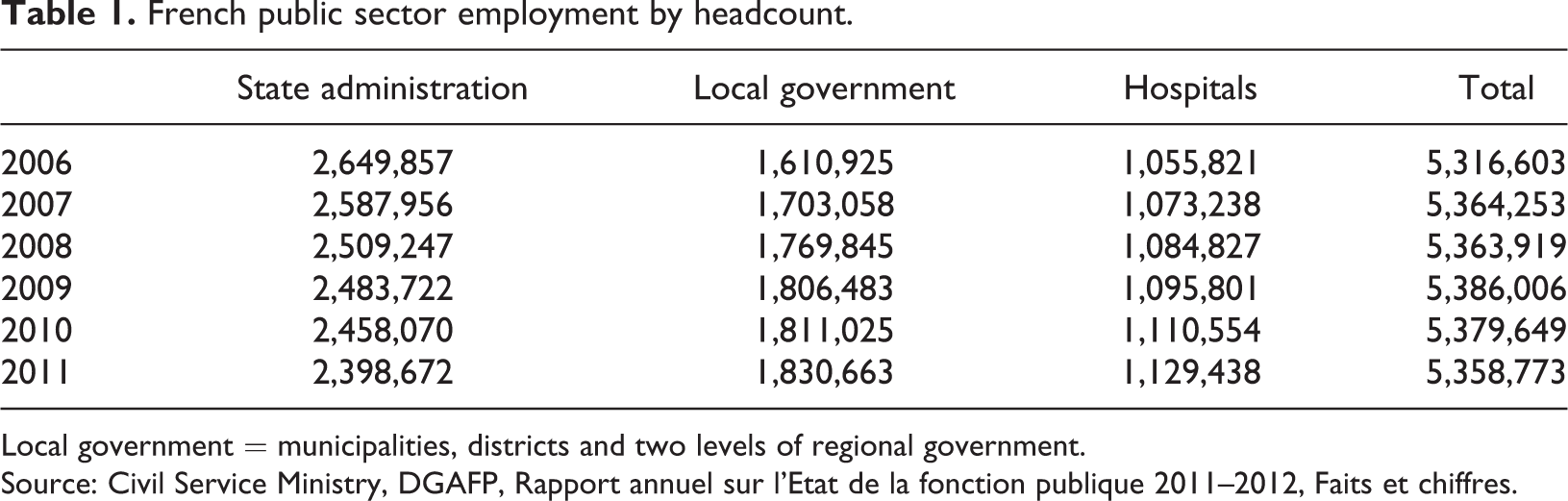
Local government = municipalities, districts and two levels of regional government.
Source: Civil Service Ministry, DGAFP, Rapport annuel sur l’Etat de la fonction publique 2011–2012, Faits et chiffres.
Municipal spending (billion euro).

Source: Ministry of the Interior, DGCL Rapport de l’observatoire des finances locales, les finances des collectivités locales en 2011.
Staff budget variations (%).
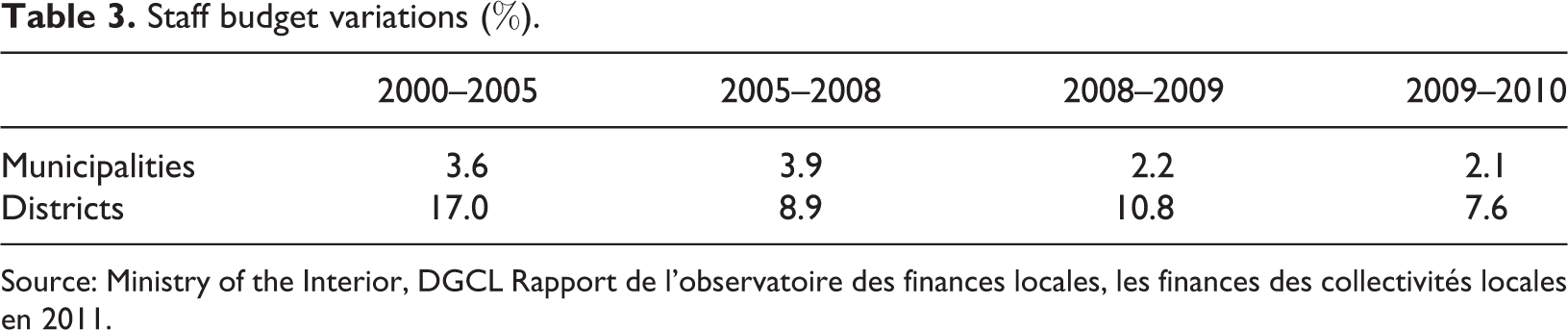
Source: Ministry of the Interior, DGCL Rapport de l’observatoire des finances locales, les finances des collectivités locales en 2011.
However, it would seem that a change is currently underway in this growth trend. Central government has scrapped a business tax that gave flexibility to those local authorities most active in attracting companies to their areas. It has frozen the lump-sum transfers arising out of the decentralization process, while at the same time freezing local government staff’s wages and restricting their sickness benefits.
Observers therefore expect budgets to have remained static since 2010. 4 During the presidential elections, then-President Sarkozy announced that local government would be directly targeted in measures to reduce public spending. 5 The current President has some room for manoeuvre, as he is supported by a left-wing majority in the Senate – attributable to the major dissatisfaction of local politicians with local government reform. Nonetheless, commenting on the 2012 state budget he conveyed the same message – though in different terms – about the need to control local budgets and to reduce subsidies from state to local government. Moreover, in October 2013 the Cour des Comptes (the French national audit office) criticized staff growth in local government.
Given that budget cuts are inevitable, it is deemed a good idea to look at a French city already subject to public spending cuts for many years. Our case study can thus be seen as a laboratory for such austerity measures.
Social dialogue responding to the economic crisis: the Saint Etienne laboratory
Background
Saint Etienne would seem to be one of the towns in France that has experienced the greatest economic problems, for reasons that are both historical and circumstantial. A former industrial and mining town (known for arms and bicycle manufacturing and for its soccer team), it has undergone a long process of de-industrialization persisting to this day. Moreover, its population is one of the poorest in terms of income. 6 A second feature is population decline – between 1990 and 2010, the city’s population has dropped from 240,000 to 175,000 – linked mainly to de-industrialization but also to the fact that the city’s wealthiest inhabitants choose to settle in the surrounding countryside. A falling population is a difficult situation for a municipality to manage, as it means diminishing resources, whereas the costs associated with the provision of existing amenities are hard to adjust. Over time, this has resulted in Saint Etienne becoming one of the country’s most indebted cities. 7 This was exacerbated by the fact that the previous municipal government opted to take out investment loans that reduced interest rates by half over three or four years, in exchange for taking a risk on financial markets and other factors over which the town had no control (e.g. dollar-yen parity). The risk became a loss with the 2008 crisis. The town had contracted 70 per cent of its debt in the form of such financial products, i.e. €260m, and accumulated a potential loss of €150m out of a total annual budget of €350m.
There were approximately 3500 employees in the city in 2011, 10 per cent of whom were not civil servants. As in other cities, the largest share was made up of the lowest-level employees (2500 category C) and 1700 in the technical branch (gardens, roads, rubbish, etc.) The CGT union holds a majority in the technical committees, followed by the FO, while the CFDT represents 50 per cent of category-A employees). Compared to other equivalent cities, St Etienne has maintained in-house service provision, such as homes for the elderly.
Policies and reforms
On replacing the previous administration in 2008, the new socialist administration made restoring the city’s finances the top priority of its term of office. As wages are set at central level, action focused on management and restructuring.
As in many towns, the municipal administration was organized around isolated departments run by elected deputy mayors who were more inclined to defend the size and budget of their departments than to contribute to overall cost-saving measures. The multi-year process of modernizing municipal management (Lorrain, 1990) is still underway. It has seen power concentrated around the mayor and the senior manager responsible for service provision, with power taken away from deputy mayors and department heads. One direct consequence of this concentration was a reduction in layers of management, with a number of middle managers being replaced and organizational reforms implemented.
The restructuring of technical services around local hubs working directly with neighbourhood committees is a further management change implemented by many towns. One of the primary aims of restructuring parks, gardens and cleaning services has been to create district-based teams, with the goal of achieving efficiency gains by removing the need for staff to travel before starting work (though restricted by the fact that certain technical facilities are shared by several districts), enhancing local proximity with people seeing the same staff day after day, and improving local democracy through closer links between the maintenance teams and neighbourhood committees. This latter aspect is part of a wider move to reorganize municipal services on a neighbourhood basis, begun in 2000. 8 A second associated priority was to improve the versatility of the maintenance teams. The aim of the initial project was to integrate the work of the gardeners and maintenance staff, and in addition to give them responsibility for combating vandalism. A third issue was weekend working, since a previous team that only worked at weekends had proved difficult to manage.
However, certain reforms would seem to be part of a longer history of professionalizing municipal management. Efforts to apply fully the 35-hour week in the municipal police force or to increase control over the largely autonomous weekend cleaning teams, for example, seem to have less to do with new public management principles than with standard professionalization of management practice.
The margin for manoeuvre with regard to wages is very limited. As described previously, wage rises are for the most part defined at national level, and municipal organizations have benefited from national wage containment. Moreover, municipality managers have chosen not to change promotion policy. Restructuring is thus the main cost-cutting lever, and has resulted in a workforce reduction limited to around 100 people on a like-for-like basis and a wage bill reduction of 1 per cent per year with a 1.5 to 2 per cent age and job-skill coefficient (wage bill of around €130m).
Social dialogue
For the municipality, these reforms are linked with a process of developing and formalizing social dialogue. This aspect is the particular responsibility of the deputy mayor in charge of human resources, a former union activist. She began by establishing a formal system for planning social dialogue, the ‘mille bornes’. Under this procedure, any restructuring plan is accompanied by a succession of preliminary, intermediate and follow-up meetings with the unions, and by associated meetings with the staff concerned (attended by the unions) and with the union organizations alone. Other initiatives have since been introduced to foster this dialogue, such as the specific recruitment of a person to facilitate relations with the unions. Another important factor is the growing role of occupational health and safety issues. A specific health and safety system has been established, pointing the way to leveraging health issues to tackle organizational questions. For example, in 2011 the GPS (gérer, prévoir, servir – manage, plan ahead, serve) group sought to clarify the role of supervisors in safety management, thereby contributing to an inter-departmental discussion network and mobilizing reception staff to organize reception areas and establish joint training programmes.
The priorities and procedures for discussion and debate on restructuring measures vary from one service to another, but in most cases result in amendments to the initial plans. Concerning the restructuring of parks, gardens and cleaning services, the objective was in line with a CGT aspiration, but encountered opposition from the CFDT, though was finally accepted. The proposal on gardener versatility met with a heated reaction from staff and was completely abandoned. Gardeners viewed the planned versatility as disrupting professional identities, and in the end restructuring was limited to one section of this cohort. All these changes were accompanied by additional recruitment and the previously outsourced tram maintenance services were brought back under municipal control.
The highly formal nature of the dialogue and such significant adjustments to initial plans do not mean that there was unanimous recognition of social dialogue quality. The two unions we spoke to clearly expressed their dissatisfaction on this point, while municipal officials were disappointed that the adjustments to the initial projects went unacknowledged. This negative view of the social dialogue led to a six-month boycott of the official structures and a well-attended demonstration that resulted in the symbolic burial of the dialogue process. This malaise partly reflects the fact that the adjustments to the plans often entailed a period of conflict. In 2011, local warnings were issued to 1978 strikers regarding local action. Most of these actions were short-lived. Warnings are also sometimes a way of avoiding conflict. It would seem that this disappointment also reflects difficulties arising less from the decision to restructure services and front offices than from tensions within management. In particular, the decision to concentrate power around central management and to replace certain senior executives put pressure on middle managers, requiring them to implement the new structures and achieve new targets. This created bad feelings amongst these managers. In a 2011 survey of 254 managers, 18 per cent judged the industrial relations climate as bad and 60 per cent as very bad, while 60 per cent felt that rules were being applied inequitably within the municipality. This bad feeling also crystallized into a social movement around the plan to reduce certain benefits relating to the organization of working time.
As a conclusion to this case study, it appears that in this city confronted by financial difficulties earlier than others, cost-saving policies excluded wages to a large extent since wage levels are largely determined at central level. Action was focused on restructuring and related staff reductions. Reviewing the three aspects of restructuring, the social dialogue record is uneven. As regards the core priority – the restructuring of services provided to citizens – the components of the debate seem clear, the organizational choices relatively clear and in certain cases shared by the unions. In addition, the plans seem in no way to have run aground, even though the basic amendments and compromises seem to have entailed periods of conflict. Turning to the second priority – bringing the administration under control – there is relative agreement over the broad record, though things were trickier in detail, with more personal factors coming into play. The unions cannot object to the general principles of regulatory equality and transparency, but they find themselves in a tricky position when wanting to avoid appearing to be simply toeing the management line. However, it is the final priority – the reform of governance – where the biggest problems arise. The new principles of concentrating decision-making around municipal services and resource departments cannot be justified on the general grounds of transparency, or by visible improvements for citizens, making them both more questionable and more questioned.
Conclusion
Seen from an international perspective, austerity policies started in France with their own peculiar rhythm. Policies for public spending cuts were launched in 2007 as a late new public management orientation just prior to the outbreak of the crisis and then moderated as a Keynesian reaction to the crisis. Moreover, local administrations were only partially affected by these public spending cuts, and local government headcount continued to rise after 2008.
This French peculiarity is now slowly dissipating, with national policies becoming more clearly reactive to economic circumstances. On top of the tax increases announced during the presidential elections, the current French socialist government has launched a competitiveness package including plans to reduce the public deficit, and it is clear that the overall economic context has guided budget policies since 2013. On the other hand, these austerity measures now also apply to local government, bringing France broadly into line with other European countries.
Social dialogue concerning local government staff is organized at two levels. Wages and general rules are discussed at the national level under the state umbrella, while working conditions and individual career issues are discussed at local level.
Local government employees are largely dependent on the outcome of national-level social dialogue concerning state employees, whereby the state acts simultaneously as employer and regulator. The employment conditions of all public servants are laid down by statute rather than contract, placing the government in a sovereign position (Bach and Kessler, 2007), since the negotiation options set out in the 1983 statute are small. Reform plans inspired by new public management have sought to alter this model by introducing more contracts (Bercy agreements), by reorganizing administrative departments, and by changing wage-setting conditions, though without transforming the statute’s underlying economic rationale (Bezes and Jeannot, 2011; Jeannot and Rouban, 2009). National dialogue seems formal and limited in impact (Rehfeldt and Vincent, 2004), making France comparable with other southern European countries (Bach and Bordogna, 2011). Wage freezes have been accepted without much discussion. Trade unions have, under left-wing governments, been able more effectively to limit changes to the advantageous retirement plan for civil servants.
At local level, the St Etienne case study shows ongoing negotiations on public service restructuring and working conditions. The hypothesis of pragmatic discussions on service delivery is broadly confirmed, with us witnessing a true bargaining situation including conflict and formalized agreements. Power relations remain very tense in particular around service provision. Alexandra Garabige (2010) speaks of ‘bellicose compromises’ in describing negotiations on working time observed by her in one municipality. This same tone would seem to similarly exist in Saint Etienne where power struggles are still a reality. Although the Bercy agreements aimed to introduce more formalism, they have not yet been applied. Similarly, there are factors relating to negotiation which are not about signing an agreement within a joint technical committee, but about managing these social movements. In certain areas, management avoids intervening, as there is too great a risk of social upheaval. In certain cases, the administration provides openings for dialogue and accords unions a certain status with a view to preventing managers being overwhelmed by unorganized staff opposition. In other cases, the administration collects its own information to identify the causes of conflict. Finally, in this marked area of power relations and within the formal frameworks of joint technical committees or official social monitoring schemes, there is often implicit understanding of what will or will not give rise to conflict. In these circumstances of potential tension, amendments to projects are not insignificant, even though this does not necessarily produce satisfaction. Direct and indirect participation (Denis and Jeannot, 2005), social dialogue and participatory democracy are intertwined. Even if this does not lead to official collective agreements, it boosts the role of formal committees. This kind of bargaining would seem to be closer to the practices found in northern European countries.
The differences we observe between service delivery and back-office reforms also support this hypothesis. We observe open conflict and real negotiations in service delivery but no discussion and general unease among back-office staff and middle management. The difference appears to be linked to the difficulty of directly linking reforms and citizen satisfaction. The question of pressure on services seems to take different forms when it comes to the provision of public services as compared to support or management functions. Defining citizen needs provides a starting point for social dialogue. Combining participatory democracy and social dialogue provides a useful way of framing this kind of shared quality-of-service objective. Reducing outsourcing practices or bringing services back under municipal control can also provide a basis for agreements. The unions or staff working groups are able not only to specify what they see as unacceptable in terms of working conditions or wages, but also to highlight failings in the restructuring proposals or challenge certain assumptions in them, pointing to the history of organizations, often one of fluctuations between different (and always imperfect) priorities. The example of the management malaise in Saint Etienne suggests that internal changes can be more problematic.
Finally, the two-tier character of French local government bargaining raises the question of the proximity dimension of social dialogue in a crisis context. Decisions on general wage cuts are taken far from local organizations, though their impact is felt across the board. As in most countries the French wage freeze has been imposed unilaterally (Glassner and Keune, 2012). In such a situation trade union strategy could tend to obtain separate offsetting benefits (e.g. with regard to retirement plans). Restructuring measures in municipalities are decided locally and have an impact on specific workers (and not others) and on specific citizens. Whereas the job consultation system on state restructuring measures is largely formal, it appears more dynamic at municipal level. The case study points to the possibility, even in conflict, of a joint problem-solving attitude conducted in a transparent manner and including the direct effect of reforms on service levels and quality. This feature, if confirmed in other case studies, could suggest a relative resilience (Bach and Stroleny, 2013) of local social dialogue in the face of crisis.
Footnotes
Funding
Financial support of the European Commission is acknowledged under the project, ‘Social Dialogue and the Public Services in the Aftermath of the Economic Crisis: Strengthening Social Dialogue in an Era of Austerity’ [grant number VS/2011/0412].