



Abstract
This article analyses so-called ‘subjective union membership’ among employees and non-employees in Italy between 1972 and 2013. Unlike trends drawn from administrative data (‘objective membership’), subjective membership, based on the declaration of the respondent, takes into account respondents’ awareness of being affiliated to a union, their sense of belonging and the social desirability of stating their membership status. Instrumental and ideational rationales inform our cross-sectional and longitudinal hypotheses. Using an ITANES pooled dataset based on 11,073 observations over 40 years (1972–2013), two major findings emerge. First, only a minority of politically engaged left-wing individuals have maintained the same probability of declaring themselves union members since the early 1970s. Secondly, subjective membership has sharply decreased over time not only among employees, but also – in clear contrast to administrative data – among non-employees. Subjective measures are thus particularly useful in improving our understanding of union membership.
The loss of members has affected the legitimacy of trade union representation, undermined union bargaining power and raised serious financial concerns for union organizational survival in most Western countries (Checchi and Corneo, 2000; Riley, 1997; Bryson et al., 2011). Explaining the decision to join a union has become, as a consequence, a fundamental subject for researchers and union practitioners.
Analyses of decisions to join unions have been based on both administrative data (provided in many cases by multiple sources, such as state offices, trade unions and even employers’ associations) and surveys. While in the first case data are based on objective measures (for example, number of membership cards deposited in state offices, number of union deductions applied by employers to employees’ pay), in the second, they are based exclusively on individual declarations. Respondent statements might be true or false, based on specific individual considerations (Sudman et al., 1996). Declaration of membership based on surveys has thus to be understood in ‘subjective’ terms. As in the case of the difference between objective and subjective social class (Vanneman and Cannon, 1987), our notion of subjective union membership differs from objective measures in that it takes into account: (i) an individual’s awareness of being a member of a union; (ii) an individual’s sense of belonging to a union; and (iii) the social desirability of publicly stating one’s membership status in a given historical and social context. Subjective union membership has hitherto remained unexplored.
Although a macro-institutional approach to union membership – that is, one focused on a country’s institutional characteristics and economic performance – has provided important insights for cross-country comparisons (for example, Ebbinghaus et al., 2011; Scheuer, 2011; Schnabel, 2013), the micro-individual decision approach has shown a greater capacity for explaining the causal mechanisms underpinning the membership decision in a single environment (Guest and Dewe, 1988; Toubøl and Jensen, 2014; Riley, 1997: 270), in our case Italy. The micro-individual approach has explained why employees join, leave or never join unions (for example, Bryson and Gomez, 2005; Schnabel and Wagner, 2006; Kirmanoğlu and Başlevent, 2012; Cregan, 2013). Despite the need to study unionism in a broader horizon than a focus restricted to employees (Gumbrell-McCormick and Hyman, 2013) and the increasing relevance of non-employee union members over time in many Western countries (Visser, 2013), the latter are typically not included in studies of union membership.
From this perspective, the Italian case is of particular relevance. First, in contrast to North America, union affiliation in Italy is based exclusively on individual voluntary decisions and is possible not only for employees, but also for non-employees (mainly retirees and beneficiaries of specific welfare measures, such as unemployment benefits and disability pensions, but also in a limited number of non-employee circumstances, such as those of housewives). Secondly, according to administrative (objective) data, employee and non-employee membership have followed opposite trends over time. Italian unions reached their density peak among employees in the 1970s (50.6 per cent in 1976; Visser, 2013). Subsequently, Italian unions have experienced a substantial decline in affiliation (around 33–35 per cent since the late 1990s) and influence. Conversely, total union membership – employees and non-employees included – followed an opposite trend. Due to the compositional effect of the increased number of non-employee members, steady growth characterized the percentage of the Italian affiliated population, which rose from 15 per cent in 1972 to almost 26 per cent in 2013. 1 Moreover, non-employees represented less than 15 per cent of total union membership at the beginning of the 1970s; then, this figure steadily increased over time to account for more than 50 per cent from the mid-1990s (Visser, 2013). However, research focused on measuring and explaining union membership in Italy is limited to the late 1990s (Checchi and Corneo, 2000), and non-employees have been systematically excluded from it.
Our aim is to examine the factors that influence subjective union membership for both employees and non-employees in Italy, with a specific focus on longitudinal changes from 1972 to 2013. Due to the nature of the data, we consider subjective membership in Italian unions taken as a whole, without having the possibility of differentiating by specific union affiliations.
In Section 1 we discuss two mechanisms – or, to use an aviation metaphor, propellers – that are central explanatory factors in the literature on union membership decision-making: the instrumental and ideational rationales. After a description of the most relevant characteristics of Italian unionism, we propose a set of hypotheses concerning the determinants of subjective membership. Section 2 presents the ITANES database, which has previously been unexplored in the union membership debate, and the results of our logistic regression models. Next, we examine the change in relevance of the main predictors in longitudinal terms. Finally, we discuss the results of our study and some apparent contrasts in the evidence resulting from subjective and objective measures of union membership. Overall, our results have significant implications for the debate about union membership and the future of unionism in Italy and, potentially, elsewhere.
Two propellers and Italian unionism
The micro-individual decision approach explains the individual likelihood of joining unions and the trends of union membership through an analysis of individual socio-economic characteristics and attitudes. Two mechanisms (‘propellers’) have contributed greatly to explanations of why individuals join, leave or never join unions: instrumental and ideational rationales (for example, Riley, 1997; Snape and Redman, 2004; Kirmanoğlu and Başlevent, 2012).
(1) Instrumental propeller. This propeller functions on a calculative basis, whether it is economic or social in nature. In Olson’s (1965) terms, the decision to join a union is based on individual utility-maximizing decisions. Based on the goods provided by unions, individuals evaluate whether the utility likely to be derived from joining a union would be higher than that from not joining. Since the beginning, unions have typically provided employment goods to employees, such as better working conditions, wages and protection, essentially through collective bargaining (Bennet and Kaufman, 2011; Scheuer, 2011). The ability of unions to provide employment goods has been under pressure in Western countries since the first effects of globalization were felt in the 1980s (Peters, 2011; Visser, 2012). This has coincided with a substantial downturn in membership among employees, also eroding the blue-collar fortress. On the contrary, when unions also provide non-employment goods, such as in the countries with a Ghent system (see Vandaele, 2006), the provision of these services becomes important in encouraging potential members to join unions, thereby limiting declines in membership (Ebbinghaus et al., 2011).
In Olson’s (1965) terms, employees may also act as free-riders. They can benefit from goods provided by unions without being union members. This is especially true in employment relations systems in which the collective agreement bargained by unions applies to all employees (both unionized and non-unionized), such as the Italian system. Therefore, the instrumental propeller achieves higher strength when it is combined with a rational evaluation of the social cost of joining unions (Visser, 2002; Corneo, 1995; Booth, 1985). Employees consider whether the social costs associated with membership (or non-membership) – such as criticisms, exclusion and sanctions from peers – is too high in comparison with the positive value of enjoying a good reputation (Checchi and Corneo, 2000). The combination of positive economic and social evaluation gives more strength to the instrumental propeller, limiting free-riding and creating a positive membership spiral.
(2) Ideational propeller. This second propeller is based on value sharing between unions and employees. Employees who perceive an important overlap between personal values and union goals are more attracted to unions and thus are more prone to become members (Kirmanoğlu and Başlevent, 2012). In contrast to the instrumental rationale, which employs a rational self-enhancement calculus, this propeller involves self-transcendent attitudes (Snape and Redman, 2004). Unions’ efforts to diminish the intrinsically asymmetrical relationship between sellers and buyers of labour (Marshall, 1961: 335–336) have incited people, motivated by values of fairness and justice, to join unions. People who identify themselves with leftist ideological positions thereby demonstrate a greater likelihood of becoming union members than those with conservative leanings (Toubøl and Jensen, 2014).
The ideational propeller is stronger when personal values are also supported by political engagement and identification. In many European countries, especially in Italy – as we shall discuss shortly – unions and parties frequently collaborate to promote progressive policies to the benefit of employees, as well as society at large (Gumbrell-McCormick and Hyman, 2013; Dufour and Hege, 2010: 353). Therefore, political interest and partisan affiliations, together with ideological inclination, are among the most relevant determinants of individuals’ choice of affiliation and support for unions (Riley, 1997; Fiorito et al., 2014). Moreover, the literature on political attitudes highlights the importance of the interaction between ideology and political interest in predicting levels of engagement and attitudinal polarization (Baldassarri and Gelman, 2008; Prior, 2013).
The research context: Italian unionism
Italian industrial relations have been characterized by poor juridical institutionalization and the strong prevalence of voluntarism (Baccaro and Pulignano, 2011). In contrast to business unionism, unionism in Italy has been politically impregnated since its origins (Regini, 1979). From the end of the Second World War until the beginning of the 1990s, Italian unionism was structurally linked to political parties (Regalia and Regini, 1995). Thus, the boundaries between the realms of politics and unions became blurred and permeable. As such, individual political interest and orientation have been an important element in structuring the choice of joining a union and, afterwards, choosing a national union organization (Regalia, 2008).
In the years following the so-called ‘hot autumn’ (1969), a high level of industrial conflict coincided with large-scale social and political mobilization. As a result, substantial advances in labour conditions and job quality were introduced through collective agreements until the late 1970s (Pizzorno, 1978; Cella and Treu, 2009). In the late 1970s, due to fundamental international economic constraints, collective bargaining thus entered a defensive phase, trying to secure rights that had been acquired since the ‘hot autumn’ (Cella and Treu, 2009). However, unions were still pivotal actors in the political sphere and continued to bargain ‘political exchanges’ with successive governments (Pizzorno, 1978; Baglioni, 1987). 2 At the beginning of the 1990s, a large-scale investigation (known as ‘Mani pulite’ [clean hands]) resulted in a major corruption scandal that caused the collapse of the Italian party system that had been in place since the Second World War, which in turn largely undermined the structural link between unions and parties. Nevertheless, union political engagement remains relevant (Negrelli and Pulignano, 2010).
Moreover, since the 1990s unions have been subjected to further constraints in collective bargaining due to the pervasive effects of globalization and aggressive managerialism (Gumbrell-McCormick and Hyman, 2013: 44). Although Italy has not been marked by a substantial decline in collective bargaining coverage, unions have faced a period of concession bargaining, particularly in the private sector. Thus, collective bargaining has substantially lost its effectiveness (Cella and Treu, 2009: 87). Unions have focused on job saving rather than job quality and they have frequently bargained the process of firm downsizing by trying to achieve the ‘least-worst’ outcome. Nevertheless, unions were still active in the political arena and bargained important tripartite agreements with governments in the 1990s and 2000s (Regini and Colombo, 2011). However, instead of being based on ‘political exchange’, most of these agreements were ‘pain-sharing’ (Gumbrell-McCormick and Hyman, 2013: 117) and focused on welfare cuts.
Due to their political engagement, unions are still present in the public sphere – for example, through the media – and maintain their role as relevant political actors. As underlined by Cebolla-Boado and Ortiz (2014), in Italy there is still a strong relationship between political participation and union membership. For example, CGIL criticized the Berlusconi government’s labour market and ‘austerity’ programmes and organized several mass rallies in Rome. In this context of concession bargaining and persistent presence in the political arena, it is not astonishing that 74 per cent of respondents in a recent opinion poll agreed that ‘[Italian] trade unions have been doing politics instead of really caring about workers’, thus confirming the perception that unions are highly politicized. 3 As a result, the share of Italians stating that they trust trade unions was only 18 per cent in 2013, down from a high of 26 per cent in 2001 and 2006. These results are striking when compared with earlier survey results: in the early 1970s almost 50 per cent of the Italian general public showed a positive attitude towards unions. 4
Beyond political activism, Italian unionism has tried to counterbalance the decline of employee membership by providing services to a wider population (Carrieri, 2003). Fiscal services provided by the union CAAF (Centro di Assistenza Assicurato Fiscale) are generally used by employees, as well as non-employees. Moreover, retirees (primarily) and other non-employees (such as the unemployed and people affected by disabilities) use services provided by specialized union offices (patronati) to complete the procedures for receiving welfare benefits. Due to these service activities, Regalia (2012: 396) pointed out some similarities between Italian unionism and the Ghent system. People who use these union services are frequently invited to join unions. In the case of retirees, once individuals become members and choose to pay union dues through a direct deduction from their pensions, they remain members unless they formally communicate their decision to withdraw to the union. The most evident outcome of this increase in service provision has been – as mentioned in the introduction – a steady increase in the proportion of the Italian population that is affiliated with a union.
Given the foregoing discussion of the changes in employment and non-employment goods provided by unions and the enduring politicization of Italian unionism, we propose the following hypotheses concerning the determinants of subjective union membership in Italy and their changes over time.
Cross-sectional hypothesis
Our first hypothesis rests on a cross-sectional analysis examining the rationales for union membership in Italy. Given the politically impregnated nature of Italian unionism, we expect that value-based predictors (ideational propeller) will provide added explanatory power beyond that provided by instrumental predictors in explaining subjective union membership in Italy during the period considered (1972–2013) (hypothesis 1).
Longitudinal hypotheses
Our further hypotheses are longitudinal in that they concern the trends of subjective membership over time and across occupational and political categories.
When we focus on the instrumental propeller, we expect levels of subjective union membership to decrease significantly among employees. Indeed, employees – especially those at a lower socio-economic level – should have been particularly discouraged by unions’ weakened bargaining power over time and may thus have defected disproportionally more than other categories (hypothesis 2a). Due to the growth of union service provision (non-employment goods), on the contrary, we expect subjective union membership to increase among non-employees, especially retirees (hypothesis 2b).
As for the ideational propeller, we expect that respondents who have greater value congruence with unions will be associated with higher levels of subjective membership over time. More precisely, respondents with a more left-wing ideological orientation and higher political interest are likely to present a persistently higher probability of being union members – and be willing to report this in a survey – than the rest of the population. The idea that a more politicized subjective membership is likely to be more resistant to decline would be consistent both with the politically impregnated nature of Italian unionism and the general decline of trust in Italian unions described above (hypothesis 3).
Overall, we expect to find consistency between trends in objective and subjective membership.
Data and variables
Our analysis of subjective union membership is based on a pooled ITANES dataset. ITANES (Italian National Election Studies) is a university-based research programme that has conducted election surveys systematically since the early 1990s, but has also acquired and reorganized data drawn from previous surveys stretching back to the 1970s. These surveys have traditionally been conducted face-to-face using semi-probabilistic sampling techniques to optimize the representativeness of the final sample of respondents with regard to the national electorate. 5
Although ITANES is an indirect survey about union membership (it was not directly conceived to study this issue, see Fiorito and Gall, 2012), and is thus less comprehensive in terms of industrial and company-level variables, it presents two main advantages. First, it is the only database that allows us to examine 40 years of total union membership (including both employees and non-employees) in Italy. More specifically, our dependent variable — self-reported membership — was present in six survey years (1972, 1985, 1990, 2001, 2006 and 2013) and the overall sample includes 11,073 respondents. Secondly, even if the survey questionnaires, especially the older ones, present the limit of significant variations across years, in our pooled dataset we can rely on relevant variables that were systematically present over time. These variables are good proxies for estimating the impact of our two propellers, especially over time.
The average percentages of total subjective union members in our sample in each survey year are shown in Appendix (Figure 1). This negative trend contrasts with the positive trend obtained by objective measures mentioned in the Introduction (from 15 per cent in 1972 to almost 26 per cent in 2013). The following cross-sectional and, especially, longitudinal analyses will shed some light on this discrepancy.
Table 1 presents all the variables that are used in our logistic regression models, in which dichotomous subjective union membership (no/yes) is the dependent variable.
Description of variables and summary statistics.
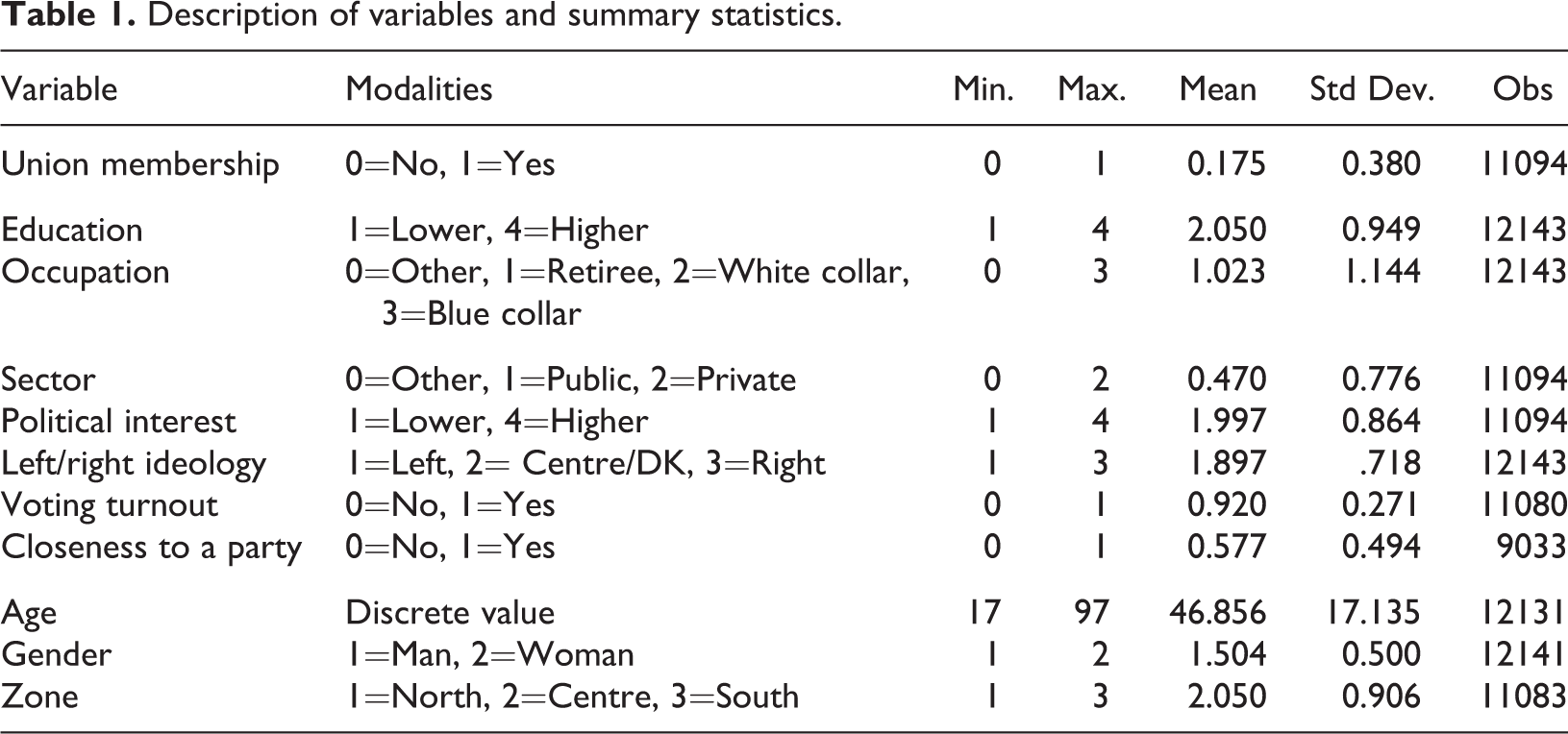
Although respondents’ income levels were not measured directly, we used occupation and education levels as proxies for socio-economic status (Erikson and Goldthorpe, 2002). Due to different wording in the survey waves, the variable ‘Occupation’ is the result of recoding pertinent survey questions into the only three possible modalities (blue-collar, white-collar and retiree), while a second variable (‘Sector’) addresses respondents’ occupational sector (private versus public). All responses not fitting these categories are coded as ‘other’. 6
Political interest, left–right ideology, participation in the last general election and closeness to a political party are all aimed at capturing the influence of the ideational propeller on respondents’ declarations of being a union member. Political interest – the classic four-item interval variable (from ‘not at all interested’ to ‘very interested’) taps into an important psycho-motivational dimension of political participation (Verba et al., 1995). The measure of respondents’ left–right ideology consists of their self-placement on a 1 to 5 scale (Left, Centre-left, Centre, Centre-right, Right). Based on both theoretical (ideological contiguity between left and centre-left) and empirical rationales (ensuring a sufficiently large sample for each category by survey year), the final variable was reduced to three broad categories: Left (categories 1 and 2), Centre (category 3) and Right (categories 4 and 5). 7
While participation in general elections indicates simply whether the respondent claims to have voted or not voted at the last general election, closeness to a party indicates whether the respondent feels relatively close to a national political party. This question addresses the issue of possible party-based mediation in patterns of union membership (Dalton and Wattenberg, 2000). Our data enable us to identify the extent to which the respondents feel close to a political party; however, they do not enable us to associate respondents with a specific political party.
In addition to the variables associated with the two propellers, our fundamental control variables are age, gender and geographic ‘zone’. While the two first variables have proved crucial in the study of union membership in different countries – being male and mid-career (that is, the quadratic effect of age) makes people more prone to join unions (Blanchflower, 2007) – the latter variable is specific to Italy. Indeed, ‘zone’ – which refers to both the socio-economic and the political dissimilarity between Italian regions – is a key variable in socio-economic and political research (Putnam, 1993; Shin and Agnew, 2008). Since the Second World War, the highly industrialized north of Italy has been depicted as profoundly different from an under-industrialized south (Hadjimichalis, 2005), while the central regions are characterized by a more heterogeneous socio-economic structure, based mainly on small and medium-sized enterprises (Trigilia, 1986; Minetti and Zhu, 2011). Moreover, and in contrast to the politically less homogeneous northern and southern areas of the country, central Italy has consistently displayed a more progressive political orientation over time (Diamanti, 2003; Bellucci and Segatti, 2011).
Results
Cross-sectional analysis of the instrumental and ideational predictors of subjective trade union membership in Italy
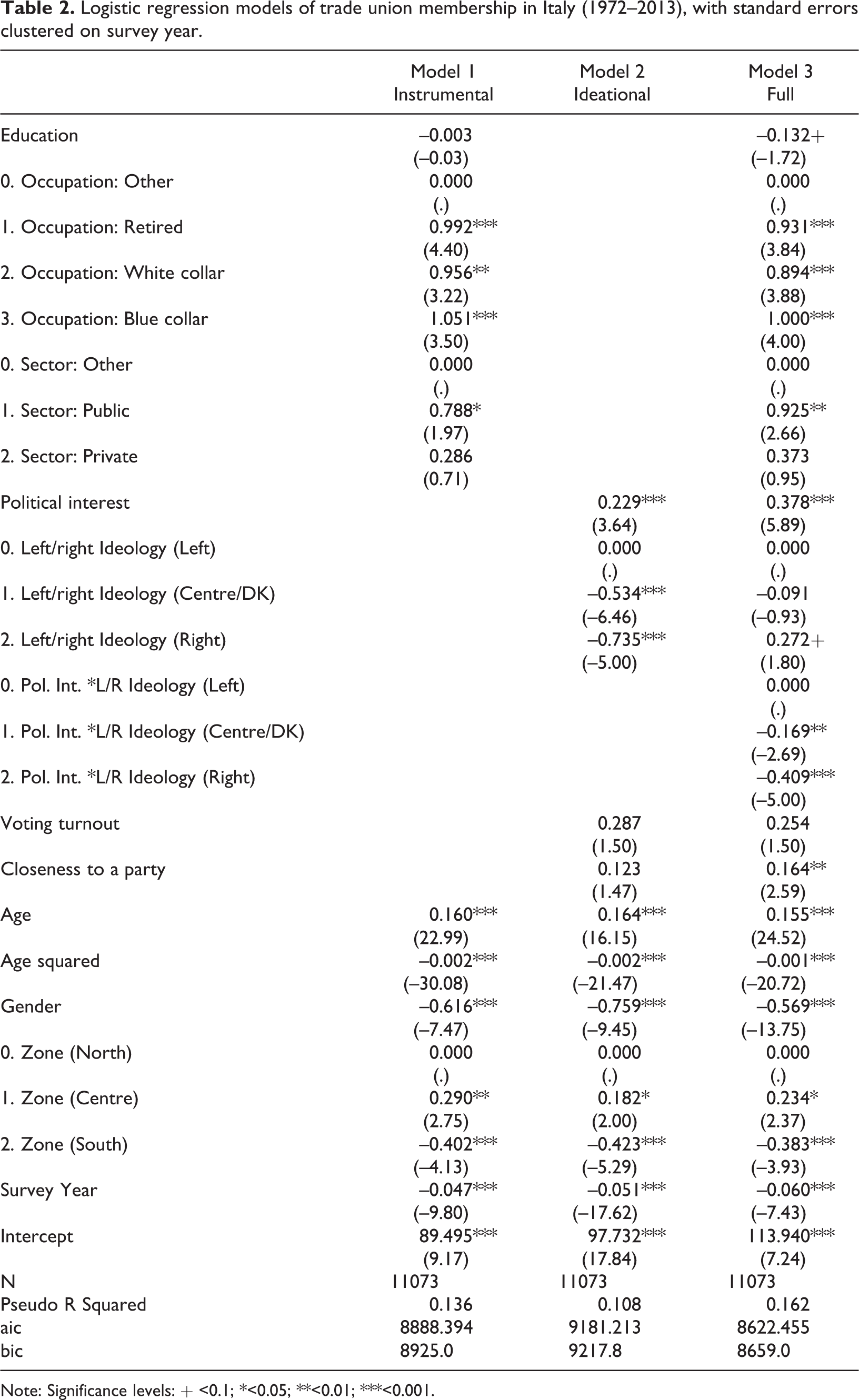
Table 2 presents parameter estimates (logistic regression coefficients with standardized coefficients in parentheses) for three different models predicting patterns of subjective union membership in Italy over the four decades considered. Model 1 tests the predictive power of the instrumental propeller, model 2 tests the ideational propeller, and model 3 incorporates the instrumental and the ideational (see Appendix 1 for regression model specifications).
Logistic regression models of trade union membership in Italy (1972–2013), with standard errors clustered on survey year.
Note: Significance levels: + <0.1; *<0.05; **<0.01; ***<0.001.
As shown in Table 2, logistic regressions indicate that political variables representing the ideational propeller are significantly associated with subjective union membership, even when controlling for instrumental and other socio-demographic factors. When we observe the two propellers separately, the instrumental propeller (model 1) seems to perform better (with a slightly higher adjusted R squared and lower aic and bic) than the ideational propeller (model 2). However, we also notice a clear link between politics and statements concerning union belonging. In particular, political interest predicts subjective membership because respondents who are more interested in politics are more likely to declare that they are union members. Moreover, left–right self-positioning predicts a clearly significant decrease in the probability of answering ‘Yes [I am a union member]’ as respondents’ self-placement shifts from left to centre (or lack of self-positioning) and, even more strongly, to the right. Predicted probabilities of declaring union membership range from 23 per cent among left-wing to 13 per cent among right-wing respondents.
When the instrumental propeller is running alone, we observe that employees and retirees are more likely to answer that they are union members than other non-employees. Moreover, ceteris paribus, public employees have a slightly higher probability of answering ‘Yes’ than remaining survey respondents. When both propellers are running, these results are further reinforced (model 3). Being an employee or a retiree makes the respondent more likely to answer that he/she is a union member, whereas being more or less educated does not seem to make a substantive difference. In addition, model 3 includes the interaction of the two most powerful political predictors from model 2, which shows that it is not only political interest or ideological positions per se that matter. Rather, it is their interaction that becomes a pivotal element in explaining the dependent variable. Indeed, the interaction coefficient is significant (p = 0.000), which indicates that stronger political interest is associated with stronger positive answers to membership questions within ideology-based categories. 8 This confirms our expectation that a mix of ideology and political engagement is a good proxy for ideational affiliation.
Moreover, when both propellers are running, if electoral participation still fails to bring a specific added value when other more important variables are included, closeness to a party proves slightly significant (p < 0.01); in other words, respondents who declared that they felt close to a party had a higher probability of stating that they were a union member.
Regarding the effect of control variables, in line with previous research on union membership, men have a higher probability of declaring that they are a union member than women, and respondent age has a quadratic effect, confirming Blanchflower’s (2007) findings. 9 The ‘zone’ effect further reinforces the overlap between politics and the individual choice of belonging to unions. Indeed, compared with people living in the politically more heterogeneous north of the country, those living in the traditional left-wing strongholds of central Italy are more likely to answer positively about their union membership status, whereas those in the less industrialized south are less likely to do so.
Finally, survey year, with its significant coefficient, was a particularly important factor. Based on model 3, the estimated probabilities of being a union member by each survey year are as follows: 40.3 per cent in 1972, 26.9 per cent in 1985, 22.6 per cent in 1990, 14.6 per cent in 2001, 11.7 per cent in 2006 and 8.5 per cent in 2013. These estimations are very similar to the actual values in our samples, as shown in Appendix Figure 1. This result clearly illustrates a dramatic and consistent decline in subjective union membership in Italy, at least since the 1980s. In turn, this point requires more attention to assess the relative decrease of the instrumental versus the ideational propeller in explaining subjective union membership.
Overall, the study’s set of variables appears to capture fundamental aspects of union membership choice. Indeed, the model performs well (Pseudo R-squared = 16.2 in model 3), especially if we consider the relatively large sample size and the fact that it includes employees as well as non-employees over a time span of more than 40 years. Moreover, the comparative performance of the regression models confirms that the two propellers have higher explanatory power when they are considered together. The balance of fit and the complexity of model 3 is also more satisfactory, even considering the larger number of variables included (see the descending values of aic and bic information criteria) (hypothesis 1 verified).
Longitudinal perspective on instrumental and ideational subjective union membership (1972–2013)
First, since education was marginally relevant (in both models 1 and model 3, see Table 2), we focus on respondents’ occupation to understand the longitudinal relevance of the instrumental propeller. Figure 1 presents the predicted probabilities of stating that one is a trade union member across the four occupational categories in each survey year. In 1972, the likelihood of answering ‘Yes [I am a union member]’ was 40 per cent and 48 per cent for white- and blue-collar workers, respectively, versus 28 per cent for retirees and 25 per cent for the rest of the population. Forty years later (in 2013), the relative estimates appear much weaker, with no significant distinction remaining between blue- and white-collar workers (approximately 20 per cent for both groups), a decline among retirees (14 per cent) and a virtual disappearance of subjective membership within the rest of the Italian population (3 per cent).
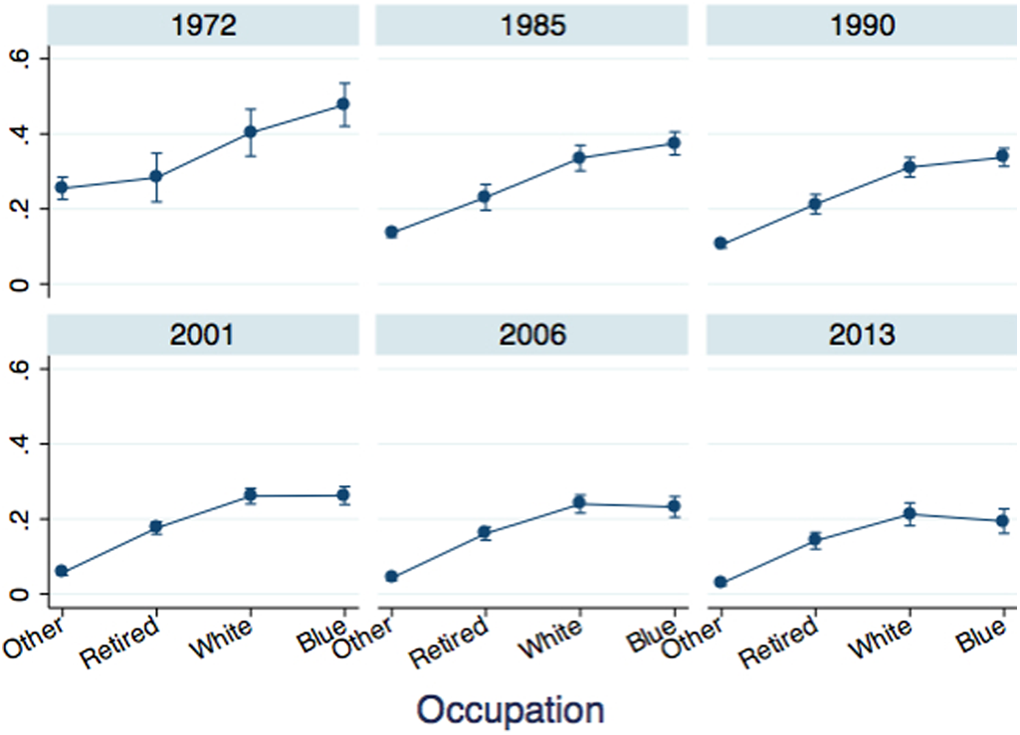
Estimated union membership by occupation (blue collar vs. white collar vs. retired vs. Other) and year.
Based on our survey evidence, a dramatic decline in the probabilities of declaring that one is a union member across occupations occurred between 1972 and 2001, whereas the decrease was much weaker in the following years. In the context of a generalized decline, the biggest fall was among blue-collar workers (from 48 per cent to 19 per cent in 2013). Overall, if we compare the estimated subjective trend with the objective measures of membership, the trend for employees is similar and consistent across the two sources, with the estimated level of subjective membership being only slightly lower (hypothesis 2a verified).
However, and contrary to our expectations, an increase in the provision of services for non-employees by unions does not translate into an increase in the subjective probability of declaring that one is a union member among retirees and other non-employees. As already indicated, subjective membership among retirees fell from 28 per cent in 1972 to 14 per cent in 2013, whereas for other non-employees it fell from 25 per cent to 3 per cent over the same years. This evidence contrasts with objective data registering a steady increase in non-employee members (hypothesis 2b rejected).
We now examine the relative importance of the ideational propeller (Figure 2). As seen in model 2, both political interest and left–right self-positioning are key predictors, and their interaction (see model 3) has even stronger explanatory power. For this longitudinal analysis, we run a three-way interaction between left–right ideology, political interest (both variables dichotomized) and survey year. As Figure 2 shows, the probability of answering ‘Yes [I’m a union member]’ for people with lower levels of political interest, regardless of their ideological self-placement on the left–right axis, clearly declined, at least until 2001. Conversely, the probability for respondents highly interested in politics remained essentially stable over time. 10 More specifically, those positioning themselves on the centre-left and having a high degree of political interest continue to present virtually the same levels (40 per cent) of probability of declaring that they are union members between 1972 and 2013.
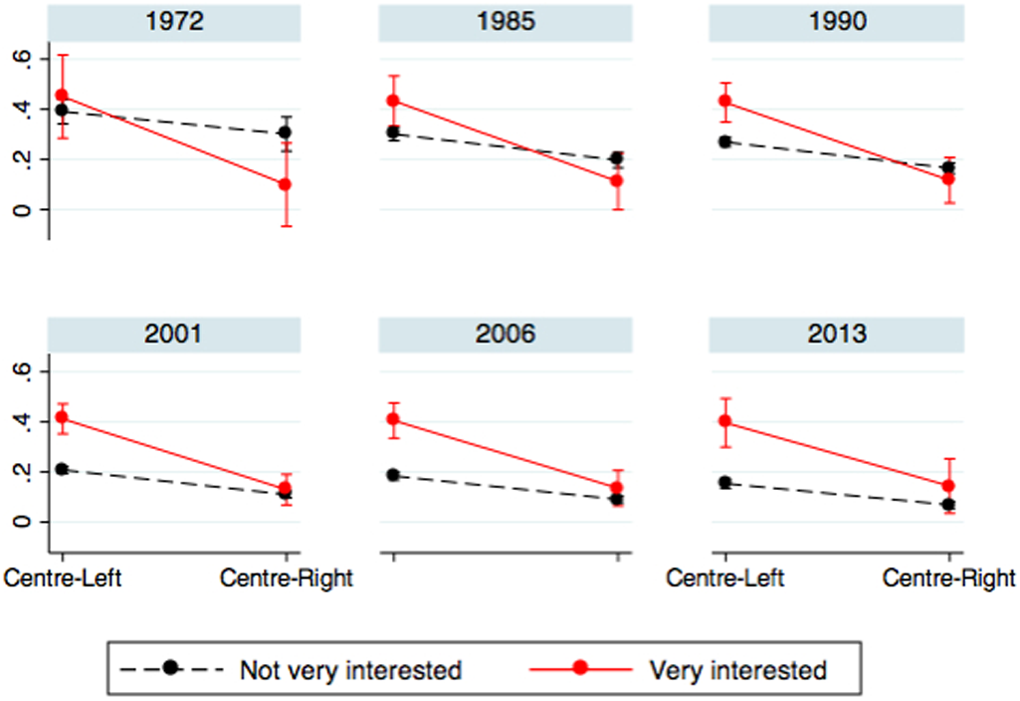
Estimated union membership by Left/right self-placement and Political interest.
To visualize this result even more clearly, we construct a new variable comprising the interaction of left–right ideology and political interest. Because the ideational propeller performs strongest when both variables are set at their ‘polar’ values, highly interested left-wing respondents represent the relatively more ideational group.
When considered within the whole population in which high levels of political interest remain relatively rare, the strongly interested left-wing respondents account for only 3.4 per cent of overall survey respondents. On the other hand, less interested left-wing, centre, right or unpositioned respondents can be considered to be a ‘less- or non-ideational’ group. Figure 3 illustrates the remarkable stability of the top ideational group in relation to subjective union membership rates over time and the demobilization of all other groups through time (hypothesis 3 verified).
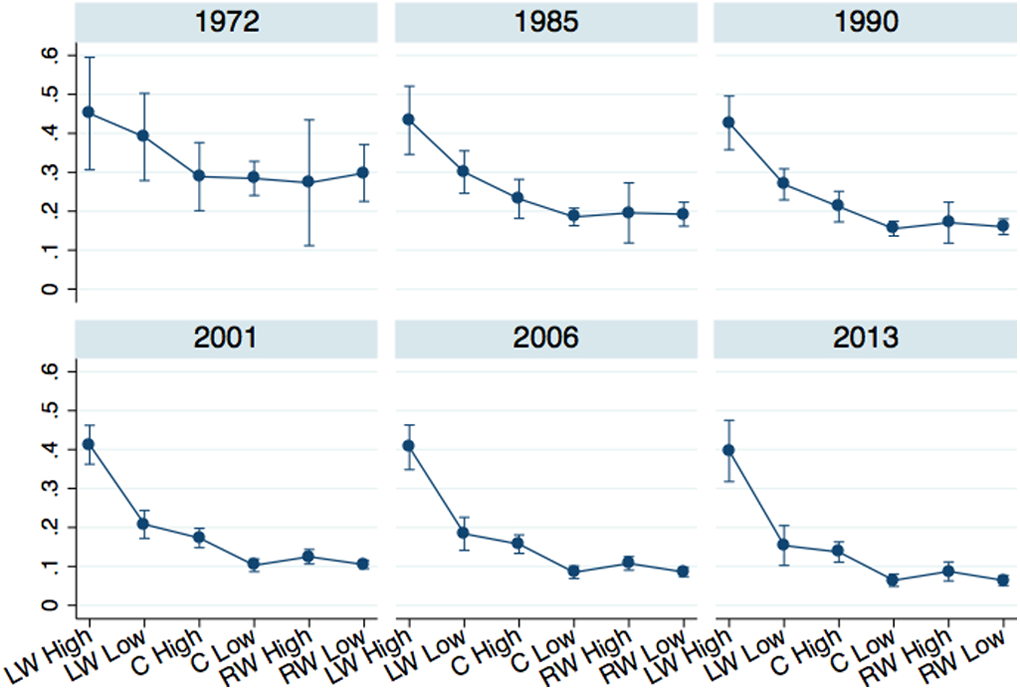
Estimated union membership by interactions of Left/right self-placement and Political interest.
Discussion
Objective and subjective employee membership have consistently decreased over time. The demobilization of many employees, especially blue-collar workers, is not surprising. Employees at the beginning of the 1970s experienced substantial advances in wage and labour conditions introduced through collective bargaining. The provision of employment goods by unions, in a self-enhancement calculus, might have stimulated many employees – independent of their political interest and ideological inclination – to be a member and declare it. Moreover, in a still Fordist industrial structure, the higher number of union members might have functioned to impose a kind of stringent peer-pressure on other employees to join unions, making the non-membership choice socially more costly and limiting free-riding. A positive spiral for membership might have taken place in the early 1970s.
According to Bamberger et al. (1999), employees’ perception of union instrumentality triggers union attachment, first, and commitment, second. By contrast, the lack of perceived employment goods provided by unions limits the subsequent process of union attachment and commitment and, in turn, undermines the positive spiral of union membership. Over time, Italian unions passed from being offensive to defensive, and then to concession bargaining from the 1990s. Moreover, the national tripartite agreements signed by unions passed from ‘political exchange’ to ‘pain-sharing’. Besides, since the 1990s, the workforce has become more ‘individualized’ and differentiated (Cella and Provasi, 2002; Baglioni, 2004) and this might also negatively affect peer expectations and pressures with regard to union membership, while favouring free-riding. Finally, the decline of economic and social benefits perceived by employees joining unions throughout the 1980s and 1990s may have progressively eroded the positive spiral in place in the 1970s. This is particularly true in the private sector where unions had less room to manoeuvre than their counterparts in the public sector.
A more surprising finding is that, while unions provided non-employment goods (mainly services through patronati), this did not result in an increase in the probability of retirees and other non-employees stating that they are members. Although this result is in sharp contrast with objective membership data, this contrast is only apparent if we consider that surveys capture subjective union membership. Employees are exposed to more (solicited and unsolicited) opportunities to interact with union officials and representatives than non-employees. Union meetings during working hours and interactions with shop-floor union representatives (Rappresentanza Sindacale Unitaria) increase membership (or non-membership) awareness and the sense of belonging (or not belonging) to unions for many employees, especially in larger firms. Conversely, many non-employees use union services relatively infrequently (the most typical service used is help in handling pension applications). Due to the rendered service (union provided non-employment goods), they agree to affiliate. Non-employees may remain members over time with a limited number of interactions – if any – with union officials or representatives. Except for information that they may receive from unions – probably once or twice a year – there are virtually no other opportunities to reinforce union belonging. Their sense of belonging may fade over time until they cease to be aware of their membership status. Therefore, even if an automatic deduction of union dues is still applied to their pensions, they may subjectively perceive themselves as non-members. In other cases, they may be aware of being members but may not want to state it.
Politically non-motivated members can use union-provided services and, at the same time, dissociate themselves from the politicized image of Italian unionism. They may thereby consider that it is not socially desirable to state publicly their membership status in a survey. Therefore, in the Italian case, in addition to members being ‘willing to act’ or just ‘willing to pay’ (Gumbrell-McCormick and Hyman, 2013), there are others who are possibly ‘unaware of paying’ or ‘unwilling to state’ their affiliation, especially in the case of non-employees.
Analysis of the ideational propeller demonstrates that a group of Italians resisted the downward membership trend over time. Once the relevance of the instrumental propeller substantially diminished, the strength of the ideational propeller manifested itself more clearly. People closer to left-wing ideological values but especially, among them, those who are highly interested in politics, persistently state that they are union members. Due to this political engagement, there may be fewer problems of awareness and sense of belonging undermining their membership declaration. Moreover, it seems highly unlikely that the social desirability of stating membership affiliation affected this group. For them – less than 5 per cent of the population – because the political balance of power has progressively swung against labour and less well-off people, union affiliation has become even more a political statement in support of the unions’ ‘sword of justice’ (Flanders, 1975). A consistent red thread seems to link the ‘hot autumn’ of 1969 to the more recent rallies against Berlusconi and government ‘austerity’ measures.
Conclusion
If we consider objective measures of total – that is, employees and non-employees included – union membership, Italy currently ranks substantially higher than the OECD average. However, as our research demonstrates, considering only objective union membership misses some important insights that subjective measures can provide. Indeed, according to objective measures, non-employee union members increased over time in Italy. By contrast, our analyses of subjective membership demonstrate that the probability of non-employees declaring that they are union members has been constantly decreasing. Italian unions have increasingly provided services to non-employees (primarily retirees) and have convinced a number of them to affiliate. Nonetheless, non-employees’ sense of belonging and awareness, or at least their willingness to state their membership status, seems to fade over time.
This evidence has important implications for the debate on union membership. Future research should carefully address the tension between subjective and objective union membership. If the divergence was evident for non-employees in the Italian case, we cannot exclude the possibility of finding similar evidence in other countries in which non-employees can join unions and unions have increased their provision of services to a wider population than just employees. Moreover, in the North American model of unionism – where union affiliation is primarily based on a collective choice (but not all employees in a unit belong to unions) and, once a unit is unionized, union dues are paid by all employees, members and non-members alike – this tension between subjective and objective membership may provide fruitful insights about the self-perception of employees’ membership status.
Finally, our results also have important implications for Italian unions. If the increase in non-employee members (according to objective measures) has ensured financial revenues to guarantee unions’ organizational survival, the challenge concerning the legitimacy of union representation is twofold: quantitative – fewer employees are represented by unions – and qualitative (a large proportion of non-employees in those represented demonstrates a marginal attachment to unions). If unions are not able to recover in these two respects, they will have marginal legitimacy not only in relation to employers but also, as recently highlighted by Culpepper and Regan (2014), in relation to governments.
Future studies about subjective union membership based on ad hoc surveys can help to overcome the structural limitations of this research, especially by defining a wider and more focused set of independent variables (rather than proxies), as well as by differentiating affiliation by national union organization. In the Italian case, indeed, national organizations refer to three different union traditions and cultures that deserve to be further analysed for their distinctive features. Lastly, due to data constraints our research could not provide more fine-grained insights about the determinants of consistency and inconsistency between objective and subjective membership. An opportunity to develop a survey among a list of members based on objective sources and to compare each respondent with their subjective declaration about their membership status could fill this gap.
Footnotes
Acknowledgements
The authors wish to thank Celeste Grimard-Brotheridge, Sean O’Brady, and the three anonymous reviewers for their useful comments.
Funding
This research received no specific grant from any funding agency in the public, commercial, or not-for-profit sectors.