




Abstract

Switzerland is well-known internationally for its industrial peace, with both employers and the government cultivating the reputation of Switzerland being a strike-free country. Yet over the last two decades this has become somewhat of a myth, as industrial disputes have become increasingly frequent, even if they remain at a relatively low level compared with the rest of Europe (Degen, 1987, 2014).
Disputes followed by industrial peace
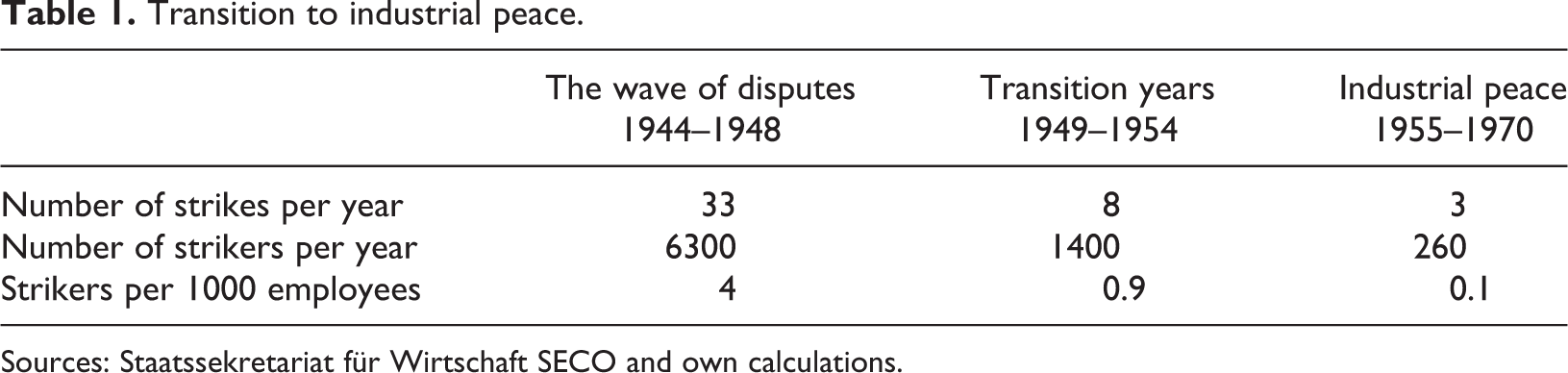
At the end of the Second World War, Switzerland was a ‘normal’ European country with regard to strikes. Yet shortly before the end of the war, a wave of industrial disputes began shaking the country in 1944, with the unions wanting to regain ground lost during the war, in particular with regard to wages. At the same time the disputes also had the goal of concluding new collective agreements (Schiavi and Brassel, 1987). The average annual number of strikes in Switzerland soared to 33, with thousands of workers involved. As a result of this industrial action, some 50 per cent of all employees were covered by a collective agreement by 1948, a coverage rate that was not to increase in subsequent years. The strikes in this period took place mainly in the manufacturing and construction industries, meaning that they involved men for the most part.
The period 1949 to 1954 was a transitional period with a low strike frequency. As in the immediate post-war years, the few strikes that did occur were mainly in industry and construction, even though these sectors were now governed by collective agreements containing no-strike clauses (Koller, 2009).
The situation changed totally in the mid-1950s, with industrial peace taking hold of Switzerland for 15 years. On average there were just three strikes a year, involving only a few hundred workers (Table 1).
Transition to industrial peace.
Sources: Staatssekretariat für Wirtschaft SECO and own calculations.
What were the main reasons for this development? The Swiss economy entered a long-lasting boom period in the mid-1950s, with exceptionally high annual GDP growth rates of 5–7 per cent. This resulted in the Swiss labour market totally drying up by the end of the 1950s, strengthening the negotiating position of workers. Swiss employers increasingly resorted to foreign labour, especially for subordinate tasks, meaning that many Swiss workers experienced a certain rise in their status. Strong productivity gains created opportunities to enshrine higher wages, shorter working hours, etc. in collective agreements.
Industrial peace clauses were increasingly to be found in private sector collective agreements. Together with the special status of civil servants (Beamte) in the public sector, this meant that any discontent seldom ended in a strike (Rieger, 2009; Tanner, 2015).
A new wave of strikes, again followed by a period of industrial peace
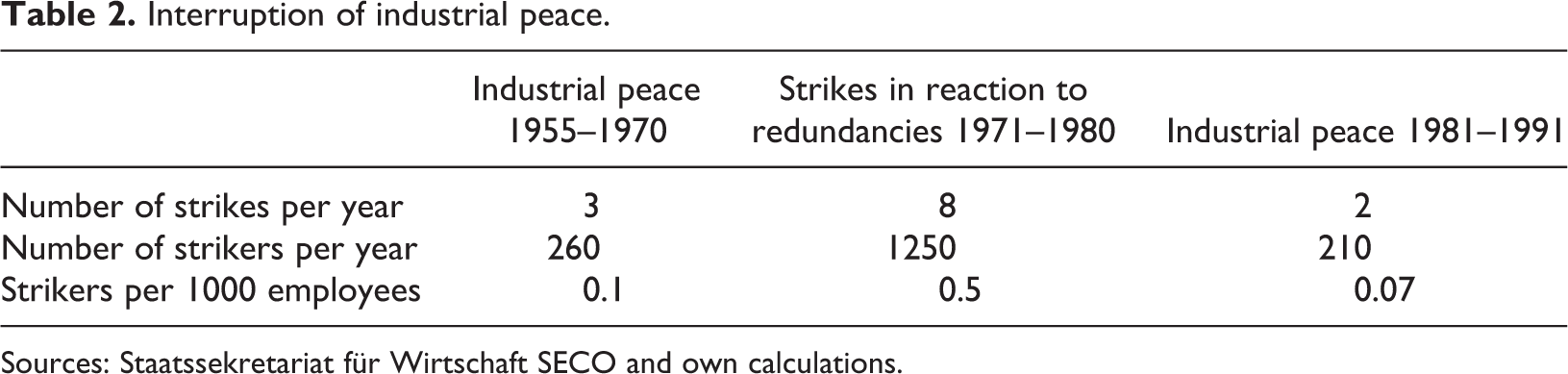
This boom in Switzerland ended in the 1970s, with the oil crisis triggering a structural and economic crisis. Between 1971 and 1980 Switzerland experienced mass redundancies on a hitherto unknown scale, especially in the industrial sector – and many workforces reacted with strikes. The protagonists of these battles to protect jobs were often foreign workers who knew all about the power of strikes from their countries of origin (in particular Italy). To a certain extent they were supported by the new left-wing movements, with the unions often remaining in the background.
In this crisis period, parts of the public sector were also subjected to harsh austerity measures, inciting the resistance of hospital employees, teachers and other public servants, in certain cases in the form of strikes. This also led to a rise in the proportion of women strikers.
By 1981 this second wave had ebbed, and Switzerland again enjoyed a period of industrial peace, with on average just two strikes a year and not involving more than some 200 workers. The reason for this was again a boom period, which was to last until 1991 (Table 2). It was also the last time the Swiss labour market practically dried up. As a result the unions were able to achieve substantial gains in their negotiations on wages and collective agreements. Wages rose, working hours dropped and working conditions improved.
Interruption of industrial peace.
Sources: Staatssekretariat für Wirtschaft SECO and own calculations.
The renaissance of industrial disputes since 1994
The boom came to an abrupt end in 1991, and Switzerland found itself in a period of recession that was to last for years. The property market crisis was comparable to that experienced by the US in 2007. At the same time, industry was hit by a structural crisis. For the first time since the 1960s unemployment shot up in Switzerland, in some regions reaching 10 per cent. This in turn had an impact on state budgets, with deficits rising on account of the drop in tax revenues. At the negotiating tables the unions were suddenly unable to make any progress. Quite the opposite, they found themselves confronted with employer demands to turn the clock back. On account of this completely new situation, the unions had to change their tactics. To create a balance of power, they had to return to the battlefield. A new generation of unionists started restructuring their organizations, restoring their ability to mobilize workers (Oesch, 2011; Unia, 2014).
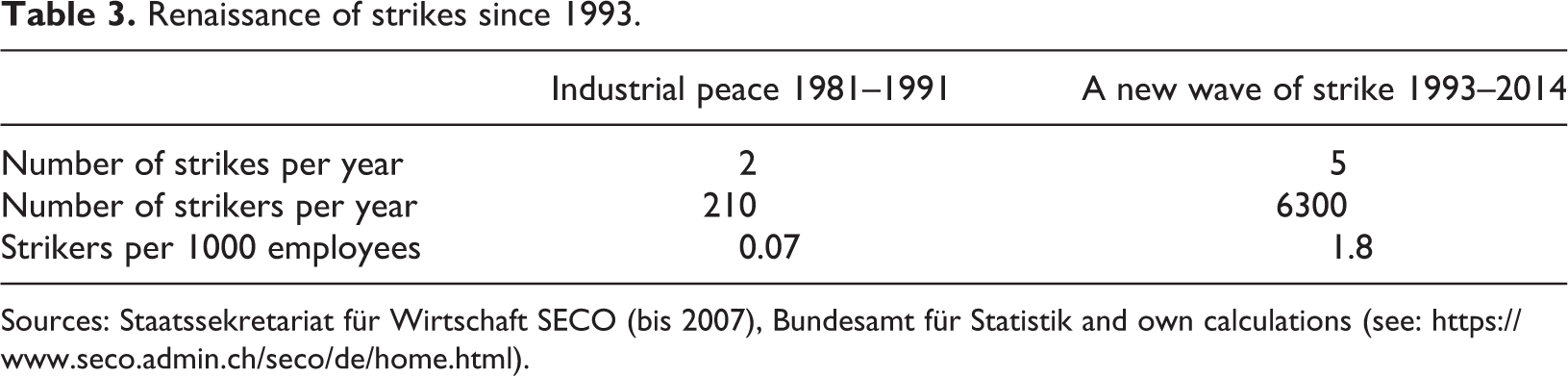
An initial state of shock in the 1992–1993 crisis years was followed by a renaissance of industrial disputes, in many cases in reaction to mass redundancies in industrial companies, but also in private sector services (Table 3). In the public sector, many groups of employees rebelled against the harsh austerity measures. These public sector strikes were facilitated by the fact that in most cases the special civil servant status, which had not allowed any strikes, had been replaced by collective agreements in the 1980s. On account of the increased strike activity in the public (as in the private) sector, the participation of women again rose. Alongside action against redundancies and the austerity measures, disputes also focused on maintaining ‘good’ collective agreements, many of which were being fundamentally questioned by employers. Finally, there were also a number of offensives, for instance in the construction industry in favour of early retirement, and in private sector services against low wages (‘Kein Löhne unter 3,000.- resp. 4,000.- Franken/no wages under 3000 resp. 4000 Swiss francs’).
The number of workers involved in strikes rose by a factor of 20 in comparison to the decades of industrial peace in the 1960s and 1980s, even though remaining comparatively low at 6300 on average. With a total Swiss workforce of fewer than 4 million workers, this corresponds to 1.8 strikers per 1000 workers, a figure that is still quite low in comparison to other European countries. In contrast to the rapidly decreasing strike frequency in nearly all of Europe, the trend in Switzerland was exactly the opposite. And quite a shock for a country used to industrial peace (SGB, 2008; Gemperle, 2012).
Renaissance of strikes since 1993.
Sources: Staatssekretariat für Wirtschaft SECO (bis 2007), Bundesamt für Statistik and own calculations (see: https://www.seco.admin.ch/seco/de/home.html).
Most strikes in this period were short, with the average duration of strikes recorded between 1998 and 2007 being only 1.3 days (135,000 days not worked for the 103,000 workers involved). In contrast to the post-war strikes, most of which took place in industry and construction, the service sector now dominated, accounting for some two-thirds of all strikers; the public sector alone accounted for half of them.
Many minor strikes
Swiss strike statistics, on which the above data are based, only record strikes lasting a whole day or more. As a result, many actions which have taken place since 1994 are not recorded. These take different forms: traditional warning strikes lasting just a few days or half a day, work-to-rules, extended breaks, demonstrations outside working hours, halting work, etc. have all become characteristic forms of industrial action in Switzerland over the last 20 years. Were the official strike statistics to record strikes lasting one hour or more, the number would be almost twice as large, and the number of strikers some 50 per cent higher.
A database has existed in Switzerland since 2000, recording such minor strikes in the private sector. It is managed by Unia, the Swiss union organizing most private sector branches, and about half of all industrial actions in Switzerland are recorded in it (Unia, 2014). The other half take place in the public sector.
This database shows an average of 12 industrial actions a year, of which six are strikes (lasting 4 hours or more), two warning strikes (1–3 hours) and four other forms of action during working hours. The database is of particular interest as it contains a number of qualitative indicators revealing the characteristics and trends of industrial action in the Swiss private sector. In almost 50 per cent of cases, strikes are triggered by the announcement of redundancies, in most cases collective ones. A further large proportion (circa 20 per cent) of strikes seek to combat worsening working conditions or wage dumping. Other actions have the goal of upholding an existing collective agreement that has been questioned by employers (10 per cent). Just 20 per cent of industrial actions seek to improve wages, working conditions or early retirement conditions. While the majority of strikes in the private sector still take place in industry and construction, they are increasingly occurring in the private service sector, meaning that women are increasingly involved. Most strikes end after half or a whole day, with only very few lasting a whole week or even a month. Most strikes take place in individual companies, meaning that the number of strikers is relatively low. Strikes affecting a whole sector are rare, and relate almost solely to the construction industry. The majority of strikes are successful, with employees pushing through most or all of their demands. Though some end without success, the strikers come out with their heads raised high. In only a very few cases do the strikes end in total defeat. The majority take place in companies or sectors governed by collective agreements, mainly shortly before their expiry or on account of items not covered by them. A quarter of strikes break out in companies not covered by such agreements, especially in the industrial and services sectors. There have been no wildcat strikes not supported by the union since 2000 in the sectors covered by Unia. In most cases, Unia was involved in the action right from the start; while in a few cases it supported at a later phase workforces wanting to strike. Strikes generally generate great public interest and wide-ranging sympathy, as they represent an exceptional situation of high social tension, attracting many supporters (and opponents). Even small strikes are taken up by the media, at least the local media.
Prospects
As long as the Swiss economy is not experiencing a long growth period with full employment, strikes will continue to break out in Switzerland. Industrial action will often take a new non-strike form, making creative use of modern means of communicating and campaigning.
In contrast to the image of industrial peace officially upheld by the Swiss authorities, even relatively short strikes lead to major social tension and attract great attention, often enabling the strikers to tip the balance of power in their favour. In a number of cases, strikes quickly become political, with different political parties taking a stand and soon offering the government their help in achieving a compromise, ending the strike through their intervention. Switzerland’s claim to be a country in which industrial peace reigns leads to a situation where even comparatively minor industrial action can have a wide-reaching effect. Longer strikes lasting several weeks, such as at Swissmetal in the Jura, at the railway workshops in Tessin or at Merck Serono in Geneva, have seen whole regions showing solidarity with the strikers.
Switzerland has to wake up to the fact that is not immune to strikes in the 21st century.
Footnotes
Funding
This research received no specific grant from any funding agency in the public, commercial, or not-for-profit sectors.