




Abstract
This article contributes to the debate on labour platforms (e.g. TaskRabbit, CoContest, ListMinut) by analysing the potential of such platforms. Although we see potential in online platforms in terms of job creation and providing opportunities to discouraged and disadvantaged people, we also address some of the challenges related to such work. Presenting empirical data, we argue that the current labour market and working conditions created by online platforms resemble 19th century laissez-faire. We thus call for the urgent creation of a regulatory framework taking into consideration the suggestions presented in our article.
Introduction
This article investigates the potential and shortcomings of work via online labour platforms. Looking at the current status, we find that the majority of platform workers are poorly compensated and that tasks posted on the platforms are inefficiently matched, leaving a number of tasks incomplete and a number of workers without ‘jobs’. On this basis, we critically review the emerging regulatory system in Europe, part of the European Commission’s ‘Digital Single Market’ priority, and suggest specific steps for the fair regulation of the growing platform economy.
Despite the quickly growing body of literature on the topic, the debate on the nature of the platform economy is still at an early stage – as evidenced by the lack of unified terminology. Terms, or rather buzzwords with widely different connotations, are used in the literature often inconsistently and interchangeably: for example, the ‘sharing economy’, ‘collaborative work’, ‘on-demand labour market’, ‘gig employment’ and ‘crowdsourcing’ (Degryse, 2016; Drahokoupil and Fabo, 2016). Though multiple efforts to systematise thinking on the platform economy have been undertaken (Maselli et al., 2016; Puschmann and Alt, 2016), a sufficiently authoritative analytical framework for understanding platforms has yet to be produced. For the purpose of this article, we use the definition stated in the European Agenda for the collaborative economy, which confines its meaning to ‘business models where activities are facilitated by online platforms that create an open marketplace for the temporary use of goods or services often provided by private individuals’ (European Commission, 2016). In line with Drahokoupil and Fabo (2016), we specifically focus in this article on platforms aimed at matching labour supply and demand, using the web as a powerful, low-cost facilitator.
Despite the inconclusive theoretical background, there is an increasing body of literature summarising empirical findings on platforms. Several scientific articles have recently been published, discussing the risks and benefits of platforms (Codagnone et al., 2016; Codagnone and Martens, 2016; Goudin, 2016; Maselli et al., 2016; Schmid-Druner, 2016), and (to a certain extent) policy responses to them. Importantly, the European Commission itself has published a Communication detailing the principles of application of European Union (EU) law to platforms, bringing online platforms to the heart of the European policy debate on the future of work (European Commission, 2016).
When it comes to normative judgments about platforms, conflicting views exist. For some, they are revolutionary vehicles empowering their users (both workers and customers) to live in a more sustainable way, while fostering social capital development and the promotion of socially beneficial values in communities (Foden, 2015; Heinrichs, 2013; Jenk, 2015; Schor, 2014; Sundararajan, 2016). But a second group of analysts associates the phenomenon with the rise of a ‘cybertariat’ – a marginalised mass of semi-skilled virtual workers, languishing on the edges of the labour market and in general strengthening the neoliberal economic order, benefiting capital owners over workers (Degryse, 2016; Huws, 2014; Kuttner, 2013). Yet again, other scholars view platforms as an intensification of already existing phenomena (e.g. outsourcing of labour, commodification of human interactions, communal sharing, offshoring), rather than as something genuinely new (Drahokoupil and Fabo, 2016; Huws, 2016b).
In this article, we do not aim to pass a definitive judgement on the platforms as such, but nonetheless argue that there is a gap between the promises and reality of platform work, and that the regulatory framework is underdeveloped and unable to guarantee basic social rights to platform workers.
The promise behind the platform economy
Our exploration starts with the investigation of the reasons underlying the optimism about labour platforms. In general, the positive attitude towards them can be explained by their potential to generate jobs, particularly for workers with reduced access to traditional labour market opportunities.
The promise of large-scale platform-driven job creation is related to the remarkable pace of the growth of the platform economy. A widely cited PricewaterhouseCoopers report predicts revenue in the key sectors of the platform economy growing from US$15bn today to US$335bn in 2035 (PwC, 2015). The current size of the collaborative economy, as estimated by the European Commission, is largely in line with this – revenue in Europe is estimated to total US$17bn (European Commission, 2016). As evidenced by the data provided by the Eurobarometer survey (Figure 1), a substantial share of the population of European countries have reported offering their services through the platforms. According to a survey from the United Kingdom, 21 per cent of the adult population, i.e. around 9 million people, claimed to have searched for a job using a labour platform, with similarly high figures also reported in other examined countries (Joyce et al., 2016). The existence of platforms as high-performance job engines that allow for efficient access to job opportunities is very tempting, especially in a Europe struggling to secure employment for its population, consisting to a high extent of skilled digital natives (CEDEFOP, 2015).
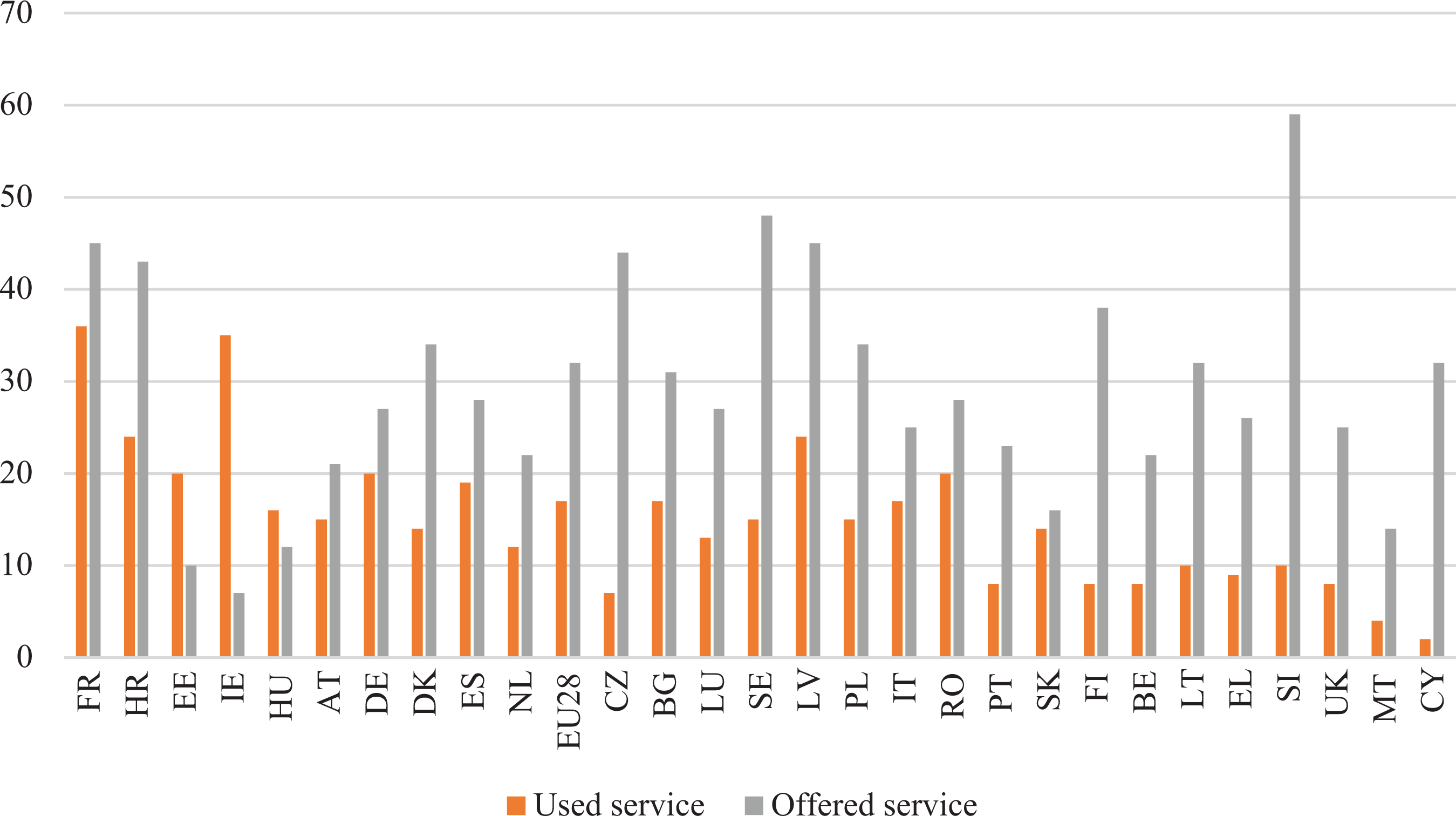
Use of online platforms.
The platform economy could benefit particularly discouraged and disadvantaged workers by offering them the possibility to work remotely. A survey of five European countries suggests there is a high share of young workers on the platforms (Joyce et al., 2016). Evidence also suggests that labour platforms have increased the labour market participation of highly educated and previously unemployed married women with children by allowing them flexibly to monetise their free time (Dettling, 2016). Codagnone et al. (2016) emphasise that labour platforms can help women in certain areas to overcome cultural barriers related to labour market exclusion as well as permit stay-at-home mothers to work (Codagnone et al., 2016). Empirical findings confirm this. Table 1 shows the activities in which platform workers were involved prior to taking on work via labour platforms, as reported in a survey conducted by Berg (2016). The numbers suggest that 26 per cent of US workers and 33 per cent of Indian workers reported caring for children, a disabled person or an elderly adult. This shows the prospect for individuals in similar situations to participate in the labour market through working remotely.
Main activity prior to working in the platform economy.
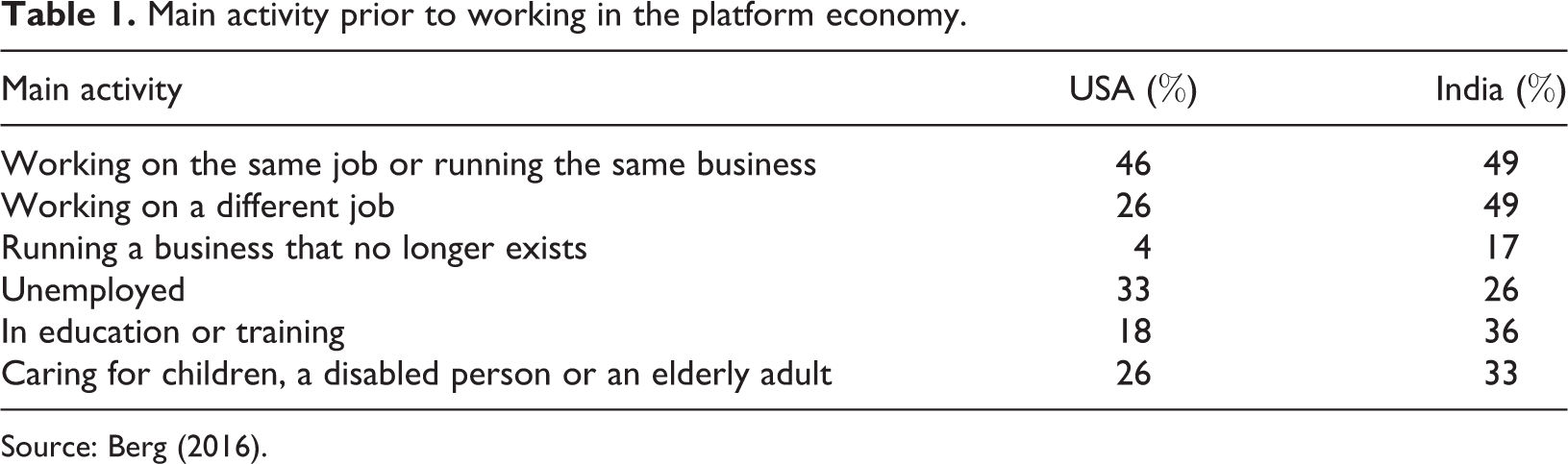
Source: Berg (2016).
Although labour platforms offer potential for increased job opportunities across the globe and benefit discouraged and disadvantaged people, this outcome can only be realised when labour platforms generate sufficient income, something currently not always the case.
The inefficiencies of platforms
So far, we have discussed the potential that labour platforms can unlock. We now explore the current labour situation offered by online platforms, presenting data from two platforms. Due to limited data availability or inconsistent estimates of workers’ earnings, we have merged empirical findings obtained by one of this article’s authors (De Groen et al., 2016; Maselli and Fabo, 2015) with those of organisations such as the European Commission’s Joint Research Centre (Codagnone et al., 2016), the ILO (Berg, 2016), or Eurofound (Eurofound, 2015). Earnings estimates are presented in Table 2.
Median income in selected platforms.
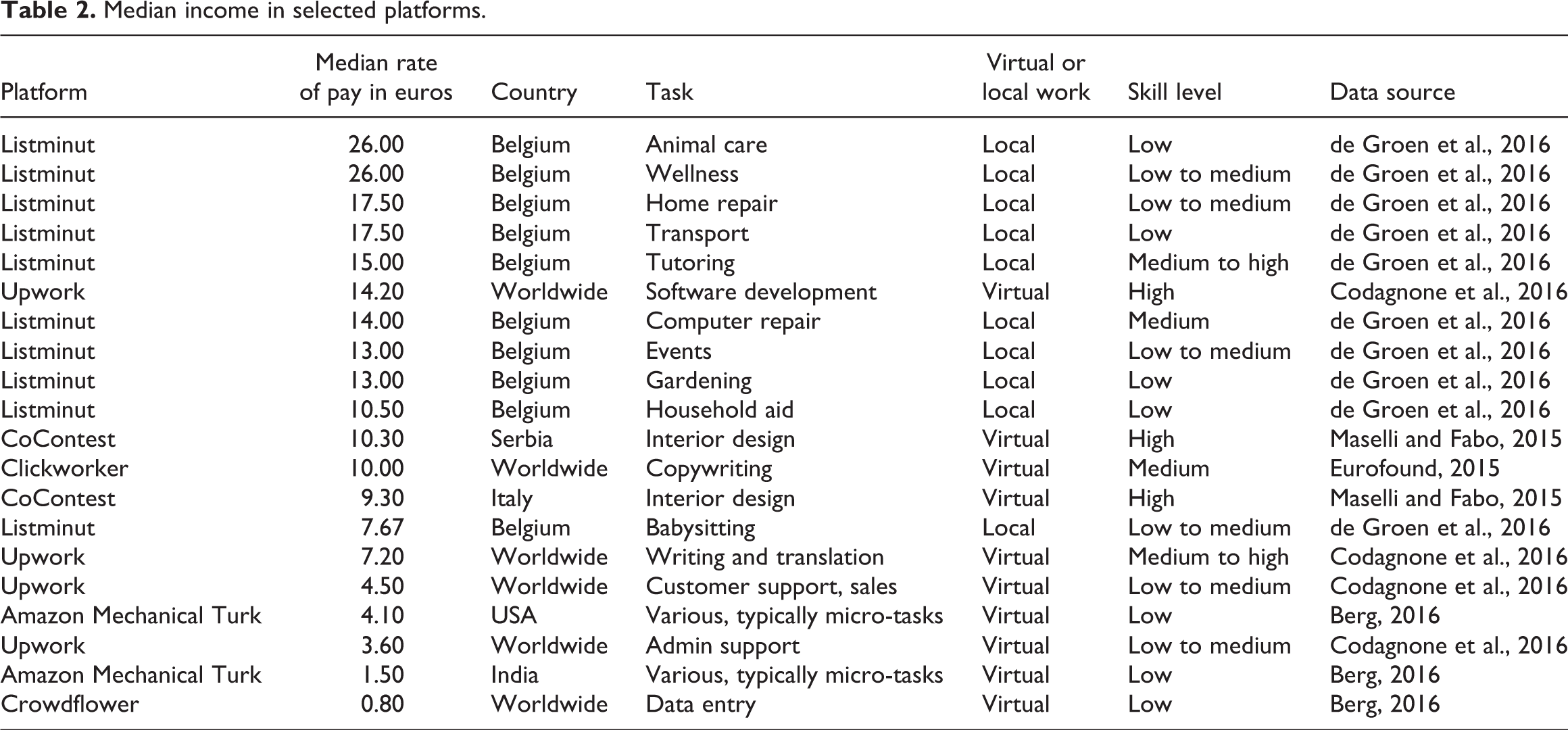
The platform earnings overview reveals several interesting points. First, rates of pay are higher on platforms offering work tied to a physical location rather than virtual work. Moreover, the hourly rate of pay for platform workers performing local tasks can be higher than that of comparable ‘offline’ workers (De Groen et al., 2016). For instance, Belgian workers in the home repair sector (e.g. plumbers) earn on average €12.70 per hour, whereas workers in the same sector commissioned via Listminut earn on average €17.50 per hour (De Groen et al., 2016).
Second, low-skilled virtual work, such as completing online surveys, is associated with extremely low rates of pay (from a Western perspective), often under €1 per hour. Interestingly, even when talking about global platforms, location matters, although not necessarily in favour of workers in richer countries. While US workers on Amazon Mechanical Turk out-earn their Indian peers, among CoContest interior designers, Serbians earn on average more than their Italian counterparts. It thus appears that, while in the skilled segment the wage differential between a high- and medium-income country can give the latter a decisive advantage, in more mundane tasks considerations such as language, same time zone and certain cultural traits might play a bigger role.
Does this mean that concerns about generating a living income from labour should be limited to platform workers performing virtual tasks? Not necessarily. The distribution of income on platforms is very much in line with the Matthew effect (Merton, 1968), also known as accumulated advantage, where a comparatively small subgroup of workers collects almost all the rewards, leaving only leftovers to the majority of their less successful peers. Such extreme distributional inequality appears to be common on labour platforms (Codagnone et al., 2016; de Groen and Maselli, 2016). Nonetheless, there is evidence that workers in less developed countries invest much more time and effort in labour platforms, as they often get involved with the aim of providing for their families. On the contrary, in high-income countries, working via an online platform is usually seen as a side job (Ipeirotis, 2010; Shevchuk and Strebkov, 2015).
This is in line with the findings of the Eurobarometer survey, which show that most EU platform workers do not work more than ‘occasionally’, i.e. more than once per month (see Table 3) (Eurostat, 2016). Only about 5 per cent of platform workers appear to work regularly through online platforms, and less than 10 per cent regularly pay social security contributions on platform work (Berg, 2016). Most likely, these are the small subgroup receiving the biggest share of earnings. On the other side of the field, we find the majority of workers, whose platform work appears to be a ‘one-night stand’ kind of arrangement of ‘permanent temporality’, rather than long-term employment (De Groen et al., 2016; Lehdonvirta and Mezier, 2013).
Frequency of platform work.

Source: Flash Eurobarometer 438.
Some platform workers might legitimately prefer the ‘one-night stand’ arrangement, being uninterested in fully committing themselves to the platforms. In some instances, platforms might serve just as a way to meet potential clients, with any subsequent work being negotiated outside the online environment. Nonetheless, evidence from a survey of platform workers in western Europe, North America and India (Berg, 2016; Joyce et al., 2016) shows that, in fact, the platforms rather than workers are the driving force behind such ‘one-night stand’ arrangements. For example, Berg (2016) finds that 90 per cent of workers would prefer to work more, but are hindered by a lack of available tasks. As the survey results suggest, workers tend to be young people on low incomes, combining their platform work with other poorly paid work, possibly on another platform. This evidence is in line with a survey conducted in the USA, which confirms these social characteristics. Additionally, a large proportion of the workers has been shown to come from a minority background (Burson-Marsteller et al., 2015).
The physical tasks arranged through platforms are by and large limited to driving, housework, delivery and micro-tasks such as walking a dog (Codagnone et al., 2016). While more skilled tasks (such as tutoring) or tasks that require advanced levels of trust (such as babysitting) are sometimes offered on the platforms, they are very often not taken up, even if there is a customer willing to pay (De Groen et al., 2016). While there is no definite answer as to why this is the case, there appears to be a strong tendency of local labour platforms to be focused on activities traditionally taken up by precarious – poorly paid, insecure and unprotected – workers. It can thus be argued that local labour platforms reorganise precarious work, rather than creating new work opportunities. An example of such reorganising is a formerly self-employed taxi driver, directed from a call centre, who becomes a self-employed Uber driver, directed by an app (Drahokoupil and Fabo, 2016).
Virtual work is where platforms really challenge the status quo, offering the opportunity to cut out the middlemen from outsourcing and/or offshoring skilled work (Dettling, 2016; Maselli and Fabo, 2015; Shevchuk and Strebkov, 2015), for instance through directly hiring programmers via Upwork. This creates valuable opportunities for workers with the right skills in countries with typically lower incomes, although typically with strings attached – such as the need to engage constantly in gig hunting and ‘bragging and begging’ to secure work (Huws, 2014). In some cases, this might include doing work as an entry to a ‘contest’ which only rewards the winners, while other workers who do a job just short of best do not get paid at all (Maselli and Fabo, 2015).
On the positive side, existing evidence shows that these highly skilled digital workers in lower-income countries who provide their labour over platforms to customers in wealthy countries do not negatively impact the wages of natives in these countries (Beerepoot and Lambregts, 2015). Nonetheless, the platforms also offer a completely new source of extremely cheap routine labour through ‘crowdsourcing’ activities via channels such as Amazon Mechanical Turk or Crowdflower. This could potentially affect traditional employment and fuel a race to the bottom in terms of pay in this segment. As already pointed out, some platforms pay the equivalent of less than €1 per hour, a low rate of pay that might decline yet further as the growing number of workers without special skills from all around the world registers on the platforms. This is likely to happen due to the increasing availability of Internet access.
The European regulatory response and its deficiencies
In the discussion above, we pointed to the existing gap between promise and reality in platform work, outlining issues faced by platform workers. In the following section, we suggest an appropriate policy response to the rise of labour platforms and the associated challenges.
First and foremost, it is important to realise that, as the situation currently stands, platforms are in a state of nearly complete laissez-faire. Not subject to any regulatory framework, platform owners are the sole ones in charge of the rule-setting (Agrawal et al., 2013). Reminiscent of 19th century labour relations, the structure of the work offered on the labour platforms is creating an urgent need for a more sustainable equilibrium. The current lack of a regulatory framework poses a challenge and an opportunity for the stakeholders to negotiate a new social contract regarding labour platforms that fits the needs of the 21st century. While it might be hard to imagine how relatively powerless workers can negotiate such a social contract, increasingly the states are stepping it to support them. A UK court ruling that two of the Uber drivers are employees and not independent contractors (Kerr, 2016) illustrates that workers can initiate changes in the regulatory framework and perhaps stimulate others to follow.
The European Commission’s Communication on the Collaborative Economy (2016) plays a crucial role, as it aims to establish a regulatory framework for platform work. In it, the Commission advises national regulatory authorities to recognise the specificities of the labour platforms without sacrificing the type of protection afforded to those who have the status of employee. Indeed, in many cases the platforms exercise a great deal of control over workers (Sundararajan, 2016), resulting in a dependent employment relationship, rather than a partnership between two commercial subjects – the way the vast majority of the platforms formally frame the relationship (Prassl and Risak, 2016). Nonetheless, we argue that it is also important to ensure compliance with the regulations for casual work applying to those workers who do not qualify as employees. Such regulations do not need to be created in most EU countries, as the relevant robust regulation already exists and only needs to be properly enforced on the platforms (de Groen and Maselli, 2016).
One important topic touched upon in the Commission’s Communication is the need to prevent the platforms from being a driver of excessive deregulation of employment. Indeed, there is an existing threat of platforms using their growing market power to push towards lowering the regulation of service providers (de Groen and Maselli, 2016). While this is not necessarily a negative phenomenon – the rise of platforms can potentially lead to the scrapping of obsolete regulations no longer benefiting either workers or customers (Petropoulos, 2016) –, in many cases a tendency is appearing of giving platforms a free hand over their workers. For example, many platforms use various means to prevent workers from working for competing platforms, often through running ‘reputation’ systems allegedly tracking customers’ satisfaction with the worker (Nosko and Tadelis, 2015). Such systems make it difficult for the workers to move their services to a competing platform as they would have to restart building their ‘reputation’ from scratch.
While the European Commission has done a very good job in setting a general conceptual framework for platform regulation, it does not really attempt to address the specific challenges faced by platform workers: low rates of pay, lack of work and a race to the bottom in the case of low-skilled virtual work. When it comes to ensuring the practical application of labour legislation to platforms, it is of vital importance to gain a clear idea of what is going on inside them. By their nature, platforms collect enormous amounts of data on their workers. If those data were to be shared with labour inspectorates, workers and trade union, this could be used to ensure enforceability of the labour laws (Huws, 2016a). For instance, unlike in the offline market, on the platforms it is easy to detect if workers do not get paid for a task. If worker unions had insights into this, they could compel platforms to act upon it.
Another important issue, also identified above, is the need to ensure that the race to the bottom in platform workers’ rates of pay, especially for relatively unskilled virtual work, is limited by some sort of minimum wage policy. Unfortunately, there is one major obstacle to this – most of the platforms are registered in countries different to where their workers are physically located. This creates problems in determining who is responsible for setting and especially enforcing the regulatory framework (de Groen and Maselli, 2016; Degryse, 2016). Nonetheless, as the platforms depend on the buying power of customers from high-income countries (Maselli and Fabo, 2015), it should be possible to make access to these lucrative markets conditional on paying a living wage throughout the world. It goes without saying that such a wage will always be a matter of controversy, as workers in different countries with vastly differing costs of living are unlikely to have converging interests (Ipeirotis, 2010). This could be partly alleviated by setting the minimum wage on the basis of a country’s purchasing power, with a robust system ensuring that all workers are properly identified in order to achieve compliance. In this way, workers from developing nations can still retain their competitiveness vis-à-vis workers from richer countries, while the platforms are forced to share higher portions of revenue with their workers, although such efforts might prove politically unfeasible.
It is also necessary to clarify who sets rates of pay and working conditions – would it be the platforms themselves (i.e. in the case of Uber drivers) or will workers and customers negotiate rates of pay themselves (e.g. Upwork freelancers). The former model appears to be dominant even though platforms typically designate their workers as freelance ‘partners’. However, there is a need for the platforms to clarify what constitutes a worker and for the regulators to adapt the regulatory framework pertaining to workers’ rights. Platforms ought to either accept that workers are in fact in an employment relationship with them, or give them significantly more power to negotiate the conditions of service with clients.
In addition to everything said so far, a new system is needed, in which the risk of a lack of available work should be distributed equally between workers and platforms. Workers currently bear the entire risk. An insurance option could be offered by the platforms, covering workers whose income is dependent on a platform, but for whom no work is available.
Finally, the workers must be given a real opportunity collectively to defend their interests. As a result of the lack of traditional trade union representation, platform workers are spontaneously establishing Internet tools such as turkernation.com, creating grass-roots, democratic, worker-driven forums in which platform workers meet virtually, exchange information and network across national borders (Kittur, 2010; LaPlante and Silberman, 2016). Such online forums are not only potential trade union allies, but also an interesting example of how workers are able to organise themselves in the emerging economy.
To sum up, the current situation regarding labour platforms is out of line with general labour regulation standards in developed countries; on the contrary, it is reminiscent of 19th century laissez-faire capitalism. Though unsatisfactory, the current situation offers the chance for the stakeholders to come together and propose a stable regulatory framework. These regulations should take into account the specific nature of labour platforms, such as virtual and physical work, the flexibility cherished by workers, as well as the ‘one-night stand’ work arrangements desired by some workers. Additionally, it is important that the data-driven nature of platforms be exploited to ensure a high level of compliance with the regulations.
Conclusion
The current situation in the platform economy can be described as ‘big promise but grim reality’. While there is a promise of job creation, increased opportunities for disadvantaged and discouraged groups, as well as a more communal way of living, platform workers are presently poorly compensated, and no prospect of things changing is on the horizon. Despite the positive outlook for platform economies, low rates of pay and inefficient task matching limit their potential. We contribute to the current literature by first indicating some of the problems emerging in line with the growing importance of labour platforms, and second by proposing policy solutions based on our findings.
We appeal to regulators to incorporate the problems identified in our article, i.e. 1) the low rates of pay, and 2) the unavailability of tasks. The problem of low rates of pay should be addressed by setting a minimum wage applicable to labour platforms, while keeping in mind differences in purchasing power in the case of virtual tasks where workers from developed countries could be disadvantaged by a standardised minimum wage. We propose that the unavailability of tasks be addressed by insurance for workers who are actually looking for longer-term work and not just for one-off tasks. Last but not least, to ensure distributed power between labour platforms, governments and platform workers, we suggest that platform workers create unions based on existing online communities of workers. We envisage increasing the bargaining power of platform workers vis-à-vis the platforms, and providing help in establishing bonds among platform workers across the globe.
The global nature of labour platforms also implies that governments around the world have to join hands if the labour market potential of the platform economy is to be realised. Recognising the added benefit to the developed world resulting from offshoring and outsourcing work, and conversely the benefit to the developing world in terms of increased job opportunities, might be a good start to a further discussion on this topic, stimulating policy-makers to take action.
Footnotes
Acknowledgements
Brian Fabo and Jovana Karanovic acknowledge the financial support of the Eduworks Marie Curie Initial Training Network Project (PITN-GA-2013-608311) of the Seventh Framework Programme of the EU. We are grateful to Ilaria Maselli, Willem Pieter De Groen and Miroslav Beblavý for their contribution to the original analysis of the Cocontest and Listminut data. Furthermore, we remain indebted to Arthur Nogacz for his language check. We are further grateful to Jan Drahokoupil and the anonymous reviewers for editorial input. Responsibility for all remaining errors is ours.
Funding
This work received the financial support of the Eduworks Marie Curie Initial Training Network Project (PITN-GA-2013-608311) of the Seventh Framework Programme of the EU.