



Abstract
In this article, we study the shift from manual to cognitive work in 10 Central and Eastern European economies. While highlighting the growth in the non-routine cognitive component of jobs, we pay particular attention to the increase in routine cognitive tasks, a trend distinguishing Central and Eastern European economies from the most advanced economies. We find that in all countries routine cognitive tasks were most common in the middle of wage distribution, but increasingly rare among the top earners. We identify two groups of workers whose jobs depend most on performing routine cognitive tasks: medium-skilled men in the manufacturing sectors and medium-skilled women in the service sectors, who jointly represent 33 per cent of Central and Eastern European workers. Should technological progress reduce demand for routine work in Central and Eastern Europe, a large proportion of workers would be affected and wage inequality would rise. We conclude with the policy implications of our findings.
Introduction and motivation
Technological progress has been changing the way people work for centuries, but there are substantial concerns that the fourth industrial revolution – the digital revolution – will destroy more jobs than it will create (WDR, 2016). There is mounting evidence that in some countries technical progress is associated with so-called job polarisation i.e. the hollowing out of medium-skilled, routine intensive employment. Documented for the US (Autor and Dorn, 2013), the UK (Goos and Manning, 2007), Germany (Spitz-Oener, 2006) and several other OECD countries (Goos et al., 2014), job polarisation is often explained by routine-biased technological change (RBTC), a hypothesis claiming that machines and computers replace people in routine tasks not requiring abstract thinking, creativity, situational adaptability, etc. with the result that demand for routine-intensive jobs shrinks. The opposite is assumed to be true for high- and low-skilled workers who perform non-automatable tasks (Autor et al., 2003; Acemoglu and Autor, 2011). The relationship between technological progress and the nature of work has been frequently discussed in recent publications: Michaels et al. (2014) have shown that ICT has been the driving force behind labour market polarisation in 11 OECD countries; De la Rica and Gortazar (2016) that the differences in ICT adoption to a large extent explain cross-country differences in the degree of work de-routinisation; while Graetz and Michaels (2015) have found a positive link between the share of routine employment and the pace of adoption of robots in 17 OECD countries. However, a growing body of literature argues that job polarisation is propelled by labour supply developments, in particular the educational upskilling of workforces (Oesch, 2013; Salvatori, 2015; Hardy et al., 2016) or migration flows (Oesch, 2013; Salvatori, 2015), and is influenced by labour market institutions such as minimum wages or collective bargaining (Oesch, 2013).
Most of the research on the de-routinisation of employment is focused on high-income countries. A few studies have shown that, contrary to most developed economies, less developed countries have not yet witnessed job polarisation, but instead a growth of medium-skilled, routine intensive employment (Aedo et al., 2013; De la Rica and Gortazar, 2016; Eurofound, 2016; Hardy et al., 2016). This is the case in the 10 Central and Eastern European (CEE) countries constituting the focus of our article. 1 We concentrate on routine-intensive jobs which are still thriving in the CEE, but may be displaced in the future through automation and computerisation. Our contribution to the literature is twofold. First, we investigate the relationship between the routine intensity of jobs and the corresponding wages paid in the CEE countries. Previous articles have only focused on employment numbers. Our intuition says that routine-intensive jobs are concentrated in the middle of wage distribution, though the degree of concentration probably varies by country, as do routine employment patterns. This dispersion of tasks across wage distribution may shed light on income inequality potentially arising if the number of routine jobs were to start shrinking. Secondly, we seek to answer the question who are the routine workers likely to be put out of a job by automation in the CEE region. While the literature often identifies routine-intensive sectors and occupations, it rarely presents a comprehensive picture of which workers perform such jobs. In the most developed countries, the incidence of routine employment (and the potential rate of substitution by technology) is highest in manufacturing and service related jobs, such as administrative and support occupations, sales occupations, or production occupations (Acemoglu and Autor, 2011; Goos et al., 2014). Marcolin et al. (2016) have shown that manufacturing presents a high degree of routine employment in OECD countries. Autor and Price (2013) in the US and Black and Spitz-Oener (2010) in Germany have found that women work in jobs with higher routine cognitive intensity than men, while also featuring a faster pace of non-routine task growth, especially in the field of interpersonal tasks. Autor and Dorn (2009) have shown that in the US older workers are more likely than younger workers to be clustered in routine employment. WDR (2016) argued that in the developing countries, the bulk of ‘new economy skills’, such as those required for non-routine cognitive jobs, are concentrated among younger workers (born after 1974). The new aspect introduced by our article is the application of a statistical clustering method to identify those groups of workers in the CEE with the highest routine task intensity and to diagnose their socio-economic traits. Learning more about the incidence and characteristics of routine employment is key to understanding which CEE workers are likely to be negatively affected by technological progress. Our findings are also relevant for other emerging and transition economies in which routine work remains well-established. The de-routinisation of work in the CEE is thus of particular interest from both a research and a policy-making perspective.
The article is structured as follows. In Section 2 we present stylised facts on the evolution of the task content of jobs in the CEE. In Section 3 we study the relationship between wages and a job’s routine intensity, while in Section 4 we identify the most pervasive profiles of routine workers. In Section 5 we summarise our findings and present their policy implications.
Literature review
Most literature has analysed the most advanced economies, though a series of articles has looked at changes in the task content of jobs – or de-routinisation of jobs – in emerging economies, including Central and Eastern European ones. Aedo et al. (2013) found that the share of routine cognitive jobs had grown in five of the seven medium- or low-income countries they studied. De la Rica and Gortazar (2016) and Marcolin et al. (2015) found that CEE countries had a higher incidence of routine intensive jobs than western European ones. Eurofound (2016) likewise showed that CEE countries stood out with the highest average intensity of ‘routine methods’ used in all jobs. Arntz et al. (2016) found that in 2012 on average 9 per cent of workers in the Czech Republic, Poland and Slovakia performed jobs threatened by automation, while an additional 34 per cent (on average) performed jobs at risk of significant change. Hardy et al. (2016) analysed occupational changes in 10 CEE countries between 1998 and 2013, using the task approach of Acemoglu and Autor (2011). They found that the intensity of non-routine cognitive tasks (tasks per worker) had grown, while the intensity of manual tasks (both routine and non-routine) had declined in all analysed CEE countries. However, Slovenia and Hungary were the only CEE countries having experienced a decline in routine cognitive tasks, in line with the job polarisation and RBTC literature, while in all other CEE countries the intensity of routine cognitive tasks was stable or rising (Hardy et al., 2016). 2 Growth of such tasks was strongest in Latvia and Romania, followed by Lithuania and Estonia. In Poland and Croatia routine cognitive tasks rose modestly, while in the Czech Republic and Slovakia they were stable (see Figure 1).
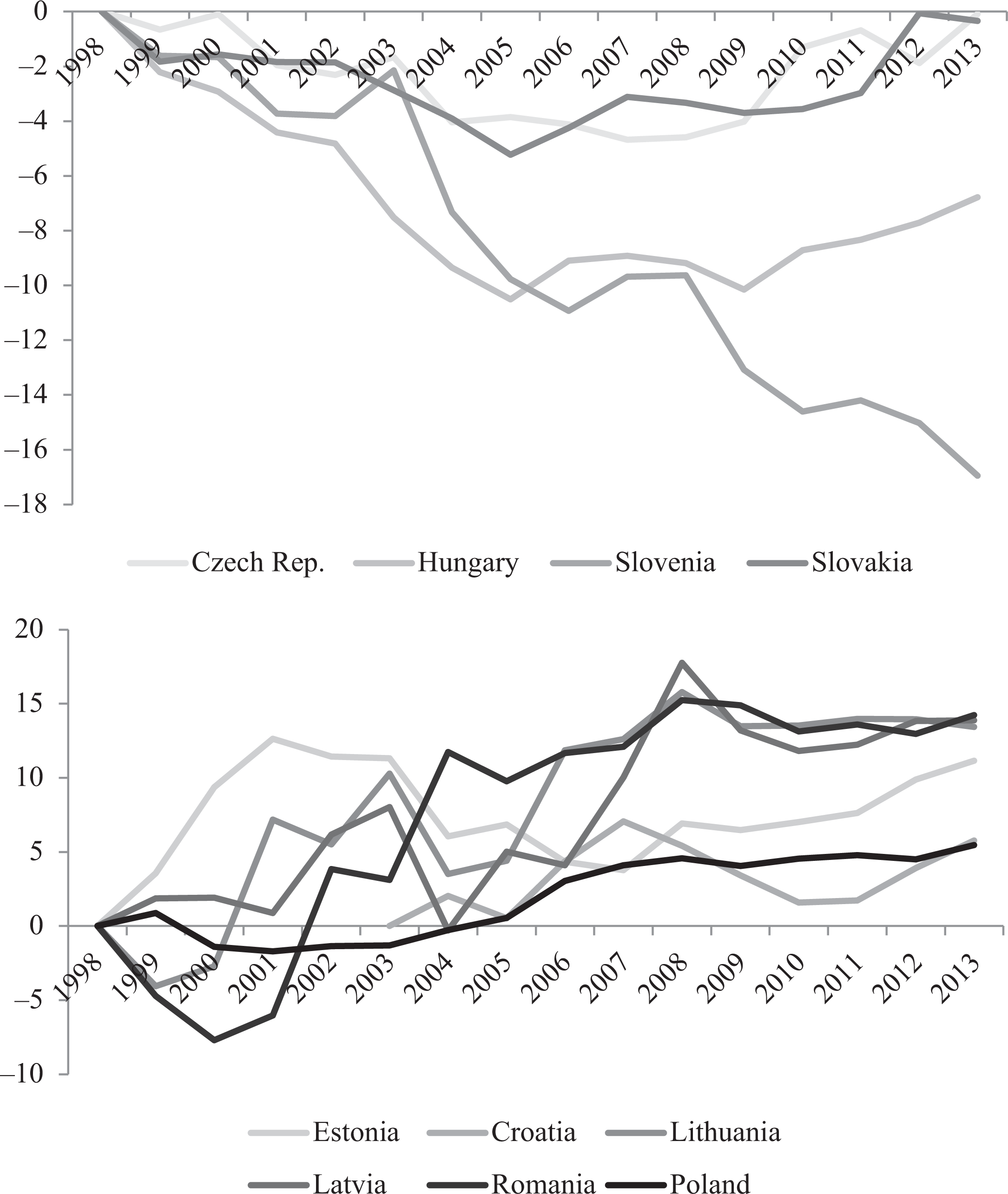
The evolution of routine cognitive tasks between 1998 and 2013 across 10 CEE countries.
The shift from manual to cognitive (both routine and non-routine) work in the CEE countries can be largely attributed to structural and educational changes undergone by CEE countries after the transition (Aedo et al., 2013; Hardy et al., 2016). Figure 2, based on Hardy et al. (2016), shows the results of the shift-share decomposition of task content changes into five factors, related to: i) structural changes, ii) changes in educational structure, iii) occupational changes, iv) changes within occupations (indirect influence of technology), and v) the interaction of these four effects. 3 The decomposition allows us to separate the impact of each of the above-mentioned factors on overall task content changes. It shows that educational expansion was the main factor behind the growth of non-routine cognitive tasks and the decline of manual tasks. Structural changes intensified both these developments, although their contribution was smaller than that of educational changes. However, structural change was the driving force behind the growth of routine cognitive content of jobs in the CEE. Had it not been for structural change, routine cognitive tasks in the CEE would have decreased. With the workforce migrating from agriculture to services, the importance of manual work shrank, while that of cognitive work increased. Hardy et al. (2016) show that in countries where agriculture receded most (such as Poland and Romania), the effect of structural change was most pronounced. In Slovenia and Hungary, the only CEE countries where routine cognitive tasks declined between the late 1990s and early 2010s, migration out of agriculture was of much lesser importance. Instead, the contraction of manufacturing drove the fall of routine cognitive tasks.
What are tasks and how are they measured?
Though closely related, tasks are not skills. A task is ‘a unit of work activity that produces output’ (Acemoglu and Autor, 2011). However, workers need a range of skills to perform various tasks; hence skills can be seen as the capability of workers to perform specific tasks. Researchers distinguish between four major job task types:
Non-routine cognitive tasks are typically performed by high-skilled workers. These tasks, often divided into analytical and personal subcategories, require abstract thinking, creativity, problem solving and strong communication skills. Computers complement the performance of non-routine cognitive tasks and improve the productivity of high-skilled workers. These tasks are commonly performed by professionals such as managers, designers, engineers and IT specialists.
Routine cognitive tasks are most often performed by medium-skilled workers. These tasks require the performance of explicit and repeatable sets of activities that can be easily coded into a computer programme. Computers can serve as substitutes for workers performing these tasks, such as clerks, sales workers, administrative workers, tellers and cashiers.
Routine manual tasks are typically performed by medium- and low-skilled workers. Like routine cognitive tasks, these tasks are highly ‘codifiable’ and automatable. Routine manual tasks are most often carried out by production workers such as assemblers and toolmakers.
Non-routine manual tasks are common for low-skilled workers. Carrying out these tasks requires situational adaptability, language and visual recognition, and social interactions. Drivers, farmers, mining and construction labourers are examples of workers who perform non-routine manual tasks. These workers are currently not replaceable by machines.
To analyse task contents in the CEE, Hardy et al. (2016) followed Acemoglu and Autor (2011) and constructed five task content measures. They used O*NET, the most commonly used source of data on the task content of occupations, and EU-LFS data with 3-digit occupational codes, the source of information on employment structures between 1998 and 2013. They exploited the 2003 and 2014 editions of O*NET in order to take account of within-occupation changes over time. They standardised task contents over time, for each country separately. To deal with shifts resulting from changes in occupational classifications (from ISCO-88 to ISCO-08 in 2011), they rescaled the task contents so that the means of task contents in the two years surrounding the introduction of ISCO-08 were equal. All task contents were expressed as intensities (average value per worker) and set to 0 in the initial year (1998), allowing the study of task content changes over time in a consistent and comparable manner.
Source: Own elaboration based on Acemoglu and Autor (2011) and Hardy et al. (2016).
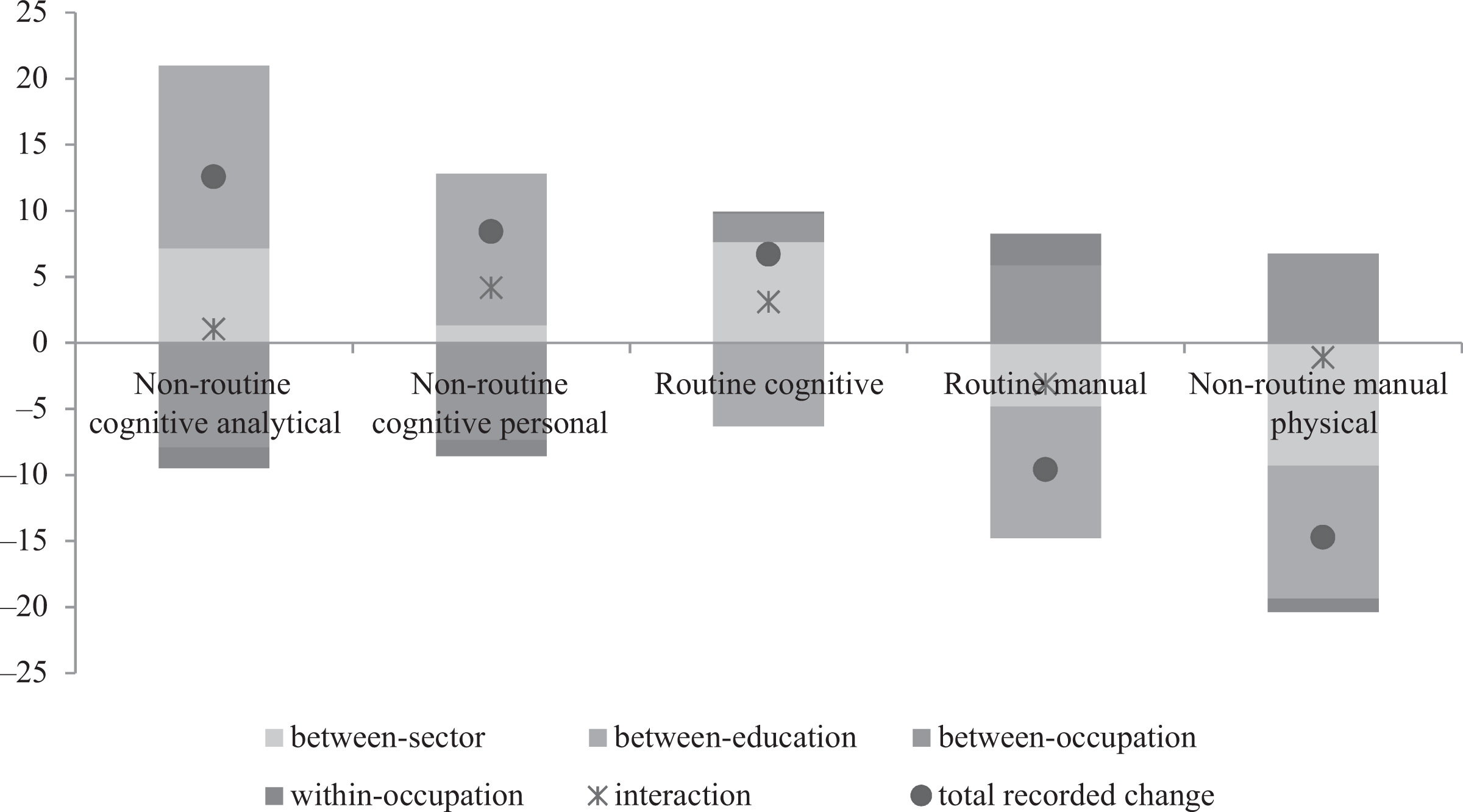
Shift-share decomposition of task content changes between 1998–2000 and 2011–2013 in the CEE countries.
What is the relationship between routine work and wages in CEE countries?
In most advanced economies, routine cognitive jobs tend to be medium-paid, while non-routine jobs are the highest paid and manual jobs are usually the lowest paid (Acemoglu and Autor, 2011; Goos et al., 2014). Using the EU Structure of Earnings Survey (EU-SES), we find that this is also the case in Central and Eastern Europe (Figure 3). In both 2002 and in 2010, 4 routine cognitive tasks were most abundant in the middle (fifth and sixth deciles) of the hourly wage distribution, and less abundant among the top 10 per cent of earners. In line with patterns observed in other countries (WDR, 2016), we find that in the CEE countries most workers in the top wage deciles mainly perform non-routine cognitive tasks, while workers at the bottom end mainly perform manual tasks. However, in 2010, jobs with high routine cognitive content were spread more evenly across the wage distribution than in 2002. This is both good and bad news. On the one hand, it suggests that low-paid workers are not increasingly dependent on manual tasks which, as discussed earlier, are in perpetual decline. On the other hand, routine cognitive work is becoming less common among the top 20 per cent of earners, and gaining ground among workers in the second to seventh deciles of CEE hourly wages, creating the risk of rising wage inequality in the future. If the incidence of work involving routine cognitive tasks were to decline, as has already happened in the US, western European and some CEE countries (Autor and Dorn, 2013; Goos and Manning, 2007; Spitz-Oener, 2006; Hardy et al., 2016), wage inequality between the top 20 per cent and the remaining 80 per cent would increase.
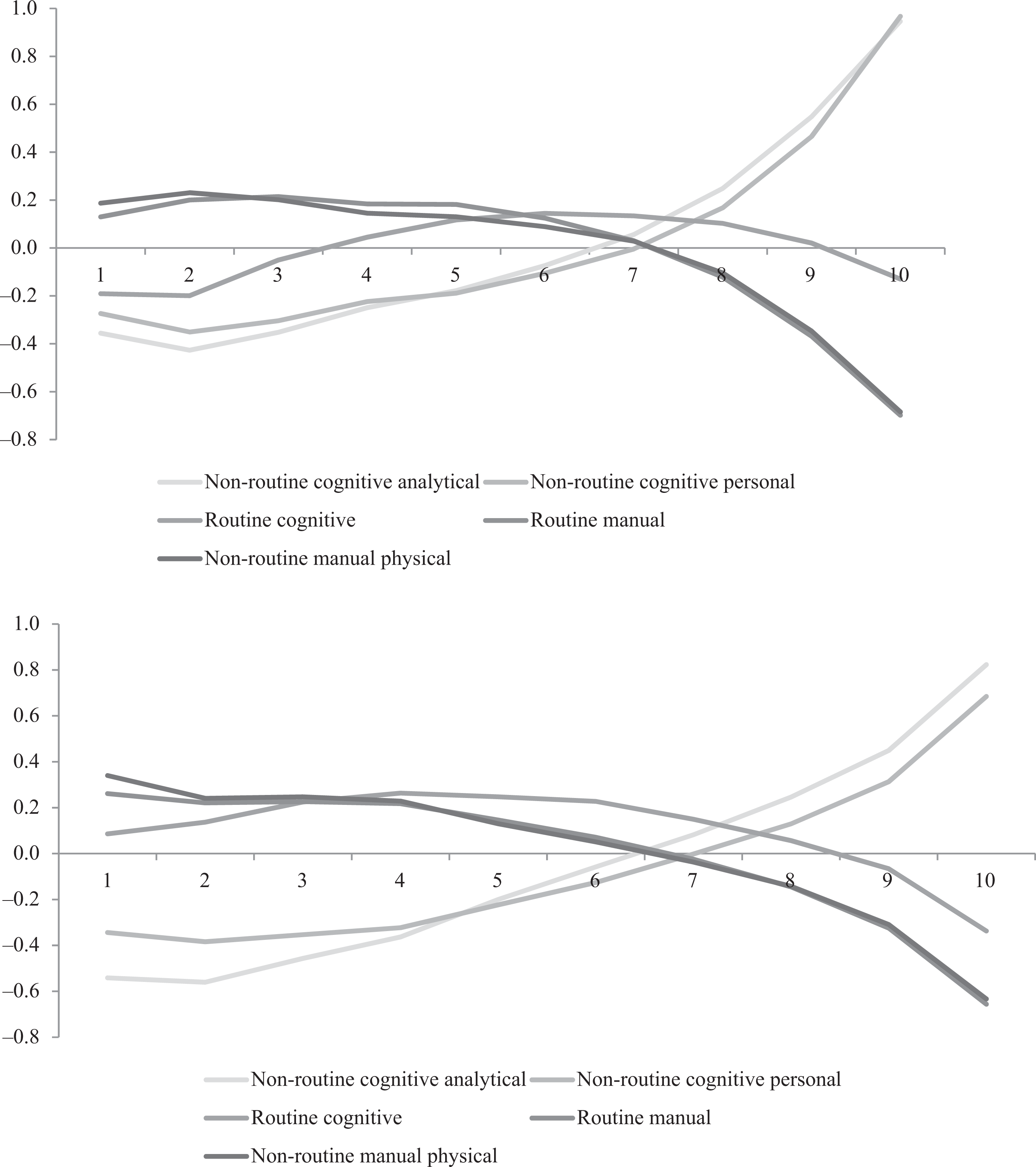
Average task intensities across hourly wage deciles in eight CEE countries, 2002 and 2010.
It is vital to look at task distribution across wages for each country separately, since they often display different patterns of occupational changes. We find that, in 2010, Poland and the Baltic States were the CEE countries with the largest differences in routine cognitive task intensity between workers in various deciles of the hourly wage distribution, as expressed by standard deviation at the wage decile level (Table 1). On the other hand, the Czech Republic and Slovakia were characterised by the lowest differences. Hungary was the only country in the EU-SES sample that experienced a drop in the routine cognitive intensity of jobs between late 1990s and early 2010s (Hardy et al., 2016). In Hungary, the 40 per cent of the lowest paid jobs displayed the highest intensity of routine cognitive tasks (see Figure 4 and Table 1), a feature distinguishing it from other CEE economies.
Standard deviation of routine cognitive task intensity by wage deciles, and average routine cognitive task intensity by wage quintiles in CEE countries, 2010.

Note: Croatia and Slovenia omitted due to lack of data.
Source: Own calculation based on EU-SES and O*NET data.
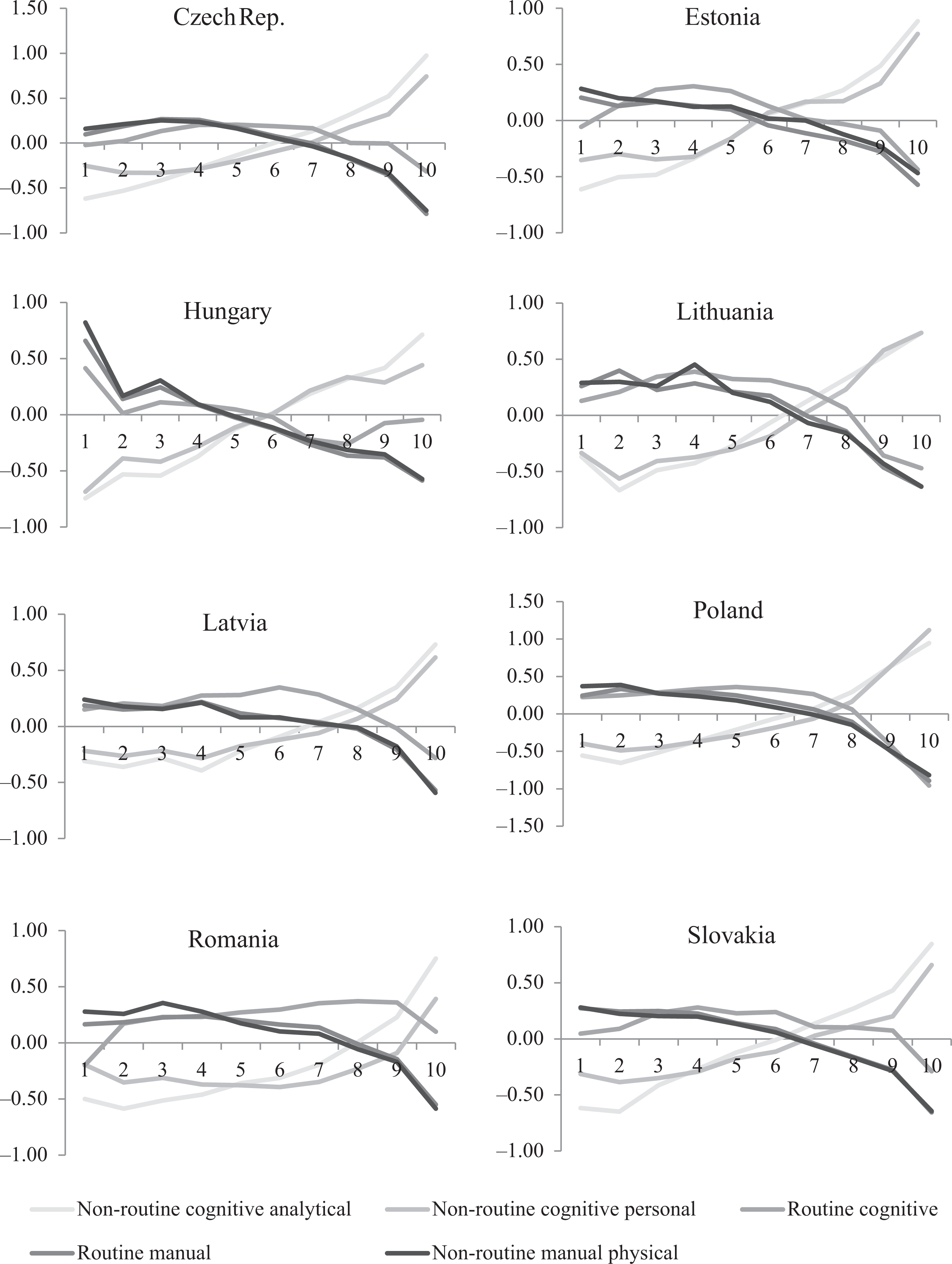
Task intensities across hourly wage deciles in eight CEE countries, 2010.
In general, those countries with the largest differences featured very much negative values for routine cognitive task intensity among the top 20 per cent of earners, and relatively high intensities among the 20 per cent of the lowest paid jobs. At the same time, these countries (except for Latvia) exhibited a large concentration of non-routine cognitive tasks among the top 20 per cent of earners (see Figure 4). Such a high concentration of routine cognitive employment in the bottom and middle wage distribution deciles could increase wage inequality substantially if the incidence of routine cognitive intensive jobs was to plunge. Having in mind that Poland, Latvia and Lithuania are also countries which have seen increasing routine cognitive employment, any decline in such jobs could pose a serious problem for these labour markets.
Who are the routine workers in CEE?
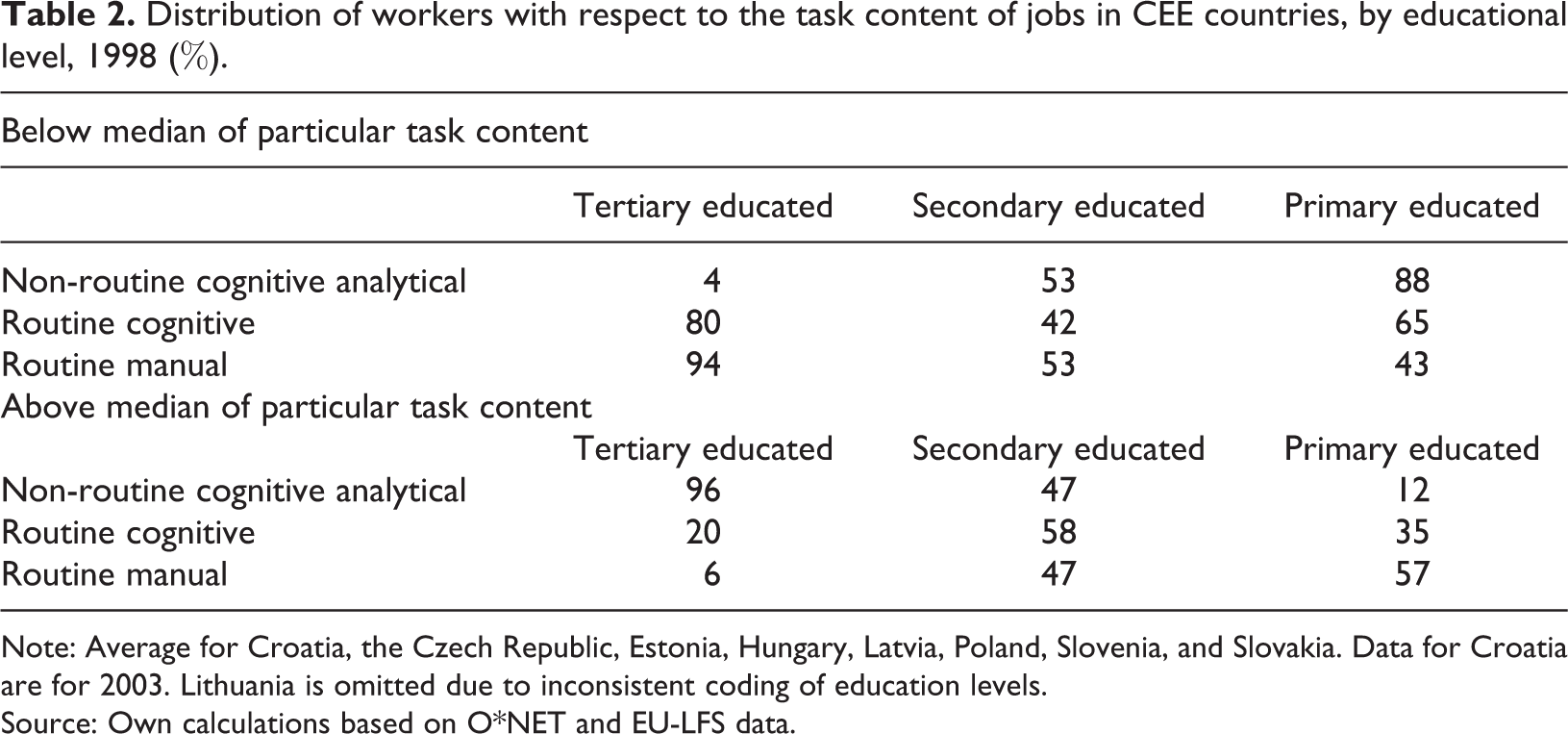
The answer to this question is not as straightforward as it may seem. The majority of previous studies on job polarisation or routine-biased technological change in other countries showed that routine intensive jobs were held mainly by medium-skilled and/or medium-paid workers (Acemoglu and Autor, 2011). However, the EU-LFS data show that in the CEE countries the mapping of education groups to task content is ambiguous: medium-educated workers are spread across distributions of routine manual and routine cognitive tasks (see Table 2).
Distribution of workers with respect to the task content of jobs in CEE countries, by educational level, 1998 (%).
Note: Average for Croatia, the Czech Republic, Estonia, Hungary, Latvia, Poland, Slovenia, and Slovakia. Data for Croatia are for 2003. Lithuania is omitted due to inconsistent coding of education levels.
Source: Own calculations based on O*NET and EU-LFS data.
To create profiles of routine workers, we use latent class analysis (LCA, see Collins and Lanza, 2010), a finite mixture model which estimates probabilities that certain individuals are members of particular latent classes. 5 We use the routine intensity index (RTI) measure, proposed by Autor and Dorn (2009), to capture the routine cognitive dimension of jobs. 6 Using 2013 EU-LFS data, we present results for three CEE countries — Estonia, Poland and Slovenia — in which the evolution of routine cognitive tasks has differed (Hardy et al., 2016). Estimations for the other countries and for a model expanded with a wage decile variable are available on request.
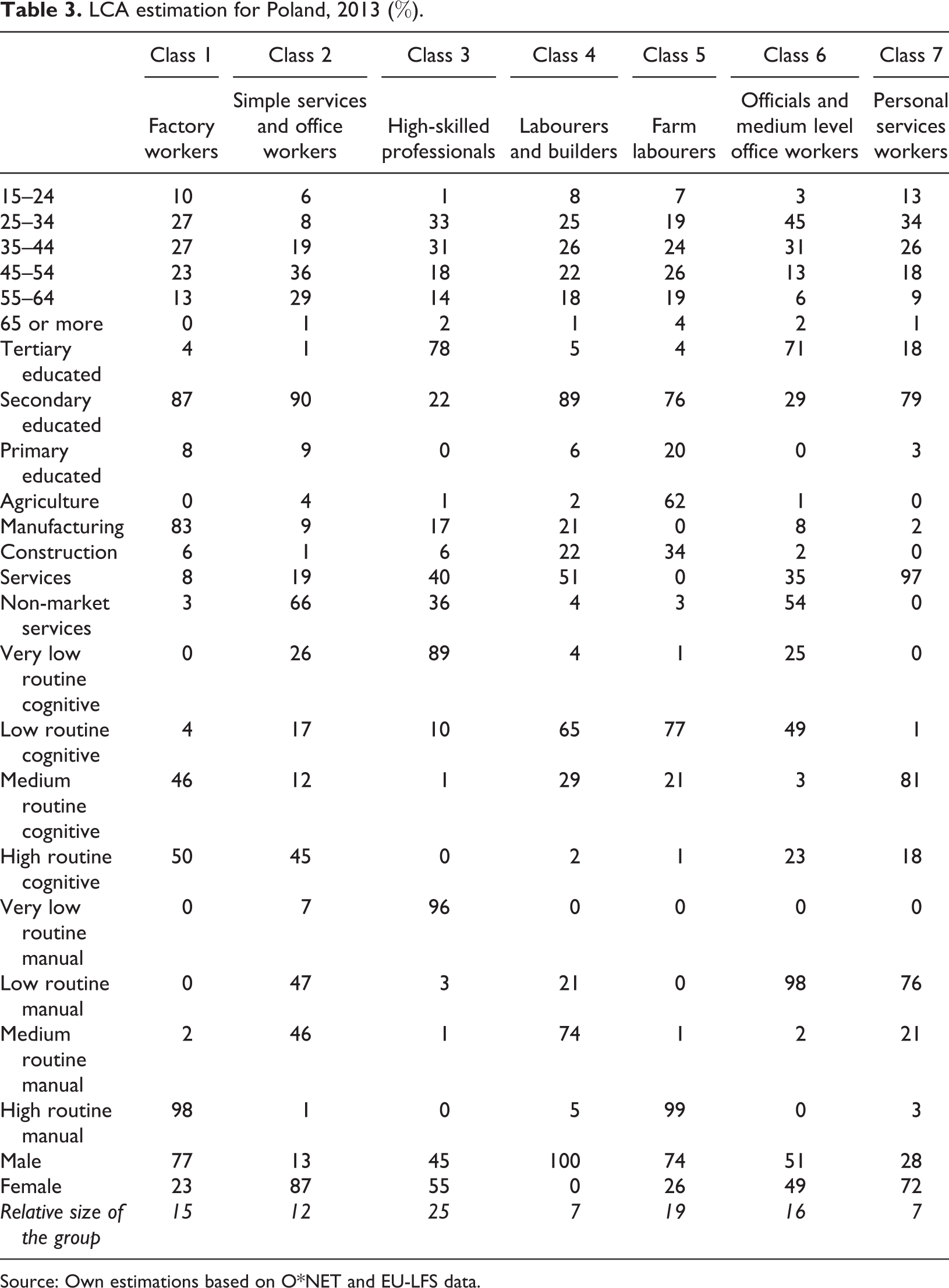
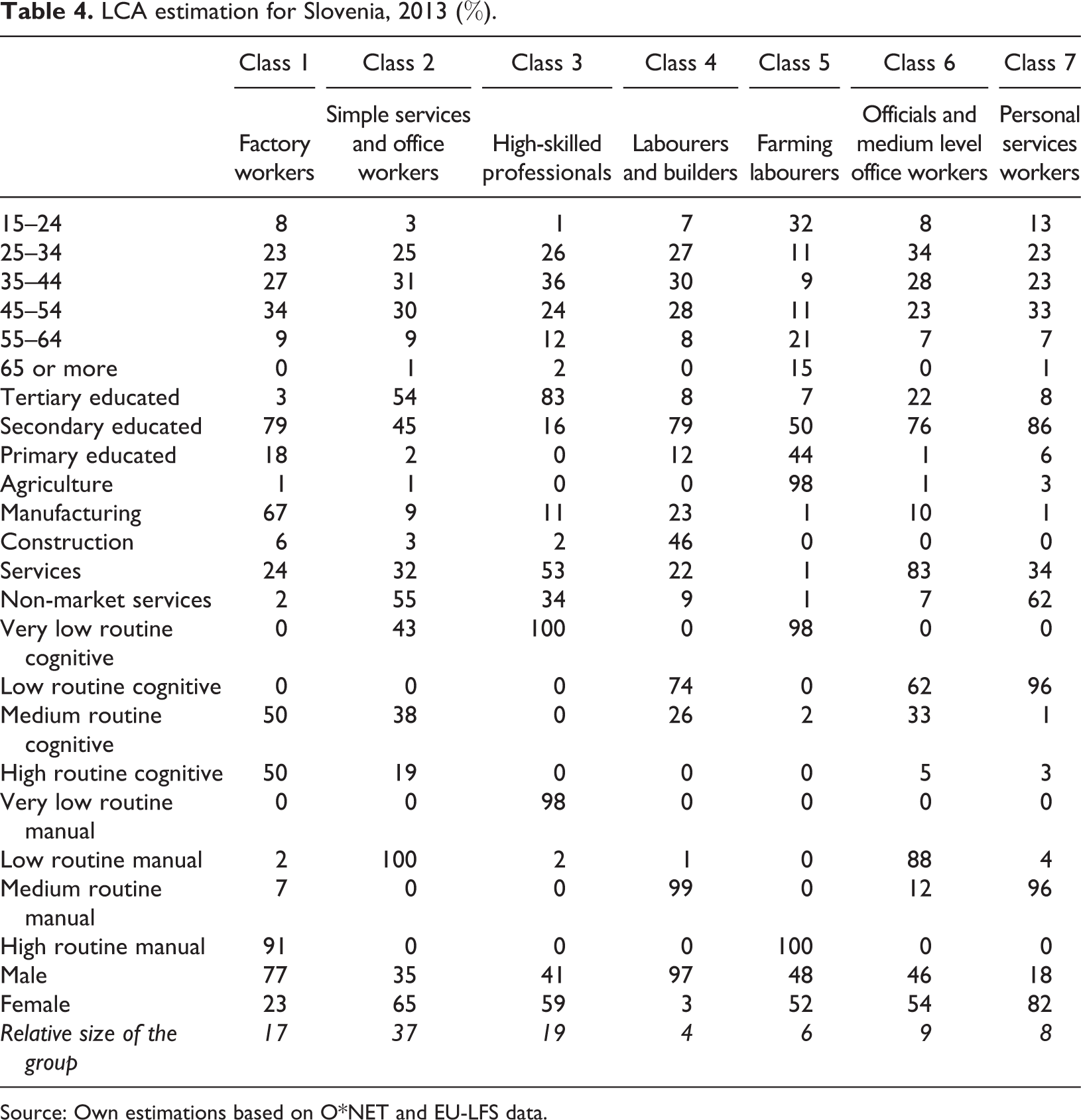
We identify the two most pervasive profiles of high-routine workers in the CEE countries. The first group, represented by Class 1 in Table 3, Table 4 and Table 5, accounts for 17 per cent of all CEE workers. Individuals in this group have a high probability of working in a highly routine cognitive job (cross-country average of 73 per cent). We also find that, on average in the CEE, 95 per cent of these workers are in occupations with a high incidence of routine manual tasks, and working in manufacturing (74 per cent). In all the CEE countries analysed except the Czech Republic and Estonia, males constituted a majority in this class. Most of these workers had secondary education (82 per cent on average), were aged 35–44, and were in the middle of the wage distribution.
LCA estimation for Poland, 2013 (%).
Source: Own estimations based on O*NET and EU-LFS data.
LCA estimation for Slovenia, 2013 (%).
Source: Own estimations based on O*NET and EU-LFS data.
LCA estimation for Estonia, 2013 (%).

Source: Own estimations based on O*NET and EU-LFS data.
The second highly routine group (Class 2 in Table 3, Table 4 and Table 5) is to be found in all countries except Slovenia and Romania, and accounts for 16 per cent of all CEE workers. A large share of these workers are in highly or medium routine cognitive jobs (75 per cent on average), though a large share of these jobs have few routine manual tasks (from 47 per cent in Poland to 100 per cent in Latvia, Slovenia and Slovakia). Most individuals in this group are women (87 per cent on average), and, in the majority of countries, have secondary education (for instance, 90 per cent in Poland, Table 3). However, in countries such as Estonia or Latvia, a relatively high share of these workers have tertiary education (36 per cent in Estonia, see Table 5, 34 per cent in Latvia). Members of this group also most often work in market services (dominant in Estonia, Latvia and Hungary) or in non-market services (dominant in the remaining CEE countries). In addition, most of these workers are situated in the lower end of wage distribution.
We have also identified the two most common profiles of workers with low routine cognitive task content. The first profile (Class 3 in Table 3, Table 4 and Table 5) represents the largest share of employment of all classes (21 per cent on average). Most of these workers have tertiary education (77 per cent on average; the highest share of all identified classes), and the vast majority of them work in a job with a very low intensity of routine tasks, both cognitive (88 per cent on average) and manual (86 per cent on average). People in this cluster generally work in market services (40 per cent) and non-market services (42 per cent), and more than half (57 per cent) are women. Most of them perform jobs with high non-routine cognitive content, and they are often well paid; for instance, 58 per cent in Poland and 47 per cent in Hungary were in the top quintile of wage distribution.
Workers in the second group with a low routine cognitive intensity (Class 4 in Table 3, Table 4 and Table 5) exhibit an above-median intensity of routine manual tasks. In the Czech Republic, Hungary, Slovenia and Estonia, most of them work in manufacturing or construction, whereas in the other countries (except Romania) most are to be found working in market services. The vast majority of them are men (almost 100 per cent on average) and have secondary education (84 per cent).
Finally, a separate profile of workers performing very low routine cognitive tasks has been identified in countries in which agriculture accounts for a relatively large share of employment. In Slovenia, Hungary, Estonia, Latvia and Poland, we distinguish a group (Class 5 in Table 3, Table 4 and Table 5) of individuals with a high probability of working in agriculture (on average 77 per cent). Most of them are men (71 per cent) and in highly routine manual jobs (90 per cent). Relatively large shares of them have only primary education (from 20 per cent in Poland to 44 per cent in Slovenia). Slovenia stands out in this respect, with its share of women (52 per cent) and of workers aged 64+ (15 per cent) higher than in the other countries (see Table 4).
Conclusions and policy recommendations
In this article, we have analysed the changes in the task content of jobs in Central and Eastern Europe between the late 1990s and the mid-2010s, paying particular attention to routine cognitive work. The Central and Eastern European labour markets have undergone a substantial shift from manual to cognitive work. In the second section, we argued that a crucial feature distinguishing the CEE from western labour markets was the resilience of routine cognitive tasks. Among CEE countries, a decline in routine cognitive jobs similar to that of the most advanced economies has only occurred in Hungary and Slovenia, whereas in Romania, Latvia, Lithuania and Poland the average intensity of routine cognitive tasks has increased substantially. Structural changes explain these different evolutions of routine cognitive tasks (Hardy et al., 2016). While western European countries have experienced substantial deindustrialisation, largely contributing to the hollowing out of medium-skilled and medium-paid cohorts in the 1970s–1980s, the majority of CEE countries have not (Eurofound, 2015, 2016). However, structural change in the CEE mainly entails the decline of agriculture, a largely manual-intensive sector, and the growth of services, whereas little deindustrialisation has occurred. This has resulted in the decreasing manual content and increasing cognitive content of jobs, especially routine ones.
In the third section, we showed that routine cognitive work has become more uniformly distributed among low-paid workers (the bottom 40 per cent of wage distribution) and medium-paid workers (the middle 40 per cent of the distribution), while it has become increasingly rare among highest paid workers (top 20 per cent). The countries with the highest discrepancy in 2010 were also the countries recording the largest growth of routine cognitive task intensity. In the fourth section, we applied statistical clustering methods to identify groups of workers most likely to perform highly routine work. The first group is made up of manufacturing workers, usually prime-aged men with secondary education and wages in the middle of the distribution. The other one is made up of workers in services, the majority of whom are women with secondary education and rather low wages. In 2013, these groups jointly constituted 33 per cent of all CEE workers.
These patterns are as yet no cause for concern, as they have largely been driven by sectoral shifts typical of economies converging with the most developed ones. This can, however, change in the future. As technology becomes more widespread and less expensive, the comparative advantage of routine workers will most likely shrink. Our estimate that 33 per cent of CEE workers had a highly routine job in 2013 is comparable with Arnzt et al.’s (2016) findings. Using different methods and data, they estimated that on average 43 per cent of workers in the Czech Republic, Poland and Slovakia performed jobs at risk of automation or significant change due to technological progress in 2012.
Policies aimed at alleviating the negative employment effects of this potential shift from routine labour-intensive production to technology-intensive production are therefore of crucial importance. In the area of lifelong learning, the CEE countries still suffer from a mix of low levels of worker awareness of the need to retrain; undeveloped and/or inefficient adult education systems; and low levels of private spending, in particular by employers (Sondergaard et al., 2012). Lifelong learning in CEE countries should be improved, and the ability to work in a technology-rich environment should be nurtured in every worker. Social dialogue on training should take account of the need to build general skills, alongside the narrow skill sets required by particular industries currently searching for workers. It is also crucial that vocational education achieves a balance between teaching skills required for particular occupations and boosting general numeracy, problem-solving and ICT skills. This is particularly relevant in the context of industrial occupations highly prone to automation. Vocational education curricula should take account of forecasts stating that the number of routine intensive jobs will shrink in the future, and that jobs involving non-routine manual tasks, especially in high-quality services requiring interpersonal interaction, can provide a medium-paid alternative. Trade unions should expect governments to produce and publish such forecasts of skills demand at national and (where relevant) regional levels.
A key challenge is also to improve and modernise higher education so that graduates are better equipped to enter occupations involving non-routine cognitive tasks. Although numbers of university graduates have risen in the CEE, these countries have struggled to adapt their traditional higher education structures, possibly contributing to a future over-supply of routine workers. Because cognitive gaps developed at an early age are extremely hard to fill later in life, it is crucial that all school pupils learn basic skills, with a focus on numeracy and problem-solving skills. Access to pre-school education and child care should be universal, and participation in pre-school education should be the default option for all children.
However, such initiatives are unlikely to transform all current and future routine workers into top non-routine workers. Some of these workers will need to remain in routine jobs. Thus, countries should seek to keep taxes on workers earning below-median wages as low as their social security and fiscal systems allow. Lower taxes would boost net incomes of workers performing mainly routine cognitive work, while also limiting wage pressure that could potentially reduce demand for routine work. Wisely regulated platform (‘sharing’) economies may also grow into important additional sources of employment and income for workers currently performing routine tasks. Efforts, also on the part of the social partners, are needed to ensure tax compliance and to ensure coverage of platform workers by social safety nets. It is also important to take action aimed at preventing the deterioration of labour standards which may happen if the production processes are divided into segments where large numbers of workers compete like contractors to perform standardised tasks (Drahokoupil and Fabo, 2016).
Footnotes
Acknowledgements
We thank two anonymous referees for their useful comments. We also thank Szymon Górka for his excellent research assistance and Wojciech Hardy for his many helpful suggestions. Data provided by Eurostat were used. Eurostat assumes no responsibility for the results and conclusions, which are solely those of the authors. The usual disclaimers apply. All errors are our own.
Funding
This work was financially supported by the Network for Jobs and Development initiative under the auspices of the World Bank, International Bank for Reconstruction and Development [grant number 502916-05].