



Abstract
The discussion on the possible implications of the digital economy for labour continues unabated. An essential dimension of the discussion is the widely shared view that a basic income could guarantee sufficient purchasing power for unemployed, underemployed and precarious workers should technological unemployment and labour market insecurity increase. A budget-neutral basic income has serious limitations as an economic stabilisation grant, but if financing proposals are revised, these limitations can be tackled. Even though guaranteeing sufficient purchasing power for unemployed, underemployed and precarious workers does not necessarily require an unconditional universal benefit, it seems clear that traditional activation based on strict means-testing and obligations will not be a strategy flexible enough to guarantee sufficient consumer demand in fluctuating labour markets. An economically sustainable solution might be to reduce means-testing gradually and to study carefully the effects.
Introduction
The idea of basic income, i.e. ‘an income unconditionally granted to all on an individual basis, without means test or work requirement’ 1 , has sparked debate throughout the world. In several countries, the possible implications of technological change for labour have been crucial in bringing this centuries-old idea of universally guaranteeing basic security back to the forefront of public debate.
It seems clear that at the technological level (e.g. Brynjolfsson and McAfee, 2014: 13–37), new digital technologies and artificial intelligence make it possible to minimise the need for many jobs currently providing wide employment. At the same time, it is likely that deregulation in labour markets will increase since digitalisation enables a more flexible organisation of work via different digital platforms (e.g. Valenduc and Vendramin, 2016: 29–38). Transportation and logistics is a textbook example: driverless vehicles are set to make millions of truck drivers redundant, while ‘uberisation’ is triggering protests among taxi drivers worried about their future.
However, given the polarised debate on the implications for labour, it seems probable that there will be neither scientific nor political consensus on how serious the disruption in labour markets is going to be. Long-term estimates vary from dramatic mass unemployment scenarios (e.g. Ford, 2015) to optimistic ‘everyone will do better’ forecasts (e.g. Miller and Atkinson, 2013).
In the first section of this article I sum up the two ideal-type digital economy scenarios. Based on this literature review I formulate a conservative scenario which works as a framework for analysing basic income in the context of the digital economy. My conservative prediction is that technological unemployment (at the very least in the short and medium term) and precarious jobs will increase, though the extent of the increase will depend on multiple interdependent factors.
Even though some commentators see the digital economy as an opportunity to challenge capitalism (e.g. Rifkin, 2014; Mason, 2015), most still consider the current societal system the most efficient arrangement for allocating welfare in the digital future too. The most obvious paradox of digital capitalism is that, regardless of the fact that productivity is expected to increase 2 , someone still needs to consume the produced goods. Numerous basic income advocates have argued that basic income would be an efficient measure to guarantee sufficient purchasing power and aggregate demand in the digital economy (e.g. Ford, 2015: 264–267; Reed and Lansley, 2016: 21; Santens, 2016).
In this article, I analyse whether a basic income can effectively increase the disposable income of unemployed, underemployed and precarious workers in the digital economy.
Does digital working life have a human face?
The ‘this time is different’ scenario
Ever since Oxford scholars Carl Benedikt Frey and Michael A Osborne published their widely cited article on the susceptibility of jobs to computerisation (Frey and Osborne, 2013), debate on the threat of increasing technological unemployment has continued without interruption. According to their estimates, which look at 702 different occupations, 47 per cent of US jobs are at risk of being computerised over the next two decades.
However, the main argument for the notion that ‘this time is different’ is based on an analysis suggesting that progression in digital technologies and artificial intelligence is exponential and stable. This is usually referred to as Moore’s law (e.g. Brynjolfsson and McAfee, 2015: 39–56). Faced with such exponentiality, it is harder to foresee the dynamics of the new demand for labour and harder for workers to adjust by education. For this reason, part of workforce will face a situation often called nowhere left to run.
Even if education remains the key solution to technological unemployment, it seems that at least the European workforce will have a hard time adjusting to changes in the type of skills needed. According to European Commission estimates (European Commission, 2016), 37 per cent of the EU workforce did not have adequate digital skills in 2015, and 13 per cent had no such skills at all. On the other hand, it has been emphasised that particularly interpersonal interaction, creativity and flexibility play a crucial role in the future labour markets. This implies that it is not necessarily digital skills that are the key for success in the digital economy.
The production of digital goods is claimed to be more capital-intensive than earlier production methods and as a result new businesses and industries are not expected to provide widespread employment (e.g. Ford, 2015: 175–176). Following this analysis, even if people are aware of the types of skills needed in the future, only the most talented would find employment.
Ford (2015: 175–176) uses YouTube, Instagram and WhatsApp as examples. YouTube was purchased by Google for about US$1.65bn when it employed just 65 people. The acquisition of Instagram cost Facebook US$1bn and Instagram employed 13 people. When WhatsApp was sold to Facebook for US$19bn in February 2014, it employed 55 people. Even the most successful digital firms seem to get by with fewer workers.
Many commentators argue that instead of job destruction, cooperation between humans and machines will increase (e.g. Autor, 2015; Valenduc and Vendramin, 2016: 23–28). However, commentators following the this time is different scenario (e.g. Ford, 2015: 121–126) have argued that this cooperation will not be long-term since in many cases workers will just help the machines to become better before they are replaced by them.
Even if workers are not replaced on a larger scale, tomorrow’s labour markets are expected to be more insecure due to the rapidly changing nature of work tasks and digitalised work organisation. Digital technologies do not mean just a threat of increasing technological unemployment, but also more flexible work organisation (Valenduc and Vendramin, 2016: 29–38).
The platform economy, gig employment, on-demand contracts, crowdworking and uberisation are concepts describing the wide range of possibilities offered by new digital technologies to break down production into smaller units. The organisational changes mean new work opportunities for people, but may also lead to worsening working conditions and less social protection for many.
The more rapidly and widely the digital organisation of work evolves, the more insecure labour markets will become, since the old institutions protecting labour may not have enough time to adjust to the new situation. The platform economy is based on non-standard and independent work which has its negative consequences: fewer rights to social protection, less training, weaker career progression and no access to credits. (OECD, 2016: 3–4)
The this time is different scenario suggests that without functional policies the digital economy will cause mass unemployment in the short and long term, sharp competition for the remaining jobs, declining salaries, stagnating economies, increasing inequality, indebted households, a breakdown of social cohesion and a concomitant rise in social tension. The key policy recommendation among this school is to provide everyone with a basic income.
The ‘this time is no different’ scenario
In the race between education and technology 3 , education has so far been the winner, with people able to re-educate themselves for new jobs. This is one of the main arguments why the other half 4 of the experts do not believe that things will be different this time. Historical evidence argues for relatively stable progress at the very least in the long term (e.g. Miller and Atkinson, 2013).
In addition to the historical evidence argument, mainstream economics offers an explanatory economic model. A compact summation of this is available in an article by a group of economists from Deloitte (Stewart et al., 2015: 1).
According to this model, technology has both direct and indirect effects. Direct effects consist of labour substitution and the expansion of innovation-based sectors. Substituting labour ought to lead to rising productivity and hence to lower prices. The expansion of innovation-based sectors is expected to increase demand for labour.
Indirect effects of technology consist of improved outcomes in sectors which then expand, leading to new demand for labour and allowing people, thanks to lower prices and reduced costs of production, to shift their spending to other goods and services, which in turn generates new demand for labour. These dynamics are believed to lead to positive outcomes at the very least in the long term.
Estimates on the susceptibility of jobs to automation change drastically if an alternative approach is employed. In a study by Arntz et al. (2016), which used a task-based approach, just 9 per cent of jobs on average are at high risk of being automated in OECD countries. This analysis is not interested in the average content of all jobs in each occupation, but the task content of individual jobs. This may be a more reliable starting point since, according to Autor and Handel (2013), the tasks within each occupation vary greatly.
The results suggest that alongside automation there may be more evolution of job tasks. According to a study by Chui et al. (2015), 47 per cent of the current tasks in the US could be automated employing current technologies, but just 5 per cent of jobs entirely.
Arntz et al. (2016) also remind us that economic preconditions need to be taken into account when analysing the possible threat of technological unemployment. First, technology uptake is a slow process. Secondly, workers are expected to be able to switch tasks. And thirdly, technological change also creates new jobs.
It is also necessary to note that political, social, legislative, organisational and technological factors may hinder the development. Trade unions and labour parties will most probably oppose any widespread displacement of workers, care ethics may prevent a robot revolution of the social and health-care sector and several new laws are needed to allow driverless vehicles on the road. Technology hype may also obscure technological bottlenecks: for instance, driverless vehicles are claimed to have serious difficulties in traffic or rainy conditions.
One can also ask whether global macroeconomic instability discourages businesses from investing in new technologies. Employing human labour may remain the more profitable option even though robots do not have annual leave, get sick or strike.
The this time is no different scenario suggests technological unemployment in the short or medium term and most importantly more convenient jobs for the majority. Wages are also expected to rise due to growing productivity. The key policy recommendation among this school is to invest in education.
A conservative scenario
Even though the presented ideal-type scenarios offer clearly divergent starting points for a discussion on the implications of the digital economy for labour, there seems to be consensus on the winners and losers of technological change. Commentators agree that predictable/routine work will be most at risk. This also includes predictable cognitive tasks. Creativity, interpersonal interaction and flexibility will be in high demand (e.g. Autor, 2015; Ford, 2015).
Another widely shared view is that the labour market will become polarised. There will be greater demand for high-skilled tasks (skill-biased technical change) which involve problem solving and interpersonal skills. Demand for some low-skilled tasks is expected to increase as well, but ‘the average’ (i.e. middle-skilled jobs) is believed to be over (OECD, 2016). However, Frey and Osborne (2013: 45) have emphasised that low-skilled and low-paid jobs are at greatest risk of being replaced. Autor (2015: 26) has also argued that employment polarisation will not continue indefinitely, since many medium-skilled jobs will still involve a task mix covering the whole skill spectrum in the digital economy.
Given the technological possibilities, a conservative scenario suggests that there will be at the very least short- and medium-term disruption to labour markets. This was the case in the earlier industrial revolutions and it is important not to dismiss the (social and economic) costs of the many displaced workers (Mokyr et al., 2015: 38). However, due to the complex interdependencies it would be risky to exclude the possibility of more serious disruption. I argue that in the context of the digital economy it is vital to have flexible policies able to cope with different scenarios.
The more widespread the disruption is, the more serious the challenges to be tackled will be. It is clear that even minor disruption can create major challenges at both microeconomic (poverty, income inequality, hysteresis, social exclusion, decreased social mobility) and macroeconomic (insufficient consumer demand, economic stagnation, budget constraints) levels. Since the global economic situation is far from what could be described as stable, disruption may have even more serious consequences.
In this article, I focus on the macroeconomic level. Regardless of how serious the disruption is, the most obvious macroeconomic problem will be insufficient consumer demand; at the very least in the short and medium term. Lower earnings translate into lower consumption and lower business profits, in turn leading to lower output. In this kind of economic environment firms do not invest and people change their consumption patterns, reflecting their long-term income expectations (permanent income hypothesis). This inevitably creates a vicious circle.
While more debt-driven consumption may prevent the deepest crashes, consumption based on private debt is only a sustainable option in digital economies when future financial crises can be prevented; not to mention the negative social aspects of debt-led private consumption.
In the digital economy, relative advantage is believed to lead to a Winner Takes All Society 5 (Brynjolfsson and McAfee, 2014: 147–162). Even if technological change creates tremendous prosperity for the few in the short or medium term, it is unrealistic to expect that such digital superstars would be able to consume enough to keep macroeconomic conditions stable. As Ford (2015: 265) puts it: ‘The billionaire is not going to buy a thousand smartphones, cars or restaurant meals.’
Increased unemployment, underemployment and/or the fragmentation of work would also mean greater competition for the remaining jobs. The most probable outcome of this is decreasing wage elasticity. The result, once again, would be less consumer demand and a more unstable macroeconomic situation.
Since my conservative scenario forecasts weakening purchasing power, I argue that future policies need to guarantee sufficient consumer demand in a socially and economically sustainable manner. Since consumer demand forms an integral part of aggregate demand in capitalist economies, guaranteeing sufficient consumer demand is a sine qua non for stabilising the digital economy. In the next section I discuss whether a basic income can be described as an economic stabilisation grant 6 as many have argued.
Even though guaranteeing sufficient consumer demand has been an essential argument for a basic income in the digital economy, it should be noted that it is not the only one. Tackling social issues such as increasing inequality and decreasing social cohesion have also been important dimensions of the current basic income discussion. However, in this article I focus on the macroeconomic argument in favour of a basic income.
Is a basic income an efficient stabilisation grant?
Income paid individually, universally and unconditionally on a regular basis regardless of other sources of income or disposable income sounds a simple idea for a social security benefit. However, what should be borne in mind is that discussing basic income at a general level is not a meaningful starting point since basic income as such is just a collection of different ideas, often with contradictory targets (de Wispelaere, 2015: 47). The amount of basic income (full vs partial), applied taxation model (budget-neutral vs redistributive) and the replaceable social security (basic security benefits vs all benefits) ultimately determine its effects.
Basic income models can be roughly divided into two categories: partial basic income and full basic income models. From an administrative perspective, partial basic income refers to a model which could replace most basic security benefits without diluting the current level of social security. A full basic income scheme means that the level of basic income would be much more generous, possibly even replacing all social security benefits. The definitions are naturally open to various interpretations (see Widerquist et al., 2013: xiv).
In this article, partial basic income refers to a model that does not significantly increase the level of social security benefits, whereas full basic income is expected to do that. Budget neutrality in the microsimulations refers to a requirement that the basic income be financed within the current social security system and by higher taxes on labour and capital income.
Intuitively it makes sense that giving people money with no strings attached would be an efficient option to guarantee sufficient consumer demand in the case of unemployment / underemployment increasing and wages declining. However, to achieve a significant macroeconomic impact on purchasing power, basic income should increase the disposable income of unemployed, underemployed and precarious workers above current levels.
In looking at how a basic income can increase people’s disposable income, the literature describes both direct options (1 and 2) and indirect ones (3 and 4). Direct options involve 1) lifting the current level of social security (i.e. implementing a full basic income scheme), and 2) combating economic disincentives (i.e. making work always pay), while the indirect options involve 3) improving workers’ bargaining power over their conditions of employment and 4) diminishing bureaucracy traps/increasing labour market flexibility (i.e. facilitating part-time work, self-employment and retraining).
In the coming sections, I will discuss the literature, assessing the strengths and weaknesses of the arguments presented. I then go on to discuss alternative financing proposals that would make basic income a more effective stabilisation grant.
Lifting the current level of social security
In times of serious recession, raising the level of unemployment benefits can be an efficient measure to increase aggregate demand. Clearly, the demand effect could be achieved also via generous basic income schemes that would have the effect of lifting the current level of social security.
Most concrete basic income proposals refer to a partial basic income model which would replace just basic social security benefits, leaving earnings-related benefits untouched. The obvious explanation for this is that a full basic income, which normally means lifting the current level of social security, is expected to face more financing obstacles than partial models whose direct effects on demand might not be that significant.
According to microsimulations carried out in Finland it seems clear that a budget-neutral full basic income faces challenges at either microeconomic (high income taxation) or macroeconomic (budget constraints) level. A budget-neutral basic income of €1000 7 a month would require a flat-rate tax of 60 per cent, while one of €1500 a month would already mean a flat-rate tax of 79 per cent (Kangas and Pulkka, 2016). If unemployment and underemployment increase as I forecast, meaning fewer taxpayers, the tax burden is naturally even heavier.
An alternative, seemingly economically more feasible, choice might be to implement a negative income tax (NIT) (e.g. Brynjolfsson and McAfee, 2014: 237–241) since only people unable to earn a politically determined minimum income (the break-even point) would benefit from it. In other words, NIT is gradually phased out after the break-even point and recipients start to pay ‘positive’ tax on higher incomes.
In terms of its definition, negative income is not the same as basic income, though the economic implications at both micro and macro levels are similar. Since NIT is also unconditional, this leads mathematically to a similar after-tax/after-transfer distribution of income (Widerquist et al., 2013: xvii; Kangas and Pulkka, 2016). To put it differently, NIT is not economically ‘Better Than Basic’ as Brynjolfsson and McAfee (2014: 237) have suggested.
Increasing the disposable income of unemployed, underemployed and precarious workers through a budget-neutral generous basic income or NIT thus seems to be an economically unfeasible option. Direct macroeconomic gains of a partial basic income would not be significant in countries which already guarantee extensive social security, whereas implementing a full basic income scheme, i.e. lifting the current level of social security with basic income, faces serious economic constraints (high income taxation or budget deficits).
Making work always pay
One of the most essential arguments in favour of a basic income has traditionally been that a basic income is a practical measure to diminish economic disincentives in social security and make work pay (Widerquist et al., 2013: xv–xvii). Economic disincentives, sometimes referred to as poverty or unemployment traps, refer to a situation in which taking up low-paid work, whether on a part-time or full-time basis, does not significantly increase one’s disposable income. In some cases (e.g. single parents), disposable income may even decrease.
This was the main argument for experimentally introducing the first nationwide basic income scheme in Finland in January 2017 (Kangas and Pulkka, 2016). For this experiment, 2000 randomly selected recipients of basic unemployment benefits will receive a partial basic income matching their current benefit level (€560 a month) for two years. Since the current progressive taxation is also applied in the experiment, the economic incentives for the participants are significant (i.e. the basic income is not taxed away). Since the model is not coordinated with taxation, the experiment has been widely criticised as testing an unrealistic basic income model.
Given the importance of this argument for basic income advocates, it is rather surprising that extensive microsimulations carried out for the Finnish basic income experiment show that it is difficult (if not impossible) coherently to boost economic incentives without diluting the current level of social security and without budget constraints. Tables 1 and 2 show participation tax rates for budget-neutral partial and full basic income schemes. The participation tax rate (see e.g. Brewer et al., 2008: 8) indicates to what extent one’s gross salary is diminished by taxation, lost benefits and income-related service charges such as child-care charges when one starts to work. To put it differently, the higher the percentage rate, the lower the financial rewards to work are. If current benefit levels are diluted or income tax and service charges lowered, this automatically also lowers participation tax rates, though at the same time it either increases income hardship or budget expenditure. Applying the current progressive taxation would lead to a budget deficit of €11bn if the model were implemented at state level. Total public expenditure in Finland in 2017 is €55.2bn.
Participation tax rates for a single person.
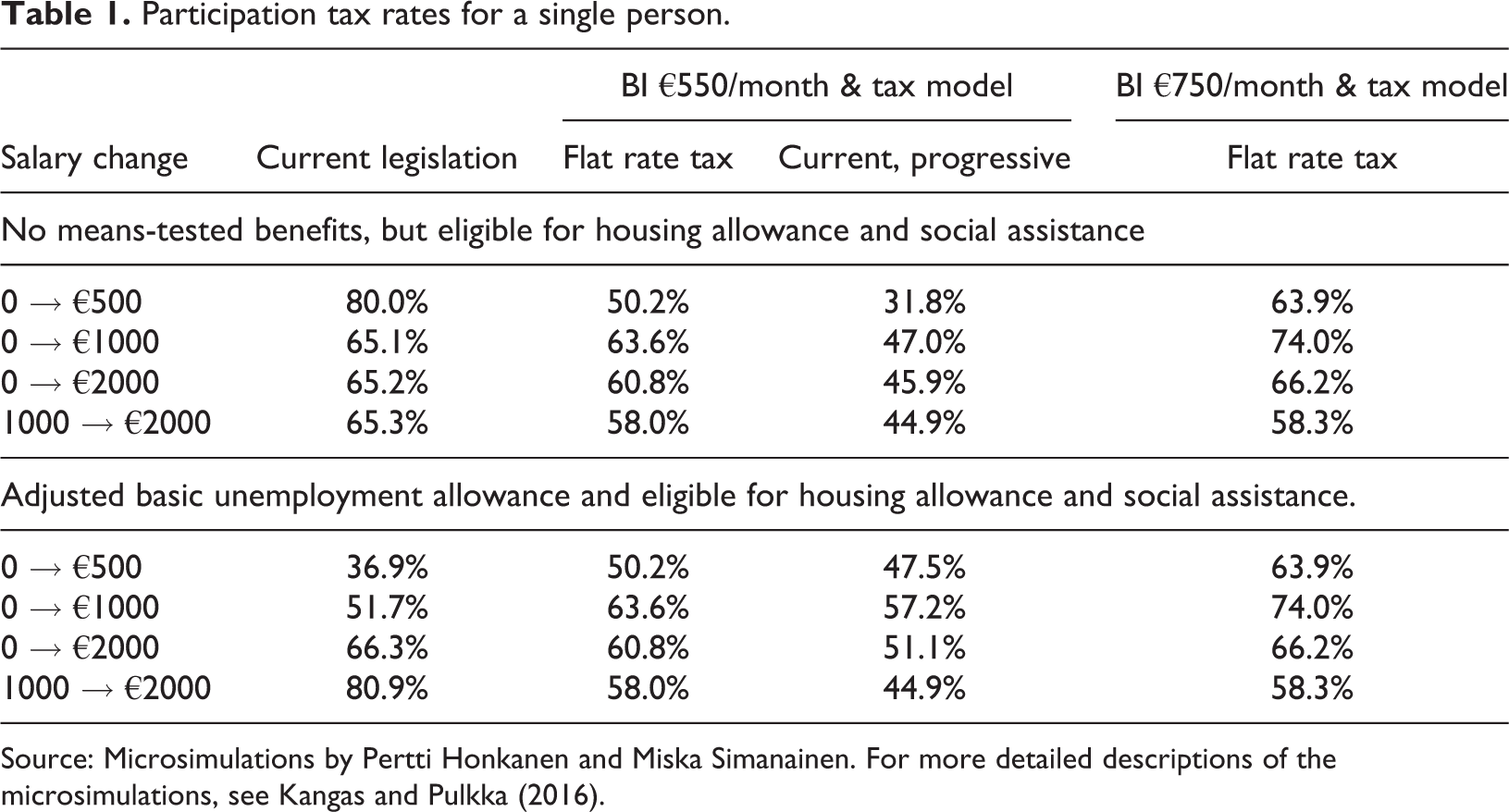
Source: Microsimulations by Pertti Honkanen and Miska Simanainen. For more detailed descriptions of the microsimulations, see Kangas and Pulkka (2016).
Participation tax rates and full basic income.

Source: Microsimulations by Pertti Honkanen and Miska Simanainen. For more detailed descriptions of the microsimulations, see Kangas and Pulkka (2016).
The results of the Finnish microsimulations cannot be automatically transferred to other welfare state regimes, though the underlying logic can prevent economic incentives arising elsewhere: if you do not want to dilute the current level of social security with a budget-neutral basic income, options are scarce. In particular, replacing housing allowances and earnings-related unemployment benefits with a single universal benefit is complex, since housing costs can vary drastically between municipalities and earnings-related benefits form an essential part of social security in many European countries. Also, when discussing purchasing power in the digital economy, any replacement of earnings-related benefits by a lower basic income will reduce people’s disposable income.
The difficulty of replacing housing allowances by a basic income was also discussed in a report by the British Royal Society of Arts (Painter and Thoung, 2015: 33–35). The authors suggest a Basic Rental Income, an unconditional extra benefit based on market conditions and continuous residency. Basic Rental Income would be granted solely to those renting accommodation (i.e. tenants). However, even this model leaves questions open: how to monitor where and with whom people are actually living and whether the system is efficient compared to means-tested schemes. So far, no functional solutions have been presented in basic income literature.
Instead of incentivising people to participate in labour markets, basic income may also have the opposite effect, enabling people to quit the labour market or decrease their workload. Even though the basic income experiments carried out in the USA and Canada in the 1960s and 1970s do not give much support to a moral hazard effect (e.g. Widerquist, 2005), increased ‘freeriding’ would have negative effects on people’s disposable income. Even though the effect is disputable, the debate on this moral hazard effect remains perhaps the most fundamental obstacle to tackle for basic income advocates. This is something that should be studied particularly carefully in future basic income experiments since belief in the validity of moral hazard theories has legitimised not just lowering income taxation, but also stricter sanctions, more obligations and benefit cuts. Moral hazard hypotheses expect the unemployed to have an incentive to favour leisure over working, thereby weakening social security, while obligations and sanctions can incentivise the unemployed to find employment faster.
On the other hand, legitimising the exit option might also have opposite effects on the purchasing power of particularly precarious workers, as discussed in the next section.
The bargaining power of precarious workers
Basic income is expected to impact general labour market equilibrium via changes in labour supply: when labour supply increases, wages go down, whereas a reduced labour supply pushes up wages. Under an economic model developed by Rothstein (2010), basic income 8 is an effective measure to raise the lowest wages.
Following this logic, basic income has often been conceptualised as ‘personal strike pay’, able to decommodify labour and ease negotiations over better employment conditions (e.g. Vanderborght, 2006; Wright, 2006; Standing, 2011b: 178). In other words, if the social security system guaranteed sufficient income and did not impose means-testing or obligations on the unemployed, wages of precarious workers could increase, as it would be easier for them to turn down unsatisfactory offers.
However, Birnbaum and de Wispelaere (2016) have argued that basic income offers a real exit option precisely when there are better jobs available. According to them, those most vulnerable in the labour market tend to face structural restrictions such as short-in-demand or exclusive skill requirements. In such an economic environment, a probable scenario (particularly in the digital economy) would be to quit completely the labour market instead of finding a better job.
The authors also note that replacing workers can be a cheaper option for an employer than raising their wages or guaranteeing better working conditions. In the digital economy, facilitating a collective exit option may become an incentive for the employer to replace workers by machines. Birnbaum and de Wispelaere argue that basic income may even worsen the bargaining power of the least advantaged when an employer decides to improve the working conditions of higher-value workers as a retention strategy (2016: 67–69).
We should bear in mind that if the implemented scheme involves drastically diluting the current level of social security and/or weakening other support schemes such as public services, the effects on bargaining power could well be negative. Unconditionality per se does not automatically strengthen the bargaining power of workers if the level of basic income and other support schemes are not adequate to live decently, i.e. if basic income maintains dependency on earned income and an employer.
Despite the limitations of the decommodification argument, it is interesting that even the labour movement, and especially the trade union movement, has been critical of the idea of a basic income. Even if unconditionality is no panacea for precarious workers, it is hard to see that unconditionality per se could be a mechanism automatically threatening workers’ bargaining power. Though a basic income may be seen in conjunction with a weakening of collective agreements or labour laws, this is not inherent to the idea of a basic income. As Birnbaum and de Wispelaere emphasise, the specific economic environment frames the probable labour market outcomes of a basic income.
Producing robust estimates on how a basic income impacts overall economic equilibrium (i.e. on wages) requires cluster-randomised controlled trials. As yet, there are no plans for such, meaning that the decommodification argument will continue to lack reliable empirical data in the near future.
Should Rothstein’s economic model be valid (i.e. introducing a basic income would lead to higher wages in a wider economic region), implications for aggregate demand and productivity growth might also be positive, as suggested by any wage-led growth strategy (e.g. Lavoie and Stockhammer, 2012). However, it is probable that this will not necessarily be the case in the digital economy.
Diminishing bureaucracy traps and increasing labour market flexibility
While ICT can automate many benefit application processes, means- and income-testing lead to bureaucracy traps (i.e. psychological disincentives) hindering people from working on a part-time basis, entering self-employment or combining paid work and self-employment. Reducing such traps may incentivise people to increase their economic activities. Indeed, working on a part-time basis or entering self-employment may currently appear as a potential risk to the unemployed – an unsustainable situation particularly in the digital economy with its increased fluctuations.
Even though reducing economic disincentives through a basic income is difficult, bureaucracy could be significantly eased. While partial basic income schemes naturally leave certain benefits untouched, many of the pitfalls stated above could be tackled.
Silicon Valley entrepreneur Martin Ford (2015: 267–268) links basic income with Peltzman’s effect, i.e. that people are more willing to take risks when their basic security is guaranteed. Discussion on basic income as an incentive for entrepreneurship is, however, decades old.
Nooteboom (1987) argued 30 years ago that a basic income would provide a compensation for diseconomies of small scale, incentivise wage-earners to become entrepreneurs, replace complicated and inefficient small business support schemes and reduce unfair competition presented by recipients of start-up grants.
The knowledge-driven digital economy is expected to offer people a better chance to work for themselves, since production does not necessarily demand as much invested capital as under industrial capitalism. The platform economy also offers new opportunities for self-employment.
Taking these factors into account, a basic income can be seen as a flexible start-up grant. Basic income experiments can shed light onto this entrepreneurship hypothesis, though it should be borne in mind that fixed-period trials cannot reveal the universal truth since people are aware that income security is just temporary.
In addition to increased entrepreneurship, lifelong learning has been mentioned again and again as one of the most crucial factors behind successful knowledge economies in the EU. The importance of education is highlighted in the context of technological change since history has shown that the race has been particularly between technology and education. While estimates of labour market disruptions vary greatly, it can be argued that all scenarios expect people to be able to re-educate themselves more flexibly than is currently the case.
Digital technologies offer several innovative measures (e.g. Massive Open Online Courses or MOOCs, smarter remote access, digital publications) facilitating lifelong learning. More people are now accessing educational resources than ever before. Though there will undoubtedly be attempts to further commercialise this area, at least on the technological level educational equality has been increased both nationally and globally.
However, the possibilities for lifelong learning depend not only on access to education, but also on other personal resources; in particular time and money. To take advantage of new educational opportunities, people must also be sure that their income security will not be threatened if they choose to prioritise skill development over job-seeking. Since labour markets seem to be becoming more insecure, conceptualising student loans as investments in the future does not sound reasonable anymore. It may be axiomatic to say that an unconditional guaranteed income enables studying and re-training more flexibly than current means-tested systems.
Based on the previous paragraphs, basic income appears to be an efficient measure to reduce bureaucracy and increase workers’ ability to adjust to labour market fluctuations. However, one can also argue that reducing bureaucracy or facilitating entrepreneurship and lifelong learning does not necessarily require unconditionality. Access to real-time information on people’s incomes (digital registries) would help reduce delays and reporting obligations, unemployment benefits could be used more flexibly for starting up a business or studying, and sanctions could be gradually decreased to check what is working and what is not.
It is therefore obvious that a basic income is not the only option to guarantee labour market flexibility in a socially sustainable manner. However, if technological unemployment and labour market insecurity increase, it is clear that strict means-testing and obligations will not be flexible enough to guarantee adequate purchasing power for unemployed, underemployed and precarious workers.
Financing proposals revisited
Increasing disposable income via a budget-neutral basic income is not necessarily more efficient than fine-tuning current means-tested schemes. However, if financing proposals are revised (i.e. no budget-neutrality requirements), the situation may change.
The microsimulations presented in this article are based on taxes on labour. A relevant question in the context of the digital economy is, however, whom and how to tax in an economy which needs less human labour; i.e. an economy with fewer taxpayers.
Arguing in favour of sustainable financing mechanisms has always been one of the greatest challenges for basic income advocates. Hence it is not surprising that there is a diverse collection of ideas about how to finance basic income, such as higher consumer or corporate taxes, resource or wealth taxes, taxes on capital speculation, cap-and-dividend and even crypto-currencies (de Wispelaere, 2015: 59–61).
In his famous book Agrarian Justice (Paine, 1945[1797]: 605–623), Thomas Paine advocated the idea of a citizen’s dividend. In short, this meant that wealth based on commonly produced conditions (such as natural resources or accumulated knowledge) should be redistributed.
Innovation studies suggest that the state, as a risk financier, strategic leader and partner in cooperation, is and has been a crucial driver of many major technological innovations (Block and Keller, 2009; Mazzucato, 2013). Since the logic of capitalism shares profits among scarce winners, it can be argued that at a time of revolutionary innovations economic abundance should be distributed more equally when the state (i.e. taxpayers) is the driving force, fundamentally involved in picking winners, as Mazzucato (2013) has alleged.
A more flexible organisation of work, more capital-intensive means of production and zero-marginal or quasi zero-marginal costs may also be an incentive to produce goods in the social/non-market/shared economy (Wright, 2006; Mason, 2015: 284–285), i.e. co-ops, volunteering, peer production and other forms of ‘free work’. As Brynjolfsson and McAfee have argued, GDP may not be the most functional tool to measure the wealth produced in digital economies, since it excludes many aspects of today’s production. Since people also contribute to production outside formal employment, the case has been made that wealth ought to be redistributed automatically via a basic income.
Following these arguments, many basic income advocates would like to see robot taxes on capital as a new, redistributive financing instrument in the digital economy. IMF economists Berg et al. (2016: 13) are frank in stating: ‘The advantages of a basic income financed by capital taxation become obvious.’
However, globalisation allows capital to flee taxation, as also noted by Berg et al. (2016). According to these IMF economists, the crucial question will be who owns the new technologies (see also Freeman, 2015).
At the same time, it is quite justified to argue that moderately redistributive basic income would not be economically disastrous. A study by Cingano (2014) has shown that income equality has had a statistically significant effect on subsequent growth in OECD countries (see also Ostry et al., 2014). This implies that the risk of increasing inequality, highlighted by many commentators of the digital economy (e.g. Berg et al., 2016), is also a risk of increasing economic stagnation and should be addressed effectively.
However, since a heavy tax burden on capital may not be the most efficient option from an economic perspective, I argue that reconsidering monetary policies may be the only option for a serious discussion of basic income schemes also increasing the disposable income of digital economy losers (see also Reed and Lansley, 2016: 21). Heterodox scholars in particular have argued that central banks could play a more active role in financing infrastructure investments and social welfare. This sort of functional finance (Lerner, 1943) might be at least a partial solution for financing basic income, whether full or partial.
While functional finance remains in the realm of heterodox economics, discussion around revisiting the role of central banks is increasing. The idea of helicopter money, popularised by Milton Friedman, has been gaining attention in European public debate, and initiatives demanding quantitative easing for people have attracted support even among mainstream economists (e.g. Saravelos et al., 2016).
Financing basic income via functional finance and moderate robot taxes would make it economically more sustainable to cut taxes on labour (i.e. make work always pay), increase social security levels and possibly improve the bargaining power of precarious workers. To put it differently, it would make it possible to boost the disposable income of unemployed, underemployed and precarious workers.
However, under these preconditions the stabilising effect would not result from any inherent mechanism of a benefit paid with no strings attached (apart from workers’ better bargaining power) but from tax/monetary reforms and more generous social security.
Concluding remarks
Many scholars and debaters have once again proclaimed the end of work. At the same time, the other half of the commentators remain convinced that technological unemployment will not be a serious risk at least in the long term.
Based on my conservative scenario, I have argued that technological unemployment will increase at the very least in the short and medium term and that future labour markets will be more precarious. These tendencies will reduce consumer demand, meaning that future policies will need to increase the disposable income of unemployed, underemployed and precarious workers to stabilise the digital economy.
However, redesigning social security is probably not the only option to guarantee sufficient aggregate demand in the digital economy. Proactive finance policies, guaranteed job programmes and employee funds (i.e. addressing the question of who owns the robots) should also be discussed in this context. What should be also borne in mind when discussing ‘sufficient’ consumer demand is that tackling the ecological crisis may not even allow current consumption patterns to be reproduced. Analysing these questions are, however, outside the scope of this article.
Numerous basic income advocates have argued that basic income would be an efficient way of guaranteeing sufficient purchasing power for unemployed, underemployed and precarious workers in the digital economy. My analysis shows that basic income can increase disposable income of these population groups indirectly, insofar as reduced bureaucracy and increased flexibility incentivise people to work on a part-time basis and/or enter self-employment. Similarly, facilitating flexible lifelong learning and retraining via a basic income might have positive effects on people’s income development. However, contrary to general belief it is hard if not impossible to decrease economic disincentives coherently through a budget-neutral basic income. Basic income does not always make work pay.
Whether a basic income improves the bargaining power of workers over their employment conditions remains disputed. It is reasonable to say that, besides the characteristics of the model implemented, the economic environment and other policies will ultimately determine the outcome. The idea of a basic income can be combined with deregulating labour markets as a political trade-off, but it has no inherent mechanism automatically requiring such a step. Since it seems clear that a basic income scheme cannot remove bargaining inequality in labour markets, there are few arguments in favour of weakening labour laws if a basic income is implemented, particularly in a digital economy subject to greater fluctuations.
I have argued that moderate robot taxes and functional finance could make it possible to implement a more generous basic income and even decrease economic disincentives in the social security system. However, paradigm shifts in tax and monetary policies would also facilitate the introduction of more generous and incentivising means-tested schemes.
Means-tested social security systems can be developed into less bureaucratic functional entities better to address future challenges. The digital economy does not necessarily require benefits with no strings attached. At the same time, it is difficult to see traditional activation policies based on strict means-testing, obligations and sanctions maintaining their legitimacy if demand for human labour decreases and labour market insecurity increases.
From an economic perspective, the most sustainable solution may be gradually to move towards less conditional social security, carefully studying what actually works. Combining benefits, reducing income- and means-testing, cutting back obligations and sanctions gradually and giving the unemployed more opportunities to define meaningful activities themselves, could facilitate a sustainable road to digital flexicurity. If this learning process proves that such reforms are insufficient, the idea of a universal basic income will remain as the light at the end of the tunnel.
Footnotes
Acknowledgements
I want to thank Pertti Honkanen, Joel Kaitila, Johanna Perkiö, Miska Simanainen and Jurgen de Wispelaere for many helpful comments on earlier drafts.
Funding
This research received no specific grant from any funding agency in the public, commercial, or not-for-profit sectors.