



Abstract
This article discusses the changes in employment relationships under globalisation and, more specifically, the phenomenon of triangulation and the attendant proliferation of employment grey zones. The first section sets out a framework for analysis of the conditions governing the organisation and exercise of power by employers in such situations by reviewing two types of relationship: an agency relationship and a relationship of intervention. Drawing on fieldwork and a number of case studies, the second part examines how human resources managers in large corporations use their powers of discretion in these situations. The third part analyses this particular form of regulation with regard to the nature of the subordinate relationship of employees to their employers. We show that the existence of employment grey zones reflects not so much a watering down of that subordinate relationship as a shift towards new values and new means of expression.
Introduction
Since the mid-1980s, the unstoppable rise of international competition based on price, quality and product differentiation, the growing importance of services and co-production relationships, and the rising pressure of financial markets have plunged business management into radical uncertainty and have constrained employment relationships in at least two ways:
– The growing need for responsiveness combined with deteriorating capacity to anticipate and explore markets have narrowed decision-makers’ strategic horizons. This situation has generated a shifting of business risk onto employees (Morin, 2005) and has helped to make the employment relationship an adjustment variable.
– In order to comply with the financial constraint inherent in return on equity, business management has engaged in multiple mergers and acquisitions, reorganised value chains in line with core competencies, externalised a share of their production and moved it offshore (Drahokoupil, 2015). The result has been that the economic power of the workplace has become concentrated and more remote, and at the same time the bargaining power of the trade unions has experienced continuous decline, as illustrated by their many concessions on pay and working conditions (Freyssinet, 2011).
Globalisation has redrawn the map of power relations: the employment relationship is now part of a new global line of authority governed in part by transnational private regulations and strategies (Cradden and Graz, 2016), and codified in part by the rules established under national labour law. Moreover, this new line of authority has extended across a huge trend in favour of vertical disintegration of businesses which has entailed widespread, deep-seated ‘triangulation’ of the employment relationship. ‘Triangulation of the employment relationship’ means the involvement of third-party players in what have traditionally been bilateral, local relationships between employees and employers (Havard et al., 2006). The third-party players are head offices, principals or corporate customers operating abroad. They can also include resident businesses (service providers, or industrial or commercial partners) with direct involvement in the business and labour relations of the ordering company’s employees (Bellemare and Legault, 2008).
In view of the above, the aim of this article is to understand how the boundaries of the employment relationship are affected by triangulation. More precisely, the article aims to examine how the third-party players influence employers (subsidiaries, subcontractors, entrepreneurs, franchisees) and how the changes to the conditions under which employers’ managerial power is exercised spill over into the employment relationship. Drawing on university research, papers and our own fieldwork 1 , we will pay particular attention to human resources management policies and the influence and power exercised by parent companies’ central management, which we consider to be principals in relation to their resident subsidiaries.
From the theoretical point of view, triangulation of the employment relationship requires us to broaden the outlook developed by systemic (Dunlop, 1958) or strategic (Kochan et al., 1986) approaches to industrial relations by taking account of a change of scale (globalisation), a change of context (triangulation) and a change of employer status in the employment relationship. In order to incorporate these various aspects into our analysis, we will use the concept of ‘employment grey zone’, which we have borrowed from geopolitics (Cattaruzza, 2012) to designate a space occupied by relationships, practices and behaviours that in part lie outside the constraints imposed under the legal and contractual frameworks of the employment relationship. The importance of this concept to our article is to understand marginal employment relationships or those that are ‘outside the institutional norm’ (Artus, 2011: 111) by regarding the field of industrial relations as an ‘open’ space where neither labour market institutions nor law can fully exercise their power to exert control and deliver standards. More precisely, in this article the approach examines the ability of management in large businesses or multinational firms to restructure power relations between employee and employer and to become established as a possible alternative to the national models of employment relationship regulation.
The article comprises three sections. The first sets out our general framework for analysis. We explain how the process of triangulation in the employment relationship affects the picture of the standard employment relationship. We also spell out the terms in which the concept of employment grey zone should be defined under this new arrangement, emphasising in particular two typical aspects: the agency relationship and the relationship of intervention. Drawing on several field studies, the second part illustrates the framework for analysis by examining human resources (HR) management policies in large corporations. We show how triangulation of the employment relationship allows management in large businesses to play a role in agency and intervention relationships, exercise extensive power over local industrial relations and introduce a singular regulation that we have termed ‘managerial regulation of employment’. The third section discusses triangulation of the employment relationship from the point of view of the nature of the subordinate relationship of employees to their employers. We shall show that, by exercising a direct influence on employees’ work, these policies clearly signal a change in the conditions under which managerial powers are exercised and in the way in which the subordinate relationship between employees and their employers is forged.
Grey zones and triangulation of the standard employment relationship
One of the salient features of the standard employment relationship is the unique nature of the managerial power held by the employer. That power is acknowledged and circumscribed by labour law. It is an indivisible whole in so far as the liability of the physical or legal person exercising it is concerned. However, although the power cannot be shared, there are many instances of triangulation where the employer who holds that power has little impact on the employees with whom he has entered into contracts. This shift in managerial power is the wellspring of employment grey zones.
Triangulation of the standard employment relationship: neither a relationship of intervention nor an agency relationship
Although not exhaustive, we have identified two case studies of triangulation (see Figure 1):
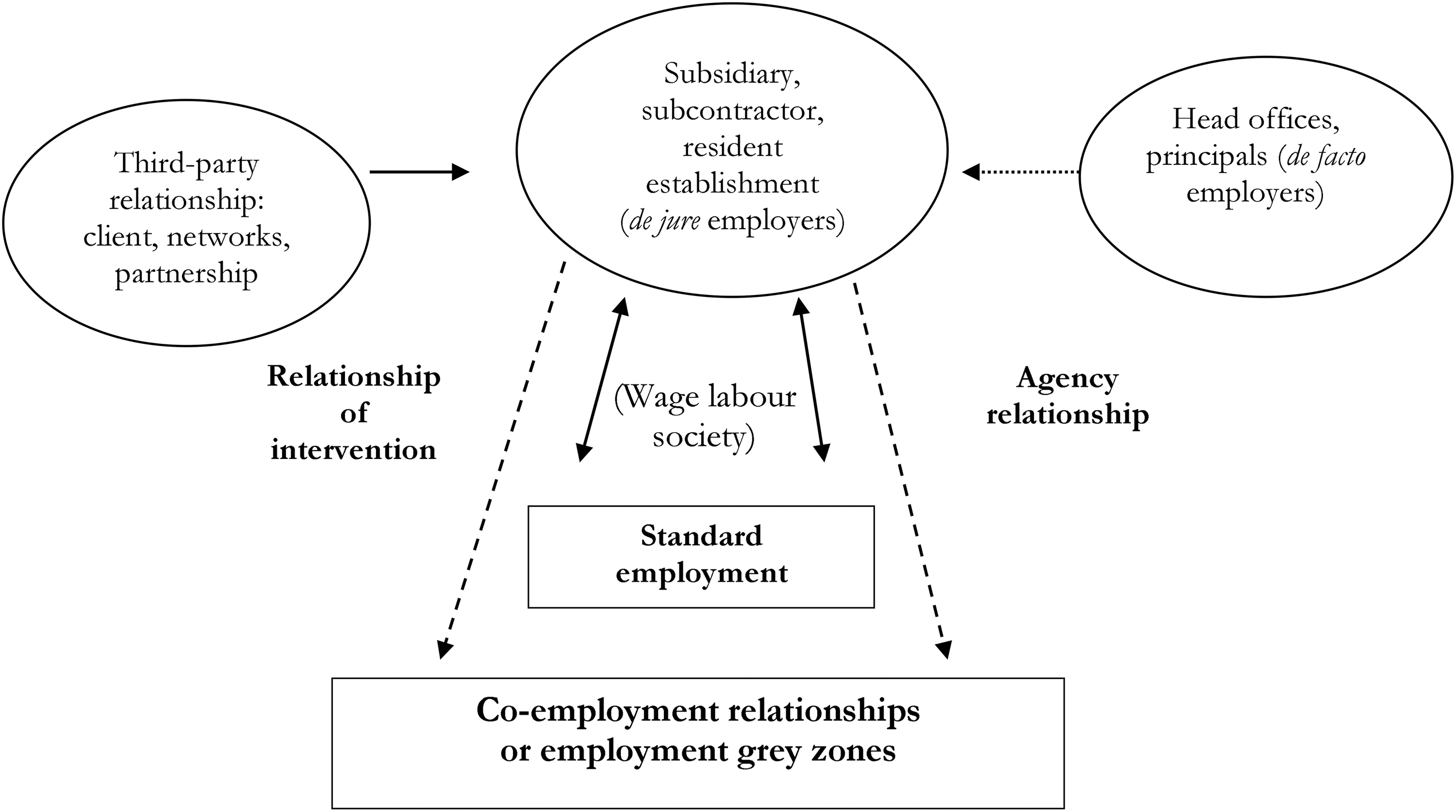
Dual triangulation in standard employment relationships.
– The first is where the corporate customer and the supplier company are party to the working arrangements and personnel management. For example, a corporate customer wishes to supervise the work done by the employer to be sure that the latter strictly follows the contract specifications that it has laid down (Baudry, 2005). This example is also valid for a B2B business that sends its staff to work on-site (Bellemare and Legault, 2008) and shares its right of control with the ordering business. One final, similar example is temporary employment agencies or wage portage companies where staff are made available (for a specific time or project) and work for a third party but remain the legal responsibility of the supplier enterprise (Havard et al., 2008). The effect of all these instances of triangulation is to water down managerial power through an arrangement that shares the employer’s responsibilities with the various parties concerned.
– The second example is resident businesses (subsidiaries, supplier networks, subcontractors) whose line of work is intimately linked with the power of large businesses or multinational corporations with head offices abroad. The chief sectors in question are motor vehicles, electronic goods and textiles and clothing (UNCTAD, 2013). In circumstances such as these, the legal managerial powers of direct employers at the local level are circumscribed by the economic power of the central management or the principals (Edwards and Ferner, 1995). In other words, triangulation of the employment relationship depends less on an arrangement for sharing or mutualising managerial powers with a third party (see above) than on a management chain established on the basis of the flow of authority between the supplier and the principal.
These various instances of triangulation reveal two possible arrangements that impair an employer’s managerial power and, incidentally, two potential sources of grey zones. The first lies in the intervention relationships (Havard et al., 2006) generated by third-party relationships of a contractual nature, in essence B2B relationships. The second lies in the agency relationship whereby principals become involved in the economic and social management of their subsidiary or network of subcontractors, giving them the status of de facto employer. 2
In short, the relationship of intervention and the agency relationship are both practical responses by clients or principals to the uncertainty or even fears that may be engendered by employers’ difficulties in effectively and inexpensively supervising employees’ activity. In both cases, the result is confusion of management interests, activities and identity, which itself gives rise to a number of problems (Cooke et al., 2002): loss of employer visibility, dilution of supervisory responsibilities, unequal conditions and treatment for employees in the workplace, etc. The standard employment relationship (full-time, permanent contract) is part of the tripartite co-employment relationship under which the partner businesses do not in law have any prerogative connected to the function of employer.
We propose to use ‘employment grey zone’ to refer to fuzzy situations of co-employment where the law is in conflict with the power of third-party players (corporate customer or de facto employers in Figure 1) about regulation of the employment relationship. From the theoretical point of view, the employment grey zone concept is somewhat removed from the distinction between authority and power drawn by Weber (Weber, 1971).
Although the work contract defines the employee as someone who performs work directed by his employer, is subject to his authority and receives remuneration for his services, the employer’s power is not unilateral. In principle, it is part of a trade-off: in exchange for a work service, the employer ‘owes’ employees a guarantee of employment, remuneration and compliance with a number of legal obligations, particularly in social matters. By recognising that debt, the employer can be confident that employees will cooperate with him in delivering his choice of organisational structure and production management. In other words, the social debt to employees establishes a framework for action that legitimises his authority in relation to these staff (Baudry and Charmettant, 2008). Where triangulation occurs, that legitimacy can, at any time, be called into question by the action of third-party players. Thus, the conditions under which managerial power is exercised have changed, and the legitimacy of the employer’s authority in the employment relationship has been weakened.
Employment grey zone, legitimacy and employer power
Although any situation where triangulation occurs can be deemed in law a change in employers’ managerial power in relation to the standard employment relationship, it is difficult to assess the effects of these changes on employees’ actual working conditions and status.
Although labour law lays down a clear legal framework and requires the de jure employer to comply with a number of rights and obligations with regard to employees, that very framework is likely to be poorly suited or even totally ineffective in situations where the employer’s decision-making is watered down, obscured or blunted by the action or behaviour of third-party relationships. It is foreseeable that, in such circumstances, a large number of employment relationships, combined with agency relationships or relationships of intervention, for example subcontracting, while formally in compliance with labour law, could be poorly regulated or even unregulated.
It is therefore possible to envisage two specific cases and, consequently, two classic types of employment grey zones:
– The first case, which is more specific to the agency relationship, lies in the economic power of the management at head offices operating abroad to organise and manage production directly worldwide (or for a network). In this case, as expertly summarised by Chassagnon in a study of the employment relationship in an international firm/network, ‘employees are locked into a twofold management structure: that of the firm itself and that of the network’ (Chassagnon, 2012: 14). This twofold ‘asymmetry of power’ (to borrow a term from Moreau, 2013) is the source of employment grey zones (see Figure 1) to the extent that it leads to the emergence of extra-judicial and often extra-territorial regulation of the employment relationship.
– The second case concerns the distortion of the employment relationship through the incursion of third-party relationships established under contract as part of B2B relationships (e.g. an agency relationship). In that environment, the direct employer’s authority is undermined at least in part by a number of prior contractual obligations or commitments, in other words the employees are linked less and less in their work to an ‘obligation of means’ and increasingly to an ‘obligation to achieve a result’. The result is an erosion in employees’ status to the extent that their activity is no longer clearly distinguished from that performed by self-employed workers (Supiot, 2000). Moreover, the incursion of third-party relationships is supported by the distortion of the conditions in which employers exercise their power, including decisions about employees becoming directly linked to corporate clients’ interests. In these circumstances, a labour contract is comparable to a ‘commercial order’ (Alchian and Demsetz, 1972). The employment relationship is now regulated by the ‘outside’ party to the extent that the employer’s power is a conduit for directly influencing employees’ drive. The employer’s authority and all the resources at his disposal are therefore a form of unregulated power whose legitimacy is based only on the employer’s ability to manage employee resistance to the performance of the business’ activity.
In short, although we may take the view that triangulation of labour relations impairs the increasingly fluid and patchy legal and contractual frameworks for managing employment relationships, we should focus our attention less on the legal shortcomings or the incompleteness of the labour contract and more on the many sources of employer power and the means by which it is exercised.
Drawing on a series of studies and fieldwork, in the next section we will examine the reality of these practices and the ‘grey zones’ that they reflect. This approach is not without its difficulties, however. They spring from the fact that an agency relationship and a relationship of intervention are not mutually exclusive but complementary, even closely intertwined more often than not. Indeed, the distinction between ‘intervention’ and ‘agency’ is tenuous where their effect on an employer’s power is concerned. As a result, it is very difficult to draw up a pattern of grey zones based on that distinction. Therefore, in an attempt to overcome that difficulty, we have chosen to restrict the scope of our observations by focusing on HR policies in large corporations and, more specifically still, the lawfulness of management action, through an examination of the individual conditions and circumstances in which direct employers’ powers to control and manage are organised and implemented locally.
This approach will give us an understanding of the grey zone concept based directly on co-employment situations without prejudging the nature of the underlying relationship (agency relationship or relationship of intervention) or even the identity of the employer (subsidiary, subcontractor, etc.). That discussion will subsequently allow us to identify the theoretical perspectives and challenges raised by the ways in which the HR practices in question affect the subordinate relationship that brings employees and employers together.
Triangulation and managerial regulations in the employment relationship
It is clear from the remarks above that the dual triangulation of industrial relations blows apart the indivisibility of the relationship between employees and employers as Fordism understood it, for example. In other words, the employment relationship is no longer intimately linked to the bridge-building role played by labour law. The agency relationship and the relationship of intervention combine to remove the legal boundaries regulating the conditions in which employers exercise their power. In this section, we will go into this point in detail by closely examining HR policies and how triangulation provides HR managers with the means to distance themselves from the normative frameworks governing employee relationships and to try and replace them with managerial regulation of the employment relationship.
From a human resources management policy to a policy to control socio-professional relations
Although previously confined to staff management, many studies have stressed the importance of HR policy in company strategy and performance. Some of them examine in detail managerial actions to establish and manage High Performance Work Systems (HPWS) that draw directly on Toyota-ism (Boxall and Macky, 2009). Others focus more on the variety of ‘HR models’ as part of the continuing work in the ‘variety of capitalisms’ school (Brewster, 2007). Yet others emphasise the importance of HR policies in protecting multinational firms within regional business systems (Almond, 2011).
However, all accept new conditions for HR policy as a result of globalisation of the control and management of employee engagement and performance (Cox et al., 2011). The conditions are new because they question not the tools and instruments of management themselves but how central management uses them as part of an agency relationship with local management.
As a result, very strict scoping policies have been introduced requiring different sites to comply with a number of management frames of reference (pay bill, staff, training and career plans for managers with potential, etc.), performance targets (operating margin, turnover, sales, etc.) and many reporting requirements (quarterly reviews, company dashboards). Although responsible for translating these targets into the operating margin, in return the management of local subsidiaries enjoys fairly broad autonomy, especially in the economies of the Central and Eastern European countries (CEECs) (Delteil and Dieuaide, 2010a), over recruitment, training and, more generally, to set the terms for employment contracts (wages, bonuses, hours of work). Additionally, if they provide mutual health insurance, supplementary pensions or disability insurance, management receives enough financial resources from ‘top management’ to adjust their offers to levels slightly above socio-regional standards. These scoping policies are not only part of a commitment to guide and perhaps also curb managers’ actions at local level; they are also a means by which the management can give itself a longstanding edge in building support among staff while sidelining the place and the role of the unions.
A recent study of the management practices of three large motor vehicle assemblers illustrates this capacity to intervene and control socio-professional relations (Greer and Hauptmeier, 2016). Although in the 1950s–1960s, the unions used to practise whipsawing in negotiations with constructors as a matter of course, the authors state that employers now practise management whipsawing in the aim of securing the greatest possible number of concessions from the unions. Benchmarking, competition between sites, threats to transfer production, in-house calls for tenders combine in varying degrees depending on the economic situation and the context to secure the employees’ and the unions’ consent. Greer and Hauptmeier (2016) also identify four possible whipsawing techniques practised by HR management at local level:
– informal whipsawing where management is vague about real or imagined decisions to close a site, or to cut or transfer production, in order to force the unions to cooperate (Ford);
– coercive whipsawing where management makes a direct, explicit threat, most often supported by a single round of wage negotiations (GM);
– rule-based whipsawing based on explicit, transparent, in-house calls for tenders, used by management to make sites compete against each other and try to smother local strikes (Ford);
– hegemonic whipsawing based on ideological work by management on unions to involve them in the decision-making process without adversely affecting the legitimacy of their actions (Volkswagen).
This range of techniques is not confined to the automotive sector. Similar practices can be identified in other industries, such as agri-food (Bongrain and Danone) and energy (Air Liquide) (Dieuaide, 2011). In these businesses, which are organised as networks and have strong local roots, a special place is also given over to the development of corporate culture (Bongrain and Danone), and to external communication with sub-national government, consumers and NGOs (Danone and Air Liquide). These instances (close to hegemonic whipsawing management) suggest that some of these HR techniques can be deployed beyond the confines of the employment relationship to try to reach out to certain categories of establishment or civil society stakeholders whose interests are likely to be the same as those of the employees (Tapia et al., 2015).
In other case studies we note the extreme care taken by central management to implement cross-sector coordination mechanisms, whether part of the formal structure (European Works Council), contractual or declarative (international framework agreements, charters), or managerial in nature (surveys, questionnaires and large-scale polls using ITC technologies). These mechanisms provide means of strategically managing the involvement and performance of employees at the local level either by feeding back information from the various locations directly up the management chain or indirectly through staff representatives or the employees themselves; or by increasing the opportunities to empower forums for social dialogue in order to spread knowledge of corporate strategy throughout the organisation (Jones and Nisbet, 2011). The effect of these forums for social dialogue, such as European Works Committee meetings, is to produce established, normative and/or procedural methods of supervision (similar to rule-based whipsawing management) and to help staff representatives to take on board corporate strategy, values and image (Delteil and Dieuaide, 2010b).
If we push the point, we may begin to think that these various techniques give management significant discretion when trying to overcome local resistance by moving away from the unions that make the strongest protests or by forging alliances or agreements with stakeholders who are outside the employment relationship, such as government authorities or regional bodies. In fact, the enlargement of the scope for action in HR policy provides management with the means of lawfully side-stepping the law and openly being part of what we could somewhat puzzlingly call an inclusive strategy. The singular feature of this strategy is to prevent any local social conflict by having a foot in the industrial relations and the management camps. In this grey zone, management has a significant margin of discretion and negotiation that brings together scoping policy and the agency relationship on the one hand, and social dialogue and the power to intervene on the other. The result is a novel form of governance for the employment relationship to the extent that, in this grey zone, management is able to deploy an à la carte HR policy that it can mould in line with corporate strategic objectives and the nature of any social constraints it meets, whether they are associated with the region in question, the features of the job catchment area or the level of market pressure.
Corporate management contract policy: manipulation and hybridisation of collective bargaining
Collective bargaining is probably the best area in which to assess the loss of effectiveness of the legal rules and their hybridisation with human resources management policies.
As noted by Freyssinet in an in-depth comparative study, competition between production sites and the threat of relocating production have heavily overshadowed the majority of employment agreements signed in Germany, Spain and France since the 1990s, even more so since the 2008 crisis (Freyssinet, 2011: 95). For the author, this threat would explain the resigned mood that overhung the unions when they had to negotiate the agreements. He also notes that many union concessions on pay and working conditions were justified in the name of protecting jobs (Freyssinet, 2011).
The weakening of union power does not result only from ‘objective’ crisis conditions.
Several analyses and field surveys at production sites in France have emphasised management hostility to the trade union movement and social dialogue, and that hostility is much greater among companies with shareholders than in family firms (Philipon, 2007): one takes a confrontational approach and consistently has recourse to the courts; another adopts a paternalist or client-based approach; while a third follows a policy of side-stepping the unions that make the strongest protests. Moreover, our surveys have shown that this critical or suspicious attitude towards the unions on the part of management contrasts sharply with the employers’ relatively generous involvement in financing social and cultural actions run by works committees (Delteil and Dieuaide, 2010b).
This climate of defiance among management toward trade unionists and collective bargaining is not only an ideological stance. It can be understood from the physical and human conditions that govern its organisation and operation, especially the obstacles that trade unionists must overcome to perform their role as negotiators. Although unionisation in France is already very low, research by Breda (2016) shows very clearly that trade unionists are not protected: their professional careers are routinely curtailed; they are less well paid and very often the first victims of redundancy plans; additionally, as their numbers are falling and the hours that they are allowed to claim for union work are continually falling, the number of commitments and responsibilities that each of them must take on is rising steadily.
In addition to pay cuts and the low number of trade unionists, we must also note the fact that collective bargaining, which has been compulsory in respect of pay and working conditions since the Auroux laws (1982), is absent from many companies. This situation is well established and has been discussed at length in France (Breda, 2016; DARES, 2015): although the unions have a monopoly on the negotiations, there are no union delegates in two-thirds of establishments with between 10 and 100 employees; in one in three establishments that does have union delegates, there have been no negotiations, and in the establishments where they have been held, they ended in an agreement in only two-thirds of cases. Breda therefore concludes that only 10 per cent of businesses, the largest of all, sign agreements.
This situation, which is a matter of great concern in respect of the conditions governing the organisation and operation of collective bargaining, might come as a surprise given that 35,000 corporate agreements are signed in France each year. The contrast is stark, but the paradox is purely surface-deep. In fact, the bulk of these agreements are driven by the authorities as part of a political agenda to deliver a specific public policy. This is the case, for example, with contracts concerning young people, equality at work or, more recently, supplementary health insurance. The driving role of the state has led some authors to describe collective bargaining in France as ‘managed collective bargaining’ (Mias et al., 2016)
However, at grass-roots level, the situation in companies is completely different. Recent surveys show that the unions are routinely on the defensive in negotiations, contending with guidelines laid down by parent companies for local management (Béthoux et al., 2015). Blackmail in employment, informal social dialogue, unilateral bonus freezes, introduction of a two-speed pay scale, etc. have all been reported. The concessions are even more numerous and lawful when the negotiations do not always take place at the decision-making level (Bonnivert et al., 2004). When faced with a direct employer who has no power, it is difficult to assert the right to representation, and negotiations struggle to get off the ground. This is particularly true for outsourcing operations which, in practice, are the lawful fragmentation of businesses into small production units. Outsourcing often results in a business falling below social thresholds and precludes the advancement of a number of collective rights (Perraudin et al., 2006).
In the same vein, corporate remuneration policy broadly based on profit-sharing has helped considerably to marginalise pay agreements (around 33 per cent of the agreements signed in France each year) in industrial relations. This is another salient feature picked up in many surveys and pieces of statistical research in France: the effect of pay negotiations conducted around extended arrangements (including bonuses, shares, incentives) is to reduce the importance of industry-wide agreements and increase that of mutual relationships (see Castel et al., 2011, for a case study). In other words, the financialisation of HR policies encourages merit-based pay by laying down a specific management standard for performance at work based on monetary incentives that also serves as a bargaining tool for management (company savings schemes, holiday vouchers, meal vouchers for restaurants, etc.). Therefore, the effect of this finance is to ‘counteract’ collective bargaining and, more broadly, to weaken the power of standardisation in one part of labour law by encouraging the emergence of quasi-private regulation of industrial relations within companies.
The various aspects of collective bargaining can be summarised by saying that everything happens as if the management of large businesses were trying to introduce ‘no-trade-off industrial relations’ (Dieuaide, 2017) based on ‘common law’ contract policy at all levels of the organisation. The paradox of a strategy that combines a one-sided relationship with a contractual relationship is purely surface-deep. It should be noted that this novel form of jeopardising the employment relationship as set out in the legal and institutional frameworks drawn up at national level does not annul labour law and the employment guarantees established at that level, rather it devoids them of their effectiveness at local level (Didry and Brouté, 2006). This is a pernicious form of dualism that deprives workers of a credible, legitimate spokesperson in negotiations and social dialogue.
On the more theoretical side of things, this deterioration in the quality of the institutions involved in the employment relationship reduces the importance of the analysis that argues that decentralisation of collective bargaining (in France at least) is the result of an ‘organised’ (as defined by Traxler) institutional process or of a ‘concerted’ institutional process, as noted by Marginson in a recent paper on adjustments in the employment relationship following the 2008 crisis (Marginson, 2015). Regardless of the negotiations conducted between the two sides of industry or established by the state as is the case in France, the decentralisation of negotiations has been supported, to some extent, in all parts of Europe by deep erosion of the regulatory capacity of the collective bargaining system as demonstrated by the enhanced powers of employers to make unilateral amendments to the terms of labour contracts (Delahaie and Vincent, 2016).
This finding calls for a return to and discussion of a more longstanding thesis developed by Bélanger and Thudéroz (1996), who argued that, in the post-Ford era, employment would replace pay in negotiations between the various stakeholders in the employment relationship (union, business, government). In other words, the question is whether, as those authors maintain, employment (especially following the crisis of 2008) will become the new point of convergence for the interests of the various actors in national industrial relations in order to legitimise their meeting commitments in a globalised world. We do not think so. The gap between the increase in employers’ discretion to perform their managerial duties and the effectiveness of the rule of law in respect of their management practices points to the existence of a vast employment grey zone dominated by power games and power structures. The proliferation of opt-out clauses or waivers or the calling into question of the favourable treatment principle in France is gradually establishing a twofold system of regulation which, apparently, the analyses that draw on Traxler’s neo-corporatist approach cannot understand; it comprises one layer of official, codified regulation constructed explicitly around the concept of a commitment to safeguard employment between established actors, and a parallel layer of poorly codified contractual regulation that is under managerial supervision and has a direct impact on industrial relations within teams and workshops. In short, this grey zone reflects the existence of a form of institutional dualism between employment and labour, and we view this as indicative of a profound change in the way in which the subordinate relationship between employees and employers is forged.
Employment grey zones: a watering down or a shift in the subordinate relationship?
Designed globally (or regionally), developed nationally (or locally), human resources management policies are a powerful means by which (large) businesses can distance themselves from the legal and contractual frameworks that govern the employment relationship and, more broadly, from national industrial relations systems. By adopting at least some of the social and professional regulations in-house, the policies have come to play a key bridge-building role in employee/employer relations and have emerged as a possible replacement for collective bargaining.
The encroachment of business policies on labour and employment institutions is a step backwards for the law in response to a contract; it is also a step back for the contract in response to management standards and to the secretive relationship between manager and employee locally to the benefit of a relationship between a shareholder and a manager globally (or supranationally). A shift of this kind is likely to reduce labour law from a normative to a proxy function of the employment relationship (Supiot, 2000). It also emphasises management’s ability to establish a new means of legitimising control and coordinating employees’ work (as discussed below).
Reducing labour law to a right to employment
For Supiot, subordination of an employee to an employer’s will in a work contract is ‘a trade-off for the constraints that prevent the employer from being able to directly own the labour whose tenure he has purchased’ (Supiot, 2000: 132). In legal terms, subordination applies to ‘performance of work’ on the employer’s account, regardless of the particular conditions in which that work is performed. Therefore, in economic or management terms, the work performed is not self-evident. As Reynaud (1998: 174) notes, setting market-based rules for procurement of labour is one thing, but incorporating employees into ‘the business rule system in order to extract their labour’ is another.
Work on what and how? Using what tools? To what end? These are questions for management. However, there is not just one possible response to the production problems that management might encounter, and the responses that are drawn up may not reflect the representations, interpretations or even the skills of the workers themselves. That is why it is likely that contract policy and collective bargaining in businesses play a key role in reducing these uncertainties. For each of these policy tools, it is clear that the preferred business practice has been to approach the market.
In an unusual, outstanding analysis of 400 employment contracts, Bessy draws a nuanced, detailed picture of the contractual practices of French businesses in recruitment matters (Bessy, 2007). The author states that there has been a marked lengthening of employment contracts. This increased level of formality is, he states, the result of a proliferation of contract clauses (clauses on aims, personalised remuneration arrangements, geographical mobility, flexibility of job content, etc.) supplemented by guarantee clauses on labour law and grounds for prima facie termination for professional misconduct (e.g. failure to achieve objectives).
Bessy also notes that this wording results in France from a change in the case-law from 1987 (Raquin case of 8 October) which stated that any amendment to an employment contract must have the prior express agreement of the employee. It should be noted that this requirement was taken up in more detail in a 1991 European Directive laying down an obligation to inform employees in writing of the conditions applicable to their contract of employment.
Additionally, the increase in warnings in the wording of the employment contract holds plenty of lessons for us: it shows, first, management’s intention to give precedence to the bilateral employee/employer relationship to the detriment of the collective industry-wide agreements and socio-professional regulations that, in the past, provided a frame of reference. It emphasises an incisive grasp or even excessive fear of the risk of moral hazard such as slacking or workshy behaviour. Finally, it is evidence of management’s intention to side-step redundancy rights, chiefly because of the cost, the negotiating constraints and the retraining requirement which in France must, in certain circumstances, be part of a social plan for redundancies.
Additionally, we should note that the changes in labour legislation as a result of the proliferation of particular forms of employment have continued to support contractual practices of this kind. The creation in 2008 of termination by mutual agreement (an ‘amicable’ agreement to terminate a contract) and, more recently, a permanent employment agency contract (March 2014) have helped to further segment the protection offered under permanent contracts. Additionally, the routine use of fixed-term contracts as a recruitment standard and the wholesale replacement of long fixed-term contracts with ever shorter ones (‘standard’ fixed-term contracts) are evidence of the ‘contract drift’ broadly encouraged by the march of temporary employment agencies in triangular relationships. Without dwelling on this point, we should also mention the fact that, by establishing the principle of reversal of the hierarchy of rules, the effect of the Labour Law (‘El Khomri’ Law) recently voted on in France (August 2016) is to shift the regulatory framework for employment to the local level and strengthen the negotiating power of business managers, particularly in terms of the duration and organisation of work hours.
Generally, these contractual practices and the institutional environment underpinning them provide only limited room for the protection of labour law. Extending contractualisation to areas related to employees’ motivation and ‘personal qualities’ will ultimately lead to marginalisation of institutional cover in response to new emerging risks to which employees are exposed.
A distortion of this kind in the employee/employer relationship has far-reaching consequences according to the analysis. Labour law would no longer protect employees as persons by establishing safeguards especially to limit the rise in psycho-social risks and muscular-skeletal problems associated with insecurity of employment and escalation of work. As Arthurs (2013: 591) notes, labour law would drift towards a right to employment. Employee protection based on a collective right directly related to employment would no longer be fully guaranteed. More substantively, pay itself is likely to become a problem under these contractual practices. By challenging the industrial relations that underpin workers’ collective security (Castel, 1995), and by allowing a move away from the observations, standards and codes that are the bedrock of the feeling of belonging to a particular social class or status, we will gradually erode the place of employees as a ‘subject of law’. Essentially, that is what the employment grey zone concept means.
Weakening of the subordinate relationship and the coordinating power of HR policy
‘Contractual drift’ in employment relationships reflects not only a move away from employment law and collective welfare, but is also a clear signal of changes in how managements manage the employment relationship against a background of changes in the world of work.
In open economies driven by services and innovation, work becomes a complex matter for workers. Often they are faced individually or as a group with problem-solving situations. This new environment requires employees to be cooperative, flexible, competent and versatile. The result is an obvious, deep tension between the need for workers to have autonomy or freedom to act and the need for management to monitor, control and evaluate their work (Azaïs, 2010). On the one hand, it is important for workers to be autonomous so that they can interact with their environment. On the other hand, it is appropriate for management to ‘modulate’ workers’ room for manoeuvre in the pursuit of their activities in order to optimise costs and maximise business performance.
In fact, there is an imperceptible shift in the subordinate relationship: the employment contract is no longer merely a series of legal clauses laying down the terms under which labour is made available, it is also a tool for managing the self-organising skills and qualities that management requires their employees to have so that they can take initiatives, work together, and communicate in complex, wide-ranging and uncertain work situations.
Contractualisation of the employment relationship is therefore inherently linked to the new means by which employers exercise their managerial power. HR management is no longer required to ensure only that an employee satisfies his contractual commitments when performing a given task. They should also advise or guide the employee in his actions, help him to assess situations and take decisions. Thus, HR policy would change its modus operandi by replacing a scheme to mobilise people based on the Fordist principle of directly ‘putting [people] to work’ physically and mentally, with a cognitive principle of ‘active [employee] participation’ that differs according to the working situation and is tailored to the various skills required to organise and perform a given task or activity.
The ‘cognitive pressure’ exerted by HR policies therefore becomes a powerful means by which management can control workers’ drive to act, cooperate and communicate. This power of meaning is vital in order for businesses to implement corporate strategy in their various subsidiaries (Edwards et al., 2011: 166). It legitimises systems of rules, procedures or representations that underpin the organisation and management of business locally. This power is not applied as a prohibition or an obligation. It is a ‘cognitive’ or ‘discursive’ power of coordination (Ibsen, 2015) which, through an extensive support system (for remuneration, information, communication, training and skills management, etc.), builds a series of connections (knowledge, information, values) in industrial relations at work.
From this point of view, HR policy is a novel alternative to the Fordist mechanisms of coordination based on an authoritarian relationship. Drawing on a large number of contractual relations, HR policy provides management with the means to act and negotiate across the board with staff in order to introduce relatively autonomous, coordinated systems for making decisions and taking action. Scoping policy and agency relationships combine with formal (contractual) and informal arrangements in response to conflicts and/or coalitions of interests, making it possible to adjust the allocation of available resources (training, recruitment, finance) across all levels of the organisation (group, subsidiaries, workshops). In other words, HR policy streamlines the chain of command as a result of the preliminary coordination of ‘means to ends’ that it has performed across the board, directly under the control or at the initiative of management.
Under these arrangements, HR policies become a key instrument in the regulation of triangular employment relationships. In the hands of central management, cognitive and discursive systems become conduits for circulating practices and messages that address stakeholders’ expectations and representations. These systems can therefore act as replacements for rules governing negotiation and discussion that are established locally under labour law and collective agreements. This trade-off displaces local employment regulations governing power relations and power structures (Charmettant, 2012). The result is a fairly strong ‘deviation from the norm’, sometimes beneficial and accepted by everyone, but more often a source of insecurity and inequality, generally to the detriment of the least skilled.
At the heart of these triangular situations, employment grey zones now become a breeding ground for ‘deviant regulations’ (Artus, 2011). This type of regulation can be recognised by the fact that employees are no longer subordinate, they are controlled. A prime example was the announcement in November 2016 by Airbus of 1134 redundancies even though its order books were full. The redundancies were justified by the need to cut costs in view of ramped-up competition with its US rival Boeing and the entry into the market of Chinese aircraft manufacturers. The argument sparked protests from the unions, who suspected that a decision had been taken on the basis of financial profitability. But they were unable to challenge it further after the human resources manager informed employees that it undertook to allocate the funds necessary to prevent any compulsory redundancies.
The Airbus example illustrates that regulation of the employment relationship is less and less ‘bound’ by labour law and is increasingly controlled by power relationships and management practices that misuse it or deflect it from the intended purposes. Finally, the proliferation of examples like Airbus in France (Michelin, ArcelorMittal, etc.) gives grounds to think that these ‘deviant regulations’ could ultimately be in place for the long term, making shareholders full players in industrial relations at the corporate level (Conchon, 2012).
Conclusion
The analysis of changes in employment relationships under globalisation based on large corporations’ HR policies is a specific approach that is not necessarily representative of all the forces in play, especially in France. But by setting out and discussing some of these policies through the lens of the concepts of triangulation and grey zones, we have, first and foremost, tried to demonstrate the importance of the need to move beyond an institutions-based, bilateral approach to the employment relationship.
Observation of large corporations’ HR policies suggests that an open model of an employment relationship is in place that in fact resembles a multi-employer model (Cooke et al., 2002). Under our approach, this extended model of the employment relationship takes account of third-party relations (referred to as relationships of intervention and agency relationships). These relationships have highlighted the normative capacity of HR policies based on ‘managerial regulation of the employment relationship’. By ‘managerial regulation of the employment relationship’, we mean the existence of a space occupied by socio-professional relationships that are undergoing ‘disintermediation’ as happened in the CEECs during the post-communist transition (Rugraff, 2006). Thus, to an increasing extent, the regulation of employment is likely to be part of global strategies that are inaccessible to the national courts, whereas industrial relations within subsidiaries will be increasingly controlled by local contractual rationales.
The ‘contractual drift’ in the employment relationship is the most obvious symptom of this particular form of polarisation. The embodiment of a gradual step backwards from employment guarantees, this drift is an indicator of a profound change in the subordinate relationship that employees have with their direct employers. From that point of view, the employment grey zone concept referred to several times in this article points to the shift in the employment relationship towards a type of regulation that is controlled by power strategies and power structures. This drift probably means that the deterioration in the standard employment relationship will be less towards a legitimate imbalance of powers that is still able to be reversed in the employee/employer relationship locally, than a deeper structural divergence connected to the emergence of a form of controlling regulation that is relatively autonomous compared to the regulations provided for in law and under collective bargaining that are ‘established’ at national level.
This twofold (or hybrid) regulatory system governing the employment relationship tends to endorse the theory of a twofold asymmetry of power driven by globalisation that was postulated by Moreau (2013). We note that, through unregulated, ‘denationalised’ power relationships, this twofold regulation converts the space occupied by industrial relations into a public (non-state) space where there is no reason whatever why the number and identity of actors, objects and even arrangements should be known or acknowledged in advance (Azaïs et al., 2017). In other words, the employment grey zone is another way of emphasising the inherently political and partially regulated dimensions of management action that now prevail in the open, collective field of negotiation with employees or trade unions.
In that environment, the question is whether the approach based on twofold employment regulation and labour relations is sustainable. That question calls on us to discuss new institutional arrangements within which area-based roots for the employment relationship could become an explicit issue in industrial relations.
Translation from the French by Susan Wilson
Footnotes
Funding
This work was supported by the French Agence Nationale de la Recherche (ANR) [Project ZOGRIS, ANR-11-INEG-0011, L’évolution des normes d’emploi et nouvelles formes d’inégalités: vers une comparaison des zones grises?, 2011–2015].