



Abstract
Initially employed by lawyers and geopolitical experts, the concept of ‘grey zones’ can be usefully applied to analyse the recent changes on the labour market. It provides a means of bypassing the dualist approaches that contrast waged work and self-employment, insiders and outsiders, or, then again, formal and informal work in a binary way. It provides visibility of the decoherence between the institutions associated with waged status and actual employment practices, and the layering of several different kinds of regulation. The ‘grey zones’ approach thus provides an analytical framework for understanding a wide variety of situations and studying various processes of institutional change, giving the actors of this change their rightful place. Although grey zones are often areas where laws are absent or weak, through these actors they can also give rise to new institutions.
The notion of ‘grey zones’ is widely referred to today. But, as far as the term itself goes, its use testifies to an undeniably wide range of meanings, from geopolitical writings, on the one hand, and from the work of legal scholars, on the other. In this issue, we propose to borrow this notion for use as an analytical framework, in order to analyse and understand recent changes in the labour market. We will try to show how the ‘grey zone’ approach overcomes the shortcomings of the usual categories.
In geopolitical and military writings, the ‘grey zone’ concept is mainly used to designate geographical areas that escape the central power of states. These areas are sources of diffuse crises, and are described as zones of lawlessness, dominated by boundless competition between various forms of authority, such as warlords or mafia groups. In France, the titles of books recently devoted to grey zones are telling: Les zones grises dans le monde aujourd’hui. Le non-droit gangrène-t-il la planète? (Pascallon, 2006) 1 ; Zones Grises. La part d’ombre de la géopolitique (Minassian, 2011) 2 . Minassian’s book goes the furthest in emphasising the notion’s ambivalence, by distinguishing, on the one hand, self-determination movements that aim to overthrow one state in order to rebuild another (e.g. the revolt in Chiapas in southern Mexico), and, on the other hand, areas under the control of mafias which hold the state to ransom without destroying it (as in southern Italy). Although the concept of grey zones has been applied to the worlds of work only to a limited extent, it opens up avenues for analysis by offering insight into how employment standards compete in a globalised economy. It indicates that national regulations are undermined as, because the boundaries of national law are porous, it is complicated to identify employers, and the regulatory institutions which establish their responsibilities are weakened (Stone, 2004). From this perspective, the concept of a grey zone is intimately linked to the notion of globalisation.
In the field of labour law and employment relations, the notion of ‘grey zones’ has been employed mainly by legal scholars, in particular by Italian scholars since the 1990s, addressing new forms of independent contractors or ‘para-subordination’. These arise when workers are formally independent, yet de facto subject to a firm’s internal rules. Alain Supiot (1999), who is quoted by all the authors in this area, contributed greatly to establishing this notion in France, analysing the blurring of the boundaries between wage labour and self-employment in Europe. Indeed, legally independent subcontractors or contractors may be economically dependent on one or a few clients, while legally dependent workers may in fact benefit from a certain degree of autonomy in their work. This blurring of borders holds for most of the oppositions that go to make up the ‘Fordist mode of regulation’: employment/unemployment, working time/leisure time, training/work, paid work/unpaid work, design/execution, public/private, etc. It also applies to the opposition between formal and informal work so often used in development economics. The work and employment grey zones thus in some ways derive from the weakening of these frontiers, which have become increasingly porous and which, moreover, vary from one country and group of workers to another.
Indeed, in most European countries, labour law no longer provides a clear, precise correspondence between instituted labour categories and actual employment practices. This ‘dissonance’ (Mazuyer, 2013) leads to a more general, structural phenomenon of ‘decoherence’ 3 of employment standards, marked not only by the proliferation of areas of lawlessness and legal confusion, but also by strategies for circumventing and gaming the multiplicity of existing rules. This also results from demands for new rights and attempts to develop new forms of regulation.
The two meanings of ‘grey zones’ (subject to competition between several forms of authority or resulting from the blurring of boundaries between two opposite categories) can converge, by means of the notion of border and the distinction between borders and boundaries. Richard Sennett (Sennett, 2008) draws our attention to this important distinction in natural ecologies between two kinds of edges: whereas the boundary is an edge where things end, a guarded territory, the border is an edge where different groups interact: ‘For instance, in the border-edge where the shoreline of a lake meets solid land there is an active zone of exchange.’ In that sense, grey zones can be understood in terms of borders, whereas dualist approaches focus on boundaries.
The articles gathered in this special issue indicate a wide variety of underlying rationales for action, whether they are deployed within, outside or on the margins of employment standards and norms. More broadly, the analyses that follow emphasise the usefulness of the notion of grey zones in understanding the singularity and diversity of the dynamics currently transforming employment norms. 4 Section I presents the general framework of analysis. It is followed by a typology of work and employment grey zones (Section 2). These developments help shed light on the relationship between grey zones and institutional change (Section 3). This presentation concludes with a series of points providing perspective on the originality of our use of this notion and its contribution to institutionalist analyses (Section 4).
Grey zones, heterogeneity and transformations in employment norms: a general framework for analysis
The ‘grey zone’ approach has an undeniable heuristic virtue, in helping to provide some distance from the standard employment relationship (SER) and portraying it, as in the words of Ingrid Artus, as an ‘institutional standard which is increasingly isolated in an ocean of unregulated social standards and jobs’ (Artus, 2011: 111). The ‘grey zone’ approach is a response to the exhaustion of analyses which measure all labour market transformations with reference to the employment norms inherited from Fordism. It is thus based on a twofold dynamic. On the one hand, the grey zone is linked to the break-up or multiplication of employment norms, due to successive socio-political compromises that express the contradictions and constraints of globalisation. On the other hand, the approach draws on the persistence or emergence of new ‘figures’ (Azaïs, 2016) or categories of actors whose identity and socio-professional practices, actions and modes of organisation in work cannot be easily framed within existing norms and statuses, but instead comprise their own specific dynamics.
In such a context, the analysis in terms of ‘work and employment grey zones’ constitutes an alternative proposition to dualistic approaches that oppose insiders and outsiders, or the formal and informal sectors. The ‘grey zone’ notion also functions as a matrix for reading the changes in employment standards, which gives a central role to the way labour market actors have an impact on institutional norms and tend towards creating new ones.
Dualist approaches versus an approach based on grey zones
According to the segmentation theories developed in the 1970s (Doeringer and Piore, 1971), there are not one but two labour markets with limited mobility between each other: a primary market characterised by rules for protecting workers and a secondary market in which workers struggle alone with market forces. As of the 1980s, new Keynesian economists began drawing on this theory and giving it new formulations in order to explain the persistence of unemployment and precariousness in Europe and the USA, beyond the oil crisis. They came to challenge labour market institutions, criticised for dividing workers into two groups with divergent interests: ‘insiders’ and ‘outsiders’ (Lindbeck and Snower, 1988). In France today, this opposition between insiders, who benefit fully from wage protection, and outsiders, who are saddled with fixed-term contracts, spells of unemployment and atypical jobs, has become a common matter of public debate. Similarly, in Germany, political scientists consider that interactions between collective bargaining and public policies aimed at reforming the labour market have strengthened labour market dualisation since the early 2000s (Palier and Thelen, 2010), as atypical and poorly paid jobs have developed, but without affecting the ‘insiders’ operating in the internal markets. In Continental Europe, it is mainly ‘outsiders’ who bear the brunt of economic integration into a globalised economy.
More generally, while dualist approaches are clearly interesting for studying the persistence of poverty and inequalities within wage labour, they suffer from several limits. By focusing on the opposition between two segments of the labour market, they in fact ignore the process of increasing precariousness extending to the very heart of the employment relationship. Robert Castel has identified this phenomenon as ‘destabilisation of the stabilised’ (‘déstabilisation des stables’, Castel, 1995). Second, dualist approaches cannot encompass the extreme heterogeneity of the situations encountered in the ‘secondary market’ from the point of view of employment conditions and social rights, or a subjective point of view in which the secondary market is experienced as more or less satisfactory in the course of a working life. They are also indifferent to aspirations that have emerged as people seek other ways of working and other life paths, which are very different from the wage-earner norms based on a single job with full-time employment, lasting from the end of education to retirement. Finally, and perhaps most importantly, binary representations are inadequate in analysing the plurality of norms which today characterise many employment situations in the global North and South. This plurality mainly takes two forms. The first relates to the actual qualification of work situations, when these combine characteristics that are opposed in the instituted categories: for example, a wage-earning job and self-employment, formality and informality. The second concerns levels of regulation in a globalised world, for example the opposition between the legal order of socio-national frameworks and forms of law negotiated at the multinational level.
According to Supiot (2000), the shifting of the debate in Europe from questions about the boundaries of labour law towards the concept of ‘grey zones’ has precisely the merit of breaking with binary, black-and-white thinking (wager-earners versus self-employed workers). It thus paves the way for a new type of labour law. An inductive approach rooted in an attempt to comprehend ‘grey zones’ seeks to enhance the relevance of institutions regulating, defending and representing the interests of workers who are not just ‘insider’ employees. Perceived from this perspective, notions of occupational status or occupational social security (securité sociale professionnelle), and also the transitional markets approach (Schmid and Gazier, 2002), are attempts at proposals to adapt existing wage-labour based institutions to the growing diversity of employment statuses and forms. It should be noted that the ‘grey zone’ approach not only concerns the scope or ‘institutional coverage’ of rights and social protection. It is also necessary to envisage the possibility that wage-labour institutions may be ‘undermined’ by the individuals themselves, and that the latter may also be active participants in alternative institutionalisation processes for the production of rules and practices that represent their interests.
The approach in terms of grey zones is similar in some ways to the framework of analysis put forward by Mayntz and Scharpf (2001), which examines the processes of regulation and self-organisation on the basis of ‘actor-centred institutionalism’. Like the latter, the ‘grey zone’ approach places great emphasis on the capacity of the actors to resist, reinvent and defy the prescriptive and normative powers of institutions. It differs, however, in so far as these actors are not necessarily constituted by the institutional framework that surrounds them, as the freedom of action they may have and on which they can rely does not necessarily enclose them in an inclusive relationship. In the work and employment ‘grey zone’ approach, the game remains ‘open’, as shown by some of the contributions to this special issue. That is to say, the workers always have the possibility to ‘exit’, by positioning themselves deliberately at a certain distance from the institutional framework.
A lexicon of the ‘grey zones’ approach
Towards the end of the last century, analyses of the deconstruction and then the breakdown of the standard employment relationship (SER) put forward a number of concepts such as ‘non-standard work’ or ‘precarious work’ (Askenazy, 2003; Cingolani, 2005; Michon, 2006). Similarly, at the international level, comparative benchmark studies such as those of the OECD (OECD, 2016) highlighted a number of indicators such as the ‘precariousness rate’ (based on the use of fixed-term contracts or temporary work), the ‘employment rate’, which includes any form of employment – be it typical or atypical – and indicators of employment protection legislation (EPL), which measures only one aspect of labour market flexibility, namely the ease with which employers can resort to dismissal.
The approach in terms of grey zones proposed in this special issue favours a multi-dimensional comparative analysis (social rights, mobility, time factors, etc.), of changes in employment norms (Azaïs and Kesselman, 2011). From a methodological point of view, this approach rests on two sets of considerations: – On the one hand, the various contributors examine the same question, namely how to understand the uniqueness and diversity of the dynamics of employment norm changes in the context of globalisation. They share the concern of identifying precise practices and configurations of work and employment whose persistence and variety cast doubts on the conceptual categories inherited from the ‘wage labour society’ (salariat). – On the other hand, the analysis of work and employment grey zones as developed in this issue rests on two assumptions: (i) wage labour cannot be considered as an exclusive form in which the employment relationship manifests itself within the division of labour; (ii) each grey zone has its own logic of development and can be perceived independently of its links with the institutions of the standard employment relationship, be they relatively remote or relatively close.
In other words, the grey zones identified and analysed in this special issue are defined as spaces intersected by power plays, woven from formal and informal relations, but always (at least partially) irreducible to the codification processes specific to wage-earning labour. There are a number of implications for the analysis: – Work and employment grey zones can be characterised from the outside, by the specific institutional context that surrounds them and which may possibly interact with them. From our perspective, grey zones cannot be termed as a chaotic world, which is ‘out of control’, or without consistency. Instead, they are more likely to be social markers of regulation in their own right. To be sure, they are sometimes transitory or short-lived. But they always make sense because they coexist with, overflow from or extend the legal, instituted regulatory space (still dominated by wage labour today). In all cases, grey areas exist only in and through a process or through their own development dynamics. This is common to the gradual approach of institutional change developed by Streeck and Thelen (2005). – Grey zones emerge with actors, who individually or collectively carry them. However, the actors instigating/engendering their emergence are not anonymous workers. Grey zones are like ‘anchored spaces’, populated locally by what we call ‘emerging figures’, following Azaïs (in press). These figures refer to profiles and socio-professional worlds built on the lived experience of individuals and collectives. These may be designations which have imposed themselves as common sense within a given environment (e.g. ‘Solos’ designating a new form of independent contractors in Germany, comparable to ‘auto-entrepreneurs’ in France), or terms designated by law (for example, ‘economically dependent, independent contractors’, which refers to a newly coined category that has arisen from the public will to regulate a legally ambiguous situation). From a dynamic point of view, these figures refer to different trajectories. Drawing on the typology of Azaïs (2016), three types of trajectories can be distinguished: (i) the ‘declining figure’, which corresponds to a deterioration of terms of pay or social rights (compared to the norms of the standard employment relationship); (ii) the ‘intermediary figure’, which refers to situations seen as stagnating or provisional (internships, civic service, subsidised activation contracts), the meaning of which may vary from person to person, depending on how individuals experience this period of transition (for example, a traineeship may be seen as providing useful training experience, or alternatively may be viewed as poorly-paid precarious work); and (iii) the ‘ascending figure’, which is associated with a quasi-militant approach to the recognition of new work relationships that are not dependent on subordination (e.g. the figure of the hacker, or that of the entrepreneur-employee). Thus, the notion of ‘figures’ makes it possible to explain the heterogeneity of the socio-professional positions of actors in grey zones. In a manner of speaking, these figures represent a spectrum of ambiguous positions with regard to labour and employment institutions. They are positions that can be understood as being situated along a ‘constraint versus freedom’ axis, depending on whether or not workers are forced to take such work, whether they accept it, defend it or even outwardly advocate it and act to bring about the new situation. – Grey zones are areas of bifurcation where no ‘institutional determinism’ or even ‘path-dependent’ phenomena prevail. In fact, the social and political reality of work and employment grey zones exists only through the tensions that permeate them. The tensions emerge from the confrontation between the normalising power of existing institutions and the diversity of practices, representations or even aspirations that govern and guide actions and interactions among individuals. Grey zones are thus moving spaces, always evolving, and more or less in or out of sync with existing institutions. This characteristic of grey zones is somewhat removed from interpretations of institutional change that attribute intrinsic stabilising properties to institutions, such as selecting relevant information (Aoki, 2002), channelling expectations (North, 1990), or envisaging sanctions for agents with deviant behaviour. In some cases, particularly when it comes to emerging ‘project managers’, there is no reason to believe that institutions can fully play their mediation role (Boyer, 2003) and present themselves as legitimate interlocutors with workers or other ‘grey zone’ figures. In such circumstances, changes in employment norms may express the rationale of rupture even more clearly. But this is only one scenario among others. By taking things a bit further, it is possible to imagine that the proliferation of emerging figures actually contributes to the development of specific, locally determined measures that recognise the activities and identities of these project managers. Therefore, it is important not to overlook the possibility that grey zones in fact comprise a singular process of institutional change, based on a permanent revision of socio-political compromises (Azaïs, 2015: 8).
In short, the approach in terms of grey zones developed in this issue aims not only to retain the notion of an employment relationship, but also to adopt plural employment ‘relationships’ in order to account for the variety of situations, dynamics and socio-professional contexts, which exist beyond established norms and categories. At the same time, this perspective creates the space to replace an explicit, normative system of codification of wage employment at the national level with a wide spectrum of complex, formal and informal work statuses and regulations, which are more or less differentiated locally. The notion of grey zones has the advantage of being able to include two key factors of institutional change into the same analytical approach to changes in employment relationships: first, the uncertainty of employment statuses and social rights, and even the legal protection void to which some people are exposed; and second, the existence of resources and space for manoeuvre which these same individuals may have to experiment with, to bring about new regulations. Concerning this last point, in their approach to institutional change, Mahoney and Thelen (2010) underline the importance of taking into account problems of interpretation inherent in the irreducible ambiguity of institutions. It is essential to consider these interpretations in so far as they open up spaces that actors can seize upon in order to have an impact on rules and their subsequent changes.
The framework of analysis that we put forward to create a dialogue between one contribution to this special issue and another therefore rests on a set of determinants that are not limited to the socio-institutional dimensions of the employment relationship. The notions of grey zones and emerging figures also help to highlight the strategies of actors (including their context, motivations and objectives), to the extent that they put labour market institutions to the test. In a way, ‘grey zones’ can potentially be perceived as areas of change, whether this change is gradual or radical. It all depends on the ability of actors to distance themselves from the normalising power of institutions or, on the contrary, shape or resist it.
The variety and dynamics of grey zones: attempting a cross-cutting analysis
While there are thus as many work and employment grey zones as observable practical cases, it is nevertheless possible to understand them through a common analytical framework. Three criteria can be put forward: the economic and institutional environment that governs the emergence of grey zones; the development dynamics of each zone; and the strategy, as well as the choices, of the actors who embody them.
The diversity of the themes addressed in the contributions to this special issue makes it possible to enrich this analytical framework even further. In the summary table (Table 1), the notion of ‘grey zones’ is understood in terms of five criteria: on the one hand, the context and the actors fostering the emergence of grey zones; and, on the other, the nature, dynamics and various figures by which they are characterised. The table also has the function of highlighting two significantly different meanings of the term ‘grey zone’:
Grey zones: variety of contexts and multiple configurations.
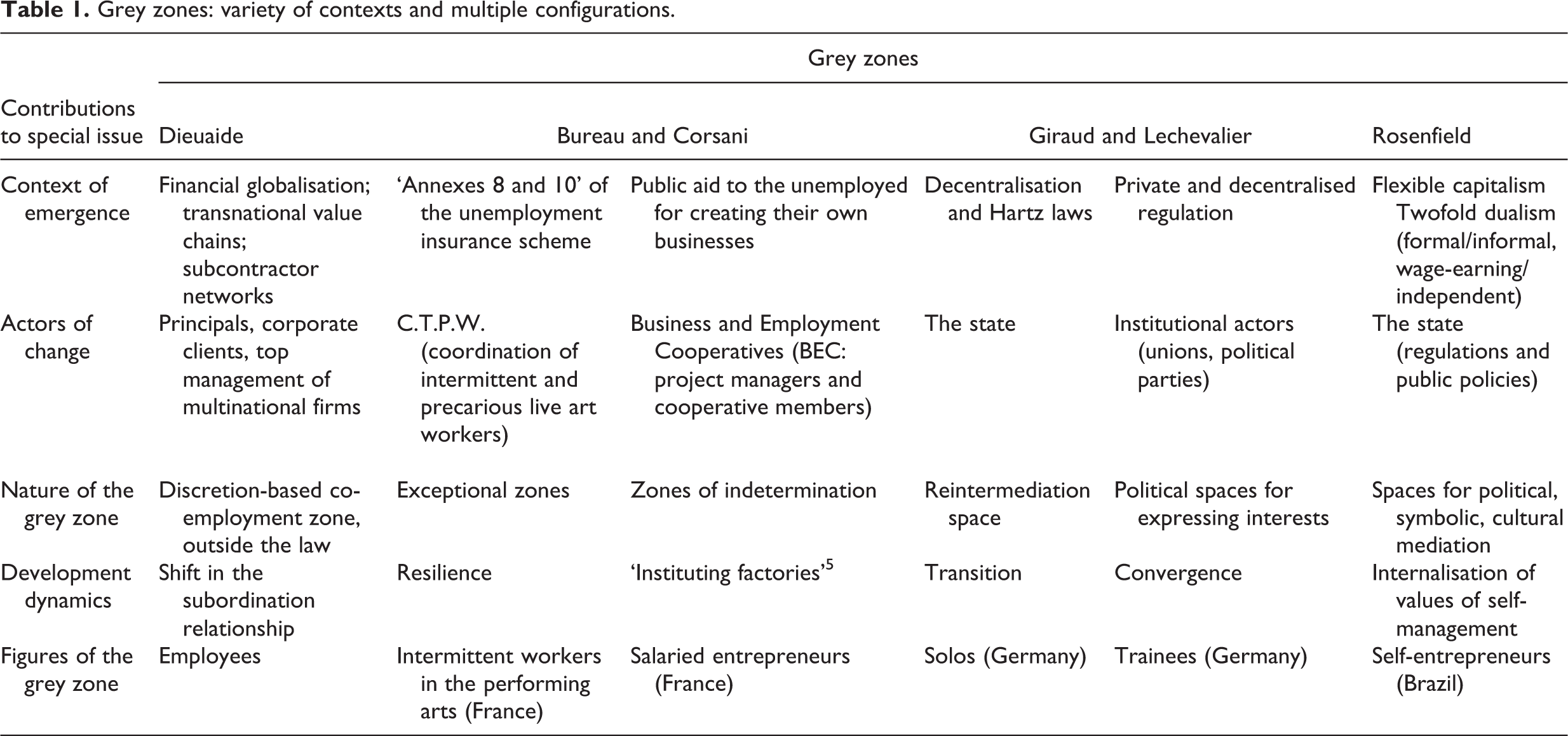
– a first meaning of the term ‘grey zone’ designates more specifically the area of (inter)actions entirely or partially placed under the control or power of regulation of non-instituted actors (Bureau and Corsani, 2018; Dieuaide, 2018). We have reserved the term ‘zone’ to designate these situations, in line with the spirit of the various approaches developed by geopolitical experts (see introduction); – a second meaning refers to the margins of manoeuvre that exist within legal regulations, which both instituted and non-instituted actors seize upon to assert their rights or improve their working and employment conditions (Giraud and Lechevalier, 2018; Rosenfield, 2018). In Table 1, we chose to use the term ‘space’ to describe this kind of configuration.
The distinction between a de facto employer and a de jure employer forms the background to the article by Dieuaide (2018) devoted to the ‘recodification of the employment relationship’ in globalisation. But, according to the author, this distinction is not sufficient in itself to identify and fully characterise the grey zone at the heart of the employment relationship. There needs also to be a more general, structural dimension stemming from the proliferation of triangulation issues. Triangulation refers to situations of conflict where the boundaries of the employment relationship are affected by either relationships between businesses (clients, suppliers), or the demands of principals or head offices based abroad. From this perspective, the grey zone is conceptualised as a ‘co-employment zone’, within which neither the law nor market mechanisms can fully exercise the power to control and normalise the actions and behaviours of the direct employer. This neutralisation of the rule of law and of institutions at local level sheds light on how the employment relationship is affected by the policies of large corporations: superimposed on top of the legal subordination of the employee to his or her employer is subordination of a technological, commercial or financial nature, imposed by third-party relationships at all levels of the organisation. This gives rise to a twofold asymmetry of power, which provides management with control and the means to combine different levels of intervention (global, national, European, local, etc.) and incidentally to place the states and various territories where the sites are established in competition with each other. In a set-up of this kind, the grey zone may be defined as an open, autonomous space of non-instituted powers. But, unlike the experience of Coopaname (see below), this open, autonomous nature remains entirely under the control of management: proliferation of tools and management reference frameworks (benchmarking, social reporting) and manipulation of the social dialogue to keep the trade unions at arm’s length; stepping up of contracting policy, financialisation and individualisation of pay, leading to the marginalisation of collective bargaining, etc. There are plenty of management initiatives and innovations highlighting the emergence of managerial regulation of the employment relationship, which falls outside the law and is discretionary by nature. Broadly free from the instituted frameworks of the national systems of employment relationships, this managerial regulation operates according to a cognitive logic that both acts as a driving force for involvement in and commitment to work and promotes extreme decentralisation of decision-making processes and activity coordination. To sum up, triangulation and the concomitant grey zones of employment have led to a complete turnaround in the ways in which the employer’s power is organised and exercised. In turn, both have contributed to the rise of an original form of subordination, directly under the control of, or relying on the initiative of, management.
Bureau and Corsani present two case studies that display two different natures of the grey zone and two different development dynamics (Bureau and Corsani, 2018). For ‘intermittent’ workers in the performing arts, the specific unemployment insurance and social security scheme is fully recognised and included within the general social insurance scheme of France’s private sector system, via two of the scheme’s annexes. Their ‘in-out’ positioning illustrates the originality of the ‘intermittent’ employment norm. This characteristic leads us to define the contours of what the authors call an ‘exceptional zone’ that is centred on intermittent employment, which in turn regularly leads to tense negotiations between trade unions, employers in the sector concerned and the state. This recurrent tension forms the historical framework for maintaining and developing this specific social insurance scheme. But Bureau and Corsani go further in their analysis by showing that the dynamic stability of the system would not have been possible without the emergence of the Intermittent and Precarious Workers Coordination Movement (Coordination des intermittents et des précaires), an artistic workers’ collective whose activism and expertise endowed this grey zone with an undeniable capacity for resilience. The second case analysed in the article is the case of the entrepreneur-employees of the BEC (Business and Employment Cooperative) called ‘Coopaname’. Here, the concept of grey zone was initially based on a hybrid figure that obtained recognition in France’s Labour Code after only 20 years of collective action: the entrepreneur-employees combine formal salaried employment and freelancing work. Coopaname’s management has used this zone of indetermination to lay the foundations of a firm which is democratic and protective of its members. This explains why the internal strengths underlying the employment relationship are different here from the previous case. They are formulated and implemented to meet a specific political objective: to equip this cooperative with the legal and organisational foundations which allow available capacities and working resources to be pooled. The result is an ‘open’ employment grey zone, one which leaves the field open to a proliferation of innovations such as the development of mini-cooperative societies (workers’ cooperatives) under this umbrella cooperative, the creation of joint committees or ad hoc committees based on the model of ‘workers’ councils’, etc. These are all initiatives that place this cooperative on a path that breaks with the hierarchical models of the organisation and management of salaried employment.
The analysis of the labour market in Germany by Giraud and Lechevalier reveals another way to understand grey zones. In their contribution, the authors distinguish two phenomena that have been developing since the 1990s: (i) the rise in precariousness and insecurity in wage employment (deterioration of the coverage rate, fall in real wages, creation of atypical jobs, and wage moderation); and (ii) the almost uninterrupted rise of non-employed work forms until 2011 (independent contractors or solo workers, as well as what are referred to as ‘mini’ and ‘midi-jobs’). For Giraud and Lechevalier, the first phenomenon was triggered by the shock of reunification and the enlargement of the European Union to the East. It must be linked to the weakening of collective regulations (companies exiting branch-wide collective bargaining agreements, the proliferation of waiver clauses, and wage moderation). The second phenomenon must be connected with the deregulation of the labour market organised by the Hartz laws. In this context, the grey zones may be seen as the result of a complex set of reciprocal influences between these two orders of regulation. On the one hand, the Hartz laws have accompanied and amplified the rise of insecurity and precariousness by facilitating transitions between employment and unemployment in secondary markets. On the other hand, the development of independent contracting (the ‘Solos’ in the Hartz II law) has favoured the emergence of a new form of labour market segmentation through the appearance of a fringe of skilled workers in professional markets, but also through the massive creation of part-time, mainly female, jobs, which are intended to top up income. Thus, in this approach, the notion of grey zones represents the moment of in-depth reconstruction of the structure and operating rules of the German labour market. In this space of reintermediation, the German model of co-determination dominated by internal markets and the insiders/outsiders opposition is gradually giving way to the rise of employment regulation based on a new structuring of markets. Thus, the underlying institutional dynamics can be seen as an open, irreversible transition process towards a more flexible, competitive regulatory order. For the authors, the most obvious signs of this are the growth of (salaried and non-salaried) atypical jobs (such as the Solos and the trainees examined in their article), but also the greater heterogeneity of work statuses and socio-professional situations, and the emergence of a new culture and representation of labour.
It is interesting to compare these developments with the reflections of Rosenfield (2018) concerning self-entrepreneurship in Brazil. There, the informal sector still plays a major role, and the self-entrepreneurial regime has always existed. However, as in Germany, it has become an issue of public policy: this state of affairs has come about as a result of tax exemptions and social guarantees designed to help workers find their way out of the informal sector, while at the same time promoting internalisation of the values of self-management. In this way, alongside waged employment, self-entrepreneurship is becoming the instrument of a public policy that legitimates the spread of a new employment norm resting directly on a political, or even cultural and symbolic, basis. In flexible capitalism, this dynamic of social insertion through the development of a ‘contractualisation’ of work activities cannot be taken for granted. Very often, this contractualisation runs into a problem of visibility and social recognition of individuals’ capacities, but also one of ways and means, in terms of objective and subjective resources for managing and developing their activities. This gives rise to a grey zone that entails a permanent state of tension between autonomy and subordination at the very heart of this new norm of self-entrepreneurship. This tension translates into a constant to-and-fro between formal and informal sectors, but also into a segmentation of the category of self-entrepreneurs, highlighted by the author, between the (genuine) ‘self-entrepreneurs’, the ‘subordinates’ (or disguised employees), the unemployed seeking integration and ‘interstitial’ entrepreneurs, who are to be found at the fringes of the labour market. This segmentation brings to light a highly imperfect, or indeed discriminatory employment norm, which is the source of numerous injustices. For Rosenfield, the promotion of self-entrepreneurship raises what Honneth calls the ‘paradox of freedom’, which combines freedom and self-realisation, but also greater precarity and weaker social protection.
By contrast, it is impossible not to draw a parallel with the article by Giraud and Lechevalier (2018) concerning the importance of collective mobilisations (young people’s unions, political parties and consultancy firms) in Germany, in order to overcome the weaknesses of the government and public regulation in defining and specifying the way in which traineeships may be used by companies and public administrations. Moreover, and as the authors point out, the step-by-step establishment of a collective but ‘private’ regulation has also failed to build a regulatory framework making it possible to distinguish between good and bad traineeships. In the absence of such standards, it may be questioned whether this indetermination does not lead to a forced convergence of viewpoints to develop more common or shared interests, but which are locally situated. Under these conditions, it is possible to argue that these collective mobilisations do not lead to dispersion, but that in the very process leading them to converge, such mobilisations actually turn grey zones into a place where they express their interests.
Grey zones and an approach to institutional change
The originality of the current process of changes in employment norms in advanced capitalist economies is highlighted by the diversity and proliferation of grey zones. These grey zones are structured by specific contexts, and distil the practices and relationships of exchange, as well as cultures and historically constituted representations. They each constitute a ‘regulatory order’ that shows the multiple ways in which individuals enter labour markets and deploy their activities. The various socio-professional figures – such as the salaried entrepreneurs, the Solos or self-entrepreneurs who have been identified as being at the heart of these grey zones – reflect this. In short, the notion of a grey zone makes it possible to measure how far actors’ actual practices are decoupled from the institutional rules of the standard employment relationship. It also allows these practices to be situated within a dynamic, procedural approach to institutional change.
In many ways, these approaches converge with the analysis of institutional change by Streeck and Thelen (2005), adopted and developed by Mahoney and Thelen (2010). Indeed, for Mahoney and Thelen, institutional change is a ‘compliance’ phenomenon: in other words, the impossibility of establishing a perfect match between the expected effects of rules and norms (based on behaviours and representations), and the real effects that result from their application by the actors. The reasons for this ‘institutional gap’ are multiple, including: the incompleteness of the rules due to the excessive complexity of reality; the limited rationality of actors; knowledge of institutions that is unevenly distributed across populations; as well as the blind division of tasks between legislators who design rules, and users who implement them. Thus, for Mahoney and Thelen, institutional change is permanent but gradual. Such gradualism stems from the behaviour of actors, who have a margin of interpretation and who impose changes to the ‘rules of the game’ that are more or less to their advantage, depending on the interests they defend, the power they hold and the coalitions envisaged. Recalling the typology of Streeck and Thelen, Mahoney and Thelen thus distinguish four types of adjustment: (i) the addition of new rules to existing ones (layering); (ii) the cancellation of rules followed by the implementation of new ones (displacement); (iii) the status quo, but with a differentiated impact linked to changes in the environment (drift); and (iv) the status quo, but with a differentiated impact linked to new interpretations of existing rules (conversion).
The approach in terms of grey zones fits in well with this framework of analysis. For example, it could be considered that the institutional change initiated by multinational companies (MNCs), referring to soft law, contractual policies and extended remuneration formulas, stems from a layering of rules. Alternatively, the development of professional markets based on solo workers or the proliferation of cooperative entrepreneur-employees follows a displacement logic.
This rapprochement, however, is possible and is fully valid only if these adjustments are considered as a series of successive ‘small steps’ that always end up by imposing themselves and reflecting the interests of actors. This perspective also suggests that a socio-political compromise between these actors and the representatives of the institutions is a necessary modality for considering the possibility of consolidating institutional change. In the ‘grey zones’ approach, the anchoring of professional figures in the grey zones leads to a focus on individuals who are inclined to negotiate their interests as closely as possible. This is the case, for example, of employees working in the subsidiaries of multinationals. But there are also actors, such as Solos in Germany or the intermittent live performers in France, who, through their mobilisation and collective action, succeed in making a claim for and exercising an ‘instituting power’. In these circumstances, it is possible to revisit the ‘compliance’ hypothesis proposed by Mahoney and Thelen (2010), in so far as institutional change depends not just on the margins of interpretation left to actors to act and to carry out their aims within the existing system of rules. This is clearly borne out by matching these different categories of workforce members with the results of their actions, namely: the emergence and consolidation of professional markets in Germany; the elaboration of common rules within the Coopaname cooperative; or even the establishment of an internal system of social regulation resulting from the contractual policies put in place within multinational groups. In these different situations, emerging figures do indeed have power of initiative, by their actions to ‘take back control’. The approach in terms of grey zones thus leads to the development of an analysis of institutional change which makes grey zones themselves the issue and terrain of a radical, alternative process of institutionalisation, as grey zones bring together all the actors, interactions and resources mobilised. Moreover, the outcome of this process does not depend on the search for a compromise within a given institutional framework. Instead it follows a qualitative leap driven by the political capacity of these figures to organise and make decisions on their own. This is why the study of grey zones is important for the analysis, because it allows the articulation of both radical and gradual approaches to institutional change, by adopting the notion of compliance of Mahoney and Thelen (2010) (see Figure 1).
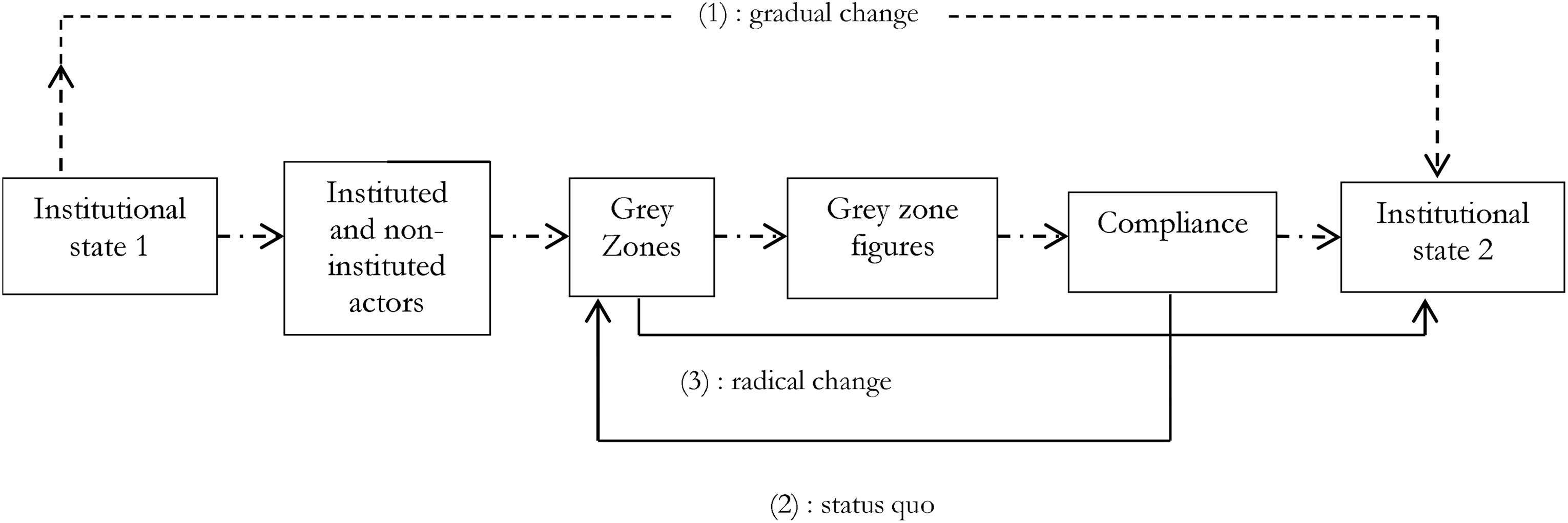
Grey zones and institutional change.
Consequently, three scenarios of institutional change may be identified:
It is important to note that these three scenarios of institutional change are not independent of one another. In particular, the status quo scenario (No. 2) could very well switch to a path involving rupture (Scenario 3) or take the path of gradualism (Scenario 1), given a lack of opportunities for the parties concerned. Similarly, Scenario 3 may never happen and may constrain project managers to fall back on a position of expectation (Scenario 2), or to reconsider their ambitions (Scenario 1). Finally, as soon as Scenario 1 leads to a change in the rules of the game, it has some bearing on the distribution of powers between the different categories of actors. This makes the fulfilment of Scenarios 2 or 3 plausible, at some time in the future.
Providing perspective
To conclude this presentation of the issue, we will discuss the heuristic value of the notion of ‘work and employment grey zone’, in order to grasp the specificities of changes in labour market institutions, given the internationalisation and global integration of economies.
The ‘grey zone’ perspective enriches the classical institutionalist approaches, which tend to underestimate the extra-institutional, cultural and political, infra- and supranational sources of change in employment norms, or even analytically marginalise them (Wailes et al., 2003). Conversely, the notion of grey zones attaches particular importance to ‘micropolitical’ or ‘micro-institutionalisation’ processes, to quote the expressions of Ferner and Quintanilla (2002). These processes contribute to the development of new regulations for work and employment, at all levels and scales. From this point of view, the ‘grey zone’ concept is valuable in opening up the ‘black box’ of the employment relationship in the attempt to understand the particular features which – for any given territory, community or company – lead to differences in regulations, usages and the implementation of forms of cooperation and systems of employment governance (Azaïs and Pépin-Lehalleur, 2014). The perspective adopted has therefore allowed us to compare highly contrasted employment situations, such as the relations between informal and wage labour in Brazil and the informal social dialogue and management practices of multinationals established in Central and Eastern Europe; or to make links between the movement of intermittent and precarious live arts performers in France, and Solos or trainees in Germany.
More broadly, and subject to further examination, the analysis in terms of ‘work and employment grey zones’ has made it possible to identify a variety of scenarios of institutional change. This builds upon the work of Streeck, Thelen and Mahoney on gradualism. However, the approach in terms of grey zones has also shown that gradualism does not exclude other, more innovative and radical experiments, depending on their place, history, circumstances and the power relations prevailing at any specific moment.
Furthermore, this diversity of possible trajectories at the local level raises new questions. This is especially so given the context in recent years of major changes in the organisation of large firms, based on the adoption of networked, polycentric, moving borders. What is the worth of all these ‘micro-regulations’ in the face of this global dynamic which, increasingly every day, impairs national systems of regulation instituted by labour law, to the point of favouring a privatisation of labour law according to Arthurs (2006)? In such a context, it is legitimate to ask whether the proliferation of grey zones does not in fact reverse the ‘forces of emancipation’ that are brought about by the mutations of work. The explosion of autonomous managerial and professional jobs, the rising level of education of the working population in Europe since the 1990s (Oesch and Ménes, 2011) and in Brazil are all changes whose importance must be relativised when employment statuses are considered (Barbier, 2013). By contrast, an optimistic or positive reading of ‘grey zone’ phenomena could also view them as being the most coherent expression of a scattered process of development of a new type of citizenship. As with certain corporate management figures, or with certain segments of the Solo or independent work categories, ‘grey zone’ actors could in fact be the source of an autonomous process. The latter is innovative at the institutional level and reflects traces of a progressive transition from a model of ‘industrial citizenship’ to a model of ‘professional citizenship’, to use the terminology of Standing (2009). Faced with the ‘decoherence’ that exists between institutions and practices, these actors then actually take back control, in order to contribute to the emergence of new instituting processes.
For the time being, the variety of situations analysed does reflect a process of ‘unequal recompositions’, related to the inequality of resources available to actively participating actors in such processes. By drawing attention to the place and importance of these non-instituted regulations and actors at the heart of the analysis of institutional change, the ‘grey zone’ approach sheds an intense light upon the political conditions involved in the production of rules for organising and managing work by the workers themselves. Developing this area of critical thought is an urgent task which should be given priority on the agenda of social scientists.
Footnotes
Acknowledgements
We would like to thank Christian Azaïs, Jean-Yves Boulin, Olivier Giraud and Donna Kesselman for their review and comments.
Funding
This work was supported by the French Agence Nationale de la Recherche (ANR) [Project ZOGRIS, ANR-11-INEG-0011, L’évolution des normes d’emploi et nouvelles formes d’inégalités: vers une comparaison des zones grises?, 2011–2015].