




Abstract
Unions and collective bargaining are generally considered to be the main vehicles for ensuring equity at work. This article questions this assertion by examining distinct forms of inequity between workers in unionised workplaces and, more specifically, the role of collective bargaining in creating, maintaining, reducing or avoiding them. Based on a study conducted in Australia, Canada (Québec), Denmark and France, the situations of inequity examined are related to employment and working conditions, and favour one group of workers over another group of workers performing the same tasks in the same workplace. To better apprehend these dynamics and distinguish between different situations, we develop an analytical framework to capture them. Then, we focus on one example observable in each country: two examples of inequity based on date of hiring (Canada and Australia) and two based on employment status (France and Denmark), showing how the four ideal-type processes interact in each national context. Based on an analysis of these examples, we demonstrate the segmentation between core and non-core employees, along the lines of segmentation theory, but also within groups of insiders or core employees and the key factors that explain how the collective bargaining process can lead to inequity: time, balance of power, and workplace institutions.
Introduction
Trade unions and collective bargaining are generally considered to be the main vehicles for ensuring equity in the workplace. Nevertheless, decentralised bargaining can favour inequity (Doellgast et al., 2018; Garnero, 2020). The impetus for this study was the observation that collective bargaining can be associated with inequity between workers, with some groups of workers required to show greater flexibility, as well as facing greater precariousness and economic insecurity, and enjoying union protection to a lesser degree than others. Equity and inequity refer here to a state of fairness or unfairness of treatment between workers in the employment relationship, including equitable minimum labour standards, fair work rewards and a balanced distribution of income, non-discrimination policies and protection against unjust dismissal (Budd, 2004: 20). This is a major issue in the field of industrial relations, which has historically focused on equity and equitable outcomes and processes in the workplace. Inequity encompasses, but goes beyond discrimination based on individual characteristics, such as gender, age or ethnicity, which have been the focus of many studies on equality and inequality. The presence of inequity in unionised settings may be a sign that unions and collective bargaining are no longer meeting their responsibilities as instruments of social justice, protecting workers and promoting equity. To document this issue, we examine the role of collective bargaining in creating, maintaining, reducing or avoiding inequities in unionised workplaces through a study conducted in four countries, with contrasting institutional and geographical settings: Australia, Canada, 1 Denmark and France.
Research problem and conceptual model
Our study contributes to labour market segmentation theory, insider-outsider theory and institutional dualism by examining the links between collective bargaining and various inequities. According to the literature, the labour market is divided into two segments: the core/primary segment, in which jobs are stable (insiders), and the secondary/periphery market, in which jobs are insecure and less well remunerated – outsiders (Doeringer and Piore, 1971). Although these analytical approaches share the notion of a segmented labour market, the mechanisms fostering the labour market divide – including collective bargaining and unions – differ profoundly. Much segmentation literature considers collective bargaining and strong union presence as instrumental in limiting labour market discrimination and inequalities by restraining employers’ ability to impose flexibility and cost-cutting by segmenting the labour force (Meardi et al., 2019; Rubery, 2015). Insider-outsider theory assumes that collective bargaining, including trade unions, forms a barrier that prevents certain groups from entering the primary or core market, as regulatory protection mainly favours insiders and thus implicitly contributes to inequalities (Lindbeck and Snower, 1989; Meardi et al., 2019). Institutional dualism is more ambiguous and argues that the very same regulatory framework, such as collective bargaining institutions, both produce and counteract labour market inequalities. For example, unions often try to protect insiders, especially in times of crisis (Emmenegger et al., 2012; Palier and Thelen, 2010). These strands of literature help us to understand how increases in flexibility contribute to segmenting labour’s working conditions not only between ‘outsiders’ and ‘insiders’, but also within the primary market, and create inequalities vis-à-vis these ‘outsiders on the inside’, that is, between insiders themselves (Laroche et al., 2019). We explore how the collective bargaining process can become inequitable by justifying unfair differences of treatment that lead to inequity.
To contribute to this discussion, we put forward a perspective that goes beyond the usual approach which implicitly assumes that national and sectoral bargaining institutions are more important than workplace institutions when dealing with labour market inequalities. We thus add another layer to the growing body of literature on income or wage inequality by exploring how distinct workplace bargaining institutions contribute to shaping labour market inequalities in order to capture the dynamics and institutional variations across countries, sectors and workplaces. In line with much segmentation literature, we include any difference in treatment – related to employment and working conditions – that favours one group of workers over another group of workers performing the same tasks. Concretely, core workers (permanent, full-time, with social benefits and so on) often work side-by-side with peripheral workers (part-time, temporary, employees of subcontractors) or newly hired core workers with less advantageous wages, benefits and other working conditions. Such analyses of inequity of treatment between different groups of employees are indeed pivotal, with the locus of collective bargaining shifting as the decentralisation process unfolds. This involves increased latitude for negotiating and derogations from sectoral agreements or statutory law at company level, and thus allows for greater discrepancies in terms of wage and working conditions among distinct employee groups (Marginson, 2014; Polavieja, 2006). Union and employers’ approaches towards dealing with labour market inequalities are often ambivalent and their responses tend to differ across countries, sectors, workplaces and employee groups. They have also slightly shifted over time (Doellgast et al., 2018; Heery, 2009). Research examining social partners’ joint responses in Denmark (Larsen and Mailand, 2018), France (Simms et al., 2018), Australia (Markey and McIvor, 2018) and Canada (Gomez and Lamb, 2019) indicates there has been a shift from trying to overlook or exclude the interests of non-full-time permanent employees, towards acknowledging, organising and jointly pushing to regulate the conditions of these groups through collective bargaining or statute in order to limit discrimination and avoid unfair competition with full-time permanent employees.
To better apprehend these dynamics and distinguish analytically between different situations, we developed an analytical framework that captures all situations. We propose a matrix comprised of four ideal-type processes (see Table 1).
Collective bargaining and inequity in the workplace: four ideal-type processes.
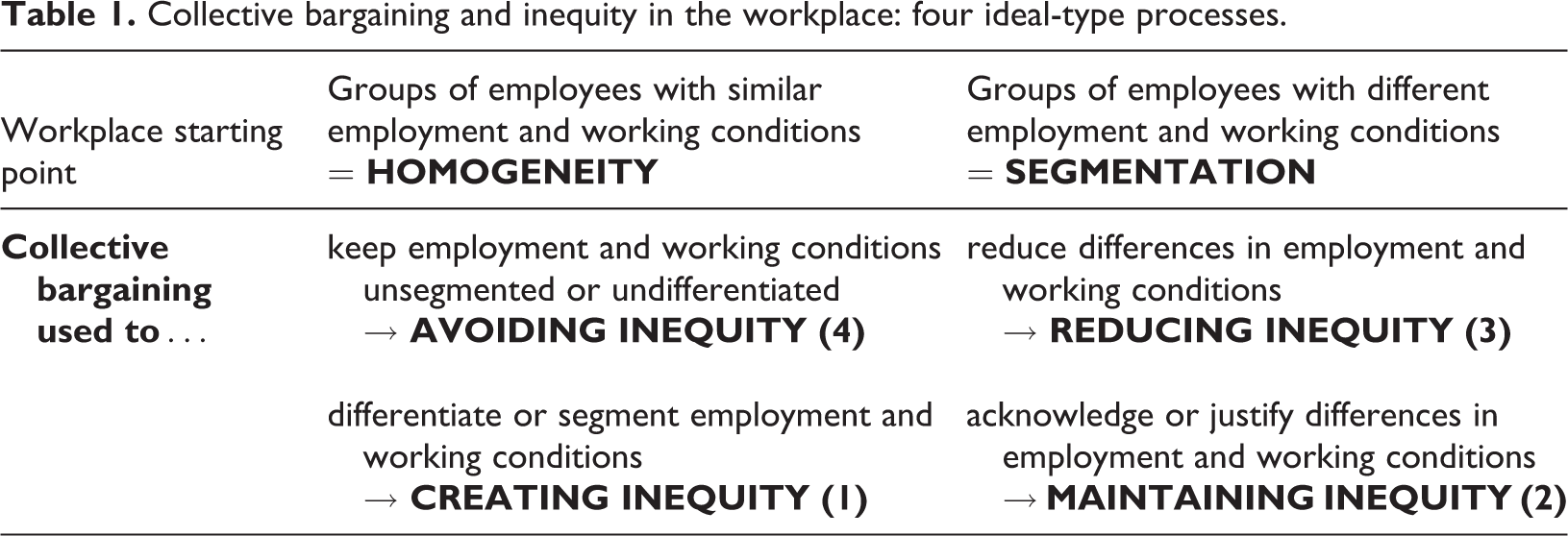
We assume that these four processes – avoiding, reducing, creating or maintaining inequity – refer to different starting points, result from different dynamics and are distinct but not mutually exclusive. In this sense, the role that collective bargaining plays in these processes is likely to differ from one situation to another. Two typical starting points are distinguished: initially, employees have either similar employment and working conditions or different ones.
In the first process, the initial situation is one of homogeneity, and collective bargaining is used to differentiate employment and working conditions, thus segmenting the workforce. This first process thus involves creating inequity in the workplace (1). An increased decentralisation of collective bargaining, especially if combined with an uneven position and strength of unions and employers at the shop-floor level, allows for greater discrepancies in terms of wage levels and working conditions (Bosch and Lehndorff, 2017). Organised and coordinated bargaining systems, such as Denmark’s, display lower wage inequality and types of non-standard work compared with fully decentralised bargaining systems, like the one in Canada, while Australia and France – characterised by centralised and rather uncoordinated bargaining (France) or largely decentralised collective bargaining (Australia) – are classified as somewhere in-between (Garnero, 2020). Collective bargaining can also prevent segmentation between groups of workers and thus contributes to avoiding inequity (4). For example, centralised wage bargaining structures and the introduction of a statutory minimum wage lift the conditions of those at the very bottom of the labour market and thus contribute to limiting, in some instances even preventing inequity (Rubery, 2015). The legislative limitation of certain forms of two-tier provisions in Québec has also helped unions to avoid some of these inequities (Laroche et al., 2019).
In other processes, it is the initial situation rather than the resulting one that is characterised by segmentation. Collective bargaining can be used in two ways. First, collective agreements can acknowledge that groups of workers are subject to different treatment, thus helping to maintain inequity in the workplace (2). Research along these lines suggests that local social partners may choose a different approach towards outsiders than their sectoral organisations and, through workplace bargaining, sharpen inequalities primarily by securing wage increases, further training for insiders or accepting atypical work as a buffer against dismissals (Lindbeck and Snower, 1989; Oliver and Morelock, 2020). Refraining from adjusting collective agreements to changing workplace circumstances also contributes to maintaining inequity (Emmenegger et al., 2012: 11).
Second, collective bargaining can be used to reduce differences in treatment between these groups, thus helping to reduce inequity (3) in the workplace. Inclusive bargaining strategies on both sides of industry, involving novel means such as legal extension of collective agreements, statutory minimum wages, labour clauses, certification schemes and campaigns to tackle downward pressures on wages and unfair competition, have been pursued by employers and unions at different bargaining levels in countries with both weak and strong traditions of collective bargaining (Benassi and Dorigatti, 2018; Doellgast et al., 2018; Trygstadt et al., 2018).
Method
To understand the influence of institutions and collective bargaining processes on inequity in the workplace, we chose to investigate four countries with different industrial relations systems. Australia and Denmark represent two different pathways to decentralisation. As company-level bargaining grows in the two countries, the case of manufacturing, for instance, shows that Danish ‘agreement-based decentralisation seems to offer better process conditions for reproduction of local partnership compared to decentralisation regulated by law’, as seen in Australia (Ilsøe et al., 2018). We decided to add two countries to the study along this voluntaristic vs legalistic line, choosing a second non-European country and a second EU country. The province of Québec provides an example of a voluntaristic industrial relations system, traditionally with a high degree of decentralisation, low coordination and very limited sectoral bargaining and extension regime. It could be considered as an outlier in this group because single-employer bargaining at the establishment level dominates (Laroche and Jalette, 2016). By contrast, France is characterised by a legal system in which the state plays a central role, particularly in the current decentralisation process that challenges traditional multi-employer bargaining at the sectoral level (Béthoux and Laroche, in press). Moreover, France stands out as having the lowest global union density rate in the four countries in question, combined with a diverse competitive union structure. The union structure is diverse and competitive in Québec as well, but the union density rate is 38 per cent, while Australia and Denmark share a diverse cooperative union structure, despite contrasting union density rates of approximately 15 per cent in Australia and almost 63 per cent in Denmark. Although Denmark and France are both labelled ‘coordinated market economies’, as opposed to ‘liberal market economies’, such as Australia and Canada, they are considered to be contrasting cases in the European context itself: Denmark illustrates the ‘Nordic model’ of trade unionism and industrial relations, while France illustrates the ‘Southern’ model (Gumbrell-McCormick and Hyman, 2014).
Australia, Québec, Denmark and France are also worth studying as they present varied configurations regarding equity at work. According to Kim et al. (2015: 646), the Australian and Canadian industrial relations systems favour effectiveness over equity, whereas the Danish system gives equal importance to both criteria, and the French system gives moderate priority to equity and low priority to effectiveness. It is with these similarities and differences regarding industrial relations institutions in mind that these countries were selected to explore the influence of these factors on inequity in the workplace. The main concern regarding data collection was to contextualise how the inequity issue was broadly understood in each national context. Documentary analysis, focus groups and interviews with union and management representatives were deployed aiming to identify a workplace-level type of inequity that was seen as predominant or as mostly debated in each national case: the inequities meeting these criteria were based on the hiring date (Australia and Québec) or worker status (Denmark and France). Each team was in charge of data collection in their country and chose the methods best suited to their context. For instance, because the type of inequity observed in Québec is ‘institutionalised’ (in collective agreements and law) and well-known by practitioners, it made more sense to explore this issue with people from different sectors to obtain a more representative and aggregated view of workplace trends. In Australia, it was more appropriate to focus on the company level, given the absence of public data and the parties’ difficulties discussing the inequity issue. In France, as the issue was most debated in particular sectors, the focus was at the sectoral level and meeting the representative unions in these sectors and then shifting to company cases. In Denmark, the increased latitude for company-based bargaining tends to hamper efforts to address inequity through sectoral bargaining, which is why company cases were used and the focus then shifted to the sectoral level. This approach helped us to better understand the examples of inequity and the associated collective bargaining dynamics in their context. A total of 110 persons were interviewed individually or in focus groups in the four countries at different periods in time. 2
Illustrative examples
Based on the analytical framework developed above, each national example scrutinises the role of collective bargaining in creating, maintaining, reducing or avoiding this inequity, showing how the four ideal-type processes interact in each national context. The emphasis and perspective may vary slightly, depending on the example, as we wanted to choose the most appropriate methods according to the national context.
Québec example: two-tier provisions
In Canada, the responsibility for industrial relations is shared among the federal, provincial and territorial governments: each jurisdiction has its own autonomous system. Consequently, there is no unified ‘Canadian’ industrial relations system. We thus chose to focus on the situation in Québec, whose industrial relations system, as in the other jurisdictions in Canada, is mainly based on the 1935 US Wagner Act, adopting many of its principles regarding grass-roots union recognition, union monopoly of representation and decentralised collective bargaining. The Labour Code specifies that union recognition and collective bargaining occur at the establishment level. Collective bargaining leads to a collective agreement that applies to the bargaining unit at the establishment level. The object of the negotiation or negotiable field is vast and only constrained by the condition that the collective agreement must not contain provisions contrary to public order or the law (Laroche and Jalette, 2016).
It is the exercise (or possible abuse) of this freedom to bargain – the parties are free to include in their agreement any measure on which they mutually agree – that may have led to the appearance of two-tier wage or compensation provisions, which almost all our interviewees referred to. A two-tier provision or, as it is called in Québec, a difference in treatment (disparité de traitement), temporarily or permanently grants an employee, solely on the basis of their hiring date, a less advantageous working condition than what is granted to other employees performing the same tasks in the same establishment. While the classic type of two-tier provision concerns wages, it can also involve other conditions related to compensation (such as fringe benefits, including complementary insurance or pension plan) or job security (for example, duration of the probationary period). As demonstrated by the nature of and presence of these provisions in about 15 per cent of collective agreements in Québec (Laroche et al., 2019), this example is located in Table 1 (box 1), corresponding to the situation in which collective bargaining creates a difference of treatment within a group of workers that were initially homogeneous.
How did labour and management come to agree on a two-tier provision in a relatively significant portion of the local collective agreements in force? Our fieldwork was conducted among experienced professional negotiators who bargain regularly at the establishment level. It revealed that these provisions were proposed by management during negotiations and aimed at reducing costs and increasing flexibility in compensation or job security, in response to competition and economic uncertainty at the sectoral or company level. Employers chose this way of restructuring compensation because, in not affecting current employees, it caused the least turmoil. As one consultant who regularly negotiates for employers at the local level stated: ‘A union [in which] 90 per cent of the workers [have] 20 years of seniority, they would never accept a cut for the whole group. […] Why would they care about someone they don’t even know, who hasn’t even been hired yet?’ (Employers 2 in 2018).
At the national level, unions were clearly against (Table 1, box 4) these two-tier provisions, which cause major disruption in the application of the equity principle and create discrimination among union members. In practice, however, some local unions agreed to them (Table 1, box 1). A study of more than 5000 collective agreements negotiated at the establishment level observed that a balance of power in favour of the employer rendered some unions unable to avoid these provisions, which they unescapably accepted, often along with other concessions (Laroche et al., 2019). As identified by our respondents, one of the great difficulties for unions in mobilising support to fight these provisions is the lack of solidarity between current members and those yet to be hired. Because the former are not willing to go on strike for people they do not know, and the latter are not present at union meetings to defend their own interests, the union’s capacity to reduce or avoid such inequity is fairly weak. ‘[…] it is not just a question of power, because we could have all the strength in the world, but if there is no united will to put an end to the disparities already established or even to refuse those that are proposed […] you will not put an end to differences in treatment, you will not prevent them from happening” (Unions 3 in 2018). In fact, some senior employees argued it was equitable to maintain differentiated treatment for new employees because they had also once had to endure such inequity and felt that everyone had to ‘pay their dues’ (Unions 4 in 2019). In this example, the dynamics appear to be clearly oriented towards the creation and maintenance of inequity (Table 1, boxes 1 and 2).
Even after the government of Québec in 1999 prohibited two-tier provisions with permanent effect on a limited number of working conditions, those with temporary effects and those not prohibited continued to be created and maintained by the parties to local collective agreements. That caused the government to intervene once again, in 2018, to extend the ban to cover these and other items. These new prohibitions do not apply, however, to disparities negotiated before the ban came into force, which are still included in collective agreements. Thus, while satisfied with the extension of the ban, at the national level unions continue to lobby politically for the ability to renegotiate, and thus to reduce or eliminate disparities conceded in the past at the establishment level. Employers are vehemently opposed to this, given the significant costs involved, particularly for complementary pension plans. In sum, in this example, it is not so much the effectiveness of collective bargaining (although 85 per cent of collective agreements do not include such provisions) as the legal constraints, introduced as a result of this institution’s inability to prevent the introduction and perpetuation of such provisions, that may explain their future reduction and eventual disappearance.
Australian example: two-tier provisions
In 1993 the Industrial Relations Reform Act moved collective bargaining from the industry to the enterprise level, and non-union bargaining was established as an alternative to union bargaining (Peetz, 2018). Thus, the Australian industrial relations system has moved from a centralised to a decentralised system, currently governed by the Fair Work Act 2009, which operates at three levels. Underpinning the system at the first level is a guaranteed safety net comprising 10 minimum terms and conditions (including minimum wages and types of employment). At the second level are 122 ‘modern awards’, covering all workers in a given industry or occupation (minimum pay and employment conditions for workers not covered by an enterprise agreement or unable to negotiate an acceptable individual contract). At the third level is collective bargaining, initiated by the employer or union and resulting in either a union or non-union agreement. The Act’s aims include providing workplace relations laws that are fair to working Australians, flexible for business, promote productivity and economic growth and achieve productivity and fairness through an emphasis on enterprise-level collective bargaining, underpinned by simple, good-faith bargaining obligations and clear rules governing industrial action. Negotiations can commence and industrial action be taken only when the previous agreement has expired. Bargaining must be undertaken in good faith and can only concern matters that directly pertain to the employment relationship. The Act does not impose any limitations on inequity but does establish that an agreement cannot discriminate against employees on a number of grounds, such as race, gender, disability, religion, family or career responsibilities. An agreement is established when a majority of employees, regardless of whether they are union members, vote to approve it (Walpole, 2015). This means that, as long as the agreement pertains to the employment relationship, does not discriminate and is accepted by a majority of employees, inequities can occur.
Prior to the 2014–2015 collective bargaining between the American multinational company Simplot and the Australian Manufacturing Workers’ Union (AMWU) in the North-West Tasmanian vegetable processing industry there had been an agreement that redundancy pay should apply equally to all permanent employees. In this sense collective bargaining had created homogenous employment conditions (Table 1). During the course of the 2014–2015 negotiations, however, the union and management agreed to introduce an inequity, in the form of a two-tier provision for redundancy pay. In short, this provision states that permanent employees hired before 1 December 2014 are entitled to four weeks’ pay, as well as an additional four weeks’ pay for each year of service, while for those hired after this date these payments are capped at 52 weeks. While this provision is unusual in the Australian manufacturing sector, there are similarities to those observed in Québec.
In the 2014–2015 negotiations, Simplot’s Australian subsidiary sought to reduce escalating labour costs and improve plant viability and profitability against a background of constant internal benchmarking and competition between plants. In addition to these two-tier redundancy payments, the company aggressively sought to decentralise the collective bargaining process by moving from one enterprise agreement to four separate site agreements, and deprive employees of a pay raise during the agreement’s first year. Wishing to preserve past gains and maintain a single agreement preserving their collective strength, the union took industrial action. Simplot responded with a media campaign that used farmers and politicians to put pressure on the workers and the union. The union managed to achieve a single agreement and pay increases but, after a year of negotiations, with no pay increases during this time, and under pressure from the company’s media and political campaign, it made concessions on redundancy payments, rosters, starting time and shift structures. ‘They caned us in the media and everywhere […] we were getting belted […] severely’ (Simplot worker in 2018). These changes were voted on and agreed to by most employees. ‘At the end of the day the workforce made the decision […] they [Simplot] wore them down till they’d had enough and they agreed to a lot of things they probably shouldn’t have’ (Simplot worker in 2018). In this way collective bargaining was used to create inequity (Table 1, box 1).
The two-tier provision related to redundancy payments was seen as a compromise because the company had initially proposed to cap such payments at 52 weeks’ pay for all permanent employees. The compromise was that the parties agreed to introduce differing conditions between those currently employed and those yet to be employed. Some union members felt that the union had managed to avoid the worst by preventing current employees from having their redundancy pay capped and thus being adversely affected by this provision. Others, however, felt that it was a poor decision to accept a provision that only the company wanted, considering it a significant change to the collective agreement. ‘The company wanted to strip our redundancy back […] But any new employee that starts is going to get a redundancy capped […] I just think that’s wrong’ (Simplot worker in 2015). Although the union recognised the inherent unfairness of this provision and aimed to eliminate it in later bargaining rounds, limitations on industrial action, collective agreement content, high levels of casualisation and declining union density have made it difficult for unions to advance their claims. Outcomes such as the two-tier redundancy pay provisions are unusual but appear to be becoming more frequent as employee bargaining power has receded under the ‘weight of a dying bargaining system’ in Australia, and employers have pushed for flexibility and created structures that reduce the need to engage with unions and collective bargaining, thus exacerbating inequity (Bornstein, 2019).
French example: workers in former public firms
The French industrial relations system is characterised by a high degree of juridification and state involvement, a three-tier bargaining system, a strong tradition of multi-unionism and a dual channel of employee representation at the workplace level. Over the past 30 years, the locus of collective bargaining has shifted from the traditional level of industry to that of companies and workplaces. This move is based on the assumption that companies are the most relevant level of social regulation to secure France’s competitiveness in a globalised economic context. Since the early 2000s employers, who initially were wary of developing collective bargaining at company level, have favoured it to introduce greater workplace flexibility. As company-level bargaining gains impetus, the ability of unions and worker representatives to take advantage of this decentralising trend has been questioned (Béthoux and Mias, 2019).
This evolving context affects the way inequities are dealt with at company level. In 1966, the Labour Code set out the ‘equal pay for equal work’ rule, relabelled in 2008 the ‘principle of equal treatment’ rule. Nevertheless since 2008, from a legal standpoint, when a company collective agreement includes or defines unequal treatments, such treatments are considered justified given that the agreement was negotiated and signed by union representatives. A series of court cases have confirmed this interpretation of the role of collective bargaining in justifying inequities at work, progressively extending it to various situations. In April 2019, however, this extension was halted: a Cour de Cassation 3 decision stated that unequal treatment is not systematically justified simply because a collective agreement exists. The Court referred to European law and EU rights in explaining its decision. Whether or not future court cases will continue to favour the recognition of inequities at work by company collective agreements thus remains under scrutiny.
Fieldwork in France was conducted with these legal and judicial developments in mind. Company agreements containing two-tier provisions, such as those analysed in the Québec and Australian examples, were rarely mentioned by management and union interviewees. In fact, unequal treatment referring to the employees’ hiring date was brought up mainly in the case of (previously) public companies. Hiring date and employment status are related but it is on the latter that the inequity is ultimately based. Employees from these companies traditionally enjoy specific employment and working conditions related to their civil servant status. Meanwhile, some of these companies, having been partially or fully privatised (such as the post office and telecommunication services) or currently undergoing such changes (such as the national railway company), have begun hiring new employees on the basis of a private employment contract. For instance, as of 2020, the railway company will stop hiring employees holding the historical cheminot public status. The most frequently mentioned differences between the two categories of employees were pay scales, and to a lesser extent health insurance schemes or days off, as well as pension calculation methods (Béthoux and Dupuy, 2019). Thus, the starting point in France is a situation of ‘segmentation’ (Table 1): the differences do not result from collective bargaining in the first place but from public companies being partially or fully privatised, with the aim of promoting economic competition. Consequently, employees holding the same position can work side by side and yet hold different – public or private – statuses.
In such situations, unions encounter difficulties in dealing with the plurality of statuses. First, the existence of inequities creates tensions between and within groups of employees, all the more so as a generational effect is also at play: public servants are often older than the newly hired employees who are working on private contracts. This makes organising and mobilising employees more complex, as different groups of employees do not share the same interests or views (Simms et al., 2018). Second, in cases such as the railway and post companies, public servants and private employees are not covered by the same rules regarding worker representation on the shop floor. Unions face difficulties in taking diverging interests into account during collective bargaining rounds, as workers are covered by different contracts or collective agreements. In this context, collective bargaining is a means of dealing with forms of unequal treatment, aiming either at maintaining (Table 1, box 2) them by way of agreement or at trying to reduce (Table 1, box 3) them. There may be recourse to collective bargaining at two levels. First, sectoral collective agreements have been negotiated to take into account the increased diversity of economic and social situations, both between and within companies belonging to the newly defined sector. The 2000 collective agreement for the French telecom sector was a good case in point (Mias, 2010). Twenty years later, the negotiation of a single agreement for the railway sector is currently under way. Company-level agreements are the second option. Unions demand the harmonisation of employees’ conditions by aligning them all with the most advantageous ones (Box 3). In the case of railways, for instance, specific health benefits have been negotiated for private contract workers to compensate for the better conditions enjoyed by public status employees. Employers’ strategies have varied from case to case, depending on the sectoral context. Some have been in favour of harmonising employee conditions, such as in the telecom case but the differences between the statuses, governed by separate rules, do not easily allow it: ‘The principle is one of equality (between civil servants and private workers) and work has been done to eliminate differences but the civil servant status will always lie above the collective agreement’ (HR manager in 2020).
Danish example: atypical workers
The Danish industrial relations system is characterised by a high degree of voluntarism, with strong traditions of multi-unionism, a two-tier bargaining system, dense networks of union-affiliated workplace representation and limited state intervention in important areas of the employment relationship, such as wage setting, which is left exclusively up to the social partners (Due and Madsen, 2008). Union density (63 per cent in 2018), collective agreement coverage (82 per cent in 2018) and union-led workplace representation (52 per cent in 2010) are high, but vary considerably across sectors. For example, the Danish bargaining model is considerably weaker in private services than in manufacturing. For workers not covered by collective agreements, there are statutory social rights, but these are less generous than the terms set out in most collective agreements.
Since the 1980s, the locus of collective bargaining has shifted: sectoral collective agreements now outline the main framework of collectively agreed labour standards, while the local social partners increasingly determine the implementation and interpretation of these agreements. The latitude for company bargaining, including deviations from sectoral agreements, varies across sectors. Such bargaining can take place only if a shop steward is present and there is local consensus in the workplace (Ilsøe, 2012). These sectoral variations, combined with the Danish bargaining model, which in principle is built on the notion of employees holding full-time open-ended contracts, have contributed to greater diversity and a higher risk of inequities that are closely linked to employment status (Larsen, 2011).
Our Danish fieldwork was conducted in the manufacturing, meat processing and hotel and restaurant sectors. It considered institutionally embedded diversity and the risk of inequities arising from differing contractual statuses. In Denmark the regulatory framework protects different employee groups, irrespective of their contractual status, but the eligibility criteria for social benefits, bonuses and wage increases are often tied to past employment records and weekly working hours, making it difficult for atypical workers to accrue such rights (Larsen and Mailand, 2018). The institutional set-up for company bargaining also entails that employees’ rights as regards collective representation refer to employer responsibility. In the case of temporary agency workers, employer responsibility lies with the agency, while for subcontracted workers it lies with the private contractors. Because these workers’ employment contract is with the agency or private contractor holding employer responsibility, they lack rights to participate in and influence bargaining processes at the client company. In some sectors, however, such as manufacturing, if the client company is covered by the sectoral agreement, this stipulates that temporary agency workers work under the collectively agreed wage and working conditions. By contrast, subcontracted workers often work under very different conditions because, unlike temporary agency workers, they are employed under the arrangements of the private contractor, even if they work on the client company’s premises. Similar to the French example, inequities arising from differing contractual statuses were widely mentioned by the interviewees, but often under the broad heading of atypical work (Table 1). At first, these differences do not arise from collective bargaining, but from the growth in novel ways of organising work, such as outsourcing, and increased use of temporary agency workers, subcontracted work and external consultants.
Danish unions and their representatives tend to build their constituencies around full-time workers, often excluding or ignoring atypical workers, although their approach has changed somewhat recently (Larsen and Mailand, 2018). This was also seen in our case studies, in which temporary agency workers and subcontracted workers are often left in representational limbo without rights to institutional representation and tend to work under slightly different conditions than the client company’s permanent staff (Table 1, box 3): ‘In the beginning they [workplace representatives] could not care less about these temporary agency workers as they come and go, but you need to fight the case of temporary agency workers, and many have also done so, but it has not always been like that’ (Local union representative in 2016). In other workplaces, local social partners have a slightly different approach and often ignore or exclude temporary agency workers and subcontracted workers (Table 1, box 2): ‘To avoid conflict, we keep the two groups [permanent staff and subcontracted workers] separate: They [subcontracted workers] have their areas and we have ours. There are always problems when working together’ (Employee representative in 2019).
Through company bargaining, the local social partners have used their bargaining position to produce a series of joint initiatives to reduce the emerging risks tied to atypical work (Table 1, box 3). Examples involve lowering eligibility criteria for social benefits, guarantees of a permanent position after a certain time as a temporary agency worker, temporary agency worker quotas and local labour clauses in procured work. Workplace initiatives are not always driven by the desire to protect atypical workers, however. In some instances, their aim appears to be to secure the position of the permanent staff. Several Danish unions and shop stewards interviewed stressed the imperative of ensuring that labour costs for atypical work remain higher than or at least at similar levels to those for permanent staff in order to eliminate unfair competition (‘wage dumpers’, shop steward in 2016). Our interviews further revealed that differing workplace practices have emerged regarding the collective representation of atypical workers. In some companies, union-affiliated workplace representatives have deliberately decided to exclude temporary agency workers from the local bargaining process by referring to their lack of statutory rights to collective representation, leaving them with no means of airing their demands or influencing bargaining outcomes (Table 1, box 1). In other companies, workplace representatives have applied a more inclusive approach, involving atypical workers in a similar way to other workers when bargaining at company level, often with the aim of preventing downward pressures on wages and working conditions (Table 1, box 4). Such findings indicate that the increased latitude for company bargaining has contributed to greater diversity in local practices, even if sectoral social partners have agreed to reduce (Table 1, box 3) the emerging risk of inequities tied to atypical work. Some leading sectors, such as manufacturing, expanded their collective agreements to cover atypical workers in the mid-1990s, and other bargaining areas started to follow suit during the 2000s (Larsen and Mailand, 2018).
Discussion and conclusion
Our study highlights different forms of inequity and their underlying dynamics in collective bargaining in four countries with contrasting institutional settings, including the role of structural and local factors. In Québec and Australia, we studied inequities based on the hiring date, while in France and Denmark they were based on worker status (public servant/private contract; regular worker/atypical worker). In all four selected countries, with diverse industrial relations systems, however, we observed examples of differences in treatment between two groups of workers working side by side, in (but not always for) the same company. Across densely and less densely regulated and coordinated labour markets, we found ‘pockets of inequity’ often institutionally embedded. We also found that inequities in employment and working conditions can co-exist between outsiders and insiders (Denmark), as outlined in much segmentation theory but also within groups of insiders (Australia and Québec), even with different status (France). From our analysis of these examples, three key factors emerged: time, balance of power, and institutions.
First, time matters. The starting point in our examples (segmentation in France and Denmark; homogeneity in Australia and Québec) proved to be crucial. This demonstrated the importance of considering time when examining the development of inequity. The national examples show that, over time, one process may succeed another, depending on the conditions of the moment. For instance, these inequities appear over time to become a kind of a moral issue for the union, whether pressured by its members or by the social or legal context. While the creation of an inequity may initially appear justifiable or inevitable, it may become unacceptable over time, leading to its reduction or even elimination. The Canadian, Australian and Danish examples show that unions have sometimes adopted one strategy, later replacing it with another as inequities arose – albeit sometimes finding it difficult to mobilise their members, as recognised in other research (Heery, 2009; Oliver and Morelock, 2020). As argued in much institutional dualism theory, these processes are thus not mutually exclusive (Emmenegger et al., 2012; Palier and Thelen, 2010). The analytical framework was developed on the basis of a review of the literature – the matrix depicting the four processes of creating, maintaining, reducing or avoiding inequity – and demonstrated its usefulness in understanding the dynamics of inequity in collective bargaining over time, taking account of the evolution of law, economic and social context, social partners’ values and members.
Secondly, we show that the dynamics of collective bargaining, and especially the balance of power between unions and employers (private in Australia, Québec and Denmark; public in France and Québec) are crucial to understanding the dynamics of inequities in the workplace. The instigation of inequity typically starts with employers’ demands to segment the workforce through differential treatment, which introduces inequities that make hiring easier and cheaper, in the name of flexibility and cost containment (Laroche et al., 2019; Rubery, 2015). These inequities, whether imposed by force or accepted by the unions, are justified by the latter in different ways: ‘We had no choice’, ‘We have to focus on current or regular members’, ‘There should be no exceptions, we’ve all been there’ and so on. As highlighted in the Australian and Canadian examples, the union’s bargaining power can be reduced when workers develop their own narratives to explain away these differences of treatment. These become self-perpetuating over time, and potentially undermine trade union solidarity during bargaining rounds in which the balance of power might have been more favourable to them. The undermining of union bargaining power, caused by a lack of intra-union (Québec, Australia, Denmark) or inter-union (France) solidarity, or by other causes, such as management strategy or a difficult economic or political context, is a significant factor in explaining these inequities and thus corroborates other research (Doellgast et al., 2018; Lindbeck and Snower, 1989). To increase their bargaining power and prevent these inequities, unions need to develop not only a bargaining strategy but also a representation strategy – as observed in Denmark – that aims at bringing all the benefits associated with unionism to as many workers as possible (Bosch and Lehndorff, 2017).
Third, our research tends to demonstrate that institutions, mainly the legal framework and national industrial relations system, are a key factor in understanding the emergence or reduction of inequities. One of our contributions is to show that workplace institutions are at least as important, if not more so, than sectoral or national ones when dealing with labour market inequalities. Although higher bargaining levels have attempted to reduce or avoid inequities, their good intentions or inclusive strategies do not always extend to workplaces, especially if decentralisation allows the preservation of inequities and enables local social partners to develop their own logics. At the workplace level, the legal framework can prevent the parties from using their freedom to bargain to establish different employment and working conditions for a specific group, as shown in the French and Canadian examples. It is also possible to combat inequities when company bargaining is subordinated to external factors, such as sectoral agreements (France and Denmark). The risk of inequities is lower than when external constraints are minimal (as in Canada and Australia). Our study demonstrates that the decentralisation of collective bargaining at the company level is a threat to equity if not organised or regulated. Checks and balances of industrial relations systems aimed at preventing these inequities – whether through another level of negotiations or a legal prohibition – should be implemented in order to ensure that collective bargaining performs its role properly. This result complements the view that ‘inclusive institutions […] encourage coordinated bargaining and constrain the employer’s ability to shift work to precarious contracts or employment relationships’ (Doellgast et al., 2018: 10). Bargaining power matters as it increases the employer’s ability to pursue a strategy of union concessions, but it is not the only factor at play, as shown in this research.
Collective bargaining can be seen as one cause of the emergence of these inequities. It can also be considered to have failed in protecting workers and promoting equity. Thus, our study clearly demonstrates that, even in the presence of unions and collective institutions, one should not assume that all workers are treated equitably. Collective bargaining can also be seen as a solution, however, preventing and reducing inequitable situations, if certain conditions are met. At the workplace level, some intertwined conditions – such as union bargaining power, solidarity among members, new awareness of the problem, change of narrative or inclusive representation strategies – appear to be necessary to turn the tide.
Footnotes
Funding
This work was supported by the Industrial Relations and Firms’ Competitiveness Chair (ESCP Europe) [grant number 2018-00].