




Abstract
Much of the recent literature on the COVID-19 pandemic agrees on the uniqueness of this crisis. Assessments of the subsequent policy response in Europe diverge, however: while some see signs of policy change, others consider the empirical evidence to be inconclusive or, worse, consistent with a reinforcement of neoliberalism. The present article aims to contribute to that debate by providing a preliminary assessment of policy measures in the areas of health care, employment protection and pensions. Recent measures are viewed in terms of the neoliberal paradigm, which is used as a benchmark to identify any sign of innovation. While it is too early to talk about a true paradigmatic transformation, the evidence collected from international datasets and official documents confirms that ideas and policy measures show signs of change. The article also suggests that the study of ideas is a promising field of enquiry with which to improve our understanding of the pandemic and its effects.
Introduction
This article focuses on the COVID-19 pandemic that has beset Europe since February 2020. The effects of the virus have been enormous: by the end of 2021, European countries had had about 109 million cases and over 1.6 million deaths. 1 This has already had profound consequences for their economies and production systems (as a consequence of the so-called Great Lockdown), labour markets and social dialogue institutions, as well as the ordinary lives of political institutions and people.
In the past couple of years, much of the literature has focused on a single question: is this crisis something new? The literature shows general agreement on the fact that the COVID-19 pandemic is a crisis like no other. It is different because of its origin and magnitude, but precisely because of its uniqueness, it could be the trigger of a new welfare and work reform agenda. Assessments of policy responses in Europe are contradictory, however: some analysts see changes, while others think that the empirical evidence is inconclusive, or, indeed, consistent with the persistence of neoliberal priorities.
While it is too early for a systematic assessment of the impact of COVID-19, and to judge whether we are experiencing a paradigmatic transformation, the present article aims to assess whether social and employment policies in Europe are experiencing any change after the pandemic. While much of the literature has compared the first response to the pandemic with the policy measures adopted in previous crises (such as the Great Recession of 2008), the present article follows a different strategy. The reforms and the ideological debate about them are compared with the neoliberal benchmark. The analysis focuses on three policy areas: health care, employment protection and pensions. The two former policies are at the core of the first measures taken to safeguard people’s health and jobs. The latter policy – pensions – is less directly affected by the pandemic. This makes it a good test of whether, beyond the urgent need to address the main negative effects of the economic downturn, policy-makers have started to rethink their reform agenda.
For each policy, we take three analytical dimensions (austerity, privatisation and marketisation) to operationalise the policy priorities set by neoliberalism and assess recent reforms against them. The article will also provide some preliminary suggestions for future research on the aftermath of the pandemic crisis and socio-employment reforms. In line with the recent turn of social sciences towards ideas and discourses, we think their analysis can be extremely relevant for assessing the nature of change and the causal link between crises and same policy changes.
The article is structured as follows. Section 1 briefly summarises the ongoing scientific debate on the role of major crises in the long-term evolution of social and labour market institutions. Section 2 operationalises the concept of neoliberalism and its main features in social and employment policies. Section 3 presents the ideological battle between intellectuals and policy-makers. Section 4 sheds light on recent policy measures in the areas of health care, employment protection and pensions. All this is analysed by reviewing the secondary literature, international online datasets and official documents. Section 5 concludes and provides some initial reflections on the future investigation of post-pandemic reforms.
Major crises and their role in policy change
Global crises – in the sense of ‘a sudden, and often unexpected, deterioration of most, or all, key macroeconomic indicators’ 2 – are scarcely new in the history of capitalism. The 20th century was punctuated by periodic global recessions, from the economic panic of 1907, through the hyperinflation that followed the First World War, the Great Depression of 1929, the disruptions of the Second World War and to the so-called oil shocks in the 1970s (coming hot on the heels of the demise of Bretton Woods). These are only a few examples of the many economic downturns Europe and the world economy have gone through (Reinhart and Rogoff, 2011). Recent decades have continued this trend. At the beginning of the 20th century, the 11 September terrorist attack and the ‘Dot.com’ bubble of the early 2000s were followed by the Great Recession of 2008.
The COVID-19 pandemic is thus to some extent merely the most recent shock, but many analysts nevertheless consider it to be sui generis. As for its origin, while many of the crises of the 20th century originated from wars or economic downturns, this one is the result of a global health emergency that threatens to affect everyone, everywhere. 3 A second peculiarity of the pandemic concerns symmetry: on the one hand, the crisis has simultaneously affected both the supply and the demand sides of the economy; on the other, the pandemic has spread across countries all over the world (Ladi and Tsarouhas, 2020; Meardi and Tassinari, 2022). Thirdly, the magnitude of the crisis is striking. The literature has so far provided only rough estimates of the differences between the pandemic and the previous major crises. De Grauwe and Ji (2020) have compared the Great Depression of 1929, the Great Recession of 2008 and the Great Lockdown of 2020. They show that the intensity of economic decline after the eruption of the coronavirus has been much greater and faster than that of the Great Depression and of the banking crisis of 2008. On top of that, the recovery after the first wave of the pandemic has also proved impressive, with a rapid improvement of economic prospects in 2021.
While there is some consensus that COVID-19 is a different type of crisis, analysts diverge on their initial assessments of the policy measures passed so far to address it. Some see the crisis as the cause of major innovations. Gerbaudo (2021) has talked of crumbling neoliberalism, as a consequence of political, economic and environmental challenges and – last but not least – the dramatic health emergency of 2020. The global pandemic has led policy-makers around Europe to resurrect forms of government intervention. This is what the author calls the Great Recoil. Along the same lines, Borio (2020) stresses that the policy response has been equally exceptional, leading to an unparalleled concerted effort, combining monetary, fiscal and prudential policies. At the same time, Buti and Papaconstantinou (2021) talk of a new macro-paradigm of economic (and social) policy in the EU in the aftermath of COVID-19. New instruments and new programmes have been set up to address the health crisis and support economic recovery, while also accelerating European integration.
These interpretations seem in line with the ‘dual’ model of historical development: shorter phases of fluidity and change, alternating with longer periods of stability and adaptation (Capoccia and Kelemen, 2007). International crises are critical junctures: major events that disrupt the existing political and economic balance and allow for political agency. Decision-makers can choose to set institutions on a new path of development that may then persist over a long period of time (Acemoglu and Robinson, 2012). In social policy, Castles (2010) and Obinger et al. (2018) – recently quoted in Pavolini et al. (2021) – see exogenous shocks caused by military conflicts and economic and financial crises as critical moments that enabled the emergence and consolidation of the welfare state.
But other scholars are much more sceptical. They do not see any evidence of policy change. Data and information are seen as inconclusive or, worse, suggest that the response to the pandemic indicates the stability of the neoliberal paradigm. Sumonja (2021), for example, sees a perpetuation of neoliberal programmes, in line with ongoing conflicts between social classes and the persistent strength of capital. Dosi (2021), too, suggests that the pandemic has reinforced the old paradigm. The production and distribution of vaccines provide evidence of this: while basic research is almost entirely public, private firms have received massive resources (the EU has paid out about €8bn) for applied research, testing and distribution of the same vaccines in exchange for weaker regulatory controls. Dosi et al. (2020) warn against the arrival of a ‘new normal’ which forgets about any radical changes in the current organisation of our societies, characterised by deep inequalities and unbalanced distribution of power (Dosi et al., 2020: 4).
The latter, more sceptical view is in line with a strand of the literature that interprets crises as moments that usually do not have the potential for radical change (Starke et al., 2013). Rather, especially in conditions of uncertainty, policy-makers tend to replicate existing policy routines in line with path dependency. Radical changes are thus possible but not frequent in the aftermath of exogenous shocks (see also the more traditional post-deterministic neo-institutionalist literature, for example, Mahoney and Thelen, 2010).
Assessing the response to the pandemic: a possible halt to neoliberalism?
These divergent interpretations of the pandemic’s main policy effects are also related to objective problems in assessing policy change (Capano et al., 2022). It is thus useful to provide some analytical clarifications.
The focus of our analysis is ideas, discourses 4 and the substantive content of policy measures (policy output). This choice is in line with trends in the contemporary social sciences, which are increasingly aware of the role of ideas and discourses in shaping politics and policy (Ban, 2016; Blyth, 2013). This is also the case with regard to employment and social policy reforms (Ban et al., 2022).
The financial crisis of 2008 is a typical example. At that time, the ‘battle of ideas’ was crucial in shaping definitions of the problem and subsequent solutions. In Europe, those who framed the crisis in terms of a ‘financial crisis’ – a consequence of the lack of regulation of global finance – were challenged by those who framed the same recession in terms of a so-called ‘sovereign debt crisis’. The outcomes of this confrontation have had a massive impact on reform. Austerity became the core part of the recovery strategy, while neo-Keynesian policy ideas remained at the margin (Irvin, 2011). In the following section we thus analyse ideas and discourses, together with the substantive content of policy measures.
While much of the literature mentioned above provides a chronological analysis and compares various crises, here we follow a different strategy. We first fix a benchmark, represented by the neoliberal paradigm. Then we compare major policy measures in the areas under scrutiny with that benchmark.
This choice leads us to ask: what is neoliberalism? How has it shaped the past few decades of social and employment policies? From an ideational point of view, neoliberalism involves a professed commitment to certain core principles focused on ‘market competition’ and a ‘limited state’ (Schmidt and Thatcher, 2015). According to Schmidt and Thatcher, neoliberals ‘believe that markets should be as “free” as possible, meaning governed by competition and open across borders, while the state should have a limited political economic role’ (Schmidt and Thatcher, 2015: 22). But how have these broad principles been translated into policy priorities and measures?
For Hay (2004), descending the ladder of abstraction, neoliberal policy goals consist of the rejection of Keynesian demand-management techniques in favour of supply-side economics. When neoliberalism emerged in the political discourse in the second half of the 20th century, it challenged some of the so-called ‘Keynesian’ post-war beliefs, such as redistributive taxation and deficit spending, international exchange controls, economic regulation, public goods and service provision, and active fiscal and monetary policies. Centrally, the ‘market’ was considered to be an efficient institution in the provision of public goods. Historically, these ideas have led to the cutting of welfare benefits, on the professed grounds that they might reduce incentives to market participation and increases in labour market flexibility (Centeno and Cohen, 2012).
What does neoliberalism represent for social and employment policies? How can we operationalise such a complex and abstract theory into more practical policy dimensions? Some authors (Crouch, 2011; Ebbinghaus, 2015) have traced the course of this ideology in the world of work and welfare. This helps us to assess any deviations to which the pandemic may have led.
We focus on three main dimensions. The first has to do with the budgetary effects of social and employment reforms and is consistent with the term austerity. As clearly outlined by Blyth (2013), austerity is the deliberate deflation of domestic wages and prices through cuts to public spending. It is supposedly designed to reduce a state's debts and deficits, increase its economic competitiveness and restore ‘business confidence’. The last point is key to the advocates of austerity, who assert that cost containment fosters private investment, signalling that the government will not ‘crowd out’ private investors or the ‘national debt’. The neoliberal view is that this will increase consumers’ and producers’ confidence, thereby boosting private spending and thus economic growth.
The second dimension is more about the role of public and private organisations in providing goods and services. Here the term privatisation is crucial. By ‘privatisation’ we mean the ‘process of shifting responsibility for welfare provision to private actors and market forces’ (see also Ebbinghaus, 2015).
The third and last dimension is ‘individual responsibility’ with a consequent reduction of the space for redistribution and protection against major social risks and needs. Some have talked of marketisation, which means that social and labour rights are increasingly dependent on market logic, involving both deregulation (for example, reduced labour protection) and individualisation of risks (for example, a stricter alignment of revenues and spending) (Ebbinghaus, 2015).
Intellectual debate in the aftermath of COVID-19
The operationalisation proposed above allows us to interpret the evidence pertaining to both the ideational debate between intellectuals and policy-makers, 5 and the substantive content of the first policy measures adopted in the aftermath of the pandemic crisis. The information summarised in this section was collected through a review of the secondary literature, and international databases of both qualitative and quantitative information. 6 Official documents from international organisations (such as EU documents and reports) and national governments are a further source of information. We also reviewed some key contributions in the literature that, based on textual and discourse analysis, shed light on the state of the debate between policy-makers (see Ferrera et al., 2021; Sjölander-Lindqvist et al., 2020).
At a very general level, criticism of neoliberal reforms over recent decades has increased in the aftermath of the pandemic. In the words of Mazzucato (2020), the neoliberal economy has proven to be ‘broken, unequal, and carbon-intensive’ (even after the Great Recession). Economic growth strategies of the past – based on cost containment and market domination – are seen to be inadequate, being based on short-termism and generating massive inequality. Both undermine the capacity to address major socio-natural challenges. Even many mainstream economists have started to take a more critical position and emphasise the need for an alternative recovery strategy. New macroeconomic ideas that have emerged in the aftermath of the global financial crisis include new understandings of debt sustainability (see De Beer and Keune, 2022) and of fiscal and monetary policy. The key point of this wave of neo-Keynesianism is that fiscal policy must play a central role in the recovery. Increased investments and spending on social and employment policies are decisive in the context of the so-called ‘zero lower bound’ scenario: monetary policy is not sufficient to boost recovery when interest rates are close to zero (Fornaro and Wolf, 2020).
Concerning health care, many analysts have outlined that the mounting pressure on national health-care systems has been aggravated by decades of cuts and the narrowing of workers’ rights. Public hospitals have often been the first victims of austerity policies. This created major problems in tackling the pandemic. For a large strand of the literature, the crisis has also shown the failure of health systems when they are partly left to ‘the market’ (Jones and Hameiri, 2021). On the one hand, public support for health research (as well as in other fields) is crucial for private companies. On the other, public authorities have failed to regulate medical research and its results, especially in vaccines (Mazzucato, 2020). A new health-care strategy should be based on increased public spending. Investments to improve universal health care (and social services in general) are expected to lower costs through economies of scale and avoid the moral hazard engendered by the market, which increases inequalities (Dosi, 2021; IIPP, 2020a).
In the field of employment policy, many economists have proposed a radical reform agenda to address the consequences of the pandemic: a vast public investment plan to protect employment and productivity; improved working conditions and wages; and ambitious programmes to address longer-term challenges. Buti and Papaconstantinou (2021) refer to a new social compact that should emerge in Europe. The compact consists of higher minimum wages, a universal basic income, more progressive tax systems and an overall rethink of the balance between what is provided by the state and what is mainly left to ‘market forces’. Along the same lines, Hemerijck and Huguenot-Noel (2020) propose a critical reading of neoliberalism in relation to work and welfare, and outline that while leading economists have repeatedly argued that ‘Europe’s overprotective welfare states were at the origin of European growth problems’, the COVID-19 pandemic has highlighted that social policy is crucial for recovery and a balanced economic model. The pandemic is seen as signalling the need to revise governments’ priorities. The crisis should be used as an opportunity to improve working relations and prioritise a more egalitarian income distribution (IIPP, 2020b).
As regards pension policy, the debate has been more differentiated. On the one hand, scholars have persisted in stressing population ageing and the consequent challenge to the financial sustainability of pension systems (Fouejieu et al., 2021). Most analysts have focused on the problem of increasing inequalities in old age. But the latter is used to justify further cuts, as they frame it, to reduce the burden on younger generations (Fornero, 2021; Symeonidis et al., 2021). On the other hand, a smaller group of scholars advocate a reframing of pension reform priorities, in line with the principle of equal conditions instead of actuarial fairness. As a consequence, higher minimum guarantee and top-up pension benefits for the least well off should be a priority (Natali and Raitano, 2022).
All in all, the rising criticisms of neoliberal ideas among academics have passed into the debate between policy-makers. 7 The political debate has also seen new priorities at the top of reform agendas and a new narrative among policy-makers. The latter often refer to the need to draw lessons from the mistakes of previous decades.
At a very general level, this is what Ferrera et al. (2021) outline in their analysis of Angela Merkel’s discourse over the past couple of years. The German Chancellor made a U-turn in relation to the fiscal orthodoxy that she professed during the previous financial crisis. This was justified in terms of a learning process aimed at identifying the right strategy to address major shocks and an interpretation of the pandemic as a tough test for Germany and Europe. Across Europe, in normative terms, policy-makers have emphasised the principles of reciprocity and solidarity. 8
In terms of policy programmes, official International Organisations’ and EU documents confirm new keywords in political discourses on social and employment policies. For health care, the WHO’s (2021: 12) Office for Europe clearly set the line: ‘To avoid the mistakes of the past, governments will need to invest more public funding in health now and in the years ahead – even as they face growing budgetary pressure – to address the backlog created by disruption to health services, mitigate the negative health effects of foregone care, unemployment and poverty, and strengthen preparedness for future shocks.’
The European Commission (2020a: 13) in the document ‘Identifying Europe’s Recovery Needs’ clearly stresses that ‘social spending not only prevents individual hardship and underpins social cohesion, but it also supports aggregate demand in the recession’ (quoted in Mancini, 2021). A look at the key documents in the European coordination of Member States (the European Semester) is also revealing. The Commission – especially through its Country Specific Recommendations (CSRs) – has outlined that social policy is decisive to ‘revitalise’ the economy once the immediate acute impact of the pandemic has been contained. A more effective and stronger welfare state is seen as necessary (European Commission, 2020b; Pochet, 2022).
A more central role for anti-cyclical strategies based on public budgets, public services (instead of market forces) and more solidarity does not mean that economic liberal discourses have disappeared. In particular, German politics has seen a constant conflict between economic liberal and neo-Keynesian positions. New German Minister of Finance Christian Lindner clearly made this point when he said that pressing on with deficit spending strategies to combat the Great Lockdown poses a great danger. By contrast, some analysts have highlighted the persistent timidity and weakness of the reform programmes of supranational and national policy-makers (on the EU Recovery Plan see ETUI, 2021). But the evidence collected so far shows that the battle of ideas seems more open than in the past and positions in favour of the state, public services and redistribution seem more central in the debate.
To sum up, we see evidence of an intense academic and political debate with a move towards criticism of neoliberalism and the consequences of the reforms adopted in recent decades, to the effect that inequalities have increased and capacity to prevent long-term challenges weakened. We have already looked at attempts to tackle austerity (with calls for more public investments and spending), privatisation (with increased emphasis on public services, starting with health care) and the need to re-establish wealth redistribution and more effective labour protections (minimum wages and income protection).
COVID-19 and the first policy measures to address it
Social and employment policies have already been the subject of some initial reforms. Various governments have put together substantial financial packages to respond to the pandemic. The main discretionary measures for economic recovery consist of additional spending, deferred contributions (see Table 1) and guarantees.
Fiscal stimulus in selected EU countries and the EU, 2020–2021.
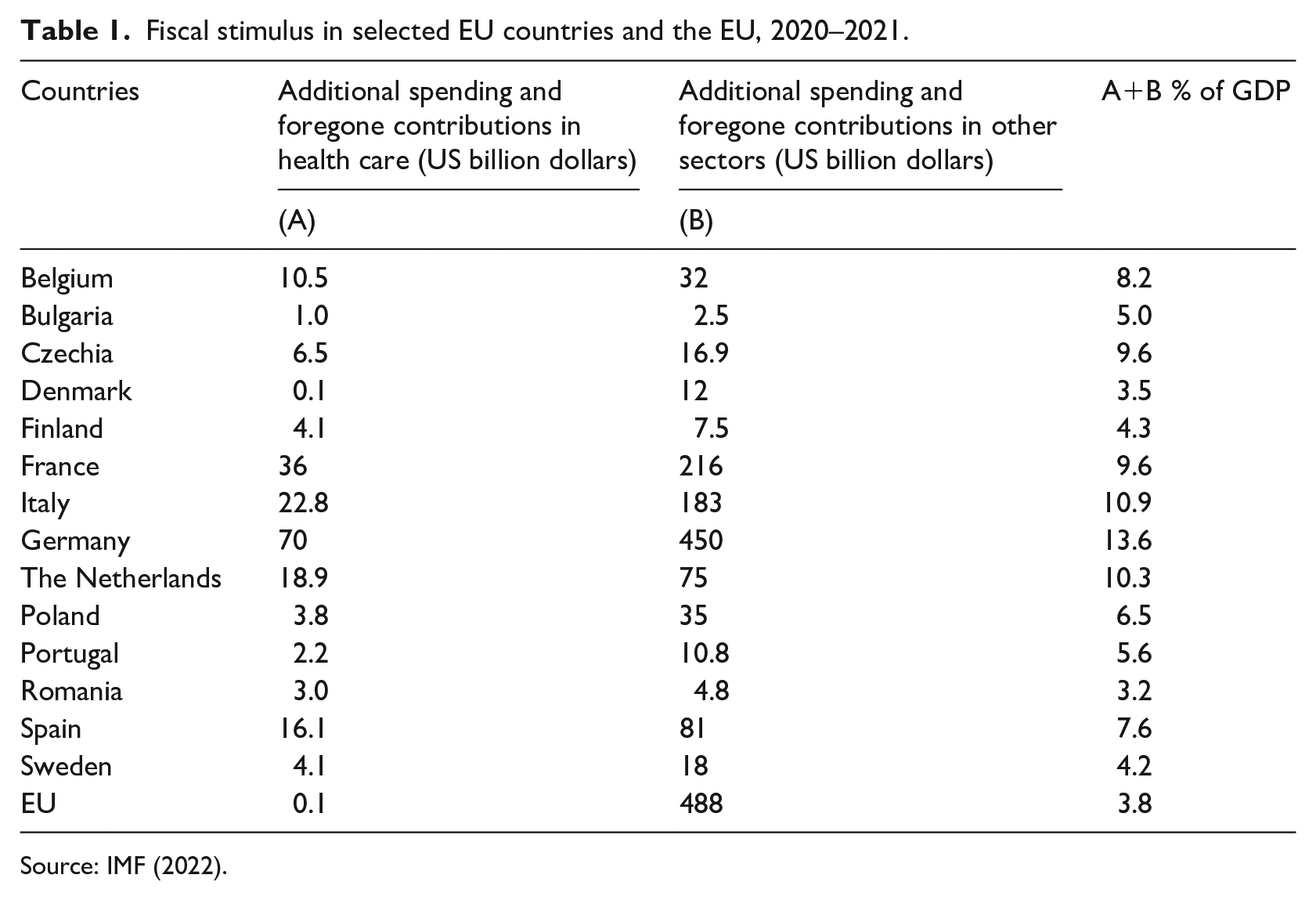
Source: IMF (2022).
With reference to the first round of stimulus measures (passed in spring 2020), Germany adopted an economic stimulus package worth about 33 per cent of GDP, in contrast to the pro-growth measures of 2008–2009, which amounted to 3.5 per cent of GDP. In the same period, France adopted measures worth up to 14.6 per cent of GDP, 10 times more than the resources mobilised in response to the Great Recession, which amounted to about 1.4 per cent of GDP (Cassim et al., 2020).
Buti and Papaconstantinou (2021) calculate that in 2020 fiscal efforts in the EU (summing national and supranational initiatives), together with liquidity provisions, added up to a substantial €2.5trn. This represents a much bigger effort than the one marshalled in the aftermath of the Great Recession. Unprecedented resources were used to protect people’s jobs and businesses, as well as to strengthen health-care system responses and social protection schemes. Beyond the activation of automatic stabilisers, policy-makers pushed for discretionary measures for economic recovery (Moreira and Hick, 2021).
Health care
The health sector was among the first recipients of the resources made available. OECD (2020a, 2020b) data show that government budgetary commitments to health-care responses ranged from around €300 per person in Germany and Ireland, to under €50 per person in Latvia, Iceland and the Netherlands (adjusted for purchasing power parity). IMF data confirm the trends mentioned above (Table 1). Budgetary measures in the health sector have included: financing the procurement of medical and personal protective equipment, expanding testing capacities, hiring of additional workers and bonus payments, support for hospitals and local and regional governments, and contributions to vaccine development (WHO, 2021).
Countries hard hit by the virus mobilised additional workers to respond to the surge in demand for care. Belgium, Ireland and Iceland quickly set up new ‘reserve lists’ to deal with the outbreak and reallocate staff across regions (Baptista et al., 2021). In the case of Italy, the government allocated additional funding of €3.7bn in 2020 and €1.7bn in 2021 to the health-care system, increases of 3.3 per cent and 1.7 per cent respectively over the original funding plan (OECD, 2020a). In 2020, the national government approved a €7.5bn funding injection for the national health service and the Department of Civil Protection hired new health workers and increased the number of intensive care unit beds. This is a common trend across the EU, as confirmed by Germany. In the latter, the federal government began implementing the ‘Hospitals of the Future Programme’, adopted in June 2020. Funding for the programme has been incorporated into Germany’s National Recovery and Resilience Plan. It is the largest single measure in the Plan and worth €4.3bn – dedicated to investments in modern emergency capacity and better digital infrastructure for hospitals. In 2021, the federal government also provided retroactive funding of €740m for health research and development (OECD, 2021).
It is important to recall that these post-pandemic trends contrast with the previous evolution of public spending on health care. In Europe, especially in the South, from 2008 to 2012, in a context of GDP decline, out-of-pocket payments grew faster than the economy and public spending on health. Between 2013 and 2018 the economy grew again, but public spending on health did not keep pace with economic growth or, more importantly, with growth in out-of-pocket payments (WHO, 2021).
A key aspect of the policy-makers’ response to the health crisis has been the active role of the EU (Greer et al., 2021). In March 2020 the European Commission proposed the activation of the Emergency Support Instrument, within the Multiannual Financial Framework (MFF) 2014–2020, to provide a €37bn Coronavirus Response Investment Initiative (CRII) to Member States for assistance with the COVID-19 outbreak and to complement the annual €500m of the EU Solidarity Fund (EUSF). These first steps were followed by the Coronavirus Response Investment Initiative Plus (CRII+). The EU strategy in the following months has been based on a range of programmes, such as the European Solidarity Fund, REACT-EU and RESC-EU, although EU4Health is probably the most innovative. The EU plans to invest €5.3bn (at current prices) in actions with an EU added value, complementing EU countries’ policies and pursuing key objectives, such as strengthening health-care systems and improving access to health care.
To sum up, in health care both European countries and the EU have increased investments, expanding public budgets, widening coverage, and putting more emphasis on the role of the governments in steering private providers and new programmes at the European level.
Employment protection
In the area of employment policy, policy-makers have passed three main types of measure: supporting business (for example, non-repayable grants, deferral of taxes and social contributions); job retention programmes; and prevention and/or support for social hardship (for example, income support) (ILO, 2021).
Job retention schemes have been one of the main policy tools for handling the employment and social consequences of COVID-19 (see Ebbinghaus and Lehner, 2022 for an in-depth review). By May 2020, job retention schemes supported about 50 million jobs across the OECD, about 10 times as many as during the global financial crisis. Job retention schemes seek to preserve jobs at firms experiencing a temporary reduction in business activity by alleviating firms’ labour costs while supporting the incomes of workers whose hours have been reduced. They can take the form of short-time work schemes that directly subsidise hours not worked, such as Germany’s Kurzarbeit or France’s Activité partielle. They can also take the form of wage subsidy schemes that subsidise hours worked but can also be used to top up the earnings of workers on reduced hours, such as the Dutch Emergency Bridging Measure (NOW) (Baptista et al., 2021; OECD, 2020c). Take-up peaked in May 2020 with a total of 28.6 million workers recorded accessing the schemes in the EU. After a rapid decline, a new peak was reached in November 2020, at more than 10.4 million (ETUI, 2021). The responses mentioned above relied to a larger extent on discretionary measures. Sweden started a completely new short-time work scheme in 2020 then extended it on more generous terms, with state contributions to alleviate the costs for employers. In other countries, the schemes have been opened up to atypical workers and the self-employed (Eichorst et al., 2020).
In most countries, access to short-time work allowances precludes dismissal during the period of application. In some countries (Austria, Bulgaria, Cyprus, France, Hungary, Lithuania and Slovakia) protection against dismissal extends beyond the period during which employees receive short-time work allowance (Eurofound, 2021). Going well beyond this more targeted approach, Italy and Spain imposed (temporary) universal restrictions on dismissals (Moreira and Hick, 2021).
EU interventions in the area have also been marked by innovation. The first emergency package of April 2020 consisted of a pan-European Guarantee Fund established by the European Investment Bank to provide €200bn in financing for companies and a temporary fund to address unemployment risks in the Member States. The latter is called SURE (Support to mitigate Unemployment Risks in an Emergency): a temporary instrument that provides support of up to €100bn in loans to Member States that request financial assistance to fund short-time work schemes. If a Member State experiences increased expenditures for the preservation of employment in the aftermath of the pandemic, it can request financial assistance under the SURE programme. Relevant expenditure concerns the extension or creation of short-time work schemes or similar measures designed to protect workers from the risk of unemployment and loss of income. Many consider this a starting point for setting up a true unemployment reinsurance system (Vandenbroucke et al., 2020). In the words of the analysts, SURE ‘signals [. . .] that the economic and the social crisis response have to go hand in hand’ (Andor, 2020) and has proven to be innovative in at least two respects. SURE provides unprecedented resources to support short-time work schemes: to give an example, the whole European Social Fund package for 2021–2027 amounts to about €100bn, while the European Fund for the Most Deprived, the new initiative for people at risk of poverty in the EU, is worth about €3.8bn. Moreover, SURE prioritises internal over external flexibility in the labour market, with an emphasis on the role of social partners (at least in some countries) as policy-makers. It thus tends to protect jobs for a more resilient (and to some extent rigid) labour market (Andor, 2020).
All in all, measures taken so far in employment policy signal a new trend, with stress on job protection (in parallel with investments), more public spending, broader coverage of occupational groups (such as atypical workers and self-employed) and the persistent if not growing role of public agencies and social partners.
Pensions
While health care and employment protection systems have been heavily affected by the pandemic, the income of current pensioners has been well protected so far. As a consequence of the measures taken for the working-age population (such as improvements of income support, job retention and so on), future pensions are not likely to be affected by the crisis (OECD, 2020c).
The measures taken in the past couple of years are relevant for assessing major innovations in the pension reform agenda, however. At domestic level, European countries have lowered the focus on cost containment (and the need to strike a balance between revenues and outlays). In the first months of the lockdown, typical measures were consistent with the deferred payment or temporary reduction of current social security (and pension) contributions. In Finland, for instance, measures included lower pension contributions for 2020. Employers’ earnings-related pension contributions were temporarily lowered by around 2 per cent (until the end of the year). The consequent fall in pension contributions was covered largely by transfers from state budgets. In Germany, the government decided on a cash injection of €5.3bn in 2020 and additional funds in 2021 for the social security budget. In France, the government decided that the French Pension Reserve Fund (FRR) should pay at least an additional €13bn to help finance state pensions (Natali, 2020).
Policy-makers then focused on improving pension benefits. This is the case of Slovenia, where those on the lowest pensions received a solidarity bonus because of the pandemic. Lithuania introduced a special bonus in the form of a lump sum of €200 to elderly people, disabled people, survivors and orphans. Hungary passed new measures that include the introduction of a 13th-month pension benefit (an extra month of benefits for pensioners). More general reforms have also contributed to improve pension adequacy, while major cost-containment reforms – like the one planned in France – were postponed. Hungary, Slovenia and Poland have increased earnings-related pensions, which will further increase future public spending. Germany, Latvia, the Slovak Republic and Slovenia have significantly improved old-age safety nets or increased low pensions.
The further major line of reform has affected legal and effective retirement ages. With the exception of Sweden, where the minimum retirement age for public earnings-related pensions was increased, other countries have weakened policy measures to increase legal and effective retirement ages. The Netherlands postponed the planned increase while reducing the pace of the future link to life expectancy. Ireland repealed the planned increase from 66 to 68 years. What is more, Denmark, Ireland, Italy and Lithuania extended early retirement options (OECD, 2020c).
All these measures suggest a (at least temporary) halt to cost containment in pension policy. Adequacy has become a priority for policy-makers while austerity has lost momentum. Well before the pandemic, the trend towards supplementary private schemes had also been halted, while the perceived need for more effective protection of low-income elderly contradicts the past emphasis on the individualisation of old-age risks (Natali, 2020).
All this seems to be related to the recent change of the EU agenda in the field. First of all, the EU decided on a temporary suspension of the Stability and Growth Pact after COVID-19. The Pact contains two clauses allowing Member States to undertake appropriate budgetary measures in the face of exceptional circumstances. The clauses allow deviations from parts of the Pact’s preventive and corrective arms, either because of an unusual event outside the control of the Member States, or because the eurozone or the EU as a whole face severe economic downturns. The Council may allow for deviation from the medium-term objectives and, in the corrective arm of the Stability and Growth Pact, the clause allows for extended deadlines for the correction of excessive deficits under the Excessive Deficit Procedure. This is a de facto suspension of the Stability and Growth Pact. In parallel, the European Semester has seen the abrupt marginalisation of pension retrenchment. While in 2018 the Semester saw 29 Country Specific Recommendations on pensions and 32 in 2019, in 2020, the Commission drafted only two Country Specific recommendations to Spain and Latvia, the former with a focus on cost containment, the latter on the need to improve adequacy (Rainone, 2020).
Conclusions and discussion
The present article has shed light on the first responses of European countries (and the EU) to the pandemic in the areas of health care, employment protection and pensions. While it is too early for a systematic analysis of the socio-economic effects of COVID-19 and the policy measures passed by decision-makers to address the consequent economic recession, we have looked for any sign of reform of the neoliberal paradigm that has dominated over recent decades in Europe.
A number of innovations have come to light. From an ideational point of view, both intellectuals and policy-makers have promoted new values and priorities. Even mainstream economists have emphasised the need for more public interventions in social and employment policy, investments in health care and worker protection. In parallel, political leaders have outlined the lessons to be learned from the crisis, in favour of strategies for fighting inequalities and retrenchment. In terms of policy measures, European policy-makers have increased public spending, with the introduction of ad hoc measures and more long-term innovations. As for health care, new investments in both infrastructure and personnel have increased public spending. The coverage of statutory health-care systems in European countries has been extended to include COVID-19 treatment and vaccination. In the area of job protection, most countries have improved existing measures by relaxing eligibility, duration and payment conditions, and some have introduced new schemes. New categories of workers have been covered, while benefits have been improved. Eventually, as for pension policy, major reforms inspired by cost containment have been suspended. By contrast, governments have passed ad hoc improvements (especially in minimum old-age protection) and – at least in some countries – more opportunities for early retirement. The overall trend has thus been consistent with more spending, a more prominent role for the state and efforts for more comprehensive protection. All this contradicts the key principles of neoliberalism.
As outlined in the previous sections, the EU has also introduced important innovations. In the policies under scrutiny, the EU has set up new programmes, such as: EU4Health in health care and SURE in employment protection. In other cases, such as pensions, the temporary suspension of the Stability and Growth Pact, the massive reduction of recommendations in the European Semester and new priorities in the Recovery Plan have contributed to new policy trends in the Member States.
But the data and information presented here do not prove paradigmatic change. More systematic and in-depth information is needed. The changes referred to in the previous sections could be temporary. Some of the new programmes – especially those at the EU level – are formally designed as such. Once the crisis is over, policy-makers could go back to more (economic) liberal strategies. This already happened after the Great Recession. On top of that, the economic context in which ideational and policy change has happened could also disappear. There are signs of growing inflation and interest rates that could, for instance, put public debt at the heart of the debate once again.
For all these reasons we need time to assess fully the new measures passed so far. The type of change will depend on policy-makers’ capacity to stabilise or even reinforce the new trend and avoid a resumption of neoliberal approaches.
Last but not least, the parallel reference to ideas and policy outputs in this article reminds us of the importance of investigating the links between major crises and change. In this article, we have provided evidence that intellectuals and political actors seem to have been receptive to new information and contexts. They have proved to be relatively open to modifying their discourses to correct what they perceive as failures. This is a promising field of research that needs more investigation of the nexus between policy-makers’ perceptions of the crisis and their capacity to design new proposals.
Footnotes
Funding
This research received no specific grant from any funding agency in the public, commercial, or not-for-profit sectors.
2
These indicators include GDP growth, unemployment levels, inflation rates and public debt. A crisis is international when it is experienced simultaneously by a large number of countries on several continents (Starke et al., 2013).
3
Some have stressed that this crisis may replicate the effects of wars on norms and sentiments. Evidence from opinion polls and official statements of decision-makers seem to confirm a change in European mood, from conflict to solidarity (Pavolini et al., 2021).
4
5
We refer here to different types of actors that play a role in the policy-making process on the basis of different resources: for example, knowledge, political power and institutional opportunities (de la Porte and Natali, 2018).
6
In what follows we refer to the OECD Covid-19 tracker; the IMF database of Fiscal Policy Responses to Covid-19; the Eurofound Covid-19 EU Policy Watch database; the WHO review of health-care policies; and the comparative contributions of the European Social Policy Network (ESPN).
7
It is interesting to note that some of the scholars mentioned above play a role in the advisory systems that have supported policy-makers in recent months. For instance, Mariana Mazzucato is Chair of the World Health Organization’s Council on the Economics of Health for All and a member of the Scottish Government’s Council of Economic Advisors; Marco Buti is Chief of Staff of the Commissioner for the Economy, Paolo Gentiloni; Anton Hemerijck is a member of the European Commission’s High-Level Group on the Future of the Welfare State.
8
The first reference is to the work of  , which compares political leaders’ discourses in four European countries (Germany, Italy, Spain and Sweden). Political leaders share the positive view of the ‘collective’ (meaning public intervention) and health-care services and personnel were highlighted as vital to containment of the virus. Bringing the public on board or ‘volunteerism’ is also mentioned to exemplify how the individual as part of the collective can make containment possible.