



Abstract
By combining environmental and social objectives in order to address climate change and other environmental challenges, ‘just transitions’ have the potential to accelerate low-carbon transitions in an inclusive and equitable manner. More broadly, by strengthening an egalitarian and ecological public sphere that protects workers’ rights and the rights of nature, just transitions can contribute to a new eco-social contract for both people and planet, guaranteeing full access to social rights and a viable future for all. But like other strategies, just transitions vary in their ambition and thus their eco-social visions. This article builds on the analytical framework developed by the Just Transition Research Collaborative to comparatively assess different just transition pathways in Germany, Poland, Spain, Sweden and the United States in the context of different types of welfare state and economic structure. The comparison may help stakeholders to evaluate different just transition policies according to contextual factors and transformative potential.
Introduction
Tackling the increasingly urgent and disastrous climate crisis has become a key global policy priority. Governments are increasingly recognising the need to accelerate emissions reductions and to work towards just transitions to net-zero emissions by 2050 (see Glasgow Climate Pact, UNFCCC, 2021). Transitioning political economies towards low-carbon development, however, presents a serious challenge that will have far-reaching implications for industries, workers and communities. In times of increasing inequalities and job precarity, the assertion that we must choose between protecting the environment and protecting workers and their communities is frequently mobilised to block stricter environmental and climate regulations. Rejecting this framing there are growing calls for a new eco-social contract that reconfigures the sharply unbalanced relationships between state and citizens, capital and labour, the Global North and the Global South, and between humans and the natural environment (UNRISD, 2021). By combining environmental and social objectives to address climate change, just transitions can promote an eco-social political economy (UNRISD, 2016) based on solidarity, inclusion and justice against policies that treat nature and workers as mere factors of production.
Not all proponents share a common understanding of what a just transition should look like or how it should be accomplished, however. Instead, we see a growing number of interpretations and approaches that are closely linked to differing worldviews and politics. A special issue edited by Clarke and Lipsig-Mummé (2020) showcases the array of strategies and approaches pursued by European workers and their unions in order to address the climate crisis and highlight the interlinkages of political economy and just transition approaches. Thus, it is important to differentiate among just transition policies as we would among sustainable development policies (Connelly, 2007). The Just Transition Research Collaborative (JTRC) (JTRC, 2018) has developed an analytical scheme in accordance with which just transition proposals range from status quo or neoliberal approaches, narrowly focused on compensatory mechanisms for affected workers that largely preserve the existing neoliberal political economy, via managerial reforms that address transitions as market failures that require state intervention to stabilise the system, to structural reforms that seek to advance social and ecological rights, and far more ambitious and transformative visions of eco-social futures that reflect a fully egalitarian and ecological political economy (JTRC, 2018).
This article therefore asks how just transition proposals vary in different contexts; how they intersect with given welfare regimes; and how they can support a shift towards eco-social development and the ambitious transformation needed to tackle ongoing social and environmental crises. To achieve this, we first introduce our analytical framework (JTRC, 2018), including modifications driven by subsequent research and reflections. We then employ the framework to explore just transition politics and policies in countries that represent the main varieties of social welfare and capitalism in the industrial world, Germany, Poland, Spain, Sweden and the United States.
What we propose is an analytical scheme intended to ensure that just transition policies and proposals are examined critically and should not be seen as a uniform blueprint. The global political economy is variable but capitalist, as the literatures on varieties of capitalism (Hall and Soskice, 2001) and varieties of social welfare state argue (Esping-Andersen, 1990; Koch and Fritz, 2014). Accordingly, like all social and environmental policies, just transition policies will be shaped and affected by the political economies of the countries in which they are implemented and the ways they are integrated into the global political economy. The direction of just transition policies then has implications for the direction of the political economy in which they are taking place. For example, the adoption of a just transition policy in the United States has the potential to move this liberal capitalist country towards a more eco-social welfare state. On the other hand, resistance to the ecological component of just transition in a social democratic country, such as Sweden, could move it away from becoming a more developed eco-social state and society.
Analytical framework and approach
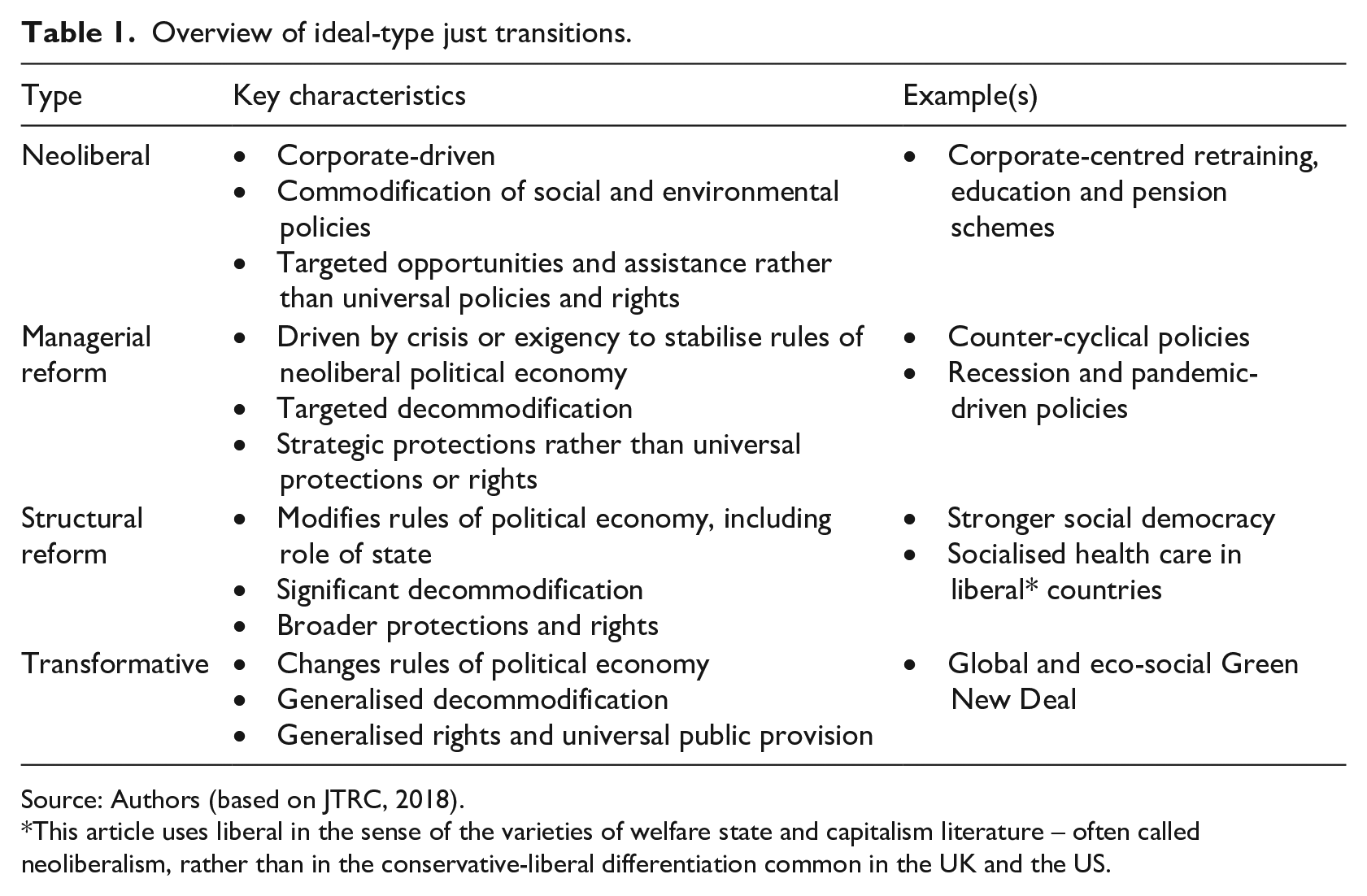
The analytical framework proposed is based on the one developed by the JTRC (2018) and further elaborated in subsequent publications in light of additional research and reflections (Morena et al., 2020; Stevis and Felli, 2020). The framework employs the dimensions of breadth (scale and scope) and depth (social and ecological equality) to map just transitions in terms of their ambition (see Hopwood et al., 2005). Moreover, it is our view that the just transition discourse can and should be broadened beyond the most directly impacted workers and the most obvious sectors, such as the fossil fuel and mining industries, to encompass all economic sectors, from agriculture to industry to services (Anderson, 2021; Stevis et al., 2021). The JTRC (2018: 12) originally identified four ideal-typical categories of just transition pathways that fall along a continuum, ranging from those preserving the existing political economy to those envisioning significantly different futures: status quo, managerial reform, structural reform and transformative pathways. In this article we have renamed ‘status quo’ as ‘neoliberal’ to avoid confusion with regard to different starting points of just transitions that will be discussed subsequently (see Table 1).
Overview of ideal-type just transitions.
Source: Authors (based on JTRC, 2018).
This article uses liberal in the sense of the varieties of welfare state and capitalism literature – often called neoliberalism, rather than in the conservative-liberal differentiation common in the UK and the US.
Just transitions, like any other policies can vary in terms of their geographic and temporal scale. A coal transition policy, for example, can cover a single plant, a sub-federal unit, a country or region or the entire globe. Just transition policies, moreover, can focus on the local or national levels, while externalising their costs. The scale of a just transition can also vary temporally, whether with regard to addressing past legacies or ensuring that contemporary just transitions do not pass their costs on to future generations. A policy can be broad in terms of scale but narrow in terms of scope. A just transition may, for instance, cover coal miners and coal plant operators but not those in related services or contract workers. Like the social welfare state, we need to be particularly sensitive to the fact that eco-social policies can be more or less broad in scope (Bhambra and Holmwood, 2018; Brand and Wissen, 2021; Stevis et al., 2021).
Depth refers to the social and ecological priorities of a just transition, a combination that is at the heart of the eco-social state. Eco-social states and societies would be expected to be more egalitarian and more eco-centric (see Hopwood et al., 2005). Just transition policies can acknowledge and seek to temper impacts related to historical injustices and legacies, as well as unequal power relations and to identify the forces leading to injustice. They may also build on a universalist conception of climate change that leaves out politics and differentiated responsibilities and makes no distinction between historically different levels of emissions between the Global North and South. Additionally, they can focus on social inequalities and injustices but not on those inflicted upon nature and, by extension, the eco-social nexus (for example, Gough, 2021; Koch and Fritz, 2014).
In terms of breadth and depth, just transition policies range from least to most ambitious regarding the inclusion of humans and nature affected and promoting an egalitarian eco-social state and society. Neoliberal just transition policies, such as those proposed from a finance standpoint (for example, Robins et al., 2018), centre on the priorities, often related to risk, of capital and enabling states. The breadth and depth of just transitions are determined by corporate dynamics and go no further than the creation of opportunities and selective assistance. Managerial just transitions are aimed at addressing crises and exigencies, which often require that the state moves in to temper neoliberal dynamics, but still with the goal of preventing systemic challenges to capitalism. The most ambitious managerial reforms would be some form of state intervention or counter-cyclical policy to stabilise the economy and mitigate the social costs of crises or structural change (see Tienhaara, 2014). Less ambitious ones would involve various temporary, albeit massive interventions, such as those experienced during the Great Recession and the current pandemic. In general, managerial policies may provide what is called a ‘social safety net’, generally partial and limited. Structural reform and transformative approaches are more conducive to rectifying historical injustices as they seek to modify governance structures and unequal power relations. Structural reforms, often associated with social democracy, involve significant departures from neoliberal and managerial capitalism in the direction of a larger and more egalitarian public sphere in which more people and nature enjoy rights rather than partial protections. As Przeworski (2021) has argued, however, the structural ambition of social democracy has diminished over time under pressure from neoliberal globalisation. Transformative just transitions, in turn, involve the generalisation of an egalitarian public sphere based on eco-social rights for all. It is important to underscore here that the move from neoliberal to transformative visions involves the reorganisation of power relations by reining in elite power and promoting equality and social justice.
Table 1 provides a short overview of the four ideal-type categories of just transitions first introduced by the JTRC (2018) and their key characteristics.
Just transitions across varieties of welfare regimes
Calls for a new (eco-)social contract have been growing louder in view of deepening inequalities and multiple, interlinked global environmental and social justice crises and the recognition that profound changes and integrated approaches are needed to address these challenges simultaneously (see, for example, ETUI and ETUC, 2021; Gough, 2021; ITUC, 2019; Kempf and Hujo, 2022; UN, 2020; UNRISD, 2016; WBGU, 2011). UNRISD (2021) has identified seven principles that distinguish a new eco-social contract from its predecessor(s) and presents a vision grounded in the overall normative framework of the 2030 Agenda for Sustainable Development:
(i)
(ii)
(iii)
(iv)
(v)
(vi)
(vii)
There are multiple entry points through which just transition proposals can contribute to the different elements of this vision. As will be illustrated below, however, the extent to which this happens depends at least partly on the political and social context in which proposals are elaborated. Galgóczi (2021: 543) argues that sharing the costs of climate action fairly and in a way that tackles inequality and promotes justice, in line with the vision of an ‘eco-social state’, requires integrated and holistic policy frameworks. This implies that preconditions for just transitions are likely to be better in social democratic welfare states as there are already policies in place to address transitions or structural change in a socially just manner. Social democratic regimes tend to be associated with stronger labour laws and trade unions, which contribute to fostering a more egalitarian system. As it stands, income inequality tends to be lower in countries with stronger co-determination policies that ensure workers board-level representation and active participation in shaping their work environments (Hans-Böckler-Stiftung, 2017). Such policies tend to be introduced primarily by left-wing or social democratic parties in order to increase workers’ participation rights (Hörisch, 2012). Welfare state expansion similarly has often taken place under more left-leaning governments, suggesting an overlap of countries with both strong co-determination rules and social welfare regimes that provide a good entry point for ambitious and transformative just transitions. It does not mean that they can be taken for granted, however. Social policies have often retrenched under the pressures of neoliberal globalisation, economic crisis or changing governments, and this tendency is visible in different welfare or policy regimes (Przeworski, 2021; UNRISD, 2010). It also remains a major challenge for all regime types to internalise environmental considerations and move from a liberal or social welfare state to an eco-social one.
When analysing and comparing just transition policies, it is important to consider the broader policy and institutional framework in which they occur. What is the status quo in welfare states with higher degrees of co-determination and decommodification (for example, in terms of labour rights and social protection) would require structural reform in liberal regimes. While universal health care in Sweden may be considered the status quo, in the United States it would entail major social mobilisation and structural reform. As our analytical scheme suggests, however, we do need to pay close attention to the scale and scope even of strong social welfare policies. Preserving the status quo with respect to socialised health care comes at the expense of a labour drain from the Global South, including highly skilled health workers (Stevis et al., 2021).
Our analytical scheme can be most useful when applied to specific political economies. Here we are applying it to different welfare regimes. All these regimes exist within global capitalism, however. All local or national just transition policies have translocal implications in the sense that they respond to and/or reinforce particular global dynamics. A structural or transformative just transition, health-care or other policies in the United States would reinforce a global eco-social turn. A managerial or neoliberal just transition policy in Sweden would reinforce a shift away from social democracy and towards global neoliberalism. Currently, a structural or transformative just transition even in a country such as Sweden would disrupt the accommodating social democratic nature of its political economy, already under pressure from neoliberal reforms (Pelling, 2019).
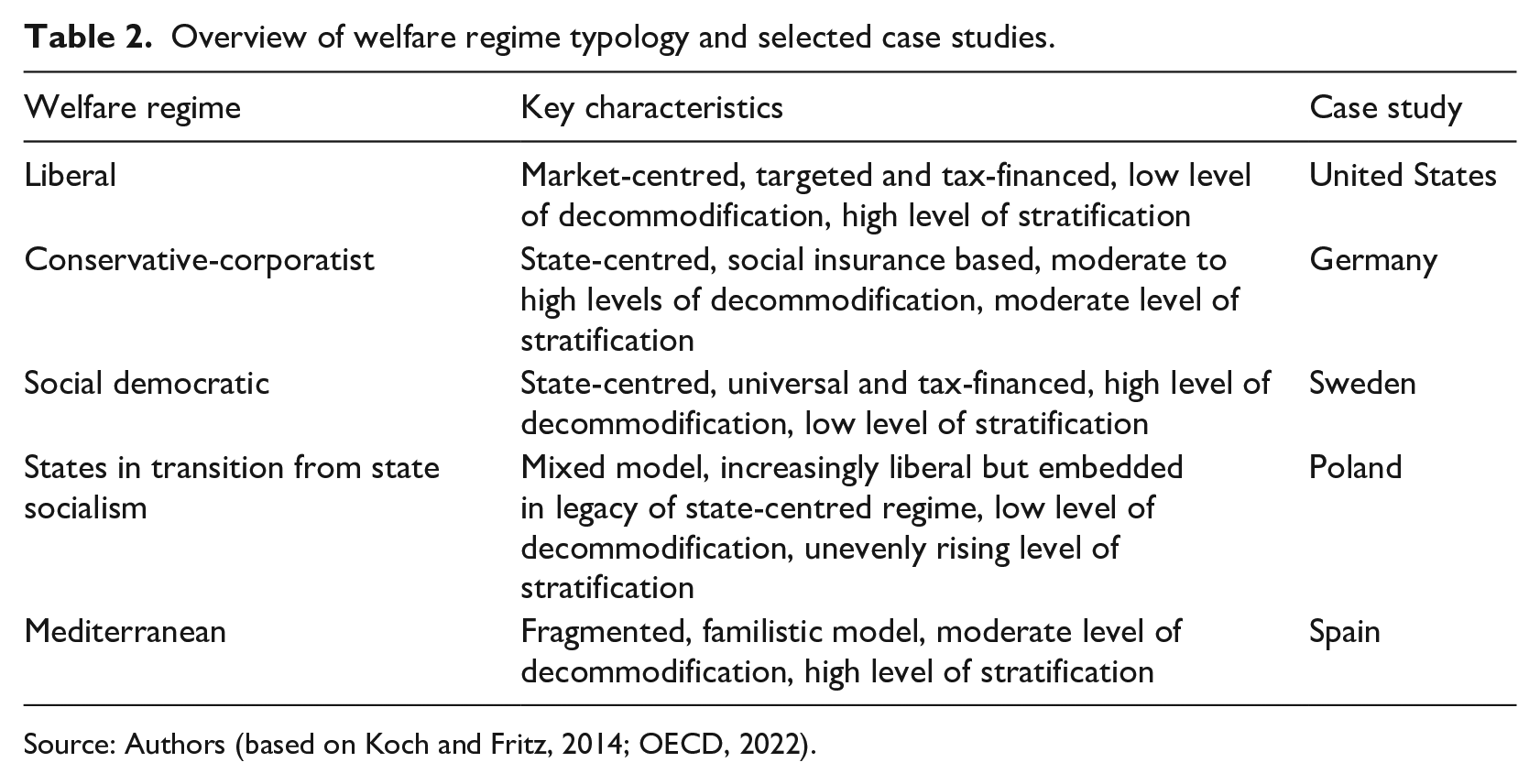
In what follows, we take a brief look at just transition proposals in five countries and at how they differ, depending on the type of welfare regime. The debate on the dynamic evolution of welfare systems and appropriate classification of countries is ongoing and has led to an increasing number of typologies (for example, Arts and Gelissen, 2002; Bertin et al., 2021; Böger and Öktem, 2019; Piotrowska and Rae, 2018). Acknowledging the debate, for the purposes of this article we work with a classification suggested by Koch and Fritz (2014). They add a cluster of Eastern European/post-socialist countries, as well as a cluster of Mediterranean countries to Esping-Andersen’s (1990) original trio of liberal, conservative and social democratic welfare regimes (see Table 2). While our assessment is by no means representative or comprehensive enough to claim causality, we argue that it provides a useful entry point towards understanding the role of the state in providing (or restricting) the necessary enabling environment for ambitious and transformative just transitions.
Overview of welfare regime typology and selected case studies.
Source: Authors (based on Koch and Fritz, 2014; OECD, 2022).
Examining just transition policies and plans in different welfare regime contexts seems to be a useful approach to illustrate different just transition strategies and their potential for contributing to a new eco-social contract and state in the context of existing political economies (see Galgóczi, 2021; UNRISD, 2021). Stated differently, we see just transition policies that combine social and ecological priorities as an important terrain of contestation over the expansion of the social welfare state towards an eco-social welfare state. As will become apparent, the starting points and national contexts of these contestations are important.
United States: just transition and liberal welfare
The United States is characterised as a liberal (or neoliberal) welfare regime featuring a thin and uneven social safety net along with market mechanisms rather than public investments or policy intervention for society-wide social provision, protection or rights (see Esping-Andersen, 1990; Esping-Andersen and Myles, 2014). Throughout its history, however, several administrations have proposed and, in a few cases, implemented social reforms with a view to protecting vulnerable groups and expanding coverage of social protection and social services (on the historical foundations, see Weir et al., 1988; for a historical overview, see Kruse, 2015). The Biden administration, which took office in 2021, declared a commitment to social and environmental change and proposed fairly ambitious policy interventions to stimulate the COVID-affected economy, create green jobs, expand social protection, achieve climate change mitigation and tackle tax injustice (see Stevis, 2021; Stevis et al., 2021). While the overall plans are rooted in visions of green growth rather than transformative eco-social change, they represent a noteworthy departure from existing legislation. This has sparked opposition (including from within the Democratic Party) so that negotiations have been contentious, leading to a lowering of the ambition of the original proposals.
Given the strong opposition to expanding social or eco-social welfare policies it is not surprising that there is no just transition policy at the federal level. Public policies on just transition are beginning to emerge at the state level, however, for example in Colorado where the first public just transition bill was passed in 2019, establishing an Office for Just Transition and leading to the development of a Just Transition Action Plan to support coal communities and workers (JTLP, 2021). Just transition policies are also being debated in Illinois, Arizona and other states.
While President Biden’s proposals are comparatively ambitious and state-level initiatives are growing, they are nowhere near the calls for transformative change coming from the grass-roots, labour environmentalists, and the more progressive wing of the Democratic Party, who are spearheading demands for a Green New Deal (Cha et al., 2022; Stevis, 2021; Stevis et al., 2021).The opposition, on the other hand, is not limited to just transition or Green New Deal policies but rather reflects a more profound and general hostility to a more inclusive and cohesive social welfare state and society based on social protections and rights. Without a major shift in that direction, however, such as through the adoption of universal health care, just transition policies will remain, at most, managerial in ambition.
Germany: just transition and conservative social welfare
Transitional policies have a relatively long history in Germany and are shaped by a consensus-oriented approach adopted by the government and within a well-developed social security system that provides strong baseline policies for protecting workers (Furnaro et al., 2021). They also take place in the context of strong centralised unions ensuring workers’ voice and participation, with a high level of co-determination in larger enterprises, despite low trade union density overall. Still, much of the just transition debate and policy enacted to date remains relatively narrow, combining neoliberal and managerial elements rather than pursuing more structural change and a broader transformation of the political economy. The just transition approach in Germany is aligned with the social welfare approach of the country, which is well developed, albeit conservative-corporatist politically. It produces more distributive justice than the US system, but continues to create labour market disadvantages for women (mainly as a result of tax advantages for married couples with unequal labour market participation) and low-skilled or part-time workers, as well as relatively high inequalities of outcomes. This is because social benefits are mainly earnings-related and contribution-financed rather than universal and tax-financed as in the case of the social democratic model. The German Trade Union Confederation (DGB) has pointed to an overall negative trend of sharply increasing income and wealth inequality, precariousness of employment and a decline in collective bargaining coverage, which undermine sustainable development and a just transition (DGB, 2021).
Coal phase-out is the most extensively studied example of just transition, but scholars are focusing increasingly on the automobile and transport sector (see, for example, Galgóczi, 2021; Gürtler et al., 2021; Oei et al., 2020; Reitzenstein et al., 2020). Recent legislation expands support for reskilling and training measures for workers to anyone affected by structural economic transition, whether as a result of increasing automation and new technologies or low-carbon transitions (Arbeit-von-morgen-Gesetz – Work of Tomorrow Act, of 2020).
The new government that assumed power in late 2021 seeks to reconcile the urgency of transition and pressures on the social security system with a commitment to climate action, embedded in an eco-social market economy and a new policy that requires all new legislation to be in line with overall climate protection goals (SPD, Bündnis 90/Die Grünen and FDP, 2021). While ambitious and aiming for structural reforms, the plans are being impeded by an increasingly complex geopolitical and economic situation as a result of the Russian invasion of Ukraine in February 2022, which has caused energy shortages, supply chain disruptions and price hikes of oil and gas.
Sweden: just transition and social democratic welfare
Sweden has long been a poster child for the modern welfare state, based on a universal social security system and comparatively high social spending aimed at fostering growth and wage equality, as well as full employment with price stability (Vogl et al., 2019). ‘Creative destruction’ and transitions from unproductive to productive industries were part of this model, but accompanied by protective measures for affected workers. Despite the impacts of neoliberal globalisation in recent years and increasing wealth and income inequality, trade union density remains high. While Swedish social democracy has been under attack from national and global neoliberal pressures there is evidence that trade unions, the backbone of that system, still support a social democratic social welfare system based on equality of outcomes rather than opportunities (Ibsen and Thelen, 2017; Magnusson, 2018).
Nevertheless, just transition does not play an important role in domestic labour or climate policy debates and seems to feature mainly at the international level (Moodie et al., 2021). In particular the European Green Deal and its Just Transition Mechanism has created new interest in just transition as the four counties of Gotland, Norrbotten, Västerbotten and Västra Götaland were identified as carbon-intensive regions and potential beneficiaries of the EU Just Transition Fund (JTF). The regions developed Territorial Just Transition Plans (TJTPs) which are a prerequisite to access funds under the JTF. Sweden seeks to tackle emissions in the steel industry, cement industry, refineries and petrochemical industry, as well as the metal industry with support of the JTF. Interestingly, policy-makers and stakeholders involved in the development of the TJTPs for the four regions do not anticipate overall job losses and rather see the potential for job creation in the transition to more sustainable industries (Moodie et al., 2021).
Unions and civil society representatives have argued that the process of developing just transition plans has focused too strongly on the technological and economic challenges associated with transition, while neglecting its potential social impacts. It remains to be seen whether existing structures for collaborative governance and the well-developed welfare state are sufficient to ensure that the transition will be socially and ecologically just, despite the technical approach. The Swedish case therefore indicates that while a social democratic society is better situated to address transitions in the workforce there can also be some resistance to a structural or transformative just transition pathway and a preference to protect the social welfare status quo, in particular as the existing system is already threatened by neoliberal policies.
Poland: just transition and liberalising welfare
Poland has been engaging in the international just transition debates, in particular since the run-up to the Katowice COP in 2018, but has used the concept mainly to justify its limited commitment to a coal phase-out rather than as an instrument for actively managing the transition or engaging in social dialogue around it. While the country has now proposed ending hard coal mining by 2049, the approach remains centred on preserving the sector as long as possible, even if this involves direct subsidies and public bailouts (Brauers and Oei, 2020; Hockenos, 2020). Overall trade union density is relatively low in Poland (OECD and AIAS, 2021), but unionisation in the mining sector is nearly universal, with trade unions powerful enough to block more ambitious transition negotiations (see Galgóczi, 2021). This type of institutional lock-in has been described in the earlier case of a declining coal sector in Germany (Hospers, 2004), but the reluctance to embrace transition more proactively probably stems from the negative experiences of the 1990s, with the collapse of the previous socialist welfare regime based on full employment and state provisioning. Rapid privatisation and liberalisation associated with this transition led to job losses without sufficient social protection and caused ‘transformation poverty’ (Golinowska, 2009). Piotrowska and Rae (2018) find that states transitioning from communist welfare regimes now tend to be more liberalised than the rest of Europe, with high inequality and poverty, but they also have higher employment levels than southern European states. In combination, this may explain the strong opposition to transitioning away from a sector that still employs around 80,000 people.
Despite the above-mentioned national trends, progress is being made with the implementation of just transition policies at the sub-national level. The lignite mining area of Eastern Wielkopolska was the first Polish region to join the Powering Past Coal Alliance, whose aim is to end the use of coal in energy and heating by 2030 and achieve climate neutrality by 2040 with the support of the EU JTF (PPCA, 2021). The region submitted its Territorial Just Transition Plan with the aim of building a carbon-neutral circular economy, developing renewable community energy, investing in technology development and supporting business and workers in the transition, making the region a leader of just transition in Poland (Ślimko et al., 2021). While the plan has been criticised alongside several other TJTPs as an attempt to shift the financial burden for land restoration and rehabilitation away from the companies that have profited from mining (Stępień et al., 2021), it is an important step towards a more proactive just transition that upholds the principles of participation, inclusion and solidarity. As with the United States, however, sub-national policies are constrained by the overall liberal nature of national and EU political economies.
Spain: just transition and fragmented welfare
In late 2018, the Spanish government put forward a just transition plan for coal miners affected by pit closures. The goal was to support miners, businesses and their communities in the affected regions of Aragón, Castilla y León and Asturias. Crafted by a left-wing administration and labelled a landmark deal by trade unionists (for example, IndustriAll, 2018), the plan was instigated by a European Directive that made state aid to uncompetitive coal mines conditional on the closure of the mines by the end of 2018 (2010/787/EU). The closure affected nearly 1700 workers directly and was seen as an important win for Spanish trade unions as it encompassed compensation payments, early retirement provisions as well as investments for mine restoration and sustainable development in mining communities (IndustriAll, 2018). The deal is especially important in the context of high unemployment and out-migration in mining regions because of the sector’s decline. The plan has been followed up by a more comprehensive climate policy framework that anticipates planned emissions reductions and an increase in the share of renewable energy by 2030, which will lead to job creation overall. The Just Transition Strategy complements the climate policy package in order to mitigate negative impacts of the transition towards a low-carbon economy, in particular with regard to the most affected regions and sectors and labour market changes (Government of Spain, 2020; WRI, 2021). Taken together, with support available through the EU JTM and COVID recovery packages, the new policies represent an important opportunity for Spain to tackle just transitions proactively (Nieto and Baratech, 2021).
Limiting just transition to coal, important as it is, suggests a more managerial approach to solving a specific problem in response to external pressures. A structural or transformative just transition approach would also entail a strengthening of the social contract through more comprehensive and universal social protection schemes and social service provision. The Mediterranean welfare model has been characterised by relatively low levels of social spending apart from pensions and universalised health care, leaving an important service provision role to families, with women responsible for a disproportionate share of unpaid care work (Gascón-Cuenca, 2019). In addition, Luque Balbona and Guillén (2021) found that the financial crisis in 2008 and subsequent austerity measures had a strong negative impact on public social investment in Spain. In this context, opportunities to complement just transition policies with social policy reforms that would strengthen the Spanish welfare regime might emerge from the EU commitment to social rights and efforts to modernise welfare systems (see Hemerijck et al., 2020). This would include a broader and deeper just transition policy that, in itself, expands the eco-social state.
Just transition pathways towards a new eco-social contract
Comparing the emergence and design of just transition policies and plans across these five countries illustrates that the typology of just transition we have introduced (JTRC, 2018) needs to account for countries’ historical context and political economy. Social democratic countries such as Sweden have started their just transition journey with much stronger redistributive policies than liberal and liberalising regimes, such as the United States or Poland. More generally, for a liberal capitalist country such as the United States the starting point is a weak social safety net. For a conservative-corporatist social welfare regime, such as Germany, the starting point is employment-based social insurance rather than universal welfare rights, which would be the case in a social democratic country. Liberalising countries such as those in Eastern Europe are engaging in just transition under conditions of a broader transition away from a state-centred model to a liberal welfare state. Like Poland, they have undergone market-oriented reforms that have resulted in the individualisation of risks and a weakening of solidarity structures. Finally, in Mediterranean countries such as Spain, which have less comprehensive and more fragmented social systems, much depends on whether they are moving towards a more, or less, ‘liberal’ social welfare regime. There can certainly be disagreements about these categories as well as the application of ideal-types to specific countries but the point we are making stands. Varieties of just transitions have to be understood within their political economy contexts. We have focused on the national context but remind the reader that varieties of welfare societies are embedded in globalised capitalism.
Overall, the increasing recognition that urgent climate action is needed to avert catastrophe on a planetary scale has opened a window of opportunity for bringing just transition into mainstream policy debates. The increased uptake of just transition at both the international and national climate policy levels provides an historic opportunity to challenge post-crisis austerity and ‘race to the bottom’ welfare politics. Just transition can serve to foster demands for broader changes to neoliberal policies and stronger commitments to the welfare state that will be needed in order to achieve the far-reaching transformations required to meet internationally agreed climate targets in a socially just way. We posit that countries with stronger redistributive and universal social policies rooted in participation and inclusion are better placed to implement an eco-social transformation. Synergies cannot be taken for granted, however, as better social performance does not automatically lead to better environmental performance (see García-García et al., 2022).
At the moment, coal continues to be a strong focus of just transition debates and policy-making in various welfare regimes. This is the result of both the mobilisation of climate and environmental activists against coal and the efforts of labour environmentalists to address the anxieties of unions and communities in the coal industry. Just transition agreements at the national level often tackle industries, such as the coal industry, that are already in decline and dependent on subsidies and state aid to survive. But this raises serious questions of how just transitions can be negotiated and agreed upon quickly enough to tackle overall emission reduction targets in other carbon-intensive sectors, in which resistance to change might be fuelled by higher numbers of impacted workers and continued profitability, as is the case with natural gas and oil. In fact, the argument can easily be made that just transition is also necessary in the renewable energy sectors, as neglect could result in weaker social and ecological standards, justified or hidden by the strategic need for more renewables.
In Europe, the EU – especially in the current conjuncture marked by its COVID-19 recovery plan – favours alignment in terms of policy responses. This probably impacts not only the predominant just transition approach but welfare policies more generally (Petmesidou and Guillén, 2022). The EU COVID-19 response and recovery packages signal a tentative shift away from austerity and renewed commitment to the social rights pillar and have been described as an opportunity to rethink what a European welfare state should look like in the long term (Hemerijck and Patuzzi, 2021). However, transition countries such as Poland, or countries with less comprehensive institutional provisioning, such as Spain, face bigger challenges than economies with more comprehensive social welfare systems, such as Germany or Sweden. While a country’s wealth is also a factor, the case of the United States (and other ‘liberal’ capitalist countries) suggests that the nature of the social welfare system is critical. Given the hegemony of ‘liberal’ capitalism and intense polarisation there, expanding the social or eco-social state beyond a thin social safety net remains a difficult task.
Conclusion
Like other welfare policies, just transition policies may be viewed as standalone or as an opportunity to expand and deepen the social welfare state, as the strategy was originally conceived (Stevis et al., 2020). Clearly, such ambitious just transition policies will be transformative in an economic-liberal society, but they will also expand the social welfare state across the board. But just transitions are not limited to the social. The promise of the strategy is in fusing the social and the ecological, while centring justice and thus inequality and power.
Welfare states based on universal social policies and fair fiscal contracts can play a key role in enabling just transitions by distributing benefits and costs fairly and reducing uncertainty and risks for individuals, households and enterprises. Despite different historical legacies in existing welfare regimes, more emphasis could be placed on the advantages of universal social policies as a basis for equitable transitions. Many welfare systems are already in need of adjustment or reform because of demographic changes, such as ageing and migration. While this implies rising costs, it is also an opportunity to rethink systems, including financing systems, to make them more sustainable, equitable and inclusive. The appropriate integration of the environment, including through the voices of those who are affected by its destruction and pollution, remains a key challenge for welfare states, however.
It is here that just transition in its more ambitious and transformative form can make an important contribution by mending the breach between environmental and social policies by broadening and deepening the social welfare state. A reorientation of welfare states rooted in principles for a new eco-social contract could provide the basis for transformative and equitable low-carbon transitions. When mechanisms for social justice are in place, just transition policies can focus much more strongly on integrating the ecological dimension into all policies and initiating a deep transformation of consumption and production structures. Assuming that a social welfare state will seamlessly adopt a just transition strategy and move in the direction of an eco-social society, however, would be to dismiss the power of existing institutional arrangements and the political nature of change, even in strong social welfare societies. Stated differently, we believe that a strong social welfare state is a necessary but not sufficient foundation for an eco-social society. The move towards an eco-social society requires the fusion, rather than the mere addition, of social and ecological priorities.
Footnotes
Funding
This research received no specific grant from any funding agency in the public, commercial, or not-for-profit sectors.