




Abstract
The extension of artificial intelligence (AI) and algorithmic management mechanisms by companies has led to growing trade union demands to regulate their use. This article explores the role of collective bargaining and employee participation mechanisms in regulating the use by companies of AI and algorithms. This is done through a comparative analysis of institutional developments at EU level, as well as in four countries with different industrial relations models (Denmark, Germany, Hungary and Spain). The article shows that there are remarkable differences between countries in the roles of social partners and in the combination of protective and participative mechanisms used to respond to the challenges of AI and algorithmic management. However, the analysis also serves to highlight the limits of existing institutions and practices to cope with the complexity of challenges associated with AI and algorithmic management. This calls for institutional adaptation and additional regulatory efforts at EU and national levels to support collective bargaining.
Introduction
The spread of digitalisation and automation, and the emergence of platforms constitute an important source of changes in the organisation of companies, employment relations and the labour market (Mair and Reischauer, 2017; Nooren et al., 2018; Schallmo and Williams, 2018). The algorithms underlying these processes are increasingly determinants of social order, work organisation and corporate decisions (Fernández-Macías, 2018; Foerster-Metz et al., 2018). Analysis of the impact of digitalisation therefore implies the study of new economic relations that arise through ‘datafication’ and the use of algorithms and artificial intelligence (AI) via digital networks or are enabled or exacerbated by these technologies. The implications of these changes for corporate and social structures, however, are likely to vary in accordance with different industrial relations and employment regimes within capitalism (Rahman and Thelen, 2019).
The implications of the spread of AI and the adoption of algorithmic management at workplace level may constitute an important change in employment relations (Pereira et al., 2021; Wisskirchen et al., 2017). The datafied workplace implies the digitalisation and automation of an increasing number of processes and decisions, ranging from work organisation, recruitment and dismissal, to evaluation and performance appraisal, among other things (Dencik and Stevens, 2021). The spreading use of algorithm-based mechanisms is thus having very diverse impacts on labour markets and employment relations, including higher productivity, improved job quality or upskilling, but also job destruction, lack of transparency, increased control or discrimination (Gilbert et al., 2021; Lane and Saint-Martin, 2021). Overall, the use of AI and algorithms at the workplace can potentially erode the capacity of trade unions and worker representatives to ensure quality of employment and guarantee their rights.
AI-based mechanisms and the increasing reliance on algorithms for both work organisation and human resource management are likely to involve an intensification, standardisation and optimisation of the production process. These instruments provide new tools for companies to surveil and monitor employees and their performance. As decisions may be taken by algorithms, transparency and accountability in managerial processes are reduced, undermining employee participation. The combined effect of intensified control and opaque decisions can lead, in the absence of adequate institutions and regulations, to an erosion of industrial democracy (De Spiegelaere et al., 2019; Doellgast, 2012). The diverse forms in which AI and algorithmic management are applied across companies and sectors calls for flexible approaches to its regulation, in which collective bargaining must play an important role (De Stefano and Taes, 2021). However, governing and regulating AI through collective bargaining requires social partners not only to share a common diagnosis of the problems and solutions, but also to have the skills and capabilities to implement them.
This article explores the role of collective bargaining and employee participation mechanisms in regulating AI mechanisms and algorithms applied by companies. This is done through a comparative analysis of institutional developments at EU level, as well as in four countries belonging to different industrial relations models (Denmark, Germany, Hungary and Spain). The article shows remarkable differences between countries in the role of social partners and the combination of protective and participative mechanisms used to respond to these challenges, which seem to reinforce prevailing institutional logics. However, the analysis also serves to highlight the limits of existing institutions and practices when it comes to coping with the complexity of challenges associated with AI and algorithmic management. This calls for institutional adaptation and additional efforts at regulation at EU and national levels to support collective bargaining.
The article is structured in three sections. Section 1 discusses the implications of AI and algorithmic management for employment relations and the potential regulatory and institutional responses. Section 2 reviews regulatory and institutional developments at EU and national level, paying attention to developments in collective bargaining. Section 3 provides a comparative analysis of developments in the four countries included in the analysis.
Workplace impact of artificial intelligence and algorithmic management
Their use of data and capacity to process, learn and make decisions are the key dimensions of AI systems. These are defined by the OECD as machine-based systems that can, for a given set of human-defined objectives, make predictions or recommendations, or take decisions that influence real or virtual environments. According to this definition, algorithms are understood as the ‘process or set of rules to be followed in calculations or other problem-solving operations’ (OECD, 2017) and are key to AI systems. The essence of algorithmic management consists of using data-based processes and data analytics to inform or make decisions about different aspects, including selection, organisation of work, production process, performance and evaluation (Jarrahi et al., 2021). What makes algorithmic management an attractive tool is precisely its capacity to manage large amounts of complex data and in some cases develop mechanisms of self-learning. This can take many forms, however, depending on several dimensions, such as the relationship between human-based and algorithm-based decisions (Wood, 2021), or the extension of AI to different spheres within the company, including recruitment, work organisation, performance appraisal and evaluation, among others.
Privacy, surveillance and algorithmic transparency
Studies on the impact of AI systems on working conditions and job quality have been accompanied by others focusing on the impact on workers’ rights, at both the individual and the collective levels (De Stefano, 2019). At the individual level, the use of AI systems may cause or exacerbate discrimination (following the use of algorithms in recruitment or internal promotion decisions) (Todolí-Signes, 2019), stronger forms of control (relying on the use of data on employee performance), intensification of work patterns and lower autonomy, among other things.
At the collective level, the extension of AI gives data an important role in workplace struggles – the collection and processing of data become a contested terrain for employment relations. We can accordingly think of three different aspects related to the use of AI and algorithmic management that may have an impact on individual and collective rights at company level, and thus call for new regulations (see Table 1). On the input side, the type of data collected and the mechanisms used by companies in order to collect them have an impact on rights to privacy and the control and surveillance of employees. Regarding the processing of the data, how algorithms are designed and which parameters are included pose important challenges in relation to transparency and algorithmic discrimination. Finally, regarding outcomes, the lack of participation of workers and their representatives in automated decisions erodes industrial democracy.
Data-related dimensions of the impact of AI and algorithmic management.

Governing algorithms and AI: the role of protective and participative mechanisms
The complexity and diversity of AI impacts on employment relations call for responses at several levels, including the adaptation of existing institutions or the creation of new ones to guarantee employment rights. This institutional reconfiguration is not automatic, however, and because industrial relations and institutions of employee representation vary greatly across countries, we can expect national responses to exhibit cross-country variation, just as the regulation of platform work has already showed (Englert et al., 2021; Molina, 2020). Actor-centred approaches to institutional change provide a framework for understanding the role of agency in industrial relations structures (Morgan and Hauptmeier, 2014). Under this approach, actors within sets of institutions may engage in various forms of strategic action to adapt, change or create new institutions or regulations. The outcomes of this process will vary depending on the characteristics of the institutional setting and actors’ resources. Thus, we can reasonably expect that actors’ default strategy will be to rely upon existing institutions and capacities in order to respond to these challenges, at least in the initial stages of institutional adaptation. This could lead to forms of incremental and largely path-dependent change, possibly followed by experimentation with new instruments complementing / reinforcing those in play.
Regulatory and institutional responses to the extension of AI and algorithmic management can combine several instruments across different levels of governance, ranging from soft (strategic plans, recommendations) to hard statutory regulations enacted by governments (with or without the involvement of social partners), social dialogue, collective agreements or other procedural forms of worker participation. Indeed, the alignment of legal and social partner regulations and instruments is part of the challenge. The growing number of legal initiatives to regulate AI-based decision-making (Zhang et al., 2022) contrasts with the so far limited evidence of regulation by collective agreements. As argued by De Stefano and Taes (2021), collective bargaining is probably the most adequate instrument for regulating the use of AI-enabled systems and algorithms by companies because collective agreements are a flexible tool, helping to reduce the risks for workers while enhancing the positive impact on society. However, the response from collective bargaining is far from automatic. First, in some countries, collective bargaining remains weak due to social partners’ limited capacities and resources. In other countries, the role of the state reduces the scope for autonomous negotiations among social partners. Moreover, the design/implementation of algorithmic systems is mainly a management decision and worker representatives typically do not have a voice regarding these issues. Finally, collective bargaining requires a certain degree of consensus around the impact and consequences of AI, which may be difficult to attain in some contexts.
The notions of protective and participatory standards provide a useful analytical tool in explaining the diversity of regulatory responses across industrial relations models (Sengenberger, 1994). Protective mechanisms provide similar guarantees to large groups of workers. They usually take the form of regulation by the state or multi-employer collective agreements setting minimum standards, often with the support of extension mechanisms, which allow multi-employer collective agreements to reach large groups of workers (Bosch, 2015). By contrast, participatory standards provide employees or their representatives and organisations with rights (consultation, co-determination) and resources to govern these processes through direct participation at company level. Based on these two categories, we can try to map responses across different employment relations models. In countries with traditions of a strong state in employment relations and weak participatory institutions at company level, we can expect trade unions to push for regulation either by the state or multi-employer collective bargaining. By contrast, in countries with stronger participatory institutions at company level, employee representatives and trade unions will try to adapt them to cope with challenges. This may lead to divergent regulatory outcomes across countries in the short or medium term because actors’ strategies will tend to reinforce existing institutional arrangements. However, this does not necessarily mean that all change must be path dependent because actors may explore new arrangements if the existing ones fail to achieve the expected outcomes.
Governing AI and algorithmic management – developments at EU and national level
This section reviews regulatory developments at EU and national level. At national level, the analysis includes four countries belonging to different industrial relations systems and models (Welz et al., 2016) and exhibiting differences in the extension and usage of AI and data analytics by companies.
In terms of industrial relations models, Denmark represents Scandinavian corporatism, with encompassing trade unions and employer organisations, strong company-level participation structures, high levels of collective bargaining coverage and a limited role of the state. Germany belongs to the Continental model, characterised by a strong role of the state in employment relations, strong but sectorally segmented company-level worker representation structures and medium-high coverage by sectoral collective agreements. Hungary is considered part of the Eastern European model, with weak trade unions and collective bargaining, especially at sectoral level, as well as weak company-level representation structures. Finally, Spain represents the Mediterranean model with a strong role for the state in regulating different aspects of industrial relations, weak trade unions but strong sectoral collective bargaining delivering high coverage, and problems representing and reaching workers in SMEs, which provide most of the jobs in Spain.
European-level regulations and initiatives
Following ongoing European debates and strategies on data protection and privacy, digitalisation in general and the platform economy, the implementation of AI and algorithmic management is also being addressed by regulation efforts at the EU level. The General Data Protection Regulation 1 (GDPR) establishes boundaries to data access in terms of the principles of lawfulness, fairness, transparency, purpose limitation, data minimisation and accuracy, and encourages more specific legislation by Member States in its Article 88. EU Directive 2002/14/EC 2 provides information and consultation rights to worker representatives. Directive 89/391/EEC 3 requires employers to assess the health and safety risks of technology at work, including psychosocial risks, and anti-discrimination legislation prohibits discrimination on legally recognised grounds. However, to date, all these provisions have been implemented and enforced unevenly among Member States and in varied sectors of the economy, such as SMEs, less unionised and low-wage sectors, and the spheres of atypical employment (De Stefano and Wouters, 2022). Generally, the EU’s policy navigates the dual aims of boosting the EU single market, building its technological and industrial capacity and leadership and setting international standards (European Commission, 2018), and that of establishing trust and ethical uses, raising algorithmic awareness, and preventing or mitigating risks to human rights, safety and security, and data protection.
In the proposed Artificial Intelligence Act (European Commission, 2021), intended AI uses related to ‘employment, workers management, and access to self-employment’ generally fall into the high-risk category. Employment addresses the use of AI-based systems on an employer’s external labour market: job advertising, selection and assessment of job candidates. Workers management refers to the existing workforce and to both HR and work organisation: AI-based decisions on the ‘promotion and termination of work-related contractual relationships’ for task allocation and for performance and behaviour appraisal. Such uses are to be internally assessed, documented and monitored by tech providers with regard to appropriate data governance and management practices, transparency of procedures, human oversight and ‘an appropriate level of accuracy, robustness, and cybersecurity’ (European Commission, 2021).
Observers from trade union and labour law backgrounds consider these provisions somewhat weak. The self-assessment of high-risk uses in employment and work by providers may lead to mere box-ticking exercises and a lack of context-specific risk prevention. In addition, the fit of the Artificial Intelligence Act with other European legal provisions appears somewhat incoherent. Critics argue strongly for a more consistent, mutually enhancing regime that strengthens rule of law, human rights and the rights and participation of all types of workers and their representatives (De Stefano and Wouters, 2022; Ponce Del Castillo, 2020). A key concern is that in the Artificial Intelligence Act (in contrast to the GDPR Article 88) there is no provision for more specific regulations by Member States. Such provisions might then be considered obstacles to the development of the single European market and of innovation in AI-based technologies and business models (Aloisi and De Stefano, 2021).
EU social partner positions
There are currently few dedicated social partner positions on AI and algorithmic management. Joint declarations have been concluded in the sectoral social dialogues of the telecommunications industry and the insurance sector (ETNO and UNI Europa, 2020; UNI Europa Finance et al., 2021), both of which have long histories of digitalisation and utilisation of ‘big data’. AI is also addressed in the joint position papers on digitalisation by CEEMET, the employer association of the Metal, Engineering and Technology Industries, by manufacturing union federation industriAll (CEEMET and industriAll, 2020), and in the overarching European Social Partners’ Framework Agreement on Digitalisation (BusinessEurope et al., 2020). UNI Europa’s ICTS group and industriAll have also published their own position papers on the Artificial Intelligence Act (industriAll, 2019; UNI Europa, 2019, 2021). All of these documents aim for win-win configurations of AI and digitalisation uses that enhance productivity, employment and working conditions.
All joint position papers and declarations make positive reference to the High-Level Expert Group (HLEG) papers and the concept of ‘trustworthy AI’, which entails lawful, ethical, robust, socially and ecologically sustainable AI uses, and human rights considerations. They also refer to compliance with Article 88 GDPR that provides for more advanced regulations by Member States. The principle of ‘humans in control’ is also referenced across the joint declarations and frameworks, including the insurance sector (UNI Europa Finance et al., 2021: 3). The telecommunications social partners point out that ‘human oversight models should be proportional to the risks involved by the AI application at hand’ (ETNO and UNI Europa, 2020). IndustriAll (2019) states that ‘humans should “never become the underlings of machines”’ and thus demands comprehensive information, consultation and agreement rights on data, metrics, training data, biases and statistics on reliability and accuracy of machine learning systems. UNI Europa (2021) translates human oversight into clear chains of responsibility from system developers to companies using algorithms. It is the unions’ own position papers and the joint papers by the more unionised sectors, namely the telecommunications and metal, engineering and technology (MET) industries, which emphasise strengthening the role of social partners in favourably shaping AI uses. The framework agreement (BusinessEurope et al., 2020) designs an iterative, practice-focused process to jointly map and assess developments, adopt digital transformation strategies and develop concrete, context-specific actions and measures. Risks of AI are generally seen in terms of monitoring, privacy, and ‘algorithmic bias’ or discrimination.
Germany: in co-determination we trust
To date, there have been few initiatives aimed at directly regulating companies’ use of AI in Germany. This contrasts with the large number of non-regulatory initiatives promoted by governments and parliaments to explore the impact of AI systems on workplaces and employment. The reasons for this lack of regulatory developments are multifarious.
Many issues related to the impact of AI in human resources are already addressed by regulations on data protection. Similarly, the Works Constitution Act plays a major role in the regulation of AI in Germany. It provides extensive information and advisory rights, as well as effective co-determination rights for works councils that also apply to the use of AI systems and algorithms, derived from the general right to information with regard to the introduction of technical systems in work processes. This applies without restriction to the automation of personnel management using AI systems. Employers are obliged to inform the works council in detail about the relevant planning in advance.
Recently, the Works Councils Modernisation Act (Betriebsrätemodernisierungsgesetz) (6/2021) came into effect giving particular importance to procedural co-determination rights (Albrecht and Görlitz, 2021). The law aims at stronger involvement of works councils in AI usage by strengthening their rights regarding the introduction and application of AI. According to the law, works councils can now call in an expert to evaluate AI or algorithmic management. Moreover, the rights of the works council in planning work processes, personnel selection and workflows apply even if these guidelines are drawn up exclusively or with the support of AI or algorithmic management.
At the meso level, future-oriented collective agreements (Zukunftstarifverträge) were introduced in the metal and electrical industry sector (in North Rhine-Westphalia) in 2021. These agreements give works councils the opportunity to start negotiations with the employer about future demands in terms of production targets, personnel requirements, or skill requirements, independently of an acute crisis. Though this new type of collective agreement is not focused on AI or algorithmic management issues, it might provide some guidance also for these areas.
Unions have published several position papers addressing general requirements regarding the regulation of AI and algorithmic management at the workplace, the planned EU Regulation on harmonised rules for AI (Artificial Intelligence Act), or the use of algorithmic management in platform work. On the side of the employers, a recent report on behalf of the German Association of the Digital Economy (BVDW, 2021) sees a lack of transparency and regulation regarding the use of AI and welcomes regulations at the national and European level.
Recent developments in the food-delivery sector show the limits and gaps of existing regulations and their enforcement at company level, however. In spring 2021, the data protection officer of the state of Baden-Württemberg raised some concerns regarding the ‘Scoober’ app, an algorithmic-based app used by large food-delivery companies such as Lieferando. The data collected and stored by the app are personalised, that is, they can be assigned to individual employees. The exact location of riders is passed on at intervals of 15 to 20 seconds. The food-delivery company denied the allegation and argues that the driver app complies with the applicable data protection regulations because the data on times and locations are essential for the delivery service to function properly. The company also stated that the data collected would not be used for unauthorised performance or behavioural control.
This case demonstrates the difficulties and possible limitations when legal regulations regarding data protection are applied. Moreover, it raises the question of how unions and works councils can intervene here by using their information and co-determination rights, and whether additional regulations and support is necessary.
Union representatives and experts from IG Metall have pointed out systematic legal gaps in the planned EU Regulation on AI (see Gerst, 2021). Among others, these include the need for a new regulation aimed at developers and providers of AI, who often do not know enough about the concrete application and user context, to oblige users to adequately protect personal rights and prevent discrimination. The risk classification of AI systems should be tightened when the system generates and processes personal data to prevent the risk of discrimination through profiling. Moreover, the need to lower the thresholds for banning AI systems is also stressed (due to possible physical or psychological damage) to prevent misuse more efficiently. Finally, the planned Regulation should address the requirements regarding the development of an appropriate infrastructure (test centres) and qualified staff to evaluate AI applications.
Denmark: collaboration and autonomous AI regulation
Danish industrial relations traditions leave most regulation of wage and working conditions to social partners through collective agreements. However, different laws regulate aspects related to the use of AI and algorithmic management. First, the Danish Data Protection Act (GDPR rules) regulates any data collection that results in data being stored in a filing database. Second, Danish auditing laws mandate all large companies to include a statement regarding their data ethics and data practices with their annual reporting, including how the company works with and implements its policies on data ethics. Third, statutory law together with collective agreements, social partners’ collaboration agreements and Danish health and safety regulations also regulate the introduction of new technologies, including AI and algorithmic management in the public and private sector. These regulations also concern employee involvement in these processes. The collaboration agreements apply only to workplaces covered by collective agreements, while the statutory regulations on information and consultation cover companies without collective agreements and with 35 or more employees. The statutory health and safety regulations cover all companies.
These regulations compel management to involve employees when introducing new technologies and inform them about any implications these technologies may have for the company’s financial situation, workforce, health and safety at work, and work organisation. Management is also requested to involve workers and their representatives in developing joint guidelines for further training, health and safety and data management (Navrbjerg and Larsen, 2022); BEK, No. 1181 of 15/10/2010). These management–employee discussions typically take place in the collaboration committee and the health and safety committee, where both sides of industry are represented through management representatives and union-affiliated workplace representatives. In the private sector, companies with 35 or more employees and covered by collective agreements are required to set up collaboration committees, whereas the threshold is 25 employees among central government authorities and there is no minimum threshold in the local and regional government sector (Navrbjerg and Larsen, 2022). All workplaces with 10 or more employees are legally mandated to appoint a health and safety representative and set up a health and safety organisation, while in workplaces with fewer employees, management is obliged to consult employees on health and safety.
Danish trade unions and employers recently developed several initiatives through collective bargaining and various digitalisation strategies to regulate activities that use AI and algorithmic management intensively. For example, the Financial Service Union Denmark, representing workers in Danish banking and insurance, has proposed the idea of data ethics codices that outline a series of basic principles that both users and employees have to adhere to when working with algorithms (Finansforbundet, 2021). Another example is the joint collaboration on digitising the public sector by Danish public employers, represented by central government authorities, regional public employers and Danish municipalities, which have initiated and funded various projects testing AI-based technologies in the hospital sector and central administration, and have discussed joint principles for working with such technologies (KL, 2018, 2021, 2022). Private employers have also developed various digitalisation strategies. Some of the largest Danish employer associations, such as the Danish Confederation of Employers, the Danish Chamber of Commerce and the Confederation of Danish Industries emphasise the need to invest in skill development and develop joint guidelines for data security and ethics to utilise the full potential of AI-based technologies (DA, 2020; Dansk Erhverv and 3F, 2021; DI, 2021).
The Danish social partners have successfully signed collective agreements regulating not only emerging digital labour markets such as the platform economy and the Fintech sector, but also employee involvement and use of AI and algorithmic management when new technologies are introduced at company level. The latter regulations compel employers, among others, to involve workers in such processes, with successful examples of local social partner agreements on health and safety, further training, and tracking of workers when using algorithmic management in Danish manufacturing (Rolandsson et al., 2020). Another example is the sectoral collective Agreement on Food Delivery Service 2021/2023 (Just Eat agreement) by the Danish Chamber of Commerce (on behalf of Just Eat) and the trade union 3F. This is the first sectoral agreement regulating wage and working conditions for couriers in the food-delivery service sector and includes regulations regarding digital devices and tracking of couriers. However, only one company has thus far joined the agreement and its regulations apply to only some of its couriers (Dansk Erhverv and 3F, 2021; Ilsøe and Larsen, 2022a). The recently signed collective agreement in the Fintech sector hardly touches on algorithmic management issues, although AI-based technologies are fairly widespread (Ilsøe and Larsen, 2022b).
Spain: an active state supporting collective bargaining regulation of AI
Spain lacked specific regulation on algorithmic management at work until 2020. Aspects related to the use of AI and algorithmic management were covered by the GDPR, transposed through Law 3/2018. This law regulated the right to privacy in relation to the use of geolocation devices at work, transparency rights in relation to the use of automated processing of personal data and profiling, and the right to disconnect. Social partners believe that the law works well to reinforce data protection rights, but lacks precision, and sectoral regulations regarding issues such as transparency and access to personal data are welcomed by social partners (CCOO Industria, 2018; CEOE, 2021).
Since the end of 2019 the issue of digital rights has become a priority in the government’s social and labour market agenda. Soon after coming to office, it passed Law 3/2018 on personal data protection and digital rights (2018), regulating the right to digital disconnection and privacy with regard to the use of geolocation systems in the workplace, as well as digital rights in collective bargaining. Labour market impacts of AI are also addressed in the Spanish Strategy for R&D in AI (Ministry of Science, Innovation and Universities, 2019), the Digital Spain 2025 Agenda (Ministry of Economic Affairs and Digital Transformation, 2019), as well as the Charter of Digital Rights, published in July 2021 within the framework of the Spanish Recovery Plan.
In May 2021 Law 9/2021 guaranteeing the labour rights of couriers for digital platforms was approved after agreement was reached among the social partners. Even though the law was aimed primarily at recognising the employment relationship of platform delivery workers, it also included information rights to access the parameters, rules and instructions influencing decision-making and affecting access to employment and working conditions. The law also enforces the role of collective bargaining at the company level to supervise the use of these technologies. More recently, the Ministry of Work presented a toolkit for social partners in relation to algorithmic management (Ministry of Employment and Social Economy, 2022). This is intended to provide trade unions and companies with a practical guide to the rights of workers and their representatives and to make companies aware of their obligations when using algorithms in the workplace.
The two largest trade unions in Spain have addressed the ethical and working conditions implications of algorithms and AI in several reports (Rocha and de la Fuente, 2018), emphasising the need for an active role of the state in regulating these issues, together with the use of collective bargaining to promote a fair and inclusive technological transition (CCOO, 2020). On the employer side, COTEC (a private non-profit business organisation whose mission is to promote innovation as a driver of economic and social development) claims that both AI and algorithmic management can lead to a more supportive work environment, with the right policies. COTEC has promoted the initiative #miempleomifuturo (#myemploymentmyfuture) in order to facilitate technological change to replace certain tasks without negatively impacting on employment quality (COTEC, 2021).
There are few instances of collective agreements regulating aspects of AI and algorithm use at the workplace. The collective agreement of the banking sector (March 2021) regulated workers’ rights regarding AI, including the right not to be subject to decisions based only on algorithms, to non-discrimination in relation to these decisions, and to request mediated intervention in case of disagreement. The agreement also establishes the obligation of employers to inform worker representatives if automated decisions influence HR and industrial relations decision-making processes, particularly in relation to data feeding algorithms, operating logic, and evaluation of the results. This agreement has become a pattern-setter for financial services: the national collective agreement of financial credit entities (October 2021) followed the banking sector, introducing similar AI-related rights.
Some collective agreements at company level have also included specific clauses to inform worker representatives on the introduction and use of AI and algorithmic management. In the case of platform delivery, the collective agreement of ‘Just Eat’ introduces the right of workers to transparency in the case of AI-based systems affecting human resource management. Other collective agreements, such as Alstom’s or Ford’s contain clauses regarding the obligation to inform worker representatives about the introduction of new technologies leading to changes in work organisation. More recently, Renault’s collective agreement established a joint committee on new technologies that must provide the works council with timely information on new technologies, as well as on their impact on employment and working conditions.
Hungary: soft regulatory approach in a weak collective bargaining system
There have not been any hard regulatory developments in Hungary in relation to the workplace application of AI and algorithmic management. There are several reasons for this. First, compared with other EU countries, Hungary is lagging in terms of digital preparedness, as reflected in its low scores on the Digital Economy and Society Index (DESI), especially in relation to the ‘integration of digital technology’. Second, amid the pandemic during the past couple of years, regulation of AI and algorithmic management had a low priority among policy-makers.
In the absence of hard regulations dealing specifically with the use of AI at the workplace level, three sources provide coverage to some of the problems arising out of the use of AI. First, EU-level regulations on privacy and data protection. Secondly, some regulations in Hungarian labour law (for example, common rules of conduct, protection of individual rights, rules on data protection and processing, the right to equal treatment) provide some protection. Finally, soft forms of regulation also exist: strategies, regulations, guidelines, social dialogue. However, in relation to this latter group of initiatives, the role of the social partners remains negligible. The Hungarian Artificial Intelligence Coalition, founded by 74 Hungarian and international companies, universities, research institutes and various government institutions had 342 members in 2022, although with very limited representation from trade unions and employers’ associations. Similarly, the social partners have played a rather marginal role in the adoption of Hungary’s Artificial Intelligence Strategy 2020–2030 (2020). In order to reduce the negative impact of AI, the document formulates – somewhat abstractly – the need to increase transparency and create models to increase the visibility of decision-making mechanisms and facilitate the interpretation of decisions. In relation to the legal regulation of AI, the strategy emphasises the need for the fast and efficient transposition of EU legal regulation into Hungarian practice.
Apart from a rather general call made in the Hungarian Artificial Intelligence Strategy, no significant roles are envisaged for the social partners. For example, Sector Level Skills Councils (SSCs) were established in 2018 to improve vocational education and training on AI. However, employers have dominated these SSC: although the number of memberships in one Skills Council varies between eight and 24 depending on the size of the sector, trade unions may delegate only one person to participate (Kun et al., 2021: 14).
Earlier research on trade union strategies to meet the challenges of digitisation already detected the main problems experienced by social partners and more specifically trade unions in regulating platform work. First, unions have so far been unable to broaden the scope of issues negotiated in the weakened legal environment of collective bargaining, even though the substantial increase in minimum and average wages in the context of the tight labour market – since 2017 – could strengthen the bargaining position of Hungarian trade unions, bring new issues into collective agreements, and, possibly, create a more favourable institutional context. However, as noted by Borbély and Neumann: ‘Time will tell if trade unions will be able to translate the labour market shortages into a better and more sustainable system of collective bargaining, which requires organisationally strengthened trade unions at all levels of bargaining (Borbély and Neumann, 2019: 18). Secondly, unions lack adequate financial, human and knowledge resources, which has hindered them in developing analyses to make good diagnoses and influence policies on how to include the regulation of AI and algorithmic management in collective agreements.
In the case of delivery platforms, for example, trade unions have made some organising efforts, but without translation into a collective agreement. Platform workers’ awareness of collective representation or voice formation is at an early phase of development. As a result, we may say that the majority of the Hungarian platform workers choose ‘silence’ or ‘individual voice’ instead of ‘collective voice’ (Gleeson, 2016). In other words, they are taking a ‘wait-and-see’ position. Surprisingly enough, when platform workers were asked what they need the most from collective organisations, be it a traditional trade union or a ‘grass-roots’ organisation, they identified four key areas in which they saw potential room for action: helping to organise, uncovering the reality of platform work, and identifying and making platform operations more visible. Finally, to put pressure on the platform companies to ensure proper working conditions: vehicles, resting zones and improvement of the algorithm, among others (Makó et al., 2021: 123).
Comparative analysis
The analysis of regulatory developments at national and EU levels shows a variegated map as regards the type and level of regulations, their content, the actors involved, and the gaps detected in the regulation of AI. Moreover, some interesting patterns of institutional and regulatory change are identified (see Table 2).
An overview of regulations in the four countries.
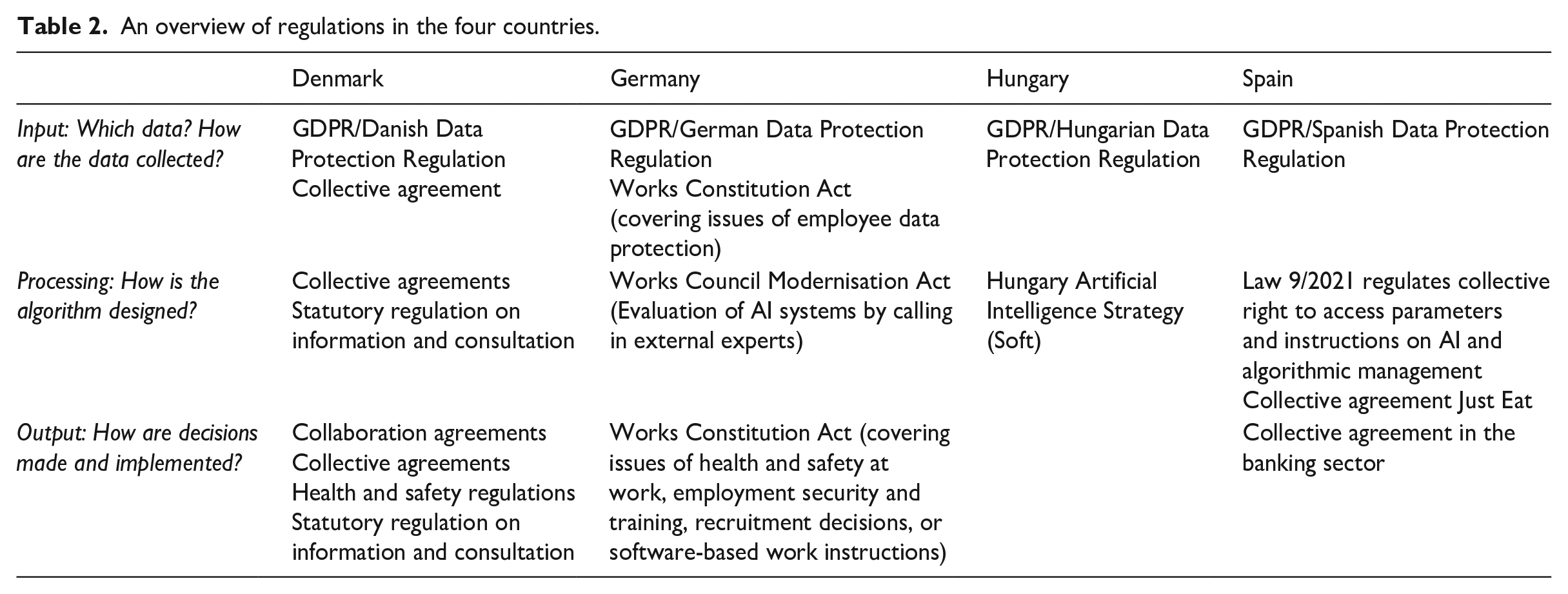
EU-level developments do not seem to lead, at least in the short term, to the development of a coherent regulatory framework across Member States. Thus, for the time being, we expect national institutions to shape the patterns of adaptation via regulations, collective bargaining and social dialogue. Evidence presented for the four countries belonging to different industrial relations models confirms this intuition. In line with the confident, high-road Nordic approaches to digitalisation, the Danish case illustrates an incremental pattern of change, where strong participatory standards through workplace-level institutions such as health and safety committees or collaboration committees are becoming key to governing the introduction of AI and algorithmic management instruments. A similar pattern is observed in Germany, where the Works Council Act has been updated and new functions added related to AI and algorithmic management. In Spain, a country characterised by a strong state in industrial relations, statutory changes have been made with a focus on the more AI-intensive sectors, including platforms. Finally, the lack of regulatory developments in Hungary, either through statutory regulations or collective bargaining, is in line with the overall weakness of the social partners and a state that is reluctant to regulate to avoid negative repercussions on FDI inflows. These results show how trade unions have tended to rely on the type of institutional resources and standards (protective or participatory) in their respective industrial relations systems to respond to the challenges posed by the extension of AI or algorithmic management.
However, analysis of the four countries has also made clear the limits of existing institutions when it comes to regulating the use and impact of AI and algorithmic management. The complexity of the challenges associated with these technologies, including the intervention of third parties designing algorithms and managing data or the opacity of data-based management systems, shows the difficulties social partners face in regulating them, even in countries with strong protective and participatory standards. In all countries, national or EU-level regulations regarding data protection are perceived to provide sufficient protection in relation to risks arising from data collection and use. No major attempts have been made to update these regulations or introduce new ones. However, the analysis shows how conflicts persist, as shown in the tracking of food-delivery workers in Germany. Trade unions in Spain have also claimed the need to issue specific regulations in this regard. The collective agreement in the food-delivery sector in Denmark also shows how trade unions are aware of limitations, especially in some of the sectors that use data more intensively in organising work, and have included some clauses in the agreement.
Similarly, one contentious field in relation to algorithmic management is precisely the design of the algorithm. First, because this is in most cases developed by an external technology provider, which makes it difficult to access it. Secondly, even if access to the parameters used is granted, it requires specific skills to understand and assess its implications. Here the four countries compared exhibit very different forms and degrees of regulation. In Denmark, local collective agreements, and the fintech and food-delivery collective agreements, have already included some clauses in relation to this, but there is no legal mandate to disclose the black box of algorithms used by companies. In Germany and Spain, steps have been taken to regulate information and access of worker representatives. In Germany, the Works Council Modernisation Act reinforces the rights of works councils to evaluate AI systems, including a right to bring in external expertise. Law 9/2021 in Spain regulates the collective right to access parameters and instructions on AI mechanisms and algorithms used by companies. Moreover, the banking sector and the Just Eat collective agreement in Spain also include additional guarantees for worker representatives to access the algorithm. Hungary is the only country in which there is no hard regulation (statutory or collective agreement), merely some reference in the Artificial Intelligence Strategy elaborated by the government.
Concluding remarks
Addressing the multiple challenges posed by the spread of AI and algorithmic management to employment relations is leading to very different responses across countries and levels of governance. The complexity and novelty of issues involved in its regulation, and the differentiated impact it has across sectors and companies, calls for approaches combining protective and participatory standards, capable of securing adequate coverage of risks for workers, while allowing enough flexibility to adapt them to their specific characteristics. Even though collective bargaining would in principle be particularly suited to reaching these goals, the evidence shows a pattern of asymmetric developments across countries when it comes to the role of social partners, largely in line with the institutional characteristics of industrial relations models. Where works councils or similar participatory worker representation structures are strongly institutionalised and enjoy a strong mandate to be informed or negotiate, as in Germany and Denmark, trade unions have put their efforts into updating this mandate to cover all aspects related to AI and extend it to companies with no worker representation structures or company-level collective agreement. An incremental pattern of change seems to be emerging in these two countries with collaboration and future-oriented collective agreements setting a general framework for social partners to govern the introduction of AI technologies and algorithmic management systems. In Spain, the legacy of a strong protective state in industrial relations is also clear in the so-called ‘Rider law’ (Law 9/2021), regulating platform work and including information rights in relation to algorithms, but also affecting employment conditions. Some sectoral collective agreements have started to further regulate these topics but lack a coherent approach and open the door to the existence of differences between sectors and companies in relation to workers’ rights. Finally, there are no developments at meso level in Hungary, where sectoral collective bargaining remains very weak.
In response to the risks derived from the extension of AI at workplace level and the diverging landscapes of national policy-making, the European institutions have taken some action through the Artificial Intelligence Act. Moreover, there have also been social dialogue initiatives in AI-intensive sectors. However, these developments fall short in achieving the consolidation of common standards to protect workers from the risks associated with the extension of AI and algorithmic management. Since its publication in Spring 2021, the Act has faced mixed reactions from the European trade unions: rather than protecting fundamental rights, it was market-based priorities and industrial development that pushed the proposal forward (Ponce Del Castillo, 2020).
In this context, national governments and social partners retain a central role in identifying gaps and regulating workplace use of AI and algorithmic management, including the necessary adjustments to existing institutions to cope effectively with the new risks. Though facing similar challenges, trade unions in the four countries face different problems in extending collective regulations and protections. Some elements stand out as particularly important for addressing the regulation of AI and algorithmic management. First, institutional resources in terms of workplace participation structures and rights are key to being able to identify, denounce and regulate their use. However, as the countries analysed in this article have clearly showed, one of the key challenges to governing algorithmic management and AI technologies is coding by outsourced companies, escaping the control of these institutions. Moreover, even in countries with strong participatory standards, there has been a decline in firms with works councils and employee representation structures. This increases reliance on protective standards to ensure effective protection. Collective agreements should accordingly pay more attention to including mechanisms guaranteeing the capacity to oversee these companies in the design and implementation of algorithms. But equally important is the development of trade union capacities and the skills necessary to grasp the real implications and functioning of AI and algorithmic management as a condition of engaging in meaningful collective bargaining with employers.
Footnotes
1

2
Directive 2002/14/EC of the Council and the European Parliament of 11 March 2002 establishing a general framework for informing and consulting employees in the European Community [Official Journal L 80, 23.03.2002].
3
Directive 89/391/EEC - OSH "Framework Directive" of 12 June 1989 on the introduction of measures to encourage improvements in the safety and health of workers at work.