



Abstract
When does the EU employment growth agenda also serve social progress? Scholars concerned with the equality/efficiency trade-off generally look at the EU as an agenda-setter. Little attention has yet been paid to its role as direct provider of social rights. Building on a data set of 71 EU measures and 317 judgments of the Court of Justice of the EU, this article evaluates the extent to which EU employment policies helped to advance social citizenship by assessing the scope and distribution of individual entitlements over time (2009–2022). Our findings show that, after almost two decades of silence, the EU not only expanded the scope of its influence over individual social rights but also took an inclusive turn, driven by more ‘universalising’ and ‘capacitating’ initiatives. Looking ahead, better monitoring of the distributive profile of EU initiatives indirectly affecting rights production (such as SURE or the Recovery and Resilience Facility) would help to ensure that this shift increasingly benefits those needing it the most.
Introduction
Jobs, jobs, jobs. From Macron in France to Draghi in Italy, the employment growth agenda has made a strong comeback in the wake of the COVID-19 pandemic. The EU is no exception to this trend. On 3 March 2021, the Commission released the Action Plan for the European Pillar of Social Rights, in which it set the aspirational goal of bringing the EU average employment rate up to 78 per cent by 2030, from 72.5 per cent in 2020. The centrality of the employment agenda is barely surprising in the aftermath of the pandemic. The freezing of the economy provoked by the lockdown created a need for governments to intervene to preserve jobs and incomes. In the recovery phase, governments have supported employment creation to address demographic ageing, climate change and the digitalisation of the economy.
The EU employment agenda emerged in the 1990s. Conceived after the adoption of the Maastricht Treaty, the European employment agenda first materialised in 1997 with the European Employment Strategy (EES) and was then consolidated in 2000 with the launch of the Lisbon Strategy. At its core, the ‘flexicurity’ model emphasised an equal concern for labour market flexibilisation and employment and social security, as ‘an alternative to sheer flexibilisation, deregulation and the degradation of social standards and social cohesion’ (Bekker et al., 2008: 68). Initially praised as a voluntarist EU initiative to address mass unemployment, the EU employment agenda has, over the years, been accused of serving as a Trojan horse, subordinating social concerns to macroeconomic ones. The original enthusiasm surrounding the socialisation of domestic employment and social objectives under the Open Method of Coordination (OMC) was succeeded by a ‘streamlining phase’ (Tholoniat, 2010), in which stronger control of the process by Member States coincided with the EES tilting towards the flexibility side (Keune, 2008). In particular with the 2003 Kok Report, which paved the way for the revision of the Lisbon target and with it of the EES, the initial focus on ‘quality in work’ was soon dismissed to refocus on a ‘jobs, jobs, jobs’ agenda under the more conservative Barroso Commission (Raveaud, 2007).
The Great Recession institutionalised the subordination of social objectives to macroeconomic concerns. In the crisis context, the ‘austerity’ paradigm – made up of collective bargaining decentralisation, dismantling of employment protection legislation, wage compression and labour mobility – became an important part of the EU response package (Matsaganis, 2011). Europe 2020, as well as the Social Investment Package (SIP), were both criticised for their asymmetric implementation. On the one hand, the EU has been adamant in calling Member States to implement structural reforms to strengthen the carrying capacity of the welfare state by broadening the employment base. At the same time, however, inclusive labour market and (gendered) life-course transition support policies remained feasible only for countries with deep fiscal pockets (Hemerijck and Huguenot-Noël, 2019). The epitome of the contradiction of the EU employment agenda materialised in the Economic Adjustment Programmes, which were adopted at the same time as the Europe 2020 strategy and the Social Investment Package (SIP), but demanded from participating Member States liberalisation of employment protection, decentralisation of collective bargaining and cuts in minimum wages (Kilpatrick and De Witte, 2014).
The return of the EU’s employment agenda within the framework of the Social Pillar understandably triggered contrasted expectations in academic circles. On the one hand, some scholars have cast doubts on whether it is possible to translate a non-binding inter-institutional proclamation into concrete policies, pointing to the risk that normative declarations will not be matched by political commitments (Crespy, 2022; Kilpatrick, 2018). On the other hand, scholars found that the launch of the Pillar could provide a non-negligeable impetus to the EU employment agenda by promoting the adoption of new legislative and non-legislative initiatives to foster quality employment (Garben, 2019; Vesan and Corti, 2021).
With hindsight, the strong comeback of the Social Europe agenda since the adoption of the Pillar can hardly be denied. Besides the wealth of new social policy legislative initiatives launched under the Juncker and von der Leyen Commissions, this return was also layered by the relaunch of the social dialogue, a more flexible interpretation and implementation of the EU fiscal rules (Darvas and Anderson, 2020), and a new understanding of the relationship between the EMU and nation-based welfare states in the European Semester (Hemerijck and Corti, 2022). Employment protection thus progressively regained centrality in the Semester’s recommendations, increasingly highlighting the importance of accompanying employment growth policies with measures strengthening social protection systems (Vesan et al., 2021). The EU’s response to the pandemic, marked by the introduction of a re-insurance scheme for short-time working schemes (Support to mitigate Unemployment Risks in an Emergency, SURE) and a Recovery and Resilience Facility (RRF) explicitly calling for an ‘employment rich’ post-pandemic recovery, finally seems to have marked a tipping point in the EU’s gradual shift to promoting quality employment (Hemerijck and Huguenot-Noël, 2022).
What does the return of the social dimension of the EU employment agenda mean concretely for EU citizens? If there has been a change of heart as regards the principles underlying EU policies, recommendations and programmes since 2017, the question remains of what this change implies from the perspective of individual citizens’ social rights. While scholars overwhelmingly regard the EU’s role as that of an agenda-setter (De la Porte and Palier, 2022; Vanhercke, 2020), the role of the EU as provider of social rights largely remains understudied. The aim of this article is to fill this gap in the literature. To this end, we build on an original conceptual framework, recently proposed by Ferrera et al. (in press), which conceives social rights as a bundle of power resources that enable citizens to claim and access a certain service or benefit and apply it to understand how citizens are concretely empowered from the EU employment policy agenda. Tracing the EU employment agenda from a rights-based perspective is not enough, however, and leaves open the question about ‘who gets what’ from EU employment policies. As a second step, taking insights from Garritzmann et al.’s (2022) proposal to assess the distributional profile of social entitlements, we zoom in on the post-Social Pillar reforms to try to understand who is empowered by European employment rights.
The article proceeds as follows. Section 2 introduces our two analytical frameworks to trace the evolution of European employment policies from a rights-based perspective, and assesses its redistributive dimension. In Section 3, we present our research strategy and data collection. Section 4 describes the evolution of European employment policies from a rights-based perspective after the Great Recession and comments on the key findings. Section 5 presents the distributional profile of EU employment policies over the past decade. Section 6 concludes.
Tracing the evolution of the EU’s social citizenship and its distributive profile
The adoption of the European Pillar of Social Rights (EPSR) revamped the debate on European social citizenship and the notion of social rights. This debate has again stressed the limits more than the opportunities of European social citizenship. For instance, Börner pointed to the poor development of European social citizenship, showing that the only social rights that exist at the European level are in the field of social security coordination (Börner, 2020). Even those limited rights, she argues, are marked by a double selectivity that excludes citizens who are not transnationally active and those who are, but lack the means to provide for themselves. Similarly, Bruzelius et al. (2017) argue that – despite the EPSR – EU citizens’ social rights remain de facto ‘isopolitical’: EU citizens are entitled to enter the welfare space of other Member States with the guarantee of non-discrimination, but ultimately they remain attached to the entitlements provided by the national welfare state of origin. This makes social rights ‘stratified’ and generates unequal opportunities for free movement, thus challenging the very concept of EU citizenship.
Based on this line of reasoning, various scholars have concluded that the proclamation of the EPSR, because it does not create new legally binding rights, does not empower citizens with new entitlements and thus does not strengthen European social citizenship. This conclusion is based on an understanding of social rights based ultimately on the formula entitlement–justiciability and conceives the nation state as the ultimate arena in which subjective social rights are institutionalised. We certainly agree that the interdependence between welfare and nation state is a historical reality which is a notable advance on local discretion to standardised legal rights supported by coercive state resources. This is nonetheless insufficient to grasp the complexity of social rights, especially in a multi-level institutional setting such as the European Union.
To move beyond the view that the existence of a right depends on its legal justiciability, Ferrera et al. (in press) conceive of rights as bundles of ‘power resources’ and stress the importance of resources that facilitate delivery and enable individuals to access benefits. Indeed, on top of traditional normative legal resources, which empower citizens to claim something, and enforcement resources, such as judicial procedures and channels to access dispute settlements and rule enforcement, Ferrera et al. (in press) identify a third category of power resources, which they call instrumental. They highlight the importance of normative soft recommendations in steering national policies and ultimately affecting social rights. Building on the power resources framework we thus classify EU employment policies in terms of three types of resources provided to citizens: normative (legal and soft), enforcement and instrumental (Table 1).
Individual power resources.
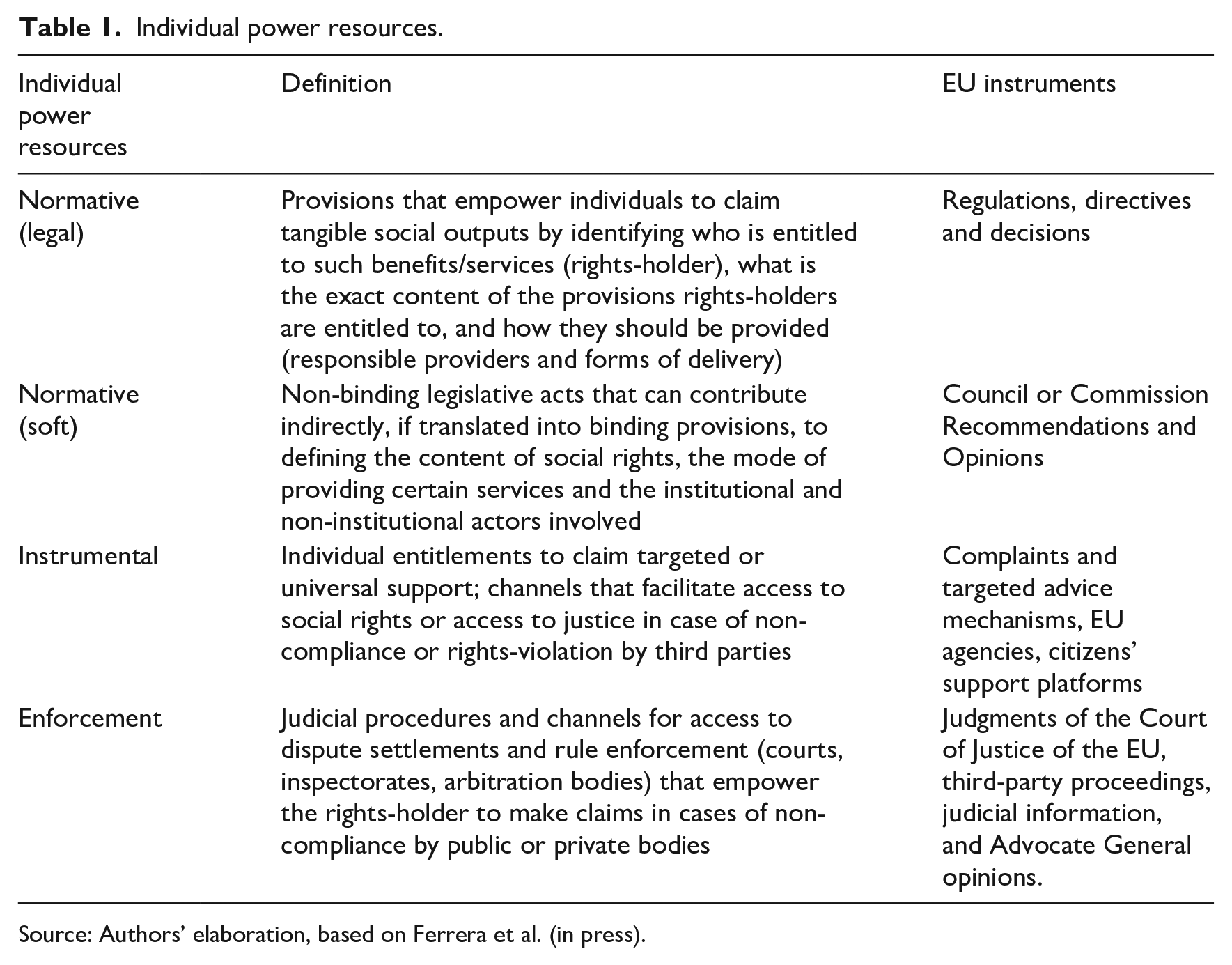
Source: Authors’ elaboration, based on Ferrera et al. (in press).
As stressed above, tracing the EU employment agenda from a rights-based perspective is not enough and leaves open the question of ‘who gets what’ from EU employment policies. In Citizenship and Social Class, TH Marshall affirms: ‘If my primary concern is with citizenship, my special interest is its impact on social inequality’ (Marshall, 1992 [1950]: 17). The normative power resources identify the who, what and how of a social entitlement. In what follows we zoom in on the who with the aim of better grasping the distributive impact of the EU employment agenda. We seek here to identify the impact of changing policy instruments on prospective beneficiaries. For the peculiar case of employment policy, we build an original analytical grid, which assesses the level of inclusiveness on a grid distinguishing between stratifying, universalising, and capacitating policies (Table 2):
EU social citizenship in employment policy over time: power resources.
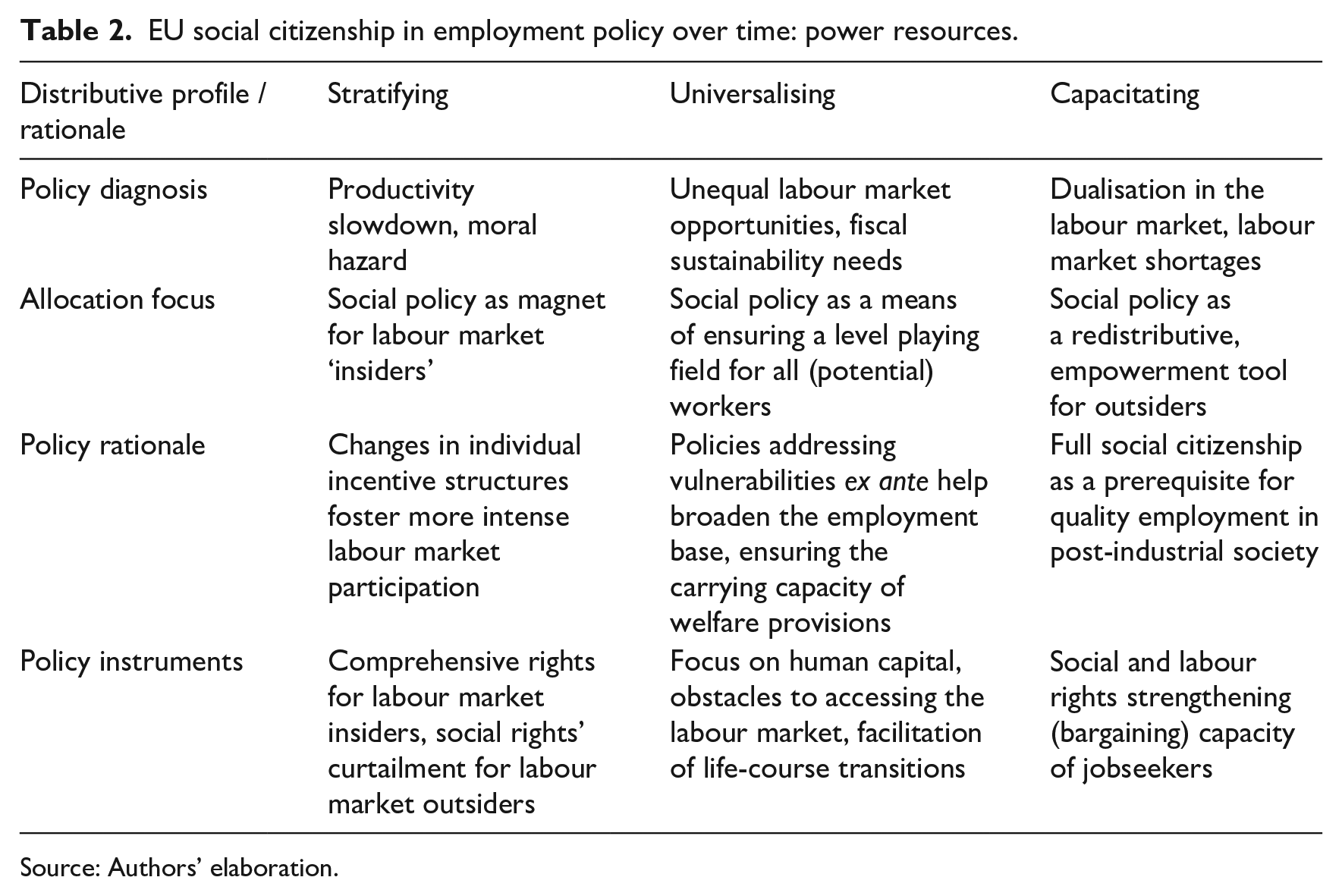
Source: Authors’ elaboration.
Stratifying reforms use social rights as a magnet for labour market ‘insiders’. Concerned with issues of slowing productivity and with the risk of creating ‘welfare profiteers’, stratifying social policies aim to set financial and non-financial incentives to attract and retain those workers considered most productive in the labour market. They typically emphasise individual responsibility in job uptake, de facto institutionalisation of a dual regime that strengthens the working conditions of labour market ‘insiders’ while exerting pressure to activate ‘outsiders’, even at the cost of curtailment of social rights (Emmenegger et al., 2012). This approach was observed notably in the workfare policies enacted under the Blair and Schröder governments in the early 2000s.
Universalising reforms aim to create new welfare services and broaden the scope of potential beneficiaries, irrespective of gender or labour market history. Universalising reforms share a common concern for higher employment productivity levels and the overall fiscal sustainability of the welfare state, but also address unequal labour market opportunities. But rather than focusing on targeted policies for specific segments of the labour market (by creating positive incentives for high-earners or negatives ones for low-earners), the activation of welfare systems takes a life-course perspective, shifting the focus from ex post compensation to ex ante intervention with the aim of creating a level playing field. The kind of welfare services that grant social rights based on citizenship rather than past contributions generally fall into this category.
Finally, capacitating reforms most obviously assume their redistributive role by targeting groups facing more difficulties in accessing decent employment. By contrast to the kind of ‘targeted’ or ‘residual’ policies identified by Garritzmann et al. (2022), ‘capacitating’ policies in this framework are conceived as necessary building blocks or ‘stepping stones’ allowing disadvantaged groups to benefit from new social rights, thereby fully participating in society (Hemerijck and Huguenot-Noël, 2022). Here, the kind of comprehensive ‘social insertion’ approach to the long-term unemployed pursued by Denmark in the 1990s represents a good example (Kvist, 2000).
Research strategy and data collection
To analyse the evolution of the EU employment agenda after the Great Recession from a power resources perspective, we use two databases (see Alcidi and Corti, 2022).
The first includes EU social directives, regulations, decisions, recommendations and opinions from 2009 to 2022. The data were retrieved from EurLex. The following EuroVoc thesaurus areas were selected to identify the directives, regulations and recommendations: employment, labour market, working conditions, labour law and labour relations. Finally, eight main employment policy areas were identified to classify the measures: employment protection legislation, unemployment benefits, labour mobility, social dialogue, organisation of work and working conditions, health and safety at the workplace, non-discrimination, work-life balance, and active labour market policies. In total, 71 measures could be classified between 2009 and 2022, of which 12 were regulations, 28 directives, and 31 recommendations.
The second database includes all Court of Justice of the EU (CJEU) judgments from 2009 to 2022. The data were retrieved from EurLex. The following subject matters were selected in order to identify the judgments: Employment (EMPL) and Social Policy (SOPO). In total, 317 judgments were classified between 2009 and 2022. In line with the classification of the regulations, directives and recommendations, eight main social policy areas were identified to classify the relevant measures: employment protection legislation, labour mobility, social dialogue, organisation of work and working conditions, non-discrimination, health and safety at the workplace, work-life balance, and active labour market policies.
Finally, to assess the distributive profile of EU action, we propose a second analytical framework, which looks at the allocation of EU social rights and distinguishes between stratifying, universalising and capacitating labour market interventions. For this, we review the content of all normative resources (regulations, directives and recommendations) made available by the EU to its citizens by means of an in-depth qualitative analysis of their legislative provisions. We then integrate the results of this analysis in the context of discussed policy alternatives to qualify each observation in accordance with the above classification. To assess the consistency and agreement of our coding decisions, we finally implement an ex post intercoder reliability check. While exchanges on the content and context of EU policies allow for better-informed classification, the results of this analysis should nonetheless be interpreted with caution. A classification process is inherently selective and, as with any typology, the complexity of the underlying data may leave scope for diverging interpretations. Further research may help to refine these findings or uncover scope conditions.
From social policy torpor to rights-based impetus: EU employment policy beyond Treaty constraints
In the wake of the Great Recession, the EU employment agenda has evolved irrevocably towards a social empowerment of European citizens. Whereas the crisis years were characterised by a kind of ‘radio silence’ as regards employment initiatives, there has been a slow and progressive change of path since 2013, which was consolidated especially after 2017 with the adoption of the Social Pillar. A first series of changes was observed at the end of 2013 with the launch of a set of soft Council recommendations (Table 3). While not yet directly creating new entitlements, EU recommendations supported Member States in developing legislative frameworks granting citizens new resources to claim social rights. This is the case, for instance, with the Council Recommendation on the Youth Guarantee, the Recommendation on Upskilling Pathways, the Quality Framework for Traineeships, the European Qualifications Framework for Lifelong Learning and for Quality and Effective Apprenticeships, the Effective Active Support to Employment, Vocational Education and Training (VET) and the Council Recommendation on Access to Social Protection for Workers and Self-employed. The scope left to Member States to provide new individual power resources varied across measures. For example, the Youth Guarantee provides that all young people under the age of 30 who are not in education, employment or training (NEET) should be entitled to a good-quality offer of employment, continued education, an apprenticeship, or a traineeship within four months of the moment they enter this status. By contrast, the Recommendation on Upskilling Pathways leaves more discretion to Member States. The target group includes adults who have left education and training without achieving an upper secondary qualification (EQF 4). They should be entitled to a skills assessment, a tailored and flexible learning offer and a validation and recognition of their skills.
EU social citizenship in employment policy over time: the allocation of power resources.
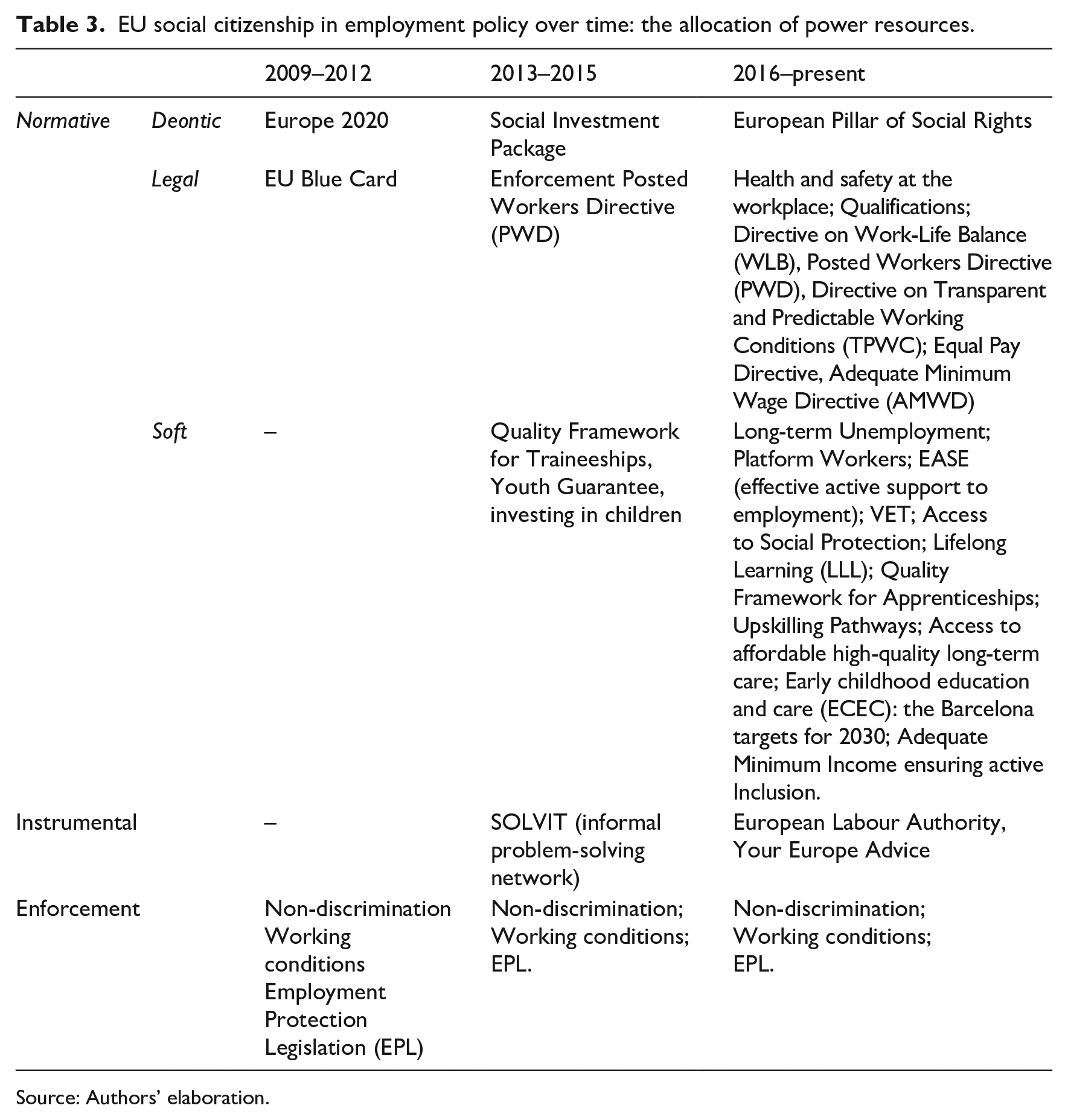
Source: Authors’ elaboration.
Starting from 2017, the EU employment agenda entered a second phase. Besides soft recommendations, legally binding instruments were also developed, ‘bonding’ EU citizens in a common policy space (Ferrera, 2023). The adoption of new directives on health and safety at the workplace, the revision of the Posted Workers Directive, the approval of the Transparent and Predictable Working Conditions Directive, equal pay and minimum wage directives directly empower individuals with new social entitlements. Interestingly, the new initiatives were adopted under the same Treaty framework and specifically under Article 153. As regards the nature of the measures adopted, these would seem to support Catherine Barnard’s claim that the Treaties define the perimeter of EU action. All new legally binding initiatives indeed fall under three main categories: health and safety at the workplace, organisation of work and working conditions, and labour mobility.
The limited number of areas in which the EU has intervened, providing legal resources to its citizens, is also reflected in the evolution of enforcement resources. In this respect, as observed by Aranguiz (2022), the Court has interpreted only a few of the fields listed in Article 153, mostly in the context of the employment directives on health and safety and working conditions. A systematic look at the Court of Justice of the EU judgments in the area of social and employment policies from 2009 to 2022 (Figure 1) confirms that the bulk of EU case-law in the employment policy domain concerns non-discrimination (207 cases), employment protection legislation (154 cases) and organisation of work and working conditions (79 cases). With respect to work-life balance, there are 19 cases from 1999 to 2021, all regarding parental and maternity leaves, which fall under the scope of the Maternity Leave Directive (1996) and the Council Directive on parental leave (2010).
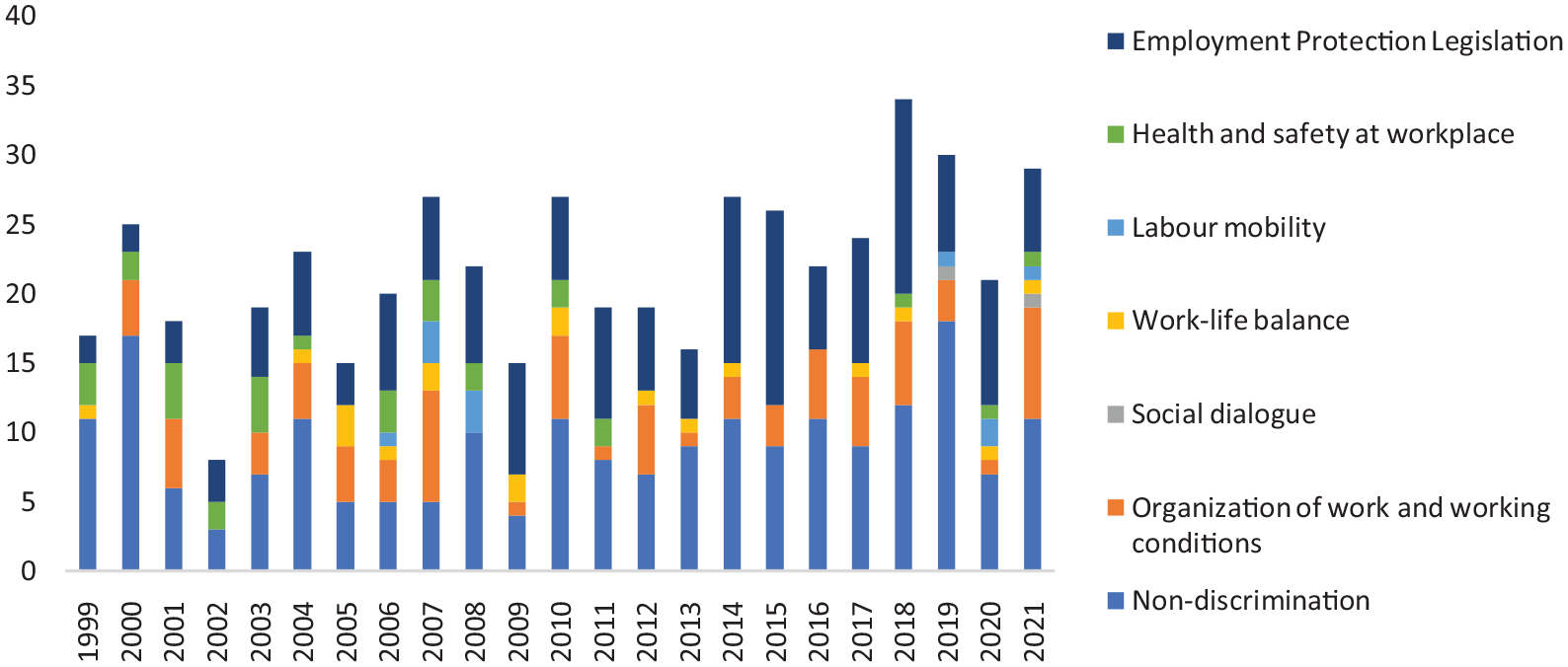
Evolution (number) of ECJ case-law in the employment policies’ domain 1999–2021.
Nevertheless, while policy areas under consideration remained the same, the scope of EU action has been enlarged, which speaks against the idea that the EU employment agenda has run its course (Barnard, 2014). From this perspective, the constitutional perimeter posed by the Treaties is indeed less of a limit as it may seem prima facie that there is still a wide margin within which hard EU employment legislation may be advanced (Garben, 2019). For this to happen, however, ultimately policy entrepreneurship is required. The fluctuation of EU legislation, without changes to social provisions in the Treaties, shows that the intensity of legal provisions depends largely on political dynamics (Graziano and Hartlapp, 2019). The same political dynamics and attention to social entitlements seems also to underpin the renewed attention to access to social entitlements since the launch of the Pillar (see Table 3). In 2019, the European Labour Authority was created to make sure that all EU rules on labour mobility are enforced in a fair, simple and effective way by a new European inspection and enforcement body. In the same year, Your Europe Advice was created to support – free of charge – citizens and businesses with targeted information on the application of EU law – beyond cross-border cases – and explain how individuals can exercise their rights.
To sum up, the evolution of the European employment agenda since the Great Recession has been accompanied by a progressive change in the policy tools available to achieve the objectives that ultimately affected citizens’ individual entitlements. Since the Great Recession, indeed, the EU has progressively expanded the scope of its action, not only reinvigorating its hard legislation – partially adjusting some of the initiatives adopted in the previous years – but also spreading, initially under the SIP framework, but more remarkably under the Social Pillar, to policy areas in which competences were less obvious, especially via soft recommendations.
Against this background, if the EU employment agenda returns, marked by an empowerment of EU citizens’ social rights, the question is, who will obtain such new entitlements?
New rights for whom? A more inclusive EU employment agenda in the post-Social Pillar period
Building on the above-illustrated analytical framework, in what follows we assess the distributive profile of the EU initiatives before and since the launch of the Social Pillar. 1 Given that policy principles are defined primarily via normative (both legal and soft) power resources, we focus on this kind of entitlement.
2009–2015: a progressive re-awakening of the equal rights agenda
As already stressed, the first half of the 2010s, which corresponds with the first years of the second Barroso Commission, was a period of social policy torpor. As stressed by various scholars, this period was characterised by a dual process: a retrenchment of the Commission’s political role, which was increasingly hesitant to set out ambitious projects, and, within the Commission, increased power for the bureaucracy close to the President and responsible for monitoring the other departments as part of the ‘Better Regulation’ agenda (Garben, 2019; Graziano and Hartlapp, 2019). As detailed by Vogel (2018), this was reflected, for instance, in the complete removal of occupational health policies – one of the EU’s key legislative competencies – from the EU agenda.
Analysing the distributive profile of initiatives adopted in the period before the adoption of the Social Pillar (2009–2015) we find that they are characterised primarily by a timid re-awakening resting on soft provisions with a universalising character. Some stratifying provisions were also adopted over the period, however.
Labour, social and mobility rights for qualified workers first
A stratifying agenda was first observed in two areas related to worker mobility: initiatives concerning the conditions of entry and residence of third-country nationals, and the rules applying to posted workers in the EU. In 2009, EU Member States agreed to introduce an ‘EU Blue Card’, setting out the entry and residence conditions for highly qualified non-EU nationals wishing to work in highly qualified jobs in an EU Member State. This Directive, which followed pressure from many EU Member States to make migration into the EU increasingly selective, stressed the conditions under which EU Member States may reject applications and restrict EU Blue Card holders to ‘highly qualified jobs’ for the first two years following entry. Controversial from the outset, the impact assessment of the Directive in 2016 pointed to ‘incoherent, ineffective and inefficient [rules] with high barriers of entry and complex and diverging admission procedures’ across the Member States. This eventually led to its replacement in 2021. Another stratifying event was the choice of the status quo in the debate on the 2014 revision of the Posted Workers Directive (PWD). The so-called ‘Enforcement Directive’ introduced important novelties to distinguish genuine from fraudulent postings, enhance the dialogue between national inspectorate authorities, and improve monitoring capacities. While these provisions supplied posted workers with new instrumental resources to claim these rights, this first revision of the PWD failed to address the critical uncertainties faced by most precarious posted workers, namely on minimum rates of pay, access to core social rights, or inconsistencies in EU rules on social security coordination (Corti, 2022). This preserved the stratification.
Equal rights and social investment focus in the recovery phase
In contrast to the status quo observed on issues related to worker mobility, the rediscovery of the EU’s legislative firepower found its way in other initiatives, which clearly displayed a universalising profile (Table 4). Two directives adopted in the same period played an important role in promoting a level playing field for EU workers. Building on the path-breaking Regulation 492/2011 on the free movement of workers, the 2014/54 Directive requires national authorities to ensure that the exercise of workers’ rights – in terms of access to employment (programmes), social and tax advantages, education and training, or trade union representation – may rely on appropriate judicial procedures and supporting organisations. These new resources granted to all workers were complemented by similar normative provisions in the pension domain. Rules adopted in July 2014 thus allowed individuals working in another Member State to see their pension rights guaranteed after a maximum three years’ employment and to be treated in the same way as workers remaining on those schemes, for example, on matters such as indexation. The shift to a more universalising approach was conveyed most forcefully with the legislation adopted in the wake of the Social Investment Package in 2013, which – as described above in the case of the Quality Framework for Traineeships or the Youth Guarantee – aimed at granting equal labour market opportunities to all, notably via smoother transitions in a life-course perspective.
Distributive profile of the key EU employment-related policy initiatives before the adoption of the Social Pillar.

Overall, if the 2009–2015 period shows the return of a more inclusive employment agenda, this revival failed to embrace a proper capacitating ambit, which would go beyond the equal rights agenda. This did occur, however, after the announcement of the Social Pillar.
2016–2022: EU change of heart and new capacitating ambitions
Jean-Claude Juncker’s launch of the Social Pillar in his State of the Union Address in September 2015 marked a revitalisation of the EU social acquis. Again the occupational health legislation – as observed by Vogel (2018) – is a telling example of this change of heart, with the revision of the Directive on carcinogens and mutagens, a new list of indicative occupational exposure limit values, and the new initiatives on psychosocial risks and musculoskeletal disorders. As we detail below, this change of heart is also characterised by a shift towards a more capacitating employment agenda, aimed at ensuring that the provision of individual social rights also benefits traditional labour market outsiders.
A lasting stratifying element in mobility initiatives
To the extent that they favoured economic freedoms over social rights or fiscal discipline and competitiveness over social assistance, EU single market initiatives have often displayed a stratifying profile, reserving the creation of new social rights for mobile and employed individuals. If some policies enacted since the adoption of the Social Pillar continue to bear that mark, as of 2022, these initiatives constitute a minority of reforms under consideration. The clearest example of a stratifying initiative adopted recently is related to another reform in the pension area. In 2019, the EU adopted a new framework for a voluntary pan-European personal pension product, referred to as the PEPP. The PEPP is presented as a tool to increase consumer choices for retirement saving by providing an optional scheme complementary to existing public and corporate options. As Hacker’s (2004) analysis of pension policy in the United States illustrates, the introduction of new programmes, progressively upgraded to attract new clients, has been part of a process of institutional layering, whereby new practices progressively replaced prevailing regimes – such as the compulsory contribution of higher earners to collective, pay-as-you-go pension systems. In this respect, the PEEP could threaten the kind of solidarity mechanisms underlying pension regimes available in most developed welfare states. An equally stratifying profile remains in the EU’s approach to the employment of non-EU citizens. With the revised ‘EU Blue Card’ Directive, adopted in October 2021, EU social rights remain targeted not only towards workers, but also towards highly qualified third-country nationals, consolidating the EU’s selective immigration approach. If the scope of beneficiaries has remained constant, it is worth noting that the EU’s agenda has concomitantly taken a more lenient approach, as indicated by the smoothening of admission criteria, the lowering of the salary threshold or the granting of more labour and mobility rights to workers and their families.
Work-life balance and adequate minimum wage consolidating the EU’s universalising ambit
Many EU policy initiatives enacted since the adoption of the EU Social Pillar also have a universalising profile. A good example of a reform universalising welfare systems is the 2019/1158 Directive on Work-Life Balance (WLB), which aims to improve gender equality by fostering more flexible arrangements for working parents. The Directive thus sets out minimum requirements for paternity, parental and carers’ leave, creates new incentives for men to assume caring responsibilities by means of new social rights (10 working days of paternity leave paid at least at sick leave level) and non-transferable paid parental leave. If the recognition of increasing family diversity and atypical forms of employment stand out as inclusive provisions, this initiative shall nonetheless not be qualified as capacitating. As Chieregato (2020: 14) highlights, restrictive eligibility criteria, combined with the absence of provisions requiring adequate remuneration for parental and carer’s leave (opposed by the Council), de facto reduce the ability of lower-income families – which are over-represented in non-standard employment – to take family-related leave. Equally universalising is the 2022 Directive on adequate minimum wages (Adequate Minimum Wage Directive), which brought EU regulation to the hitherto unexplored area of working conditions. A flagship commitment of the von der Leyen Commission to pursue the agenda of the Social Pillar, the Adequate Minimum Wage Directive aims to provide more workers with guaranteed access to minimum wage protection. To achieve this goal, the Directive notably promotes the capacity of social partners to set wages via collective bargaining and encourages countries with statutory minimum wages to use consistent criteria to set and update their adequacy. While an alliance of ‘regulatory’ governments and the European Parliament backed by influential trade unions pushed for more ambitious provisions, the Council defended its own prerogatives by ensuring that this ‘framework directive’ would not legally bind them to set new individual rights for hitherto uncovered workers.
New capacitating ambit targeted at young people and labour market outsiders
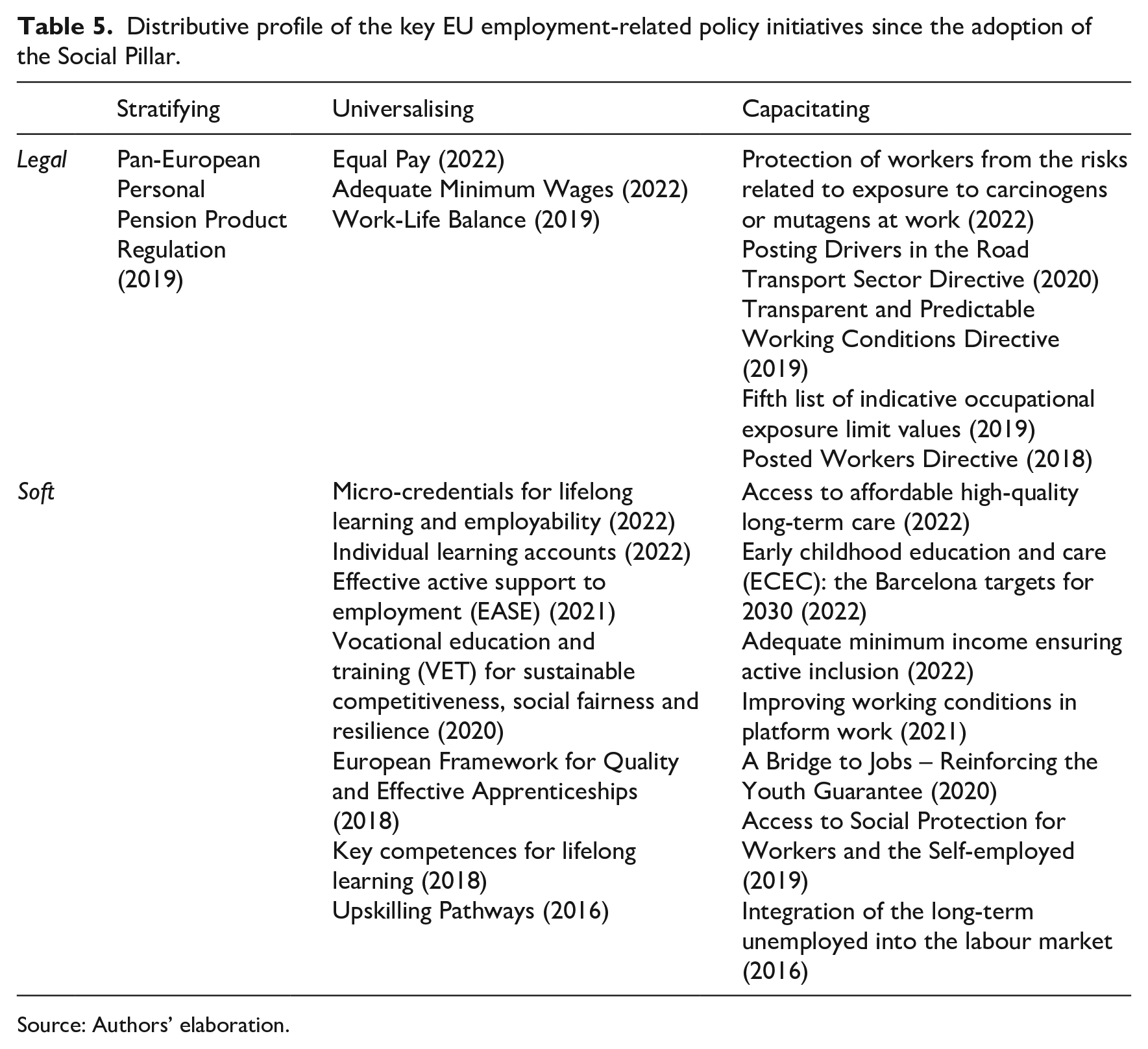
EU initiatives since the adoption of the Social Pillar have primarily taken on a capacitating profile (Table 5). A representative example is the revision of the Posted Workers Directive. In a universalising fashion, this Directive revision advanced the principle of ‘equal pay for equal work at the same workplace’ and ensured that collective agreements can be applied to posted workers not only in the construction sector but in all sectors and branches. But it also went beyond the mere focus on free movement characteristic of the original directive with a ‘market-correcting’ logic, providing new social rights to workers often bound by precarious contracts, such as temporary agency workers and subcontractors. Further evidence for this stems from the reprioritisation of the objectives and target groups of EU initiatives, as demonstrated by EU institutions’ increasing involvement in areas such as youth policies and the working conditions of precarious workers. As highlighted above, EU initiatives specifically targeting youth employment, such as the Youth Guarantee, emerged as the result of the dramatic impact of the Great Recession and austerity policies on youth unemployment, particularly in the EU’s southern periphery. In the wake of the Social Pillar and the COVID-19 pandemic, the EU’s youth employment policy marked a new step, characterised by heightened attention to tackling the root causes of many young people’s inability to enter the labour market, going beyond the above-mentioned initiatives linked to apprenticeship. The Council Recommendation ‘A Bridge to Jobs – Reinforcing the Youth Guarantee’ adopted in October 2020 to update the Youth Guarantee reflects this trend. The recommendation not only acknowledges that NEETs are a ‘heterogenous group’ requiring ‘longer interventions’; it also specifically focuses on ‘especially vulnerable’ young people, such as early leavers, who – unlike most highly skilled people – may also face structural issues linked to social protection coverage, restricted access to financial resources, precarious work conditions or discrimination. Besides the update of the Youth Guarantee, another initiative proved representative of the capacitating profile of EU measures adopted since the Social Pillar. The 2019 Directive on Transparent and Predictable Working Conditions is specifically targeted towards workers on zero-hours contracts (such as workers in logistical centres, shelf-stackers in supermarkets, domestic or voucher-based workers) and platform economy workers (on-demand drivers). The Directive notably constrains Member States to take measures preventing abusive labour market practices characteristic of on-demand employment. Significantly, by relying on the ECJ’s jurisprudence on ‘workers’, the Directive now also allows new categories of workers (such as ‘bogus self-employed’) to benefit from new kinds of social protection (Georgiou, 2022).
Distributive profile of the key EU employment-related policy initiatives since the adoption of the Social Pillar.
Source: Authors’ elaboration.
To sum up, our analysis shows that EU employment policy initiatives enacted after the adoption of the Social Pillar have, overall, proven largely inclusive as they have aimed to expand the scope of welfare provisions beyond ‘traditional’ beneficiaries. Looking at the distribution of all EU initiatives through our analytical framework, this trend is observable quantitatively, with the highest shares of legal and soft initiatives falling either in the universalising or capacitating columns (Table 5). This evolution can also be discerned in the content of new initiatives, as in the case of the directives on Transparent and Predictable Working Conditions, Work-Life Balance, Equal Pay, or Adequate Minimum Wages or through the manifold recommendations enacted between 2018 and 2021, for example, on platform workers’ working conditions, minimum income, or long-term care. The ‘inclusive turn’ in EU employment policy-making is perhaps best reflected, however, in the reorientation of existing policies on the posting of workers, the Youth Guarantee or early childhood education and care (ECEC) provisions, all of which denote a clear intent to reach out to most vulnerable segments of the population.
How can the EU’s employment agenda better serve EU social citizenship?
The evolution of the European employment agenda has been marked by the sequencing of different policy priorities over the years. From a rights-based perspective, however, the EU experienced an almost two-decades long silence, during which the proclaimed employment strategies failed to be layered by an equally ambitious empowerment of EU citizens. This period of social policy torpor gave Member States discretion on whether and how to implement the EU’s broad guidelines. Combined with growing concerns about fiscal surveillance, timid efforts to advance a European social citizenship in its own right de facto materialised in the subordination of individual social entitlements to the macro-objectives of increasing cost-competitiveness and consolidating public finances. The progressive erosion of the austerity paradigm and the failure of the preceding flexicurity-without-teeth model slowly pushed policy-makers at the EU level to reinvigorate the EU employment agenda by filling the holes in the EU social acquis (Garben, 2019) by revising the obsolete legislative provisions of the 1990s. Only since the adoption of the Social Pillar have we been able to observe a transformation of this perspective into a progressive attempt to expand the EU influence on national employment policies and social rights with the adoption of soft recommendations, accompanied by financial assistance. From a distributional perspective, while a few new legal initiatives have a stratifying profile, the EU employment agenda has irrevocably assumed a more inclusive profile, combining universalising attempts, aimed at increasing job opportunities for all, with an ever more capacitating perspective, bringing due attention to the peculiar constraints faced by most disadvantaged individuals.
The outbreak of the COVID-19 crisis seems to have marked a tipping point in the EU’s shift to promoting quality employment. Interestingly, this happened in the wake of new policies, notably financial assistance under conditionality. The new instruments in place, such as SURE and the RRF, do not empower citizens with new social entitlements directly. But they affect citizens’ social rights indirectly. With the adoption of SURE and then the RRF, the EU institutions ventured into new terrain by positioning the EU as a co-guarantor of social citizenship, de facto entering into the co-production of new social rights (Corti and Huguenot-Noël, in press). While less debated, the creation of new employment rights by means of fiscal backing represents a new pathway to substantiating the Social Pillar. Obstacles remain, however. As we have warned in this contribution, the introduction of new power resources and new employment rights may also reinforce inequalities, if the distributional profile of the envisaged reforms is not carefully considered. An instrument such as SURE marked a decisive step forward in terms of employment protection as it incentivised all Member States to either introduce or improve on the design of job retention schemes, loosening or enabling quicker access to instruments, raising subsidies, or extending maximum duration (Baptista et al., 2021). Significant differences nonetheless persist with short-time working schemes in some Member States mostly benefiting a limited group of workers with open-ended contracts. Similarly, under the RRF, early empirical evidence shows that the distributional impact of reforms envisaged under national Recovery and Resilience Plans has not been addressed systematically in all Member States (Ferrera et al., in press). This raises the question of how to make sure that this new way of mainstreaming the employment agenda results in less, rather than more segmented societies.
If the shift towards a qualitative approach in the post-pandemic EU employment agenda is genuine, there is a long way to go before it is well anchored, and benefits everyone. Among the concerns, particular attention should be paid to the remaining asymmetries in the EU legal framework between the macroeconomic governance framework and single market integration, on the one hand, and social citizenship, on the other. In this respect, except for the hard legislative approach, risks remain that the new ways of implementing the EU employment agenda – especially those based on non-binding recommendations – will either be ignored or subordinated to a new wave of fiscal consolidation concerns. For this reason, we concur with the proposal advanced by Barnard (2014) for a European Social Compact to guarantee a social protection floor, preventing the ‘displacement’ of the EU employment agenda (Kilpatrick, 2018) to merely serve economic governance objectives. Keeping this floor in line with dynamic developments occurring in European labour markets implies also better equipping the EU social policy-making toolbox. As of today, EU-level action on social security and workers’ social protection requires unanimity voting. Existing provisions have thus led envisaged directives to be scaled down to the level of recommendations (for example, on access to social protection for workers and the self-employed). As unanimity is also required for the adoption of these recommendations, veto threats could also continue to reduce agreements to the lowest common denominator. In employment policy, qualified majority voting and an equal say for the European Parliament should be the norm, not a hard-to-reach state of exception.
Systematically proving the inclusiveness of the EU employment agenda will also involve revising governance rules. Policy-making not only occurs within pre-defined, formal rules but also via established practices, granting some participants bargaining advantages over others. While efforts have been made over the years to socialise the Semester, existing EU arrangements (including the governance of the RRF) often continue to favour ‘economically oriented’ actors over ‘socially oriented’ ones. Equally, joint meetings between ECOFIN and EPSCO at the EU level will not suffice if domestic hierarchies at home are not reconsidered. As obvious as it may seem, making the EU more inclusive will not happen unless heads of state and government assign greater institutional leverage – that is: internal power – to those for whom advancing social citizenship for all remains the primary goal.
Footnotes
1
We take 2015 as the cut-off date for the pre- and post-Pillar periods as the EPSR was formally announced by Juncker in September 2015 and the consultation was launched in 2016.
Funding
This work was written in the context of the Horizon 2020 funded project EUSOCIALCIT [grant agreement no. 870978] and ERC funded project WellSIRe [grant agreement no. 882276].