




Abstract
The negotiations over the Eurozone crisis have increasingly come to reflect Poulantzas’ idea of ‘authoritarian statism’, i.e., a decline in the relevance of democratic institutions and a shift in political power towards technical state apparatuses. Yet, scholarly approaches to transnational integration have provided little guidance as to why monetary relations have become such a pronounced point of condensation for the contradictions inherent in European integration. While mainstream theories of monetary unions such as optimal currency area theory neglect the impact of state power and class interests on monetary politics, more critical perspectives on transnational integration have paid insufficient attention to monetary governance and its role in the mediation of international relations. The present paper brings heterodox theories of international relations and monetary integration to bear on the increasingly authoritarian dynamics of Eurozone governance. Reflecting on Bruff’s discussion of authoritarian neoliberalism, we proceed to examine how the circumvention of democratic institutions via Eurozone monetary governance is more precisely captured through the notion of transnational authoritarian statism. We develop this concept in relation to two historical periods of European integration: the formation of the Economic and Monetary Union and the recent extension of the European Central Bank’s scope of monetary governance.
Keywords
Introduction
After the outbreak of the global financial crisis, many commentators suggested or at least hoped that neoliberalism was past its peak and that the world would enter a new phase of political and economic possibilities (cf. Peck et al., 2009). Yet, nearly 10 years later, despite the economic fall-out from the collapse of housing markets across the world and an interminable series of financial and debt crises, the neoliberal agenda appears to have consolidated itself under what observers have suggested is an increasingly authoritarian guise (e.g. successive ‘Troika’ interventions in the Eurozone crisis countries, the curtailment of civil liberties, such as the right to demonstrate, in Spain, the introduction of ‘states of exception’ in France and Turkey, etc.). Our contribution to this debate has been to suggest that the specific transnational dynamics underpinning the process of crisis management in the European Union (EU) have come to reflect what Nicos Poulantzas termed ‘authoritarian statism’ (Sandbeck and Schneider, 2014). Specifically, we argued that a novel application of Poulantzas’ ideas to the dynamics of European crisis management after the financial crisis – via a transnational articulation of authoritarian statism – would unveil the contradictions that traversed the boundaries of national and transnational statehood and which were producing a ‘strengthening-weakening’ of the EU state project. This phenomenon of transnational authoritarian statism was subsequently grounded as part of the longer historical trajectory of uneven and combined development in Europe that produced the rocky terrain of unevenness and inequality that the project of European integration attempted to flatten, but which the EU was simultaneously premised upon. The historical contradictions of multiscalar European statehood thus produced crisis tendencies that required increasingly authoritarian responses not only at the level of the nation-state, but via transnational avenues of crisis management that, by their very nature, functioned to bypass democratic institutions at the nation-state level.
However, in spite of an apparent theoretical convergence on the category of authoritarianism in relation to the European debt crisis and the broader historical conjuncture of neoliberalism (e.g. Bruff, 2014; Joerges, 2014; Kiely, 2017; Ryner, 2015; Wahl, 2014; Ziltener, 1999), the deployment of the adjective ‘authoritarian’ lacks a coherent, unified meaning across its variegated uses. For example, many approaches to the authoritarianism inherent in the debt crisis have been limited to examining the ways in which fiscal policies at the domestic level have been increasingly constrained within the Economic and Monetary Union (EMU), or, politically, the manner in which civil liberties such as the right to demonstrate have been retrenched in Spain, France and elsewhere. While these are certainly important expressions of the crisis, the historical process underwriting monetary integration itself has often been ignored as a distinct political problem. This is problematic insofar as it ignores the authoritarian and anti-democratic tendencies inherent not only in fiscal rules that have underpinned European monetary integration – such as the Stability and Growth Pact – but also in the introduction of the Euro as a supranational currency and the specific construction of the European Central Bank (ECB) within the broader setting of the EMU itself. As we illustrate below, all of these monetary developments serve to ‘lock-in’ the predominant bias towards austerity measures and have empowered the ECB as a transnational economic state apparatus to actively undermine alternative responses to recurrent economic crises. In this sense, this paper also seeks to contribute to the ongoing debate about the strategic implications of the ultimate failure of progressive forces, particularly in Greece, to fundamentally challenge the neoliberal and authoritarian core of European economic integration.
Our argument unfolds in three steps. First, we examine dominant theoretical approaches to money and dependency, both heterodox and neoclassical, and suggest that the combination of their lacunae – i.e. a tendency to undertheorize the phenomenon of monetary dependency – creates a critical blind spot for contemporary theorizations of monetary integration and the authoritarian dynamics of transnational monetary governance. Second, we scrutinize Ian Bruff’s (2014) conception of ‘authoritarian neoliberalism’ and argue that a partial ‘return’ to a modified conception of Poulantzas’ idea of authoritarian statism would offer a more theoretically coherent and nuanced point of departure for analysing the present conjuncture, particularly in relation to the Eurozone’s recurrent crises; this renews our earlier attempt to conduct a ‘reading with and against’ Poulantzas’ theorization of the state (cf. Sandbeck and Schneider, 2014: 849). Finally, we deploy our modified conception of transnational authoritarian statism in order to clarify crucial dimensions of European monetary integration that appear to embody Poulantzas’ prediction of authoritarian statism: the circumvention of democratic institutions and popular dissent via the insulation of executive and administrative state apparatuses, albeit through transnational (read: scalar) strategies that are part and parcel of the establishment and maintenance of the Euro as a supranational currency.
Contemporary approaches to monetary integration
Part of the blockage that prevents an adequate understanding of how monetary integration can lead to such transnational authoritarian dynamics lies in the limitations of prevalent theories of money and how they are brought to bear on actually existing cases of currency areas like the EMU. Conventional accounts of the failure of the EMU often rely on extensions of Optimum Currency Area (OCA) theory and its ontologically ahistorical conceptualization of currencies as a function of private market evolution and cost minimization. Historical questions of political economy and sovereignty do not enter into the theoretical equation and reflecting on the ostensible failures of the EMU (if they are even regarded as such) primarily involves analysing whether or not the Eurozone, in fact, adequately falls under the definition of an OCA. These analyses vary in scope, but are generally aligned with one of two approaches: (a) traditional OCA analysis in which an economic region is assessed according to particular financial/economic characteristics, and whether or not these would allow a fixed exchange rate to be feasibly instituted or (b) cost–benefit approaches that examine the mutual economic advantages obtained by nations entering into a currency area, including the reduction of exchange volatility risks, direct/indirect efficiency gains, price stability, etc. In either case, there is no necessary correlation between a currency area and the sovereign boundaries of the nation-state. For OCA theory, the latter constitutes either an (untheorized) historically rooted phenomenon that does not possess any inherent relationship to the development of money itself, or the evolutionary outcome of private market processes that served to minimize transaction costs, institutionalized in the form of a specific currency. Since the nation-state cage is neither a necessary form nor institutional impediment seen from the ahistorical perspective of money’s efficiency-enhancing functions, fiscal and political integration was not an indispensable precondition for monetary integration in Europe.
The institutionalist, post-Keynesian, or neochartalist critique of OCA theory has centred around the latter’s ahistorical conception of money and the elision of questions surrounding the linkage between political sovereignty and currency development. Drawing on the work of heterodox monetary theorists such as Georg Friedrich Knapp (1924) and A. Mitchell Innes (1913 [2004]; 1913 [2004]), neochartalists such as Geoffrey Ingham (2004) and Randall Wray (1998, 2000) argue that the historical development of money was deeply imbricated with the consolidation of state sovereignty itself. In other words, standard accounts that see money developing out of stateless bilateral barter exchanges bear no relationship to actually-existing monetary development, which are always trilateral in nature, being mediated by some kind of third party (usually the state) that guarantees the monetary token’s quality of ‘moneyness’. Neochartalists thus regard OCA theory’s primary deficiency to be its ahistorical detachment of political power from the spatial domain of money, i.e. currency – in other words, the delinking of monetary sovereignty from political sovereignty. The failure of the EMU is located in the absence of fiscal integration and the ECB’s relative lack of political power vis-à-vis the individual states that comprise the Eurozone, as prescribed by OCA theory, the latter seen as the primary ideological driving force behind the formation of the EMU (e.g. Ingham, 2004). As Goodhart (1998) suggests, If, then, the key issue is the (political) relationship between control over money and sovereign power, we need to consider carefully what problems this may portend for the future Euro single currency area. In the Euro area, the traditional historical links between money creation and sovereignty will be broken to a unique extent. Money creation will be the responsibility of a federal body, the European System of Central Banks, intentionally made, by the Maastricht Treaty, entirely independent of Government(s), whereas most other fiscal and other powers will remain in the hand of the participating nation states. (p. 425)
However, the neochartalist critique simultaneously tends to ignore the fact that national structures of political sovereignty are inextricably linked through a global, hierarchical system of territorial states. If OCA theorists subtract political power from the question of how money is constituted, neochartalists ignore the question of how this political power is differentially constituted both within and across the boundaries of political/monetary sovereignty. This also means that proponents of neochartalism often neglect the role that distinct currencies play in the maintenance of these cross-boundary differentials, i.e. the fact that not all monetary sovereignties are created equally. For example, the fact that the US dollar has played a hegemonic role during the post-war period as the global reserve currency, which confers upon the US the ‘exorbitant privilege’ of raising cheap capital and paying for imports in domestic currency, does not merit significant mention within neochartalist accounts of modern money. Finally, neochartalists do not examine the impact of capital–labour relations on the linkages between political and monetary sovereignty, seeing the creditor-debtor divide as a far more significant social cleavage under capitalism and, indeed, throughout history (e.g. Ingham, 2004). The resultant fusion of these oversights dovetails with the fantasy of enhanced fiscal integration envisioned by some institutionalists as a solution to the Eurozone’s difficulties, which is ultimately grounded in the absence of a theoretical account of the capitalist-led institutionalization of European unevenness by the EMU as part of a hegemonic political project implemented on behalf of Europe’s “core” states. In this sense, both neochartalists and mainstream institutionalists fail to ask the question “whose (monetary) project?” in relation to the EMU, subtracting international relations of capitalist power from the equation even as they re-centre the historical importance of state power in the creation of money and maintenance of monetary sovereignty. What appears from this constellation of diverse perspectives is an account of the present crisis that has little to say about how monetary governance at the level of the EMU is imbricated with the kind of transnational authoritarian statism that we have previously described as constitutive of the project of European integration (Sandbeck and Schneider, 2014).
In order to address the institutionalist and neochartalist lacunae, it is our contention that some of the theoretical categories of the dependency paradigm are necessary to bring to the fore the contours of unevenness that permeate the Eurozone by focusing on a ‘longer view’ of the roots of differential development between core and periphery (for an overview, see Weissenbacher, 2018). In the case of Europe, various interventions into dependency debates during the 1970s and 1980s highlighted trajectories of dependent development in Southern Europe, Ireland and Finland, focusing on patterns of peripheral industrialization and ‘premature’ de-industrialization, which predate not only the introduction of the EMU but European integration as such (cf. Louri and Minoglou, 2001; Schneider, 2017: 28–34; Seers et al., 1979). Elsewhere, analyses of Greece have, for example, highlighted the structural similarities between the dependent path of Greek economic development and the more ‘prototypical’ cases found in Latin America, Asia and Africa, suggesting that the roots of Greece’s peripheral status are to be found in the relative ‘backwardness’ of its socio-political formation beginning as far back in history as its subjugation under the Ottoman Empire (Evangelinides, 1979). Given that the project of European integration was erected upon this pre-existing uneven economic and geopolitical terrain, a dependency approach suggests that the formation of the EU constituted an institutional shift in the pattern of dependent capitalist integration rather than a categorical rupture towards a new set of relations between the European periphery and the rest of the EU. Theoretically, this implies that our attempt to analyse the political and economic contradictions undergirding the recent crisis must be grounded in a recognition of the longstanding penetration of Europe’s periphery by foreign capital, a transnational dynamic which characterizes the uneven and combined development of all classically ‘dependent’ countries.
In our view, however, what the recent Eurozone crisis has brought to the fore is the constitutive role of monetary sovereignty in sustaining and decisively modifying the core–periphery relationship of dependency, a question that did not figure prominently in dependency debates and exposes a significant lacuna in traditional variants of the dependency paradigm and structuralism (Palludeto and Abouchedid, 2016: 61). 1 This can partly be attributed to the continuing existence of the Bretton Wood System during the peak of the dependency debates. Moreover, the main conceptual category that embodies dependency theory’s understanding of the structures that preserve the core–periphery linkage is formal or informal domination, with all its connotations of politically sustained unequal exchange, militarism, patronage, and authoritarianism. Yet, the accession of Greece and other peripheral European nations to the EU was only completed after the end of the Mediterranean dictatorships and, in the case of Central and Eastern Europe the Cold War, with liberal democracy serving as the ideological sine qua non for economic membership in Europe. And this economic membership was always grounded in the eventual realization of monetary integration under the EMU, a process that was ideologically cast – with great success – as a democratic convergence among sovereign equals (for a critique, see Seers et al., 1982).
The dependency paradigm’s difficulties with capturing the more nuanced, ‘soft’ manifestations of core-periphery domination has, of course, attracted significant criticism. As early as 1976, Poulantzas noted that the form of dependency among the erstwhile dictatorships (Portugal, Greece, and Spain) experienced substantial changes throughout the 1960s and 1970s, such that many of the central dynamics characteristic of classical imperialist-imposed ‘structural dependency’ were no longer relevant, e.g., the preponderance of agriculture and a capital export regime tied to the primary sector, i.e. the production of raw materials or staple commodities. And yet, it was certainly not the case that these countries had effectively emerged out of a state of ‘underdevelopment’ as a result of these shifts towards large-scale capitalist industrialization, since the continued domination of these economies by foreign capital precluded an independent trajectory of late development and could only produce unique forms of ‘dependent industrialization’. In fact, the transition from dictatorship to democracy was viewed by Poulantzas as the direct outcome of a redistribution of the internal balance of forces in favour of the dependent capitalist fraction – the interior bourgeoisie – oriented towards the EEC rather than the United States; what mattered for the political outcome was the internal struggle over the form that dependency would take rather than the contestation over foreign domination itself. Similarly, Cardoso and Faletto (1979) saw in the ‘new dependency’ variegated articulations of core-periphery linkages that went beyond simple structures of coercion or domination, and that required an attentiveness to the democratic mediation of dependency through overlapping foreign and domestic interests, and, crucially, new dynamics of debt. And Becker, Jäger and Weissenbacher (2015) have recently argued that contemporary relations of dependency are also constituted through financialization, a development that classical dependency theory failed to adequately capture given the move away from the internationalization of ‘money capital’ after the Great Depression, and which only reasserted itself in the 1970s (see also Vernengo, 2006). But even these more expansive and historically sensitive accounts of the new forms of dependency have not engaged in depth with the centrality of monetary sovereignty, or rather, its subversion by neoliberalism (from the perspective of peripheral countries), as exemplified by the EMU.
Where the issue of monetary sovereignty is implicitly broached in relation to the concept of dependency is typically during discussions of a more overt form of monetary dependence, 2 i.e. the ‘dollarization’ of the periphery – whereby nations with weaker currencies use the USD as a currency substitute – a historical process that Carchedi (2002), for example, views as a partial response to the challenge posed by the Euro to the US dollar’s global hegemony. But above and beyond the geopolitical rivalry between the Euro and U.S. dollar, the dollarization of the global periphery provides deeper insights into the dynamics underlying EMU integration insofar as the economic incentives and potential for the loss of monetary sovereignty are similar in both cases. And it ultimately raises the question of how monetary sovereignty is leveraged by the core to sustain relations of dependency under a political regime that moves beyond traditional mechanisms of imperialist domination. Thus, Jameson (1990) avers that the post-Bretton Woods era entailed a convergence of nations across the globe into regional currency blocs, both formal and informal, with the dollar bloc comprising a clear example of the latter. Such regional currency subsystems emerged as a way to confront the nascent financial fragilities of the neoliberal era, and were often achieved – as in the case of dollarization – without any overt international agreements. For our purposes, however, the key point is that despite its informal nature the dollar bloc shares the same limitations as formal arrangements such as the EMU, which lock peripheral states into forms of monetary-led dependency, and has profound effects on the scope of domestic policy. Even the ostensibly voluntary and informal provisions of the dollar bloc mean that peripheral states effectively abdicate sovereign authority over three main areas: control of the money supply, control of the exchange rate, and capital controls. As detailed in Monetary integration as a core element of transnational authoritarian statism in the EU section below, these are precisely the elements of monetary sovereignty surrendered by dependent, peripheral Eurozone states.
In sum, a theoretical orientation that focuses on the question of monetary sovereignty allows us to grasp how the dynamics of capitalist money creation and circulation impose uneven and differentiated imperatives on nation-states, depending on their position within the geopolitical hierarchy of core and peripheral states. Thus, the monetary interests of hegemonic or dominant capitalist states depart drastically from those nations at the margins of the global economy. Moreover, by framing capitalist monetary governance as a historical and changing phenomenon punctuated by sudden, contingent institutional shifts, we arrive at an alternative way of periodizing capitalism itself. Thus, the end of Bretton Woods and the arrival of neoliberalism is inextricably linked to a shift in the very nature of capitalist money itself, and consequently, introduced new imperatives of monetary governance. Prior to the end of Bretton Woods, capitalist monetary governance had almost always taken a form of ‘practical metallism’ (cf. Schumpeter, 2006 [1954]), with currencies backed by reserves of precious metal such as the Sterling and US dollar occupying the peak of the monetary hierarchy. Despite the fractional reserve basis of such a system (i.e. the money in circulation exceeds the metallic reserves redeemable), for many traditional monetary theorists money’s intrinsic value was indissolubly linked to its metallic backing and a global monetary regime based solely on non-convertible central bank paper was unthinkable until the revolution ushered in by the closing of the gold window in 1971. The upshot of the latter was to cleave state budgets ever more tightly to monetary policy via the immense pressures of flexible and volatile exchange rates which forced nations to actively defend the value of their currencies, but differentially depending on the economic and geopolitical clout of the nation-state in question. 3
Against this background, the Eurozone in its present form can be understood, in large part, as a historical reaction to the end of the Bretton Woods regime, the arrival of flexible exchange rates and burgeoning financialization, and US dollar hegemony. Our main point here is that dynamics of transnational authoritarian statism in the EU are not merely restricted to direct institutional interventions targeting fiscal policies among countries of the periphery, but also encompass those non-democratic and authoritarian measures indirectly elicited by the architecture of EMU monetary governance itself. And this architecture of governance was erected on a pre-existing landscape, the contours of which were shaped by historical relationships of geopolitical power and dependence, but whose dynamics have been exacerbated by the EMU rather than alleviated as proponents of monetary integration often tout. The imperatives of integration under the EMU have consequently restricted the political autonomy or policy space of individual member states and are consistently biased towards austerity as the only viable option during economic crises. And this is not a new phenomenon, despite recent invocations of the concept of ‘authoritarian neoliberalism’, which tend – as we will argue in the following section – to nullify the historical and political particularities of divergent authoritarian tendencies that have emerged during the past couple of decades. In what follows, we critique the concept of authoritarian neoliberalism and clarify why a return to a modified conception of Poulantzas’ authoritarian statism offers a clearer and more nuanced theoretical understanding to the current conjuncture.
Theoretical interventions
Authoritarian neoliberalism
In coining the idea of ‘authoritarian neoliberalism’, Ian Bruff (2014) attempted to steer discussions about the post-crisis trajectory of capitalism away from premature claims about the demise of neoliberalism towards a closer examination of just how resilient and hegemonic the neoliberal order had become. Bruff averred that what occurred after 2008 was not a decline in neoliberal policymaking, but rather a re-articulation of neoliberalism that increasingly relied upon coercive state practices and juridical/administrative apparatuses which explicitly marginalize subordinate groups and limit the paths for popular resistance (Bruff, 2014: 115–116; see also Tansel, 2017). As such, the concept of authoritarian neoliberalism was leveraged as a critical intervention into debates around how capitalist states responded to the financial crisis, highlighting the fact that state-centric, coercive forms of governance are nevertheless perfectly compatible with neoliberal market-oriented policies. Unsurprisingly, the idea of authoritarian neoliberalism has proved fecund in its incorporation into a growing body of literature dedicated to examining variants of state strategies that appear to fit the authoritarian neoliberal mold, particularly within the European periphery (e.g. Clua-Losada and Ribera-Almandoz, 2017; Lendvai-Bainton, 2017; Mercille and Murphy, 2015; Shields, 2015; Yesil, 2016).
However, as we detail below, there a number of ambiguities embedded within the idea of authoritarian neoliberalism that lend themselves to concept-stretching, curtailing the concept’s explanatory power. Our uneasiness with the concept falls along two primary axes: firstly, we question whether authoritarian neoliberalism indeed constitutes a theoretically distinct category or, conversely (and this is our view), whether the primary properties that Bruff (2014) ascribes to authoritarian neoliberalism are already present in Poulantzas’ original conception of authoritarian statism. Secondly, we argue that the concept of authoritarian neoliberalism lacks historical and political specificity, conflating divergent historical trends that in fact belong to distinct political logics of authoritarianism, some of which are in fact responses to neoliberalism itself: The emergence of both mainstream right-wing and extreme right-wing populism cannot, in our view, be coherently rooted in the same dynamics which characterize a leaner, meaner technocratic neoliberal centrism, as the notion of authoritarian neoliberalism as an umbrella term for these distinct historical trends suggests.
Certainly, our two critiques are not wholly distinct; the above ambiguities partially emerge because Bruff (2014) conflates two possible uses of authoritarian neoliberalism throughout his explication of the concept. First, authoritarian neoliberalism is implicitly posed as a theoretical renewal of Poulantzas’ conception of authoritarian statism, one that is purported to more accurately capture a recent breakdown in the consent-oriented strategies of the state and a move towards more overt or punitive forms of control and exclusion: Authoritarian neoliberalism does not represent a wholesale break from pre-2007 neoliberal practices, yet it is qualitatively distinct due to the way in which neoliberalism’s authoritarian tendencies—such as the increasingly punitive nature of penal and criminal policy—have come to the fore through the shift toward constitutional and legal mechanisms and the move away from seeking consent for hegemonic projects (i.e., away from neoliberalism as “socially desirable” as well as “economically efficient”). […] Under authoritarian neoliberalism dominant social groups are less interested in neutralizing resistance and dissent via concessions and forms of compromise that maintain their hegemony, favoring instead the explicit exclusion and marginalization of subordinate social groups through the constitutionally and legally engineered self-disempowerment of nominally democratic institutions, governments, and parliaments. (Bruff, 2014: 116) Authoritarian statism … involves the establishment of an entire institutional structure serving to prevent a rise in popular struggles and the dangers which that holds for class hegemony. This veritable arsenal, which is not simply of a legal-constitutional character, does not always come to the fore in the exercise of power: it is revealed to the mass of the population (that is, to all except certain ‘anti-social’ elements) above all through sudden jolts to its functioning. Hidden under a bushel, this arsenal is still in the republic’s reserve-stock, ready to be unleashed in a fascist-type enterprise. (2000 [1978]: 210) …the State’s economic role only assumes the present authoritarian forms because of a paradoxical circumstance. Incompressible beyond certain limits, that role no longer acts as a stabilizing force; on the contrary, it is itself an important factor of destabilization. The paradox lies in the fact that authoritarian statism is not simply the means with which the State equips itself to tackle the crisis, but the response to a crisis which it itself helps to produce. This role of the State proves to be at once the accelerator of the general elements of political crisis and the generating force of that crisis itself. (2000 [1978]: 212)
At most, then, what we are witnessing today from a Poulantzian perspective is an intensification of the authoritarian statist tendencies inherent in neoliberalism, rather than the qualitative transformation that Bruff (2014: 116) claims to observe, and the concept of authoritarian neoliberalism has the potential to occlude rather than disclose the coercion that lies at the heart of neoliberal state practices by imputing the existence of a ‘non-authoritarian’ neoliberalism (for similar arguments, see Ryan and Fabry, this issue). For Bruff, the possibility of the latter appears to be foreclosed by neoliberalism’s intrinsically authoritarian character: “neoliberalism in principle and in practice is fundamentally about the coercive, non-democratic and unequal reorganization of societies along particular lines” (Bruff, 2016). But if this is true, then the ‘authoritarian’ prefix loses its distinguishing purpose, ascribing an attribute to neoliberalism that is present in situ. In other words, Bruff’s theoretical use of authoritarian neoliberalism muddles a difference in authoritarian degree with a difference in authoritarian kind.
The theoretical deployment of authoritarian neoliberalism as a qualitative distinction in different modes of capitalist governance intersects with a historical use of the concept, as a periodization of different phases of neoliberalism, again following Poulantzas’ attempt to ground a periodization of capitalist state forms via the concept of authoritarian statism. Bruff (2014, 2016) consequently asserts that the post-2007 age of neoliberalism has been uniquely predicated not only on a shift towards the aforementioned abandonment of consent through an increase in coercive state strategies, but also, notably, a striking decline in social democracy and the rise of far-right populism across the world.
There are multiple problems with this periodization, however, given that it blurs the discrete historical contours of these various trends’ emergence and conflates disparate political logics of authoritarianism. If the decline in social democracy is measured by “the growing use of collective bargaining negotiations to explicitly discipline labor rather than treating unions as equal partners; increased welfare retrenchment and the broader shift from welfare to workfare; plus the decline of ‘catchall’ political parties and the rise of authoritarian forms of government” (2014: 115) then authoritarian neoliberalism pre-dates 2007 by a couple of decades at the very least. The transition away from social towards competitive corporatism among even the most entrenched social democratic policies in Scandinavia already began during the mid- to late-1980s, when distributional coalitions organizing welfare and social wage structures began to be systematically linked to productivity coalitions pursuing competitiveness via the industrial relations system (Rhodes, 2000). Pay determination in Denmark, for example, was gradually decentralized from the peak level to sectoral and enterprise levels of collective bargaining from the mid-1980s to early 1990s while the peak labour confederation, LO, cleaved itself to a social pact of competitive wage restraint in 1987 in exchange for the legislation of a more comprehensive pensions system (Due and Madsen, 2008, 2012; Due et al., 1994; Elvander, 2002). And the Social Democratic party in Denmark was responsible in the main for introducing the primary facets of active labour market policy during the 1990s, which formed the workfarist basis for Denmark’s renowned regime of flexicurity and progressively undermined the universalist foundation of Danish welfare policies (Torfing, 1999). This trend towards locking in neoliberal workfarism and wage competitiveness via the industrial relations system, social pacts and social democratic complicity has been observed across a wide array of European contexts, for example, during Ireland’s 22-year era of social partnership from 1987 to 2009 (see D’Art and Turner, 2011; McDonough and Dundon, 2010; Mercille and Murphy, 2015) and Spain’s experiences with competitive corporatism from the 1990s onwards (see Clua-Losada and Ribera-Almandoz, 2017; González Begega and Luque Balbona, 2014). Notably, Stuart Hall observed these exact trends in the years prior to the rise of Thatcherism in England, under the leadership of the Labour Party (Hall, 1979, 1980b; Hall et al., 1978).
Bruff (2014, 2016) has also suggested – and this is our second criticism of the concept of authoritarian neoliberalism – that the success of right-wing populism embodied by the likes of Trump in the U.S., Putin in Russia, Erdogan in Turkey, Abe in Japan, Modi in India, and governing alliances with far-right parties in a number of European countries, is endemic to the age of authoritarian neoliberalism and represents the propagation of a political ideology that is perfectly compatible with the logic of neoliberalism itself, despite appearances to the contrary. For Bruff, the main purpose of neoliberal state practices is to coercively “orchestrate social relations in the name of markets” (2016: 17) rather than along particular, recognizable policy lines. The spread of right-wing populism across the globe and the concomitant clampdown on popular dissent through various legal and constitutional means is therefore symptomatic of an upsurge in those authoritarian state practices and ideologies that mark the present as an age of authoritarian neoliberalism, even though the precise political content of populist policies and platforms might appear to break with traditional conceptions of neoliberal economic principles. Here, a stronger case can certainly be made for the qualitatively distinct nature of the new far-right populisms that have variously emerged and attained electoral success over the past decade, which would more closely accord with Bruff’s periodization of the authoritarian neoliberal era. But in order to pose these political trends as emblematic of authoritarian neoliberalism itself, Bruff is forced to reduce neoliberalism to a purely formal description of state intervention ‘in the name of markets’, whatever their content, abstracting from the specific policies that neoliberal governance has historically been associated with. It is this abstraction that allows Bruff (2016) to imply, for example, that Trump remains a committed neoliberal despite torpedoing free trade, since “neoliberalism is fundamentally about the coercive, non-democratic and unequal reorganization of societies along particular lines” (2016: 17) rather than any real dedication to defending free markets. In our view, however, the end product stretches the concept of neoliberalism to a breaking point and lumps vastly disparate authoritarian logics together under the same historical heading.
On this second point, Poulantzas’ original conception of authoritarian statism similarly constitutes an advance on the concept of authoritarian neoliberalism since it has the capacity to account for how the erosion of democratic participation and the insulation of administrative state apparatuses paves way for the emergence of right-wing populisms via a generalized decline in the representative roles of political parties. Rather than conflate the content of various authoritarianisms, Poulantzas’ concept explains how certain forms of political populism can emerge through the fashioning of new alliances as a result of the dislodging of traditional political parties and their parliamentary functions in favour of ‘technocratism’ (cf. Poulantzas, 2000 [1978]: 221–225; 2008 [1976]: 321). The driver of this process is, in the last instance, the authoritarian statist shift in power from parliamentary authority to the summits of the administration-executive and an increasingly independent state bureaucracy, which severs the established links of representation between class or ‘national’ interests and traditional political parties. And the malaise of party politics so neatly captured by Poulantzas eerily foreshadowed our present state of affairs: …the range of political choices has been considerably reduced, as is demonstrated by the famous bi-partisan alternation of government which now characterizes most Western democracies[…] Today, they differ over little more than the aspect of administrative-executive policy that should be popularized: their propaganda takes up one and the same policy of the administration and Executive, differentiated according to the class which they address. This, then, is the famous ‘end of ideology’, the obliteration of distinctive ideological features and the transformation of parties into catch-all organizations. (2000 [1978]: 229–230)
Transnational authoritarian statism
In light of the aforementioned theoretical ambiguities, it would be worthwhile to return to Poulantzas’ original concept, which is the common point of departure for both Bruff’s notion of authoritarian neoliberalism and our conception of ‘transnational authoritarian statism’. To begin, it is important to note that Poulantzas develops his ideas about authoritarian statism within the analytical context of State, Power, Socialism (2000 [1978]) and his development of a specific theory of the capitalist state. Against prevailing Marxist conceptions of the capitalist state at the time, which theorized the state either as the primary locus and subject of social power or as a mere instrument in the hands of the dominant capitalist class (cf. Miliband, 2009 [1969]), Poulantzas conceptualized the state as a “condensation of a relationship of forces between classes and class fractions” (2000[1978]: 132). The capitalist state stands at the center of power relations and the strategic organization of the dominant class and its fractions precisely because it is a relatively autonomous institutional platform, i.e., one that is not solely or exclusively controlled by a particular capitalist individual or class fraction. 4 It thus provides the focal terrain for the articulation of societal interests as well as the forging of a ‘power bloc’ through compromise and hegemony. At the same time, however, as the state is a material condensation (2000[1978]: 128–9), which suggests that it is not an immediate reflection of broader societal relations of forces. Rather, the state is a sedimentation of past struggles, endowing it with a materiality of its own, exhibiting specific selectivities, i.e. filter mechanisms, vis-à-vis different social forces (2000[1978]: 130). The materiality of the state provides privileged access to the dominant class and, in particular, to certain dominant class fractions while marginalizing, disorganizing and dividing the fractions of the dominated class and popular forces (2000[1978]: 140). Nonetheless, the ‘normal’ form of the capitalist state is characterized by hegemonic strategies of domination based on universal suffrage, competing political parties, the separation of powers, and legislation according to constitutionally codified procedures (Oberndorfer, 2017: 188).
This is the state theoretical context within which the notion of authoritarian statism was originally situated. What Poulantzas subsequently sought to capture was a dominant tendency to restructure the state in a way that further secludes and dislodges it from the influence of popular forces, without, however, effecting an outright rupture with the normal functioning of the capitalist state as in the case of military dictatorship, fascism or Bonapartism (2000 [1978]: 203–247). This process of restructuring undermines those institutions and arenas of representative democracy that are more amenable to popular participation and contestation (particularly parliaments) by concentrating power in executive apparatuses and drastically altering the strategic selectivity of the state. Jessop (2011; see also Kannankulam, 2010) identified five specific characteristics of authoritarian statism: (1) a shift of power from the legislative to executive state apparatuses; (2) an amalgamation of the legislature, executive and the judiciary, in combination with a general erosion in the rule of law; (3) a decline in political parties and their ability to organize hegemony by mediating the interests of civil society, the administration and the government, (4) the emergence of parallel power and decision-making networks which traverse the formal structure of the state; and (5) an intensification of class conflict, both between the fractions of the ruling class as well as between the latter and the popular classes.
While the move towards authoritarian statism undoubtedly strengthens state capacity to intervene in society unfettered, Poulantzas suggested that it constituted a concomitant weakening of the state (see Ryan, this issue). Thus, the growing interventions of the state in favour of “the strictly ‘economic-corporative’ interests of certain fractions or of individual capitals” (2000 [1978]: 213) exacerbate crisis tendencies as the state loses its capacity to organize hegemony and forge long-term compromises between the various ruling fractions and subaltern groups (Demirović, 2007: 156). This apparently paradoxical strengthening-weakening of the state led Poulantzas to characterize the authoritarian state as a ‘clay-footed colossus’ (2000 [1978]: 205).
In light of current developments, Poulantzas’ ideas appear far-sighted if not prophetic. It is no coincidence that the concept of authoritarian statism has proven highly productive in analysing various facets of neoliberal restructuring both before and after the recent crisis (c.f. Kannankulam, 2008). Examples include the erosion of corporatism, the roll-back of participatory institutions under welfare retrenchment, and the increasing influence of executive branches such as finance ministries and central banks over policymaking. Elsewhere, authoritarian statism has been applied to the process of EU crisis management, which circumvented and even broke EU laws and regulations outright (Oberndorfer, 2015: 197–198), as well as successive interventions by the Troika which curtailed the budgetary powers of national parliaments while granting supranational bodies such as the Eurogroup and European Commission and the technocracies of the ECB, International Monetary Fund (IMF) and European Stability Mechanism (ESM) virtually unlimited powers to impose programs of austerity (Sandbeck and Schneider, 2014; see also Ryan, this issue). Finally, the erosion of traditional party systems, particularly in Italy, partially in Spain, and most recently in France, and the dramatic loss of hegemony among traditional power blocs which have been outmaneuvered by extremist right-wing parties appear to all confirm Poulantzas’ predictions regarding the declining role of traditional parties and the simultaneous strengthening-weakening of the state.
While the above trends certainly lend theoretical credence to Poulantzas’ concept and its contemporary relevance, it is patently insufficient to list particular historical developments and correlate them to some of the defining features of authoritarian statism. There are at least three theoretical obstacles which complicate any immediate application of authoritarian statism to our current constellation. First, and as we have argued elsewhere (Sandbeck and Schneider, 2014; cf. Wissel, 2007: 102–121), Poulantzas unequivocally situated the tendency towards authoritarian statism at the level of the nation state (2000 [1978]: 213). While Poulantzas was highly sensitive to processes of transnationalization of the time, paying particular attention to the internalized transformation of the nation state by the transnationally oriented but domestically based so called ‘interior’ bourgeoisie, he could not foresee the far-reaching inter- and transnationalization of the state especially within the transnational European state project from the 1980s onwards (Brand et al., 2011; Demirović, 2011). Lukas Oberndorfer (2015, 2017) has captured elements of authoritarian statism within the so called ‘ensemble of European state apparatuses’ with the concept ‘authoritarian competitive statism’ (autoritärer Wettbewerbsetatismus), highlighting in particular the competition-driven mode of European integration (wettbewerbsstaatliche Integrationsweise) (cf. Ziltener, 1999). In our own reconceptualization of authoritarian statism (Sandbeck and Schneider, 2014: 865–867), we depart from Poulantzas in our analysis of how authoritarian statist tendencies unfold within and through the multiscalar terrain of the EU. As a result, strategies to relocate decision-making powers to various transnational levels through scale jumping and forum shifting (Brad, 2016; Jessop, 2005; Smith, 1995) have become critical in order to insulate neoliberal policymaking from democratic contestation at the nation state level—a political pattern that we have tried to capture with the notion of transnational authoritarian statism.
Secondly, Poulantzas’ conception of authoritarian statism was rooted in a periodization of capitalism that is at least partially at odds with the developmental trajectory of Western neoliberal capitalism since the late 1970s. For Poulantzas, the authoritarian statist shift corresponds to the transition from the competitive stage to the monopolist stage of capitalism. Some of the decisive features of authoritarian statism that Poulantzas described and anticipated, such as single case-based legislation and direct interventions by the state administration on behalf of individual monopoly capitalists, along with increasing bureaucratization, were premised on this anticipated transition. The state was to become increasingly present in the economy and society as a whole—embodying a trend towards ‘statization’—and the executive/administrative state apparatus was to evolve into the center of monopoly capitalist power 5 (Poulantzas, 2000 [1978]: 204, 218, 224, 232). However, the neoliberal transformation of capitalism clearly took another path (Demirović, 2007: 172–174): instead of bureaucratization and a linear process of ‘statization’, various branches of the state have either been privatized or marketized according to New Public Management-strategies while network-oriented governance mechanisms as well as private think tanks and consultancies have proliferated and become highly influential (Demirović and Walk, 2011). And competition law—particularly at the level of the EU— has effectively curtailed interventionist and selective economic policies.
Thirdly, as Demirović (2007: 167–174) has pointed out, although Poulantzas distinguishes authoritarian statism from exceptional forms of the capitalist state such as fascism, the exact line of demarcation is far from clear: the emergence of parallel networks of power and the decline of political parties, which are key features of authoritarian statism, similarly inform Poulantzas’ definition of fascism. Against this background, authoritarian statism appears as a hybrid at the intersection of ‘normal’ and exceptional forms of the capitalist state rather than just another expression of the ‘normal’ capitalist state, making such distinctions much more ambiguous and fluid than Poulantzas perhaps intended. Indeed, authoritarian statism might be more usefully conceptualized as the incorporation of exceptional elements into the ‘normal’ form and functioning of the capitalist state. 6
It should be clear that these limitations are serious enough to proscribe any attempt at an unmediated application of the notion of authoritarian statism, as if it were a ready-made blue-print that holds the key to the architecture of authoritarianism under neoliberalism. Nonetheless, understood in a strictly heuristic sense, we maintain that the augmented concept of transnational authoritarian statism is instructive in that it allows us to not only constructively analyse some of the most profound authoritarian tendencies within neoliberalism today but also to differentiate these from the ‘new’ authoritarianisms of the far-right (Kiely, 2017; Opratko, 2017; Worth, 2014). The instructiveness of the concept follows three contours.
First, transnational authoritarian statism points to the fact that the hollowing-out of democratic and popular avenues of contestation, particularly parliaments but also corporatist institutions, occurs through scalar strategies. This has taken (a) the form of a shift of power to executive state apparatuses, (b) the massive gain of competencies by mostly technical apparatuses largely removed from democratic accountability, such as central banks or the European Commission Directorate General Economic and Financial Affairs in the EU Economic Governance mechanisms, and (c) the ‘institutional embedding’ (Ryan, this issue) or ‘locking-in’ of neoliberal principles at the level of superordinate, transnational or intergovernmental legal frameworks such as investment protection and free trade agreements, the intergovernmental Fiscal Compact in the EU or the TRIPS Agreement on intellectual property rights, which Stephen Gill characterized as ‘new constitionalism’ (Gill, 1998). As Oberndorfer (2015) has argued, the crisis management in Europe represents an ‘authoritarian constitutionalism’ which radicalizes the ‘new constitutionalism’ in that it implements austerity not by inscribing it into international law, but rather through a strengthening of executive apparatuses by partially side-lining and even breaking with EU legislation. 7
Secondly, and this is probably the most valuable merit of the concept, the notion of transnational authoritarian statism casts light on the ambivalent strengthening-weakening tendencies of these dynamics at the transnational level. Generally, mechanisms of consensus and hegemonic rule erode as power is increasingly concentrated in bodies and legal frameworks secluded from popular contestation. But in addition, as we will elaborate in more detail in the next section, the multiscalar strategies which characterize the transnational authoritarian statism in the EU exacerbate this strengthening-weakening tendency as strategies of scale jumping and forum shifting not only allow for the circumvention of resistance but also undermine the overall coherence of decisions, institutions and apparatuses within the European state project.
Finally, the notion of transnational authoritarian statism allows to distinguish between neoliberal authoritarian statist tendencies in the strict sense and the authoritarian strategies of the far-right which, as we outlined above, have emerged precisely in response to the political crisis that neoliberal authoritarian statism has created. Whereas the authoritarian tendencies inherent to neoliberalism are characterized by the attempt to de-politicize and technocratically circumvent democratic institutions, the authoritarian response of the far-right aims at a re-politicization of these technocratic domains through popular mobilization, without, however, re-establishing those forms of democratic representation that Poulantzas associated with the ‘normal' form of the capitalist state (Davidson and Saull, 2017; Kiely, 2017).
Monetary integration as a core element of transnational authoritarian statism in the EU
While many core elements of European monetary integration appear as merely technical arrangements of secondary importance, they represent, as we are going to argue in this final section, a particularly stark expression of transnational authoritarian statism underwritten by neoliberalism. However, the majority of critical approaches to the political economy of European integration have focused on the Single Market and the strict fiscal rules established with the introduction of the Euro (cf. Stützle, 2013). Important as these dimensions are, European monetary integration per se, i.e. the Euro as a supranational currency and the ECB as a supranational central bank, has remained relatively undertheorized among critical perspectives.
A notable exception within this body of literature is Stephen Gill’s work on ‘new constitutionalism’ (1997, 1998). During the 1990s, while the construction of the EMU was still in its infancy, Gill presciently argued that neoliberal and, in particular, monetarist imperatives were becoming locked-in through the EU’s economic and monetary governance framework. Gill’s research not only examined rule-based financial and fiscal discipline to ensure debt sustainability, market-based surveillance of government policy through rating agencies and public international financial institutions (such as the IMF or the OECD), as well as the increasing political weight of technocratic bodies in general. His work on the EMU was also focused on the monetary dimension of new constitutionalism, particularly emphasizing how tight inflation targets and the transfer of monetary policy to independent central banks imposed economic policy constraints while concomitantly separating monetary policy “from the pressures of domestic politics and accountability” (1998: 15; 1997: 218–222).
But while these transformations analysed by Gill constitute essential elements of transnational authoritarian statism in the EU – as detailed below – looking at the more recent developments of the monetary dimension of the EMU through the prism of transnational authoritarian statism reveals two critical features which go beyond Gill’s analysis. First, the notion of transnational authoritarian statism not only highlights how the leeway for progressive economic alternatives is constrained through the locking-in of neoliberal principles, but further reveals how the ECB as a specific state apparatuses in the EMU was empowered to operate and respond to crisis tendencies in a highly discretionary and decisionist fashion since far-reaching powers to regulate monetary and – more generally – economic relations in the Eurozone have been concentrated at the ECB and insulated from popular contestation. Strategically, the particular authoritarian statist architecture of the ECB as the linchpin of the EMU comprises a combination of scale jumping (transferring monetary policy from the national to the supranational level) and forum-shifting (empowering the ECB as the only genuinely supranational economic state apparatus).
Secondly, Gill has paid less attention to the way in which the architecture of the EMU exacerbates asymmetries between core and periphery. In this context, the key principles of monetary policy have not only generated additional pressures upon peripheral countries within the highly uneven European division of labour, but have also increasingly channeled the genuinely traversal contradictions between core and periphery and between capital and labour into conflicts between the ECB, as a supranational economic state apparatus on the one hand, and individual member states in the periphery, on the other. This has been particularly true for Greece and Portugal where, in the context of the obviously asymmetric impact of the Eurozone crisis upon core versus periphery (Becker and Jäger, 2012), progressive parties have garnered broadbased popular support but have simultaneously proven unable to overturn the constraints on implementing economic alternatives, having been stymied by the monetary dimension of transnational authoritarian statism.
At the most fundamental level, then, the Euro, like any currency, is not simply politically and economically ‘neutral’ as conceived by neoclassical economic theory, but inherently bound up with social and historical relations of power (Ingham, 2004). From its very beginning, the Euro as a project of a unified European currency was initiated by France in an attempt to curb the power of the German Bundesbank in control of the de facto anchor currency in Europe. Meanwhile, the German leadership, which only reluctantly acquiesced to the project of a common currency in order to garner French approval for re-unification, was successful in setting the terms for the construction of the EMU – particularly as the ordoliberal-monetarist principles already entrenched in the institutional set-up of the Bundesbank enjoyed broad support from other conservative, pro-neoliberal forces in Europe at the time (Bonefeld, 2015; Gill, 1997; James, 2013; Marsh, 2011).
Most importantly, unlike the central banks of France, Britain and Italy at the time (Goodman, 1992), the ECB followed the design of the Bundesbank in that it was set up as an independent central bank (Gill, 1997). 8 This has effectively meant that the governing council of the ECB is sealed off from any political influence regarding the goal and instruments of its monetary policy and its members are protected from politically motivated replacement by extended tenures. 9 Far from being politically neutral, this so-called independence constitutes a decisive shift in the overall selectivity of central banks as a key economic state apparatus, following authoritarian statist strategies as formulated above (cf. Şener, 2016): Central banks and monetary policy are almost entirely insulated from democratic contestation as the power to determine monetary policy shifts to technocratic bodies (in the case of the ECB the governor council) which are particularly susceptible to the interests of finance capital. 10 However, the transnational dimension is particularly important here as the supranational character of the ECB reinforces these authoritarian statist tendencies, making it the ‘most independent central bank in the world’ (Heine and Herr, 2008: 52). Its legal foundation, the so-called statute, is part of EU primary law, which makes it unalterable by simple parliamentary majority (which was still possible in regard to the legal foundations of the Bundesbank). Except for certain special provisions that affect the core construction of the ECB, changing the statute of the ECB – such as revoking its status as an independent central bank – would, in principle, require unanimity among the European heads of state.
Apart from insulating monetary policy from democratic contestation, the transnational authoritarian statism of the Euro and ECB further enforces neoliberal principles by effectively constraining economic alternatives via four distinct monetary mechanisms. First, the supranational character of the Euro creates automatic austerity and wage restraint imperatives for the periphery of the Eurozone, particularly since monetary transnationalization was not accompanied by a concomitant transnationalization of economic policy mechanisms that could convincingly contribute to economic convergence across core and peripheral economies which had become enmeshed within a single monetary space. While the Euro certainly entailed some tangible advantages from the perspective of the periphery, e.g. improved refinancing conditions and protection against currency speculation, it also initiated a gradual erosion of price competitiveness since rates of inflation in the periphery are generally higher than those of the core countries such as Germany or Austria (see Figure 1). Prior to the introduction of the Euro, the peripheral countries of the Eurozone had been able to sustain price competitiveness via external devaluation, but this option was no longer available within the transnational currency union (c.f. Rodrigues and Reis, 2012). And the lack of price competitiveness in the periphery was further exacerbated by a transnational monetary policy which, by way of its peculiar design, only responded to the average economic situation, paying little attention to the specific conditions of the periphery whose economies carry less weight vis-à-vis those of the core (Höpner and Lutter, 2017; Scharpf, 2011). Although the reasons behind higher inflation rates within the periphery have been the subject of much debate (cf. Felipe and Kumar, 2011; Uxó et al., 2014), the fact remains that the absence of external devaluation as a policy option shifted the burden of adjustment on to wage development in order to restore price competitiveness and to avoid another escalation of current account imbalances. In short, the dominant mechanism for maintaining price competitiveness in the European periphery has been what is euphemistically called “internal devaluation”, i.e. wage cuts (Lapavitsas et al., 2012; Storm and Naastepad, 2014).
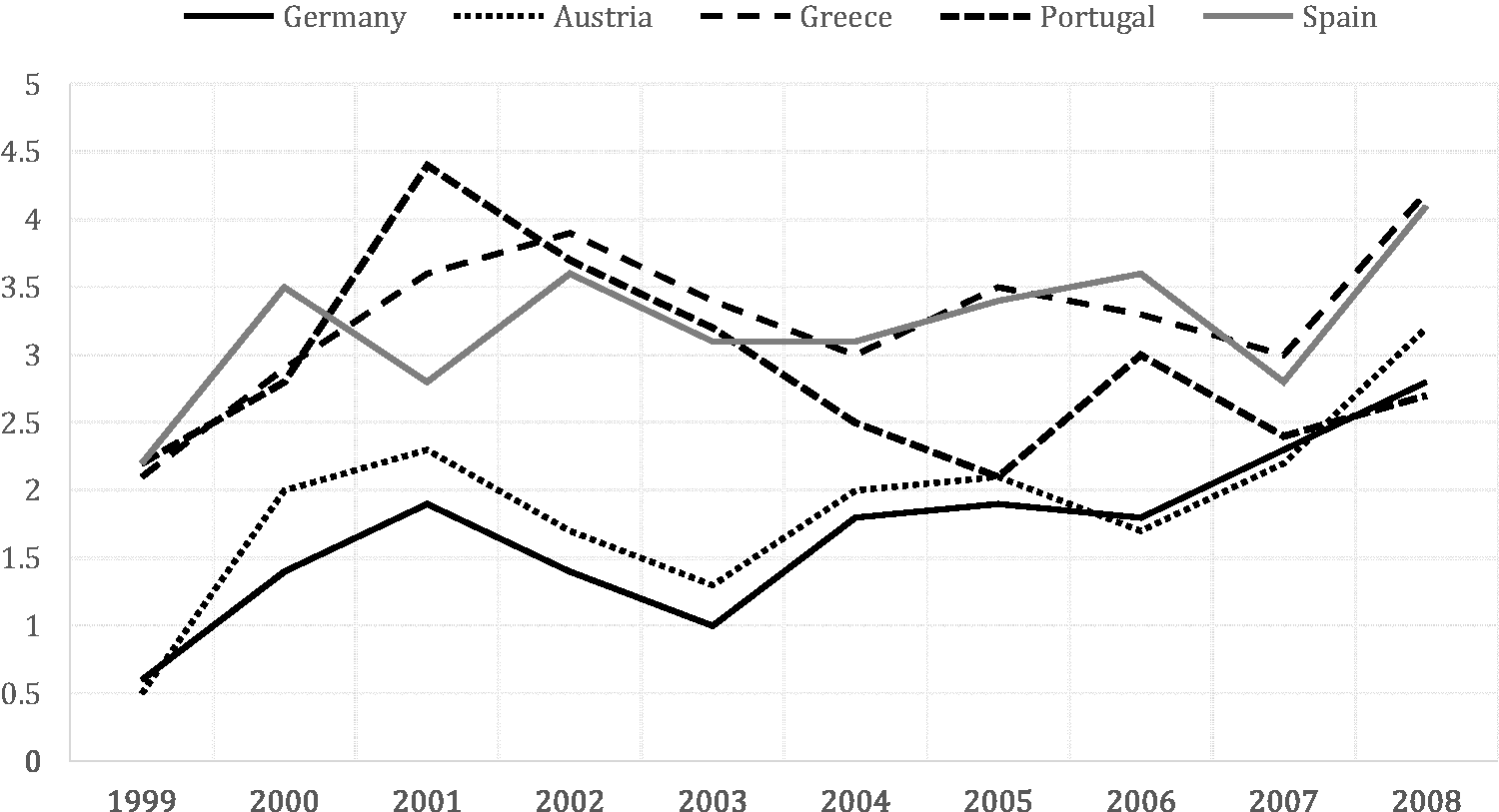
Inflation rates (HICP), own representation based on Eurostat.
Second, the design of the ECB’s statute—hardly modifiable even in the hypothetical case of a plurality of progressive European governments pursuing an alternative economic policy for the EU—prescribes a strict neoliberal orientation towards monetary policy with far-reaching consequences. Specifically, it requires the Governor Council of the ECB to maintain price stability at all costs, above all other economic goals such as employment or an alternative social and ecological investment strategy. Not only is the ECB not obligated to support an alternative economic policy in the Eurozone, the authoritarian-statist construction of ECB as an independent supranational central bank requires and empowers the ECB to thwart alternative economic policies once its restrictive 2% inflation target is violated, through the implementation of contractionary monetary policy (Arestis et al., 2001: 2; Heine and Herr, 2008). To be sure, any progressive economic policy would have to keep inflation as low as possible. Low inflation is not only in the interest of finance capital, which seeks to maintain the value of its assets and debt claims, but also for workers whose wages and social transfer payments generally lag behind inflation. Nonetheless, moderate inflation rates above the ECB’s 2% goal would be crucial for any progressive economic policy strategy as this would allow for a more flexible prioritization of different policy goals, especially transformative public investment strategies.
Third, ‘monetary financing prohibition’, which bars the ECB from directly purchasing sovereign bonds—in stark contrast to the US Federal Reserve, the Bank of England and the Bank of Japan—led to an inevitable escalation of the debt crisis, drastically constraining public finances and further galvanizing austerity measures since it was doubtful whether the ECB could effectively act as a lender of last resort vis-à-vis domestic public sectors. The impact of the prohibition on monetary financing is particularly apparent when comparing bond yields between the core and periphery (see Figure 2), illustrating how the ECB’s decision to effectively circumvent monetary financing prohibition through massive purchases of sovereign bonds on the secondary market (the OMT-program) markedly improved the refinancing conditions of peripheral Eurozone countries. Even as the announcement by Mario Draghi that the ECB would purchase enough government bonds to ‘save the Euro’ alleviated speculative pressures within the financial markets, the OMT-program simultaneously allowed the ECB to take over the function of disciplining fiscal policies in place of financial speculators. For member states that signed onto a Memorandum of Understanding with the ECB, assistance through the OMT-program is only guaranteed once all agreements with the ‘Troika’ or ‘Quadriga’ 11 have been met. And in the case of Italy and Spain, the ECB attached the OMT-program to specific austerity requirements that were detailed in classified letters (Dell’Aquila et al., 2015: 17–9; Henning, 2016).
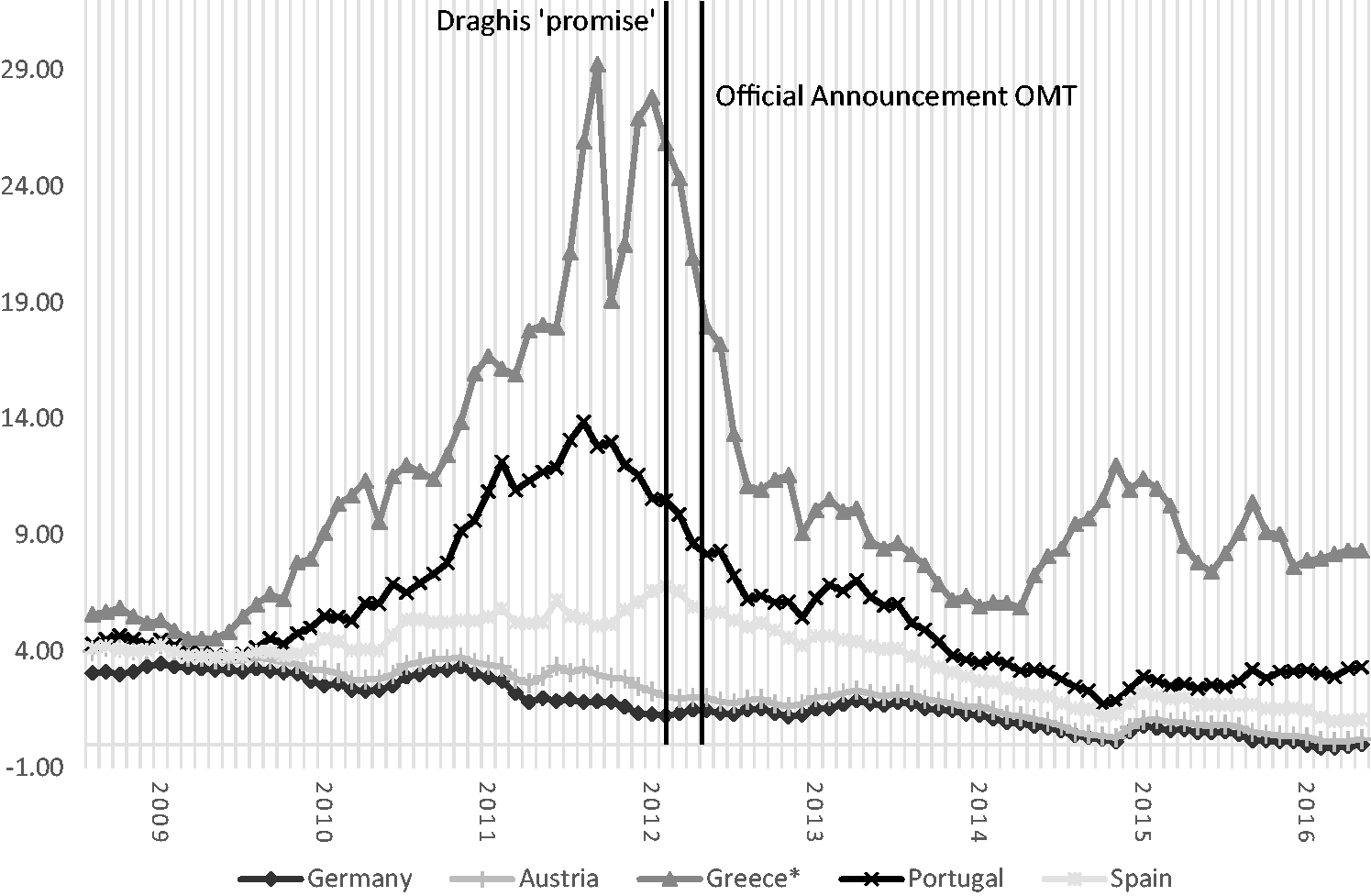
Ten-year government bond yields in percent, *estimate for July 2015. Source: Eurostat, own representation.
Finally, the fourth mechanism – perhaps the most important pillar in the architecture of transnational authoritarian statism facilitated by European monetary integration – allows the ECB to function as lender of last resort not only in relation to the public sector but also the private sector, in a highly selective and politicized manner. As the experience of the SYRIZA government in Greece aptly demonstrated, the ECB can simply decide to no longer accept certain government bonds as securities for its refinancing operations with private banks if they fall below a specific rating by the four major rating agencies. Since national banking sectors usually hold a high proportion of domestic government bonds, they become highly dependent on injections of liquidity which the ECB subsequently provides through its Emergency Liquidity Assistance (ELA) program. Since the ELA credit line is continually readjusted by the ECB-council on a weekly basis, the ECB enjoys unlimited power to ‘pull the liquidity plug’ for an entire economy in the Eurozone if it so chooses. A more subtle variation on this mechanism currently constrains the space for alternative economic policies in Portugal: since the Canadian DBRS is the only agency which maintains a rating of Portuguese bonds above ‘junk’ status (Wise, 2017), economic policies have to conform to its evaluation criteria which are biased against alternatives to austerity. Therefore, its role as lender of last resort empowers the ECB to act as what one might call a ‘preventer of last resort’ instead.
Conclusion
Although often deemed merely ‘technical’, the construction of the Euro as a supranational currency and the ECB as a transnational state apparatus that is almost entirely detached from democratic influence lies at the core of transnational authoritarian statism in the EU. The introduction of the Euro not only fundamentally shifted control over the determination of monetary policy to the level of the executive in the negotiations over the specific architecture of the EMU, it eventually insulated monetary policy in the Eurozone from the influence of those same executives after power was handed over to ‘independent’ central bankers. Meanwhile, the unconditional prioritization of price stability and the monetary financing prohibition that was entrenched in the near-unalterable, super-constitutionalist statute of the ECB significantly constrained alternatives to neoliberal austerity while at the same time allowing the ECB to act as a ‘preventer of last resort’ through the selective deployment of its function as a lender of last resort.
To be sure, the ECB as an institution is not the sole or even main driving force behind the enforcement of austerity. Rather, despite being inoculated from contestation from below, the ECB is itself a terrain of conflict, riven by contradictions between dominant forces, particularly what could be termed a ‘flexible-neoliberal’ faction (which introduced the OMT and the quantitative easing program) and an ‘orthodox-neoliberal’ faction which steadfastly defends monetary financing prohibition (Sablowski and Schneider, 2013). Moreover, the ECB – despite its formally independent position – has operated in close coordination with the dominant strategies articulated through the Eurogroup.
This, in our view, has fundamental implications for progressive politics and resistance: even if the Left manages to build alliances between trade unions, movements and parties, and is able to establish itself as the strongest political force – at least in electoral terms, as was the case with SYRIZA in Greece (Spourdalakis, 2014) – it remains highly vulnerable as key elements of economic governance have been relegated to the supranational level and are quarantined from popular contestation. It was the leveraging of the monetary power of the ECB which constituted and continues to constitute the most effective instrument to enforce these dominant strategies against progressive forces.
But as Poulantzas averred, the specter of the ‘clay-footed colossus’ remains ever-present under authoritarian statism: the authoritarian elements of European monetary integration have exposed the double tendency of ‘strengthening-weakening’ at the transnational level. Not only have the asymmetries between Europe’s center and periphery been intensified by the introduction of a supranational currency (Becker et al., 2015), but the creation of the ECB as the only real monetary power in the Eurozone—absent of fiscal integration and any progressive transfer mechanisms—disarms those very instruments that could effectively address the root causes of the imbalances in the Eurozone. As a result, the ECB possesses both the capacity and obligation to eradicate any national attempt to veer from austerity responses to the financial crisis, but cannot—as the ineffectiveness of its current quantitative easing program demonstrates—resolve the recurrent economic crises embedded deep within the monetary and political architecture of the Eurozone.
As a result, the European state project lacks effective capacities of hegemonic rule and is riven by contradictory strategies that subvert its overall coherence. While the Greek ‘OXI’ was an unexpectedly stark expression of opposition to what was perceived as an ‘external intervention’ by the Eurogroup and the ECB, attitudes towards the EU and the Euro continue to diverge between the ‘elites’ and the broader public (Raines et al., 2017) and extreme right-wing parties with an Euroskeptic agenda are on the rise. At the same time, the ECB is frantically employing ‘unconventional’ expansionary monetary policy strategies to curb deflationary tendencies, a strategy not only strictly opposed by German ordoliberalists but continuously undermined by the overall austerity agenda which depresses demand.
Instead of waiting for a progressive reform of the institutional architecture of the EMU, those progressive forces which manage to assume government power on the national level might attempt to leverage the contradictions of transnational authoritarian statism by engaging in ‘strategic disobedience’ (Mittendrein and Schneider, 2018), i.e. refusing to implement or comply with specific requirements such as fiscal rules entrenched on the European level, particularly in cases which allow for broad politicization, mobilization of popular support and counterhegemonic struggles. Depending on the economic and political position of individual countries within the Eurozone, this strategy would be, however, susceptible to the interventionary capacities of the ECB as we have outlined above. What this ultimately means is that any concerted attempt to overturn the EU’s transnational authoritarian statism through strategic disobedience would require broadbased political coordination between political parties on the left and the backing of progressive alliances and movements across the whole of Europe.
Footnotes
Acknowledgements
We wish to thank all the members of the Neoliberalism and Authoritarianism panels at the 2016 International Initiative for Promoting Political Economy (IIPPE) conference in Lisbon, Portugal, for their insights. We are also grateful to Adam Fabry for his helpful comments on an earlier draft of this paper. Additional thanks goes to the two anonymous peer reviewers for their invaluable comments and suggestions.
Declaration of Conflicting Interests
The author(s) declared no potential conflicts of interest with respect to the research, authorship, and/or publication of this article.
Funding
The author(s) received no financial support for the research, authorship, and/or publication of this article.