



Abstract
The ban of Huawei by the United States and European governments from their 5G infrastructure has been described in recent literature as economic statecraft. However, it remains under researched that in these ban decisions the domestic political and economic constellations differed. To address this gap, this study adopts an agency perspective and compares 5G Huawei policies in the United States, Germany and the United Kingdom. While in the United States the ban was unanimously supported by state actors and telecommunication companies and equipment manufacturers, in the United Kingdom and Germany telecommunication companies and (initially also) governments were opposing the ban. There, we also observe interests from governing parliamentarians across political parties representing cyber security interests prevail in the domestic policy making processes over political and economic actors representing economic interests. In line with recent works on the domestic politics of economic statecraft and adopting the method of structured, focused comparison our inductive, theory developing case study reveals that economic statecraft is a dyadic concept between ‘by default’ and ‘by design’. We show that economic statecraft occurs ‘by default’ in the manner that states’ and businesses’ interests align, it happens ‘by design’ in the manner that states’ and businesses’ interests diverge. We contribute to previous literature that theory building on economic statecraft should start before the notions of power and policy preferences by a closer inspection of the domestic interest constellations.
Introduction
‘Economic statecraft can be broadly understood as state manipulation of international economic activities for strategic purposes’ (Norris, 2016: 3). Hence, economic policy is a resource of states’ abilities to exercise power vis-á-vis other states. Concepts of economic statecraft have received increasing attention in recent studies of international and comparative political economy (Abels and Bieling, 2023; Blackwill and Harris, 2017; Davis et al., 2019; Drezner et al., 2021; Farrell and Newman, 2019a, 2019b, 2021a, 2021b; Gertz and Evers, 2020; Gjesvik, 2023; Hua and Zeng, 2022; Lee and Maher, 2022; Thurbon and Weiss, 2019).
While previous literature has focused on the use of policies such as sanctions (Norris, 2016: 14), Farrell and Newman, (2019a) have argued that states may exercise economic statecraft by ‘weaponized interdependence’ (WI). The WI-concept assumes that states can use network structures in geopolitical competition to pursue their geo-strategic objectives, such as security interests. The decision of the United States and other governments to ban 1 the Chinese SOE Huawei from providing equipment for their domestic 5G networks constitutes a prominent case of ‘economic statecraft’ and of decisions to contain cyber security threats from China (Calcara, 2023; Cartwright, 2020; Contreras, 2021: 5-6; Farrell and Newman, 2019b; Krolikowski and Hall, 2023: 174-175; Lee and Maher, 2022: 341–343; Segal, 2021; Sutherland, 2020: 15; Umbach, 2020: 22–31, 33, n. 66).
Given that – in contrast to the U.S. telecommunication companies (telcos) – in Germany and the UK, domestic telcos and their lobby associations were against a Huawei ban and, initially, their demands were sponsored by their governments, it is of conceptual interest for accounts of economic statecraft to investigate in what manner in 2020 and 2021, respectively, both governments decided to ban Huawei.
This article uses the historical record of the United States, Germany and the UK to argue that there are different types of economic statecraft which can be described by differences in domestic politics. In line with recent scholarly interest on the domestic politics of economic statecraft (e.g. Farrell and Newmann; 2021b: 315; Gjesvik, 2023; Norris, 2016; Thurbon and Weiss, 2019), we argue that different types of economic statecraft can be described by different manners of agency and interest constellations on the side of corporate actors and the state on the domestic level. Not only the degree of alignment of businesses’ economic interests with states’ security interests requires further scrutinization; rather also within states’ interest constellations must be analyzed. In contrast to the United States, where there was an alignment of businesses’ economic and the state’s security interests, in the UK and Germany the debates on the Huawei bans not only were driven by diverging businesses’ and state interests but also by conflicts of economic and cybersecurity interests in the executive and legislative. The bans were decided when parliamentarians across political parties representing cyber security interests prevailed in domestic politics over actors representing economic interests. Based on previous theoretical considerations on the role of state and business agency in economic statecraft (e.g. Gjesvik, 2023; Norris, 2016) and on these case histories, this study suggests a novel refinement of the economic statecraft concept: Economic statecraft occurs ‘by default’ in the manner that states’ and businesses’ interests align, it occurs ‘by design’ in the manner that states’ and businesses’ interests diverge.
Our study adopts the ‘method and logic of structured, focused comparison’ (George, 2019). Our data sources are two interviews, 2 parliamentary hearings, newspapers and secondary literature. The primary objective of our analysis is not causal analysis or theory testing but description to develop a finer grained conceptual framework of ‘economic statecraft’ by closer inspecting in what manner economic statecraft occurs. Through our case knowledge, we contribute to previous literature that theory building on economic statecraft should start before the notions of power and policy preferences by a closer inspection of the domestic interest constellations. In addition, we take description seriously since extant concepts of economic statecraft risk to assume permanent state control if they neglect that there are different manners of economic statecraft which can be best described by the alignment or divergence of interests which occur in the manner of different types of agency. The next section discusses newer agency concepts of economic statecraft and deepens them with our case histories. While section three summarizes our research design, in section four we present the results of our ‘structured, focused comparison’ of the Huawei bans. Section five provides two lessons for policy makers and section six concludes.
Theory: Economic statecraft by design and by default
In an inductive, explorative and theory building case study as ours is, concept formation results from an ‘interaction’ between the ‘investigators’ theoretical framework’ and the case (George, 2019: 208, n. 31). Concepts are result of an iterative process since ‘[i]mportant theoretical distinctions often emerge from … [the] dialogue of ideas and evidence’ (Ragin, 1997: 30). Ragin claims ‘using knowledge of the empirical world … [helps] to build better concepts and thus, ultimately, stronger theories’ (Ragin, 1997: 30).
So, what do we already know about the economic statecraft concept?
Although a comprehensive state of the art report is far beyond the scope of this article, it seems to be uncontested, that with the increase of economic interdependency between states and the internationalization of economic activities of commercial actors, economic statecraft has become a major issue in the literature of international and comparative political economy. Following Norris’ general definition, economic statecraft is ‘state manipulation of international economic activities for strategic purposes’ (Norris, 2016: 3). Statecraft refers to states’ interactions with other states, thus to foreign and geopolitical policy objectives which pursue states’ ‘interests in the international system’ (Norris, 2016: 15); the use of economic instruments such as sanctions, trade agreements, tariffs or economic networks (digital infrastructures such as the 5G network) as sources of state power vis-á-vis other states makes statecraft economic but Norris also highlights that the term economic should not only refer to the ‘means’ (Norris, 2016: 11). He also brings corporate actors into the game (Norris, 2016: 16).
Although concepts of economic statecraft are multifaceted, two major issues of the recent debate are of particular interest for our analysis on the Huawei bans.
First, the WI-concept brought the use of economic networks aside to traditional state policy tools such as sanctions into the debate. The WI-concept argues that ‘global economic networks have security consequences, because they increase interdependence between states’ (Farrell and Newman, 2021a: 20). In addition, WI assumes that because networks inherently produce asymmetric structures (Farrell and Newman, 2021a: 21) states can ‘weaponize’ networks and use network structures such as the internet or the 5G network as an instrument of economic statecraft as well.
Second, there is increasing interest not only to analyze how economic statecraft affect international relations (e.g. Drezner, 1999; Hua and Zeng, 2022; Lee and Maher, 2022) but also to investigate the interrelationship between economic statecraft and domestic political economy influences (Abels and Bieling, 2023; Farrell and Newman, 2019a, 2019b, 2021a, 2021b; Gjesvik, 2023; Norris, 2016; Thurbon and Weiss, 2019). Criticizing structural explanations (Abels and Bieling, 2023: 518f 3 ; Gjesvik, 2023: 725), scholars suggest to broaden concepts of economic statecraft by bringing in agency or ‘micro foundations of economic statecraft’ (Norris, 2016: 14), not only on the side of the state (Calcara, 2023: 441–446 4 ; Norris, 2016: 28) but also with regard to businesses (Gjesvik, 2023: 726; Norris, 2016: 21).
At this stage, we also can bring in previous other scholars interested in the state–business relationship (Abels and Bieling 2023; Babic et al. 2017, 2022; Davis et al., 2019; Gertz and Evers 2020) who have pointed out the importance of moving beyond ‘state centrism’ (Babic et al., 2022: 3) or stress that ‘[w]hen there is a close relationship with businesses, it is easier for states to pursue geopolitical goals’ (Gertz and Evers, 2020: 119). 5
Drezner (1999: 27) assumes in his model of economic coercion that ‘governments act as rational unity actors’, while Norris (2016: 223) declares ‘state unity’ to an empirical question since ‘state unity is the most critical [factor] for state control because without it, the state cannot control actors’. While also Farrell and Newman (2021b: 315) acknowledge that their ‘original theory did not provide real independent agency to businesses, treating them as passive transmitters of state policy’, Gjesvik, 2023: 740) argues that concepts of economic statecraft such as WI should recognize the ‘independent agency private corporations hold’ and that the ‘relationship between states and the private corporations holding the resources states seek to exploit is more dynamic and contested than assumed’ (Gjesvik, 2023: abstract). Also, Norris (2016: 21) highlights that ‘the agency of commercial actors vis-à-vis the state’ should not be ignored. While Gjesvik (2023) points to the dynamics of the relationship between state and corporate power, Norris (2016) demands to scrutinize what state and businesses want, thus their preferences and policy objectives. For analyzing economic statecraft in China (Norris, 2016: 231) 6 , Norris (2016: 21) has developed the concept of ‘state control’ 7 which assumes ‘that the state and the economic actor each have a set of preferences. Sometimes these align and sometimes they diverge’ (Norris, 2016: 21).
Our study adopts this agency perspective and develops it further. While we do not question the significance of ‘state control’, corporate power sources as well as the power relationship between states and corporations, in the following, we focus on the analysis of businesses and states’ interests. We focus on interests for two reasons: First, if commercial actors and state actors have the same material interests, the impacts of power or control become a second order issue (Gjesvik, 2023: 728). Second, interests also determine policy preferences (Woll, 2008: 23). Following Vormedal and Meckling (2023: 3), we argue that ‘[i]nterests are exogenous to the strategic political environment in which actors make constrained decisions about how to best advance interests’, while ‘[p]olicy preferences concern how business actors rank policy alternatives by degree of alignment with underlying interests’. Consequently, when economic actors’ interests diverge from state interests, it is to be expected that business and state policy preferences differ as well and so firms will try to reach an outcome in their favour. In situations of interest divergence, economic actors can either respond with compliance or resistance. What Norris (2016: 21) called ‘state control’ is crucial for a state to achieve its goal in situations where business oppose. But our theory building on economic statecraft starts before that notions of preferences and power. We are interested in the relationships in play between business and state beforehand a state pursues the projection of power through economic means, therefore understanding in what manner a state uses the manipulation of economic activities to project power. If the theory neglects the alignment or divergence of interests, it risks to undervalue differences in the manner statecraft occurs by assuming permanent state control and unity of actors.
So, how can we bring all these previous theoretical considerations on economic statecraft and state–business relationships together with our case histories to further develop the concept of economic statecraft?
As already indicated, previous studies have shown that the Huawei bans in the United States, UK and Germany were an outcome of economic statecraft. Farrell and Newman (2019b: 3) have argued that the U.S. government was using WI and denied Huawei access to its network. Segal (2021: 150) argues in an equivalent way. When Huawei equipment was limited in the domestic 5G networks in Germany and the UK, in the media as well as in recent studies these decisions were also interpreted as instances of statecraft due to interstate competition and geopolitical struggles (Calcara, 2023: 453f; Contreras, 2021: 5–6; Krolikowski and Hall, 2023: 183; Sutherland, 2020: 15; Umbach, 2020: 22–31, 33, n.66). In all three countries, economic means were used to increase security and reduce dependence on Chinese equipment.
This article argues that the Huawei-5G bans in the United States, UK and Germany are useful cases to shed further light on how different types of economic statecraft can be described by differences in domestic politics since in Germany and the UK businesses as well as states have been very fragmented on the Huawei ban. When in May 2019 the Trump administration finally 8 banned Huawei from its ICT and 5G equipment, in the UK and Germany telcos not only strongly lobbied against bans but were also sponsored by their government heads and their economic ministers, who, however, were confronted with opposing legislative and executive forces representing security interests. Still in 2019 both governments did not exclude Huawei. However, in 2020 and 2021, both governments decided for a ban when in domestic politics parliamentarians representing cyber security interests prevailed over economic and political actors representing the economic interests of their domestic telecommunication industry.
The cross-case comparison with the U.S. ban history reveals that alignment of businesses economic interests with state security interests is an empirical question and the usage of economic statecraft should be conceived of as a dyadic concept which encompasses an interplay between different actors. The ban in the United States has demonstrated a high level of alignment between economic business interests and political authorities’ security interests, on the one hand, and state unity between economic and security interests, on the other. 9 When there is a high level of alignment between economic and security interests, domestic state authority of representatives of cyber security interests (or state control) seems far less important for exercising economic statecraft. In this study, we will call this kind of economic statecraft ‘by default’. As Gjesvik, (2023: 728) bluntly notes, ‘[i]f the interest of a company and the interests of a state are aligned, who hold the authority is far less important as they by and large want the same thing’. Contrarily to the United States, in the UK and Germany the level of alignment of business and state interests has been lower. In cases, where conflicts of interests drive the domestic policy making, advocates of economic statecraft are required to win domestic political battles. In this study, we will call this kind of economic statecraft ‘by design’. Norris (2016: 22) argues that ‘[s]tate control is most easily observed under conditions when the preferences of the state are diametrically opposed to those of the economic actors’. However, treating states as unitary actors with one common preference – hence, unitary interests – seems incomplete. To understand these dynamics, we propose to inspect interest constellations more closely. Considering recent works on the significance of agency for economic statecraft and our case histories, our proposition is that economic statecraft is a dyadic concept between ‘by default’ and ‘by design’ and mediated by interest (dis)alignment.
In situations of state interest alignment with economic interests, the usage of economic statecraft is domestically uncontested, and the ability to use state control seems obsolete. Whereas in situations where these interests are contested, we should expect a power struggle between business and state actors which is explained through state control if states’ interests prevail and through forms of business power when economic interests succeed. When interests align, economic statecraft ‘by default’ prevails, whereas when interests are contested, states use economic statecraft ‘by design’ and state control significantly influences the configuration and success of statecraft by economic means.
In sum, our concept of economic statecraft by design or by default adds to previous literature that concept building on economic statecraft should start before the notions of power and policy preferences: In the manner of state’ and business’ interests aligning, economic statecraft occurs ‘by default’ and states are only in the back seat of statecraft (Figure 1). Manners of economic statecraft: ‘by design’ and ‘by default’.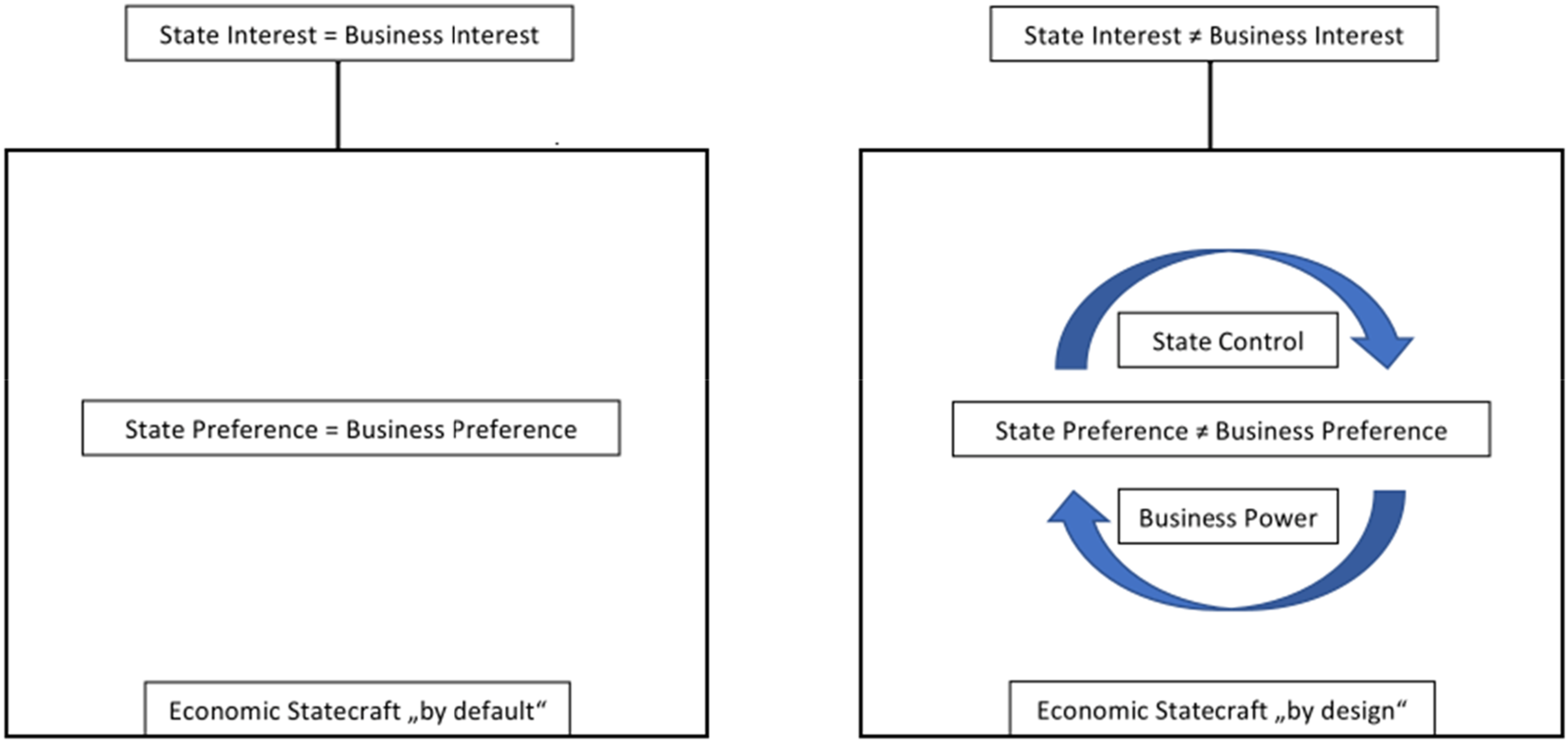
Research design
The difference between the United States on one side and the German and UK cases on the other in which we are interested to explore is neither when nor why economic statecraft was exercised by their governments, but in what manner economic statecraft occurred. While we acknowledge the value of causal analysis and explanation, following Kreuzer (2023: 65; italics i.o.), we argue that answering the ‘why question requires exploring first the how question’. Our main objective is a proper description in order ‘to get the dependent variable right’ (Caramani 2010: 43). Or as Kreuzer (2023: 65) bluntly asserts: ‘Without detailed description of how something happened, it is difficult to explain why it happened. No description, no answers’.
To develop an appropriate concept for describing how different types of economic statecraft can be described by differences in domestic politics, we have adopted a comparative research design. In detail, we use the ‘method of structured, focused comparison’ which George (2019: 212) recommends as a ‘strategy of controlled comparison for the development of theory’. In our comparison we focus on ‘only certain aspects of the historical case[s]’ (George, 2019: 213), namely, on differences and similarities in the domestic policymaking processes of the Huawei bans. Our comparison is structured as it ‘employs general questions to guide the data collection and analysis’ (George, 2019: 213). Asking for interest (dis)alignment, it shows that in the United States the alignment between economic business interests and political authorities’ security interests and state (policy) unity between economic and security interests both were high, while in the UK and Germany the level of alignment in both dimensions was low. In the within case analyses, we trace the sequences of events in order to explore the decision-making processes which is an inductive and descriptive form of temporal process tracing (Trampusch and Palier, 2016: 437).
Therefore, we gathered in a first step information from official documents, hearings, parliamentary debates and committee work, newspaper articles and secondary literature. As the subject is still sensitive, information gathered from written evidence is the core of our empirical material. Moreover, we conducted two expert interviews to triangulate our data source. By comparing our cases, we are able to single out common and diverging patterns on the politics of economic statecraft in our three countries.
Analytically, we structure our narratives of the policy-making processes into two broad sections: telcos’ economic interests with regard to Huawei equipment and domestic telecommunication manufacturing equipment, on the one hand, and political actors’ economic and security interests, on the other. For the United States, we illustrate the high level of alignment between states’ cybersecurity interests and companies’ economic interests by turning to Cisco and the American aim to reinstate manufacturing capacity in the mobile infrastructure sector.
The Huawei ban in the United States
U.S. telecommunications market
The telecommunications market in the United States is heavily concentrated. In the past, this has been made possible by huge M&A activity with T-Mobile recently acquiring rival Sprint. In the process of approval, both companies tried to dispel the U.S. government’s doubts by pledging not to use Huawei equipment (Wee, 2018). Instead, T-Mobile uses Ericson for its NSA towers (Ericsson, 2018) and partnering with Cisco, Ericsson, MediaTek, Nokia and Qualcomm (T-Mobile, 2020), while AT&T and Verizon also choosing Ericson, Nokia and Samsung. All three companies welcomed the ban of Huawei equipment. While T-Mobile agreed for the mentioned reasons, Verizon and AT&T publicly supported a ban due to the issues of competitiveness and national security (Shepardson, 2019; Silliman, 2019). In general, big telecommunication carriers and equipment manufacturers are embedded into the U.S. security state (Van Alst, 2021: 28–31). All three carriers do massively benefit from government contracts 10 (USASPENDING, 2023a; 2023b; 2023c), which were at stake when Congress enacted tougher requirements. Naturally, such high contracts bind the telecommunication companies closer to national security actors which pay greatly for their services. Additionally, a Huawei ban had been in the telco giants’ interest as it decreases competition because smaller regional carriers often relied on more affordable Huawei equipment to maintain their operations (Kendall, 2019). As such, a ban threatened their competitiveness.
Interest alignment
With the Trump administration escalating the U.S. relationship with China in July 2018 by imposing tariffs on Chinese goods, open confrontation escalated into a so-called trade war (Swanson, 2018). But even before, Huawei had been restricted in the United States when in 2013 the Department of Commerce, the Department of Justice, the National Aeronautics and Space Administration and the National Science Foundation had restricted to use its equipment (Congressional Research Service, 2021: 5). In 2018 and 2019, these purchasing restrictions had been expanded by Congress in a bipartisan effort (Congressional Research Service, 2021: 5; Fandos, 2018). In 2019, President Trump enacted by executive order to ban the usage of Huawei technology and the Commerce Department set Huawei on its entity list (Department of Commerce, 2019). This measure did not only target Huawei’s equipment business but also its fast-growing mobile phone business as access to semiconductors and other components had been shut down. 11 During that time, the federal administration realized that no domestic manufacturer would be able to initially supply 5G technology.
Cybersecurity concerns played an increasing role as the specifics of the 5G technology, and its potential applications had been named great sources of danger by senior state department staff (Inzaurralde, 2019). Federal intelligence agencies early on advised for a cautious approach, pointing to Huawei’s ties with the Chinese Communist Party and the Peoples Liberation Army (Salinas, 2018). European partners had been pressured by intelligence services and the state department with its new head Mike Pompeo (being the former CIA director) to ban Huawei equipment from their critical infrastructure. Otherwise, cooperation on information sharing would be ended (Cerulus, 2019). Across the legislative and executive branch as well as the remaining business competitors, Huawei had been seen as a threat to U.S. strategic independence and national security.
U.S. government interest had also been shaped by its desire to maintain its own cyber security capacities and power sources. As the Snowden leaks revealed, U.S. telecom manufacturers and providers heavily cooperate with security agencies such as the NSA in matters of national security (IISS, 2015: 143). Huawei’s dominance on the international telecoms market challenged this symbiosis as national manufacturers were not able to sustain a sufficient market share globally and went out of business (Lowenstein, 2005; NTIA, 2021; Van Alst, 2021: 51; Virki, 2010).
The United States thus followed two goals with its policies: to exclude Huawei from their networks and to harm its global dominant position in the 5G equipment and mobile phone market. Both goals are interconnected by the issue of cybersecurity as at that time no U.S. company had sufficient innovative capacity to provide 5G solutions and the United States threatened to lose ground in the technology race with China. As Huawei’s dominance on international markets had been achieved by allegedly intellectual property theft and massive Chinese state subsidies, targeting commercial activities outside the United States seemed appropriate to protect domestic companies which should increase their competitiveness (Congressional Research Service, 2022).
On the other side, the issue of cybersecurity allowed the United States to perform such steep measures and put pressure on allies to follow suit. It is not surprising that U.S. carriers started early with 5G Standalone (SA) test installations as U.S. technological solutions are mostly SA equipment in development. Thus, the federal government measures slowed the process of 5G installation worldwide and bought time for domestic companies to catch up. As such, U.S. politics did not only follow cyber security interests, but also the economic interests of domestic manufacturing companies. Telcos had been aligned because they were not using Huawei equipment in their 4G networks and had not been dependent on the company to upgrade to 5G.
Bipartisan agreement in Congress
Congress had been very supportive on the Huawei ban and even pushed the Trump administration to take a potential national security threat seriously by modifying the National Defense Authorization Act 2018 and 2019 and voting it through the Senate with an 85 to 10 bipartisan majority (Fandos, 2018). The House Intelligence Committee, the Foreign Relations Committee and the Committee of Foreign Investment investigated the matter (Congressional Research Service, 2022). Both parties saw the matter as an issue of national security and supported counter measures. Thus, the legislative and the executive branch followed similar interests and perceptions. Congress even pushed the administration to a tougher stance.
Competition between Cisco and Huawei
Cisco remains the largest U.S. manufacturer of supplies to the ICT sector in terms of connectivity. Therefore, Huawei is in many areas a main competitor on the domestic as well as the international markets. The company tried several times to publicly lobby against the usage of Huawei equipment in U.S. infrastructure, but desired to keep quiet about its success (Bort, 2019). The two companies are at odds since Cisco initiated in 2003 a lawsuit regarding intellectual property usage and trying to diminish Huawei’s influence on the equipment markets (Kane, 2003). Since the remaining manufacturers Lucent and Motorola were forced out of business and merged with competitors outside the United States, Cisco remains the only big U.S.-based company to supply networking equipment but has not yet strong capabilities in the mobile infrastructure equipment market comparably to the three dominant companies Huawei, Nokia and Ericsson.
Clearly, U.S. usage of economic statecraft occurred ‘by default’ illustrating that interest alignment between telcos, government and legislature enabled the state to target and exclude Huawei without meaningful opposition. Telcos agreed because they did not use Huawei equipment in their networks which gave them a competitive advantage over regional carriers which used mostly Huawei infrastructure. Politicians were very keen on banning Huawei and spoke with one voice. As legislative and executive interests aligned to exclude Huawei from U.S. infrastructure, there was no mediation or power struggle between political entities. A great majority within the political system saw the use of economic statecraft as a necessary tool to strengthen national cybersecurity, re-establish intelligence capacities, strengthen the competitiveness of domestic mobile equipment supply and containing the dominance of Chinese companies in these markets ultimately fending off resources of Chinese power.
The Huawei ban in Germany
German telecommunications market
The German telecommunications market is divided between three main carriers, Deutsche Telekom, Vodafone and Telefonica. Contrary to the big carriers in the United States, they have installed around fifty percent of Huawei equipment for their single access RAN networks and hence depend on the Chinese manufacturer to upgrade existing infrastructure. In case of removal of Huawei equipment, costs have been estimated by the carriers to € 3 billion each, whereas Deutsche Telekom and Vodafone being most vulnerable as a ban could additionally prolong the introduction of 5G up to 5 years (Berke and Wettach, 2019; Kerkmann, 2020; Koch and Scheuer, 2020). Unsurprisingly, German telcos interests were to avoid a ban. They argued heavily against it and had been initially successful in keeping Huawei open to their 5G network infrastructure. Especially Deutsche Te-le-kom lobbied heavily for Huawei access (Interview B, 2022).
Interest divergence in government
Within German government contradictory propositions to manage the Huawei case envisioned. While the German Chancellor Angela Merkel and the Minister for the Economy initially sponsored the telcos’ demands and strongly opposed an exclusion of Huawei (Becker, 2019; Reuters, 2019a), the Federal Foreign Office and intelligence agencies raised concerns to give Huawei access to the telecommunication networks (DPA 2019; Neuerer, 2020; Reimers, 2019; Reuters, 2019b). The government bodies involved most in security policy, the Federal Ministry of Defense (BMVg) and the Federal Ministry of the Interior (BMI), voiced a more nuanced position between economic and security policy (Heberlein, 2019). Interests among the government were thus divided and contested.
Interest divergence in parliament
Lawmakers of the coalition were initially divided alongside cybersecurity and economic fault lines. On the one hand, the interest to control access to critical telecommunication infrastructure due to suspicion of Chinese influence was voiced from the security camp; parliamentarians favouring a liberal solution were driven by concerns of economic consequences for German companies on the one hand in their export destinations China and the United States and on the other due to slow installation of domestic 5G infrastructure (Interview A, 2022). The liberal camp wanted to solve the issue quietly (ibid.).
However, parliamentarians concerned with security interests successfully increased the salience. The parliamentary foreign committee started an investigation into potential security threats by Chinese equipment manufacturers. In two rounds on 19 March and 11 November 2019, different opinions from experts, businesses and the administration, including the Federal Ministry of Defense and the Federal Office for Information Security (BSI), had been collected and discussed. Overall, the coalition members within the committee, conservative backbenchers and social democrats, supported the conclusion the committee established: Access to mobile telecommunication infrastructure should not only be a technical but also a political issue. As such, Huawei’s close connection to the Chinese military and the Communist Party was scrutinized (Auswärtiger Ausschuss, 2019a; 2019b).
Designing a solution
To resolve the issue and decrease parliamentary pressure, the BMI and BMWi instructed their aligned agencies, the BSI and the Federal Network Agency to develop a catalogue of requirements for vendors of telecommunication infrastructure (Bünder, 2020; Bundesnetzagentur, 2020; Hoppe et al., 2020).
The new rules applied to all carriers and required them to certify their equipment, issue a declaration of trust and carriers had to diversify their sources of equipment (Bünder, 2020; Bundesnetzagentur, 2020). This addressed interests voiced by both camps as the implementation of tougher general requirements was seen as not directly targeting Huawei while it addressed the security concerns. This consensus process led to the implementation of the IT security 2.0 law which institutionalized state control. Security interests were successful in implementing a political component as the law grants the BMI in cooperation with the Federal Foreign Office the power to exclude vendors which are controlled by foreign governments (BSIG §9a, 2021a; BSIG §9b, 2021b). As a result, the Chinese company has been banned in core parts of the network effectively, but still supplies the equipment to the existing lower tier infrastructure. As of April 2023, BMI increased its suspicion on Huawei technology and requested carriers to name remaining critical components (Bünder, 2023).
Cybersecurity capacities
There is currently no large German manufacturer of ICT infrastructure equipment since the sale of German Siemens AG’s remaining stake of the joint venture NSN to Nokia in 2013 (Sheahan 2013). Additionally, the support of European companies Nokia and Ericsson was of no direct interest. German security politics was only concerned on vulnerabilities for their own infrastructure as there were no capacities to exploit domestically manufactured infrastructure abroad.
Even though German telcos initially succeeded in securing political support against a Huawei ban, mounting pressure within the government and from the parliament (through increased salience) led to a change in legislation regarding the requirements for telecommunication infrastructure manufacturers. Interest fragmentation within the state resulted in tougher requirements for telecommunication infrastructure manufacturers effectively limiting Huawei’s market access and excluding the company from the core 5G network. The German usage of economic statecraft occurred ‘by design’ following its interest to retain access to two crucial markets while ensuring domestic cybersecurity and fending off influence by the United States which would have harmed German exporting business (Interview B, 2022). By implementing new legislation as a tool of state control, political actors reached a consensus and telecommunication carriers had to comply to the state’s interest as the increased salience reduced business power resources (Culpepper, 2011: 190).
The Huawei ban in the UK
Brexit as special circumstance
The years before the Brexit 2021, British politics had been dedicated to preparing trade relations with the EU and the rest of the world. But the UK had not been very successfull in striking such deals. Even with the United States – a close cooperation partner in terms of security (five eyes) – no trade deal had been struck (Sutherland, 2020: 13). Thus, pressure from the United States to ban Huawei from telecommunication networks mounted from two sides: security cooperation and a potential trade agreement. The circumstances of Brexit created also chaos in the parliament, which led to the internal division of the Conservative party (Lyons and Proctor, 2019).
UK telecommunications market
The telecommunications market in the UK is divided between BT with its brand EE, Vodafone, 3 UK and Telefonica with O2. Only the latter has not used Huawei equipment in its 4G networks, leading all three remaining carriers to be reluctant to partially use Huawei equipment in their 5G network developments (Fildes, 2020). Replacing Huawei entirely from the telecommunications networks has been estimated to take up to 10 years and cost several billion pounds and to delay the implementation of 5G in networks (Fildes, 2020). The telcos had been initially successful in pressing for their interest of using Huawei 5G equipment (Calcara, 2023: 449), even though security agencies already audited Huawei equipment for lower tier networks. Since 2010, it has operated the Huawei Cyber Security Evaluation Centre (HCSEC), which provides technical expertise to government bodies regarding Huawei products. Since 2014, the British intelligence service GCHQ – later succeeded by the National Cyber Security Centre (NCSC) – has been responsible for working closely with the HCSEC and reviewing Huawei products (HCSEC, 2021: 4).
Interests in government
At first, the executive branch sponsored the efforts by Huawei and the network carriers with the Prime Minister Theresa May wanting to partially allow Huawei to equip 5G networks, despite opposition from within her government (Swinford and Elliot, 2020; Swinford and Hymas, 2019). Philip Hammond (Chancellor of the Exchequer) also supported a more balanced decision whilst trying to secure good trade relations with China (Holden and Stubbs, 2019). In the executive branch, five ministers – including Sajid Javid then Home Secretary – blocked a decision on Huawei’s access in 2019, leaving the Huawei question unanswered (Swinford and Elliot, 2020; Swinford and Hymas, 2019).
When the Johnson government took office, the Prime Minister and his Foreign Secretary Dominic Raab at first heavily defended the government decision to partially allow the use of Huawei equipment and finally decided to allow its usage as a high-risk vendor in February 2020, which allowed the company to be part of the telecommunications infrastructure with a limited market size of maximum 35% per provider (Dowden, 2020; NCSC, 2020a). This decision toughened the already existing restrictions and tested relations with the United States (Kharpal, 2020). Contrary to its decision in January 2020, the UK government announced to ban Huawei in July 2020 from its entire network infrastructure (Dowden, 2020). The decision had been justified with changed assessment by the NCSC. Since the United States did put Huawei on its entity list, the Chinese company had been expected to be cut of its semiconductors supply and of other critical components for its products. Therefore, the NCSC concluded that Huawei’s new hardware would pose an additional security threat as it had been expected that the company had to switch to Chinese-made components (NCSC, 2020b).
Interests in parliament
The Conservative party in the British parliament was heavily divided by Brexit, thus contrary to having a comfortable majority, the executive relied heavily on finding solutions to unify the two blocks. Opposition in the Huawei case had been steered before from Conservative backbenchers – which supported Brexit. They formed a Huawei interest group demanding the complete removal of the company from the entire network (Calcara, 2023: 448; Proctor, 2020; Sabbagh, 2020; Steward and Sabbagh, 2020). The Labour Party and the SNP supported the Tory backbenchers in the House of Parliament, increasing the pressure on the government (Eardley, 2020). Their most prominent argument was a potential loss of access to information from the five eyes as other members had pledged to exclude Huawei from their 5G networks hindering sharing of information (Holden and Stubbs, 2019). Additionally, some MPs interpreted China’s behaviour in Hong Kong as increasingly hostile (Landale, 2020). Security policy played a significantly greater role than market access to China in the discussions (Helm, 2020).
With the Johnson government, the executive seemed to be pushed by the parliamentary revolt led by senior figures Ian Duncan Smith and Tom Tugendhat against its decision (Cerulus and Casalicchio, 2020; Steward and Sabbagh, 2020). This altered the UK’s perception of Huawei and induced the removal of all existing equipment.
The use of economic statecraft occurred ‘by design’ as the executive and parliament effectively used state control to reign in telecommunication providers and achieve the UK’s domestic cybersecurity interests, which was fulfilled with the enactment of the Product Security and Telecommunications Infrastructure Act 2022 (UK Parliament 2022). The telecommunication providers were not integrated into the state-security nexus; however, Huawei had been under observation from security actors for quite a while, even though the UK also had no domestic manufacturer. The UK decision saw an interplay between parliamentary and governmental interests which led to a power struggle between the two political actors, even though this is quite unusual for the political system of the UK. The special circumstance of an internally divided Conservative party in power gave parliament more than usual influence on the matter. 12 Our finding contrasts Calcara’s (2023: 448) claim that the UK was a case of executive dominance whereas we have shown that parliament played a significant greater and more important role than attributed, which leads to the importance to look beyond institutions and at actors and their interests. As political actors reached a consensus on banning Huawei, the UK used new legislation as a tool of state control to reign in telecommunication carriers to comply with the ban.
By default and by design: Lessons from the cases
Our cases hold two lessons from observing and comparing the interests of business actors, governments and legislatives across our analysis.
First, political processes around economic statecraft can occur ‘by default’ as the U.S. case clearly illustrates. Interest alignment across our three actor categories (government, legislative and business) fastened the implementation of economic statecraft as business did not contest the usage of economic statecraft. When lawmakers or executive actors consider using economic statecraft to achieve security interests, they could integrate affected businesses into their security framework. When interests between all three actors align, politics may act quicker to achieve their interests while businesses won’t contest regulation if they benefit from the security nexus integration. The state’s benefit is thus coherence of interests and as such the possibility of faster action. Telecommunication companies in the United States for example may voice different interests when their existing infrastructure is at stake as in the two other cases or manufacturers may think differently when measures do not protect their business but threaten to shut down their export destinations. This might be dependable on the degree of integration into the security nexus and should be further tested in subsequent studies.
Second, the concept of economic statecraft occurring ‘by design’ describes the circumstances of power struggles, contestation and slow decision making in these situations. The German and UK case highlight that security interests can contest business friendly legislation by increasing the salience and thus forcing economic interests to make concessions. Additionally, not integrating affected businesses into the state-security nexus increases the chances of business opposition as there is no a priori compensation for businesses. Thus, businesses will try to look for coalitions within the political system which support their interests, stirring division between political actors. The struggle to apply economic statecraft is decided between business power and state control when economic statecraft occurs in the manner ‘by design’. Besides this aspect, the UK and German cases share similar contestation between the legislative and the executive even though they are very different in their political systems.
Conclusion
Our cases illustrate the importance of understanding interests across state and business by uncovering the manners of economic statecraft in the context of Huawei bans. It has been shown that states are not unitary actors free from internal inference due to interest heterogeneity when they chose to exercise economic statecraft. To understand the relationship between different constellations of interest alignment and conflict between political actors and business, we made the case to perceive economic statecraft as the result of a dyadic policy process occurring ‘by design’ or ‘by default’. Based inductive, explorative and theory building case study, we argue that concepts of economic statecraft should move beyond the inspection of power and policy preferences by bringing in the analysis of domestic interest constellations.
For further research on economic statecraft our study produces the following implications: First, the processes which led to limit Huawei’s access to the 5G networks in Germany and the UK have led to slight differences in the outcome of economic statecraft since in Germany Huawei stills supplies the equipment to the lower tier infrastructure. Consequently, an interesting avenue for further research is to investigate variations in the outcome of economic statecraft by design. Variation may also apply to cases of economic statecraft occurring by default.
We also expect our differentiation between ‘by design’ and ‘by default’ to be helpful when looking beyond our cases to the wide range of different policy decisions on the ban or permission of Huawei equipment in other countries. The Huawei ban in Taiwan seems to be of further interest to look at a potential ‘by default’ case besides the United States.
Second, our terminology could be helpful when analyzing the comparison of economic statecraft cases beyond the Huawei bans. Interesting cases for a further application of our concept could be the new U.S. sanctions against China which have been viewed with great concern by business across the globe. The case of Dutch export controls for advanced semiconductor manufacturing equipment seems to be a promising case of economic statecraft occurring ‘by design’ as well as the U.S. case itself, even though the outcomes differ in degree and extent. Also, the sanctions imposed against Russia – especially in the energy sector – have caused great discontent among European governments and business even though the security implications have a far greater impact on economic and political stability than in the Huawei case. The German effort to cut off Russia from its economic resources deriving from the sale of oil and gas was heavily contested by industry and energy suppliers which seems a promising starting point for further investigation into this process of economic statecraft ‘by design’. The cases of France, the UK and Norway are likely economic statecraft ‘by default’ as domestic energy businesses started to exit the Russian market very soon and national governments implemented measures to cut ties with Russia before EU-wide action had been implemented
Third, research should further scrutinize the relationship between states and business as not only states can provide to companies’ advantages by weaponizing interdependencies (Gjesvik, 2023: 740) but thinking from the opposite, business with huge potential for weaponization might possess a special sort of ‘structural’ business power. Interesting subjects could be companies relevant for global value chains such as in the semiconductors industry or digital businesses with huge networks and therefore potential to use them. With regard to digital technologies and infrastructures the line between economic statecraft and business power might be blurring: Both, states and businesses may use them as a structural source of power.
Fourth, and finally, our concept is parsimonious since it neglects other economic, political and ideational factors which may play a role in the relationship between interests and policy preferences (Vormedal and Meckling, 2023). Further research on economic statecraft and the 5G bans could investigate in how far norms, economic pressure by the U.S. government, technological or market change might have played an intervening role how interests determine policy preferences (besides the fact that these conditions might have impacted the ban decisions independently from the domestic interest constellations).
Footnotes
Acknowledgments
We would like to thank Jana Diewald for her indispensable assistance in collecting the data and the participants of the 2022 CES conference and the SASE 2022 Annual Meeting for their useful comments on an earlier draft of this paper.
Declaration of conflicting interests
The author(s) declared no potential conflicts of interest with respect to the research, authorship and/or publication of this article.
Funding
The author(s) received no financial support for the research, authorship and/or publication of this article.

Notes
Author Biographics
Moritz F. Walter is Doctoral Researcher at the chair for International Comparative Political Economy at the Cologne Centre for Comparative Politics (CCCP) at the University of Cologne.
Christine Trampusch is Professor for International Comparative Political Economy at the Cologne Centre for Comparative Politics (CCCP) at the University of Cologne.