




Abstract
This article presents two consecutive studies aimed at disentangling the significance of study contexts on students’ attitudes towards learning and interacting in culturally diverse groups. Context was operationalised as two distinct study programmes with contrasting organisational and instructional characteristics and diverse/nondiverse groups embedded within each. The combination of a small longitudinal questionnaire study (Study 1) and follow-up in-depth interviews (Study 2) provided valuable insight into the significance of contextual aspects of the learning environment for students’ intercultural experiences and attitudes. The findings revealed that language proficiency, academic competencies, and cohort characteristics play an important role for students’ intercultural encounters. The results also suggest that students’ own attitudes towards intercultural interactions may be affected by the quality of close peers’ experiences in culturally diverse groups (extended contact effect).
Introduction
Internationalisation of higher education aims at developing skills, knowledge, attitudes, and values of faculty, staff, and students, so that they can become interculturally competent to efficiently live and work in an international context (de Wit, 1995). Further aims are to enhance all students’ understanding of equality (De Vita, 2000) and appreciation of other cultures (Volet & Ang, 1998). However, studies conducted across English speaking countries (Halualani, Chitgopekar, Morrison, & Dodge, 2004; Quintrell & Westwood, 1994; Trice, 2004) have revealed that despite growing numbers of international students and increasingly diverse domestic student bodies, there is strong evidence of minimal interactions between culturally diverse students. It appears that provision of opportunities for intercultural contact on campuses does not automatically lead to an increase in intergroup contact (Pettigrew, 1998), which clearly conflicts with the aims of internationalisation.
The importance of promoting positive interactions and productive intercultural learning on international campuses is on the agenda of all universities hosting large numbers of international students. Yet the implementation of effective strategies to achieve this aim has proved challenging (e.g., Deakins, 2009; Nesdale & Todd, 2000; Pritchard & Skinner, 2002; Quintrell & Westwood, 1994). Theoretically, group learning activities conducted in culturally mixed groups can potentially enhance the quality of student learning outcomes as well as create opportunities for positive intercultural learning (De Vita, 2001). Empirical research examining the educational merit of culturally diverse versus nondiverse group work is growing (e.g., De Vita, 2002; Watson, Johnson, & Zgourides, 2002), but findings remain inconclusive. While Wright and Lander (2003) found concerning deficits in culturally diverse groups’ mutual interactions and communication patterns, De Vita’s (2002) and Watson et al.’s (2002) research provided empirical support for the benefits of participation in diverse groups.
Clearly, student-led group activities conducted with peers from culturally diverse backgrounds appear challenging. This is not surprising because such activities require a sophisticated set of skills to successfully manage multiple relationships, navigate unfamiliar communication styles, and coordinate different expectations and work habits. Consequently, in countries with socially and culturally diverse student populations, students are often reluctant to join culturally diverse groups for assignments (Ledwith, Lee, Manfredi, & Wildish, 1998; Montgomery, 2009; Trice, 2004, Volet & Ang, 1998). This research has revealed students are naturally inclined to seek social contacts entailing a low risk of negative or awkward experiences (Nesdale & Todd, 2000; Slavin, 1990), which is more likely with peers sharing similar values, beliefs, and attitudes. Other identified obstacles preventing intercultural interactions in academic settings include language barriers, common stereotypes, poor intercultural relational skills, and fear of diminished grades (De Vita, 2002; Ledwith et al., 1998).
Despite this prior research, it remains unclear why some diverse groups are able to capitalise productively on emerging learning opportunities, whereas others apparently feel overwhelmed by sociocultural and socioemotional challenges. The literature on cooperative learning widely acknowledges that cognitive, motivational, and affective benefits of group learning activities are more likely to be achieved under specific contextual circumstances. Critical elements to promote successful collaborative learning are, for example, task interdependence, teacher support, task instructions, and small group characteristics (Cohen, 1994; Johnson & Johnson, 1999). Learning environments displaying these key elements are expected to induce active involvement of all students in the learning process and in turn lead to higher cognitive gains, motivational levels, and student satisfaction. With regard to collaborative activities conducted in culturally diverse groups, there is emerging evidence (e.g., Sweeney, Weaven, & Herington, 2008) that interdependent task features and availability of adequate teacher support represent critical factors for positive and rewarding group experiences.
In sum, there is converging evidence that completion of collaborative learning activities in culturally diverse small groups is a highly complex, socially and emotionally demanding experience. The degree of success can therefore be sensitive to the contextual conditions in which the actual encounter occurs. In that regard, the paucity of empirical work on the impact of learning contexts on students’ culturally diverse group work experiences and subsequent attitudes towards intercultural interactions is rather surprising. Moreover, a major limitation of prior research is that study context is never unpacked, with researchers locating their work in either the overall university setting or within a single study programme (overwhelmingly business). Furthermore, previous research is typically conducted with a single point of data collection or single set of interviews or questionnaires—with some exceptions (e.g., Summers & Volet, 2008; Watson et al., 2002). To our knowledge, few studies have undertaken systematic examinations of (a) how students’ experiences in culturally diverse and nondiverse groups develop in the same educational setting over a period of time and (b) how students’ group work experiences compare across learning contexts, taking into consideration distinct organisational structures and specific instructional characteristics of the learning environment.
Assuming that individuals and social contexts coshape and coconstruct the nature of engagement in interpersonal interactions and group learning activities, it is argued that the context-sensitive and changing nature of students’ intercultural experiences would best be captured by examining this phenomenon over a period of time and within learning contexts that differ on characteristics identified as significant in the literature on group work. In addition, it is expected that including both questionnaire data (to identify patterns within contexts and over time) and interview data (to unveil students’ own interpretations of the detected patterns) will provide deeper and fine-grained insights.
The two consecutive studies reported in this article, therefore, were designed to examine how students’ attitudes towards culturally mixed groups developed within distinct study contexts at two levels of specificity (i.e., broad context as study programme; and proximal context as diverse or nondiverse small group within each), using a multimethod approach. Addressing the issue of attitude towards culturally mixed groups across contexts, and illuminating the quantitatively detected patterns with anecdotal, subjective insights was expected to stretch understandings of the complex, multifaceted and context-sensitive nature of students’ intercultural interactions. Including two study contexts with contrasting organisational structures and instructional characteristics was intended to reveal the impact of contextual affordances and constraints on experiences of, and attitudes towards, culturally mixed groups. Finally, to reflect the combination of individual and contextual cultural characteristics, cultural mix was operationalised as students’ experiences in culturally diverse/nondiverse groups over the duration of a group assignment as well as students’ attitudes towards interacting with peers from different cultural backgrounds during their study at university in general.
Specifically, Study 1 aimed to determine how students’ attitudes towards cultural mix develop over the duration of a group assignment completed in a culturally diverse or nondiverse group embedded within a particular instructional environment. Study 1 also aimed to examine the extent to which the development of students’ appraisals of multiple aspects of their group experience varied between group types. 1 Study 2 aimed to gain insight into students’ subjective experience of mixing with peers from different cultural backgrounds during their academic study beyond the scope of a single group assignment, with a view to better understand and explain the patterns of results emerging from Study 1.
Study 1
Research Questions
Two research questions were generated for this study.
Research Question 1: How do students’ attitudes towards mixing with peers from different cultural backgrounds develop over the duration of an actual group project completed in a culturally diverse or nondiverse group of peers, and to what extent does the broader instructional environment affect students’ group work experiences?
Research Question 2: How do students’ appraisals of multiple aspects of an actual group project experience develop in culturally diverse and nondiverse groups, and how does that experience relate to the broader instructional environment?
Method
Participants and Procedure
Two classes of 2nd-year university students, science (N = 81) and business (N = 88), participated in this study. The two classes were chosen as their respective instructional environments displayed the characteristics of more (science) and less (business) enabling collaborative contextual conditions. While in both classes students had to complete a mandatory, self-managed group assignment, which attracted a group mark, there were also considerable differences across study contexts. Within science group sizes varied between 5 to 6 members and teacher support was structured including compulsory meetings to monitor group processes. Furthermore, progress and task features were interdependent requiring considerable collaboration and interactions among students for successful completion.
By comparison within business, groups sizes varied between 3 and 4 members, the opportunities for teacher support were strictly by appointments during weekly consultation time, and task features were noninterdependent, which allowed division of labour and completion of individual work in isolation from the group. At the broader level, the two study contexts also differed in structure: while science students formed a cohort studying exactly the same units and thus were relatively familiar with each other, business students came from a larger student population studying core and elective units, and thus were relatively unfamiliar with each other. (Students’ reports on peer familiarity revealed significant class differences (p < .001) with science students more familiar with peers than business students.) Overall, these commonalities and differences of both classes allowed for the interpretation of findings in light of the combined effect of specific contextual affordances and constraints present in each study context.
In each course, groups worked together for a period of approximately 7 to 8 weeks. Group membership was self-selected. Nondiverse groups (science N = 6, business N = 14) were composed of peers who had completed their entire schooling in Australia, were permanent residents and predominantly monolingual. Diverse groups (science N = 8, business N = 15) were comprised of some peers with these characteristics, but at least 50% of group members had extensive international experience. The latter completed the majority of their schooling in another country, were typically permanent residents of other countries and predominantly multilingual.
All students completed matched questionnaires at the beginning and end of the group assignment, which allowed for examination of stability and change in students’ group work appraisals. The main instrument was the Students’ Appraisals of Group Assignments (SAGA) Questionnaire, which contains six contextualised scales (5 items each) measuring students’ appraisals of the cognitive benefits, motivating influence, affect, management, group assessment, and interpersonal dimensions of their current assignment (thus contextualised to that task). One measure from the SAGA-General version (decontextualised) was also used in this study. The cultural mix scale (5 items) measures students’ general attitude towards assignments completed in groups comprised of both international and local students. The limited number of small groups required nonparametric tests for data analysis. Hence Mann-Whitney and Wilcoxon’s signed rank tests were conducted. Finally, to account for the interdependence between peers in groups, all analyses were conducted using group mean scores.
Findings
Research Question 1 addressed the issue of how students’ attitudes towards mixing with peers from different cultural backgrounds develop over the duration of an actual group project in culturally diverse and nondiverse groups of peers and the extent to which the broader instructional environment may affect students’ group work experiences. A Mann-Whitney test on students’ cultural mix appraisals revealed that prior to task commencement culturally diverse groups were systematically more favourable than nondiverse groups towards mixing with students from different cultural backgrounds for group assignments. This overall pattern was consistent across study contexts as shown in Table 1 and illustrated in Figure 1.
Pre- and Posttask Cultural Mix Appraisal by Group Type Within Class

Note: Business class: Diverse group N = 15, Nondiverse groups N = 14; Science class: Diverse groups N = 8, Nondiverse groups N = 6; The arrows indicate the direction of appraisal change over time (↑ positive; ↓ negative).
p < .05. **p < .01. ***p < .001.
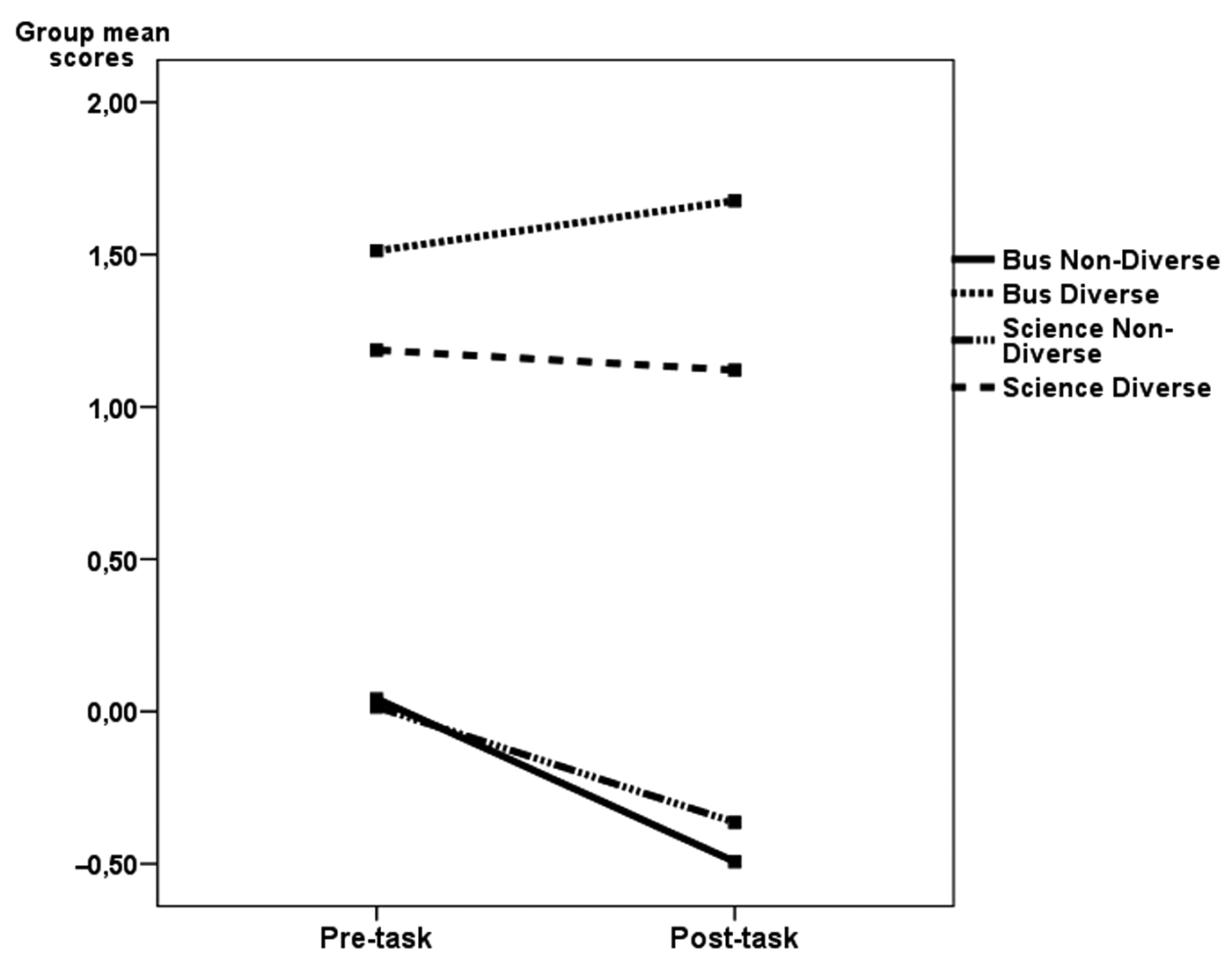
Pre- and posttask cultural mix appraisal by group type within class
While the pretask pattern for cultural mix was the same for both classes, possible explanations for this pattern seemed to vary between classes. Independent t tests revealed that in the science context this finding could be explained in terms of significantly more favourable attitudes of local, monolingual students who self-selected into diverse small groups (M = 1.08, SD = 2.20) compared to local students who chose to work in nondiverse groups (M = −0.02, SD = 1.53, t(49) = −2.09, p < .05). This suggests a self-selection bias among the local student population in the science class. In contrast, within business this finding could be linked to the positive attitude of students with international experience within the diverse groups, because the subgroup of local, monolingual students within diverse and nondiverse groups did not significantly differ on this measure.
Wilcoxon’s signed rank tests were conducted for group type (culturally diverse, nondiverse) within class (business, science) for cultural mix. These tests showed similar changes over time for each group type in both study contexts. While diverse groups did not significantly change on that measure, nondiverse groups were significantly less positive towards mixing at the end of the particular group assignment. This latter finding seemed particularly troubling given that these students had been interacting in nondiverse groups during the group activity.
These patterns raise the question of whether students in culturally diverse and nondiverse groups experience their respective group learning activity differently. This was the focus of the second research question.
Research Question 2 raised the issue of how students’ appraisals of multiple aspects of an actual group project experience develop in culturally diverse and nondiverse groups and how this experience may be related to aspects of the broader instructional environment. Before commencement of the group assignment, Mann-Whitney tests revealed that group type had no impact on students’ initial appraisals of the forthcoming group assignment, as evidenced by the lack of significant differences between diverse and nondiverse groups’ multiple group work appraisals. This was consistent across instructional environments. Subsequently, further analyses were carried out within business and science allowing for examination of how appraisal profiles developed over time for diverse and nondiverse small groups within each specific instructional environment.
Wilcoxon’s signed rank tests were conducted to explore change in multidimensional group work appraisals over the duration of the assignment separately for nondiverse and diverse groups within both class contexts. Within business, there was a mainly negative development for nondiverse groups, although students’ appraisals in diverse groups largely stayed stable. The decrease over time within nondiverse groups was significant for cognitive benefits (z = −2.92, p < .01), motivating influence, (z = −2.10, p < .05), affect (z = −2.35, p < .05), management (z = −2.27, p < .05), and assessment (z = −2.61, p < .01). Alternatively, diverse groups displayed significantly more positive appraisals for the interpersonal (z = −3.29, p = .001), and less positive attitudes towards the cognitive (z = −2.35, p < .05) aspects at the end of the group assignment. Within science, Wilcoxon’s signed rank tests showed diverse groups were more positive towards the affect (z = −2.38, p < .05), and assessment (z = −1.96, p = .05) dimensions of the group assignment at the end, whereas nondiverse groups’ appraisals of the assignment did not change significantly from beginning to end.
In sum, while pretask appraisal profiles were similar for groups across study contexts, appraisals developed differently depending on whether group tasks were completed in diverse or nondiverse groups. Hence, after task completion, appraisal profiles differed between groups within business, with diverse groups displaying significantly more favourable appraisals of the cognitive benefits, interpersonal and management aspects of the group assignment than nondiverse groups. In contrast, no significant differences were found between groups in the science context at the end of the assignment.
Discussion and Conclusion of Study 1
With regard to the first research question, diverse groups consistently displayed more favourable attitudes towards mixing with peers from different cultural backgrounds than nondiverse groups, which is consistent with other research (e.g., Ledwith & Seymore, 2001). However, evidence of further decline over the duration of the group assignment for nondiverse groups was especially concerning given the lack of intercultural interactions during task completion. This supports Summers and Volet’s (2008) findings on the emergence of nondiverse groups’ cultural mix appraisals in 1st, 2nd and 3rd year business courses. Hence one could argue that this trend is illustrative of a business programme with noncohort characteristics. Even so, the decline within nondiverse groups in the science class is particularly puzzling as it could be speculated that belonging to a cohort may weaken this phenomenon.
Furthermore, in light of the second research question the findings for diverse and nondiverse groups within business suggest that diverse groups managed to establish a beneficial group climate for positive appraisals to emerge. This is consistent with prior research (e.g., Watson et al., 2002), but remarkable in this study, given noninterdependent task features and unstructured teacher support (e.g., Sweeney et al., 2008). In contrast, within science no significant differences between groups were found after task completion. This finding shows the combined beneficial implications of interdependent task characteristics, structured teacher support, and cohort characteristics creating an enabling environment for efficient collaborative processes to emerge regardless of group configuration.
In sum, Study 1 identified distinct patterns in the emergence and evolution of students’ attitudes towards intercultural mixing and towards group work, findings which could partly be interpreted in terms of affordances and constraints present in different study contexts. To gain insight into the development of such patterns, a follow-up study was designed.
Study 2
Aims and Research Questions
Study 2 aimed to examine how students’ accounts and reflections on their experiences of interacting with peers from different cultural backgrounds within a particular learning context may shed some light on the patterns of results from Study 1. For that purpose, the notion of context in which intercultural interactions take place was broadened beyond a single, specific group assignment, enabling exploration of students’ accounts of and reflections on their experiences of intercultural interactions in their respective courses, namely business or science.
Two research questions, emerging from the patterns of results of Study 1, were generated for Study 2:
Research Question 3: How do students explain the process of self-selection into culturally diverse or nondiverse groups in their study context?
Research Question 4: Why do students who self-select into nondiverse groups become more negative towards working in diverse groups?
Method
Participants and Procedures
Twenty-seven students from identical study contexts to Study 1, business (N = 13) and science (N = 14; of which 10 partook in Study 1), volunteered to participate in the research. Semistructured, in-depth focus group and individual interviews were conducted to elicit students’ subjective experiences and accounts of interactions with culturally different peers. An additional three individual interviews were organised for volunteers unable to join a focus group because of time constraints. Interview questions were framed so as to invite students to freely discuss various aspects of group work and social experiences, when interacting with peers from different cultural backgrounds. The interviewer’s own cultural and linguistic background differed from all interviewees, meaning that both native and nonnative English speakers were interviewed by someone from a different background from theirs, albeit with near native English proficiency. To establish a positive and open interview climate and address the issue of positioning (Scollon & Wong-Scollon, 2001), the interviewer released some personal information about her background as an international student in Australia as well as familiarity with issues related to intercultural mixing. In contrast, when interacting with local students, the interviewer emphasised her considerable experience in the Australian context. The issue of being thoughtful of self-disclosure is consistent with Glesne and Peshkin’s (1992) notion of “tailoring the self” (p. 83). In the present study, it was particularly important to stay neutral and accommodating for both positive and negative experiences to encourage participants to talk openly about their histories without withholding or censoring information (Fontana & Frey, 1994). Interviews were conversational and lasted between 30 to 90 min. All interviews were audio-taped on students’ consent and transcribed verbatim for analysis.
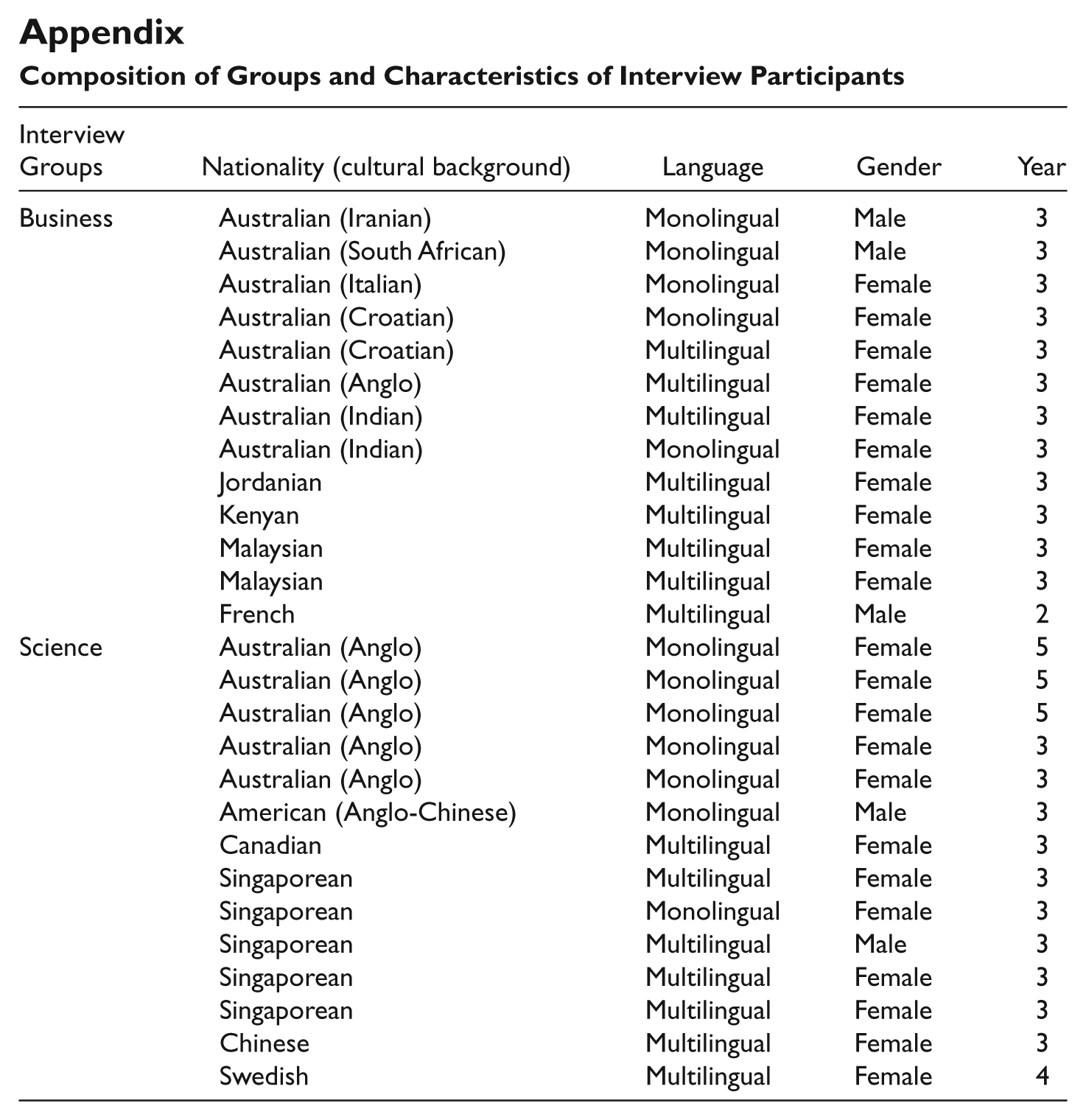
Information regarding composition of interview groups and characteristics of participants is provided in the appendix. Country of origin is included in the table to illustrate diversity of students’ backgrounds within each context and not to relate findings to particular ethnic groups.
Interview Data Analysis
The interview data was transcribed and coded according to the principles of qualitative content analysis (Chi, 1997; Mayring, 2000). Transcripts were analyzed using a dynamic combination of inductive and deductive techniques (Chi, 1997; Miles & Huberman, 1994): being open for emerging themes while also examining (in)consistencies with concepts derived from prior research on intercultural interactions between student groups. The analysis was dynamic as it remained open towards incorporating data- and theory-driven modifications throughout the entire coding process. All data were entered in MaxQDA software.
In the first phase, interview transcripts from science and business students were read and tagged to identify all discussions about interactions between students from same or different cultural backgrounds. Text segmentation was based on semantic features, such as topics, ideas, and argument chains (Chi, 1997). The first reading, therefore, aimed at detecting notable, significant, and recurring patterns or themes in the core interview content that best represented and structured verbal data (Mayring, 2000). The next step involved a deductive approach, where the researchers looked for frequent regularities, similarities, and consistencies with prior research. The topics were refined and relabelled accordingly at that point, taking into account prior research findings.
In the second phase, transcripts were reread several times and themes examined in light of their suitability and appropriateness for addressing the predetermined research questions and contexts. Topic revision and refinement was only marginally required in this phase. Throughout the analysis, careful consideration was given to identifying any evidence of deviant patterns and issues that did not match the dominant, recurring themes and these were allocated correspondingly (Patton, 1990).
In sum, while the dominant orientation of the analysis was bottom-up, the conceptual issues addressed in the research questions led to the generation of top-down codes (Chi, 1997). Overall, the combination of inductive and deductive approaches allowed for a systematic and holistic perspective of students’ contextualized accounts of their cultural mix experiences.
Findings
The findings are organised around the two research questions: Where applicable, converging findings across study contexts are reported first, followed by context-sensitive findings specific to the natural, instructional environment of each course.
How do Students Explain the Process of Self-Selection Into Culturally Diverse or Nondiverse Groups in Their Study Context? Similarities in Explanations Across Study Contexts
Across study contexts, students’ accounts converged to acknowledge limited interactions between peers from different cultural backgrounds and highlighted students’ strong inclinations to work with close peers or friends from similar cultural backgrounds. These findings are consistent with numerous other studies conducted in countries hosting large numbers of international students (e.g., Trice, 2004; Volet & Ang, 1998).
Working with friends and peers from a similar background was perceived as less stressful, more relaxing, and more fun. Interestingly, both international and local students highlighted that having fun while working was an expectation mostly of Australian students and attributed its origin to cultural differences rather than social practices. Otherwise, reservations to join culturally mixed peer groups for group assessments were explained by factors other than culture, such as communication difficulties (due to language proficiency and accents), differences in working styles, and work ethics.
Also common across study contexts were international students’ appreciation of the value of academic tasks conducted in mixed groups, and in contrast local students’ scarce comments in that regard. Regardless of country of origin, most international students wished for more time within their groups to complete projects, an issue which was raised more frequently within business than science. Some comments implied that subgroups of international business students within diverse groups tended to work closely together, which could explain Study 1’s finding that diverse groups in business have more positive group work appraisals than nondiverse groups. In contrast, there was limited evidence of these views or practices among local students. Across study contexts, local students did not express interest in mixing with peers from different backgrounds although stories of positive group experiences were occasionally acknowledged.
Although the strong in-group bias among all local students interviewed in Study 2 was consistent with the business findings in Study 1, it was somewhat inconsistent with the findings within science, where a self-selection bias of local, monolingual students who chose to work in diverse groups was identified. Science local students’ reflections on processes of self-selection into diverse or nondiverse groups failed to provide explanations for the Study 1 findings. This suggests that while variability in attitudes towards intercultural interactions was evident in self-selection patterns (Study 1 patterns), students may be unaware of diverse views within their class, or alternatively the views of science students interviewed in Study 2 were not representative of the overall science student population.
Another notable point is that although in-group bias was evident among both science and business students, for science students, joining a group of close, culturally similar peers emerged simply as a preference given the choice, whereas for business students, especially local students, culturally diverse groups appeared as something to be avoided whenever possible.
Differences in Explanations Between Study Contexts
Differences in explanations regarding the process of self-selection also emerged between the two study contexts. These related to proficiency in the language of instruction and academic skills, and peer group familiarity. Diverging explanations for preferences for nondiverse groups were also noted.
Proficiency in the language of instruction and academic skills
A recurrent theme in the literature regarding interactions between local and international students is the role of international students’ (real or perceived) insufficient proficiency in the language of instruction (Harrison & Peacock, 2008; Ledwith & Seymore, 2001; Montgomery, 2009). The two distinct contexts in this study made it possible to explore this issue, as distinct from cultural background, on the process of self-selection into groups. In light of the dominance of published studies with business students, it was also useful to examine and compare the experience of students in a different course of study.
Consistent with the literature, Business students’ reflections on the process of group self-selection highlighted the significance of language as a major impediment to join culturally diverse groups. Of concern, though, was evidence that students almost systematically linked language proficiency to other aspects, such as academic skills or work ethics. Local students appeared to be particularly wary of, even deprecatory towards culturally mixed groups. All local students from business, without exception, reported negative prior experiences of working in diverse groups and they invariably pointed to both poor language and academic skills. Many declared that this forced them to check and fix their peers’ contributions, in addition to their own share of the work.
You feel like you have to go over again and read it. And go through it and fix it up which can be frustrating. Especially, when you know from the start that you gonna [sic] have to do that.
The potential risk to grades due to perceived language difficulties and lower academic standards of international students was a recurrent theme in these students’ explanations for unfavourable attitudes towards self-selecting into diverse groups. Some international students’ comments also appeared to acknowledge this as a problem.
You cannot blame her, because this is how it is, but you actually have to go through everything to make sure it is fine.
One international student from non-English speaking background acknowledged initially experiencing difficulties with essay writing and referencing skills, in addition to grappling with the issue of studying in a second language. This student reported unpleasant group work encounters in his 1st year, receiving extensive criticism due to unacceptable work standards. In retrospect, he was appreciative of and grateful for the support of local group members, because their feedback contributed to improving his academic skills and knowledge of local conventions.
My English was not very perfect. They noticed my impact was not as good as theirs. So, that is why I got some remarks, (. . .) and critics at first. It is not that they gave me a chance, but they helped me. They did help me at first and I really appreciated that.
Overall, it appeared that both local and international students within business considered insufficient language proficiency as a critical issue for effective group work and tended to systematically link deficiencies in language and academic skills.
In contrast, although the issue of language was also explicitly mentioned by international and local Science students, it did not appear to present the same challenges.
Some peer groups that have a poor command of English, they find it more difficult to interact because already the language is a barrier. (. . . .) Like this is quite common, but not in our class.
Some of them um like most of them speak really good English.
Science students’ perceptions of no language related difficulties were striking in light of such a culturally diverse student population. This might be explained by more stringent academic entry requirements in the science course compared to business, which raises the issue of whether academic level was linked to language proficiency. Since science students nevertheless displayed strong in-group preferences for self-selection into nondiverse small groups, this highlights that poor communication and perceived deficiencies in academic skills are not sufficient to explain this phenomenon, as often implied in prior research.
Differences in familiarity with the peer group (cohort effect)
As described in the method section for Study 1, the study contexts (business, science) for the two consecutive studies differed in structure, with science students completing mandatory units and business students completing a combination of mandatory and elective units. Despite similarity in cohort sizes (about 80-100 students at each year level in both courses), science students had multiple opportunities to become familiar with each other and feel part of a cohort since they studied exactly the same units semester after semester, while this was not the case in business.
The cohort effect emerged as a strong theme among both business and science students’ explanations for self-selection into groups. Business students frequently pointed to the noncohort characteristics of their course. Although group work was a common requirement across business units, most students declared they met new peers every semester, highlighting the high degree of anonymity in the business course.
I am always with different people, always in different groups every semester.
You don’t know your class. (. . .) And that is at the beginning of the semester. Of each semester.
Cohort issues also emerged spontaneously in interviews with science students. Remarkably, some science students reflected on the highly segregated nature of student groups in their course in spite of all students being familiar with each other. Consistent across years of study (Years 3-5), students stated that culturally similar groups were formed in the 1st year and subsequently maintained.
I found that people had segregated . . . like international students in one group or local students in one group or from different cultures or nationalities.
I’m in 4th year now and there is really strong groups now. You can’t get into the groups, because we have already decided which groups belong together and you cannot change them around anymore.
The significance of belonging to a cohort versus being unfamiliar with the peer group, discussed by students from both contexts, will need to be examined in future research. This study revealed that while poor cohort cohesion partly explained difficulties in intercultural mixing (business), cohort presence did not necessarily promote self-selection into diverse groups (science).
Diverging explanations between international students and local students preference for nondiverse groups
International and local students’ additional explanations for self-selection into nondiverse groups often differed depending on study context.
The 9 international students from science (5 from Singaporean background) typically justified their choice to work in nondiverse groups through similar group management and allocation of workload practices, and common work standards and ethics. Their comments did not differ across students’ country of origin and invariably focused on task completion and work attitudes, rather than social or interpersonal dimensions of group work.
Like at least in my case, my friends are on the same level of understanding as I am . . . it just happened to be that my friends are also like they want to finish their work. They don’t like to run away from doing their part of the work and we are all on the same level. It just works out nicely.
In contrast, the five local students (exclusively from Anglo, monolingual backgrounds) systematically described socioemotional aspects of group work such as having fun, feeling relaxed and comfortable, which in their view was more likely to occur with peers from similar background.
I mean you always get the work done with your friends, but you also have fun as you are doing it. So, that is obviously going to be better than having to do it where it is just going to be “ok, just go and get it done” and you do not have any fun at all.
Interestingly, international students’ focus on commonalities related to task management and local students’ commonalities related to the socioemotional aspects of group work to explain preference for self-selecting in nondiverse groups were only partly duplicated in the responses of business students. This stresses that enrolment status (local, international) per se is insufficient to explain the nature of students’ intercultural experience.
Like their science counterparts, international students from business (5 students from four different continents) expressed concerns about task management when working with local students. They often described how local students’ time constraints due to off-campus work commitments resulted in their preference for dividing up labour. International students found this frustrating because it meant group assignments were completed in isolation rather than collaboratively. These 5 students tended to be either positive or indifferent but never negative towards interacting with local students for group work, which could reflect the nature of their course of study (business). In addition, most of these students reported spending significant amounts of time with the other international students in their groups to discuss, negotiate, and prepare their assignment.
International students’ tendency and desire to spend more time working collaboratively on group assignments was noted by some local students.
I find international students have more time allocated to complete work, so they are more university-work oriented. And we are juggling our lives outside uni as well. In that regard you also have a conflict of interest, because I know from myself that I don’t always meet deadlines with my group.
Especially with international students you just want to get down to the point and “this is what we are doing and this is how we gonna [sic] go about it. You do this and you do that.” Divide the work, come back together.
As a result, many international students felt disappointed and frustrated.
You are doing this, doing that, keep in touch on the Internet. Send me your part. That’s it. For all. (laughs) But apparently we passed, so that was amazing at first. The group meetings lasted 15 min.
Interestingly, although many local students recognized their meeting time limitations, they did not appear to desire more interaction with peers from culturally diverse backgrounds. As aforementioned, local students within business spoke at length about international students’ insufficient English and academic skills to explain lack of intercultural mixing, and none recognised missed opportunities for intercultural learning.
Overall, students’ accounts and reflections contributed to explain Study 1’s findings regarding self-selection into diverse or nondiverse groups and also illustrated the nature of their experience in such activities. Yet one unexplained finding concerning students who completed group assignments in nondiverse groups but displayed more negative attitudes towards intercultural mixing at the end of that assignment still remains. This issue is addressed in the next research question.
Why do Students Who Self-Select Into Nondiverse Groups Become More Negative Towards Working in Diverse Groups?
Regardless of study context, Study 1 revealed a significant drop in cultural mix appraisal for nondiverse groups, a finding consistent with Summers and Volet’s (2008) study, conducted with business students across 1st, 2nd, and 3rd year of undergraduate study. Summers and Volet (2008) noted this troubling finding but like in Study 1, which compared students from two distinct instructional contexts, only speculative explanations could be put forward based on quantitative findings. The analysis of students’ own accounts and reflections made it possible to seek an explanation within extended contact theory (Wright, Aron, McLaughlin-Volpe, & Robb, 1997). The extended contact hypothesis postulates that an individual’s awareness of a close enjoyable relationship between an in-group member with an out-group member has the potential to lead to a more favourable attitude towards the out-group as a whole. Likewise, the reverse could also apply, whereby an individual displays more negative attitudes towards an out-group after observing or hearing about an in-group member’s negative, unpleasant experience with a member of that out-group.
Some interview data provided partial support for this explanation but due to students’ skewed accounts of vicarious experience of group work, the findings should be interpreted with caution. Both business and science students reported multiple stories of close friends’ group work experiences. However, the overwhelming majority of these stories involved negative experiences, attributed to personality clashes, unequal contributions, lack of quality of individual components, disagreements over content issues, and subsequent low grades.
Yes, you do hear about everyone else’s experiences especially the bad ones.
When you have heard about other people’s bad experiences, you just don’t want to be that person.
Students unanimously admitted that hearing accounts from others influenced their own ideas and, in some cases, reaffirmed their already unfavourable attitudes towards intercultural mixing. A few local students, mostly from science, declared that others’ accounts would only affect them if the names of noncooperating peers were mentioned.
Because the next time you ask yourself, “Do I really want to work with them? Because my friend really had a hard time with them.” That’s only if you name names.
Given that science students were familiar with their peers, local students’ negative attitudes toward diverse groups may not have been related to in- and out-group distinctions but rather to negative stories about specific individuals. The in- and out-group distinctions were more evident in the business context where students were relatively unfamiliar with each other.
Reciprocally, and consistent with the extended contact hypothesis, hearing positive stories of successful collaboration with peers from a different cultural background could be expected to create more positive attitudes towards diverse groups. At least one local student from each class mentioned active networking among close peers, enabling recommendations of individuals from different cultural backgrounds who would be good group members due to work attitudes and competences.
Nevertheless, analysis of students’ reflections suggests that degree of familiarity (as with science students) may influence the extended contact hypothesis. For example, it appeared that attitudes towards intercultural mixing and, ultimately, self-selection into diverse groups tended to be affected by perceptions of individuals rather than in-groups.
There have been some cases in my class that you kind of changed your whole opinion about someone.
In contrast, when students were unfamiliar with their peer group, distinctions between in-group and out-groups seemed more likely to affect attitudes towards intercultural interactions and self-selection for group activities, for example,
A lot of other people in that class did get stuck with a few people, who happen to be international students. They did not do so well. And I don’t want to be in a group like that at all.
Furthermore, there were implicit indications that awareness of a close relationship between one in-group peer with an out-group peer may lead to a change in attitudes towards the out-group as a whole. Overall, there was some support for the assumption that students may become more negative towards diverse group work after an experience in a nondiverse group, due to learning of others’ negative experiences, which in turn reinforce their current membership choice. This phenomenon, however, could be mediated by peer familiarity.
Further possible explanations for the overall negative trend in various group work appraisals for nondiverse groups compared to diverse groups found within Business in Study 1 were sought. Interestingly, participants’ accounts of their experience of intercultural interactions and group work in Study 2 were largely inconsistent with the quantitative patterns identified in Study 1. Local students’ anecdotal accounts emphasised satisfactory, pleasant, and nonstressful experiences when working with in-group members, which contradicted Study 1’s findings of negative group work appraisals among nondiverse groups. Yet there was some variability among local students with regard work ethics and study commitment, which may impede or depreciate group work experiences among nondiverse local groups. The extent to which variability in work ethics and study commitment could be linked to the overall student profile (e.g., ability) or subject matter characteristics (e.g., degree of complexity of subject matter knowledge) of particular courses of study should be explored in future research.
Accounts of variability in the work ethics and study commitment of local business students were widespread. International students as well as a few local students’ accounts were quite critical of local students’ tendency to divide up the labour and fail to communicate with their group members, as well as their habit of leaving work to the last minute, ultimately handing in their work share late.
Everyone just seems to work heaps out of uni. So, a lot of our timetables clash, which makes it really like frustrating and difficult to meet up and get anything done.
And when she was at uni, she could only spare like two or three hours. And we had like group assignments like group projects to hand in and a presentation. And we found it really hard to communicate with her. (. . .) Half the time her phone was off. We were so annoyed. It was really difficult for the rest of us.
I think with international students it is a bit more complex. But local students they don’t get away, they are slack. They understand what is being said. It is just slackness.
Some local students felt frustrated about inefficient group communication and collaboration, and ultimately were upset about unequal work and quality of outcome. Therefore, it could be speculated that the negative appraisals of group work identified among nondiverse groups in Study 1 may be a result of group configurations where members differed in their academic goals, expectations, and study commitments.
Summing up, business students’ accounts provided some insight as to why diverse groups may experience group work more positively than nondiverse groups as identified in Study 1. Explaining why local students participating in nondiverse groups can become more negative towards mixing remains, however, speculative. Contributing factors may be found outside local students’ actual experience of group work, for example, in the detrimental impact of heavy work commitment outside class (Ward & Volet, 2008). In any case, the discrepancy between local students’ inclinations to remain with in-group members despite negative group work experiences will need more attention in future research. Finally, the decline in cultural mix appraisal for nondiverse groups across study contexts may be related to mechanisms of the extended contact effect, with possible mediation of contextual characteristics of the learning environment (cohort vs. noncohort) in which it occurred. However, this would need to be further examined.
Limitations of Study 2
Before summarising the key findings, it is important to point to some limitations of this study. First, the sample was relatively small and biased in terms of gender and ethnicity. Significantly, male students within science and monocultural Anglo-Australian students within business did not volunteer for an interview. The extent to which this is representative of these students’ lack of interest in intercultural interactions or is illustrative of the course-specific student population is unclear.
Second, approximately 70% of students in this particular science course were females, explaining the relatively small number of male participants. However, it is unknown whether the pool of local students from non-Anglo background within science was limited or whether these students did not volunteer to participate. The absence of monocultural local participants within business was particularly striking given that this subgroup makes up 67% of the overall local student population. There is no doubt that students from these missing subgroups would have provided additional, valuable insights into intercultural interactions within each study context. This is particularly relevant for monocultural local students as prior research has found that these are least inclined to display positive attitudes towards cultural mixing (e.g., Summers & Volet, 2008).
Finally, the degree to which these findings are generalisable to other study contexts would need to be established. Nonetheless, the cross-contexts consistencies with prior research lend notable support to the significance of findings regardless of specificity of student body and instructional environment.
Discussion and Conclusion of Study 2
Students’ subjective accounts and experiences of mixing with peers from different cultural backgrounds largely converged with the extant literature. The issues of strong detachment between cultural groups and impediments to intercultural interactions such as differences in working styles, management problems, and assessment concerns were highly consistent with prior research on students’ intercultural interactions in academic settings (e.g., De Vita, 2002; Quintrell & Westwood, 1994).
While these themes emerged across study contexts, the study design with two distinct learning contexts was critical to reveal exclusive patterns specific to each educational environment. There was evidence that relational and collaborative dynamics play out differently depending on a combination and interaction of contextual affordances and constraints. Issues related to proficiency in the language of instruction and cohort characteristics appeared to create learning environments that were more (science) and less (business) conducive for rewarding and productive peer interactions and group management. The combined effect of lacking cohesion, communication difficulties, and poor academic skills cocontributed to a less favourable climate for intercultural interactions within business, particularly for local students. Whereas within science, cohort features, language fluency, high academic standards, and strong professional attitudes cogenerated a more constructive environment for culturally diverse group work.
Yet regardless of collaborative enabling or inhibiting characteristics of the learning environment, cultural groups largely studied in parallel and did not interact on a voluntary and frequent basis. Consistent with Volet’s and colleagues’ research (Volet, 1999; Volet & Ang, 1998) local, monolingual students were the most likely to display strong in-group bias. This is undeniably concerning as these students miss out on the valuable intercultural learning opportunities offered to students who choose to have an international education experience (De Wit, 1995). The design and implementation of tasks involving multiple perspectives and which stimulate students to capitalise on each others’ knowledge may be a promising means to overcome students’ hesitations towards intercultural interactions. The beneficial implications of assignment tasks incorporating cultural dimensions and authentic culturally diverse learning activities for fostering intercultural awareness are widely acknowledged in the literature (e.g., Volet, 2004).
Overall Discussion and Conclusion
The two consecutive studies clearly emphasise the significance of broader instructional environments for students’ intercultural experiences. Both studies revealed how students’ experiences and subjective accounts of mixing with peers from different cultural backgrounds can vary depending on the organisational structure and instructional features of the specific learning context. The issue of cohort vs. noncohort emerged as a potentially additional explanatory factor although mainly in regard to the reasons given by students for mixing or nonmixing. The findings point to the value of creating a sense of cohort among students as it appears to potentially facilitate intercultural interactions among peers due to increased peer familiarity and acquaintance. Interestingly, while insufficient language proficiency was confirmed as a critical contributing factor for paucity of interactions, there was evidence that even when language was not an issue, students still preferred to work in nondiverse groups.
Of significance for future research are the discrepancies between quantitatively identified patterns and students’ anecdotal accounts. While these could, in part, reflect some different participants between studies, they nevertheless stress the criticality of using multimethods approaches when studying attitudes towards, and experiences of, interactions. Overall, these findings highlight the complex, multifaceted, and changing nature of intercultural experiences in students’ real life contexts. The paradox and complexities in students’ perceptions of and attitudes towards intercultural interactions were also documented by Harrison and Peacock (2007). Especially striking was the contradiction in local students’ tendency to self-select into nondiverse groups (Study 1) explained in terms of leading to more satisfactory, pleasant, and less stressful experience (Study 2) and the concurrent finding of nondiverse groups’ negative group work appraisals (Study 1). It seems plausible that although students may experience difficulties when working with in-group members, they nevertheless find nondiverse group work less demanding than anticipated socioemotional, sociocultural, and attitudinal challenges emerging in culturally diverse groups. Consequently, these findings shed doubt on the exclusive reliance on students’ anecdotal reports and emphasise the richness of mixed method approaches (Johnson & Onwuegbuzie, 2004) to investigate the complex interplay of academic, relational, emotional, and contextual aspects for intercultural interactions in the university context.
From an educational perspective, these findings highlight the important role of teachers in designing and monitoring learning activities for culturally diverse groups that are perceived as personally rewarding, academically enriching, and professionally relevant. This could best be achieved by deliberate efforts to constructively capitalise on cultural diversity for raising students’ awareness of future workplace demands and by embedding the relevance of intercultural competencies in the context of prospective professional practice. Group learning activities that incorporate cultural dimensions of the professions and that are carried out with continuous, structured teacher support are expected to lead to positive, secure, and rewarding experiences for all students involved. As part of regular teaching, teachers need to be sensitive to and prepared for potential challenges arising in culturally diverse group work. Especially in the context of the internationalisation of higher education and internationalised curricula, teachers and course designers have a responsibility to facilitate the development of students’ intercultural competencies as an integral part of university study (De Wit, 1995; Otten, 2003). Moreover, further research is required to investigate the mechanisms of the extended contact effect (Wright et al., 1997) that seemed to play a vital role for students’ attitudes regardless of personal experiences. This research suggests the extended contact effect may play out differently depending on characteristics of the study context, such as cohort vs. noncohort. These dynamics will require more attention in future research.
On evidence that culturally homogeneous groups are firmly established within the first year of study, it appears imperative to promote intercultural interactions and amenable attitudes towards intercultural encounters from the very start of students’ study experiences. Early prevention of systemic in-group favouritism is critical on multicultural campuses and activities conducive to rewarding intercultural interactions and learning need to be maintained throughout all years of study.
Finally, given that students’ intercultural experiences are not exclusively limited to formal classroom situations, future research on intercultural interactions should extend the scope of investigation towards other types of social contexts. This would provide a more holistic picture of how students’ experiences across multiple settings interact, impede, or combine to produce specific intercultural appraisals and, ultimately, attitudes.
Footnotes
Appendix
Composition of Groups and Characteristics of Interview Participants
| Interview Groups | Nationality (cultural background) | Language | Gender | Year |
|---|---|---|---|---|
| Business | Australian (Iranian) | Monolingual | Male | 3 |
| Australian (South African) | Monolingual | Male | 3 | |
| Australian (Italian) | Monolingual | Female | 3 | |
| Australian (Croatian) | Monolingual | Female | 3 | |
| Australian (Croatian) | Multilingual | Female | 3 | |
| Australian (Anglo) | Multilingual | Female | 3 | |
| Australian (Indian) | Multilingual | Female | 3 | |
| Australian (Indian) | Monolingual | Female | 3 | |
| Jordanian | Multilingual | Female | 3 | |
| Kenyan | Multilingual | Female | 3 | |
| Malaysian | Multilingual | Female | 3 | |
| Malaysian | Multilingual | Female | 3 | |
| French | Multilingual | Male | 2 | |
| Science | Australian (Anglo) | Monolingual | Female | 5 |
| Australian (Anglo) | Monolingual | Female | 5 | |
| Australian (Anglo) | Monolingual | Female | 5 | |
| Australian (Anglo) | Monolingual | Female | 3 | |
| Australian (Anglo) | Monolingual | Female | 3 | |
| American (Anglo-Chinese) | Monolingual | Male | 3 | |
| Canadian | Multilingual | Female | 3 | |
| Singaporean | Multilingual | Female | 3 | |
| Singaporean | Monolingual | Female | 3 | |
| Singaporean | Multilingual | Male | 3 | |
| Singaporean | Multilingual | Female | 3 | |
| Singaporean | Multilingual | Female | 3 | |
| Chinese | Multilingual | Female | 3 | |
| Swedish | Multilingual | Female | 4 |
The authors declared that they had no conflicts of interest with respect to their authorship or the publication of this article.
The authors disclosed that they received the following support for their research and/or authorship of this article: This research was supported under Australian Research Council’s Discovery Projects funding scheme (Project No. DP0666933).