




Abstract
Internationalization of the curriculum attracts considerable interest, yet often remains in the hands of enthusiasts or is relegated to the periphery of personal skills modules. While academics may be “happy to ‘tinker around the edges’ of their course content and classroom pedagogy” they still frequently ask, “What does it really mean for me and my classroom?” This article outlines the experience of one U.K. university, which has been seeking to internationalize the curriculum through two phases. The overarching development framework of the first phase (Jones & Killick, 2007) is now being embedded through the university’s adoption of a global outlook as a graduate attribute. This attribute interlinks inclusivity and global relevance and connects equality and diversity with internationalization to form a cohesive construct for graduate development. The authors describe the process of working with academics across the institution to design and implement learning outcomes at modular and program levels within disciplines, to support student achievement of this attribute through the process of constructive alignment.
Keywords
Introduction
Internationalization has become increasingly the norm for universities around the world, albeit with varying interpretations of the term (Jones & De Wit, 2012). In 1998, Mestenhauser described international education as “an important educational mega-goal that should permeate the entire educational system” (Mestenhauser, 1998, p. 4), and Brandenburg and de Wit (2010) now claim that internationalization has “moved from the fringe of institutional interest to the very core” (p. 31). Hudzik (2011) sees comprehensive internationalization as an “institutional imperative, not just a desirable possibility” (p. 7). Yet in spite of these grand statements, many universities continue to relate internationalization to institutional performance, largely in economic or reputational terms, and pay less attention to the benefits that can result for students. Notwithstanding much recent debate on drivers for internationalization (Green, 2012) and rethinking its purpose and nature (IAU, 2012), as yet there are relatively few examples in the literature of successful curriculum internationalization initiatives. Where these exist (see Leask, 2012, for examples), they tend to be “bottom up” in nature, instigated by academics within their own discipline rather than ‘top down’ with an institution-wide focus. This article presents an example of an ongoing internationalization of the curriculum (IOC) process at one U.K. university that seeks to combine an institution-wide initiative delivered within the disciplines.
The current phase of the process has been prompted by the adoption of three graduate attributes within the university, one of which is “a global outlook” (the others being employability and digital literacy). Australian universities have engaged with graduate attributes for some time, many incorporating international/intercultural elements. They have been defined as
the qualities, skills and understandings a university community agrees its students should develop during their time with the institution. These attributes include, but go beyond, the disciplinary expertise or technical knowledge that has traditionally formed the core of most university courses. (Bowden, Hart, King, Trigwell, & Watts, 2000, p. 1)
Graduate attributes and the potential they offer for IOC are relatively new to the United Kingdom, where IOC efforts have been driven typically by small numbers of academics working on individual courses or modules. 1 Presented here is a case study from one of the few U.K. institutions to have taken an institution-wide approach to curriculum review and development for internationalization, dating from 2003. The initial, ground-breaking, 5-year IOC project involved course teams using an institutional framework to internationalize their programs and has been reported elsewhere (Jones & Killick, 2007). This article considers Phase 2 of the process, focusing on module and course learning outcomes designed to enable students to achieve the graduate attribute of a global outlook. The article offers a description of the process to date and may suggest ideas for those interested in taking a similar path. However, we suggest that direct replication may be inappropriate, as a truly transformative approach to IOC must be firmly grounded in the local institutional and disciplinary contexts.
Context of Curriculum Internationalization
Much of the literature on IOC comes from Australia and the United Kingdom, both countries having diverse, multicultural urban populations alongside significant numbers of international students. IOC is located at the intersection between the international and the intercultural and is thus equally relevant for domestic and international student populations. The authors have argued that “responding to the diversity of international students and responding to the diversity of home students are in fact not two agendas but one” (Jones & Killick, 2007, p. 110). The intercultural element is also crucial for Webb (2005), who sees IOC as incorporating “a range of values, including openness, tolerance and culturally inclusive behavior, which are necessary to ensure that cultural differences are heard and explored” (p. 110). However, Marginson and Sawir (2011) suggest there is still much to do, with international education failing to meet its potential for intercultural development and “the ethnocentrism traditional to English-speaking nations has hardly been dinted” (p. 6).
Across Europe, the recognition that much is to be gained from international/intercultural experiences gave rise to the Internationalization at Home movement (Crowther et al., 2000; Nilsson, 1999). This focuses on the local context, embracing the international as well as the intercultural dimension (Beelen, 2007) in the knowledge that not all students have the means or the inclination to study abroad. Aligning internationalization within the wider multicultural environment of equity and diversity helps to place international students “at the heart of the university as a source of cultural capital and intentional diversity, enriching the learning experience both for home students and for one another, expanding staff horizons, building a more powerful learning community and thus deepening the HE experience as a whole” (Brown & Jones, 2007, p. 2).
The link between internationalization and intercultural competence development also appears in studies from North America (e.g., Deardorff, 2006), which consider the transformational potential of international experiences (Savicki, 2008), including through “disorienting dilemmas” that can lead to perspective transformation (Mezirow, 1991). Yet this literature relates largely to students who have studied or volunteered abroad or who interact with international students on the domestic campus. To date, there has been limited consideration of the local, multicultural context in the United States as an enabling factor for IOC, although a recent survey by the American Council for Education (American Council of Education [ACE], 2012) found that 55% of American higher education institutions report initiatives underway to internationalize the undergraduate curriculum, including at home, and Green (2012) offers a number of case studies that support this.
Scholars have argued variously that IOC “needs to be connected to a pedagogical discussion to be transformative” (Vainio-Mattila, 2009, p. 95), to enable students to “challenge familiar and typical practices, norms, values and beliefs” (Caruana, 2011, p. 245) and “requires changes in pedagogy to encourage students to develop critical skills to understand forces shaping their discipline and challenge accepted viewpoints” (Zimitat, 2008, p. 143). None of this is dependent on an international context, thus affording equally valid approaches to internationalizing the curriculum at home or abroad and indeed across multicultural as well as international boundaries. Done well, IOC “can offer creative assessment, learning and teaching approaches for staff willing to engage seriously with the multicultural dimensions of their classrooms” (Jones, 2013) and facilitate the extension of comfort zones in a controlled manner by challenging cultural assumptions and extending knowledge and experience through the responses of fellow students (Jones & Caruana, 2010).
Van Gyn and colleagues (Van Gyn, Schuerholz-Lehr, Caws, & Preece, 2009) note that the challenge for academics is to
extend our actions far beyond concerns of course content to include pedagogies that promote cross-cultural understanding and facilitate the development of the knowledge, skills, and values that will enable students, both domestic and international, to successfully engage with others in an increasingly interconnected and interdependent world. (p. 26)
Haigh (2009) takes a more extreme position altogether, suggesting we make a non–Western curriculum framework our starting point, whereas Aulakh et al. (1997) emphasize the breadth of the challenge, which involves
teachers and students learning from each other, meeting the needs of overseas, offshore [i.e. those studying on programs overseas] and local students, creating interdependence between students, viewing our professional practice from diverse perspectives, using culturally inclusive teaching practices, accessing teaching and learning resources which reflect diversity, and offering high quality courses which are internationally relevant. (p. 15)
A range of studies with pedagogic approaches in line with this view have resulted in valuable practical resources as well as academic research (see, for example, Harrison & Peacock, 2010; Higher Education Academy, n.d.; Montgomery, 2010; Thom, 2010).
The work cited here supports Leask’s definition of IOC, incorporating, as it does, the intercultural alongside the international, and curriculum content in addition to classroom pedagogy and assessment. IOC is defined as
the incorporation of an international and intercultural dimension into the preparation, delivery and outcomes of a program of study. (Leask, 2009)
During both phases of IOC we have found it beneficial, therefore, to locate internationalization alongside multiculturalism and inclusivity as we seek to develop the cross-cultural capability and global perspectives of our students.
Context of the Case Study
Leeds Metropolitan University is a large university with a teaching and learning focus and a wide portfolio of courses, many of which are vocationally oriented. In the early 2000s a values-driven, holistic approach to internationalization was adopted. By 2006 this was embedded in the university’s strategic plan, with the intention that an “international, multicultural ethos be pervasive throughout scholarship, curriculum, volunteering and community engagement at home and overseas” (Leeds Met, 2006).
Phase 1 of the institutional focus on IOC was through a guidelines document on cross-cultural capability. This provided a strategic framework of developmental questions, to be used by undergraduate course teams across the institution with a view to introducing or enhancing cross-cultural capability in programs within their discipline over a 5-year period. An internal review at midpoint led to modification of the guidelines, with global perspectives being explicitly added as an ethical underpinning (Killick, 2006). These were seen to contribute to the development of graduates as global citizens and drew on synergies between international and intercultural contexts and between local and global responses to issues of equality and diversity. The university was cited in several reports and academic publications for this strategic approach to IOC (Bourn, McKenzie, & Shiel, 2006; Caruana & Spurling, 2007; Fielden, 2007; Shiel & McKenzie, 2008). Examples of the reviews produced by course teams can be found on the website (Leeds Met, n.d.), and the project was evaluated by Jones and Killick (2007).
Much was achieved by way of advancing the institutional discourse around internationalization and bringing cross-cultural capability and global perspectives into a range of programs. However, IOC had often been embedded in personal development modules or key skills work rather than closely aligned to the subject area, as had been intended. How, then, to embed IOC further, and in particular, to make links with equality and diversity more explicit, contextualizing IOC very clearly within the discipline and associated professional practice?
The opportunity came with a strategic project to introduce graduate attributes into the undergraduate curriculum. Graduate attributes are only now becoming a feature of U.K. higher education, in part as universities seek to make themselves distinctive in a more market-oriented environment. Barrie (Barrie, 2004, 2006, 2007) has looked at how Australian academics construe and seek to embed graduate attributes in their own institutions. In general, he found a confused picture and limited evidence that the attributes were being embedded into student learning. Barrie’s (2007) publication proposed they could be developed either through the course (“engagement” model) or through participation in broader university life (“participatory” model). These might be seen as either the formal or the extended/informal curriculum. The latter profoundly mediates the messages of the formal curriculum but is not the focus of this article, which looks instead at embedding graduate attribute development through the formal curriculum, such that student engagement is driven by module and course experiences.
Mindful of limitations identified by Barrie in the Australian experience, we note
The extent to which the rhetoric of such statements [of graduate attributes] actually represents a shared understanding of the outcomes of a university education is a matter of conjecture. The extent to which present day university teaching and learning processes actually develop such outcomes in graduates is even more contestable. (Barrie, 2006, p. 215)
Thus, we saw it necessary to pay attention both to process and to outcomes as we continued the IOC work already begun. The curriculum review process requires all undergraduate course teams to undertake a number of structural modifications and to embed three graduate attributes into all disciplines. Reviewing the embedding of a global outlook across the whole undergraduate provision is a key responsibility of one of the authors of this article. We now consider efforts to devise, advise on, and implement the embedding of the global outlook attribute in continuation of the strong history of IOC within the institution.
Developing, Defining, and Embedding a Global Outlook
It was noted in Phase 1 that learning outcomes for IOC were not always embedded and assessed within the mainstream curriculum or linked directly and explicitly to the core knowledge and skills of the subject area. Drawing upon Biggs’ (Biggs, 2003; Biggs & Tang, 2007) work on constructive curriculum alignment, it was apparent that being explicit in this way would be key for success at Phase 2. Constructive alignment is not without its critics (e.g., Hussey & Smith, 2008; Jervis & Jervis, 2005) in that it seeks to “prescribe” the student learning journey, from intended outcomes, through “aligned” learning experiences through to final assessment. Notwithstanding the inherent tension between defining outcomes and predicting what is actually learned, we consider that embedded learning outcomes for such a broad attribute as a global outlook could lead to the kind of assessment as preparation for future learning for which Boud and Falchikov (Boud, 2000; Boud & Falchikov, 2006) have argued.
In the United Kingdom at least, significant emphasis is given to constructing outcomes that reflect cognitive taxonomies of learning, notably drawn from Bloom’s (1956) seminal work, or the SOLO taxonomy developed by Biggs and Collins (1982). Thus, each learning outcome is a statement of a measurable outcome of the learning process, utilizing an explicit “action” verb, which students are able to “perform” and which is bound to the level of study. The constructive alignment process ensures that content, delivery, and assessment build outwards from these.
What is also clear from much of the literature on global citizenship (and related) learning is the need for learning outcomes themselves to reflect a more holistic learner development than is often the case and for at least some consideration to be given to their affective and behavioral capabilities (see Krathwohl, Bloom, & Masia, 1964). This was in line with our use of graduate attributes, and the challenge was to ensure that learning outcomes were observable and measurable, in order to drive curriculum and assessment effectively.
It was clear that guidance would be needed on (re)framing subject learning outcomes. It would also be necessary to ensure that the global outlook attribute itself was given shape, informed by a range of subject specialists. To achieve these ends, the authors coordinated a cross-faculty working group chosen from those with a particular interest in internationalization. It was felt that their experience would contribute to deliberations and they could provide valuable support as we rolled out the initiative across faculties. The result was to be a guidance document and other resources for course teams on embedding a global outlook into curricular and assessment practices.
We were concerned to ensure that this work should continue and build from the rationale and experience of the Phase 1 curriculum work on cross-cultural capability and global perspectives. It would also be crucial to start from existing learning outcomes, helping colleagues to “internationalize” these rather than creating alternatives. Fundamental features to be considered included global issues, social justice, communicating and working effectively across cultures (broadly defined), seeing subject and related professional activities in a global perspective, and linking global/international and local/multicultural contexts.
The first outcome of the group was a working definition of the graduate attribute of a global outlook as “effective and responsible engagement with a multicultural and globalizing world.” The attribute was described as incorporating two interlinked dimensions: inclusivity and global relevance:
inclusive—non-discriminatory, appropriate, transparent, etc. for the wide range of students we recruit. While in internationalization of the curriculum this work has tended to be directed towards “international” students, the issues raised and responses required are no different in principle from those involved in working with any student. Each student is part of the diversity of the institution, and as such they benefit when we interrogate and improve our practice to best meet individual student needs and value individual student perspectives and contributions whatever their nationality, ethnicity, gender, etc. A similarly inclusive attitude towards “others” locally is encompassed in the graduate attribute of a global outlook. globally relevant—for all students graduating, seeking employment and going on to shape their personal lives in a multicultural, globalising world, with its increased connectivities, unpredictabilities and mobilities. In internationalization of the curriculum, the concern is to ensure the students see how their discipline and the professions to which it relates fit into this rapidly evolving global context, and to equip them with attributes such as cross-cultural capability and global perspectives which will enable them to “make their way” responsibly in this world, professionally and personally. (authors’ emphasis; Killick, 2011, pp. 18-19)
Working from such expanded definitions, the group devised guidance in the form of generic learning outcomes, which might allow course teams to substitute [bracketed] items with topics and activities from their own modules. Examples include
Students will be able to
explain how [specific aspects of practice] impact upon the lives of people locally and in diverse global contexts; critically review [current U.K. practice] through reference to practice in [two] other countries; present an analysis of [the subject] appropriately for an audience of diverse cultures and first languages; make a significant positive contribution as a member of a multicultural/international team work project; effectively conduct primary research involving participants from a range of cultural backgrounds; synthesize a range of international data sources as the basis for an analysis of potential problems and benefits associated with [the expansion of this practice]; critique the themes presented in [this area] from [two] alternative international perspectives; find commonly acceptable ethical solutions to complex global problems relating to [this area]; present a critically reasoned and respectful argument in favour of one specific socio-cultural response to [this area]; detect bias, stereotypical thinking and prejudicial opinion in published material relating to [this issue]; advance creative solutions for [this problem] which demonstrate appropriate consideration of at least one global (non-U.K.) context in which they will be applied. (Leeds Met, 2011, pp. 7-8)
We then did more specific work on actual learning outcomes from existing programs with which working group participants were familiar, in order to ensure our expectations were realistic. Figure 1 gives some resulting examples.
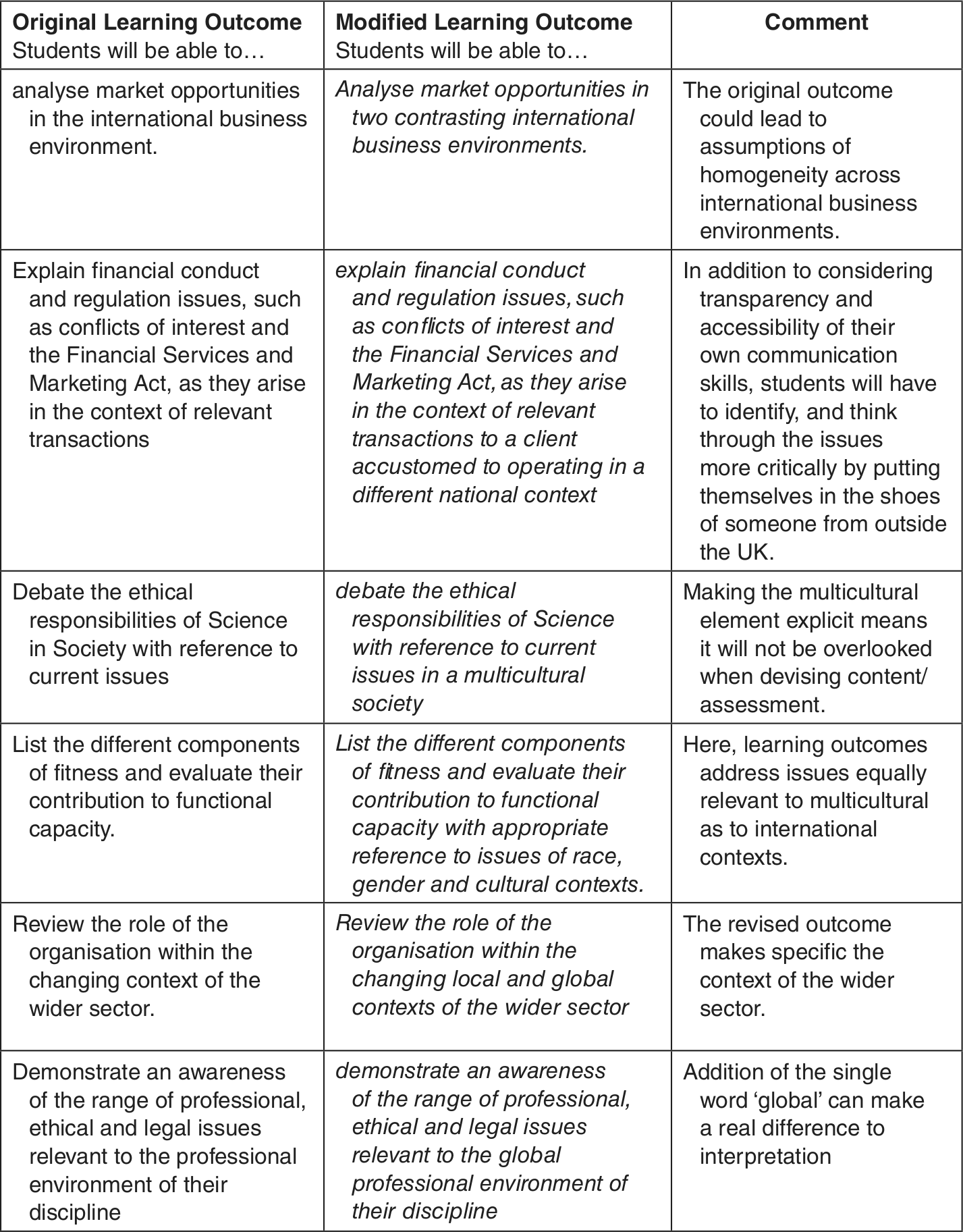
Sample of existing and modified learning outcomes.
As can be seen from the examples, the revised wording performs a number of functions. First, quite small changes can have a significant impact on how the learning outcome is to be interpreted. Second, with the revised wording, appropriate pedagogy and assessment must follow in order that students can demonstrate achievement of the outcomes. It is here that support and development of staff will be crucial in achieving effective IOC. Third, by using existing examples of learning outcomes we stress that it is not about adding a learning outcome for IOC but about embedding it, or making existing practice explicit, and we also emphasize the primacy of the disciplinary context. Finally, it was clear that this would be possible across all disciplines we considered, including in science and technology or courses with professional accreditation. It has been known for resistance to IOC to be ascribed to demands of the professional body or the “universality” of concepts within some disciplines. It was satisfying to have examples to counter such arguments.
In devising the generic learning outcomes and in modifying those in current use, we noted several issues, including the need to
make the attribute explicit even though it might be “understood” to permeate the subject; clarify terminology such as “international” to include “intercultural,” for example, in the use of case studies; ensure that issues identified as globally relevant are not limited to an outward-looking perspective but also include awareness of how U.K. or Anglo-centric disciplinary practice/culture might appear from other perspectives; go beyond conceptions of internationalization being addressed by international industry standards or processes; make explicit that inclusivity requires an active approach not a passive one, for example, using group work to address diversity in a positive way, not merely assuming that multicultural/mixed nationality groups will be effective; recognize that IOC might not be relevant to every single module but that it should appear progressively in some modules at each level of study.
Some highly productive professional conversations in the working group enabled us to reach these conclusions. Cross-disciplinary discussions helped all of us to challenge disciplinary assumptions within learning outcomes. Our ability to identify why course development teams may be approaching their task in particular ways and to advise on how or where further modifications might be made to learning outcomes was enhanced as a result.
One further issue was whether we might be able to devise a taxonomy of progress toward a global outlook during a course. However, it was agreed that progression would be better dealt with by teams:
a. Module tutors devise learning outcomes to match disciplinary-level requirements. b. Course leaders look across module outcomes to ensure “horizontal” coherence within a level as well as “vertical” development over course levels or years of full-time study.
Figure 2, taken from Jones (2013), illustrates how this model can work. In our case, the top of the pyramid is represented by the global outlook graduate attribute as an outcome for all students in the university. At the bottom are the module learning outcomes that make up each course or program. The intermediate stages of the diagram indicate how the learning outcomes are designed to ensure successful students achieve the graduate attribute within their own program/discipline, with each “phase” denoting a year of full-time study.
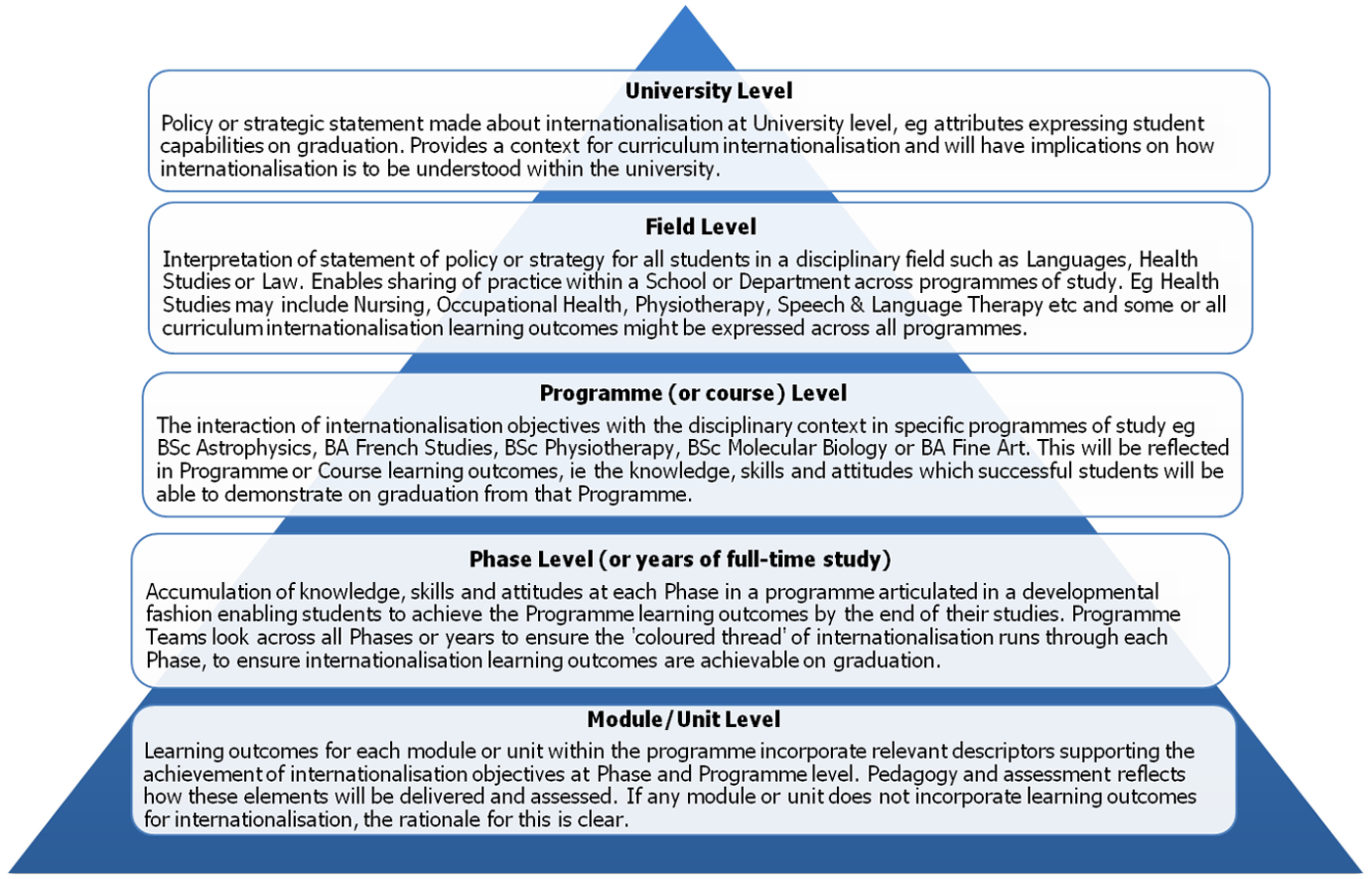
The curriculum pyramid.
We recognized that academic staff might need further guidance on generic expectations of students at the end of each year of study to ensure that progress is being made and articulated these as follows:
After the first year of full-time undergraduate study, students will be able to discuss
their individual sociocultural values and practices; the role of their discipline in diverse cultural and global contexts; the impact of diverse cultural and global contexts on their discipline.
After the second year, students will be able to evaluate
their individual attitudes, values, and skill set for diverse cultural and global contexts; the impact of diverse cultural and global contexts upon aspects of their discipline; the impact of aspects of their discipline within diverse cultural and global contexts.
After the third year (completion of the course), students will be able to apply their subject-specific, work-based, and generic life skills
in multicultural and global environments; within a personal ethic that is informed by a critical awareness of diverse cultural and global contexts.
The guidelines document that resulted from discussions at the working group (Killick, 2011) formed one of a range of supporting documents presented to course leaders through a series of workshops and made available on the university learning and teaching website prior to the curriculum refocus project.
Progress to Date
At the time of writing, course documentation is completed and course teams are planning the implementation of their work to embed graduate attributes. To illustrate how some course teams have successfully embedded dimensions of a global outlook within core aspects of their discipline, the following are extracted from course documentation.
First, two examples of course-level outcomes:
From BSc Sport, Physical Activity and Health,
Students will be able to . . . critically evaluate local, national, and international intervention strategies for the promotion of physical activity for health across a diverse range of populations.
From BA (Hons.) Landscape Architecture,
Students will be able to . . . appreciate the significance of landscape design theories, global and ethical perspectives (including planning and sustainability contexts), and their application to landscape architecture.
And second, two examples of module-level outcomes:
From BA (Hons.) Primary Education, Level 5 module: Professional studies: Diversity and inclusion,
Students will be able to . . . develop and evaluate inclusive approaches to teaching and learning, including strengthening global and local dimensions in the taught curriculum.
From BSc Mental Health Nursing, Level 6 module: Leadership, management, and enterprise
Students will be able to . . . critically appraise the World Health Organization’s health priorities in both a national and international context of health care policy and practice, evaluating the role of nursing and other health care professionals within a globalized context
The next stage will be to review student achievement against these outcomes during end-of-year assessment.
As a major initiative in curriculum development, affecting all undergraduate courses at a defined point in time, this offers significant opportunities for a longitudinal evaluation of impact. Plans for this include the use of student focus groups and questionnaires to capture comparative data for those engaging with the original curriculum and those undertaking curricula in which the graduate attributes have been embedded.
Summary and Evaluation
To our knowledge, this is the first university-wide project to embed a significant construct for the internationalized curriculum through module and course learning outcomes. The writing of these has been facilitated through individual support for course teams, workshops, drop-in sessions, and an online FAQ site to support the general guidance documentation. As revised curriculum documentation is submitted for scrutiny, the formative review stage will provide additional guidance directly to each course team where this appears helpful. Leask (2008) noted the importance of taking a “holistic” approach to IOC, pointing out that internationalizing content alone is insufficient:
An internationalised curriculum will therefore need to utilise a wide variety of teaching and learning strategies which have been carefully selected and constructed. It will focus on both “what is taught and learned” (that is, on both content and outcomes) and “how it is taught and learned” (that is, on what both teachers and learners do). (p. 61)
We entirely endorse that statement. Although we have addressed only outcomes in this paper, our view is that we will achieve such a holistic result through the process of constructive alignment which underpins good curriculum design, delivery and assessment. Notwithstanding the considerable resource commitment already made in developing appropriate learning outcomes, ongoing staff development and support will be essential in enabling course teams to deliver the student learning opportunities leading to these outcomes.
The process detailed above forms the latest stage of continuous engagement with internationalization at Leeds Metropolitan University, which began several years before the first IOC project in 2003. It is perhaps rare for two academic members of staff to be involved in such an extended process. It is also rare, if not unique, for any institution to have undertaken such a strategic and pervasive approach to IOC. We conclude therefore with what we hope are helpful reflections on what might have been done better in hindsight and some suggested priorities for others who may wish to take forward similar initiatives.
Learning points from Phase 1 of the project—curriculum review using the Guidelines on Cross-Cultural Capability and Global Perspectives:
The questions for review teams were “static” rather than developmental, encouraging an audit-type response, that is, we asked. “How does the course . . . ?” instead of, “How could the course better . . .?” There should have been more planning of support for course teams, offering development opportunities, prior to and during the review period, particularly as internationalization was only just entering U.K. higher education discourse. Although course team responses to the review questions were captured in course-level annual and periodic review documentation, and so captured through quality assurance processes, there was only limited overview of responses across different course teams; among other things, this limited the dissemination of good practice.
Our thoughts on critical success factors for embedding IOC
a. align IOC with relevant related agendas—in our case, the link with equality and diversity is particularly important; b. enlist the support of subject specialists; such people are not only essential if the language of any documentation is to speak to those implementing the changes, but they also make helpful allies and effective champions within their departments; c. demonstrate how the work benefits students and becomes embedded into the discipline; these are essential in defusing academic staff concerns over the potential for this work to detract from the core subject; d. offer a wide range of staff development and course development support and be prepared to engage in open, constructive professional conversations; use these as opportunities to identify and disseminate good practice from within the institution.
Qualitative as well as quantitative data will help us evaluate the success of IOC Phase 2 as students progress through revised learning outcomes at each level of study. However, it will take at least 3 years for students following the refocused curriculum to graduate and only then will we know finally whether our efforts have helped them develop a global outlook.
Footnotes
Declaration of Conflicting Interests
The authors declared no potential conflicts of interest with respect to the research, authorship, and/or publication of this article.
Funding
The authors received no financial support for the research, authorship, and/or publication of this article.