



Abstract
Internationalization of the curriculum points to the interdependent and interconnected (globalized) world in which higher education operates. However, while international awareness is crucial to the study of journalism, in practice this often means an Anglo-American curriculum based around Western principles of journalism education and training that are deeply rooted in Western values and traditions. This tendency to privilege Western thought, practice, and values obscures from view other journalism practices and renders Western models of journalism desirable, replicable, and transplantable to any part of the world. This article discusses the engagement of a small group of staff in the process of thinking through the meaning of internationalization of the curriculum in their particular disciplinary and institutional context. The staff are located in a school of journalism and communication at a large research intensive university in Australia. The article describes the thinking behind their decision to focus internationalization of the curriculum on “critical de-Westernization” and social imaginaries. This was a gestalt shift resulting from discussion of the way in which “taken for granted” disciplinary canons had hitherto been uncritically embedded into the curriculum. It is argued that treating internationalization of the journalism curriculum as critical de-Westernization has conceptual and practical benefits in a globalized world.
Background
The work described in this article was part of an Australian National Teaching Fellowship, “Internationalisation of the Curriculum in Action,” in which groups of academic staff in different disciplines and universities in Australia were involved in a process of internationalization of the curriculum (IoC; Leask, 2011). This article describes work in progress and the substantial but unfinished intellectual journey of a small group of academics engaged in the Fellowship activities at one university.
Introduction
There have been persistent calls over a number of years for internationalization of the curriculum to be conceived, approached, and described at the disciplinary level, rather than at a generic or universal level because each discipline may require a different approach (de Wit, 2011; Leask & Beelen, 2010). Leask’s (2011) framework highlights the interaction between disciplinary perspectives and the institutional, national, and global settings in which internationalization of the curriculum is being undertaken (see also Leask, 2003). This article considers both the disciplinary and the institutional influence on the University of Queensland’s School of Journalism and Communication’s engagement with the idea of internationalization of the curriculum and the subsequent focus on critical de-Westernization and the social imaginary.
Internationalization of the Curriculum
IoC is a complex process that can have different purposes, functions, and forms of delivery depending on “the actual policies, programs and strategies that are used at the national, sector and institutional/provider levels” (Knight, 2004, p. 13). It encompasses a range of factors including building knowledge and understanding about the relationship between and among nations, cultures, or countries; it traverses the global and local; and it requires an understanding of the diversity of cultures that exist within countries, communities, and institutions. It involves three dimensions, namely, international, global, and intercultural (see Knight, 2004, pp. 10-11).
IoC can and should generate uncertainty about what is taken for granted and the relevance of the dominant model of education within a disciplinary context. It is also important, in the process of internationalizing the curriculum, to understand the social imaginary—the common understanding that countenances common practices and a widely shared sense of legitimacy—around curriculum design and student learning. The social imaginary encompasses the common sense ways in which people see themselves in relation to others (see Taylor, 2004, p. 24).
The background understandings students bring to learning is particularly important in the higher education context where pupils from different social, educational, and cultural settings (who have diverse learning experiences and traditions—social imaginaries) come together in one cohort. One of the challenges for university educators seeking to internationalize the curriculum is to design a set of experiences that will “purposefully” develop students’ international and intercultural perspectives to foster the knowledge, skills, and self-awareness they need to participate effectively as citizens and professionals in a global society characterized by rapid change and increasing diversity (see Leask, 2011). IoC planning and implementation therefore require an understanding of how students imagine themselves within their new cohort and the way they view themselves relative to others—staff and students. From this standpoint, IoC is much more than what people learn; it requires consideration of how people learn and the attitudes they bring to learning.
Furthermore, greater mindfulness of the rationale/s underpinning curriculum development is needed on the part of academics charged with designing and delivering university programs of study. Rizvi (2008) is critical of the neo-liberal imaginary within education, which privileges a “set of neo-liberal assumptions that are assumed to be universally applicable” (p. 88) which potentially privileges the global and possibly overlooks local contexts. This neoliberal imaginary puts “enormous pressure on educational systems not only to increase the amount of formal education young people are now required to have, but also to align this education with the alleged requirements of the global economy” (p. 77). Instead of generating greater diversity and competition, “educational systems have seemingly mimicked each other, pursuing a common set of solutions to their fiscal and organisational problems.” The outcome has been a standardization of university curriculum, a reduction of choice for students and a tacit curtailment of academic autonomy.
Rizvi (2008) asks educators to “imagine and work with an alternative form of globalization” which focuses on “open dialogue across cultures and nations” (p. 89). To do this, academics must interrogate and reflect on their own attitudes toward education, curriculum design, and the imagined or archetypal student for whom they are designing the curriculum and the educational experiences that form part of it. Furthermore, they must reflect on common practices and attitudes towards education and IoC. “Imaginaries” are affected by broader background concerns at the international, national, sectoral, and institutional level and have an impact on the way people think and behave. Understanding the social imaginary of the collective of academics contributing to an academic program is an essential first step in the IoC process.
It follows that IoC involves much more than reviewing the program of study and redefining learning outcomes, experiences and activities. It requires a holistic approach, which reflects on:
The institutional context: How the institution (University and School) understands, implements, and gives voice to IoC. The disciplinary setting: How academics from within a scholarly field understand, implement, and give voice to educational aims. The student imaginary: How students see themselves and how this understanding shapes their thinking, actions, and learning.
Consequently, IoC requires both students and staff to engage in a process of review and envisioning (idealization) that challenges the habits and assumptions they bring to learning and teaching decision-making. This view is consistent with that put forward by Leask (2011) but extends the negotiation in her process diagram to include the student imaginary as an integral part of each stage of the process (see Figure 1 above).
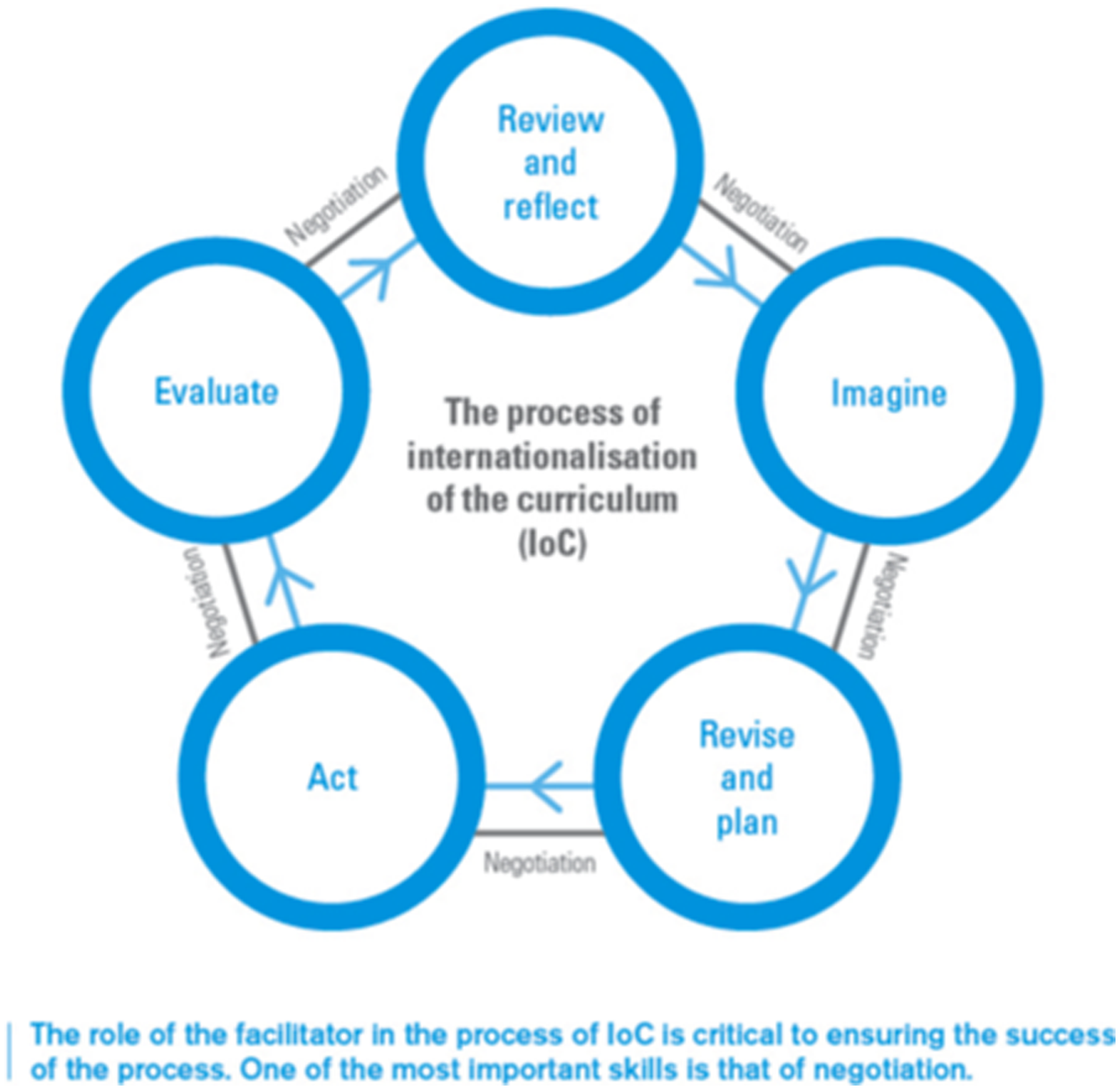
The process of internationalization of the curriculum. Adapted from “Internationalisation of the curriculum” by Betty Leask (a contribution to a workshop on Internationalisation of the curriculum in Action), National Symposium (2011, October 10), Bradley Forum, University of South Australia, City West Campus, North Terrace, Adelaide, Australia.
Discussions around IoC often focus on intercultural competence because it helps to broaden the knowledge, skills, and ability of students to value cultural difference (see Fitch and Desai, 2012; Freeman et al., 2009). Intercultural competence refers to “a dynamic, ongoing, interactive self-reflective learning process that transforms attitudes, skills and knowledge for effective communication and interaction across cultures and contexts” (Freeman et al., 2009, p. 3). Developing students’ intercultural competence equips them with the “knowledge, skills and attitudes required for effective communication and interaction with individuals from other cultures” (Paige et al., 1999, p. 50). This is achieved by exposing students to understandings of other cultures and developing the skills required for interacting with people from different cultures including “the ability to communicate effectively and appropriately in intercultural situations” (Deardorff, 2006, p. 247, cited in Fitch and Desai, 2012, p. 63).
Promoting intercultural competence alone does not translate into an internationalized curriculum (see Leask, 2009, 2011; de Wit, 2011). Leask (2009, p. 209) posits IoC requires “the incorporation of an international and intercultural [emphasis added] dimension into the content of the curriculum as well as the teaching and learning arrangements and support services of a program of study”. Therefore, “an internationalised curriculum will purposefully develop the international and intercultural perspectives [skills, knowledge, and attributes] of all students” and staff (Leask, 2011). IoC requires a critical understanding of the local in the context of the global and vice versa. In the case of journalism, different “journalism cultures” exist locally and globally. To prepare students successfully for careers in journalism, they need to understand how journalism works at both local and global levels. Furthermore, they need to understand how local and global journalism cultures interact to shape and/or reinvent professional practices.
This means tertiary educators seeking to internationalize the curriculum face the challenge of designing a program of study which:
broadens knowledge and understanding of the local relative to the global; fosters a greater awareness of an increasingly diversified student and staff cohort; embeds skills and experiences to enable interaction across culturally diverse settings; and develops reflective skills that can help challenge the habits and assumptions that inform attitudes towards learning and professional practice.
In summary, effective IoC requires an understanding of how a program of study in a particular university contributes to the wider discipline and how it offers an original contribution to the field of study. This involves an analysis of course content, modes of learning and teaching and knowledge construction and professional practice within the broader context of the discipline.
The Disciplinary Context
A number of scholars have expressed discontent about the failure of the journalism curriculum to capture diverse issues of global concern, such as the inability to acknowledge or understand non-Western journalistic practices, cultures, and traditions (Hafez, 2009). In fact, journalism is often referred to as “an Anglo-American invention” (Chalaby, 1996, p. 303). Although the Anglo-American ideals of journalism may have influenced the origins of other forms of journalism, Wasserman and de Beer (2009, p. 428) suggest the “dominant Anglo-American view of journalism is being challenged by studies showing up the gap between theory and practice”. They also insist that the exclusion of some areas of the world (e.g., Africa) in the way journalism is taught and practiced has diminished intellectual efforts to map global media models.
The dynamic interplay between the international and the intercultural within local and global settings plays out differently in different disciplines. For example, programs preparing nurses or pharmacists are “more likely to focus on the development of socio-cultural understanding” but for an engineer, emphasis could be on developing an “understanding of the global and environmental responsibilities and the need for sustainable development” (Leask, 2005, p. 119). Given the different professional practices in various countries, including industry responses to globalization, Fitch and Desai (2012, p. 64) argue that IoC requires education designers to tackle the ethnocentric predispositions of the disciplines. They join the call for an internationalized curriculum that equips university graduates with the abilities to cope with the challenges of a globalised world (see also Harari, 1992; Haigh, 2002; Rizvi and Lingard, 2010; Rhoads & Szelényi, 2011).
It is only quite recently that journalism in Australia has emerged as a discrete discipline in tertiary education. A number of tensions have surfaced as journalism seeks to find its place within the mainstream academy. At the forefront of these tensions is the relative weight given to practice and theory as well as the emphasis placed on local and global issues.
Australia’s first journalism school was established at the University of Queensland in 1921. Since then, almost every University within Australia offers journalism education as either a discrete degree or a major or program of study within a bachelor or masters degree. This rapid growth in journalism programs within Australia and internationally has resulted in scholars paying greater attention to how journalists are educated and trained. Increasingly, the scholarly community is challenging the universalist model of journalism education that draws heavily on Western understandings of journalism because such approaches tend to shape and narrow worldviews, potentially distort journalism history, ignore connections, and intersections which enhance our understanding of global journalism; devalue indigenous knowledge and approaches and privilege English and European languages.
In its prescribed model curricula for journalism education across the world, UNESCO (2007) offered these “universal” goals of journalism education:
A journalism education should teach students how to identify news and recognize the story in a complex field of fact and opinion, how to conduct journalistic research, and how to write for, illustrate, edit and produce material for various media formats (newspapers and magazines, radio and television, and online and multimedia operations) and for their particular audiences. It should give them the knowledge and training to reflect on journalism ethics and best practices in journalism, and on the role of journalism in society, the history of journalism, media law, and the political economy of media (including ownership, organization and competition) . . . It should ensure that they develop—or that they have as a prerequisite—the linguistic ability necessary for journalistic work in their country, including, where this is required, the ability to work in local indigenous or vernacular languages. It should prepare them to adapt to technological developments and other changes in the news media. (UNESCO, 2007, p. 6)
This model highlights issues of language within journalism education. English is the predominant language of education and research in the academic world. As Reagan and Schreffler (2005, p. 116) have noted: “Nowhere is the influence, power and dominance of English more clear than in the academic world . . . as a language of international communication English increasingly dominates academic and scientific publishing, discourse and even instruction” (cited in Wilkinson, 2007, p. 289). Wasserman and de Beer (2009) believe scholars from non-English speaking backgrounds have inadequate opportunities for publishing their research. Wilkinson (2007, p. 290) cautions, however, that the “idea is not to displace the central, vital role of English as a shared communication medium, but to open our dynamic field to broader and more diverse influences.” Therefore, when designing journalism curricula and conducting journalism research, we must keep in mind the impact that language differences could have.
Despite acknowledging linguistic variation, the UNESCO model has been criticized for privileging western approaches to journalism. As Wasserman and de Beer (2009) point out:
The end-result is too often that the Western democratic model of liberal democracy remains the implicit or explicit normative ideal against which journalism in non-Western societies is measured, with media-state relations as a primary determinant of journalistic standards. (p. 431)
The predominance of Anglo-American and Eurocentric approaches to journalism has broad implications. It affects what is taught, what is seen as quality journalism, and how journalism ethics are framed. Furthermore, it has implications for the kind of research that is conducted and seen as valid. Thus, those writing from non-Western perspectives are required to frame their experiences in terms of how they compare with or differ from Western values and practices. The quality of journalism practice and research is evaluated in terms of how far along they have developed towards some Western ideal. This often entails a framework of “talking back” to the West rather than being fully located or understood in the place of origin (Turner, 2012).
Miike (2010) has identified two key weaknesses with this universalist ideology: First, European perspectives have become so entrenched that non-Eurocentric viewpoints are not recognized, thereby essentializing human experiences as if all humans were people of European decent (Miike, 2010, p. 3). Secondly, it “disregards, downplays, or overshadows certain values and elements that have been historically embraced in non-Western cultures” (p. 3). This predilection for a Western journalism tradition is highly problematic in the 21st century where mobile and internet-based technologies are radically transforming journalism. Now, more than ever, all journalistic forms, regardless of their intended audience, are available globally. As Wasserman (2009) observes:
The world today is perhaps more interdependent and interconnected than ever before, thanks in large part to the pervasive role global media play. In a world where the local and the global combine and are interlinked, one could perhaps say that all journalism is global journalism. (p. 22)
Owing to this dissatisfaction with the western model of journalism, there are increasing calls for adoption of regionally appropriate models of journalism, journalism education, and journalism scholarship (Josephi, 2007, p. 303; Papoutsaki, 2011). For example, in Africa, there has been a call for journalistic practices that recognize local cultural traditions.
Miike (2010) advocates for Asiacentric and Afrocentric views of journalism and communication because they are more accommodating and reflective of diverse worldviews. Therefore, we contend, the students might benefit from exposure to both Western and non-Western theories and practices of journalism. Such experiences would enrich rather than limit knowledge and develop students’ understanding of the interdependent and interconnected nature of global journalism. As Wasserman and de Beer (2009, p. 429) point out when talking about their own experience:
While the political-economic context of journalism studies in Africa might differ considerably from some non-Western contexts like Asia, it might correspond with, for instance, Latin America, for both historical [such as the history of colonialism] and economic [as developing regions in the global economy] reasons.
It follows that the theoretical underpinnings of journalism might be better understood by critically examining how local and global journalisms interact and interconnect within a diverse range of Western and non-Western settings (Wasserman and de Beer, 2009, p. 429; see also Dissanayake, 2003; Gordon, 2007; Miike, 2010). The advantages of this approach are highlighted by Papoutsaki (2011), who is critical of how the Western and globalised paradigm has affected tertiary education systems, resulting in “local” cultural knowledge and Indigenous ways of knowing being disregarded or abandoned in preference for the Western ideals. Some scholars attribute the exclusion of local cultural knowledge to the influence of the universal Western models of journalism (see Gordon, 2007; Miike, 2010). Dissanayake emphasizes the importance of understanding Indigenous viewpoints and approaches to journalism and communication more broadly (Dissanayake, 2003, p. 18, cited in Miike, 2006, p. 14).
The need for a more culturally nuanced approach to teaching journalism is supported by studies of journalists’ role perceptions across the world. These studies reveal that journalists do not perceive their roles in a universal way. Role perceptions of journalists are often influenced by the social, political, and cultural structures within the countries in which they practice (see Weaver, 1998a, 1998b). Weaver’s survey of journalists in 21 countries found some similarities in the way journalists perceived their roles, but there were also distinctive differences. Most of those surveyed agreed that journalists conveyed news and information to the public, and provided a forum for public debate. However, journalists reported “much disagreement over how important it is to provide entertainment, to report accurately and objectively, to provide analysis of complex issues and problems, and to be a watchdog on government,” as well as the degree to which journalists felt it was justifiable for them to use contentious reporting strategies (Weaver, 1998b, p. 478).
In summary, universalist approaches to journalism education which have characterized the neoliberal era are no longer acceptable to many scholars. There are clear calls for a more critical and inclusive curriculum, which takes account of the diverse forms of journalism that contribute to the global product. Internationalization, in the context of journalism, requires an extensive reexamination of the content of the curriculum and the research agenda; it requires active acknowledgment of diverse global theoretical, practical, and research perspectives, including local cultural knowledge and recognition of the value of cultural, political, social, and economic differences. As part of the imagine phase in Figure 1, the School of Journalism and Communication took account of these key international debates and concerns in the field as well as the local context of journalism education within the University of Queensland setting.
The Institutional Context
As well as considering the broader disciplinary issues outlined above, the disciplinary team engaged in the process of internationalization also needed to take account of the institutional context. The School of Journalism and Communication at the University of Queensland sits within the Faculty of Social and Behavioural Sciences. Journalism is taught in combination with communication, with specialisms in “Public Relations” and “Communication for Social Change.” “Communication for Social Change” presents communication as more than transferring information and sending messages. It is about listening, responding to, and helping people give direction to their own change, and supporting enabling environments for this change to take place. This philosophy informs the whole school’s approach to journalism and communication education. Notwithstanding this culturally sensitive orientation, the language of delivery of the school is English. This is despite a highly internationalized postgraduate cohort.
Reflections on the Process of Internationalization of the Curriculum
In early 2011, the School of Journalism and Communication at the University of Queensland was approached to take part in the IoC in Action Fellowship project. While ideas around internationalization are prominent in university policies all over the world (de Wit, 2011), this project focused attention on the curriculum and more importantly on what internationalization would mean in particular disciplines. In mid-2011, the Program Leaders and Teaching and Learning Chair in the School of Journalism met to discuss the project with the Fellow and a member of the University’s professional development team. The first meeting focused on responses to a Questionnaire on Internationalization (QIC). The QIC was designed as a prompt for reflection and discussion of the extent to which internationalization was already embedded in the curriculum and shared and individual understandings of what internationalization meant in terms of the content and the approaches to teaching and learning in the programs and courses offered. The QIC certainly prompted extensive robust discussion around what the term “internationalization” meant for us as a School and for the discipline of journalism in terms of orientation, teaching, and research.
Reviewing and Reflecting
Initial discussions pointed to a number of indicators of internationalization within the program. Examples of international theories and case studies embedded in different levels across the program of study were cited. The publication of research in international journals and the high proportion of international conferences attended by staff were also seen as clear indicators of internationalization. In terms of the curriculum, various textbooks produced by international writers were identified. Two core courses, explicitly focused on international journalism and intercultural communication, were seen as another indicator of IoC. Furthermore, it was noted that a large number of staff in the school were either originally from, had worked at, or had obtained qualifications from, international universities. And while the undergraduate student cohort was predominantly made up of domestic students, at post-graduate and research higher degree level, the cohorts were predominantly made up of international students.
As discussion progressed, however, it became clear that many of these indicators of IoC were Anglo-American in concept and English in medium. The textbooks came out of Anglo-American universities using theories and examples populated from these locations. The international journals the team were reading and citing and in which they published were predominantly managed by Western publishing houses. All but a few articles were published in English. The conferences attended by staff were spread around the globe, but were predominantly conducted through English and focused on testing Western theories in different contexts. Furthermore, all programs were taught in English.
Of most immediate concern was the realization that the courses focusing on international journalism and intercultural communication were siloed and not well integrated into the curriculum. The valuable knowledge, perspectives, and experiences of the conveners of these courses were not being drawn upon across the School. Furthermore, while there were many anecdotes of assessment that incorporated non-Western dimensions, it was not clear how widespread this was across the curriculum. Finally, while we had a high proportion of international students undertaking postgraduate and research higher degree studies, and some were engaged in tutoring work, we were not drawing upon their international experiences. Thus, our problem was not the extent to which we were “international” but that this version of being international meant incorporation of Western ideas, values and practices which at best obscured and at worst denied the existence of non-Western values, ideas and practices.
Imagining
This was the most exciting and most challenging phase of the process. During our process of reviewing the journalism curriculum, while we had been able to point to a number of areas where nontraditional or non-Western ideas were apparent and indeed flourishing, on reflection, it was clear that these were not necessarily embedded in the wider school curriculum. In the imagine phase we conducted a more detailed audit of our curriculum and reviewed our teaching practices and educational aims. We sought examples of non-Western content and assessments that allowed or included discussion of non-Western experiences and ideas. We heeded Couldry’s (2007, p. 249) warning that internationalizing should not be a process of “de-nationalizing” or “de-Westernizing.” It should be achieved by producing new discourses that have global reference points. We imagined and developed a strategy of “critical de-westernization”—the embedding of non-western approaches to journalism into the curriculum and the development of a critical discourse with global reference points.
This became a whole-of-school approach that emphasized IoC as a continual development cycle, in which critical reflection as a team and imagining new possibilities was an essential component, and there were many changing and shifting goals, rather than a single goal. This is consistent with Leask’s “cycle” in Figure 1.
One of our first goals was to develop a common understanding of what internationalization meant within the school. Conversations and meetings we subsequently undertook helped to develop a language and a plan to give voice to the school’s understanding of internationalization: namely fostering a critical understanding of the diversity of journalism through adopting a critical de-Westernization agenda. This approach aligned with the ideology of the communication programs, which emphasize communication for social change and highlighted the importance of the local context within which IoC occurs.
Our audit had revealed that critical de-Westernization was well embedded in some courses, yet other courses still predominantly drew on Anglo-American theories, constructs, and approaches to learning. So another goal was to ensure a more coherent, planned, and purposeful approach to IoC, independent of individual lecturer’s attitudes and understandings. This resulted in a restatement of our education aims in terms of knowledge, performance (doing), and being (see Barnett & Coate, 2004). Therefore, we aim to promote a transformative educational experience for journalists and communicators of the future, who are able to work across diverse intercultural contexts. Graduates of our program will be reflective practitioners who are:
mindful of their habits and assumptions; capable of dealing with complex problems across different professional and cultural settings; capable of positioning their approaches within the global and local contexts; capable of ethical reasoning that is mindful of diversity and changing socio-cultural settings; accountable for their actions; responsive to change; capable of evaluating and adapting practice to respond to changing contexts; and committed to lifelong learning.
Furthermore, the School developed a plan of action identifying a number of initiatives, each of which will contribute to achieving these goals through embedding and synthesizing critical de-Westernization within the School’s curriculum. This plan has allowed us to achieve greater coherence in ongoing projects. Two major projects have evolved: One around Critical De-Westernization (described above) and the other around Cultural Inclusivity. Two leaders have been appointed to these projects to facilitate School-wide discussions and conduct research (on student and staff attitudes, approaches, and knowledge) into these areas.
The Cultural Inclusivity Project will help us to better understand the student and staff imaginary. Its overarching aim is to equip students and staff members to successfully engage with the culturally diverse environment that we live in and to successfully communicate with people from different ethnic communities including indigenous communities. We seek to foster greater understanding of students and staff of indigenous issues, recognizing the importance and contribution of Indigenous Knowledge as an emerging discipline and embedding Indigenous Knowledge into the curriculum so that it is considered and incorporated alongside traditional discipline content. Hence, our focus on IoC as Critical de-Westernization and the school’s unique orientation towards Communication for Social Change have resulted in a focus on the incorporation of Indigenous Knowledge and experience into our journalism curriculum. This approach will offer critical insights into different ways of thinking about and doing journalism. It will ensure students and staff challenge some of the assumptions and habits underpinning their understandings and experiences of journalism. It will allow us to address complex social and communication problems from a range of perspectives – Indigenous and non-Indigenous.
Conclusion
Treating internationalization as critical de-Westernization has many benefits to the University of Queensland’s School of Journalism and Communication. It helps us to articulate and position our approach and contribution to journalism education. It enables students to position local issues relative to global issues facing journalism and vice versa. This has conceptual benefits as it forces students to question some of the habits and assumptions they bring to their learning and their lived experiences of journalism. In terms of employability, this approach also has benefits. Many of the School’s graduates will, in the first instance, be looking to obtain employment in the local area. Therefore, it is important students understand the local environment in order to be prepared for the local job market, whilst being aware that their work will also have a global audience. Furthermore, as journalism as a practice and a product is global, many of our graduates will obtain employment nationally and internationally. It is therefore important that the School’s curriculum reflects this mix of local, national, and global environments.
One of the important insights for us has been that critical de-Westernization does not mean replacing Western with non-Western ideas, practices, and values. Rather we have interpreted it to mean developing awareness of the diversity of approaches and understandings of journalism as well as helping students to understand how their understanding of journalism affects what they do and how they feel. We will achieve this by expanding course contents, changing assessment, reviewing language, and embarking on a process of professional development through staff development seminars around Indigenous issues and pedagogies, promoting a greater mindfulness of the assumptions underpinning our own scholarly activities and fostering champions among staff and students.
The project of critical de-Westernization is a continuous process that entails a shift in focus. It requires ongoing work around understanding the way the discipline has been shaped, what it takes for granted, and what it obscures because of this. For our School, it became clear that the dominance of the Western notions of journalism in regard to journalism teaching, research and production (the social imaginary within the discipline) has affected tertiary education systems to the extent that localized (non-Western and local) cultural knowledge (as well as Indigenous ways of knowing) have been disregarded or abandoned in some university education curricula and undervalued in others.
Recognizing this also meant that we were able to open up discussions within the School and reflect upon both the practical ways we could Internationalize our Curriculum but raise awareness of the University of Queensland’s unique contribution to journalism education and what it might contribute to understanding journalism locally and globally.
The QIC facilitated a reflexive engagement with what internationalization means to Journalism at the University of Queensland. We discovered internationalizing the curriculum requires much more than reviewing the program of study and redefining learning outcomes, experiences and activities. It requires a holistic approach (Taylor, 2004) to design a program of study that takes account of international, global, and intercultural dimensions of the discipline and journalism education. This means IoC is much more than what people learn; it takes account of how people learn and their attitudes towards learning. This process helped us to foster an institutional imaginary around how academics understand, implement, and give voice to internationalization within the disciplinary context.
Entwined with the institutional imaginary is a student imaginary around how students see themselves and how this understanding shapes their thinking, actions and learning. As part of the Cultural Inclusivity Project, we are designing a survey instrument to investigate these issues. Data derived from this survey, combined with University evaluations, will provide us with rich insights into the student imaginary. These data will help us to make informed decisions about the suitability of the current learning experiences and their capacity to encourage students to challenge the habits and assumptions they bring to their learning. This systematic approach to curriculum design will help us to promote lifelong learning through a process of critical reflections (Taylor, 2004, p. 29). It is hoped that these targeted strategies will help us to design rich learning experiences that engage students as whole persons and develop them as critical individuals.
This process of IoC is not complete. We have made some decisions and some changes but we are also still imagining what our curriculum might be. We know that this ongoing process will require constant negotiation and evaluation. Furthermore, given the dynamic nature of journalism, our Internationalization of Curriculum process might never be complete. Ultimately, its success will be measured by the success of our students and their capacity to work productively and creatively within a globalised world.
Footnotes
Acknowledgements
The authors would like to acknowledge and thank Betty Leask and Wendy Green who assisted us on this project. Furthermore, we thank the reviewers whose comments and insightful feedback have helped to shape and develop this work. We also acknowledge Betty Leask for her patience and insightful guidance in structuring and finalizing this article.
Declaration of Conflicting Interests
The author(s) declared no potential conflicts of interest with respect to the research, authorship, and/or publication of this article.
Funding
The author(s) received no financial support for the research, authorship, and/or publication of this article.