




Abstract
One might argue that an Indian student entering higher education is faced with a critical question—Where to study, in India or abroad? With a gross enrollment ratio of around 20% in the tertiary sector, only one in five in the 18 to 23 age group of a 140 million eventually gets to answer the question. But those who do, and whose numbers are rapidly increasing, pursue higher education abroad in response to a range of choices presented not only by increasing domestic provision in higher education but also through increased international collaborations (for instance, through branch campuses) that Indian students can avail of without leaving the country. As a result, this presents problems for characterizing the Indian student pursuing higher education abroad. By placing emphasis on the multiple transitions across spaces and tensions between “controlled” and “emergent” mobilities, this article sets out a conceptual framework with which to understand potential pathways into higher education, so that policy makers and educational providers can better understand international mobility in the Indian higher education sector.
Background
The transition to higher education is an important turning point in the life of secondary school students (Christie, 2007). Within the Indian context, this transition is particularly significant, especially only it is estimated that the Gross Enrollment ratio for tertiary education is around 20% (Government of India, 2011). In other words, only one in five students in the 18 to 23 age category actually enters higher education (see Table 1). The table reveals not only gender differences in Gross Enrollment Ratio but also unequal levels of access, especially for those who are from the lowest castes 1 in Indian society.
Student Enrollment in Domestic Higher Education Institutions in India.
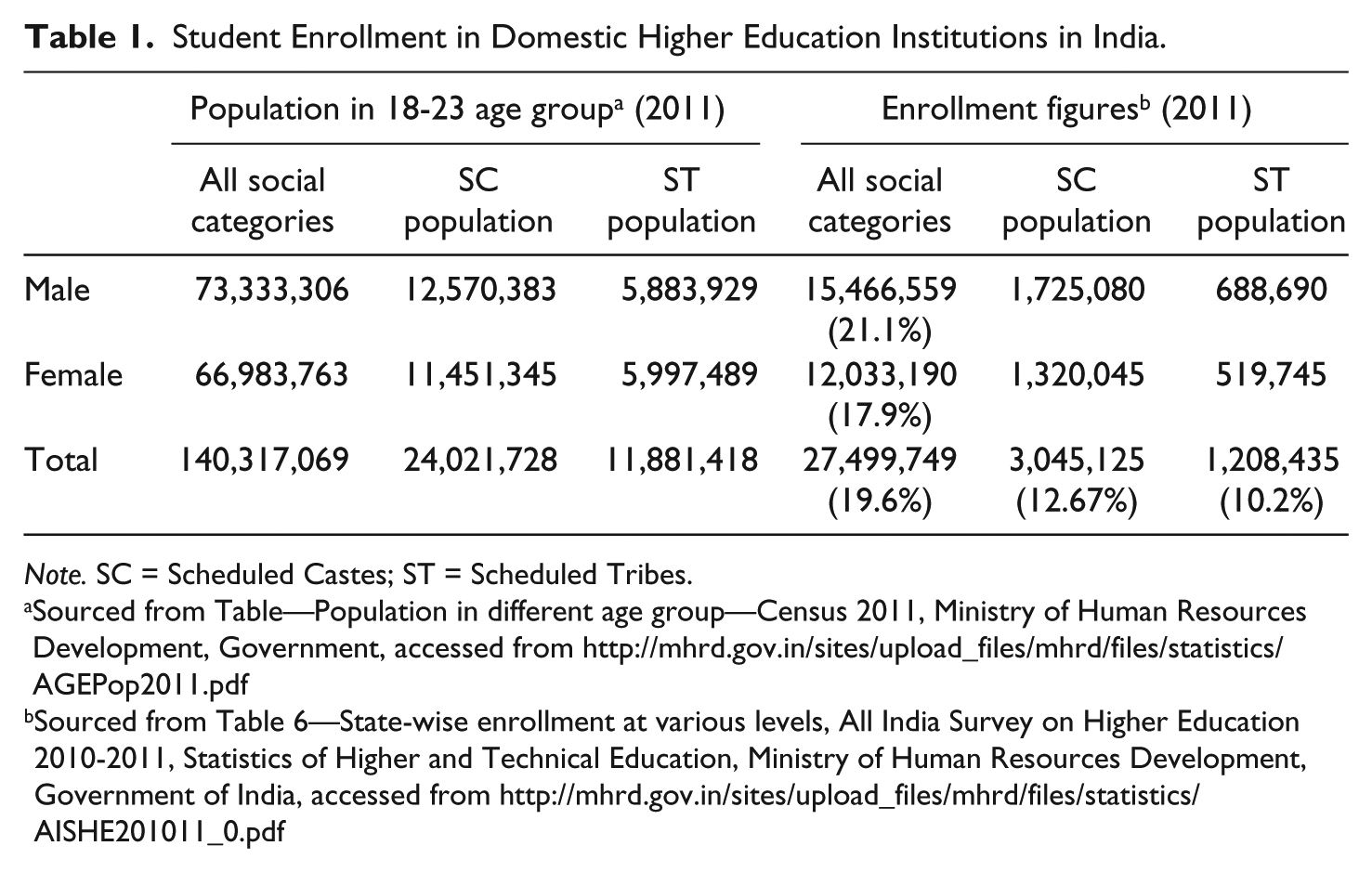
Note. SC = Scheduled Castes; ST = Scheduled Tribes.
Sourced from Table—Population in different age group—Census 2011, Ministry of Human Resources Development, Government, accessed from http://mhrd.gov.in/sites/upload_files/mhrd/files/statistics/AGEPop2011.pdf
Sourced from Table 6—State-wise enrollment at various levels, All India Survey on Higher Education 2010-2011, Statistics of Higher and Technical Education, Ministry of Human Resources Development, Government of India, accessed from http://mhrd.gov.in/sites/upload_files/mhrd/files/statistics/AISHE201011_0.pdf
Those who do make the transition to higher education find themselves having to engage with two key aspects: where to study and how. Within this cohort of tertiary-level students, some Indian students travel abroad for higher education. Starting with tens of thousands who were globally mobile in the 1960s, today around 200,000 Indian students study abroad (Agarwal, 2011). The United States continues to be the most popular destination attracting 96,754 Indian students in 2012-2013 (Institute of International Education [IIE], 2013), although other top destinations have fluctuated in preference for Indian students over the last decade (see Figure 1). The United Kingdom, for instance, although currently the second most popular destination for Indian students, has seen its numbers fall from 18,535 in 2010-2011 to 10,235 in 2012-2013 (Sellgren, 2014). Also, India is one of the top countries of origin of international students. In 2011, 723,000 Chinese and 223,000 Indian students accounted for about 45% of all students carrying out tertiary education worldwide (Organisation for Economic Co-Operation and Development [OECD], 2013).

Top six destinations for Indian students.
Interestingly, while the number of Chinese students pursuing international education abroad has been rapidly increasing, the number of Indian students pursuing higher education has been stabilizing since 2008 around the 200,000 mark (see Figure 2). This is interesting because by 2025 the 15 to 24 age group population in India is projected to rise rapidly to 245 million (from its current value of 232 million), whereas in China, the young population will drop down to 172 million (from current value of 212 million; Agarwal, 2011; UNESCO, 2014). What might this mean? Does this point to better opportunities to pursue “internationalization” without leaving the country and at a fraction of the cost? Now, more than 140 collaborations are in place between domestic and global higher education institutions (HEIs) to provide education services in India (Dhar & Bhushan, 2008) and much recently, particularly in the last decade, four branch campuses have been set up across India. What about domestic modes of higher education provision? With serious gaps between supply and demand, the Indian central government has set out an ambitious plan to set up 800 new universities and 40,000 new colleges, so that the Gross Enrollment Ratio rises to 30% by 2020 (British Council, 2014).
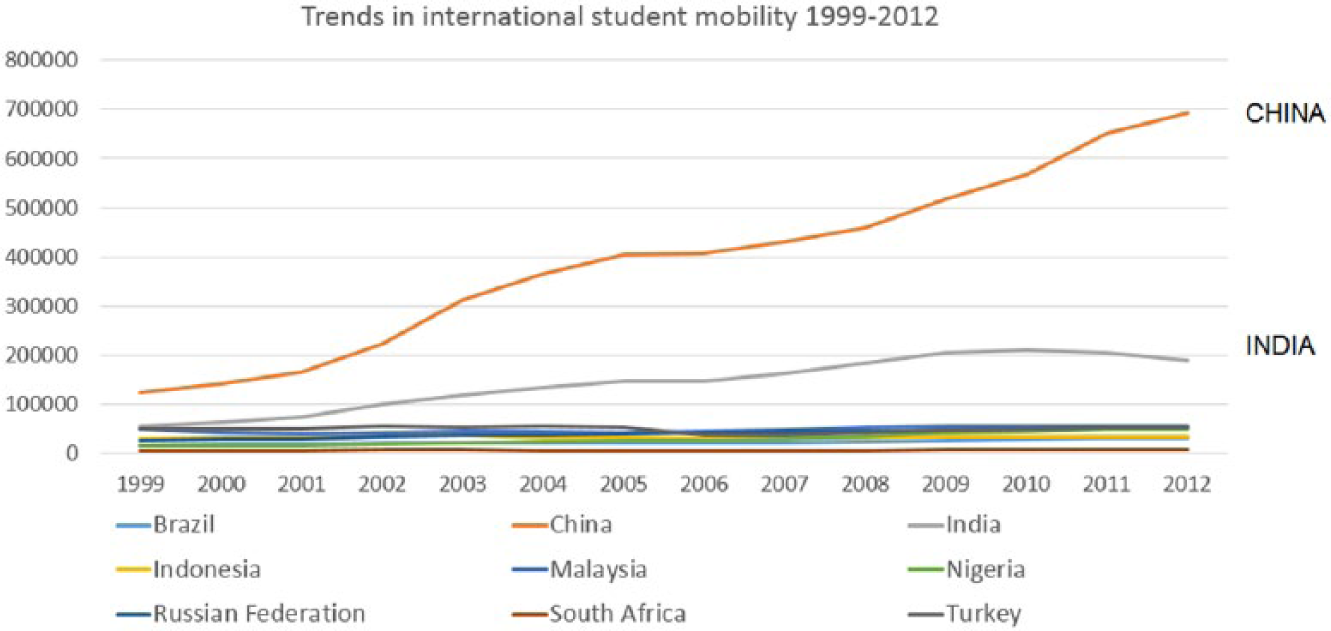
Trends in international student mobility 1999-2012.
Within this rapidly shifting context and where there is a wide range of choices of both domestic and transnational modes of higher education provision, it is useful to characterize the Indian student who pursues higher education abroad. Each of the choices that are presented to Indian students is geographically situated and can take the form of a number of pathways. For instance, many students decide to pursue higher education locally, either voluntarily or by constraint. Also, there exist a range of world-class institutions in India (such as the Indian Institutes of Technology [IITs] and the Indian Institutes of Management [IIMs], which are based in different cities across India), and some students are able to pursue their educational career in these institutions within India, moving within and between states. But it might also be that some students are pursuing higher education globally through a series of transitions, that is, from a domestic HEI, to a transnational HEI and then to global HEI. So how might one conceptualize such pathways in a complex setting such as the Indian context, marked by diverse provisions of higher education and where there are also differences in cultural and historical influences?
In response, the structure of this article is based on the approach developed by Jabareen (2009) in developing conceptual frameworks. First, core concepts significant for this discussion are identified through a rigorous and systematic review of literature and a deconstruction of these concepts is then carried out. Following this, a synthesis of concepts and their attributes is undertaken to outline pathways for internationalization of higher education for Indian students entering the tertiary education age group (18-23 years). The article concludes by outlining areas of research that might be carried out in the future.
Identifying and Deconstructing Core Concepts
Contemporary understandings of the “internationalization” agenda of Indian students is largely under researched except for studies that have looked at experiences of migration for Indian students in destination countries (Sondhi, 2013), rationales for international mobility for Indian students from certain regions in India (Yakaboski, Sheridan, & Dade, 2014) and the impact of immigration policies in destination countries on the enrollment figures of Indian international students (Hawthorne, 2014). This lack of academic discussion on Indian students could be because of a number of reasons.
First, much attention has been paid to lack of domestic higher education provision and how with national and international intervention such issues might be addressed (British Council, 2014). Second, Indian students are seen as one of many potential recruitment markets and thus largely being viewed by global HEIs as aggregate flows whose levels need to be maintained or enhanced. Within this strand, it is not clear why in some years there are more Indian students arriving at these destinations and whereas at other periods, numbers are low. Placing of mobility restrictions in destination countries (such as tighter visa controls) might be one factor but what are not being discussed are the challenges and constraints faced by Indian students in pursuing higher education globally. Third, it is not clear how transnational collaborations and recent setting up of branch campuses have affected/will affect the nature of internationalization agenda of Indian students. As a result, it might be that many may not have to leave the country’s borders to experience/consume international higher education. Equally, there might be others who will see these new “transnational spaces” as intermediate, transition points which might permit them in the end to pursue higher education abroad.
In response, an understanding of student mobility in the Indian context, its key determinants, and how it might shape what students want/get to do become important to explore. Equally, to pursue internationalization, Indian students are not just engaging with the question of whether mobility is possible or not. There is also the need to understand how domestic and transitional higher education spaces in India are configured that might present opportunities and/or constraints for Indian students to engage with the internationalization agenda. Thus, the two concepts identified from the review of literature that might offer a better understanding of how the internationalization agenda is pursued by Indian students are (a) student mobility and (b) spaces of higher education in India.
Concept 1: Student Mobility
The nature of mobility accompanying transitions to higher education in different contexts has been studied in considerable detail. For instance, Cantwell, Luca, and Lee (2009) outline different methods that have been used to study student mobility: (a) based on the data on aggregate flows (IIE, 2006; OECD, 2007); (b) by examining the experiences of students after arriving at the destination country (Deumert, Marginson, Nyland, Ramia, & Sawir, 2005; Lee & Rice, 2007); and (c) based on the motivations and push–pull factors eventually shaping where students get to study abroad (Li & Bray, 2007; Mazzarol & Soutar, 2002).
Others have looked at the rationale(s) for student mobility. For instance, (a) student mobility as an “economic phenomenon,” and a pathway to skill building where the opportunities for entering the global “highly-skilled” labor market and to be subsequently employed either in developed nations or by global corporations; (b) student mobility as a product of globalization where the flow of students is both facilitated and regulated by the nature of political relationships between (groups of) countries (Findlay, King, Stam, & Ruiz-Gelices, 2006; King & Ruiz-Gelices, 2003). Closely linked to which, Smith (2009) talks of “new student geographies” and in how student mobility brings about socioeconomic impacts both in the developed (Pickren, 2008) and developing economies (Sabri & Ludin, 2009). Here, it is conceived as a means to experience and/or pursue alternative work-styles and/or lifestyles (Findlay et al., 2006; King & Ruiz-Gelices, 2003) involving family “investment” in the higher education of their children in acquiring cultural capital (Waters, 2006). Such practices by middle-class families have been argued to “exclusionary” whereby the comparative advantages over children from working-class backgrounds are reproduced across generations (Ball, 1993, 2003; Bourdieu, 1996; P. Brown, 1995; P. Brown, Halsey, Lauder, & Wells, 1997; Ehrenreich, 1989; Waters, 2006). This brings out a pattern in global mobility reflecting the internationalization of cultural capital linking migration for learning (the declared objective) with learning to migrate (the hidden objective). The interface between the “declared objective” and “the hidden objective” is also captured in the work by Baas (2010), who looked at Indian students in Australia through the lens of three inter-related concepts: “imagined mobility” (how Indian students construct notions of transnational mobility following higher education in Australia), “arrival points” (key milestones as students move between the “migration for learning” and “learning to migrate” phase), and “in-betweenness” (different processes and transformations that the students engage with while becoming transnationally mobile).
There is also literature that suggests that some of this global mobility is a-directional, that is, their objective for mobility is not place-bound but an “eternal” accumulation of various forms of capital, thus creating a “transnational capitalist class” (Sklair, 2001; Waters, 2007). But when this “transnational capitalist class” that relies strongly on established networks or “social capital” returns to their original location, it recreates an advantageous community that is separate and distinct from other disadvantaged groups (Butler, 2003; Waters, 2007). This again brings about the possibility of reproducing disadvantage over children from poorer backgrounds and thus raises the question of the possible impacts choice of mobility has not only on the student adopting it but also on society.
In this article, I argue that the approach to internationalization adopted by Indian students is the result of a complex inter-relationship between two attributes of mobility. First, “controlled mobility,” which can be understood as an interface between “knowledge” and “society” and which in some sense reflects the reproduction of (dis)advantage across generations; for instance, the pathways open to a student born in an upper caste family or in a family of business. Second, “emergent mobilities” in response to new forms of (dis)advantage, students are able to carry out mobility previously considered not possible; for example, pathways open to a student from a working-class background and whose father has been working as a semi-skilled laborer in the Middle East for the last few decades.
Within “controlled” mobility, reproduction of (dis)advantage does not take place merely along class lines but also along caste, gender, religion, local/regional customs and practices. All of these in some sense shape a differential access to education, which in turn shapes pathways to mobility for Indian students. This is explained by cultural reproduction theory, which states that students from advantaged backgrounds will reproduce their “advantage” with respect to students from disadvantaged backgrounds by drawing on the possession of different forms of capital in addition to economic capital (Berggren, 2006; Bourdieu, 1992). In this regard, Bourdieu (1973) talks of “cultural capital,” which includes among many things academic qualifications, linguistic competence, purchasing/reading books, theater/museum/concert attendance, and not only that the access to which is shaped by which social class one belongs to but also that the access to cultural capital is reproduced across successive generations within various social classes (Bourdieu, 1973; R. Brown, 1973). Bourdieu (1997) further argues that to access “cultural capital,” one not only needs to have economic capital but also “social capital,” which includes a network of family and friends, connections to those with different forms of “capital”—social, cultural, and economic (Berggren, 2006; Bourdieu, 1997). In this regard, it is argued that working-class students fail to understand the workings of the higher education system unlike middle-class students, because they have not inherited adequate linguistic competence to understand “academic language” (Bourdieu, Passeron, & de Saint Martin, 1994) nor have their family friends experienced necessary “cultural capital” (Hutchings, 2003).
The relationship between “knowledge” and “society” has historically been seen as significant in explaining and in some cases predicting human behavior particularly in the Indian context. There is as much evidence of governments systematically collecting information of its populace in ancient Rome (Burke, 2008) as much as there are instances in 19th-century India. For instance, the first population census in India was carried out in 1872. At that time, census operations were seen as necessary and “central technique of social control” without which the Indian state could not effectively govern its populace (Appadurai, 1993). As caste identity was seen as central to understanding “Indian-ness,” caste became an important basis for categorizing Indian society (Jassal, 2001). Although such social categories or “collective representations” vary with context (for instance, the caste category will have particular relevance to India), one can generally conclude that such categorizations have the potential to reproduce how successive generations within particular categories are classified (Burke, 2008; Lamo de Espinosa, Gonzalez Garcia, & Albero, 1994, pp. 205-226; Worsley, 1956). Social class is another important category or “collective representation” that affects how people in particular classes might get access to various resources such as health and education. For instance, works by Douglas (1964) and Jackson and Marsden (1962) bring out the relationship between social class and educational opportunity (R. Brown, 1973).
Thus, there are arguments that mobility within society is in fact “controlled,” to borrow Bourdieu’s (1973) term.
. . . the controlled mobility of a limited category of individuals, carefully selected and modified by and for individual ascent, is not incompatible with the permanence of structures, and . . . it is even capable of contributing to social stability in the only way conceivable in societies based upon democratic ideals and thereby may help to perpetuate the structure of class relations. (p. 71)
Within “emergent mobilities,” the focus is on actions taken by individuals/groups to pursue mobility for themselves by making single or multiple transitions across local, national, and global spaces. Therefore, the questions “What is seen as a roadmap for mobility? What does one hope to achieve by following particular roadmaps?” are raised. These arguments are concerned with the possibilities and constraints individuals/groups face while trying to be “mobile” within existing social structures in society. For some, it is conceptualized as a “project of modernity” where students move away from their home and immediate environments to (re)construct a unique, individual identity for themselves (Christie, 2007; Giddens, 1991). By focusing on creating “autonomous” individuals with limited links with tradition and/or family, the notion of “mobility” can be seen as part of a “neoliberal” agenda (Christie, 2007; Mitchell, 2003). For instance, the use of education by disadvantaged groups as a means to empower themselves and to move to a less-disadvantaged position in the social structure (and which will then cease to be permanent). This is closely linked to Freirian philosophy, where individuals and communities can take control of decisions that affect their lives (Freire, 1968). This justification is also linked to a post-structural view that emphasizes the transformative potential of social movements within society (Mitlin, Hickey, & Bebbington, 2007), which would eventually dismantle existing social structures.
In the wider literature on “emergent mobilities,” others have talked about student mobility as a means to experience and/or pursue alternative work-styles and/or lifestyles (Findlay et al., 2006; King & Ruiz-Gelices, 2003), which involves family “investment” in the higher education of their children in acquiring cultural capital (Waters, 2006, 2007) and global mobility reflecting the internationalization of cultural capital and the linkage of migration for learning (the declared objective) with learning to migrate (the hidden objective). Drawing on this, Park (2009) in a study of international mobility of Korean students uses the “push–pull” criteria to understand the dynamics of choice making by students keen on pursuing higher education abroad. The “push” factors, also referred to as the “driving force” factors, are what students consider to be lacking in their home country and as a result of which they have decided to pursue studies abroad. The “pull” factors, however, also referred to as “directional factors,” reveal why students are attracted to higher educational institutions in particular contexts such as the United Kingdom, United States, and so on. But a sharp distinction between “push” and “pull” factors may not be helpful as the debates shaping the broad framework discussed above seem to suggest.
While these dimensions of mobilities are important in developing potential pathways, this has, however, not been engaged with the Indian context. In particular, the variations and combinations of these factors in affecting the perceptions of students and their families lie at the center of an analytical strategy to unpack the dynamics of student decisions on choosing (or not) particular educational pathways.
Concept 2: Higher Education Spaces in India
Higher education in India is delivered through an elaborate institutional framework consisting of a range of universities and colleges. As “education” is a subject in the “Concurrent List,” both central and state governments have legislative powers on various matters relating the delivery of education although the power to coordinate and determine quality standards rests with an agency of the central government, the University Grants Commission (Stella, 2002). Students in higher education in India would have generally followed the 8 + 2 + 2 + 3 model—that is, 8 years of elementary education (in some states, this is divided into 5 years of primary education and 3 years of upper primary or middle school education), 2 years each of secondary and senior secondary education, and then 3 years of university education (4 years, if pursuing a degree in a professional course such as engineering or 5 years if pursuing a medical or architecture degree). In all, 3 National Boards (Central Board of Secondary Education, Council for Indian School Certificate Examinations, and the National Open School) and 34 State Boards specify the curriculum and examination content for Grades 10 and 12.
However, there remain critical challenges in providing access to higher education across India. In 2003-2004, among a total population of 122 million in the 18 to 24 age group, only around 10 million students had enrolled in higher education in India, including 65,525 for doctorate, 0.8 million for postgraduate studies, 8 million on general graduate courses (arts, science, and commerce), and the remaining 1.1 million in technical graduate courses (engineering, medical, etc.; Naidoo, Bhushan, & Scesa, 2008). In the next decade, India is to overtake China in having the largest population in the tertiary sector, and in response, the Indian central government plans to add 14 million places for higher education (British Council, 2014). As a result, the central government is currently working on (a) increasing the number of domestic HEIs across the country, (b) involving global HEIs to provide education services to the host population.
I argue in this article that higher education in the Indian context can be understood as a configuration of “spaces of destination/transition” and can be categorized into two types (see Table 2): (a) domestic spaces and (b) transnational spaces offering virtual (e.g., distance learning) or partial internationalization (e.g., branch campuses).
Higher Education Provision Across Different States in India.

Figures for domestic higher education provision derived from Statistics of Higher and Technical Education, Ministry of Human Resources Development, Government of India, accessed from http://mhrd.gov.in/sites/upload_files/mhrd/files/statistics/StatHTE_2008-09_0.pdf
Four branch campuses are currently operating in India—Leeds Metropolitan University (United Kingdom) branch campus in Bhopal, Madhya Pradesh (started in 2009); Lancaster University (United Kingdom) branch campus in Gurgaon, Haryana (started in 2009); Schulich School of Business of York University (Canada) branch campus in Hyderabad, Andhra Pradesh/Telangana (started in 2010); Strathclyde Business School (United Kingdom) branch campus in Noida, Uttar Pradesh (started in 2011).
Figures for distribution of institutions having foreign collaboration are based on Dhar and Bhushan (2008).
Domestic spaces
HEIs within the domestic space can be broadly categorized into universities and colleges. Central and state universities (public or private funded) designated by Acts of Central and State government legislations, respectively, constitute two thirds of all university-level institutions in India. For example, central universities include the University of Delhi, Jawaharlal Nehru University, and so on. The University of Kerala, the University of Madras, and so on, for instance, are public-funded state universities, and private-funded universities include Birla Institute of Technology Pilani, Manipal University, and so on (Agarwal, 2007; University Grants Commission, 2006). These central and state universities could either be (a) unitary universities that are based in a single campus, public or private funded, which award undergraduate, postgraduate degrees, and are research “active,” for example, the University of Hyderabad and Jawaharlal Nehru University; or (b) affiliating universities that are also based in a single campus with departments that offer undergraduate postgraduate degrees and which are usually public funded. However, there are a number of colleges (offering undergraduate and/or postgraduate degrees) that are “affiliated” or attached to affiliating universities—around 50% of universities in India are of the affiliating type where colleges in a particular state are generally attached to one of the affiliating universities within that state and some of the key affiliating universities include Osmania University and Bangalore University (Stella, 2002; University Grants Commission, 2006).
In addition to central and state universities, there are other types of institutions that have been accorded the status of universities as they are well regarded for their excellence in teaching and research and include (a) “institutions of national importance” (currently numbering 33), which are designated through Acts of Parliament and which included, for instance, the IITs, the IIMs, and so on; (b) “deemed-to-be-university” (or “deemed university”; 128 in number) where such institutions have been conferred the status of a university because of its long-standing contribution to knowledge and scholarship, for instance, the Tata Institute of Social Sciences in Mumbai, Birla Institute of Science and Technology, Pilani, or the School of Planning and Architecture in Delhi.
In addition to universities in the domestic higher education space, there are more than 36,000 colleges (including teachers training institutes and polytechnics) which are an important component of the Indian higher education system. Colleges can be classified based on a range of criteria (Educational Consultants India Ltd [EDCIL], 2009; Stella, 2002): (a) funding patterns—university colleges, those which are managed by public-funded, government colleges, which are managed and funded by state governments; (b) degree of autonomy to innovate the curriculum, affiliated colleges are linked to affiliated universities discussed above; (c) off campus and recognized centers, depending on how and where the courses are delivered.
Transnational spaces
It is interesting to note that around 143 collaborations are in place between domestic and global HEIs to provide education services in India and much recently (Dhar & Bhushan, 2008), particularly in the last decade, 4 branch campuses 2 have been set up across India. Although both domestic and transnational spaces exist in India, the questions of how might an Indian student navigate through these various choices that are presented to them and how do they eventually pursue international higher education are raised. For instance, financial consideration might be a factor as there is a considerable variation in costs across these HEIs (see Table 3).
Comparing Costs in Higher Education in India.
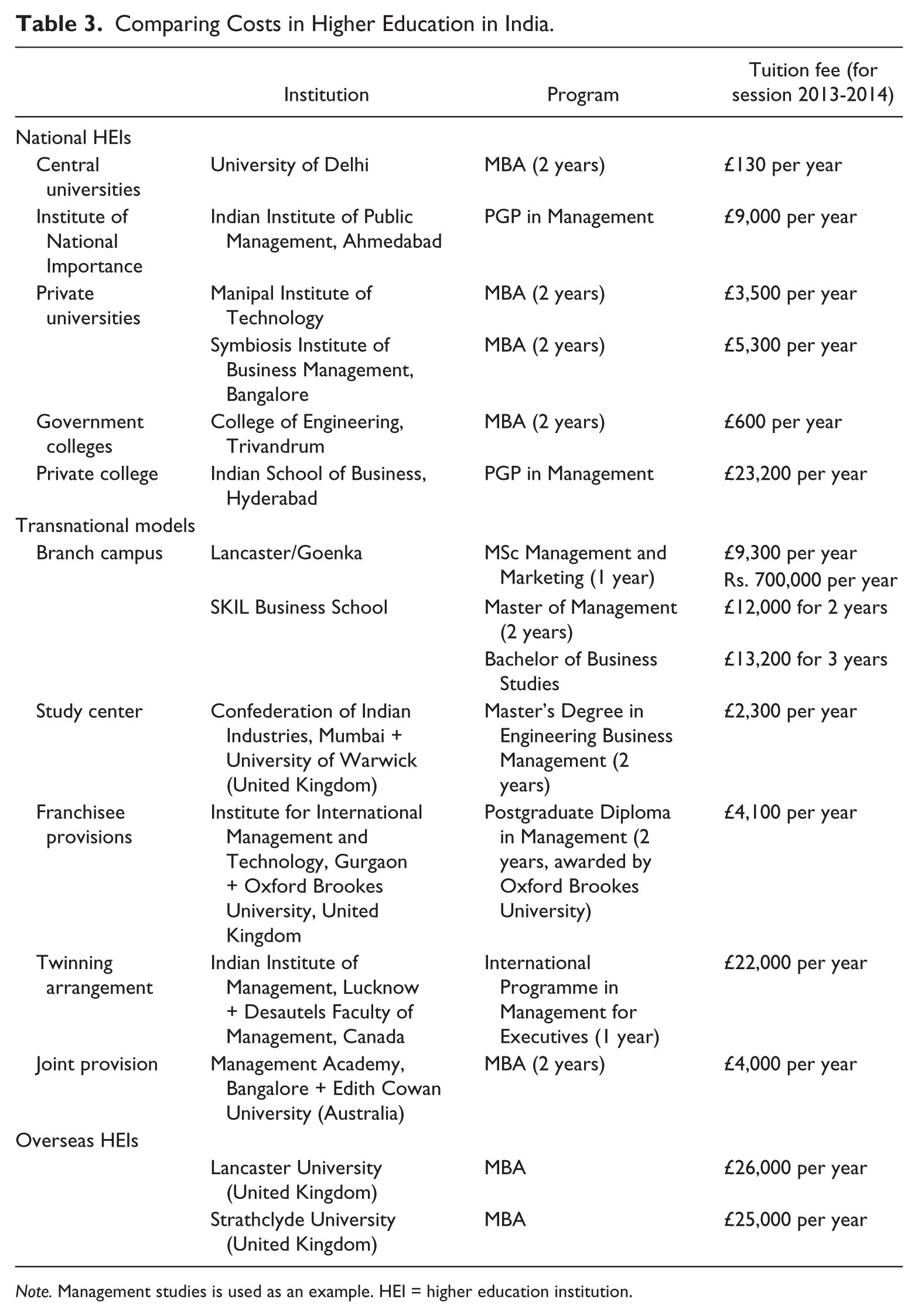
Note. Management studies is used as an example. HEI = higher education institution.
The dominant modes of transnational higher education provision are as follows (Dhar & Bhushan, 2008): (a) collaboration through a study center, where a local institution (the study center) is recognized by an overseas HEI for the delivery of a range of programs. The programs offered in the study center are designed and validated by the overseas HEI, although the latter do not get involved in course delivery; (b) collaboration with franchisee provisions, where a local institution (the franchisee) in India is authorized by an overseas HEI (the franchiser) to deliver a program under the latter’s supervision. The franchisee usually operates under the franchiser’s brand name, and uses its curriculum and evaluation methods; “Where the whole, part or discrete modules of a course which is validated for delivery at the University is delivered by academic staff not employed by the University at premises not owned by the University” (Dhar & Bhushan, 2008, p. 101); (c) collaboration with twinning arrangements: An Indian student enrolled through this arrangement completes one part of the studies in the overseas HEI and the remaining in the local HEI in India; (d) collaboration with Joint Provision: also referred to as “link programs” where an Indian student has the opportunity to earn dual degrees, that is, an overseas qualification along with the qualification that the student will/is working toward in India.
This section looked at key concepts shaping the internationalization agenda of Indian students and their important attributes (see Figure 3). Overall, the conceptual framework is underpinned by the epistemological question, how does the Indian student know where to study? Such an inquiry, as I have argued in this section, is shaped by two concepts, student mobility in the Indian context and configuration of higher education spaces in India. Student mobility is guided by ontological concerns and raises the question of what mobility means in the Indian context. From the discussion carried out earlier in the section, the two key attributes of this concept are “controlled mobility” and “emergent mobility.” Similarly, the concept of higher education spaces is shaped by the interplay between domestic, transnational, and global HEIs. To understand how these concepts might be brought together, I used “pathways” pursued by Indian students in internationalizing their higher education. The integration of concepts using “pathways” is elaborated further in the next section.

Conceptual framework.
Integrating the Concepts
Altbach, Reisberg, and Rumbley (2009) talk of an emerging “logic of massification” in international education, which permits greater opportunities for mobility for a particular “segment” of the population. In this case, this “segment” refers to those who are able to internationalize their higher education, whether by remaining in India or traveling abroad. There is, thus, a need to understand the challenges and constraints of this segment of the population as well as the larger 18 to 23 population group in India. Thus, by bringing together concepts of mobility and higher education spaces, and their characteristics, I chart out possible pathways open to Indian students who are entering the tertiary education age group (i.e., 18-23 years). While developing such pathways, I hope to capture possible patterns of student mobility that Waters (2006) refers to as the movement of people both within and between countries to realize defined/hidden economic, social, and/or cultural objectives, including educational attainment, migration for work or for being close to family networks. But while rationales for international mobility are significant and important to understand, here we are only recording the range of patterns of mobility that might later as part of additional research might provide detailed understanding of the rationales.
In addition, I draw on previous research carried out on how I understood and used pathways to integrate different concepts. Pathways in this article build on (a) the notion that students tread pathways to international education due to its “world class” brand, prospect of better employment, and so on and that they see the range of HEIs in a pecking order. This assumption draws from work carried out by Findlay, King, Smith, Geddes, and Skeldon (2011); (b) an understanding of different types of students who might follow such pathways, which draws on the work by Choudaha, Chang, and Schulman (2013) who classified international students studying in the United States based on two criteria: financial resources and academic preparedness, and drawing on from which four types of international students (from a range of countries) were identified. The pathways developed in this manuscript, although built on Choudaha et al.’s approach, is distinct in two ways: (a) the type of Indian students choosing particular pathways developed in this article is at the source country (i.e., India) and not at the destination country (as in Choudaha et al.’s work); (b) the type of Indian students pursuing internationalization captured in this article is not static but captures the dynamic nature of student mobility by bringing about possibly pathways to international student mobility and engages with local, regional, and national HEI spaces as well; (c) the pathways also present an opportunity to understand what barriers and opportunity exist for pursuing international education and at what scales.
Based on these ideas, the pathways that are developed in this article are shaped by the interaction between different characteristics of the two core concepts discussed earlier. For instance, seen through the interplay between “controlled mobility” and the configuration of higher education spaces in India, two pathways are possible for Indian students (see Figure 4): (a) pathway to complete mobility (A1-A2), where Indian students directly after secondary school education arrive at a HEI abroad; (b) zero mobility (B1-B3), where Indian students exit higher education within the domestic higher education sector itself and do not pursue global higher education. Pathways A1 and A2 are pursued by those who are able to pursue international education with minimal barriers on their pathway (except immigration controls and checks). For A1, tertiary education means “international education” and such students (and their family) do not see the need to carry out higher education in India at all. Those on A2 pathway, however, might have the resources to start international education following completion of secondary school education but possibly due to the influence of family values/customs/norms and/or other “controlling factors” (such as gender) carry out a transition to a domestic/transnational higher education space first before traveling abroad for higher education. Pathways B1-B3 are pursued by the “disadvantaged” category who however continue to be affected by reproduction of disadvantage and are unable to carry out mobility as barriers such as X1, X2 seem to be insurmountable. As a result, they are unable to start higher education (B1) or voluntarily take up employment following completion of higher education in domestic higher education spaces (B2), or complete higher education in domestic spaces but are forced to drop the idea of internationalization (B3).
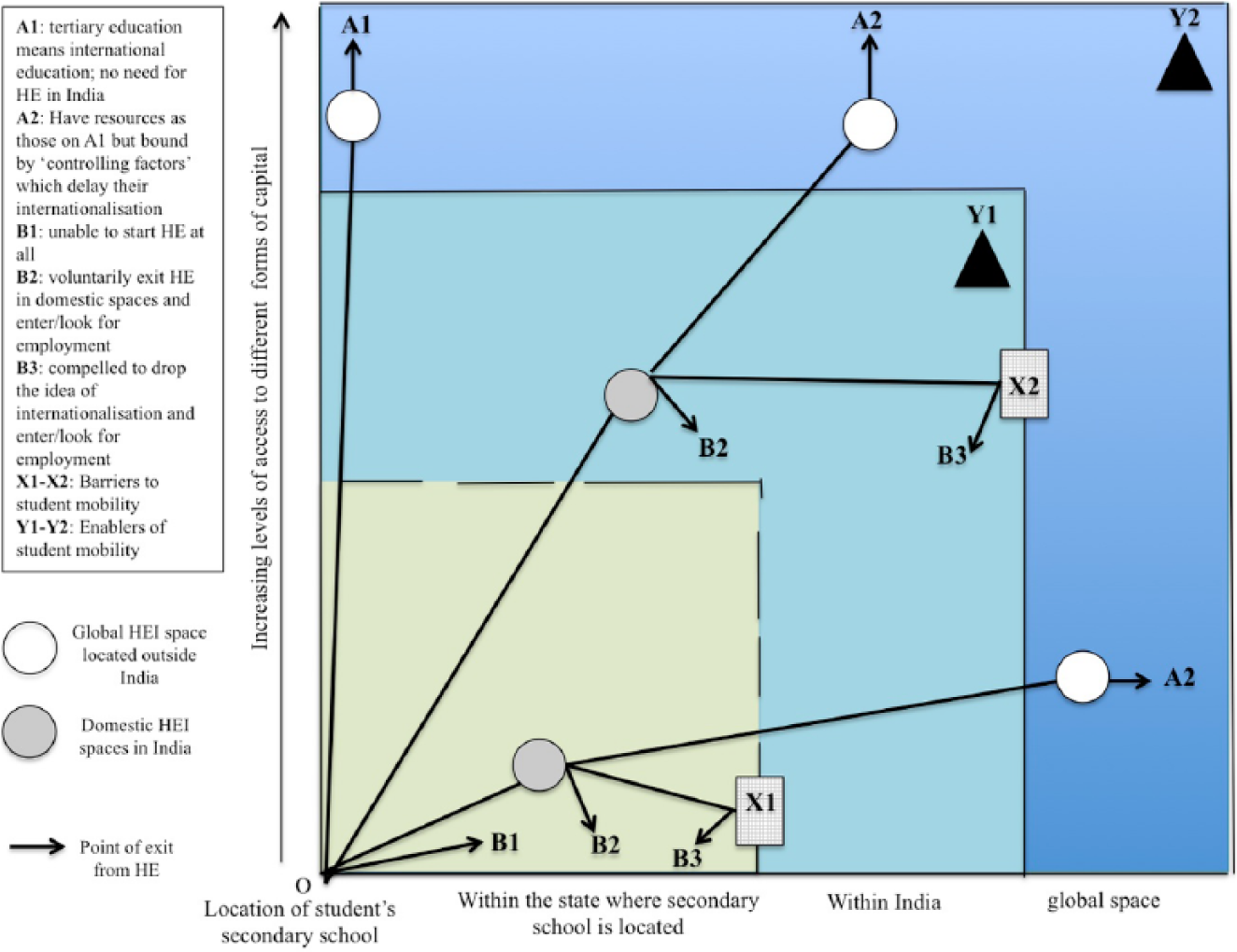
Pathways–Controlled mobilities.
However, “emergent mobilities” and its engagement with higher education spaces in India (see Figure 5) permit a number of pathways (C1-C5) as well, for instance: (a) pathway to virtual internationalization (C1) where, for instance, the student registers for distance learning offered by a HEI abroad; (b) partial internationalization (e.g., at a branch campus or other transnational forms of education), which the student intentionally pursues with a view to gaining employment within the domestic space or within the Indian subcontinent (C2); (c) where following partial internationalization, the student accumulates enough capital (e.g., through scholarship opportunities, new networks, etc.) to engage with barriers that prevented him or her to undertake international student mobility (C3); (d) along this path, without gaining even partial internationalization, one is able to pursue international higher education, for example, through marriage, through support of friends and families who have recently moved abroad (C4); and finally (e) with/without partial internationalization, some students are still unable to accumulate sufficient capital to pursue international higher education. Those pursuing pathways C3 and C4 are those who although affected by reproduction of disadvantage across generations (seen through the existence of barriers such as X1 and X2) are able to pursue international higher education because of new resources/opportunities (such as branch campus, various forms of transnational education, families and friends who have moved recently abroad, etc.).

Pathways–Emergent mobilities.
These pathways in many ways reflect the reproduction of advantage, access to new/emergent forms of capital, and reproduction of disadvantage, respectively, and are closely linked to the transitions charted out. For instance, the transitions could take a number of possible routes reflecting the levels of access to different forms of capital that would be derived from both “controlled mobility” and “emergent mobilities” that were discussed earlier. For some, it would be about entering higher education in the local space first and then again in the national space, and possibly through new forms of private/institutional social capital would be able to engage in international higher education. For others, it might be that in spite of arriving at higher education in the national space, barriers to overseas study are insurmountable that they exit higher education and enter the job market. Thus, these variations point us to potential barriers (e.g., X1, X2) and potential enabling factors (e.g., Y1, Y2) at different stages in the transition. The transitions also reflect the movements (or not) between diverse types of higher education provisions in India (domestic and transnational) that are located in either local or national space, relative to where the student completed his or her secondary school education.
Conclusion
This commentary reiterates the need to take a closer look at how students in India, one of the world’s largest stock of English-speaking human capital, consider the significance of internationalizing their higher education. Such an understanding of the mobility of Indian students becomes an important line of inquiry not only for domestic economic development but also for wider debates and practices in the globalization of higher education. However, it is also important to keep in mind what Choudaha et al. (2013) refer to as the diverse nature of international students and that not all international students are the same (Choudaha, Orosz, & Chang, 2012). Thus, rather than generalize an Indian student as being able to carry out international educational mobility or not, this commentary sheds further light on (a) a number of pathways that Indian students would probably take to pursue international higher education; (b) the two possible attributes of mobility, “controlled” and “emergent” that co-exist; (c) the need to spatially position the aspirations and constraints of Indian students entering higher education by mapping flows between local, national, and global spaces with reference to both domestic and international provision of higher education in India.
However, further work needs to be done on understanding the internationalization agenda of Indian students. This is because, as Altbach and Knight (2007) point out, most of the students who pursue international education are funded by their families, that is, are self-funded and equally have to decide as “individuals,” as to why and how to carry out internationalization. It is in this regard that the conceptual framework and pathways developed in this article provide a useful starting point for the following to be examined: (a) the significance of geographical variation across India, and how and whether the influence of the local sociopolitical context contributes to the dynamics of choice making by students; (b) the role of various actors and factors affecting students’ decisions and in particular how to unpack what views students’ families have on “domestic/international mobility”; (c) a study of students who are at the end of formal secondary school education both in the public and private sectors; (d) the factors that have constrained students from pursuing their “desired” educational path.
Footnotes
Acknowledgements
I am greatly indebted to the very supportive feedback and suggestions from the two anonymous reviewers. Also, a big thanks to Prof. Allan Findlay at the University of St. Andrews, Scotland, UK for shaping my interest and knowledge in the field of student mobility.
Declaration of Conflicting Interests
The author(s) declared no potential conflicts of interest with respect to the research, authorship, and/or publication of this article.
Funding
The author(s) received no financial support for the research, authorship, and/or publication of this article.