




Abstract
We explored the use of mobile social software, in the form of a mobile group blog, to assist cultural learning. The potential of using this technology for cultural adaptation among overseas students was examined as those students adapted to the everyday life of studying abroad. Two pilot studies and a successful field study of a mobile group blog as used by U.K. overseas students are reported. A further study with prospective overseas students witnessing this “moblogging” in China revealed the advantages of communicating through this technology as a form of peer-supported preparation for cultural adaptation. Potential advantages for learning a second language, via this system, were highlighted as communication was interwoven with cultural adaptation and exercised in the blog entries. Given mobile Internet, the language experience together with cultural observation impressively supported these students’ growing confidence with time, space, and imagination.
Introduction
Learning overseas can offer opportunities for students, but it can also present them with challenges (K. T. Wang, Heppner, Fu, et al., 2012). Their learning will not exclusively concern their chosen academic discipline. They must also learn about their new environment, the host culture. The present project addresses the support of such learning.
In framing the project here, we do not wish to imply that international students are passively adjusting to the prescriptions of a globalized educational policy vision (cf. essays in Hickling-Hudson, Matthews, & Woods, 2004). Indeed, it has been noted in various ways that such students will manifest considerable independence around the difficult challenge of managing a cultural identity. Referring to Indonesian students studying in Australia, Kiley (2003) identified a variety of strategies that students adopted to manage the developing way in which they were coming to view the world. Yet, while acknowledging significant personal agency in the management of such change, it remains the case that exercising that agency may often benefit from mediational resources and structured patterns of social interaction. Identifying these in the particular context of digital communications is the special concern of this report.
For a newly arrived student, the circumstances for adaptation may happen anytime and anywhere: navigating the streets, talking casually, campus studying, and so on. Incidental learning will be a pervasive and continuous process. Language will be an important carrier of culture while cultural factors are included in every engagement with language. Atkinson (2002) noted how learning is relentlessly infused through everyday living, with the language that is encountered being inseparable from the experiences that constitute cultural knowledge. Although language learning cannot alone deliver a complete understanding of a host culture, culture is always a matter of linguistically mediated membership of discourse communities: both real and imagined (Kramsch, 1995).
Such encounters with unfamiliar cultural contexts can have serious implications for students in developing countries, including the uncertain impact of importing cultural imperialism from dominant western cultures (Gu, Schweisfuirth, & Day, 2010; McLoughlin & Oliver, 2000). It is therefore important to support students in acquiring a measured and sensitive perception of their host culture—as well as helping them sharpen a sense of criticality toward it. Nostrand (1989) interpreted culture as “ground of meaning,” that is, the attitudes and beliefs, ways of thinking, behaving, and remembering shared by members of a community. Occupying this ground comfortably and appropriating this meaning is a considerable challenge: one that we wished to address in the project described here. So, the aim of the present project was to consider whether mobile personal technologies could be recruited to allow cultural newcomers productively to share their encounters with local culture.
Empowering individuals to act meaningfully and to use reflectively a host language in the authentic host cultural environment will be significant aspirations in support of enculturation. But tracing that process of empowerment might also be helpful to those who are later to enter the culture themselves—if such trails of enculturation could somehow be made available to them. This productive sharing of cultural experience is another concern of the present research.
Cultural Learning and Its Support
University study overseas is an educational option that is pursued by increasing numbers. Yet it is well documented that such student sojourners can experience considerable challenges of culture adaptation. These are often referred to in the language of “cultural shock” (Zhou, Jindal-Snape, Topping, & Todman, 2008). The form that these experiences commonly take has been the subject of recent review (Furnham, 2010; Smith, Nigar, & Khawaja, 2011).
Kramsch (1995) described the challenge of cultural learning in terms of three axes: the synchronic axis of space, the diachronic axis of time, and the metaphoric axis of the imagination. The diachronic axis has traditionally referred to how individuals can identify themselves as members of a particular society to the extent that “they can have a place in that society’s history” (Kramsch, 1998, p. 7). The synchronic one indicates that people who see themselves as belonging to a particular group acquire, through interacting with other members of that group, a common way of seeing the world, which takes the form of attitudes, beliefs, opinions, and, ultimately, behaviors. The final layer of culture acknowledges that common dreams and imaginings also characterize a group and are mediated through language, which in turn reflects and shapes its cultural reality.
Learning a language interweaves with this cultural learning. Learning a language is far from being an abstract skill: It demands appropriating the cultural resources or voices of local communities in the variety of their social contexts. Accordingly, it is shaped in relation to a broad range of social and cultural conditions (Burr, 1995; Collentine & Freed, 2004; Wertsch, 1991). Kramsch (1995) asserted that fully reflecting the historical situatedness and local context of language serves to strengthen language learning—as individuals encounter authentic interactions in the target culture.
The nature of the challenge of adaptation has been explored for Chinese students studying overseas and various patterns have been documented (K. T. Wang, Heppner, Fu, et al., 2012; Wu & Hammond, 2011). Albrecht and Adelman have identified several types of supportive communication directed toward the sojourner’s predicament: for instance, predeparture assistance with a source of social comparison, orientation instruction programs, direct assistance with personal resources, emotional support for personal relationships, and venting emotions (Albrecht & Adelman, 1987). Sources providing these supportive and traditional messages are indeed numerous for student sojourners. Enculturation has been resourced by targeted preparation for studying abroad, as well as direct guidance in the acquisition of new skills relevant to the host culture (Bochner, 1982; R. Huang, 2008; Klineberg, 1982; Ying & Liese, 1990). This investment in predeparture assistance and orientation programs indicates the perceived importance of assigning prospective sojourners in developing realistic expectations and confidence to mediate stress (Albert, 1986; Aycan, 1997; Daly, 2007; Tsang, 2001).
Some universities appoint staff to give lectures overseas about predeparture information. “Institutional aids” such as personnel officers, foreign student counselors, and social workers have been utilized. However, they are unlikely to become part of a personal social circle and thereby be responsive to more personal needs (Adelman, 1988; Humfrey, 1999). Because of the mobility and diversity of these overseas students, formal courses that assist their transition by exploring different living and learning environments are quite difficult to deliver in a sensitive manner. Personalized solutions are inherently difficult because of the diversity and volatility of individual experiences.
According to Kim’s review of immigrant adaptation studies, during the initial phase of cultural entry, reliance on ethnic ties were a less stressful form of resource than interaction with natives (Kim, 1987; Volet & Ang, 1998). The previous cross-cultural experiences of expatriates and veterans could be helpful through the resonance of their reactions to transition and their knowledge of the host country (Sherry, Thomas, & Chui, 2010). In Anderson’s research, a social group was established for local students and for women who were international; this group was conceived as a source of connection, support, information, explanation, and learning (Anderson, 2008). Supports might also come from strong connections with personal domestic networks without a feeling of loss within the host country (Arkoudis et al., 2013).
In the present research, therefore, Chinese overseas students were selected as an example of a group confronting cultural adaptation. The study explores opportunities in providing support and resources by tracking their experiences of transition and facilitating “group-help” from within those people from the same cultural backgrounds. Students might acquire more adaptive cultural strategies through encountering specific “common” problems solved by fellow international students or from solutions collected from authentic experiences. However, such fragmented, touch-and-go, and sometimes unexpected events may not always be captured at their moment of occurrence. There is a need for technology that might support recording and sharing experiences on the move.
Technology Assisting the Overseas Student
Overseas students today are mainly young people who have grown up with digital technology and, thereby, developed relevant skills and an enthusiasm for using it (Davies & Eynon, 2012; Oblinger, 2003). Moreover, it is apparent that these social media have strongly penetrated Chinese student cultures (Gray, Chang, & Kennedy, 2010; Herold & Marolt, 2011; Li, 2010; Szablewicz, 2010).
In general, families and individuals drawn apart by living overseas widely turn to social media as a way to sustain relationships and strive to do so regardless of structural factors that might impede such communication (Wilding, 2006). For students in particular, such social networking may have come to play an important role in protecting their sense of belonging to their own culture (Lin, Peng, Kim, Kim, & LaRose, 2012). The virtual home built through social media in some sense may release the psychological homelessness (Gomes, Berry, Alzougool, & Chang, 2014). Yet it must also be considered how far this strand of domestic communication could impede the social interactions with current peers—local students and other international students.
So, research has begun to explore how digital technology could be a medium for recording, storing, and tracing shared experiences of cultural and language learning. One study in the United States structured and presented students’ experiences of language during cultural transition in the form of texts and images from a digital library system (“Woezor”). They found this helped individuals reduce such stress by sharing in-depth stories about experiences (Azeez, Kerne, Southern, Summerfield, Aholu, & Sharmin, 2004). Their cultural transition experience, as initiated by institutions, was digitalized into web pages for students to view and search.
In recent years, mobile technology in particular has entered into this support. At one university, a mobile application was developed for international students to address issues of cultural shock (Bennet & Maniar, 2007). Students retrieved useful information from prepared cultural knowledge. However, this preplanned information was still based on “expert” knowledge generated by designers or consultants. The wealth of knowledge created by students themselves could be a more effective approach to support. Sharing authentic experiences could provide real-time guidance for individuals to deal with problems and uncertainties. This was not available in those previous studies.
Outside of the classroom, learning frequently occurs through interacting with other people and using socially provided tools and schemas for solving those problems that arise in the “everyday” (Rogoff & Lave, 1984). Such learning is therefore a cultural process: It is shaped by the community or social network around its learners (Nasir, Rosebery, Warren, & Lee, 2006). Learning about a culture as part of a learning community can sustain people by providing bonding, mutual encouragement, and support (McGivney, 1999). In this sense, overseas students define a community of “learners-of-enculturation.” With mobile devices, students might collate on-the-spot cultural information, share it, discuss it, or simply react intuitively. Learner-generated blogs are a resource that can extend social interactions—when those blogging learners now have such vastly greater power to publish and access content (Flatley, 2005; Y.-M. Huang, Jeng, & Huang, 2009).
Mobile blogging, or “moblogging,” is an activity whereby the user publishes blog entries directly from a mobile phone or other mobile device. This might involve sending photos and videos by email/multimedia messaging service (MMS) to a website. A report from the Detecting Center of Chinese Internet (DCCI) showed that in 2012 there were more than 327 million mobile blog users in total, with 2.31 blog entries everyday on average (DCCI, 2012). Applying mobile blogging in cultural transition could fill the gap of great differences between official information and personal experiences by managing and sharing authentic individual enculturation information within a group of overseas students.
Mobile technology therefore offers a rich resource for people to recruit the Internet for information exchange. The term mobile should not suggest a technology that is simply portable. It is people themselves who are mobile (Sharples, Taylor, & Vavoula, 2005). As such, “mobile technology” includes technical resources that allow people to achieve connection, communication, and interaction while they are on the move. Such communication can play a productive part in the learning experience of students.
In sum, the new genre of “social software” has been successful in animating networked communication in everyday contexts: encouraging participation (Churchill, 2009; De Jong, Specht, & Koper, 2008; Lessig, 2001). Some social software, such as blogging, has the potential to be a transformational technology for teaching and learning (Williams & Jacobs, 2004). Learning with mobile technology can also be part of this “social landscape” (Rosen, Carrier, & Cheever, 2010). Consequently, social software coupled with wireless mobile technology potentially provides the basis for enhancing cultural learning in a relatively unstructured environment: potentially stimulating reflection, critique, collaboration, and the exchange of user-generated content (Cochrane, 2006; Greyling & McNulty, 2011).
Using mobile technology around everyday contexts thereby may assist the novice’s cultural learning to resolve uncertainties in those contexts, to explore flexibility, and to cater for unpredictability (Ying & Liese, 1990). There is a great need to support the informal learning that might reduce the difficulty, uncertainty, and culture shock so often experienced by overseas students. Mobile communication technology could contribute to addressing this need.
We suggest that the mobile group blog can support such a vision but its use in this role has yet to be widely evaluated. In the present research, we examine and evaluate the authentic application of a mobile group blog to support cultural learning: both by Chinese overseas students in the United Kingdom and for prospective students planning to come from China. We therefore consider the following questions:
Scoping Studies
As this research concerned the deployment of technology situated in everyday living, a sequence of exploratory studies was conducted around specifying comfortable and useful data capture in such natural settings. The project implemented a step-by-step, programmatic approach achieved through four substudies now brought together here. Three groups of Chinese overseas students attending a U.K. university for their undergraduate or postgraduate study participated in research to establish needs that would inform a final design. A further group of Chinese students in China then participated in a study drawing on the outcomes of this final design.
Two pilot studies were first conducted to assess the actual needs of Chinese students in the United Kingdom to help with their cultural transition. These studies also addressed their attitudes toward using blogs and, in particular, their inclination to use a mobile blog. Results were analyzed to scope the design and development of a realistic mobile resource. These pilots are outlined in the following sections prior to describing the evolved design and field intervention. The main empirical study investigated real and practical mobile blogging activities with a group of 12 Chinese overseas students who had newly arrived at university. Students’ authentic moblogging experiences in the United Kingdom were examined. Their blog entries and discussions were then shared through the group blog site with another group of (intending) students in China. Mixed methods were applied, including log files collection, personal interview, and focus group discussion in each study.
Scoping Study 1: Audio Diaries of Student Lived Experience
An audio diary study was conducted to identify the main concerns and observations of newly arrived Chinese students and thus inform the design of a blog content structure that could support others. Such diaries have been shown to be an effective way of discretely capturing student experience (Conole, 2007). The study recruited a group of 20 Chinese students (16 female, 4 male) from the University of Nottingham’s Ningbo campus in China arriving at Nottingham’s U.K. campus for a 1-month summer school. Shortly after their arrival, they were lent MP3 voice recorders for 2 weeks and were asked to record their thoughts and experiences, especially the differences between any aspects of their everyday lives in the United Kingdom and in China. A total of 192 audio diary entries were received. The diaries revealed that these students shared similar experiences and faced similar problems. They often admitted considerable shock and expressed their feelings of excitement, anxiety, uncertainty, and loneliness in their diaries. The main themes in their reflections were coded and collated. In order of prominence, these were found to be food, customs, communication, buildings, travel, study, and shopping.
Participants enjoyed this audio diary study. It enabled them to “think aloud.” Although they were not requested to share these stories with others, they showed their desire for requesting such communication, as well as asking for support from others.
Scoping Study 2: Needs Assessment Using a Pilot Group Blog
Using an audio diary, records could not easily be shared and distributed to others. The purpose of this second study was to explore what might take place when overseas students captured local information with digital cameras. This would involve taking photos and annotating these with textual reflections because such complementary use of text and image offered a direct and speedy communication device with a great opportunity for sharing.
A pilot study was therefore conducted using an internal group blogging system, Exblog, to investigate traditional (i.e., not mobile) blogging as a resource to support cultural adaptation. Sixteen newly arrived Chinese students (10 female, 6 male) who had enrolled on either an undergraduate or a postgraduate program were recruited. These participants were asked to carry out-group blogging about anything in their everyday life that they felt was interesting and useful to share. There were three phases to this study: preblogging focus groups, blogging that lasted for 23 days, and postblogging interviews and focus groups.
The study found that these overseas students were enthusiastic about recording and sharing their experiences with other people locally or globally. Unlike the resource of an audio diary, this blogging did not encourage so many verbal reflections. Photos were now the more significant representations of these bloggers’ experiences.
The follow-up interviews and focus groups confirmed that these overseas students were familiar with the general functionality of mobile phones (SMS and taking pictures) and had positive expectations of the mobile group blog. The digital cameras used by participants in this study enabled records to be kept on the go by taking pictures simply when inspired. However, many regretted that they had missed “moments” for taking photos in their everyday life when they did not have their camera with them. These participants recognized that if they could use mobile phones, they could take and blog pictures so as to capture unexpected occurrences and share such stories immediately.
Main Field Work
A mobile group blog system was therefore established on the basis of the two needs assessment studies presented above. Both had demonstrated the appetite for such a group blog. They both also confirmed the need although with surprise and, sometimes, tension in relation to cultural discoveries but with a pleasure in the reflective experience. The second scoping study also suggested the potential of collecting and sharing momentary information from mobile devices. Users should be able to access the group blog (for both reading and posting) either from mobile devices or from desktop or laptop computers. The design of the mobile group blog also took account of the categories of troublesome cultural experiences that were identified by students in the two pilot studies.
The Mobile Group Blog System: Design
A mobile group blog was created by customizing Wordpress 2.2 with a mobile plugin. The interface of the mobile group blog site is displayed in Figure 1.

The mobile group blog site and its mobile interface.
A blog entry contains the title and the content in the form of text and image. At the bottom of each blog entry is displayed the date of submission, the category to which this blog entry belongs, and the number of blog comments. Navigation and administration contains five key features: “recent post,” “recent comments,” “categories,” “archives,” and “administration.” Recent post refers to the 10 latest blog entries posted to the group blog. It lists the titles of these blog entries in reverse chronological order. Recent comments refers to the five latest blog comments made by participants in reverse chronological order although it lists only the name of the person making the comment and the title of the entries. Categories lists the names of preset categories in alphabetical order: custom, conversation, events, life, buildings, food, shopping, traveling, and studies. These categories were inherited from the previous two scoping studies. Archives gives archived blog entries by month to facilitate search. Administration provides the links to the registration and login web page. Blog statement and help displays a brief description of what the blog is for and what could be posted, together with a link to “help” pages.
From the mobile devices (Figure 1, right), every blogger needs to input his or her username and password in “login” and “password” textboxes, type in the title and texts of their post, and then choose pictures that had previously been taken and stored in their mobile devices. After categories and pictures are chosen, the individual blogger in this group can submit what they saw, what they experienced, and what they felt about their new life in the form of texts and images straight to the mobile group blog site from mobile devices.
In sum, a full field study evaluating this design was ready to be conducted. An opportunity sample of Chinese students in the United Kingdom took part as bloggers and respondents in the mobile group blogging. After this, a further opportunity sample of students in China served as passive readers of these blogs. The study in the United Kingdom lasted for 4 weeks and the 1-day study in China was conducted after the study in the United Kingdom was completed.
Participants
Participants in United Kingdom: 12 newly arrived Chinese overseas students were recruited—8 females and 4 males, aged from 19 to 25. They had joined undergraduate or postgraduate programs at this university. Most were previously unknown to one another. No participants had any experience of mobile blogging before but all had their own personal blogs.
Participants in China: 13 participants were female and 10 male. Ages ranged from 19 to 23. All these students had their own personal blogs. No participants had encountered moblogging but all of them had their own blogs.
Procedure
Each of the students in the United Kingdom was loaned a Nokia N80 mobile phone. They were instructed to start blogging on the day they received the equipment and were asked to recount their experience, thoughts, and feelings, including insights into local society and the way of life in the United Kingdom, and their exploration of Englishness.
Students in China were asked to review the blog site to understand those mobile bloggers’ contributions. Participants were then divided into six groups of either three or four people. Each group spent about 30 min on the reviews, during which time their conversations reviewing the blog site were recorded by audio recorders. This study collected the readers’ responses and suggestions about the design of the mobile group blog and investigated the utility of the contents that those bloggers in the United Kingdom submitted and which could be viewed in China by prospective overseas students.
Data Collection
Log files of the mobile group blog site were collected. Follow-up interviews and focus groups were transcribed. Qualitative data were analyzed by a grounded approach as there were no precedents for predicting the categories of meaning that might arise. Analysis involved a process of reading the transcriptions, taking memos and notes, reviewing those annotations, revisiting the transcriptions to confirm emerging themes, and, finally, characterizing the data in relation to the apparent focal point of a theme. In this way, the participants’ reflections and conversations were schematized and integrated.
Blog entries were analyzed in conjunction with log files and interviews. For example, blog entries were classified in terms of themes referenced to the nine preset categories, individual blogger’s contributions, participation of other people, submission from mobile phones or personal computers (PCs), and the collocation of texts and images. By matching the corresponding patterns found in the blog entry analysis with the interviews, we synthesized findings, drawing on material from the blog site as well as their conversations.
Results and Discussion
Participants in the United Kingdom reported no difficulty in using the loaned Internet-enabled mobile phone. Some participants shared information immediately by mobile blogging to the group blog site. Nobody withdrew in the period of study. The mobile group blog site received 216 blog entries and 109 blog comments from students. Results showed that, on average, each participant in the United Kingdom had produced an average of 4.5 blogs, 23.45 hits, and 2.27 blog comments each week.
The mobile group blog was semistructured and monitored by the researcher, guiding participants to contribute to the blog under the theme of cultural transition. At the start, the researcher entered a few examples of blog entries as scaffoldings for the bloggers. Support from the researcher was provided through emails, personal contacts, and blog comments. Participants could also get help from the website at any time.
A number of themes describing the experience were extracted from analyses of blog entries, the log files of participants’ activities, and feedback from interviews. These are described next.
Tuning a Cultural Awareness
In our preliminary Audio diary and group blogging studies, participants were not invited to make points regarding specific topics. While in this moblogging study, participants were asked to collect useful and interesting information for the purpose of sharing and helping others. Participants commented that they had become more alert to cultural transition issues after taking part in this study.
The purpose of this group blog always reminds me of the awareness about the cultural contexts I am in. Sometimes I neglect something in the context but some other people noticed them in similar context and put them on the group blog. Thus I realized the cultural difference there. They may have better observational skills, which make them more sensitive to the environment. This is useful. (Master’s student, male)
Student participants in China were eager to know the true experiences of their peers in the United Kingdom. An awareness of cultural differences seemed to drive the interest of culture learning. These participants were becoming increasingly aware of cultural issues and more motivated to be involved in sharing their experiences and opinions.
Co-Constructing Cultural Knowledge From Authentic Representations
In the mobile group blogging, captured knowledge was available for other blog members to draw on. The knowledge created by mobloggers in the United Kingdom was delivered remotely to participants in China. Blog comments indicated that authors and respondents could co-construct knowledge from self-generated authentic information in conjunction with established individual knowledge.
In the example in Figure 2, for instance, “Solbyb” addressed her knowledge about the “leafcleaner.” Wanzi added her opinion and associated it with British culture using her own inference. “Solbyb” illustrated that British people did collect the leaves to the truck instead of leaving all of them on the road, but less frequently. In this way, the commenter and the author generated their own “common sense” about reasons behind the “cleaning leaves” phenomenon.
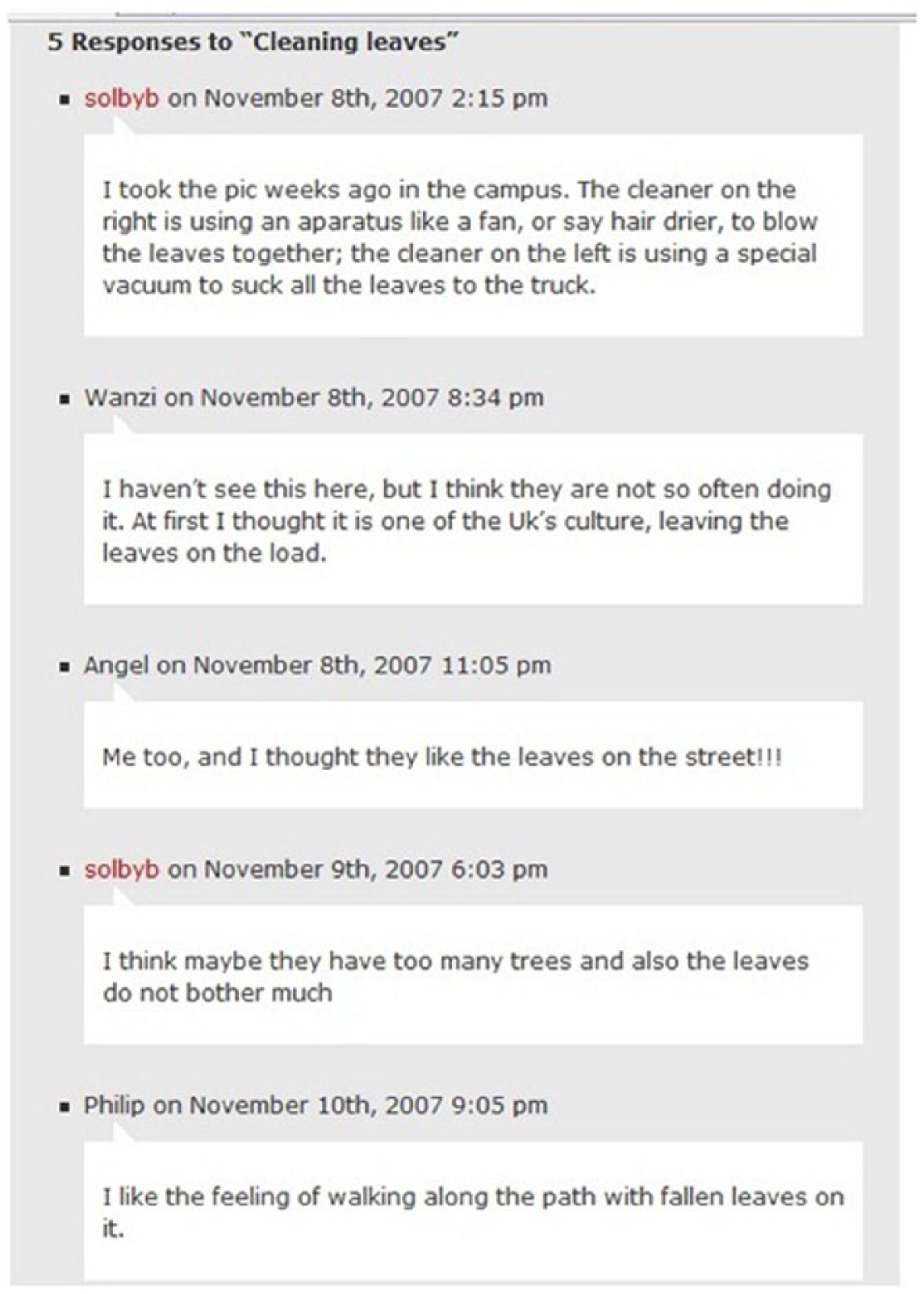
An example of generating knowledge from comment discussion.
Using the mobile group blog in the real-world not only enriched personal contextual knowledge from everyday life but also enabled the knowledge construction both individually and in a community through interaction and sharing. Through sharing and discussion, blog members co-authored and co-constructed their knowledge about cultural transition. The experience is enhanced by retrieving and sharing real-time authentic information on the move.
Gaining Language Capability and Confidence
From all these studies, we noticed that the Chinese overseas students had a growing command of English. At the beginning of their transition, they indicated reluctance to blog in English. The following figure (Figure 3) shows an example of language transition in blogging. Both the left and right figures show that these texts were in Chinese with some English words included. The earlier blog entry on the left (posted October 12) had many Chinese characters while the blog entry on the right (posted November 2) had only three Chinese characters. Figure 2 (left) illustrates an example of their construction of knowledge from different individuals’ understanding and interpretation about leaf clearing in the United Kingdom. The slight discussion on the phenomenon and the exchange of personal feelings boosts their adaptation to the local culture.
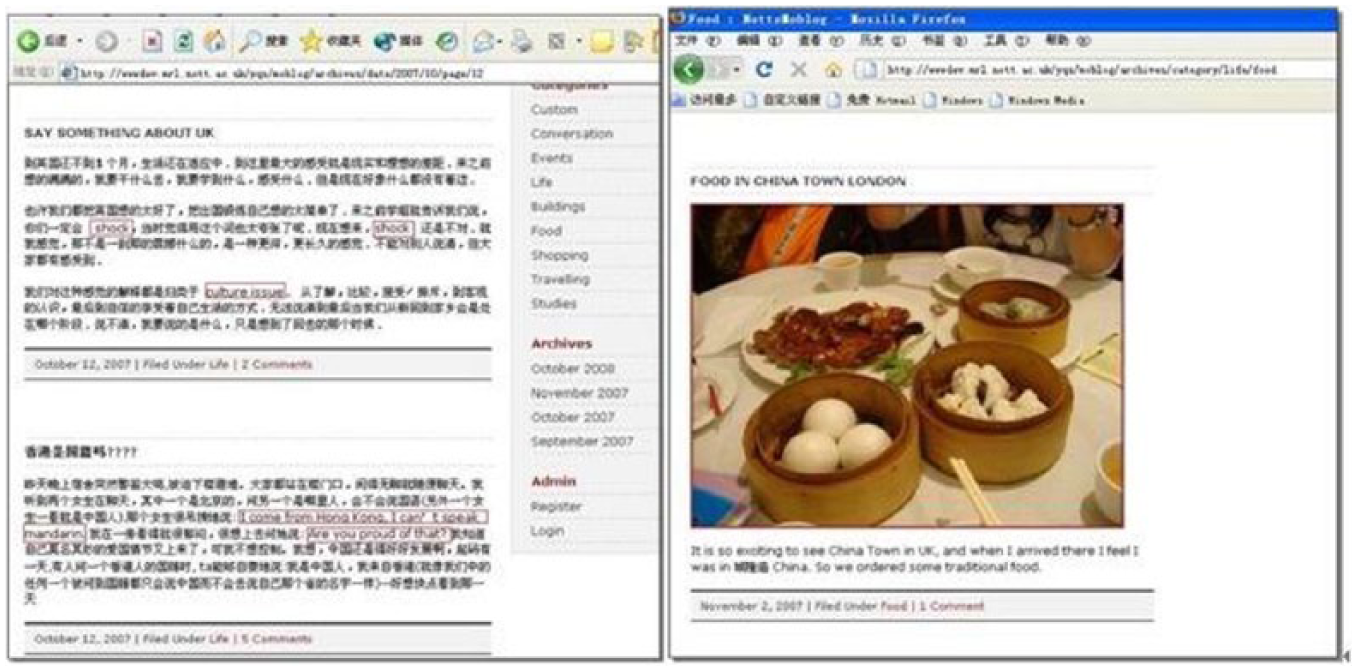
Potential language transition in the blog entries.
The phenomena described in the moblogging showed the process of transition from pure Chinese toward English mixed with Chinese and then to pure English. Figure 4 below shows the percentages of entries that contained English texts during the 1-month of study.

Percentages of texts in blog entries.
This figure displays the percentage of English words that were used, in contrast to Chinese words, in each blog entry on the basis of the date they were posted. There are far less English texts at the beginning of the study (early and middle of October), and there is a steady increase of texts in English as time passed. Until the end of the study (late October and early November), most blog entries were in English. In interviews, participants in the United Kingdom admitted this transition and showed more confidence in expressing their thoughts in English, while students in China were less confident and had difficulties even in reading. This indicated that their language capability could have also been improved by encouraging them to practice English in British cultural contexts and achieving successful transition from one culture to another.
These findings reflected a successful application of mobile group blogging in assisting students studying overseas. These participants’ use of the mobile group blog allowed documenting their lives and the discussion of interesting or difficult moments. Participants thereby constructed trajectories of interaction in the mobile group blog.
Temporal, Spatial, and Community Dimensions of Cultural Learning
At the outset, we noted that culture is constituted within three axes: the synchronic axis of space, the diachronic axis of time, and the metaphoric axis of the imagination. In our study, these three axes were found to be supported by the features of a mobile group blog. Tracking of their locations, time, and conversations in-the-country over the blog reflected each blogger, as a member of this “group” community, with similar cultural background. All their stories in the “group” history were recorded and shared across time and place with out-of-the country students. We explore the grounds for this claim in the sections below.
Issues of place
Mobile technology helped students to capture representations of place while the blog kept a record of the resulting communication. A total of 25.5% of blog entries were real-time reporting of current experience. All participants claimed they often did moblogging in their own room in the evening after classes. Although photos could be taken at any time, they felt that texts required time to type. They also reported moblogging on trains and buses, in parks, and in cafés. With a full “anywhere” sense of “on the move,” the most valuable feature of moblogging in cultural learning is the freedom of capturing and sharing what they encountered in the flow of everyday life.
Participants indicated that moblogging resourced interaction outside of its own digital environment. Some mobloggers said they went outdoors together, exchanged pictures taken through “bluetooth,” and discussed what was to be submitted to the blog site. They shared skills on how to use the phone to take better photos. This therefore implies an opportunity to build social relationships through these kinds of interaction.
Issues of time
The mobile blog helped to trace activities of this group of students, taking down their stories at specific times. It was found that 47% of bloggers posted blogs in the evening and during the night (after 7:00 p.m. and before 2:00 a.m.), 39% blogged in the afternoon (after 12:00 noon and before 7:00 p.m.), and 14% in the morning (between 6:00 a.m. and 12:00 p.m.). Most moblog entries sent in bulk were submitted during the evening or night, except two sets that were sent in the late afternoon. Figure 5 shows the frequency of mobile blogging by these participants in detail.
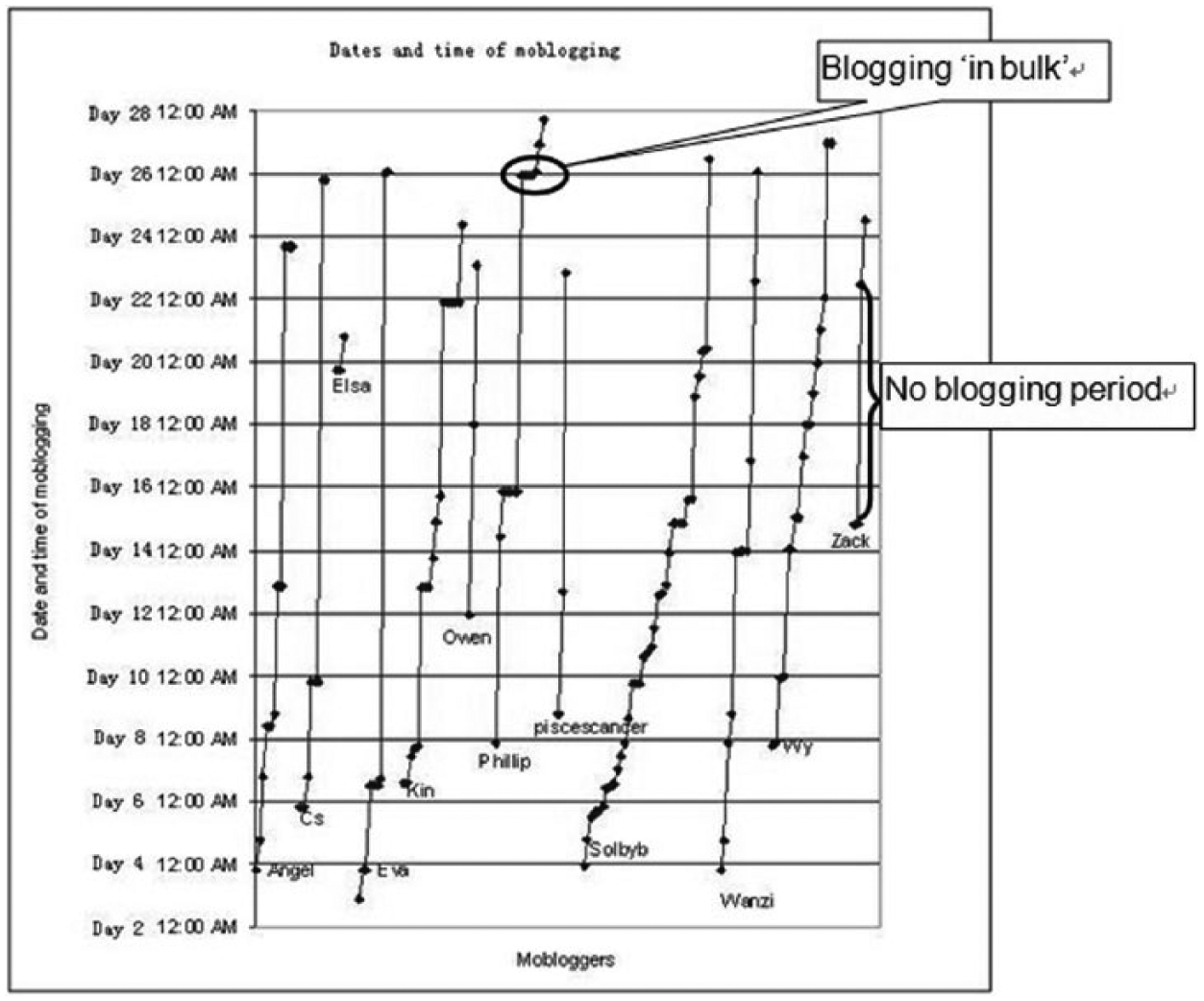
Dates and time of mobloggings.
In this figure, the dots represent the time when blog entries were submitted and the lines between dots represent the duration when there was no moblogging activity. Those superimposed dots indicate bloggers posted several blog entries in bunches at one time. The more angle in a line, the more bunching in the blog entries that the blogger submitted. Participants were maintaining a steady pace of engagement, and nobody dropped out. It is interesting that “in bulk” moblogging often occurred in the evening. So some participants carried out blogging in the more traditional way: collecting information in cameras and uploading them when they go back indoors. At the same time, our focus group results indicated that most students behaved as “silent” reader with mobile phones more often than as blogger. They still believed that the mobile devices brought convenience for reading blogs.
The data imply that the majority of these participants did mobile blogging continuously though not regularly. Moblogging activity became intense in the second and third weeks. We may infer a transition happening here, from traditional blogging to mobile blogging. Different people have different abilities to adapt to moblogging: Some are quick, like “Solbyb,” while others are slow; some others were like “Elsa,” whose interview indicated that she did not like moblogging at all as she was simply not interested in using emerging new technology. It seems the “anytime” sense of “on the move” is not universally shared. The data indicates the current habit of mobloggers in posting new blogs. The “on-the-inspiration” capturing and “at-own-will” sharing are readily achieved through the mobile group blogging technology.
Issues of community
The mobile group blog formed an online virtual community for these Chinese students, most of whom were previously unknown to one another. Within the group blog, each participant knew the explicit purpose of this study and shared his or her experiences, encouraged people who encountered problems, answered questions, and discussed phenomena observed. The following example (Figure 6) illustrates a discussion that occurred among three students about their understanding of the neglected “fallen leaves” that one of them discovered.

A short discussion.
The sense of belonging to the online community provided by the group blog helped to reduce feelings of loneliness. People found common sense through the communication, as displayed in the following example.
“Owen” expressed his great disappointment with the long waiting time and other troubles he had encountered with his broadband service. “Wanzi” agreed with his opinion and gave her impression of British people and their behavior. She even cited a Chinese proverb to support her comment.
The positive psychological effects of the group blogging activities assisted in reducing cultural shock. Meanwhile, results also showed that participants in China also wanted to feel part of the mobile blog community.
Vicariously Experiencing Remote Social Contexts
Participants in China found that the information on the mobile group blog site was authentic and personal, and this supplemented traditional supports for cultural transition. The following example came from some blog-reviewing students in China:
I would like to know people like us, coming from the same background. Would like to know their lives over there. What are they exactly doing there everyday? And this group blog site brought forth some students’ true lives to us, although just a bit. (Undergraduate, male)
His words also indicated that remote participants were frequently imagining the context that the blogger was in through a blog entry. They reported that, as a result of reading blog entries, some existing knowledge was confirmed and some new knowledge gained. Those blog entries provided an open space for full imagination. For example, they commented that they had previously heard about the good environment and facilities in the United Kingdom and were satisfied when they browsed the blog site. Participants in China were unable to understand some contents without being in the same context in the United Kingdom. For instance, students in China had no idea about why English cleaners just blew fallen leaves to the roadside instead of collecting them and burning them. This indicates just how important contextual information is for cross-context users. These cross-border blog participants also suggested that there should be more participants, especially the original bloggers whose continued engagement and contributions were in great demand.
Perhaps a remedy to contextual information that is missing is to ask bloggers to provide more sufficient and relevant contextual information when they are posting a blog entry, although one might even draw on the assistance of more advanced context-aware technology. Another solution might revolve around building up more interaction and communication with bloggers synchronously or asynchronously, which would encourage the setting up of an international community.
In addition, the analysis of blog entries showed that participants not only discussed British culture, local events that had occurred, and stimulating things they had found but also shared in their blogging the sadness, agony, difficulties, and troubles encountered in their everyday lives (See Figure 7). The example in Figure 8 gives responses to a blog entry previously posted by “Eva” who had suddenly lost her uncle in the second week of her arrival in Nottingham. Her blog conveys how she felt heartbroken about this bereavement, and how—touched by the sadness of being away—she felt the distance, isolation, and fragility of human beings.
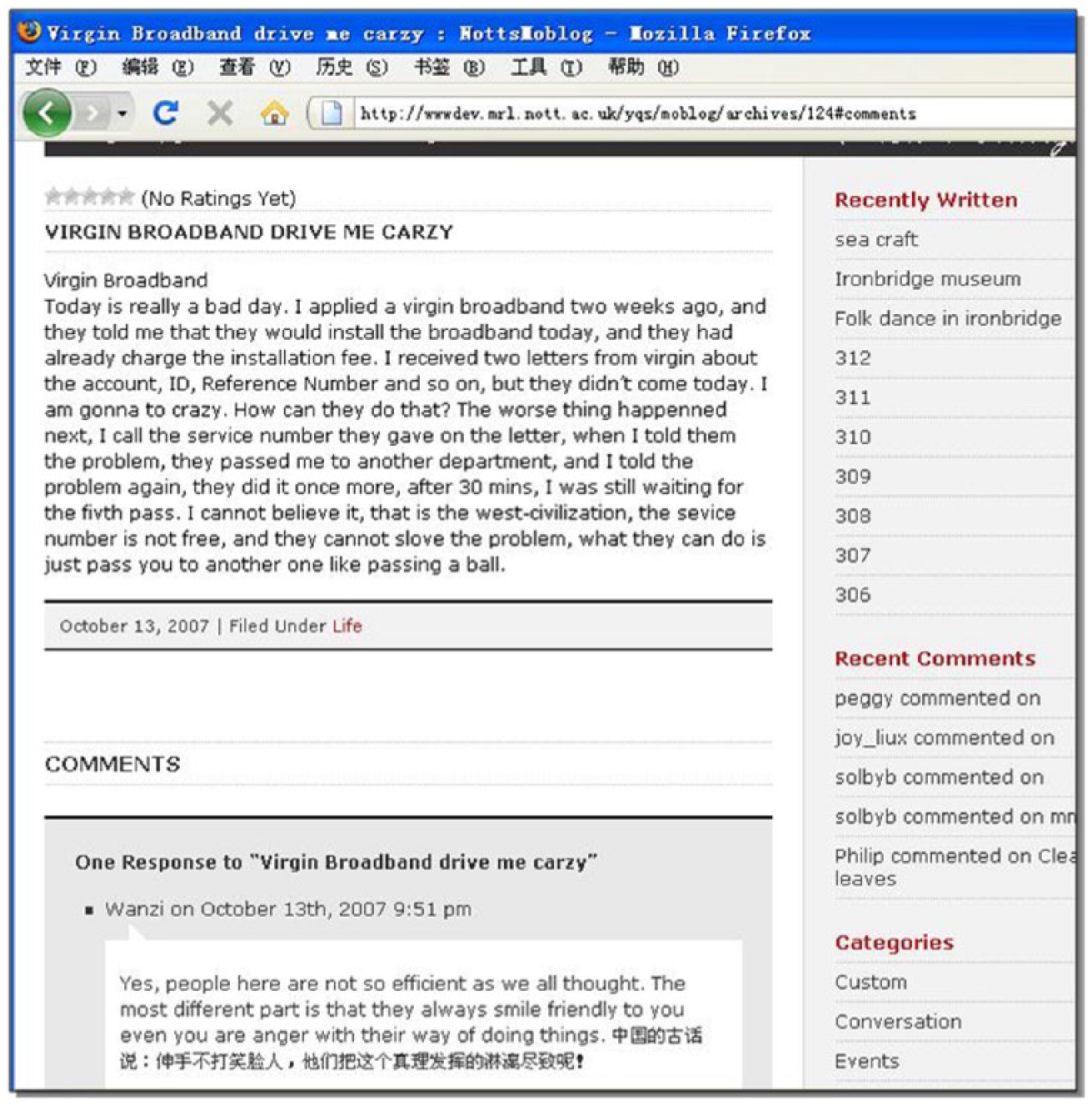
Common negative impression.

An example of discussion through comments.
Three other people in this group, although strangers to her, consoled and encouraged her. The blogger’s own comments show that she gained some strength from their words. In a sense, the responses from other members of the group blog helped her to release some of her stress. The example also indicates the positive psychological effects on individuals that can be gained from social interaction in the mobile group blog community.
Conclusion and Future Work
Bloggers in the United Kingdom could gain benefits by reviewing other group members’ postings, as well as finding their own worth in giving cultural help to others. The potential advantages of applying mobile group blogging in the particular arena of language learning suggests a new route toward naturalized language teaching with new technology. Although the technology deployed here is no longer particularly innovative, we submit that the use to which it has been put is certainly novel—in short, what the technology has mediated here represents a usefully innovative institutional practice.
The study in China was itself a group reflection undertaken remotely outside the blogger community at some later time. The blog site was therefore sustainable in both the short term and long term, and for self- and group reflections. This implies that blog entries on the group blog site can be informative and reflective for anyone for as long as the group blog exists—this could be synchronous or asynchronous.
An improved prestructure for the input of blog entries is required. The “category” system for issues was found useful, yet bloggers might have other assistance, such as a “tag” to specify what they tried to express in each blog entry—these might draw from the keywords of blog contents.
Yet, despite the apparent success of this intervention, there are several questions that are left suspended. First, it remains uncertain how important the mobile element of the blogging is for success. It is true that many uploads were not carried out on the move but at a latter point in a domestic space. Second, it is not clear how far the momentum of the project and its sustainability depended on a research presence to drive it. Third, we noted that a number of these students had personal blogs, and it might be wondered how far this was a necessary condition for engagement.
Insofar as these concerns may appear to represent constraints on the success of initiatives of this kind, they all promise to be lightened by the way in which the constituent technologies are now evolving. This project was completed in 2010, and this is an important factor in evaluating the significance of its findings. We do not believe that technology has been transformed since that time and certainly not transformed in ways that would impede activities of the sort reported here. In fact, a number of changes in the technology environment would make this form of intervention all the more practical, while shifts in technology engagement levels would make it all the more familiar and attractive. Therefore, we believe that blogging on the move is a considerably more familiar and realistic activity now than it was at the time of our fieldwork. We believe also that students engage more routinely in this sort of mobile communication now, and therefore, our research presence would be more important to inspire than to sustain such enculturation initiatives.
Finally, although students may be less likely to manage personal blogs in the traditional sense of such services, they would be more likely to be active on those popular social media sites that reproduce the feel of such personal blogging (K. T. Wang, Heppner, Fu, et al., 2012) and may be drawn to a structured project of the kind illustrated in the present report. International students may have complex identities on those different sources of social media, which shape the development of local social networks. But it would be inappropriate to simplify the understandings of place that emerge from what may be a very fragmented pattern of engagement through social media—simultaneously exploring a new cultural world while allowing active threads into the world “left behind” (cf. Martin & Rizvi, 2014).
To enhance engagement and sustainability, further research should be carried out in a larger community and on a wider scale. The vision of mobile technology assisting international students’ adaptation could resource all overseas students to update authentic living experiences, to exchange their perceptions, and, in particular, to understand a remote culture better by socializing around shared and mutually understood contexts. However, a more challenging task will be to integrate the personal records of these enculturation experiences with the mainstream of the host culture—the wider student community. There are good reasons for striving toward this, for there is a need to guard against any initiative that exaggerates social clustering of students rather than promoting wider participation (Nasir et al., 2006). Much research now highlights the extent to which international students in Western higher education experience relatively modest levels of intercultural interaction (Rienties, Grohnert, Kommers, Niemantsverdriet, & Nijhuis, 2011; Volet & Karabenick, 2006; Volet & Jones, 2012). Moreover, Rienties and Nolan (2014) use social network analysis to show how intercultural social coordination does not necessarily become tighter across time, although engagement in activities involving a mix of cultural groups can strengthen such cross-cultural coordination. We have stressed here the value to the individual sojourner of mobile blogging centered on reflective visual records. However, this form of activity (or at least shared access to its products) may have an intriguing role in the construction of intergroup shared understandings and subjectivities.
Footnotes
Declaration of Conflicting Interests
The author(s) declared no potential conflicts of interest with respect to the research, authorship, and/or publication of this article.
Funding
The author(s) received no financial support for the research, authorship, and/or publication of this article.