




Abstract
Increasing participation in the Erasmus study abroad program in Europe is a clear policy goal, and student-reported barriers and drivers are regularly monitored. This article uses student survey data from seven countries to examine the extent to which student-level barriers can explain the considerable cross-country variation in Erasmus participation rates. We observe remarkable similarities between countries with respect to how barriers cluster for students and what barriers characterize non-participants compared with participants. The study confirms that home ties and lack of interest are most robust predictors for non-participation. Data on student-level barriers and motivations, however, give surprisingly little information to explain why students in some countries are considerably more active participants. For further understanding, we need to study more how national and institutional policies and context influence students’ decision making and help them overcome perceived barriers to mobility.
Introduction
The benefits of participating in a study abroad program during university studies are reported in numerous studies. Students point out that studying abroad (for a semester or a year) considerably contributes to their personal development, understanding of and interest in global affairs, language competence, and inter-cultural skills (Institute of International Education, 2004; King & Ruiz-Gelices, 2003; Maiworm & Teichler, 1996; Norris & Gillespie, 2009; Paige & Fry, 2010; Vossensteyn et al., 2010). A number of studies confirm that studying abroad makes a strong and long-lasting impact on people’s lives (Paige, Fry, Stallman, Josic, & Jon, 2009). It enhances cross-cultural proficiency and sensitivity, openness to diversity, as well as interest, understanding, and engagement in global affairs (Anderson, Lawton, Rexeisen, & Hubbard, 2006; Carlson & Widaman, 1988; Clarke, Flaherty, Wright, & McMillen, 2009; Ismail, Morgan, & Hayes, 2006; Kitsantas, 2004). Students with a study abroad experience seem to work in higher status employment sectors, they are more likely to have an international job or work abroad, and they are also less likely to remain unemployed after their studies (Bracht et al., 2006; European Commission, 2014b; King & Ruiz-Gelices, 2003; Norris & Gillespie, 2009; Parey & Waldinger, 2011).
Increasing study abroad participation is an important policy goal within Europe and in many countries elsewhere. The European Commission (2013) sees international mobility of students and staff as one of the key components in positioning the European higher education in the world and in the creation of a single European labor market. The Erasmus program of the European Commission (2014b) plays a key role in this mission, facilitating and subsidizing a study abroad experience to more than 250,000 students a year. The new Erasmus program for the budgeting period 2014-2020, so-called Erasmus+, aims at “doubling the current number” of participants (European Commission, 2011). Short-term study abroad is not a Europe-specific policy issue, even though in Europe it may have some unique political goals (King & Ruiz-Gelices, 2003). In the United States, for example, a recently proposed legislation aimed at increasing study abroad participation 5 times over a 10-year period to a million students by the year 2017 (Salisbury, Umbach, Paulsen, & Pascarella, 2009). Similarly, Australia invests funds into raising the participation rate in international mobility among domestic bachelor students (Universities Australia, 2013).
This inspires our interest in understanding what keeps students from participating in study abroad programs, despite of all the efforts. Participation in the Erasmus program varies considerably between countries. In some countries, more than 10% of students in higher education participate (e.g., Finland), whereas in others the rate is around 2% or 3% (e.g., the United Kingdom) (European Commission, 2014b). Several studies have examined student-perceived barriers and motivations for Erasmus participation (e.g., European Commission, 2014a, most recently). We wish to explore the extent to which the perceived barriers can explain why students in some countries are significantly more active in undertaking a study abroad than in other countries. First, we map systematically different barriers that students perceive for participating in the program and we compare the prevalence of the main barriers among Erasmus participants and non-participants. Thereafter, we examine whether the cross-country differences could be linked to the aggregate participation rates at the country level. As we will demonstrate below, European students are rather similar in how they perceive different barriers and drivers, and in what barriers are clearly characteristic to the non-participating group. Before we present our empirical results, we first discuss theoretical perspectives regarding short-term mobility decisions and review empirical evidence from earlier studies.
Determinants of International Student Mobility
Conceptual Perspectives to Explain Short-Term Mobility
From a conceptual perspective, short-term student mobility is usually approached by adapting either the “push–pull framework” known from the degree mobility studies, or the college choice framework that looks at educational choices more broadly. Both approaches analyze students’ decision-making process, but they put a somewhat different emphasis on what matters for the decision.
In the push–pull framework, the decision for international mobility can be explained by a complex set of educational, political/cultural/social, and economic factors that “push” the student away from the home country and “pull” to a specific host country (McMahon, 1992; see de Wit, 2008, p. 28, for a complete overview). Poor socio-economic conditions and lack of educational opportunities in the home country as well as high level of international interaction, priority given to education and economic capacity to facilitate studying abroad, make students consider educational opportunities in other countries. Moreover, economic ties between countries, political links, and available resources for international students pull students to a specific country. Empirical research based on this framework shows consistently the positive effect of safety and living standards in the host country, future career perspectives, available information about the educational opportunities, quality of education, and several other factors (see King, Findlay, & Ahrens, 2010; Wilkins, Balakrishnan, & Huisman, 2012, for a review; Van Bouwel & Veugelers, 2013). Short-term mobility, however, is likely to exhibit a somewhat different dynamic than degree mobility. Short-term mobility may be less driven by the reputational and signaling effect of the host university and by immediate career perspectives in the host country. Nevertheless, Rodríguez González, Bustillo Mesanza, and Mariel (2011) show that quality/reputation seems to matter also for short-term mobility, demonstrating that the number of top-ranked universities in a host country is a significant pull factor for Erasmus exchange. Yet the “consumption benefits” (Souto-Otero, 2008), such as warm climate or attractive city, seem to have a stronger effect.
Another perspective looks at short-term mobility decisions as similar to other decisions regarding university education. Salisbury et al. (2009) argue that the decision-making process for studying abroad is “virtually identical” to the process of college choice. In the first phase, students develop intent to study abroad, then they search for an appropriate location/program for their period abroad, and finally, they make the selection and depart. Similar to the college choice in general, the decision to study abroad is greatly influenced by the “social capital” of the students, that is, by their social network and environment. Study abroad participation in the United States, the United Kingdom, and in Europe in general tends to be strongly influenced by the socio-economic background of students, such as parental education, ethnic background, and to a lesser extent by family income (Souto-Otero & McCoshan, 2006; Gelices, King, Findlay & Stam, 2004). Interestingly, certain predictors for study abroad participation seem to reveal themselves already early on in the university program. Goldstein and Kim (2006) show that an intent to study abroad is often developed before actually starting a university program. Furthermore, some personal attitudes seem to matter significantly. Researchers in the United States have found that the level of “ethnocentrism”—a view that other cultures should be more like “my” culture—seems to play a significant role in predicting participation, and its effect seems to exceed the importance of expected career benefits or worries about timely graduation (Goldstein & Kim, 2006). The recent study among Erasmus students shows a somewhat weaker link between initial predispositions and Erasmus participation but the difference with respect to the level of curiosity, serenity, tolerance of ambiguity (including tolerance for different values), and other personal traits is clearly significant (European Commission, 2014a). The initial difference in such traits among Erasmus participants and non-participants exceeds the change in these traits during the Erasmus period. The decision to participate in a study abroad program is thus a result of multiple extrinsic and intrinsic factors. Specific barriers and drivers as perceived by students are an important part of the decision-making process and require a closer look here.
Drivers and Barriers to Student Mobility
Student motivation is the key starting point in explaining participation in a study abroad program. Surveys from different Western countries show two main dimensions motivating participation: On one side, students look for a living abroad experience, inter-cultural skills, and personal development; on the other side, students see the experience as a way to increase their competitiveness in the labor market (Carlson, Burn, Useem, & Yachimowicz, 1990; Findlay & King, 2010; HEFCE, 2004; Maiworm & Teichler, 1996; Souto-Otero & McCoshan, 2006). Other motivations, such as academic development and interesting social life, are also reported as important but show a less consistent pattern (Kitsantas, 2004). The rhetoric of the EC in support of the Erasmus program seems to have shifted noticeably from the inter-cultural development toward labor market benefits (King & Ruiz-Gelices, 2003; see also EC, 2013).
Next to the motivations, students face a number of barriers for participating in a study abroad program (Desoff, 2006; Lincoln Commission, 2005; NAFSA, 2003; Vossensteyn et al., 2010). The financial costs for studying abroad have received perhaps most attention. Lack of awareness about study abroad opportunities, inflexible curriculum that cannot accommodate a study abroad period, family and social commitments in the home country, lack of foreign language skills, and an uncertainty about the benefits of a study abroad seem to be common obstacles faced by students. The EC is sensitive to the barriers and encourages universities to develop better services for sending and receiving international students or researchers, including individual counseling to advise on career paths, language training facilities, and so on (European Commission, 2013).
Many of the studies that explore obstacles for participation have one significant methodological weakness. They survey students who have participated in a study abroad program, which means that the problems the students identify can be severe but not significant enough to keep them from participating. We try to overcome this weakness in our study by comparing three groups of students: students who have participated in Erasmus, students who did not participate but who considered participation, and students who did not participate and did not consider participation. Furthermore, a detailed look at the barriers as identified by non-participants in comparison with other student groups gives some insights about another potential bias, namely, whether a reported obstacle is indeed an active barrier to participation or a retrospective justification for the decision not to participate (Salisbury et al., 2009; Souto-Otero, Huisman, Beerkens, & de Wit, 2013). More information about methodological considerations follows in the next section.
Data and Method
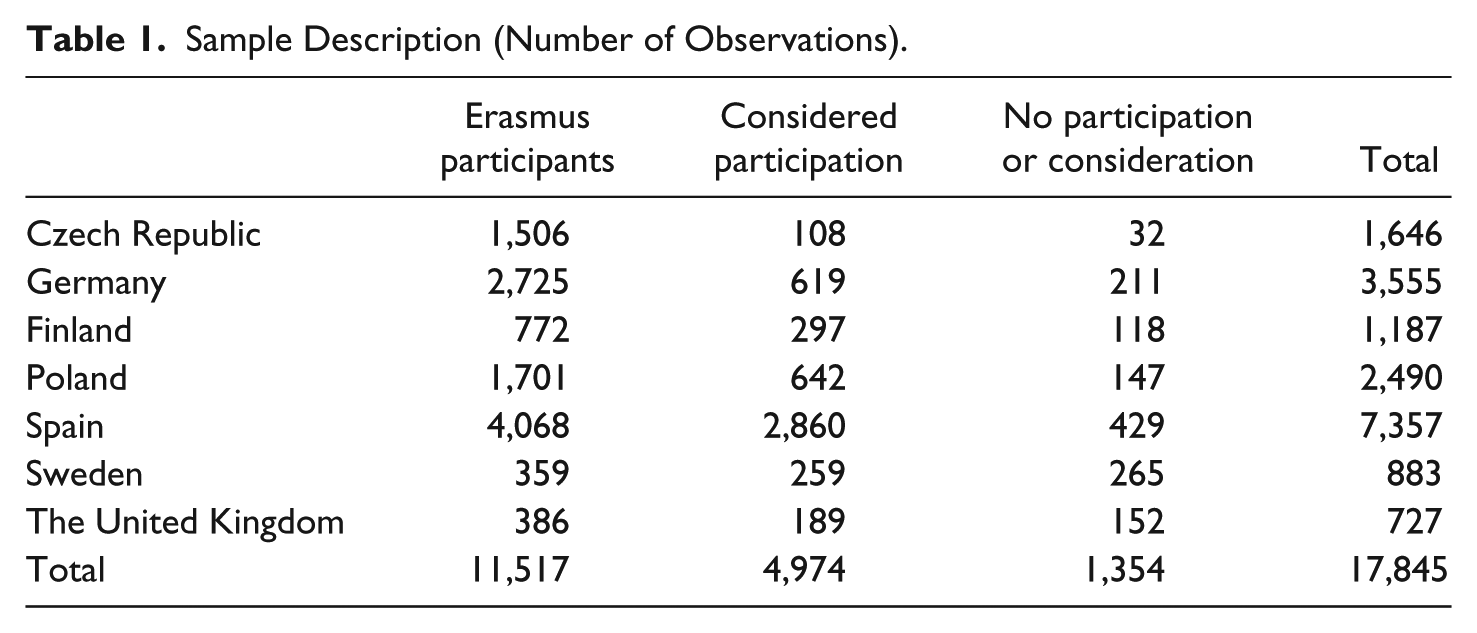
This article is based on student survey data from seven countries, collected in 2010 (see Vossensteyn et al., 2010). The questionnaire inquired about reasons for participating or not participating in the Erasmus program, and about perceived barriers. The online questionnaire was distributed through institutional Erasmus coordinators to all universities in seven countries. The country selection was determined by the level of Erasmus participation as a proportion of the total student body (high/low) as well as variation in size (large/small) and geography (East/West, North/South). These criteria led to selecting Czech Republic, Finland, Germany, and Spain as representatives of “active” Erasmus countries and Poland, Sweden, and United Kingdom as representatives of “less active” countries. The final cleaned data set includes 17,845 students (see Table 1).
Sample Description (Number of Observations).
The questionnaire inquired about the extent to which students perceived a specific barrier to Erasmus participation (21 items) and to what extent various motivations explain their interest in the program (18 items), both on a 5-point scale from “not at all important” to “very important.” In this article, we reduce the long list of items to a limited set of barriers and motivations by using factor analysis. With this, we can test conceptually whether the items form theoretically meaningful sub-dimensions and we can create a more manageable and comprehensive overview for cross-country comparison. Although the data reduction exercise may conceal some cross-country variation within the identified dimensions and hide differences in relative importance of single items, it gives us additional valuable information about inter-item correlations, as we discuss below.
We apply the principal components analysis (PCA) technique to extract as much variance with as few components as possible. As the correlation between factors is quite low, although slightly above the .32 threshold (Tabachnick & Fidell, 2007), we assume uncorrelated components and use a varimax rotation. We retain the components with eigenvector above 1 and we use the coefficient 0.55 as a threshold value for including an item in a component. We have run the PCA in two stages. The first run was based on the entire data set and the procedure identified five key barriers (see Table 2). To check whether the clusters are robust also within countries, we ran the procedure the second time for each country separately. 1 While the results on the first three components were consistent across all countries, the latter two show some country-level variation. Two of the initial components are therefore split into two or three parts in the analysis, to respect cross-country differences. We assigned each item to the barrier where it had the highest loading, above the threshold value of 0.55. The same routine was applied for motivations, but the cross-country differences in identified components are marginal and we use the components identified in the first step. In the analysis of cross-country differences below, a “barrier” and a “driver” refers to a set of items that form one component.
Clusters in Barriers for Erasmus Participation.
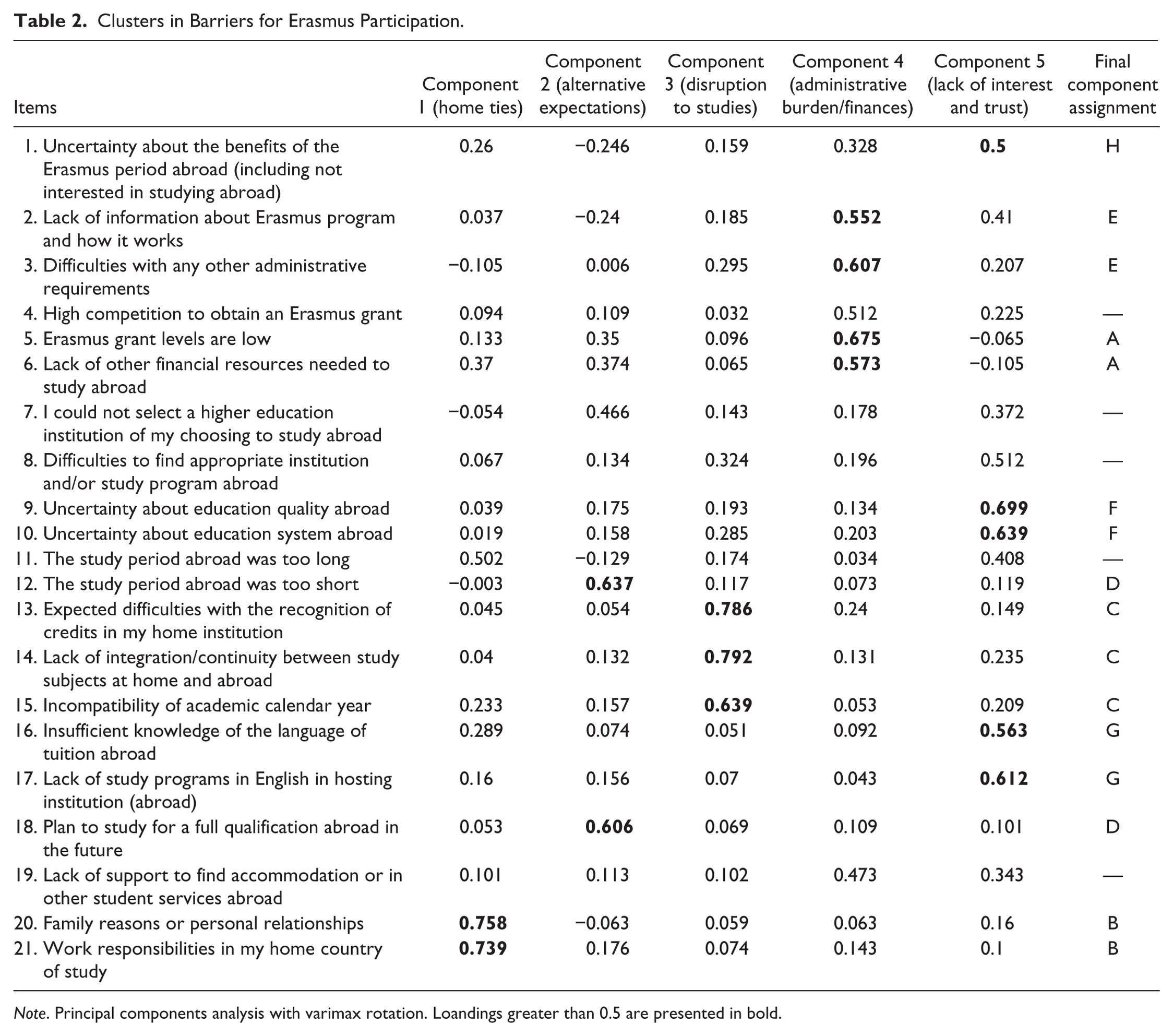
Note. Principal components analysis with varimax rotation. Loandings greater than 0.5 are presented in bold.
Results
The Structure of Barriers in Erasmus Participation
The PCA extracts five barriers that students face in the context of Erasmus participation (Table 2). We can characterize the first barrier as home ties. These students face difficulties with leaving their work commitments behind and they are restrained by family and other personal relations. This is a group that also tends to report that Erasmus periods are too long. The barrier home ties can be clearly identified in all countries, with some additional elements in Sweden and Spain.
The second clearly identifiable barrier characterizes students who have alternative expectations for studying abroad. These students are more interested in a full degree program abroad and they find Erasmus mobility too short. They tend to be most concerned about not being able to choose the institution of their wanting for their Erasmus exchange, but to a lesser extent and somewhat inconsistently. This cluster is again robust in all countries, with the exception of Sweden.
The third barrier refers to disruption to the studies. The students expect difficulties with credit recognition, with integrating a study abroad in their regular curriculum, and with incompatible academic calendar. In some countries, the fear of disruption extends to other uncertainties, either related to the educational system abroad and its quality (Finland, the United Kingdom, and Spain) or to difficulties with finding a matching program in the host country (Spain).
The remaining two components are more mixed. The fourth component combines financial and administrative constraints related to Erasmus participation. These are students who worry about the costs of studying abroad, including indirect costs of having to give up their (part-time) employment or living with parents, as well as the insufficient level of the Erasmus grant. This is combined with lack of information about the Erasmus program and difficulties with administrative requirements. A country-specific analysis shows that in most cases financial constraints are separable from the administrative problems. Furthermore, although the low level of Erasmus grant and lack of financial resources are clearly correlated, high competition to obtain Erasmus grant does not belong to this cluster in all but two countries and is omitted from the cluster.
The last component is quite mixed and combines elements of different nature, reflecting a general uneasiness or uncertainty about going abroad. This component reveals a significant cross-country variation. Issues with foreign language skills and availability of programs in English stand out most clearly as a separate dimension (Finland, Czech Republic, Germany, Poland, Sweden, and also in the United Kingdom). Doubts about the education system or quality abroad seems another, albeit ambiguous factor. As a separate dimension, we include lack of interest which includes uncertainty about the benefits of the Erasmus period abroad, not considering Erasmus as important for one’s future career and simply not being interested in a study abroad program.
In the analysis below, we will thus use the eight barriers for our cross-country analysis as identified through the PCA: home ties, alternative expectations, disruption to studies, financial barriers, administrative problems, doubts about educational system, language problems, and lack of interest (see Table 2 last column for item allocation). Besides the scale development, the results give also some methodological and conceptual insights about the structure of student-perceived barriers. Strong correlations between individual items show that specific items in a barrier list are not necessarily independent from each other, and students likely to perceive one barrier are significantly more likely to face also another barrier. From a methodological perspective, it is also conceivable that students do not decompose their reasoning about barriers into very specific items as listed by survey designers and instead perceive more generic worries about finances or home ties. Furthermore, relatively high correlations between conceptually similar items indicate also the reliability of the data, reducing the possibility that the respondents have filled out the questionnaire carelessly.
The argument proceeds by comparing the prevalence of different barriers in different countries and among student groups. We will examine whether countries differ significantly with respect to the perceived barriers and equally importantly, whether the perceived barriers differ significantly among students who participated and who did not participate in Erasmus to indicate what barriers might lead to non-participation in individual countries.
Cross-Country Differences in Perceived Barriers
The seven countries in our data set differ substantially in terms of Erasmus participation. Therefore, one might expect to see that some of the barriers are considerably more prominent in the countries of low participation than in the countries of high participation. Table 3 presents the percentage of students facing each barrier, per country. 2 The results show that there are indeed some cross-country differences but no barrier seems to give an indication why students in some countries are considerably more active in participation than others. In Finland and Sweden, students are much less worried about finances and disruption to their studies, yet Erasmus participation is high in Finland and low in Sweden. The administrative burden is perceived equally in Spain and in the UK, yet students in Spain are considerably more active participants. Language concerns characterize students in Spain and Czech Republic as well as in the United Kingdom and Poland. What stands out from the results is not systematic differences between countries, but similarities in how Erasmus participants versus non-participants perceive the barriers in all countries.
Cross-Country Differences in Perceived Barriers for Participating in the Erasmus Program (Percentage of Students Reporting the Barrier as Important or Very Important).
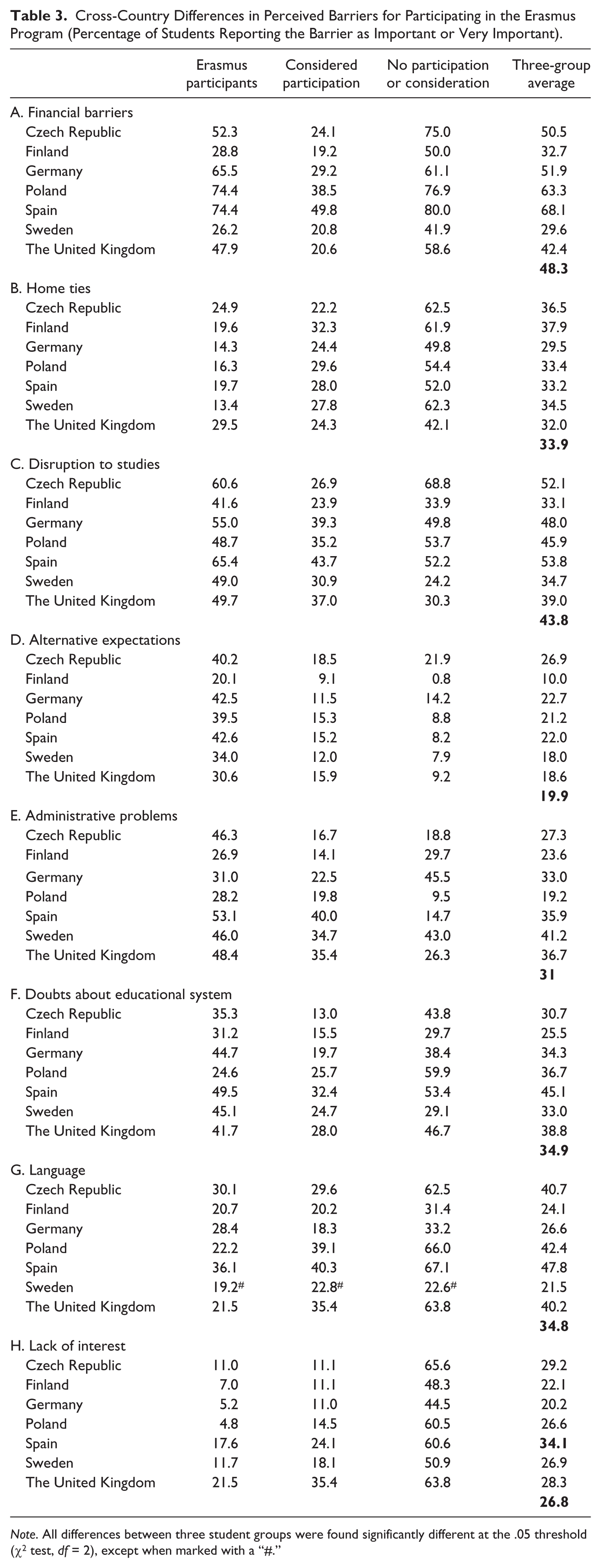
Note. All differences between three student groups were found significantly different at the .05 threshold (χ2 test, df = 2), except when marked with a “#.”
Based on the results in Table 3, we can distinguish three types of barriers. The first type includes barriers that are reported particularly often by non-participants. Such barriers could be interpreted as upfront obstacles that truly deter students from participation. The second type includes barriers that are more often faced by Erasmus participants. These may be barriers that reveal themselves in a later phase of the decision process, once the student has embarked in study abroad. Finally, we see barriers that are more or less equally reported by Erasmus participants and non-participants. While we cannot claim that the barriers have no influence on participation decisions, they are not characteristic to a specific student group.
The barriers that characterize clearly non-participants compared with participants include lack of interest, home ties, and, to a lesser extent, language issues. The lack of interest is expectedly a barrier typical for non-participants. While 45% to 66% of non-participants have such doubts, only 5% to 18% of participants report such doubts. Students who considered participation are rather similar with participants but their concerns are somewhat higher, indicating that the lack of interest is obviously an upfront barrier that keeps students from considering the possibility any further but it pushes some students away also in the later stage. Home ties are another clear upfront barrier. While less than a quarter of Erasmus participants worried about personal or work commitments at home, more than half of students not considering participation were bound by home ties (except in the United Kingdom). The group of students who considered participation is in most countries somewhere between the two groups indicating that some students with home ties were open to consider Erasmus. Language problems show more variation across countries, but in all countries the issue characterizes more often non-participants.
The financial concerns could be also classified as a barrier faced more strongly by non-participants (except in Germany), but the differences tend to be small. On average, this is the most common barrier. Almost half of the entire sample (48%) report the barrier. Only in the Nordic countries, the financial concerns are not the leading barrier that students face. It seems that students perceive the barrier strongly but many students nevertheless participate in the Erasmus program. Financial concerns are thus strongly perceived in the initial stage and may keep some students from developing an intent to study abroad; however, once the intent is developed, the financial constraints are still noticeable. For some Erasmus students, the financial concerns may emerge only later when faced with specific costs or even during studying abroad. For some non-participants, however, finances may be a retrospective justification for not studying abroad. The survey data alone thus do not provide a good understanding about the magnitude and the nature of the financial barrier.
The barriers that are more strongly experienced by Erasmus participants include alternative expectations and to a lesser extent administrative problems and disruption to studies. Alternative expectations stand out most clearly. Around 30% to 40% of Erasmus participants (with the exception of Finland) were interested in a degree program and/or a longer stay abroad, whereas only a very small group of non-Erasmus students had similar concerns. Students with such alternative expectations still seem to go abroad, and the desire for degree mobility does not crowd out short-term mobility. It may also be that the Erasmus experience itself enforces the desire for a longer period or a degree program abroad. Administrative problems tend to be perceived more strongly also by students who participate in the Erasmus program, but in some cases, differences are rather small and in Germany it is more an issue for non-participants. Similarly, participants are slightly more worried about the disruption of their studies than non-participants in five countries out of seven. Furthermore, this is a very common barrier (43.8% from all students), not far from financial concerns. It seems that disruption to studies is a worry that presents itself upfront but is even stronger later in the process, conceivably when students face difficulties with recognition, for example.
The analysis of barriers thus shows that some barriers clearly characterize non-participants: home ties, lack of interest, and to a lesser extent language issues. Other group of barriers is more present among participants, suggesting that the problems might emerge only when students have started seriously consider and apply for the program, such as administrative problems in several countries. The strongest barriers—financial concerns and disruption to studies—are almost equally perceived by participants and not participants. Before we continue with the discussion of these results, we turn from barriers to drivers to check whether countries differ in the motivation of their students.
Decision Making and Motivations
A decision to participate in the Erasmus program is dependent not only on the lack of obstacles but also on motivational factors that generate the initial intent to study abroad and help overcome the barriers that students face. Similarily to the barriers described above, we reduced a list of 18 items by using the PCA. Five components that emerged from the exercise aggregate conceptually similar items (Table 4): career perspectives (benefits to future employment either at home or abroad), inter-cultural experience (opportunity to live abroad, meet new people, develop inter-cultural skills), availability of the Erasmus grant (or other financial support), available administrative support, and a good fit of the program (the choice and quality of the host institution, alignment with the curriculum, and the length).
Clusters in Motivations for Erasmus Participation.
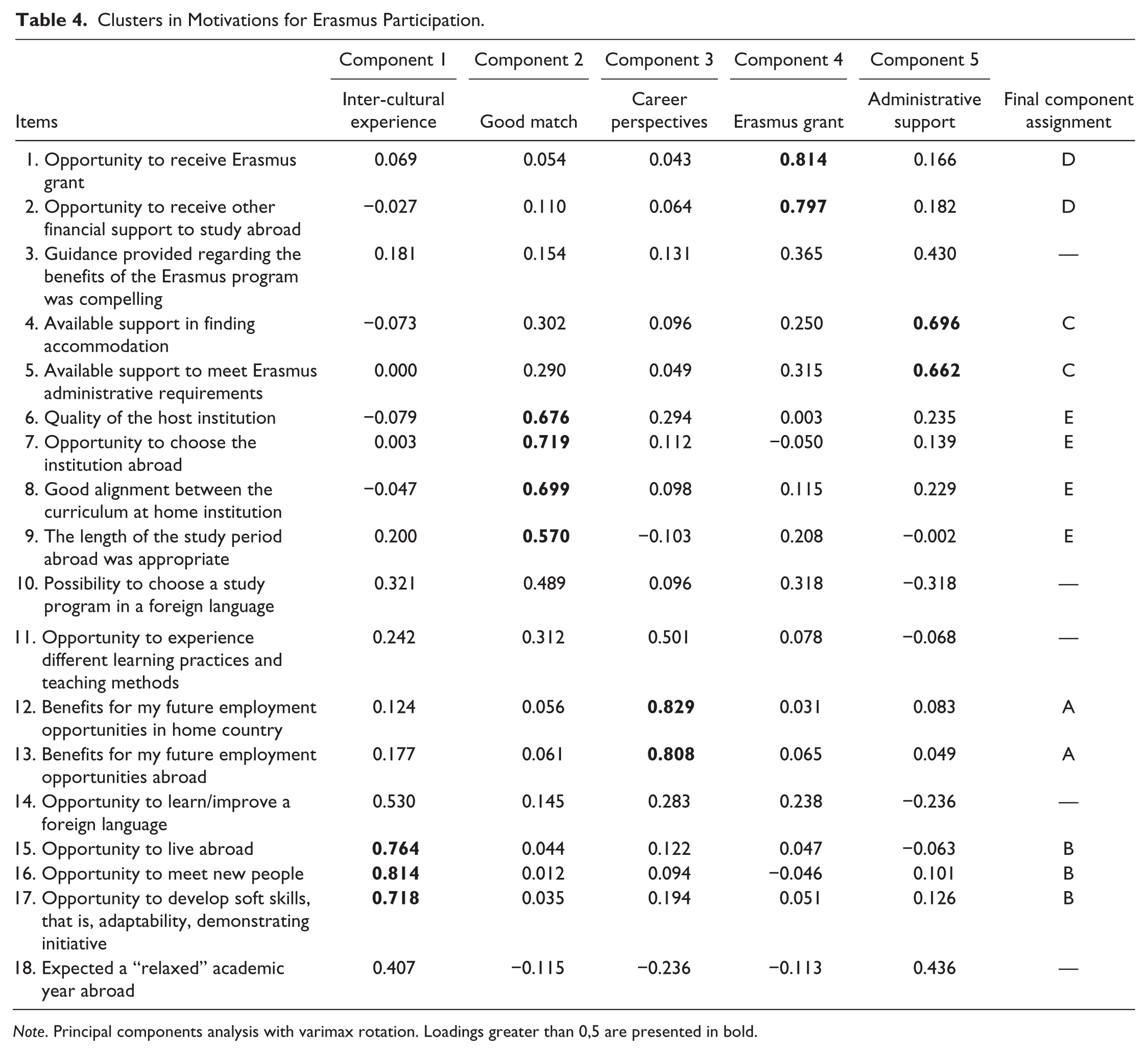
Note. Principal components analysis with varimax rotation. Loadings greater than 0,5 are presented in bold.
The results (Table 5) show clearly that the dominant motivational factor is cultural experience: More than 90% in all countries report this motivation. There is virtually no statistical difference between students who participate and students who considered participation (with an exception of Spain). The other two common factors are a good fit of the Erasmus program and career perspectives. Career perspectives are slightly more present among non-participants, and a good fit of the program was in the range of 10 to 20 percentage points higher among non-participants. Larger differences emerge between the two groups with respect to financial and administrative support. A significant proportion of students got interested in Erasmus because of the grant linked to it or administrative support, but relatively more of these students did not eventually go abroad. Again, we need to keep in mind certain biases that appear from retrospective surveys. After a positive study abroad experience, students may freshly remember their cultural experience and forget that initially they got interested in the program because the opportunity presented itself, either through administrative or financial support. Making Erasmus more accessible, both in terms of funding and administrative support, indeed creates interest in the program, even if many of the students end up not participating eventually.
Cross-Country Differences in Motivations for Being Interested in the Erasmus Program.
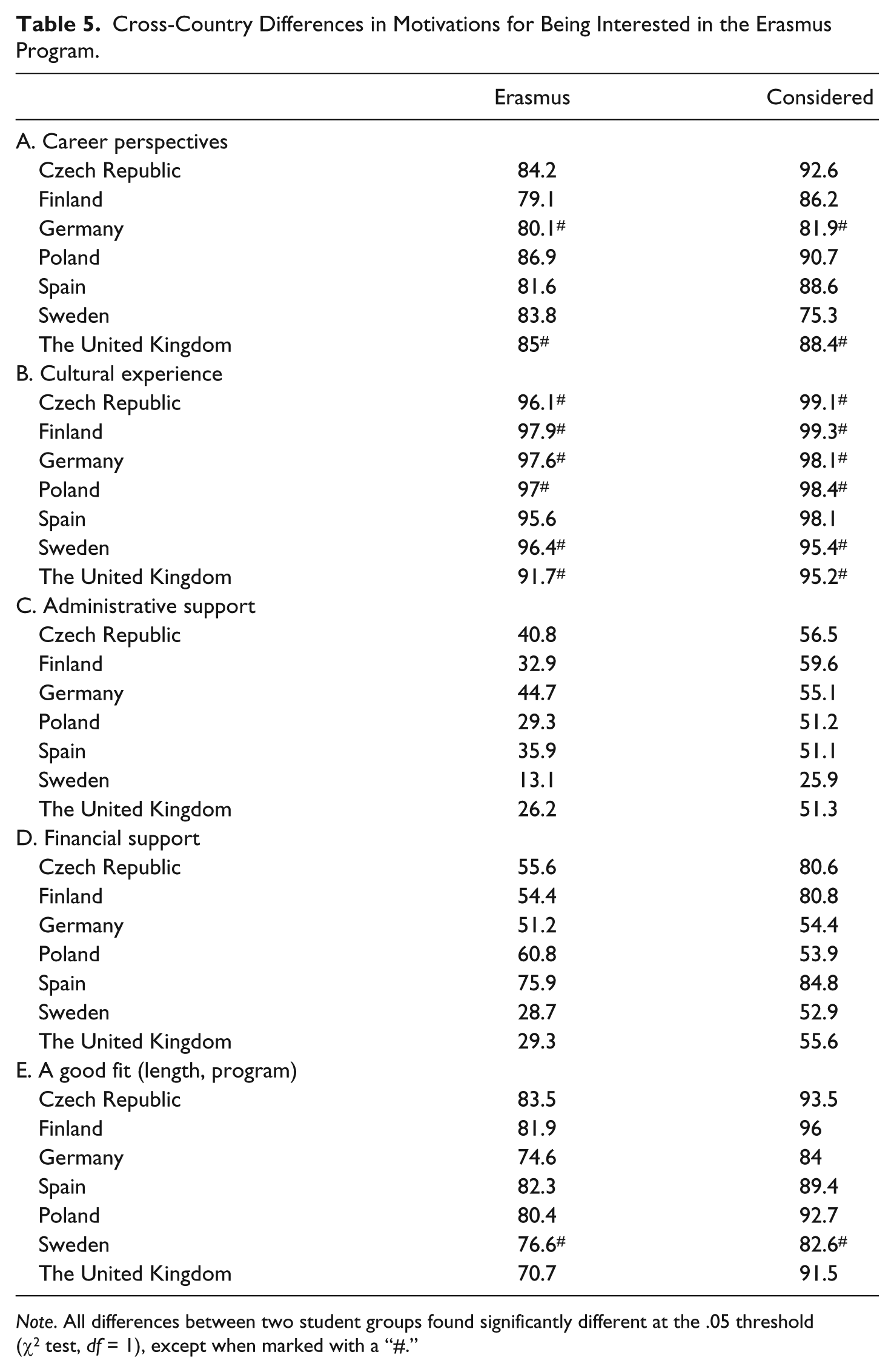
Note. All differences between two student groups found significantly different at the .05 threshold (χ2 test, df = 1), except when marked with a “#.”
Discussion and Conclusion
This article examines the extent to which student-level surveys on barriers and drivers can explain cross-country variation in Erasmus participation. The empirical analysis indeed reveals some differences between countries. The proportion of students facing financial barriers, the administrative burden and language problems varies per country. Yet, none of these differences help to separate active Erasmus countries from less active countries. We must conclude that this level of analysis says rather little about systematic differences between countries. What appears from the results, however, is that students in Europe are rather similar when it comes to barriers and drivers. The factors that distinguish Erasmus participants from non-participants are rather similar. How students make their decisions, what motivates them, and how they reach the conclusion for participation in the Erasmus program does not seem to be highly country-specific. In what stages of the decision-making process a barrier emerges also seems to be rather predictable, with some exceptions. This study confirms that the upfront barriers that keep students from developing an intent to look deeper into study abroad opportunities seem to be home ties and lack of interest (see also Souto-Otero et al., 2013). While several other barriers are even more prevalent, such as financial problems and concerns over delaying studies, it is difficult to link them to the actual participation decision. Based on this study, we can only assume that low-activity countries have simply more students who lack interest and are bound by home times.
In the last two decades, we have learned a lot from student surveys about barriers and drivers for mobility in Europe, but this approach has also some challenges for making policy-relevant conclusions. A link between perceiving a barrier and actual decision not to participate is often ambiguous and not necessarily causal. The barriers that students report most widely are not always the ones that keep them from participating. This means that a policy intervention to address a specific barrier may fail to deliver the expected effect on participation and eventually lead to disappointing results. Another challenge of this approach is inherent in the method of a structured survey. Surveys inquiring about barriers that keep student from participating in a study abroad program assume that there has been a conscious decision not to participate. It can also be that students have never really thought about this option. Even the most neutral answer options such as “not interested” or “not enough information” are a retrospective justification for a decision that never even was a conscious decision. The issue of retrospectivity emerges also when looking at the drivers. Erasmus participants are likely to remember their initial thought process somewhat differently from non-participants.
Strong correlations between certain items may also point to a discrepancy between the structured questionnaire and students’ actual thought process. The issue of home ties is intriguing in this respect. No doubt that many students have family responsibilities or work commitments that make even a short-term study abroad difficult, and a strong correlation could refer to the fact that indeed both responsibilities tend to be simultaneously present, for example, among mature students. However, this barrier characterizes more than half of non-participating students and the correlation between having personal and work commitments is so strong that it makes to wonder whether the barrier is more related to a mind-set than objective external circumstances in these students’ lives. It may characterize students who are hesitant about undertaking a short-term mobility because it takes them out of their established network and the daily comfort zone of their home environment. The correlations in such a case refer to an underlying latent barrier, probably of a more generic nature than researchers assume, either because students do not offer such level of precision when filling out a questionnaire or because they have not defined the barriers for themselves on such a level of precision. However, strong correlations within logical clusters are also a proof of data reliability, indicating that students do not fill out the questionnaire sloppily.
While self-reported barriers and drivers are an important source of information for understanding mobility, we may need to couple these results more effectively with other types of research, to advise on effective policy instruments. Longitudinal studies could significantly reduce certain biases of a retrospective survey and help us better understand the critical initial stage of getting students to consider studying abroad. We could also learn more from systematic studies on national and institutional policies and their effects on student perceptions, to understand the policy levers that underpin some of the national differences. Understanding cross-country differences in mobility requires more than understanding barriers and drivers at the student level. Nonetheless, understanding cross-country differences in participation can teach us a lot about the environment where the initial disposition for studying abroad is more likely to develop.
Footnotes
Declaration of Conflicting Interests
The author(s) declared no potential conflicts of interest with respect to the research, authorship, and/or publication of this article.
Funding
The author(s) disclosed receipt of the following financial support for the research, authorship, and/or publication of this article: The collection of data that is used in this article is funded by the European Parliament, within the project “Participation in the ERASMUS programme.”