




Abstract
International faculty mobility raises important questions about the relationship between culture and teaching in higher education. As international faculty members adjust to new cultural expectations, they may alter their teaching styles. This study uses survey data to examine the teaching styles of international faculty members in South Korea. The study considers whether international faculty assimilate into Confucian heritage classroom culture by testing the hypothesis that formal authority and expert teaching styles will correlate positively with the number of semesters an international faculty member has taught in South Korea. However, the results reject this hypothesis. The findings elucidate teaching styles used by international faculty members in Korea and provide a platform for further investigation into intercultural pedagogy in higher education.
Keywords
Introduction
As global integration changes politics, economies, and societies in the 21st century, it also drives international engagement in higher education (Altbach & Knight, 2007). Higher education institutions (HEIs) are taking part in further international exchanges that generate new demands on their organizations. Education’s original mission of instilling and developing a national culture conflicts with the needs of rapidly diversifying student and faculty populations (Otten, 2009). As international mobility and multiculturalism increase and the demands of the economy change (Mok, 2007), traditional models for higher education are drawn into question. As a result of these growing pressures, many HEIs are pressing forward with reforms to better compete in the global arena.
English-medium instruction (EMI) has been one approach to the competition in the international student market. As governments turn to higher education marketization, HEIs receive less public funding (Mok, 2007), a trend that has intensified in the aftermath of the 2008 global financial crisis. International students offer an important source of revenue to replace government financial support. However, non-English-medium higher education systems can only draw from a limited pool of potential international students. In Japan, trials with EMI allowed Japanese HEIs to attract students from a wider range of source countries (Tsuneyoshi, 2005). Likewise, in the European Union (EU), English is increasingly becoming “the language of higher education” as a result of market demand, despite European language policies designed to protect local languages (Coleman, 2006).
South Korean (henceforth Korean) HEIs have taken steps toward increasing EMI for more than 10 years, part of a broader effort to upgrade major universities in Korea to the level of a global standard of excellence (Kim, 2005). EMI has been used as a major instrument for HEI internationalization with the hopes of raising Korean HEI competitiveness in the global higher education market (Byun et al., 2011). The increased use of EMI aims to help local students better prepare for future work by improving their English language and international skills and to benefit Korean professors by regularly exercising their English language abilities (Byun et al., 2011). Implementing EMI also allows universities to tap into the global market for international faculty and students, and the presence of both groups at Korean HEIs has increased in recent years. As of 2012, there were 5,964 international faculty members teaching at Korean HEIs, more than quadruple the number of foreign faculty 10 years prior (Korean Education Development Institute, 2013).
Yet the Confucian heritage classrooms of Korean host institutions, where the teacher–student relationship is characterized by restrictions on students’ freedom of action as well as a lack of free exchange between teachers and students (Ho, Peng, & Chan, 2001), may be unfamiliar to newly arriving international faculty members. Conflicting cultural views concerning instruction can result in a situation in which it is very difficult for an instructor to satisfy the cultural expectations of his or her students (Mccargar, 1993; Tsuneyoshi, 2005). Within Confucian classrooms, lessons tend to be teacher-oriented, and educators tend to be more authoritative (Hofstede, 2001), and these cultural expectations at Korean HEIs may lead to changes in the teaching styles of international faculty members as a response to perceived resistance or discomfort from their students.
This study aims to address some of the uncertainty regarding the impact of cultural context on international faculty instructional practice. It looks specifically at the impact of Confucian heritage educational culture on the teaching style of international faculty at HEIs in Korea and the possibility of faculty assimilation into their host culture. To these ends, the study tests the hypothesis that formal authority and expert teaching styles will correlate positively with the number of semesters an international faculty member has taught in South Korea.
International Faculty Challenges
Successful internationalization requires a clear plan for the integration of foreign faculty members into their new host institution. Simply recruiting international faculty without providing proper support could lead to missed opportunities and even conflict. As international faculty members integrate and adjust to a new university setting, they need to consider student attitudes, cultural differences, and varying degrees of language ability. Intercultural instruction stands out among the challenges newly arrived international faculty members face. As Gress and Ilon (2009) point out, “teaching styles vary throughout the world according to culture, custom, and history” (p. 190). With the varying degrees of English language ability among students, foreign faculty members are presented with considerable linguistic and cultural challenges. Students must first be able to linguistically understand course material and communicate their ideas sufficiently to have the potential to do well in an English-medium course.
As faculty members revisit their teaching practices and cultural views, it is important that they remain aware of students’ language ability and that student efforts are supported and appreciated (Gress & Ilon, 2009). For instance, faculty members teaching English-medium courses in a non-native setting may provide lecture notes before the class lecture, gradually introduce students to unfamiliar activities, and allow students to ask for additional support outside of the classroom. For faculty members unprepared or inexperienced in cross-cultural educational environments, such changes to their teaching habits may not come easily or naturally. Depending on the circumstances, without proper preparation for intercultural instruction, this process could lead international faculty members toward gradual assimilation into local education norms or an outright rejection of their students’ expectations.
The Korean Context
Korean society is heavily influenced by the Confucian tradition, and this has a profound impact on education and social life (Shin, 2011). The principles of politeness, helpfulness, and respect for elders are deeply ingrained. Admiration for educational attainment and scholarship are an important element of the Confucian tradition (Marginson, 2011), and this contributes to the atmosphere of Korean HEIs. Formal schooling is positioned in both a social and institutional hierarchy, with a strong emphasis on assessment, seniority, and departmental affiliations. The Confucian model teaches learners to respect and obey authority figures and to adhere to the notion that humility ensures better learning (Li, 2003). In a similar manifestation of this hierarchy, HEIs tend to follow the lead of the government in determining their future course.
On the national scale, HEIs in Korea have worked through both structural and cultural changes triggered by the government’s policies for higher education internationalization and global competitiveness. Institutional assessments and the allocation of awards play an important part in government steering of higher education (Byun et al., 2011). Programs such as “Brain Korea 21” and “Brain Korea 21 Plus” bestow special grants to research projects, and despite controversy surrounding the selection of winning proposals, the programs have been very successful in increasing the productivity, in terms of publications, of scholars (Shin, 2009). Likewise, government evaluations (as well as third party higher education rankings) introduce pressure to increase the numbers of international faculty and students at Korean HEIs (Ghazarian, 2011). However, many HEIs focus simply on meeting quantitative measures set out in these assessments, overlooking qualitative assurances in the process (Byun & Kim, 2011). As a result, although the numbers of international faculty and staff have increased, the lack of infrastructure to support these new additions to Korean HEIs could lead to future problems.
In the classroom, Korea is a large power distance culture (Park, Lee, Yun, & Kim, 2009). Power distance dimension describes students’ perceptions of instructor communication behaviors in the classroom. In small power distance cultures, teachers and students treat one another as equals, and education is often student-centered. In this type of environment, teachers incorporate group discussions and encourage students to ask questions and even argue with instructors. However, large power distance cultures are based on teacher-centered instruction. The instructor initiates all communication in the classroom, and students speak up only when prompted. Faculty members from small power distance cultures may struggle at Korean HEIs, leading to possible discomfort for the instructor and students.
Teaching Style in Higher Education
An analysis of teaching styles and educational cultures using Park et al.’s (2009) power distance dimension dichotomy would risk oversimplifying the diverse approaches to instructional practice. These varying approaches, or teaching styles, consist of “a teacher’s personal behaviors and media used to transmit data to or receive it from the learner” (Kaplan & Kies, 1995, p. 29) and the roles that a teacher prefers to play in the classroom (Grasha, 1994, 2002). They are shaped by a variety of factors, including an individual’s beliefs, culture, past teaching and learning experiences (Heimlich & Norland, 2002), and the discipline of the content being taught (Evans, 2004; Lawrence, 1997).
Teaching styles are important for learners because they influence the effectiveness or attractiveness of a particular instructor’s lessons (Felder & Henriques, 1995; Felder & Spurlin, 2005). Kumaravadivelu (1991) explains that “the narrower the gap between teacher intention and learner interpretation, the greater are the chances of achieving desired learning outcomes” (p. 98), suggesting the potential trouble that intercultural misunderstandings can create for instruction. Work by Felder and Brent (2005) examining the effects of the students’ learning styles on performance found that students with learning styles more compatible with an instructor’s teaching approach perform better than other students.
A number of frameworks for understanding and measuring teaching styles have emerged over the years. Early approaches attempted to categorize instructors based on verbal interactions with students (Flanders, 1970) or sought to group instructors according to large, generalized categories such as discipline-centered, teacher-centered, or student-centered (Dressel & Marcus, 1982), or as didactic, Socratic, or facilitative (Jarvis, 1985). Later models have sought to interpret instructors in terms of the amount of holistic and analytical presentation of knowledge (Evans, 2004) or guidance, exposition, and opportunity for inquiry provided by the instructor (May Oi & Stimpson, 1994). However, most of these early efforts were incomplete and overemphasized or ignored certain aspects of teaching style.
Major contemporary measures of teaching style consist of the Center for Occupational Research and Development (CORD, 2005) Teaching Style Inventory, the Pratt and Collins (2001) Teaching Perspective Inventory, and the Grasha–Reichmann Inventory (Grasha, 1994, 2002), each of which takes a different approach to quantifying teaching style. The CORD teaching style inventory was developed by the Center for Occupational Research and Development and consists of two dimensions of teaching style: teaching goal dimension and teaching method dimension, each with two constituent subfactors that are scored on a dichotomous hierarchy. Teaching goal dimension subdivides into learning (rote and comprehension) and concept representation (abstract or applied). Teaching method subdivides into interaction (cooperative or individual) and cognitive process (symbolic or enactive). However, the CORD Teaching Style Inventory is too discipline-centric for general use and heavily reliant on dichotomous interpretations of teaching practice that may not always be appropriate.
Pratt and Collins’s (2001) Teaching Perspective Inventory assesses several styles—transmission, apprenticeship, developmental, nurturing, and social reform—and assigns an instructor a score on a continuum for each perspective on teaching. However, these results seem to offer more information about an instructor’s teaching philosophy than role in the classroom.
Grasha (2002) presents an alternative model of five roles that instructors take that are specific to higher education. Rather than suggesting an instructor adopts only one of these roles in the classroom, Grasha argues that all instructors adopt each of these roles at different times to varying degrees:
Faculty with the “expert” teaching style see themselves as a source of specialized knowledge and concern themselves primarily with transmitting information to students and preparing students to understand more advanced knowledge.
Faculty with the “formal authority” teaching style focus on structuring learning experiences by providing positive and negative feedback, establishing learning goals, expectations, and rules for their learners.
Faculty with the “personal model” teaching style emphasize providing a personal example to their students of how they should think and behave.
Faculty with the “facilitator” teaching style emphasize personal relationships and providing support and guidance as students take primary responsibility for their learning.
Faculty with the “delegator” teaching style concentrate on building team and individual autonomy and supporting students with the resources they need to progress by themselves.
While Grasha’s model provides a nuanced look at the individual practice of instructors, Diaz-Maggioli (2004) offers a model for understanding the factors influencing an individual’s teaching style. This model considers six sources of influence on teaching style: career-stage factors, curriculum factors, knowledge factors, personal factors, professional factors, and institutional factors. Of these, the present study focuses on the influence of institutional factors, such as the school culture and climate, on the teaching style of instructors at HEIs. The study examines the possible impacts of a drastic change in institutional factors on self-reported teaching style.
Based on the present literature, it remains unclear whether or not international faculty members assimilate into the host educational culture. More evidence is needed to determine whether international faculty members adjust their practice to meet their students’ expectations or whether they persist with the teaching styles with which they are familiar from their home cultures. Such research would shed further light on the impact that international faculty have on the students of their host institutions and provide insight into the strength of the influence environment exerts over teaching style. The present study tests whether the number of semesters a faculty member has taught in Korea correlates with differences in self-reported teaching style. The study also examines differences in the teaching styles between genders and age groups. For the present study, Grasha’s (2002) model of tertiary teaching styles and Diaz-Maggioli’s (2004) framework of teaching style serve as the frameworks for understanding individuals’ teaching styles and the factors that influence them.
Method
This study examines the teaching styles used by international faculty members at Korean HEIs. The study first examines the teaching styles that these international faculty members report to use. It then tests the hypothesis that expert and formal authority teaching styles will correlate positively with the number of semesters an international faculty member has taught in Korea. This is followed by a test for the presence and nature of differences in teaching style among international faculty according to gender and age.
Sample
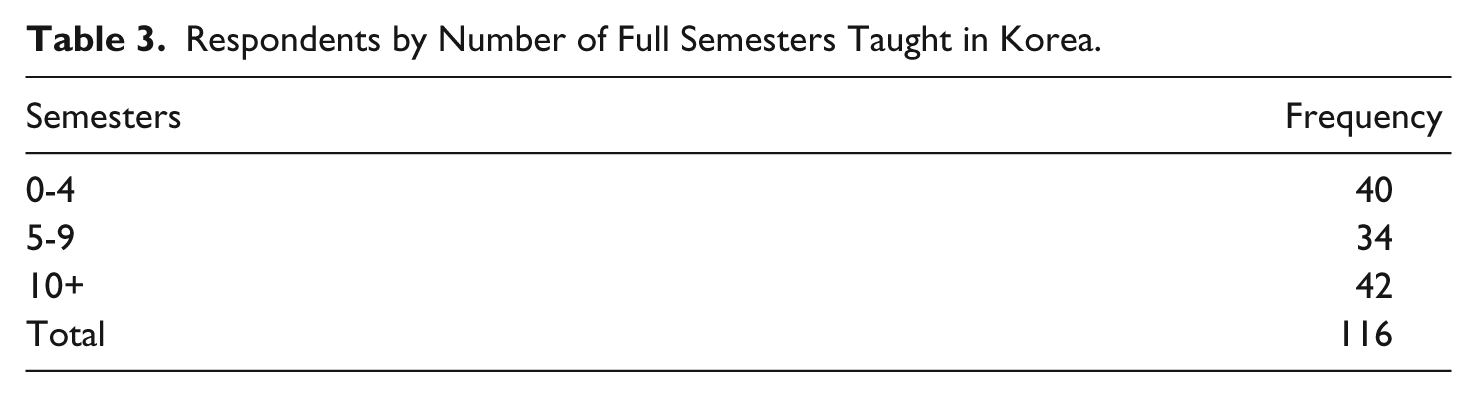
A survey was distributed by email to 882 international faculty members listed on departmental directories on the websites of HEIs in all provinces and self-governing areas of South Korea. Data were collected between November 15, 2012, and February 15, 2013. There were 116 total survey completions, for a 13.2% completion rate. The reasons for this low rate of completion are discussed in the “Limitations” section of this article. Table 1 breaks down the distribution of age and gender for the sample, Table 2 provides information about global regions of respondents’ nationalities, and Table 3 offers details on the length of time respondents have taught in Korea.
Age Groups by Gender.
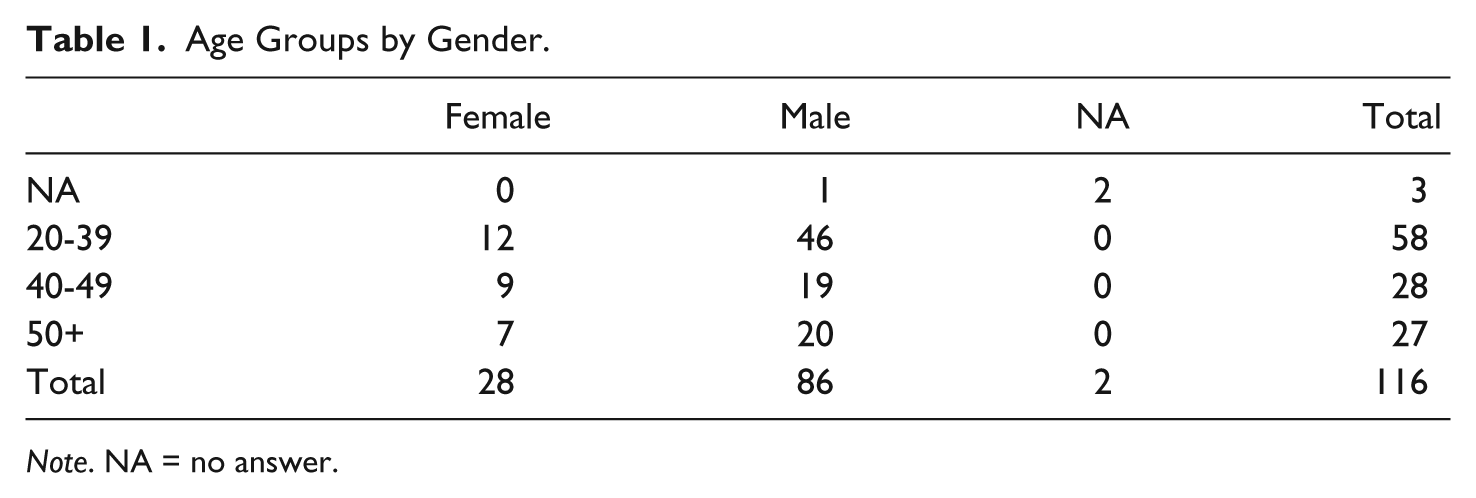
Note. NA = no answer.
Respondents’ Nationality by Global Region.

Note. NA = no answer.
Respondents by Number of Full Semesters Taught in Korea.
Instrumentation
Data were collected using an Internet-based version of Grasha’s (2002) Teaching Styles Inventory. The Teaching Styles Inventory is a 40-item instrument designed to assess attitudes and behaviors associated with the five different teaching styles. The 5-point Likert-type scale used for each of the items included in the Teaching Styles Inventory assigns every participant a score for each of the five teaching styles. The various teaching styles are not mutually exclusive of one another, and Teaching Styles Inventory assigns every respondent a score for each teaching style. Cronbach’s alpha was .642 for expert, .697 for formal authority, .652 for practical model, .801 for facilitator, and .563 for delegator. The relatively low alphas may be a result of the inclusion of non-native English speakers in the sample, for whom the survey items would be measuring their English proficiency in addition to self-perceived teaching style. Participants were also asked basic demographic questions concerning their gender, age, and number of full semesters taught in Korea.
Analysis
The analysis begins with an overall description of international faculty members’ teaching styles. This portion of the analysis follows the Teaching Styles Inventory procedures to calculate scores for teaching styles for each respondent. The means of scores for each teaching style are used to determine the overall prevalence of each teaching style among international faculty at Korean HEIs. The second step of the analysis utilizes Pearson correlations between the number of semesters an individual has taught in Korea and each of the five teaching style variables. The last step of the analysis tests for differences in teaching styles among demographic groups based on gender and age. Shapiro–Wilk tests (p < .05) reveal that the responses are not drawn from a normally distributed population, and as a result, an ANOVA test could not be used. Instead, the study makes use of non-parametric Kruskal–Wallis test to determine significant differences between groups based on gender. Respondents who did not report gender were omitted from this final step of the analysis.
Limitations
Aspects of this study that could influence the results include the low completion rate for the survey, the possibility of self-selection bias, and language barriers that may have resulted in lower rates of participation among non-English speaking faculty members. These limitations all have the capacity to affect the findings of the study. In addition, due to resource constraints, the present study is designed based around a single self-reported measurement of teaching style. Conducting multiple measurements on participants before coming to Korea, on arrival, and over the course of international faculty members’ stay would further strengthen the findings. Multiple measurements would further benefit the study if they also included third party observations and student perceptions of their instructors’ teaching styles.
The low completion rate for the online survey by faculty members and the focus specifically on the context of Korea could limit the generalizability of the findings. For this study, questionnaires were sent online using current email addresses of faculty members provided by departmental directories on the websites of universities. Two important factors may have contributed to the low completion rate. First, many university websites may not have updated contact information for foreign faculty members. As foreign faculty members at Korean HEIs frequently leave their positions, many surveys may have been sent to disused or non-responsive email addresses. Second, official HEI email systems in Korea are often only offered in Korean language interface. As a result, not all foreign faculty members make use of their official email address, and they may not check their HEI email account regularly. Both of these factors may have contributed to the low completion rate.
In addition, certain faculty members may have encountered language barriers when filling out the questionnaire. Data were collected using an English language instrument, not in all the possible first language of the foreign faculty respondents. These linguistic issues could have contributed to the low completion rate, self-selection bias, and the quality of responses of international faculty members with limited English language ability.
Results
Descriptive statistics provide an overall summary of the teaching styles used by foreign faculty members in Korea. The results reveal comparable means for all teaching styles among the respondents, with no significant differences between the self-reported use of teaching styles. All of the teaching styles include low-value, but no high-value, outliers. These results reveal the diversity of teaching styles among foreign faculty members despite their shared new experiences of teaching at a Korean HEI.
Pearson Correlations reveal significant relationships between both formal authority and personal model teaching styles with number of semesters taught in Korea. The correlations also produced a suggestive finding for correlation between expert teaching style and number of semesters taught in Korea. The findings are presented in Table 4.
Pearson Correlation of Teaching Styles With Semesters Taught in Korea.
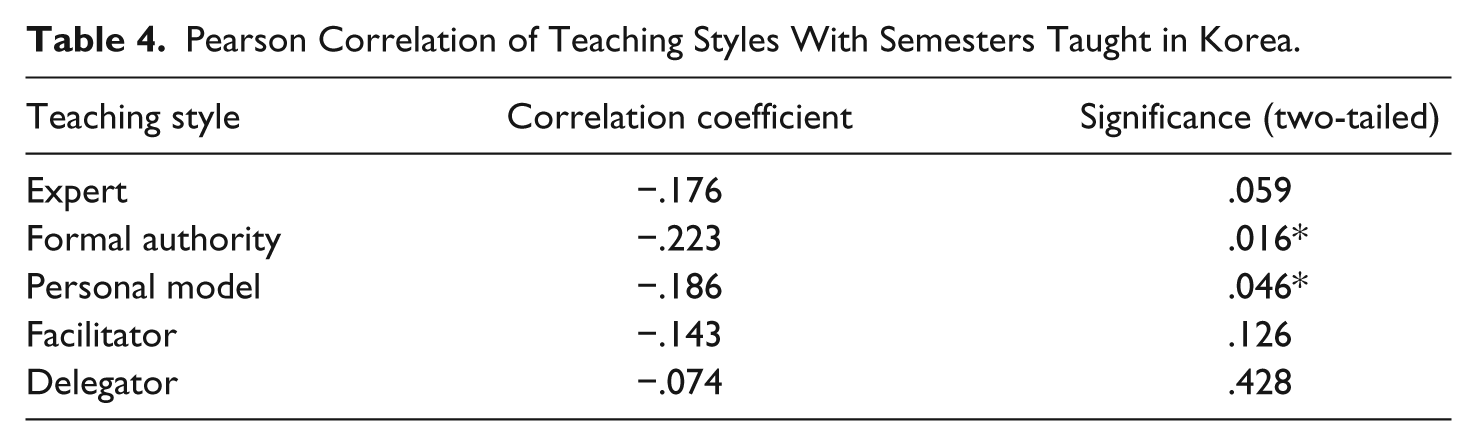
The significant correlation between formal authority and number of semesters is negative, with a coefficient of −.223. This result suggests that the more semesters an international faculty member has been in Korea, the less likely that individual is to self-report the use of formal authority teaching style. In addition, the significant correlation between personal model and number of semesters taught in Korea is also negative, with a coefficient of −.186. This result indicates that those who have taught for more semesters in Korea are less likely to self-report the use of personal model teaching style. Last, the analysis produced a suggestive finding for the correlation between expert teaching style and number of semesters taught in Korea. The coefficient was negative, at −.176 (p = −.059). The result also suggests that those international faculty members who have taught for more semesters in Korea may also be less likely to self-report use of the expert teaching style.
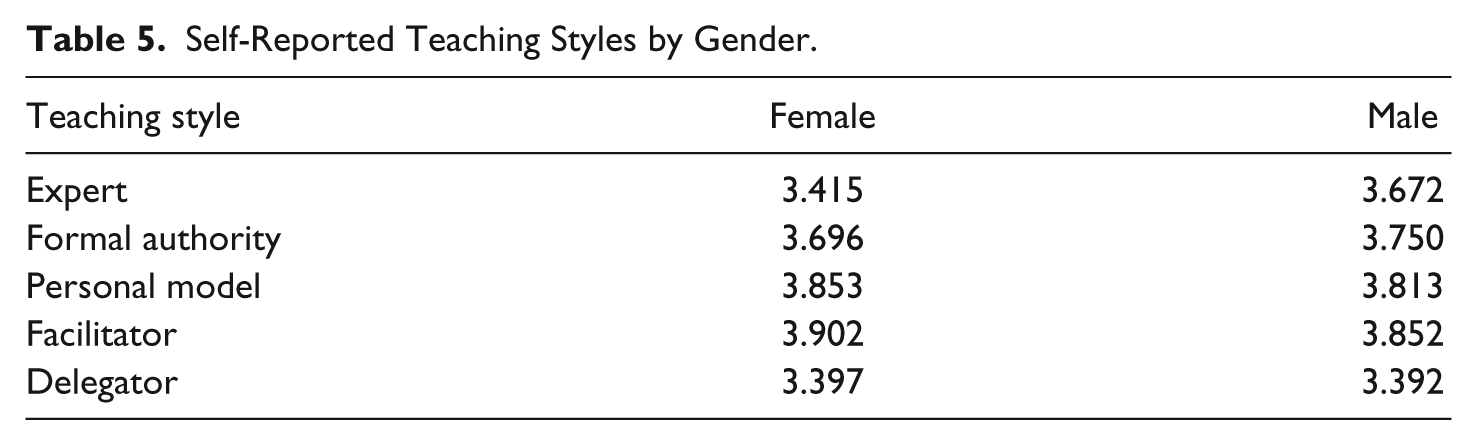
The last step of the analysis focused on determining differences in teaching style among gender. Table 5 illustrates the international faculty’s self-reported teaching style mean scores by gender. The results of the Kruskal–Wallis tests reveal a significant statistical difference in teaching styles between genders (H = 3.921, 1 df, p = .048). Male respondents report a significantly higher use of the expert teaching style than female respondents, with an effect size for gender of 3.5%. This finding could be a result of pre-existing gendered differences in higher education teaching styles among faculty members, or could be linked to gendered differences in foreign faculty reactions to the intercultural classroom.
Self-Reported Teaching Styles by Gender.
Discussion
The results of the analysis reject the hypothesis that those international faculty members who have taught more semesters in Korea would self-report greater use of the expert and formal authority teaching styles. Instead, the results reveal a significant negative correlation between formal authority teaching style and semesters taught in Korea and a suggestive negative correlation for the expert teaching style. There was also a significant negative correlation between personal model teaching style and semesters taught in Korea. These findings support the notion that faculty members who have taught in Korea longer are less likely to use teacher-focused teaching styles such as formal authority, personal model, and perhaps expert teaching styles. The findings directly contradict the hypothesis and could mean that on arriving in Korea, international faculty members are more likely to use teacher-centered teaching styles, but later move away from such an approach as they grow comfortable in Korea.
In addition, the results from the Teaching Styles Inventory reveal comparable self-reported means and distributions for each of the five teaching styles. These findings show that international faculty members are using a diverse range of approaches to their teaching at Korean HEIs and that no one approach to teaching is used significantly more than the others. However, investigation into differences between the genders reveals a significant difference in the use of the expert teaching style among international faculty by gender. These findings may indicate pre-existing differences in gendered approaches to tertiary education or perhaps different gendered approaches to intercultural teaching environments.
Semesters Taught in Korea and Teaching Style
The findings suggest that those international faculty members who have more recently arrived in Korea are more likely to self-report the use of formal authority and personal model teaching styles. They also may be more likely to use the expert teaching style. A number of factors could contribute to this greater use of teacher-focused instructional approaches among these international faculty members. Those more recently arrived in Korea may feel less certain about how to interact with their students. Accustomed to the large power distance culture described by (Park et al., 2009), tertiary students in Korea can be reluctant to engage with instructors at first. As a result, some international faculty members may struggle to build a rapport in class and instead rely more on formal authority and personal model teaching styles. Such an approach allows for the instructor to maintain greater control of the classroom, a situation that international faculty may find more comfortable for their first experiences in a new intercultural classroom setting.
Meanwhile, those international faculty members who have been in Korea longer would be more comfortable with the cultural norms at Korean HEIs. Having had more time to reflect on how Korean HEI culture compares with their personal views, these faculty members would have a greater opportunity to negotiate an intercultural identity. These faculty members would better understand how their personal teaching styles might differ from student expectations and take steps to ease the transition for their students. As a result, these international faculty members may tend to be better prepared to use personal teaching styles that deviate from student expectations. Faculty members more experienced with their students’ cultural expectations may make use of their knowledge of learners to help them grow accustomed to new and unfamiliar teaching styles.
Alternatively, the negative correlation between formal authority and personal model teaching styles may be a consequence of subjective nature of the data collection instrument. As a self-assessment, the Teaching Styles Inventory is limited by the self-perception of the respondent. The existence of a significant negative correlation may be down to a gap in self-perception. Those international faculty members more recently arrived in Korea may perceive their teaching style as more distinct relative to their new surroundings or may be more sensitive to changes in their approach to teaching as a result of their relocation to Korea. Furthermore, those international faculty members who have been in Korea longer may have adjusted their norms in such a way that influences the way they self-report their teaching styles. This possibility emphasizes the need for further research making use of third party observations or student perceptions to strengthen the data on how teaching styles change after an international faculty member arrives in a host culture and over the course of their time there.
Gender and Teaching Style
The findings also reveal that male international faculty members self-report a significantly greater use of the expert teaching style at Korean HEIs. On one hand, this difference may simply be a result of underlying gender differences in the approach to teaching. Previous research finds that gaps between males and females vary by discipline, course level, and also the number of times a course is taught by the same instructor (Laird, Garver, & Niskodé-Dossett, 2011). Results from that study indicate that compared with male instructors, female instructors spend less time lecturing and spend a greater proportion of class time on active classroom participation and activities. This prior finding could explain the significant difference between males and females in the present study.
On the other hand, the gap between self-reported teaching styles by gender may also be influenced by the different ways in which the genders respond to intercultural experiences. This unexpected outcome for the study offers a potential avenue for further investigation into the relationship between gender and the intercultural classroom. Further research would be necessary to determine the precise nature and origin of gendered differences in teaching style and the influence, if any, that gender exerts on faculty responses to intercultural teaching experiences.
Conclusion
As internationalization brings both financial and social benefits to institutions and students, there still remain many challenges (Bodycott & Walker, 2000). One of the major challenges can found in university lecture halls and classrooms between students and teachers. As Korean HEIs press forward with internationalization and pressure for EMI continues, the effect of a foreign instructional language on teaching performance needs to be further investigated (Vinke, Snippe, & Jochems, 1998).
Research has been conducted on East Asian students and the challenges they face once they arrive at overseas universities; however, there are limited studies investigating the experiences of international academics teaching in East and South East Asian higher education settings (Bodycott & Walker, 2000). There is also a lack of research conducted on strategies for supporting international faculty members to make transitions (Brown, Dashwood, Lawrence, & Burton, 2010). Building up understanding of how faculty members can successfully transition their teaching and research work at a new environment is essential to getting the most out of the presence of international faculty at an HEI.
This study establishes foundation knowledge about the approaches to teaching used by international faculty members at Korean HEIs. The study finds that international faculty members use a diverse range of teaching styles, collectively favoring no single teaching style over any others. The study reveals that those international faculty members more recently arrived in Korea are more likely to self-report using formal authority and personal model teaching styles in their lessons. Recently arrived international faculty members may also be making more use of the expert teaching style than their peers. Further work to verify and expand on the findings of this study would clarify international faculty members’ reactions to the intercultural classroom and expand the scope of this investigation to other national higher education systems.
Further research on the role of international faculty members at Korean HEIs is essential if the efforts toward internationalization are to be successful. Such research needs to focus on teaching, research, and administrative responsibilities of international faculty members. To deepen our understanding of how the intercultural classroom affects teaching style, future research should test for changes in teaching style longitudinally. In this type of study, it would be important to gather data before international faculty members arrived to Korea or before their first semester at the Korean HEI. These data would allow for a clearer understanding of how approaches to teaching change on arrival and as time passes in the new educational context.
Furthermore, future research is needed to verify the negative correlation of formal authority and personal model teaching styles with the number of semesters a foreign faculty member has taught in Korea. Such a follow-up study would make use of classroom observations, foreign faculty interviews, and data collected on the students’ perceptions of international faculty members’ teaching styles. Triangulation of data in this way could strengthen the findings of this study and help further explain why these transitions away from formal authority, personal model, and perhaps expert teaching styles occur.
Footnotes
Declaration of Conflicting Interests
The author(s) declared no potential conflicts of interest with respect to the research, authorship, and/or publication of this article.
Funding
The author(s) received no financial support for the research, authorship, and/or publication of this article.