




Abstract
This article explores how three different learning spaces could be appropriate for developing a sense of global citizenship among university students. We draw on an interview study conducted at the Universitat Politècnica of Valencia (UPV) between 2010 and 2012. The spaces analyzed were two electives devoted to international cooperation, a mobility program that took place mainly in Latin American countries and a student-led university group. We examined the three spaces in terms of expansion of capabilities and agency related to global citizenship and cosmopolitanism using a conceptual framework that synthesizes Nussbaum’s and Sen’s capability approach with Delanty’s critical cosmopolitanism to explore the limits and potentialities of those three spaces. Although the exploratory character of our study cannot allow us to generalize our findings, what we can affirm is each of these areas has the potentiality to enhance global citizenship but with nuances, differences, and complementarities. The electives appear to be good spaces for the critical learning capability, while international mobility (Meridies) is a strong enabler for narrative imagination capabilities. Students belonging to Mueve (student led group) showed elements of these capabilities plus a very strong emphasis on agency, which does not occur in the other two learning spaces. Critical cosmopolitan process happened both in Mueve and Meridies. In the student-led group, this cosmopolitan process begins with the local, while in the internships it was the global encounter that initiates a cosmopolitan reflection.
Keywords
Introduction
Since the end of the last century, we have been experiencing the fast and complex phenomenon of globalization, which is producing changes, interdependencies, and risks in the economic, political, and cultural spheres (Beck, 2000; Giddens, 1990). Universities are not alien to this phenomenon and its consequences are numerous: the decline of public funds to finance universities and an increase in private funding, intensification of internationalization, or the appearance of rankings as a measure of the quality of higher education institutions (Global University Network for Innovation [GUNI], 2009). In these new scenarios, Marginson (2011) identifies three possible imaginaries, with tensions between them, which are even able to coexist in the same institutions.
The first imaginary is the idea of higher education as an economic market, as a system for producing and distributing economic values and for augmenting value created in other sectors. The second is higher education as a field of status ranking and competition; unlike commercial markets, university status ladders are conservative, reproducing the same order from generation to generation and the timeless power and prestige of the university is an end in itself (Bourdieu, 1991). The status competition overlaps with the economic market, and both dominate higher education reforms and policies today. The third imaginary “is the networked and more egalitarian university world patterned by communication, collegiality, linkages, partnerships and global consortia” (Marginson, 2011, p. 422). Similarly, interconnectivity is noted by Delanty (2001), who suggests that higher education institutions can play a role in society as a place of interconnectivity; opening up sites of communication in society rather than becoming a self-referential bureaucratic organization. This means that these institutions may foster a democratization of knowledge, which implies the participation of more and more actors in the social construction of reality.
We locate the formation of global citizens within this third imaginary, as a university responsibility that is widely recognized (Development Education Association, 2006; GUNI, 2009; Taillores Declaration, 1990; United Nations Educational, Scientific and Cultural Organization [UNESCO], 2009). However, what it means to be a globally competent citizen and how this global citizenship identity is being built is a controversial issue. There is no unanimously accepted definition. However, the following definition for a global competence resulted from a multi-stakeholder (human resource managers, UN officials, senior educators, etc.) study conducted in the United States was provided: “having an open mind while actively seeking to understand cultural norms and expectations of others, leveraging this gained knowledge to interact, communicate and work effectively outside one’s environment” (Hunter, White, & Godbey, 2006, p. 277).
In a recent study conducted in Australian and European Universities (Lilley, Barker, & Harris, 2015), the characteristics of global citizenship identified by informants, and exemplified through students’ self reports of change, were openness, tolerance, respect, and responsibility (for self, others, the planet). Killick (2012) identifies the process of self-identification through others as crucial to the development of global citizenship as identity. Gaventa (quoted in Bourn, 2010) affirms, “as citizens do engage in transnational forms of action, new identities as global citizens begin to emerge” (p. 20).
However, the term global citizenship has raised some criticism (Bourn, 2010; Boni, Hoffmann Pinilla, & Sow, 2012): elitist, not grounded in realities of political systems, makes assumption, usually by people in the North on behalf of the rest of the world, about best forms of global social change, or recall the term globalization which has negative connotations due its ecological and social consequences.
In an attempt to address these controversies, we used aspects of two theoretical approaches to analyze global citizenship and cosmopolitanism in universities. The first is Nussbaum’s capability, which provides an ethical justification of cosmopolitanism and describes capabilities for global citizenship. The second approach is sociological and refers to cosmopolitanism as a site of interaction and cultural encounters where global identities can emerge (Delanty, 2006).
With these two approaches in mind, we will analyze the potentialities and limitations, to create global citizenship and cosmopolitan process, of three learning spaces developed at the Universitat Politècnica of Valencia (UPV): (a) a formal space that comprised two elective courses on development aid; (b) Meridies, a mobility program in which students spent between 3 and 6 months in an organization located in a country in the South; and (c) Mueve, an informal space led by a group of students committed to social change.
The structure of this article is as follows: The section “Global and Cosmopolitan Citizenship in the Capability Approach (CA)” refers to the theoretical framework of the CA; “A Critical View of Cosmopolitanism” section approaches the perspective of critical cosmopolitanism; section “Formal and Informal Learning Spaces at the UPV” refers briefly to some characteristics of the three initiatives, and in “Method” section, we explain the methodology. The section “Capability and Agency for a Global Citizenship” discusses the findings and, finally, the section “Potentialities, Complementarities, and Limitations of the Three Learning Spaces” describes the analysis and discusses limits and potentialities of these three different spaces and informs ways to develop a cosmopolitan curriculum in universities.
Global and Cosmopolitan Citizenship in the Capability Approach (CA)
Martha Nussbaum (1996) uses the term cosmopolitan citizen to refer to one who is engaged with the global community of human beings and gives four reasons for choosing cosmopolitan citizenship as the basis for civic education: (a) the possibility of learning more about ourselves, (b) the need to solve global problems through international cooperation, (c) the acknowledgment of moral obligations to the rest of the world, and (d) to be able to prepare a solid and coherent series of arguments based on the differences that we are prepared to defend. She then locates this definition within the CA by citing the three capabilities required for democratic citizenship. The first of these is the capability for critical examination or critical thinking which “requires developing the capability to reason logically, to test what one reads or says for consistency of reasoning, correctness of fact, and accuracy of judgement” (Nussbaum, 2006, p. 388). Second, cosmopolitan capability focuses on
understanding the differences that make understanding difficult between groups and nations and the shared human needs and interests that make understanding essential, if common problems are to be solved, which includes the related task of understanding differences internal to one’s own nation (Nussbaum, 2006, p. 390).
Finally, narrative imagination is concerned with
the ability to think what it might be like to be in the shoes of a person different from oneself, to be an intelligent reader of that person’s story, and to understand the emotions, wishes and desires that someone so placed might have (Nussbaum, 2006, pp. 390-391).
Nussbaum’s line of argument can be found in other CA authors, who without specifically mentioning cosmopolitan capabilities introduce the same elements proposed by Nussbaum. One example is Walker (2006) who proposes his ideal-theoretical list for capability distribution and evaluation at university, considering capabilities as “being able to use critical thinking and imagination to comprehend the perspectives of multiple others and to form impartial judgements” or “awareness of ethical debates and moral issues” or “being able to show empathy, compassion, fairness and generosity, listening to and considering the other person’s point of view in dialogue and debate” (Walker, 2006, p. 128).
Other authors in the CA have produced list of capabilities in which global citizenship was included. Note that, in the CA literature, global and cosmopolitan citizenship are used with the same meaning. Crosbie (2013) prefers the term cosmopolitan citizenship to refer to a list of capabilities of students of English as a foreign language in Dublin City University, in which students acknowledge a deeper and greater understanding of global issues, learning more about themselves, their ethnicity, and their social roles in society. Amartya Sen (2006) prefers to refer to global identities; he acknowledges the existence of multiple identities, among which that of global citizenry, that includes elements of concern for global justice and events taking place elsewhere in the world, which is (or should be) one aspect of a person’s multiple identities. Landorf and Doscher (2013) identify three learning outcomes for global citizenship (global awareness, global perspective, and global engagement) following a participatory and dialogic process at Florida University. They explicitly acknowledge they expand upon Martha Nussbaum’s capabilities for democratic citizenship by placing additional emphasis on student’s agency as global citizens.
Agency is another key contribution of the CA. An agent can be understood as “someone who acts and makes change happen” (Sen, 1999). According to Alkire and Deneulin (2009) the Senian concept of agency is characterized by (a) having to do with the goals that people value; (b) involving effective power and control, not only individual agency but also what a person can perform as a member of a group, community, or political community; (c) being able to pursue well-being or other objectives that somehow should be reasonable (humiliating others cannot be understood as an agency); and (d) the responsibility of the agent to want to achieve those goals. Agency freedom moves beyond an economic calculus to include other goals and forms of life, shared collective goods as individual goods (Marginson, 2014), including goals related with the idea of global citizenship.
Nussbaum’s perspective on cosmopolitanism has been criticized because of its universalism which does not correspond with our diverse, uncertain, and changing world (Delanty, 2006). Cosmopolitanism should be rooted, as Appiah (2005) notes.
It is beyond the sonic of this paper to analyze in depth the limitations and contradictions of different ways of understanding cosmopolitanism. We consider insights from the CA extremely valuable for understanding our learning spaces in terms of its contribution to global citizenship. However, a more sociological approach to how cosmopolitanism is built is also helpful for three reasons: first, because it stresses the importance of a communicative and reflexive learning process to build cosmopolitanism; second, because it strongly emphasizes the importance of the encounter of local and global; and, third, because citizenship is not understood as be part of a political community but as a learning process. Let us explore these three points with more detail.
A Critical View of Cosmopolitanism
According to Delanty (2006), cosmopolitanism can be defined as a process of self-transformation in which new cultural forms take shape and where new spaces of discourse open up, leading to a transformation in the social world. Building on this, critical cosmopolitanism can be defined as a communicative process that concerns the multiple ways the local and the national is redefined as a result of interaction with the global (Delanty, 2006):
It is in the interplay of self, other and world that cosmopolitan processes come into play. Without a learning process, that is an internal cognitive transformation, it makes little sense in calling something cosmopolitan (p. 41.) . . . In this sense, critical cosmopolitanism is an open process by which the social world is made intelligible; it should be seen as the expression of new ideas, opening spaces of discourse, identifying possibilities for translation and the construction of the social world. (p. 42).
The development of a cosmopolitan identity from the encounter between the local and the global requires an analytical and reflective thinking process. As suggested by Beck (2006), “this cosmopolitan outlook is something active and reflexive in contrast to banal cosmopolitanism which unfolds beneath the façade of persisting national spaces, jurisdictions and labelling” (p. 7).
In other works, Delanty (2003) has explored the meaning of citizenship understood as a learning process:
Citizenship is not entirely about rights or membership of a polity, but is a matter of participation in the political community and begins early in life. It concerns the learning of a capacity for action and for responsibility but, essentially, it is about the learning of the self and of the relationship of self and other . . . In this view, citizenship concerns identity and action; it entails both personal and cognitive dimensions that extend beyond the personal to the wider cultural level of society. It is possible to relate this understanding of citizenship to “life-long learning,” as citizenship is an on-going process that is conducted in communicative links. (p. 602)
Even if in this article, the author did not refer to global citizenship; if we follow his idea of critical cosmopolitanism, we can understand global or cosmopolitan citizenship as a reflexive learning process where, in communicative situations produced by the encounter of local and global, learners acquire a capacity for action and responsibility, and an understanding of the self and of the relationship of self and other. In the section “Potentialities, Complementarities, and Limitations of the Three Learning Spaces,” this approach to global citizenship will be discussed in relation with the outcomes of our three learning spaces.
Formal and Informal Learning Spaces at the UPV
This section provides concise information on three sites of activity explored: the elective courses, the Mueve’s student group (Move in its English translation), and the Meridies Programme.
The Electives Courses on Development Cooperation
In the mid-1990s, the Non-Governmental Development Organization (NGDO), Ingeniería Sin Fronteras (Engineers Without Borders) proposed integrating development education into the UPV’s technical schools as a way of contributing to human development and promoting long-term structural changes in the higher education system. This idea materialized in 1995 as an elective course dedicated to development cooperation; in 1997, another elective course on development cooperation projects was offered, and in the following years, these two free elective subjects came to be implemented in several of the UPV colleges and schools. Since they were first introduced, more than 3,000 students have taken these elective courses at the UPV (Boni, McDonald, & Peris, 2012). Due to this spectacular growth, Engineers Without Borders volunteers were replaced by university lecturers, who were former members of the organization, so the same idea and spirit of the initial proposal was maintained.
From the outset, critical thinking, a cosmopolitan viewpoint, and empathy toward “the different” were seen as essential elements of the courses. The goals and contents of the curriculum and the pedagogical approach followed the development education paradigm described by Cameron and Fairbrass (2004) that seeks the empowerment of people through teaching-learning processes. The teaching-learning process was oriented toward a meaningful, experiential type of learning, where students were encouraged to apply their own previous knowledge, experiences, and insight to the topics of the course, which included historical perspectives, development theories, human and sustainable development, poverty, migration, globalization, development aid and projects, NGDO, and the role of technology. In this way, critical reflexivity and questioning were fostered so that students felt free to explore new ways of thinking that could lead them to change their previous attitudes and actions. To achieve this, the classroom dynamics were based on dialogue, discussion, and cooperative work with the aim of developing a series of abilities such as critical thinking, effective arguing, cooperation, and conflict resolution.
The Mueve’s Student Group
In 2004, ten students from a technical school at the UPV established the university group Mueve. These students, critical of the university environment and the educational approach (to produce “efficient” professionals), decided to take action to promote analytical thinking and participation among the student community. For this purpose, the group intended to carry out direct actions and campaigns inspired by principles of solidarity, diversity, ethics, and ecology. Mueve had various working groups, which were coordinated through monthly assemblies, including the following: (a) The Ecology Group—One aim of this group was to promote cycling as the main means of urban transport among students and it offered several initiatives, such as a petition for bicycle parking at the campus, a self-repair garage for bicycles and a bike-sharing service as well as membership of the cycling group Masa Crítica. (b) The For Peace and Against Military Research Group campaigned to make students aware that military research was taking place at the university. They organized various “Peace Days” and collected many demurrer statements, where researchers committed to avoiding involvement in research with military purposes. (c) The Fair Trade Group tried to raise awareness about responsible consumption and the promotion of fair trade. They promoted the introduction of the first fair trade coffee machines at the university and also offered “tasting days” and fair trade exhibitions. (d) The Culture and Ethics Group organized themed film seasons and exhibitions to raise the critical awareness of students.
The Meridies Programme
This program was established in 2007 by UPV’s Development Cooperation Office with three main goals: (a) to put into practice technical knowledge acquired through engineering studies, (b) to be familiar with the nature of work carried out in the development sector, and (c) to develop solidarity and commitment toward disadvantaged groups of people. Between 2007 and 2013, 83 students obtained the grant and spent a period of time (between 2 and 5 months) in an international organization in South countries, especially in Latin America. Participating bodies included NGDOs, and also multilateral institutions, local governments, and universities.
The procedure of selecting students who are going to participate in Meridies begins with a public call with a detailed description of the task to be carried out and the profile required. Normally, the description is very technical, and, besides the knowledge and skills required of students, references to the eradication of poverty or other ethical skills are not very common (i.e., in the 2013 call, only 3 out of the 17 proposals mentioned these kinds of skills). After being selected for the grant, the students must attend a 10-hr course (compulsory since 2010) concerning basic knowledge of the characteristics of the program and participate, upon their re-entry, in a short event to comment on their experience and engage other students to participate in the program. In some cases, the teachers in charge of supervising students also participate in this dissemination activity. This happens when the grant forms the basis of the final dissertation project. However, according to the information available since 2010, only a small percentage of these grants include the specific goal of accomplishing the final dissertations.
Unfortunately, the Meridies Programme is the only experience still underway at UPV; the two electives have disappeared because the big higher education policy reform that took place at European Level (the European Higher Education Area) changed the structure of the Spanish degrees. Thus, free elective courses disappeared and, as a consequence at the UPV, contents related with development issues are not in the curriculum anymore.
Mueve stopped actively campaigning in 2009, but it left a long-term legacy. First, it was an innovative participation proposal that inspired other student groups in other universities in Valencia. Some of these have taken over some of the projects started by Mueve. Second, it played the role of a citizen’s school for most of the 30 student members who are still working together at present, either individually or collectively, at home or at work, for a more supportive, ecological, ethical, and diverse society. Third, former Mueve members continue to promote the group’s aims and principles. Some are currently working at the university as teachers or researchers. Others work for private companies, mainly in renewable energies or mobility.
Method
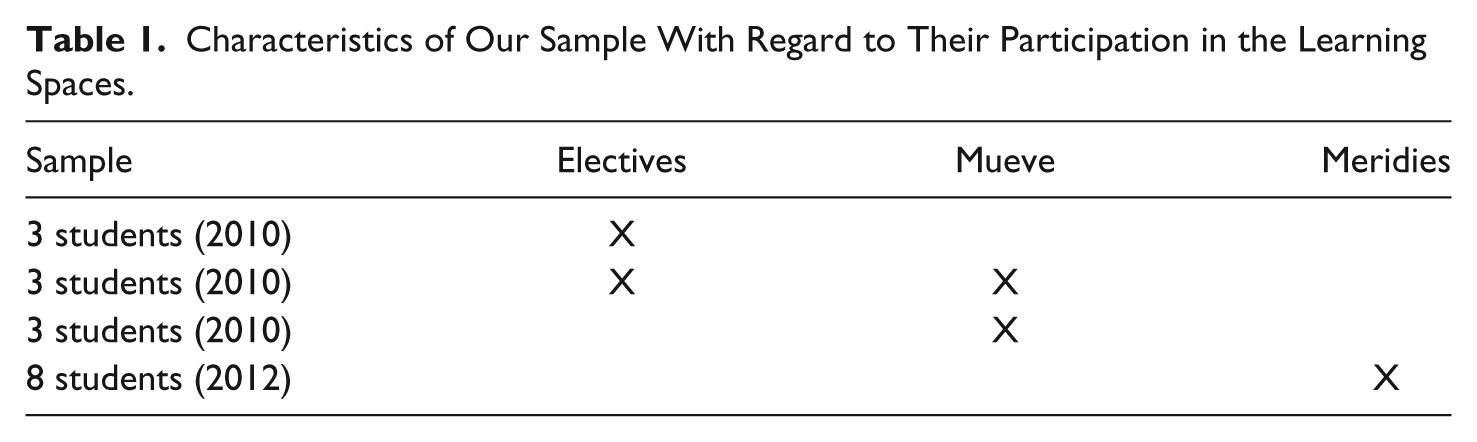
To gain insight into the cosmopolitan spaces generated by the three spaces, 20 UPV students were interviewed between 2010 and 2012, half of which were men, and half women. The first part of the research was conducted in 2010 and focused on Mueve and the electives. The second part was made in 2012 and targeted the Meridies Programme. In Table 1, we summarize the characteristics of our sample with regard to their participation in the aforementioned learning spaces.
Characteristics of Our Sample With Regard to Their Participation in the Learning Spaces.
We must note that none of the eight students who participated in Meridies Programme received any ethical training during their studies, and the Meridies grant was the first opportunity to experience immersion in a different context, outside Europe.
The semi-structured interview began with open questions to try to find relevant moments of learning that had occurred during their engineering courses (i.e., questions such as “What kind of abilities have you acquired?” or “Which moments do you especially value?”); following this, “negative” questions were posed to try to find negative moments in their learning pathways. After this starting point, we asked some questions related to cosmopolitanism: We used cards with unfinished quotes, such as “in my experience, my idea of development is . . . ”; or “in my experience, as a professional I’m able to . . . ”; or “my abilities are . . . ”; and so on.
In the case of Mueve and Meridies, there was a special section directly linked with these personal experiences, where we posed questions such as “What do you value most about your experience?” Following this, we explored the influence of family, friends, and political or voluntary activism on their ethical vision.
The categories used to analyze the interviews were based in our theoretical framework; from one side, we tried to find evidences of the three capabilities suggested by Nussbaum (critical thinking, cosmopolitan capability, and narrative imagination) and other capabilities not only addressed specifically by Nussbaum but also relevant for our discussion. Agency was another category explored: Involvement in groups and collectives that bring about change and an active behavior grounded in a sense of responsibility toward others were two ways of approaching agency. We have also focused on relevant learning moments where an encounter with something different took place and the way in which our participants have reflected on it. Our aim in the first group of participants (electives and Mueve) was also to find information on global identity formation but the answers were poor and we decided not including this question in the Meridies interviews.
We did not look for generalizations; on the contrary, we considered our interview study as a small-scale study with an exploratory aim. The number of interviews was reduced compared with the total sample (especially in the electives), there was no control group, and other instruments, such as Intercultural Development Inventory questionnaires, were not used. Precisely, further avenues to research the ongoing Meridies Programme include the use of mixed methods, and expand on the information by including the perspectives of the teachers engaged in supervising, and from the people in the organization where the students carried out their internships. We must add that, at the time of writing this article (June 2015), more ambitious research is being designed at the UPV, which will include a broader range of respondents and methods. Undoubtedly, this research has been a motivational starting point.
With regard to ethical procedures, at the moment of conducting the study, no university-level clearances existed in UPV. Unlike the Anglo-Saxon universities where ethical procedures to conduct research in universities are generalized, in Spain it is a recent policy. At UPV, the first general recommendation on ethical practices in research was adopted in November 2012, and specific ethical procedures were published in October 2014. However, in our study, all the participants gave us a verbal consent to be recorded during the interviews and to use the results of our analysis for academic purposes. We have respected their anonymity in the presentation of the results and all the names we will use in the following section are false names.
Capabilities and Agency for a Global Citizenship
In this section, we want to highlight some findings of our study; we will discuss each learning space to try to highlight which ones are the capabilities boosted and if some traces of agency are present. We will also refer to the encounter between the local and the global to try to explore cosmopolitan processes.
Electives: Critical Thinking Capability
For those participants who took the subjects, the most mentioned capability was critical thinking. According to this, José mentions,
Nowadays when I read news in the papers or Internet that tries to give an excessively nice picture of certain issues, I know it is not like that. Of course, in this respect critical thinking has changed us, as you have provided us with information that allows us to say: No, it’s not like that . . . you did not do that before.
Following a similar line of thought, Juan says in relation to the engineers’ curriculum:
It is important that not everything is economically orientated . . . after all we are going to become professionals with a certain level of power in our hands to take important decisions . . . this year I am becoming aware that most of this degree is economically orientated . . . We are only exposed to different criteria in this subject.
The students who had taken the elective subjects highlighted a different set of abilities, which were not acquired through life and group experiences but are nevertheless valuable in developing global citizenship: (a) knowledge acquisition to understand the complexity of development; (b) the development of critical thinking; (c) the ability to participate actively and express personal opinions; (d) the ability to listen, to be tolerant of different ideas, and to be able to understand the reasons behind the behavior of others; and (e) awareness of the need to consider context before taking action, particularly when facing situations that involve international cooperation.
Mueve: Critical Thinking, Cosmopolitan Capability, and Agency
Two participants who took the electives and participated in Mueve concluded that the subjects have provided a theoretical basis and knowledge and awaken sensitivities, whereas Mueve has given a positive realistic dimension opening the possibility of changes and, thus, opening up the space to exercise their agency. References to cosmopolitan capabilities were also made. Emilio summed up as follows:
The subjects have given me a framework to interpret the world, showing me the structural motives. . . . They helped me to reflect and think about social justice . . . Mueve had an inspirational spirit. It helped me to generate commitment and understand the changes . . . The subjects and Mueve complemented each other. Mueve was more locally orientated while the subjects had a global orientation. . . . Both of them have provided me with an open mind and opened new horizons.
The participants involved in Mueve explained how the group had helped them to acquire the practical abilities related with exercise of their agency: (a) work properly in groups, organize themselves in groups, and produce collective work; (b) become aware and discover the ability to do things and be able to change; (c) understand changes and generate commitment; (d) persevere and fulfill obligations; (e) promote different perspectives on life; (f) develop a range of problem-solving abilities and deal with stress; and (g) organize and manage ideas.
Ana summed up the importance of Mueve as she saw it, describing it as “a participation forum, a space to seek agreement and ideas, to produce them, to get answers, positive or not. It was never an introspective or philosophical activity.” In regard to commitment, she emphasized the group’s commitment to ideas. However, she also explained that if she were to fail in meeting a commitment, she would not only be letting herself down but also the whole group. This concern with action and with solidarity framed her reflections on the importance of empathy and coexistence.
Finally, one of the most interesting quotes was made by José, who went further and credited Mueve with developing a sense of intercultural citizenship. He explained how it had helped him to “build myself as a person, as a professional and as a citizen to claim my rights and spaces [but] also to understand my obligations.” He then went on to talk about sharing this with others, including group members outside UPV, “so talking to somebody who is in a different part of the world becomes normal [and] natural.”
Meridies: Fostering Narrative Imagination
In the mobility experience, one of the impacts most noted by the participants was the ability to understand one’s own previously lived reality, the ability to adapt to any kind of context and an understanding of other people’s emotions, wishes, and desires (narrative imagination).
As a triggering factor of those abilities, we should highlight the possibility of experiencing other lifestyles, or solving problems different to those found in their day-to-day lives. As Juan remarks, “You do not go there to learn a language: you go there to learn another way of life . . . although, on their return, putting this new life-style into practice is not always easy.”
A point to be highlighted is the importance many respondents gave to the richness that arises from diversity, and the importance of creating trust in personal relationships:
They had a really calm way of working and I put pressure on them, and one day they told me, listen, we do not work this way . . . They asked me where I was from, what my parents’ names were, what they had studied, what I had studied, what my sisters’ names were . . . Once they knew me, there was a sort of mutual confidence and this allowed for different work to be carried out, . . . they told me that the work had to be done, but it was impossible if they did not know each other and what to expect, and I said to myself: “Aha!” (Eva)
Also, contact with different Southern people and organizations leads to understanding and respecting other views, perspectives, and beliefs. As Pedro states,
Your personal view is also broadened. . . . Rejecting behaviors usually stem from ignorance, and when you leave your usual environment, when you go to different places and mix with people different from your environment, from the point of view of language, religion, diversity . . . your compassion, justice, generosity are expanded, you are able to listen, you are able to understand, rejection is no longer there because things are no longer alien, it is something usual, something normal, something you understand.
In addition, during their stay, various experiences made participants abandon some assumptions they had previously taken for granted, and they gave a different value to the contributions made by people from other social statuses. The following quote from Eva is very revealing:
They said their names and directly the problems they encountered on a daily basis. Then I realized that their time was really valuable because they had left their children in somebody else’s care in order to go to the meeting and, for many, just travelling there had been costly. . . . I commented that I had not really introduced myself as they had introduced themselves to me. My education was immaterial in comparison with their daily struggle. I thanked them for giving me another opportunity and said that I really wanted to take part in the movement, because I obviously had so much to learn.
Interestingly, participants highlighted the curiosity to understand their discipline, society, and so on from a critical standpoint. This means that university has gone from being considered solely as a professionalizing space to a space for integral growth. This new concept is reflected in new learning interests through formal education and taking part in associations or groups, and the appearance of new interests on issues that had been alien until then, such as public policy or global issues. On their return, some participants searched for training channels in social areas to acquire information on the complexity of development and of the relationships between North and South, in the belief that this knowledge is essential to becoming a professional with an integral worldview.
Potentialities, Complementarities, and Limitations of the Three Learning Spaces
Although only limited inferences can be drawn from our small-scale study, the evidence suggests that the three areas are potentially good spaces to promote a global citizenship. The electives could be good spaces for the critical learning capability, while international mobility is a strong enabler for narrative imagination capabilities. Students who have belonged to Mueve show elements of the three capabilities plus a very strong emphasis on agency, which does not occur in the other two learning spaces. Critical cosmopolitan process happened both in Mueve and the internships. In Mueve, this cosmopolitan process begins with the local, while in the internships was the global encounter that initiates a cosmopolitan reflection.
The students valued the reflective spaces offered by the elective subjects, but there is a sense that they wanted to put their learning into practice. Mueve enabled direct and immediate engagement with a wider community even though that engagement took place locally. However, Nussbaum’s cosmopolitan citizenship does not exclude the local—it links it with the global. Writing in the context of school-based citizenship education in the United Kingdom, and highlighting the importance of developing empathy, Osler (2011) notes that
it is at the local level that we have the opportunity to practise our citizenship on a day-to-day basis. Demonstrating solidarity with others in the global community has limited value, if we are not ready and able to stand up for justice and defend the rights of others in our own locality. (p. 2)
Mueve enabled an understanding of citizenship rooted at the local level that could (and typically did) encourage that understanding to flourish at the global level. It offered practical activism that cannot easily be incorporated into the electives—particularly if the practical activities of the electives are to be relevant to the subjects.
The electives may be suitable to try to find connections and interdependencies between the local and the global. They may talk about the problems of the global South in connection with what is happening in the global North; they may promote spaces of encounter between the local and the global in a cosmopolitan sense, inviting and sharing the curriculum with individuals and organizations from any part of the world that are promoting social change. This could be one of the major contributions of universities, as Delanty (2006) remarks: the creation of new cultural forms, new discourses produced by the interaction between the local and the global.
An especially powerful combination is the link between formal curricular spaces and international mobility. As we can see from the interviews, and consistent with what other studies have highlighted (Jones, 2010; Lilley et al., 2015), learning that occurs through the international mobility is very powerful because it takes people out of their comfort zone, which is one of the key facilitators of transformative learning (Barnett, 2004; Mälkki, 2010, quoted in Lilley et al., 2015, p. 238). Having to interact with different people, other cultures, statuses, ethnicities, and so on makes students more aware of themselves and how they are located in the world, which is an essential first step toward the self-transformation processes leading to cosmopolitanism (Killick, 2012).
However, the challenge is to make this self-transformation process a catalyst to create agency among students. As we have seen thorough the students’ answers, there is little evidence of agency in the Meridies experience. Thus, a perfect combination may be a formal space such as the electives to promote dialogues, encounters, and reflection on North–South interdependencies, before and after the mobility experience. At the present moment, Meridies lacks all these learning spaces: prior training is very short, monitoring is nonexistent, and the activities upon the students’ return are more for dissemination than for reflection and collective sharing. All these spaces prior, during, and after the mobility experience could be transformed and inspired by an experience like the electives. Obviously, the agency component is not guaranteed, but we presume that engineers who go through all these learning processes could be in a better position to exercise their agency both at the local and the global level.
Conclusion
In this article, we described how the CA (especially the three capabilities highlighted by Nussbaum: critical thinking, cosmopolitan capability, and narrative imagination) and a critical approach to cosmopolitanism can provide a basis to understand global citizenship and to analyze formal and informal learning spaces at universities. The spaces analyzed were two electives devoted to international cooperation, a mobility program that took place mainly in Latin American countries and a student-led university group.
Although the exploratory character of our study cannot allow us to generalize our findings, what we can affirm is each of these areas has the potentiality to enhance global citizenship but with nuances, differences, and complementarities. The electives could be good spaces for the critical learning capability, while international mobility is a strong enabler for narrative imagination capabilities. Students who belonged to Mueve show elements of the three capabilities plus a very strong emphasis on agency, which does not occur in the other two learning spaces. Critical cosmopolitan process happened both in Mueve and Meridies. In the student-led group, this cosmopolitan process begins with the local, while in the internships was the global encounter that initiates a cosmopolitan reflection. Further research is needed to enlarge the sample and combine the interview study with other methods. Also, it is important to expand on the information by including the perspectives of other actors: teachers, local communities, technical staff, and so on.
To maintain and enlarge cosmopolitan spaces such as these, cooperation between different internal and external actors committed to the values of cosmopolitanism is an indispensable task in the contemporary university. In the cases we have presented here, students have demonstrated the ability to organize and promote changes at the local level; the faculty has designed the electives and created spaces for reflection and encounter that, among other effects, enabled the formation of the original Mueve group; the Meridies experience is being driven by technical staff engaged in raising awareness about development issues inside the institution. Therefore, it is important to establish cosmopolitan communities (Hansen, 2010) inside the university, composed of faculty, students, staff, and practitioners from external institutions that share a common interest in promoting global citizenship. Without this, it will be really difficult to move cosmopolitan initiatives forward.
Footnotes
Declaration of Conflicting Interests
The author(s) declared no potential conflicts of interest with respect to the research, authorship, and/or publication of this article.
Funding
The author(s) received no financial support for the research, authorship, and/or publication of this article.