



Abstract
This article examines the role of international service-learning (ISL) in facilitating undergraduates’ exploration of their conceptions of self (i.e., self-exploration). Conception of self refers to the use of values to define one’s role in a social/cultural group or organization and in society, and to determine current actions and future commitments. ISL is intentionally structured activities involving students in social services in overseas settings. Existing research underscores the importance of inducting students to other-oriented (showing care and empathy for others) values in facilitating their self-exploration through ISL. Interviews with 48 students in Hong Kong who participated in ISL revealed qualitative differences in students’ conceptions of self related to moral, cultural, and leadership values. The findings highlight the need to guide students to critically self-reflect on their values and actions, and build reciprocal relationships with others. Implications for international educators and service-learning practitioners to support students’ self-exploration in ISL are proposed.
Keywords
Introduction
This article examines the role of international service-learning (ISL) in facilitating students’ self-exploration for constructing their conceptions of self. Conception of self refers to the use of values to define one’s role in a social/cultural group or organization and in society, and to choose current actions and future commitments (Jones & Abes, 2004). Service-learning is defined as intentionally structured activities that engage students in social services to solve problems encountered by community members. Such problems range from educational and social issues, through health care and economic development issues, to human rights and environmental issues (Lies, Bock, Brandenberger, & Trozzolo, 2012). As a form of service-learning, ISL engages students with community members who are recipients of students’ social services in overseas settings (King, 2004; Mather, Karbley, & Yamamoto, 2012).
Past research suggests that service-learning participation plays an important role in students’ development of service-related values, such as altruism, care for others, and sense of responsibility as citizens, which may become integral to their conceptions of self (Cox & McAdams, 2012). Apart from developing such values in students, ISL also exposes students to community members’ customs, beliefs, behavioral norms, and communication patterns. Such exposure may enhance students’ understanding of their own culture and competence of communication in culturally diverse settings (Mather et al., 2012). ISL experiences may also challenge students’ presuppositions about community members’ culture; the resulting dissonance in students’ intercultural understanding can in turn stimulate students’ self-reflection on their values (King, 2004). ISL therefore holds potential for enhancing students’ intercultural learning and can be regarded as a valuable means of international education provision (Wessel, 2007).
This article reports on a qualitative study situated in two higher education institutions in Hong Kong, East Asia, involving 48 undergraduate students in interviews about how they engaged in exploration of their conception of self in ISL. The study explored two research questions:
Participants included students from Hong Kong and those from other countries/regions (Mainland China, Japan, India, Canada, and Sweden) studying in Hong Kong higher education institutions. Previous relevant studies have been conducted in Western countries mainly (e.g., Mather et al., 2012). The current article contributes to the field by investigating students’ self-exploratory experiences through ISL in East Asia, an original research context for investigating this topic, where individuals are expected to adopt Confucian values and social norms, such as respecting authoritative persons’ decisions, conforming to the majority’s views, and giving priority to collective over personal interests (Yang, Webster, & Prosser, 2011). Exploring how Hong Kong students experienced intercultural learning through ISL can therefore contribute to new knowledge of the potential of ISL for promoting intercultural learning. The participation of several students from Western countries in the present study enriched the findings by allowing the exploration of the students’ intercultural interactions in their ISL teams. In this way, the article can also shed light on the nonacademic experience of Western students studying in East Asia, where Hong Kong has emerged to be one of the regional hubs attracting an increasing number of international students (Jon, Lee, & Byun, 2014).
The remainder of the article first examines the key characteristics of ISL and the core values to which students are exposed in association with these characteristics. Four strategies for supporting students’ self-exploration in ISL programs are then derived by examining the empirical literature. This is followed by a description of the research context at two Hong Kong universities and the qualitative methodology informed by the phenomenographic perspective. The findings, illustrated by students’ narratives, reveal three main categories of students’ conceptions of self. The last three sections discuss the findings and draw conclusions before proposing future research directions and deriving implications for international educators and service-learning practitioners.
Characteristics of ISL
ISL experiences may be a compulsory or voluntary component in students’ undergraduate programs; in either case, ISL experiences bear three key characteristics. These include the moral intentions of ISL participants, intercultural learning opportunities inherent in ISL activities, and the team-based nature of ISL activities.
First, like other forms of service-learning such as community involvement in academic courses, ISL presupposes students’ moral intentions, namely, the objective to promote the betterment of the condition of community members’ lives by solving social problems (King, 2004). By meeting community members’ needs through conducting service, students acquire service-related values, beliefs, attitudes, and competences that assist in their learning and development (Lies et al., 2012). Researchers caution that although some students come to recognize their moral obligation to help community members as a result of realizing their own socioeconomic and cultural privilege (Cox & McAdams, 2012), certain students’ prejudice toward community members can be reinforced (King, 2004), which points to the need to provide students with support in moral values clarification.
The second characteristic of ISL is the affordance of intercultural learning experiences, which aid in students’ intercultural understanding and competence (Yang et al., 2011). An essential part of such experiences is students’ unlearning of previously held cultural misconceptions; stereotypical cultural beliefs may often arise from students’ memberships in predominant social or cultural/ethnic groups (Gurin, Dey, Hurtado, & Gurin, 2002). Studies in ISL indicate that individuals’ commitment to the common good of community members from different social and/or cultural backgrounds than one’s own stems from a sense of being emotionally related to community members (Miller & Gonzalez, 2010), often following prolonged intercultural contact with community members (Pettigrew, Christ, Wagner, & Stellmacher, 2007).
The third characteristic of ISL relates to the peer group–based feature of ISL activities (Miller & Gonzalez, 2010), which entails some students playing leadership roles while others collaborate closely with peers to fulfill service tasks. It is also common that student leaders (students holding office in student associations) actively seek collaboration with academics and student affairs officers in promoting service initiatives (King, 2004). Although previous studies offer evidence on how service-learning supports students’ development of leadership skills and attributes (Litzky, Godshalk, & Walton-Bongers, 2010), to date, limited studies (e.g., Seider, 2010) have concentrated on how service-learning—and ISL specifically—influences students’ conceptions of self as leaders who promote and uphold long-term benefits for community members and their peers as well.
Cultivating students’ moral values, intercultural competence, and leadership capacity is emphasized in the undergraduate curriculum in both Eastern and Western settings (Ma, Chan, & Chan, 2013; Miller & Gonzalez, 2010). The aforementioned three key characteristics make ISL a viable vehicle to support students’ development of these desirable attributes.
Values Associated With ISL
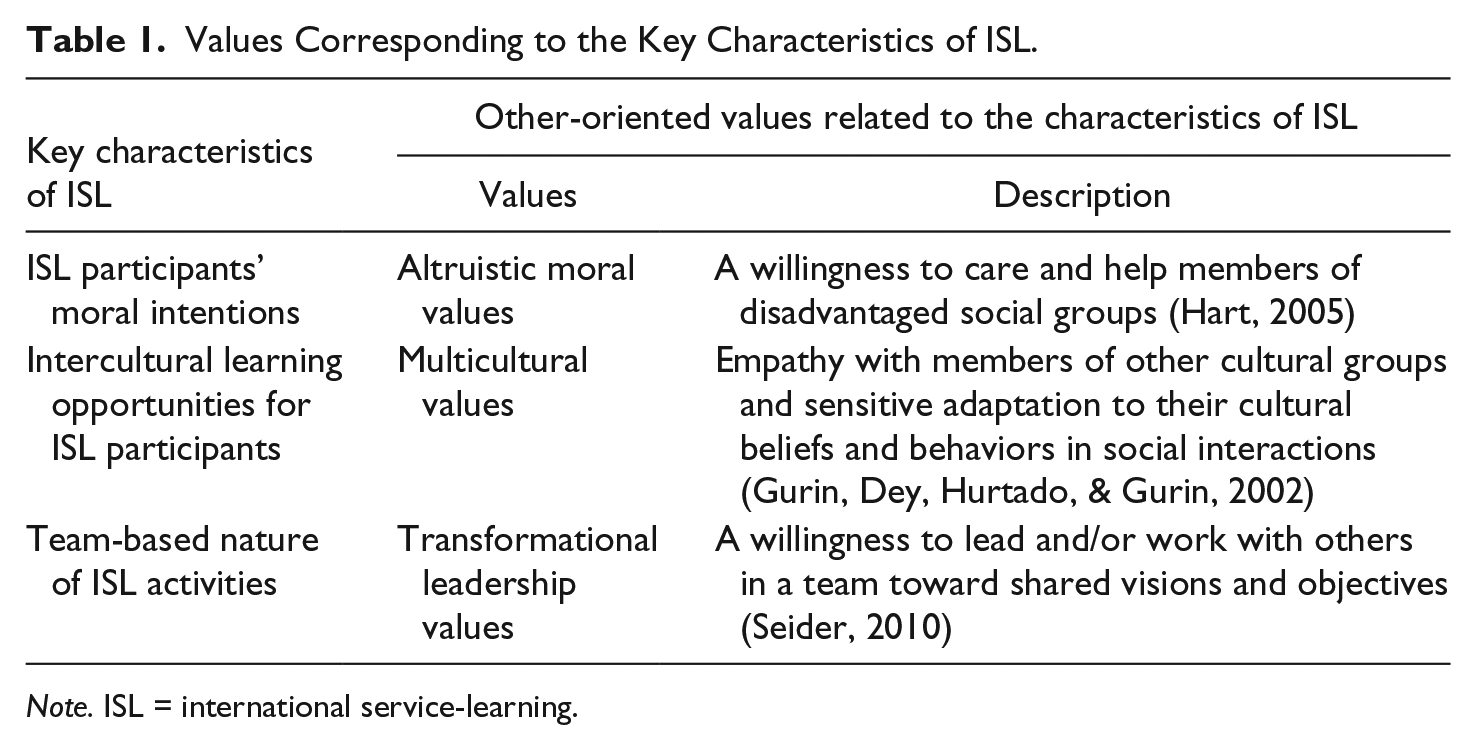
Given the aforementioned three characteristics of ISL, for students to act effectively in ISL, they need to incorporate relevant values into their conceptions of self. A summary of such values is presented in Table 1.
Values Corresponding to the Key Characteristics of ISL.
Note. ISL = international service-learning.
It may be argued that the values associated with ISL are essentially other oriented, expressing a sense of care for and empathy with community members (Kezar & Rhoads, 2001). The values presented in Table 1 are not inclusive of all the values to which students may be exposed in service participation. Other values, for instance, aesthetic values and professional values, are equally important for students’ self-exploratory development. For the purpose of this article, the above three categories of values are explored in relation to students’ self-exploration experiences through ISL.
Although altruistic moral values and multicultural values have been discussed in detail, transformational leadership values merit some elaboration. A notion borrowed from organizational research, transformational leadership (as opposed to transactional leadership) is a form of productive leadership characterized with the leader acting according to one’s values, leading by shared vision, and catering to others’ interests (Bass & Steidlmeier, 1999; Carroll & Levy, 2010). In ISL settings, it is reasonable to expect transformational leadership values to be geared toward the betterment of conditions for community members and the society as a whole, which resonates with higher education institutions’ aspiration to promote students’ sense of responsibility for local and international communities (Gurin et al., 2002).
Existing Research on Students’ Self-Exploration Experiences in ISL and Related Strategies
Past studies reveal that ISL affords students rich exposure to other-oriented values and facilitates their self-expression of such values through altruistic actions (Kiely, 2005; Lough, 2011). These affordances may, in turn, encourage students’ long-term commitment to service-related values and actions, such as choosing a career related to helping disadvantaged social groups (Seider, 2010). Research evidence is gleaned from the literature on how students engage in processes of exploring their values and beliefs to construct their conception of self. Based on the research evidence, which is reviewed in subsequent paragraphs, a set of strategies for designing ISL programs to realize such affordances are proposed. The strategies are summarized as direct contact, reciprocal relationships, reflective learning tasks, and connected service experiences, which are discussed in detail next.
Strategy 1: Involving Students in Direct Contact With Culturally Diverse Community Members Through Service Tasks
Strategy 1 ensures that students are supported in critically examining their taken-for-granted cultural values by involving them in daily interactions with culturally diverse community members. This strategy is informed by findings in King’s (2004) case study. Based on interviews with 14 students on a weeklong ISL program, King (2004) reported a process of students’ defamiliarization of existing cultural values, enabling them to gain the competence to serve and interact with community members from diverse cultural backgrounds.
Strategy 2: Guiding Students to Build Collaborative, Reciprocal Relationships With Others, Including Peers in the Service Team, Significant Others (University and Nongovernmental Organization [NGO] Staff Members), and Culturally Diverse Community Members
Strategy 2 is informed by Kezar and Rhoads (2001) and Mather and associates’ (2012) research stressing the need to promote mutuality and reciprocity between students and community members (cf. King, 2004). This strategy echoes Mortensen and associates’ (2014) findings from two students’ written reflections on experiences in a 2-week ISL program, which reveal young people’s leadership values as being embedded in collaborative relationships and expressed through collective action.
Strategy 3: Setting Reflective Learning Tasks to Engage Students in Critical Self-Analysis of Their Values in Relation to the Social-Cultural Realities in ISL Settings
Strategy 3 stresses guiding students’ critical self-reflection (Cox & McAdams, 2012) through reflective learning tasks, such as reflective journals and reflective team meetings (Lough, 2011). Reflection in ISL may be considered an essential part of students’ experiential learning process (Kolb & Kolb, 2005), in which students gain immediate ISL experience, observe behaviors and consequences, reflect on the observation to distill generalizations such as values related to service, and actively experiment on such generalizations in ISL settings. In a longitudinal case study with 57 students using observation, document analysis, and interviewing, Kiely (2005) reports that students who were nonreflective adopted stereotypical cultural values about community members and were unable to build trusting, reciprocal self–other relationships.
Strategy 4: Assisting Students in Making Connections Between Prior Service Experiences and Current ISL Experience
Finally, Strategy 4 helps students to sustain a sense of continuity in what Dewey (1938) calls educationally meaningful experiences. This strategy is informed by Cox and McAdams’s (2012) analysis of 36 students’ written accounts of their weeklong ISL trip. Their analysis showed that students with prior service experiences reported a higher level of self-transformation (positive changes in moral values related to volunteerism), suggesting that meaningfully relating current and previous service experiences facilitates students’ self-exploration.
The above-discussed past studies used interviews, observations, and students’ reflections in analyzing how students self-explored their values, beliefs, and perspectives. It may be suggested that such qualitative methodologies can contribute to an in-depth understanding of how students construct their conception of self through the exploration of their values and beliefs in ISL. In the same vein, a qualitative approach was adopted in the present study to advance deeper knowledge about students’ self-exploration experiences in ISL.
Research Context
At Hong Kong higher education institutions, there has been a considerable increase in the provision of ISL programs (Ma et al., 2013). The growing attention to service-learning is a response to Hong Kong’s recent undergraduate curriculum reform aiming to nurture students’ all-round capabilities and sense of social responsibilities (University Grants Committee, 2004). The two institutions under study are a comprehensive research university and a liberal arts university, labeled here as University X and University Y. At the two institutions, ISL programs are offered by student affairs office and service-learning office, respectively.
Method
The study is informed by a phenomenographic perspective (Marton, 2000). Phenomenographic researchers have found qualitative differences or variations in individuals’ understandings: Although some individuals see the various aspects of a phenomenon as an interrelated whole, others are only aware of fragmented parts of the phenomenon; the former understanding is more complex and coherent than the latter. The methodology requires the researchers to engage empathetically in students’ lifeworlds (Ashworth & Lucas, 2000).
Data Collection
The study involved 12 individual interviews and 10 group interviews with 48 full-time undergraduate students. Students who were unable to attend group interviews were interviewed individually. The students from Institution X were majored in arts, business, social sciences, law, science, and engineering, whereas those from Institution Y were studying arts, business, and social sciences. The students were from various countries, including Hong Kong, Mainland China, Japan, India, Canada, and Sweden. The interviews were conducted in English or Chinese (Cantonese or Mandarin) depending on students’ preferences and were transcribed verbatim. Where the interviews were conducted in Chinese, the transcription involved translation from Chinese into English. To enhance trustworthiness of findings (Miles & Huberman, 1994), all transcripts in English were emailed to students for member checking.
The data encompassed students’ experiences in 10 ISL projects undertaken by seven project teams (see detailed information about the projects and interviews in Appendix A). The students quoted in the “Findings” section were coded anonymously according to their teams’ labels (e.g., A1 was a participant of Team A). The projects’ objectives ranged from education for children/youth, advocacy for environmental protection, cultural heritage preservation, to rural development. The projects’ overseas service trip destinations included Thailand, Indonesia, Mainland China, Ghana, and Denmark. The majority of the service trips lasted for about 2 weeks, except for two projects that lasted for 1 week and 8 weeks, respectively. English was used as the medium of communication in most service trips except for the projects undertaken in Mainland China, where Putonghua (Mandarin) was needed for communication with the locals.
Just two projects were organized by university staff, whereas the remaining eight projects were organized by five student voluntary groups with the support of university funding. Student-initiated projects entailed the service team leaders to assume greater responsibilities than in staff-organized projects. Fifteen students took leadership positions in their teams, such as planning service activities, managing resources, recruiting group members, and liaising with student affairs/service-learning offices and community organizations. Staff-arranged projects required students’ completion of various reflective learning tasks (e.g., group reflection meetings, reflective journals, and posttrip reports), whereas student-initiated projects only required students to submit posttrip reports. In comparison, the student-initiated projects gave student leaders greater degree of freedom to exercise their leadership role, whereas staff-arranged projects offer more extensive reflective learning opportunities. Such differences in project organization by either staff or students, which have implications for students’ self-exploration experiences and outcomes, were rarely noted in previous studies.
A semi-structured interview protocol was used to tap into students’ self-exploration through ISL experiences:
What were students’ prior service experiences and reasons for joining the project?
What were their role and tasks, and how did they collaborate with others in the project team?
What were their everyday activities in the service site?
What were their relationships with others (peers, community members, and university/community organization staff) like?
What was the impact of the project on community members and themselves, and how might such impact be sustained?
What were their future plans for service participation?
Data Analysis
In the phenomenographic analysis (Trigwell, 2000), the transcripts were treated as a collective data pool in identifying the qualitative differences in students’ conceptions of self as a result of their ISL experiences. Two researchers independently coded a subset of the transcripts with marginal notes, from which initial categories were generated to capture the meanings that students gave to their experiences. The researchers then discussed these initial categories, subsequently creating a set of codes for analyzing the remaining transcripts. The codes were derived by describing each category with a short phrase, such as “care for community members.” Once the coding was complete, the initial categories were further synthesized into categories that summarize students’ conceptions of self.
Findings: Qualitative Differences in Students’ Conceptions of Self
Students’ conceptions of self were analyzed in relation to their moral, cultural, and leadership values. In other words, students’ ISL experiences were explored in moral, cultural, and leadership domains. The moral domain was examined in terms of whether and how students used altruistic values to define their role in ISL activities. The cultural domain was explored in terms of how students experienced social interactions and relationships with community members. Last, the leadership domain was analyzed regarding how students perceived the leadership role of themselves, peers, and influential others in ISL activities. Informed by previous research finding (Mortensen et al., 2014) that youth tend to perceive leadership as available to anyone, not those with leadership positions, all students were included in the analysis of the leadership domain.
The remainder of this section presents a detailed analysis of the categories of students’ conceptions of self that emerged from the qualitative data. A summary of the key aspects of each category is presented in Appendix B.
Conception A: Transactional—Present Oriented
Students from different project teams were identified in this category. The majority of the quotes discussed below were selected from interviews with members of ISL project teams; the exceptions are two quotes from D1 who was a student team leader.
The following quote illustrates students’ positive attitude toward service participation, which, while expressing their altruistic values, was mixed with an instrumental intention to meet personal needs.
We just thought that setting up a service team could be a good thing, because our members can have some new experiences for their résumé for future employment and see Africa’s scenery and cultures, while helping local people at the same time. (D1)
The students expressing this conception focused mainly on current service tasks and rarely discussed how to carry their service forward, as mentioned by C2: “I may visit this country (Ghana) again but will not join service next time.”
They reported the privilege they felt about their material resources at home, showing that they had started to engage in self-reflection on cultural differences between themselves and community members.
I’ve got a lot of good teachers, photocopiers, and a lot of other resources (back in Hong Kong). Compared with the students in Thailand, I’m fortunate and I shouldn’t have taken it for granted. (B4)
On the contrary, they expressed a somewhat superficial understanding about the local culture and showed limited empathy with community members’ lifestyles and cultural customs.
In Ghana people have abundant resources and raw materials and agricultures and they do not have winter. So they do not feel the urge to work . . . (D1)
The students also tended to understand leadership as hierarchical relationships, which corresponds to the transactional leadership view (Bass & Steidlmeier, 1999): Team members were not supposed to have a role in decision making, and team leaders in turn had to accept influential others’ (e.g., NGO staff members) decisions.
Without a team leader, we (team members) would not know or understanding the things we were working on. He could coordinate with the NGO staff and tell us our duties. (C2) We (team leaders) asked them (NGO staff) whenever we didn’t understand the situation. Jane and Sue (NGO staff) would make a final decision for our plans and actions. (G4)
In sum, students with Conception A showed a willingness to learn about the community members’ cultures and fulfill service goals, which were conducive to their expression of altruistic moral values and enhancement of intercultural understanding. Nonetheless, they mixed service goals with somewhat selfish intentions, displayed limited sensitivity to community members’ cultures, held a transactional perspective on leadership, and generally focused on present service goals and actions, with little attention paid to formulating future service plans.
Conception B: Transformational—Present Oriented
In the quotes presented below, some were taken from team leaders (D1 and D2), and the rest were from team members of various projects.
Students with this conception expressed clear views of their service goals and articulated concrete ideas of fulfilling such goals, implying their commitment to service goals.
By interacting and playing with village school pupils, we wanted them to have a better understanding of the wider world, to know they should learn more. For the world is not confined to their village. (G1)
The quote below showed these students’ reflection on their cultural differences compared with community members and their warm relationship with community members.
After living in Ghana for some time, I started to understand the life of the locals and their modes of thinking and started to think of the reasons behind it. (C6)
The quote below shows that these students experienced shared leadership in their team, which echoes Mortensen and associates’ (2014) findings of adolescents’ understanding of leadership as embedded in horizontal relationships among peers.
We asked our group mates’ opinions first and did what the majority voted for. I would treat NGO staff as senior friends; they were more experienced than us. The NGO staff took care of us; and we had a harmonious relationship. We would discuss the arrangements together. (D2) I think cooperating with local NGOs was appropriate, because we did not have in-depth knowledge about the local situation. They planned tasks, while we mainly made adjustments, since they knew better what kinds of activities might bring about positive outcomes. (D1)
Similar to students with Conception A, students with Conception B also expressed altruistic moral values. They were, however, more able to articulate concrete ways of improving the conditions of community members, suggesting their commitment to service goals. They also expressed self-reflective and empathetic views about cultural differences. They also held a participatory perspective on leadership, which is congruent with transformational as opposed to transactional leadership values (Bass & Steidlmeier, 1999). Nonetheless, they did not articulate a forward-looking perspective, and confined themselves with the present service actions and goals.
Conception C: Transformational—Future Oriented
We found significantly that all the quotes in this category were taken from team leaders’ interviews, implying that students with leadership responsibilities might be more likely than others to hold Conception C. Another possible explanation is that the majority of the team leaders had 1 year or longer experiences of service participation, whereas most team members were first-time service participants.
Similar to students with Conception B, students expressing Conception C articulated clear service goals and strong commitment to service.
We can’t say our contribution was great, but we hoped to help them (local teachers of English) to think from a different point of view in their teaching. When we were teaching, we sang songs, watched short films and gave students oral practices, and the teachers would pick up these alternative approaches to teaching. (A1)
These students also mentioned their strong emotional attachment to community members despite social-cultural differences.
Thailand is like my second hometown . . . My relationship with the young refugee (at the border of Burma and Thailand) is so close and it would be a pity if I could not visit them anymore. (B3)
For these students, the relationships between team leaders and members and between students and influential others were mutually supportive and collaborative.
One of our roles (as team leaders) was helping our peers (team members) to see things differently. (F4) If they want to do it (a service task), they just sign up to it . . . (F1) They actually come to meetings on the issues they are interested in. (F2)
Distinctively, their service engagement had a future orientation with a view to achieve sustainable community changes. They did so by seeking close partnerships with influential others and by building their peers’ and community members’ capacity for long-term community development.
We have very few resources, but we want to have the biggest impact, so we teach (English) teachers and hope that the teachers would then teach the students. (A1) The crucial thing is to find a way of generating funds from different sources to make sure the children (suffering from AIDS) will get their medicine and school fees. That’s the sustainable goal; that’s how we measure success. (C9)
To sum up, similar to Conception B, students with Conception C articulated commitment to service goals and empathy with community members, and self-reflected on how service affected community members’ lives. They went beyond those expressing Conception B by seeking sustainable service impact through collaboration with community members, peers, and influential others, which suggests that they adopted transformational leadership values (Carroll & Levy, 2010) and a future-oriented perspective on their ISL projects.
It should be noted that the distinctions made between the three categories are not clear cut (Trigwell, 2000). Although most aspects of a student’s conception may be classified into one category, certain other aspects may fall into another category. For example, student C8, a leader of Project C, demonstrated a mixture of characteristics in Conceptions A and B. He prioritized service tasks and experienced a friendly relationship with the locals (Conception B), although he perceived a hierarchical relationship with NGO staff (Conception A): All our wants like travelling around, visiting local markets etc., should not be prioritized. We went there (in Ghana) to serve, to do something good by helping others to help themselves . . . We were always close to our host family, watching TV and played cards together. Our relationship with the NGO staff was good but a little bit distant. When talking to them, I felt as if I was talking to our bosses. (C8)
The above examination of the findings focuses mainly on how students’ conceptions of self varied in relation to their moral, cultural, and leadership values after their engagement in ISL experiences. The limited space does not permit a detailed comparison of students’ conceptions of self before and after their ISL experiences. A few examples of how changes in students’ conceptions of self occurred as a result of ISL experiences are presented now. Related to Kezar and Rhoads’ (2001) notion of the caring self is a student’s retrospective description of how she came to realize the importance of giving care and concern for the service recipients: At the beginning, I focused on the teaching according to the schedule. Then I realised that the teachers there could also teach them the same things, so what was our purpose to go there? Therefore I started to tell them more about the world outside and give them more exposure—to let them know there were people caring about them outside. (B5)
Echoing researchers’ (e.g., King, 2004) contention for reciprocity between students and community members, a student shared her new insights into the different lifestyles between herself and the local community members: Since the pace of life in HK [Hong Kong] is fast, I always think we should do things efficiently. Life is however different in Ghana. I don’t know whether we might be too aggressive and disturb their [the local’s] lives. We are used to keeping ourselves busy, but we should not bring such practice to the local community which is impolite. (C5)
Yet another student reported how she learned, by engaging in ISL experiences, about leadership as establishing collaborative relationships (Mortensen et al., 2014).
This experience definitely increased my leadership ability . . . It helped me to solve problems in many ways. For example, I had to know how to deal with the NGOs and the students as well as their needs. I learnt these skills. (B3)
Although the above analysis provides some evidence on students’ changes in their conceptions of self through ISL, further studies are needed to explicate the processes involved in students’ exploration and clarification of moral, cultural and leadership values for the construction of their conceptions of self.
Discussion
Based on the findings from qualitative data, the current study provides evidence that ISL was capable of inducting students to altruistic values, helping them to appreciate the cultural differences between different cultural and ethnic groups, and enabling them to collaborate with peers and others in working toward service goals. In the context of ISL particularly, these values are centered on the care and help for culturally diverse community members (Seider, 2010).
The findings show that differences existed in students’ conceptions of self with regard to their moral, cultural, and leadership values, which were associated with their different manners of negotiating service goals and personal interests, engaging in social interactions with culturally diverse community members, and pursuing short-term and long-term service impact in overseas communities by working with peers and significant others. Implications of these findings are discussed in detail in the next section.
Given the finding that those students holding Conception C (transformational—future oriented) were mostly student leaders, it is likely that taking a leadership role in service teams is conducive to students’ self-exploration through ISL. However, except for students’ roles in ISL projects as team leaders or members, the findings did not show explicit evidence on how other programmatic and personal characteristics influenced students’ conceptions of self. Such characteristics may include ISL project types (duration, destination, project objectives, and language of communication) and students’ backgrounds (institution, discipline, and country of origin). These aspects of students’ self-exploration experiences may be examined in future research.
Implications for ISL Programs
In view of the discussion of findings, several practical implications for service-learning practitioners and international educators may be drawn, echoing the four key strategies for designing ISL programs to support students’ self-exploration proposed in this article, namely, direct contact with community members, reciprocal relationships with others, reflective learning tasks, and connected service experiences. First, notwithstanding the positive influences of ISL on students’ self-exploration, the qualitative differences in the students’ conceptions of self point to the need for a balanced approach to cultivating students’ characters and values, on one hand, and equipping them with skills for future professional work, on the other hand (Kezar & Rhoads, 2001).
Second, in view of the qualitative differences in students’ ability to empathize and establish mutually trusting relationships with culturally diverse community members, students should be put in frequent contact with community members through ISL activities. ISL programs may provide explicit instruction to educate students about community members’ customs and cultural beliefs and behaviors (Gurin et al., 2002).
Third, as students’ moral, cultural, and leadership values can be developed through engagement in altruistic actions of helping culturally diverse community members, practitioners organizing ISL programs may consider providing students with explicit guidance in critically reflecting on their values in relation to such actions (Lough, 2011), through which students can self-reflect on how their values and behaviors are transformed by engaging in ISL experiences.
Finally, considering the positive self-exploration experiences of some students with prior service exposure, students may be offered multiple opportunities for involvement in ISL so that they can derive insights into their values, actions, and long-term goals (Cox & McAdams, 2012). This is congruent with the experiential learning theory (Kolb & Kolb, 2005) that emphasizes involving students in recursive cycles of experiences to sustain their development and learning. Innovative ways of increasing ISL opportunities for students include using simulations or role-plays to engage students indirectly in ISL situations and involving them with ethnically/culturally diverse community members in domestic service-learning settings (Kezar & Rhoads, 2001).
Conclusion
Based on the findings, two conclusions can be drawn. First, ISL has potential for supporting students’ self-exploration by giving them opportunities to incorporate moral, cultural, and leadership values into their conceptions of self. Second, it is important to entrust students with leadership responsibilities in serving culturally diverse community members (Seider, 2010).
It would require further research to explicate the dynamics and processes of how ISL facilitates students’ exploration of their conceptions of self, particularly those student leaders who strive to sustain the benefits of service for community members and their peers (Seider, 2010). Quantitative methodologies such as surveys (Miller & Gonzalez, 2010) and qualitative methodologies such as phenomenology (Logue, Hutchens, & Hector, 2005) and narrative inquiry (Cox & McAdams, 2012) may be used to provide a holistic picture of how students construct the conception of themselves as leaders in the ISL context. Future studies may substantiate or disconfirm the positive outcomes of ISL by comparing students’ conceptions of self before and after their participation in ISL programs. Using larger samples of ISL participants, future studies can be conducted to explicate how other factors (e.g., program related, personality related) may influence students’ conceptions of self.
In summary, by raising fundamental issues for international educators and service-learning practitioners and posing new questions for future research, this article adds to our existing knowledge about how ISL can facilitate students’ effective self-exploration in higher education.
Footnotes
Appendix
Students’ Conception of Self in Moral, Cultural, and Leadership Domains.
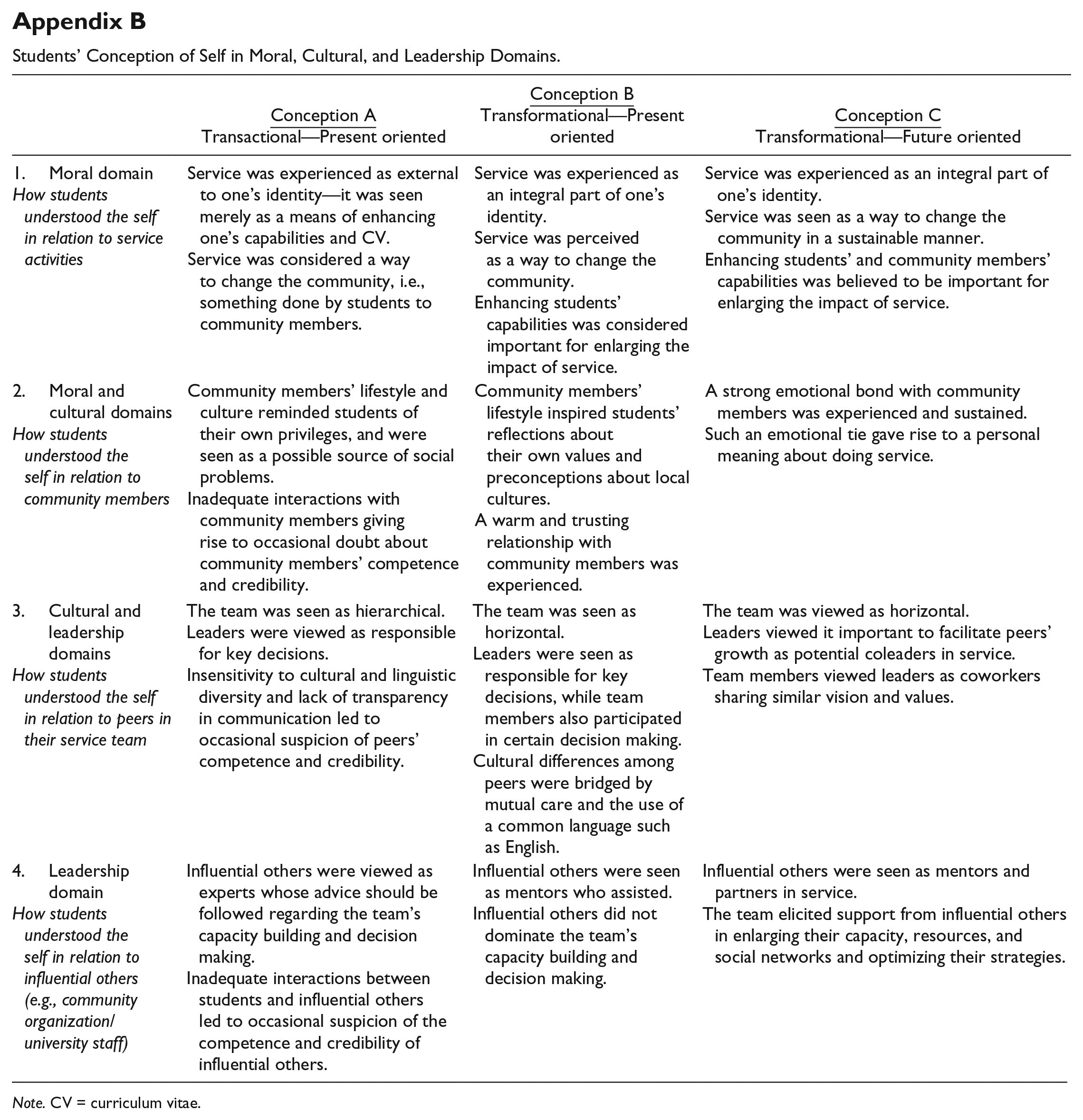
| 1. Moral domain How students understood the self in relation to service activities |
Service was experienced as external to one’s identity—it was seen merely as a means of enhancing one’s capabilities and CV. Service was considered a way to change the community, i.e., something done by students to community members. |
Service was experienced as an integral part of one’s identity. Service was perceived as a way to change the community. Enhancing students’ capabilities was considered important for enlarging the impact of service. |
Service was experienced as an integral part of one’s identity. Service was seen as a way to change the community in a sustainable manner. Enhancing students’ and community members’ capabilities was believed to be important for enlarging the impact of service. |
| 2. Moral and cultural domains How students understood the self in relation to community members |
Community members’ lifestyle and culture reminded students of their own privileges, and were seen as a possible source of social problems. Inadequate interactions with community members giving rise to occasional doubt about community members’ competence and credibility. |
Community members’ lifestyle inspired students’ reflections about their own values and preconceptions about local cultures. A warm and trusting relationship with community members was experienced. |
A strong emotional bond with community members was experienced and sustained. Such an emotional tie gave rise to a personal meaning about doing service. |
| 3. Cultural and leadership domains How students understood the self in relation to peers in their service team |
The team was seen as hierarchical. Leaders were viewed as responsible for key decisions. Insensitivity to cultural and linguistic diversity and lack of transparency in communication led to occasional suspicion of peers’ competence and credibility. |
The team was seen as horizontal. Leaders were seen as responsible for key decisions, while team members also participated in certain decision making. Cultural differences among peers were bridged by mutual care and the use of a common language such as English. |
The team was viewed as horizontal. Leaders viewed it important to facilitate peers’ growth as potential coleaders in service. Team members viewed leaders as coworkers sharing similar vision and values. |
| 4. Leadership domain How students understood the self in relation to influential others (e.g., community organization/university staff) |
Influential others were viewed as experts whose advice should be followed regarding the team’s capacity building and decision making. Inadequate interactions between students and influential others led to occasional suspicion of the competence and credibility of influential others. |
Influential others were seen as mentors who assisted. Influential others did not dominate the team’s capacity building and decision making. |
Influential others were seen as mentors and partners in service. The team elicited support from influential others in enlarging their capacity, resources, and social networks and optimizing their strategies. |
Note. CV = curriculum vitae.
Declaration of Conflicting Interests
The author(s) declared no potential conflicts of interest with respect to the research, authorship, and/or publication of this article.
Funding
The author(s) received no financial support for the research, authorship, and/or publication of this article.