



Abstract
Regarding higher education as a type of extended duration service, this article proposes a framework considering adjusted expectation, disconfirmation, satisfaction, and commitment in a conceptual model to explain international student loyalty. Employing a structure equation model to the sample data collected from 252 Vietnam overseas students studying in more than 15 countries, this study confirms the direct and indirect roles of satisfaction and commitment in student loyalty. Given the nature of extended duration service for higher education, another important finding is that adjusted expectation mediates the satisfaction–commitment relationship and subsequently affects student loyalty through commitment. An additional discovery is the encounter of a direct path from disconfirmation to adjusted expectation and to commitment, previously overlooked in prior studies. Our findings have implications for university and government strategies for retaining international students.
Keywords
Introduction
Over previous decades, we have witnessed an unprecedented cascade of students across the world. According to Organization for Economic Co-Operation Development (OECD; 2015) data collected in 2013, there were more than 4 million international students across all countries, twice those in 2000 and thrice those in 1990.
This phenomenon deserves recognition for several reasons: First, tuition fees are becoming a significant source of income for higher education institutions. Specifically, for certain developed countries, international higher education has become a powerful export industry to lure in self-funding foreign students (Healey, 2008; Naidoo, 2010). For instance, in Australia, education is the fourth largest export industry, contributing US$15 billion in revenue annually (Group of Eight Australia, 2014).
Second, international students are the future labor force of host countries. This is particularly true for traditional host countries such as the United States, the United Kingdom, or Australia where future creative capabilities are threatened by shortages of high-qualified manpower in science and technology (S&T) majors. For example, in 2007, it was estimated that for every 100 doctorates in S&T in the United States, there were 46 overseas students. Many of them are employed in host countries after graduation (National Science Board, 2008).
Recently, marketing researchers have increasingly regarded higher education as a service (Arambewela & Hall, 2013; Brown & Mazzarol, 2009; Hennig-Thurau, Langer, & Hansen, 2001).
As demonstrated rigorously in other service settings (Chiou & Droge, 2006; Yi & La, 2004), long-term relationship marketing increases profit, reduces advertising costs, and decreases operating costs. In addition, more loyal students tend to involve themselves in universities’ activities, such as conducting research and participating in feedback surveys (Hennig-Thurau et al., 2001).
Given this consideration, many existing studies have exploited student loyalty from a customer perspective (e.g., Helgesen & Nesset, 2007; Hennig-Thurau et al., 2001). However, most of these efforts have examined it at the “national” level, while neglecting the “international” level. Consequently, they disregard the different characteristics of international students, such as financial burden, language difficulties, and culture shock.
To fill the said gap, this article investigates the determinants of student loyalty, sampling Vietnamese overseas students.
Specifically, this study examines roles of satisfaction and commitment as two direct determinants of student loyalty and further verifies the mediating role of commitment in the relationship satisfaction–loyalty.
Second, based on previous studies (e.g., Liao, Chen, & Yen, 2007; Yi & La, 2004), we investigate the impact of disconfirmation, defined as the difference between the perceived performance of a service or product and the prior expectation of the customer, on satisfaction and commitment. Under this circumstance, we discovered two new direct paths from disconfirmation to adjusted expectation and commitment.
Finally, given the nature of extended duration service for higher education, we will examine whether adjusted expectation, defined as the “[customer] expectations updated through cumulated or current consumption experiences” (Yi & La, 2004), is a direct factor on student loyalty. We also assess the possible mediating role of adjusted expectation in the satisfaction–commitment relationship.
Literature Review
Higher Education as an Extended Duration Service
To understand customer loyalty in a higher education setting, we should apprehend the idiosyncrasies of this service. Prior literature has introduced multiple ways to classify different types of services.
Zeithaml (1981), based on customer’s capacity to evaluate service’s performance, divided service into three categories: search (easy), experience (possible after purchase), and credence (impossible even after purchase). From this perspective, higher education falls into the third category (Licata & Frankwick, 1996). This is because the customer lacks the specific knowledge required to evaluate the service that she or he has received. This attribute is different from search service (e.g., e-ticket selling) and experience service (e.g., health care) in which the customer can evaluate before or after the purchase, respectively.
We must also consider the service’s consumption time. Higher education, especially international higher education, is an extended duration service. This service is over a prolonged period, with high interaction between service suppliers and customers (Bloemer & de Ruyter, 1999). These are identified attributes of higher education (Licata & Frankwick, 1996). Time consumed in higher education (counted in yearly units) is comparatively long than other regular services, for instance restaurants (counted in hourly units) or tourism (counted in daily units).
Overview of the Model
Figure 1 represents our conceptual model, which follows Hennig-Thurau et al. (2001) to consider student loyalty from attitudinal dimensions.

Conceptual model.
Hennig-Thurau et al. (2001) divided the concept of loyalty into two components: behavioral and attitudinal.
The former refers to behavioral responses of customers, such as repurchase intention, whereas the latter concerns itself with emotional responses, such as willingness to tell others about advantages of the service.
As noted earlier, in the higher education context, benefits of institutions do not only pertain to student continuance intention, or behavioral loyalty, but are also spread out after student graduate through emotional liaison, or attitudinal loyalty. Thus, emotional liaison is important and more suitable in an international higher education setting.
Satisfaction (SAT) and disconfirmation (DIS) are selected as direct and indirect determinants of loyalty (LOY) as they are well regarded previously as preeminent factors leading to loyalty (e.g., Yi & La, 2004).
Moreover, by considering adjusted expectation (AEX) and affective commitment (COM) as mediators of relationship satisfaction–loyalty, we emphasize the nature of higher education as an extended duration service. This has been overlooked in previous studies.
Hypotheses Development
Hypotheses 1 to 3: Partial mediating effect of commitment on relationship between satisfaction and loyalty
It is traditionally acknowledged that satisfaction is the most powerful antecedent of customer loyalty (Dick & Basu, 1994). Satisfying customer demands is the strategic end for all providers across all sectors. Within the higher education setting, student loyalty has also been verified as dependent on student satisfaction (Brown & Mazzarol, 2009; Helgesen & Nesset, 2007). These arguments suggest our first hypothesis:
Commitment is another crucial determinant of loyalty. According to Morgan and Hunt (1994), commitment is identified as customer’s desire to remain in a valued relationship. Garbarino and Johnson (1999, p.72) defined commitment in a business to customer context as “customer psychological attachment, loyalty, concern for future welfare, identification, and pride in being associated with the organization.”
Some authors (e.g., Han, Kwortnik, & Wang, 2008) have distinguished two types of commitments: affective and calculative.
While the former places emphasis upon emotional dimension and determines how a customer feels about the service, the latter centers on the rational dimension, addressing how the relationship benefits customers.
Of these two variables, Evanschitzky, Iyer, Plassmann, Niessing, and Meffert (2006) observed that affective commitment has significantly more influence on the customer marketing relationship than the calculative commitment.
Previous studies have demonstrated that commitment precedes loyalty in different industries, including e-services (Chen, 2012); hotels, hospitals, beauty salons, airlines, banking, mobile communications (Han et al., 2008); and higher education (Rojas-Méndez, Vasquez-Parraga, Kara, & Cerda-Urrutia, 2009).
Commitment was also revealed as a mediator, creating a peripheral route from satisfaction to loyalty (Chen, 2012).
However, this assertion has not gained full consensus among those who work within the higher education context.
For example, the study of Rojas-Méndez et al. (2009) conducted on 752 Chilean students confirmed the direct liaison commitment–loyalty but not satisfaction–commitment. Instead, they found that satisfaction goes to commitment through a mediator, named trust.
In this article, we explain this contradiction by introducing the variable of affective commitment (hereafter called commitment) into the conceptual model.
Thus, we propose the next two hypotheses:
Hypotheses 4 to 7: Mediating effect of satisfaction on relationship between disconfirmation and adjusted expectation, and the direct paths of adjusted expectation to commitment and loyalty
Disconfirmation is regarded as a strong proxy of satisfaction. This construct is rooted in the expectation disconfirmation paradigm (Oliver, 1981), which states that a customer will be satisfied if the actual performance exceeds his or her preconsuming or purchasing expectations. Based on this, the fourth hypothesis is as follows:
Expectation is a dynamic concept that evolves over time. Current expectations may differ from past expectations, as they alter as consumption experience is accumulated.
Based on this assumption, Yi and La (2004) introduced adjusted expectation as a mediator between satisfaction and loyalty.
For prolonged customer service relations in which one stays with a supplier for several years, such as higher education, a student may revise demand and, thus, change expectations according to what was perceived from prior experience and newly acquired information.
On one hand, expectations after adjustment may stimulate customer loyalty.
On the other, adjusted expectations may also raise a customer’s feeling of emotional affiliation or commitment to the supplier.
Under these circumstances, the next three hypotheses are as follows:
Method
Questionnaire Development
The survey questionnaire includes two sections:
In one section, we collected demographic data from respondents, such as gender, age, host country, and major. The other section is dedicated to measuring constructs’ items.
All measurements are made on the Likert-type scale (5 or 7).
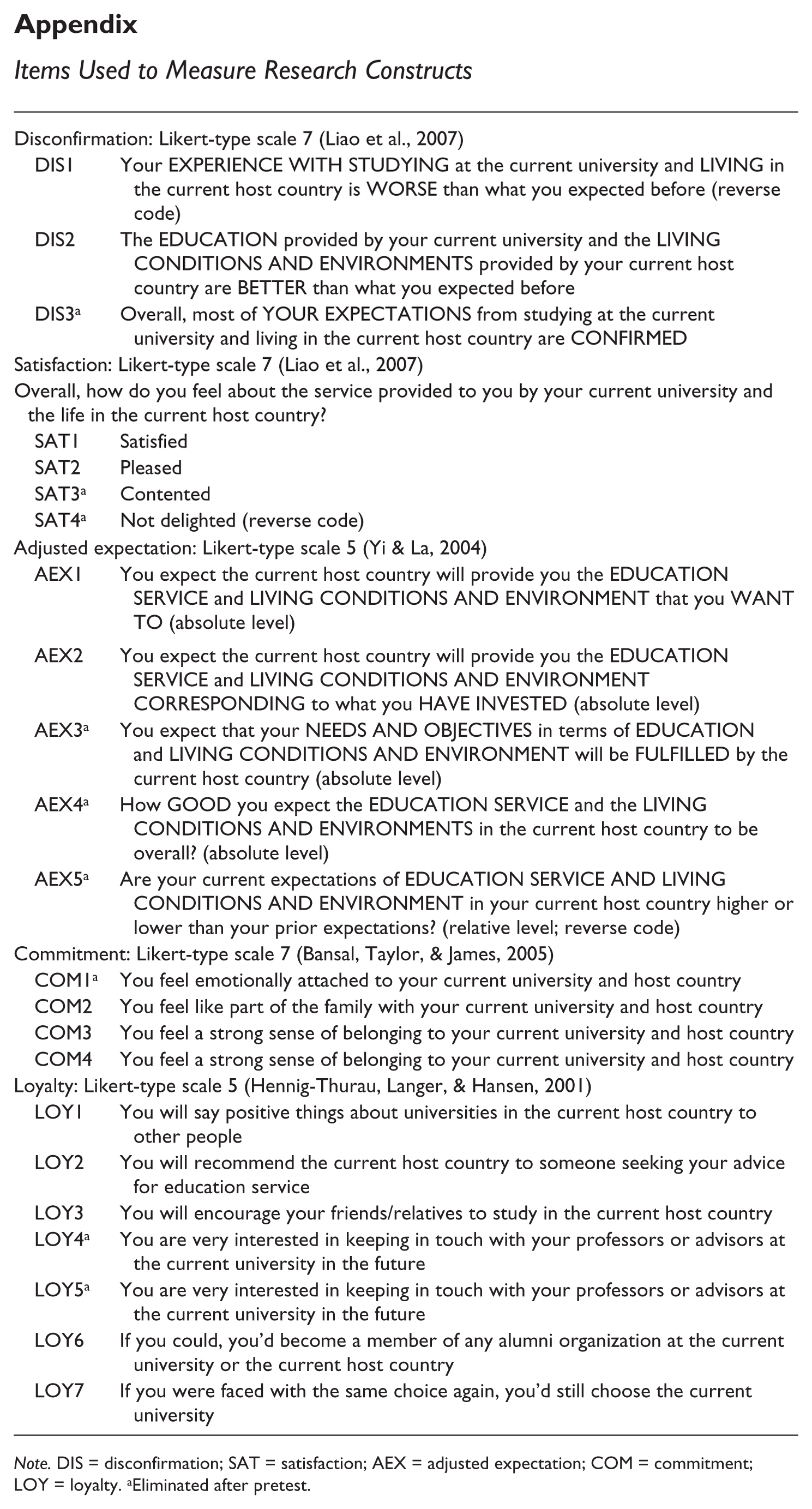
To ensure validity of the measurement, all items’ questions were obtained from previous studies, with small adjustments made in terms of terminology to fit the setting of higher education. The detailed items are listed in the appendix.
Pretest
To address the face validity of the measurements, two experts, one familiar with consumer behavior and the other having majored in higher education studies, were invited to review the questionnaires.
A sampling with 52 target respondents was then carried out through Facebook.
Based on the feedback of these two experts and the primary analysis from this pretest, the questionnaire was further revised terminologically, and some items were eliminated due to their low factor loadings (see the appendix).
Data Collection
The proposed model was tested in an international higher education service context.
A web-based survey was conducted with Vietnamese overseas students from more than 15 countries.
Among the origin countries of international students, Vietnam is one of the most emerging sourcing countries (Choudaha, 2012).
In 2013, Vietnam had around 125,000 students across the globe, a 15% increase over 2012 (An, 2015). Vietnamese students going abroad include both scholarship-receiving and self-funded students, with the latter making up the majority recently.
In terms of geographical destination, while English-speaking countries such as the United States, the United Kingdom, or Australia are still the most wanted host countries, the traditional host countries in continental Europe such as France, Germany, or Russia are still receiving a stable number of Vietnamese students.
In recent years, increasingly students have chosen higher developed neighboring countries such as Singapore, China, Malaysia, South Korea, or Taiwan for their higher education.
For data collection, a solicitation message was sent to 1,000 people randomly selected from the member list of a Facebook-based group, comprising more than 17,000 Vietnamese overseas students (data accounted in May 2014).
The message outlined briefly the study’s purpose and invited readers to click through the URL to answer the questionnaires.
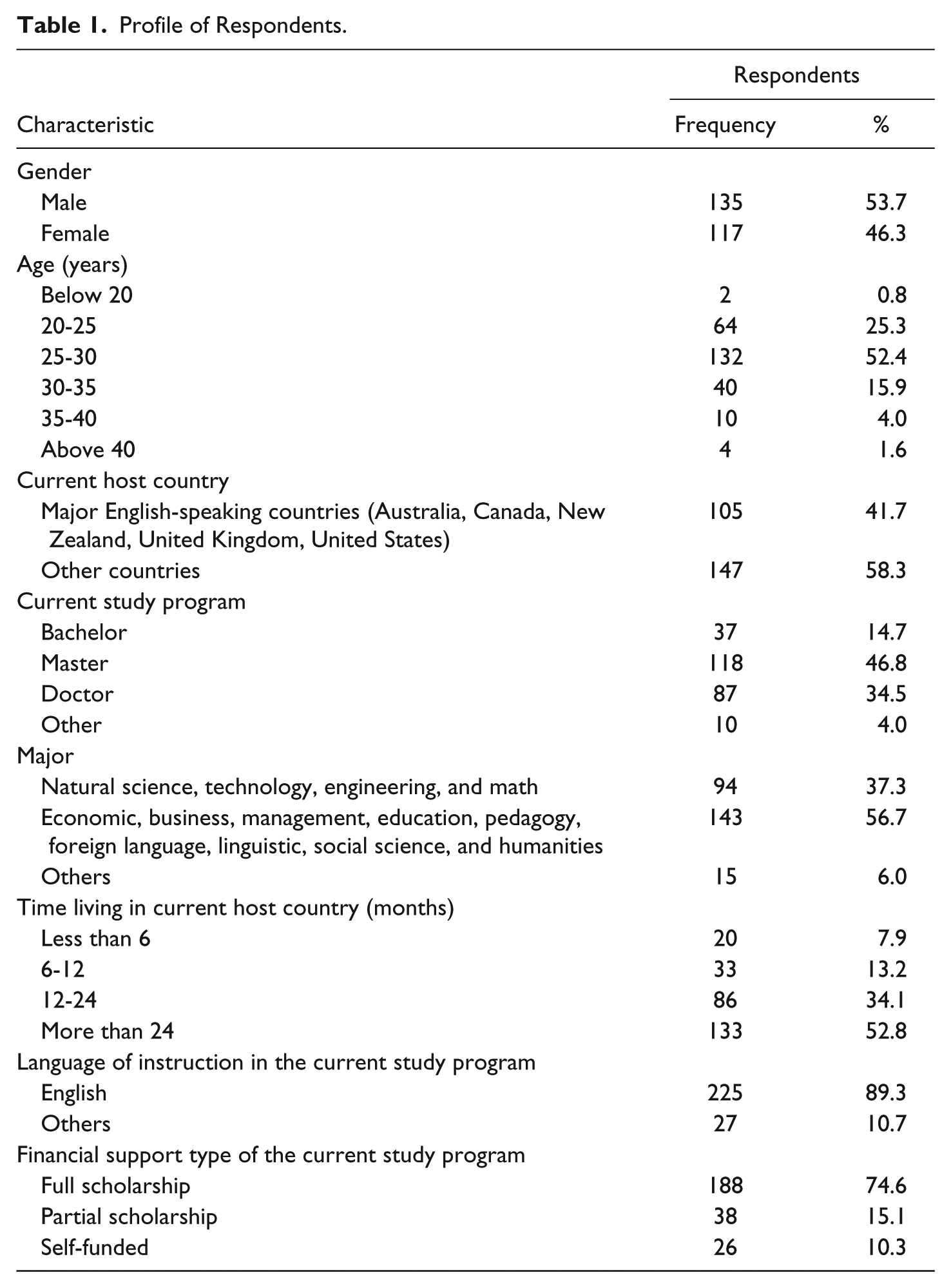
The questionnaires, answers, and survey apparatus are all provided in English. A total of 420 people replied but 168 were eliminated due to incomplete responses. The final sample size was 252, and the actual return rate was 25.2%. Table 1 shows the detailed profiles of respondents.
Profile of Respondents.
Results
Measurement Validation
To test the measurement validity, confirmation factor analysis (CFA) was performed using SAS 9.3.
First, multiple fit indices, including chi-square, degree of freedom, goodness of fit (GFI), adjusted goodness of fit (AGFI), normed fit index (NFI), comparative fit index (CFI), root mean square error of approximation (RMSEA), and Bentler comparative fit index (BCFI), were considered.
All of our results satisfied the rule of thumb: Chi-square divided by degree of freedom should be less than 5; GFI, NFI, CFI are to be larger than 0.9, AGFI should exceed 0.8; RMSEA should be less than 0.08. Table 2 shows the details of our multiple fit indices.
The Dimensions, Reliability, and Validity of Constructs (Fully Standardized Solution).
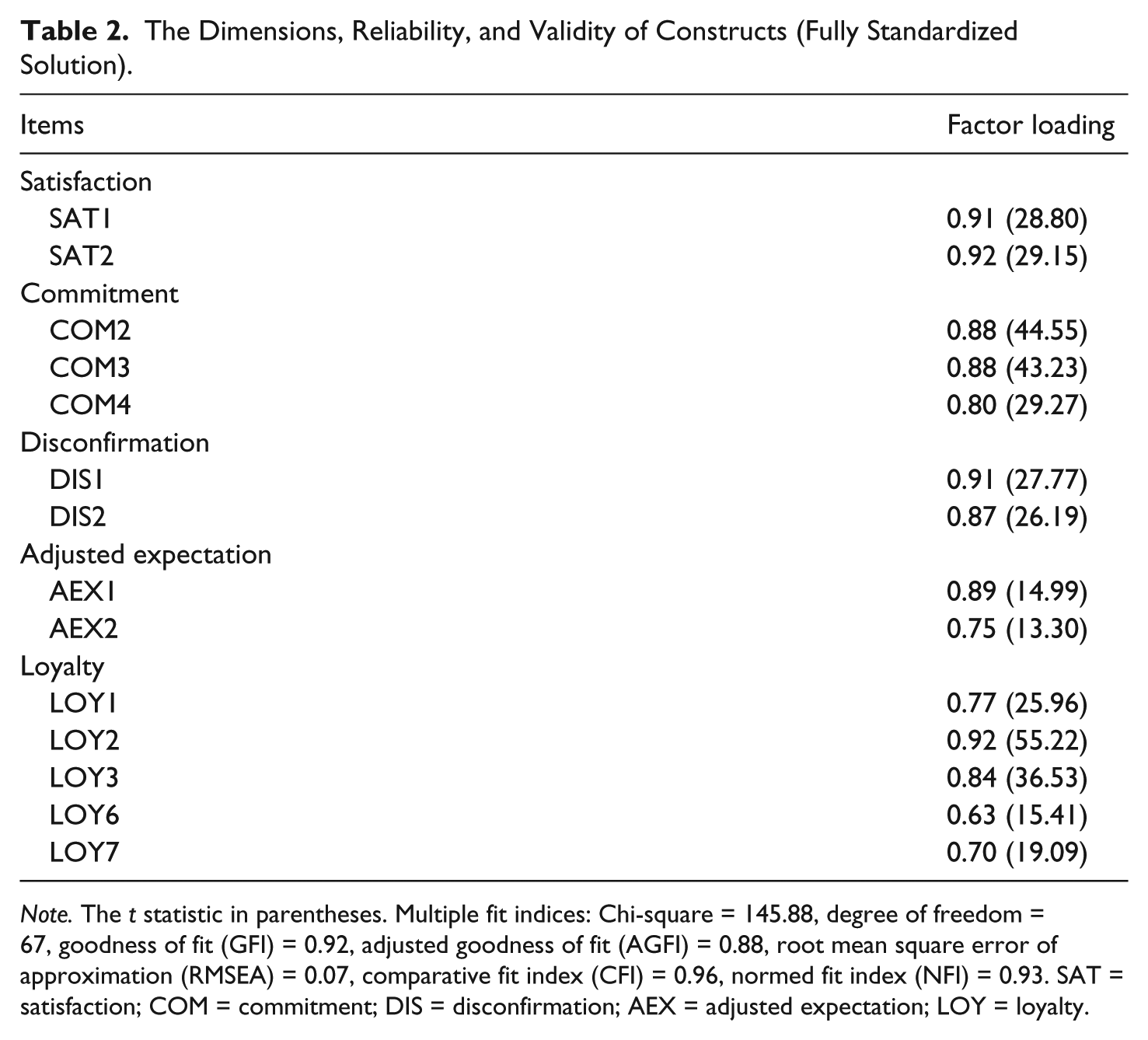
Note. The t statistic in parentheses. Multiple fit indices: Chi-square = 145.88, degree of freedom = 67, goodness of fit (GFI) = 0.92, adjusted goodness of fit (AGFI) = 0.88, root mean square error of approximation (RMSEA) = 0.07, comparative fit index (CFI) = 0.96, normed fit index (NFI) = 0.93. SAT = satisfaction; COM = commitment; DIS = disconfirmation; AEX = adjusted expectation; LOY = loyalty.
Second, we examined the convergent validity of our measurements through estimation of all items’ factor loadings; construct reliability (CR) and average variance extracted (AVE).
As shown in Table 2, all above indices were satisfied: All factor loadings for questionnaire items (except LOY6’s) are greater than 0.7 and significant in t test. All CRs and AVEs are above their cutoff points, that is, 0.8 and 0.5, respectively.
Finally, discriminant validity was tested through verifying if AVE scores are higher than the square of the parameters estimated among the latent variables.
Our results also indicate that all the constructs in the model have acceptable discriminant validity, and the constructs included in this study are uncorrelated with others (see Table 3).
Confirmatory Factor Analysis for Convergent and Discriminant Validity.
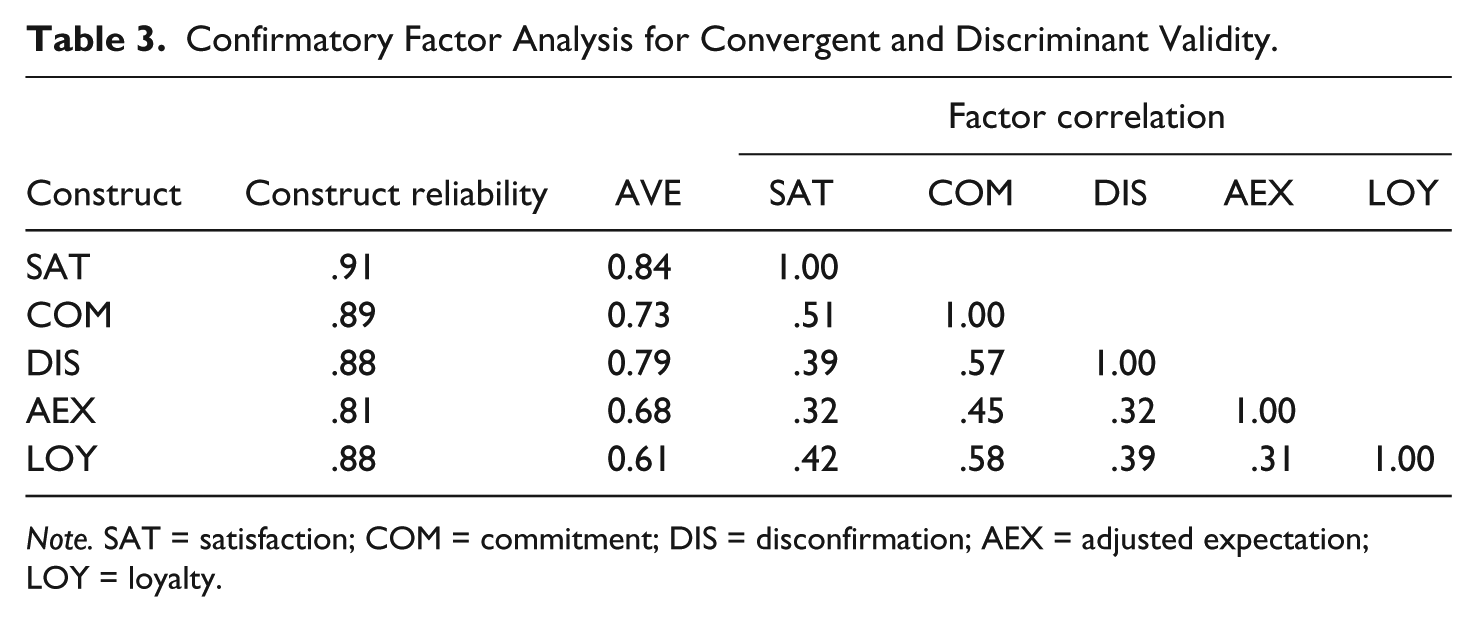
Note. SAT = satisfaction; COM = commitment; DIS = disconfirmation; AEX = adjusted expectation; LOY = loyalty.
Structural Model and Hypotheses Testing
As all fit indices, including the GFI, AGFI, and parsimonious GFI, satisfied the model fit criteria, they suggest that the whole structural model proposed in this study is a good fit (see Table 4).
Results of Structural Equation Systems.

Note. Multiple fit indices: Chi-square = 141.41, degree of freedom = 63, goodness of fit (GFI) = 0.92, adjusted goodness of fit (AGFI) = 0.87, root mean square error of approximation (RMSEA) = 0.07, Bentler comparative fit index (BCFI) = 0.96, normed fit index (NFI) = 0.93.
These results demonstrate that our proposed model has a significant fit with obtained data, and all endogenous variables are explainable through exogenous variables included in the framework.
Overall, the model predicts the variance of student loyalty to be 35%, commitment 49%, adjusted expectation 15%, and satisfaction 15%.
Table 4 shows the estimation of path analyses. Among three hypothetic direct antecedents of student loyalty (commitment, satisfaction, and adjusted expectation), the first two constructs are verified to have significant impacts while the latter is not. Thus, Hypotheses 1 and 2 are supported but Hypothesis 6 is rejected.
Taken together, commitment (β = .46, p = 6.23) and satisfaction (β = .17, p = 2.42) predict 35% of variance of international student loyalty.
These findings are consistent with previous research (Chen, 2012; Hennig-Thurau, Gwinner, & Gremler, 2002), estimating the positive direct impact of satisfaction and commitment toward customer loyalty in other industries.
However, by comparing the path coefficients of satisfaction and commitment toward loyalty, we found that contrary to what had been indicated in Hennig-Thurau et al. (2002), commitment, not satisfaction, is the most important motivator of loyalty.
The meditating role of commitment impacting the satisfaction–loyalty relationship has been a debated issue in previous customer-loyalty-based studies.
While some empirical works (e.g., Chen, 2012; Han et al., 2008) supported this role in various settings, it did not support in higher education (e.g., Rojas-Méndez et al., 2009).
As indicated in Table 4, the path from satisfaction to commitment is significant (β = .29, p = 4.82).
Therefore, Hypothesis 3 is supported; in the international higher education context, commitment does play a role of direct mediator between satisfaction and loyalty.
In addition, we found an indirect path from satisfaction to commitment through the intermediate construct of adjusted expectation.
As shown in Table 4, at first, high satisfaction generates high adjusted expectation (β = .23, p = 3.09), and in turn high adjusted expectation will create high commitment (β = .23, p = 3.67).
So, Hypothesis 5 and Hypothesis 7 are both supported.
The verification of Hypothesis 5 consolidates the relation between satisfaction and adjusted expectation, introduced by Yi and La (2004) in a family-restaurant setting.
Interestingly, through scrutinizing the modification indices, this study unveiled the two direct paths that were overlooked in previous studies.
Both the paths start from disconfirmation and end at adjusted expectation (β = .23, p = 3.06) and commitment (β = .40, p = 6.61), respectively.
Thus, the more experienced performance outstrips the ex ante consuming expectation, the more expectedly customer feels ex post and the more he or she commits to the service.
Non-Response Bias and Common Method Bias
These two biases may be problematic for any research employing a survey questionnaire. In this study, we have employed a number of measures to tackle these issues: (a) conducting chi-square test of difference; ANOVA between two groups (early and late respondents) to test non-response bias; (b) using multiple Likert-type scales (5 and 7) and reverse coded questions; Harmon’s one-factor test to ensure the problem of common method variance. Our measures obtained evidence convincing that the measurement model is robust enough against these two biases.
Discussion
As international study is one of the most significant phenomena relevant to higher education recently, investigating factors influencing their loyalty is crucial.
Regarding international higher education from the view of extended duration service, our study provides the first empirical testimony pertaining to the relationships between international student’s loyalty and its key antecedents.
Implications for Theory
The data collected in this study reconfirmed the major roles of satisfaction and commitment as direct drivers of loyalty (Chen, 2012; Hennig-Thurau et al., 2002).
Also, as noted previously, our analysis showed that of these two above direct paths to loyalty, the latter (i.e., commitment–loyalty) is stronger than the former (i.e., satisfaction–loyalty). Thus, these results are in line with Chen (2012) but not consistent with Hennig-Thurau et al. (2002).
In addition, we found that there are two significant paths from satisfaction to commitment.
The first one is indirect and mediated by adjusted expectation, and the other is direct. In considering international higher education as an extended duration service, these above findings are understandable.
First, as international higher education is characterized by a relatively extended period of consumption, one may change his or her expectations over the service period according to his or her accumulated experience over time. This assertion is even true for short duration service settings such as restaurants (Yi & La, 2004). In turn, the post hoc expectation will influence the emotional attachment (i.e., commitment).
Second, the results that emphasize the central role of commitment within a high-involvement service actually illustrate credence feature (which is also an identified proxy of high-involvement service) of higher education.
According to Shemwell, Yavas & Bilgin (1998), in a credence setting, as customers often suffer asymmetric information and cannot evaluate the received service rationally, they must rely on emotional bonds (i.e., affective commitment in our study) to form loyalty toward the service.
A plausible reason explaining the immense role of commitment is that the loyalty included in our study pertains to attitudinal dimension, which, to a certain extent, is relevant to the concept of affective commitment.
Hence, it is reasonable that commitment would be the most influential driving force of attitudinal loyalty.
Regarding the role of disconfirmation, our analyzed data have shown that this construct has direct impacts on satisfaction, adjusted expectation, and commitment.
Unlike the first relationship (i.e., disconfirmation–satisfaction), which has been widely established in empirical studies (Ha & Janda, 2008; Liao et al., 2007; Yi & La, 2004), the two others (i.e., disconfirmation–adjusted expectation and disconfirmation–commitment) seem to be overlooked in the previous literature.
Implications for Practice
The study’s results provide several insights for universities’ managers and policy makers when implementing internationalization. Thus, the findings are in line with the proposition in extant literature that regards university–student relationships through the lens of supplier–customer marketing.
Specifically, our findings indicate that adjusted expectation is an important issue that higher education suppliers should scrutinize thoroughly.
Given the nature of extended duration services, apart from focusing on quality that in turn will bring about positive disconfirmation and then satisfaction, universities are suggested to implement frequent and efficient evaluation to learn about updated expectations of their students-customers over time.
This, in turn, is supposed to bring up-to-date input that helps institutional managers respond promptly to changing demands of their international students.
Our study is also consistent with previous studies in service marketing (de Ruyter, Moorman, & Lemmink, 2001; Shemwell et al., 1998), suggesting that affective commitment is a key antecedent of loyalty.
In other words, in an extended duration service, increasing factors that help evoke an emotional bond with customers is a more critical task for marketers than obtaining satisfaction.
Specifically, in an international higher education setting, enhancing attitudinal loyalty of international students is worthwhile, because this will lead to positive word of mouth, higher degree of interaction between universities and students after graduation (e.g., alumni activities, endowment, or further collaboration with former professors).
Higher education managers are advised to focus not only on the “hardware services” (i.e., educational elements such as faculties, laboratories, or libraries) but also on “software services” (i.e., non-educational elements), which also results in student’s higher attitudinal commitment.
However, “software service” does not only pertain to “on-campus” borders (e.g., dormitories or student cafeterias) but also extend to “off-campus” environments (e.g., tourism, public transport, visas for foreigners, safety or part-time jobs) that are, in fact, beyond the intervention of universities/colleges.
This implies that governments of host countries should also put effort to support their universities in harmonizing a “software service” system, which may satisfy the multifaceted demands of international students during their time studying offshore.
This assertion, indeed, has been observed clearly in a number of previous empirical researches studying cross-border education.
For instance, by analyzing data from 33 European countries during 1998-2009, Caruso and de Wit (2015) concluded that the actual level of safety is the second important determinant that explains the likelihood of students to undertake study overseas.
In another study, Lee (2014) similarly revealed that the two most significant factors determining the destination choice of international students in Taiwan were cost issues (including tuition fees, cost of living, opportunity of working during the course, time to get the degree, and safety of the environment) and the physical and learning environment (including comfortable climate, exciting place to live, friendly and supportive learning environment).
Conclusion
Over previous decades, academic researchers have increasingly acknowledged universities as service organizations. In view of higher education as an extended duration service, the purpose of this project was to develop a model to investigate the attitudinal dimension of international student–customer loyalty and its direct and indirect precursors. The structural equation model’s results reconfirm the role of affective commitment as a powerful driver of loyalty that has been identified in the “national” higher education context. In addition, we find that adjusted expectation functions as a mediator between commitment and other factors (i.e., disconfirmation and satisfaction). Another interesting finding of our study is the empirical support of two direct routes from disconfirmation to adjusted expectation and commitment, which have been neglected in previous research.
Limitations and Future Researches
There are a number of concerning issues that have been unaddressed in this article, and these are, indeed, potential caveats for further studies.
First, in our initial conceptual model, we excluded an important factor, namely trust, which has often been juxtaposed with commitment in previous studies examining the customer relationship. Future studies are advised to add trust into their conceptual model.
Second, as we only investigate the education quality on a one-dimensional scale by considering disconfirmation, we have not determined how different subindicators of quality concepts, that is, tangibles, reliability, responsiveness, assurance, and empathy (Parasuraman, Zeithaml, & Berry, 1988) interplay with other antecedents in forming loyalty responses. To overcome this weakness, prospect researchers may incorporate well-developed instruments of service quality like SERVQUAL (Parasuraman et al., 1988) or SERVPERF (Cronin & Taylor, 1992) into their studies.
Third, in the same vein as the second limitation, another possible arena for future studies is extending the unidimensionality of commitment and loyalty from solely an emotional perspective to multiperspectives (i.e., emotional vs. calculative for commitment and cognitive vs. affective vs. intention vs. behavioral for loyalty). This is, of course, a fruitful issue for further investigation.
Fourth, another limitation of this study lies in the underrepresentation of undergraduate students among our sample. This may not reflect the actual pattern of Vietnamese overseas students. For instance, data released by Institute of International Education (2015) revealed that 71.7% Vietnamese students in the United States study at undergraduate level, while in our study, the respective figure is only 14.7%. This is partly due to the fact that the group in which we delivered our survey is mostly comprised of graduate students. Further studies may avoid this limitation with sample that reflects better the overall population.
Footnotes
Items Used to Measure Research Constructs
| Disconfirmation: Likert-type scale 7 (Liao et al., 2007) | |
| DIS1 | Your EXPERIENCE WITH STUDYING at the current university and LIVING in the current host country is WORSE than what you expected before (reverse code) |
| DIS2 | The EDUCATION provided by your current university and the LIVING CONDITIONS AND ENVIRONMENTS provided by your current host country are BETTER than what you expected before |
| DIS3 a | Overall, most of YOUR EXPECTATIONS from studying at the current university and living in the current host country are CONFIRMED |
| Satisfaction: Likert-type scale 7 (Liao et al., 2007) | |
| Overall, how do you feel about the service provided to you by your current university and the life in the current host country? | |
| SAT1 | Satisfied |
| SAT2 | Pleased |
| SAT3 a | Contented |
| SAT4 a | Not delighted (reverse code) |
| Adjusted expectation: Likert-type scale 5 (Yi & La, 2004) | |
| AEX1 | You expect the current host country will provide you the EDUCATION SERVICE and LIVING CONDITIONS AND ENVIRONMENT that you WANT TO (absolute level) |
| AEX2 | You expect the current host country will provide you the EDUCATION SERVICE and LIVING CONDITIONS AND ENVIRONMENT CORRESPONDING to what you HAVE INVESTED (absolute level) |
| AEX3 a | You expect that your NEEDS AND OBJECTIVES in terms of EDUCATION and LIVING CONDITIONS AND ENVIRONMENT will be FULFILLED by the current host country (absolute level) |
| AEX4 a | How GOOD you expect the EDUCATION SERVICE and the LIVING CONDITIONS AND ENVIRONMENTS in the current host country to be overall? (absolute level) |
| AEX5 a | Are your current expectations of EDUCATION SERVICE AND LIVING CONDITIONS AND ENVIRONMENT in your current host country higher or lower than your prior expectations? (relative level; reverse code) |
| Commitment: Likert-type scale 7 (Bansal, Taylor, & James, 2005) | |
| COM1 a | You feel emotionally attached to your current university and host country |
| COM2 | You feel like part of the family with your current university and host country |
| COM3 | You feel a strong sense of belonging to your current university and host country |
| COM4 | You feel a strong sense of belonging to your current university and host country |
| Loyalty: Likert-type scale 5 (Hennig-Thurau, Langer, & Hansen, 2001) | |
| LOY1 | You will say positive things about universities in the current host country to other people |
| LOY2 | You will recommend the current host country to someone seeking your advice for education service |
| LOY3 | You will encourage your friends/relatives to study in the current host country |
| LOY4 a | You are very interested in keeping in touch with your professors or advisors at the current university in the future |
| LOY5 a | You are very interested in keeping in touch with your professors or advisors at the current university in the future |
| LOY6 | If you could, you’d become a member of any alumni organization at the current university or the current host country |
| LOY7 | If you were faced with the same choice again, you’d still choose the current university |
Note. DIS = disconfirmation; SAT = satisfaction; AEX = adjusted expectation; COM = commitment; LOY = loyalty. aEliminated after pretest.
Declaration of Conflicting Interests
The author(s) declared no potential conflicts of interest with respect to the research, authorship, and/or publication of this article
Funding
The author(s) received no financial support for the research, authorship, and/or publication of this article.