




Abstract
The growing importance of internationalization and the global dominance of English in higher education mean pressures on expanding English-taught degree programs (ETDPs) in non-English-speaking countries. Strategic considerations are necessary to successfully integrate ETDPs into existing programs and to optimize the effects of internationalization. Previous studies have proposed that innovation theory might explain effectively how to achieve this. This article examines the validity of innovation theory as a framework for understanding the institutionalization of ETDPs and identifies determining factors of successful outcomes. A case study was conducted in Dutch universities to identify factors influencing the institutionalization of ETDPs. A qualitative analysis of 15 interviews with academics demonstrated that an innovation theory-based framework can enable a systematic understanding of the institutionalization of ETDPs and can be effective in analyzing the influencing factors. Analyses utilizing this framework can contribute to strategic planning and policy-making for internationalization at national and institutional levels.
Keywords
Introduction
English-taught degree programs (ETDPs) have been actively promoted as an important internationalization strategy at universities in non-English-speaking countries, in the context of the global dominance of English in higher education. I use the term internationalization in this study to describe all policies and activities of universities aimed at making them more responsive to the challenges of globalization (see van der Wende, 2004). In recent years, there has been a drastic increase in the number of ETDPs because of the expectation that they can facilitate a university’s internationalization and increase its international competitiveness.
In this study, however, I pose the following questions: Can ETDPs really internationalize universities? How and to what extent can they be successful in internationalizing universities? What is an adequate theoretical framework for undertaking an analysis to answer these questions?
Previous studies (van der Wende, 1999; van der Wende, Beerkens, & Teichler, 1999) have argued that innovation theory can provide a framework for analyzing how internationalization can cause innovations in higher education institutions, as well as for analyzing the factors that define the success of internationalization in terms of the optimal outcome of the innovation. These studies analyzed the internationalization of higher education as an innovation process in higher education, focusing on the last stage of the process—institutionalization. However, as the authors themselves have pointed out, because of the limited empirical basis, the results only indicate some general routes to the successful outcome. They do not suggest any immediate and comprehensive approach to achieving success in internationalization.
The purpose of this study is to examine the validity of innovation theory as a framework for understanding the institutionalization of ETDPs, which is one specific type of innovation for the purpose of internationalization, as well as to identify factors that determine the successful outcomes of innovation. Semi-structured interviews were conducted in Dutch research universities. ETDPs in the Netherlands have expanded drastically during the decade after the Bologna declaration and have been currently institutionalized (cf. Kotake 2012, 2013). Therefore, the Dutch case is an extremely suitable one to study as a means of identifying the factors that influenced the institutionalization of ETDPs.
Accordingly, the following two research questions drive this study:
Theoretical Framework
The seminal works of van der Wende et al. (1999) and van der Wende (1999) used the work of Arthur Levine (1980), Why Innovation Fails, as the basis of their analyses. According to Levine, innovation is defined as “any departure from the traditional practices of an organization” (p. 3). Providing ETDPs can be an innovation in non-English-speaking universities, where ETDPs are perceived as new and different from their traditional practices.
Levine proposes that the innovation process has four fundamental steps:
recognizing the need for change,
planning and formulating a solution,
initiation and implementation of a plan, and
institutionalization or termination.
Innovation efforts tend to focus on the first three stages, and it is often believed that the third stage (implementation) represents the end of innovation. However, Levine focuses on the last stage (institutionalization) as being a crucial stage for making the operating plan a routine part of activities in the organization. This is especially critical for internationalization because nowadays we see more and more cases of institutions reacting, instead of being proactive, to external policies formulated at national or supra-national level (van der Wende et al., 1999).
According to Levine, the most successful outcome of the institutionalization stage is the achievement of diffusion, which means that innovation characteristics are allowed to spread through the host organization. Diffusion depends on two particular characteristics: compatibility and profitability.
Compatibility is the degree to which the norms, values, and goals of the innovation are congruent with those of the host organization. Compatibility is a measure of the appropriateness of the innovation within the existing organization. Rogers (1983) explained that the innovation can be compatible with (a) the sociocultural beliefs of the organization, (b) previously introduced ideas, and (c) clients’ needs for innovation. The greater the degree of compatibility of an innovation within the organization, the lower the level of dissatisfaction.
Profitability is the effectiveness of an innovation in satisfying the adopter’s needs and is a measure of satisfaction. Profitability is subjective, and what counts is an adopter’s perception of profitability, not objective profitability. Profitability concerns not only the economic concept of profitability but also a multitude of non-economic forms of profit obtained by the innovation adopter, such as security, prestige, peer approval, growth, efficiency and improvement in the quality of life, and so forth. What is perceived to be profitable by an individual adopter can vary depending on the individual’s needs. Furthermore, what is perceived to be profitable by an individual will not necessarily coincide with what is profitable for an organization as a whole.
Following Levine’s theory, the most successful outcome of providing ETDPs at the institutionalization stage is the diffusion of internationalization. To achieve this, both the compatibility and profitability of ETDPs should be optimal. This study intends to unravel what constitutes the compatibility and profitability of ETDPs as a preliminary step toward future comprehensive research. To measure the degree of compatibility, the norms, values, and goals of the ETDP concerned and those of the host organization must be compared. Therefore, this study seeks to develop comparison criteria for this purpose and to explore the explanatory variables required to make the comparison. Regarding profitability, this study seeks to clarify the elements that constitute profitability and to systematize them in a way that can be useful for future research.
Compatibility and Profitability of ETDPs in Dutch Research Universities
Today, ETDPs in Dutch research universities can be considered to be in the institutionalized stage, although until the late 1990s, ETDPs were new and non-traditional practices in many of these universities. In 2002, two new laws came into effect, which introduced the bachelor-master structure in compliance with the Bologna process and set up an accreditation system for all degree programs whether in Dutch or in English. 1 This change accelerated the offering of numerous master’s programs in English. In 1995, the number of English-taught programs, including short-term programs lasting a week or less, in Dutch higher education was 364 (Huang 2006). In 15 years from 1995 to 2010, the number increased by 430% to 1,560 (Nuffic, 2009). In 2010, out of the 1,088 ETDPs that existed in Dutch higher education, 2 just less than 70% of them were provided by research universities. The major portion (approximately 95%) of these ETDPs were master’s programs (Nuffic, 2009).
Some facts identified in previous studies indicate that ETDPs in Dutch research universities have a high level of compatibility. First, the proactive policies toward ETDPs indicate a high level of compatibility with the goals and values of universities. Some universities set a numerical target for the number of master’s programs offered in English, while other universities have a policy that all master’s programs will be offered in principle in English (Kotake, 2013). Second, a high level of compatibility can also be seen in their views on the European Higher Education Area initiative, as well as the fact that they have looked at the Bologna degree reform as a good opportunity to promote ETDPs. The proactive way in which ETDPs have been promoted has been strongly supported by the idea that Dutch higher education can be competitive because of the advanced English ability of the Dutch population (Westerheijden, 2004). Third, Dutch research universities have had previous experiences of receiving mobility students on the Europe-wide student exchange program ERASMUS, which started in 1987: From the end of the 1980s through to the 1990s, English-taught courses and programs were rapidly established to receive these mobility students (van der Wende, 1996). This also indicates compatibility.
On the contrary, some academic fields are said to have a low level of compatibility. To become advanced professionals in fields such as medicine, law, psychology, and public administration, students need to acquire a high level of Dutch vocabulary and good Dutch writing skills (Kotake, 2013). ETDPs can be restrictive in these cases.
Concerning profitability, attracting international students, and preparing domestic students for future careers seem to constitute primary general profitability. The positive attitudes on the part of the people involved toward active ETDP policies (Kotake, 2013) imply a high level of profitability.
How, then, can we obtain a comprehensive picture of the compatibility and profitability of ETDPs? Building upon the above findings, this study seeks to clarify this picture by analyzing the results of interviews with academics. A fundamental characteristic of higher education institutions is the way authority is decentralized among individual academic professionals. Hence, innovations may arise easily, often at the lower level of the organization, and may even be diffused among the bottom levels (van Vught, 1989). The key to success is whether individual academics perceive ETDPs as worthwhile. Therefore, conducting interviews with academics is an effective data-collection method with which the researcher can enter into the everyday lives of academics and directly draw out their subjective viewpoints and attitudes toward ETDPs.
Method
In February 2014, I conducted semi-structured interviews with 15 academics from six research universities in the Netherlands (see Table 1). Being careful to avoid a bias in terms of specialist fields and years of experience at universities which may influence their needs and values, I chose interviewees with the cooperation of my local acquaintances and of an acquaintance in Japan who had experience of studying at a Dutch research university. During interviews that lasted from 50 minutes to 1.5 hours, the interviewees were asked about their views on the institutionalization of ETDPs, including the regulative aspects, any perceived change from the past, their opinions about institutional ETDP policies, and their personal satisfaction with teaching in English.
Description of the Interviewees.
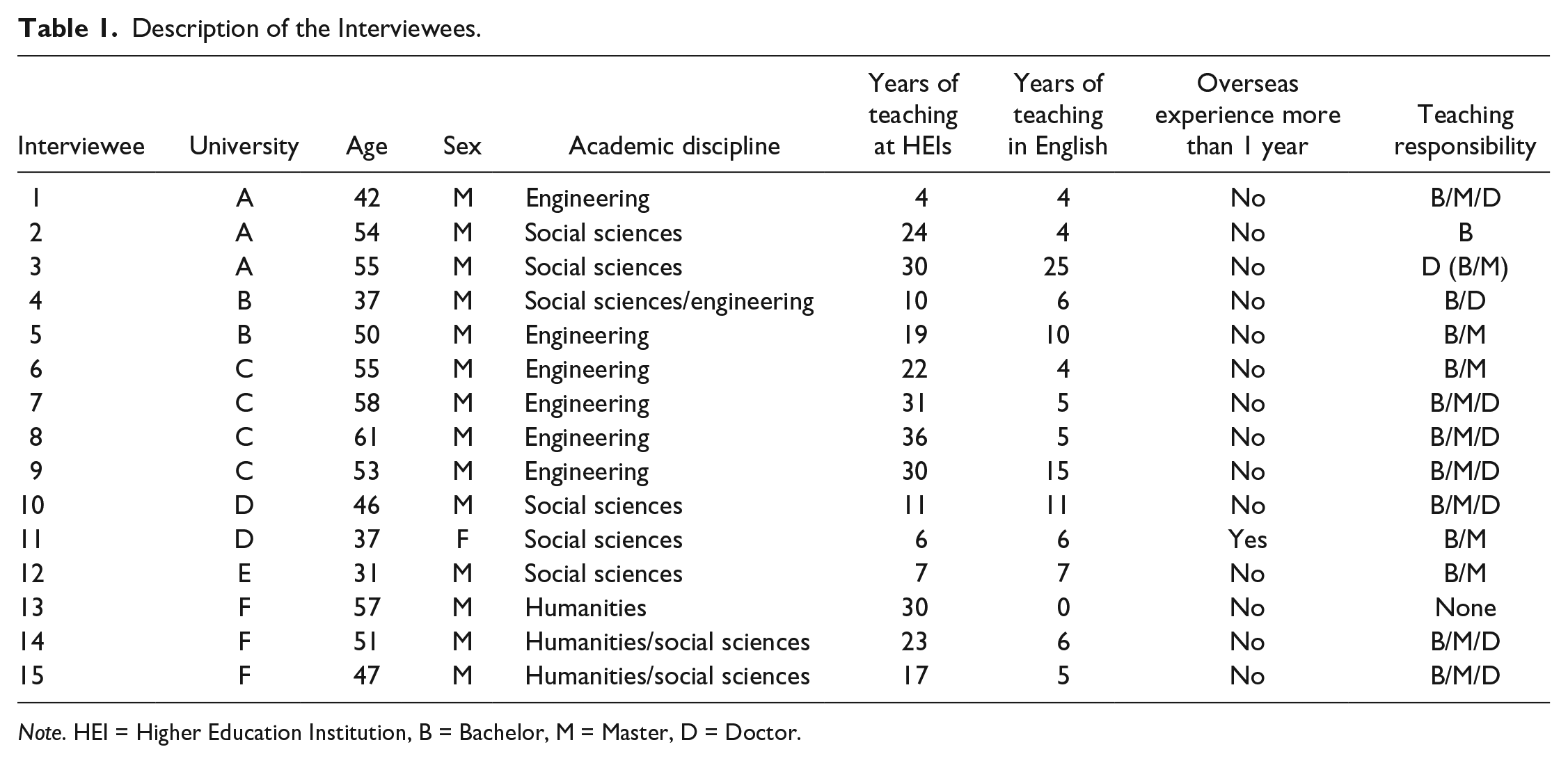
Note. HEI = Higher Education Institution, B = Bachelor, M = Master, D = Doctor.
All interviews were transcribed, and indicative statements of compatibility and profitability were extracted from the transcripts. Similar statements were grouped into larger categories. Multiple readings of the transcripts allowed me to think about the data in different ways and to refine the categorization by carefully reflecting interviewees’ ideas and perspectives.
Results
Compatibility of ETDPs
The following five criteria for measuring the degree of compatibility were developed based on the analysis:
1. Sociocultural values and beliefs
Sociocultural values and beliefs in the organization are the basis for various behaviors and value judgments. These are the “normalities” of everyday life. First, the “normalities” seem to be largely determined by the fact that the Netherlands is a small country in Europe and the Dutch language is a minority language. The interviewees frequently referred to the position of the country and the language while talking about their views on ETDPs: for example, “The Netherlands should be functioning as part of Europe a whole” and “We are used to looking abroad and speaking foreign languages. This is part of our culture.” Some interviewees predicted that teaching in Dutch would disappear except for some special occasions because they strongly recognized that English was necessary for the survival of universities.
Some changes in formal aspects also influence these “normalities.” Since the introduction of ETDPs, the interviewees have been formally asked to teach in English, in addition to conducting research in English. In recent years, the number of ETDPs has increased at the bachelor’s level, in addition to the master’s. For the academics interviewed, it is becoming clear that there is almost no possibility of not teaching in English.
2. Conformity to the organizational goal and policy
Providing ETDPs is a strategic instrument for universities to pursue their organizational goals. Universities compete among the universities in the country in attracting both international and domestic students. Attracting international students is not only for the purpose of internationalization but also for the purpose of maintaining the appropriate number of students. Due to changes in the nation’s demographics, the population of children is decreasing. This is exemplified by the following comments:
. . . This is really changing here and one of the things that you are attracting international students and that’s an important thing. We are a University, well somewhat detached from what we call Randstad . . . a lot of universities over there . . . we didn’t have problems in attracting students because most students from the north are going to . . . But of course we have lowering level of number of children so the number of students is changing. (Interviewee 15)
3. Conformity to the goal of human resource development
ETDPs are considered to be important to increase domestic students’ employability. There was the very clear idea among interviewees that English-language proficiency is becoming even more important for the future careers of students in the Netherlands. It is essential, especially for academic careers. At research universities, they essentially train students in academic study and research; therefore, ETDPs are compatible with the overall goals of human resource development. English is important for non-academic careers as well because the people working in the Netherlands tend to have more foreign contacts even within the country. In addition, finding an appropriate job in the country is not always easy, and English is necessary to obtain a job abroad.
4. Conformity to the disciplinary characteristics
Attitudes toward the use of English vary significantly depending on academic disciplines. First, in terms of discipline-specific career paths, this study found public administration and clinical psychology to be examples of incompatibility. Those who wish to work in local government or in clinical sites in the country need to acquire a professional level of Dutch vocabulary and writing skills. Second, in terms of the degrees for which the scientific concepts depend on the Dutch contexts, this study found that “Dutch architecture and urbanism” to be an example of incompatibility:
A lot of students I know that come for architecture and urbanism, they are interested because the Netherlands has a specific tradition in architecture and urbanism . . . But there is almost no English literature on Dutch urbanism. It’s all in Dutch. So automatically you are going to teach the Anglo-Saxon tradition. So that’s also a thing. So you also have to take care of English study material . . . . It’s not only teaching or speaking in English which is not so easy . . . (Interviewee 8)
The disciplinary variation in English-language use is a product of the different knowledge-making practices of the disciplines (Kuteeva & Airey, 2014). In this study, for the most part for engineering and somewhat for the social sciences, it was found to be just a matter of switching languages, but for others, it was found to be impossible to teach the same content in English and it was found to be necessary to change the teaching content for the international audience. Even within the same discipline, there were major differences depending on the divisions. The availability of English-language textbooks, journal articles, dissertations, and academic books shows how often English is used in academic writing. The availability of these English-language materials can be an indicator of compatibility.
5. Introduction process and past experiences
The circumstances in which ETDPs came to be implemented, whether it was bottom–up or top–down, influences the level of compatibility. If it was introduced in a top–down way, people’s sense of purpose tends to be lower and there may be a feeling of being forced to implement ETDPs, as the following case shows:
When we started, there were some classes where we had the normal book in Dutch. And if there was a foreign student, they get a special assignment, he get a special literature, and they did something else than the other students . . . He could say in the beginning: “Just study the book! And come to me in two weeks’ time. And then, we do talk about it. And don’t be in my class, because my class is in Dutch.” You cannot do that nowadays. (Interviewee 6)
By contrast, if people have had similar experiences in the past, this can reduce uncertainty in regard to ETDPs and lower the degree of dissatisfaction. As previous studies show, some interviewees had experience in English-teaching for ERASMUS students before the introduction of ETDPs. The experiences seem to be utilized to promote shared values.
Profitability of ETDPs
The following 10 profitability factors were identified based on the analysis:
1. Attracting international students
It was strongly recognized among all interviewees that ETDPs were essential for universities to compete for students by overcoming a language barrier (compatibility). This is not only in regard to internationalization but also in regard to widening the student market to cope with the shrinkage of the domestic market.
This profitability was observed throughout the interviews, but there seems to still be much room for improvement, as the quote below indicates:
I think it’s better to make a more interesting focused English taught program that is really of interest to foreign students instead of doing everything in English. . . the only thing we do is we are going to teach it in English, . . . That’s not enough. Then you are not making an interesting educational program for foreign students. Then you have to do specific things. (Interviewee 8)
The above opinion reflects the fact that the English-language master’s programs were introduced without curriculum changes, merely by changing the language of instruction. Any actions to differentiate programs, as suggested above, could further increase the level of profitability.
2. Increasing the employability of domestic students
ETDPs are necessary for advanced English and multicultural skills. This profitability is supported by the strong recognition that English is becoming even more important for students’ future careers (compatibility). It is especially important for nurturing the next generation of academic researchers, who must have advanced English abilities to pursue their careers.
3. Promoting international collaborations by the university
ETDPs can create various opportunities for such collaborations as student exchanges and double or joint degree programs. In addition, together with enhancing the university’s international reputation and internationalizing the staff composition, ETDPs can facilitate the development of good relationships with overseas universities. These can also create opportunities to acquire international external funding. This can be profitable for institutions as well as for individuals who can take part in such international activities.
4. Internationalization of research
The increased presence of international academic staff facilitates the internationalization of research activities and also makes it easier to deliver courses in English. The more English-taught courses a university has, the easier it becomes for international staff to teach (and to be employed for research). This is profitable for both individual academics and the institution. In the past, the international staff had to learn Dutch before they could start lecturing, but now they can cover big parts of the master’s programs, get experience in teaching, and start building their portfolio in teaching.
In research universities, it is typical for the international academic staff to be employed primarily for research rather than teaching:
. . . the students are not profiting from the fact that we have really interesting research going on . . . there is a huge gap between the people who teach and then the hotshot researchers who publish, but their knowledge is not translated into the educational system. (Interviewee 11)
Any actions to improve the above situation may increase the level of profitability.
5. Incorporating international perspectives in class
Multicultural settings can stimulate and motivate academics in regard to teaching, as the following statement shows:
It’s really a stimulus for teachers to offer courses in a multicultural setting . . . because it’s a topic but also people bring in different backgrounds and that’s very interesting. It’s also very tiring for the teacher because you have to see how you can handle this but it’s for the university but also for the teacher. It’s very attractive to operate in such an environment. (Interviewee 13)
In addition, opinions were given that such international classes can be effective in raising awareness of internationalization among domestic students and also that international academic staff with various cultural backgrounds could bring new perspectives to their subjects. The term International Classroom is often used in policy documents, but at a practical level, such a classroom cannot automatically be realized merely by putting international and domestic students in the same classroom. This profitability must be earned by academics, by accumulating experiences themselves. This is valued at the institutional level as well. One interviewee informed me of a case where an institution had organized an “International Classroom” project and had been developing courses for academics to learn about, and to practice, multicultural teaching.
6. Enhancing the international reputation of institutions
A university’s international reputation is important for university management. The proliferation of world university rankings plays a role in this. This form of profitability is supported by the idea that Dutch universities are in an advantageous position in providing ETDPs because of the relatively advanced English-language abilities of the Dutch population (compatibility).
7. Recognition within the institution
In some situations, introducing an ETDP might improve one’s positioning within the institution, as the following case shows:
We started . . . because we are a little bit in an odd place as a more social science type of program within the arts faculty. Well, that’s the history that we started, as part of history and we slowly developed as a program of our own. So we are always used to find ways in order to adapt to the market to certain developments and one of the things we always wanted is to go abroad and to teach in English. (Interviewee 15)
Academics feel rewarded if their hard work is recognized within an institution, especially by those above. Nowadays, university policies are clearly directed toward increasing ETDPs, and top–down policies are dominant in some institutions. In this context, an increased workload due to English-teaching can lead to dissatisfaction, due to a lack of institutional supports. Some interviewees expressed their dissatisfaction with the increased teaching load, saying that English-teaching can take more time and can make them feel more tired than teaching in Dutch, especially at the beginning. The degree of dissatisfaction regarding the teaching load may vary depending on the level of compatibility, such as the introduction process and past experiences and disciplinary characteristics. The level of profitability could be improved by some form of recognition, including effective institutional support with due consideration of differences in compatibility, such as a reduced teaching load and a staff evaluation system which is supportive for English-teaching.
8. Self-growth of academics
Academics can naturally learn to look at their own subjects from an international perspective, through the experiences of teaching in a multicultural classroom as noted in the following quotation:
. . . when you are teaching in Dutch, your examples are in Dutch. And most of the students know the examples. Nowadays you have to pick up international examples. And that changed the way the teachers look on their own course. So I think that’s an advantage. Your teachers get a more international view on their field, as my colleague said. That’s good. (Interviewee 6)
It is also profitable for academics to be able to improve their English-language abilities, which are extremely important for pursuing an academic career. The level of this profitability seemed to be supported by the Dutch academics’ very open and flexible attitudes toward English (compatibility). Self-growth on the part of academics is profitable for individual academics as well as for the institutions.
9. Efficient coherence between research and teaching
English-written journal articles and presentation materials, which academics wrote or created by themselves, can be used in English-taught courses. This creates coherence between research and teaching, which is efficient for the academics interviewed. In addition, one interviewee mentioned that it was even easier to teach in English (than in Dutch) because all of the vocabulary in one’s mind was in English. This is a profitability factor for individual academics.
10. Internationalization as an everyday affair
It has taken a long time for gradual changes in work environments, after the introduction of ETDPs, to change the academics’ perceptions. Nowadays, English-teaching has become a routine part of their activities, and they have come to perceive internationalization as a thoroughly ordinary everyday affair. Academics perceive these changes as good experiences and good trends. One interviewee said, “It is kind of generating a more international attitude or drive.” Another interviewee described how the situation has changed over the last five years:
For a long time, academic staff were not that happy to see that more courses were actually taught in English but it’s not an issue anymore . . . Some said we are a Dutch institution so we also have responsibility to educate in Dutch and to bring Dutch at a good level. So the language of communication, particularly in this faculty, should be Dutch. But this has changed during the last 10 years, you would say in particular last five years as a result of appointing so many foreigners. So the atmosphere, the culture has changed completely. People seem to be satisfied, having so many international colleagues . . . So this really has become a multicultural environment. (Interviewee 13)
Profitability Categorized by the Level of Relationship with ETDPs
The above 10 profitability factors identified were further categorized into five types of profitability, as shown in Figure 1. This categorization relates to the level of relationships with ETDPs: namely, whether the relationship with ETDPs is direct or indirect.
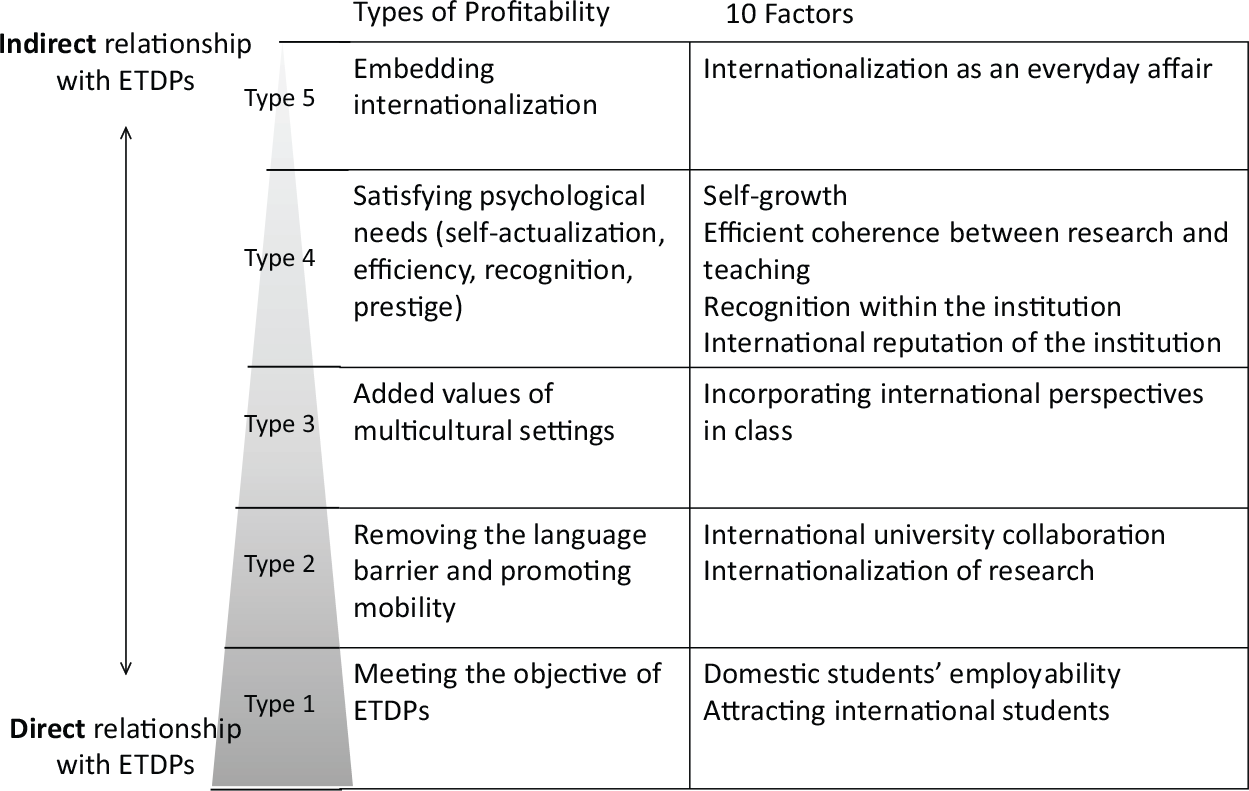
Profitability of ETDPs.
The first type of profitability includes two factors: attracting international students and domestic students’ employability. These two factors are closely connected because the presence of international students is important in internationalizing education for domestic students. These are direct profitability factors as they satisfy the objective of ETDPs itself.
The second type includes two factors: international university collaboration and internationalization of research. These two factors are related to removing a language barrier and to promoting mobility among students and the staff. To implement educational collaborations with overseas universities, it is necessary to remove a language barrier by adopting a common language. Usage of English as a common language can promote the international mobility of students and of the staff, and it can make it easier for the international academic staff to teach courses. It can, therefore, result in facilitating the employment of the international academic staff. The increased presence of international academic staff then facilitates the internationalization of research.
The third type of profitability is the added value of multicultural settings. Profitability comes not only from conducting courses in English but also from the addition of different cultural perspectives from international students, which can result in value-added courses with interesting and high educational effects.
The fourth type of profitability includes four factors: the university’s international reputation in terms of the profitability for the university as an organization, recognition within the institution, self-growth, and efficient coherence between research and teaching in terms of the profitability for individual academics. All these factors satisfy psychological needs, such as prestige, recognition, self-actualization, and efficiency, rather than material needs.
The fifth type of profitability is embedding internationalization. In university organizations where the members perceive internationalization as a thoroughly ordinary everyday affair, internationalization can be embedded in attitudes, standard university practices, and organizational cultures.
Discussion and Issues
This study has illustrated that an innovation theory-based framework can help us to understand how ETDPs in Dutch research universities have been institutionalized, by unraveling what constitutes compatibility and profitability. The institutionalization of ETDPs in Dutch research universities can generally be explained as being a consequence of an extremely high level of compatibility and a basic profitability, except in certain academic fields. The basic profitability comes largely from meeting the objective of ETDPs itself, attracting international students and increasing domestic students’ employability, and it is strongly supported by the sociocultural values and beliefs embedded in the university.
To clarify whether the outcomes of institutionalization can be characterized as diffusion, additional case studies need to be conducted, focusing on specific programs and organizations. For such analyses, the five comparison criteria of compatibility and the 10 profitability factors (divided into five types) that were presented in this study can be utilized as a framework of investigation.
This study also made clear the limit of the framework’s explanatory capacity. The framework can explain the influencing factors of institutionalization only at the particular point in time when the research was conducted. However, compatibility and profitability are continuously influenced by various changes in external and internal environments. During the interviews, many interviewees referred to their experiences of various changes, especially in the last decade, such as the internationalization of students and the staff composition, the improvement of the English-language proficiency of the younger generation, the increasing importance of English in academia, the increase in bilingual secondary education, and the ethnic diversification of the population and people’s daily exposure to English in Dutch society. Also in terms of internal changes, it is not uncommon in universities for a change in leadership to lead to a significant change in the policy direction. It seems that all of these changes influence the level of compatibility and profitability to various extents, but the influence of such changes cannot be explained only by the concepts of compatibility and profitability. Whatever the elements of compatibility and profitability are, how academics perceive them can change over time. To enable more in-depth analyses of the institutionalization of ETDPs, the time axis needs to be incorporated into investigations. How it should be incorporated remains an issue to be resolved in future research.
The two concepts also showed some overlap, which created some complexities in dealing with them. Namely, there were cases where the same elements could be interpreted as both compatibility and profitability. For example, nurturing the next generation of academics is the goal of human resource development (compatibility); however, at the same time, it is a basic need ETDPs can satisfy (profitability). Compatibility and profitability are intertwined, and the overlap makes it complex to categorize the indicative elements into one or other of the two. However, it should be understood that each concept of compatibility and profitability is independent and has an influence in its own right and that the level of profitability depends on the level of compatibility.
The findings of this study also have practical implications for those who are involved in planning and implementing ETDPs, especially institutional leaders, international education administrators, and policy officers. Analyses utilizing the framework could help us to identify the strategic areas of ETDPs concerned: namely, how and what institutional efforts should (or should not) be made in relation to a certain ETDP to achieve diffusion. These analyses can thereby provide valuable knowledge for strategic considerations regarding successful internationalization through ETDPs.
However, like all studies, this study has some notable limitations. Most importantly, the validity of the framework should be tested through additional case studies in other non-English-speaking countries as well. Because the factors relating to the English language largely depend on the social, cultural, institutional, and academic contexts in which ETDPs operate, additional case studies in other non-English-speaking countries may reveal new factors, based on which the framework would need to be modified. It would be worthwhile to elaborate on the framework by accumulating empirical analyses and adding necessary modifications, utilizing the findings of this study as a guide to such analyses. Potentially, this framework could become a useful analytical tool for understanding the institutionalization of ETDPs better in various non-English-speaking contexts.
In addition, because of the small size of the sample, differences in profitability only due to academic disciplines were confirmed, but no other significant differences were confirmed: for example, due to age or overseas experiences. Future research should heed possible differences in profitability depending on such personal experiences. Despite its preliminary character, however, this study will contribute to a better understanding of the institutionalization of ETDPs, about which little is known.
Finally, there are some recommendations for future investigation. The first recommendation concerns the unit of analysis. Even within one university organization, compatibility and profitability differ throughout the organization. Therefore (although this will also depend on the size of the university), rather than taking the whole university as the host organization, it would seem to be better to take faculties as the unit of analysis. In addition, due attention must be given to the obvious gap between the faculty level and the departmental level in deciding which part of the organization should be the object of examination. A high level of profitability in the lower level of the organization is important to optimize the innovation effects, due to the fundamental characteristic of universities—Individual academics’ beliefs or interests are the key to successful outcomes. Furthermore, it is also necessary to be aware of the possibility of a major gap in compatibility and profitability due to differences in the division of academic disciplines even within the same department.
Conclusion
This study has demonstrated that innovation theory is valid as a framework for understanding the institutionalization of ETDPs and has identified factors that determine the successful outcomes of providing ETDPs at the institutionalization stage. The findings provide new evidence of the validity of innovation theory for analyzing the internationalization of universities through ETDPs.
The following five criteria were developed to measure the degree of compatibility of ETDPs within institutions:
sociocultural values and beliefs,
conformity to the organizational goal and policy,
conformity to the goal of human resource development,
conformity to the disciplinary characteristics, and
the introduction process and past experiences.
The following five types of profitability were then identified:
meeting the objective of ETDPs,
removing the language barrier and promoting mobility,
the added value of multicultural settings,
satisfying psychological needs, and
embedding internationalization.
However, it should be mentioned that the validity of the framework should be tested through case studies not only in the Netherlands but also in other non-English-speaking countries. It is likely that analyses utilizing this framework can contribute to effective strategic planning and policy making for internationalization at national and institutional levels. Moreover, it could also potentially be applied to various non-English-speaking contexts.
Footnotes
Declaration of Conflicting Interests
The author(s) declared no potential conflicts of interest with respect to the research, authorship, and/or publication of this article.
Funding
The author(s) received no financial support for the research, authorship, and/or publication of this article.