




Abstract
This research, based in South Korea, compares the experiences of international students from within and outside the Asian region and then examines Chinese international students’ perceptions of discrimination. Utilizing the concept of neo-nationalism, survey findings revealed that Asian students reported greater difficulties and unfair treatment compared with students coming from Europe, North America, and other regions. The interviews further revealed anti-Chinese sentiments resulting in verbal aggression, challenges securing housing, discriminatory employment practices, and more.
Keywords
More than ever before, universities around the world are recognizing the benefits that international students offer. For some countries, as in the United States, Australia, and parts of Europe, international students tend to contribute economically with full-paying tuition and fees. In other parts of the world, as in South Korea and China, international students might be partially to fully funded by the host country or university as markers of international or Western prestige. Although there are numerous exceptions and different rationales across different universities, international students have generally been sought after with a close eye on enrollments.
In the scramble to internationalize, international students are in danger of being narrowly viewed as university commodities for financial and reputational gains (Lee, 2013). What higher education institutions tend to pay less attention to are the experiences of international students once they arrive. Although international students often report a positive educational experience, especially compared with available options in their home countries (Lee, 2010), their social experiences are less understood. Meanwhile, there have been numerous accounts of discrimination against students from developing countries studying in the United States, Australia, and the United Kingdom, in forms ranging from subtle stereotyping to physical violence (Beoku-Betts, 2004; Lee & Opio, 2011; Lee & Rice, 2007; Marginson, Nyland, Erlenawati, & Forbes-Mewett, 2010). The general explanation has been framed as a form of racism from the dominant White majority against ethnic minorities (Lee & Rice, 2007). However, as nations in non-Western parts of the world are increasingly internationalizing as host destinations, what are the experiences of students studying abroad in such regions?
The research on international students in non-English speaking countries is sparse compared with studies conducted in Western, English-speaking, countries. Nevertheless, countries beyond North America and Europe are playing an increasing role as host destinations. Despite limited course offerings in the English language, several non-English speaking countries have experienced an increase in the proportion of the world’s international students, including Russia, Spain, and South Korea (Organization of Economic Co-Operation and Development [OECD], 2014). Although the numbers of overseas students in the United States and globally have been increasing, the United States has also experienced a significant decline in its global share since 2000 (7%; OECD, 2014). There is also evidence that regional mobility occurs at a higher rate than global mobility, with 21% of international students in all OECD countries studying in an immediate border country (OECD, 2014).
Considering these preceding trends, this study examined the case of South Korea (Korea hereafter), and in particular, the intercultural experiences of international students in this country. Given the past research on the challenges and discrimination faced by international students in the United States (Lee & Opio, 2011; Lee & Rice, 2007), we were especially interested in what they might encounter in a country where Whites are not the majority and English is not the official language. Thus, this study investigated international student experiences in Korea, with an eye on its largest international student population, Chinese students.
International Student Social Experiences
For the most part, international students have consistently reported being satisfied with their educational experiences abroad. Lee (2010), for example, found that 83% of surveyed international students would recommend the institution to friends and family back home, but the same study also found mistreatment against students from non-Western countries. Negative experiences included perceptions of biased treatment from faculty, feelings of unacceptance from peers, and disrespectful conduct because of one’s ethnicity, all of which were found to be significant influences on an international student’s attitude about the host institution.
Among the limited studies that have compared domestic and international students, Mullins, Quintrell, and Hancock (1995) found that “international students were more likely than local students to experience problems and to a greater degree” (p. 210) across three universities in Australia. The study’s pre-selected problems that were compared between the two groups included finding part-time work, fear of failure, workload, and nervousness/tension, to name some on their survey instrument. Since then, Marginson et al. (2010) interviewed more than 200 international students in the same country and identified similar cases of concern but also identified issues that may be especially pronounced among non-Australians, particularly personal safety, lack of finances, sub-standard housing, loneliness, and racism. With regard to the latter, they identified numerous cases of physical assault against South Asians in particular, known as “Curry bashing,” combined with a lack of governmental response (Marginson, 2010).
There have also been limited studies on students’ international experiences in non-Western countries. According to Roberts, Chou, and Ching (2009), students reported high rates of satisfaction in choosing to study at a Taiwanese institution, particularly in the university’s highly regarded Mandarin language program, which was among the primary draws for most of its students. Yet as reported in Western countries, the international students, across 22 different countries, reported difficulties in adjusting to the climate, food, culture, and feelings of loneliness and homesickness while in Taiwan. From the perspective of host students in Korea, Jon and Jang (2012) identified a range of attitudes—friendly, indifferent, and discriminatory, based on international students’ country origins, with a preference for those from the West (i.e., North America and Europe). The study further revealed that despite sharing the same region, Korean students espoused discriminatory views against those from less economically developed nearby countries.
Past research has similarly provided a more critical perspective on how host countries may inadvertently target international students. Beoku-Betts (2004) reported discrimination in the United Kingdom, particularly White male professors targeting African female students and instances of being required to take remedial courses without clear justification. Lee and Rice (2007) have since provided a neo-racism framework to explain how the burden is often wrongly placed on international students to overcome their challenges rather than critically examining how host countries make it especially difficult for them to succeed. This is the new racism, or neo-racism, in a globalizing world. Utilizing the same framework of neo-racism, Lee and Opio (2011) further criticized U.S. institutions for systematically recruiting African student athletes for their athletic prowess and institutional prestige under the guise of an international education. Examples of neo-racism included underestimations about the African student athletes’ desires to learn and other negative assumptions that undermined their academic success.
Student Mobility to Korea
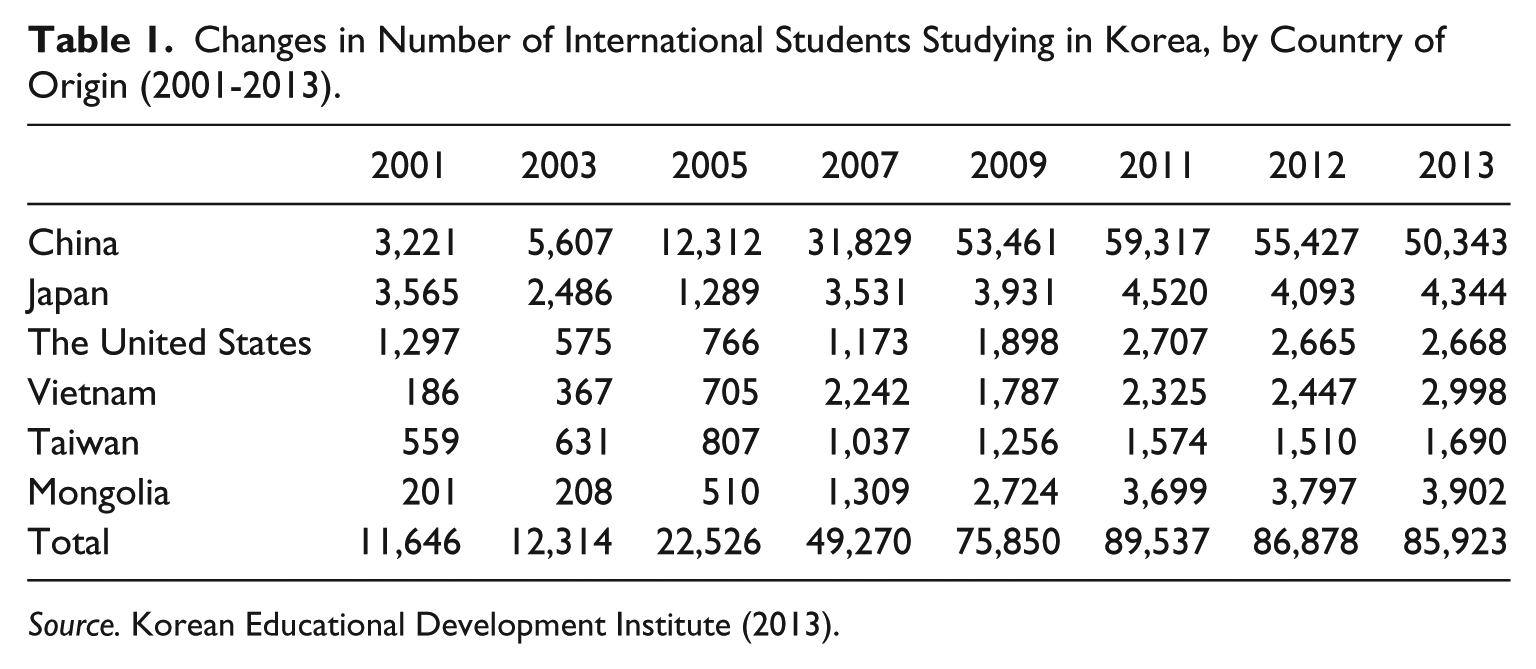
With its rising economic development as an economic powerhouse of the East, Korea has quickly emerged as a major higher education destination within the East Asian region (Jon, Lee, & Byun, 2014). Among all OECD countries, Korea had the highest reported change index in international student enrollment (OECD, 2011). The country experienced a 15-fold increase in international student enrollment at Korean universities over the past 10 years (the United Nations Educational, Scientific and Cultural Organisation [UNESCO], 2011) with the highest proportion of international students originating within the East Asian region (see Table 1). Among all OECD countries, Korea ranks third in the highest percentage of international students coming from neighboring countries (75%), after Japan (81%) and Greece (76%; OECD, 2014).
Changes in Number of International Students Studying in Korea, by Country of Origin (2001-2013).
Based on our findings from an earlier phase of this research, we found different rationales for studying in Korea and the host institution based on geographic origins (Jon, Lee, & Byun, 2014). Students from Asia were driven by educational, economic, and other utilitarian reasons compared with students from North America and Europe. North American and European students, who tended to enroll in short-term study programs, prioritized cultural interests and personal connections over the particular institution. Asian students, however, who usually enrolled in long-term degree programs, weighed the financial and practical aspects of studying in Korea more heavily. Their rationales for choosing the country included job opportunities after graduation, easier visa process, geographical proximity, and safety. Their priorities in choosing the institution were largely based on affordability and the quality of education. Given such differentiation in the rationales of those who seek study in the country, it is likely that there may be corresponding differentiation in the experiences upon arrival. Thus, Korea’s role as a regional hub is worth further investigation.
A key player in spurring Korea’s higher education international exchange is China. The number of Chinese students studying abroad in Korea, and vice versa, notably increased since 2000, a period of economic growth for both countries, particularly after the 1997 Asian financial crisis. This high rate of international exchange corresponds with the high exchange of human, material, and cultural factors following the economic interdependence between the two countries (Byun & Um, 2014). In the case of China, its rapid economic growth in recent years has given rise to a larger wealthier class and thus increased social demand for higher education, which could not be fully met by China’s domestic capacity. Korea, however, which had been suffering from student recruitment and income shortage problems caused by a declining domestic population of college-aged students, was well suited to meet China’s educational needs based on its geographic proximity and reputable universities. Korea has six top-20 entries in the QS (2015) Asian University Rankings and 24 ranked institutions overall in the QS World University Rankings (QS, 2015) as well as eight universities ranked in the top 500 of Times Higher Education (THE; 2015) World rankings. Korea also has global brand recognition with companies such as Samsung, LG, Kia, and Hyundai. In addition to these factors, the Korean government’s efforts (during the aftermath of the 1990s financial crisis) to minimize the country’s educational deficit by changing its policy focus on international students from “outbound” to “inbound” mobility, and thus actively recruit overseas students, also played a significant role in drawing Chinese students to Korea. 1
As also shown in Table 1, Chinese college student enrollment in Korea increased more than 18-fold from 3,221 in 2001 to 59,317 students in 2011; the Korean student enrollment in Chinese higher education institutions has also increased almost fourfold from 16,372 students in 2001 to 63,488 students in 2013 (Korean Educational Development Institute, 2013). During 2011, when the number of international students in Korea was at its peak, 59,317 students, or 66.2%, of the total 89,357 foreign students studying at universities in Korea were from China.
Table 1 further reveals, however, that the number of international students in Korea has been on the decline since 2011, and that this decline is mainly due to a decrease in the number of Chinese students. According to the Korean Ministry of Education, the number of international students studying at Korean universities decreased by 3,614 in about 2 years, from 89,537 students in 2011 to 85,923 students in 2013. This drop corresponds with a decrease in number of Chinese foreign exchange students of 9,000 people, from 59,317 in 2011 to but 50,343 in 2013, further showing that the proportion of Chinese students out of total international students fell by 7.6%, from 66.2% in 2011 to 58.6% in 2013. The ostensible reasons for this trend may be attributed to policy changes that occurred during this period: The Korean government actively sought to ensure the quality of international students coming to study in Korea by introducing the International Educational Quality Assurance System (IEQAS) in 2011 and also required international students to pass at least Level 3 of the Test of Proficiency in Korean to qualify for application to Korean universities. Although the exact reasons remain under-investigated, when considering the fact that the demand to study abroad is steadily rising in China, 2 it is not unreasonable to conjecture that Korea may be losing its appeal as a study destination for Chinese students.
Korean Attitudes Against Chinese
Korean society has been homogeneous throughout its history considering the international standard, and until recently, opportunities to interact with those from abroad were virtually nonexistent or at least very rare. Consequently, Koreans have historically been unfamiliar with how to peacefully co-exist with people of other cultures (Kwak, 2007; Yoon, 2008 cited in D. S. Kim, Kim, & Jung, 2011). As a result, modern-day stereotypes or prejudices Koreans espouse toward certain ethnic groups tend to be rooted mostly in indirect experiences through various mediums such as television and the Internet (H. Kim, 2009). Put another way, Korean stereotypes or prejudices regarding outsiders are not necessarily based on individual biases, but rather, as the literature suggests, reflect society-wide perceptions and beliefs molded over time.
Overall, Korean perceptions toward Chinese people have shown to be contemptuous. Depictions of Chinese people as dirty, noisy, slow, not to mention wily can easily be found on the Internet. Previous research on Koreans’, including Korean college students’, perceptions of foreigners has revealed a very pervasively negative view of the Chinese (Jon & Jang, 2012; D. S. Kim et al., 2011; Min, 2012; Nam, 2010). This tendency can be attributed to both subjective and objective factors: The subjective factors include the relative feeling of superiority Koreans have toward Chinese concerning socioeconomic development and civic consciousness, as well as the sense of inferiority Koreans may feel due to their history of having been a tributary of China, and a subject of Sinocentrism. Media attention on the wrongdoings of certain Chinese people, such as environmental pollution or counterfeiting of products, and their undemocratic social system, including human rights abuse and lack of freedom of press, further exacerbate negative perceptions Koreans may hold toward the Chinese (Korea Times, 2009; Min, 2012; Power, 2015).
According to D. S. Kim et al. (2011), Korean university students generally harbored more negative than positive perceptions and stereotypes concerning the Chinese, as opposed to the dominantly positive perceptions they held toward Americans or the Japanese. The Korean students reported that although they were wary of some degrading attitudes on the part of Americans or Japanese, they felt mostly amity toward the two groups. When it came to the Chinese, however, students reported greater feelings of disdain. This negative tendency also applied to Korean students’ views about Southeast Asians. Efforts to better understand what drives these perceptions and address such tensions are needed. Any negative stereotypes that Korean university students may hold toward specific ethnic groups could lead them to become inflictors of on-campus discrimination and prejudice against students of those ethnicities.
Neo-Racism and Neo-Nationalism
Neo-Racism
Past research on discrimination against internationals has framed forms of neo-racism (Cantwell & Lee, 2010; Jon & Jang, 2012; Lee & Opio, 2011; Lee & Rice, 2007). Neo-racism refers to a “new racism” based on negative perceptions about an individual’s region of origin, in addition to his or her race. Beliefs about a hierarchy of cultures become a basis for discrimination against those from perceived inferior parts of the world, thereby fueling exclusion and mistreatment in a global society (Balibar, 1991; Barker, 1981; Hervik, 2004; Spears, 1999). Most of the neo-racism higher education research has been based in the United States and the United Kingdom and highlighted how ethnic minorities from low-income countries can be negatively viewed and mistreated by the dominant majority group (i.e., Whites; Cantwell & Lee, 2010; Lee & Opio, 2011; Lee & Rice, 2007). Neo-racism helps to explain this phenomenon against international students as determined by one’s phenotype and a perceived cultural order. However, the concept may not adequately explain hostility toward groups within the same race and with cultural similarities, as in the case of Asian 3 internationals studying within the same region.
Neo-Nationalism
Whereas nationalism refers to identification with one’s nation, we propose that neo-nationalism, like neo-racism, extends this traditional concept to the new global economy. With increasing internationalization, national identity is being reintroduced and reconceptualized as a form of global competition. Based on his anthropological analysis of Europe, Gingrich (2006) explained, “all major forms of nationalism are intrinsically linked to capitalist market economy and related forms of statehood” (p. 194) and neo-nationalism is “nationalism in a globalised period of aggressive postcolonial and post-Cold War readjustment” (p. 200). Likewise, Paquin (2002) described globalization as “changing the nature of nationalism” (p. 58), in which free trade and economic interests become difficult to separate from national interests. In her case example of Scotland, she explained this new nationalism has little deference for traditional culture, such as language. Yet, Gingrich’s (2006) and Paquin’s (2002) description of neo-nationalism in the European Union does not aptly translate to a region with a less formal political and economic partnership as in the case of East Asia.
Unlike the political and economic union of the European Union, countries within East Asia have attempted to collaborate as a regional bloc but have also been in much competition with one another as trading partners with the West. In a new global society based on capitalist values, countries then vie for economic and political power. In this sense, China and Korea are interdependent global rivalries, although China’s economic powers far surpass Korea’s. This new nationalism includes maintaining a sense of national distinctiveness and power, but societal boundaries are reinforced by negative attitudes against those who are “below” a perceived global hierarchy.
Method
Extending the concept of neo-racism to observe possible forms of neo-nationalism, this mixed method investigated international students’ perceptions of discrimination in Korea, with further focus on those from China. Both quantitative and qualitative data were collected concurrently in a large private research university in Seoul, Korea. The population of international students at this university has increased noticeably with its efforts to internationalize the campus. The number of international-exchange students reached 895 from 154 in 2004, and that of degree-seeking international students expanded from 411 to 956 between 2007 and 2010. About half of international students seeking degrees came from China. The proportion of Chinese students is somewhat lower than that at the national level, 67% in 2011. Considering the highly regarded reputation of this university in Korea, this university has also attracted international students from different regions in the world (Jon, Lee, & Byun, 2014).
The research instruments were utilized for a larger study on the role of Korean higher education in the region (Jon, Lee, & Byun, 2014). Quantitative data were collected using an online survey provided in English and Chinese. The international affairs office at the university contacted and invited enrolled international students by email. Among a total of 332 responses used in the analyses, those from Asia constituted 67% (228), with the majority of Asian respondents from China (156), followed Malaysia (18) and Vietnam (13). The remaining 12 Asian countries had 10 or fewer students. Participants from North America were 12% (40), mostly U.S. students (33) and the rest from Canada (seven). Europe comprised 16% (54), with 10 or less across 17 European countries. Finally, those from the rest of the world were 3% (10) of the total sample, with only one to two students across nine countries.
For the qualitative data collection, 20 Chinese students enrolled in undergraduate degree programs were interviewed. We purposely sampled Chinese students for their prominent presence in Korean higher education and the site university. Moreover, degree-seeking students’ experiences can be qualitatively different from exchange students who tend to stay in Korea for a short-term period. A Chinese Korean graduate student, who was fluent in Korean and Chinese, conducted interviews with Chinese students. The interviews were conducted in Chinese to facilitate as much open and candid sharing of the participants’ experiences and thoughts without a language barrier. Using snowball sampling, eight male and 12 female students participated in interviews. The distribution of academic majors was 11 in social sciences, five in science and engineering, and four in humanities. Eight of the Chinese students were juniors, followed by five sophomores, four freshmen, and three seniors. The semi-structured interview was based on a broad range of questions adapted from related research on international student experiences and included reasons for their decision to study abroad in the host country and their academic experience as well as social experiences (Jon, Lee, & Byun, 2014).
To observe any distinguishable patterns of neo-racism, the quantitative analyses compared international students’ perceptions and experiences with regard to any possible discrimination across different regions. Questions related to feeling welcome, acceptance, and treatment by locals in Korea were analyzed using descriptive statistics, ANOVAs, and post hoc tests. To understand the possible extent of neo-nationalism, the researchers analyzed the translated interview transcripts. Interview data were coded inductively using open coding, creating a code list based on anticipated findings and then modified after further analyses.
Quantitative Findings
The survey analyses revealed that international students generally felt welcome, but significant differences emerged by their regions of origin, F(3, 324) = 10.09, p < .001 (see Table 2). Students from Asia felt the least welcome compared with the other regional groups.
Difficulty in Feeling Welcome in Korea by Region of Origin.
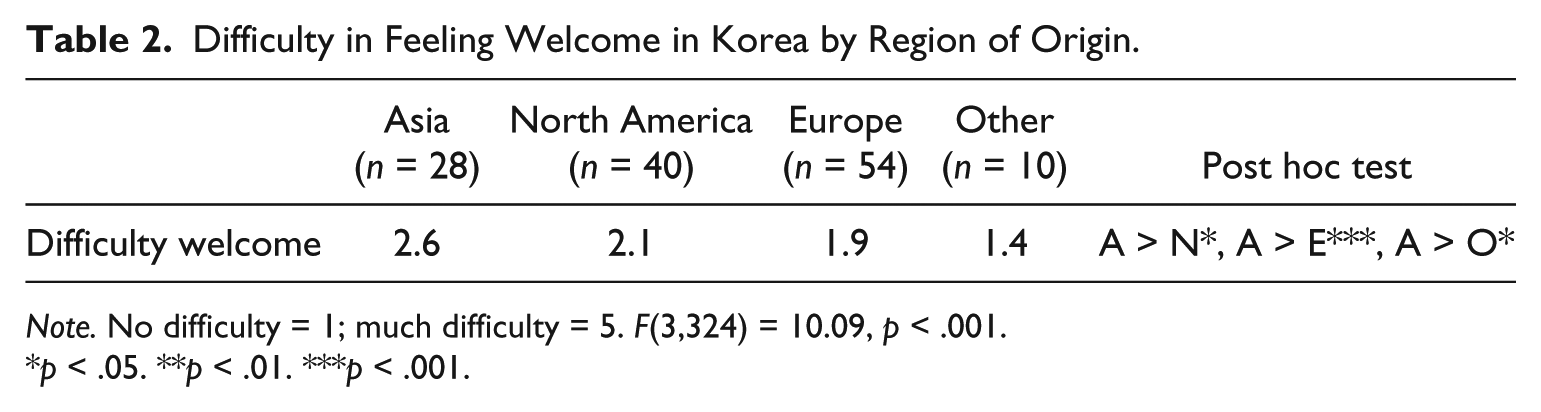
Note. No difficulty = 1; much difficulty = 5. F(3,324) = 10.09, p < .001.
p < .05. **p < .01. ***p < .001.
In addition to feeling unwelcome, survey findings revealed that Asian students felt less accepted and comfortable in Korea than North Americans, Europeans, and those from other regions (see Table 3). They also believed they were treated the least fairly compared with Koreans (see Table 4). Asian students consistently reported significantly lower rates of fair treatment compared with Korean students by classmates and outside the university.
Feel Accepted and Comfortable in Korea by Region of Origin.

Note. Yes = 1, no = 0.
p < .05. **p < .01. ***p < .001.
Treated Fairly Compared With Korean Students by Region of Origin.
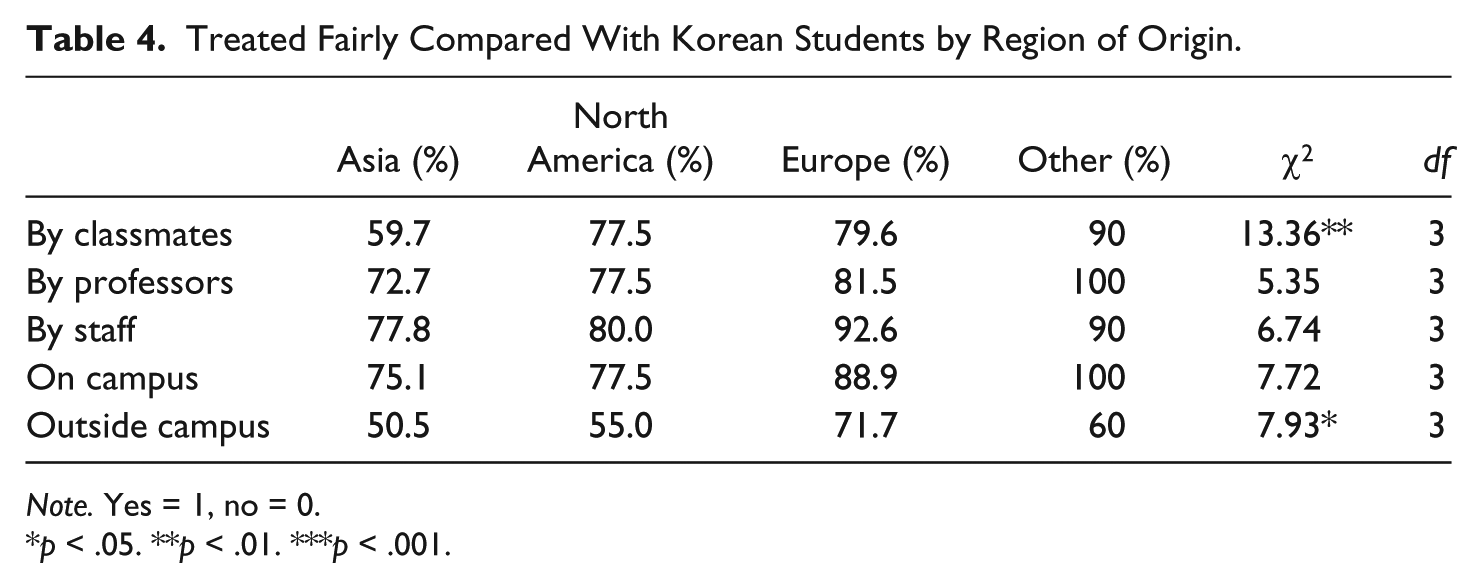
Note. Yes = 1, no = 0.
p < .05. **p < .01. ***p < .001.
The findings also revealed that Asians believed they were not only treated less fairly than local Koreans but also less fairly than other international students. They felt they were treated worse than other international students by classmates, professors, staff, on campus, and off campus (see Table 5).
Treated Fairly Compared With Other International Students by Region of Origin.

Note. Yes = 1, no = 0.
p <.05. **p < .01. ***p < .001.
Given these results, we conducted further analyses to differentiate Asian students. We found no significant differences by country of origin within the Asian sample. However, in comparing Chinese students with all other Asians and regions, the differences were significant, with Chinese students reporting greater difficulties and unequal treatment across all the same measures (see Tables 6 -9).
Difficulty in Feeling Welcome During Stay in Korea by China and Region of Origin.

Note. No difficulty = 1; much difficulty = 5. F(4,323) = 7.96, p < .001.
p < .05. **p < .01. ***p < .001.
Feel Accepted and Comfortable in Korea by China and Region of Origin.
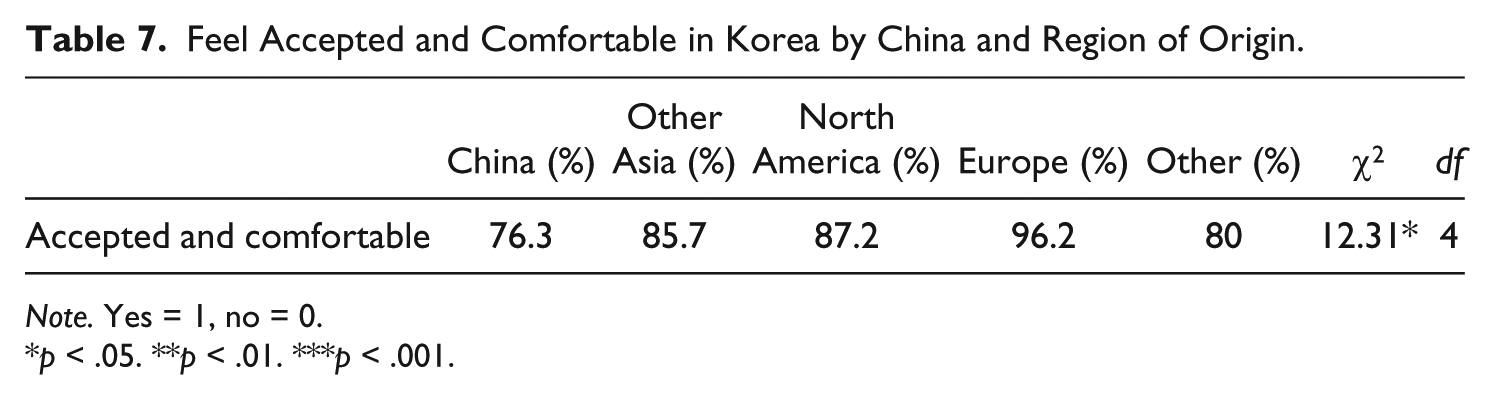
Note. Yes = 1, no = 0.
p < .05. **p < .01. ***p < .001.
Treated Fairly Compared With Korean Students by China and Region of Origin.

Note. Yes = 1, no = 0.
p < .05. **p < .01. ***p < .001.
Treated Fairly Compared With Other International Students by China and Region of Origin.
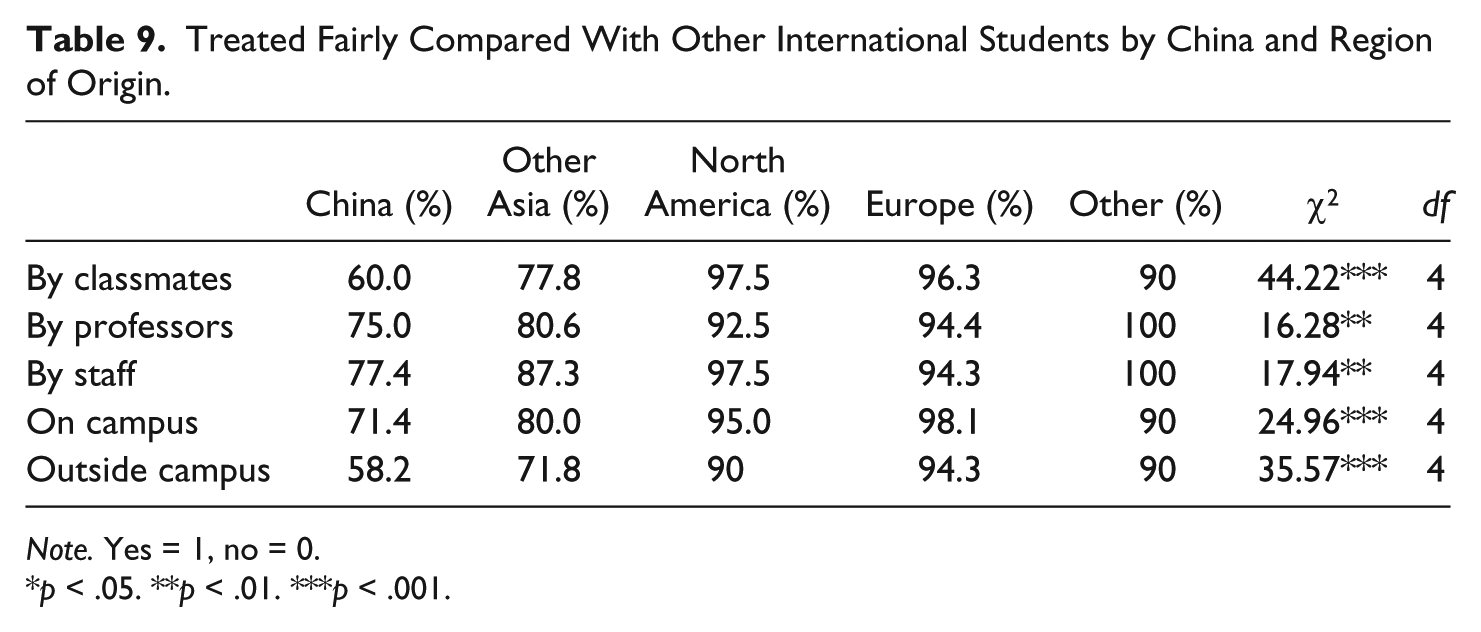
Note. Yes = 1, no = 0.
p < .05. **p < .01. ***p < .001.
Qualitative Findings
In-depth interviews with Chinese students in Korea provided a deeper understanding of the experiences of international students from within the same Asian region. The major themes included feeling unwelcome, differential treatment, and overt mistreatment. Despite such negative encounters, the interviews revealed that many international students managed to maintain a high self-regard and sometimes a positive view of the local host community.
Lack of Welcome
The interviewed Chinese students revealed a range of opinions about how they are treated by locals and, consistent with the survey findings, the majority of the interviewees felt unwelcomed. The few affirmative responses were conditional in that despite feeling welcome, discrimination against Chinese people as a whole was acknowledged: “In my case, I’m welcomed by native students. Although I could see elders don’t like China . . . Chinese students are welcomed in general” (11). Another student shared getting along with Korean students despite being Chinese:
It’s relatively okay. As I just said before, Koreans tend to look down on Chinese a little. But when it comes to my Korean friends, they never realize I’m Chinese when I hang out with them. We enjoy chatting, not bringing controversial issues such as politics. There never have been any conflicts among us. It’s great. (20)
As indicated by this student, his or her “great” relationship with his or her Korean friends was at least partly attributable to suppressing his or her Chinese identity.
Besides these few exceptions, most Chinese students shared that they were not welcomed, as simply spoken by one student, “I think most Koreans don’t like Chinese” (4). Another elaborated,
Though I have a few experiences, I should say that I’ve been rarely welcomed. I also can say that I’ve been discriminated if I have to list the cases. Generally, there’s little personal connection between us and Koreans so no conflict was made. Anyway, the discrimination exists. (1)
According to the latter, there were no direct confrontations due to a lack of interactions to begin with. Recognizing the possibly negative perceptions about the Chinese, some Chinese students withdrew from social interactions with peers outside their own ethnicity. One student shared her or his inhibitions: “I have few foreign friends . . . Korean friends are very friendly but I can’t approach them proactively.” When asked why, s/he responded, “I’m afraid they hate or ignore me” (1).
Differential Treatment
As demonstrated in the survey findings, not all international students felt marginalized. The interviews further elaborated on patterns of differential treatment based on nationality despite originating from the same region. Chinese students explained in their interviews that they observed Korean students favoring international students from Western countries. In many interviews, they also compared themselves with students from Japan, with those from more recent colonizer preferred. A student stated, “Chinese are not welcomed by everyone on the campus. It depends since there are lots of Chinese. Some like us but some don’t. I think Koreans like Americans or Japanese more than us.” Others explained,
Korean students tend to socialize well with students from Western countries and also not bad with Japanese students. But they don’t do so with particularly Chinese students. Sometimes they do well to us but sometimes they don’t. I feel distant from them. (17) Koreans treat Chinese differently compared to the way they treat Japanese. They treat us amazingly, when we say that we are from foreign country. However, when I reveal that I’m Chinese, I can feel that they look down on me. I know that there are many people who have same complaint. Chinese students sometimes tell me how Koreans looked down on them. But in my case, all Koreans who I met were kind to me. (16)
Having been colonized by Japan two generations ago and ongoing political disputes to date, Koreans might espouse a more negative view of Japanese students. Such historically based relations do not appear to play out in current times at the university setting, according to the Chinese students who were interviewed. Rather, Chinese students, based on their reported accounts, believed they were treated worse than the Japanese. Several Chinese students reasoned that Koreans’ negative attitudes were partly a result of the shared history between Korea and China, for example, Korea having been invaded by China numerous times throughout history, but not completely explainable given Korea’s poorer past relations with Japan. The students explained as follows:
I think the major reason is probably history. They seem to think that there were historically unpleasant incidents between Korea and China. But such a historical issue is worse with Japan. It may not be simply the matter of history. I suppose that the second important point is national economy. And education and other things. (6)
Negative Stereotypes
Such reported lack of welcome against Chinese students in particular appeared linked to negative stereotypes. According to an interviewee, “Actually Chinese are not like what Koreans think. I think they regard Chinese as left behind, dirty, and loud, thanks to deeply rooted prejudice” (16). Many Chinese students shared these views within the context of their interactions with the local community. A commonly reported stereotype was the lack of resources and quality items in China, unlike in Japan. Such examples included the following:
One Korean has asked me if there’s watermelon in China. I guess it’s because they cannot understand or don’t know China well. (19) I heard it happened off the campus like asking about China or saying that there’s no coffee in China. A Korean once said that the product made in China must be cheaper than the one made in Korea. One day, I went to a copy shop to print out but paper was too thick. I asked the clerk for thinner paper. Then, she said such thing is only in China not in Korea. That kind of discrimination truly gets me mad but nothing else. (15)
One reason that Chinese students might have felt especially unwelcome was that some reported understanding the Korean language and what was said about them. In our preliminary analyses for this study, we found a slight negative correlation between Korean language ability and feeling treated fairly compared with other international students outside the university (r = −.15, p < .05). In the interviews, the following student described a negative encounter that she or he was able to understand more fully because she or he understood the Korean language:
I also have experienced on the campus. When I was walking on the street with my Chinese friend, three people were drinking alcohol outside and we went by them. Suddenly, they swore at us when they heard us speaking Chinese. They thought we wouldn’t be able to understand what they said, but we did. I knew they were drunk but it made me get mad seeing them insulting my country, China. (6)
Overt Discrimination
Although most discriminatory experiences took place off campus, there were also negative reports in classrooms.
[A professor] spoke aggressive words to Chinese and mistreated them. I think that’s too much. If a general person behaved like that, I would think that it’s because he is not well educated. But the problem is, the professor is highly educated and I can’t understand it. Some professors are even extreme. (8)
Others described a few related accounts of professors making negative remarks about China or preferring local students.
Other concerning incidents related to obtaining jobs, lower wages or exploitation that are left unreported:
I’ve often been discriminated. Once, I was looking for a part-time job for vacation. I made my best effort to search jobs but I was rejected since I was foreigner. Actually, managers didn’t recognize [that I was Chinese] while we were speaking, but I told them honestly since I thought I should not be embarrassed of being Chinese. Then, soon they rejected. (5)
The same student described another experience in which she or he managed to find a job but the wages were cut from 5,000 won to 4,000 won per hour with added restrictions once she or he met the manager in person. The student shared, “This kind of discrimination is very serious and it directly hurt my self-esteem . . . It happens quite a lot.”
Another student provided another example of employment challenges that stemmed from discrimination:
I once heard from seniors that [Koreans] don’t give paychecks regularly. They pay late, less, and even don’t pay. The discrimination is like what I said just before. Otherwise, it’s the example of not holding the right. (3)
Like many interviewees, this student did not file any complaints. She or he explained, “It feels like having nowhere to talk. As long as we don’t have right, it’s no use talking about the problem.”
The most common challenges were related to accommodation. Several reported cases of being declined housing once the renter learned the student was from China. The following quote exemplified the repeated sentiment:
A while ago, I was looking for housing. I asked if there is any vacancy, and the person asked me which country I came from. I answered that I am a Chinese and the person answered back that there is no vacant house. (13)
There were also reports of price manipulation. According to a student, “I guess [the landlord] tricked the Chinese on purpose for being a foreigner. It seems really bad when such things happen. It’s inhuman to do such things to foreigners who are struggling in Korea by themselves” (18).
The reasons stemmed from negative stereotypes, resulting in the following:
It rarely happens, though, for example, when I moved into goshiwon [Korean share house], the dorm mother said she never accepted Chinese to live since they were dirty and noisy. But now 6 months later I got in there, she treats me well and really likes me. Later, more students moved to the share house and it was all Koreans who ran away leaving 3 months rents to be paid or threw away garbage anywhere messing up around. (16)
On occasion, tensions can escalate to verbal or physical attacks:
I once worked in a restaurant where my Chinese friend also worked and I felt that the manager looked down on me as he knew I was Chinese. He was my boss so he spoke rude to me . . . I had a feeling that there could be some fights between my friend and the manager. (10) I heard from an exchange student that s/he was talking to friends in a subway and suddenly a Korean guy came and hit this friend. He said that they were too noisy and swore and hit them. Isn’t it funny? (12)
Maintaining Agency
Although many reported negative encounters, several worked to change prevailing views. One Chinese student recounted an incident in which a professor made a stereotypical remark about products made in China and how she responded:
I could almost cry. I tried not to cry holding my hands tight. After class, I told the professor, “You people buy products made in China because they are cheap. You buy what you don’t need to buy [because they are cheap]. Your companies come to China and ask us to make products at 5 dollars because our products are cheap while it costs 10 dollars in other countries. How can you ask to improve the quality?” The professor may not have known that there is a Chinese in class. That’s how they talked about Chinese like such and such. There are too many such incidents. (6)
Despite many negatively reported incidents, many did not report feeling victimized but explained such lack of welcome and negative behaviors as reflective of the host country’s ignorance. As demonstrated by one student, “I think some people ignore China because they do not know it well. If they knew China well, they would have thought that it is really great” (2). Another indicated such incidents as reflective of the naivety of Koreans:
As I said, there are too many Chinese. With so many people, there are all sorts of people. Great people and not so great ones. China may not have been anything several years ago, but it has been rapidly developing. But Koreans are still trapped with old memories and seem to perceive it as poor, left behind, and unclean. (16)
Nonetheless, misunderstanding between the two countries can occur both ways. A Chinese student shared,
In fact, Koreans are very nice. But in China, people say how Koreans are [in a negative way]. But every country has both good and bad side. So if I look at the country by absolute standards, I think there are more good people. (18)
One student explained that there is rivalry between the two countries and that Korea is “jealous.” Another explained,
I guess Koreans lack experience in dealing with foreigners. Now, things must be changed gradually with the past World cup and G20 Seoul Summit. The best we can do is to retain a good image as much as possible. It’s hard to change Koreans. Koreans are globalized more than before though. (1)
Despite such feelings of unacceptance, such desire to befriend local students was often shared. For example, a student discussed,
I want to meet more Korean students in Korea University. It’s really sad to have no single Korean friend until I graduate. I want to meet altogether, greet and get to know them . . . Anyways I am living in Korea, and there are times when I need their help. Of course, they may need my help. So I want to make friends who I can be together in intimate relationships regardless of countries we are from. (17)
Discussion
In the push for universities to internationalize, this research reinforces the importance of considering the social experiences of international students and in particular, a critical examination of possible discrimination against particular groups in the host country. This study examined international student experiences in the understudied region of East Asia, with particular focus on the social dynamics among regional university students—domestic Korean students and international Chinese students.
The findings suggest evidence of neo-racism and neo-nationalism in Korea. The study found that Asian students reported greater difficulties and unfair treatment compared with students from other regions, suggesting neo-racism, with a preference for students from the West. The added theoretical contribution of this research is that neo-racism is not simply discrimination against ethnic minority individuals from developing, non-Western countries migrating to the West (Balibar, 1991; Cantwell & Lee, 2010; Lee & Rice, 2007). The interviews further uncovered neo-nationalism, in the form of anti-Chinese sentiments resulting in verbal aggressions, challenges securing housing, and more. As this study demonstrated, discrimination can occur with preference for those outside the region than within one’s own. The findings suggest that neo-racism may have more explanatory power to capture some of the challenges of those from developing countries studying in the West, such as in the United States (Lee & Opio, 2011; Lee & Rice, 2007), the United Kingdom (Cantwell & Lee, 2010), and Australia (Marginson et al., 2010), and less explanatory power for those studying in countries within the same geographic region and economic development.
As evidenced by the interviews of Chinese international students, neo-nationalism might better explain tensions between such groups divided by citizenship but share the similar cultural values and phenotype (i.e., Asian). According to the Chinese students in this study as well as past research (D. S. Kim et al., 2011), Korean students appeared to prefer international students from Japan over China, despite being colonized by Japan generations ago and its ongoing political tensions. Possible reasons for such neo-nationalism should be further explored but may be based on a range of factors that might include a combination of modern-day stereotypes that are likely formed prior to entering higher education (Hwang, 2011) and economic rivalries in the new global economy.
There are current efforts underway to add multicultural education in Korean schools. Multicultural goals include affirming democratic principles, accepting cultural differences, and abolishing discrimination among ethnic groups in the nation (Hwang, 2011). The limited past research on addressing diversity challenges provides some evidence that despite efforts to reduce negative stereotypes early on, they still need much improvement. Hwang (2011) indicated that the problems of multicultural education in Korean schools include (a) lack of overall vision and philosophy of multicultural education, (b) one-time (not sustainable) multicultural programs implemented by local government, (c) lack of multicultural programs tailored to specific cultural/foreign groups, (d) too much concentration on the programs on Korean language and culture, (e) lack of multicultural education on Korean people (students), (f) neglect in efforts to provide multicultural education for cultural groups other than the students from international marriage families, and (g) lack of educational support for parents’ language and culture for the students from multicultural families. Research on further reducing prejudice in the Korean higher education sector is very sparse but also suggests not enough is being done. Based on a case study investigating multicultural education at a large university in Seoul, Kang (2008) suggested that media (i.e., newspapers, TV, movies, and other Internet resources) played was most influential in forming opinions about diversity and that university attempts to address prejudice tended to occur in students’ liberal arts courses than in their major courses. Future research might examine the role of higher education in further multicultural programming (i.e., the intercultural training programs and intercultural understanding courses) for students and staff in preventing and dealing with any on-campus discrimination.
As regional hubs continue to emerge and strengthen, neo-nationalism should be of increasing attention in the years to come. The extent to which neo-nationalism is occurring in other regional hubs and its underlying causes should be further studied. Future research could also explore possible neo-racism and neo-nationalism by examining local students’ sentiments toward international students. For this study, the reported experiences of the Chinese students were not verified, although previous research has suggested negative stereotyping exists (Jon & Jang, 2012; Kim et al., 2011; Min, 2012; Nam, 2010). Regardless, international students’ perceptions, whether verified or not, may still negatively affect their experiences, including their transition and engagement. Such difficulties may not only be harmful to Korea’s international students, but may also negatively affect Korea’s ability to attract international students from its primary market, China, in the future.
Footnotes
Declaration of Conflicting Interests
The author(s) declared no potential conflicts of interest with respect to the research, authorship, and/or publication of this article.
Funding
The author(s) received no financial support for the research, authorship, and/or publication of this article.