



Abstract
This article analyzes the People’s Republic of China’s elite-making higher education policies that began in the early 1990s, notably with the 211 Project and then 985 Project, which led to the formation of the C9 League, a group of nine leading institution’s dubbed China’s “Ivy League.” This elite grouping is compared with other Chinese universities in terms of global rankings from 2003 to 2015 to ascertain the separation by these top tiered institutions. Furthermore, the C9 League will be compared with other global elite coalitions in the United States, Canada, Australia, and the United Kingdom over the same period. University rankings, despite considerable criticism, have provided the Chinese leadership with key benchmarks for their vision of world-class higher education. This article finds that the C9 League has made some separation from other Chinese universities and has also caught up with its Western peers (notably passing Canada’s U15) in terms of international rankings.
Keywords
Introduction
Beginning back in 2003 from Shanghai Jiao Tong University, the Academic Ranking of World Universities (ARWU) was the first prominent globally comprehensive ranking system or league table. Other organizations quickly established their own global university ranking systems and, despite their relativity recent creation, they have had a considerable impact onto policy ever since, as universities are now compared on the same metric globally. The ARWU was specifically created for Chinese policy makers and educational administrations to measure China’s own institutions against those in the West, which have dominated this sector globally (Liu & Cheng, 2005; Rust & Kim, 2015). Research output and knowledge production provide the foundation for the ARWU ranking scheme (Hazelkorn, 2015; Marginson, 2014). Although there is considerable criticism of these rankings and their effectiveness at quantifying university comparison, research shows that students, administrators, and policy makers at various levels use these rankings for decision making (Altbach, 2006; Bowman & Bastedo, 2009; Hazelkorn, 2015).
In 1999, the People’s Republic of China (PRC) injected a major investment into its higher education subsector known as the 985 Project. The funding was targeted at a handful of key elite institutions and the project’s goal was to cultivate world-class universities. The government’s investment totaled around 27 billion RMB and went to just 34 universities, 1 while only nine institutions received about 42% of all funding from this central government investment (Yue & Zhu, 2009). These nine universities have since forged the “China 9 University League” (C9 League), which has been dubbed the “Ivy League” of China (Chinese Ministry of Education, 2014; Fang et al., 2013). The rationale for the limited scope of funding was that top key universities would drive the entire higher education system for the country. With a disproportional share of central government funding, the C9 League is expected to drive higher educational progress and institutional research output—a key indicator for university rankings (Marginson, 2014).
With the founding of the ARWU, educators and policy makers in China now have an explicit metric in which their institutions can be compared with their counterparts in the West, especially important to the elite universities in the country. China’s route of elite making in higher education, whereby the top-level universities receive substantial financial support, is a strategy to “catch up” with their Western counterparts, while ARWU’s scores provide a technocratic benchmark (Ngok & Guo, 2008). However, the limited scope of the rankings allows for considerable criticisms against the immense focus that has been placed upon these narrow and often seen as flawed metrics. Furthermore, scholars have questioned whether Chinese institutions can truly be comparable to the global elites, despite heavy investments (Altbach, 2016). In late 2015, in an effort to ease the disparities, the Chinese government announced a new program called World Class 2.0 that is supposed to be more egalitarian than the 211 and 985 Projects. Yet, this plan has yet to be unveiled by the government and is still expected to concentrate considerable investment at the top of the system (Sharma, 2016).
For this analysis, I gauge the university rankings of the C9 institutions against the other Chinese 985 Project universities to determine whether these elite-grouped institutions have separated from the other domestic universities, creating a tiered system in China. I then compare the international university rankings of the C9 universities with peer groupings around the world: the United Kingdom’s Russell Group, Australia’s Group of Eight, Canada’s U15, and the Ivy League in the United States. While these sets of universities do not all have the exact same characteristics, they all represent the top research institutions in their countries and all, except the Ivy League, were created in the past 20 years with the explicit goal of raising the respective countries’ public research university capacity. The inclusion of the Ivy League is important, though, because the concept of a Chinese “Ivy League” is used throughout the discourse, including by China’s Ministry of Education (2014; see also Fang et al., 2013; Metzgar, 2015; Oleksiyenko, 2014).
There is little analysis on the C9 League as a singular unit (Yang & Xie, 2015). Thus, this study aims to determine if there is indeed a separation between this elite coalition and other top institutions in China, which can help to understand the driver effect for these institutions on the entire system. Even as these current investment projects are being retooled by the Chinese government, there is still considerable merit in understanding the policy’s accomplishments. Furthermore, as the policy was directed at catching up to the West, the Chinese elite coalition will also be compared with its peers in the United States, Canada, Australia, and the United Kingdom. This study will provide descriptive statistics for these various comparisons to find inter- and intradifferences between the groupings.
Elite-Making Chinese Policies
In the early 1990s, the Communist Party of China (CCP) started to unveil policies targeted at advancing science and technology through quality improvement of the higher education system with massive central government funding injections (Tsang, 2000). With a push from General Secretary Jiang Zemin, the government proposed the high profile 211 Project in the Ninth Five-Year (1996-2000) Plan. This project targeted investment at the top tiers of the higher education sector, with explicit goals of meeting a “world standard” in teaching and research (Ngok & Guo, 2008, p. 546). There were 100 institutions selected as the pool for project funding of around US$2.2 billion from 1996 to 2000 (L. Li, 2004). The universities selected in this project become key institutions for the Chinese domestic sector (L. Li, 2004).
Following the success of 211 Project, in 1998, while making a speech at Peking University’s centennial anniversary, Jiang Zemin declared that China should have many globally recognized institutions, saying, “China must have a number of first-rate universities of international advanced level” (cited by L. Li, 2004, p. 17). In the following year, the government officially unveiled a project to inject a major investment into its higher education subsector known as the 985 Project (L. Li, 2004; Ngok & Guo, 2008). The funding was targeted at a select few key elite institutions and the project’s goal was to cultivate world-class universities. The CCP’s investment totaled around 27 billion RMB and went to just 34 universities (later expanded to 39), while only nine of the institutions received about 42% of all funding from this central government investment (Yue & Zhu, 2009). These nine universities have since forged the “China 9 University League” (C9 League), which have been dubbed the “Ivy League” of China (Fang et al., 2013). Although, even within this grouping, the top two institutions, Peking University and Tsinghua University, have received more total central government investment (L. Li, 2004; C. Li, 2004; Zhang, Patton, & Kenney, 2013).
The C9 League is not geographically diverse. Of the nine universities, two are in Beijing, two are in Shanghai, one is in Nanjing in Jiangsu province, one in Hefei of Anhui province, one in Hangzhou of Zhejiang province, one in Xi’an of Shaanxi province, and one in Harbin of Heilongjiang province. 2 Concurrently, China’s hukou system, or household registration system gives unfair advantages to students who live in regions or cities with more highly ranked universities—this is especially true for Beijing residents because they have more high quality institutions per capita than any other region (C. Li, 2004). To allay disparities within higher education, the other 985 Project universities are spread throughout China, but still many are clustered on the East Coast and in large cities.
There is also growing critique of China’s elite-making higher education policies from academics inside and outside of China. Philip Altbach (2013, 2016) has questioned whether China can truly compete globally without having real academic freedom, and has recently described China’s rise in the global rankings as a “glass ceiling” with “feet of clay” (p. 11). Academic and bureaucratic constraints may limit how far Chinese institutions can truly progress in terms of global elite educational and research institutions. Even Min Weifang, professor of education and Party secretary at Peking University, a high-ranking position, has argued for expanded academic freedom to keep up with global pressures on research for faculty (cited in Ngok & Guo, 2008). Yet, many important appointments in the university structure still go through the Party, such as university presidents, hindering the kind of academic freedom often associated with Western institutions (Altbach, 2012; Luo, 2013; Ngok & Guo, 2008)
Altbach’s “clay feet” reference refers to the unbalanced construction of the entire higher education system. China’s system has already created critical disparities between both provinces and the urban and rural divide, as most of the top institutions are clustered on the East Coast in major cities. Those who live in these more affluent areas have an advantage when applying to local universities (C. Li, 2004; Zhao, 2014). As mentioned, policies such as the 985 and 211 projects put an incredible focus on just a fraction of China’s massive higher education sector. For instance, the larger 211 Project still only accounts for around 6% of the massive Chinese higher education sector (L. Li, 2004). The C9 League and the 985 institutions obviously comprise an even smaller proportion of universities. These elite institutions are supposed to drive the entire system; however, they might just be creating greater disparities in the entire system. There does seem to be an awareness by Chinese policy makers of this “clay feet” issue with the announcement of the new World Class 2.0 project (van der Wende & Zhu, 2016). Early reports for this project claim that the new system will still focus on elite-making policies but will also open up funding in a more competitive process that takes in accountability under performance reviews. This new project is also expected to focus on creating globally competitive disciplines within Chinese institutions rather than the whole university focus. However, the project has still not been fully unveiled by the government and the new project is still expected to have large focuses toward the top of the system. Performance funding has already taken hold in higher education around the world (Dougherty & Reddy, 2013; Shin & Kehm, 2012) and thus, perhaps, China is moving in that direction. It is still early for in-depth analysis, though.
Despite any of the massive investments, clear institutional barriers, such as academic freedom, will seemingly continue to hold back Chinese institutions from other global peers. Furthermore, and perhaps a much greater issue, disparities in the gargantuan education system may continue to widen, bringing on social unrest, even with the new World Class 2.0 policy. Yet, these elite-making policies are exactly what the CCP has wanted, all the way up to the top leaders like Jiang Zemin (L. Li, 2004). The goal has been that the elite-making policies would drive the entire system, eventually joining Western peers. To gauge this progress, though, university rankings have become an important tool for policy makers globally, but especially in China.
University Rankings and Measures of World-Class Universities
China’s quest for “world-class” universities is apparent. The obsession with these kinds of institutions has become globally prevalent, often characterized as large and comprehensive research universities (Altbach & Knight, 2007). Altbach (2013) calls these institutions the pinnacle of the modern state that must have a properly educated citizenry. However, the exact definition of world-class remains elusive. Deem, Mok, and Lucas (2008) claim that the vagueness in definition allows for global malleability with a common language for the sector. Yet, league tables have helped to provide the most apparent affirmation of world-class institutions, which can be understood in the case of China with the establishment of the ARWU.
The expectation of having these elite global universities is not only sought by rich and developed societies as it has even permeated to many still-developing nations (Altbach, 2013). Shin and Kehm (2012) argue that there are some key characteristics for the recent quest for world-class institutions. First, the current environment is a global competition rather than just regional or domestic, which is exhibited in the CCP’s global catch up strategy (also see Marginson, 2006). Furthermore, recent competition focuses more on research productivity, rather than on education in general, especially true for ARWU’s metrics. Finally, the competitiveness of universities is measured by global ranking schemes, ideal for technocratic governance popular within the CCP.
The C9 League coalition is not a new innovation invented by the Chinese, as other systems, such as the United Kingdom, Australia, and Canada, have similar research consortiums in place with the aim of increasing research capacity of their national universities. This comparison connects to a modern trend of isomorphism in the educational sector, as nations are looking more and more similar in their policies (Baker & LeTendre, 2005; Boli, Ramirez, & Meyer, 1985). Higher education is witnessing this through the quest for world-class universities; thus, it is important to consider these county groupings through this paradigm. While it remains unclear if every society around the world has an elite coalition, both the Anglo-West and now China do share this similarity. Furthermore, all of these societies are dominant players in the global higher education sector, China being the relative newcomer to the influential group.
Chinese policy makers have shown a willingness to interject the C9 League into the peer discourse of elite world-class institutions. In October of 2013, the C9 League signed a global policy statement along with the Group of Eight, Association of American Universities, League of European Research Universities titled the Hefei Statement on 10 Characteristics of Contemporary Research Universities. The official purpose of the document was the following:
The purpose of this statement is to identify the key characteristics that make research universities effective; and to promote a policy environment which protects, nurtures and cultivates the values, standards and behaviors which underlie these characteristics and which facilitates their development if they do not already exist. In the absence of a supportive environment, research universities will be unable to impart the major competitive advantage and global recognition that all nations seek from them. (Association of American Universities et al., 2013, p. 1)
Implicitly, through these types of global connections, there is a policy goal of showing that the C9 League universities are peers among other highly ranked institutions around the world. Thus, for the analysis on the global comparison, four key groupings have been selected as comparison groups in this study. First, the United Kingdom’s Russell Group was established in 1994 and holds that their universities “are committed to maintaining the very best research, an outstanding teaching and learning experience and unrivaled links with business and the public sector” (Russell Group, 2015). This group also uses the phrasing “world-class” to describe all of their institutions, but it is an endeavor not originating from the government, but instead from the institutions themselves. Second, Australia’s Group of Eight (Go8) was informally established by the institutions themselves in 1994 and then later formalized in 1999. Go8 has similar goals of creating “world-class universities” that represent the best of its country (Group of Eight, 2014). Third, for Canada’s U15 Group of Canadian Research Universities (U15), there was a more direct connection with government involvement, as the organization formulated out of an initiative led by then-Premier David Peterson in 1985 and formally organized in 1991 (U15, 2015). The organization expanded to its present number in 2011 and has also focused on fostering “world-class scholarship” from its members.
The selection of the Ivy League is quite different from the other recently established research university groups and there are other possible choices of comparison, such as the Association of Public and Land-Grant Universities (APLU), but there are several key reasons for the Ivy inclusion in this study of elite coalitions. The Ivy League was actually established in 1954 as an athletic conference among several private American universities (Ivy League, 2015). Since its establishment, though, the coalition of universities has now become synonymous with elite education for the United States, moving beyond sports. Although the group does not have a connection to the U.S. government explicitly, the universities have long been considered crucial to the soft power image of the entire U.S. higher education system abroad and have received considerable government research grants (Nye, 2004). Furthermore, the C9 League has also been dubbed China’s “Ivy League” by the Chinese government and throughout the discourse on internationalization of higher education, which provides a warranted comparison (Chinese Ministry of Education, 2014; Fang et al., 2013; Metzgar, 2015; Oleksiyenko, 2014).
University Ranking Criticisms and Effects
There is considerable criticism of university rankings because the claim that they accurately capture higher educational excellence is often seen as overstated, as the commensurate measurement in league tables is often narrow or even misleading. For instance, Marginson (2014) calls the weighting of measures, such as the amount of articles published in Nature and Science, completely arbitrary. Furthermore, the ordinal ranking of each institution, like with the top-100 in the ARWU, inflates the actual difference between institutions, meaning that the difference between the rank of 100 as compared with the rank of 25 is almost negligible or at least not as sharp as the rankings portray (Marginson, 2014).
Some criticism comes from the actual effects that the rankings have on students, faculty, administration, and governments. The literature on the effects of rankings is quite abundant, though more heavily studied in the Western context. Studies on the effects from U.S. News & World Report (USN&WR) rankings show that there is an ever-present standardization effect onto institutions and their departments created by the narrow parameters in the ranking metric (Espeland & Sauder, 2007). This standardization effect makes it especially difficult for institutions to focus or specialize in areas that are not mainstreamed within the larger sector. Furthermore, students are especially apt to respond to movement onto the “front page” of the USN&WR ranking issue, usually the top-25 ranked institutions (Bowman & Bastedo, 2009, p. 432). These movements can be quite arbitrary in a real sense, but their impact onto students and general perceptions fuels an ever-increasing competitive environment. Comparable to rankings in the United States, Hazelkorn (2015) states that there is a similar effect with global rankings and being positioned in the top-100, as institutions jockey to be in this presumed elite club. International students are especially attuned to institutional rankings, factoring into the global competition for these students (Hazelkorn, 2015).
The effects from rankings also reach the highest levels of government. Globally, countries around the world have attempted to boost their institutions from high-level investment projects, such as the Brain Korea 21 Project in Korea, comparable to China’s 985 and 211 projects (Shin & Kehm, 2012). Even the World Bank cites the rankings as helping to understand how to develop world-class universities (Salmi, 2009). The focus of these projects is often increased research capacity, which means academics are often pressured to increase output of publications in prestigious journals at the expense of teaching or other campus focuses. These elite publications are also mostly English-based, providing yet another barrier for faculty from non-English-speaking nations (Chou, 2014; Hazelkorn, 2015). With these pressures and effects, institutions and governments around the world are putting increased emphasis on resources geared toward boosting rankings, but this does not always trickle down to educational improvements.
Research shows that policy makers, university actors, and students all use and react to the rankings throughout the world. Thus, although these rankings cannot be equated to absolute education quality, they certainly can provide trending data in general for how the sector is being perceived by stakeholders. These league tables create perceptions and expectations from actors and policy makers, which is certainly the case in China. For these reasons, an analysis is warranted using this data, as long as the critiques are remembered in the interpretations.
As presented, the Chinese government has established a policy of elite making for the top sector of its higher education system. The purpose of the policy is twofold; (a) the elite institutions will drive the entire national sector and (b) the elite-making policies will allow China to catch up with the West in terms of universities. Global rankings, such as the ARWU, can provide a metric to understand the current policy outcome, as viewed by important sector stakeholders. Thus, with considerations to the domestic and international environments presented, the aim of this study is to ascertain the following two propositions:
Method and Data
For this analysis, I have used the ARWU data from 2003 to 2014 from the Center for World-Class Universities, at the Graduate School of Education, Shanghai Jiao Tong University, China. ARWU is the longest continuous world ranking available and is quite respected in the field, being widely cited throughout the literature (Hazelkorn, 2015; Marginson, 2014; Rust & Kim, 2015). The system of ranking relies on six research-focused indicators: number of alumni or faculty winning Nobel Prizes or Fields Medals, number of highly cited researchers as indicated by Thomson Reuters, number of articles published in Nature or Science, number of articles in the Science Citation, Expanded, or Social Sciences Citation indices, and per capita performance of the institution (Center for World-Class Universities, 2014). Thus, the metric used by ARWU relies heavily on research capacity and does not factor in any peer opinion scores, popular in the other ranking systems. The measures in ARWU were established to remove subjectivity, yet are still heavily criticized (Marginson, 2014).
The ARWU was the first highly cited ranking system established, which was quickly followed by Times Higher Education (THE)–QS World University Rankings (Hazelkorn, 2015; Rust & Kim, 2015). In 2003, the Shanghai ranking group began to use publicly available data to rank anywhere from 1,000 to 2,000 institutions, releasing the results for the top 500 institutions globally, in an ordinal rank (Center for World-Class Universities, 2014). The top 100 institutions are ranked in singular position (e.g., Harvard is ranked first, Stanford is ranked second, etc.). From 101 to 500, universities are ranked in larger groups of around 50 to 100 positions (e.g., 50 institutions can be ranked as 101 to 150, where Rank 101 and Rank 150 carry the same score). For the purpose of this analysis, the ranges for these rankings have been averaged out to place them on a scale. Thus, a university ranked 101 to 150 was ascribed a ranking of 125.5 in the analysis. Likewise, for universities not ranked, the value of 1,000 was ascribed to them in the analysis section. This ascription was also done for scaling purposes of this research comparison.
There are other highly cited university rankings other than ARWU, specifically QS and THE rankings. I have decided to use the ARWU for a several reasons. First, as mentioned prior, the Shanghai ranking is the longest continuous global university ranking, as the others split from one another in 2009, making it difficult to track along the same metric from the early years. Second, the Institute of Higher Education at Shanghai Jiao Tong University established the ARWU with the explicit goal to “assess the gap between Chinese universities and world-class universities” (Liu & Cheng, 2005, p. 127). The institution’s goal, therefore, aligns with the elite-policy aspirations of the government. Finally, the ARWU’s focus on research outcome also aligns with the investment areas of the high-level projects from the Chinese government. Marginson (2014) claims that its focus on research provides some objectivity and transparency, especially compared with QS and THE, which both use subjective perception scores. However, the narrow metrics have still created other issues, as discussed in the previous section.
For Proposition 1, every Chinese university that has appeared on the ARWU rankings and in the 985 Project was tracked from 2003 to 2015. Even if a university only appears in the chart for one cycle, it is included in the analysis throughout the entire span of study. This technique provides a landscape of the top-tier higher education sector, with the very elite parsed out from other top-ranked key institutions. All of these institutions were placed onto a chart that provides a mark for every institution over this period. The C9 League institutions have been grouped and color-coded together, while the other institutions, largely other 985 universities, have also been grouped and color-coded together in Figure 1 found in the analysis. Furthermore, a trend line for the two groups was also calculated, as well as a yearly growth rate established. Through these measures, the entire tabulation of the group was compared.
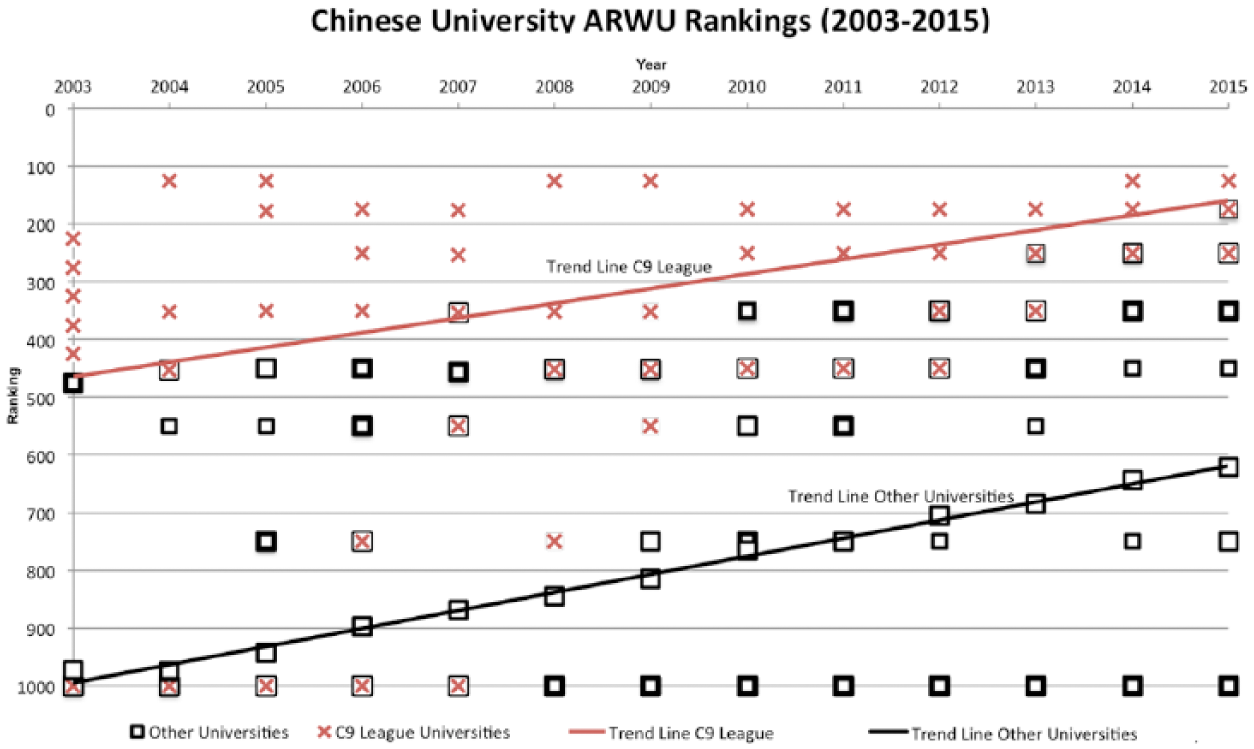
Chinese University ARWU rankings (2003-2015).
For Proposition 2, the selected elite coalitions (Ivy League, Go8, U15, and Russell Group) from around the world were selected for comparison with the C9 League. The ARWU ranking of each member institution was scored, means for each ranking year were established, and the yearly growth rate was calculated. These grouping means were situated on a color-coded chart for an easier comprehension of the comparison, which can be found in Figure 2. For the analysis, the yearly growth rates have been calculated in reverse because an “increase” (e.g., moving from Rank 100 to Rank 1) in the rankings is a positive indicator for the study.
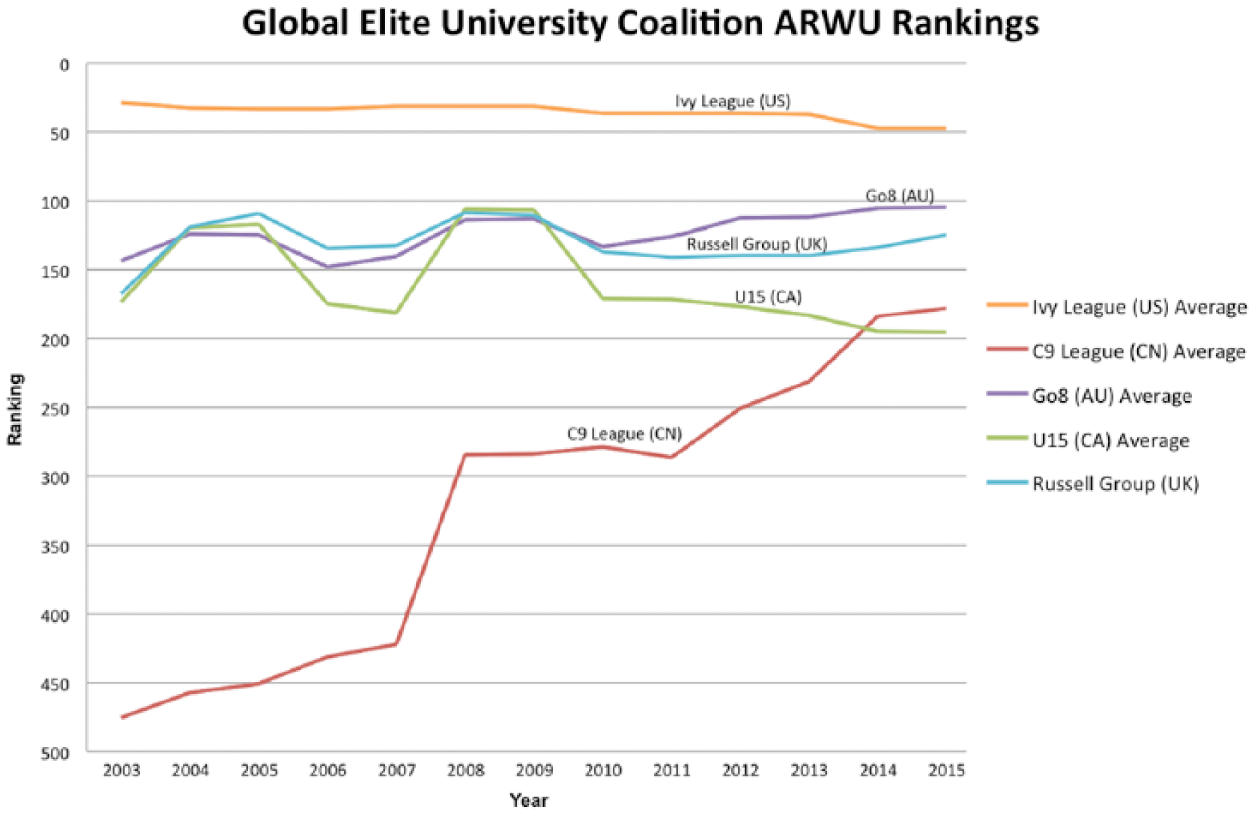
Global elite university coalition ARWU rankings.
Comparative Study
The Analysis for Proposition 1
China has had an elite-making higher education policy since the early 1990s, with massive injections of funding to the very top of the system. These top institutions have been expected to then drive the entire domestic sector. The analysis here shows that there is an overall positive growth in all Chinese universities that have ever appeared in the ARWU rankings, including C9 League. Looking at Table 1 and Figure 1, each year, more Chinese universities have moved into the top 500 in the world, with an average ranking of around 865 in 2003 to 558 in 2015, growing at an average rate of about 4.7% per year. In general, the proliferation of world-class institutions, as measured by rank, is exactly the outcome goal for the 985 Project. However, the key inference to Proposition 1 is a comparison between the C9 League and other key institutions in China.
Comparison Between C9 League Institutions and Other Ranked Chinese Universities.

Note. Yearly growth rate has been calculated in reversed order because an “increase” (e.g., moving from Rank 100 to Rank 1) in the rankings is a positive indicator.
According to the data, Peking University, Shanghai Jiaotong University, and Tsinghua University have been consistently the top three C9 League institutions, followed by Fudan University, Zhejiang University, University of Science and Technology of China, and, until recent years, then Nanjing University. Both Xian Jiaotong University and Harbin Institute of Technology lagged behind the other C9 League institutions early on but now have caught up with their peers. Overall, Xian Jiaotong University was the weakest member of the C9, not even making it into the rankings in 2010 at the 401 to 500 range. Likewise, Harbin Institute of Technology also performed poorly early on in the rankings, missing the top 500 from 2003 to 2007. However, once these institutions broke through the rankings, they each saw a steady climb in the rankings globally, a trend found in all C9 institutions except with Nanjing, which peaked in 2009. Aside from Harbin Institute and Xian Jiaotong, all other C9 League members had been ranked since the inception of the ARWU’s release in 2003.
The best preforming non-C9 member is Jilin University, which has been ranked since 2003, the first year rankings were made available, and Sun Yat-sen University, which climbed into the 150 to 200 range. Overall, though, these institutions did see a jump to an average better ranking over this period, moving from around a mean of 475 to around 178. However, overall, these other key institutions did not surpass the C9 League as a whole, and while these did make a slight increase in the rankings, the average growth rate was less than half that of the C9 League, from 4.4% growth rate to 12.8%, respectively. This disparity is not simply connected to better starting positions, although that is part of the story. For instance, Shandong University was also ranked in the initial 2003 ARWU report, but fell out of the rankings the following year until 2006. The institution then made a similar steady climb, akin to Jilin, but again slower than the C9 League growth. Many other non-C9 universities were found in the rankings before both Xian Jiaotong University and Harbin Institute of Technology (C9 League members), including China Agricultural University, Lanzhou University, Nankai University, Sun Yat-sen University, and Tianjin University. However, eventually, all of the C9 League institutions moved ahead or equal to their non-C9 peers, except in the final year with Sun Yat-sen University edging three C9 League institutions.
In general, the 985 universities are all moving up in the rankings, and the positive movement does seem to point toward a success for this policy. Likewise, the C9 League institutions are also rising in the rankings, but at a faster rate than their non-C9 peers. Through this Chinese domestic comparison of international rankings, the C9 League institutions do seem to be trending toward a separation from the majority of other 985 institutions. In confirmation of Proposition 1, the policy of elite making appears to be working, with a tiered system of C9 institutions at the top and then filtered down throughout the rest. With the fast rise of both Xian Jiaotong University and Harbin Institute of Technology compared with a slower rise for other institutions, especially Jilin University and Shandong University, it appears that being in the C9 League has led to a tiered system in China. But, with an overall positive trend for all of the universities, it seems the 985 Project has been successful in proliferating quality institutions across China; though, a systemwide analysis for future studies is needed to determine deep sector penetration. Furthermore, to gauge the global competiveness of these universities, an international peer comparison was also conducted in this analysis.
The Analysis for Proposition 2
Despite the global trend of seeking world-class institutions, there has never been an agreed common definition, only loose affiliations and university ranking systems. The rankings provide benchmarks for comparison with other universities around the world. As mentioned in the literature, the C9 League is comparable to the Russell Group, Group of Eight, U15, and Ivy League. For domestic policy makers in China, these prestige comparisons are important to gauge the global “catch up” policy for this sector.
For Proposition 2, looking at Table 2 and Figure 2, early on in the comparison, China’s C9 League was vastly behind its global peers. In 2003, the average rank for a C9 institution was approximately 494, with only Tsinghua ranked inside the top 250. For the Ivy League, their average ranking in 2003 was approximately 29, with three in the top 10 and seven in the top 50. For Australia’s Go8, their average was around 143, with all of their institutions in the top 250. For the U15, their ranking average was approximately 173, with two universities outside the top 250. Finally, the Russell Group tallied an average of around 173, with several universities inside the top 25, but also many outside the top 250. From these averages, the C9 League was clearly behind its global peer groups at the onset of the first comprehensive global university rankings. The Ivy League, the gold standard for these kinds of coalitions, was firmly entrenched at the top of the rankings in 2003, followed by the Go8, the U15, the Russell Group, and then China’s C9 League.
Comparison Between C9 League Institutions and Other Global Elite University Coalitions.

Note. Yearly growth rate has been calculated in reversed order because an “increase” (e.g., moving from Rank 100 to Rank 1) in the rankings is a positive indicator.
Jumping to 2015, the means for the various coalitions changed considerably from just over a decade before. For the C9 League, the coalition of Chinese universities averaged a ranking of approximately 178, with all universities in the top 300, which is a growth rate of 12.8%. The Ivy League retained its gold standard position; however, it still slipped overall, tabulating an average of approximately 48 in 2015, a yearly three percentage point decrease since 2003, which can mostly be accounted for by Dartmouth’s fall out of the top 250. For Australia’s Go8, there was a steady increase to an average ranking of 104 in the most recent year, a 3% yearly increase. Canada’s U15 actually witnessed an overall decline in the rankings, sliding down around almost one percentage point every year to an average of about 195 in 2015. The Russell Group saw an overall steady increase from 2003 to 2015, gaining about a 2.6% yearly increase to an average ranking of around 124. In considering Proposition 2, it appears that China’s elite coalition of universities has indeed caught up with its Western peers in terms of ARWU rankings. Surprisingly, China’s research coalition was not even at the bottom of the rankings in 2015 for these selected cases, but it actually ranked ahead of Canada in 2014 and continued this trend in 2015. This jump over Canada’s U15 by China’s C9 League is an incredible feat for affirmation of the elite-making policies sought by China. The policies like the 985 Project and the formation of the C9 League have actually allowed Chinese universities to catch up with their Western counterparts in terms of international rankings.
From 2003 to 2015, the C9 League actually moved ahead of Canada’s U15 group, as the Canadian universities dropped overall and the Chinese universities rose. While the other Anglo university coalitions remained in front of China, the movement to catch up with one of them is certainly a sign of success for elite-making policy. Overall, the C9 League had the fastest growth rate among its peers in the study and the rate should continue further. The Chinese universities did have a positional advantage of starting much lower in the rankings, but the increase is nonetheless impressive. The Ivy League showed an overall dip, but remained quite top heavy. Likewise, Go8 and the Russell Group both made slight gains. But, the Canadian grouping’s overall drop allowed for the Chinese coalition to pass the North American educational power. Even if the Canadian and Chinese rankings are quite similar, the narrative of being parallel can be considered a success for the policy of catching up with the West. Furthermore, the Chinese C9 League is still on an impressive growth pace, meaning that it is not unforeseeable that China may eventually catch up with the other Anglo higher education elite coalitions in the near future.
Conclusion and Implications
In the 1990s, Chinese policy makers introduced elite-making higher education policies. The C9 League quickly spawned from these policies, creating a so-called Chinese Ivy League. This elite grouping was supposed to drive the entire Chinese educational sector. Thus, through these top-level investments, Chinese policy makers realistically looked to catch up with their Western counterparts and, through this analysis, it appears that the policy has been working. Yet, the narrow focus on top institutions has been criticized for ignoring the larger institutional barriers in the county’s higher education sector, sometimes described as “glass ceiling” with “clay feet,” which is perhaps a key reason for the recently announced World Class 2.0 initiative (Altbach, 2016).
When looking at the domestic comparisons of university rankings of Chinese universities, the analysis shows that the C9 League universities have indeed been the top-ranked institutions of the country. While most of the institutions in 2003 were on top of the rankings, the numbers show that, early on, not all of the universities were ahead of other Chinese institutions. For China in 2015, the C9 League institutions are now the elite of the elite, ranking ahead or equal to their other Project 985 peers, for the most part. Likewise, the entire system seems to be trending up in the rankings. These findings seem to show that there is indeed an incrementally forming tiered system of universities in China, with the C9 League institutions at the top. But, the findings also show that there has been an overall increase in most other 985 Project universities, which indicates an overall drive toward higher ranked institutions for the largest higher education sector in the world. However, a larger analysis of this sector, from top down, needs to be carried to out truly ascertain the “clay feet” problem.
For the international comparison, the C9 League was compared with its elite contemporaries in the United Kingdom, the United States, Australia, and Canada. When the initial rankings were released in 2003, the Chinese coalition was far below these other groups. However, in 2014, the C9 League moved ahead of Canada’s U15 group, and actually increased that lead the following year. The other coalitions remained in front of the C9, but Chinese rate of increase has also been much faster. With these findings, it appears that the CCP’s Project 985 elite-making strategy has been a success. While this does not mean that the “glass ceiling” has been broken, it does show that the very elite Chinese institutions can at least claim peer status in terms of rankings, which have strong effects onto higher education stakeholders globally. The top-ranked Chinese coalition has caught up and surpassed at least one Western, Anglo country (Canada). Thus, the goal of “catching up” for Chinese institutions has indeed been accomplished in terms of rankings.
China’s higher education system is indeed improving. Although global university rankings are rightfully criticized by scholars, they are nonetheless used by policy makers and other stakeholders for decision making. The ARWU system was specifically created for Chinese comparison with the rest of the world, with metrics that ultimately matched China’s elite-making policies. Those policies have been shown to be working; yet, it is unclear what the effects of the new World Class 2.0 will be on this trajectory of the few elite institutions. It might now be time for the government to expand the focus to the wider system, truly addressing the “clay feet” conundrum, which could account for this new upcoming revamped performance funding system. However, this project is also expected to have a top-heavy system focus, meaning the inequality within the system will probably continue.
For the rest of the world, there might be a proliferation of more elite-making policy focuses to counter or mirror China’s rise, which could create an even more skewed global higher education system. The Go8 of Australia even released a document in 2012 on institutional complacency in which it warned of rising Asian universities in the rankings, especially China, in a document titled World University Rankings: Ambiguous Signals (Group of Eight, 2012). With continued perceptions of success for China’s elite-making higher education polices, there could be a kind of future educational arms race between nations if the global university rankings continue to have an important role as an international benchmark.
Footnotes
Declaration of Conflicting Interests
The author declared no potential conflicts of interest with respect to the research, authorship, and/or publication of this article.
Funding
The author received no financial support for the research, authorship, and/or publication of this article.
Notes
Author Biography
 .
.