




Abstract
As the experience of studying abroad can signal general and transnational human capital, it is considered to be increasingly important for professional careers, particularly in the context of economies’ internationalization. However, studies using graduate surveys face problems of self-selection and studies on employers’ opinions face problems of social desirability. To overcome endogeneity problems and to investigate the employers’ decisions directly, a particular field experimental design of a correspondence test was applied. Two hundred thirty-one applications of a real student with systematically varied studying abroad and professional working experience were randomly sent out for true internship offers of German employers. The time provided for the response and invitations for job interviews was measured, and additional publicly available information on the employers were collected. Results show that studying abroad decreases the days required until response and slightly increases the probability of invitation. However, at least in this field experiment, studying abroad is considered to be more of a sorting criterion by the employers with foreign branches than by those without.
Keywords
Introduction
In the context of the internationalization of economies, studying abroad is considered to be increasingly important for professional careers (e.g., Gerhards & Hans, 2013; Parey & Waldinger, 2011). Accordingly, increasing chances in a globalized labor market are emphasized as the key motivations for students to study abroad (e.g., Doyle et al., 2010). In fact, we can observe a steady increase in international student mobility in the last two decades (e.g., DAAD & DZHW, 2014; Organisation for Economic Co-Operation and Development [OECD], 2014).
However, the basic assumption that employers prefer applicants with experience in studying abroad is rarely investigated explicitly. Instead, the effects of studying abroad on foreign language proficiency, intercultural competences, and open-mindedness are examined, while positive impacts on the employability are regularly presumed (e.g., Brandenburg et al., 2014; Salisbury, An, & Pascarella, 2013; Williams, 2005; Zimmermann & Neyer, 2013).
Most studies use graduate surveys to investigate effects of studying abroad on both employability and labor market placement (Brandenburg et al., 2014; DAAD, 2011; Messer & Wolter, 2007; Potts, 2015; Støren & Wiers-Jenssen, 2010; Wiers-Jenssen, 2011; Wiers-Jenssen & Try, 2005). However, a number of studies revealed that students with certain properties, that is, personal traits or professional orientations, are overrepresented in higher education abroad due to self-selection (e.g., Netz, 2015; Salisbury et al., 2013; Williams, 2005; Zimmermann & Neyer, 2013). Furthermore, graduates with experience in studying abroad select themselves in international companies (Parey & Waldinger, 2011; Wiers-Jenssen, 2008, 2013). This may result in obtaining biased results for apply-side studies.
When using graduate studies, the employers’ principles of selection in the recruiting process are not considered directly, and they remain necessarily open (cf. Breen, Hannan, & O’Leary, 1995). Although some studies explicitly consider the assessment of studying abroad experience by the employers (Archer & Davison, 2008; Bracht et al., 2006; Brandenburg et al., 2014; Crossman & Clarke, 2010; DAAD, 2011; European Commission, 2011; Molony, Sowter, & Potts, 2011), the employers’ real recruitment does not have to correspond with what they would have done in hypothetical situations (Pager & Quillian, 2005).
Even though most studies see the advantages of experience in studying abroad for professional careers, other credentials, such as a suitable field of studies, good final grades, or relevant professional work experience are normally more important in the recruitment process as they already serve as a reliable job match (Humburg & Van der Velden, 2015; Messer & Wolter, 2007). Correspondingly, employment chances of mobile and nonmobile graduates are rather similar (Bracht et al., 2006; DAAD, 2011; Wiers-Jenssen, 2013), sometimes even in the favor of graduates with domestic degrees (Støren & Wiers-Jenssen, 2010; Wiers-Jenssen & Try, 2005).
It is also repeatedly reported that export-oriented firms or multinational concerns value international student mobility higher (Archer & Davison, 2008; DAAD, 2011; European Commission, 2011). Accordingly, experiences in studying abroad slightly increases the probability of subsequent working in a foreign country (Brandenburg et al., 2014; Parey & Waldinger, 2011), or, for multinational employers, in the domestic labor market (Bracht et al., 2006; Wiers-Jenssen, 2008, 2013).
As the value of studying abroad for potential employers is merely underexposed, we apply a so-called correspondence test, a field experiment, to overcome the problems of indirect measurement and self-selection (cf. Pager, 2007; Riach & Rich, 2002). Written applications with systematically varied studying abroad and professional working experience were randomly sent out for real internship offers from German employers. The recorded real invitation behavior allows for certain interpretations on their perceived benefit of studying abroad. A comparison of the employers, both with and without foreign branches, further allows for a proper test where studying abroad serves as a signal of general performance or as a specific sign of international skills.
Theoretical Background
In general, we understand the relations between educational attributes and labor market allocations in the context of matching processes between the applicants’ skills and the requirements of employers’ jobs. Employers evaluate potential employees and employees evaluate their potential employers, to achieve the most optimal match (Kalleberg & Sorensen, 1979).
Human Capital and Signaling
In a job-matching process, employers offer wages to their employees according to their individual labor productivity. From the perspective of the human capital theory, the general individual’s job performance is increased by learning effects through education and work experience. As trained job seekers are more valuable for employers, students are motivated to invest in their stock of human capital by acquiring education or work experience (Becker, 1964; Mincer, 1958). However, as the individual properties that entail labor productivity remain sometimes unobservable directly, a number of authors developed the idea that job seekers acquire productivity-related signals which may serve as available information for employers to screen and filter applicants according to their job requirements (Arrow, 1973; Spence, 1973; Stiglitz, 1975). In this view, job seekers with related unobservable traits acquire signals to reduce uncertainty for employers. Both signaling and screening serve to sort employees and match them with the right jobs, so that the notion of “sorting” is suggested (Weiss, 1995). In both theories, the highest and longest educated applicants with the most productive and educational credentials help employers to filter and to pay them (Bills, 2003), and so, Weiss (1995) understands sorting models as extensions, not opposite, of human capital theory.
In the selection process, employers successively reduce the pool of applicants through certain elimination criteria (cf. Behrenz, 2001). Considering the offered vacancy, the employer selects applicants on the basis of their written applications for invitation. After the job interview, a specific wage is offered to one applicant, and, in the best case, a working contract is subjected. Although studying abroad may unfold some signaling power at all stages, we consider only the first stage, employer’s screening, for invitation purposes, due to methodological restrictions.
Studying abroad can be associated with various skills that generally advance a person’s job performance. Specifically, professional expertise gained abroad leads to directly observable skills, for example, foreign certificates, which are often indicated as important for employers. But, this also includes unobservable properties, generally rewarded by the employers, that are acquired through studying abroad, such as self-confidence, decisiveness, serenity, teamwork skills, and autonomous working skills (Archer & Davison, 2008; Bracht et al., 2006; Brandenburg et al., 2014; DAAD, 2011; Potts, 2015). Due to its relation with general job performance, those applicants are considered more attractive to the employers, and that may motivate them to quickly put them to the next stage in the selection process. We, therefore, assume that applications with experience of studying abroad reduces the time before a response is received (Hypothesis 1a) and leads to a higher probability of invitations (Hypothesis 1b) when compared with the applications without that experience.
Moreover, given a suitable field of studies, the related literature points out that, among others, professional working experience is considered to be an important credential for employers in the screening process (e.g., Behrenz, 2001; Humburg & Van der Velden, 2015). It can, thus, be argued that because professional skills and knowledge gained through previous jobs can lead to a greater stock of human capital, employers should be motivated to react quicker (Hypothesis 2a), and with a rather positive response (Hypothesis 2b).
Specific Transnational Human Capital and the Role of Employer’s Internationality
Human capital models commonly distinguish between general and specific human capital. General human capital refers to the skills and key qualifications that are valued and rewarded by the vast majority of employers. Specific human capital refers to the skills that are only applicable to certain employers or jobs (e.g., Bills, 2003; Weiss, 1995). Also, from the signaling perspective, it is stated that some characteristics may be signals with respect to some types of jobs, but not for all jobs (Spence, 1973).
In this view, studying abroad may, in particular, enhance internationally relevant skills and knowledge, which can be captured by the concept of transnational human capital (Gerhards & Hans, 2013). Transnational human capital includes the stock of knowledge that enables an applicant to deal in a number of fields beyond the individual nation state, such as foreign language proficiency and intercultural competence, and can be acquired through education abroad. In fact, studying abroad leads to a range of specific international skills. For instance, foreign language proficiency, the ability to cope with different cultures, global mindedness, knowledge about a foreign country, and pertinent international networks are all acquired (Brandenburg et al., 2014; Crossman & Clarke, 2010; Salisbury et al., 2013; Williams, 2005).
Transnational human capital is highly valued by employers with overseas offices, subsidiaries, partners, consumers, or suppliers abroad. For instance, the majority of export-oriented companies in Germany prefer graduates with such experience, where foreign language skills are considered to be the most important (DAAD, 2011). But, other European employers with international day-to-day operations also mostly agree that it is very important for new recruits to have studied abroad (Archer & Davison, 2008; European Commission, 2011).
We argue that transnational human capital is of greater attractiveness for internationally oriented employers, as they benefit more from such knowledge and competences. Accordingly, we assume that studying abroad experience reduces the time taken for any reaction (Hypothesis 3a) and makes invitations more likely (Hypothesis 3b) among the employers with foreign branches, especially when compared with those without foreign branches. In turn, professional working experience does not serve as a signal for transnational human capital. Therefore, it seems reasonable that there are no remarkable differences between the employers with and without foreign branches with regard to duration until responses (Hypothesis 4a) and invitation probability (Hypothesis 4b).
Method and Data
In the study, a correspondence test has been deployed. Certain job applications with systematically varied characteristics were randomly sent out for true job offers, to investigate the real recruitment selections made by the employers at their first stage of invitation. The subsequent rate of correspondence made by employers served as the measurement of selection principles. As all applications are equal, except the varied intervening treatment variables, the design allows for the identification of the causes of selection behavior (cf. Pager, 2007).
The correspondence test design was originally developed for the investigation of discrimination processes in the labor market (e.g., Bertrand & Mullainathan, 2004; Jowell & Prescott-Clarke, 1970), and has been widely applied to various factors that were considered by employers in recruitment process for a number of national labor markets (e.g. Eriksson & Rooth, 2014; Jackson, 2009; Kaas & Manger, 2011; McGinnity & Lunn, 2011; Protsch & Solga, 2015). This makes the correspondence test design a promising approach for investigation of studying abroad effects.
Considering the systematically manipulated applications and random assignment to employers, the correspondence test design shows the characteristics of a randomized experiment (cf. Shadish, Cook, & Campbell, 2002). The validity of experimental results is usually evaluated in terms of two major criteria: While “internal validity” refers to the question of to what extent any difference in the observed outcome between experimental groups is indeed caused by the varied treatment variable, “external validity” addresses the question of to what populations, settings, and variables a revealed effect can be generalized (see Campbell, 1957). Due to controlled variation and randomization, correspondence tests generally guarantee a high internal validity, while measuring true responses of real employers serves some degree of external validity (cf. Pager, 2007; Riach & Rich, 2002).
However, though a design strong in both internal and external validity is ideal, it turns out that the criteria are “to some extent incompatible, in that the controls required for internal validity often tend to jeopardize representativeness” (Campbell, 1957, p. 297). In case where either internal validity or generalizability must be restricted, internal validity is the priority, as it is indispensable for experimental designs (Campbell, 1957, p. 310).
Experimental Design and Sampling
In an experiment, the design and participants’ sampling are strictly interrelated. The number of experimental conditions, that is, the number of application versions, directly affects the required number of subjects, that is, the number of employers.
For legal reasons, one real female student with true and unique characteristics and credentials served as the experimental applicant in our study. 1 The student spent two semesters abroad at an Italian university and worked for the last two semesters as a student assistant at the faculty of her home university. The systematic reduction of her real curriculum vitae by these two characteristics served as a treatment variation in applications.
Yet, relying on the existing characteristics of a real student also resulted in restrictions. First, no variation of name, gender, field of studies, type of school, and voluntary engagement was legally possible, and so, all applications were identical with regard to these features. Second, as she was not finally graduated at the time of data collection, and thus, no graduation certificate existed, applications were only provided for internships. Contrary to applications for a first real job at the labor market entry, graduation certificates are not expected by the employers when students apply for an internship.
In addition, as the applications were from a genuine sociology student, the offers had to cover the social sciences, and, to prevent detection by employers, only one application was sent out per company. 2 This leads to the problem where although the applications were carried out across the entirety of Germany, there was only a very limited number of fitting internship offers available during the period of data collection. As a consequence, we used all internship offers that were published at their respective job portals and websites during the period, without additional selection.
As a consequence, though further experimental variations were technically conceivable to test additional treatment effects, like, for instance, applications from a similar male student, there were, in fact, not enough internship offers for social science in time to reach sufficient subsample sizes. As the study was restricted by a real student’s characteristics, and subsequently, by the size of fitting internship offers, the priority was on internal validity (valid effects of study abroad), as it is indispensable for experimental designs. Accordingly, only studying abroad and work experience were varied in the applications (see Table 1).
2 × 2 Factorial Design.

Data Collection
Data collection was conducted for 2 months in spring 2015. Internship vacancies were researched out through relevant Internet job portals 3 or directly from the employers’ websites. A total of 231 written applications were randomly sent out via email or online-form, equally distributed across the four experimental conditions (Table 2).
Observations Across Experimental Groups.

The written applications included a motivation letter, a curriculum vitae, and a transcript of records. The motivation letter consisted of a largely standardized text, while employers’ names and addresses, and the date of entry were adopted with regard to each internship offer. Furthermore, in the first paragraph, some specific references were made to the employer’s profile to justify the applicant’s motivation. In the subsequent paragraph, the contemporary field of study, and its relation to the internship were described, optionally completed by statements about study abroad experience, and/or professional working experience. The information in the curriculum vitae was adapted correspondingly. Finally, each application included a real transcript of records, showing the average study performance.
Employer Sample
Employers’ publicly available data, such as size, field of activity, organization form, region, and foreign branches were additionally researched. The composition of the reached sample of employers, both the total and differentiated by foreign branches, is shown in Table 3. The table also contains the proportions of treatment conditions across the sample. Altogether, the distributions of all variables seem quite reasonable, and group sizes of 129 and 102 employers with and without foreign branches enable comparison.
Internship and Company Characteristics.

However, the direct comparison of the proportions of applications with and without studying abroad experience across both subsamples reveals that treatment randomization did not work perfectly. Applications with studying abroad experience are slightly overrepresented among the internationally oriented employers, and are somewhat underrepresented among those without foreign branches. Although a chi-square test shows no significant difference at the 5% level, it indicates a weak correlation between the studying abroad treatment and the internationality of an employer. In addition, the chi-square analysis shows reasonable but significant variations in the employers’ characteristics across both groups. Thus, to obtain unbiased effects of the studying abroad treatment, additional statistical control by collecting the employers’ characteristics is necessary.
Dependent Variables and Estimation Methods
Of a total of 231 applications, 131 (56.7%) evoked any response. For those applications, the days until response and a possible invitation were recorded (see Figure 1). Fifty-one applications involved the invitation to a job interview (22.1% of all applications; 38.9% of all responses). On an average, it took 11½ days for any response, while the distribution of this count data variable is quite right-skewed (v = 1.78). Three quarters of all employers responded within 15 days after the application while only 10% needed longer than 29 days. 4
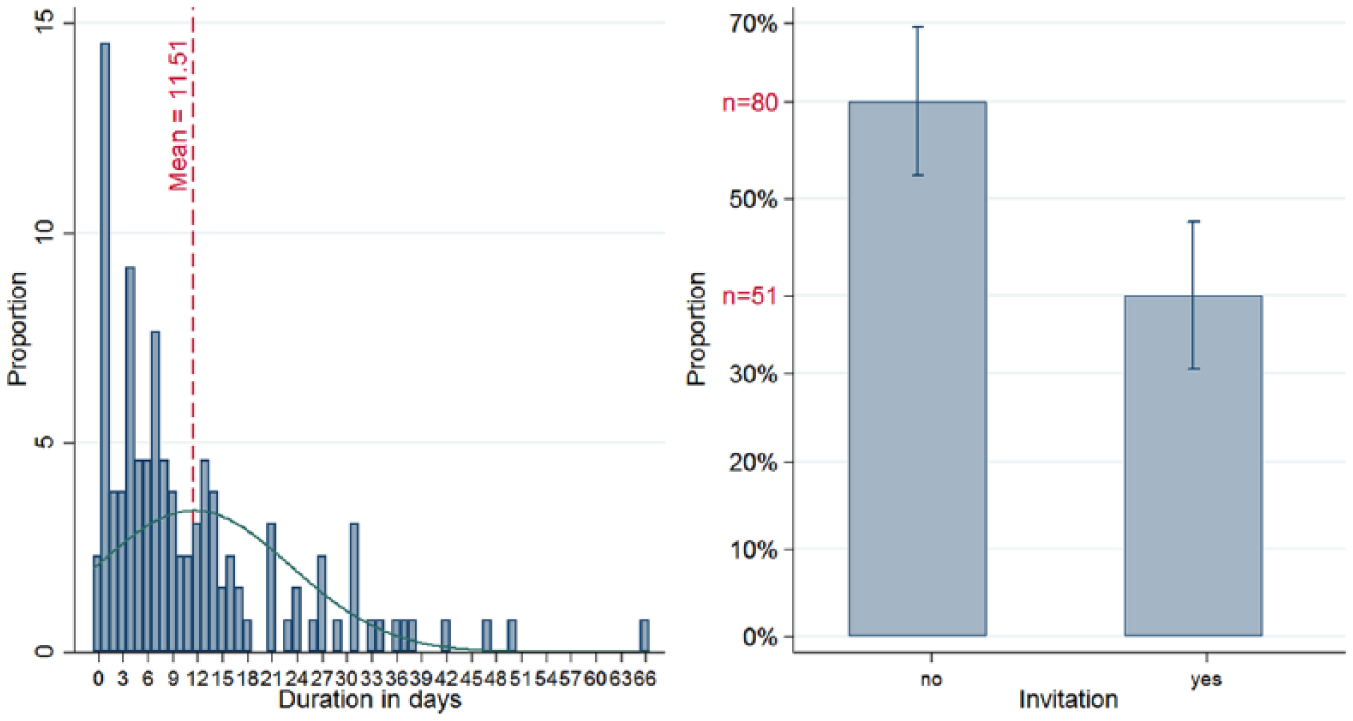
Distributions of duration until response, and invitation.
Although data stem from an experiment, which ideally does not require further statistical control due to systematic manipulation and randomization, the sample analysis revealed a necessity for additional statistical adjustment in multivariate models. For the prediction of binary variables, such as the invitation variable, binomial logistic regressions are common (e.g., Menard, 2010). In contrast, the days until any response is considered as a count data variable with typical right-skewed distribution. For those dependent variables, negative binomial regressions are appropriate (e.g., Hilbe, 2011). However, both binary logistic regression and negative binomial regression are nonlinear models that cause model-inherent problems (i.e., model-inherent interactions) so that the coefficients are difficult to interpret and suffer from comparability across subsamples. Therefore, in accordance with the recommendations of relevant literature (cf. Mood, 2010), the so-called “average marginal effects (AME)” are calculated and reported here, that allow for a likelihood interpretation and effect comparison.
To uncover the potential heterogeneity in the effects of treatment variables between employers with and without foreign branches, interaction terms between the treatment variables and the grouping variable were included in the models. As the treatment of studying abroad experience is slightly correlated with the employers’ internationality, that is, with the grouping variable, additional interaction terms of grouping variable with all covariates are also included in the models (cf. Winship & Morgan, 1999). However, due to nonlinearity, interaction effects are also hard to interpret in the logistic and negative binomial regression models. Therefore, a turn toward linear probability models, estimated with ordinary least squares (OLS), that is, to simple linear regression models, is suggested in literature (cf. Best & Wolf, 2015). As, in this case, nonmodeled heteroskedasticity may arise, robust standard errors are used to capture this problem. Finally, for reasons of clarity and intuitive interpretability, we solely present the theoretically relevant treatment effects and use graphical visualizations, while the models are reported in more detail in the appendix.
Results
As both studying abroad experience and professional working experience should be positively associated with general job performance, we assumed that they reduce the time until any response and make invitations more likely. As plotted in Figure 2, 5 studying abroad experience significantly abbreviate the time until responses by around 4 days (AME = −4.3; Hypothesis 1a), while professional experience does not (AME = −0.1; Hypothesis 2a). In addition, studying abroad experience increases the probability of being invited for an interview (AME = 0.16; Hypothesis 1b), although the effect is not statistically significant. Surprisingly, working experience even decreases the invitation probability significantly (AME = −0.18; Hypothesis 2b). Thus, the results do support the hypotheses on studying abroad effects, but contradict the hypotheses on working experience effects.

Main effects of treatments on duration until response and invitation.
Furthermore, different effects of the studying abroad experience for national and international employers have been presumed. As studying abroad should increase the performance of employers with foreign branches further, it should ideally specifically make those employers tend to respond quicker and to invite applicants. Conversely, for general working experience, no effect differences between both types of employers are expected. The results are displayed in Figures 3 to 5. 6

Conditional effects and interaction effects with internationality (duration).
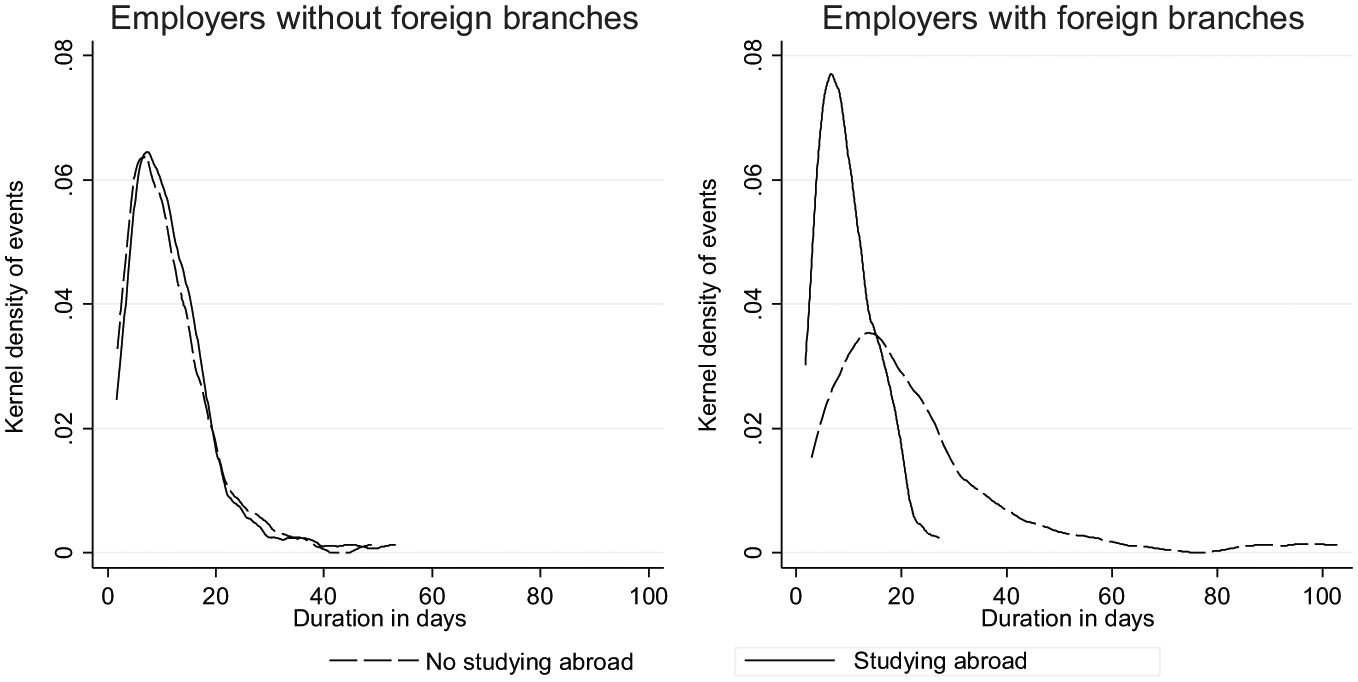
Conditional distributions of predicted duration until response (neg. bin. regression).
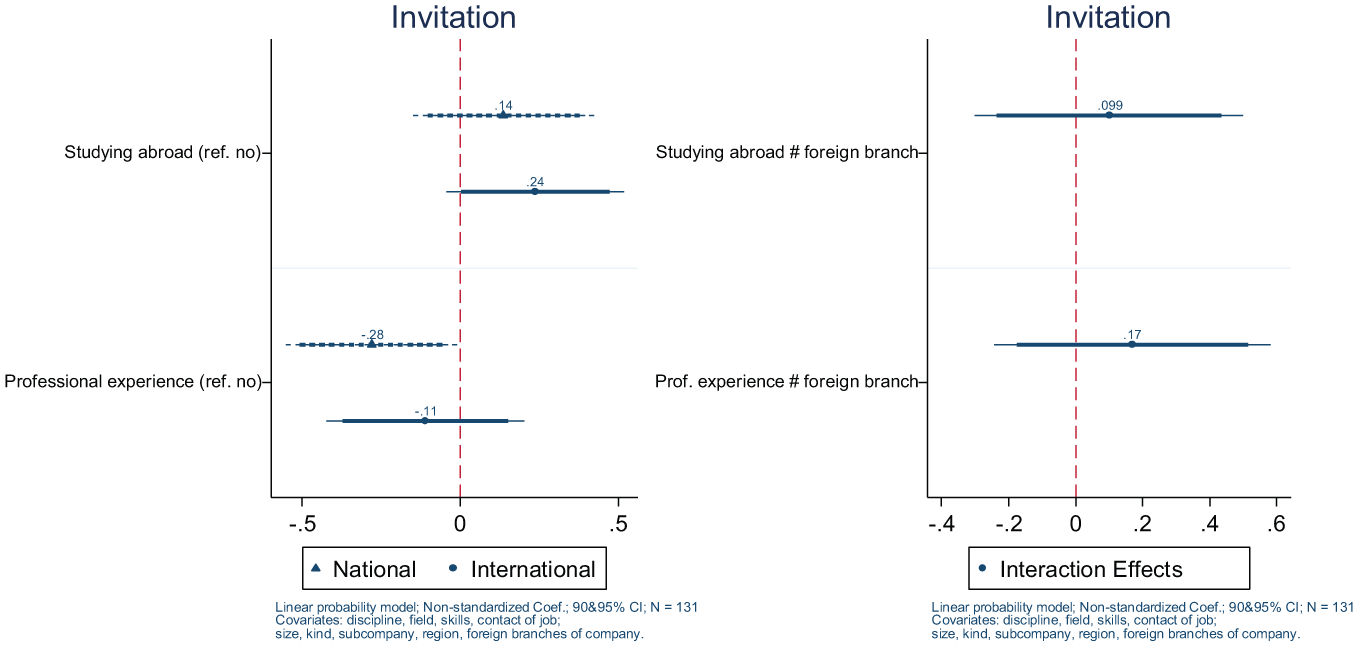
Conditional effects and interaction effects with internationality (invitation).
While studying abroad does not make any difference in time until response for the employers without foreign branches (b = 0.1), those with foreign branches respond, on an average, almost 10 days (b = −9.9) faster if an application consists of studying abroad experience (Figure 3). As the interaction effect shows, this difference is also statistically significant. To further demonstrate the heterogeneity of the studying abroad effect, a set of separate negative binomial regressions have been calculated for employers with and without foreign branches. The distributions of the predicted time until any response for the applications with and without studying abroad experience are displayed for both groups in Figure 4 (using kernel density for visualization). It becomes clear that the employers without foreign branches respond almost in the same time to applications with and without studying abroad experience. In contrast, employers with foreign branches respond quite slowly to the applications that lack studying abroad experience. These results provide a clear evidence for Hypothesis 3a. In contrast, for both types of employers, working experience does not accelerate the response (b = 0.3/−1.6) which was assumed in Hypothesis 4a.
Figure 5 shows, furthermore, that the studying abroad experience does increase the invitation probability slightly among international employers (b = 0.24), while there is no significant effect for the employers without foreign branches (b = 0.14). However, the effect differences between both employer types are statistically unimportant, as the interaction effect reveals, so that Hypothesis 3b cannot fully be supported. Working experience decreases the invitation probability significantly when the employer has no foreign branches (b = −0.28), while it is almost unimportant for international employers (b = −0.11). Again, this effect difference remains statistically unimportant, as expected in Hypothesis 4b.
Conclusion and Discussion
The article aimed to explore the signaling value of the studying abroad experience from the employers’ perspective. In particular, we asked whether and how real employers responded to true applications to internship offers of a real student with different study abroad and working experiences. By following a general matching approach and combining human capital with sorting, the experience of studying abroad can principally serve as a signal for both general and transnational human capital.
Unlike professional working experience, studying abroad abbreviates the time until any response, and slightly increases the likelihood for being invited to a job interview. Given the applications with studying abroad experience, employers with foreign branches respond significantly quicker when compared with those without them. International employers also tend slightly more for invitations if the application contains mentions of studying abroad. Conversely, no differences in the evaluation of professional working experience could be found between both employer groups.
The results indicate, as presumed, that studying abroad may principally serve as a sorting criterion in the recruitment process, particularly by international employers. Those with foreign branches obviously sort applicants without studying abroad in a rear position in the queue, because they respond noticeably later. This may indicate that these applicants are treated as reserve by international employers, especially if the first choice applicants do not fit. In addition, international employers also tend slightly more than national ones to invite internationally experienced students. Due to this condition, studying abroad could be interpreted as being primarily perceived as a signal of transnational human capital than as one of general human capital, at least with regard to the present study. Therefore, studying abroad apparently serves particularly as a specific signal of knowledge that enables people to deal in different fields internationally.
However, experimental correspondence tests are always limited in their outreach (cf. Heckman, 1998). In our study, a high internal validity, served by the systematic study abroad variation and neutralizing biases through random assignment to internship offers, is in the expense of external validity. This addresses the question whether the effects uncovered can be generalized with regard to other outcomes, samples, treatments, or settings (cf. Campbell, 1957).
First, an experimental correspondence test is generally limited to the first stage of selection in the recruitment process. It is not possible to investigate other outcomes, such as whether an applicant would be hired later or not. In addition, the applicants’ long-term effects of studying abroad experience in the later stages of their career cannot be analyzed. Therefore, further research is urgently needed which would make a comparison between the employers’ real decisions, not only in invitation but also in hiring.
For the sake of plausibility, as the applicant was still a student, the applications were restricted to internships. Accordingly, also the interpretation of results is limited to internships in this study. However, for internships, the principles of selection may differ substantially from those for real first jobs at labor market entry. Although there is a remarkable chance for trainees getting a real job offered by their employer (see Brandenburg et al., 2014), an individual’s pure invitation to internship applications cannot be generalized to general success in labor market placement.
Second, a representative sample can hardly be reached because the researcher relies on publicly advertised vacancies. Here, a very small section of the publicly offered internships for students of social sciences led to a highly selective sample of German employers. This makes any attempts to further generalize the results to employers of other sectors or economies highly vulnerable. Moreover, the outcomes of a recruitment processes may depend on specific institutional conditions, such as the number of applications received and the degree to which recruitment procedures are formalized (cf. Midtbøen, 2015). A replication of the study, with a larger and less selective sample, is highly appreciated, in order to enhance the external validity. In particular, several economic branches, sectors, and professions should be investigated. Also, employers from other countries with other economies, welfare states, and labor market conditions should be researched by using this approach, for instance, from Asia or Northern America.
Third, as the applications stem from a real student, treatment variables are restricted to the existing experiences, which are, in turn, specific. While studying abroad shows a positive effect during the time of feedback, the effect on invitation probability is rather small. This may be reasoned by fact that the period abroad has, in fact, been completed in Italy. Thus, employers could not assume that the stay abroad had strengthened the English skills of the student. Yet, these language skills are highly valued by German employers (Brandenburg et al., 2014; DAAD, 2011). Therefore, studying abroad in an English-speaking country could have an even stronger effect. Accordingly, the indication of work experience significantly reduced the chance to be invited in this study. One possible interpretation of this counterintuitive finding is that working experience was gained as a student assistant, which might already be perceived as a very specific human capital, and not as the general human capital which is interesting for many employers. As a consequence, various treatments of studying abroad and work experience should be carried out in future studies.
Fourth, the general setting in this study was the application of one female student with certain characteristics for internships, wherein the treatments of studying abroad and work experience were varied. Although we can trust the effects of the experience of studying abroad within this setting due to its high internal validity, it is largely unclear whether it interacts with other student’s characteristics, which is not taken differently in this study. In particular, any possible gender biases cannot be identified, which, in turn, are specifically likely for the selection processes with regard to internships and may overrule the importance of studying abroad or work experience in its absolute terms. Thus, further characteristics’ variations, especially in gender, are urgently needed in the future researches.
However, these issues provide interesting venues for future research, as correspondence tests are a promising approach to investigate true and unbiased employers’ behavior towards applicants’ international experience as well as towards other credentials which are gained by higher education.
Footnotes
Appendix
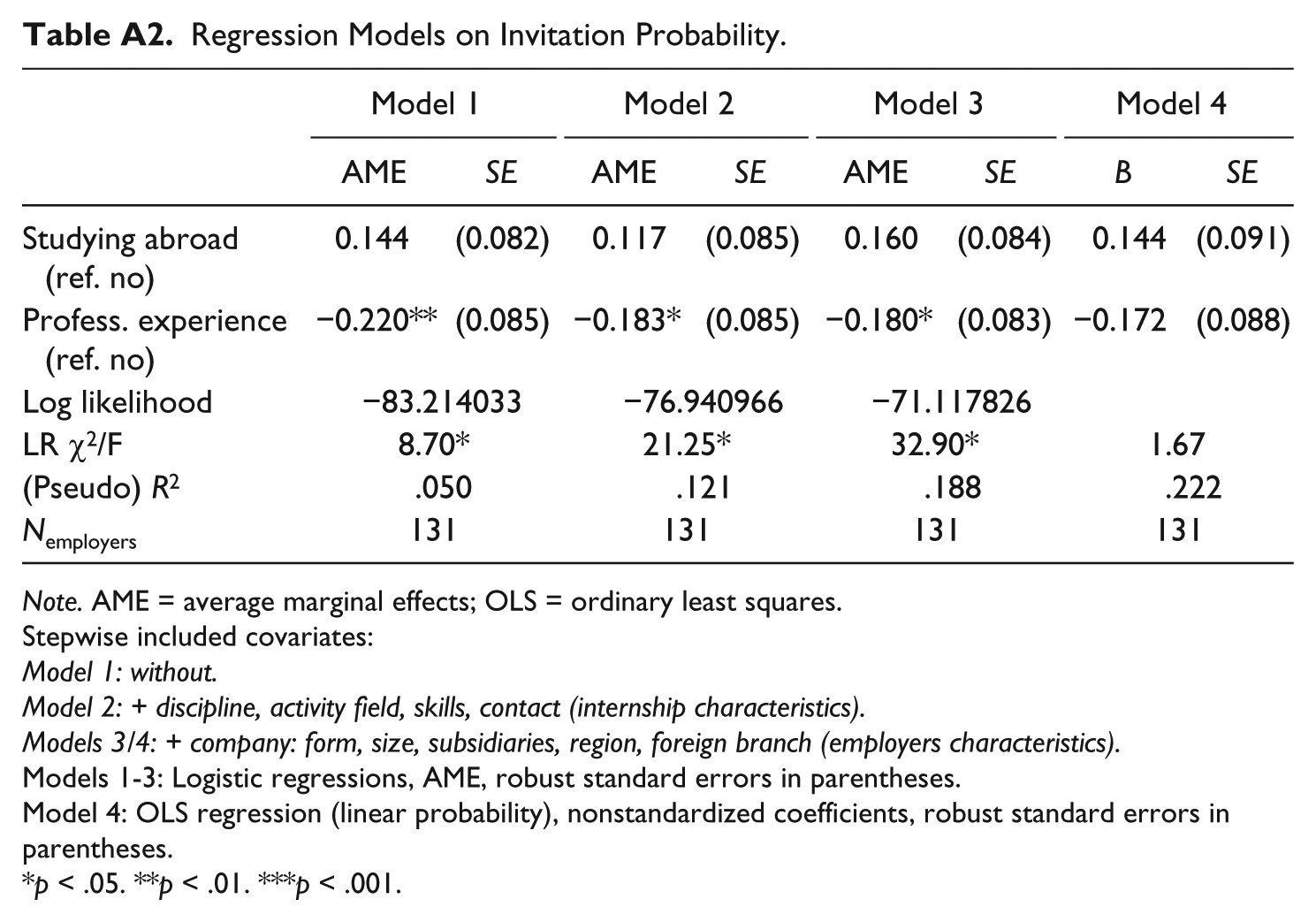
Regression Models on Invitation Probability.
| Model 1 |
Model 2 |
Model 3 |
Model 4 |
|||||
|---|---|---|---|---|---|---|---|---|
| AME | SE | AME | SE | AME | SE | B | SE | |
| Studying abroad (ref. no) | 0.144 | (0.082) | 0.117 | (0.085) | 0.160 | (0.084) | 0.144 | (0.091) |
| Profess. experience (ref. no) | −0.220** | (0.085) | −0.183* | (0.085) | −0.180* | (0.083) | −0.172 | (0.088) |
| Log likelihood | −83.214033 | −76.940966 | −71.117826 | |||||
| LR χ2/F | 8.70* | 21.25* | 32.90* | 1.67 | ||||
| (Pseudo) R2 | .050 | .121 | .188 | .222 | ||||
| N employers | 131 | 131 | 131 | 131 | ||||
Note. AME = average marginal effects; OLS = ordinary least squares.
Stepwise included covariates:
Model 1: without.
Model 2: + discipline, activity field, skills, contact (internship characteristics).
Models 3/4: + company: form, size, subsidiaries, region, foreign branch (employers characteristics).
Models 1-3: Logistic regressions, AME, robust standard errors in parentheses.
Model 4: OLS regression (linear probability), nonstandardized coefficients, robust standard errors in parentheses.
p < .05. **p < .01. ***p < .001.
Declaration of Conflicting Interests
The author(s) declared no potential conflicts of interest with respect to the research, authorship, and/or publication of this article.
Funding
The author(s) received no financial support for the research, authorship, and/or publication of this article.