



Abstract
For too long, transnational higher education (TNE) has been linked to discourse predominately focused upon strategic implementation, quality assurance, and pedagogy. While these aspects are important when designing and managing overseas provisions, there is a lack of research focusing on the social interactions that influence the pace and development of TNE partnerships. This gap is particularly evident at the operational phase of TNE partnerships. This conceptual article therefore offers an alternative way in which to research TNE partnerships, in relation to the interactions of faculty members delivering at the operational level. It provides an integrated theoretical framework, comprising of three different theoretical approaches to provide a conceptual tool in which to investigate and evaluate TNE partnership development. The article concludes that by understanding how relationships develop between faculty members tasked with delivering TNE, international partnerships can be significantly strengthened in terms of their progression and value.
Keywords
Introduction
Today’s higher education community operates in a complex and dynamic global environment (Naidoo, 2009), whereby global changes, stimulated by a reduction in trade and communication barriers, as well as other “globalising tendencies” (Bennell & Pearce, 2002, p. 216) have prompted higher education institutions (HEIs) to reconsider their attitudes toward internationalization. One method for realizing international opportunities afforded by neo-liberal policies is to develop international educational partnerships (Chan, 2004). These partnerships, if designed correctly, offer institutions a way to satisfy commercial objectives, while also assisting in the development of global knowledge transfer and citizenship (Brookes & Becket, 2011).
Critical to the success of any transnational higher education (TNE) partnership is the way in which faculty members interact with, share, and negotiate tasks and outcomes that suit the requirements of a multitude of stakeholders (Bolton & Nie, 2010). Relationship management and the generation of social capital are therefore critical in the development of successful and sustainable partnerships (Dhillon, 2015).
This conceptual article is concerned with exploring how social relationships develop within TNE partnerships. It particularly focuses on the way relationships develop between faculty members who operationalize these overseas programs. The article offers a theoretical framework in which to explore faculty member operational interactions and the effect they have on TNE partnership progression and maturity. In the context of this article, operational faculty members are defined as those who have a direct responsibility for the teaching and learning of overseas students, such as module leaders, local tutors, course leaders or equivalent representatives, who operate at both the awarding and hosting HEIs. These individuals are at the coal-face, concerned with ensuring the daily management of these overseas educational programs, which includes ensuring and overseeing program delivery, quality, compliance, pedagogical content, assessment and feedback, as well as providing student support. I argue, that fundamental to the success of a TNE partnership are the social relationships which establish between these awarding and host operational faculty members, whereby these relationships I consider to be vital in the maintenance, development, and survival of the transnational partnership over time (Amey, Eddy, & Campbell, 2010).
I begin this conceptual article by defining transnational education, before exploring the concept of partnership and the role undertaken by faculty members in the delivery and management of TNE partnerships. A conceptual definition of partnership is provided, through which it becomes possible to conceptualize TNE partnerships as being representative of two boundary-spanning interacting activity systems (Engeström, 2001). This conceptual approach makes it possible to analyze TNE operational phases in an alternative way, highlighting the important relationships that exist between dimensions such as the subject, rules, time, communities, motives, activity production and outputs, and artifacts. The article continues by applying three theoretical frameworks, cultural-historical activity theory (CHAT; Engeström, 2001), social action theory (SAT; Weber, 1978), and the transformational model of social action (TMSA; Archer, 1998), whereby it becomes possible to analyze these dimensions and to theorize as to what is potentially happening in terms of social interactions between faculty members, as well as how these interactions may be influencing TNE partnership developments over time.
This theoretical approach could assist HEIs, currently participating in TNE or considering it as an internationalization strategy, to contemplate the design and management of their partnerships. By analyzing what factors affect faculty member relations, and the subsequent effect these have on partnership development, alliances could be reconfigured, to improve the performance of current or future cross-border ventures. I begin by defining TNE for contextual purposes, before analyzing partnership and TNE literary sources.
Exploring TNE Partnerships
Transformations in the strategic objectives of HEIs are now evident in the way they are integrating international strategies into their working practices (Knight, 2004). One approach is to develop collaborative links with one or more overseas higher education institutes where students can study for a foreign qualification without leaving their home country (British Council, 2013). Otherwise known as transnational education (TNE), United Nations Educational, Scientific and Cultural Organization (UNESCO) and The Council of Europe (2002) in their Code of Good Practice define it as
all types of higher education study programmes, or sets of study, or educational services (including those of distance education) in which the learners are located in a country different from the one where the awarding institution is based.
Furthermore, they define a transnational arrangement as
an educational, legal, financial, or other arrangement leading to the establishment of (a) collaborative arrangements, such as franchising, twinning, joint degree, whereby study programmes or parts of a course of study, or other educational services of the awarding institution are provided by another partner institution. (b) non-collaborative arrangements, such as branch campuses, offshore institutions, corporate or international institutions.
TNE and transnational arrangements are therefore highly complex. Simply put, TNE allows degree awarding institutions, situated outside of a host nation, to provide a variety of educational provisions to international students, who may not have the means or motivation to travel abroad. More often than not, this requires some form of partnership between an awarding and hosting institution. Collaborating partners therefore need to find common ground in the way courses, arrangements, and delivery methods operate.
TNE has seen a sharp increase in the last decade, with the Higher Education Statistics Agency (HESA) recording annual growth rates in students studying wholly overseas for a U.K. qualification through some form of overseas arrangement (Table 1).
HESA “Students in Higher Education 2013/14 & 2012/13” Table O.

Note. HESA = Higher Education Statistics Agency (2014); HEI = higher education institutions.
Arguably, these figures evidence the increasing significance of TNE to U.K. HEIs, who have sought to grow their share of the international student market by developing and expanding overseas provisions. Moreover, the data evidence the increasing need to ensure relationships with overseas partners remain positive, to ensure international students have the best experience of U.K. HE offshore.
TNE can take multiple forms, with numerous modes of cooperation existing between collaborating institutions (Healey & Bordogna, 2014). These can embrace a wide range of models: joint programs, branch campuses, distance-learning programs, articulation and validation (Quality Assurance Agency [QAA], 2010). Underpinning each of these modes of delivery are complex structures and systems, whereby collaborating partners often have to find common ground through negotiation and compromise, while promoting resource exchanges and building trust (Amey et al., 2010).
To ensure international partnerships survive the dynamic international environments in which they are situated, partnership structures must enable systems to achieve optimal levels of cooperation and collaboration. This often requires participating institutions to adopt new forms of distributed and coordinated agency (Keevers et al., 2014). As alliances grow in complexity and involve wider sets of stakeholders (Bolton & Nie, 2010) with varying objectives, understanding how partner groups interact and respond to each other offers a new way in which evaluate the development of TNE partnerships, and what can be done to potentially improve these overseas ventures.
Partnership Implementation: Operating Transnational Partnerships
By analyzing partnership discourse from a series of business, education, health, and management sources (Austin, 2000; Dhillon, 2015; Gray, 1989), the importance of the operational phase is evident (Wohlstetter, Smith, & Malloy, 2005). However, this is not to suggest partnership initiation and evaluation is unimportant. Initial conditions play a vital role in establishing, framing, and launching the partnership, with no amount of relationship building able to compensate for mistakes at initiation (Arino & de la Torre, 1998). Even though initiation is critical to a TNE partnerships success, it is often operational team members, through their daily activities, who provide the catalyst for partnership change and progression. Operational staff members are therefore often best placed to make recommendations as to the direction and needs of the partnership, as well as being critical in the implementation of possible solutions. Austin (2000) concurs, arguing, “relationships at the top of a partner organisation are necessary but not sufficient to sustain and grow a partnership” (p. 129).
Existing TNE partnership research often focuses on the initiation stage, with interinstitutional relationships often considered in light of their strategic significance. Research is often focused on the value of a partnership, and its role in the achievement of strategic goals, competitive advantage, and educational rankings (Ayoubi & Al-Habaibeh, 2006; Heffernan & Poole, 2004). TNE partnership researchers often conceptualize TNE ventures as strategic tools, whereby transnational links function to service strategic internationalization aims and objectives (Fielden, 2008). This understanding, while offering valuable insights into the rationale and value of transnational alliances to nations and educational sectors, fails to explain how partnerships, once initiated, are able to sustain themselves over time.
Despite the proclamation of initial benefits, partnerships are difficult to manage and more complicated than senior management may initially think (Paul, 1990). Many partnerships fail or cannot be sustained for long periods of time, suggesting that to fully understand how educational collaborations function, it is important to look beyond the “value added rhetoric” found in most calls for educational alliances and to ask questions that examine the operational level of partnership management (Amey et al., 2010, p. 335). Knight (2015) argues that TNE creates complex operational environments in which academic staff members face challenges around classroom management, plagiarism, workloads, and negotiation for grades. Furthermore, she maintains that operational phases do require strategic forethought, but are “often neglected until a problem occurs” (Knight, 2015, p. 118). To rectify this issue, she argues,
[M]ore attention to these issues is required, to ensure that culturally diverse classrooms, campuses and faculty/management teams provide benefits not problems. (Knight, 2015, p. 118)
Existing TNE research which engages with the operational phase often stresses the importance of quality (Smith, 2010) and pedagogy (Bell, Smith, & Vrazalic, 2008; Leask, 2008), with research often focused on exploring and improving these dimensions. For example, Australian academics who utilize operational phases often use the experiences of faculty members to contribute to an understanding of how professional development can assist in the delivery and maintenance of quality offshore transcultural education (Debowski, 2008; Dunn & Wallace, 2006; Gribble & Ziguras, 2003). The empirical findings highlight the importance of quality and institutional support in the maintenance of international alliances. While I am not suggesting quality and pedagogical issues are not important elements in TNE delivery, I simply serve to highlight the need to expand research beyond these facets. Faculty member experiences could be analyzed to understand how and what affects relationship development between operational staff and the implications this has on TNE partnerships over time.
I am interested in investigating how and why faculty member relationships develop. How do operational tasks affect relationships between overseas colleagues? Do these activities affect resource exchange, reciprocation, confidence, and trust, and if so, what are the consequences? Are faculty members able to modify their practices to strengthen their relationships or are they somehow regulated and limited in being able to make changes that would significantly improve their relationships and partnerships over time? It is my intention to create a theoretical framework in which to explore the operational phase of TNE, whereby questions like these can be postulated to provide research communities with further insights into operational relationship and their effect on TNE partnership development.
Recent research conducted by Helms (2015) and Keay, May, and O’Mahony (2014) has sought to address certain operational issues. Helms (2015) suggests that a key theme in the management of international education partnerships is that of “faculty and staff engagement” (p. 10). She stresses the importance of commitment to the partnerships, whereby faculty members must feel able to contribute to the future of international partnerships, as well as being supported in terms of their working conditions and professional development. In addition, they require adequate access to resources to enable them to perform their duties. Clearly informative, the report provides an introduction into the role faculty members play in managing and sustaining overseas partnerships. However, a more detailed analysis of faculty member engagement could help us to identify and evaluate factors that affect faculty member commitment and “buy-in” (Helms, 2015, p. 12). For example, although commitment and resource access is paramount to the success of international partnerships, how do HEI structures and systems influence this willingness to share and participate? Moreover, could we use operational activities to access the commitment of faculty members?
By focusing on answering research questions centered on practice, delivery challenges, and institutional support for transnational education, Keay et al. (2014) sought to explore TNE partnerships by applying a communities of practice framework. Although this is arguably the most comprehensive account of TNE partnership development produced thus far, there are limits to their research. By applying the characteristics of a community of practice of joint enterprise, mutual engagement, and shared repertoire, their aim was to focus on the quality of relations that reside “between partners for the enhancement of practice” (Keay et al., 2014, p. 252). The research engages with “heads, leads or managers of UK HE transnational programmes” with “sufficient seniority” in “managing” such arrangements (Keay et al., 2014, p. 252), yet does not involve overseas partners in their assessments of working relationships, shared repertoire, and engagement. Therefore, it would now be helpful to move on to analyze TNE partnerships in a way that acknowledges the whole international community involved. Moreover, although the concept of communities of practice is useful in analyzing how operational faculty interact and learn within TNE contexts, it was not developed with the analysis of international partnerships in mind. By exploring partnership literature further and identifying key partnership characteristics, it becomes possible to consider other dimensions that may affect faculty member engagement and learning over time.
Further work on international partnerships by Taylor (2016) suggests that international partnerships comprise of nine stages. He maintains the operational phase is important in building links, formalizing, and deepening the partnership. The work identifies the importance of “champions” (Taylor, 2016, p. 48) in developing international relationships, and the importance of delegating responsibility to academic teams. However, the study only serves to aid our understanding of partnership as a series of stages, cementing the work of previous academics on the subject of partnership (Gray, 1989). No further understanding as to how relationships form and are affected by interactions over time is evident.
Developing a model delineating the key success factors in international education partnerships, Heffernan and Poole (2005) identify effective communication, trust, and commitment as being the most significant variables for the development of effective international partnerships. Based on a study of senior partners involved in 10 partnerships, their study identifies key activities, such as face-to-face communication, as being significant in driving effective communication. Furthermore, their work recognizes the importance of “doing the ‘little things’” (Heffernan & Poole, 2005, p. 237) to develop trust, such as delivering on promises. However, a deeper analysis of how this translates at the operational level and what these “little things” entail, as well as how they are encouraged, could arguably help us to understand how to strengthen operational relationships over time.
Other approaches to understanding international partnerships are also evident. Employing a social network analysis, Walton and Guarisco (2007) sought to explore the way in which knowledge transfers between partners at individual, group, and organizational level. While a useful quantitative tool for studying the patterns of relations, sources of knowledge transfer, frequency, and interactions between nodes, social network analysis alone does not provide enough detail as to how actors feel about each other, or how their connections are affected by external conditions such as time, rules, or resources. Clearly, successful partnership implementation requires faculty members to work together across borders in the negotiation of tasks, while at the same time being mindful of the affect a certain course of action may have on the motivation and attitude of other members involved. To understand how and why faculty member relationships develop and how this influences the way the TNE partnership develops, one must try to understanding how agents interpret action, and the subsequent psychological outputs this generates (Roth, 2007).
While faculty member interactions and interpretations are important, these agents do not operate, evaluate, or reconfigure their operational practices in a vacuum, other intertwining mechanisms aid in the development of the partnership, such as structures and systems (Huxham & Vangen, 2000). Nevertheless, while the structure creates the operational framework, operational process do feedback, influencing structural changes over time. Processes relating to communication, resource deployment, and training can influence partnership agendas, producing structural reconfigurations over time. Material and social structures embedded in the partnership therefore both constrain and enable faculty members in the pursuit of partnership transformation.
This suggests while partnership structures create a framework for operating, faculty members are able to exercise a directional influence. Partnership operational structures and systems therefore need evaluating in relation to the influence they exert on faculty members, while faculty members need to evaluate their actions in relation to the effect these have on the transformation of partnership structures and processes over time (Archer, 2010). Based on the above analysis, the following section introduces a series of complementary theoretical frameworks that can assist researchers in an exploration of the operational phase of TNE partnerships.
Operational Practices and Faculty Member Relationships: Developing an Alternative Theoretical Approach for Empirical Research
Based on the aforementioned review of the operational phase of a TNE partnership, I argue, any analysis of the operational phase of a TNE partnership must consider a range of dimensions if research is to fully investigate and analyze faculty member TNE operational practices, relationships, and interactions, which have implications for the way in which the partnership progresses over time. The dimensions are listed below, and examples of what these features could look like in relation to the operational phase of TNE are included:
The subject (an individual faculty member or faculty group)
Time (delays, zones, real time)
Structure and systems (rules, procedures, protocols, partnership contracts)
Community (partner institutions and their senior leaders, central governments, municipalities, quality agencies, parents, students)
Mediating artifacts/resources (intangible: ideas, knowledge, support; tangible: classrooms, leaning resources [books], examination papers)
The object of the operational activity (assessment and feedback practices, teaching and learning, field trips, peer-observation of teaching, Virtual Learning Environments (VLE) updates, course evaluations)
The output of the activity (grade awarding, awareness, learning, self-development, knowledge generation)
Motive (reason or motivation for doing an activity)
Psychological output (the emotions or feelings felt by the subject based on having engaged in and interpreted an activity and its output)
Based upon this analysis, it is possible to conceive of the operational phase of a TNE partnership as an interacting activity system, whereby subjects (faculty members) participate in collective action across boundaries (TNE program delivery) (Daniels, Edwards, Engeström, Gallagher, & Ludvigsen, 2010), whereby faculty members produce activities that contribute to the development of the partnership over time (Engeström, 2005). Figure 1 makes it possible to visualize what two interacting faculty groups, from two different cultures, operating a TNE partnership may look like. I therefore argue that the application of third generation CHAT (Engeström, 2001) as an exploratory framework can aid our understandings of TNE operational phases, by enabling researchers to contemplate a host of potential variables in relation to each other that have not been considered in this, within this context.
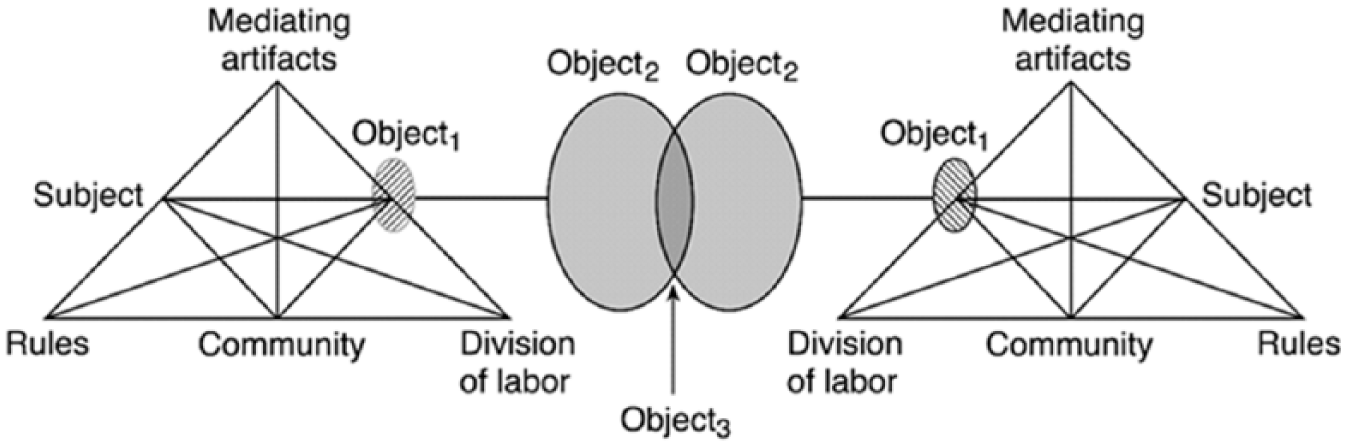
Third generation cultural-historical activity theory.
Introducing CHAT
CHAT has evolved through three generations. Initially, it focused on the work of Vygotsky, who explored the relationship between human activities and mediating artifacts, such as tools and signs (Engeström, 2005). Although insightful, the first generation was limited by its focus on individual actors. The second generation sought to overcome this problem. Developed by Leont’ev, second generation theory sought to differentiate between individual action and collective activity by considering rules, communities, and division of labor, thereby expanding Vygotsky’s triangular model. The focus was now on complex interactions between the individual subject and their wider community. Finally, the third generation sought to develop ways to understand cultural diversity, multiple dialogues, perspectives, activity networks, and boundary crossing (Engeström, 2001).
Third generation CHAT provides more than just a visual stimulus. It contains five key principles that make it possible to analyze the operational phase of TNE partnerships in greater detail by considering the way mediating artifacts, legacies, multiple voices and perspectives, roles and responsibilities, and learning influence faculty member activities and outcomes (Engeström, 2001). The principles state:
Although third generation CHAT (Engeström, 2001) is useful in analyzing the operational phase of a TNE partnership as it allows the subject (faculty member) to be investigated in relation to multiple dimensions, it carries limitations, whereby the aforementioned TNE partnership dimensions cannot fully be understood by solely applying CHAT. I therefore argue that CHAT requires further theoretical elaboration before empirical investigations commence.
Introducing the TMSA
Although Principle 5 of CHAT discusses how interacting activity systems have the potential to undergo “expansive transformation,” its abstract nature means application for the purposes of research is problematic. Therefore, the second theoretical framework to apply to CHAT is TMSA (Archer, 1998). Figure 2 depicts TMSA in its simplest form. Elements not explicit in CHAT, such as time (Figure 2: observed as T1, T2, T3, and T4), feedback loops, and the evolution of structure, fundamental to understanding TNE partnership development, become visible when TMSA is considered.
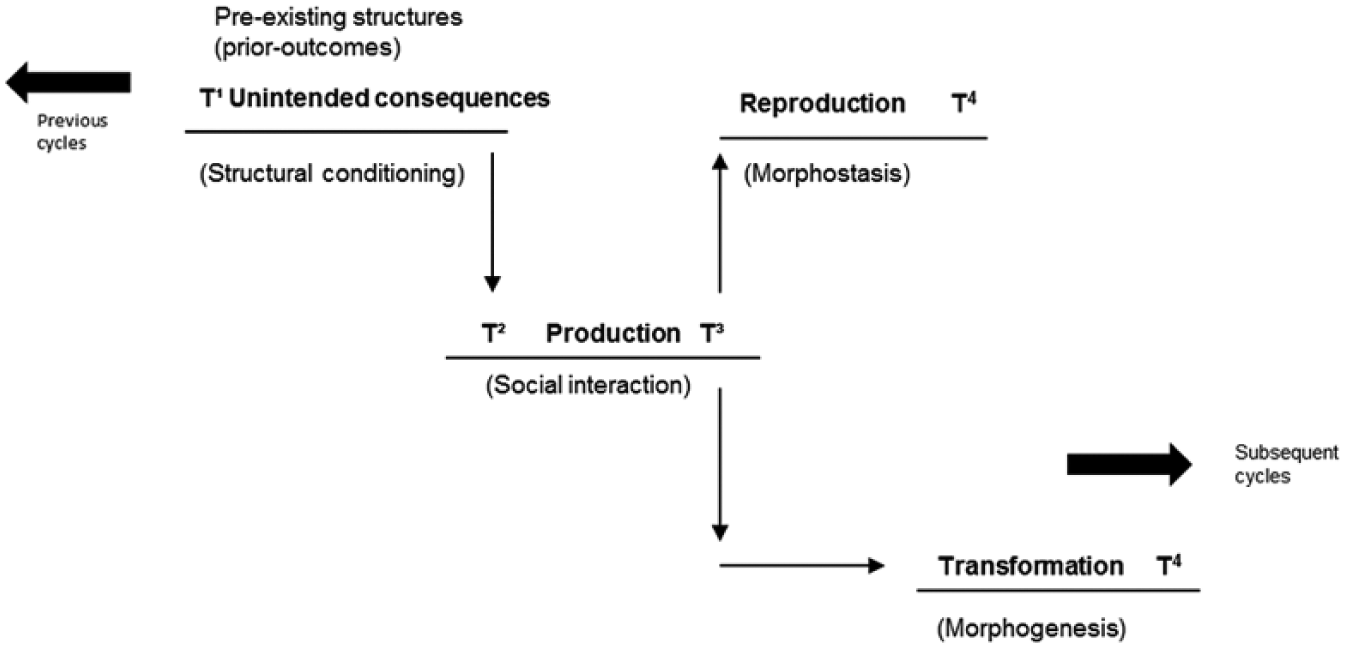
Superimposing the transformational model of social action and the morphogenetic/static cycle.
So why is TMSA important? TMSA implies that faculty members, conditioned by their partnership’s initial structure (which they may or may not have been party to), interact in the operational phase, producing outputs which see them reproducing (morphostasis) and subsequently transforming (morphogenesis) their partnership’s structure over time.
By combining the structural elements of CHAT, with the transformational elements evident in TMSA, it becomes possible to explore the dynamic relationship between structure and agency in more detail. It also enables empirical researchers to analyze faculty member operational tasks in regard to their reproductive qualities, and how these types of practices have the potential to transform partnership structures over time. For example, TNE programs with a flying faculty element may see this face-to-face activity generate greater understandings between faculty members. While reproductive in nature (year on year), face-to-face contact could lead to increased levels of empathy and compassion developing between faculty members, whereby activities are jointly designed or negotiated to suit the contexts in which they are being implemented. Trust, commitment, and communication are arguably enhanced (Heffernan & Poole, 2005), thereby strengthening relations and hopefully encouraging partnerships to transform and institutionalize over time (Amey et al., 2010). Other activities may simply slow or halt the possibility of positive transformation, such as tasks that create uncertainty, highlight cultural differences, or require too much time to implement. Once the identification of these tasks has occurred, activities have the possibility of being redesigned and managed.
Introducing SAT
Although CHAT seeks to explore joint activity in the transformation of systems and social structures, the psychological effects of joint activities, which are important in the development of integrative bonds between subjects (Molm, Whitham, & Melamed, 2012), are not explicitly stated. If activities foster psychological and social conditions (Roth, 2007), then clearly activity design and participation is important in ensuring faculty member relations remain positive.
As faculty members engage in activities, they generate outcomes. These outcomes can cause “ambiguity,” and encourage “sense making . . . and interpretation” (Engeström, 2001, p. 134) to take place. Therefore, depending on how faculty members interpret the outcomes of each other’s activities, TNE partnerships may suffer from periods of tension or conflict, whereby communication distorts and relationships become strained affecting subsequent interactions. Operational activity systems should therefore aim to make faculty member interactions as positive as possible. Vygotsky (1989) claims the relationship between emotions, practical actions, and reasoning is integral to the unit of activity, therefore making them dialectically related. This suggests faculty members, through their participation in operational practices, have the ability to stimulate emotional states (Roth, 2007), which third generation CHAT or TMSA cannot explicate.
Interpretation, associated meanings, and responses form a critical aspect of social interaction, and SAT (Weber, 1978) provides insight into the way actors interpret situations and apply meaning. Social action therefore enables the sense-making side of activity production to be explored. How faculty members understand and share their experiences with each other is arguably critical in helping them to understand the meanings behind each other’s actions. In addition, this understanding helps in the production of responses, whereby Weber (1978) suggests the more we can appreciate the conditions surrounding other people, the more empathy is generated. Weber (1978) suggests “rational certainty . . . and empathetic certainty” (p. 8) are important in helping individuals understand the actions of others. This is arguably critical to the development of relationships between operational faculty members. Face-to-face activities such as secondment and flying faculty may assist in the development of empathy. Furthermore, activities such as course evaluations, module evaluations, QAA audits, and assessment and feedback strategies may be rationalized due to strict codified rules of engagement. Furthermore, how we understand each other’s operational environment is very much dependent on the way the operational (activity) system is structured and managed.
It would be naïve for research focused on understanding operational faculty member relationships to neglect this psychological dimension. Social action therefore provides a third theoretical lens through which to analyze faculty member behavior. It allows us to postulate how staff associate meaning and understand each other’s operational tasks. Moreover, it allows us to discover which tasks stimulate positive responses and evaluate why that particular activity created that type of response.
Introducing an Alternative Theoretical Approach: Investigating the Operational Phase of TNE and the Role of Faculty Members
By amalgamating the aforementioned theoretical frameworks, Figure 3 offers an initial platform from which to launch an empirical investigation into TNE operational faculty member relationships, and how these relationships affect partnership development. The model can be applied to all types of TNE partners and all types of partnerships, for example, Sino-British partners, operating distance learning, dual degrees, franchise, or “joint” program partnerships.

Operational level transnational partnership development: A fusion model.
To strengthen TNE partnerships over time, faculty member operational activities ideally need to meet or exceed stakeholder expectations. This requires the ability to offer innovative solutions to operational problems, with faculty members actively reconfiguring and transforming their practices to suit the challenges that face them. However, reconfigurations may not always be possible, and expectations may not always be meet or exceeded.
Figure 3 enables researchers to postulate and evaluate the relationships between a series of factors—the subject (faculty member), artifacts (resources), rules (structures and systems), community groups, time, and division of labor—to access what may be blocking, limiting, or enhancing faculty member activities. For example, poor access to physical artifacts (resources), such as laboratory equipment, IT equipment, or key text books, may make the delivery of U.K. programs in China difficult between collaborating Sino and U.K. faculty members. To understand why this may be the case, Figure 3 allows researchers to explore the relationship between other factors, such as community groups, division of labor, time, and rules, and encourages an exploration of these factors in relation to the influence they may be having on access to physical resources. Clearly a lack of access to artifacts (resources) required to generate an activity is problematic. Without access to key text books or laboratory equipment, teaching and learning activities may be limited or even rendered impossible overseas. However, it may be that rules, policies, or stakeholder groups (central government, municipalities, or parents) can exert a controlling influence over the educational partnership that may not be initially obvious to those investigating faculty member operational interactions. Moreover, faculty members themselves may be unaware of underpinning forces that control their operational activities and outcomes. The aim of Figure 3 is to assist researchers in identifying and examining a series of factors and the relationships between them, so that the operational phase can be understood in detail. This type of investigation makes it possible to uncover where some of the challenges facing faculty members operationalizing TNE originate, and enable senior managers to consider the relationships between a series of factors that could potentially be modified to enhance faculty member interactions over time.
Conclusion
The aim of this article was to offer an alternative research approach in which to investigate the operational phase of TNE partnerships. For too long, TNE educational research has focused on the strategic initiation of overseas partnerships, or on the implementation of partnership for the sake of improving quality and pedagogical delivery. While these discussions are critically important, further investigations into the operational phase of TNE can expand our knowledge of this rapidly growing phenomenon.
By considering the operational phase of TNE as an interacting, cross-boundary activity system, it becomes possible to identify, examine, and evaluate relationships between a series of factors: activities, rules, stakeholders, resources, historicity, and motive. By adding additional theories such as TMSA and social action, further variables become visible, such as time, reproduction, transformation, and the meaning of action. These dimensions can then be analyzed in relation to the influencing effect they have on the subject (faculty member). TNE operational research can now focus on exploring how these variables affect operational faculty member interactions and outcomes. Moreover, these engagements and the outcomes of these interactions can be analyzed to discover which variables seemingly have the greatest influencing factor on faculty behavior over time.
Although pervious research is informative and engaging, there is an opportunity to advance theory in the area of TNE operations that relates specifically to faculty member practices, interpretations, and responses. In addition, research findings could be utilized to develop HEI TNE partnership strategies and structures which could benefit faculty members in their operational tasks, thereby strengthening relations between international operational teams. This article recommends senior management engage with research that utilizes this alternative approach to research so working environments and the needs of operational faculty members can be enhanced over time. Operational activities have the potential to transform, positively or negatively, international partnership relationships. Moreover, it is these social relations that underpin TNE programs, creating implications for quality assurance, pedagogy, and the overseas student experience of U.K. higher education.
Footnotes
Declaration of Conflicting Interests
The author(s) declared no potential conflicts of interest with respect to the research, authorship, and/or publication of this article.
Funding
The author(s) received no financial support for the research, authorship, and/or publication of this article.