




Abstract
This study assessed both local and international students’ satisfaction on dimensions that may foster or disadvantage their learning experience in a recently established English-medium instruction (EMI) undergraduate international business program in Southern Taiwan. The study recruited 278 students (171 local and 97 international), and assessed their satisfaction with program management, interaction with peers within the program, and cultural diversity in the university. The results indicated that both local and international students were satisfied with local students’ openness to foreign cultures, students’ ability to communicate in English during class, content of courses, and the level of internationalization of the college. All participants, however, were significantly dissatisfied with the depth and frequency of social interaction outside classrooms, and with the facilities and management offered by the university. Findings of this study may have managerial and instructional implications for staff and faculty of English-medium programs in identifying potential issues and improving student retention.
Keywords
Almost 20 years ago, Graddol (1997) pointed out that “one of the most significant educational trends world-wide is the teaching of a growing number of courses in universities through the medium of English” (p. 45). His words have proven to be prophetic. Increasing numbers of higher education institutions worldwide, striving to internationalize their campuses, have made greater efforts in recruiting international students by introducing English-medium instruction (EMI) courses and entire degree programs. Taiwanese universities are no exception, especially after the government forecast a sharp decline in local student enrollment in the 2016 academic year consequent on low fertility rates in the late 1990s (“Taiwan Plans to Close up a Third,” 2015). To compensate for the falling number of students, and to enhance the visibility of local higher education institutions, since 2005 the Taiwan Ministry of Education (MOE) has commissioned the Foundation for International Cooperation in Higher Education of Taiwan (FICHET), a nonprofit organization in Taiwan, as the primary platform for recruitment and international cooperation between Taiwanese universities and international higher educational institutions worldwide. At the same time, to increase their competitive edge and promote cross-cultural learning experience on campus, EMI programs have burgeoned across Taiwan’s predominantly Chinese-speaking universities (Chang, 2010). With the aim also of creating international programs that accommodate both international and domestic students by using English as the medium of instruction (EMI; Chen & Kraklow, 2015), these English-taught programs have expanded beyond language-related departments, with some universities establishing separate international colleges to house these programs. According to the most recently published information (FICHET, 2011-2015), among the 156 Taiwanese universities, 49 offer 121 English-taught undergraduate and graduate programs, including disciplines such as engineering and technology (40), business and management (38), social science (15), agriculture and fishing (eight), medicine and biotechnology (13), and environment and tourism (seven). Some of these programs also offer either exchange or dual-degree programs with affiliated institutions overseas to provide students with more diversified and richer international experiences.
To ensure the quality of these EMI programs, starting in 2009, FICHET has launched ongoing reviews of these Taiwan-based international programs on the following seven dimensions: (a) university’s goals and missions for globalization; (b) non-language barrier learning environment; (c) academic and administrative supporting schemes for international students; (d) counseling and follow-up internships, job opportunities, and alumni associations for international students; (e) curriculum and program design (added in 2012); (f) international mobility (added in 2012); and (g) English-language university website. Each year, FICHET updates and publishes a list of recommended programs on its website for prospective students.
Mr. Ma Ying-jeou, former president of Taiwan, proclaimed that the government would have recruited 150,000 international students by 2020, and the number would account for 10% of the total student population in Taiwan’s higher education. To be more specific, official usage in Taiwan defines an international student as “an individual of foreign nationality, who has never held nationality status from the Republic of China (“R.O.C.”) and who does not possess an overseas Chinese student status . . . ” (MOE, Republic of China, 2013). In the meantime, Taiwan’s Executive Yuan, the government branch in charge of execution of national policies, has also drawn up an 8-year plan to increase the number of Chinese-language centers, in hopes of attracting more international students to study Mandarin Chinese and, accordingly, possibly pursue their undergraduate or graduate degrees in local universities (Leung, 2014).
Compared with the tuition and fees needed if a student were to study in American or British universities, EMI programs in Taiwan appear to be relatively affordable alternatives (between approximately US$1,100 and US$2,500 per semester), which appeals both to local and international students seeking immersion in an English-only learning environment. In addition, in terms of economic performance, government proficiency, business efficiency, and infrastructure, Taiwan has had a reputable ranking on the dimension of competitiveness: ranked 13th in 2014 and 11th in 2015 by the World Competitiveness Center (IMD World Competitiveness Center, 2015); and ranked 15th in 2016 and 14th in 2017 by the World Economic Forum (Schwab, 2016). Therefore, more and more students from regions near and far have made Taiwan a destination to further their studies and seek potential local employment opportunities after graduation. Official statistics show the number of international students studying in Taiwan rose dramatically from 27,023 to 92,685 between 2006 and 2014 (MOE, Republic of China, 2015). Moreover, in a more recent press release on the MOE’s Department of International and Cross-Strait Education official webpage (2016), as of January 2016, the number of noncitizen students (as they are officially termed) reached 110,182, which marks a 17.66% increase from the previous year.
In a survey of 2,759 international students who were studying in Taiwan as of October 2015, among the degree-seeking students the top three reasons for choosing Taiwan as their study destination were provision of scholarships/stipends, reputable and quality higher education, and studies of Mandarin Chinese (FICHET, 2011-2015). These findings resonate with those of other Taiwanese scholars such as Ko (2008) and Roberts, Chou, and Ching (2010) for reasons why international students choose Taiwan. Consequently, it is becoming common in Taiwan to see students of different cultural and linguistic backgrounds sitting side by side in college classrooms attending to English-medium lectures.
Review of Literature
There is a growing empirical literature on student satisfaction with, or perception of, EMI courses in Asian universities (e.g., Byun et al., 2011; Chang, 2010; Floris, 2014; Hu & Lei, 2014; D.-F. Huang, 2015; Kim, Tatar, & Choi, 2014; Kondakci, 2011; Lei & Hu, 2014; Wu, 2006; Yeh, 2014), including some studies focusing on content courses in global/international business (e.g., Hu & Lei, 2014; S. C. Huang & Chung, 2000; Kym & Kym, 2014).
However, the scale of studies done on EMI business courses or programs offered in the predominantly Chinese-speaking universities (i.e., Mainland China and Taiwan) is relatively small and mostly on native Mandarin Chinese-speaking students. For instance, in S. C. Huang and Chung’s study (2000), they selected 48 college seniors across different disciplines taking the same Global Business course in a Taiwanese university and investigated their attributions of performance in the course. In Hu and Lei’s (2014) case study, they chose students from EMI (6) and its parallel CMI Business Administration programs on the same campus to discuss their language beliefs in English and EMI and at a personal, institutional, and national level.
Wu (2006) conducted an investigation with 28 graduate students studying in a private technological university, which may be the first of its kind. Students interviewed in the study reported having a less-than-satisfactory level of English proficiency, but were convinced that taking EMI courses would help them advance their command of English, while they chose not to engage themselves interactively with their peers and instructors in English. Simultaneously, their instructors did not thoroughly reinforce the English-only policy. Later, in Chang’s (2010) study of 370 Taiwanese undergraduate students and six professors in colleges of engineering, management, and informatics who were involved in the learning and instruction of EMI courses in a private university, she found at the end of the course that while students generally did not regard themselves as comprehending the lectures to a great extent, they reported an improvement in listening, and expressed appreciation toward their instructors for lowering their level of anxiety in class. About 80% of the students interviewed felt satisfied with or neutral (i.e., neither satisfied nor dissatisfied) toward their EMI courses. In a similar vein, D.-F. Huang (2015) investigated the experience of 157 local and international students taking EMI courses in a private technological university in southern Taiwan. He pointed out that although both groups of students were motivated to take EMI courses to improve their language proficiency and found such courses useful, the two groups demonstrated significant differences in terms of motivation, anxiety, and achievement: The locals reported experiencing higher levels of anxiety and lower motivation and sense of achievement compared with their international peers, possibly because of a self-perceived low level of English proficiency. Moreover, Yeh’s (2014) study of 476 undergraduate and graduate students across six Taiwanese universities also reported students’ learning difficulties in EMI courses because of their insufficient English competency, despite their overall satisfaction with the courses they chose to take.
The focus in this literature, however, is on issues such as students’ language proficiencies, the varying demands of different academic situations, and EMI support for specific courses (rather than a complete degree program) where the teachers are usually nonnative English speakers and the students typically are local ones. Identifying an empirical study that discusses and assesses simultaneously the experiences both of international students and local students studying in the same program is difficult. A rare example that focuses on international student satisfaction in Asian universities is Kondakci’s (2011) paper on the rationale for in-bound international student mobility in Turkish universities.
The present study, therefore, focused on student satisfaction in an international business degree program where all subject coursework instruction was in English, where there was a high proportion of native English-speaking instructors, and where international students comprised approximately one-quarter of the student body. Therefore, this study hopes to complement the existing literature on the up-to-date development of international programs in Taiwan and to stimulate further research investigating the challenges and opportunities such EMI programs present.
Method
The authors developed a 44-item questionnaire inspired by the items proposed by Kondakci (2011) to suit the situation of the target students in the sample. The present study is part of a larger scale study investigating students’ determinants for international students’ choices of destination for studying abroad, which resembled the setup of the Kondakci (2011) study. A 5-point Likert-type scale was used, with 1 being strongly dissatisfied and 5 being strongly satisfied. In addition, the negatively keyed items were reverse-scored before the analyses were conducted. The analyses included three parts. First, an exploratory factor analysis was conducted using R (version 2.15.2) to determine the number of factors that could be derived from the items on the questionnaire. Second, the level of students’ satisfaction on each factor and its significance was investigated. Last, possible between-group differences (i.e., international vs. local, male vs. female) on the factors were examined.
Background Information of the Program
In the College (which consists of four departments) where we recruited our participants, all courses, except for Chinese literature courses for Chinese-speaking students, are conducted in English. Nonetheless, for some of the required core courses with which our Chinese-speaking students would struggle (e.g., statistics, accounting, managerial math, to name a few), the College offers remedial evening courses (in which participation is entirely voluntary) taught by teachers who are proficient in both Mandarin Chinese and English. These courses, however, do not form part of the curriculum of any of the four departments, nor do they carry any credit, and constitute a form of tutoring only.
As for students’ general English proficiency upon entering the College, for local Taiwanese students who took the College Entrance Examination, their level of English was at the 50th percentile among their peers. For the international applicants, their high school transcript, a statement of purpose written in English, and a proof of English proficiency examination score are required when they apply. The official statement about the English-language proficiency requirements for the College, and from the University’s Office of International and Cross-Strait Affairs Handbook, is “an English proficiency certificate (e.g., TOEFL, IELTS, TOEIC, GEPT) (only for applicants from non-English-speaking countries). Those with an IELTS band score of 5.0 or higher will enjoy admission priority.” In practice, the departmental selection committees do not recommend admission of any applicant who does not demonstrate a score of 500 on TOEIC (or equivalent) as a minimum level of proficiency. Upon graduation, the College requires its graduates to demonstrate a level of English proficiency that meets or exceeds one of the following standards: (a) TOEFL iBT 70, (b) TOEIC 750, (c) IELTS 5.5, and (d) BULATS ALTE Level 3 (or CEFR B2).
As the curricula in the College do not require students to take any courses taught in Chinese (other than those in Chinese literature that are required by MOE regulations and for which special arrangements are in place to offer the course in English to non-Mandarin speakers), we did not measure the students’ proficiency in Chinese in this study as, in our collective opinion, it was not essential to the interpretation of our findings. Among local Taiwanese students who took the College Entrance Examination, the level of Chinese proficiency was at the 50th percentile among their peers. As for the level of Chinese-language proficiency among international students upon entering the College, except for students who had Mandarin-speaking parents or were recipients of the Taiwan Scholarship (a scholarship offered by the Taiwan ROC Ministry of Foreign Affairs for students who first take Mandarin Chinese classes only in Taiwanese universities, and who later apply to undergraduate or graduate programs in Taiwan), a small number were at the beginner’s level, but most spoke no Chinese at all. To encourage the non-Chinese-speaking students to learn the local language and to help them adapt to life in Taiwan, the University’s Chinese Language Center provides students (and non-Mandarin-speaking international faculty members) with voluntary, free, Chinese lessons throughout their 4 years of studies.
Participants
A total of 278 students, comprising 179 females (or 64.4% of informants) and 99 males (35.6% of informants), enrolled in an undergraduate International Business Administration program in an international college in Southern Taiwan, participated in this study. The program is one of four in the international college in which all instruction is in English only and where foreign nationals dominate the teaching faculty.
One hundred eighty-one (or 65%) of the informants were local students, and 97 (or 35%) were international students from El Salvador (1), France (1), Haiti (5), Hong Kong (9), India (2), Indonesia (1), Malaysia (26), Mongolia (24), Nepal (1), Philippines (1), Russia (1), South Korea (1), Swaziland (2), Thailand (7), the United States (4), and Vietnam (7). Their ages ranged from 17 to 31, and the mean age was 20 years.
Results
An exploratory factor analysis was conducted on the 44 items with oblique rotation (oblimin). The overall Kaiser-Meyer-Olkin (KMO) was 0.84, and all KMO values for individual items were well above the acceptable limit of 0.5. Barlett’s test of sphericity, χ2(946) = 7,023, p < .001, indicating that correlations between items were sufficiently large for principal components analysis. Ten components had eigenvalues over Kaiser’s criterion of 1, accounting for 68% of the variance. Data analysis suggested the following 10 factors: (a) Taiwanese students’ susceptibility to foreign cultures; (b) school management responsiveness; (c) students’ ability to use English to communicate in class; (d) cross-cultural diversity within the college; (e) students’ perception of internationalization of the college; (f) students’ barriers to social interaction; (g) language of communication used by the University; (h) students’ perception of campus facilities; (i) variety of food available on campus; and (j) students’ perception of course content.
The results of the second part of the analyses are summarized in Table 1. They show that both international and local students were significantly satisfied on four factors: Taiwanese students’ susceptibility to foreign cultures (MIntl = 3.54, SD = 0.78, t(96) = 6.87, p < .001; MLocal = 3.94, SD = 0.63, t(180) = 20.24, p < .001; two-tailed tests), students’ ability to use English to communicate in class (MIntl = 3.73, SD = 0.59, t(96) = 12.03, p < .001; MLocal = 3.50, SD = 0.66, t(180) = 10.10, p < .001; two-tailed tests), students’ perception of course content (MIntl = 3.28, SD = 0.79, t(96) = 3.55, p ≤ .01; MLocal = 3.62, SD = 0.83, t(180) = 10.02, p < .001; two-tailed tests), and students’ perception of internationalization of the college (MIntl = 3.25, SD = 0.71, t(96) = 3.39, p < .01; MLocal = 3.29, SD = 0.64, t(180) = 6.04, p < .001; two-tailed tests). On the contrary, both groups were also significantly dissatisfied on four factors: students’ barriers to social interaction (MIntl = 2.41, SD = 0.69, t(96) = -8.38, p < .001; MLocal = 2.42, SD = 0.70, t(180) = -11.28, p < .001; two-tailed tests), language of communication used by the university (MIntl = 2.12, SD = 0.87, t(96) = -10.06, p < .001; MLocal = 2.30, SD = 0.82, t(180) = -11.53, p < .001; two-tailed tests), students’ perception of campus facilities (MIntl = 2.55, SD = 0.83, t(96) = -5.33, p < .001; MLocal = 2.40, SD = 0.78, t(180) = -10.38, p < .001; two-tailed tests), and variety of food available on campus (MIntl = 2.08, SD = 0.85, t(96) = -10.67, p < .001; MLocal = 1.92, SD = 0.80, t(180) = -18.10, p < .001; two-tailed tests). As for the satisfaction ratings on the remaining two factors, local and international students differed: Local students were significantly satisfied with the cross-cultural diversity within the college (MLocal = 3.12, SD = 0.76, t(180) = 2.04 p < .05; two-tailed tests), while they were significantly dissatisfied in school management responsiveness (MLocal = 2.86, SD = 0.70, t(180) = -2.69, p < .01; two-tailed tests).
Testing for Satisfaction Significance and Between-Group Significance.
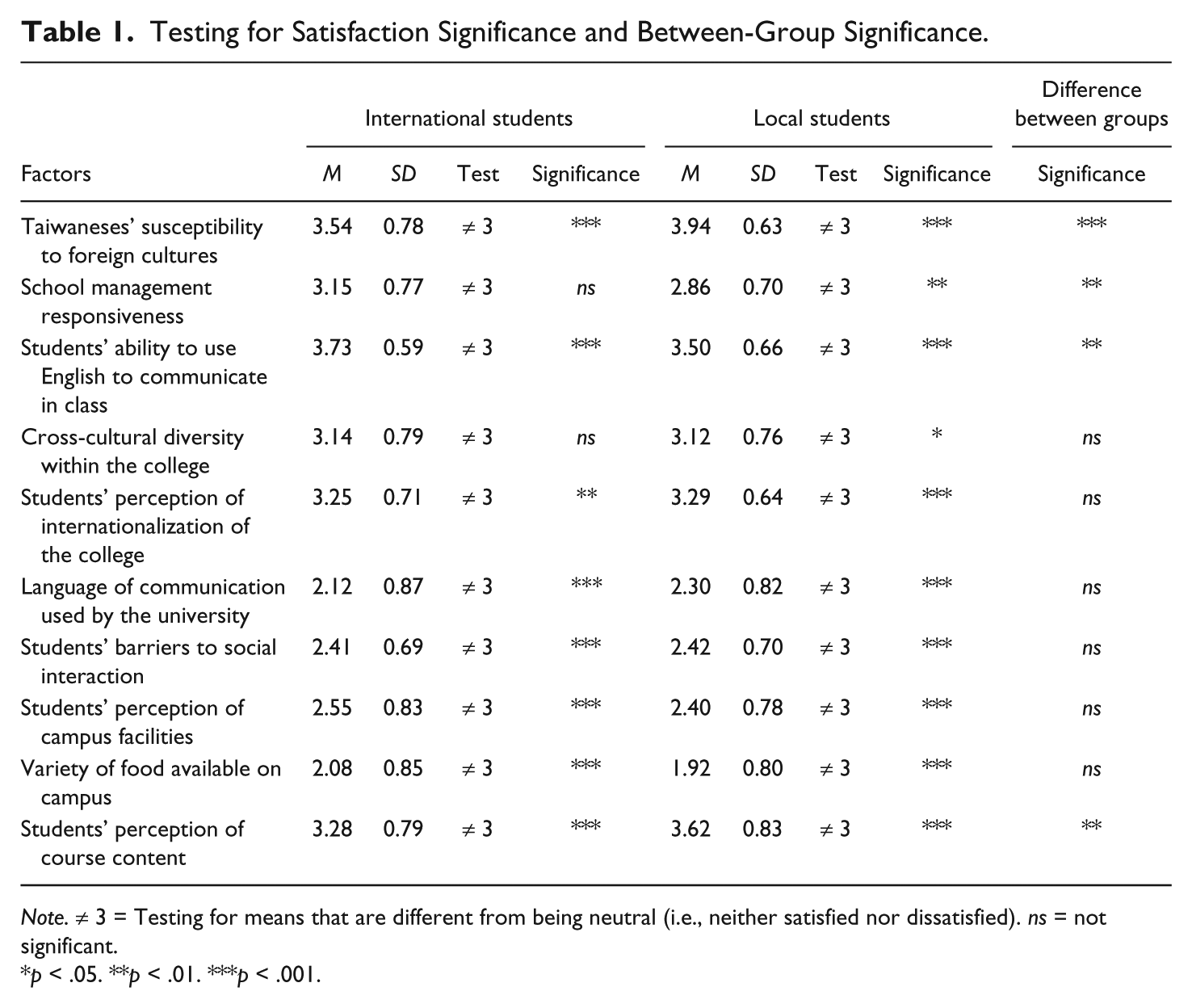
Note. ≠ 3 = Testing for means that are different from being neutral (i.e., neither satisfied nor dissatisfied). ns = not significant.
p < .05. **p < .01. ***p < .001.
A MANOVA was conducted on the ranked data using Munzel and Brunner’s (2000) method, implemented in R using the mulrank() function (Wilcox, 2012). There was a significant main effect of the student type (i.e., international vs. local) on the 10 factors (F = 6.38, p < .001). Followed by individual ANOVAs, the third part of the analyses showed that there were some significant differences between the satisfaction ratings of international students and those of local students on four factors. Local students were significantly more satisfied than international students on factors such as Taiwanese students’ susceptibility to foreign cultures, F(1, 164.03) = 19.21, p < .001; students’ ability to use English to communicate in class, F(1, 215.13) = 8.71, p < .01; and students’ perception of course content, F(1, 205.74) = 11.02, p < .01, but were significantly more dissatisfied with school management responsiveness, F(1, 180.11) = 9.14, p < .01. Overall, both local students and international students were quite consistent in their ratings. The only exception was school management responsiveness.
Overall, both local and international students were quite consistent in their ratings. Examination of the results presented above shows that both local and international students were significantly satisfied with interpersonal relations in the classroom environment and in the content of their courses, that is, with departmental-level issues. Students, however, were dissatisfied with interpersonal relations outside the classroom environment, and with official support structures for on-campus life, that is, with university-level issues.
Local and international students differed on satisfaction or dissatisfaction with cross-cultural diversity (e.g., the 65:35 split between local and foreign students), and school management responsiveness, that is, with issues outside departmental responsibility.
Discussion
This study’s major importance is fourfold. First, it is a rare example of a focus on the satisfaction of both local and international students within a totally EMI-based international business undergraduate program. Second, we extended the Kondakci study by including local students in our sample. The results nonetheless indicate that both local and international students, to a large extent, were quite consistent in their satisfaction ratings on all these factors, even though the strength of satisfaction may be different between the two groups on some of the factors. Unlike the major English-speaking countries (e.g., the United States, the United Kingdom, Canada, and Australia) that receive the majority of the influx of international students (Organization for Economic Co-Operation and Development, 2014), Taiwan (like Turkey, in terms of economic development) is a peripheral but growing hub in attracting international students who aspire to study overseas. The authors (believing in the value of replication in advancing scientific understanding) used the Kondakci (2011) study as a model. As Park (2004) noted, “The activity itself, regardless of the degree of precision of the replication, can have great merit in extending understanding about a method or a concept” (p. 189).
Third, our study provides some managerial implications, especially for factors with which both local and international students were dissatisfied, for example, barriers to social interaction. When we looked at students’ responses on this factor with those on the participation in classroom factor, an interesting phenomenon emerged: International students were more satisfied than local students with their participation in class, and both groups were dissatisfied when they were in social settings. In light of this outcome, we suspect that the majority of local students’ command of English may not be compatible with that of some of their international peers when it comes to verbally expressing themselves fluently. To prevent themselves from making mistakes or embarrassing themselves, consequently, local students became reluctant to use English in class participation and social interaction. It is likely that the university may assume good social interaction between the two groups will arise naturally by simply putting both groups of students in the same program where English is used as the medium of instruction. Unfortunately, our results suggest that this assumption can be problematic, because students come with their various linguistic backgrounds and different proficiency levels in English. Another example is the language of communication used by the university. We found that students in our sample rated unanimously that the university tended to ignore international students’ linguistic needs and their limited comprehension of the Chinese language by overwhelmingly using Mandarin Chinese as the primary mode of official communication. Actually, our results suggest that even local students are dissatisfied with such means of communication in an international college, where English is expected to be used as the working language.
To improve student retention and satisfaction in such programs, we echo Mellion’s (2008) recommendations concerning the necessary curriculum and other support if EMI programs are to be successful. Imposing stringent standards on applicants’ English proficiency and maximizing the use of English in official communications appears to be crucial for student satisfaction.
Ultimately, we propose that the university should consider adopting the following measures to improve students’ overall experience in their program: (a) screen incoming students’ English proficiency with more stringent standards to minimize the gap between proficient English users and struggling English users to foster optimal learning experiences; (b) along with the specialized subjects in their major, students should be required to attend remedial English classes that meet their individual needs to ensure their comprehension and retention of the knowledge acquired in class; (c) in addition to the summative evaluation (i.e., meeting the English requirement for graduation, for example, 70 on TOEFL iBT or 5.5 on IELTS) that students have to pass before obtaining their bachelor’s degree, periodical formative assessments on students’ English comprehension and progress need to be administered by instructors with expertise in ESL to ensure teaching effectiveness; and (d) all forms of communication between the university and its students should be conducted in both Mandarin Chinese and English. Even though total English immersion was promised by the program, granting non-Chinese-speaking students opportunities to be exposed to the Chinese language on a daily basis may actually facilitate their adaptation in the host country. In so doing, both international and local students can get the maximum benefits from studying in an international college.
Overall, our study provides some insights on the satisfaction factors for both international and local students in an international college which is situated in a non-English-speaking country. In addition, no conflicts were found in terms of satisfaction factors between local and international students. We believe that these results may serve as a dose of healthy precaution in helping administrators of international programs identify potential problems, which, in turn, can improve the overall satisfaction of both domestic and international students.
In conclusion, as noted earlier, the empirical literature on international student flow, including that on EMI programs and student experiences, focuses largely on core countries such as Australia, Canada, the United Kingdom, and the United States. Although there was only a small number of nonethnic Chinese among the international students in this study, their presence demonstrates the complexity of the international student mobility phenomenon by showing how students from non-English-speaking peripheral countries can choose EMI programs in other similarly non-English-speaking peripheral countries and, thereby, enhance their total international educational experience in new and different ways. Our findings also illustrate how interaction between Taiwanese and international students from non-English-speaking backgrounds can benefit both groups of students if appropriately managed by a university’s administrative procedures and student support infrastructure. Furthermore, the composition of the student sample in the current study suggests that student mobility is not just from less-developed countries toward more developed countries, but can include student flow from countries of similar levels of economic development, particularly if opportunities for admission to EMI programs in a student’s home country are restricted for one reason or another. Examples of this situation were presented among our student sample in the case of ethnic Chinese students and university admission quotas in Malaysia, and non-Chinese residents of Hong Kong SAR, who cannot speak Mandarin sufficiently well to secure admission to local universities, where lectures predominantly are delivered in Mandarin. These are areas for future research.
Footnotes
Declaration of Conflicting Interests
The author(s) declared no potential conflicts of interest with respect to the research, authorship, and/or publication of this article.
Funding
The author(s) received no financial support for the research, authorship, and/or publication of this article.