



Abstract
This article evaluates the degree to which international students are satisfied with different dimensions of their university experience, namely, their arrival, living, learning, and support service experiences. Using quantitative survey research methods based on data from the International Student Barometer (ISB), the study evaluates the experience of over 45,000 degree-seeking, undergraduate international students at 96 different institutions in Australia, the United Kingdom, and the United States. Multiple regression analyses indicated that all four dimensions of satisfaction were positively associated with students’ overall university experience, and the article reveals which of the four is the most influential. To the authors’ knowledge, this study represents the first time that a comparative meta-analysis of ISB data across institutions in the three chosen countries has been undertaken. Key implications are discussed for how university administrators, practitioners, and researchers might best allocate resources to support and enhance the experience of international students, leading to more effective institutional recruitment and retention strategies. The study also offers a baseline for future research on international student satisfaction.
Keywords
Introduction
International students are an important source of diversity at institutions of higher education as they bring with them new perspectives and help cultivate intercultural awareness and engagement among campus and community members (Lee & Rice, 2007). Although several authors argue that institutions fail to capitalize on this (e.g., Leask, 2010; Montgomery, 2010; Volet & Ang, 1998), their presence on campus can create more opportunities for all students to increase their level of interaction across cultures, which can in turn lead to enhanced global competencies, leadership skills, and intellectual development (Luo & Jamieson-Drake, 2013). In this sense, they can support the broader internationalization efforts of institutions of higher education, defined by de Wit, Hunter, Howard, and Egron-Polak (2015) as the intentional process of integrating an international, intercultural or global dimension into the purpose, functions and delivery of post-secondary education, in order to enhance the quality of education and research for all students and staff, and to make a meaningful contribution to society. (p. 29)
One of the guiding research questions for this study was to evaluate the level of satisfaction with International Student Support offices at institutions in the United States. This was due to record-high numbers of international students over the last decade and the urgent requirement to effectively support the needs of this diverse population. The scope was extended to include a broader perspective from Australia and the United Kingdom, countries which have been successful at operationalizing innovative models and best practices for supporting international students.
International students are integral to institutional and national reputation, cultural enrichment, and economic gain of host countries and can be a driver for campus internationalization (Forbes-Mewett, 2016). In purely economic terms, a recent study for the U.K.’s Higher Education Policy Institute and Kaplan International (Higher Education Policy Institute, 2018) found that the benefits of international students to the United Kingdom are 10 times greater than the costs. The role of international students in the context of higher education internationalization, however, is more than just increasing numbers and meeting the financial goals of institutions. Wider societal benefits arising from student mobility include preparation for skilled migration, addressing capacity building or skills shortages in either the home or the host country, and soft power support for closer ties between nations (Mellors-Bourne, Humfrey, Kemp, & Woodfield, 2013). Nevertheless, in this article, we focus on institutions themselves and seek to highlight the different dimensions of experience with which students are most and least satisfied, using results from a large global survey, the International Student Barometer (ISB) (i-graduate, 2014), along with the aspects within those dimensions which have greatest influence on overall student satisfaction.
Review of Literature
International Student Numbers
Globally, the number of students enrolled in tertiary education outside their country of citizenship increased more than 3 times, from 1.3 million in 1990 to nearly 5 million in 2015 (Organisation for Economic Co-Operation and Development, 2015). The United States, the United Kingdom, and Australia attract the largest number of international students from around the world and have been leaders in developing successful international recruitment strategies and practices, supported by attention to the student experience. According to the Institute of International Education (2017), the number of international students enrolled in U.S. higher education in 2016 increased by 7.1% from the previous year to over a million, representing an increase of 85% over just a decade ago. There were 496,000 international students studying in the United Kingdom, the second largest host of international students after the United States, and more than 292,000 international students in Australian higher education in 2015 (Institute of International Education, 2017).
It remains critical, therefore, for universities to ensure that international students receive the support they need so they can have a positive experience, be academically successful, and become fully engaged members of the community, just as is the case for domestic students. With rising numbers, the responsibility of fostering a welcoming campus environment and maintaining quality may come under pressure. Indeed, Choudaha and Hu (n.d.) have argued that a majority of institutions, particularly in the United States, still struggle to provide adequate resources that meet the expectations and experiences of their high-paying international students.
Coping with a new academic setting and environment can be challenging for all students, particularly those from diverse geographical, societal, or cultural backgrounds, which may include international students (Jones, 2017). Adapting to a different society, culture, and often language, away from family and friends, can make the university experience particularly stressful for international students (Bista & Foster, 2016; Perrucci & Hu, 1995). They may not only have to adjust to new program requirements, academic culture, and participation styles, but also to alternative social and cultural norms, such as communication styles, eating options, living arrangements, and making new friends. The continued growth in numbers has challenged many universities to focus on more than simply the academic aspects of the student experience, including services and other matters related to their stay and general comfort (Kelo, Rogers, & Rumbley, 2010). In countries with well-established international recruitment, there is a recognition that providing adequate support services and resources for international students can contribute to a positive experience and serve as a key factor in attracting and retaining other international students. Improving the international student experience is thus critical to remaining competitive in the global student market (Baranova, Morrison, & Mutton, 2011).
International Student Experience
Several factors can directly influence experience during a program of study. Jones (2017) identifies four interrelated aspects that could have a bearing on student experience in the academic, living, and social domains. These are personal history, family context, national context, and institutional nature and location, including institutional values and support services. Archer, Jones, and Davison (2010) offer recommendations on improving international student experience at different stages of their program, including application and arrival, cultural and social integration, accommodation and living, work experience, and employability. They also affirm the need for better communication, coordination of services, appropriate use of technology, flexibility, and management of expectations.
Nyland, Forbes-Mewett, and Härtel (2013) suggest that the commercialization of international education could have a direct impact on the experience of international students if not properly governed. They identify three main challenges that international students in Australia commonly face: (a) serious financial difficulties leading to anxiety, stress, poor academic performance, and adjustment and health issues, due to a misrepresentation of the cost of living by recruiters; (b) limited assistance by support offices in helping students find affordable housing options in lieu of expensive on-campus housing; and (c) lack of support and infrastructure to address personal safety and security concerns on campus and in the community.
In a study at the University of Derby, Baranova et al. (2011) found that the main factors contributing to a 32% improvement in student experience in just one year were the quality of information and media channels used, greater access to online enrollment options, additional customer service training for service staff, a new self-service system for ID collection, and a revamped welcome week program focusing on student transition and acculturation to their new campus environment.
International Student Satisfaction
Wiers-Jenssen, Stensaker, and Grøgaard (2002) define student satisfaction as students’ assessment of the services provided by universities and colleges, including the quality of teaching and academic services, support facilities, physical infrastructure, and social climate, among other factors. It is a continually changing construct and a dynamic process that requires clear and effective action as a result of student feedback (Elliott & Shin, 2002). Student satisfaction represents subjective experience during study and perceived value of the educational experience (Astin, 1993). According to Perez-Encinas and Ammigan (2016), institutions that actively surveyed their international students, using either in-house surveys or third-party instruments, found the feedback to be effective in improving customer service, student advising, programming, outreach and educational training.
In recent years, international student satisfaction data has been used as a way to influence campus change and strengthen support services for this community. Yu, Isensee, and Kappler (2016) explored how data from the ISB (i-graduate, 2014) could be used collaboratively to drive change and enhance campus internationalization within the University of Minnesota. The authors found that information overload and a busy schedule during orientation, limited airport pickup services, and a lack of short-term accommodation options affected student satisfaction with their arrival experience. In terms of their learning environment, international students indicated that it was highly rewarding to be involved in diverse learning activities and regular scholarly exchanges with faculty and other classmates, which they believe led to new learning opportunities, cross-cultural perspectives, and intercultural friendships. The study also found that students struggled to develop friendships with both local and other international students, and often experienced a disconnect with the wider campus community outside the classroom (Yu, Isensee, & Kappler, 2016).
In investigating the relationship between student expectations and student satisfaction, Appleton-Knapp and Krentler (2006) found that those whose expectations of the educational experience were exceeded were more satisfied with their learning environment than students whose experience did not meet their expectations. Hence, having a sound understanding of the factors affecting expectations and how they influence student satisfaction is critical for higher education practitioners and administrators.
Support for International Students
While the structure and organization of support services for international students can vary greatly in function, role, and reporting line, universities in the United States, United Kingdom, and Australia commonly have dedicated offices designed to support students in their academic, cultural, and social transition to campus. These offices usually provide a wide range of services from advising on immigration compliance, academic, employment, financial, and personal issues, to hosting social and cultural programs that help with the adaptation and acculturation process (Council for the Advancement of Standards in Higher Education, n.d.). However, the American Council on Education (n.d.) notes that international student retention relates to campus-wide experiences, so collaboration is needed between student affairs and services personnel, career and counseling centers, residence and housing departments, dining facilities, multicultural centers, academic staff and professional administrators within faculties in order to address the needs of international students across the university as a whole (Jones, 2013) and advocate for additional resources whenever necessary.
Method
In the context of the available literature, some of which has been reviewed here, this study examines the level of satisfaction of degree-seeking, undergraduate international students with their experience at institutions of higher education in Australia, the United Kingdom, and the United States. Specifically, it investigates arrival, living, learning, and support service experiences and their influence on student satisfaction with the institutional experience overall. We have chosen to limit our focus to these three countries because of the following reasons: (a) the United States, the United Kingdom, and Australia were the top English-speaking study destinations globally in 2016, hosting the most international students, particularly undergraduate students (Institute of International Education, 2016); (b) this offers an already large sample size of over 45,000 student responses from nearly 100 institutions, allowing inferences for other institutional contexts; and (c) while there is a robust literature base on international student mobility and experience in these three countries, none provide a detailed comparative perspective on student experiences with arrival, living, learning, and support services and their impact on overall university satisfaction.
Instrument
The instrument used in this study was the International Student Barometer, or ISB, originally developed by i-graduate International Insight Company in 2005 (i-graduate, 2014). As the most widely used benchmarking tool for tracking the international student experience globally, the ISB has gathered feedback from more than 3 million students across all student types, levels, and years of study (i-graduate, 2014). Since its inception, the ISB has been periodically tested for validity and reliability and, as argued by Brett (2013), has been refined through over 14 cycles as an industry standard for understanding international student satisfaction at institutions across the world. The ISB uses a 4-point Likert-type scale to rate degrees of satisfaction (1 = very dissatisfied, 2 = dissatisfied, 3 = satisfied, and 4 = very satisfied). Confidential information is fed back to participating institutions, not only giving them a view on different elements in their own institutional performance, but also allowing them to compare with national and international benchmarks. However, to our knowledge, this study represents the first time that a comparative meta-analysis of ISB data across institutions in the three chosen countries has been undertaken.
Respondents
The respondents were 45,701 international undergraduate students from 96 institutions in Australia, the United Kingdom, and the United States. In all, 46.9% (n = 21,443) were from the United Kingdom, 46.2% (n = 21,117) were from Australia, and 6.9% (n = 3,141) were from the United States. In total, 90% of all participants were 25 years old or younger; 58.1% were female, 41.8% were male, and 0.1% identified themselves as transgender FTM (female to male), non-binary/gender fluid/genderqueer, or indeterminate/intersex/unspecified. Respondents held 204 different nationalities from countries, nation-states, and sovereign territories around the world; 54.1% of all students were from Asia, with 18.5% from China. International students in this study represented 23 different disciplines at the time they took the survey. A majority of them were studying Business and Administrative Studies (22.5%). In all, 37.7% of respondents reported that they were studying in a year other than their first or last year; 67.4% of all international students reported that they were financially sponsored by family funds to pay for their education. Of the 96 participating institutions in the survey, 43.8% (n = 42) were from the United Kingdom, 35.4% (n = 34) were from Australia, and 20.8% (n = 20) were from the United States.
Procedure and Data Analysis
The annual ISB questionnaire was disseminated in autumn/fall 2016 to all international students at participating institutions in Australia, the United Kingdom, and the United States. Using a single stage sampling procedure, students were invited to take part in the online survey via email. Based on a confidentiality agreement between the researchers and i-graduate, responses to corresponding survey items and non-identifiable student and institutional characteristics were made available for analysis. 1
In all, 104 ISB survey items were selected to investigate international student satisfaction in four main institutional dimensions, namely arrival, learning, living, and support services. The arrival category focused on students’ first impressions and experience of arrival on campus. Questions included welcome events and airport pickup services, orientation programs and academic registration, setting up a bank account, and getting around campus and the local community. The learning section looked at the university’s academic setting. Questions included the content and quality of lectures, academic expertise and teaching quality, level of research activity, and access to and feedback from academic staff. The third category comprised questions around the living experience of students, such as the cost and quality of accommodation, campus safety and security, internet access, and opportunities to make friends with local and other international students. The last section focused on support services and resources provided by university units, such as the international office, finance department, career services, health and counseling centers, and chaplaincy and multi-faith provision. There was a set of demographic questions used for categorizing and comparing groups of students.
This pre-existing data was imported into IBM’s SPSS statistics software for quantitative analysis. The data was analyzed using both descriptive statistics—in the form of frequency distributions, means, percentages, and inferential statistics—including ANOVA and multiple regression analyses.
Findings
Results from this study are organized into three main sections. The first includes mean satisfaction scores for overall university experience, as well as for variables within each dimension of experience. Sections two and three include various statistical relationships among satisfaction variables and reveal which are most influential in terms of the overall student experience.
How Satisfied Are Students With Their University Experience?
The analysis of data showed that international students were generally satisfied with their overall experience at universities in all three countries. According to mean satisfaction scores (Table 1), students were most satisfied with their arrival experience followed by living, learning, and finally their experience with support services.
Australia, the United Kingdom, and the United States Combined—Satisfaction With Overall Institutional Experience: 1 = Very Dissatisfied, 2 = Dissatisfied, 3 = Satisfied, and 4 = Very Satisfied.
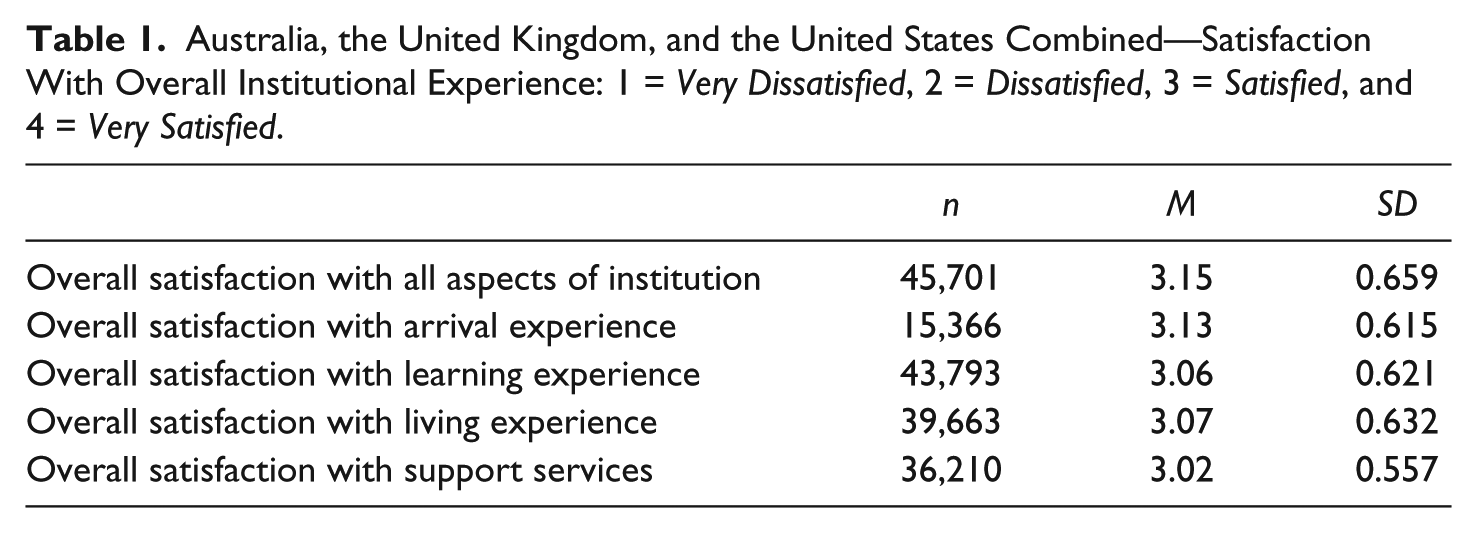
Table 2 indicates the comparative mean scores of satisfaction with the overall institutional experience as well as within each dimension of experience in each of the three countries. Satisfaction with the arrival experience was the most highly rated dimension, and support services had the lowest rating in each of the three countries. At institutions in the United Kingdom, respondents showed a higher level of satisfaction with their overall experience than those in the United States and Australia. ANOVA models were applied to compare the levels of satisfaction of international students at institutions across Australia, the United Kingdom, and the United States. There was a statistically significant difference between the means of satisfaction of overall university experience and within each dimension of experience.
Australia, the United Kingdom, and the United States Compared—Mean Scores of Satisfaction With Institutional Experience.
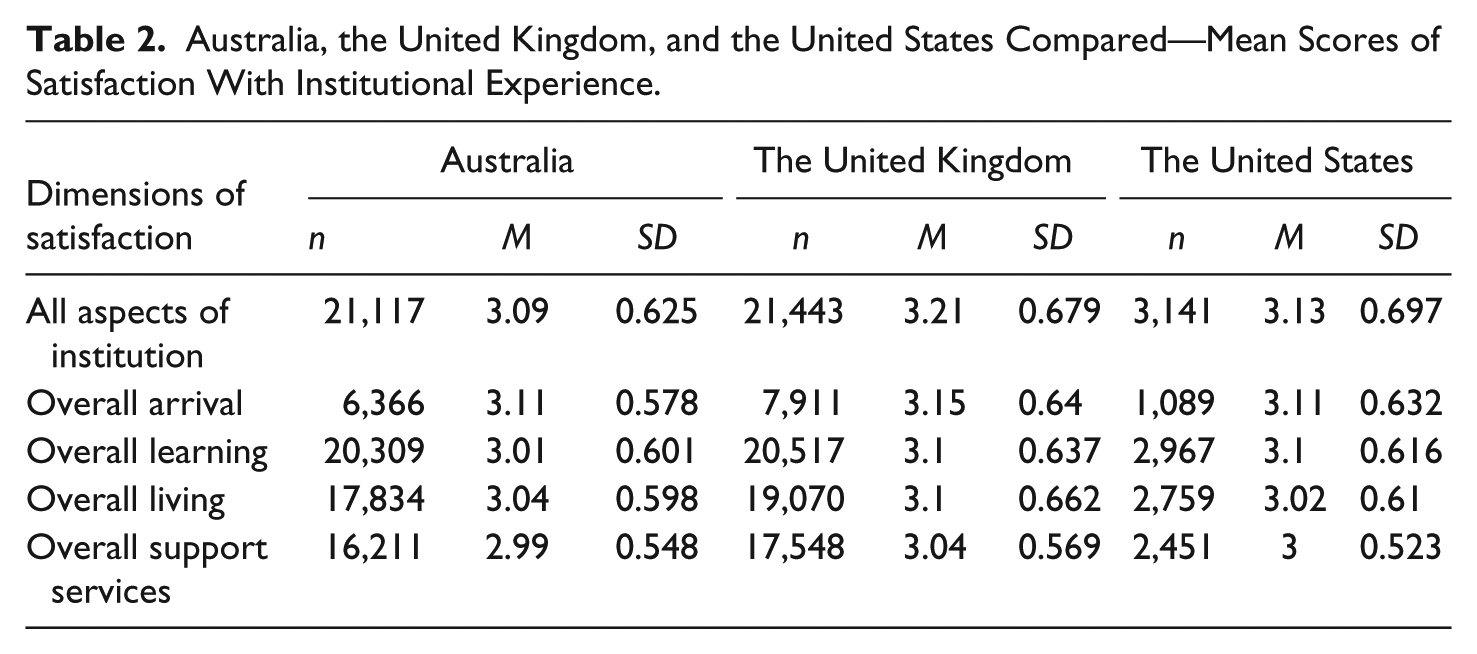
Table 3 compares the aspects within each dimension of experience, which had the highest and lowest satisfaction levels overall, while Table 4 breaks these figures down by country.
Australia, the United Kingdom, and the United States Combined—Aspects of Highest and Lowest Satisfaction Across the Four Dimensions in All Three Countries.

Australia, the United Kingdom, and the United States Compared—Dimensions of Highest and Lowest Satisfaction in Each Country.

Satisfaction With Arrival Experience
Table 3 shows that international students were most satisfied with the formal welcome provided by their institution and least satisfied with the ability to make friends with local students. Table 4 indicates that at Australian institutions, respondents were most satisfied with their experience setting up a bank account and least satisfied with the ability to make friends with local students upon arrival. At U.K. institutions, respondents were most satisfied with making friends from other countries and least satisfied with the ability to set up their bank account. At U.S. institutions, respondents were most satisfied with meeting their academic staff and least satisfied with the opportunity to make friends with local students.
Satisfaction With Learning Experience
Table 3 shows that international students were most satisfied with the command of English of academic staff, and least satisfied with finding work opportunities in their learning environment. From Table 4, we see that at Australian institutions, respondents were most satisfied with online library facilities, while in the United Kingdom and the United States, greatest satisfaction was with the English command of academic staff. In all three countries, respondents were the least satisfied with finding work opportunities during their studies.
Satisfaction With Living Experience
At institutions in all three countries, Table 3 shows that international students were most satisfied with the sense of safety and security at their institution, and least satisfied with the availability of financial support. As indicated by Table 4, respondents were most satisfied with safety and security on campus in both the United Kingdom and Australia, and least satisfied with financial support. In the United States, they were most satisfied with sports facilities on campus and least satisfied with the cost of accommodation.
Satisfaction With Support Services
As we see from Table 3, at institutions in all three countries, students were most satisfied with their institution’s provision of chaplaincy or multi-faith resources, and least satisfied with campus eating options. Table 4 shows that respondents were most satisfied with the provision of chaplaincy or multi-faith services in Australia and in the United Kingdom. At U.S. institutions, respondents were most satisfied with the student union services. International students were the least satisfied with campus eating options in all three host countries.
Which Aspects of Student Experience Have the Most and Least Significant Influence Within Each of the Four Dimensions of Satisfaction?
Within each of the four dimensions, an analysis was undertaken of those aspects having the most and least influence on that particular dimension of international student experience. Table 5 provides a combined and comparative regression analysis, both within and across countries.
Australia, the United Kingdom, and the United States Combined and Compared—Regression Analysis Showing the Aspects With the Most and Least Significant Influence Within Each of the Four Dimensions of Satisfaction.

Significant at p < .05. **Significant at p < .001. ***No variable (or no other variable) found to be significant.
Arrival Experience
Across all institutions, international students’ experience with welcome and airport pickup and first night stay had significant impact on their satisfaction with the overall arrival experience. Of these two, the first night experience had the greatest influence, followed by being welcomed and picked up from the airport. At Australian institutions, no aspects of arrival had more or less significance in terms of the overall arrival experience. At institutions in the United Kingdom, the first night stay was the only aspect to have a significant impact on overall arrival experience, while at U.S. institutions, satisfaction with airport pickup and welcome was the only aspect with significant influence.
Learning Experience
Within the learning experience dimension, the aspects which significantly impacted the learning experience overall were quality of lectures, expertise of lecturers, teaching ability of lecturers, academic content, organization of course, explanation of marking, learning that might lead to a good job, and learning that improves English language skills. Of those aspects, the quality of lectures had the greatest influence. Explanation of marking and grades for their class had the least impact. At Australian institutions, the quality of lectures had the most impact on satisfaction with the learning experience, and learning that improved English language skills had the least impact. Similarly, at U.K. institutions, the quality of lectures had the most impact, but the teaching ability of lecturers had the least impact on students’ learning experience. At U.S. institutions, the expertise of lecturers was found to have the most, while the physical library facilities had the least impact on their learning experience.
Living Experience
Aspects that were found to significantly impact students’ overall living experience were access to suitable accommodation, quality of accommodation, and safety and security. Quality of accommodation influenced overall living experience the most, while safety and security had the least impact. Quality of accommodation had the most impact on satisfaction with the living experience at institutions in all three countries. Least impactful was safety and security in Australia, and internet access in the United Kingdom. Quality of accommodation was the only variable that had a significant impact on overall living experience in the United States.
Support Services
The aspects with significant impact on the experience of support services were services provided by the International Office, campus eating options, and clubs and societies. Of those aspects, International Office services had the most influence, and campus eating options the least. At Australian institutions, International Office services had the most, and campus eating options had the least impact on the support services experience. In contrast, at U.K. institutions, campus eating options had the most impact, and satisfaction with services from the Finance Department and personal tutors were the least influential. At U.S. institutions, satisfaction with International Office services was the only significant aspect.
Which Dimensions of International Student Experience Influence Overall Satisfaction With Their University?
By running multiple regression analyses, all four dimensions of satisfaction (arrival, learning, living, and support services) were found to have a significant positive impact on international students’ overall university experience, as indicated in Table 6. However, we were curious to find which of the four dimensions was the most influential.
Australia, the United Kingdom, and the United States Combined—Regression Analysis Showing Which of Four Dimensions Have Greatest Influence on Overall Institutional Satisfaction.

The authors of this article have themselves been international students, have worked in both collaborative and competitive marketized higher education and international recruitment, and have been involved for many years with students studying outside their country of birth. Therefore, we were delighted when the findings unambiguously demonstrated that, of the four dimensions, the greatest influence on overall international student satisfaction with their university was the learning experience.
Meanwhile in contrast, and counter to the original purpose for beginning this study, satisfaction with support services was shown to have the least impact on students’ rating of their overall university experience.
The same results were obtained with an analysis by country. Table 7 provides a comparative regression analysis of satisfaction for each of the four dimensions with the overall institutional experience. Once again, the findings are clear: satisfaction with the learning experience had the most impact on overall satisfaction at institutions in Australia, the United Kingdom, and the United States. Satisfaction with support services had the least impact in all cases.
Australia, the United Kingdom, and the United States Compared—Regression Analysis Showing Which of the Four Dimensions Have Greatest Influence on Overall Institutional Satisfaction for International Students in Each Country.

Significant at p < .05. **Significant at p < .001.
Discussion
Findings from this study show that students are generally satisfied with all aspects of their institution in all three countries examined. Support services show the lowest overall satisfaction scores within all three countries, but students are still generally satisfied. Some care is needed in understanding, for example, “services provided by the International Office,” as these may well differ across countries and institutions. This could also be the case for “campus eating options,” among others, so some of these results will need interpreting by individual institutions. However, the overall picture presented here, both within and across countries, offers a context for such interpretation.
Another important factor for consideration is the changing nature of student expectations and the link to provision of services. Many of the institutions surveyed for the ISB will have been receiving feedback for several years and learning from these measures of student satisfaction at the institutional level to enhance their provision and support for international students to better address their needs. For example, one surprising finding (Table 6) shows that internet access was the aspect of least influence on the overall living experience of international students in the United Kingdom. In contrast, institutional feedback to one of the authors by i-graduate around 10 years ago indicated that this was the aspect of greatest concern to international students at that time. Likely explanations for this change include both an improvement in the standard of internet services during the intervening period, and also an understanding by universities of the crucial role internet access plays for all students, causing them to greatly enhance their provision over the years.
Perhaps also a reflection of increasing reliance on online services, a further surprising finding (Table 5), was that physical library facilities had the least influence on overall living experience in the United States.
Some findings are less surprising and are in line with anecdotal concerns commonly heard, for example, that international students are relatively less satisfied with opportunities to make friends with local students both during their arrival and living experiences (Table 4). Another common student concern evident in the same table is the cost of study and accommodation, allied with the ability to find work during studies.
Satisfaction is high with, perhaps, more “niche” aspects of experience, such as use of the accommodation office, residence hall welfare, and in particular with chaplaincy and multi-faith provision, even though the numbers accessing them are relatively low (Table 3). This suggests that those who do have cause to use these services are relatively satisfied with them.
Given that the original intent of this study had been to investigate the role of support services in student satisfaction, it was a surprise to find that they have the least overall influence of all four dimensions of international student experience in each of the three countries examined (Table 6).
However, there can be no room for complacency, even though international students are relatively satisfied. This study finds clearly that the academic dimension is the most important in terms of influencing the overall student experience, while the literature review indicates the importance of a whole institutional approach. We suggest therefore that, having been successful in achieving a good level of international student satisfaction across all dimensions of experience, institutions recognize the primacy of the learning experience in overall satisfaction, as demonstrated by these findings, and consider placing greater emphasis on support services that enhance that learning experience, by facilitating collaborative working between academic departments and support units.
Limitations and Future Research
This empirical analysis of data from the ISB investigated the satisfaction of over 45,000 international students with various dimensions of student experience in three different countries. Although this represents a relatively large sample, the study has several limitations.
First, the findings are based on one single instrument which relies on self-reported data. Although the ISB is widely used, other surveys of international student experience might provide different results, especially those administered within an individual institution. Furthermore, the study represents a snapshot in time and must be considered in terms of the changing nature of student expectations and increasing sophistication in the experience offered by higher education institutions to all students (including international) across the four dimensions studied here.
The reported findings were not necessarily meant to be generalizable in nature but rather to serve as a comparative baseline and indeed as a possible springboard for future research, one element of which could be to compare the data found here with other instruments or with other methods of data gathering. Of note also is that from the United States, the sample size of students and the number of participating institutions were both relatively low compared with those from Australia and the United Kingdom.
Even though a large number of students were included, this study only considered undergraduate, degree-seeking students, overlooking those studying for credit in other countries. Erasmus and other exchange students, for instance, were not part of the sample. Others not included were those studying at the postgraduate level or in English as a second language programs.
No personal or cultural factors were considered that may have had an impact on student experience. The researchers did not have access to responses for the open-ended questions, which also form part of the ISB, due to the nature of the confidentiality agreement with i-graduate. It is possible that these may have provided more context on response bias, and engaging with those responses would certainly be interesting for future studies, should access be allowed.
Additional areas for future research would be to take a larger sample size including data from other leading nations in student recruitment, or to expand the data by considering students beyond those at the undergraduate level. A comparative perspective with other student satisfaction instruments or a longitudinal study to assess the changing nature of student experience and expectations are all factors to consider for future research on the topic of international student satisfaction.
Conclusion
This study has evaluated international student satisfaction with different dimensions of the university experience, namely their arrival, living, learning, and support service experiences, and the aspects within those dimensions which have the greatest influence on their experience overall. Results from the ISB of over 45,000 degree-seeking, undergraduate international students at 96 institutions in Australia, the United Kingdom, and the United States formed the basis of the study, which offers the following:
enhanced understanding of international student experience and satisfaction;
support for institutions in interpreting their own results from international student experience surveys;
help for campus support services in developing collaborative practices;
support for institutional policies and practices and effective resource allocation for enhancing the international student experience;
generation of interest for future research on international student experience, in particular, what matters to students and which services should be provided or enhanced;
support for institutional recruitment and retention strategies, as well as the academic success of students.
Findings from this study represent a starting point for researchers interested in further pursuit of these topics, as well as others, in continuing to explore the rich data provided by the results of ISB surveys. 2
Footnotes
Declaration of Conflicting Interests
The author(s) declared no potential conflicts of interest with respect to the research, authorship, and/or publication of this article.
Funding
The author(s) received no financial support for the research, authorship, and/or publication of this article.