




Abstract
Transnational Education (TNE) has potential for expanding access to higher education in Africa, which has chronic high rates of unmet demand for access. Paradoxically, African higher education institutions (HEIs) have the least participation in TNE. There is a dearth of systematic understanding of the factors that influence the participation of African HEIs in TNE and the impacts of their participation at both institutional and societal levels. This article proposes a sociological framework for investigating the factors that enable or hinder the participation of African higher HEIs in TNE, and the impacts of their participation on the institutions themselves and their respective countries. The framework is constructed with societal and organizational factors disparately identified through a purposive review of the literature.
Keywords
Introduction
In the diverse and dynamic developments in internationalization of education, Transnational Education (TNE) is regarded as an innovative mechanism in higher education provision. The challenge of formulating a precise definition of TNE is acknowledged in the literature (Knight, 2016; McNamara & Knight, 2017). However, TNE is described as “the delivery of higher education programmes in a different country from the one where the awarding/overseeing institution is based” (British Council and German Academic Exchange Service, 2014, p. 6). The fundamental defining characteristic of TNE is the mobility of academic programs and providers across international borders. Related to the definitional challenge is the “terminology chaos” in which, for instance, different terms, such as cross-border, offshore, and borderless education are used interchangeably to denote TNE activities. Knight (2016) proposes a framework which subsumes TNE modes in two primary categories: independent and collaborative, and provides a definition for the modes. TNE modes in the independent category are branch campus, franchise university, and distance education; while twinning initiatives, joint degree programs, cofounded universities, and locally supported distance education programs are included in the collaborative category. Knight’s (2016) framework contributes in creating a common language and understanding needed for greater clarity in TNE conversations, policy making, partnerships, and data collection.
TNE can be beneficial in a number of ways to TNE host countries with weak higher education systems and high rates of unmet demand for access. Through well-planned, sufficiently resourced, and effectively implemented programs, TNE can complement the efforts of higher education institutions (HEIs) in host countries to develop human capital needed for social and economic development. It can also help to reduce capital outflow associated with movement of students to foreign countries in quest of higher education. TNE is seen as a mode of education provision that contributes in staunching the malaise of brain drain from developing countries, considering that it provides a convenient opportunity for professionals in host countries to engage in continuing professional development while still in full employment (Alam, Alam, Chowdhury, & Steiner, 2013; France Strategie, 2016; Mohamedbhai, 2013). In addition, TNE programs provided by reputable institutions in sending countries are promoted as quality education that can produce knowledgeable and skilled graduates with better prospects for employment in their home countries or elsewhere (British Council, 2014; British Council and German Academic Exchange Service, 2014; France Strategie, 2016).
Conversely, skepticism and concerns have been expressed about the rationales undergirding the championing and propagation of TNE which typically entails mobility of higher education programs and providers from industrialized countries to developing countries (Bannier, 2016; Mohamedbhai, 2013). For instance, there are concerns that TNE can further weaken, rather than strengthen, local HEIs which can result in educational and cultural imperialism (Bannier, 2016; British Council, 2014). Related to this concern are questions as to whether TNE curricula are relevant to the needs of host countries; and whether pedagogical practices in TNE are responsive to the culture and learning styles of students (Bannier, 2016; Bell & Keevers, 2014). Although TNE is seen as an innovative strand in internationalization of education, there are concerns that TNE operations and practices seem to have the character of a commercial enterprise driven more by profit motives (Altbach, 2000; Ziguras, 2007), than by the philosophy and rationales that undergird internationalization of education (De Wit, 1995). In this regard, there are questions whether TNE has the potential to really contribute to the internationalization of higher education, since it appears TNE transactions essentially entail selling knowledge as a commodity across international borders with little mutual exchange of ideas and exchange of students or faculty for the purpose of broadening and deepening global understanding or world cultures (Altbach, 2000; Ziguras, 2007).
In spite of the concerns or perceived risks, demand for higher education through TNE is growing rapidly, and TNE is consequently burgeoning phenomenally. In this regard, citing Cross-Border Education Research Team (C-BERT) census, France Strategie (2016) observes, The most emblematic form [of TNE] is the international branch campus (IBC). . . . there were at least 230 such institutions [IBCs] worldwide in 2015, while there were just 160 in 2006. But other delivery modes also exist, including joint-ventures, decentralized programmes, franchise and distance learning. (p. 33-34)
Africa and TNE
Although there are significant variations in higher education enrollments among African countries, however, the continent’s average higher education enrollment is 7% compared to world’s 29% (UNESCO Institute for Statistics, 2012). The low enrollment rates, in spite of the high demand for access, combine with the concerns about quality and inadequate resources for higher education (United States Agency for International Development [USAID], 2014) to indicate that African HEIs lack the capacity to meet the quantitative and qualitative human capital needs for the continent’s socioeconomic development and competitiveness in the global knowledge economy. Paradoxically, African HEIs have the lowest participation rates in TNE, which is generally seen as a strategy for addressing the challenge of high levels of unmet demand for access (Bannier, 2016; Ilieva & Peak, 2016).
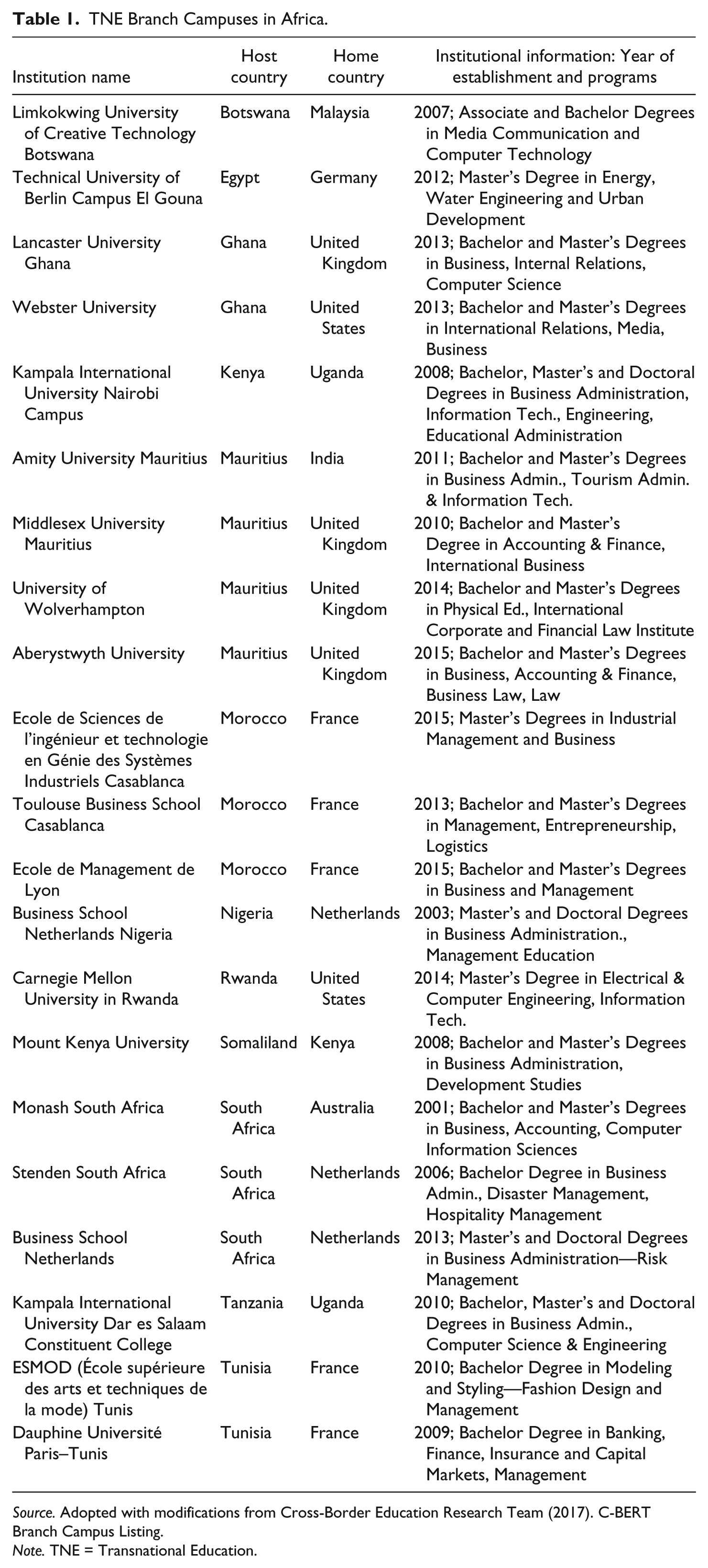
Nevertheless, African countries are embracing TNE (UK HE International Unit & British Council, 2016; Zeleza, 2005). For instance, Table 1 shows international branch campuses (IBCs) hosted in 12 African countries. As Table 1 shows, the IBCs offer predominantly business- and management-related and information technology programs; and only two African HEIs are TNE providers: Kampala International University, and Mount Kenya University. Kampala International University has branch campuses in Kenya and Tanzania; while Mount Kenya University has a branch campus in Somalia. The fact that Kampala International University and Mount Kenya University have IBCs suggests that the two institutions are academically and organizationally strong enough to support TNE enterprises.
TNE Branch Campuses in Africa.
Source. Adopted with modifications from Cross-Border Education Research Team (2017). C-BERT Branch Campus Listing.
Note. TNE = Transnational Education.
Although Table 1 provides some inventory of IBCs in Africa, there is a paucity of systematic understanding of the participation of African HEIs in TNE, including student enrollment in TNE. Although the contexts and capabilities of African HEIs vary, the low rate of their participation (Bannier, 2016) can be attributed to a variety of factors, for instance, lack of government support, especially with regard to enabling legal and policy frameworks; lack of institutional capacity; lack of resources; and lack of leadership commitment (NAFSA, 2017). Considering that TNE are international high risk ventures driven by profit motive, they are run in accordance with business model and principles. It follows that weak African HEIs without entrepreneurial or commercial capabilities may not be ready to forge TNE partnerships with international providers, and may not be considered by providers as viable partners. Conversely, well-resourced and well-functioning HEIs within strong higher education systems are more likely to attract partners for TNE. The “weak-strong institution thesis” for participation in TNE may well be a rationale, for instance, South Africa, which has the most well-functioning HEIs and strong higher education system in Sub-Saharan Africa has emerged as a leading TNE hub in Africa (NAFSA, 2017; The Observatory on Borderless Higher Education, 2004). Regarding student participation in TNE in Africa, enrollment data, whether for the continent generally or disaggregated by country, are difficult to come by in available literature. The challenge of enrollment data is attributed to the lack of TNE data collection, management, and reporting systems (McNamara & Knight, 2015, 2017)
In addition to the dearth of enrollment data, there is also a lack of analytical understanding of the participation of African HEIs in TNE. Hence, there is a need for systematic and comprehensive understanding of the factors influencing the participation of African HEIs in TNE, including the impacts of their participation on the institutions themselves and their respective countries (McNamara & Knight, 2015).
Approach and Purpose
Although the dynamics of globalization within the world system, including commercialization of higher education generally provide fillip for the expansion of TNE (Bannier, 2016; Moutsios, 2009), the participation of African HEIs in TNE is, however, more directly influenced by impetuses in the ambient socioeconomic conditions of African countries in which the institutions are embedded, and by organizational realities within the institutions themselves. These impetuses include, for instance, the need to produce knowledgeable and skilled labor force needed for socioeconomic development, the need to reduce brain drain by widening access to higher education, and the need for HEIs to diversify their sources of revenue and generate funds for strengthening institutional capacity and improving curricula quality and facilities. Therefore, it follows that studies seeking to generate a comprehensive and robust analytical understanding of the participation of African HEIs in TNE, and the impacts of their participation are likely to be more productive with a broad sociological approach that takes into account the influence of relevant societal factors, as well as relevant organizational factors within the HEIs. The broad sociological approach to investigating social phenomena is grounded in the understanding that, being organizations, African HEIs exist and function as open systems in dynamic relationship with their environment (Katz & Kahn, 1966; Morgan, 2006); and as a result, institutional or structural features of society impact behavior and activity within the institutions (Layder, 1993). Hence, the purpose of this article is to propose a sociological framework for investigating the factors that enable or impede the participation of African HEIs in TNE, and the impacts of their participation on the institutions themselves, as well as their respective countries. The factors, both societal and organizational, that have potential for influencing the participation of the institutions in TNE are identified through a purposive review of the literature. The sociological framework presented later in this article is constructed with the societal and organizational factors identified in the literature.
Literature Review
Purposive selection and review of the literature is guided by the following question: What are the societal factors (factors outside African HEIs) and the organizational factors (factors within African HEIs) that have potential to influence the participation of African HEIs in TNE? The literature review has two sections. The first section focuses on identifying societal factors with potential to influence the participation of African HEIs in TNE; while the second section is concerned with identifying organizational factors within HEIs that can enhance or impede the engagement of African HEIs in TNE.
Societal Factors
Although they exist and function distinctly as organizations, African HEIs inevitably operate in dynamic interactions with their societies, governments, and economies, and therefore, are susceptible to societal influences or forces outside their organizational boundaries (Miles, 1980). A review of the literature on TNE, higher education, sociology of higher education in Africa, and internationalization of education suggests that the influence of each of the following societal factors contributes in determining or shaping the initiatives, programs, performance, or inertia of African HEIs: economic development imperative, government, demand for access and student mobility, funding, commercialization and privatization, and information and communication technology (ICT; e.g., Altbach & Knight, 2007; Association of African Universities [AAU], 2012; British Council, 2014, 2015, 2017; The Campus France Notes, 2016; France Strategie, 2016; Ilieva & Peak, 2016; Jowi et al., 2013; Mohamedbhai, 2016; Muianga, Hansson, Nilsson, Mondlane, & Mutimucuio, 2013; Nyangau, 2014; Teferra, 2013; USAID, 2014; Varghese, 2013, 2016; World Bank, 2010).
Economic development imperative
In the context of the global knowledge-based economy, it is widely acknowledged in the literature that HEIs now have a clear “mandate,” more than ever before, to contribute significantly to national economic development and competitiveness (AAU, 2012; British Council, 2014, 2015; Nyangau, 2014; The Task Force on Higher Education and Society, 2000). In spite of the myriad of constraints they face, African HEIs are challenged to respond to the economic development imperative by engaging in research and development (R&D) in partnership with industry, preparing employable and entrepreneurial graduates with knowledge and skills needed to enhance productivity in public and private sectors of the economy, and by contributing to the development of knowledge society and economy (AAU, 2012; World Bank, 2002, 2004).
As African HEIs strive to respond to the imperative for knowledge generation and application, as well as human capital development, there are concerns about quality of academic programs, and employability of graduates (British Council, 2014, 2015; Mohamedbhai, 2016; Nyangau, 2014). However, the literature indicates that African HEIs are increasingly instituting mechanisms for assuring quality. There are indications that international partnership initiatives such as TNE are seen as part of the strategies for addressing concerns about quality, especially concerns regarding quality of teaching and learning (British Council, 2014).
Government
Like governments across the world, African governments have major responsibilities and roles in higher education (Altbach, 1990; Sehoole & Phatlane, 2016). Acknowledging the cardinal role of government in shaping higher education, Altbach (1990) observed that the influence of government on higher education occurs in rich and poor, totalitarian and democratic nations. It is emphasized in the literature that any meaningful study of educational systems necessarily includes analysis of the role of government (Carnoy, 1985). Governments typically utilize public policies as rationales and mechanisms for influencing education (Fowler, 2013). According to Fowler (2013), “Public policy is the dynamic and value-laden process through which a political system handles a public problem. It includes a government’s expressed intentions and official enactments, as well as its consistent patterns of activity and inactivity” (p. 5). Evidence in the literature indicates that African governments influence HEIs through the existence or lack of policies, regulations, and guidelines on a variety of issues, for example, institutional governance (Varghese, 2016), funding (Teferra, 2013), student mobility (McNamara & Knight, 2015, 2017), TNE and internationalization (Ilieva & Peak, 2016), registration and accreditation of institutions and programs (Ilieva & Peak, 2016), commercialization and privatization (Jowi et al., 2013), and ICT (eTransform Africa, 2012). Thus, the important role of government provides a rationale for including government in the analytical purview of studies designed for generating systematic and comprehensive understanding of the participation of African HEIs in TNE.
Demand for access and student mobility
It is widely evident in the literature that demand for access including student mobility is a key societal influence on African HEIs (British Council, 2014, 2017; The Campus France Notes, 2016; France Strategie, 2016; Nyangau, 2014). African higher education has expanded significantly over the past 40 years (USAID, 2014). For instance, between 2000 and 2010 higher education enrollments increased from 2,344,000 to 5,228,000 (UNESCO Institute for Statistics, 2009). Even with the expansion, there is the problematic phenomenon of sustained high rate of unmet demand for access because African HEIs lack the capacity to accept large numbers of qualified candidates. In Nigeria, for instance, only about 30% to 40% of qualified candidates seeking admission into Nigerian universities each year are admitted (British Council, 2017).
A major consequence of the unmet demand for access to higher education in Africa is the large number of outbound mobile African students. In 2013, for instance, there were 347,322 mobile African students (The Campus France Notes, 2016). Although the rate of outbound mobility of African students has risen astronomically since the colonial era, the phenomenon of students leaving the continent to pursue higher education outside Africa has been historically driven largely by the inability of local institutions to meet demand for access. Historically also, the pattern of outbound mobility of African students varies based on the colonial history or experience of their countries. For instance, France has remained the most popular destination for the bulk of outbound mobile French speaking African students. In 2013, France was the destination of 26.7% of outbound mobile African students welcomed by the 12 top receiving countries (The Campus France Notes, 2016). Similarly, outbound students from African countries colonized by Britain typically prefer Britain or other English-speaking countries as their destination. In addition to colonial history, other factors that influence students’ destination choices include language, cost, quality of education, foreign employment opportunity, visa and immigration requirements, and the prospects of scholarship or funding (France Strategie, 2016).
The significant levels of unmet demand for access combine with the large numbers of students moving outside the continent to provide impetus and market African HEIs can tap into for entrepreneurial and commercial initiatives, such as TNE partnerships. In addition, in a continent in which human capital needed for social and economic development is insufficient qualitatively and quantitatively, the high rate of unmet demand for access puts pressure on African HEIs to look beyond the brick-and-mortar model of provision to meaningfully increase or widen access. Hence, non-traditional modes of higher education provision, such as TNE and distance education are often justified as innovations or initiatives in response to pressure on HEIs to address demand for access (British Council, 2017; USAID, 2014).
Funding
It is ubiquitous in the literature that funding is a major factor that impacts the performance of African HEIs (AAU, 2012; Teferra, 2013; Teferra & Altbach, 2004; The Africa-America Institute, 2015; UNESCO, 2011; USAID, 2014; World Bank, 2010). Underfunding has been a chronic feature of African higher education (Teferra, 2013; Teferra & Altbach, 2004). On average, Africa’s allocation for higher education as a percentage of its gross domestic product (GDP) was 0.75 in 1990 and 0.78 in 2006 in spite of the exponential growth in enrollment. For instance, higher education enrollment tripled, rising from 2.7 million in 1991 to 9.3 million in 2009 (World Bank, 2010). For public HEIs, public funding has not kept pace with the rapid expansion in enrollment. Both public and private institutions typically have limited capacity for engaging in entrepreneurial ventures through which they can generate significant revenue. Concerns about African higher education regarding, for example, the quality of academic programs, facilities, inadequate number of faculty, and inability to engage in significant R&D are usually attributed mostly to the challenge of persistent underfunding (AAU, 2012; British Council, 2014; Nyangau, 2014). It is not uncommon for African HEIs, both public and private to receive some targeted funding from private donors and development partners; however, the reality is that most of the institutions operate on shoestring budgets. Hence, African HEIs are typically referred to as the most financially challenged (Teferra, 2013). The funding situation creates a rather circular problem for HEIs in the sense that although cash-strapped, they are, nevertheless, under immense pressure to provide quality education, and to contribute to economic development and wealth creation; yet they neither have the funding for investing in, for instance, R&D laboratories and significant revenue generating initiatives like science parks, nor for developing the capacity and expertise needed for managing such ventures. On average, Africa spends a meager 0.3% of its GDP on R&D in spite of African Union’s resolution committing each African country to allocate at least 1% of its GDP for R&D (African Development Bank, 2008; African Union, 2006).
Commercialization and privatization
The impact of commercialization and privatization on higher education worldwide, including Africa is acknowledged in the literature (Garwe, 2015). Both commercialization and privatization of higher education entail selling the services or work of a public or private HEI for profit (Bok, 2003). Commercialization and privatization emerged as significant developments in African higher education in the 1980s and 1990s (Varghese, 2013). Globalization and the categorization of education as tradable service in the General Agreement in Trade in Services (GATS) provided impetus for the emergence of the commercialization and privatization regime. In addition, the economic turbulence in much of Africa in the 1980s and 1990s, as well as the Structural Adjustment Program of the International Monetary Fund (IMF) and the World Bank, which prescribed drastic reduction in public spending for higher education, inclined African governments to commercialization, and privatization of higher education (World Bank, 1988).
Commercialization in African higher education manifests in cost-sharing measures, including payment of tuition in public HEIs that were tuition-free; while privatization is resulting in increasing numbers of private HEIs (Jowi et al., 2013). Although commercialization and privatization may be contributing to widening of access to higher education, there are, however, concerns regarding equity and quality associated with the “market logic” undergirding higher education and the increasing alignment of operations with the marketplace. Regarding equity, individuals and groups who cannot afford to pay for higher education are likely to be marginalized. With regard to quality, it is feared that quality can be compromised and the traditional values of education undermined, especially in systems without effective regulatory frameworks and quality assurance (Altbach & Knight, 2007).
Information and communication technology (ICT)
Evidence in the literature indicates that the remarkable rate of penetration of ICT in Africa is resulting in increasing use of ICT in higher education and education generally (eTransform Africa, 2012; Farrell & Isaacs, 2007; Muianga et al., 2013). The substantial diffusion of ICT in Africa is attributed to a number of factors, including availability of infrastructure, such as backbone for broadband services, institutional reforms, liberalization of markets which stimulated competition and resulted in significant reduction in prices, and the establishment of regulatory bodies. Studies on ICT on the continent also find that use of ICT is deepening in various sectors of the economy, including education (World Bank, 2011). For instance, mobile phones are being used as platform for Internet access; thus, with mobile phone subscriptions at 650 million (eTransform Africa, 2012), databases and other information repositories for educational transaction can be accessed relatively conveniently. The availability of ICT infrastructure provides an enabling environment for utilizing ICT in education whether for on-campus, online, or TNE provision. Recognizing the critical role of ICT for enabling delivery of education, many African governments now have national ICT policies, which typically include guidelines or aspirations for providing HEIs Internet connections (Farrell & Isaacs, 2007; Muianga et al., 2013).
Organizational Factors
This section of the literature review focuses on identifying factors that typically contribute in influencing initiatives, programs, activities, and performance in HEIs. Consequently, the following factors are identified through a purposive review of the literature: institutional leadership, strategic planning, faculty attitude, and student satisfaction and support services (AAU, 2012; Hanson, 2013; Hinton, 2012; Hoare, 2012; Johnsrud, Harada, & Tabata, 2005; Magne, Poverjuc, & Hefferman, 2017; Mellors-Bourne, Jones, & Woodfield, 2015; Varghese, 2016). In pursuit of the purpose of the article, it is postulated that the five factors have potential to enable or hamper the participation of African HEIs in TNE. Hence, the factors are utilized to configure the organizational component of the sociological framework presented later in this article.
Institutional leadership
The crucial and strategic role of leadership in organizations is acknowledged in the literature (Black, 2015; Bolman & Deal, 2013; Draft, 2015; Senge, 2006). There has been a significant shift in governance in African higher education. Governance of HEIs evolved from state-control model to state-supervision model, resulting in appreciable level of autonomy for HEIs (Sehoole & Phatlane, 2016; Varghese, 2016). The implication of increased institutional autonomy, especially within the context of inadequate public funding and changing higher education environment is that institutional leadership has responsibility, more than previously, for meeting the expectations of stakeholders; and for developing local and international partnerships, and other strategies needed to mobilize resources for ensuring program and institutional quality, effectiveness, and sustainability (Black, 2015; Garwe, 2014; Hanson, 2013; Hanson & Leautier, 2011).
The potential of institutional leadership to enable or hinder internationalization and TNE initiatives is underscored in the literature (Mestenhauser, 2000). Hence, systematic efforts to generate a robust understanding of the factors that influence the participation of African HEIs in TNE are likely to be more fruitful if they include in their analytical scope the extent to which institutional leadership is philosophically amenable to, and pragmatically supportive of TNE.
Strategic planning
Strategic planning is increasingly becoming a leadership tool in African HEIs (AAU, 2012; Luhanga, 2006). Strategic plans can be a source of evidence of institutional commitment. Therefore, the extent to which African HEIs value, engage in, and support TNE programs may be expressed in their strategic plans, considering that strategic plans typically include the following components: mission statement, values, goals, vision, and implementation plan (Hinton, 2012). It follows that studies designed to generate systematic and comprehensive understanding of the factors that facilitate or hamper the participation of African HEIs in TNE are likely to find strategic planning a useful source of evidence, although it is recognized that commitments or aspirations articulated in a strategic plan may not necessarily move to implementation nor translate into actuality.
Faculty attitude
Positive faculty attitude is a fundamental requirement for sustainable effectiveness of academic programs in higher education (Carley, Cheurprakobkit, & Paracka, 2006; Johnsrud et al., 2005). A review of the literature reveals a dearth of studies on the attitude of faculty in African HEIs toward TNE. However, considering the important role of faculty in teaching and curriculum development which are integral activities in TNE, the extent of faculty interest in, and support for TNE has potential to influence the participation of African HEIs in TNE. Students are not likely to be well-served and programs may have limited success if motivated or active participation of faculty in TNE or international education generally is not secured and sustained through institutional efforts, such as professional development, reward system, availability of resources, and participation in TNE decision-making (Carley et al., 2006; Magne et al., 2017).
Student satisfaction
Research indicates that satisfied students are more likely to persist, while dissatisfied students tend to dropout (Pascarella & Terenzini, 2005; Tinto, 1987). Institutions seek to measure levels of student satisfaction with their programs and services, including, for instance, the extent to which students are satisfied with what they are taught, how they are taught, and how they are assessed. Institutions also seek to determine levels of student satisfaction with a view to identifying areas for improvement and need for new programs. Students’ need for, or satisfaction with TNE programs has potential to influence the participation of African HEIs in TNE. However, in spite of the rapid growth of TNE, the literature indicates that very little attention has been paid to student satisfaction (Hoare, 2012; Mellors-Bourne, Jones, & Woodfield, 2015).
Support services
In higher education, the extent to which support services are provided to both students and faculty can determine not only program effectiveness, but also level of student and faculty motivation and satisfaction (Guan & Stanford, 2016; Roberts, 2009). The extent to which support services are available to both students and faculty in TNE can impact the participation of African HEIs in TNE. It is acknowledged in the literature that support services for students and faculty are essential, especially because teaching in TNE is a complex and demanding activity in light of the diversity of cultures and the unequal power relations it typically entails (Bell & Keevers, 2014; Dobos, 2011; Magne et al., 2017). While the areas students need support include orientation in intercultural communication, study skills, library services, and career guidance (Magne et al., 2017; Mellors-Bourne, Jones & Woodfield, 2015), the literature also identifies the need for systematic faculty development, including induction programs for host country and providing country faculty (Lim, 2010; Shams & Huisman, 2012).
A Sociological Framework
The literature review supports that societal factors: national economic development imperative, government, demand for access and student mobility, funding, commercialization and privation, and ICT are factors with potential to facilitate or impede the engagement of African HEIs in TNE. The eclectic literature in which support for the factors is grounded includes literature on TNE, internationalization of education, higher education, sociology of higher education in Africa, organizational theory, and social research. The factors are in two categories: societal and organizational. Factors in the societal category are national economic development imperative, government, demand for access and student mobility, funding, commercialization and privatization, and ICT, while the organizational factors include institutional leadership, strategic planning, faculty attitude, student satisfaction, and support services.
The societal and organizational factors are utilized to construct the sociological framework this article presents for researching the participation of African HEIs in TNE (see Figure 1). The framework is designed to serve as an analytical template for guiding empirical investigation of the participation of African HEIs in TNE.
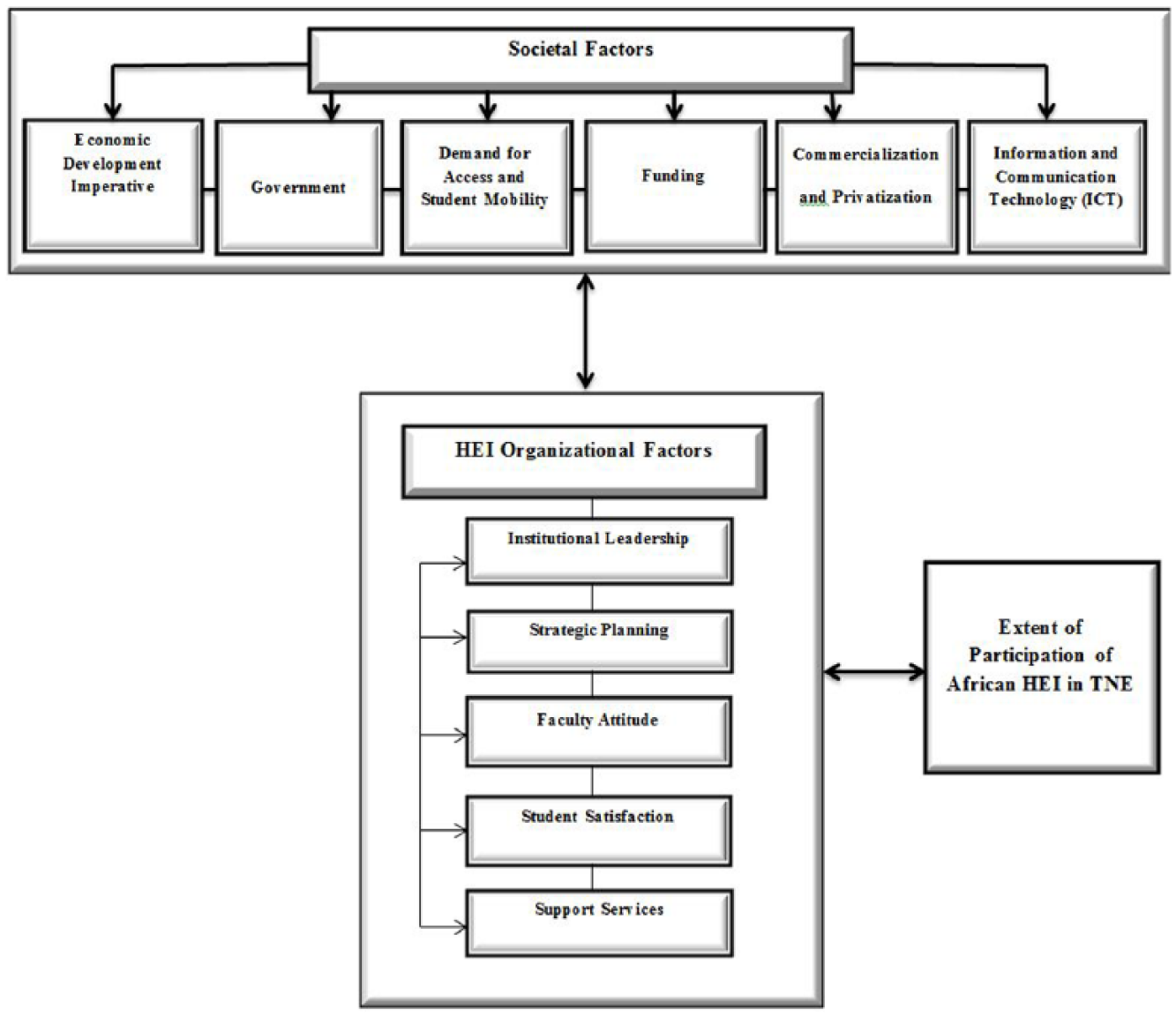
A sociological framework for understanding the participation of African higher education institutions in transnational education.
As depicted in the framework diagram, the interaction of the societal and organizational factors results in the extent an African HEI participates in TNE. Consequently, the participation of HEIs in TNE has potential to impact various aspects of the institutions themselves, such as structures, processes, and behaviors. Additional potential consequences of the participation of HEIs in TNE can be impacts on social and economic conditions in the society in a variety of ways, for instance, through increase in access to higher education, increase in the production of needed human capital, increase in the diffusion of global awareness, and through reduction in brain drain.
Conclusion
The need for empirical studies and evidence on the impacts of TNE in host countries, especially countries in Africa is acknowledged in the literature (McNamara & Knight, 2015; Mellors-Bourne, Jones, & Woodfield 2015). In this regard, the sociological framework this article proposes contributes to addressing the gaps in the literature. Grounded in a broad sociological approach to understanding organizational phenomena, the framework delineates relevant societal and organizational factors that can be operationalized to elicit evidence for generating comprehensive and robust understanding of the factors that enable or hamper the engagement of African HEIs in TNE, including how the engagement impacts the institutions themselves and the society. The framework has relevance for TNE practice and policy development. In this regard, in-depth case studies can use the framework as an analytical compass for systematic scanning of social forces and conditions, as well as for evaluating institutional capacity with a view to identifying potential or actual enablers and drawbacks in TNE initiatives.
Footnotes
Declaration of Conflicting Interests
The author(s) declared no potential conflicts of interest with respect to the research, authorship, and/or publication of this article.
Funding
The author(s) received no financial support for the research, authorship, and/or publication of this article.