



Abstract
Scholars have critiqued the current understanding of international students for glossing over its diversity, resulting in the reification of the “international student experience” as either homogeneous or clustered along nationality. Through a qualitative case study of 18 Chinese international students, this article examines the heterogeneity of their experiences despite a common nationality. Findings reveal that Chinese international students’ communication in English, engagement with subject content, preparation for the future, and participation in extracurricular activities vary by year of study, field of study, and, to a small extent, gender. Even within a single nationality, experiences of students are uneven and intersect across various categorical lines, suggesting the possibility that other international students may encounter diverse and intersectional experiences as well. Findings point to how we need to re-conceive and research international students by examining the heterogeneous nature of their experiences, and how higher education institutions can differentiate support given to internationals.
Keywords
Introduction
Defined as “those who have crossed borders for the purpose of study” (Organisation for Economic Co-Operation and Development [OECD], 2013), international students (or internationals for short) are receiving increased attention as higher education institutions (HEIs) seeking to internationalize favor enrolling internationals for the economic, diplomatic, intellectual, and inter-cultural benefits they bring to host institutions and communities (Altbach & Knight, 2007). Scholars assert that HEIs are not doing enough to understand the international student experience and, consequently, not innovating their services sufficiently to respond to their needs (Bista & Foster, 2011; Choudaha, 2017). To begin, internationals are typically viewed as a problem needing to be addressed, with their voices left out of conversations around “international student experience” (Abdullah, Abd Aziz, & Mohd Ibrahim, 2014; Heng, 2017). In addition, research around international student experience tends to assume internationals as a homogeneous group risking an overgeneralization and otherization of internationals (Hanassab, 2006; Lee, 2014). Indeed, the phrase “international student experience” in itself connotes that the experience is the same for all internationals; yet, Jones (2017) argues that internationals are influenced by personal, familial, institutional, and national milieus, and these milieus shape students’ academic, pastoral, and social experiences. Even within internationals, studies reveal that students from non-predominantly White regions of the world have less positive educational experience compared with those from predominantly White regions. In particular, Asian internationals reported the lowest level of satisfaction (Garrett, 2014) and a higher level of discrimination by professors, university staff, and classmates compared with European peers (Glass, Kociolek, Wongtrirat, Lynch, & Cong, 2015; Hanassab, 2006). Negative encounters with professors were also experienced more frequently among internationals with less financial resources, underscoring the uneven experiences of internationals (Glass et al., 2015).
Existing studies tend to explore the heterogeneity of internationals’ experiences via broad categories, like nationality or ethnic group, with few disaggregating students’ differential experiences within a category (Moores & Popadiuk, 2011; Tran, 2008; Wang, 2012; Wu, 2015). Thus, this article seeks to examine the heterogeneity of internationals’ experiences by using Chinese internationals in U.S. universities as a case study. This case study is bounded by nationality (Chinese internationals) and context (U.S. private research universities), and is used to illustrate how internationals’ experiences in U.S. universities are diverse even within a single category of nationality. Through a qualitative study of 18 Chinese internationals in U.S. universities over 1 year, this study reveals that their experiences can diverge along categorical lines—year of study, field of study, and gender—suggesting the need to develop a more variated understanding of internationals’ experiences and how their experiences overlap and diverge.
Review of Literature
The heterogeneity of internationals’ experiences is argued via a case study of Chinese internationals as they comprise the largest number of internationals worldwide and are the leading source for HEIs in both traditional destinations like the United States, the United Kingdom, and Australia, and non-traditional destinations like Singapore and Japan (United Nations Educational, Scientific and Cultural Organization [UNESCO], 2017). In the United States alone, international students have expanded by 73% from 623,805 in 2007 to 1,078,822 in 2017 with Chinese internationals being the top source since 2008 (Institute of International Education, 2017). In this study, Chinese internationals are defined as students from mainland China—excluding those from Hong Kong, Macao, and Taiwan—pursuing their higher education overseas.
Current Research on Chinese Internationals’ Experiences
Current research tends to explore Chinese internationals’ experiences around teaching, learning, assessment, and student life (e.g., engagement in extracurricular activities and socialization) at HEIs in Anglo-Saxon countries. Chinese internationals have been found to struggle with new academic expectations that, to name a few, demand self-directed learning (Skyrme, 2007; Tran, 2008), cede epistemic authority to learners (Chen & Bennett, 2012; Wu, 2015), require active classroom participation and groupwork (Wang, 2012; Wu, 2015), and emphasize argumentative writing (Heng, 2018b; Tran, 2008). Curriculum showcasing perspectives from Anglo-Saxon countries, with minimum references to perspectives from students’ home countries, serve to further isolate Chinese internationals as they grapple with unfamiliar sociocultural–historical–economic contexts (Heng, 2018b; Guo & Guo, 2017). On the social front, students reported difficulties navigating the host culture (Moores & Popadiuk, 2011), facing discrimination from host peers and the local community (Heng, 2017; Guo & Guo, 2017), and struggling to find time for socialization (Heng, 2018b). Given the tensions faced in their academic, personal, and social lives, Chinese internationals reported feelings of isolation, anomie, and heightened stress (Chen & Bennett, 2012; Yan & Berliner, 2009).
In reviewing research around Chinese internationals between 2005 and 2017 across 16 top-tier higher education journals, 38 articles were located. Given the focus and brevity of this article, only a subset of the articles are referenced here (see Heng, Forthcoming, for details on the literature review and journals examined). Twice as many studies involved masters and doctoral students, compared with undergraduates, signifying greater representation of graduate student experiences in current research on Chinese internationals. Scholars have observed that Asian undergraduates’ transition depart from graduates’ (Heng, 2018c): first- and second-year undergraduates face more challenges compared with third and fourth years (Heggins & Jackson, 2003), and first-year undergraduates experienced a dramatic drop in academic performance in their second year (Crawford & Wang, 2015). In addition, internationals attending colleges hosting more of their compatriots saw greater challenges with English language issues as opposed to those in schools hosting fewer compatriots (Zhou & Todman, 2009).
Rarely does existing qualitative research disaggregate Chinese internationals’ experiences along categorical lines such as degree program, year of study, field of study, and gender. Chinese internationals’ experiences tend to be portrayed as homogeneous across the group. Hanassab (2006) cautions against an overgeneralization of internationals and argued that doing so exhibits deficit perceptions of internationals. Indeed, scholars have found that some faculty members viewed Chinese internationals as passive, prone to plagiarism, and uncritical (Zhao & Bourne, 2011), while host peers viewed them as smart/hardworking, poor in English/unassimilated, and oblivious/annoying (Ruble & Zhang, 2013). Stereotypes like these point to homogeneous perceptions of Chinese internationals. Thus, this article seeks to illuminate the variegated experiences of Chinese internationals with a goal toward arguing that future research needs to generate more nuanced understanding of international students’ experiences.
Hybrid Sociocultural Framework
I developed a “hybrid sociocultural framework” that leverages concepts from anthropological, psychological, and postmodern work around culture and education as a conceptual frame to gain a holistic understanding of participants vis-à-vis their previous and current contexts. Tenet 1 of the framework sees human learning/development/behavior as embedded and shaped by one’s sociocultural context, and this context is shaped by changes in human behavior, patterns, and phenomena across time (Nasir & Hand, 2006; Rogoff, 2003; Vygotsky, 1978). Tenet 2 states that humans participate in more than one sociocultural context, and in doing so, their attitudes, behaviors, and participation may change across contexts and time. As such, their learning, development, and behavior cannot be distilled from a single culture but comprise the intersection of their experiences across different contexts (Abu-Lugbod, 1991; Erickson, 2011; Gutiérrez & Rogoff, 2003). To illustrate Tenets 1 and 2, Mexican children are encultured to silently observe (in deference to adults) and help their friends spontaneously (in focus on the communal). However, they have to relearn these behaviors when they enter the U.S. classrooms where they are expected to speak up for help and work independently (Gutiérrez & Rogoff, 2003). When Mexican children cross national as well as home-school borders, their behaviors and participations shift accordingly to these different contexts. Yet, humans are not passive reproducers of their environments and cultures. As Tenet 3 proposes, humans exhibit agency in improvising, interacting, or contesting the values, beliefs, and behavior associated with different sociocultural contexts (Klemenčič, 2015; Willis, 1981). Students in higher education, in particular, are highly agentic. Away from parental supervision and expected to contemplate their roles as adults, they embark on a self-formation process and exercise their agency via civic and political participation as student representatives and in student unions (Klemenčič, 2015). In sum, Tenets 1 and 2 of the framework allow us to view Chinese internationals’ experiences as contextualized, dynamic, and complex (rather than unitary) when they cross borders moving from China to the United States. Tenet 3 reminds us that Chinese internationals, as higher education participants, must be recognized as agentic beings who are not passive.
This article is scoped around examining the heterogeneous experiences of Chinese internationals and such an article limits detailed exploration of each tenet and its implications in the level of depth and breadth I would prefer. Furthermore, given that this article is a subset of a larger study, only three out of the four original tenets in the hybrid sociocultural framework are highlighted above. To understand the larger study, see Heng (2018a) that discusses all four tenets of the framework and unveils how participants exhibited agency in coping with challenges they faced, Heng (2018b) that illustrates how differing sociocultural contexts shape participants’ challenges, and Heng (2018c) that documents how participants’ experiences changed over time. This series of articles has been written with a goal toward shifting and complicating current narratives around Chinese internationals.
Methods of Inquiry
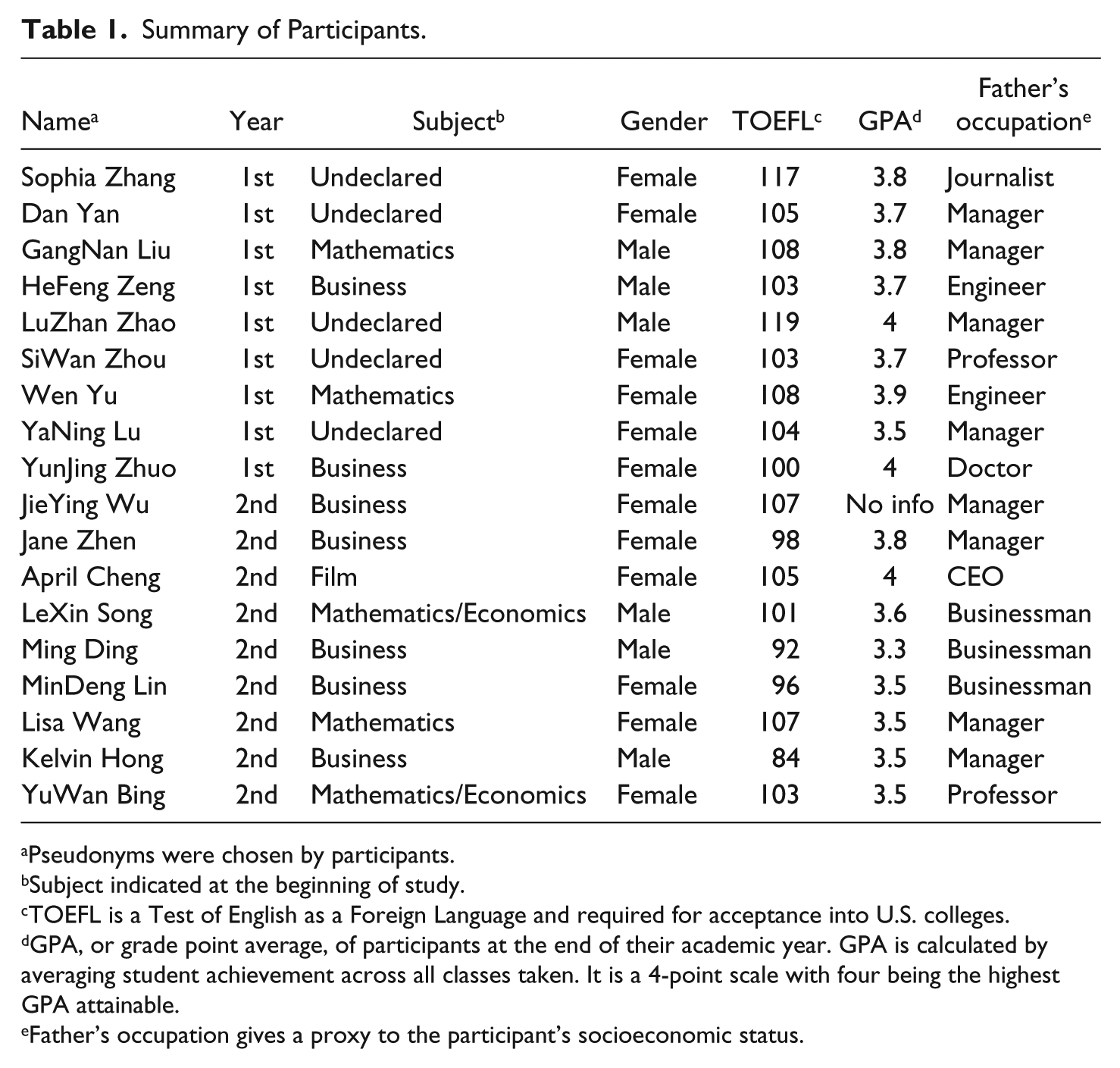
The hybrid sociocultural framework pairs well with qualitative research as both value participants’ meaning construction within their sociocultural milieu and aim to unveil multi-layered understandings of their lived experiences (Hatch, 2002). Through this methodology, participants’ voices are privileged, rather than silenced, allowing for authentic, holistic, and socioculturally embedded insights to surface and overturn prevailing misconceptions. Upon approval by my college’s institutional review board, I posted research advertisements, and participants responded to the advertisements posted on their school bulletin boards and disseminated via international student offices, social media platforms, student association events, and personal contacts. Eighteen participants were recruited via snowball sampling from initial respondents, with participants evenly split across first- and second-year undergraduates (see Table 1). Participants were chosen based on criteria typical of Chinese internationals in the United States—they were mostly engineering, mathematics, or business-related students, on student visas, single, under 20, and had no prior educational experiences outside China (Chow & Bhandari, 2010).
Summary of Participants.
Pseudonyms were chosen by participants.
Subject indicated at the beginning of study.
TOEFL is a Test of English as a Foreign Language and required for acceptance into U.S. colleges.
GPA, or grade point average, of participants at the end of their academic year. GPA is calculated by averaging student achievement across all classes taken. It is a 4-point scale with four being the highest GPA attainable.
Father’s occupation gives a proxy to the participant’s socioeconomic status.
Participants studied in three private, 4-year research universities in an east coast metropolitan city. The undergraduate enrollment of the three universities were around 6,000; 9,000; and 26,000. All three universities were ranked 80 and above in U.S. News University and World Report’s U.S. college ranking. While I made efforts to recruit from public universities, response was poor as Chinese internationals were not enrolled in large numbers in public universities within the metropolitan city at the time of this study. Participants’ TOEFL (Test of English as a Foreign Language) scores ranged from 84 to 119, and they all achieved a grade point average (GPA) higher than 3.3 at the end of the academic year. All participants were self-funded and their fathers were either professionals or businessmen, with these data being a proxy to their socioeconomic status. Table 1 helps readers further contextualize the participants and draw boundaries on the transferability of this case study to different settings.
Participants completed a questionnaire that collected personal information to frame their experiences. Thereafter, they were interviewed thrice: at the start, middle, and end of their academic year. Semi-structured interviews were conducted in participants’ choice of language (typically Mandarin) to facilitate communication and expression of culturally embedded ideas (Davies, 2008). To encourage extended reflection and minimize memory recall bias, participants were invited to complete four journal entries. Journal entries were crucial as many Asian internationals prefer having time for quiet and deep contemplation as opposed to speaking immediately (Kim, 2002). (Refer to Heng, 2018a, for more details on the inquiry method.)
Using LeCompte and Schensul’s (1999) item, pattern, and structural analysis approach, I analyzed the data by first tagging item-level data (e.g., repeating words like “job” and “interview”) and regrouping them within patterns (e.g., “internship”). Constant examination of items for similarity, co-occurrence, and corroboration with other data sources supported the analysis. Eventually, I derived a structure that captured the relationship across patterns (e.g., “preparation for future”). Within each structure, I inductively re-examined the data for patterns along categorical lines. Structures exhibiting clearly visible patterns were eventually included in this article’s findings. To enhance trustworthiness, I conducted data triangulation and member checks, and searched for discrepant evidence (Shenton, 2004).
Findings
This section discusses four prominent themes around Chinese internationals’ experiences—communication in English, engagement with curriculum content, preparation for the future, and participation in extracurricular activities and socialization—and examines departures in experiences along categorical lines (year of study, field of study, and gender).
Communication in English
Chinese internationals reported difficulties with writing and speaking in English. With respect to writing, seven out of nine first years cited writing as one of the most challenging aspects of their classroom experience, while only two second years referenced it by year end. First years agonized over writing argumentative essays as they were more used to narrative essays in China. Even those familiar with argumentative essays shared that the format in China was less strict, more “open to opinions,” and shorter, whereas argumentative essays in the United States expected “strict logic” and “step-by-step” development, and were longer. Furthermore, they observed that writing in the United States focused on “logic” and argumentation of “new ideas” while China focused on linguistic elegance and “intuition.”
In China, there’s more emphasis on the beauty of the language . . . over here, the teachers don’t care about your use of big terms . . . but in China, teachers care about the terms, proverbs, or pretty phrases. . . Western way of thinking is premised on rationality. (Sophia, first year)
There are several plausible reasons for first years’ greater struggle with writing. First years were often expected to participate in mandatory writing courses and were new to the language and expectations around format, expression, and academic conventions. While first years cited writing as challenging even by year end, they acknowledged its waning difficulty over time as “using English to think” and having “practiced enough” helped.
Several second years explained that as they focused on pursuing subjects related to their major (e.g., mathematics), and they took fewer writing-intensive classes, pointing to the intersection of field and year of study, and its impact on writing experiences. Even when writing was expected, participants felt that writing for content-specific subjects was different from a liberal arts writing course.
Last year’s classes are liberal arts classes, but this year’s classes are all business classes and there’s less writing. We need to write marketing essays, but you only need to write a one-page essay . . . It’s ok to write such an essay because it’s related to what we learned in class. (Kelvin, second year)
In addition, group work (heavily emphasized in business-related classes) relieved some pressure as participants relied on peers for language help. However, not all second years found writing easier. Students taking a social science subject (e.g., economics) continued to point to challenges in researching for essays and coherent expression.
In terms of speaking, first years expressed more concerns with speaking during class participation, while second years with speaking outside an academic context and for new academic tasks. First years experienced great anxiety in classroom participation as “native speakers speak really fast and their responses to issues are faster.” Participants also clarified that a large class size of 40 and above, teacher-centered instruction, and heavy syllabus in China offered markedly reduced opportunities for classroom discussion. Second years explained that greater familiarity with the language and observation of classroom participation norms (“you can raise your hand first and then slowly think”) mitigated their anxiety with classroom participation, revealing initiative on their part in overcoming speaking fears. However, second years reported facing newfound challenges when speaking in new contexts. For instance, they struggled with having to interview for internships (“I’m nervous. . .my mind blanks out. . . I think I lack training”) and making business presentations that were graded.
It’s only my 2nd year here, so my language is still not as good. If your language is not as good, your anxiety is doubled. If I had to present in Mandarin, I’d also be nervous, but it’s better because I know I can improvise. . . In China . . . all tests are paper and pen tests, so I have no experience in this area [making business presentations]. (Ming, second year)
Participants were optimistic that their language will improve with time explaining that “it’s especially hard in the beginning but a lot better now.”
The embeddedness of participants within sociocultural contexts with differing expectations and practices yielded tensions that participants gradually overcome, as Tenets 1 to 3 of the hybrid sociocultural framework propose. Tenet 1—the embeddedness of humans within their sociocultural contexts—supports us in understanding that the academic expectations and trainings in China have predisposed participants to write, think, and talk in ways different from the United States. In China, narrative writing was privileged over argumentative; even with argumentative writing, Chinese teachers awarded marks for beautiful language and difficult terms whereas U.S. teachers privileged rationality and novel ideas. In China, large class sizes, frontal teaching, and heavy syllabus meant fewer chances to speak up whereas the smaller class sizes and non-traditional teaching methods in the United States ask for greater classroom participation. Yet, participants’ efforts to change and optimism in improving over time speak to Tenets 2 and 3, revealing their agency and adaptation to different contexts.
Engagement With Subject Content
Participants’ engagement with subject content differed with their field of study. Participants expecting to undertake humanities or social science modules to fulfill their major requirement spoke about challenges around unfamiliar sociocultural context, different content matter, and pedagogical differences. They shared how foreign key historical events, sociopolitical arrangements, classic authors/texts in the Western canon, and religious references (Judeo-Christian religion commonly alluded to) were in the humanities subjects.
“Text and idea” class has history, philosophy, and politics in that class. . . This class is harder for me because most of my friends are locals who understand the current context in the US and understand religion more . . . they know the Bible . . . I haven’t had any contact with any of this information. (LeXin, second year)
Business students struggled with recognizing popular U.S. companies which professors referenced or keeping up with current business news. They toiled for business law class as there were “too many law vocabulary and ideas I [they] don’t come in touch with. For example, America’s court system and appeal court. That’s all new” (Kelvin).
If you take business law, it’s very exhausting, even after much revision, you can’t reach the professor’s standards. It’ll be less tragic if you study math. I think it’s because math is another language. You use numbers and equations. (Jane, second year)
Participants talked about mathematics and science subjects, especially in foundation classes, being easier in the United States as they have had more rigorous training in China and the mathematical language is more universal. Conversely, they reasoned that humanities classes were taught very differently as classes involved more content memorization in China versus engagement in a “very long thinking process” as expected in the United States. They explained that given China’s very long history, there is much to learn about different historical eras; this is further compounded by standardized tests. That history is taught and learned very differently in China thus posed challenges for those undertaking humanities classes in the United States as the latter context emphasizes critical engagement with the subject content. Yet, mathematics and science subjects were not necessarily always easy. Second-year mathematics students reported that increasing abstraction and complexity at higher levels posed greater challenges, highlighting the intersectionality of different categorical lines in influencing participants’ experiences.
In coping with difficulties within a subject, participants used different strategies, such as diversifying their learning techniques, spending more time re-reading, and asking peers for help (see Heng 2018a, for more on coping strategies). However, more second years (eight) sought help from their professors directly as opposed to first years (five), suggesting that students’ relationships and perceptions of their professors changed with time. JieYing, for instance, shared that she saw her professors as “legends” in their own fields and are “very cool, they can be your friends.”
Preparation for the Future
Second years were very active in preparing for their future with six of them, versus one first year, raising concerns about finding internships, long-term job prospects, and post-graduation plans. Second years were stressed out about finding internships amid a highly competitive market as they had no “social security. . .work experience” nor “network” that could help with finding jobs. Lisa’s quote below summarized many second years’ sentiments: I’m ending my sophomore year and starting junior next year. If I’m going to graduate school, then I’ll have to apply for GRE and GMAT, or figure out what program I want to study? Econ? Math? Should I do research? If I work, shouldn’t I apply for internship in fall for the summer after? What types of job should I do? . . . Should I work in the US? China? Hong Kong? . . . . I used to think a little of these, but now that I’m reaching third year, it’s becoming more urgent.
Participants felt that the new sociocultural-economic context disadvantaged them as internationals faced more restrictions around working given their visa status, had a narrower social network in the United States, and were less familiar with academic options available upon graduation.
First years, on the contrary, were mostly concerned about the declaration of their majors and were influenced by their peers and the new sociocultural contexts. To illustrate, Dan worried that graduating from her initial choice of early childhood major might make her uncompetitive in the job market, and she might not earn income quick enough to repay her university loan. In addition, surrounded by peers competing to enter her university’s business school, she was influenced by their proclivity toward business studies, and thus changed her major. Lu agonized over transferring from engineering to linguistics—a newfound field he is “incorrigibly in love with”—as his parents would disapprove of something non-traditional. Thus, we see a clear departure between the concerns of first versus second years as they were viewing different horizons. At the same time, we see that in moving into their new contexts, participants’ values and behaviors changed (refer to hybrid sociocultural framework, Tenet 2)—Dan, surrounded by pragmatic peers, felt pressurized to enter business. Lu, in encountering linguistics (a field Chinese universities typically do not offer) and feeling distanced from parental preferences for traditional engineering, struggled to assert his newfound independence.
Participation in Extracurricular Activities and Socialization
All but one first year-student were involved in extracurricular activities. Participants wanted to “understand the American society” and grow in non-academic aspects. Thus, both first and second years were equally involved in extracurricular activities. However, first versus second years also appeared to have slightly different motivations in extracurricular involvement. Second years tended to be more targeted in their choice of extracurricular activities, with the intent to boost their resumes. Jane, for example, “joined a professional club where [she] can meet people who’re already working” and applied for an executive board position. Kelvin volunteered to do taxes at a refugee shelter as he is “familiar with the context,” could apply his learning and “write it in the resume.” Second years’ approach to extracurricular activities may seem instrumental to some, but if viewed through the hybrid sociocultural framework’s tenet 3, we can argue that participants exhibit agency in overcoming the lack of “social security,” “network,” and “work experience” they cited as challenges above by actively seeking opportunities.
First years tended to choose extracurricular activities they were interested or comfortable in but were also more open to “diverse experiences.” Participating in extracurriculars was also a way for them to “make more friends” and “reduce stress,” revealing agency on their part to adapt to their new environment. For instance, they joined string orchestra or photography club to deepen their interest or attended international students’ gatherings as “meeting international students” makes for easier communication given their overlapping predicaments. They relished the diversity in and emphasis on extracurriculars which they noted were less present in China, signaling their capacity to participate in and adapt to multiple sociocultural contexts (Tenet 2).
Second years reported having more host peers as friends as they had been in the United States longer, sought more chances to interact with host peers, and thus had more common experiences to ease the interactions. Kelvin, for instance, found friends “through the cohort, the dorm, sports, and volunteering” and felt that he “belongs” in his second year, as opposed to feeling like a passenger in transit in his first year. April and YuWan forged stronger friendships with host peers through a semester-long study abroad in Prague and the United Kingdom, respectively. Most first years remarked that making close host peer friends was challenging as they struggled with differences in lifestyles, pop-culture interests, “ideas of making friends,” and interpretations of fun (host peers “like to party”). Furthermore, they prioritized learning over socialization as new academic expectations, and the English language demanded longer hours of learning.
Fields of study that emphasized structured team learning—for example, business, physical sciences, and film studies—increased chances for closer friendships as students had to complete mandatory group assignments. For instance, Ming explained how a business case group helped him “understand Americans better” and “gave me [him] a connection to meet others.” Lu shared that “in my [his] chemistry lab. . . we have 40-60 minutes of discussion weekly. . . everyone is cooperative and it’s very constructive.” Business school students talked frequently about their “cohort” and how they “know peers better over time” (HeFeng) as the cohort structure enhanced chances of interactions with the same peers. In contrast, participants pursuing subjects with less structured group learning, for example, mathematics and humanities, found it harder to forge friendships with host peers as “everyone is in a rush to return to their dorm or attend their next class” or they “have different classes.” Math students, like Lisa, shared that “it’s better to learn on your own. No one in math class will organize study group. The content requires you to understand on your own.”
Male and female participants appeared to have different socialization experiences. Two female participants (one each in first and second year) joined sororities, whereas no males mentioned fraternities. Males shared about making friends with host peers via sports like “soccer,” “skate-boarding,” and “gym” workouts whereas no female participants mentioned having made host friends via sporting activities. In addition, male participants commented that it was harder for them to befriend domestic peers during parties—Kelvin, for instance, remarked that “Asian females are more welcomed in parties” whereas “Asian men are more attractive at gay parties.” Ming observed that “Americans like bodies with better muscle tone and shape. . . .U.S. girls think that muscular men are attractive. But in China, Chinese girls will not like muscles.” He opined that cultural divergence around the “concept of beauty” and different “physical shape” made him less attractive in the United States and that the “external environment” and availability of “a good gym in any university” motivated him to improve his physique.
Discussion and Significance of the Study
This article explores the case of Chinese internationals to elucidate their heterogeneity as much research on international students’ experiences tended to lump them together or disaggregate them by broad categories, like nationality (Abdullah et al., 2014; Hanassab, 2006; Lee, 2014). However, this study does not claim to generalize its findings to all internationals. Indeed, the study itself could have been improved by an examination of different internationals and more in-depth pursuit of the categorical lines of field of study and gender, or an incorporation of a larger/more diverse sample or third- and fourth-year undergraduates. Likewise, some of these findings might not transfer to students studying in lower ranked colleges or from lower socioeconomic status backgrounds, underscoring the influence of personal contexts. In addition, using more objective data collection methods, like observations, could make the data more robust. Instead, this article argues for more nuanced ways of understanding internationals’ experiences through the case study of Chinese internationals. Induced findings reveal that experiences diverged along categorical lines, like year of study, field of study, and (to a smaller extent) gender. Echoing Heggins and Jackson’s (2003) observations, this study found that Chinese internationals’ experiences differed by year of study. On the academic front, first years were more bogged down with mandatory writing classes and classroom participation, whereas second years contended with greater complexity and abstraction in subject content as well as new communication demands, like job interviews and graded presentations. While Heggins and Jackson (2003) observe departures in experience between first and second years versus third and fourth years, this study found that even within first and second years, experiences diverged.
In terms of field of study, Chinese internationals encountered different challenges. Despite their relatively high TOEFL and GPA scores, these participants grappled with unfamiliar sociocultural–economic–political references in humanities and social science subjects and found that while mathematics used a more universal language, the increasing abstraction at higher levels was not easy. This brings to question whether students with weaker academic proficiency have more intensified or differentiated academic experiences. Fields requiring structured team learning, like business, enhanced students’ interactions with host peers. While there were no visible departures along academic experiences by gender, internationals’ socialization and relaxation methods revealed a preference for males to engage in sports and, possibly, an easier socialization experience for females. Males’ preference for sports corroborates research that males tend to participate in sports to cope with stress and derive a sense of community (Frydenberg & Lewis, 1993; Warner & Dixon, 2013), suggesting that internationals’ experiences may transcend nationality. Female socialization via sororities and perceived increased acceptance at social events point to scholars’ conclusions that Asian men face discrimination around their masculinity and physical attributes (Iwamoto & Liu, 2010; Wong, Owen, Tran, Collins, & Higgins, 2012) while Asian women face preference for their femininity (Pyke & Johnson, 2003).
Furthermore, this study highlights that the experiences of Chinese internationals need to be understood vis-à-vis the changing sociocultural contexts they are immersed within (refer to Tenets 1 and 2 of the hybrid sociocultural framework). Chinese internationals face challenges with communication in English and subject matter given differing expectations and norms in China and the United States. As highlighted above, participants wrote more narrative essays and privileged linguistic elegance in China whereas argumentative essays and strict logic were preferred in the United States. In addition, historical events, sociopolitical institutions, and religious references in humanities or social sciences subjects were foreign to Chinese internationals, thus creating learning obstacles. Yet, while Chinese internationals faced challenges, their challenges were not always permanent as Tenet 3 of the hybrid sociocultural framework reminds us. This article illustrated student agency and changes with their experiences over time. English communication challenges, prominent as they were for first years, in contrast with second years, waned by year end. To widen their social network and increase employability, students participated actively in extracurriculars. Furthermore, more second-year students coped by seeking help from their professors and were also more successful in making friends with host peers (see Heng, 2018a, for more about Chinese internationals’ coping strategies and agency that is beyond this article’s scope). Thus, the hybrid sociocultural framework encourages one to adopt a more sociocultural way of seeing differences and to move away from deficit views of Chinese internationals that scholars have cautioned against (Heng, 2018c; Ruble & Zhang, 2013; Ryan, 2011).
This case study does not claim that findings around Chinese internationals’ experiences in U.S. universities are representative of internationals’ experiences. Indeed, specific findings around Chinese internationals’ heterogeneous experiences, like greater ease with mathematics or their gendered experiences, may not apply to other internationals or to Chinese internationals in universities in Asia. Instead, this study suggests that even within one nationality, internationals’ experiences comprise an intersection of various aspects: nationality, field of study, year of study, and gender. To speak of the “Chinese international student experience” as homogeneous would be inaccurate, just as it would to speak of the “international student experience,” supporting scholars’ observations of the heterogeneity of the international student population (Glass et al., 2015; Hanassab, 2006; Jones, 2017). Furthermore, homogenizing internationals overlooks convergence and divergence along various lines—for instance, students from China or Brazil who had attended international schools in their home countries may have overlapping experiences in U.S. universities; conversely, Chinese or Brazilian students who had studied in their local school system may find some of their academic experiences departing from compatriots who had attended international schools. In essence, international students’ experiences are diverse, not singular; condensing their endeavors into the “international student experience” gives a reductive understanding of them.
Understanding the variations in internationals’ experiences can help us avoid over-generalizing as well as help different offices within HEIs work collaboratively toward a more inclusive higher education (Jones, 2017). Other than encouraging more collaborations across service delivery offices, a more holistic understanding of internationals’ experiences can also allow for optimization of service delivery to internationals. For instance, career guidance offices working in collaboration with international student offices may offer more support to second-year internationals around career counseling.
These findings also spell implications for future research around internationals’ experiences. In combining qualitative research and a hybrid sociocultural framework, findings revealed nuanced and complex understandings that unveiled participants’ experiences and interpreted their experiences vis-à-vis their sociocultural contexts. Qualitative research offers insights into reasons for points of departure within internationals, complementing large-scale surveys that offer broader and more representative perspectives. For instance, Crawford and Wang (2015) call second years’ dramatic drop in academic performance an “enigma” (p. 916) as the drop was statistically correlated to enrollment year, not prior academic achievement. They speculated the drop could be due to surface learning approaches that students continue to rely on despite encountering more challenging materials in upper levels. This speculation, while perhaps not wrong, suggests that the learning approach Chinese internationals hold is deficient; it also omits other perspectives. Therefore, a qualitative study like this offers alternative reasons from students’ perspective: second years tended to spend more time on non-academic pursuits like job interviews and student organization leadership, on top of contemplating post-graduation plans. In addition, increased comfort with socialization may reduce the amount of time second years spent studying, resulting in a drop in academic performance. Conversely, first years privileged their academic results above all else. Thus, nuanced and complex understandings yielded from qualitative research with explicit conceptual framework can push back on overgeneralizations and deficit perspectives. Rather than leaving it to quantitative research to unveil perspectives along categorical lines, qualitative research can refine and contribute new insights that may otherwise be overlooked. Scholars hold heavy responsibilities in ensuring multiple methodologies, methods, and questions contribute to a rich understanding of the variations in international students’ experiences.
Conclusion
This study explores the heterogeneity of Chinese internationals’ experience to illustrate the potential complexities and assortment of experiences different internationals may hold. The convergence and divergence along different lines, like nationality, gender, and year of study, complicate our understanding of internationals and point to the diversity and intersectionality of their experiences. We need to look beyond a reductive understanding of internationals merely by their nationality or by a binary “internationals vs. domestic students” lens. Rather than think about the “international student experience” as a monolithic whole, it is more productive and timely for the research community to begin conversations around “international students’ experiences.”
Footnotes
Declaration of Conflicting Interests
The author(s) declared no potential conflicts of interest with respect to the research, authorship, and/or publication of this article.
Funding
The author(s) received no financial support for the research, authorship, and/or publication of this article.
