




Abstract
With the internationalization of education, studying at international branch campuses (IBCs) is becoming a popular choice in China. Taking Dongbei University of Finance and Economics (DUFE)—Surrey International Institute as an example, this article explores the choice criteria used by Chinese students enrolled at an IBC. Based on auto-ethnography and 46 in-depth semi-structured interviews, this study found that students’ choice of this particular IBC was influenced by personal reasons, institution image, program evaluation, and city effect. The study further proposes a model of factors that may influence Chinese students’ choice of an IBC. As the IBCs are run as for-profit ventures in an increasingly competitive environment, the marketing strategies to attract Chinese students to study at IBCs based on the findings are also discussed in this article.
Introduction
Internationalization has played an important role in shaping higher education across the world over the last two decades. With the internationalization of education, the rapid growth of international branch campuses (IBCs) has attracted a great deal of academic attention (Healey, 2016; Liu & Lin, 2017; Wilkins & Huisman, 2015). An IBC is defined as an entity that is owned, at least in part, by a foreign higher education provider; operated in the name of the foreign education provider; and provides an entire academic program, substantially on site, leading to a degree awarded by the foreign education provider. (Cross-Border Education Research Team [C-BERT], 2017)
According to the C-BERT database, a total of 247 IBCs were in operation in 2015 and 22 new IBCs were planned to open in 2016 (C-BERT, 2017). China has not only become the fastest-growing destination for IBCs (Xiao, 2017), but also one of the largest importers of IBCs among 76 importing countries (C-BERT, 2017). This is due to China’s attempt to internationalize its higher education since announcing a series of economic and political reforms in the 1990s (Ennew & Yang, 2009). The internationalization of higher education has been viewed as a strategy to strengthen China’s national economic competitiveness (Mok & Lo, 2007).
As foreign institutions must partner with a local Chinese university based on the requirements of China’s Ministry of Education (MoE, 2003), the IBCs are normally defined as Chinese–foreign cooperative universities in China. Previous studies have examined the IBCs from many perspectives, such as motivations for studying at IBCs (Ahmad & Buchanan, 2017; Wilkins, Balakrishnan, & Huisman, 2012), factors affecting university image formation (Wilkins & Huisman, 2015), assessing quality (Ahmad, 2015; Datta & Vardhan, 2017), academic motilities (Liu & Lin, 2017), achieving legitimacy (He & Wilkins, 2018), and how to manage IBCs (Hill & Thabet, 2018). However, very little is known about the factors influencing students’ choice of an IBC (Ahmad & Buchanan, 2017; Wilkins et al., 2012), and in particular IBCs in China. Given the unique characteristics of IBCs in China, the results may be different for Chinese students. Moreover, as the majority of IBCs are run as for-profit ventures in an increasingly competitive environment, it would be useful for IBCs to understand students’ decision making of studying at an IBC to develop marketing strategies.
IBCs in China
Institutional cooperation has been implemented as one of the most important strategies to internationalize China’s higher education (Yang, 2011). With the development of internationalizing higher education, partnership programs between Chinese and foreign institutions have undergone a rapid expansion in terms of both quantity and scope (Xiao, 2017). Willis (2001, p. 79) classified Chinese–foreign education collaboration into four categories based on levels of Chinese–foreign university cooperation, including “exchanging staff and students,” “cooperated degree programs,” “Sino-foreign research centers or institutes,” and “Sino-foreign independent or semi-private campuses in China.” The majority of the first three institutes are smaller institutions that can only offer one or two specialized programs under the organizational structure of an independent Chinese university. Sino-foreign independent or semi-private campuses in China are recognized as institutions with an independent legal position (MoE, 2003). The implementation of Sino-foreign independent or semi-private campuses has accelerated the development of IBCs in China (Xiao, 2017).
IBCs began to be established in China in the early 2000s with more than 20 IBCs running in China by 2016 (C-BERT, 2017). The rapid development of IBCs in China has attracted a great deal of academic attention (Ennew & Yang, 2009; Feng, 2013; Xiao, 2017). For example, Ennew and Yang (2009) described the challenges of IBCs in China by using the University of Nottingham Ningbo as a case study. Apart from challenges, Feng (2013) examined the respective governance, management, and mission strategy models by comparing the University of Nottingham Ningbo and Xi’an Jiaotong-Liverpool. However, the studies are too descriptive to provide a deep insight into IBCs in China. Hence, interviews were employed by Xiao (2017) to explore IBCs in China from the perspective of educational stakeholders, including their perception of international higher education, how to support IBCs in policies and practices, and perceived benefits and challenges of the development of IBCs in China.
The majority of previous studies have examined the IBCs in a Chinese context from the perspective of universities or governments. However, few studies have explored the IBCs from the perspective of students. Hence, in order to fill this research gap, this study aims to explore students’ decision criteria in the selection of one IBC in China. Although the push–pull model is one of the most commonly used frameworks to explain international students’ decision-making process, it has been criticized for ignoring the nature of the mobility process on the micro level and personal characteristics of students (Lee, 2014; Li & Bray, 2007). Hence, a comprehensive theoretical model was proposed by Cubillo, Sánchez, and Cerviño (2006) to examine the factors influencing international student decision making including personal reasons, country image, city effect, institution image, and program evaluation. This comprehensive model will be adopted as the framework for this study in the context of one IBC. As this study focused on Chinese domestic students, the influence of the choice of country was disregarded. Therefore, a conceptual framework of factors influencing students’ choice of DUFE, as their IBC is presented in Figure 1.
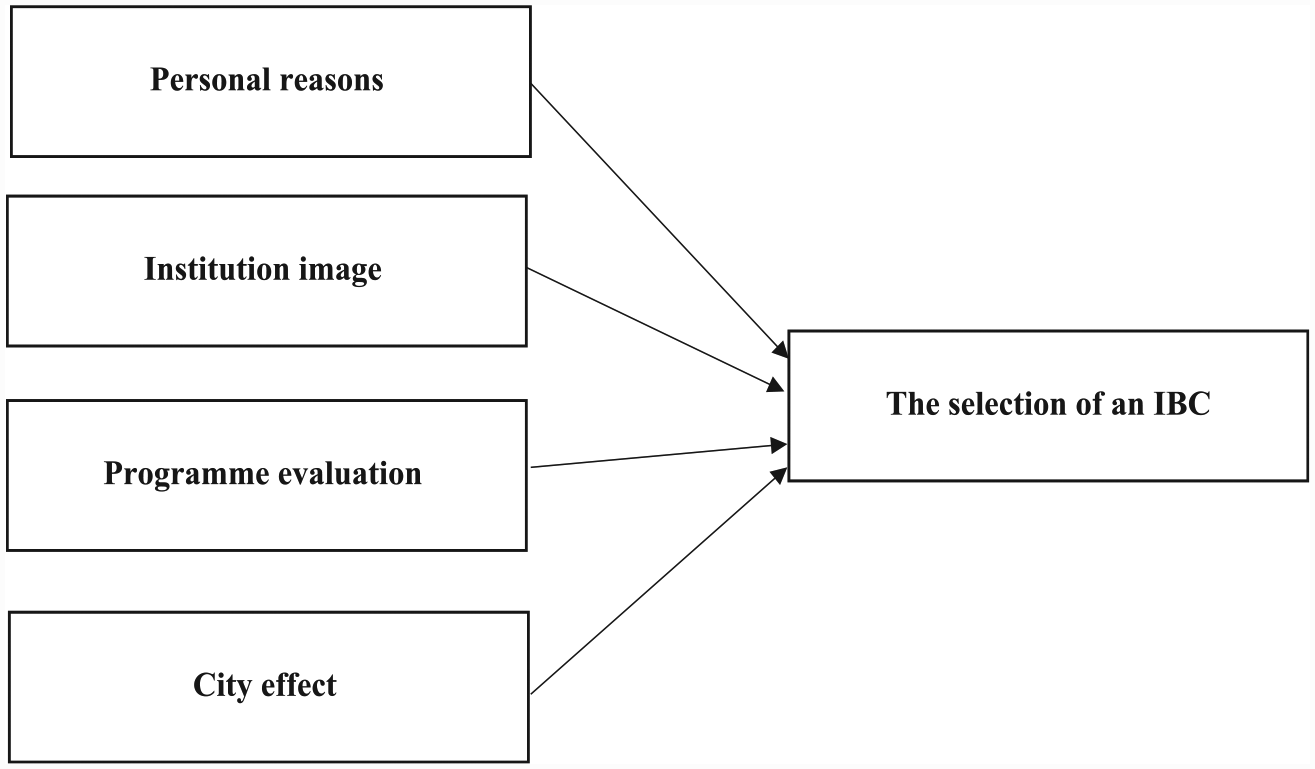
Conceptual framework of factors influencing students’ choice of an IBC.
Research Method
The Case of Dongbei University of Finance and Economics (DUFE)—Surrey International Institute (SII)
The DUFE-SII is a joint academic partnership between University of Surrey in the United Kingdom and DUFE in Dalian, China. The institute is governed through a joint management committee (JMC) which is led by the Vice-Chancellor of the University of Surrey. The institute as an approved Sino Foreign Joint Cooperative school was established on August 30, 2007 by order of the Ministry of Education’s formal document No. 200,769 (SII, 2018a).
The institute offers two majors for students, including business management and tourism management which are accredited by The Association to Advance Collegiate Schools of Business International (AACSB). The programs offered at SII-DUFE are designed to be taken within a dual-degree structure. For the first two years, all students study at DUFE on a mutually agreed syllabus. The programs are wholly under the auspices of DUFE for the first 2 years. For years three and four, students who satisfied the entry requirements such as an average of 70% or higher, with no module failures, plus an overall IELTS score of 6.5 (and a minimum score of 6.0 in all elements) can choose to proceed to the dual-degree program on DUFE campus or apply to study in the United Kingdom. The programs have been wholly under the auspices of Surrey University for the last two years. The qualified graduates will receive Dual Degrees from both parties. There are currently around 1,300 students studying at SII.
SII has received many awards due to its outstanding performance over the last decade, such as achieving top level in the MoE audit review in the China-Foreign Cooperation Running Schools in 2011 and the Best Joint Venture in Liaoning Province. The institute is also audited by the Quality Assurance Agency for Higher Education (QAA) in the United Kingdom and the China Education Association for International Exchange (CEAIE), ensuring that quality standards in teaching, learning, and assessment are continually improved (SII, 2018a). Therefore, this institute, as one of the most long-established and successful of the faculty-based ventures, was selected as a case for this study.
Data Collection
As discussed above, topics related to Chinese students’ decision making in choosing IBCs are still under-researched; a deeper understanding of this issue is necessary before formulating any hypotheses. Given the exploratory nature of this study, qualitative approach was considered to be a suitable data collection method. Compared with the methods of hypothesis testing, surveying, and statistical analysis, a qualitative-explorative research methodology allows room for interpretation and adaptation within the scope of relatively limited research (Merriam, 2002).
There were two stages of data collection. During the first stage of research, data were collected in the form of a reflective journal written by the author of this article who completed his full-time undergraduate study from SII in 2012. He went overseas for further study after graduation. He is currently working as a researcher in New Zealand. The author recorded his own study experiences and self-reflection, especially regarding his selection criteria. The performance of auto-ethnography allows researchers to be “insiders” and to conduct the research from an epistemology of “insiderness.” Being part of the story, researchers’ own experiences make it possible to gain “inner knowledge.” In summary, auto-ethnography enables researchers to provide unique insights, thoughts, and observations, so that researchers’ reflexivity is openly discussed (Ateljevic, Pritchard, & Morgan, 2007). In this study the researcher’s experiences informed the questioning, which also drew on the above cited literature on the international student decision-making process.
Semi-structured interviews were selected as the second stage of data collection to obtain in-depth information (Yin, 2008). The interviews for this study were conducted between May 2, 2018 and June 25, 2018 by the author. As the author graduated from the institute in 2012, all the participants were recruited with the help of the author’s past relationships and the staff from the institute’s alumni center. First, 60 potential research participants were identified with the assistance of the institute’s alumni center staff. All potential participants were selected on a purposive basis in order to reflect students’ ideas at different years of study. Forty one student participants eventually participated in the telephone interview after the initial invitation via email and/or telephone. Table 1 presents a general profile of the student interviewees. Apart from the students, five administration staff from SII were also interviewed to gain a more comprehensive understanding of this topic. As the focus of this study was placed on students, the interviews from five administration staff served mainly as a complementary information source for triangulation purposes when analyzing data.
Profile of Student Interviewees.

Each interview was conducted in Chinese and lasted between 20 and 25 minutes. The interviews were audio recorded for 44 of the 46 interviews. 2 of the 46 interviewees refused to have the interview recorded (taking notes). The interview questions focused on four themes proposed by Cubillo et al. (2006):
What personal reasons drove you to select SII?
Was your decision influenced by the institution’s image? If yes, how? What were the key factors?
How did you perceive the importance of program evaluation on your decision-making process?
Was city an important factor influencing your choice? Why or why not?
Data Analysis
The recordings and notes were transcribed verbatim into text for analysis. In order to ensure the quality of the data, the Chinese transcripts were used for analysis to avoid missing data and distorting information at the transcription stage. The data analysis involved four stages based on the process proposed by Berg (2001). First, by repeatedly reading the transcripts the author became familiar with the text in preparation for coding. Second, open coding was applied to engender the code frames (Strauss, 1987) using NVivo 11. Third, a grounded coding list was further grounded with the application of concepts in accordance with the theoretical model proposed by Cubillo et al. (2006). Fourth, the developed codes were applied to all interview transcripts. Member checking (i.e., sending preliminary results to interviewees for confirmation) was used to assure the validity and accuracy of the data coding. The results and supporting quotations were then translated into English after completing the data analysis in Chinese. To avoid or minimize possible inaccuracies during the translation process, the results and supporting quotations were checked by a Chinese–English linguist for accuracy of translation.
Findings
The results are discussed in the context of the four conceptual factors said to influence Chinese students’ choice of an IBC in China, namely: personal reasons, institution image, program evaluation, and city effect.
Personal Reasons
Twenty five of the 46 participants highlighted the importance of personal situation and development in selecting this IBC. First, students’ National College Entrance Examination (NCEE) scores were considered to be one of the most influential personal factors in selecting an IBC in China. The NCEE is a prerequisite for entrance into almost all higher education institutions at the undergraduate level. Students are only allowed to study at an IBC if they achieve the minimum required score for that IBC. Therefore, the majority of participants argued that the first thing for them to consider was their examination scores: “SII seemed to be the best choice for me among the IBCs in terms of my national college entrance examination score” (Participant 9). The statement was also confirmed by participant 21, who worked as an administrative staff member in the institute: “a large number of students call our office to consult the possibility of enrolment given their scores after the national college entrance examination every year.”
Second, students’ selection of SII was also influenced by the motivations for personal development, such as gaining international/intercultural experiences, improving English ability, and future career prospects. Studying at SII was viewed as an opportunity to improve English skills and gain international/intercultural experiences without studying overseas. Normally, students get more opportunities to learn and use English at IBCs than other universities, as they have access to a large number of English classes, and use English textbooks, in an English-speaking environment. Moreover, the majority of lecturers at IBCs are from English-speaking countries or are Chinese who have an overseas study background. SII provided an international study environment for students to experience different cultures and improve their English without going overseas. For example, Participants 1 and 7 commented: English is one of the most valuable skills in the society. I knew that the majority of papers were taught in English by lecturers from English speaking countries before applying for the institute. My parents expected me to speak fluent English after four years’ study in the institute and lay a solid foundation for future development. (Participant 1) Studying in an international environment and experiencing different cultures drove me to study at an IBC. It will be a good chance to extend my horizons while I am still young. (Participant 7)
Another influential factor for personal development mentioned by participants was future career prospects. Studying at SII was viewed as a good pathway to overseas master’s study and job hunting in international companies after graduation. IBCs were seen to provide a similar learning environment to overseas universities such as English-speaking environment, similar way of teaching, similar assignments, and exams; studying at an IBC was therefore seen as a solid foundation for overseas master level study. In terms of employment, five participants mentioned that the desire to work in big international companies drove them to study at SII. They expected out that their improved English language ability and expanded international horizons would be an advantage for them to apply for jobs in big international companies. For example, Participants 10 and 18 commented: I expected to go the UK for my master study after graduation. The institute lays a good foundation for my application such as a large number of English classes, similar teaching method to the UK such as tutorials and assignments. It will be a lot easier for me to study overseas in the future. I have already got used to the British higher education system. (Participant 10) I would like to work in big foreign companies after graduation. The SII could provide me with two important skills for working in international companies, including the ability to use English and work in multi-cultural environment. (Participant 18)
This finding is confirmed by the SII graduate’s employment report (SII, 2018b). The report indicated that 60.15% of the graduates went overseas for master’s study in 2017 which is a lot higher than the graduates from the host university (22.03% for DUFE). In terms of the nature of employment, the report also indicated that 15.79% of undergraduate students worked in foreign-funded enterprises in 2017.
Apart from personal situation and personal development, four participants identified that recommendations from others, particularly previous successful graduates, played an important role in the process of decision making. Previous successful graduates served as role models for new students. One typical comment from Participant 19 was the following: I took the advice from one of my father’s friends. His daughter graduated from the institute in 2014. My parents and I got many positive comments on Surrey International Institute from him and his daughter. She is working in a very big international company in Beijing now. She is my role model. (Participant 19)
Institution Image
Participants evaluated the importance of institution image from five perspectives; legality, quality of teaching, institutional prestige, social recognition, and facilities. First, the legality of the institution was the first thing for students or their parents to consider when selecting an IBC. To avoid selecting pseudo institutions and projects, a checklist was proposed by students or their parents when selecting an IBC. This included such things as a permit from the People’s Republic of China for Chinese–Foreign cooperation in running a school, general enrolment regulations, and the requirement of students’ previous NCEE scores. One typical comment from Participant 12 was the following: Given the large number of pseudo Sino-foreign cooperative education institutions and projects, my parents did a lot of research. The most important thing in their list was to check the permit in running a school. Then, they further checked the enrolment regulations and previous year’s entrance scores. In fact, some Sino-foreign cooperative education institutions and projects do not require students’ national college entrance examination scores. In my parents’ [thinking] the required scores determine the quality of the institutions. (Participant 12)
Second, 30 of the 46 participants highlighted the importance of quality of teaching in selecting an IBC, such as the qualifications and experience of teaching staff. Not surprisingly, the quality of teaching was viewed as one of the most important factors highlighted by the interviewees when it came to selecting an IBC: My parents and I checked the official website of the institute. We found that the majority of lecturers in SII completed their doctoral study overseas. The percentage of foreign lecturers is also very high. Some of them graduated from top universities overseas and some of them had overseas teaching experience. The information made me feel confident in making the decision to study at SII. (Participant 16)
Moreover, interviewees’ selection of an IBC was also influenced by prestige and social recognition. The higher the institution’s prestige, the higher the social recognition. This study’s participants preferred to select an IBC that had high prestige and social recognition for two reasons. First, many famous companies in China only recruit graduates who graduate from universities that have high prestige: DUFE is one of China’s top schools in accounting and management. As far as I know, it is easy for the graduates to find jobs in banks or financial organizations, especially in the northeast part of China (Participant 11).
Second, the selection is driven by face (mianzi) in Chinese culture. Face (mianzi) can be most closely defined as dignity or prestige. One of the worst things that can happen to someone in Chinese culture is to lose face. Studying at a high prestige institution is regarded as face-saving and an honor to the family: SII is one of the most famous IBCs in the northeast part of China. The whole family is proud of my studying at this reputed institute (Participant 23).
The importance of prestige and social recognition were also confirmed by Participant 15 who worked as an administrator in the institute: Students and their parents really care about the institution’s prestige and the social recognition of the qualification. The most frequently asked questions include: is it the qualification recognized by the society and country? Is it easy to find a good job after graduation? Is it easy to apply for a good overseas university for master study after graduation? (Participant 15)
Finally, five of the participants argued that the facilities of the institute played an important role in making the decision. The facilities are important elements of the study environment in their eyes: I and my parents visited four different institutions before making the decision. Relatively speaking, the facilities of SII are better than the other three institutions. It has a separate building. The decoration of the whole building is western style. It also has its own library. I and my parents were happy with the study environment there. (Participant 25)
Program Evaluation
The criteria used by participants to evaluate programs included host universities’ recognition, foreign universities’ recognition, quality of programs, total cost and finance, graduates’ achievements, and program suitability. The graduates from some IBCs get degrees from both Chinese host universities and foreign universities. A dual-degree program was very attractive to the majority of the participants. In this regard, the host universities’ recognition and the foreign universities’ recognition both determine the value of the degree. For example, Participants 14 and 29 noted: The most attractive part for me is to gain two degrees from DUFE and Surrey. DUFE is famous for accounting and management major in China. Surrey is one of the top five universities in the UK. My parents and I are satisfied with the rankings of DUFE and Surrey. (Participant 14) My major is tourism management. DUFE used to be in the top five universities in tourism management major. Surrey has been the No.1 tourism school in Europe for years. The degree from DUFE has good domestic recognition. The degree from Surrey is well recognised internationally. The degrees lay a good foundation for my future work in the tourism industry. (Participant 29)
Twenty-two of the participants highlighted the importance of the quality of the program for selecting SII. The majority of participants evaluated the quality of a program based on information from an official website, social media, and online comments. For example, Participants 6 and 33 commented as follows: My parents and I checked the official website of the institute before applying for it. We found that the institute obtained many awards. The institute and its dean had many convincing media reports written about them. The factors indicate the high quality of the programme. (Participant 6) We did online research. The results of our research made us believe that the quality of the programme is relatively high. Firstly, we found many videos related to the institute online. It gave a good introduction to the institute. Secondly, we did our best to search the big forums and read almost all the words related to this institute. The majority of comments on this institute are positive. (Participant 33)
Total cost and finance were other important criteria cited by participants. Participants aimed to select an IBC that offered value for money. SII was seen as a cost-effective choice: The total tuition fees of the SII are only 146,000 RM for four years if you join the dual-degree programme. This budget allowed me to study in an English-speaking environment and get two degrees after graduation. This is very cheap. The four years’ tuition fees were equal to my one year master’s study fee in the UK. (Participant 17)
This finding was confirmed by the author’s observation. Many of the author’s classmates once mentioned that this institute is a relatively cheaper option than other IBCs. The majority of them viewed this institute as a stepping stone to future study. In fact, more than half of the author’s classmates went overseas to pursue their master’s after graduation. Graduates’ achievements were seen by some interviewees as an important program evaluation criteria. They were taken as an indication of the quality and recognition of the program and motivated some participants to select SII.
My parents and I read the 2017 graduates’ employment report online. We realized that it has a high employment rate. The quality of employment is also very high. The statistics gave us confidence in my future development after graduation. (Participant 38)
Finally, six of the participants pointed out that program suitability played an important role in selecting SII. One typical comment from Participant 40 was the following: I am an extroverted person who likes to communicate with people and make new friends. We found that SII held many kinds of activities for students. I am a big fan of student activities. In addition, I am good at English. I am able to adapt to the massive English classes easily here. SII seems a good fit for me. (Participant 40)
City Effect
The impact of city on decision making can be divided into two categories, including essential characteristics (development level, degree of internationalization, employment prospect, social reputation, and natural environment) and distance (geographic proximity to home and cultural distance). The development level and degree of internationalization were viewed as the most important indicators to measure the economic strength of a city. Certainly it can be argued that the stronger its economy, the easier it will be for the city to attract resources such as investment and talent. In fact, new technology and trend are often launched from a developed city. It may therefore be easier for graduates from a developed city to experience the application of advanced technology and broaden their horizons. In terms of employment, the biggest Chinese and international companies are located in developed cities. The importance of the city’s economic strength and the presence of international companies were mentioned by interviewees in this study. For example, Participants 30 and 32 commented: In terms of a city’s economic strength and degree of internationalization, Dalian is one of the most of developed cities in the northeast part of China. Compared to my hometown, Dalian, as a bigger city, has more job opportunities. (Participant 30) It will be easier for me to perceive the latest technology and development of China if I study in a city with a high degree of development and internationalization. The majority of new technology has started in big cities. It enables (me) to broaden my horizons and realize the needs of big companies during my study. I also realised that the majority of big international companies are located in big cities and they preferred to recruit graduates from the same city. (Participant 32)
Some participants emphasized the importance of Dalian’s social reputation and natural environment during the process of decision making: Dalian as a famous tourism destination has a good social reputation. It is a safe city to live in” (Participant 28); “Dalian’s scenery is very beautiful. I really enjoyed the climate and environment of the city (Participant 35).
In addition to Dalian’s characteristics, another influential factor in selecting SII was distance from home. Eight of the participants mentioned that Dalian is in geographic proximity to their homes. Short traveling distances and easy access to their home towns were attractive to students who did not want to be far away from home during their study. These findings were confirmed by the observations of the author. The author recalled that there were 28 students in his class and more than half of them are from Dalian neighboring cities. Moreover, cultural distance was also a factor proposed by participants when selecting SII. Cultural distance was seen to have a direct influence on the culture shock experienced by students. Some participants pointed out that they felt comfortable staying in a similar cultural background with familiar language or accent, lifestyle, eating habits, and traditional customs. One typical comment from Participant 23 was the following: I am from Dandong which is not far from Dalian. Dalian is an ideal place for me to live in. The culture is quite similar to my hometown. Same accent. Famous for high quality seafood. The costal climate. The majority of people viewed me as a local Dalian resident. I really enjoyed the life in Dalian. (Participant 23)
Discussion and Conclusion
Given the increasing number and popularity of IBCs in China over the last decade, it is important to understand the criteria used by Chinese students in the choice of an IBC. From a theoretical viewpoint, the findings of this study contribute to literature related to IBCs in two ways. First, a variety of factors influencing Chinese domestic students’ choice of one specific IBC, Surrey International Institute, were explored in this study. These factors are summarized in Figure 2. Some findings support those of Ahmad and Buchanan (2017) and Wilkins et al. (2012), such as the importance of the reputation of the university, the quality of education provided, being a foreign university, favorable tuition costs, geographic proximity to home, and familiarity or comfort with the culture.

Factors influencing Chinese students’ choice of SII as an IBC.
The author also observed some differences in the choice criteria proposed by Ahmad & Buchanan (2017) and Wilkins et al. (2012). For example, in this study a low cost of living/expenses, a safe place to live and study, and an exciting place to live were not identified as important factors influencing destination choices for Chinese students. In terms of destination selection, Chinese students focused more on the development of the city, such as the degree of internationalization and employment prospects. This difference may have been the result of the study focus. Ahmad and Buchanan (2017) focused on Malaysia (the country) as a destination and Wilkins et al. (2012) focused on the United Arab Emirates (the country) as a destination. This study focused on one specific city in China. Another key finding of this study is that, the push and pull model used by previous studies ignores the personal characteristics of students (Lee, 2014; Li & Bray, 2007). Therefore, some new factors related to personal reasons were identified by adopting the model proposed by Cubillo et al. (2006) who summarized previous studies of international students’ decision making. The findings are in line with existing international student decision-making process literature suggesting that the students’ choices are influenced by personal reasons (Binsardi & Ekwulugo, 2003; Bourke, 2000) and considerations of program quality (Cubillo et al., 2006). The identified personal reasons included personal situation, personal development, and recommendations from others. The most important personal situation was the students’ NCEE scores, which reflects the recruitment characteristics of IBCs in China. This research also found that Chinese students’ parents played an important role in helping them select an SII.
In addition to theoretical contributions, this article also provides valuable implications for policy makers of IBCs like SII to (re)consider their marketing strategies. Students and their parents were very concerned with the legal status of the institute, the quality of the program, and their employment prospects. To alleviate concerns, the official website of the institute could highlight the institution’s legal status, the previous years’ required examination scores, and the profiles of teaching staff. It would also be useful to provide the graduate employment report for students and their parents to read. Moreover, word of mouth seems to be very powerful. Successful graduates can be promoted as role models for potential students. In addition, the information related to the location of the city should focus more on the development level and the culture of the area.
Despite the theoretical and practical contribution to existing studies, there are still some limitations to be considered when interpreting the research findings. The study deals with one IBC in China—DUFE-SII. The findings of this research may not be generalizable to other IBCs in China. Second, while this study has highlighted the importance of demographic variables such as geographic proximity to home in making a decision to enrol at an IBC like SII, these factors were not explored in detail. Further research is required, perhaps by using quantitative research methods such as a questionnaire, to explore the relationship between factors influencing Chinese students’ choice of an IBC identified in this and other studies and how identified choice factors and demographic variables, such as gender and household income affect these considerations. As there has only been limited research on this topic, particularly in the context of China, it is hoped that this exploratory study will provide a foundation for future research into the reasons why students choose particular international branch campuses as preferred institutions for further study.
Footnotes
Declaration of Conflicting Interests
The author(s) declared no potential conflicts of interest with respect to the research, authorship, and/or publication of this article.
Funding
The author(s) received no financial support for the research, authorship, and/or publication of this article.
