



Abstract
In the Asian context, when students transition from pre-university to an International Branch Campus of a Western university, they tend to experience significant differences in a number of areas in their first-year university lives. Because of the different educational cultures, students and teachers may have different expectations on the academic culture of university. If a misalignment of these expectations occurs, the potential for a negative learning and teaching experience is likely to increase. This article attempts to identify the gaps between the two parties to circumvent the potential problems that come with it. A survey was conducted with 728 first-year students and 124 teachers who teach first-year subjects at a Western university international branch campus in Malaysia. The results show that significant gaps exist in their expectations on course content, responsiveness, assessment support aspects, and concern for student. These findings warrant attention from the home campus as well as the branch campus. Some suggestions are offered to address these gaps in expectations.
Keywords
Introduction
There is a growing number of first-time university goers, as evidenced by the rapid increase in enrollments. For example, enrollment in higher education in Asia has increased by over 50% in the last decade (Calderon, 2012). The input of parents is often missing in the case of first-time university goers when forming their expectations of university experience (Hunt et al., 2018). This is especially the case in developing countries that lack a well-established higher education sector and encourage foreign universities to invest within their countries, in the form of International Branch Campuses (IBCs).
The IBC
This research focuses on the concept of an IBC, an educational facility that is separated from the home campus, where students receive face-to-face instruction in a different country from that of the home campus. C-BERT (2016) reports the existence of 249 IBCs worldwide, of which 16 are in Malaysia—the third highest number after China and the UAE. Most IBCs are relatively new; therefore, the information available to form expectations of studying in IBCs is limited. This is the case in IBCs in Malaysia where the first IBC was established less than 20 years ago.
There has been an influx of Western universities establishing their IBCs and offering higher education programs in Asia (Calderon, 2012; Escriva-Beltran, Muñoz-de-Prat, & Villó, 2019). This growth in the industry is fueled by the prospect of students being able to attain a degree from a reputable university for a lower expense and their desire to stay with their family in the home country (Huang, 2007; Wilkins, Balakrishnan, & Huisman, 2012). As such, there is clearly an expectation in relation to the reputation and value of the certificate. A recent report highlighted the difficulty of the partnership between Yale and the National University of Singapore, with one of the factors being that student-based learning did not provide in-depth learning experiences (Philomin, 2015; see also Tierney & Lanford, 2015). Ignoring these cultural differences can lead to problems with the transition into university life, as the expectations of the student can be very different from those of the teachers. These cultural considerations apply not only to students when they form their expectations but also to teachers who may face different teaching and learning environments in IBCs (Cai & Hall, 2016). Echoing Cai and Hall, a review of the studies of IBCs showed that in the establishment of IBCs, the issues facing academics include the adaptation of curriculum to local contexts and general intercultural competence when teaching a transnational community (Escriva-Beltran et al., 2019).
An early work by Kingston and Forland (2008) recommended developing a cultural synergy between Western and Asian approaches to teaching and learning to improve the overall experience of all parties involved. Miliszewska and Sztendur (2012) investigated student views on various dimensions of Australian IBCs in South East Asia, such as curriculum and instruction design, teachers and teaching, and the use of technology. Wilkins et al. (2012) adopted a similar approach and examined student experience at IBCs in the UAE.
The design of courses should be done in dialogue with all parties to ensure that one of the goals of the assessment at first-year level is to prepare a student to be an independent learner rather than merely striving for good grades (Harvey & Knight, 1996; Higgins, Hartley, & Skelton, 2002; Horsburgh, 1999). This study contributes to this dialogue by (a) providing a better understanding of the two parties’ expectations and (b) exploring these expectations within the context of a Malaysian IBC. Malaysia is considered well suited as a research site for the IBC phenomenon.
Expectation Gaps Between Teachers and Students
Transition into university life can be challenging to students across a range of higher education contexts. Globally, the transition from high school to university is a major concern. Much of the research in the area analyzes the aspects, such as the academic motivations and achievement, and attrition rates, and studies various demographic student groups (e.g., Long, Ferrier, & Heagney, 2006; Tierney, 2005). Concerns about a gap in student’s skill between pre-university schools and university have been reflected across a broad range of disciplines (Brinkworth, McCann, Matthews, & Nordström, 2009). Based on a survey of science students, Cook and Leckey (1999) concluded that students do not bridge the gap between pre-university institutions and university effectively because students’ study habits formed in secondary school tend to persist to the end of the first semester to university life. For example, Lowe and Cook (2003) found that almost a third of the first-year student sample in their study in a UK university reported difficulty with adapting to a more independent study style and being responsible for their own learning. Such a transition gap may be particularly wide for students who enter into an IBC where the academic cultural environment, curriculum design, and teaching style are significantly different from those of the local universities. It becomes more challenging for students with an Asian education background to have a successful transition into higher education in a Western IBC. Kingston and Forland’s study (2008) highlighted the tension between the expectations of East Asian students and the implicit rules that govern the academic environment of UK higher education due to the educational cultural differences. The broader issue that is being explored in this study is expectations. How expectations are formed and managed plays a crucial role in a student’s learning experience, and subsequently, their ability to succeed in their studies. When it comes to the matter of teaching styles, students are likely to understand there will be differences in tertiary education compared to their previous experience. The problem lies in the fact that while they know there will be differences, they do not know what those differences are (Crisp et al., 2009). With little support to manage their expectations, students revert to their previous experience as the point of reference or begin to form expectations that may be beyond the actual scope of the institution. Borghi, Mainardes, and Silva (2016) found that students have, perhaps rightly so, a high expectation of the quality of faculty services but they also expect institutions to cover areas that previously would not have been considered. Furthermore, an increased sense of being unable to independently manage one’s own studies has led to an increase in expecting support in areas beyond merely academic matters (Bartram, 2007).
Although there is evidence that introducing independent learning through undergraduate research projects leads to better grades and improved satisfaction in the longer term (Bowman & Denson, 2014), and that self-evaluation of assignments trains students to operate independently in future jobs (Tai, Ajjawi, Boud, Dawson, & Panadero, 2018), this does not necessarily mean that students are automatically equipped or want to adopt independent learning. Although there have been findings in specific contexts demonstrating that students require no feedback from teachers because they have developed independent learning methods (Jungert, 2008), there is sufficient literature to show that teachers are concerned that students today arrive expecting to be spoon-fed and are not equipped to think for themselves (Towler, Woolner, & Wall, 2011), and that they are happy to copy a style given to them but not exercise creativity to develop their own (Wallace, 2002). There appears to be a lack of willingness to undertake independent study and contribute to class discussion, and instead, students demand more teaching time and end up passively listening in classes (Towler et al., 2011). This outcome is also, in part, due to students having low expectations of themselves in terms of their responsibilities as a learner (Towler et al., 2011). In short, students are more interested in what the institution can do for them, without consideration of the role they play in the educational process. Thus, if the teacher’s style is that which favors independent learning, participation, and student-led learning, this teaching style can easily be construed as the teacher failing to meet student expectations in learning.
It is possible that this lack of engagement in the knowledge creation process is due to the emergence of consumerist attitudes among students (Rolfe, 2002; Zepke, Leach, & Butler, 2014). It is possible that the nature of the IBC itself fuels this sentiment. After all, IBCs are set up primarily for commercial purposes, or “export revenue,” creating the context of a business transaction (Marginson, 2015). Students (and parents) identifying themselves as “customers” instead of “students” places teachers under immense pressure to not refuse requests for fear of not giving the customers what they want (Bartram, 2007), which in turn only further encourages dependence on teachers. This lack of active participation has led to more guidance given in the amount of material provided, even down to assigning the exact pages required to read (Rolfe, 2002).
Given the transition difficulties so evident in the first year of university life, researchers have investigated the issues of students’ expectations in a number of areas such as workload, course content, and aspects related to assessment support and feedback (Adcroft, 2011; Bartram, 2007; Borghi et al., 2016; Crisp et al., 2009; Lowis & Castley, 2008). Such studies highlight the key issues that occur between the student and the teacher are the purpose of feedback, the level of availability, the level of responsiveness such as reviewing drafts and work, feedback, and more personal and professional development. The suggested solution is an ongoing dialogue between the parties to better align between student expectations and the reality of university study and culture (Crisp et al., 2009).
This study contributes to the literature on the transition to higher education. It examines the transition and expectation gap that occurs in an IBC in an Asian setting. This research was conducted by surveying both parties in the transition process—the student and the teacher.
Method
Research Setting and Sampling
One of the large IBCs in Malaysia was selected as an appropriate research setting. This Australian branch campus was established in the late 1990s and served as the first foreign university in the country. The number of students rose steadily to approximately 7,000 students in 2017. Two separate rounds of pen-and-pencil surveys were administered to students and teachers, respectively. Survey 1 sample included the first-year, first-semester university students. Survey 2 sample included casual and full-time teachers who were currently teaching or had previously taught first-year students in the past 3 years.
Measurement
The questionnaire contained two sections. Part A contained the measurements for the expectations of first-year course content, teacher responsiveness, assessment feedback, preparation for assessment, personal interaction, concern for the student, and library support. These measures were adapted from different sources in the literature and were measured using multi-item scales. Course content and library support were adapted from Hampton (1993) and Kwan and Ng (1999). Teacher responsiveness was adapted from Ibrahim, Wang, and Hassan (2013) and assessment feedback from Weaver (2006). Personal interaction, concern for the student, and preparation for assessment were adapted from Kwan and Ng (1999). Respondents were asked to rate on 5-point Likert-type-scale, the extent to which they agreed or disagreed with each of the statements (1 = Strongly Disagree), or the perceived importance (1 = Not at all important). Part B contained respondents’ demographics questions along with categorical data on the expected time spent on self-study and expected time frame for feedback on assessments.
A pretest procedure was undertaken to ensure that the questions were appropriately worded and understood. Representatives from both student and teacher cohorts were asked to review the questions to determine which of these questions were relevant to their first-year educational experience. The questions were refined according to the feedback and comments received from the pretest.
Survey Administration
Survey data was collected from the first-year students and teachers. Students were approached during the orientation week. Three research assistants briefed students on the purpose of the survey to solicit their participation. It was especially important to administer the survey upon their entering classes as their expectations were still latent, and their actual experience of the institution was not yet developed (Appleton-Knapp & Krentler, 2006). The teacher survey questionnaires were distributed by the researchers and a research assistant during the teaching semester and break. The participation of both surveys was voluntary. Bookshop vouchers were provided upon the completion of questionnaires as a token of appreciation. Questionnaires were distributed to 1,239 first-year students participating in the compulsory orientation program and 753 were returned with 728 usable. Excluding 25 incomplete responses, this yielded a 58.8% response rate. Among 381 teachers in total at this IBC, a total of 124 usable questionnaires were obtained from those who had taught the first-year students in the past 3 years.
Analysis and Results
Respondent Profile
Table 1 depicts a summation of the profile of student participants. It shows that the respondents were from a wide range of the students in terms of study programs, with 34% of the students surveyed in Business, followed by 24% in Engineering, 19% in Science, and the remaining 23% a mixture of students from the Arts and Social Sciences, Pharmacy, Information Technology, and Medicine and Health Sciences. An almost equal number of female and male respondents were obtained (368/358 split). Of 728 students who disclosed their age, the majority fell under 21 years old (92.2%). Most students surveyed were of Chinese ethnic origin (76%), followed by 7.4% of Indian origin and 3.4% Malay students. The remaining 13% students were described as “other.” The student sample comprised mainly Malaysians (83.2%) and those from neighboring countries such as Indonesia and Bangladesh. Slightly more than half of the students had entered the University with qualifications from either a Foundation Year program or A-Levels. The remaining students had obtained Pre-University, Unified Examination Certificate and other types of qualifications.
Demographic Profile of Student Sample.

As Table 2 shows, approximately 40% of the teachers who participated in the study fell within the age group of 26 to 35, with another 38% being in the age group of 36 to 50. Those in the age groups of 18 to 25, and 51 and above contributed to about 25% of the sample. About half of the respondents had lived outside of Malaysia prior to joining the IBCs, among those including 36 teachers who had lived in Western countries such as Australia, the United Kingdom, the United States, Belgium, and New Zealand. Most of the teachers were teaching associates or tutors (41.9%), lecturers (34.7%), and senior lecturers (17.7%). Only seven respondents were at the Associate Professor level or above. Nearly 60% of respondents held a PhD qualification. Those who did not have a PhD were mainly PhD students serving as tutors, or casual staff, in which case a PhD is not required. Forty-one teachers had been teaching for 4 to 10 years, followed by 31 who had a teaching experience of more than 10 years, totaling 58.1% of the respondents. The majority of respondents (70%) had 4 to 12 contact hours per week in a typical semester.
Demographic Profile of Teacher Sample.

Assessing Data Normality and Factor Analysis
The normality of distribution involves an assessment of skewness and kurtosis values (see Table 3). The value meets the recommended cut-off points with skewness of ±2 and kurtosis of ±7 (Hair, Black, Babin, & Anderson, 2010). Unidimensionality tests on each of the seven constructs confirmed that only one latent trait underlies the items. Principal component analysis revealed that four constructs were indeed unidimensional, apart from Preparation for Assessment, Concern for Student, and Library Support. Two underlying traits for Preparation for Assessment were found and named as “material support” and “effort required,” after removing a cross-loading item (“Grade will improve if a student works hard”). Two traits underlie Concern for the Student, including “teacher-level” and “management level” concerns. Library Support also appeared to contain two traits, that is, “hardware” and “software”, after one item being removed due to cross-loading (“Availability of space for group work”). All factor loadings are presented in Table 3, demonstrating the satisfactory range of loading with the majority above 0.6 and three items with the loading of 0.58 (Hair et al., 2010). The measures showed good internal consistency with Cronbach’s α above .70 for all constructs, apart from Personal Interaction with Cronbach’s α of .65 which is acceptable when it has only three items (Hair et al., 2010). This reliability result demonstrates that the set of items used are consistent in measuring the intended concept.
Normality and Construct Unidimensionality Test Results (N = 852).

Comparison of Student and Teacher Responses
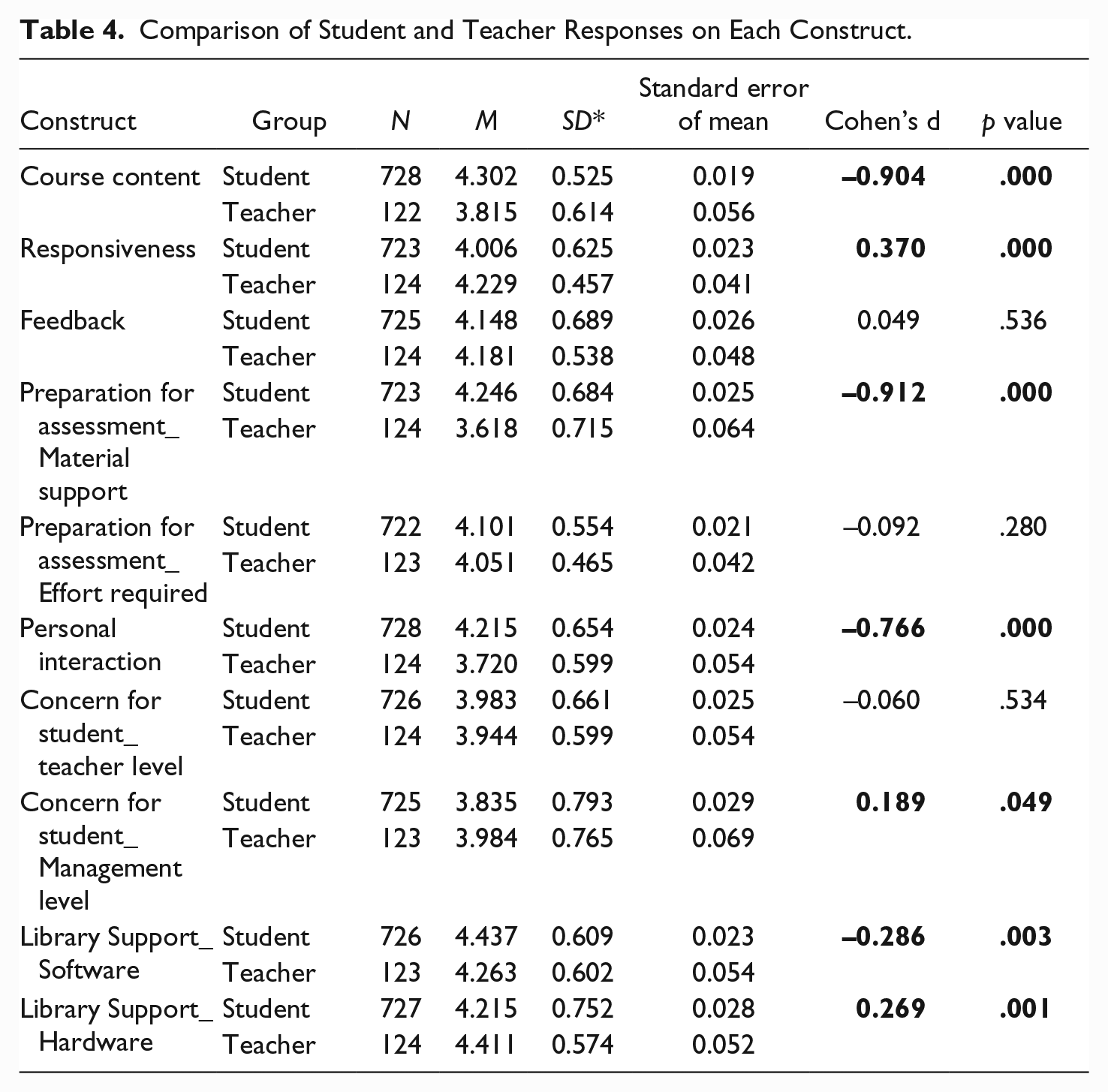
An independent samples t-test was conducted to examine the differences in expectations between students and teachers. The scores of items measuring each of the four unidimensional constructs and the sub-dimensions of Preparation for Assessment, Concern for Student, and Library Support were averaged to create an overall score for each respondent. As Table 4 shows, the mean difference exists between students’ and teachers’ responses in most constructs/dimensions because p values smaller than .05 indicates the results being statistically significant. These significant results are highlighted in bold in Table 4. These include Course Content, Responsiveness, Material Support for Assessment Preparation, Personal Interaction, Management-level Concern for the Student, and Library Support. Although the differences are statistically significant, the difference in Management-level Concern for Student appears to be trivial with a very small effect size (Cohen’s d <0.2). The differences in Responsiveness and Library Support are slightly small (Cohen’s d <0.5). Teachers tend to have a somewhat higher expectation on Responsiveness and Hardware Support of the Library, whereas students have higher expectations on Software Support of the Library. The large differences are found in Course Content, Material Support for Assessment Preparation, and Personal Interaction with Cohen’s d ranging from 0.77 to 0.91. There is no difference in terms of Assessment Feedback, Effort-required for Assessment Preparation, and Teacher-level Concern for the Student. Hence, as the focus of this article is on the gap in expectations, the discussion will focus on areas in which there is a difference.
Comparison of Student and Teacher Responses on Each Construct.
Discussion
Using an Asian branch campus of a Western university as a context, this study revealed that gaps exist between the teachers and the students in relation to their expectations of the university in an IBC. Because the student’s perception changes over time, this study focused on first-year university students and the teachers involved in teaching first-year courses. The following section discusses their differences in responding to the aspects of Course content, Responsiveness, Material Support for Assessment Preparation, Personal Interaction, and Library support for both Software and Hardware.
Course Content
Course content captures the utility of the current course for the student’s personal skill development, goals, and future job. The results indicated that students had significantly higher expectations than teachers concerning course content. This finding may indicate a difference in understanding between the two parties, with the teachers understanding that the course material is a part of the portfolio of skills that students need to obtain to progress in their academic program at this level. Given the relatively new role higher education has with many students being the first to attend universities in their family, there is a misalignment in this factor, with students having a higher expectation of the course. This may also be linked to the increased consumerist nature of education, with the crafted content of “promised experience” used during the recruitment period to create a positive perception, which leads to higher expected outcomes from their studies. In addition, there has been traditional value placed upon education for personal improvement and social advancement in many Asian societies (Kember, 2000).
Responsiveness
It is found that teachers’ expectations on their responsiveness to students are moderately higher than that of students. This conflicts with past research where first-year students usually expect to be assisted by teachers as much as they were during secondary education (Borghi et al., 2016; Rolfe, 2002). What this factor highlights are that teachers place higher importance on the ongoing learning process in which being responsive and providing prompt feedback as the learning progresses is part of that picture. The indicative questions focused on prompt feedback, consistent and fair marking, and additional feedback. These are all linked to the notion that ongoing learning process will improve the student learning experience over time.
An interesting finding related to prompt feedback is the response to the question of expected return time for assessments (see Table 1 and 2). Over a quarter of students expect their assessments to be returned within a week, which is in stark contrast to teachers, where only two teachers recorded this outcome. This finding on student response is consistent with what Crisp et al. (2009) found in their study of students in an Australian university, where a third of students thought the marked work would be returned within a week. This expectation from the student is believed to be unrealistic in multiple studies (Brinkworth et al., 2009; Crisp et al., 2009), considering that university teachers face the problem of increasing workloads with increasing student numbers (Brinkworth et al., 2009).
Material Support for Assessment Preparation
The students’ expectations of learning materials in preparing for assessment were much higher than those of teachers’. Students expect detailed teaching notes, more assessment instruction, and additional resources provided by teachers. There may be a confusion as to what constitutes independent study, which could be perceived by students as outside classroom study. When it comes to time-per-week expected to study outside of class, more than half of the students expected to study less than 6 hours a week. So almost all their preparation for assessment was to be done with the teacher, hence the greater importance that material support plays. This factor highlights the dilemma faced by teachers—content and material having an important role in the student’s learning, while at the same time reducing the student’s ability to be an independent learner. It is the ability to interpret and refine content and material rather than the ability to remember it that is of growing importance.
Personal Interaction
Students have much higher expectations of personal interaction than teachers, expecting teachers to talk with them outside of class time for extended periods if needed. They also place higher importance on the way teachers talk to students when being asked for help.
With regard to the matter of personal interaction with teachers, whether in the classroom, the laboratory, office hours, or other venues, it has been found that positive, close interactions between undergraduates and their teachers precipitate students’ favorable educational experiences as well as their greater academic and personal development (Lau, 2003). However, some factors may influence the frequency of these interactions. Undergraduates attending large research universities may have more difficulty gaining access to, and have less frequent interactions with teachers than those in small institutes (Kuh & Hu, 2001).
Teachers appear to be caught between trying to make students ready for future jobs and making them independent while being expected to give individual attention. There is also a shift to making the university more flexible around changing student needs. This shift is a response to the consumerism of education and the competing nature for student time (Bartram, 2007).
Library Support
The library is an integral part of the student’s university experience. Many IBCs tend to have small libraries with limited collections compared to the home campus. However, students can usually order books and resources they require and have access to the same online resources and databases offered at the home campus. Despite this, it is often seen that IBC’s investment in libraries and learning sources fall below international norms (Naidoo, 2007). The results associated with expectations of library support show that teachers expect more from hardware support provided by the library, such as computer facilities and space for group work—whereas students expect more in relation to software, specifically additional support such as a workshop on study skills and availability of online library resources.
The across-the-board gap between both parties surveyed may be due to the cultural context in which the research has taken place. The Asian education system has always been more teacher-oriented and teacher-dependent than the Western system, which most IBC Asian teachers adopt and expect as well. Students studying at IBCs on the other hand, with their increasing exposure to Western educational systems and practices through the Internet and social media together with international students, may expect a higher level of independent learning at university level. Students expect university studies to develop them personally and prepare them for work. However, the finding of this study clearly demonstrates that most students do not expect to work outside of the classroom as demonstrated by half of the students reporting that they expect to study less than 6 hours a week outside of the classroom. These findings help to explain teachers’ frustration toward students’ passive learning style as students do not see the importance of the ability to work independently for future job readiness.
Conclusion
This study offers insight into a growing industry, foreign universities with offshore campuses in Asia, and particularly Malaysia—an education hub in the South East Asian region. At the time of writing more than ten universities had established IBCs in Malaysia. Clearly, there is a demand for Western education in Malaysia, but it appears that there is insufficient understanding of what a Western education in the classroom entails, based on the findings of this study reported above.
It is our hope that the broad findings of this study will lead to practical changes in institutions of higher education to narrow the gap in teacher/student expectations. Although the data presented in this article suggests that it is imperative to consider how assessments are administered, its potential implication covers more areas, such as curricula design. As an increasing number of universities are embracing the paradigm shift in course design and delivery into a more student-centered one, it is important to engage students in more detailed transition programs that prepare them for the rigors of independent learning. Orientation programs can move beyond traditional activities such as the library tour or essay writing workshops, to sessions on student-led learning, undergraduate research skills, independent study skills, and more. Teachers, too, can take the lead in setting firm expectations early in the teaching semester, reinforce these standards as the semester progresses, and actively demonstrate the value of good feedback. It is important to take into consideration students’ expectations, such as their desire for personal interaction. This could be achieved by the upskilling of tutors, both in terms of qualifications and teaching ability, to ensure that students have opportunities to engage in quality consultations throughout the semester.
The findings suggest imbalanced expectations of first-year students across most of the areas investigated. Possible solutions to better balance and integrate their expectations may include IBCs working collaboratively with pre-university institutions to prepare the students for successful initial transition into the academic aspects of university life. Online “study skills” check list is an example introduced in universities in the United States and made available to first-year students (Brinkworth et al., 2009). Non-subject-specific courses and similar transition programs can also be developed collaboratively by pre-university institutions and university teachers and be offered at foundation year, A-levels, and other similar pre-university schools. Included in such courses may address the academic culture differences, social and cultural transition issues, being customizable to different academic cohorts.
This study focused on the expectations of students and teachers at an Australian university’s IBC in Asia. Although the results capture the general student population in this setting, it is not representative of all IBCs. Future research may expand the scale of the study to include multiple IBCs using different operational frameworks. It would also be valuable to provide more insight into the differences within the teacher’s segment by obtaining a more representative sample across IBCs in a geographic region. In addition, being cross-sectional, this study does not capture the time effect on participants’ expectations. With the support of the institution, future research may adopt a longitudinal approach to investigate participants’ expectations over time.
Footnotes
Declaration of Conflicting Interests
The author(s) declared no potential conflicts of interest with respect to the research, authorship, and/or publication of this article.
Funding
The author(s) disclosed receipt of the following financial support for the research, authorship, and/or publication of this article: This study was funded by Monash University Malaysia Campus Education Committee (grant number: MUM-BTBL-2015-001) and Monash Education Academy (grant number: SCI/BTBL/11-2015/002).
