




Abstract
As we continue to develop into a more globalized society, it is an expectation that students in higher education become global citizens. While the literature supports the notion that students positively benefit from international education experiences, little research has been done to determine what role the community plays, or what effects the study abroad experience has on the community in which the student population is engaged. This study introduces an innovative conceptual framework that overlays the biological concept of symbiosis on the international education experience. This unique conceptual framework shines a light on the study abroad experience from the community’s perspective, as well as illustrating positive and negative impacts of student interaction within the local community. The results indicate that not only is there a role for communities but also communities need to be included in the planning and creation of these experiences, ultimately leading to more mutually beneficial outcomes. Ideally, these findings could be used by educators to capture the community voice to create more mutualistic programs in study abroad.
Introduction
A continuous increase in globalization and growing diversity in society demands that students have a greater understanding of people and culture (McCabe, 2001; Myers, Hill, & Harwood, 2005). International educational experiences aim to assist in filling that gap by developing student cultural competence. According to an Open Doors Report on international education exchange, in the 2015-2016 school year, a record high of 325,339 students studied abroad for academic credit, an increase of 4% from the previous year (Institute of International Education, 2017).
As university education abroad opportunities persist in playing an important role in higher education, research continues to show us that students can be positively impacted by study international education in a variety of ways (Williams, 2005). Students who study abroad develop a number of competencies including better linguistic skills, increased cultural competencies, improved engagement, increased global awareness, and enhance their marketability in the global workplace (Kuh, 2008; Kurt, Olitsky, & Geis, 2013; McCabe, 2001; Trooboff, Vande Berg, & Rayman, 2008). Ideally, they become more “global citizens,” or students who identify with and understand their roles in the global community (Dolby & Rahman, 2008; Tarrant, 2010).
Clearly, it can be argued that international education has proven to be extremely beneficial both personally and professionally for student participants. However, while it is relatively easy to document student benefit within current research, the involvement of other stakeholders (i.e., community leaders or members) in this process is often overlooked. There are not only students engaged in the study abroad experience, but also faculty, and host community members and leaders who have the potential to be impacted by the overall process. Therefore, it stands to reason the roles of the local community need to be clearly defined for a more beneficial program for everyone involved. What is more, it has been stated that seeking the “community voice” is of great importance for student and community reciprocity, yet little research in international education has been conducted to engage community members in the process of planning international educational experiences (Longo & Saltmarsh, 2011; Sutton, 2011).
When discussing study abroad, there are many different programs associated with the term; short-term programs, semester-long, embedded class programs, international service learning (ISL), and many others (McClintic, 2015). One approach that takes the local community into consideration in the education abroad experience is ISL as Crabtree (2008) illustrates, ISL projects are not about providing material support to our partners in developing countries and communities—after all, how much can we really do in the face of such extreme poverty and structural inequality? ISL is about producing global awareness among all participants, providing opportunities to develop mutual understanding, and creating shared aspirations for social justice and the skills to produce it. (p. 29)
Shifting the paradigm within study abroad experiences from just student or participant centered to considering the experience from both the student and community perspective, we draw a parallel to another discipline that also considers relationships from a mutually beneficial perspective. Within the field of biology, symbiosis is the interaction of two beings in close association (Bauman & Machunis-Masuoka, 2009), and these relationships can prove to be negative, neutral, or positive in impact. Transposing this into an international education context, we seek to explore the relationships and interactions occurring within the study abroad experience between the students and local community from a biological perspective; ideally, the impact of these interactions can be considered when creating, planning, and facilitating the study abroad experience.
The purpose of this exploratory study was to understand the roles of international communities in the process of education abroad in higher education. International communities play an important part in the study abroad process; within this study, community is defined generally, as a specific type of terrestrial or social environment (Wilkinson, 1991) that houses and engages with students during the ISL experience. On the community level, it is apparent that there is a lack of preparation and consideration of potential impacts within the international host community, which can be articulated as the locale where the international experience is taking place (Whitney & Clayton, 2011). In addition, as globalization and societal diversity grows, the rising interest of international education opportunities needs to keep up and be impactful for all parties. It is especially important to recognize that this is also a learning process for the international host communities and to provide appropriate structures to help ensure success. This research aims to narrow the knowledge gap between all parties involved in the planning processes of ISL and education abroad.
Theoretical and Conceptual Framework
The foundation of this framework is the three stages of education abroad—preimmersion, immersion, and postimmersion—as characterized by Hains, Tubbs, and Vincent (2013) can be considered extended exposure within a specific culture or locale. Each of these stages is differentiated according to when they occur—preimmersion happens before traveling to the international host community; immersion happens while on location; and postimmersion happens after returning from the international experience (Ricketts & Morgan, 2009). Due to the unique application of relationships, the researcher overlaid the stages with the biological concept of symbiosis. In biology, ecology, and other related sciences, symbiosis can be defined as the interaction between two different organisms in close association (Bauman & Machunis-Masuoka, 2009). Furthermore, while organism can be defined as an “individual animal, plant or single-celled life form,” we have chosen to align with a more community-friendly definition. According to Organism (n.d.), an organism can be defined as, “a complex structure of interdependent and subordinate elements whose relations and properties are largely determined by their function in the whole.” Using this perspective, it can be argued that organisms operate from the same systems thinking orientation as do communities. Therefore, simply stated, this conceptualization helps us illustrate that what occurs to organisms is symbolically similar to what also occurs within today’s communities.
Within symbiosis, there are three significant relationships: parasitism, commensalism, and mutualism (see Table 1). In this study, “Organism 1” will represent the university stakeholders (the students and faculty) associated in the context of education abroad, and “Organism 2” will represent the international host community or organization.
Three Types of Symbiotic Relationships.

Source. Adapted from Bauman and Machunis-Masuoka (2009).
To define these symbiotic relationships, Schowalter (2006) aids in this effort. According to the author, parasitism is the idea that one organism (the parasite) benefits while the other (host) is affected negatively, either weakened or damaged. Furthermore, he establishes that commensalism is the relationship between two organisms when one is positively receiving benefits and the other (host) is minimally affected. Finally, mutualism is the interaction between two organisms when both partners positively affect each other, creating a cooperative or mutually exploitative relationship. In Figure 1, you can see the dependent relationships between the symbiotic associations.

Symbiotic relationships.
The symbiotic relationships between biological organisms can be used as a framework or metaphor, if you will, for university and community research. In contrast to parasitism, mutualism requires dependency to benefit both organisms involved in the relationship. Applied within a study abroad context, this translates to mutual benefit for both the community as well as the students. It is important to note that while mutualism should be considered the ideal design for ISL and other education abroad programs, commensalism can also be considered appropriate within many study programs. For example, for education study abroad programs with a more general country focus that includes significant touring about the county, or programs that do not include an engaged service-learning project, then commensalism could be an appropriate application. Ultimately, avoiding parasitism should be the goal for every program.
Commensal Design
The commensal design of study abroad is a system where students and academic institutions reap all of the benefits of international education or study abroad, with minimal cost to the international host community. Ideally, the community remains minimally affected by the presence of students in any capacity. This design is likely to be the most common in study abroad or cultural tourism (Hughes, 1996; MacCannell, 2002).
Preimmersion (program creation)
The design of the program would have minimal or no input from the community. Most of the preimmersion program creation and design would be facilitated by faculty of the institution with few or no international contacts or partners. The preparatory education would be the responsibility of the university (faculty and student) and the community would provide minimal insight to cultural norms or expectations during the predeparture education.
Immersion (roles)
During the program or student’s sojourn, the roles and responsibilities would be implemented. The program would take place within the context of the community; however, the immersion would include the community or its perspective in the process only minimally. The community acts solely as a locale for international learning to take place; after all, the primary rationale for study abroad is to benefit the student (Bringle & Hatcher, 2011). Thus, they (the community) have little to no role or responsibility during the immersion. This is uncommon in the implementation of ISL, where the community interaction is the pinnacle of the program (Tonkin, 2011).
Postimmersion (impacts)
The success or failure of the program could be assessed solely from the student perspective in the commensal relationship. From this perspective, with the community having minimal involvement in the program, they would be relatively unaffected by the presence of the students. The benefit of this type of program is experienced predominantly by student participants. International host communities within this context benefit minimally, if at all. This design can be seen in Figure 2. In the end, the community is the same before the student immersion, as it is postdeparture.

Commensal design.
Parasitic Design
A parasitic design of education abroad is the idea that the students and professors of the university reap all the benefits of the international education experience; however, it comes at the expense of/or negatively impacts the international host community. Although every study abroad program is extremely different in the design, there is little research to evaluate the unintended consequences for host communities (Schroeder, Wood, Galiardi, & Koehn, 2009). The literature highlights potential negative impacts of foreign visitors on the host community’s economy, social structures, and culture (Cooper, Ruhanen, & Archer, 2005; Schroeder et al., 2009).
Preimmersion
In the parasitic design of study abroad, the community would not play a role in the creation of the program. The university and professors would be the sole proprietor of the program and the design. Within academics, the term “Ivory Tower” is often used to describe academic institutions operating off of theory with no input from the outside world. Applied within this situation, this allows the program directors to be inherently removed from practical or worldly affairs making decisions for the community without actually including them or having real experience within the community. This concept of elitism is often seen in study abroad programs, when a community is selected based off of convenience or due to the perceived need of students, and not according to shared needs.
Immersion
According to the Standards of Good Practice for Education Abroad (The Forum on Education Abroad, 2015, p. 19), they only suggest that students “respect the cultures and values of the countries in which it operates”; however, there are no recommendations made about how to mitigate the potential negative effects of study abroad on local communities (Schroeder et al., 2009). Yet, community risks could include: overuse of community resources (including water, disposal, and pollution), economic stress, consumption of goods, community member exclusion, cultural offenses, modeling poor behavior, negative perceptions, reinforcing stereotypes, and lack of preparation, which are some of the potential negative impacts a community endures during study abroad (Schroeder et al., 2009).
Postimmersion
Students immersed into a community for study abroad are often using time and community resources. These impacts support the idea that students “leech” off an international community to gain personal and professional benefits at the expense of the community, which models a parasitic design (see Figure 3). In a study conducted out of Central Michigan University, community members participating in hosting students in study abroad programs (homestays), found that the burden food preparation, modern conveniences (i.e., telephone usage), and cultural disregard were draining and negatively outweighed the positive impacts (Knight & Schmidt-Rinehart, 2002).
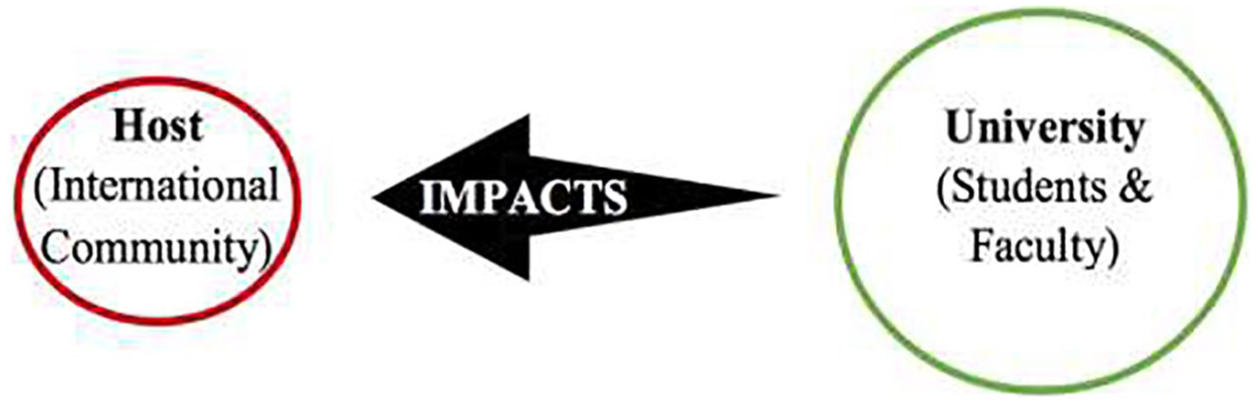
Parasitic design.
Mutualistic Design
The mutualistic design can be best exemplified in the international educational term, reciprocity. In terms of ISL, reciprocity is the concept that both the sender and the host mutually benefit in the implementation on the program (Tonkin, 2011).
Preimmersion
To create a mutually beneficial program, “both the practice of ISL and research about ISL require close, thoughtful attention to local context and a clear understanding of the forces shaping that context” (Sutton, 2011). This involves a dependent partnership between the university and the host community during creation and design of the international educational program. Sutton (2011) emphasizes that education abroad can use the engaged and inclusive pedagogy of service learning to amplify the community voice in the design and program.
Immersion
To mutually benefit, students must respect customs, culture, and people of the international host community (Bringle & Hatcher, 2011; The Forum on Education Abroad, 2015; Tonkin, 2011). These roles and responsibilities are clearly outlined for the students and hold impactful consequences. Within study abroad, reciprocity can be problematic when a student does not integrate with the host community, and can potentially reinforce negative American stereotypes (Ogden, 2006).
In terms of the community’s roles and expectations in a mutualistic design of study abroad, “little to no work has been done on framing these considerations as research questions, nor on setting them in an international context” (Tonkin, 2011). As a major player in the process of education abroad, the host community needs to have established roles and responsibilities to positively benefit from collaboration with students and faculty.
Postimmersion
When using the ideas of mutualism, where both parties reap benefits, international host communities and university participants can create a mutually beneficial relationship (see Figure 4). ISL focuses on reciprocity as a core value stating, “mutuality in partnerships must always be the foundation for this work” (Longo & Saltmarsh, 2011). One major limitation in the evaluation of education abroad is that the primary investigation or reflection is from the students’ perspective, even when the goals are to reach a much broader audience (Whitney & Clayton, 2011). For education abroad to fully evaluate the impact and program outcomes, the community voice needs to be captured.
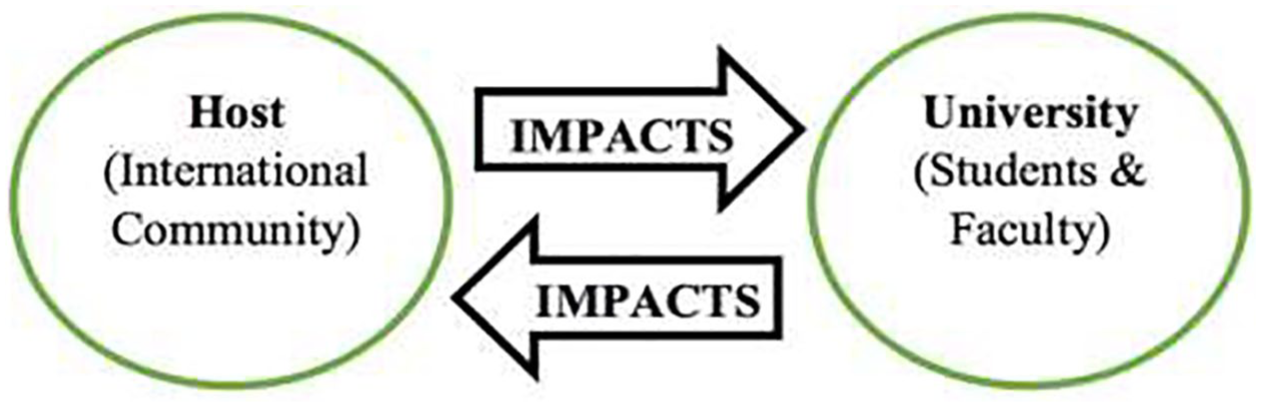
Mutualistic design.
Summary
There is a need to seek the community’s voice to establish roles and potential impacts for students and for the host community during international education experiences. The literature supports the ideas that the current education abroad designs often exemplify parasitic or commensalism relationships (Ritsema, Knecht, & Kruckemeyer, 2011). Operationally, the students would serve as the dependent party receiving all of the benefits, while the international host communities are minimally affected or even harmed in the process (i.e., exploitation). This design is a “one-way” street that begs for a more mutualistic process. More engaged study abroad experiences, including ISL experiences, illustrate the salience of mutualism or reciprocity between the students and the host communities. But what does a more mutualistic design process look like for study abroad?
Methodology
The purpose of this exploratory study was to identify the community’s roles and potential impacts in the education abroad design. This study was conducted in 2014 within a western county of Nova Scotia, Canada. This community was identified and established as a partner for international educational opportunities for University of Kentucky undergraduate students. This study took place concurrently with a faculty-led ISL study abroad program.
The overall guiding research questions for this qualitative study were as follows:
The target population of this study were community members living in the international host community located in rural western Nova Scotia in Canada. Community member participants were identified for this study through snowball sampling. The identified “gatekeeper” of the community established relationships with random interviewees to consent to participation. All participants were identified through their relation to the gatekeeper and by their positions within the community. To maintain confidentiality, participant names have not been identified, and will be referred to as the following:
(P1): Female—community leader, head of a local community development.
(P2): Male—university professor.
(P3): Female—university professor.
(P4): Female—local governmental official.
(P5): Female—employee of local community development organization.
(P6): Female—student.
The interviewees were asked a set of semi-structured questions by the researcher, which allowed them to share their experiences and community perspectives of international education. The researcher-designed semi-structured interview guide was used to ensure consistent inquiry between interview while allowing the participants the latitude to add supplementary insight on the topic and related subjects (Patton, 2002).
The researcher analyzed the rich data while gaining a comprehensive understanding of the participant’s perspective of community involvement in education abroad. First the data were organized, recordings were transcribed, and researcher notes were collected. As the first stage of analysis, the researcher identified themes from the data, identified through “open coding” (Saldaña, 2013). After each participant’s interviews were thematically evaluated, the researcher began to study consistencies as a group to represent the collective themes. Themes were identified when four or more participants identified a topic as relevant.
Limitations
The mode of inquiry was to collect community member perspective on the process or design of international education, yet the community targeted was in Nova Scotia, Canada. Due to the potential similar cultures between the international community and the domestic community—it can be seen as a potential imbalance of the representation of the greater populations of international communities. Researcher interpretation of the findings based on personal relationships with some of the interviewees forms the researcher bias associated with this study. Observable data can be misinterpreted based on setting or general misconceptions collected by the researcher.
Results
Ultimately, the purpose of this study was to explore the roles and impacts associated with the three factors: student, university, and community in the design and process of international education. Using the three symbiotic relationships—parasitism, commensalism, and mutualism—the results are represented to outline examples of each from the community perspective in the process of education abroad. The following results indicated the community perspective of roles and potential impacts. Each of these strategies was used as a frame to address the research question:
Parasitism
Even in ISL, there can be negative-associated outcomes when working with a community. One primary finding was that students participating in international education programs use community resources, specifically time and money. In one example, participant 1 (P1) explained how it would have been a lot easier for her and a local group to complete the tasks of the students.
In addition, the international community contacts or partnering universities are relying on their social capital to create networks and to help build relationships between the students and the community members. If the students were to fail or inappropriately carry out the program, they could damage the social capital of the community contact. Likewise, it was mentioned that the duration of the education abroad program can also affect the overall impact because the shorter the program, the less likely students will make a significant or lasting contribution to the community.
Another theme highlighted the need for self-awareness while being immersed in a community. When a group of students is immersed into an international community for the first time, they need to be aware of the impression they are leaving with the host community. Participant 5 (P5) stated, “If the students tear up the town, the next group might not be welcomed.” Ultimately, parasitic relationships are not sustainable.
Commensalism
In education abroad, a commensal design would be one that has minimal impact on the community, yet students reap the benefits of the study abroad experience. This design can be seen in the student-centered focus of the program. Due to the lack of community input, the responses for the community are ones that drive the student impacts without having any mutual benefits. Participant 2 (P2) reflected, One of the biggest things in traveling is you see yourself and your own community more clearly . . . you probably learn much more about yourself and your own community than learn about the community you are going to.
In addition, empathy can be developed, and their self-awareness can be advanced as students begin to determine where and who they are as a person through critical reflection. At the same time, students are creating a global perspective and opening their minds (P1).
Another theme supported by participants argues that students may contribute differently within various environments. Students participating in education abroad programs or even “cultural tourists,” “may not be able to contribute to the community, but they may contribute by providing education when they get back home” (P2). This idea neither helps nor hurts the international community the students are immersed within. Students are able to gain many personal and professional skills while traveling abroad.
Mutualism
Mutualism or reciprocity is the idea that both the community and the students participating in ISL or education abroad benefit mutually. This is ideally the best design practice for international education, creating a “win-win” situation for all the stakeholders. ISL aims to meet the needs of an international community, while students are able to gain new insights of internationalization, globalization, and intercultural competence (Bringle & Hatcher, 2011). Ultimately, the relationship should be mutually beneficial.
To establish mutual impact through ISL, preimmersion is essential to collect the community’s voice and determine its “needs.” P2 stated that open communication must exist to deeply connect with people in the community and clearly explain why the students are coming, what the students hope to get out of it, and what potential there might be for the community to get out of it [education abroad program], and what might be the limitations or disadvantages or negative parts of the students coming into the community and interacting with me—if there are any [negative factors].
The community members felt that students need to adapt and accept change for mutual benefit and success of the program: in change, it needs to happen with the permission of the community and the facilitators—they can’t just go freelancing. There is an implicit agreement about what is going to happen at the benefit of everyone. It is important to honor that agreement. (P2)
In creating education abroad programs with the foundations of mutualism in mind, the three phases of the program—preimmersion, immersion, and postimmersion—need to be addressed. To reiterate the importance of the three phases: immersion is the creation of the program and the pre-education, the immersion is the implementation and the development of the stakeholders’ roles and responsibilities, and finally, the postimmersion includes the assessment and evaluation of the program to determine success and outcomes. According to the community, the roles of the stakeholders (students, faculty, and the community) have been detailed in the following to create a mutualistic relationship between students, faculty, and the international host community.
Discussion
Student Roles
According to community members, the most important role a student should take on in the process of study abroad is the preparation or predeparture education. If the community is open and receptive to students, they should be prepared to live and function in the context of that specific community and try to understand the history and culture that have shaped their “norms.” P2 expressed that students also have an obligation, to the best of their ability and understanding, to prepare themselves culturally and socially . . . they are never going to be fully ‘prepared,’ but they have an obligation to think about that and do whatever work is needed for their understanding.
In addition to cultural and social awareness, the students need to consent to the goals and objectives of the program. In ISL, the idea is to identify and establish relationships and community needs (Bringle & Hatcher, 2011). Once the program has been outlined and clearly communicated to the students, they need to agree and work to the best of their ability to carry out the mission. Participant 2 best exemplified this: If they agree to participating, to live within the context of the program and do that . . . living in the framework of a relationship that is connecting the community, the facilitator/faculty and their university. So they need to be prepared to know what it is that they are doing, and when they are going to do, and honor that.
The interviewees’ answers varied in range of the ideas of the roles of students. In addition, there were many similarities and key ideas that appeared in their answers. One emergent theme was the idea of respect. Students need to respect the community they are immersing themselves in. At the same time, the need for critical reflection is extremely important (Mezirow, 1998). Many of the interviewees wanted the students to reflect on their experiences, both personally and with the community. The ideas of reflection will reoccur under faculty roles and community impacts.
University Roles
After aligning the students’ roles in international education, it was clear that the expectation then falls to the faculty, directors, or university facilitators. The community members participating in this study had clear expectations for all the professors involved in the process of international education, specifically in regard to creating connections in the international community. These community members might be gatekeepers, colleges or universities, or other organizations. The importance of this role can be best exemplified in the following quote from P3: “Doing the work at the university and to connect with the community . . . To ensure the program will meet the needs of the community.”
Another role of the university, according to the participants, was to provide the students with adequate cultural background, so that they have a solid understanding of the cultural before immersing themselves. Nonetheless, the most apparent role of the university was said to be communication and clarity. The international host community would like to be adequately informed of all of the goals and objectives of the program. This question often led participants to raise their voices, or become more animated in their hand gestures, signaling a sense of importance to the idea. P1, wanted the faculty to help the community understand the program by “making it clear, what the goals of the class are . . . making it clear to the community and connecting people, what the expectations are of the students and the goals of the course.” P1 continues that the stakeholders must have an articulated agreement about the roles, expectations, goals and tasks. And making ALL parties aware of that—the university, the students and the community. And doing that in a timely manner, so that the groundwork can be laid. And building these things into the course description and sharing that with the community and host organizations.
Other roles outlined by the participants for the facilitators or faculty include providing reflection for the students; prepare for the program with adequate time, resources, and professional focus; and ensuring their obligation to the students. P3 stated the importance of reflection with; “When the students come ‘home,’ there is an obligation of the facilitator to provide the student with a good debriefing to allow them critical reflection on their experience.”
Community Roles
Participants felt that communities had a variety of roles and responsibilities in the process of an education abroad program. The community roles begin in the initial establishment of the relationships between university and the community. P2 stated, “The community’s role is to say whether they want them [students] to come and what they might be able to offer.” After the relationship has been established, P2 said, everybody [in the community] needs to be on board about who is coming, why, when, where and what the purpose is and what their time demands are going to be and what the expectations are on both sides. The community should be really clear on that.
Many of the interviewees expressed they wanted the community to be included in the preimmersion phase of the education abroad program. This can be implemented in the design or creation of the program. As P1 shares, “The community’s role is sharing the knowledge the community has, about what would work, helping to design the process and providing contacts and context.” In creating a mutually beneficial design, P3 strongly stated, “. . . before anything begins there needs to be some sort of understanding that there is going to be reciprocity between the two groups so that the community isn’t going to be taken advantage of in the relationship.”
While the students are immersed into the community, P2 stated the responsibilities should become “. . . defining what roles community members are expected to play relative to them and what roles they need to play.” They are to be open-minded and welcoming to the students, P4 stated the role of the community is to “welcome the students and celebrate their contributions.” Community pride was definitely apparent for the interviewees; they want students to enjoy their public goods, and “we would hope the community would be welcoming and make the students visit enjoyable” (P5).
Conclusions
The findings from this study have the potential to shift the paradigm on how universities think about the international education experiences, particularly those designed as ISL courses. This paradigm shift would encourage faculty to structure international study abroad experiences differently, creating more engagement by laying the foundation of how faculty, students, and communities should interact in all three phases of study abroad. Study participants indicated that the international host communities should have input during the creation and overall design of the program. In the long run, this could encourage future faculty to develop study abroad experiences with a more mutualistic design in mind. Furthermore, the themes of education, reflection, reciprocity, and communication were identified as necessary factors for this paradigm shift to occur.
Education
Prior to students immersing themselves into an international community, research indicated pre-education and development is essential for students (The Forum on Education Abroad, 2015; Whitney & Clayton, 2011). While existing literature very much supports this notion, this study found that it is the community that is best suited to educate students before immersion. Participants revealed that helping students to understand the culture, social norms, history, and other specific community factors should come from within the community itself.
Reflection
The idea of reflection helps students to make connections, understand experiences, and help further the learning process (Whitney & Clayton, 2011). The results of this study indicate the international host community also feels reflection plays a major role in the community, and they would want students to reflect on their experiences in “real time” with the community members. This would allow for the community to receive feedback, so they can adequately understand and implement changes in future programs with students. A recommendation for university and faculty directors of education abroad programs would be to include student reflection with the community as part of the program objectives.
Reciprocity
ISL promotes the idea that students can address a community need and establish a mutually beneficial relationship (Bringle & Hatcher, 2011). However true this might be, much of the evaluation data within education abroad circles is collected from the student perspective, not the perspective of the community in which they are immersed. This study helped to illustrate that both international host communities and students can benefit from education abroad programs—ultimately, it is important to get both community voice as well as student voice to determine the overall program impacts.
Participants indicated students can bring a new perspective to a community simply by engaging with community members and sharing experiences. In addition, they can highlight positive attractions and community goods that often get overlooked, as well as promote tourism and create sustainable program relationships. In the context of ISL, students have the ability to participate in developing a social good.
Communication
According to the community participants, communication between all stakeholders needs to be clear and abundant. In establishing the program, faculty have a responsibility to articulate the goals of the program and provide student information. The community must convey an interest in the program for consent and provide voice in the design and the goals, as well as provide feedback for the faculty members in terms of the students and the program to avoid any pitfalls or parasitic outcomes.
Opportunities for Future Research
This exploratory study laid a positive foundation for future research associated with more engaged study abroad opportunities (such as ISL), and more specifically, the impact and role the community can play within this process. We would like to see more in-depth research done within this study community; however, it is recognized that this is a unique setting and the results cannot be generalized to the larger population.
Similar studies done within other study abroad communities would assist in further refining the innovative conceptual framework developed for this project. It is recommended that future research be conducted in other international communities to create a greater sense of understanding in the community’s perspective of education abroad. Other suggestions for future research include using a larger and more diverse participant sample, looking at the length of the international education opportunity (i.e., short-term versus long-term programs) and comparing and contrasting more engaged study abroad experiences with less-engaged international study tours.
Footnotes
Declaration of Conflicting Interests
The author(s) declared no potential conflicts of interest with respect to the research, authorship, and/or publication of this article.
Funding
The author(s) received no financial support for the research, authorship, and/or publication of this article.
