



Abstract
Culturally mixed group work has become a common mode of assessment in higher education to encourage students from different cultural and linguistic backgrounds to learn from and work with each other. This article aims to address whether culturally mixed group work can contribute to students’ intercultural competence (IC) development. The Multicultural Personality Questionnaire was used to measure students’ IC development over time, while three waves of interviews investigated students’ attitudes on culturally mixed group work. Findings suggest that both staff and students think culturally mixed group work can be beneficial and is an effective way to develop IC and increase intercultural awareness. However, students perceived it as both rewarding and challenging. Findings showed that without staff guidance, mixed group activities can cause a long-term negative effect on students’ open-mindedness. This result points to a need to reconsider how mixed-culture group work can be utilized effectively in class.
Keywords
Introduction
Internationalization is a phenomenon affecting higher education institutions (HEIs) worldwide, and debates on its various manifestations, causes, and consequences are burgeoning (Robson et al., 2018). An increased emphasis on public accountability in the higher education (HE) sector has led to a requirement for HEIs to demonstrate that they are able to produce employable “global” graduates with a set of core skills and attributes (Campbell, 2010). One such graduate attribute is intercultural competence (IC), which has been described as an outcome of HE internationalization (de Wit et al., 2015). In addition, IC is increasingly acknowledged as an important graduate attribute by employers, and there has been recognition that it is not only the “hard” academic knowledge and technical skills that are essential in the global workplace, but also “soft” skills such as interpersonal communication and IC (Deardorff, 2016; Yemini, 2014).
Consequently, research on how to develop IC in university students is burgeoining (Lantz-Deaton, 2017; Spooner-Lane et al., 2013), but there is little agreement on the best mechanisms for doing so (Summers & Volet, 2008). Culturally mixed group work has been put forward by some as a possible vehicle for IC development (Glass, 2012; Lavy, 2016; Sawir, 2013), but evidence of the positive effects of group work on IC is still scarce in the literature, with some studies reporting negative effects (Fozdar & Volet, 2012; Moore & Hampton, 2015). To date, most research studies on this topic have investigated students’ attitudes toward and experiences of mixed-culture group work as an opportunity for intercultural learning (Montgomery, 2009; Volet & Ang, 2012). In response, this article reports on a longitudinal mixed-methods study of the effects of culturally mixed group work on HE students’ IC.
IC
A review of the literature reveals a plethora of definitions of IC and, consequently, a broad range of instruments for measuring the concept (Schartner, 2016). In their meta-analysis, Spitzberg and Changnon (2009) found more than 300 conceptualizations of IC, and Fantini (2009) reports 44 instruments aimed at measuring it. There is little consensus on what exactly constitutes IC with definitions ranging from behavioral aspects to language proficiency and qualities related to one’s personality, skills, attitudes, and knowledge (see Fantini, 2009, for a review). In this article, we conceptualize IC as “a complex of abilities needed to perform effectively and appropriately when interacting with others who are linguistically and culturally different from oneself” (Fantini & Tirmizi, 2006, p. 12).
In this study, we used the Multicultural Personality Questionnaire (MPQ) to measure IC. The MPQ has been designed and developed to measure “the effectiveness of individuals in dealing with groups or individuals that culturally differ from themselves” (Van der Zee & Van Oudenhoven, 2000). It has been widely used with international student samples (Schartner, 2016; Yakunina et al., 2013) and generally exhibits high construct validity with Cronbach’s alpha typically ranging from around .7 to .8 in the studies above. As a result, it has been described as a solid psychometric instrument for measuring IC (see a review by Matsumoto & Hwang, 2013). Previous studies have also provided evidence for the ecological validity of the MPQ in predicting intercultural interaction (Ali et al., 2003). The concepts of “effective” and “appropriate” in this definition emphasize both “etic” and “emic” perspectives of communication—that of self and other (Fantini, 2009). It indicates the importance of studying intercultural communication from the views of both sojourners and hosts.
The MPQ includes five subscales: Open-Mindedness (OM), Cultural Empathy (CE), Social Initiative (SI), Emotional Stability (ES), and Flexibility (FL), which measures individual’s abilities and attitudes in intercultural communication.
OM is defined as “an open and unprejudiced attitude towards outgroup members and towards different cultural norms and values” (Van der Zee & Van Oudenhoven, 2000, p. 294). Individuals who have higher levels of OM are thought to have less fixed mind-sets of what is “right” and “wrong,” appropriate or inappropriate, and hence are more likely to accept new ways of doing things (Hammer et al., 1978). OM has been described as malleable and susceptible to experiences. For example, Gu et al. (2010) found that international students become more positive about the host culture and more acceptable of people who share different attitudes and values after studying abroad. This echoes Williams and Johnson (2011) who claim that “OM is not a static trait, but an attitude or stance which can be cultivated with appropriate education and experience” (p. 46). However, recent research with international student samples suggests that OM may actually decrease over time (Schartner, 2016; Van Bakel et al., 2015) for reasons such as overly high expectations (Herrera, 2012), negative intercultural group work experiences (Lantz-Deaton, 2017) or overestimation at the beginning of study (Dunning et al., 2003).
CE is defined as “the ability to empathise with the feelings, thoughts, and behaviours of members from the different cultural groups” (Van der Zee & Van Oudenhoven, 2000, p. 294). Recently, research has suggested that this aspect may decrease as a result of study abroad (Schartner, 2016). SI is defined as the tendency to approach social activities in an active way and to take initiative, similar to the concept of Extraversion in the Big Five survey. It is often classified as a behavioral aspect, which focuses on the ability to instigate and maintain interpersonal relationships (Hammer et al., 1978).
ES aims to measure whether individuals have the ability to remain calm in stressful situations (Van der Zee & Van Oudenhoven, 2000). Although the concept is typically viewed as a fairly static personality trait, especially in the field of psychology, recent research suggests that it can vary over time (Schartner, 2016) and may be considered a behavioral aspect of IC (Hammer et al., 1978). FL is the ability to switch easily from one thing to another (Van der Zee & Van Oudenhoven, 2000). This dimension is seen by some as a skill component of IC that can be trained (Wiseman, 2002), while others view it as a more cognitive aspect that is unlikely to change in the short term (Matveev & Merz, 2013). We felt that the MPQ was especially worthy of use as it measures both attitudinal and behavioral aspects of IC. Based on prior evidence (Herfst et al., 2007), we assumed that the dimensions of OM and CE would be most susceptible to “change” over time, either through interventions by educational institutes or through the experience of study abroad itself. The study set out to determine this.
Culturally Mixed Group Work
Intercultural scholars have found that two crucial contributory factors for the development of IC in both “home” and “international” students are intercultural curriculum elements and assessment modes that encourage working with others from different cultural and linguistic backgrounds (Summers & Volet, 2008).
One obvious way to involve both groups of students is mixed-culture group work, which is thought to enhance student learning and create intercultural experiences (Denson & Zhang, 2010; Lavy, 2016). Evidence shows that international students who study on a program that offers group discussion/work tend to report more positive experiences of the university’s diversity (Glass, 2012). Proponents of culturally mixed group work report that the advantage of forming such mixed discussion groups is to encourage students to learn from multicultural perspectives in class (Sawir, 2013). Researchers also highlight that group work can benefit international students’ academic and sociocultural adjustment (Wang, 2012), contributing to a more diversified social network over a period of time. However, some claim that simply placing students in groups with others from different backgrounds may not necessarily lead to intercultural interaction (Moore & Hampton, 2015). Social tensions among different group members (Takahashi & Saito, 2013) can arise, which may be due to lack of shared experiences and backgrounds (Fozdar & Volet, 2012). If intercultural interaction does occur, it can be problematic or require careful management (Leask, 2011). In addition, Carroll and Li (2008) found that students tend to have negative attitudes toward culturally mixed group work when high stakes are involved in the assessment.
Although students acknowledge the benefits that mixed discussion groups can have for their IC, they also acknowledge that it can be challenging (Fozdar & Volet, 2012). In fact, research suggests that both “home” and “international” students prefer to work on assignments with people from their own countries (Volet & Ang, 2012) and that the default self-selection modus for student group work is typically along monocultural lines (Hills & Thom, 2005). This is believed to be due to several factors including language and communication, perceived emotional connectedness, practicality, and negative cultural stereotypes (Popov et al., 2012; Volet & Ang, 2012).
Some studies indicate that “home” students tend to exhibit ethnocentric views and that this may prevent them from forming groups with their international peers (Volet & Ang, 2012). However, the same study also found a gradual shift in students’ attitudes over time and that, in fact, individual differences may override perceived cultural differences in student group work.
This study aimed to address the following research questions:
Method
Research Design
The study followed a mixed-methods design including quantitative self-report surveys and semi-structured interviews. Participants were students undertaking 1-year postgraduate taught degrees in the humanities and social sciences across three academic disciplines (Business, Education, and Engineering) at a single British university, as well as academic staff. A total of 370 students took part in a pre-survey in the first week of the academic year (September 2016; Table 1). A post-survey (n = 227) was conducted with the same respondents in the last week of teaching, 8 months into the program (June 2017; Table 2). In addition, three waves of interviews were conducted with students, in October (Time 1; n = 14), February (Time 2; n = 13), and June (Time 3; n = 12). All the participants were diversified in age, gender, nationality, and program of study (Table 3). The survey allowed us to measure IC, identify any patterns in the data, and compare any changes over time, while the interviews provided more fine-grained data on how students and staff experienced culturally mixed group work.
Number of Participants in the Pre-Survey.

Number of Participants in the Post-Survey.

Student Interviewees’ Demographics.
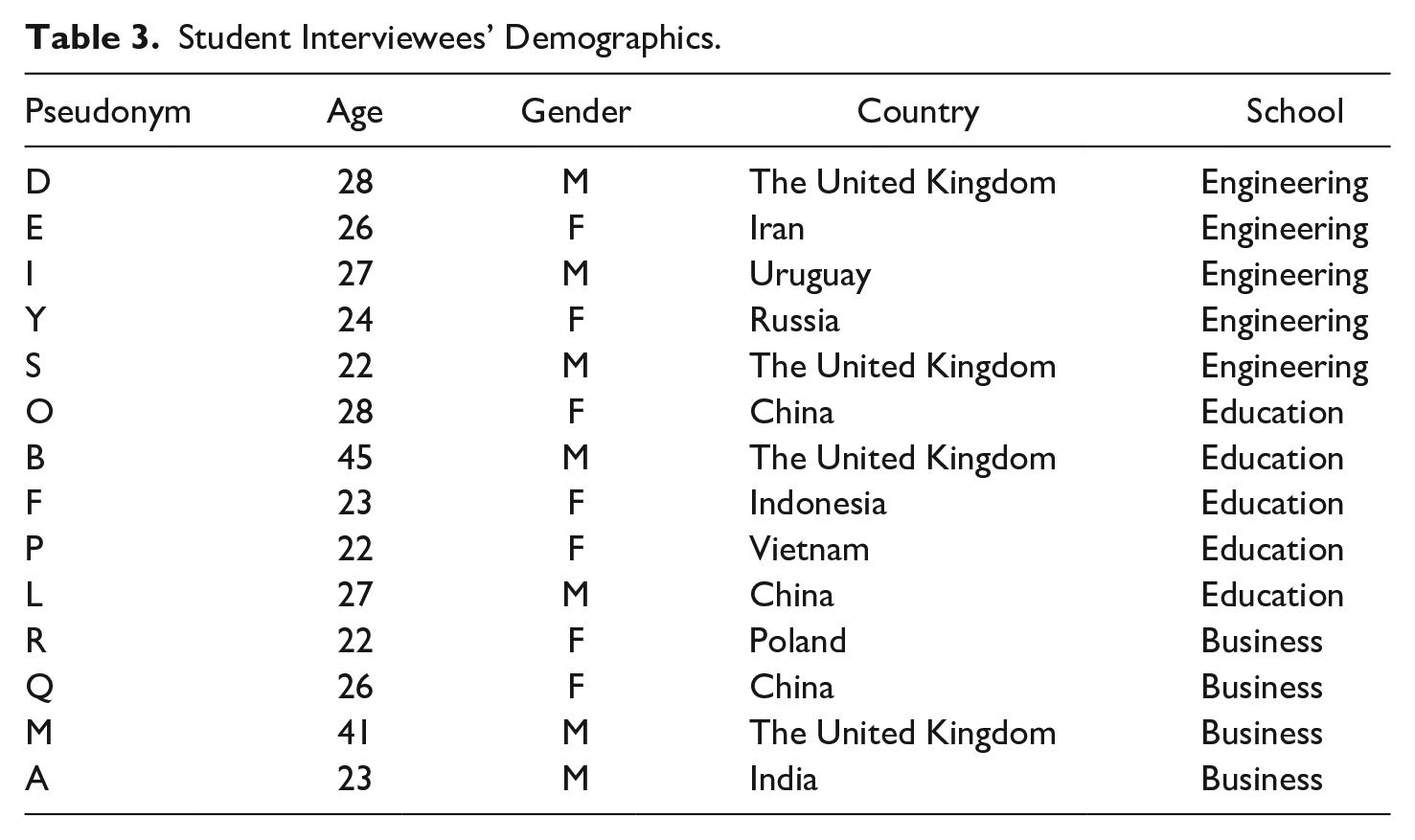
We felt that when measuring students’ IC development over a period of time, an inventory alone was not sufficient and that a mixed-methods approach comprising both quantitative and qualitative data could offer more comprehensive insights (cf. Deardorff, 2006; Fantini, 2009). Previous studies on the development of IC have largely relied on qualitative methods such as interviews and reflective writing (Spooner-Lane et al., 2013), and quantitative studies of IC development to date largely follow a cross-sectional design, while only a few cases adopted a longitudinal approach (Schartner, 2016). Thus, a longitudinal mixed-methods approach, including pre- and post-surveys and three rounds of semi-structured interviews, would not only add rigor but also make an important methodological contribution to the literature.
Measures
The pre- and post-surveys included a demographics questionnaire and the MPQ-Short Form (van der Zee et al., 2013). The latter contained 40 items and five subscales, each measuring eight items. The subscales were OM, CE, SI, ES, and FL. Participants’ answers to the MPQ items were rated on a 5-point Likert-type scale, ranging from 1 (totally not applicable) to 5 (completely applicable).
Numerical analysis was performed using Microsoft Excel 2003 and the Statistical Package for Social Science (SPSS), the most widely used analysis software in social science research (Bryman & Cramer, 2001). To analyze the baseline (T1, pre-survey) as well as the endline (T2, post-survey) data, measures of central tendency for each subscale were compared. First, paired-samples t tests were used to investigate how the IC subscales changed among students in each discipline over the whole academic year. Second, independent-samples t tests were used to compare similarities and differences across disciplines and between “home” and “international” students. A “p” value of less than .05 was used to ascertain statistical significance as is common in the social sciences (Cohen et al., 2007).
The interviews followed a semi-structured approach. While the same set of open questions was asked in all three interview rounds, FL was maintained and probing questions were used to facilitate further discussion. Examples of open questions include “How do you feel about working with people from different cultures?” and “How do you feel you have developed IC over the last few months?” Regarding the second question, group work emerged as a strong theme, perceived to be a vehicle to IC development.
Thematic analysis (Braun & Clarke, 2006) was adopted for all interview transcripts. Interview data were analyzed manually line-by-line which also provided the opportunity to look at the transcriptions closely and carefully (Creswell, 2007). Qualitative data were collected and analyzed after the pre- and post-survey to help explain and elaborate on the quantitative data results (Ivankova et al., 2006). The interview data provided useful information on student’s individual experience of culturally mixed group work and a way of explaining unexpected results generated from the quantitative data (Morse, 1991).
Results
Quantitative Data
International students’ OM significantly decreased from T1 to T2, while scores for FL significantly increased (Table 4). No significant differences were found for the home student cohort.
International Students’ IC Development in MPQ Subscales.
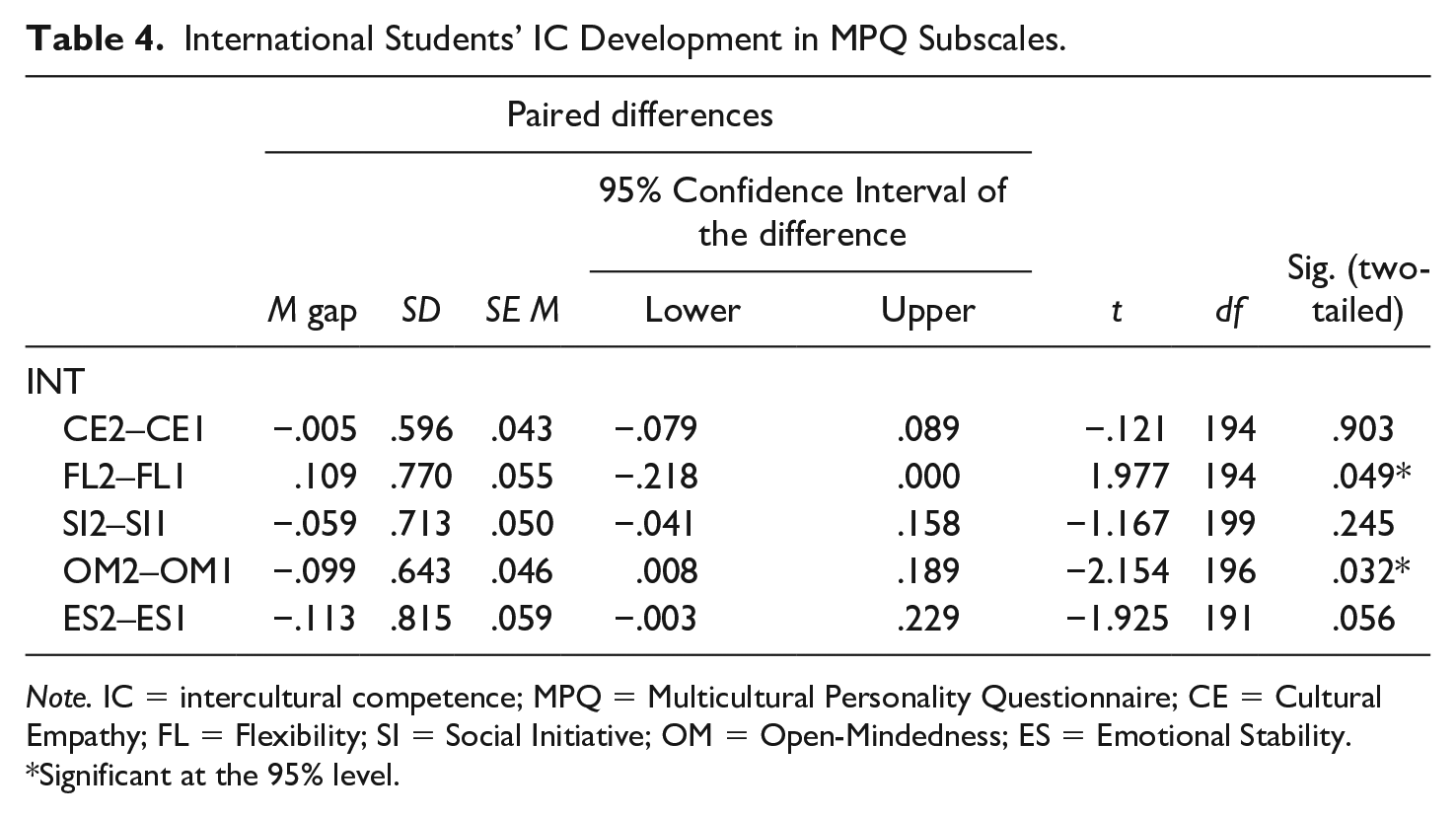
Note. IC = intercultural competence; MPQ = Multicultural Personality Questionnaire; CE = Cultural Empathy; FL = Flexibility; SI = Social Initiative; OM = Open-Mindedness; ES = Emotional Stability.
Significant at the 95% level.
A paired-sample t test was administrated to investigate how IC changed from T1 to T2 in each discipline (Table 5). Results show that FL increased significantly from T1 to T2 in the Business discipline. In the Engineering discipline, OM decreased significantly. Although the statistically significant differences reported here are small, they do provide some indication for the malleability of these dimensions over time and corroborate recent evidence that IC might be susceptible to training and experience.
The Pre- and Post-IC Survey Comparison in Three Disciplines.
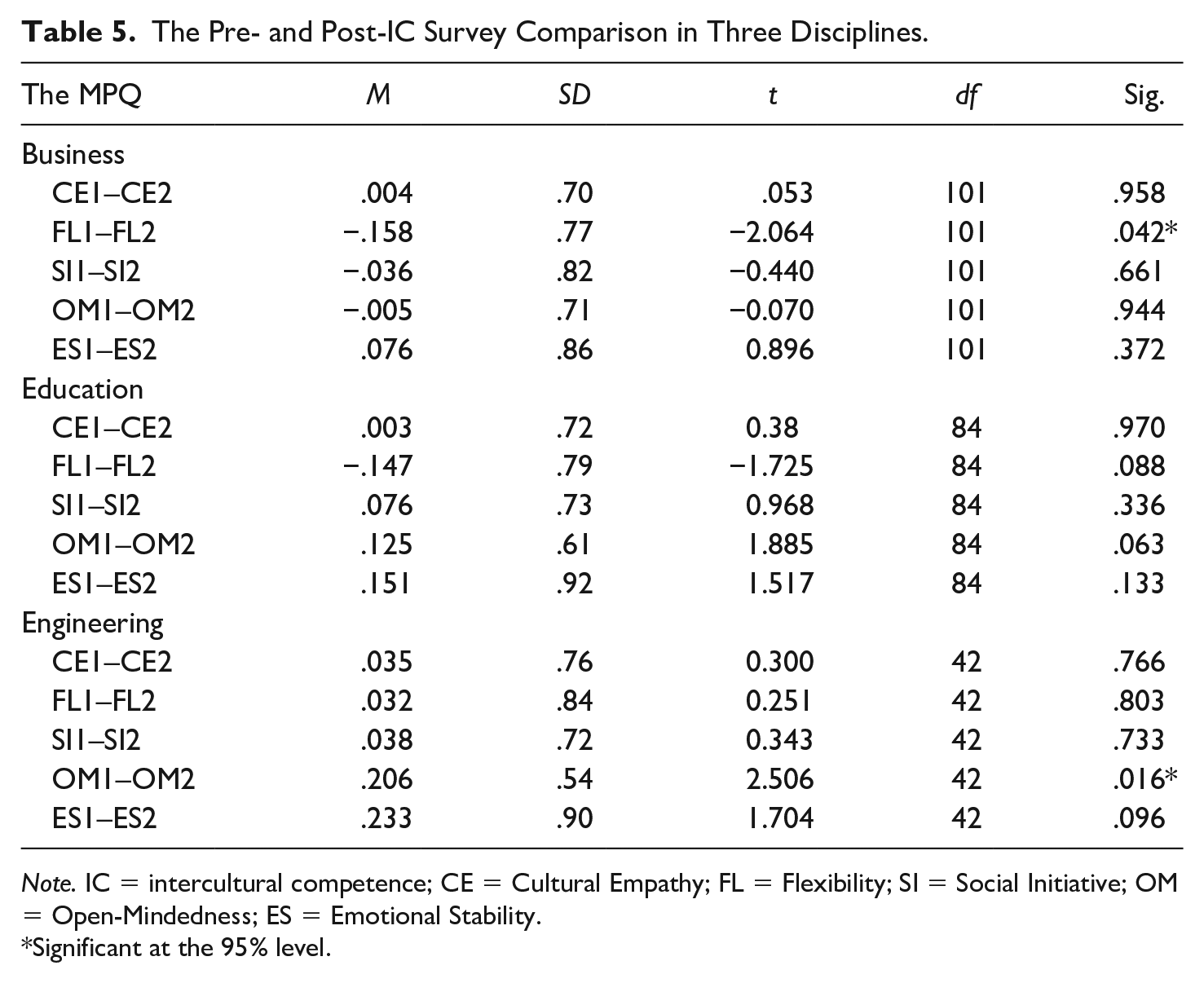
Note. IC = intercultural competence; CE = Cultural Empathy; FL = Flexibility; SI = Social Initiative; OM = Open-Mindedness; ES = Emotional Stability.
Significant at the 95% level.
Students’ Views on Culturally Mixed Group Work in Relation to IC
At the beginning of the program (Time 1)
At an early stage, 13 out of 14 participants were rather positive about working in a culturally mixed group with people from all over the world, except one home student who said he would take into consideration language and communication issues when choosing whom to work with. They believed that working with people from diverse backgrounds enables them to learn from other perspectives and cultures and also to improve their communication skills. It is important to emphasize here that most students at this point in time had had little firsthand experience of assessed, summative or formative group work and the comments below are therefore more prospective and forward-looking.
When we mix the people, we learn about the other culture, the other habits, so even about eating habits, about study habits, about many things. How to communicate with them. What is polite and what is impolite in different cultures. (A, international, Business, T1) I think by then I would know how people from each country work based on their perspectives and their cultures . . . so I think that would benefit me for the future . . . it would benefit me for having basic ideas about each different person. (F, international, Education, T1)
In the first semester (Time 2)
During the first semester, participants from the Engineering and Business schools (n = 9) frequently expressed mixed feelings about working with people who came from diverse cultural backgrounds. Similar to T1, six out of nine participants believed that mixed-culture group work was “rewarding” and “enjoyable” as it gave them the opportunities to learn about different cultural behaviors and different ways of thinking. Meanwhile, all the nine participants frequently expressed that group work is “challenging” and “frustrating” largely due to language barriers and perceived cultural differences. The data showed that participants encountered difficulties and had mostly negative feelings about working in mixed groups in the first semester of their study. Comparatively speaking, assessed, summative group assessment seemed to be less used in the Education school. Students sometimes had small group discussions in the class. Similarly, they acknowledged the benefits of working in a multicultural group, despite some conflicts or disagreements often caused by confronting different cultures and values.
It’s great to be able to confront so many different cultures, to have insights into different ways of thinking really, this can be a challenge sometimes just misunderstanding, confusions . . . (R, international, Business, T2) Working in groups with different nationalities is pretty difficult but again it’s very frustrating but also very rewarding. So language barriers, cultural differences, it’s really good. I’ve learned how to communicate with different cultures. (M, home, Business, T2) . . . during the teamwork, it was like a nightmare because we don’t speak the same language, everyone should speak English so we had to focus on the work and we had to explain what’s going on and translate. So it was very exhausting and frustrating . . . (E, international, Engineering, T2) We do solo most of the time, but sometimes we have group discussions. We exchange our ideas in the group and sometimes there are clashes because we come from different countries and have different cultural backgrounds. But clashes make progress, doesn’t it and it’s a way to broaden our horizons really. (D, international, Education, T2)
In the second semester (Time 3)
During the last round of interviews, approximately 8 months into their studies, a home student from the Engineering school expressed disappointment and frustration about doing extra work for those whose first language was not English, such as correcting their grammar, rewriting sentences, and re-referencing. Another home student believed that language was not a problem, but getting people together was difficult.
It’s quite difficult sometimes, I found a lot of corrections work so every project spent quite a few hours rewriting, rewording, re-referencing that goes to home students as well. As I said I don’t like a group project in university, the problem is everyone is not at the same level. (D, home, Engineering, T3) We sort of agree in the group that the English native speakers will check all the work but it was getting all together, try to get everyone in the same place was difficult, so that was the hardest part of it. (S, home, Engineering, T3)
Nearly all international students interviewed from the Business and Engineering schools echoed that it was difficult to work on group projects as people had different levels of English. They believed that it should be the university’s responsibility to reduce the conflicts and frustration caused by different levels of English.
There been some difficulties in particular one assignment of group studies, it lasts for three months, and people from different backgrounds but it wasn’t well prepared so people have different schedules and different levels of English, so I think that brought frustration within the group. (F, international, Engineering, T3) It is a misery. We need to do many things but somehow we don’t know how to express ourselves and I am struggling a lot. (Q, international, Business, T3)
Furthermore, all three international participants from the Engineering school reported that they felt ignored and excluded by local students in group work, which they experienced as upsetting and challenging. This issue seemed less pertinent to international students from Education and Business schools as there were large numbers of international students and not many home students on their courses. However, there was one international student from the Education discipline who expressed that she felt stressed when working with native speakers in group discussions. It shows that international students tend to feel stressed over group discussion or group work regardless of the summative or formative nature of the group assessment, but it may be largely associated with whom they work with. Working with English native speakers often cause international students a great level of pressure due to unequal language abilities/confidence: . . . sometimes very challenging though, like British students they used to ignore us internationals coz somehow not all of them but I can say some of them, most of them think we are dumb, so sometimes they didn’t even give us the chance to express our opinions and ideas. (E, international, Engineering, T3) I felt the most challenging was when you have a group assignment. There is one American student, I feel it’s more pressure because sometimes when you say something, she started to give the eye rolling with the way you speak, I feel my English is so bad. (F, international, Education, T3)
Despite the negative experiences students had, all 12 students felt that group work or group discussion was the only real opportunity to work in a multicultural environment and to develop their IC: I guess the group project is the only real way that happened. (D, home, Engineering, T3) Our module leader separated us into multicultural group to have group discussion . . . I don’t like it but it was very necessary to develop IC. (Q, international, Business, T3)
It is interesting to note that although participants complained about group work, most of them reported positive changes resulting from working with people from other backgrounds. They felt that they had become a better listener and team player and some reported becoming more patient, empathetic, and understanding.
During my academic life, group work, I think I improve myself in a way that I am a better listener now, at least I listen to people’s ideas, I am a better group member coz I had, even now I have this kind of self-expressive, conventional, independent that I think I know the best, I don’t care who else what they say . . . (E, international, Engineering, T3) I have to say in the first semester, I tended to get frustrated by different things you know these cultural differences and our conversation. I think in this second semester, I was more empathetic, more understanding . . . you just need to accept certain things and go with it. (R, international, Business, T3)
At the beginning of the program when students had not yet experienced any group work, they all felt very positive about working in a mixed-culture group and they believed working with people from different cultural backgrounds could help them to know more about other cultures and therefore to develop their intercultural communication skills. After 4 months, despite both staff and students seeing the benefits of working in a culturally mixed group, such as providing opportunities to learn from different perspectives, student participants from the Business and Engineering disciplines reported more negative aspects that they encountered in the group work, such as misunderstandings and frustrations caused by cultural differences and language barriers. International students from the Education school also experienced some issues when working in a multicultural group but it was less salient.
After 8 months into the program, the antagonism between the two groups—home and international students—seems to become more severe caused by the group work, especially in the Engineering school. Data showed that home students became more concerned about potential language barriers, perceived cultural differences, and different academic abilities that might have added to their workload. As for international students, they felt excluded from group discussion because their ideas were seemingly not valued by their home counterparts and English language abilities were seen as a problematic issue that caused exclusion and segregation. Despite their unpleasant experiences, most of the students stated that they had become more patient, understanding, and open-minded individuals because of group work. This was contradicted with the quantitative data suggesting that Engineering students’ OM decreased over time. The results showed that although students reported that they had become more open-minded and culturally empathetic in the interviews, the challenges and misunderstandings they experienced over time contributed little to their IC development. As one international participant from the Engineering school expressed at the end of the interview, “the way how we were divided into different groups was not to develop multiculturalism, it’s just putting students together to make them feel uncomfortable.” This result shows a necessity to adopt a mixed-methods approach in the field of IC study.
Discussion and Conclusion
This study found that while mixed-culture group work can be beneficial for developing students’ IC in terms of becoming more empathetic and open-minded toward others, it can also contribute to negative feelings toward others and less OM at the end of the sojourn. Our results showed that international students experienced a significant decrease in OM over time while no significant difference was found in home students. This group difference is intriguing and could suggest that the former may have had overly high expectations of intercultural interactions which were then perhaps not fulfilled (Schartner, 2016). It is noteworthy that, although international students’ OM overall decreased from T1 to T2, when focusing on each sub-discipline separately, a significant drop in mean scores was found only for participants from the Engineering discipline. The interview data revealed that Engineering students reported less pleasant experiences of mixed-culture group work than students from other disciplines. One possible reason for this may be the different demographic distribution across disciplines. In Business, for example, international students outnumbered their domestic peers and therefore perhaps had more opportunities to work with either co-nationals or fellow international students, which may have resulted in a more pleasant experience. Previous studies have suggested that international students feel more comfortable and confident to work with co-nationals, and that working with home students can make them feel anxious (Greenland & Brown, 2005; Volet & Ang, 2012). This could have had some effects on the findings.
Most of the international participants reported experiencing feelings of exclusion when working with home students while the latter mentioned issues such as communication problems and unequal commitment to group work. Similar results have been reported by a number of studies: Students may think negatively about intercultural group work, especially when the assignment is of high stakes (Carroll & Li, 2008), which can cause anxiety (Summers & Volet, 2008). Allport’s (1954) “contact theory” can help to explain why group work may be negatively perceived by students; it proposes that under certain conditions, active, positive, and purposeful interactions with people from different cultures can reduce intergroup prejudice and anxiety, therefore enhancing mutual understanding and tolerance (Denson & Zhang, 2010). Students’ attitudes demonstrated the challenges to achieving one of the main purposes of internationalizing HE through the curriculum, and that is to prepare students to function in an international and intercultural context in the future (Knight, 2004). Volet and Ang raised this issue in 1998, and it remains a challenge two decades later.
It may well be that the support of academic tutors as “mediators” (Boylan & Smith, 2012) could help students overcome anxiety and to make group work a more positive experience, leading to more meaningful interactions between “home” and “international” students (Zimitat, 2008). However, in practice, this may be difficult to achieve, in particular in large classes with only one module leader where group work, for logistical reasons, has to be largely self-policed. One could also argue that the management of group work, such as overcoming communication challenges and resolving intergroup conflict, is an intrinsic part of the exercise and thus interventions by academic staff may be counterproductive.
Montgomery (2009) previously reported that interaction in group work with other nationalities is important as it provides an opportunity for students’ personal and professional development. Whereas in Montgomery’s research, low-stakes assessment environments were emphasized and promoted, the present study involved high-stakes group work as the commonly adopted assessment method in Business and Engineering schools, meaning that group assignments were summative and, in most cases, formed an integral assessed component for the classes they were part of. It may well be that the type of assessment environment can greatly affect student perceptions of intercultural learning. There are also other contextual factors that might be at play, including whether the default modus for group work is student self-selection or tutor-led allocation. Our findings suggest that in the context of our study, the latter was generally the case.
In contrast to the quantitative data on OM development, the interview data showed that those who felt excluded and segregated in group projects with home students nonetheless felt they had become more open-minded after a period of time. In line with previous studies (Campbell, 2010; Lantz-Deaton, 2017), it is proposed that when students had positive intercultural experiences, the actual development of IC is unlikely to be evident within 8 months as this requires an ongoing and lengthy process. Intercultural experience may not necessarily lead to IC development as a matter of course. IC is a complex concept which depends on “. . . quality of the contact experience, the context in which it takes place, and the frequency and extensiveness of contact relationship” (Brewer, 2003, p. 108). When students perceive that they have become more open-minded and tolerant toward other cultures and people, this does not necessarily indicate that they have indeed developed IC during their sojourn, at least not in a “measurable” way. The interview data also point to the pivotal role of language and communication for successful mixed-culture group work. This is something not explicitly measured by the MPQ but as an emergent finding gives credit to the interview data as more fine-grained and nuanced perspectives.
Implications for Intercultural Learning
The study indicated that simply exposing to a multicultural environment does not necessarily lead to the development of IC. Intentional interventions are needed to promote intercultural learning in classrooms. Understanding the rationale and purpose of the group activities in regard to intercultural development could enhance students’ experiences of working in multicultural groups, leading to real intercultural learning in the classroom. Previous studies also suggested intentional pedagogical approaches to explicitly emphasize the importance of exploring cultural differences and similarities to students as learning goals for collaborative assignments (Reid & Garson, 2017). Similarly, Seifert et al. (2010) claimed that instructional approaches that highlight the awareness of diversity is central to students’ intercultural learning. In addition, self-reflection through journaling or other writing forms could be implemented as a form of assessment as intended and guided reflection on intercultural experiences contributes to students’ intercultural development (Vande Berg et al., 2012). Group work should be viewed as a process to develop intercultural learning rather than a product to be marked as pass or fail. These pedagogical approaches can be applied to maximize both home and mobile students’ intercultural group work experiences in different disciplines where group work is used as either summative or formative assessment and ultimately transform their experience into tangible skills—the development of IC. Prior research showed that immersion in a multicultural environment and intentional interventions of intercultural learning could develop students’ IC more effectively (Paige & Vande Berg, 2012). Different disciplines could potentially adopt different pedagogical interventions to better deliver their subject curriculum and to develop students’ IC. Meanwhile, as a learning outcome, the assessment of IC could be implemented and embedded in the degree and evaluated at the end of the program.
In addition to the aforementioned pedagogical approaches, positive guidance from staff is essential to minimize the social segregation and stereotypes caused by imposed diversity in multicultural group work. Recent studies also showed that staff guidance plays a crucial role in supporting and encouraging students’ intercultural competent behaviors in groups (de Hei et al., 2019). Due to the complication of this guiding role, staff training is essential (Sanderson, 2008). For example, sessions such as intercultural awareness or cross-cultural communication and skills to improve and encourage interactions between home and international students could be embedded into staff training. Modules such as cross-cultural communication could also be beneficial to all students to achieve a better learning experience in culturally mixed group work across different disciplines.
Footnotes
Declaration of Conflicting Interests
The author(s) declared no potential conflicts of interest with respect to the research, authorship, and/or publication of this article.
Funding
The author(s) received no financial support for the research, authorship, and/or publication of this article.
