



Abstract
The study develops and presents a concept of Virtual Internationalization (VI) in higher education, which refers to internationalization implemented using information and communications technology (ICT). VI is contextualized with the inclusiveness of international experiences and with external challenges to internationalization (posed, for example, by the Covid-19 pandemic). Conceived as an institution-spanning concept, VI is developed from the ACE-CIGE model of Comprehensive Internationalization. It is inferred from actual practice based on a content analysis of conference abstracts from relevant fields, employing coding and computer-assisted text analysis (CATA). Based on the findings, the VI concept includes strategies and articulated institutional commitment as a transversal category and online and distance education (ODE) as an additional category in contrast to the concept of Comprehensive Internationalization. This research furthermore considers two dimensions of VI: one that is directly internationalization-related and the other concerned with broader aims of the combination of the virtual and the international. It concludes with a perspective on a “new normal” of hybrid internationalization in higher education.
Keywords
Introduction and Theoretical Framework
The Covid-19 pandemic has been a catalyst for furthering existing developments towards the application of information and communications technology (ICT) in international contexts in higher education. Teaching, collaboration, and travelling in the virtual space has evolved from a niche internationalization practice to a—at least temporary—“new normal” for students and staff worldwide (Hudzik, 2020), and virtual exchange between classes in different countries has gained importance. Following this development, ideas emerging from the internationalization at home and distance education fields have entered the mainstream of the internationalization discourse (de Wit, 2020; Kanwar & Carr, 2020). Yet, the use of ICT in international contexts was not a new phenomenon when the pandemic hit. Digitalization and internationalization have been connected in higher education for decades (cf., e.g., Thune & Welle-Strand, 2005; Wächter, 2002). Respective practices (including, in particular, forms of virtual mobility/virtual exchange) have been manifold before, albeit less widespread. However, practitioners and scholars have not yet explored the synergic potential of ICT and internationalization comprehensively (Gaebel et al., 2014, p. 47). The concept of Virtual Internationalization (VI) which is presented in this article aims to address this gap. In parallel to the concept of Comprehensive Internationalization (Helms & Brajkovic, 2017), it broadens the perspective beyond virtual exchange and the curriculum by including the administration, faculty, physical mobility, and collaboration and partnerships. VI thus helps researchers and administrators consider the entire scope of possibilities to internationalize higher education with the help of ICT.
A major rationale for utilizing ICT for internationalization is the inclusiveness of international experiences. ICT can be included in internationalization at home, which has been developed in order to reach all students, not only the “mobile few” (e.g., Beelen & Leask, 2011). Virtual exchange (or Collaborative Online International Learning (COIL)) is the most prominent example of ICT-supported internationalization at home. Through virtual forms of transnational education (TNE)—or virtual elements within TNE—ICT can also enhance access to an international experience in another country. In both realms—at home and abroad—ICT can help increase accessibility, affordability, and flexibility to support an inclusive and equitable internationalization (Bruhn, 2018; Ward, 2016).
Further rationales concern external challenges to higher education internationalization. Global pandemics may obstruct the mobility of people and programs, and so may other developments like a rise in nationalist policies, regional conflicts, and the forced displacement of people. These may lead administrators to reconsider and adapt traditional modes of “attraction of talent” and transnational delivery of education. Also significant is climate change which has challenged the primacy of physical travel for internationalization (de Wit & Altbach, 2020). The future role of ICT to address these challenges remains to be elaborated.
Furthermore, the expansion of online and distance education (ODE) within higher education merits a thorough consideration of its impact on internationalization and the impact of internationalization on ODE, respectively.
The proposition of a comprehensive concept of Virtual Internationalization (VI) is meant to provide scholars with an analytical perspective that facilitates the categorization and further investigation of the diversity of ICT use in international contexts. It is also meant to assist administrators in drafting comprehensive internationalization strategies and to help faculty consider a broad arsenal of tools for internationalizing their research and teaching practice.
VI is conceived as an integral part of the broader internationalization concept. Based on the long-standing definition of higher education internationalization by Jane Knight (2003), VI is defined as the process of introducing an international, intercultural, or global dimension into the delivery, purpose, or functions of higher education with the help of information and communications technology (ICT) (Bruhn, 2020, p. 49). This perspective allows scholars to systematically assess the particularities of ICT-assisted internationalization practices across all of the dimensions of higher education delivery, purpose, and functions. VI thus complements existing conceptualizations of internationalization in light of the importance which digitalization plays for the internationalization field.
The development of a concept of VI is based on an investigation of the varied ways in which ICT and internationalization intersect in higher education. The methodology applied was a content analysis of abstracts from relevant higher education conferences, employing thematic coding and computer-assisted text analysis (CATA). With this methodology, a concept could be inferred from actual practice.
Method: Content Analysis of Conference Abstracts
General Approach
For the development of a comprehensive VI concept, the entire spectrum of Comprehensive Internationalization had to be considered. Higher education conferences from relevant fields were chosen as data sources. Conferences were selected that unite a broad spectrum of perspectives on higher education, including at the strategic, administrative, faculty, and classroom levels. Because of this diversity and practical orientation, conferences constituted a more suitable data source than scholarly literature, questionnaires, or interviews (Bruhn, 2020, pp. 77–81). They facilitated an investigation of the actual practices on administrative, academic, teaching, and political levels.
Included conferences took place between 2012 and 2017. Besides relevance to the research question, selection criteria were geographic distribution (worldwide) and thematic width of the conferences. Key thematic fields were internationalization and ODE/educational technology. For achieving thematic width, conferences from general higher education and some educational disciplines were also included (see Figure 1). By contrast, conferences centering only on isolated aspects of VI were excluded. For instance, the COIL/IVEC conference, which focuses on a specific kind of curricular internationalization, was omitted.
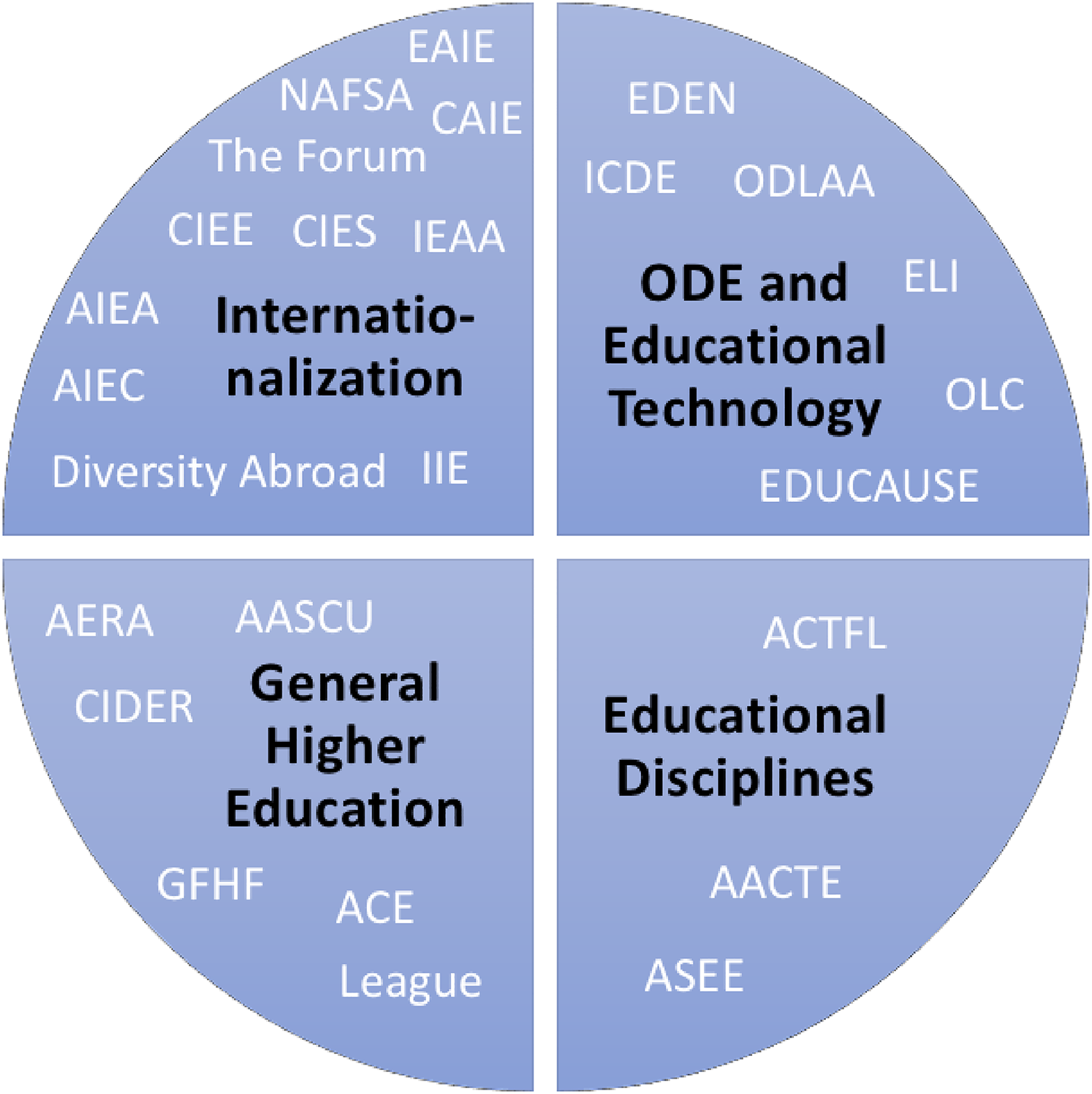
Conferences in the sample 2 .
To access the information presented, a content analysis (Julien, 2008; Krippendorff, 2013) of conference abstracts was conducted. Abstracts were sampled that combined the virtual and the international, using appropriate search strings (cf., Bruhn, 2020, p. 96). Within the content analysis, two distinct methods were applied: coding and computer-assisted text analysis (CATA). Coding was used to obtain manageable units of analysis from the data in relevant categories. CATA facilitated probing for transversal concepts and topics, thus adding detail and nuance to the analysis, and countering potential researcher bias.
Coding
Abstracts were coded according to different categories, in particular:
- Aim/function of the measure; - Respective pillar of the model of Comprehensive Internationalization.
The ACE-CIGE model of Comprehensive Internationalization (Helms & Brajkovic, 2017)
1
consists of six pillars of internationalization, namely, 1) articulated institutional commitment; 2) administrative leadership, structure, and staffing; 3) curriculum, co-curriculum, and learning outcomes; 4) faculty policies and practices; 5) student mobility; and 6) collaboration and partnerships.
For the aim/function category, a two-step coding approach was applied, moving from a detailed level towards a higher level of abstraction (cf., Lewins & Silver, 2007, p. 85). The first step consisted of open coding, recording the concrete aims/functions pursued in the respective abstract. In order to reduce complexity and draw more general conclusions from the data, higher-level coding categories were developed inductively that grouped those concrete aims/functions to a manageable number of more abstract entities (cf., Julien, 2008, p. 120). With this method, one key aim/function per abstract was attributed.
To facilitate the analysis, abstracts that were coded with the same category (pillar) of Comprehensive Internationalization could then be grouped and analyzed in more detail—both along the lines of the aim/function coding category and with the complementary CATA method, as described in the following section.
Computer-Assisted Text Analysis (CATA)
Two software tools were used to perform CATA: MS Excel and the concordancing software AntConc.
In MS Excel, formulae were employed to conduct customized text probing tasks. This way, particular character strings of interest and their occurrence across abstracts (in the entire corpus or filtered sub-datasets) could be identified. For instance, in a spreadsheet with abstract texts listed in column A, the formula = IF(ISERROR(SEARCH(“strateg”;A1));0;1 would result in the value 1 if the string *strateg* occurred in the abstract in field A1 (irrespective of the number of occurrences in that abstract), and in 0 if it did not occur. The customized formulae facilitated the combination of different string searches into one—in the case of strategic action, probing for the occurrence of several key terms associated with the topic at once (cf., Bruhn, 2020, pp. 111–113). This went beyond the possibilities of automated text analysis programs, which would not recognize the lexical association of these terms (cf., Bruhn, 2020, pp. 107–108).
This text probing approach served as a preliminary step. Additional CATA methods were required since it could neither be assured that each occurrence of an identified term pointed to the issue under investigation (here: strategic action), nor could contexts be distinguished with this method. Concordancing software (AntConc, Version 3.5.7) was selected for investigating such preliminary results with the word search and keyword in context (KWIC) techniques. These have been found to provide effective analytic methods for similar purposes (cf., Guest et al., 2012, p. 107; Krippendorff, 2013, pp. 214–220). Three techniques have been included in this research:
- - -
The concept of VI was developed by investigating the sample along the six pillars of the model of Comprehensive Internationalization with the methods described and by expanding the existing categories according to the results obtained. In the following section, the developed VI concept is outlined, before its different categories are presented in further detail.
Findings: A Concept of Virtual Internationalization (VI)
General Results
From a sampling frame of 74 conferences, 549 abstracts were obtained that made a direct connection between a virtual and an international dimension of higher education. These abstracts constituted the sample for this research. In this article, numbers in square brackets [1 ≤ n ≤ 549] are used as unique identifiers for individual sampling points.
The attempt to transfer the model of Comprehensive Internationalization to the sample (i.e., to code abstracts according to their respective pillar) proved useful, but showed two limitations. First, it was impossible to treat strategies and articulated institutional commitment independently of the contexts of their application. Rather, strategic action was identified as transversal to all other categories of VI.
The second limitation of the model of Comprehensive Internationalization was that abstracts pertaining to the field of ODE did not fit into either of the predefined pillars. In the classification outlined by Helms and Brajkovic (2017), programs delivered entirely online or at a distance fall into the collaborations and partnerships pillar as part of “other offshore programs”. This categorization is in line with the general scholarly discourse, which regards ODE as one of the facets of TNE (François et al., 2016; Knight, 2016)—while Knight (2016) also acknowledges problems with this categorization and recommends further research into the topic. This research identified two problems in particular. First, transnational ODE does not have to be characterized by collaboration, but can be developed and offered independently of foreign partner institutions. Second, ODE is often not targeted at an international, but at a domestic clientele (although there may also be international students enrolling). By separating education which is entirely delivered at a distance from primarily campus-based education, this research was able to depict the specifics and different requirements of each mode of education. Therefore, the category of online and distance education was added to the analysis (Figure 2).
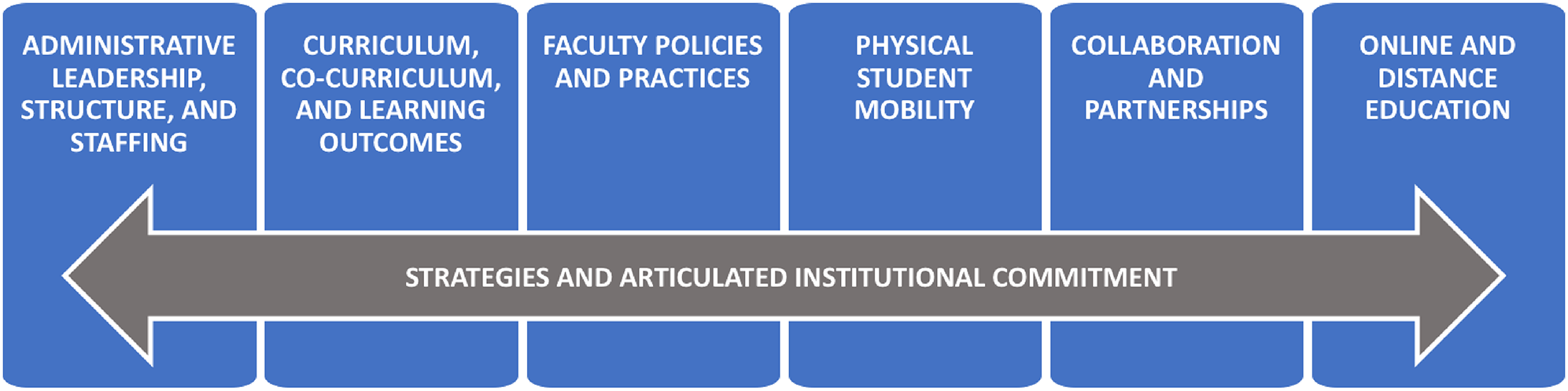
The six parallel categories and one transversal category of virtual internationalization. Adapted from Bruhn (2020), p. 131.
Through coding, 24 key aims/functions were identified across the dataset (Table 1). Note that all mentions of codes from Table 1 and of categories from the VI concept (Figures 2 and 3) are set in italics in this article.
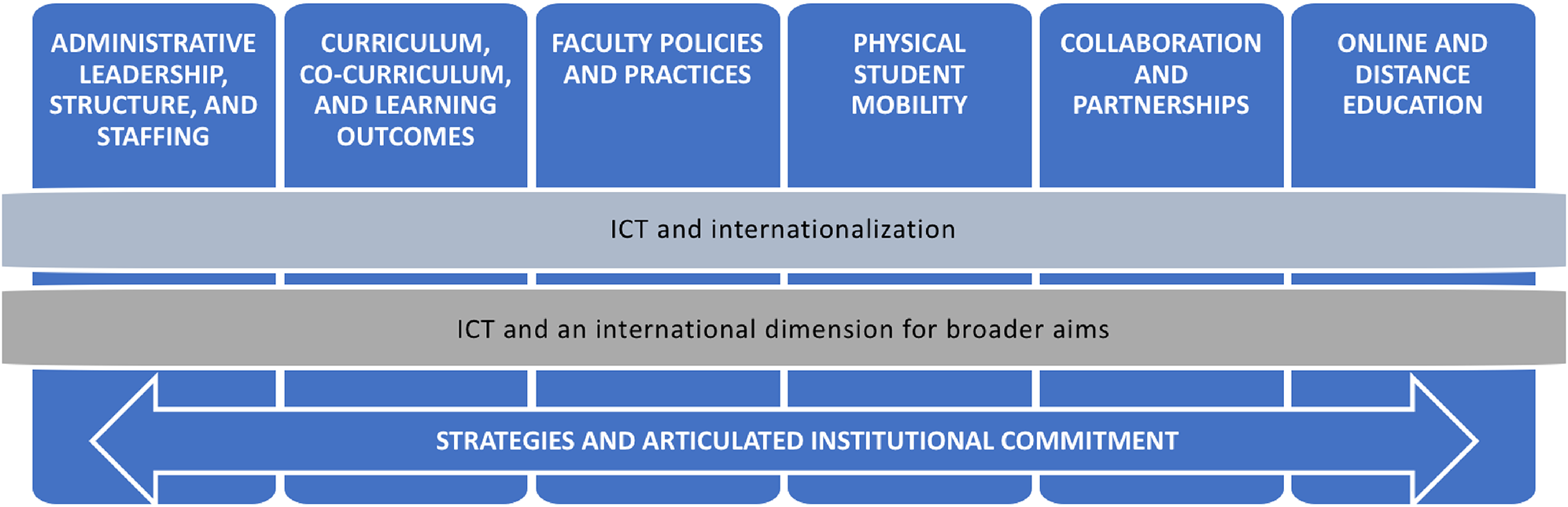
Seven categories and two dimensions of virtual internationalization.
Aims/functions of VI and Their Frequency in the Sample (adapted from Bruhn-Zass (2020), p. 144).
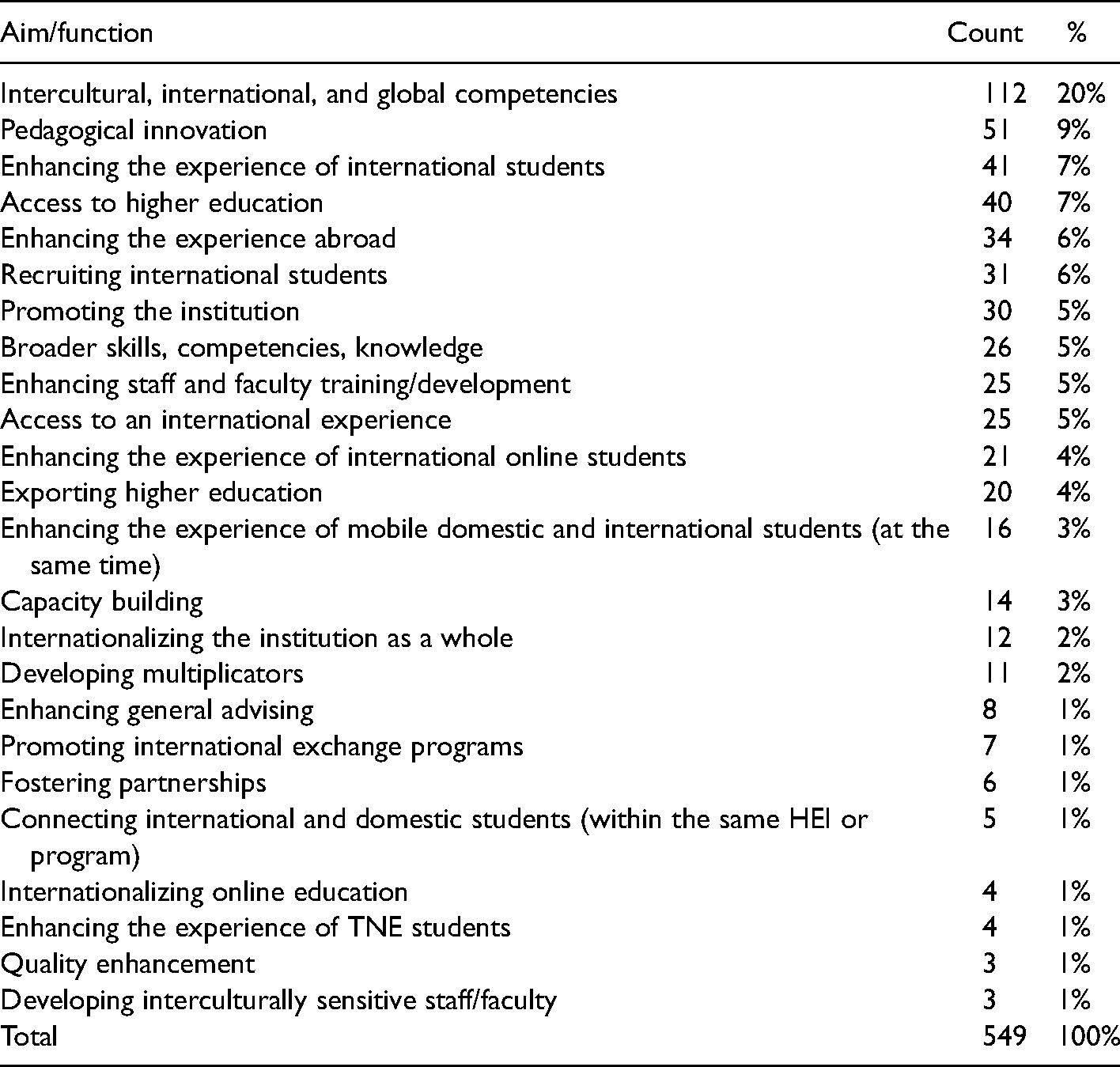
A closer look reveals that several abstracts do not aim at internationalization itself, but at something broader: On the one hand, internationalizing the experience of students and/or staff by developing their intercultural, international, and global competencies is a widespread issue (20% of contributions in the sample). On the other hand, the relatively frequent occurrence of the more general broader skills, competencies, and knowledge (5%) implies that the sample also covers aims that go beyond the idea of “internationality”. Similarly, while access to an international experience—a concept referring to the internationalization discourse—is at the center of 5% of contributions, the broader concept of increasing access to higher education is widespread within the sample as well (7%).
This result presented a challenge to this research: If internationalization was to be addressed in the narrow sense of the term, abstracts had to be excluded that use the combination of a virtual and an international dimension as a vehicle to reach something different. However, as scholars have emphasized, internationalization and its broader functions are inextricably linked (Brandenburg et al., 2019; de Wit et al., 2015, p. 29). In fact, several aims/functions can be interpreted as two sides of the same coin—for instance, capacity building or creating access to higher education as flipsides of exporting higher education (cf., Tait & O’Rourke, 2014, p. 45). Therefore, these diverse aims and functions were maintained in the analysis, while a second dimension was added: The first includes aims/functions that are directly internationalization-related (ICT and internationalization), and the second those that go beyond internationality (ICT and an international dimension for broader aims) (Figure 3).
Coding the abstracts according to the six parallel categories of VI revealed that the largest portions of the 549 abstracts in the sample revolve around issues of curriculum, co-curriculum, learning outcomes, and physical student mobility, which each constitutes at least one-third of abstracts (37% and 33%, respectively). The category of collaboration and partnerships is covered in just over one in ten contributions, similar to that of (fully) online and distance education (11% each). The aspects of administrative leadership and faculty policies and practices are least often at the center of attention (4% each), but still provide a rich database to inform this research (24 and 21 contributions, respectively).
This distribution within the VI categories shows that students are the core target groups of VI as discussed at conferences examined, whereas academic staff is less often in the focus. This observation is substantiated by the fact that the lemmas student, learning, course, and education represent four out of the five most frequent terms in the sample, whereas teacher and faculty rank places 21 and 25, respectively (having eliminated functional words such as “and”, “in”, and “the” (cf., Krippendorff, 2013, p. 216)).
In the following, findings obtained for each of the seven analytical categories of VI are presented, starting with the transversal category of strategies and articulated institutional commitment.
Strategies and Articulated Institutional Commitment
Probing the sample for strategic terms with MS Excel resulted in 1,219 occurrences of terms that potentially describe strategic action. KWIC and cluster searches found that one in four abstracts (135) addressed the topic, with 164 mentions total. Coding of these occurrences resulted in six strategic fields:
Internationalization strategies (in general) (37 occurrences) International marketing and recruitment strategies (35) International collaboration strategies (17) Articulated faculty and staff policies (7) Strategies for innovation and future readiness (50) Assessment of the success of strategic action (18) (cf., Bruhn, 2020, pp. 151–154, for an in-depth analysis).
Among these are four fields that consider internationalization directly (1–4). It is noteworthy, however, that the strategic area focused most frequently at conferences in the sample (5) refers to a broader topic instead of internationalization, namely, innovation and future readiness. The sixth aspect, assessment of the success of strategic action, is itself transversal to all strategic action.
Administrative Leadership, Structure, and Staffing
A key aspect in the administrative leadership, structure, and staffing category is leadership for internationalizing the institution as a whole with ICT. This includes the (infra-)structural support of virtual exchange and hybrid international events. A further facet is the provision of online tools to international office staff to help them optimize processes.
Additional aspects in this category refer to the training and development of administrative staff to support internationalization (coded: enhancing staff and faculty training/development and developing interculturally sensitive staff/faculty. Abstracts referring to faculty are discussed below). This research identified both formalized and nonformal approaches. Examples include online training for professionalizing international office staff (including in partner institutions abroad), virtual self-help tools, and peer-learning and networking opportunities to enhance administrative processes.
Broader aims of staff development include the enhancement of skills to facilitate access to, capacity of, or quality of higher education (at home and abroad) (coded: access to higher education, capacity building, and quality enhancement). For instance, the proficient use of interoperable software and skills in following global standards are presented as central to widening access to higher education.
Curriculum, Co-curriculum, and Learning Outcomes
Enhancing intercultural, international, and global competencies is the most frequently addressed aim/function in the curriculum, co-curriculum, and learning outcomes category. Among the competencies mentioned are language skills, intercultural understanding, openness to multiculturalism, and the ability to deal with cross-cultural issues. Another aspect discussed is the development of responsible global citizens, empowered to tackle global challenges. Access to an international experience is a further aspect addressed.
VI is also used with the aim of connecting international and domestic students (within the same HEI or program)—for example, with virtual learning environments that encourage active online discussions between national and international student populations.
Broader aims in this category include the acquisition of broader skills, competencies, knowledge. Preparing students for the society of the 21st century and enhancing their employability are frequently addressed aims. Virtual international work experiences and expert mobility are used to provide students with insights into international businesses and to foster “21st century skills,” which students need for the global economy.
A further aspect of broader skills, competencies, knowledge is the enhancement of discipline-specific knowledge: Presenters in the sample argue that Web 2.0 broadens the community of inquiry and that “the spaces of knowing are changing; no longer are learners constrained by institutional boundaries, but they can explore in virtual and cross-cultural settings” [312]. With transnationally expanded access to virtual labs and specialists from abroad, knowledge is becoming trans-institutional and international.
Another broader aim identified is pedagogical innovation in teaching and learning. Examples include global virtual collaborative environments where “innovative thinking” and a “deeper level of learning” [484] are fostered, “innovative content-based course design” [85] that includes e-travelling, and a transnational virtual lab to provide inquiry-based science education.
Finally, aspects of VI in this category include increased access and capacity of higher education (coded: access to higher education and capacity building)—for example, when massive open online courses (MOOCs) and open educational resources (OER) introduced into curricula facilitate worldwide access to content from renowned institutions. One abstract argues, for instance, that gamified transnational learning can increase access to higher education for students of low socio-economic status because of these students’ familiarity with the gaming concept.
Faculty Policies and Practices
Most of the aims/functions addressed in the sample concerning faculty policies and practices refer to the training and development of academic staff to support internationalization (coded: enhancing staff and faculty training/development and developing interculturally sensitive staff/faculty. Abstracts referring to administrative staff are discussed above). From the concrete aims/functions identified at the coding stage, two purposes and two modes of VI in faculty development were deduced. This differentiation helps in grasping the complexity of the role of faculty development in VI.
The two purposes are:
Development of Development of Training or development (physical or virtual) for teaching or collaborating in
The two modes identified for these two purposes are:
For the development of domestic faculty (1), examples for the first mode (a) include a global STEM virtual community in which ICT is used for supporting physical researcher mobility. For the second mode (b), one abstract suggests that international collaboration on curricula can enhance the quality of transnational online courses. Adding a different aspect, one HEI developed a training program for faculty to integrate virtual global classrooms in on-campus education. And the course “Teaching the International Student” is targeted at ODE faculty who teach in online study programs that expand into international markets.
Regarding the development of international faculty (2), examples of the first mode (a) include a hybrid training program to lower barriers for internationally educated academics to acquiring a teaching position in domestic higher education. For the second mode (b), an example reported is an online teaching academy for faculty from partner institutions that provides skills for teaching in international contexts.
Concerning broader aims in this category, pedagogical innovation is addressed as one key goal—for example, when training faculty in creating international multimedia experiences which enrich student learning (1-b). Broader skills and competencies are another aspect. For instance, faculty are expected to broaden their teaching competencies by means of virtual international collaboration (1-a).
Physical Student Mobility
ICT is used for enhancing advising and the overall experience before, during, and after the stay for both domestic and international students:
- - Regarding
ICT is furthermore implemented for promoting international exchange programs by employing a variety of online channels. It is also included in internationalization at home measures which may increase students’ motivation to study abroad. Moreover, ICT is used in physical mobility contexts to enhance access to an international experience. One such aspect is the offering of shorter physical stays blended with virtual mobility, which may attract nontraditional students who would not be able to spend a full semester in another country. A further aspect is the design of accessible international environments for students with disabilities.
Additionally, marketing and recruiting international students have been identified as key components in this category. Alongside “classic” online marketing, social media have “radically changed the global landscape of international student recruitment” [421]. HEIs include international alumni as well as domestic students abroad in these activities—with social media campaigns, alumni testimonials, blogs, or vlogs.
Based on its capacity to aid the personalization of services, ICT leads many presenters to omit concepts of cultural diversity and instead treat international students as part of “the youth market” [439], as a new “generation” [460] pertaining to the current “pop culture” [164, 330], and as common “native speakers of a new kind of language, digital” [460].
Among the broader aims of ICT use in physical mobility (as broader skills, competencies, knowledge), employability is a key topic. E-portfolios that help integrate career skills into learning abroad are discussed, as well as game design elements that bridge education and the world of work to “boost the employability of international students” [422]. Other abstracts argue that access to higher education is enhanced when expatriate or military learners can pursue higher education degrees from their home country despite their mobility.
Collaboration and Partnerships
This research found ICT to be used for fostering partnerships through inter-institutional platforms for e-learning, MOOCs, and OER, and with joint hybrid courses and degrees. In addition, ICT is employed to support HEIs’ presence abroad, serving both an institutional expansion to new markets (coded: exporting higher education) and access to an international experience for international students. “Virtualization” is discussed as a potential future scenario for branch campuses, as in one panel discussion: “to morph, blend, specialize, innovate, virtualize or close?” [513].
ICT is also used for enhancing the experience of international students enrolled in TNE, with a variety of web- and app-based m-learning tools. One argument raised in abstracts is the flexible provision of educational and support offers. Another is the possibility to counter intercultural difficulties between the awarding institution and the branch, for example, with social media tools that create a sense of community.
With regards to broader aims of ICT use in collaboration and partnerships, access to higher education and capacity building are the main aspects discussed, in TNE and beyond. OER, MOOCs, m-learning, and virtual labs are invoked as means to this end. For instance, the transnational “Gender in Agriculture” and “Open Content for Development” (OC4D) projects both employ OER for developing countries. Another collaborative project uses virtual labs and m-learning to “allow universities in Africa to teach STEM subjects with hands-on activities at a fraction of the cost” of traditional classes [107]. M-learning is also employed in transnational projects training community health workers in Africa. Besides developing countries, industrialized nations are also addressed in the context of access and capacity. The “Boldic” Nordic-Baltic transnational cooperation, for instance, attempts to increase access to high-quality education in regions with low population density.
Pedagogical innovation is also considered: For TNE, MOOCs are discussed for “transcend[ing] the formal and informal learning space”, thereby impacting on “our evolving understanding of pedagogy through this new medium of learning” [445]. Another abstract argues that online learning can help overcome challenges in international joint degrees, facilitate the transfer between systems, and innovate curricula at all institutions involved.
Online and Distance Education (ODE)
ODE is frequently addressed in the sample as opening new markets for exporting higher education, and as a way of adding a mode of delivery to the TNE landscape. TNE is also called “the next leap in distance learning” [524]—a logical step for the ODE field, fueled by advances in educational technology.
Supporting and enhancing the experience of international online students is another key aspect drawn from the data. Whether international students are enrolled in virtual TNE with an entirely international target group or in degrees with both domestic and international peers, ICT is used to help them navigate their educational programs—with culturally responsive online learning and self-help MOOCs. Adapting content, language, media, technology, and instructional methods to international contexts are regarded as necessary to counter a “clash of cultures” [482] and ensure equitable learning outcomes in ODE.
Furthermore, ICT is acknowledged for internationalizing online education—often as the only option for domestic ODE students to get a study-related international experience. This includes two aspects in particular: making use of the virtual presence of international students and collaborating with online classes from abroad.
The dimension of broader aims of ODE in international contexts has a large overlap with aspects discussed for collaboration and partnerships—in terms of access to higher education and capacity building in developing and emerging economies in particular. The strength of transnational ODE vis-à-vis other modes of (TNE or domestic) delivery is seen in securing capacities for sustainable development and in helping to meet the global demand for (quality) education. This also extends to nontraditional students, especially those who have family or job commitments—a classic target group of ODE. To further expand access, one abstract discusses the transnational use of OER in non-formal education.
The internationalization of ODE is also addressed in its potential for quality enhancement of the ODE delivery mode—for instance, by adopting transnationally shared institutional practices and quality assurance standards.
Finally, pedagogical innovation is discussed. In comparison to physical campuses, one abstract argues, online campuses “begin with a great advantage: They are not limited by geography, they can tap into experts across the world and bring their knowledge into a central and easily accessible location”. Consequently, it is argued, the disadvantages of a placeless education can be counterbalanced by the borderlessness of a “global campus” [511].
Discussion
The VI concept offers a comprehensive perspective on higher education internationalization with ICT. Six parallel categories and one transversal category of VI have been identified. Their closer examination reveals the role which ICT can play in international contexts in the diverse operational areas of HEIs:
Strategies and articulated institutional commitment regarding ICT use in international contexts are transversal to VI. Institutionalization of VI can occur in internationalization strategies and strategies/policies regarding international marketing and recruitment, collaboration, and faculty and staff. VI in HEIs’ strategies and policies often serve HEIs’ “future readiness”—their continued relevance and competitiveness in education and research. Future-proof universities, according to the hypothesis, use ICT in their international operations. Regarding administrative leadership, structure, and staffing, HEI management and administration provide structural support for VI and set frameworks for institutional action. Their commitment and expertise are success factors for VI. Staff can be supported by development and training measures to assure that they have the necessary competencies to include VI in their practice in a meaningful manner. In the curriculum, co-curriculum, and learning outcomes, a diverse range of aims can be pursued with ICT—from the improvement of intercultural competencies to “21st century skills” and a quality enhancement of curricula. VI thus supports both students’ international outlook and the broader knowledge, skills and competencies they need for future work environments. These include transversal skills emerging from digital international collaboration, such as competencies to work remotely in diverse teams. Curricular VI practices include collaborative types of virtual mobility and virtual exchange as well as virtual forms of field trips, work experiences, and expert mobility. With regards to faculty policies and practices, this research found a variety of measures that aim at the development of academic staff for (physical or virtual) international contexts. This diversity points to the complex role which said group plays for VI within HEIs, be it in research collaboration or in teaching international [online] students. Virtual collaboration between faculty in different countries can not only enrich research cooperation, but also build teaching competencies—for instance, in projects in developing countries. ICT can also be used to help international staff integrate into domestic higher education, to train TNE staff in the host country, or to develop curricula conjointly with the teaching staff of joint or dual programs. Concerning physical student mobility, ICT can be employed to facilitate “anytime, anywhere” support of physical mobility. This also applies to stages where students cannot easily be reached by other means—including the before (pre-departure) and after (alumni) phases for international students, and the during (study abroad) phase for domestic students. ICT makes seamless transitions from one phase to another possible. This can be interpreted as the virtual bridging of the before, during, and after, and as the creation of blended mobility experiences. ICT is also widely used in international marketing and the promotion of study-abroad, often involving the personalization of services and content. International collaboration and partnerships can be fostered and enriched by virtual elements. For TNE, ICT-based measures can complement physical offerings and strengthen the nexus between home campus and branch. ICT also supports communication and curriculum development in joint programs. Finally, in addition to their capacity of strengthening existing partnerships, virtual means expand the possibilities for international cooperation—for instance, by enabling collaborative projects like transnational virtual labs or OER and MOOC platforms. VI is found to open up opportunities to integrate an international experience into domestic online and distance education (ODE), in addition to its applications for ODE provision internationally. In both cases, VI can make an international experience more inclusive, because ODE generally attracts nontraditional students who would not be able to spend an extended period abroad (Bruhn, 2018). Online and distance degrees have been a growth market in many parts of the world in recent years (Qayyum & Zawacki-Richter, 2018)—and because of their virtuality, they hold an intrinsic potential of transcending borders. Therefore, it appears promising to further explore possibilities of internationalization within this delivery mode, which did not receive much attention in the broader internationalization discourse in the past. Just as they always have, technological innovations will reveal new ways to be a globally engaged university. The tools will change, and new goals will move to the forefront, but the case for internationalization of the university is not diminished. (p. 3)
The concrete measures identified in this study represent a temporary snapshot that dates back to the time before the Covid-19 pandemic. The concept of VI can nevertheless be expected to remain valid beyond the data collection period. It transcends individual means and measures and covers the aims and functions pursued with ICT in international contexts. Contrary to concrete technological tools and applications, these are not subject to change as a consequence of short-term developments, but refer to the general paradigms of internationalization. As Kinser (2014) noted:
Note that this research did not consider the usefulness, limitations, and conditions for the success of individual measures. Further research is indicated to help practitioners meaningfully complement “non-virtual” internationalization activities with ICT-based measures.
The concept of VI invites researchers and internationalization professionals alike to adopt a comprehensive approach towards ICT-based forms of internationalization—including ODE—and to acknowledge VI as an inherent part of internationalization in general.
Conclusion
At the methodological level, this research demonstrated an application of content analysis methodology in educational research. CATA proved to be a useful tool to develop a concept from actual practice.
Regarding the results of the study, VI has been found to touch on all areas of Comprehensive Internationalization, as well as on ODE. The data presented show that VI has been employed for years to complement the internationalization portfolio of HEIs. In light of this fact, it appears probable that the future “new normal” of higher education internationalization will remain hybrid, while the Covid-19 pandemic may serve as a catalyst.
As higher education internationalization increasingly integrates aspects of VI, it appears particularly fruitful to delve deeper into the intersection of the ODE field with the internationalization field. Joining the expertise on distance and online education with that on internationalization can enrich both the scholarly discourse and the professional practice—in ODE and on-campus education alike.
In light of the limitations of both physical and virtual forms of internationalization, it is advisable for HEIs to follow the principle of an outcome-oriented internationalization practice which neither idealizes ICT-based measures nor dogmatically follows the primacy of physical mobility. The concept of VI offers a holistic perspective on the applications of ICT in internationalization. It can serve as a tool in order to achieve a comprehensive and inclusive internationalization practice—in times of crisis and beyond.
Footnotes
Acknowledgments
This article reflects the personal opinion of the author.
Declaration of Conflicting Interests
The author(s) declared no potential conflicts of interest with respect to the research, authorship, and/or publication of this article.
Funding
The author(s) received no financial support for the research, authorship, and/or publication of this article.
