



Abstract
The pursuit of global competence (GC) is heavily promoted as part of university education in Japan, where the government exhorts universities to equip graduates with skills that will enable them to function as global citizens. Foreign language (FL) educators are often expected to cultivate these globally competent individuals. However, there is little consensus on what GC actually is, and limited evidence that existing models of GC are actually applicable in the Japanese context. This study used a qualitative survey targeting professionals, researchers, university teachers and students to determine the attributes that are seen to comprise GC, and the challenges faced in achieving GC in the Japanese context. Findings highlighted the primacy of FL communication skills, as well as openness, extraversion, emotional stability, and a willingness to engage. To overcome challenges to the achievement of these attributes, we suggest that FL educators need to tap into learners’ individual identities and aspirations, rather than pursuing generic and decontextualized approaches to the development of GC.
Keywords
Introduction
Universities worldwide are under pressure to produce global citizens capable of navigating the social, political and economic demands of life in the twenty-first century (Hammond & Keating, 2018). Yet despite the inherently “global” nature of global competence, most frameworks have been developed on a foundation of Western cultural norms (Arasaratnam-Smith, 2017; Chong & Grzymała-Moszczyńska, 2015; Deardorff, 2015). The lack of culturally specific models means that researchers and educators often adopt models without sufficient evidence that they are appropriate in the local context. A further problem is the tendency of such models to be developed based on “expert” opinion and to ignore the voices of key stakeholders in the day-to-day business of global competence education and application.
In Japan, the past decade has seen the launch of numerous government initiatives intended to internationalize universities and foster globally-competent graduates (e.g., Global 30 Project, Project for Promotion of Global Human Resource Development, Re-inventing Japan Project and Top Global University Project), but the precise aims of global competence (GC)-oriented education remain nebulous. Policy documents advocating the cultivation of gurobaru jinzai (officially translated as “global human resources”) tend to focus on quantifiable foreign language (FL) goals (e.g., proficiency test scores). Other aspects of GC are mentioned only in vague subjective terms and are thus difficult to target and teach (Bouchard, 2017; Chapple, 2014). For example, in 2017 the Japanese Ministry of Internal Affairs and Communications published a policy evaluation report wherein they defined gurobaru jinzai as: “those who are rooted in their identity as Japanese by an in-depth understanding of the Japanese culture and can thrive in a variety of fields with (a) high levels of language ability and communication competence, (b) autonomy and proactiveness, and (c) a spirit of intercultural understanding.” (Translation from Kubota & Takeda, 2021, p. 9)
The document goes on to report on the achievement of factor (a) on the basis of standardized English-language test scores, essentially conflating English language ability with communication competence (Kubota & Takeda, 2021), a tendency repeatedly seen in Japanese internationalization policies (Phan, 2013). Components (b) and (c) are measured in the report only in terms of exposure to different cultures; through study-abroad or interaction with foreign students and faculty. In Japan, it is largely up to individual institutions or educators to interpret exactly what these less quantifiable aspects of GC look like, and how to cultivate and measure them (Rose & McKinley, 2018). Katsumata (2017) sums up the situation bluntly: What the heck is gurobaru jinzai anyway? What kind of people are we talking about? We don't even have a clear definition to start from (first author's translation, p. 14).
This article documents an exploratory study that aims to address the need for a conceptual framework for GC that can be applied by FL educators in Japan. By analyzing bilingual data collected from students, teachers, professionals and researchers (N = 130), we examine what it means to be globally competent, and the challenges that need to be addressed to help university students in Japan to develop GC. Previous conceptual research in this field has been criticized for being conducted “within a single language” (usually English) and “within a single culture” (often North American) (Fantini, 2019, p. 33). To this we would add the criticism that studies often focus on the opinions of a single group of “experts” (usually researchers or academic administrators). This study attempts to integrate multiple perspectives to explore the concept of GC in Japan and begin to map the terrain of what a Japan-specific framework may look like. In so doing, we hope to highlight the culturally relative nature of GC conceptualizations found in the literature, and contribute new perspectives to the international GC conversation.
Global Competence
Frameworks that seek to describe the competence needed to survive and thrive in a globalized world are prolific. They hail from multiple disciplines, including business, leadership, communication studies, applied linguistics, social psychology and international education fields (Kramsch, 2002; Leung et al., 2014). They also employ a wide variety of terms (e.g., global competence, global citizenship, global leadership, intercultural competence, intercultural communicative competence, transcultural competence, intercultural sensitivity and cross-cultural understanding), often synonymously. The multi-disciplinary nature of GC-related research has yielded a large and unwieldy collection of key factors (for selected reviews see Bradford et al., 2000; Spitzberg & Changnon, 2009), but the majority of studies share a tendency to regard this type of competence as a configuration of attitudes, skills and knowledge that enables an individual to communicate effectively and appropriately with culturally different others.
The attitudes dimension is usually described in terms of character traits (such as openness, flexibility and curiosity) and specific attitudes (e.g., willingness to communicate; interest in interacting with people from different cultural backgrounds). Skills tend to relate to cognition, communication and collaboration, while knowledge includes both culture-general and culture-specific knowledge pertaining to local and global contexts.
Notably missing in many of these frameworks is direct reference to FL skills. While frameworks that have arisen within the fields of FL education or linguistics tend to regard a language component as pivotal (e.g., Byram, 1997; Fantini, 2019), other frameworks often omit it entirely (e.g., Arasaratnam, 2006; Deardorff, 2004), an oversight that Baker (2015) describes as “a serious weakness” (p. 34). In Japan, where being able to communicate effectively in English is considered to be “the hallmark of a global citizen” (Aspinall, 2013, p. 117), the absence of a FL component in a framework for GC is virtually inconceivable. Fantini (2019) argues that despite its common omission, the importance of language for GC is “fundamental and indisputable” (p. 18) and suggests that a disconnect between the fields of language education and intercultural communication may be responsible for this oversight.
This limited focus on FL skills in much of the GC literature contrasts with GC representations that appear in Japanese governmental and institutional policy documents, where FL proficiency is foregrounded and other elements of GC often end up being sidelined or overlooked (Burgess, 2015). Kubota (2013) conducted interviews with Chinese and Japanese employes of manufacturing companies based in Japan and China. She found that interviewees regarded language skills as important, but tended to emphasize that FL proficiency was simply one of a number of tools that were needed for communication to succeed. This focus on the primacy of “successful communication” is at odds with the way that foreign languages are usually taught in Japan, where accuracy is prized and the “native-speaker” ideal remains strong (Rivers, 2018). While the Japanese Ministry of Education, Culture, Sports, Science, and Technology (MEXT) continues to push universities to produce globally competent graduates, there is little consensus on what GC constitutes, or what educators – and learners – need to do to achieve it.
Research Questions
This study is the first stage in a larger project that aims to ultimately develop a framework and pedagogical approach to help FL educators in Japan to effectively identify and target key skills and attributes for GC. In this study, we sought to investigate two questions:
What knowledge, skills, attitudes and traits do stakeholders believe are necessary in order to be “globally competent”? What specific challenges do FL learners in Japan face in the development of GC?
Methodology
Participants
A qualitative questionnaire was used to canvass opinions from four self-identified participant groups: FL teachers at Japanese universities (n = 33); students studying at Japanese universities and majoring in a FL (n = 46); professionals with experience working inside and outside of Japan, or in Japan together with colleagues from different cultural backgrounds (n = 39); and researchers with experience in GC-related fields, especially pertaining to Japan (n = 12). See Table 1 for demographic details of participants.
Participant Profiles.

Teacher participants were mostly EFL teachers (n = 33) with a small number of teachers of other foreign languages (n = 4). Students were all English-language majors, ranging from 1st year undergraduates to postgraduates. Global business professionals all had experience either working in multicultural environments within Japan, or working in other countries (and were either Japanese themselves, or worked with Japanese colleagues). Researcher specialties lay in the fields of education, GC, communication, cognitive linguistics and organizational science.
Following research ethics approval by the relevant institutional committees, participants (N = 130) were recruited using a combined criterion-snowball sampling strategy. Open invitations to participate were disseminated via academic associations (i.e., Society for Intercultural Education, Training and Research Japan; Japan Association for Language Teaching; Japan Intercultural Institute; and The Japan Association for Global Competency Education) and other related organizations (e.g., Japan Exchange and Teaching Alumni). Volunteers were invited to complete the questionnaire, and to forward it to colleagues, acquaintances or students who they felt might be interested. Participation was voluntary, and participants were provided with information and consent forms prior to agreeing to complete the questionnaire.
Procedures
The primary research instrument was an anonymous online questionnaire. An online questionnaire was chosen to facilitate data collection from a large number of participants without geographical or financial restrictions. In line with the exploratory nature of this study, open-ended questions were used in an attempt to collect answers representative of the full spectrum of opinion related to the research questions.
The questionnaire was developed based on two focus groups conducted bilingually using a mixture of Japanese and English. Student (n = 4) and teacher (n = 5) focus groups were used to maximize active participation by all members and reduce the impact of hierarchical relationships (Liamputtong, 2011). These two focus group sessions allowed the researchers to hear the perspectives of representatives of groups who would ultimately participate in the study. Volunteers were recruited via fliers and emails distributed to teachers and students at the first author's institution. Participants in each focus group ranked, sorted and discussed various terms and questions provided by the first author as facilitator. Sessions were audio-recorded, transcribed bilingually by the first author and then checked by an L1 speaker of Japanese. Transcriptions were then used together with written facilitator reflections to inform the questionnaire design.
Japanese and English questionnaire items were created using a “dual-development” approach (Potaka & Cochrane, 2004) together with a bilingual L1 speaker of Japanese. The resulting questionnaire was piloted by three colleagues (all researchers in fields related to GC and also FL educators; one whose L1 is Japanese and two whose L1 is English) and two students (majoring in English as a FL; L1 = Japanese). Pilot participants completed the questionnaire and provided feedback about time taken, clarity of questions and online format. Revisions were made based on their comments and the final bilingual questionnaire comprised four to six demographic questions (depending on participant group) and eight questions related to GC. The questionnaire was administered online using Qualtrics software over a period of three months. Both languages were visible to participants to allow bilingual participants to check their understanding of questions (Potaka & Cochrane, 2004).
This paper focuses on participant responses to two of the GC-related questions asked in the questionnaire:
What do you think Japanese university students need in order to be globally competent? Think about specific attitudes, skills, knowledge, or qualities. Please list at least five. What are some personal challenges that Japanese university students face in developing global competence? Please list at least three.
Data Analysis
Open-ended responses were coded thematically by the first author over several rounds using content analysis. A round of initial coding was conducted using an Excel spreadsheet to identify the main categories emerging from the data (see Saldaña, 2016). This stage was completed separately for Japanese and English responses to minimize the risk of losing nuances in the data through early translation. Tentative codes were organized using Mindnode software to look for conceptually similar themes and devise a coding scheme (Friese, 2019). The resulting codes were then applied to code all responses. Atlas.ti software was used to facilitate the coding process. A third round of coding was employed to eliminate redundancies and merge codes where possible. At this stage Japanese and English codes were compared and merged into bilingual codes where there was no discernable nuance difference by language.
To complete the final stage in the coding process we returned to the literature to explore possible theoretical frameworks with which to organize the data. As none of the existing frameworks aligned clearly with the questionnaire results, elements of three models – Deardorff's Pyramid Model of Intercultural Competence (2004), the Model for Twenty-first Century Skills (Binkley et al., 2012) and the Five Factor Model of Personality Traits (McCrae & Costa, 1987) – were incorporated to arrive at a tentative organizational schema (Figure 1). Specifically, the authors adopted Deardorff's three-part description of knowledge, Binkley et al.'s ten key skills and McCrae & Costa's categorization of traits into five key factors. The resulting organizational schema facilitated categorization of participant responses to the research questions in the final stages of the analysis. Specifically, it was used to bring terminological clarity to codes and to cluster individual codes into larger categories (code groups) in order to reveal “the big picture” that the data was painting. After coding was completed, some simple quantification was used to get a sense of the frequencies with which various codes and code groups occurred, and to facilitate exploration of trends within the data.

Tentative organizational schema.
Reliability and Validity
Following Lincoln and Guba (1985), we endeavor in this paper to demonstrate the credibility and rigor of our qualitative research through attributes such as truth value (acknowledging multiple viewpoints in the literature and presenting participants views accurately), trustworthiness (presenting our methods and analytic procedures in detail with clear decision-trails) and applicability (giving detailed consideration to the contexts to which the findings might apply, and the limitations associated with any generalizations).
Findings
The views on GC provided by participants suggest that FL ability is an important factor for GC in Japan, and its role in effective communication is deeply connected to emotional factors experienced by learners. Findings are presented with reference to code frequencies and illustrated with specific excerpts from participant data. These excerpts are provided in the original language, together with English translations by the first author as required.
Specific Components of Global Competence
Participants clearly focused on language as a key component of GC, together with various traits, attitudes, knowledge and experiences that support effective communication. Notably missing or infrequent in responses were references to career-related skills (such as IT or management skills). Table 2 shows the factors most frequently represented in participant responses.
Factors Contributing to Global Competence.
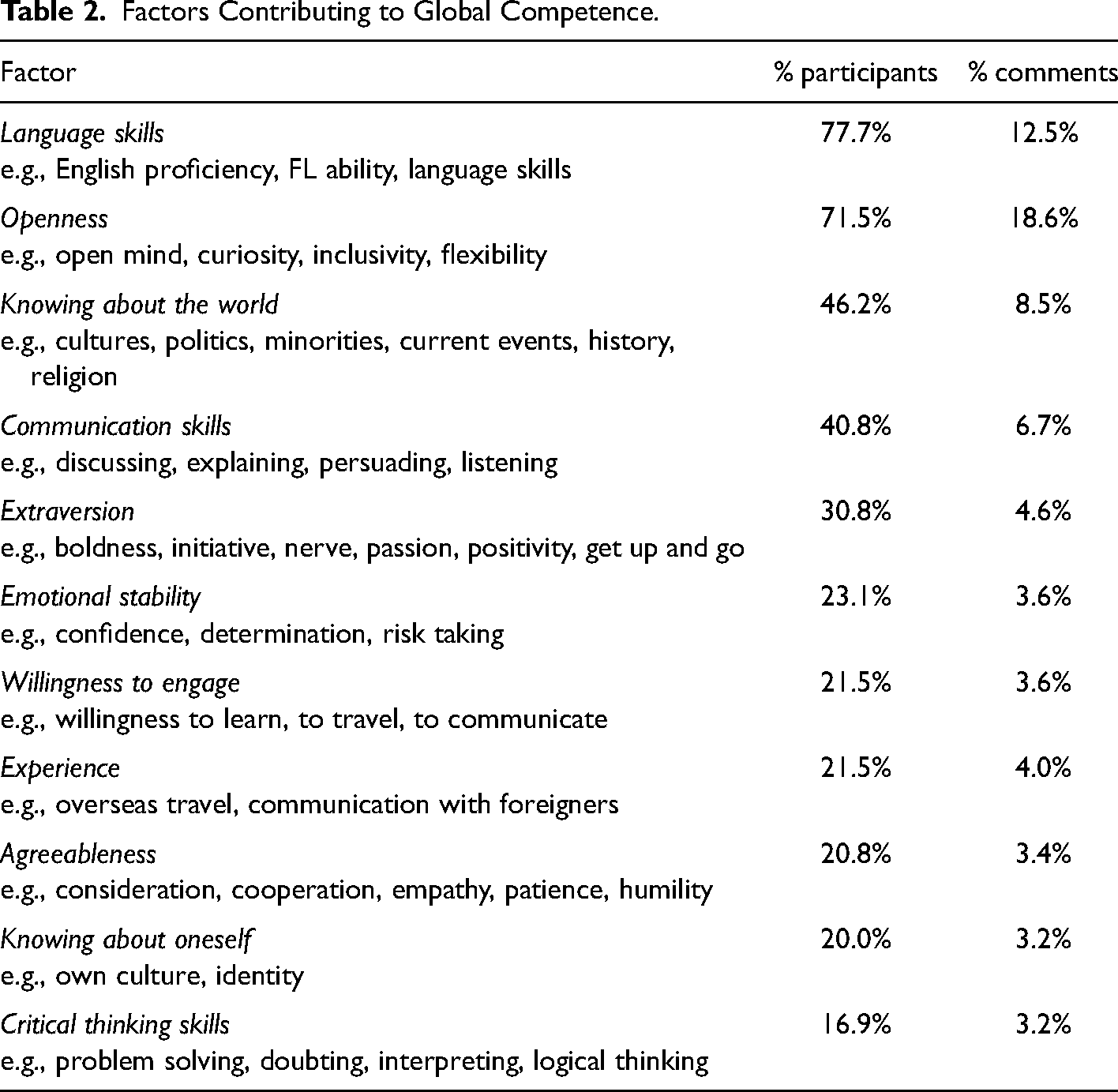
Language skills was the most frequently cited element of GC, with 77.7% of participants considering it necessary. Approximately a third of all participants specifically referred to English skills (31.5%) or FL skills (26.9%), while others simply wrote “language” (or 言語; gengo). In the Japanese context, where the terms “foreign-language” and “English” are frequently used synonymously (Kubota, 2002), and there is a tendency to regard Japanese-English bilingualism as the solution for global communication (Butler & Iino, 2005), it seems reasonable to infer that most participants who cited “language” were referring to FL skills. Although the initial intention was to treat language as a subset of communication, the generalized terms used by most participants to describe language skills (like “proficiency” or 能力; nōryoku) led to a decision to code communication and language independently of each other, as there was no basis for the supposition that language was to be used as a tool for communication, and indeed some answers (e.g., Excerpt 1) suggested otherwise.
Excerpt 1
TOEICのスコア [TOEIC score] (Participant 65)
The trait of openness also featured in the answers of many participants (71.5%). Indeed, while students and researchers tended to focus on language skills, teachers and professionals were more likely to refer to the necessity of openness. According to the Five Factor Model, the openness trait encompasses curiosity, creativity, open-mindedness, having non-dogmatic attitudes, resourcefulness, and intelligence (McCrae & Allik, 2013). The most common response-types in this data set referred to curiosity (21.7% of openness-related comments) and open-mindedness (22.3%). Other answers related to flexibility, independence and inclusivity. Samples of these answer types are provided in Excerpts 2, 3 and 4.
Excerpt 2
柔軟な考え [Flexible thinking] (Participant 39)
Excerpt 3
誰かに合わせるのではなく、自分の意思をきちんと持つこと (Participant 54)
[Having one's own will, rather than simply pandering to others]
Excerpt 4
他者を受け入れることのできる度量 (Participant 7)
[The capacity to accept others]
While a degree of consensus was observed regarding the perceived importance of language skills and openness, there was far less agreement on other elements. Figure 2 shows the different code frequencies by participant group.

Frequently occurring code groups by participant group.
While the third most frequent theme overall was knowing about the world, less than half of the participants listed this type of knowledge as important. Researchers were most likely to consider it relevant, while only a little more than a third of professionals (36.0%) did so. The emphasis in answers related to world knowledge was on knowing and understanding how people live in different parts of the world. Participants made specific reference to economics, politics, religion, work culture, gender roles and current events. Some focused on targeted cultural knowledge (e.g., Excerpt 5) but most used more general language suggestive of a broad knowledge base (e.g., Excerpt 6).
Excerpt 5
その国の文化、流行への深い理解 (Participant 40)
[Deep understanding of that country's culture and current situation]
Excerpt 6
Awareness of other cultures (Participant 114)
An even greater degree of discrepancy was displayed in the frequency of comments related to communication skills. This was the second most common response among the researchers (83%) but came in fourth for all other groups. The much higher frequency of references to language by these groups may be indicative of a tendency to equate linguistic accuracy with communicative ability in a global arena, perhaps as a result of the Japanese government's insistence on the importance of quantifiable FL ability. Most responses simply listed “communication skills” (or コミュニケーション能力; komyunikēshon nōryoku); some elaborated that it was important to be able to communicate with people from different cultural backgrounds; and a small number focused on specific communication-related abilities (e.g., discussion skills, being able to paraphrase, being able to communicate persuasively, effective listening).
The majority of GC factors listed by participants fit the traditional conceptualizations of GC as a composite of various skills, traits and knowledge, but a fourth category arose that lay outside of those standard dimensions. Almost a quarter (21.5%) of all respondents felt that intercultural experience was a necessary part of GC. Educators would traditionally consider experiences to be a means by which to arrive at the desired skills, attitudes, or knowledge, rather than a necessity or an end goal in and of themselves, but professionals in particular seemed to feel that experiencing life outside of Japan was an integral part of GC.
Closely related to the experience component was willingness to travel. This was categorized (together with willingness to learn and to communicate) as an attitude referred to as willingness to engage. This attitude was differentiated from traits in this analysis according to the definitions provided by Sherman and Fazio (1983), who explain that “attitudes must be directed toward something or someone” while “traits are more global concepts and need no object specified for them to be meaningful” (p. 309). Teachers were more likely to pick up on the importance of willingness to engage than other participant groups and to focus on the importance of willingness to communicate with culturally-different others.
Extraversion was the fifth most frequent theme overall, but received substantially more attention among students than other participant groups. Students’ answers here tended to relate to needing sufficient boldness to speak out and to the importance of 積極性; sekkyokusei, a code that was retained only in Japanese as no truly equivalent response was found in English answers. Sekkyokusei can be roughly translated as “get-up-and-go” but also contains elements of being positive, being active, and taking risks. Excerpts 7 and 8 show examples of student comments related to boldness and sekkyokusei.
Excerpt 7
積極的に話しかける勇気 (Participant 57)
[The courage to actively start a conversation]
Excerpt 8
何に対しても積極的な態度 (Participant 67)
[An attitude of just having a go at everything]
While students were concerned with extraversion, teachers were more likely to suggest emotional stability as an important factor. This was one of the few areas in which researchers and teachers showed similar results. Participants who talked about emotional stability referred to a tendency among Japanese students to be anxious about making (linguistic) mistakes, and the importance of self-confidence and risk-taking. While a third of teachers perceived the need for students to develop confidence, only 13.0% of students felt that emotional stability was important for them. It seems likely, however, that emotional stability and extraversion are closely interrelated, as increased confidence is likely to result in increased boldness and willingness to engage, and less fear of making mistakes. It is interesting to note here that all comments related to confidence (an aspect of emotional stability) were made by L1 speakers of languages other than Japanese, and all but one of the references to the need for boldness (categorized as extraversion) were made by L1 Japanese speakers. It may be that although application of the Five Factor Model led these answers to be categorized differently, they are in fact different expressions of the same concept.
In summary, findings in response to the first question show that FL skills are considered to be a key aspect of GC development in Japan, and that experiences and affective traits are perceived to play an important role in the ability to use those linguistic skills effectively.
Difficulties Faced by Students in Developing Global Competence
The particular challenges for GC development most frequently named by participants showed considerable overlap with the factors suggested as important for GC. Of the ten most frequently suggested challenges, seven relate directly to factors contributing to GC (e.g., willingness to engage emerged as an important factor and apathy as a corresponding difficulty that needs to be overcome). The remaining three challenge-types all relate to external obstacles; specifically a lack of experience, problems with the education system and cultural factors inherent in Japanese society. Table 3 shows the challenges most frequently listed by participants.
Challenges Students Face in Developing Global Competence.
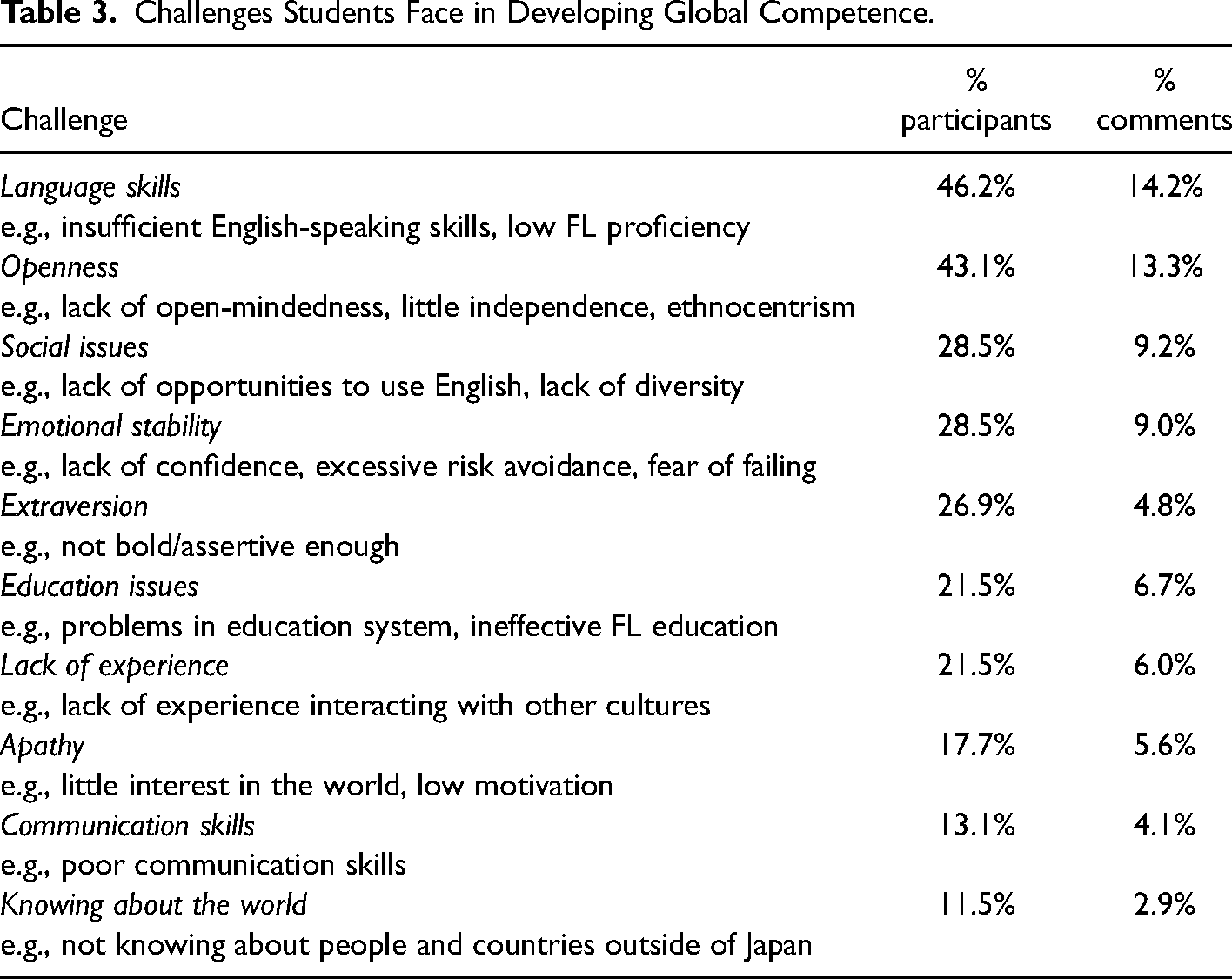
Insufficient language ability was the most frequently raised difficulty, cited by 46.2% of participants. This underlines once again the perceived importance of linguistic skills for GC. FL ability was the focus here, and while some answers simply cited low levels of FL proficiency as problematic, those who answered in more detail tended to focus on issues with using language appropriately and effectively for communication, rather than on accuracy or degree of linguistic mastery. See Excerpts 9, 10 & 11 for examples.
Excerpt 9
inability to communicate in a foreign language (Participant 116)
Excerpt 10
実際に使える外国語 (Participant 87)
[practical FL ability]
Excerpt 11
When learning a 2nd language, lack of focus on verbal communication skills
(Participant 31)
Teachers were the only group who did not pay the most attention to linguistic ability (see Figure 3 for a by-group breakdown of responses). They were more likely to comment on challenges concerning openness and emotional stability. Their focus was on the challenges of ethnocentrism and insularity (e.g., Excerpt 12) and students’ lack of confidence.
Excerpt 12

Frequently stated challenges by participant group.
Ethnocentrism and lingering racist attitudes esp[ecially] towards other Asians (Participant 121)
Other groups were also concerned about a lack of openness and it was the number two concern overall (43.1%). A closer look at responses assigned to this code group suggests a connection between openness and effective language use. For example, according to the Five Factor Model, the trait of openness includes aspects of individuality. Several participants (and especially students) commented on the difficulty students have in formulating an opinion and finding something to say (e.g., Excerpt 13); and their subsequent problems with saying it (e.g., Excerpts 14 and 15).
Excerpt 13
自分の意見の欠如 (Participant 6)
[Lacking their own opinion]
Excerpt 14
[Japanese students] are relatively subdued compared to other students from other countries I have taught (Participant 3)
Excerpt 15
Becoming brave enough to speak up (Participant 42)
Extraversion was an especially frequent focus for students, and even more prominent than responses related to assertiveness were those concerning the aforementioned concept of 積極性; sekkyokusei (get-up-and-go), which more than a quarter (26.1%) of students specifically listed as problematic. Attitudinal problems with apathy (in relation to FL learning motivation and general interest in the “outside” world) were also raised by students, and more than 20% of researchers and teachers agreed. Apathy has been found to correlate with a lack of extraversion (Bjornsen et al., 2007) and also with low emotional stability.
Some participants suggested that difficulties connected to speaking up stem from societal values and circumstances rather than individual traits. Teachers problematized external factors more often than other participant groups, with many of their comments on societal issues referencing the insularity of Japanese society (e.g., Excerpt 16) and the difficulty of learning a FL in a society that offers little opportunity to use it (e.g., Excerpt 17). Professionals also noted challenges due to insularity, as well as referring to the difficulties of trying new things within the traditional framework of Japanese society, as illustrated in Excerpts 18 and 19.
Excerpt 16
A rather insular, isolated (but overly proud) domestic culture (Participant 112)
Excerpt 17
英語を実際に使う機会の少なさ (Participant 19)
[The scarcity of opportunities to actually use English]
Excerpt 18
旧態依然とした思考や組織 (Participant 28)
[Old-fashioned structures and ways of thinking]
Excerpt 19
Not encouraged to do things outside the “box” in terms of what is expected in the Japanese cultural context (Participant 17)
In addition to problems attaining GC that were rooted in living in Japanese society, researchers, professionals and teachers (and to a lesser extent students) expressed concerns that the education system was itself a hindrance. Most comments simply remarked that the education system was inadequate, but some specified problems related to test-oriented teaching and passive learning.
Overall, linguistic ability and openness were deemed both important and challenging for students. Furthermore, if students lack confidence, motivation, and the ability to speak up, it will be difficult for them to apply their language skills effectively.
Discussion and Conclusions
This study sought to examine the nature of GC in Japan and the primary challenges that learners face in its development. Figure 4 provides a graphic representation of the important components of GC that emerged from the data. Areas deemed particularly challenging for learners have been highlighted. Arrows have been included to show the interrelation between emotional stability and the development of other aspects, and to highlight the role of language in communication. The connections were in some cases directly suggested by participants (such as Participant 114's comment that students struggle with “having the confidence to speak out”) and in others have been proposed by the authors based on existing literature that supports a correlation between heightened emotional stability and increased willingness to engage and extraversion and, ultimately, more effective communication (e.g., Bjornsen et al., 2007; McCrae & Allik, 2013). The result is a tentative framework that pinpoints aspects of GC that participants identified as most relevant and in need of attention in the Japanese higher education context.

Key global competence components and challenges in Japan.
The results of this study show that language skills, though often omitted in GC frameworks, are regarded as pivotal in the Japanese context. Researchers, teachers, students and professionals all focused on FL ability as key for the development of GC. This is not unexpected, given the emphasis that the Japanese government places on language proficiency in its gurobaru jinzai policies, and the large proportion of FL teachers and students in the sample. It does suggest, though, that FL ability needs to be an integral part of any framework for GC in Japan.
The tendency among participants to view FL skills as not only important, but also as one of the primary hurdles that students have to overcome to develop GC, indicates that the type of language abilities that are needed go beyond what is currently being taught in the classroom. The difficulty does not seem to be a lack of knowledge or understanding on the part of students, but rather a lack of practical ability to apply their theoretical FL skills. A combination of external and internal factors come into play here, as underlying affective traits (chiefly openness, emotional stability, and extraversion) are preventing learners from effectively applying their language abilities; and the education system and society as a whole are failing to support the types of attitudes and actions that may help learners to develop GC.
Implications
The potential benefits of intercultural experiences for GC have been widely acknowledged in the literature, and participants in this study suggested that they are key. However, as participants pointed out, opportunities for experiences such as overseas travel are limited, and low levels of confidence and motivation may also impact on students’ willingness to expose themselves to new experiences. Rather than relying on students’ out-of-class experiences, Ushioda (2011) argues that FL educators “need to engage [students’] own identities and interests in [the teachers’] lessons and promote a sense of continuity between what [students] learn and do in the classroom, and who they are and what they are interested in doing in their lives outside the classroom, now and in the future” (p. 204). The stark reality is that GC is not something that can be imposed by a teacher; it will come only as part of an identity that individuals choose for themselves.
It is tempting to suggest international mobility experiences as a “solution” to the acquisition of GC among university students. However, as Hyett et al. (2019) point out, there can be a range of financial and other barriers to participation in exchange or study abroad programs. Hyett et al. (2019) discuss the implementation of an innovative virtual intercultural activity bringing together students in Australia and Hong Kong, involving an individual cultural self-assessment, a virtual group meeting, and a reflective narrative task. Findings suggested that the participants engaged reflectively in vital intercultural learning, and gained valuable experience in navigating “out-of-comfort-zone” experiences. Such approaches would be readily adaptable to the Japanese context and provide a concrete blueprint for embedding GC into the curriculum.
It is also important to consider underlying traits and attitudes of students. In the literature, traits are often perceived as stable and applied as predictors of the degree of GC that an individual can attain rather than as trainable factors (Yarosh, 2013). Yet if all students are expected to develop GC, it is important to find a way to mitigate trait-based obstacles. In the Japanese context, where self-esteem and anxiety have been identified as hindrances to development of GC, building confidence and mitigating anxiety may be effective places to start. Bjornsen et al. (2007) suggest that providing an open-minded, supportive and encouraging atmosphere can promote emotional stability among university students. This in turn can filter into reduced apathy, increased extraversion and willingness to engage, improved application of language to communicate, and, ultimately, progress in the development of GC. From a practical standpoint, this is likely to necessitate reducing the test-focus and emphasis on accuracy that is often ingrained into students in Japan from a young age. To meet the needs of their learners, teachers need to understand them as individual people with whom they can co-create the learning experience.
The aspect of GC most emphasized by participants in this study is one that is often overlooked in GC literature: FL ability. Participant responses indicated a deep connection between emotional factors experienced by learners in Japan and the development of FL ability perceived as necessary for GC. Results of this study suggests that conceptualizations of GC are culturally relative and that applying frameworks underpinned by Western cultural norms may be problematic in other contexts.
Limitations and Future Research
This study sought to begin mapping the terrain of GC in Japan by examining the perspectives of multiple stakeholders. However, we can identify two limitations. First, the disproportionately small size of the researcher participant group means that percentages shown for that group can be significantly skewed by the opinion of a small number of participants. Future research would benefit from a more balanced representation of stakeholder groups. Secondly, to protect participant identity no information about affiliation was collected in the questionnaire. It is thus not known to what extent participant group opinions may reflect a shared organizational context (such as students studying in the same university).
This study has attempted to shed light on the construct of GC in Japan from a range of stakeholder perspectives. The themes uncovered in this preliminary investigation have laid the foundations for further research, discussion and exploration, which will in turn facilitate the development of a comprehensive framework, and associated pedagogies, to support effective GC-oriented education in Japan.
Footnotes
Acknowledgements
This research was funded by a JSPS Grant-in-aid for Scientific Research (no. 19K00840). The authors gratefully acknowledge the comments received from the journal editors and anonymous reviewers on earlier versions of this manuscript. The authors are grateful to Phil Benson for his advice on aspects of the development of the study.
Declaration of Conflicting Interests
The author(s) declared no potential conflicts of interest with respect to the research, authorship, and/or publication of this article.
Funding
The author(s) disclosed receipt of the following financial support for the research, authorship, and/or publication of this article: This work was supported by the Japan Society for the Promotion of Science (grant number 19K00840).
