



Abstract
This article reports on an ethnographically-informed case study of a Canadian university that is experiencing growth and systems change through three initiatives: internationalization, intercultural education, and Indigenization. The article describes the goals of internationalization and “interculturalization” (a term coined at the university) at the site of the case study. The study then examines points of convergence and tensions between internationalization and interculturalization and emerging Indigenization initiatives. The work draws upon conceptualizations of “imaginaries” in higher education, and identifies that plural imaginaries exist within a single institution, creating opportunities for convergence but also over–reach by particular actors. We conclude that imaginaries are a useful conceptual tool for understanding the broad-based goals of higher education and identifying their varied rationales and also for understanding intra-institutional dynamics.
Introduction
Like many countries around the world, Canada's governance occurs through a combination of central policy mandates and laws and local responsibilities that are designated as within the specific purview of provincial governments (Jones, 2009). Historically, Canada's higher education policies treated higher education as a provincial issue. Enrollments in higher education were historically low enough to allow for provinces to guide the purposes and functions of higher education without significant concern for national or international priorities. Following World War II, however, an upswing in demand occurred as soldiers serving in the war returned home and sought new economic opportunities (Jones, 2014). At this time, Canada's federal government began disbursing funding – at first to provinces and later to individuals – to manage the demand for higher education across Canada's socioeconomic strata (Cameron, 1991). Large, public-serving institutions later began to form in western provinces that had similar public-serving functions as United States land grant institutions as well as a range of technical and vocational education institutions (Jones, 2014).
According to Jones (2014) “universities were publicly supported secular, degree-granting institutions with similar governance and administrative structure” (p. 17). Jones (2014) further acknowledged that the Canadian higher education sector historically lacked the vertical stratification found in other nations’ sectors and benefited from the diversity that resulted from Canada's welcoming visa policies (Trilokekar & Kizilbash, 2013; Shubert, Jones, & Trilokekar, 2009).
Despite its relative sectoral equality compared to other systems worldwide, Canada's higher education sector has also faced a number of critiques and internal challenges. For example, in 2014, Canada released its first international education strategy, entitled Harnessing our Knowledge Advantage to Drive Innovation and Prosperity. This strategy has been criticized by international education scholars for its neoliberal aims. Trilokekar (2016), for example, suggests the strategy “serves as a tool to reinforce (1) societal exclusion (not inclusion); (2) class hierarchy (not equity); (3) political borders (not mobility); and (4) global competition (not reciprocity)” (p. 1). Internationalization of higher education, which is often lauded for its capacity to develop intercultural understanding in students, has been critiqued in Canada for its over-reliance on goals related to desired economic outcomes. According to Garson (2016), Canada's angling to recruit ever-higher numbers of international students for the purpose of their potential economic contribution is limited in its view of internationalization's potentially transformative power. In an updated strategy released in 2019, Building on Success: International Education Strategy, Canada's government reaffirms its commitment to neoliberal aims in supporting Canada's competitiveness in the global market through strengthening economic power, maintaining immigration, and educating its citizens on cross-cultural competencies.
A second area of ongoing concern for First Nations and critical scholars was Canada's higher education sector's reification of settler colonialism. Settler colonialism is a unique form of colonialism because, in this case, colonizers never physically leave the space they invaded; instead colonizers seek to erase the Indigenous peoples and their claim to the land and place in order to establish the colonizer's belonging and assumed supremacy. Settler colonialism continues to mark the history and contemporary lives of people in Canada, the United States, Palestine, Australia, and New Zealand. There are numerous implications for this form of colonization, including governance (which was set up and remains in the hands of colonizers) and provisions of education that culturally reproduce and advantage dominant groups (Wolfe, 2006). It is nearly impossible to achieve a “post-colonial” state in a settler colony because colonization is ongoing, not marked by a single point in history (Tuck & Yang, 2012; Wolfe, 2006).
The legacy of settler colonialism is present in land rights claims and the structure of its educational systems, among other structural systems of government. Early educational provisions for First Nations youth, such as the hundreds of Residential Schools across Canada, included attempts of religious conversion and cultural erasure. Land, a central component of place-based cultural traditions, remains a commodity that could be bought or sold. The language of the settlers was a core feature of colonial education (Adams, 2008) as Eurocentric models of higher education became popular across the nation. To address the legacy of settler colonialism and the lasting effects of efforts of cultural genocide, Indigenous academics and advocacy groups have called for reclamation in all levels of education of ways of knowing lost or suppressed over the centuries.
Indigenous-focused educational efforts have been present in what is now the nation of Canada for millennia and robust Indigenous education and pedagogical discussions continue to grow at many higher education institutions. The push for a more expansive Indigenization movement in higher education gained more wide-spread traction after Canada's Truth and Reconciliation Commission released Calls to Action in 2015 specifically around access, language rights and learning, curriculum, autonomy, and community engagement by and for First Nations and Metis students and scholars in higher education. Pidgeon (2016) describes the Indigenization strategy as one meant to disrupt settler domination of higher education as well as designed to support Indigenous student success in higher education. Gaudry and Lorenz (2018) outline three distinct conceptualizations of Indigenization found in higher education: Indigenous inclusion, reconciliation Indigenization and decolonial Indigenization. These sit on a spectrum, from inclusion of Indigenous scholars and research to a complete teardown and reconstruction of the higher education system. Among the range of policy options, Pidgeon (2016) warns that that Indigenization of higher education must be carefully monitored to ensure it does not become an exercise of reproductive assimilation for Indigenous students and academics.
Conceptual Framework: Higher Education Imaginaries
In the subsequent section we will introduce a university case in which three strategies – internationalization, Indigenization, and a case-unique strategy – “interculturalization” are being simultaneously implemented. In the sections below we will describe how the various strategies interact with one another and describe a complex organizational ecosystem in which neoliberal undertakings, assimilative pursuits, and epistemic pluralism are all present. Prior to this analysis, however, we introduce the concept of “imaginaries” in higher education.
Stein et al. (2016) drew upon the work of philosopher Charles Taylor (2002) defining social imaginary as “the organizing structure of shared understanding that makes legible or illegible certain relationships and practices within a given community” (p. 2). The authors then go on to describe how internationalization is imagined as a driver for the global economy, a tool to promote the public good, as an act of anti-oppression, or relational translocalism. In short, imaginaries are the vision for the purpose of higher education that stakeholders use to plan policy and practice. Imaginaries are sometimes developed through critical reflection and at other times reify unchecked assumptions or habitus in institutions or the sector. The framework of imaginaries helps set the scene for our analysis of three interconnected, yet siloed initiatives in a higher education institution in Canada.
Study Site
This study of interacting initiatives took place in Western Mountain University (pseudonym) of Canada, with full ethics board approval from WMU and the authors’ home university. In the past decade WMU transitioned from college to university status and has the reputation of being a relatively new and flexible institution among its peers. The university enrolls 28,000 graduate and undergraduate students and boasts both on-campus and open-learning programs, placing it in the top half of all Canadian universities for enrollment, but also far below Canada's largest universities in size (e.g., University of Toronto which enrolls over 70,000 students). It has an international student population of around 5,000 and approximately 2,500 students identify as Aboriginal or First Nations * (terminology used by the institution). WMU sits in a town of about 100,000 inhabitants and is the only university within an hour's drive of its city. The university, and its city, are both acknowledged to be located on traditional and unceded Indigenous land.
Like many universities of its kind, administrative units are intended to lead on particular activities and initiatives, but there is often blurring of responsibilities. For example, Indigenous programming at WMU spans several academic, administrative, and student service units, but is largely led by an Office of Indigenous Education, which drives most of the Indigenization activity on campus. The office heads a variety of efforts, including leadership on integrating the local Indigenous language in classes and supporting an Elders program for counseling students. WMU also has committed to building its research footprint, with faculty positions and a center to support Indigenous students and academics interested in research and publication opportunities.
WMU also features a Global Office, which focuses on international student recruitment, international programming and partnerships, and WMU student mobility. An additional noteworthy administrative structure at WMU is a small team that focuses on “interculturalization” and is housed within the faculty development office. The interculturalization team operates independently from the Global Office and focuses primarily on development of intercultural sensitivity, largely informed by the Developmental Model of Intercultural Sensitivity (Bennett, 1998) and intercultural competence, which is measured by the Intercultural Development Inventory (Hammer, 2012). The office provides support for faculty interested in implementing intercultural practices into their classrooms as well as facilitating workshops and trainings for students, faculty, and staff.
Methods
Investigations primarily occurred through qualitative review of university documents and interviews of key stakeholders. Heath also conducted observations of welcome events in the beginning of the academic year and during an annual campus-wide event dedicated to the three initiatives. Document reviews were primarily for the purpose of understanding WMU's strategic direction, but deductive analysis also investigated how the institution framed three seemingly separate strategic efforts as tangentially connected: internationalization, interculturalization, and Indigenization. Documentary evidence can be useful for understanding a university's stated goals but is also limited because it does not capture the interactions that occur in daily events of the institution (Yin, 2014). For this reason, observational and interview evidence was also useful for identifying the how the stated imaginaries of WMU's three initiatives were enacted in daily practice.
Interviews with key stakeholders provided insights into how people understood their environment and experiences at WMU (Weiss, 1995). Interviews were conducted in a semi-structured format to allow for exploration and veering off-script when conversations allowed but kept a standard set of questions that were asked of all participants. Efforts were made to encourage personal rather than institutional responses from interviewees so that interview data could complement and triangulate institutional literature reviewed for this project.
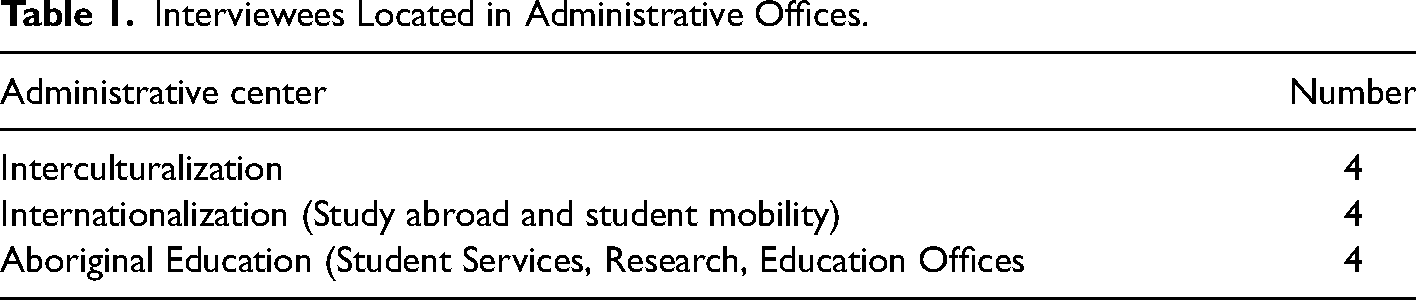
The interview participants were selected from those who do the work and those who influence the work. This purposive sampling technique draws on Mestenhauser's (1998) assertion that in order to understand internationalization, researchers must interface with all of those involved in the work – from influence to implementation. Leaders and operational employees who implemented internationalization, interculturalization, and Indigenization were interviewed on campus. In addition, academic administrators, staff, and faculty who interfaced with these initiatives and movements on campus participated in interviews. Tables 1 and 2 provide an overview of interviewees.
Interviewees Located in Administrative Offices.
Interviews in Academic Units.

In total, 26 interviews were completed (22 in person and 4 via Zoom) over the course of seven months. Interviews with administrative units focused on interculturalization, internationalization, and Indigenization offices. Interviewees were purposefully selected from pools of faculty and staff who had participated in Interculturalization of the Curriculum programming, supported Indigenous students, coursework and teaching, or were experienced in teaching or advising international students. The purposeful selection of the sample was intended to: 1) focus on stakeholders in each of the three initiatives on campus (horizontal sampling) and 2) engage with stakeholders who worked at both operational and leadership levels within these initiatives (vertical sampling).
Qualitative data was analyzed by the first author through an initial process of reading and re-reading transcripts and organizational documents. Then, based on suggestions by Saldaña (2016), codes were created by linking ideas presented in documents and by interviewees. Initial deductive codes of Indigenization, international education, and interculturalization were used to distinguished broad programmatic initiatives, then additional codes were created to describe the way that participants talked about the nuanced activities and direction of the initiatives, thereby providing insights into the imaginaries of these initiatives.
The exercise of data interpretation was an interpretive exercise largely carried out by Heath, in consultation with the Johnstone and research participants themselves. During this process, interpretive conversations were held to improve the credibility of the findings reports (Creswell, 2013) and to ensure the researchers – who were outsiders to the site – were making assertions that were sensical to participants based on their lived experiences at WMU. The use of multiple data sources as well as member checking was used as a broad approach to triangulate data and verify interpretations (Stake, 2005). Special consideration was taken throughout the study to confirm that interpretations about Indigenization aligned with the vision of participants and colleagues who envisioned this movement on campus. Because neither author of this paper identifies as Indigenous, both authors and participants engaged purposefully and reflectively around reporting research findings and review by key stakeholders of preliminary interpretations. While research was done to better understand Indigenization, it was not designed to measure or assess implementation or outcomes. Rather, the authors set out to examine how faculty and staff working in these initiatives understand their work and focusing on the implications for the process and objectives taken up by international and intercultural strategies.
Findings: Three Imaginaries
WMU's three initiatives – internationalization, interculturalization, and Indigenization – all had distinct agendas of change for campus but were all housed together in the strategic priorities of WMU (at the time of this study) under the overarching priority to increase intercultural understanding on campus. The Global Office, the visible arm of the internationalization initiative, used student mobility to increase campus diversity (and revenue streams) primarily through targeted recruitment of international students. A small intercultural team was tasked with increasing intercultural awareness across campus and developing intercultural understanding among and between different stakeholders on campus. Indigenization aimed at re-centering Indigenous ways of knowing in the academy through teaching, learning, language, research, student support and creative practice. How these initiatives interacted is reflected by how the leaders and participants in these movements imagined their roles on campus and is instructive for both higher education leaders and researchers interested in intra-institutional dynamics. Although a Marxian analysis could also be conducted on this case study to identify how sub-units competed for ever-shrinking institutional resources, in the paragraphs below we find that ‘imaginaries’ provided an interesting way to describe the ways in which intellectual influence occurred and institutional values were reified in the daily work of academics and administrators.
Internationalization
While internationalization was imagined institutionally as creating a “globally minded campus” that could foster the global citizenship, this imaginary was not shared by those working on the ground. Internationalization, as conceptualized and imagined by WMU staff and instructors, was focused primarily on the economic stability it provided to the institution through the recruitment of international students. For staff who worked in WMU's global office, the mandate was clear – Canadian higher education funding models were increasingly relying on institutions to self-fund their operations, therefore international student recruitment became a budgetary response. For WMU, fee-paying international students represented an opportunity to ensure a sustainable revenue stream for the larger university. According to WMU's website, international students paid three times as much to attend WMU as did domestic students. Any public subsidy that was available was typically applied to domestic students (Anderson, 2015).
Jennifer, an academic in the English as a Second Language (ESL) department, has been involved in providing ESL courses to international students as well as Teaching English as a Second or other Language (TESOL) certification courses for future teachers. Jennifer explained that provincial funding for operations has gradually decreased “so they [higher education institutions] start to look their own way. Many (institutions) have donors, but we were never in that position because we were a small college.” Amanda, an administrator in the Global Office, further explained that “International students at WMU have been an important component of the university's fiscal plan…for the majority of the history of the institution.”
The fiscally-informed imaginary related to internationalization is generally, often begrudgingly, accepted by the Global Office, the staff dedicated to supporting and retaining international students, and ESL instructors supporting the students. For others outside of the offices driving internationalization, how internationalization is institutionally imagined is worrisome when examining campus-wide support. Alice, an academic, described internationalization as “cynical” and not focused on any sort of meaningful engagement between international students, WMU, or the larger community in which it sits. Instead, Alice framed internationalization as a money-making endeavor.
John, a student services counselor, hypothesized that there is another reason for the fiscal orientation of internationalization at WMU. Beyond the attractive fees that international students paid to the institution, international students represented a population group who could help WMU maintain enrollment minimums in general. He explained: WMU as it sits right now…domestic students have kind of flat-lined for enrollments, so it's neither going up or down, staying pretty consistent. I believe that's right across [the province] as well, whereas international enrollments have gone up and they continue to go up.
The implications of a recruitment-oriented focus on internationalization had ripple effects throughout the university. For example, WMU, like many western hemisphere HEIs, often conflated “international diversity” with students from primarily two countries – India and China. Further, some academics had expressed concern to the changing demographics of their classrooms, which had become skewed toward international students (in some cases, classes had 80–90% international student enrollment). Faculty acknowledged that entirely new pedagogical and curricular approaches were needed.
In response to the neoliberal internationalization imaginary embraced by the Canadian government in its international education policy and taken up by leadership at the university, individuals began to question what the everyday experience for international students was on campus. The Global Office had a large team of advisors to work with international students, often looking towards alumni and candidates who shared the national background of the incoming students. John, the student services counselor mentioned above, delivered workshops for incoming international students, partnering with Global Office international advisors. Lily, an academic, advocated that the Global Office consider transition needs such as identifying adequate housing for international students who sometimes arrive “without a clue” about how to navigate a Canadian city to find a place to live. Jennifer, Jillian and others began exploring professional development opportunities related to “intercultural learning” as a way of creating a stable learning environment at WMU for all students, addressing the biases held by academics and students (see also Lee & Rice, 2007) and a way for everyone at WMU to reflect on their own cultural ways of knowing and communication styles. This focus led to a second initiative on campus – “interculturalization.”
Interculturalization
Interculturalization was a process term used by academics and administrators to describe a series of initiatives on campus. There was not an exact definition of interculturalization in WMU literature, but rather it was used to describe activities focused on building intercultural understanding and sensitivity among WMU community members. Participants acknowledged that interculturalization was a term found in other Canadian universities as well and was used to better capture the global citizenship goal of internationalization. As noted above, the roots of interculturalization at WMU appear to be related to a discomfort with revenue-focused internationalization. Jennifer, an ESL instructor and early supporter of the establishment of an intercultural team, explained this shift: I think to me the internationalization seemed more like a business approach…So my understanding is that it's got to be, it's beyond internationalization. It's not about nations, it's about people and people come from whatever cultural background, regardless of whether they're in their community or there's a specifically strong religious group or whatever it happens to be…So for me, I don't even really use the word international. Faculty have the authority to direct student learning and model the knowledge, behaviors and values of a global perspective. Interculturalization/internationalization of curricula involves infusing Western and non-Western perspectives into courses and offering students learning opportunities that will prepare them as professionals and citizens in an increasingly interconnected world. This may involve adaptations in both pedagogy and curriculum. WMU recognizes this challenge and is committed to supporting and building expertise across the disciplines.
Despite the discursive overlap in some materials, the distinction between interculturalization and internationalization became clear as activities began to develop at WMU. Whereas the Global Office served a critical financial role at the university, its imagined role as a recruitment center and support center for a particular group of students also left the office in a somewhat peripheral role in creating institutional change. For example, although the Global Office was a proponent of intercultural learning, the office that focused on the connection between international efforts and intercultural learning emerged at WMU sat outside the Global Office. An “intercultural team” soon began to play a core role in conducting intercultural training on campus. The “team” – a small group of designated experts, was eventually given space at WMU to directly teach and train students, staff, and faculty about interculturalism, housed within faculty development efforts. The team was small (two full-time staff members and others with a portion of the percentage of employment at the time of this study) in relation to the workload it possessed but were positioned as part of the core activities of the university.
In this way, the interculturalization team re-framed and re-imagined their goals. Rather than focus on recruitment for fiscal sustainability, as the Global Office did, the interculturalization team imagined themselves as connectors on a broadly diverse campus that included, but was not limited to, international student diversity. A broadened conceptualization resonated with advocates who pointed to the diversity of the domestic student body as well as the large population of Indigenous students, troubling a homogenized Canadian student experience on campus.
The rise of interculturalization in terms of institutional authority and notoriety is likely attributable to its imaginary as a large umbrella concept. There is a logical argument that any difference on campus that threatens social cohesion could be the result of an intercultural misunderstanding and with the rapidly increasing number of international students on campus, misunderstandings were not uncommon. The logic of interculturalization was bolstered by central training efforts and its positioning as central to both internationalization and Indigenization.
Not all stakeholders at WMU, however, were driven by a desire to fit under a large and purportedly welcoming umbrella. In the following section, a third initiative – Indigenization – is described. In this section we investigate how an initiative driven by sovereignty and reclamation, rather than institutional integration, existed both within and outside of the dimensions of interculturalization's large umbrella imaginary while also introducing system reforms on its own terms.
Indigenization
A third initiative being newly undertaken at the time of research was Indigenization. As a strategic priority, Indigenization is described as “the inclusion of traditional and contemporary Aboriginal teaching, learning, knowledge, research and creative process” on the WMU campus. The Indigenous WMU website describes the initiative as a series of activities “created for WMU to come together and create a campus that is welcoming to all, especially Indigenous students and staff.”
The launch of Indigenization has roots in Canada's Truth and Reconciliation process – which was a national effort designed to interrogate and reflect on the nation's residential schools, which closed as recently as the 1990s, and ongoing colonial violence. The process of Indigenization at WMU was both driven by a central unit and decentralized scholars and students, each with their own take on what Indigenization meant to the campus. For James, an administrator in the Office of Indigenous Education, it was about institutionalizing Indigenous knowledge so that all WMU students can benefit. He reflected on a scaffolded approach and an expansive objective: It's also the key point of this story, is that the institution has prioritized it and I see that as a difference. So, once you get that commitment, then you can make an impact with the instructors and then it goes down to the learning groups, because it's the Indigenous learners you want to impact, and you want to have Indigenous knowledge at your institution. And once you established that, it's amazing what happens too, is that the non-Indigenous learners benefit, because you have Elders in the classroom, because you have Indigenous knowledge in the curriculum, because you do this in an Indigenous respectful way, you honor your Indigenous learners and your non-Indigenous learners.
My own sort of understanding of Indigenization is that it means we retain some hope in the institution. Decolonization means we’re done. Let's start again. I think Indigenization is about making the university welcoming. It's about that pluriversity idea, right? Not talking about one set of ideas, we’re talking about numerous. It's about recognizing the university as a pluriversity as opposed to university.
Further interviews around campus revealed that Indigenization itself appeared to a pluralism imaginary. For some, it meant curricular change and integration of Indigenous knowledge into existing structures. For others, it was a way to transform institutional space into a complex imaginary in which multiple ways of knowing were cultivated independently and interdependently at any given time. The latter understanding challenged the typical practice of identifying institutional strategies and outcomes. This plural understanding was at times a challenge to administrators in other offices who had more defined objectives as they sought to align their work. Jillian, a member of the intercultural learning team, explained that It's just that it's a little bit confusing I think who's doing, like what Indigenization means because to some people it means supporting Indigenous students, to others it means decolonizing practice, to others it means Indigenizing the university policies and processes. And for others it's really about land sovereignty and political rights. So, there's almost like a continuum, and I don’t think that's unique to this campus, I think that's what this country is going through right now.
Jillian's comments highlighted a tension between campus imaginaries of other initiatives on campus that had clear administrative structures and operational goals, and Indigenization, which was primarily focused on supporting Indigenous students through a variety of initiatives. That Indigenization advocates worked across many offices and both on campus and off was in and of itself an act of decentering the Eurocentric organizing structure present at WMU, similar to the way in which Pidgeon (2016) envisioned Indigenization as a process that moved beyond checklists of suggested activities into a more holistic movement for education itself.
The case of Indigenization at WMU represents one of three simultaneous initiatives at WMU that had points of contact and separation with one another over the course of the academic year and between relevant stakeholders (including administrators, faculty, and students). In the following section, we review the ways in which these initiatives and their respective imaginaries operated in the context of one another.
Discussion
Institutionally, the three initiatives were imagined by institutional leadership as being interconnected in a commonly perceived goal – supporting deeper intercultural understanding on-campus. This understanding was positioned as bringing together the diverse communities found on campus, highlighting both global and Indigenous communities. Staff and faculty working on the ground, however, described different imaginaries for each strategy, identifying tensions in the current organization of the institution as well as concerns in the institution's vision of interconnected and intertwined outcomes.
The imaginary of interculturalization was rooted in its origin as an effort to bridge the gap between the realities of an internationalization strategy that brought large numbers of international students and what to do when they arrived on campus. An increased intercultural understanding did not suddenly occur because of the international students’ presence; deeper understanding came from targeted learning opportunities for all members of the campus community. The focus on intercultural understanding brought attention to the diversity of international students, the need for pedagogical changes in the classroom, and more intentional engagement with international students and their needs. These efforts were taken up with the prospect of creating a more inclusive university where international students might be better served. Focusing on intercultural learning was not a reform of internationalization but rather a way in which to shift the imaginary of internationalization from one supporting and indeed, furthering, Canada's economic agenda to one that centered international students and their cultural experiences. These efforts did not inherently change the design of internationalization nor its motivations, however. Staff reflected a resignation that the financial realities of higher education necessitated recruiting large numbers of international students. The imaginaries of internationalization as an economic engine and opportunity for global understanding existed simultaneously for many staff and faculty, but the bottom economic line always appeared to drive conversations on campus.
Interculturalization thus became the strategic goal furthering intercultural understanding and its small team were able to make inroads in deepening international learning in ways that the internationalization could not, but the two became increasingly coupled together. Interculturalization, as noted, was used as a reference point in advancing WMU's public positioning as a global university. Similar to the quote describing curricular innovation that was found on the Global Office's website, intercultural initiatives such as integrating global mindedness into academic departments were now found in university-wide documents, and the two terms were at times used interchangeably, further blurring the strategies.
Indigenization's relationship to interculturalization revealed a fundamental challenge to WMU's strategic goal of positioning interculturality as a frame for all campus activity. Interculturalization had been closely tied to the increase of international students and the experiences they encountered when on campus and development opportunities for faculty, staff, and students to deepen their understanding of difference. This relationship made it difficult at times to uncouple the intercultural and international terms from each other. With internationalization as a strategy so tightly bound to the financial solvency of WMU, there were concerns about the purpose of an interculturalization effort being applied to an Indigenization effort. For many, Indigenization was a movement born out of sovereignty narratives. It signaled a potential ontological shift of the institution, moving beyond what might be perceived as a surface level of understanding or integration of Indigenous students into the university and challenging the structure of the institution itself. Indeed, Grosfoguel (2012) warned a decade ago that purported decolonial and multicultural reforms that were driven by Western epistemic traditions would do little to disrupt colonial legacies, and may amount to neocolonization. Santos (2016) critiqued such reform efforts as “weak” answers for “strong” questions (2016).
Staff and faculty across the campus shared the concerns of potential erasure by Indigenization's placement under the umbrella of the interculturalization strategy of the campus. Bill, an administrator in support services for Indigenous students, shared “putting them all together in one, one single thing…could be dangerous,” noting that Indigenization's tie to place and its support by the federal government, adding legitimacy and setting it apart from institutional strategies. Those working in interculturalization discussed this complexity, acknowledging some intersections between the two but emphasizing the separation between the two strategies.
This concern was particularly acute in the Canadian context due to the legislated efforts of multiculturalism in the 1970s. Ostensibly created to bring together Canadians, multiculturalism was (and is) critiqued for its erasure of First Nations and Metis peoples and their concerns and experiences. For some at WMU, interculturalization was seen potentially as the next iteration of multiculturalism and another effort towards erasure. If Indigenization was a movement based on connecting to Indigenous knowledge and place-based philosophy, then it needed to ground other strategic initiatives. Bill in Aboriginal Student Services noted, “We need to make sure that…if we’re going to go down the road of interculturalization or internationalization, that you need to first look at, you know, Indigenization. That's a good place to start.”
Higher education and its strategic frameworks like interculturalization were at odds with the complexity of Indigenization and its varied motivations and outcomes. The imaginary of Indigenization might vary, as noted, from decolonization, to pluralism, to reconciliation, complicating potential partnerships with interculturalization and internationalization efforts. For instance, some staff and faculty noted that some international students may identify as Indigenous in their home country or had experiences with colonization in their home. However, in the context of Canada, international students were tightly bound to the nation state, holding passports and student visas that strictly defined how they could live within the country. The offices working with student populations were separated by both space and practice with little opportunity on finding strategic connection points. Simultaneously, the identities of the students blurred the lines of the offices, encouraging staff and faculty to find ways in which to serve students.
Those working in staff positions for Indigenization initiatives communicated little overlap with WMU's internationalization plan regarding the stated global citizenship imaginary or the economic imaginary. Rather, Indigenization staffers saw a more practical or educational intersection between internationalization and Indigenization efforts. In Canada, where international education often shows up in student mobility and high numbers incoming international students, there were efforts to more intentionally orient international students to the First Nations and Metis of Canada, the history of colonial Canada and protocol for visiting a new place. As noted by Bill, (Experience with) internationalization (has occurred) for, for many, many years…we’ve shared borders with a number of different Indigenous peoples. We’ve had to deal with each other for a long time, so, you know, when we travel and we’re in a different country for us, a different place…we have to acknowledge that we’re on traditional territory that's not ours.
Finally, despite their divergent ontologies and imaginaries, Indigenization and internationalization staff found a point of connection in relation to international partnerships and study abroad opportunities for students. These partnerships and opportunities were developed to created affinities among other Indigenous groups in the United States and New Zealand/Aotearoa. In this case, the aims of international mobility and the study of Indigenous identity on a global scale aligned, allowing for greater synergy between the two initiatives.
Conclusion
The divergences and occasional convergences of the three initiatives at WMU were unique to this institutional setting but may be similar to those experienced in other institutions.
Internationalization's economic imaginaries have been long identified in North American universities (see, for example, Seeber et al., 2016). Interculturalization's tendency of framing all interactions as intercultural – without consideration for power, history, or the hegemonic othering that may occur with such framing (Tervalon & Murray-Garcia, 1998) is also a likely scenario in many North American institutions. Finally, pluriversal imaginaries are increasingly part of the critical study of higher education (Santos, 2017), as those within and outside the academy question its purpose and whose knowledge is considered expert. Indigenization efforts at universities will necessarily vary depending on whose land the institution sits and that community's priorities. Commitments to the strategic prioritization of Indigenization can vary from inclusion to institutional transformation (Gaudry & Loren, 2018), but also may represent weak answers to strong questions (Santos, 2016) that do little more than to frame Indigenous initiatives in existing (western, white) epistemologies (Grosfoguel, 2012).
The imaginaries alone tell a story about institutional operations and how initiatives engage with one another. The broader story of this case study, however, is the utility of conceptualizing “imaginaries” for intra-institutional case studies. Although higher education itself has been imagined in a variety of ways (Andreotti et al., 2016), this study demonstrates that initiatives themselves within institutions may have their own imaginaries, which are explanatory to both scholars and practitioners seeking to understand how initiatives may find spaces of co-existence and resistance within the same institutional space.
This article provided fresh examples of how imaginaries are at work and may be central to the reform work occurring in institutions (and the reformers doing the work). The perspectives shared in this case study of WMU demonstrate that reform is often framed in the mind of the reformer, and that the change sought by some units may not be desired (or may be actively resisted) by other units. In this case, imaginaries aligned with reform activity. Often these reforms occurred in isolation of one another, but when reform movements intersected, reflections on power, place, and purpose were deemed to be important at WMU by all stakeholders. The scope of the WMU case study was necessarily narrow (it was an intentional case study aimed at gathering in-depth information of a bounded site). At the same time, it may provide insights for other scholars seeking to understand higher education reform in other contexts.
Neoliberal economic influences, for example, are likely to be present many higher educational settings worldwide. Ideas of universalism and pluralism are also likely at work in the imaginaries of reformers. The WMU example demonstrates that not every higher education actor wants to be neatly integrated into universalist models (especially in this case, in which Indigenous actors were suspicious of the epistemological roots of interculturality). In future research on higher education reform phenomena, the conceptual lens of imaginaries may help scholars and practitioners make sense of the ways in which reform, renewal, or revolution occur in higher education settings.
Footnotes
Funding
The author(s) received no financial support for the research, authorship, and/or publication of this article.
