




Abstract
Music education researchers have sought to clarify two fundamental issues. The first concerns ‘the extent to which musical progress is sequenced and orderly, and why some children’s progress appears to be effortless in contrast to others who struggle’ (McPherson, 2005, p. 5). The second concerns how successful learners are able to acquire the resilience needed to ‘bounce back’ despite stresses and distractions which impact on motivation and a desire to continue learning (West & Rostvall, 2003; Costa-Giomi, Flowers, & Sasaki, 2005). This article aims to contribute to research on these issues in the context of instrumental music lessons, by presenting a dynamic model linking skills acquisition (from the perspective of scaffolding theory) and self-determination theory. We argue that musical development is a transactional, dynamic process in which the scaffolding of the music student’s skills and self-determination are deeply intertwined. Within this conception, teacher-student interactions are conceptualized at the micro- and macro-level time scales, and are viewed as mutually connected. We conclude by discussing the ways in which this model can guide future research.
Introduction
Learning to play a musical instrument requires the acquisition of a complex set of motor, sensory and cognitive skills (Lehmann, Sloboda, & Woody, 2007, p. 5) which for skilled performers typically takes years to develop. A key ingredient in the development of this complex array of skills is the quality and type of music lessons learners are exposed to, in addition to the motivation they develop or fail to develop as a result of interactions with their teacher. For this reason, music education researchers have sought to clarify two fundamental issues. The first concerns ‘the extent to which musical progress is sequenced and orderly, and why some children’s progress appears to be effortless in contrast to others who struggle’ (McPherson, 2005, p. 5). The second concerns how successful learners are able to acquire the resilience needed to ‘bounce back’ despite stresses and distractions which impact on motivation and a desire to continue learning (West & Rostvall, 2003; Costa-Giomi, Flowers, & Sasaki, 2005; McPherson, Davidson, & Faulkner, 2012).
The purpose of this article is to present a model that integrates the existing literature on skill acquisition and motivation in (music) education research. By integrating the theoretical frameworks of scaffolding and self-determination theory we will frame the above two issues in ways that we believe will lead to more focused future research. Our focus takes the interaction between music teacher and student as a primary unit of analysis in order to understand the processes that emerge during a music lesson. We assert also that understanding more about how these interactional processes unfold in real-time (an approach that is, as we will argue, relatively rare in empirical research in music education) provides a means for more meaningfully understanding the mechanisms that underpin skill acquisition and self-determination. This knowledge about intra-individual change (‘how’ questions) is a first step to answering ‘why’ questions (e.g. why some students progress much faster than others), which often deal with inter-individual differences.
First, we will review literature on teacher-student interactions in music education from the perspective of scaffolding and mutual causation. Second, we will discuss motivation for music learning from the perspective of self-determination theory (SDT) so that we can show how scaffolding and self-determination are intertwined in real-time teacher-student interactions. Third, we will emphasize the coupling of real-time and long-term timescales, after which we will present a conceptual model (Figure 3) that incorporates all relevant aspects. We conclude by providing directions for future research.
Socially mediated learning through scaffolding
Socially mediated learning is an important feature of childhood (Vygotsky, 1978). From infancy onwards, children are ‘problem solvers’ in their own way (Bruner, 1973), but also surrounded by others who can help them master new skills.
As exemplified in the following vignette, the individual music lesson is one important context where the set of skills needed to play a musical instrument is acquired through social mediation.
Anna has been taking violin lessons for about a year. She is studying a piece with a recurring rhythm, consisting of alternating long and short notes. Anna tends to use the entire length of the bow for each note, causing her to play the faster notes too slow. The teacher says: ‘I’ll show you the difference between the long and the short bow. Let’s see if you can do that.’ She demonstrates the two first bars of the piece. When Anna tries to play the same two bars, all bows are still very long. The teacher then tries something else: ‘I’m going to try to make the short bow as small as your teeth.’ The teacher again plays the first two bars, but now also says while she is playing: ‘these are long’ and ‘these are short’. After this demonstration, Anna is capable of playing the first two bars with alternating bow length. The teacher adjusts to this new level of mastery by playing the whole piece together with Anna.
The above example (taken from Küpers, van Dijk, & van Geert, in press) demonstrates how interactions between teacher and student can facilitate musical learning. At each stage, an effective teacher will continually assess what level his or her student is at, in order to decide on the next most logical task to improve or elevate a young player’s performance.
These types of learning processes can be studied from the framework of Vygotsky’s (1978) zone of proximal development, defined as the difference between what a child can do by him or herself as compared to what that child can do with the help of an adult or a more knowledgeable peer. Within this sociocultural theory, learning is seen to take place on a social (inter-mental) level before it takes place on an individual (intra-mental) level (Stone, 1998). Vygotsky’s view has been extended by various lines of research, some of the most important of which have focused on instructional scaffolding, a form of teaching where a teacher seeks to promote deeper learning by providing support during the learning process that is tailored to the learner’s individual needs (Granott, Fischer, & Parzialle, 2002). Scaffolding is seen as an important and efficient form for organizing teacher-student interactions (Bruner, 1975; Wood et al., 1976). The mere completion of a specific task is not the most important aspect of scaffolding. Instead, successful scaffolding implies that the child acquires a better understanding of what is needed to complete the task, so that in the future the same level can be accomplished with less direct involvement from the adult. The learner is seen as an active participant in his or her own learning process (Stone, 1998). As such, the concept of scaffolding is related to notions of self-regulated learning which demonstrates how teachers socialize their students so that they are able to take more control over their learning (Zimmerman & Moylan, 2009).
Based on their review of recent studies on the topic of scaffolding, van de Pol, Volman and Beishuizen (2010) discerned three major characteristics of scaffolding: contingency, fading and the transfer of responsibility (see Figure 1).
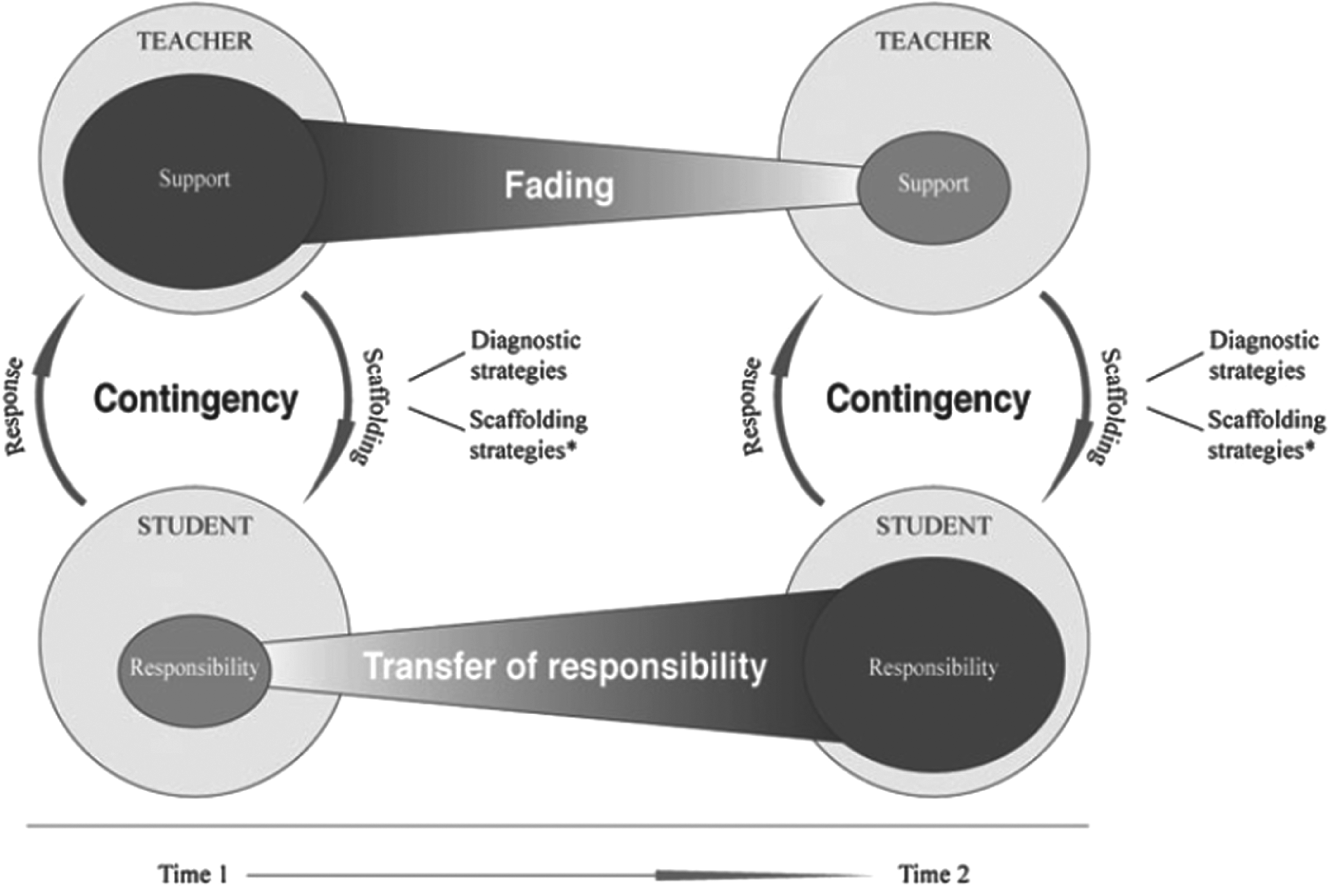
Conceptual model of scaffolding (van de Pol, Volman, & Beishuizen, 2010, p. 4).
The first core characteristic of scaffolding is contingency. Contingency implies that the level of support that is provided by the teacher should be adapted to the level of the student at any point in time (van de Pol, Volman, & Beishuizen, 2009, 2010; Lajoie, 2005). This is a crucial aspect of scaffolding because it infers that scaffolding is not an aspect of teaching that can be planned in advance, but instead unfolds in the lesson itself because it is dependent on the student’s level and behavior. Van Geert and Steenbeek (2005) define the aspect of contingency more specifically in terms of mutual adaptivity of teacher and student levels (levels of skills or knowledge). These authors state that there should be an optimal distance between the level of the teacher and that of the student. If the distance is too small, the student will not learn anything new, but if the distance is too large, the student might not be able to grasp the concept. The optimal distance is not set but can vary within a range and is also likely to vary for different teacher–student dyads. To maintain this optimal distance, the change in the student’s performance level must be accompanied by a change in the teacher’s support level and vice versa. In other words, contingent scaffolding implies a connection between change in the student’s level and change in the teacher’s level, which is necessary to maintain an optimal distance between the two (van Geert & Steenbeek, 2005).
The second characteristic of scaffolding is fading, which is the gradual decrease of support over time (Pea, 2004). Importantly, the rate at which fading occurs should depend on the student’s development (van de Pol, Volman, & Beishuizen, 2010; van Geert & Steenbeek, 2005). For instance, when a student is learning a new piece, the teacher might start out by modeling and providing hints while the student performs the piece for the first time. As the student progresses, the teacher provides less support.
The third characteristic involves transfer of responsibility. As a result of contingent fading, the responsibility for learning is eventually transferred back to the student. Transfer of responsibility implies that scaffolding should result in autonomous competence (Reigosa & Jiménez-Aleixandre, 2007). An example of autonomous competence would be playing a rehearsed piece at a concert. This aspect of scaffolding is fundamental in meeting the student’s needs for autonomy, as we will discuss in the third section of this paper.
To the three aspects discerned by van de Pol et al. (2010) we add a fourth dimension that is related to the cyclical nature of the scaffolding process. The skills needed to master a musical instrument become sub-goals in the learning process. For instance, when a student is learning to play the violin, some basic sub-goals are a relaxed bow hold and making contact between the bow and the string. In the early stages of learning to play an instrument, these goals are usually addressed separately. When one sub-goal is accomplished through scaffolding, the teacher will reset the challenge by introducing a new sub-goal that is within the student’s zone of proximal development. For this new sub-goal, the whole process of scaffolding starts again.
Scaffolding and the notion of mutual causality (see level 1 in Figure 3)
Contingency is a central notion within the concept of scaffolding. It implies that what the teacher does at a particular moment in time (in terms of scaffolding) is dependent on what the student has achieved immediately prior to that moment (van Geert & Steenbeek, 2005). For example, certain behaviors lead a teacher to diagnose that the student masters some aspects of the task (such as playing the correct notes), but not others (such as adding dynamics to the piece). In turn, these scaffolding actions of the teacher have an effect on what the student is able to do in the moments that follow (hopefully, being able to master more aspects of that same task). In short, teacher and student are constantly influencing each other over time. These processes are iterative in nature; the current state of scaffolding influences the state of scaffolding at the next point in time, and so on. These processes of iterative mutual causality take place in many other contexts (for instance, in parent-child interactions; see Lunkenheimer, Olson, Hollenstein, Sameroff, & Winter, 2011; van Dijk, Hunnius, & van Geert, 2009, or in play interactions between children; see Steenbeek & van Geert, 2006, 2008) and fit with the notion of human development as being a bidirectional, dynamic and complex process (Sameroff & Chandler, 1975; Thelen & Smith, 1994; van Geert, 1994).
The emphasis on the importance of mutual causality as the ‘motor’ behind developmental change has gained increasing recognition in the past three decades. The predominant theoretical model in developmental psychology, however, is still the interactionist model (Sameroff, 2009). Such interactionist models typically state that the relation between an inborn characteristic and a developmental outcome is in some way mediated or moderated by an environmental characteristic. Sameroff (2009) argues that the problem with the interactionist model is that child and environmental variables are defined as static entities, whereas in reality they are dynamic. He contrasts this with the transactional view of development (see Figure 2). Within this conception, the development of the child is a product of the continuous dynamic, iterative interactions between the child and his environment. The core of the model is the emphasis that is placed on the bidirectional and interdependent nature of these interactions (Fogel, 2009; Sameroff, 2009). That is, both the child and the environment qualitatively change through the transactions between them.
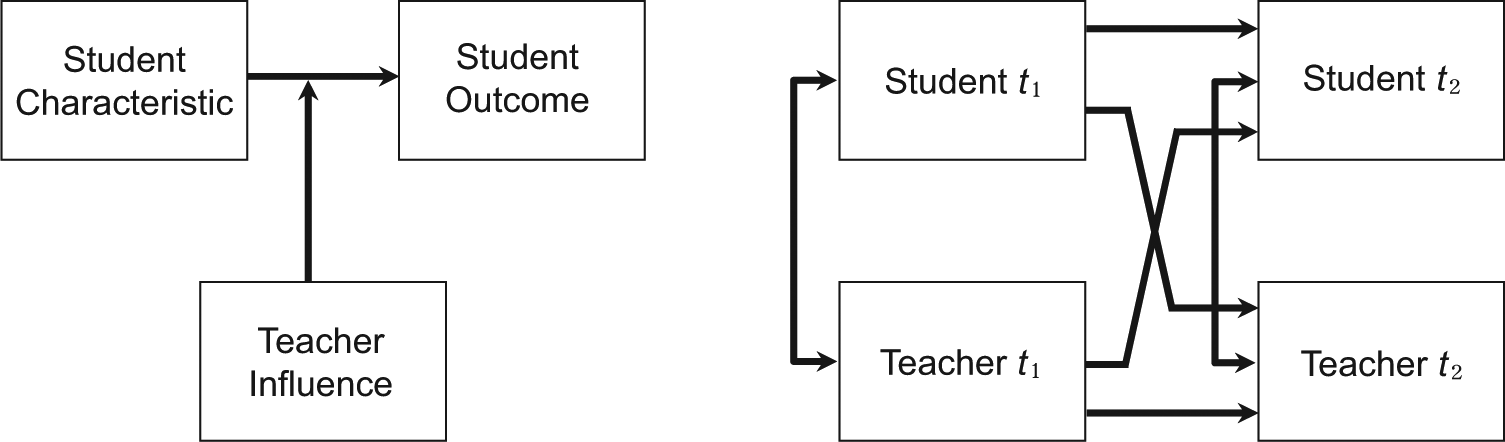
An interactionist versus a dynamic, transactional model.
To summarize, scaffolding is an intrinsically dynamic notion which occurs through repeated transactions between music teacher and student. In order for scaffolding to be effective, these transactions need to be contingent. Over time, a transfer of responsibility occurs as the teacher fades out the level of support according to the student’s progress in ways that enable the learner to function more independently. This process is repeated for each next sub-goal. Because the interaction between teacher and student is the core of individual music lessons, a dynamic model of scaffolding provides an important key to understanding how musical learning occurs in this context.
Research on scaffolding
Stone (1998, p. 349) argues that research on scaffolding has operationalized scaffolding too much in terms of ‘what structure is provided by the teacher’ instead of taking the dynamic aspect of the original scaffolding definition (Wood, Bruner, & Ross, 1976) into account. In more recent studies, which often take place in the context of a primary or secondary education setting, more emphasis is placed on the original core characteristics of scaffolding, especially contingency. Studies on scaffolding are often descriptive in nature and use small samples or case studies (van de Pol, Volman, & Beishuizen, 2010). To date, the literature has resulted in a greater understanding of what types of scaffolding behavior often occur (the most recurrent are giving hints, instructing, giving feedback, explaining, modeling and questioning) (Wood et al., 1976; Tharp & Gallimore, 1988, cited in van de Pol, Volman, & Beishuizen, 2010). These concepts are linked to either contingency (Salonen, Lepola, & Vauras, 2007; van de Pol et al., 2009), fading and/or transfer of responsibility (Aukerman, 2007; Maloch, 2002).
The empirical work illustrates that there is much variability in the form and extent to which contingent scaffolding is actually occurring in different settings (van de Pol et al., 2010). This is particularly relevant since adaptive scaffolding is positively related to learning outcomes (Mercer, Dawes, Wegerif, & Sams, 2004). For instance, Maloch (2002) studied scaffolding in literature discussion groups and found that the teacher was actively involved in transferring the responsibility for learning to the student. Other research shows that the actual practice in classrooms differs markedly from the theoretical model. For instance, when examining differences in patterns of contingent scaffolding among teachers in prevocational schools, it was found that the teachers generally showed little contingent teaching (van de Pol, Volman, & Beishuizen, 2009). Meyer and Turner (2002) discriminated between different types of scaffolding (the scaffolding of understanding, but also of autonomy and motivation) and found that there were substantial differences between teachers in the ways their scaffolding interactions were either supportive or non-supportive.
Scaffolding in music education
The term scaffolding is rarely mentioned in the literature on music education despite a growing body of research focusing on teacher (instructional) and student behavior during instrumental lessons (Colprit, 2000; Duke & Henninger, 2002; Duke, 1999). Although these studies provide us with relevant information on what behaviors might be relevant for scaffolding in this context, the time-serial structure of the teacher-student transactions is often neglected, as well as the more long-term changes in the student-teacher relationship. Rather, teacher and student behaviors are seen as separate factors that are correlated at the group level. For instance, Siebenaler (1997) reports that teachers who were relatively active during their individual piano lessons scored higher on ratings of effective teaching compared to less active teachers, with their students performing better during the lesson.
Duke (1999) related observed teacher instruction to student characteristics and reports that students who are – according to their teachers – easy learners tend to receive more directive instruction from their teachers. Furthermore, teachers who were more experienced tended to give their students more feedback in general and more positive feedback in particular (Duke, 1999).
Only a few studies have addressed patterns of teacher and student behavior over time. Yarbrough and Price (1992) analyzed sequential patterns in music teachers’ instruction. Their study was based on the model of directive instruction (Rosenshine, 1976), consisting of a) getting the student’s attention; b) presenting the task and allowing for the student’s response, and c) giving feedback. Both in general educational settings (Brophy, 1979; Rosenshine, 1976) as well as in music lessons (Yarbrough & Price, 1989, 1992), teachers who engaged in these sequences typically had students who were (on average) better achieving. However, the majority of real-time instruction patterns in music lessons did not match their proposed model, with the behavior of the more experienced teachers deviating most from the expectations. Although Yarbrough and Price examined instruction patterns over time, they only focused on patterns in teacher behavior to predict student outcomes, thereby neglecting how teachers might adapt their instruction to what the student is doing (see Level 1 in Figure 3). Another example of a study that examined patterns of teacher-student transactions over time is that of West and Rostvall (2003). These researchers report on teachers in individual instrumental lessons who dominated the interaction and who leave little room for students’ initiatives. Consequently, lessons mainly focused on reading and playing notes from sheet music, rather than addressing expression or musical phrasing.

A dynamic model that links skill acquisition with self-determination.
What does the current research on teacher-student interactions in music education tell us about scaffolding? Most studies provide valuable insight concerning what teacher and student characteristics are associated with certain (student) outcomes, but adopt a static rather than a dynamic approach. For instance, the studies of Duke (1999), Colprit (2000) and Siebenaler (1997) use extensive coding systems that are able to capture student and teacher behaviors that could be important in scaffolding (e.g. the types of instructions that music teachers generally use). What is still missing, however, are detailed empirical descriptions of how teacher-student transactions influence each other, and whether these patterns over time contribute to certain kinds of learning and motivational outcomes. As mentioned in the Introduction, knowledge of how processes unfold within the lesson and over longer periods over time (that is, knowledge of intra-individual change) is necessary to answer ‘why’ questions that often encompass inter-individual differences (e.g. why do some students remain motivated and others drop out?). Taking the dynamic concept of scaffolding as a framework for studying teacher-student interactions in music lessons allows us to distinguish between a range of optimal and less optimal scaffolding patterns. This distinction would be a first step towards explaining different learning outcomes (as has been illustrated in special education settings by Steenbeek, Jansen, & van Geert, 2012).
Self-determination and motivation
Self-determination as a socially embedded process (see level 2 in Figure 3)
As proposed in the Introduction of this article, one of the main issues for music education concerns how and in what ways some children remain motivated for an extended period of time, while others become less motivated and eventually cease learning (Costa-Giomi et al., 2005; McPherson, Davidson, & Faulkner, 2012; West & Rostvall, 2003). The developmental model of interest – a concept closely related to motivation (see Hidi & Renninger, 2006; Lipstein & Renninger, 2007) – demonstrates how interest within a certain domain develops from being mainly situationally triggered to becoming a more or less stable individual characteristic. This process shows strong resemblance to the dynamic model of scaffolding, in the sense that interest grows from being mainly other-regulated to mainly self-regulated.
In research on learning and teaching in school contexts, self-determination theory (Deci & Ryan, 1985, 2008; Deci, Vallerand, Pelletier, & Ryan, 1991) has played an important role in understanding the dynamics of motivation. This theory differentiates between intrinsic and extrinsic forms of motivation (Ryan & Deci, 2000). When people are intrinsically motivated, they engage in activities that interest them for their own sake. Extrinsic motivation, on the other hand, is motivation that is controlled by external conditions. Extrinsic and intrinsic motivation are not necessarily distinct categories but rather opposites on a continuum. The types of motivation along this continuum differ in the extent to which they are self-determined or controlled. When behavior is self-determined, the person perceives the locus of control as internal to his or herself, whereas in the case of controlled behavior the perceived locus of control is external. Self-determination theory further explains that every human being has three basic psychological needs (Deci et al., 1991). The first is the need to feel competent, the feeling that you can achieve the things you want to achieve and that you know how to get there. The second is the need for relatedness, which is the need to develop secure and meaningful relationships with the people around you. The third is autonomy, or the need to be able to take initiatives and to self-regulate.
Developmental psychologists consider the movement toward greater autonomy and self-initiation to be a hallmark of healthy development according to Ryan, Deci and Grolnick (1995). These authors believe that ‘the need for autonomy is essential for explaining this developmental thrust of regulations from external to self-determined’ (p. 620). Accordingly, successful internalization and integration can be understood as being energized by and allowing satisfaction of the needs for autonomy, competence and relatedness (p. 620). Self-determination is also especially relevant in the context of musical learning. According to McPherson and Zimmerman (2011; see also McPherson, 2012), learning to play an instrument may require more self-regulation and intrinsic motivation than learning in other domains, especially in the early stages when there are many difficulties to overcome and children experience failure next to success.
Self-determination and self-regulation are both dynamic and socially embedded processes (Meyer & Turner, 2002; Steenbeek & van Geert, in press; Turner, 2006). During music lessons, not only students but also teachers are driven by their concerns and psychological needs as well as by their beliefs about what makes them efficient teachers Therefore, the fulfillment of psychological needs is regulated between teacher and student (Steenbeek & van Geert, in press). Meyer and Turner (2002) argue that during instructional scaffolding the teacher can support student self-regulation in three ways: a) by helping the students build competence through increased understanding; b) by engaging the students in learning while attending to their socio-emotional needs; and c) by helping students build and exercise autonomy as learners (Meyer & Turner, 2002). In other words, the ability to self-regulate can be actively promoted by contingent scaffolding and is deeply intertwined with the regulation of the student’s (and teacher’s) psychological needs. In this sense, the scaffolding of specific skills (necessary for learning a musical instrument) cannot be considered separately from the ‘scaffolding’ of self-determination.
Self-determination in music lessons
Autonomy
Research in music educational settings demonstrates the importance of fostering the student’s need for autonomy in learning music. As the study of West and Rostvall (2003) has demonstrated, the support of student autonomy in instrumental music lessons is far from self-evident. For instance, teachers can be highly disapproving of students’ initiatives. In the long run, this mismatch between the needs and behavior of the student and those of the teacher might contribute to non-desirable outcomes such as early drop-out. Anguiano (2006) found that the students’ perception of their teachers’ autonomy support was positively associated with the students’ perception of their own autonomy. In turn, this predicted the students’ motivation to continue their music lessons. Similarly, it was found that instrumental students reported a higher level of fulfillment of their psychological needs when they were highly engaged in music learning, compared to when they decided to cease playing (Evans, McPherson, & Davidson, 2012).
Research in other educational settings also shows the importance of fostering the need for autonomy in students. Teachers can support students’ autonomy by displaying certain behaviors, such as asking what the student wants, providing a rationale, responding to student questions, and giving positive feedback. However, teachers can also undermine student autonomy by uttering directives, asking controlling questions, and criticizing the student (Reeve, Jang, Carrell, Jeon, & Barch, 2004; Reeve & Jang, 2006). As with intrinsic and extrinsic motivation, it is important to note that autonomy supportive and controlling teaching styles are not distinct categories but rather opposites on a continuum (Deci, Schwartz, Sheinman, & Ryan, 1981).
Reeve et al. (2004) examined the effect that autonomy supportive behavior by teachers has on the engagement of students. They found that when the teacher was autonomy supportive at one moment in time, their students displayed higher levels of engagement at the next moment. Other studies (Sierens, Vansteenkiste, Goossens, Soenens, & Dochy, 2009) show that, on average, students with autonomy supportive teachers who also provide sufficient structure tend to display higher levels of engagement.
A central assumption of these studies is that the teacher is the primary locus of control regarding the student’s autonomy. It is the teacher who either promotes or hinders student autonomy. As such, these studies do not address the students’ influence on the autonomy supportive actions of their teachers.
Competence
Because of the central role competence beliefs play in students’ intrinsic motivation, these beliefs are an important topic in music education research. For example, studies dealing with self-efficacy – defined as ‘the conviction that one can successfully execute the behavior required to produce the [desired] outcome’ (Bandura in McPherson & McCormick, 2006, pp. 323) – show that perceptions of self-efficacy are an important predictor of musical achievement (McCormick & McPherson, 2003; McPherson & McCormick, 2006).
In a study by O’Neill and Sloboda (1997), children participated in a musical test measuring their pitch perception. After experiencing failure on the test, some of the children reported a decrease in their self-confidence, while others reported no decline. The children with a decreased sense of competence were more likely to take on maladaptive performance strategies on the subsequent test, while the other children adopted a more adaptive ‘mastery’ strategy. These coping styles also seem to make an impact long term. Beginning music students who have maladaptive performance strategies made less progress in the first year of learning their instrument compared to students who adopt more adaptive performance strategies (O’Neill & Sloboda, 1997). Costa-Giomi, Flowers and Sasaki (2005) found that students who dropped out of piano lessons in the first three years were, in comparison to students who persevered, less able to accomplish the goals that teachers set during the lessons. Although the authors did not evaluate the students’ beliefs in terms of self-determination theory, it could very well be that the students experienced diminished feelings of competence, resulting eventually in drop-out. In terms of our understanding of contingent scaffolding, such findings also demonstrate the importance for teachers to adapt the level of the goals they set for their students to the current performance level of the student.
Relatedness
Since music lessons are largely voluntary, one of the main indicators of motivation in music is whether students continue to take lessons. Costa-Giomi, Flowers and Sasaki (2005) show that students who ceased instruction, compared to those who persevered, tended to seek more approval from their teachers during the lesson but actually received less teacher approval. These findings demonstrate an existing mismatch between the student’s need for relatedness and the relatedness support that the teacher provides. If these patterns repeat over time, it could lead to diminished intrinsic motivation and decisions to cease taking music lessons. Creech and Hallam (2010a, 2010b) found that, in the context of individual string lessons, the quality of the teacher-student relationship predicted various (musical) outcomes for both teachers and students. For instance, student-teacher accord (encompassing the qualities of warmth, understanding patience and mutual respect) predicted student enjoyment, satisfaction, motivation and self-esteem (Creech & Hallam, 2010a).
Home practice and self-regulation
When a child is taking music lessons, an important part of the learning process is practicing at home (Hallam, 1998). A child therefore needs to be able to work on the goals that were addressed in the lesson independently of the teacher. The theoretical framework of self-regulated learning is an effective means for defining the quality of home practice (McPherson & Zimmernan, 2011). A defining feature of self-regulated learning theories is a personal feedback loop (Zimmerman & Moylan, 2009). The feedback loops of students typically consist of three phases. The first phase is the forethought phase. This phase precedes the actual efforts to learn and involves the processes necessary for preparing to execute a task. The forethought phase depends on sources of self-motivation, such as self-efficacy beliefs and the extent to which a student is sufficiently intrinsically motivated to be engaged in executing the task. The performance phase, in which the student actually executes the task, involves two major categories: student’s self-control and self-observation. The third phase is the self-reflection phase and consists of self-judgment and cognitive and affective self-reactions (Zimmerman & Moylan, 2009). The outcome of the third phase is then followed by a next forethought phase, and so on (see McPherson, 2012; McPherson & Renwick, 2011; McPherson & Zimmerman, 2011, for applications to music learning).
Three important points need to be stressed concerning what is key to understanding self-regulation. First, whereas self-regulation is often seen as a purely metacognitive construct, the student’s motivation is equally important (Zimmerman & Moylan, 2009). Self-regulation can be seen as a process energized by, and having an impact on, sources of self-motivation. Second, self-regulation in real-time is likely to be a dynamic rather than a linear process (Turner, 2006). A third, related point is that self-regulation does not only happen ‘inside’ the student (on an intra-mental level) but can instead be seen as a social process (on an inter-mental level) (Meyer & Turner, 2002) similar to scaffolding. Therefore, adaptive scaffolding is likely to be connected to high intra-mental self-regulation. These issues have consequences for the way that self-regulation can best be studied (see final section of this article).
In the field of music education, a growing body of research is examining self-regulation in different phases of musical development (McPherson & Zimmerman, 2011; McPherson & Renwick, 2011; McPherson, Nielsen, & Renwick, in press). In general, the quality of students’ self-regulated home practice develops over time, with beginning students simply playing through a piece from beginning to end without adopting specific strategies, possibly because they may not be aware of what they are doing wrong (Barry & Hallam, 2002). As the student develops, more appropriate strategies are applied. However, even in the beginning stages of development there are large inter-individual differences in self-regulated learning (McPherson & Zimmerman, 2011). Students who use more sophisticated self-regulation strategies from early in their development are often the students who, later on, achieve at higher levels (McPherson, 2005). The student’s need for autonomy seems to play an important role in self-regulation during the home practice of young instrumentalists. A case study of a young clarinet student showed that there was a clear increase in self-regulated practice strategies when she was working on a piece that she wanted to learn herself, compared to the pieces that were assigned by her teacher (Renwick & McPherson, 2002).
A dynamic view of development and the coupling of timescales (see level 3 in Figure 3)
To summarize, learning to play an instrument is a highly complex process with many different (meta) cognitive, physical and motivational aspects involved. Let us go back to our two initial research issues: why some children’s progress appears to be effortless and orderly in contrast to others who struggle, and how some children are able to maintain their motivation whilst others cease their involvement.
We can approach these issues (and, for that matter, any others that deal with learning and development) in different ways. It is relevant to distinguish between the macro and micro levels of development. Time can be defined at different levels, and the nature of the concepts that we study depends on the time-scale we use (Lichtwarck-Aschoff, van Geert, Bosma, & Kunnen, 2008; van Geert, 2006). We can study musical development from second to second, week to week, or across the life span. The micro-level of development refers to the timescale on which actions take place. It refers to the timescale within the individual music lesson, where the student attempts to master a new piece guided by the teacher’s modeling, hints and feedback, which we defined previously as scaffolding. At the same time, this challenge of learning a new piece and the nature of the teacher’s support shapes the student’s expressions of competence and self-determination at that moment. The macro-level of development refers to change over longer periods of time, for instance the students’ scores on yearly music examinations, or their decision to continue or abandon music lessons.
Dynamic systems theory (Fogel, 1993; Thelen & Smith, 1994; van Geert, 1994; Lewis, 2000) provides a framework to integrate the macro- and micro-level of development. It states that development occurs through constant transactions between the child and his or her environment. Development is conceived as an iterative process where the current state of scaffolding, or self-determination, directly influences the next state, which then influences the next state, and so on. These processes are likely to be non-linear (because dynamic systems are self-organizing, and not governed by top-down influences) and characterized by variability (van Geert & van Dijk, 2002). Dynamic systems theory also states that the micro- and macro-level of development are interrelated (see for instance Haken’s (2006) discussion on how brain functions at the lowest (micro) levels are connected to and governed by functions at higher levels). Consequently, the processes that unfold on the micro-level (for instance, the co-regulation of autonomy within the context of the music lesson) impact on the student’s autonomy beliefs. These beliefs can be seen as the ‘aggregated’ level of autonomy (Lichtwarck-Aschoff, Kunnen, & van Geert, 2010; Lichtwarck-Aschoff et al., 2008) over the longer term. In return, the student’s experienced level of autonomy up until a certain point in time (macro-level) constrains the co-regulation of autonomy in the next music lesson (micro-level).
What does this mean for our two key issues? Recent investigations in music education have begun to define musical development in terms of complex, non-linear, individual trajectories in which different factors and environments interact (McPherson, Davidson, & Faulkner, 2012). In terms of the issues addressed in this article, this has several implications. The first is that in order to better understand the complexity of musical learning, we must make a link between processes that unfold on the micro-level and outcomes on the longer term. Therefore, these real-time processes can be seen as the building blocks of development. Recent studies in educational settings (Ensing, van Geert, van der Aalsvoet, & Voet, n.d.; Steenbeek, Jansen, & van Geert, 2012) show how complex transactional patterns in teacher-student interaction emerge on the micro-level and contribute to different learning outcomes on the macro-level. However, one thing that stands out from examining literature is the lack of detailed descriptions of real-time processes that occur in the music lesson (West & Rostvall, 2003). In our view, this should be a focal point for future research.
A dynamic model of skill acquisition and self-determination in music lessons
We integrated the literature discussed above in a model that can be used as a framework to better understand the processes of skill acquisition and self-determination in the context of individual music lessons as a means of guiding future research (Figure 3). The core of our model is the real-time interaction between music teacher and student within the music lesson. Teacher and student co-regulate their actions, as well as their psychological needs and motivation. We can see this mutual adaptation occurring on multiple levels. When we look at task-related scaffolding (level 1 (L1) in Figure 3), it is important to note that the level of the student and that of the teacher are connected such that change in the level of the student is dependent on, but also causes, change in the level of the teacher. When scaffolding is contingent in this way, it also means that there occurs a gradual transfer of responsibility for learning from teacher to student over time. Learning changes from being mostly teacher-regulated towards becoming more self-regulated.
Similarly, we can view processes of mutual adaptation to better understand the development of motivation and self-determination (level 2 (L2) in Figure 3). Drawing upon the literature on interest (Hidi & Renninger, 2006), we would expect that intrinsic motivation and self-determination can develop over time, from being mainly situationally triggered to becoming a more stable, individual characteristic via a process we can refer to as ‘motivational scaffolding’. Our model emphasizes the cyclical relationship between the micro- and macro-timescale of musical development (level 3 (L3) in Figure 3). Out of the repeated, variable teacher-student transactions within the music lesson (at t1, t2 t3 through tx in Figure 3), macro-level outcomes emerge such as the student’s overall sense of self-determination, the student’s performance level and the style of teaching of the teacher. These macro-level outcomes constrain the range of possible teacher-student transactions in the next lesson, as depicted in Figure 3 by the dotted arrows from the macro- to the micro-level of development.
Discussion and directions for future research
In our dynamic model, we distinguish between ‘task-related’ and ‘motivational’ scaffolding even though these are naturally related within the teacher-student interaction. In general, healthy development is characterized by a thrust towards greater independence and self-determination. This is a common feature of both scaffolding (development from mostly teacher-regulated learning, towards mostly self-regulated learning) and self-determination theory. However, we know little about the underlying dynamics of the relation between the acquisition of skill on a musical instrument and the development of self-determination. For instance, we need to further investigate how the teacher can use the asymmetrical teacher-student relationship (in terms of skills) to facilitate student intrinsic motivation.
Given the need for self-determination, the scaffolding dynamics requires a delicate balance between meeting the student’s need for autonomy while at the same time transferring the skills required to play the instrument from teacher to student. Also, the nature of these concerns for autonomy, competence and relatedness are actively shaped through teacher-student transactions. Therefore, an important direction for future research will be to address how processes of self-determination and skill acquisition influence each other over time within the same teacher-student dyad. The dynamic model that we presented in this paper can serve as a guideline for providing directions to these future studies.
Another core assumption of the model is the cyclical relation between the micro- and the macro-level of learning music. Surveying the literature in music education research shows that most studies deal with the macro-level rather than the micro-level of learning and development. Although this has provided us with much important information about what factors are crucial to consider in musical development, there is considerably less known about the moment-to-moment learning process as it unfolds within the music lesson itself. Research questions that actually deal with the understanding of these micro-level processes are relevant and need to be addressed for two reasons:
In order to answer ‘why’ questions (that typically deal with explaining inter-individual differences on the macro-level) we first need to know how learning occurs (and thereby examine intra-individual change at the micro-level). Not until we have solid descriptions of the learning that goes on in the here-and-now will we be in a position to establish ranges of adaptive and maladaptive patterns that lead to certain outcomes.
When translating our results to the practice of music education, studies that deal with the timescale of real-time behaviors will be able to most closely resemble educational practice, as learning and teaching take place in the here-and-now (and this is, therefore, also the level at which interventions that aim to improve learning processes should take place).
What should future studies, departing from the presented dynamical model, look like? A first important point is how to capture intra-individual change. Because developmental change is usually characterized by large moment-to-moment variability, and since the range of this variability provides us with information about the underlying mechanisms of change (van Geert & van Dijk, 2002), it is vital that future studies incorporate many repeated measurements. Moment-to-moment change in real time can be captured by, for instance, coded video-observations. These real-time developmental changes can be linked to development on the macro-level by taking many video-recordings of the same (music) teacher–student dyads over time. Similar designs have been implemented in (case) studies on scaffolding in special educational settings (Steenbeek et al., 2012), communication between infants and their mothers (Fogel, 2006) and young children’s language development (van Dijk et al., 2013).
A second point is how to capture inter-individual differences (that is, to eventually answer our ‘why’ questions). When we depart from detailed case studies (see above), the next step is to document what the range of individual patterns is, and how these might differ between different teacher–student dyads. This means that our designs should not only have sufficient repeated measures within dyads but also enough dyads to determine what different trajectories are possible, and how they relate to different outcomes on the group level (for instance, to see how students who drop out of music lessons are different from the ones continuing music lessons). By first looking in detail at different case studies, we should aim to devise measures that tell us something about the quality of interaction in the domain that we are studying. Measures that reflect the complexity of intra-individual change could then be extrapolated to comparisons on the group level, thereby contributing to the study’s generalizability. For instance, Lunkenheimer et al. (2011) examined the extent to which patterns of parent-infant communication are flexible or rigid/stable, and found that flexibility in the interaction led to positive developmental outcomes when children were older. A similar measure that reflected the (dis)organization of the mother-child interaction was found to distinguish between children who showed progress following a therapeutic intervention and children who did not progress (Lichtwarck-Aschoff, Hasselman, Cox, Pepler, & Granic, 2012). These measures yield information about the fundamental properties of dyadic interaction. Because of their fundamental nature, similar variables can be used in studies on music education.
Of course, designs that rely heavily on coded video data are time-consuming. One solution would be to use a mixed design, which has case studies that are measured intensively over time combined with data of a larger group of music teachers and students who are videotaped less frequently to address both intra-individual change and inter-individual differences.
By devising studies of this type which examine skill acquisition and self-determination in music lessons, we will be able to say much more about how music learning occurs, as well as explain more adequately why music students differ in their long-term outcomes regarding the level of skill and motivation they acquire as a result of their learning.
Footnotes
Funding
This research was funded by the PhD fund of the Graduate School of Behavioral and Social Sciences of the University of Groningen.