




Abstract
This study focuses on the affective experiences of listening to self-identified sad music. Previous studies have concentrated on the emotions induced by music by rationalizing and labelling emotions. However, focusing on such categorization leaves the subjective experiences of the individual aside. The aim of this article is to broaden the methodology of studying music and emotion by analysing the metaphorical language used in the narratives about the subjective experience of listening to music. A total of 373 participants answered open-ended questions about the experiences of listening to sad music via an online survey. The responses were then analysed using systematic thematic analysis concentrating on the metaphors used in participants’ narratives. The aim was to identify interesting themes not usually attainable through conventional self-report methods. The analysis thus focused on how affective experiences were narrated, and what kinds of metaphors and metonymies were used in describing them. The narratives were put into two categories: (I) spatial metaphors, and (II) metaphors of movement. The analysis also showed similarities in metaphorical mappings of the listening experience and its conceptualization by individuals.
Very sad music induces feelings of wistfulness in me, and sometimes I can just cry because of the beauty of the song; because I can feel the pain in the music and its message as well. The feeling is so strong, that it is hard to try to describe it verbally. The feeling displaces all the other feelings, it is overwhelming.
1
This is how a 25-year-old woman describes her experience of listening to sad music. The bodily expressions and strong feelings are almost impossible for her to describe verbally. She is unable to specify what the feelings of “pain in the music” and “the message of music” are and what they mean. She cannot name the emotion, although she starts by describing the feeling as “wistfulness”. As her description goes on, she refers to it only as “the feeling” – something so powerful that it replaces everything else and is very difficult to explain. Her narrative is made up of different figures of speech that describe music as some kind of messenger and emotion as a physical force.
The description cited above is an example of the figurative language people use when speaking about their experiences or emotions related to music. Being “moved by music” can be a powerful experience that is not necessarily easy to articulate. In the process of explaining the experiences music stimulates, metaphorical language acts as a vehicle of communication. Music is an abstract phenomenon, and musical discourse seems to be metaphorical on a very basic level: physical metaphors of rising and falling are used constantly when talking about music in Western culture. Zbikowski (2008, p. 503) points out that music makes reference to people’s interior world of emotions or psychological states – a world that “typically escapes the grasp of non-metaphorical language”. Metaphor is not solely a poetic way of expressing oneself, but also a cognitive mechanism whereby experiential domains are connected or “mapped” to each other (Barcelona, 2000). This is in accordance with Lakoff and Johnson’s (1980) idea that the human conceptual system is thoroughly metaphorical: our conceptual structure is shaped by the body, the brain and our modes of functioning in the world, and thus people use “metaphorical modes of thought” subconsciously.
Metaphors have been the focus of academic attention both in the context of emotions (Crawford, 2009; Emanatian, 1995; Huang, 2002; Kövecses, 1995, 2000), and of music (Adlington, 2003; Ayrey, 1994; Feld, 1981; Hatten, 1995; Spitzer, 2004). However, whereas metaphors have been studied with regard to musical meaning and music theory, the question of how non-music scholars experience music-related emotions has been neglected. The bodily and material aspects of feelings when listening to music are, as yet, an under-researched area. Demands for “putting the body back into music” (Walker, 2000, p. 40) have only so far been partly answered by identifying individual emotional and bodily music experiences (Strong Experiences in Music, SEM; Gabrielsson, 2011), and approaching music semantics from an embodied perspective (Leman, 2010).
Recent technological developments have provided new and productive ways of studying embodied aspects of music listening, such as music’s effect on movement (e.g., Burger, Thompson, Luck, Saarikallio, & Toiviainen, 2013), and neural activation while listening to music (e.g., Alluri et al., 2013). However, the subjective experiences of participants in cases such as these have often been left unexplored. Some of the previous studies on music-induced emotions (e.g., Juslin, Liljeström, Laukka, Västfjäll, & Lundqvist, 2011; Van den Tol & Edwards, 2013) have approached the topic by involving participants in the process of actually labelling their emotional responses. However, they are often asked to rate their emotions on Likert-scales, so evaluating the listening experience in these terms emphasizes rational and evaluative processes without fully acknowledging the affective experience. The overall scarcity of self-report studies using free descriptions suggests that there is a lack of analytical tools for studying subjective musical experiences, when in fact these experiences should be the focus of more research, especially in the field of music and emotion. Indeed, as Barrett (2006) suggests, emotions may not be biologically inherited, but constructed via the process of categorization itself – which is very much shaped by the cultural environment, language and context – and therefore only exist as experiences. The subjective interpretation of one’s own feelings and the language one uses when verbalizing these depends on one’s knowledge of context-dependent emotion categories and conceptualizations, which may also in turn determine how one actually feels (Barret, 2006). Thus, feelings and their subjective interpretation are the building blocks of the affective experience itself.
To study these experiences that we call “emotions”, we therefore need to pay closer attention to people’s subjective accounts, as they could be essential for “revealing the ontological structure of consciousness” (Barret, Mesquita, Ochsner, & Gross, 2007). The question is, how might researchers catch even a glimpse of subjective experience? One possible answer is to focus on the metaphors used in people’s accounts. The aim of this article is to combine a cognitive approach to music-induced emotions and a metaphorical analysis of the narratives used to describe them, and thus to broaden the methodology used in the study of music and emotion. Sad music was chosen as the context of the listening experiences, because of its paradoxical and ambiguous nature. Our hypothesis suggests that people especially use metaphors to articulate and communicate their experiences of listening to sad music. We investigate: 1) how self-identified sad music is experienced; 2) how the experiences are narrated; and 3) what kinds of metaphors and metonymies are used in describing these experiences.
Theoretical framework
This study combines two research fields when examining the metaphors used to describe listening to sad music. The principal theory that guides this analysis is the cognitive theory of metaphors and the other theory is based on the so-called “tragedy paradox”.
Cognitive metaphor theory and embodiment
Metaphors function as a communicative resource enriching the expressiveness of messages (Norocel, 2013, p. 76). Since Aristotle’s Poetics (c. 350 BCE), metaphor has been seen as a key rhetorical tool that carries with it both cognitive and emotional power. Etymologically, the word “metaphor” comes from the Greek metapherein. According to Norocel, meta means “with or after”, while pherein stands for “to carry or bear” (2013, p. 76). Just what is being “carried with” a metaphor however, is meaning, so a metaphor is a process of transferring meaning (Aristotle, cited in Norocel, 2013).
Present day research on metaphor is both multidisciplinary and interdisciplinary. The cognitive view of metaphors sees them as natural outcomes of the human mind (Gibbs, 2008, p. 4), and focuses on how people use metaphors to conceptualize the world and their actions in it. A growing body of empirical work offers some evidence as to how metaphor works, and how it affects language and thought (see Gibbs, Costa Lima, & Francozo, 2004; Crawford, 2009).
Metaphor is interlinked with the body. Lakoff (2003, p. 3) argues that the unique nature of the human body determines the structure of our conceptualization, and that abstract thought – which is largely metaphorical – uses the same sensory-motor system as the body. These kinds of metaphors represent concrete, bodily experienced domains, and are termed conceptual metaphors. There are two types of conceptual metaphor: primary and complex. Primary metaphors are derived straight from embodied experiences and are likely to be universal, but complex metaphors, combining both primary metaphors and cultural beliefs, tend to be culture-specific (Yu, 2008, p. 248). Thus, these metaphors may be based on embodied experience, but they are shaped by our cultural understanding. Conceptual metaphors are thought to shape our understanding of these experiences, and linguistic metaphors are used to communicate them to others (Crawford, 2009, p. 130).
Human discourse is riddled with metaphors, and especially when talking about emotions or “affects”, which refer broadly to all kinds of affective states (see e.g., Crawford, 2009). Emotion language is dominated by metaphorical and metonymic expressions (Kövecses, 2008). Through metaphors, it has been argued that we are “trying to comprehend partially what cannot be comprehended totally: our feelings, aesthetic experiences, moral practices, and spiritual awareness” (Lakoff & Johnson, 1980, p. 193). Meanwhile, metonymy is defined by Kövecses (2008, p. 382) as a motivator of the metaphor, in that emotive metonymies “indicate certain physical aspects of the body involved in emotion”; and Yu (2008, p. 249) describes metonymy as a link in the chain from bodily experience to abstract concept (i.e., bodily experience → metonymy → metaphor → abstract concept).
Walker (2000, p. 39) also describes the process of conceptualizing and meaning-making but in the reverse order: “when ‘objective’ language fails us, we are most often driven to metaphor, and when metaphoric language fails, we are then driven to gesture”. Nevertheless, in either case, metaphors are located somewhere in the middle on the continuum that runs between the body and language related to subjective experience.
The “tragedy paradox”
Sad music is an inspiring yet challenging topic of research and it has recently gained popularity among researchers of music and emotion (e.g., Garrido & Schubert, 2011a, 2011b; Huron, 2011; Vuoskoski, Thompson, McIlwain, & Eerola, 2012). Sadness is considered as a basic emotion in some research (e.g., Ekman, 1972), and yet in situations involving an art form representing sad or devastating events, the feelings experienced are often ambiguous, causing both anxiety and yet a certain degree of positive feeling as well (e.g., Eaton, 1982; Vuoskoski et al., 2012). In many languages there are words for describing these mixed feelings – for instance, haikeus and kaiho in Finnish, saudade in Portuguese, or sehnsucht in German. Indeed, some might loosely call this “nostalgia” or “catharsis” in English, but for others it is something far stronger. Whatever the case, in music-induced experiences of sadness, positive feelings are often intermingled with negative ones, and this may leave the person feeling strangely calm and satisfied after listening to sad music, hence the term “tragedy paradox”.
The tragedy paradox has puzzled researchers elsewhere too: for example, in psychology, literature, and film studies (e.g., Eagleton, 2003; Goldstein, 2009; Knobloch-Westerwick, Gong, Hagner, & Kerbeykian, 2012; Schramm & Wirth, 2010). According to studies in the field of film research, more sadness actually produces greater enjoyment in people while watching tragic films (Knobloch-Westerwick et al., 2012). It is argued that art provides people with a safe and controlled environment in which to experience strong emotions without the need for self-protection, because they know that the sadness-inducing events will not have an effect on them in real life (Goldstein, 2009). When people realize that the context is fictional, they allow themselves to feel more and perhaps deal with emotions they would otherwise avoid and have no experience of in real-life situations. However, no all-encompassing theory has been postulated to explain this phenomenon that is not only paradoxical, but also as ancient as it is common. As Trimble (2012) suggests, “crying in such settings brings pleasure, and seems to have been doing so for well over 2,000 years”. Eaton (1982) describes “a strange kind of sadness” as unreal, as people want to experience emotions they would try to avoid in real life.
Tragic performing arts can arouse many kinds of emotions in the audience: intertwined with empathic sorrow felt for certain characters or events, there can also be relief and cathartic joy. It can be a purifying experience, and, indeed, people use tragic art therapeutically for themselves. People are known to use sad music as a tool to cope with tragic events in their personal lives, to relive certain memories, and go through negative emotions (e.g., Van den Tol & Edwards, 2013). It has also been found that some personality traits are related to a preference for sad music (Garrido & Schubert, 2011a; Vuoskoski et al., 2012). Our study aims to give further clarification of the way that people actually describe their subjective experience of listening to sad music.
Method and material
Music’s ability to induce affective states in the listener is a multifaceted phenomenon. Recent studies have shown that music has a strong effect on the human body, brain and its neural activity. All the same, how this “strong effect” is experienced by the individual is often left aside. In focusing solely on explanations that rationalize the listening experience, there is a danger of neglecting the multifaceted nature of human experience. Paying attention to the way metaphorical language is used enables a deeper insight into the ambiguous nature of music-related affective states. Musical metaphors have certainly been the focus of previous studies (e.g., Adlington, 2003; Ayrey, 1994; Feld, 1981; Hatten, 1995; Spitzer, 2004, 2010; Zbikowski, 2008), but they have been interpreted mostly in the context of Western art music, and by music scholars. How people who are not music experts conceptualize music specifically in terms of conceptual metaphors has remained largely unexplored, although an exploratory look into the subject has been made in the field of music education (Jorgensen, 2011). In this study we collected empirical data from a substantial number of participants to tackle this question.
Data collection procedure
The material for this study was collected in February 2012 via an online questionnaire, and it included both qualitative and quantitative data as part of a wider research project (see also Eerola & Peltola, 2013). The latter part of the questionnaire focused on people’s experiences of music-induced emotions, and there were three open-ended questions about sad music, which were as follows:
In general, does listening to sad music evoke any feelings in you? If yes, please describe these feelings.
Recall the last time you heard/listened to sad music. Did it evoke any feelings in you? If yes, please describe these feelings.
Has music (no matter what genre) ever evoked sadness-related feelings in you? If yes, please describe these feelings and consider what might have caused them.”
The open answers to these three questions are the primary material of this study.
Participants
Participants were invited to take part in the study via an email invitation that was sent out to all the mailing lists of student organizations at the University of Jyväskylä. A web link was also posted on social media sites, and it could be forwarded without restriction. We received 373 answers from Finnish volunteers whose age ranged from 19 to 75 (M = 26.11, SD = 7.5). Of all the participants, 290 were women (77.7 %), 53 were men, and 30 did not indicate their gender. Such a large proportion of women is typical in a sample of Finnish university students, since the majority of university students in Finland are female. In fact, in the University of Jyväskylä’s Faculty of Humanities, 77.0% of students are female and 23.0% male (University of Jyväskylä, 2011). Ten of the participants did not reply to the open-ended questions, and were removed from the data set. Thirty-seven percent of the participants identified themselves as “non-musicians”, 26% as “music-loving non-musicians”, 23% as “amateur musicians”, 6% as “serious amateur musicians”, 5% as “semi-professional musicians”, and 3% as “professional musicians”. The open answers alone amounted to a total of over 90 pages of written text. Some of the respondents gave short answers of only a few words, but many wrote longer, personal and self-analytical descriptions about their experiences.
Data analysis
Systematic thematic analysis was used to investigate the narrative material produced by the participants. Thematic analysis is a qualitative descriptive method that is “not wed to any pre-existing theoretical framework” (Braun & Clarke, 2006, p. 9) and is useful for identifying “a limited number of themes to adequately describe what is happening in textual data” (Howitt, 2010, p. 163). We found this method to be the most appropriate for our material that consisted of a large number of short narratives (as opposed to long interviews, for example).
The first phase in the analysis was data familiarization, which involved a careful reading and re-reading of the narratives. The second phase was to code the entire material. Respondents were each coded with a letter and number. The letter indicated their gender (N = non-identified gender, F = female, M = male), and the number ranked them according to when their response was received. Thus, N028 was the 28th person to submit answers, whose gender was unknown.
Initially, the narrative material was coded inductively using a data-led approach (Braun & Clarke, 2006) to identify the overall themes of the narratives. No pre-existing set of codes was used, and thus the construction of categories was completely based on the material. After categorization, we excluded the codes and material relating to aspects on music listening already familiar from previous studies – such as mood regulation (Saarikallio & Erkkilä, 2007), or coping strategies (Van den Tol & Edwards, 2013) – and focused instead on the themes that did not match previous findings regarding music and emotion. Metaphorical language dominated the accounts despite the fact that informants were not given any specific indications to use metaphors. It was only at this stage of the analysis that the specific research questions were formed. Since the human body is a mediator between music and subjectively experiencing it (Leman, 2010), and since many previous studies imply that affect is linked with physical dimensions (Crawford, 2009), we focused on descriptions about bodily experiences related to music listening. In particular, we investigated what kinds of metaphors people are liable to use to describe such experiences. Ninety-two narratives were found to have explicit metaphors of a physical dimension. Line-by-line coding was then applied to these narratives by using, this time, a theory-led approach (Braun & Clarke, 2006).
Following the idea mentioned above of metonymy and metaphor as steps in a continuum from bodily experience to abstract cognitive concepts (Yu, 2008, p. 249), the codings were categorized into two schemas that emphasized the connection between the body and metaphorical expressions used. These were (I) spatial metaphors and (II) metaphors of movement. Both of these categories were used in the narratives to describe the affective states evoked by listening to music. Although these categories evidently overlap and are often hard to distinguish from one another, they were effective for the sake of analysis.
Results and discussion
According to their initial reports, sharing the experience of listening to sad music was a challenging task for many respondents. And yet, although the participants might have stated that “it is hard to put the experience into words” or “I cannot explain it to the others”, they actually often ended up providing vivid descriptions of their personal experiences. The apparent difficulties of labelling the emotions felt, and explaining the experience might simply suggest that people may “lack the necessary vocabulary to provide accurate verbalizations of their emotional experience”, as Zentner and Eerola (2010, p. 193) have previously observed. Nevertheless, the participants turned out to have a rich vocabulary of metaphors when they persevered with describing their affective states.
I. Spatial metaphors
Participants often chose words referring to conceptualizations of physical space or motion when describing their experience of listening to sad music. According to Lakoff and Johnson (1999, p. 30), all concepts of spatial relations are embodied: “they allow us to negotiate space, to function in it as well as to conceptualize it and talk about it”. We use orientational metaphors not only to define our location in relation to our surroundings, but also to formulate other concepts such as feelings. These metaphors usually have to do with spatial orientation (up-down, high-low, forward-back, in-out, etc.), and thus they give an emotional concept a specific orientation in space (Lakoff & Johnson, 1980). Although they have a bodily basis, spatial metaphors emerge through a “cultural filter” that only allows certain bodily experiences to map onto certain concepts (Yu, 2008).
Spatial metaphors were found abundantly in our material. In many narratives, sadness appeared as either a space or location where one can “be”, or a “state” that overtakes a person. Participants used expressions like emotional state (tunnetila) or state of mind (mielentila). These kinds of metaphors are typical in Finnish, as in other languages, and they can also be classified as “conventional” in Lakoff and Johnson’s (1980) sense. Conventional metaphors are expressions that appear in everyday language and have lost their metaphorical character, so people tend not to always recognize them as metaphors. F206, for example, described how “it is good to be inside your own sadness through listening to [sad] music”. To her, sadness is something personal, something one can possess. It is like a room or a nest where she enjoys being, as long as there is music involved. F185 explained that “sad music helps you enter your own true feelings”, whereas F092 had a more negative view: “[sad music] puts me into a kind of state of distress that I cannot escape from”. The experiences described here feature emotional states that the listener can access with the help of music. Lakoff and Johnson (1999, pp. 31–32) call this kind of conceptualization the container schema that has an inside, a boundary, and an outside. The container is the affective state itself: music acts as a tool to cross the boundary between the inside (one’s “own true feelings”) and the outside (“non-affective states”). Hence, the conceptual metaphor here would be EMOTION IS A CONTAINER. Music-related sadness can also be regarded as something of an object with which one can be in contact. F213, for instance, wrote about the melancholic atmosphere that music induces: “you can somehow wrap yourself in that sad feeling, and have a light and relaxed sensation”. In her description, music-related sadness resembles a comfort blanket or something of that sort, in which she can wrap herself up in to feel better. Also, the metonymy of physical relaxation stands for relief occurs here. In all of these three excerpts, the reader gets the impression that the emotional state created by music is something that surrounds the listener. There is a particularly strong feeling of three-dimensional space in these experiences – music and sensation are interwoven and inseparable.
The body can also function as a container that holds feelings inside, and not just bodily fluids. F316, for example, reported that some powerful and sad melodies may induce feelings that can clearly be compared to genuine sadness and affection. But sometimes a piece is structured in a way that makes those feelings just pop up, and you can’t really tell the reason for that.
The music, it seems, is capable of arousing sudden melancholic feelings within her that “just pop up” without warning. M304 had a similar description about his feelings while listening to sad music.
For me, sad music is often the closest thing to the most beautiful music that can exist. It goes hand in hand with nostalgia and wistfulness, merging with the feeling of some kind of romanticized sadness and beauty. The beauty of music makes me experience love, either for music or universally. Because this feeling does not have any way of spilling out, in the “worst” cases it can even lead to this feeling of bursting.
The writer is describing himself here as a container, which is filled with “liquid-like” feelings that need an outlet; otherwise the pressure becomes too great. This is an example of the conceptual metaphor of FEELING IS A LIQUID. His “feeling of bursting” is a metonym for an emotion that he interprets as a particular kind of love induced by music. In a similar way, M333 explained how music “evoked a tremble inside”. According to Kövecses (2000, p. 139), this kind of container metaphor is quite a common way for describing particular embodied feelings, especially negative ones. He suggests that the “near-universality” of metaphors “comes from universal aspects of bodily functioning in emotional states” (Kövecses, 2000, p. 139). Yu (2008) also argues that since all humans have the same body structure, we thus share many bodily experiences and functions, and so it is only natural that there are many similarities in how we link our sensorimotor experience to our subjective experience. In Finnish, the metaphor of THE BODY IS A CONTAINER also appears frequently in expressions where one is damming up (often negative) feelings.
Alternatively, music can appear as “a being” that comes to people and enters them or is directly interacting with them. Thus, music is personified, as it often is in the case of ontological metaphors. These kinds of conceptual metaphors are used when something concrete is projected onto something abstract (Lakoff & Johnson, 1980). Previous studies indicate that people sometimes consider works of art as a companion or a significant other (e.g., Saresma, 2003, p. 53). These human-like qualities were found repeatedly in the material describing emotions evoked while listening to music. M099, for instance, described music as a guide or courier that leads him through a melancholic landscape: Music tuned my mind to a certain mood and guided my thoughts to sad topics. The thoughts were not always even sad. It was mainly this general melancholia that was present.
For him, both the music and his emotional state are somehow personified. His sadness or melancholia is not in him, it is outside, and yet it is “present” with him. The music is gently directing him to think about sad things, but it is not forcing him to do anything. The conceptual metaphor of MUSIC IS A MESSENGER would thus be fitting for this narrative. The atmosphere in his account is also calm and static, unlike many other participant’s accounts, where music was described as almost attacking the listener, and stirring up feelings and remote memories.
II. Metaphors of movement
Many participants employed motion-related metaphors in expressions that could be placed somewhere on a continuum ranging between the two opposite extremes of “still” and “moving”. Some reported that music stops something from going forward, whether it is in time or space. A sort of awakening was also described as being a part of this phenomenon. F024, for example, wrote that sad music or melancholic lyrics “can even make you halt in your tracks”. Meanwhile, N278 noted that “sad music makes you stop and think of things differently”; while for F295, the lyrics and rhythm of music made her “stop and ponder over” her own situation. Another even clearer example of this kind of metaphorical expression was in F316’s account, which explained how “something just ‘clicks’ and you feel as if you’re nailed to the spot by the music”. M216 described how “listening to sad music makes one pause from the daily routine. It somehow resonates with a certain nook inside of you that you can seldom sense yourself, but the existence of which is important”. Spatial metaphors are combined here with motion; music is something that interrupts time. It is personified, and it interacts with one’s inner space to be a reminder, not only of something outside everyday events, but also one’s innermost thoughts and feelings about oneself. Again, the conceptual metaphor of MUSIC IS A MESSENGER seems fitting, and the metonym to stop stands for close listening is very tied up with descriptions of experiences such as these. M260 employed a similar figure of speech when he wrote that “sad music functions to make a person stop and think about the transience of life”. He too sees music as almost a human-like creature that has tasks or even obligations towards the listener. To him, sad music acts as a reminder of life’s darker sides and its inevitable end. In life, there is also sorrow and pain, and sad music somehow addresses these negative feelings. “One should not listen to sad music too much, otherwise it may start to impact on your positive thinking!” he added later. For him, music also has the power to “take over” and affect his mood and ways of thinking, whether he wants it to or not.
Music can also “move something inside you” (N173) or “penetrate through some sort of shell and therefore stir up emotions”, as F261 described, adding “you may not even be aware of where the feeling comes from, that the music aroused in you, but it is liberating when you let it go through you, and then you calm down”. Her text describes a kind of movement that combines both music and feeling. First music comes to her, penetrates her “shell” and goes inside her. There it “stirs emotions”, also makes them move and finally carries them away. Music, and the feelings it induces, go “through her”. Music therefore appears perhaps almost like a wave that washes through her and takes away (perhaps slightly negative) feelings. As for F164, listening to sad music made her feel moved and compassionate. She thinks that music is a more multidimensional and yet direct form of communication than spoken language, claiming that “music seems to bypass the cognitive filter that captures words and messages of spoken language […]. Music goes straight to your heart and nerves, therefore it is harder not to react to that”. For her, the feelings induced by music are something that she cannot control and are difficult to resist. She spoke of the “cognitive filter” provided by language that makes the emotions controllable, whereas music and its effects, conversely, cannot be controlled. In these cases, the conceptual metaphor of EMOTION IS A PHYSICAL FORCE seems applicable. The metaphors in this category often describe music as causing feelings of helplessness and feebleness. Contrary to the findings of earlier studies on deliberate mood regulation (e.g., Saarikallio & Erkkilä, 2007; Van den Tol & Edwards, 2013; Van Goethem, 2010), participants’ descriptions typically characterized sad music as something that affects them whether they want it to or not. This experience is very hard to explain, even for the participants.
Many describe the strong effects of music on their mood and its capability to induce negative feelings in them, to the extent that they might avoid the kind of music that might unbalance them. Often, bodily reactions such as tiredness are involved. Respondent F024, for instance, found that “sad music brings me down no matter how good the day has been”. She described how she once only listened to half a song, which was “very bleak and depressing”, and how it affected her mood long after she had turned the music off. As for F235, she reported that certain songs and minor modes made her “feel low and sad, if the music is moving enough”. These descriptions also reveal the conventional correspondence between negative affect and feeling “low” and vice versa (e.g. SAD IS DOWN, HAPPY IS UP, Lakoff & Johnson, 1980).
Certain unrecognizable feelings were also described, which seemed to be either repressed or sometimes not even known about until music caused them to appear. In these cases, the juxtaposition between a subconscious inner self and a more aware conscious self was prevalent. Again, the body is seen as a CONTAINER that holds emotions inside, until music makes them almost boil over, so that they overflow and can be perceived. According to F124, listening to sad music “raises current feelings up to the surface”. Meanwhile, F025 noticed that “sometimes beautiful and sad music itself has moved something deep inside me, without any previous emotional state, situation or memory; even in my car, whilst driving”. F080 also found that “anxiety pushes through to the surface” around Christmas time, for example, and she therefore has sometimes had to avoid certain songs on the radio. Music’s power to evoke strong emotional states or to “take over” (see Gabrielsson, 2011) is repeatedly interpreted as unpleasant. F206, for example, finds that “sad music at the wrong time can bring sadness up to the surface, which is not always pleasant […] Sadness, which is sometimes very strong, comes to me. The sensation is often ‘misplaced’, because the situation is not necessarily sad, at least not to other people”. Here, sadness is a private emotion not to be shared or expressed publicly. The idea of privacy recurs, when M165 writes that “sad music evokes a world of its own that belongs only to me”. Listening to sad music acts as a “channel” that helps him to release his anxiety, so that “some other part of the self can survive, stay unbroken and carry on”. He relates privacy to secrecy, and how music can reveal emotions not only to oneself, but also to others. Listening to sad music is sometimes therefore described as being agonizing because there is the threat of revealing one’s most profound secrets to the rest of the world. Shedding tears is often involved in these kinds of descriptions. Crying in public can be regarded as an embarrassing thing, at least in Finland, and people may think it should be done only in private. As F270 describes it, “sometimes I can listen to melancholic music when I’m home alone. Then it doesn’t matter if I get tears in my eyes”. Meanwhile, F262 explains that “sad music induces sad feelings in me, I may cry. In that case I don’t want to listen to it for a very long time, unless I want to process my emotions”. Being moved to tears is definitely a strong bodily reaction that can be difficult to prevent or stop. Hence, vulnerability seems to be closely linked to these accounts of listening to sad music. Many respondents associated shedding tears automatically with sadness and sorrow. The metonym teardrops stand for sadness recurs again and again in these accounts. M165’s description (see above) of music as “a whole world of its own” is a common kind of metaphor describing a feeling of crossing some boundary when listening to music. F331 described how the “world of music washes me away and stirs similar emotions in me”. Music comes across as a strong force – it does not only crash into her, and yet leave her standing (as in the case of F261 earlier) – it washes her away with it so that she gets transported to some other place. F124 also uses this primary metaphor when she calls the emotions stirred up by music a “world of feelings”. For her, this extraordinary “world” already exists inside her, in a way that it has evolved from her inner self, with music simply revealing it. Perhaps it is the movement that music has caused (tidal or volcanic) that reveals these emotions (like a beach at low tide, or some newly formed volcanic island). An entire world is lifted up from the depths to the surface, so that what was once deep below is now on the surface, or what was inside is now outside. The conceptual metaphor EMOTION RISES UP illustrates these kinds of experiences.
Many of the descriptions relate to water. One can “quieten down and sink into thoughts…” (F195), or “drown in the song” (F334). Two of the most commonly cited terms were to “churn” or “wallow” in a number of emotional states: namely, melancholy (F007, F282), sad feelings (F057, F105, F309, F330), sad things (F177) or the music itself (F247, F297). F331 writes how she experienced “sadness and other feelings that were bubbling under the surface”. Again, the conceptual metaphor FEELING IS A LIQUID occurs, but the music too is described as liquid in these accounts. As the metaphor EMOTION RISES UP shows, the deep versus the surface is a dichotomy that recurs throughout the material and also refers to water. Water is a physical element that can be static or flowing, and both qualities are also to be found in music. But whereas water is something that exists and moves in physical space, music does so in a temporal context. Like the ocean, streams, or a stagnant swamp, music takes many different forms and flows at different speeds and volumes. Water can be used as a metaphor for unpredictability and menace, but also for serenity and calm. Maybe that is the reason why F217 describes her thoughts when listening to music as “a ship in stormy sea, fumbling for a calm cove and rest”. Interestingly, signs of this kind of metaphorical connection between music and flowing water are presented also by Feld (1981; cited in Zbikowski [2008]), who portrays the Kaluli people of Papua New Guinea describing melodic intervals with the same terms they use to define features of a waterfall. This finding could suggest that in the context of music, water-related metaphors have some universal, embodied basis.
In our analysis, we have thus identified a number of conceptual metaphors in the narratives that refer to either space or movement in each individual’s description of their emotional experiences when listening to sad music. The conceptualization of these experiences seems to follow certain schemas. There are similarities in how the participants describe their emotional experiences when listening to sad music, e.g., via the rich use of metaphorical language. In the analysis, we identified a number of primary metaphors in the narratives conceptualizing the affective listening experiences. They referred to either space or movement as follows: EMOTION IS A CONTAINER/THE BODY IS A CONTAINER; MUSIC IS A MESSENGER; MUSIC/EMOTION IS A PHYSICAL FORCE; EMOTION RISES UP; SAD IS DOWN; and FEELING/MUSIC IS A LIQUID. The interwoven quality of the metaphors is illustrated by the circle diagram in Figure 1. Spatial metaphors form the most general category, that encompasses all the others, while the sub-categories are metaphors of movement, and (more specific still) of music. This diagram is compatible with the three overlapping categories of conceptual metaphor presented by Lakoff and Johnson (1980): where spatial metaphors would be orientational metaphors, metaphors of movement equate with structural metaphors, and metaphors of music are ontological metaphors.
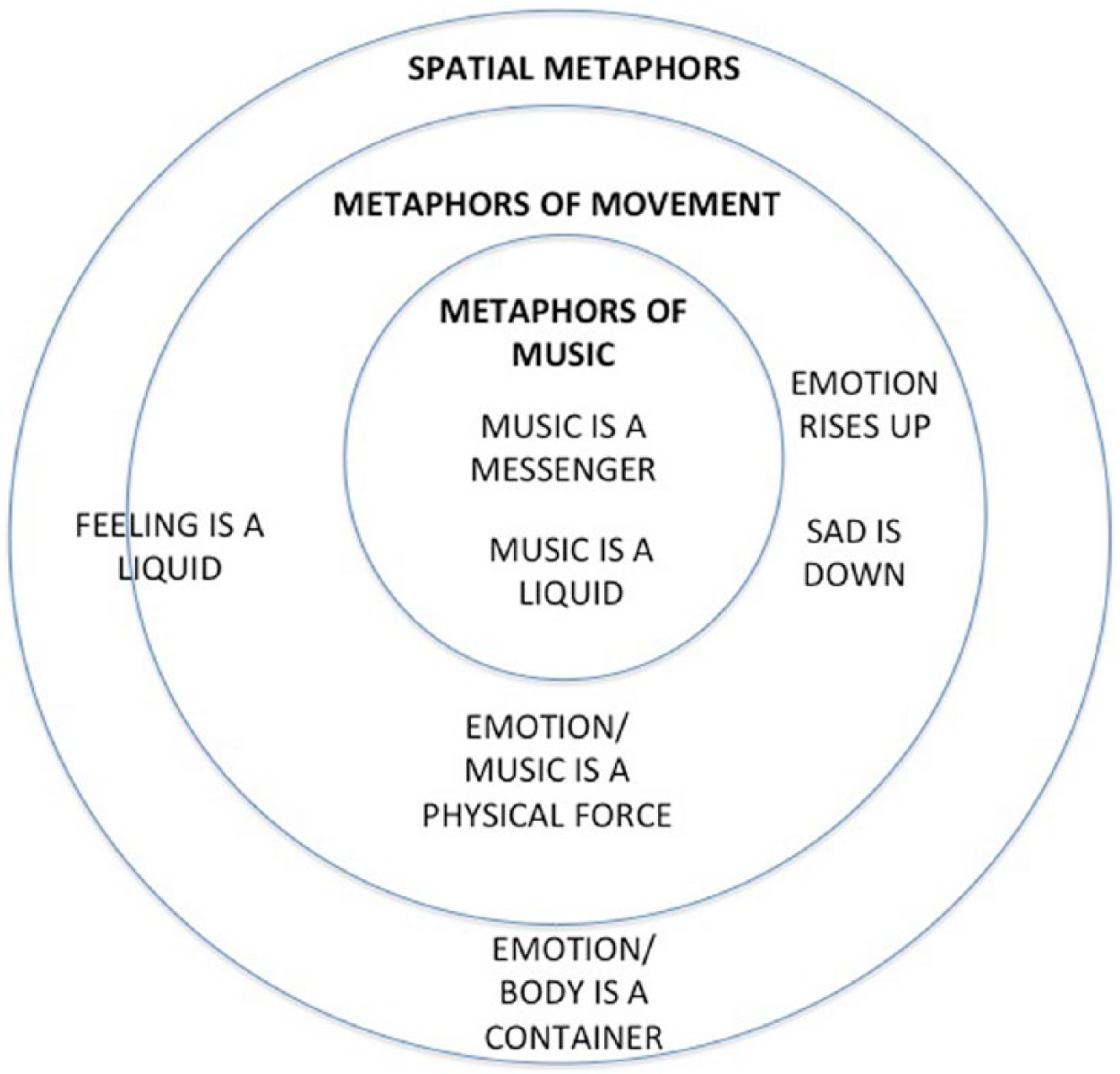
Interwoven quality of the primary metaphors.
MUSIC IS A MESSENGER was the most frequent conceptual metaphor that occurred in our material, as the respondents tended to personify music in their accounts. MUSIC/EMOTION IS A PHYSICAL FORCE was also repeatedly used (see Table 1). It appears that the narrators’ experiences of listening to sad music is a process that develops in more or less the following way: (i) first there are some “true” emotions or memories, which lie either “deep inside”, under the “surface”, or in the “subconscious”; then (ii) music “makes one stop” for a while (i.e., detachment from everyday routines/everyday thinking); then (iii) music either “breaks the walls” or “pierces the shell”, and “triggers” or “raises” some emotions, or memories; and (iv) finally, if one finds this state to be comfortable, one may want to stay and “swim in it”. The process can either start voluntarily, in which case the listener usually considers the experience as pleasant and positive, or involuntarily, in which case the listener may feel anguished because of the music’s strong effect, and the feelings it induces in them.
The occurrence of conceptual metaphors.

Note. Conceptual metaphor represents the linguistic metaphors existing in the data. Number of occurrences stands for the number of participants using that type of metaphor.
Conclusions
In this exploratory study, investigating narratives about the subjective experience of listening to self-identified sad music, we focused on metaphors used by a sample of participants with no musical training. We investigated how music was experienced, how these experiences were narrated, and what kinds of metaphors and metonymies were used when describing them. In the analysis we identified similarities in how people narrate their affective experiences of listening to sad music using conceptual metaphors of spatiality and movement. The use of metaphorical language when describing these experiences is natural, as non-metaphorical thought about subjective experience is often quite impossible (Lakoff & Johnson, 1999, p. 59). In our material, we found that when asked to describe their feelings, the narrators either used familiar metaphors or invented novel “innovative metaphors” to explain the affects experienced. The complex metaphors seem to emerge from both the embodied experience, and the surrounding culture and its language. In the narratives, the supposed universality of primary metaphors used to describe affect and emotion was evident, confirming the suggestion of Kövecses (2000) that “embodiment appears to be a key component in cross-culturally similar conceptualizations of the same domain” (p. 162).
The results of this exploratory study are thus consistent with previous research. However, a descriptive study is only the starting point in studying how experiences related to music and emotions are conceptualized and narrated by individuals. Further study, for example, is needed to discover if the conceptual metaphors presented here are primary metaphors or complex metaphors.
This study focused on Finnish participants and thus the Finnish cultural environment and especially its music culture may have influenced the emphasis put on certain metaphors. For example, is the recurring use of water-related metaphors only typical of Finnish participants or is this indicative of a more universal experience of listening to (sad) music? Further empirical study of metaphors and music with participants from different music cultures could offer interesting perspectives on how experiencing and conceptualizing (sad) music might be context dependent. Further research on metaphors could also be a solution for bridging the gap of knowledge between neurophysiological studies and self-report studies in the field of music and emotion. Some neuroscientists have also shown an interest in the use of metaphorical language in the context of embodied semantics (Aziz-Zadeh & Damasio, 2008). As Lakoff (2003) argues, neural theory may explain a lot more about the properties of metaphor and its embodied base. Also, a comparison between metaphors used when describing music-related emotions and the metaphors used when describing “real” emotions can only shed more light on the complicated yet intriguing relationship between music and the emotions.
Footnotes
Funding
This research was partly funded by the Finnish Doctoral Programme for Music Research (1st author).