




Abstract
The use of the lifespan perspective as a reference point for analysing and researching the musical and artistic development of professional musicians has only recently begun to attract more attention amongst music researchers and educators and amongst musicians themselves. The knowledge about the processes of aging and their influences on making music is especially scarce. This study presents the results of a representative questionnaire on the issue of growing older in a symphony orchestra. A total of 2,536 professional musicians aged between 20 and 69 from 133 German Kulturorchester took part in the survey. The orchestral musicians were asked about a range of issues, including their own perception of their age, how the perks of being a musician change over time and how they manage declining performance caused by aging. The results show how the years between 40 and 50 are a time of change. During this period, musicians feel they leave their youth behind and join the older age group. This is also the time when they feel they have left behind their period of peak musical performance and are now on a downward slope. The majority of musicians notice that their performance is declining due to a range of age-related factors that can be divided into four categories: physical problems, cognitive problems, sensory organ problems and psychological problems. These findings confirm the inverted J-curve that was described in previous studies on the topic of peak musical performance.
Keywords
The use of the lifespan perspective as a framework for analysing and exploring the musical and artistic development of professional musicians has only recently begun to gain more attention amongst music researchers and educators and amongst musicians themselves. There are several reasons for this. The lifespan perspective has become a normal frame of reference in developmental psychology, similar to the idea of lifelong learning in educational theory. At the same time, the media is increasingly full of reports on aging, increased life expectancy and the consequences for individuals and society alike. The musicians of tomorrow who are still at music college are beginning to think more about how their careers will progress once they have finished their studies (Bork, 2010; Gembris & Langner, 2005). Demographic change, the general aging of the population and the increasing number of active, older adults who are interested in music are all issues that have become more prominent in the media and in musical life. For music educators, it is now normal to teach adults and older people (cf. music geragogy, Hartogh, 2005). In classical music, over recent decades it has been far from unusual to see older pianists (such as Vladimir Horowitz) and conductors (such as Herbert von Karajan, Günter Wand) on the concert stage and in the media. And pop and rock music is increasingly the home of older performers and aging stars who have had decades-long musical careers in an area of musical culture that was originally an expression of youth. There is no longer a contradiction between pop music and age. In terms of cultural history, this is a new phenomenon that has now become part of everyday life. This has all led to a growing need to understand more about musical development from a lifespan perspective in the different musical genres. To date, little research has been carried out in this respect and scientific findings are somewhat sparse. As Brodsky (2011, p. 7) recently noted: “Needless to say, very little is known about older musicians. A literature search on aging among music performers is not only disappointing, but futile! To date, there is just one English-language publication available on the subject”. In this publication, Gembris (2006) brings together contributions from the conference on “Musical Development from the Lifespan Perspective,” organised by the Institute for Research on Musical Ability (Institut für Begabungsforschung in der Musik, IBFM) at the University of Paderborn, (Germany) in autumn 2004. The first psychological studies on the course of musical development and creativity were carried out back in the 1930s. Their main focus was on the development of compositional creativity (Bühler, 1933/1959; Lehman & Ingerham, 1939). Although different areas or domains of activity (such as sport, music, visual arts, philosophy, mathematics, etc.) display a variety of ways in which productivity and performance can develop over the course of a lifetime (as already demonstrated by Bühler, 1933), most studies on creativity in music-making describe an inverted J-curve. In a musician’s early years, the production of musical works increases quickly to reach a peak between the ages of 35 and 45. The following decades see a fairly steady drop in productivity (Hargreaves, 1986; Lehman, 1953; Simonton, 1989). For a detailed review of these and later studies, see Lindauer (2003).
In the 1970s, Polish music psychologist Maria Manturzewska (1990) carried out a study that remains relevant today into the lifespan development of professional musicians and described the various stages and developmental phases of a musician’s life. Her model of the lifespan development of musical productivity shows a slowdown in artistic activity in the early-to-mid 40s.
Working from the paradigm of research into expertise, Krampe (1994) looked into the link between practice and musical performance in young and older professional and amateur pianists. He found that as they grew older, both groups demonstrated diminished speed and precision in cognitive exercises that were not music related. However, when given exercises related to playing, professional pianists displayed no reduction in the speed, precision and coordination of their finger and hand movements, unlike the amateur group. Krampe explains this by the fact that professional pianists practice more, which allows them to counter the cognitive and motor limitations that arise later in life (see also Krampe & Charness, 2006).
In 2009, Kopiez, Lehmann, and Klassen carried out a single-case study examining the connection between life events and artistic activity in the pianist and composer Clara Schumann. This study demonstrates how the course of artistic activity is affected by phases of health and sickness. In 1988, David W. E. Smith published his research into growing older within an orchestra. The aim of the study was to provide general information on the musical careers of orchestral musicians, their professional problems and their attitudes towards their profession, music and retirement. To this end, Smith interviewed 14 musicians (string, woodwind and brass players) from one of America’s great symphony orchestras. Most of them had been active musicians for over 40 years, and some of them for more than 50 years. The results of this study no doubt inspired the author to formulate a conclusion of sorts in its title: “The great symphony orchestra – A relatively good place to grow old”). Is an orchestra in fact a good place to grow old? The title also contains some reservations in that it refers to great symphony orchestras, not to small or medium-sized orchestras which may present very different general and working conditions. We should also be aware that in this 1988 study, Smith interviewed a relatively small group of musicians who had “survived” in the orchestra for a very long time, while many other musicians who, for whatever reason, had left the orchestra, may have had a quite different story to tell.
One of the few studies to look at the psychological/developmental psychological problems of orchestral musicians is that carried out by Brodsky in 2006 on British orchestra players, with a particular focus on the long-term benefits, risks and downsides of a career as a professional musician. The intrinsically motivating and satisfying work of a professional musician is countered by the constant requirement to suppress their own musical ideas, their ambitions as soloists and their artistic personality in order to serve the needs of the conductor and the orchestra as a whole – something that can often lead to conflict and frustration. Many musicians try to balance this out with other artistic activities such as playing as soloists or otherwise with small ensembles that give them more freedom to develop as artists. A recent study of American orchestral musicians (Abeles & Hafeli, 2014) has shown that such musicians often find great satisfaction and fulfilment through working with children in schools. This gives them an opportunity to demonstrate their creativity, build relationships with children that will have a lasting impact on their lives and have an opportunity to serve the community: “The results indicate that the orchestras can enhance musicians’ positive perspectives of their career paths by making available ongoing opportunities for them to work and build relationships with young people, particularly in under-resourced schools” (Abeles & Hafeli, 2014, p. 13).
However, most other studies on professional musicians tend to focus on medical issues that affect musicians rather than on their musical and artistic development. These medical issues include specific problems experienced by musicians such as performance anxiety, illness, prevention and treatment options (Blum, 1995; Fishbein, Middlestadt, Ottati, Straus, & Ellis, 1988; Schmale & Schmidtke, 1985; Spahn, Richter, & Altenmüller, 2011; Voltmer et al., 2012; see also Gembris, 2012). These studies are nevertheless relevant to the lifespan development of orchestral musicians, because health is a major factor in the musical and artistic development of professional musicians (see above-mentioned study by Kopiez et al., 2009).
The increased general interest in health and well-being that has been apparent over recent years was taken up by Kenny, Driscoll, and Ackermann (2014) in their study on the psychological well-being of 377 professional orchestral musicians in Australia. They concluded that young musicians, and particularly women, suffer much more from performance anxiety than older musicians. The study also looked at issues such as musicians’ health, preventive measures and stage fright. However, this article will not be examining these issues.
Although previous studies have looked at the main aspects of the lifelong development of orchestral musicians, some important aspects have so far been neglected, such as the question of how motivation, attitudes towards music and the perks of being a musician change over time or of how diminishing performance due to age is recognised and overcome. The demands placed on professional musicians in terms of precise motor skills, strength, speed, concentration, cognition and reaction capacities and virtuosity are often compared to the demands made on top athletes. They are affected by general age-related physiological changes and by changes in perception, cognitive processes, speed and sensory motor skills (Bialystok & Craik, 2006; Park & Schwarz, 2000). This applies also to musical performance. These age-related changes in musical performance may have important consequences for the professional identity, occupational everyday life and the career of professional musicians. There are large gaps in research on these and other related issues.
Research questions and aims
Against this background, we will be tackling the following questions: what is the age of peak performance, when does performance start to decline and how can this be prevented? This is clearly a major area of concern for all musicians. In practice, however, declining performance and how to deal with it is something of a taboo that everyone has to deal with on a practical level, but that is not discussed openly (Schmidt-Ott, 2008). One of the aims of this study is to use data and facts to look at this issue more closely and encourage discussion of this taboo topic.
In general, the present study “Growing older in a symphony orchestra” aims to provide some basic insights into the lifespan perspective of orchestral musicians’ careers. This includes insights into the following questions: age-related changes in professional life; the ability to perform and how this changes; how attitudes and needs change over time; health issues; stress and pressure to perform; strategies for coping; perspectives for retirement/the future; development phases. These questions bring with them a host of other questions, such as the differences brought about by factors such as gender or age, or differences between different types of instruments or orchestra sections. There are very few findings on these and other questions, so our study is largely of an exploratory nature.
Our descriptive research begins with a general description of the study and then goes on to consider the following: (a) the age-related self-concept of musicians in different age brackets and (b) the way musicians estimate their own performance on their particular instrument in various age brackets. It should be understood that this relates to the way musicians estimate their own performance on a particular instrument rather than an objective assessment of their performance on an instrument. Making an objective assessment of musical performance that is not limited to individual technical, measurable parameters (such as tempo) but that also takes into account musical and artistic aspects (such as the arrangement or interpretation of a piece) is a complex process and – as far as we know – no such studies have been published to date. We only know of one study that examines practical music-making by professional musicians of different ages (W. Brodsky, personal communication, September 22, 2012), and this is currently ongoing.
Method
The present study “Growing older in a symphony orchestra” has been carried out in conjunction with the German Orchestra Union (Deutsche Orchestervereinigung, DOV), which has close to 10,000 members. The DOV is the professional organisation and union of orchestral musicians and it represents their professional interests.
Germany has more – and a greater variety of – orchestras than anywhere else in the world, so it provides a good opportunity to examine the issues and questions described above. At the time our study was carried out (autumn 2010), there were 133 professional, state-subsidised Kulturorchester in Germany with almost 10,000 players (since then this number has fallen to 132). Kulturorchester are defined as being “chiefly recipients of public funding (from taxation or TV and radio licence fees), with fixed staffing levels throughout the year, and a performance schedule that excludes purely popular or march music” (Mertens, 2010). There are four different types of orchestras that fall within the Kulturorchester category. The largest group comprises the 84 theatre orchestras that for the most part serve the operas, operettas and musicals at city and state theatres. Here, the spectrum ranges from major, internationally acclaimed opera houses, such as Berlin, Hamburg, Stuttgart and Munich, to small provincial theatres. The second group is made up of 30 concert orchestras that perform predominantly or exclusively in concert halls. These include top international orchestras such as the Berliner Philharmoniker, the Münchner Philharmoniker and the Gewandhausorchester Leipzig, along with smaller, less well-known local orchestras. The third group consists of seven chamber orchestras, which often play purely as string ensembles. Finally, the fourth group comprises 12 radio orchestras that remain a mainstay of high-quality music productions, ambitious programming policy and the promotion of contemporary music in Germany (cf. Mertens, 2012, p. 2 f.)
Another special feature of German orchestras is the fact that they are assigned to pay groups A to D, depending on their membership and number of positions. Orchestras with no more than 55 fixed positions are assigned to pay group D. Those with 56 to 65 positions are assigned to group C, 66 or more to group B and 99 or more to group A (along with radio and chamber orchestras). Further distinctions are made within each group. This classification is not only a reflection of the various pay grades, but also of the orchestra’s reputation and performance. The salary level is highest in group A orchestras and lowest in group D orchestras. Conditions of employment can vary drastically, depending on the size, reputation and type of orchestra involved (e.g., whether it is a large opera or concert orchestra in a major city, with numerous tours, TV and radio broadcasts and recordings, or whether it is a small provincial orchestra).
For this reason, the classification and type of orchestra has been included in the study as an independent variable.
Going beyond these Kulturorchester, Germany is also home to other professional orchestras that are organised in different ways, employ freelance musicians or work as project orchestras. These do not form part of this study.
Study population
For reasons of methodology, we have carried out a comprehensive survey of all orchestral musicians in Germany’s 133 (at time of survey) Kulturorchester. The decision to carry out a comprehensive survey of the Kulturorchester was largely based on the realisation that it is nigh on impossible to define age bands and determine a priori when musicians belong to the younger group and when to the older group. Growing older is an ongoing process in life, and we are also interested to hear the experiences and opinions of younger musicians with regard to the various aspects of aging. This is why we have not excluded any age group but rather surveyed all musicians, with a view to also discovering more about young musicians’ perspectives of older musicians and their opinions about age-related issues.
Survey development and procedure
We began by drawing up a number of relevant questions on the topic “Growing older as a musician in an orchestra”, based on related literature, theoretical considerations and practical experiences. We then carried out explorative interviews with 12 musicians (9 male, 3 female) in order to make the questions posed in the survey as relevant as possible to the everyday reality of orchestral musicians. The musicians interviewed played different instruments and belonged to different orchestra sections, and were aged between 48 and 72. They had between 20 and 40 years’ experience in professional orchestras (for a more detailed account, see Gembris & Heye, 2012, p. 26 ff.) The results and insights gained from these interviews completed our pool of questions. On this basis, we developed a comprehensive standardised questionnaire containing 245 questions over 19 pages. We pre-tested the questionnaire on a group of 11 professional musicians to check the comprehensibility and clarity of the questions and then revised it accordingly.
The final questionnaire was divided into seven sections: 1. General information about the musicians (socio-demographical data, instruments); 2. Current employment situation; 3. The pleasures and frustrations of orchestra work; 4. Health; 5. Crises and conflicts; 6. Growing older; 7. Perspectives on retirement (see Appendix 1 for an excerpt of the questionnaire in English translation).
The cross-sectional survey was carried out between October 2010 and February 2011. A total of 9,922 questionnaires with return envelopes were sent out via the German Orchestra Union to the 133 Kulturorchester, based on the number of positions in those orchestras (as at February 2010). A covering letter explained the purpose of the questionnaire, and asked the musicians for their help on a voluntary basis, with the assurance that their anonymity would be maintained. In general, the completed questionnaires were collected from the orchestras anonymously in sealed envelopes by DOV representatives and sent to the DOV office in Berlin. Here, the questionnaires were collated and sent on to the Institute for Research on Musical Ability (Institut für Begabungsforschung in der Musik/IBFM) at the University of Paderborn, which carried out the evaluations.
In total, 2,550 musicians returned questionnaires (a return rate of 26%). Of these questionnaires, 2,536 were included in the analysis (14 had to be excluded because of incomplete data); see Figure 1 for an overview of the survey procedure).
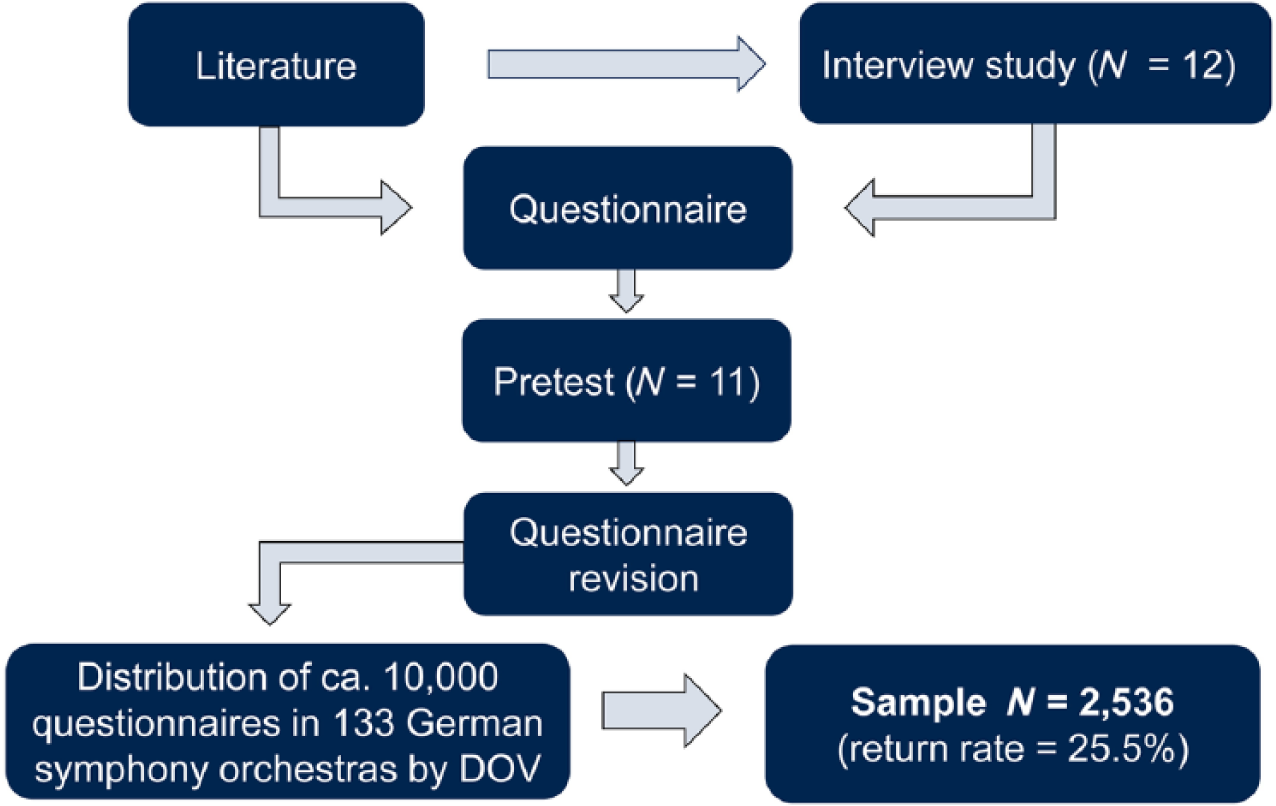
Survey procedure.
Despite the DOV’s well-organized distribution and collection of the questionnaires, the rate of return remained somewhat below expectations. The main reasons probably lay in the fact that several orchestras were away on international tours during the data collection phase, and also the length of time required to fill in the 19-page questionnaire. Nevertheless, when compared with the 17% to 55% return rate of other studies on orchestra musicians, (e.g., Fishbein et al., 1988), our return rate is not out of the ordinary (see Gembris & Heye, 2012, p. 22).
However, our sample can be considered as representative for orchestra musicians in Germany because it reflects the overall distribution of the basic population of orchestra musicians in Germany in terms of the main parameters (age, gender, orchestra section, musician’s country of origin, etc.).
As a first step, we carried out descriptive analyses and comparisons according to different groups including age, gender, type of orchestra, kind of instrument, etc., using the statistic software SPSS 19.
Results
In the following section, we will be presenting a selection of results that particularly concern (self-assessed) age-related changes in musical performance, because age-related changes in performance are one of the most important and most-discussed aspects of aging for professional musicians. Other results have been published in a German-language book (Gembris & Heye, 2012).
The 2,536 musicians who took part in the survey included 1,359 string players, 113 percussionists, 41 harpists and 19 others. The average age of the musicians in the survey was 45.8 years (SD = 9.52). See Table 1 for an overview of the contracted instruments within each family of instruments broken down by age and gender.
Standard instruments within the instrument families, grouped according to gender and age.
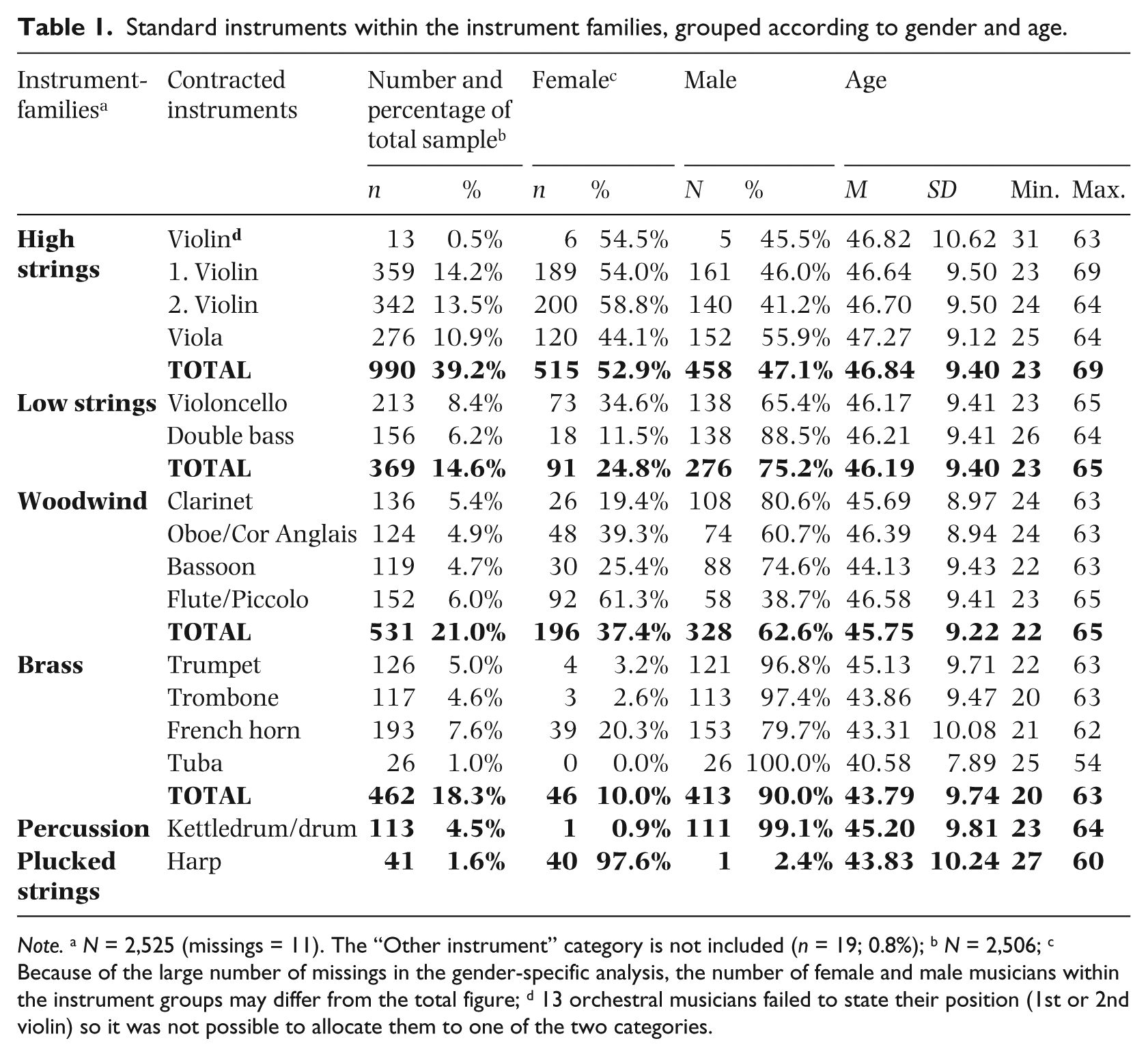
Note. a N = 2,525 (missings = 11). The “Other instrument” category is not included (n = 19; 0.8%); b N = 2,506; c Because of the large number of missings in the gender-specific analysis, the number of female and male musicians within the instrument groups may differ from the total figure; d 13 orchestral musicians failed to state their position (1st or 2nd violin) so it was not possible to allocate them to one of the two categories.
Their ages ranged from 20 to 69 1 and 36% were female and 64% male. The overwhelming majority were from Germany (82%), with the next best represented country being Romania (3%), followed by the USA, Austria and Poland (2% each), and Japan and Hungary (1% each). The musicians had on average 22 years’ experience as professional musicians; their experience in the orchestra they were playing with at the time of the survey was on average 18 years. Over half (56%) had more than 20 years’ experience as orchestral musicians.
Actual and perceived age
An interesting question relating to our theme of growing older in a symphony orchestra is the musicians’ own perception of their age. So we asked them how old they felt (irrespective of their actual age) (see Appendix 1, item 42) and whether they felt they belonged to the younger or older group of musicians (see Appendix 1, item 40): 55% categorised themselves as belonging to the older group, and 45% to the younger group. The average age of those that categorised themselves as older was 52 years (SD = 5.96), while the average age of those that categorised themselves as younger was 38 years (SD = 7.13). Interestingly, the higher the biological age, the greater the discrepancy between actual and perceived age. And with regard to the musicians’ own perception of their age, almost all those under 39 (97%) placed themselves in the younger category, while almost all those over 50 felt they belonged to the older group. The musicians aged between 40 and 49 were clearly undergoing a period of transition in which their perceptions of themselves and their age were changing. Between the ages of 40 and 49, younger musicians began to see themselves as older musicians.
Along with asking the musicians to categorise themselves as younger or older, we also asked them about how old they felt. The older they were, the greater the discrepancy between their biological and perceived age. While younger musicians (up to age 30) tend to feel their actual age, the difference between actual and perceived age widens as they grow older. Musicians who are 60 or older feel almost 10 years younger than their actual age (see Figure 2).
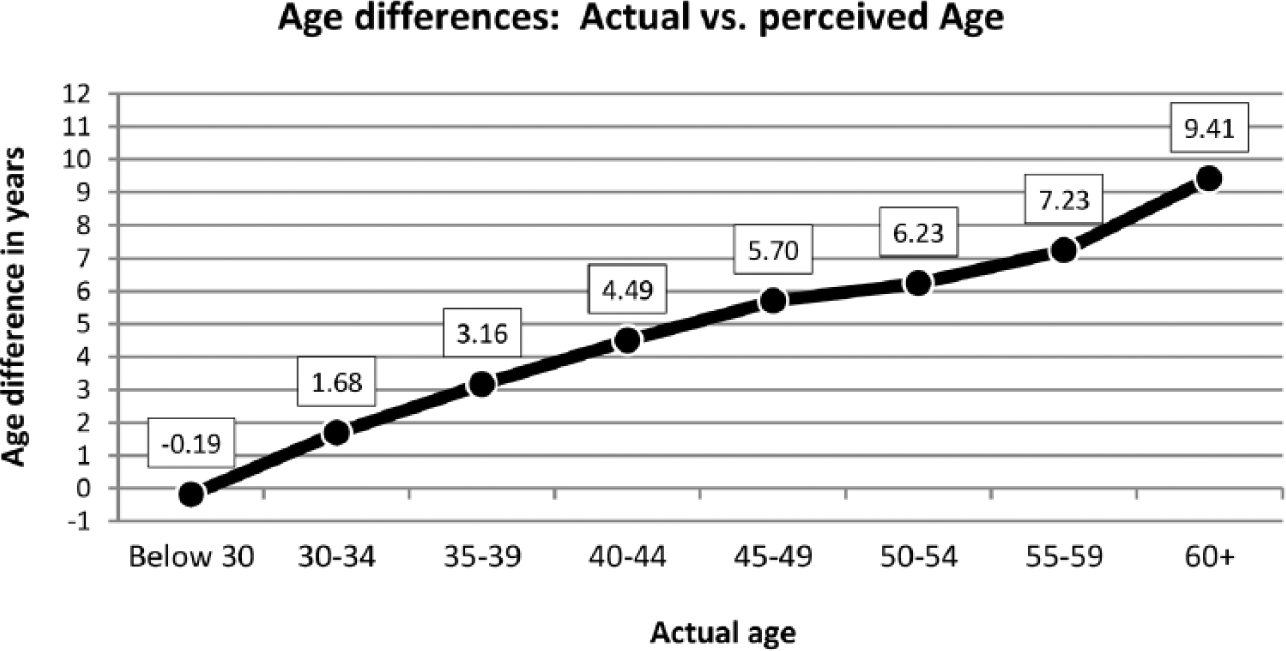
Increasing difference between actual and perceived age.
The fact that the difference between actual and perceived age widens as the years go by may be termed a general trend. Above 70 years, the average difference between actual and perceived age is as much as 13 years (Römer, 2009; cf. also Schafer & Shippee, 2010).
The development of musical performance at different life stages
One of the most interesting issues relating to research into lifelong artistic productivity is the question of when is the period of peak artistic productivity and performance. We asked the participants to estimate at what age they would generally expect to perform at the highest level on their own particular instrument (see Appendix 1, item 22). The results show a positively skewed distribution and an inverted J-curve (see Figure 3). A full 25% of those asked believed that peak performance on their particular instrument was reached before 30 years of age. However, the majority felt that maximum performance was attained between the ages of 30 and 39. They felt that performance begins to decline after this age. Only 11% of musicians believed that peak performance on an instrument could be reached between the ages of 50 and 54.
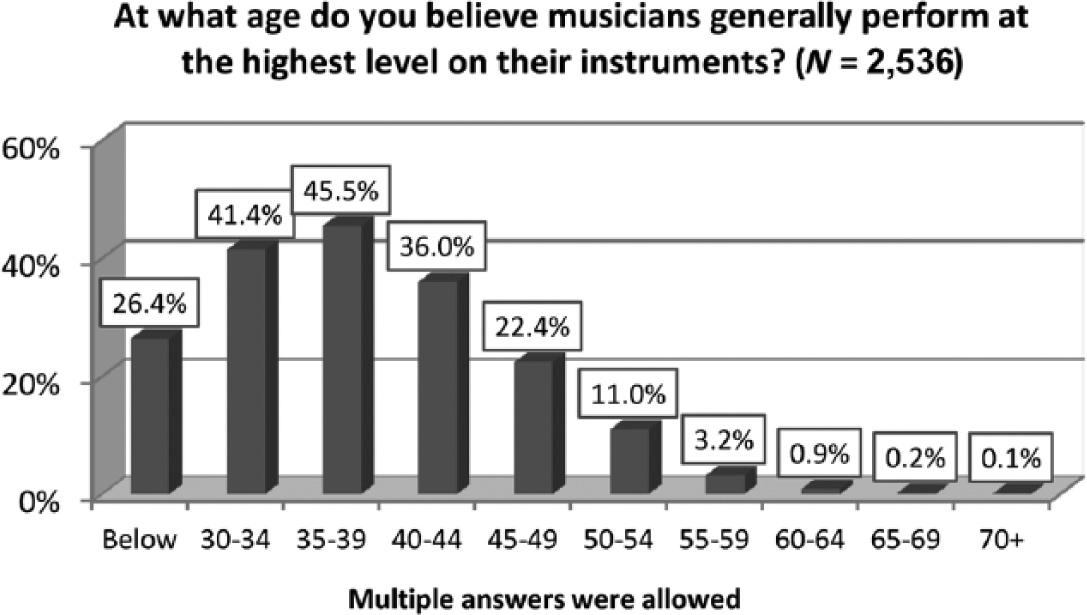
Estimation of peak musical performance by age group.
It should be noted that there were no significant differences between the various instrument groups (strings, wind, percussion, harp) with regard to this question on peak performance. This inverted J-curve in instrumental performance bears similarities to the progression of compositional creativity at different stages of life (e.g., Manturzewska, 1990; Hargreaves, 1986), but with the difference that the decline in performance occurs much more rapidly after the peak years of 35–39.
If we assume that this curve is accurate, then we should expect to see an age-related decline in performance after the age of 40. This is borne out by the answers given by the musicians surveyed. On average, 41% of orchestral musicians have noticed at least once that their performance has declined due to age-related factors (see Appendix 1, item 44). As expected, the frequency of these instances of declining performance increases strongly with age; whereas only 5–10% of the under-35 age group reported declining performance, the percentage in the oldest age group (60 and above) reached 64% (see Figure 4).
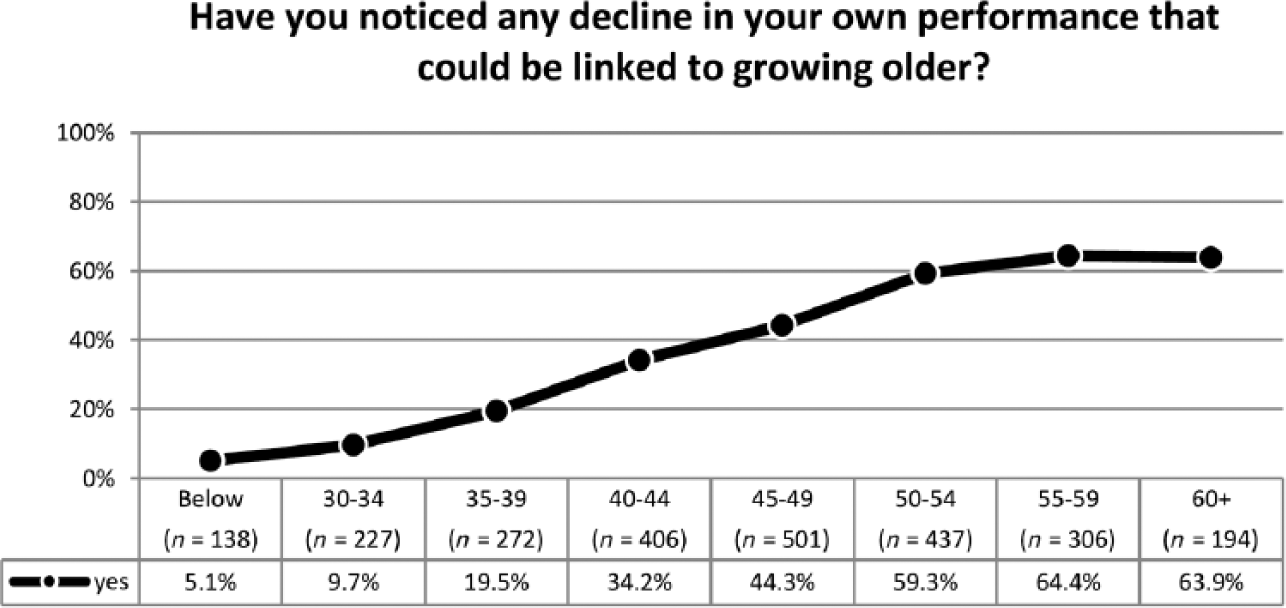
Perception of age-related decline in performance in different age groups.
The musicians’ own perception of their musical performance at different stages of their lives shows very different results. They were asked to evaluate their personal performance on a 5-level scale (pp, p, mf, f and ff) 2 (see Appendix 1, item 21). This produced the following results: in general, the musicians did not place themselves in the highest performance category (ff), but instead rated themselves in the second-highest category, forte (f). Secondly, their own perception of their musical performance barely declined between the ages of 30 and 60 (see Figure 5). This is in clear contradiction to the inverted J-curve showing the progression of musical peak performance. There were also some differences between players of strings and players of wind instruments. In the 30–34 age bracket wind players assessed their own performances significantly higher than did the string players, however the effect size is not significant (paired t-tests; string players vs. wind players aged 30–34: t = -2.196; df = 2.109; p = .028; d = .11) Indeed, greater differences were noted in the two highest age groups (55–59 and 60+): whereas the string players’ assessment of their performance remained relatively constant, that of the wind players dropped away much more sharply. The difference is significant in both age groups, with a medium effect size (paired t-tests; string players vs. wind players aged 55–59: t = 3.031; df = 404; p = .003; d = .32; string players vs. wind players 60+: t = -3.426; df = 170; p = .001, d = .56). It is also striking that the variance between the oldest group of wind players (M = 2.95, SD = 1.061) is larger than that of the corresponding group of string players (M = 3.50, SD = 0.943). In other words, on the one hand, decline in performance due to aging is significantly more noticeable in wind instrument players than in string players; and on the other hand, the individual differences in this respect between older wind players and violinists are greater. Despite these differences between string and wind players, the musicians’ own assessment of their performance over several decades remains fairly consistently high, though not at the absolute highest level.
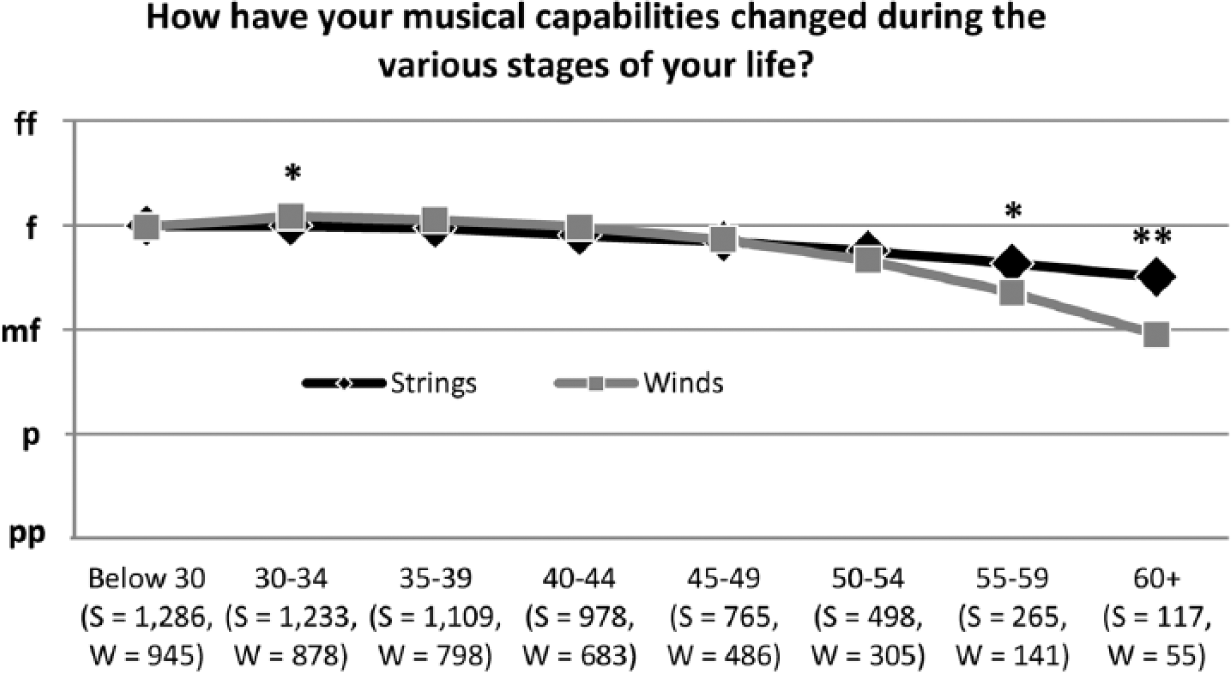
Changes in subjective musical performance of wind and string players at different life stage ages. The musical symbols ff (fortissimo), f (forte), mf (mezzoforte), p (piano) and pp (pianissimo) indicate the degree of performance. The highest possible performance is indicated by ff, the lowest by pp. The stars indicate significant group differences. The character S at the x-axis indicates the number of string players in each age group, W indicates the number of wind players.
However, if in contrast we look only at those musicians who ranked themselves in the highest category (ff) for personal musical performance, we see a different progression (see Figure 6). This is clearly linked to age. Over one-third of musicians (36% and 34% said that they achieved their peak performance before the age of 30. This percentage dropped steadily with increasing age to reach a figure of 13% in the 55 and older age group (see Figure 6).

Age-related changes to maximum performance (multiple answers allowed).
One explanation for the difference in these progressions could be that the orchestral musicians normally play at a high level but not always to the absolute maximum of their ability. In contrast to solo concert musicians, playing in an orchestra does not normally require peak virtuoso performances, despite the fact that orchestral musicians may be capable of such performances. This means that orchestra players still have the potential to perform at a higher level, but this is not activated in their everyday work. However, this untapped potential can be used to counter the effects of declining performance due to aging. In this way, a high level of performance that is below peak performance can be maintained for many years and decades before any obvious decline becomes noticeable.
Although it is possible to maintain the normal high level of performance for a relatively long time, it may be that this becomes more difficult as time goes on (see Appendix 1, item 20). In any case, achievement of the musicians’ own high standards of performance is clearly linked to age (see Figure 7). It becomes increasingly difficult to reach these standards as they grow older. The number of musicians who found it more difficult to meet their performance standards grew from around 10% amongst the under-30s to almost 60% in the over-55 and older age group. However, among the under-49 age group, the majority of musicians believe their ability to meet their own standards has either not changed or it has in fact become easier.

Growing older makes it more difficult to achieve own high standards of performance.
There are two possible explanations for this progression. Professional musicians of all ages set the bar very high when it comes to their own performance, and these standards either do not change or change very little. Age-related limitations mean that as they grow older it becomes increasingly difficult to meet these high standards. A second theoretical explanation would be that their own performance standards increase or have increased during the course of their professional career (generation or time effect) and that as a result it becomes ever more difficult to meet these standards. We believe the answer probably lies in a combination of these two explanations. On the one hand, standards of musical performance are already extremely high during the musicians’ studies and these standards are internalised. No-one gains a place in an orchestra unless they can meet the high standards that are set. So the bar is set so high at the start of their career that it can probably not be raised much higher. In this respect, it would mirror the age effect curve.
On the other hand, expectations of musicians in terms of their performance have escalated over the last decades. Older musicians in particular have lived through this process and found it to be a challenge that they are not always able to meet. For this reason, we can expect to see the strong influence of generation effects in the older age groups. This also applies to their answers when asked about perceived pressure to perform.
The proportion of those who find the pressure to perform in the orchestra either high or very high also increases with age. In the under-30 age group, 22% find the pressure to perform in the orchestra to be either high or very high. This proportion climbs to 44% in musicians who are 60 and over. In the freely-formulated answers, the most common reasons given for the increased pressure to perform were increased artistic demands, a strained relationship with the conductor, an increased workload and pressure from the public or from cultural policies. It should be borne in mind that this progression includes both age-related and generation-related factors. It may indeed be the case that, as musicians grow older, they subjectively experience an increase in the pressure to perform because their own performance tends to reduce while standards either stay the same or increase. However, it is also the case that perfect CD recordings and a general increase in the level of performance in orchestras has led to an objective increase in expectations and artistic demands over the last decades, along with pressure from the public and from cultural policies (such as the dissolution of orchestras). Older musicians have lived through more of this process than their younger colleagues, and indeed the older they are, the more of this they have experienced. So these generation and time effects are particularly noticeable in the answers of the older musicians.
With regard to whether their performance has diminished with age, we asked the musicians in which areas they feel this is particularly noticeable (they were allowed to name more than one area). The majority (44%) pointed to physical problems, followed by cognitive problems (26%), sensory organ problems (24%) and psychological problems (17%). At the musical level, these problems manifest themselves through such things as a reduction in fine motor skills, speed and precision; through lip and breathing problems in wind instrument players and a reduction in lung volume; failing hearing; intonation problems; slower reaction times; nerve problems and also difficulties with concentration and memory.
Dealing with age-related decline in performance
How can musicians compensate for the fact that their performance declines as they grow older? (see Appendix 1, item 51). Most musicians counter the problems of aging by practising (optimisation) (62%). They also find it important to look after their health (43%). Eleven per cent admit that they play less or are more selective about what they play. Less than 10% mentioned improvements in work conditions, changes in attitudes, suggestions for compensating musically, using their experience or ending their musical career. It is noteworthy that only 5% admit to compensating for age-related declining performance through their experience. The oft-quoted SOC principle (selection, optimisation, compensation) put forward by Baltes (1997) as a compensation strategy for age-related decline in performance can only be used to a limited extent by orchestral musicians because the conductor decides what music they should play and how it should be played. They do not have the option of selecting their own pieces (selection) or perhaps playing them more slowly (compensation). The only option that is generally open to them is optimisation through practice. In any case, the SOC principle normally reaches its critical limits sooner or later in the musician’s life. At this point, selective optimisation or compensation is no longer able to make up for the deficits caused by age and the relation between developmental gains and developmental losses becomes negative (Porfeli & Vondracek, 2009, p. 417).
Within the environment of a competitive orchestra, it is difficult for musicians who are affected by declining performance to know who to speak to about their problem. The survey participants were asked to state which of the listed people or groups of people they would definitely, possibly or definitely not speak to about these issues: 86% of musicians stated they would “definitely” speak to their partner about declining performance due to aging. A large number (73%) said they would definitely speak to a friend about it, followed by a member of the family (69%) or a doctor (60%). The majority (61%) said they would definitely not speak to the conductor about their problems (though it should be borne in mind here that it is usually the conductor who speaks to musicians about their dwindling performance). Almost half (48%) would definitely not speak to a staff representative about it, and only 43% would possibly do so.
It seems that other members of the orchestra are not the right people to speak to on this thorny topic: only 20% would definitely talk to their colleagues, two-thirds (66%) possibly and 14% definitely not. These findings show that the orchestra is clearly not a place where musicians feel comfortable talking about their age-related performance problems. There are many possible reasons for this, including feelings of shame, loss of self-confidence and a lack of trust in staff representatives and colleagues.
How should orchestras deal with musicians whose performance is declining because of their age? The great majority of musicians (83%) believed that orchestras should definitely or generally give them the opportunity to stay on as long as possible. Only 17% disagreed with this. However, two-thirds of musicians (67%) thought that colleagues who were clearly failing to perform to the required standard should be replaced. Eighty per cent of musicians rejected the proposition that they should leave the orchestra voluntarily. The majority of them also rejected the idea that they should be forced to retire (92%).
Overall, most musicians felt that orchestras should take the needs of older members into account. One-third of musicians (34%) believed the orchestra should definitely take these needs into account, and 47% thought it should possibly do so. A small group of around 20% believed the orchestra should probably not take the needs of older members into account.
Stability and the advantages of age
Growing older in a symphony orchestra does not entail declining performance. It also brings stability and advantages in other areas. Curiosity is a key element of learning. We asked the musicians about their curiosity and desire to be constantly learning new things in their music. The younger age groups are the most curious in their music: 93–96% said they were keen to learn new things in music. However, this curiosity did not drop off to any significant extent in the older age groups. Some 80% of musicians in the 55 and older group claimed they were still interested in learning new things in music.
Greater experience is generally considered to be a benefit of growing older. We asked the musicians to what extent they could use their experience to compensate for declining performance as they grew older. Whereas half of the youngest musicians under 30 said they could use their experience to compensate for such declining performance, this proportion grows to 85% amongst musicians in the 60+ age group. Experience is clearly seen as a means of compensating for age-related decline in performance. It is perhaps not a direct contradiction, but this finding does call into question the aforementioned figure of just 4% of musicians who feel they can use their experience to compensate for age-related decline in performance.
A deeper understanding of music is another advantage of growing older. In the youngest group of under-30s, three-quarters of musicians also believed that growing older goes hand-in-hand with a deeper understanding of music. The proportion of musicians who agreed with this statement grew to 85% in the oldest age group (60+). A large number of musicians agreed with the statement that their experience allows older performers to reach levels of performance that younger musicians are unable to reach and 43% of under-30s agreed with this statement, rising to 65% in the older age groups. It is interesting here to note that younger musicians already see a deeper understanding of music as an advantage of aging. This view of growing older is overwhelmingly confirmed by the older musicians. However, we should not overlook the fact that one-third of older musicians do not believe growing older confers a deeper understanding of music.
The youngest musicians (under 30) are particularly interested in the experience of their older colleagues (81%). This interest tends to drop off as younger musicians themselves grow older, but in the 40+ group interest in the experience of older musicians stabilises at around 40–45% of musicians in the older age groups.
Although we might expect enthusiasm for playing music to start to fade as a result of the daily routine over many years, in fact this is not the case. Only 10% of under-30s claimed they had less enthusiasm for playing music than when they were younger. However, this figure does grow to 26% in musicians over 55. But three-quarters of musicians disagree with the statement that enthusiasm for playing music declines with age. And there is overwhelming agreement (96%) with the statement that, all in all, being an orchestral musician is a great job. The majority of musicians agreed that increasing age makes them more relaxed (82%) and less dependent on the opinion of others (77%). Most musicians are not afraid of growing older (80%), with almost half (47%) saying they are actually enjoying growing older. For the majority of musicians (67%), the music itself is their main way of dealing with extreme professional pressures, followed by their partner (66%), and by family and children (60%; cf. Gembris & Heye, 2012, p. 172).
Discussion
This is the first large-scale study to provide comprehensive empirical data on the subject of growing older in a symphony orchestra. The ages of the study participants ranged from 20 to 69 years, providing a reflection of the opinions and experiences of different generations.
It demonstrates how the years between 40 and 50 are a time of change. During this period, musicians perceive themselves as leaving behind their youth and joining the group of older musicians. They feel they have left behind their period of peak musical performance and they are now on a downward slope (cf. Manturzewska, 1990). Our study confirms the inverted J-curve of the progression of musical peak performance, as described in previous research. However, it is necessary to distinguish between “maximum” performance on the one hand and “usual” or “normal” performance, on the other (Krampe & Charness, 2006). Musicians’ own perception of their “normal” performance in the orchestra, which is not their maximum performance, barely declines at all as the years go by.
The results of this study provide some basic information about the career of orchestral musicians. They provide empirical evidence for job engineering in symphony orchestras (for example, in the area of preventive health care). They provide a basis for policy discussions with regard to musicians’ careers and working conditions. And they provide pointers to aid in the education and training of professional musicians to ensure their lifelong development.
One of the limitations of the study is the fact that the statements relating to age are based on a cross-sectional survey. As a result, there is a combination of age effects, inter-individual effects, generation effects and time effects. It should also be borne in mind that the trajectories shown here are based on the musicians’ perceptions of their own performance and not on some kind of objective measurement. On the other hand, it seems likely that there is generally a high correlation between the self-assessed and actual musical performance of professional musicians.
We should also bear in mind that the professional situation and musical development of orchestral musicians in a salaried, permanent position is very different from that of freelance musicians. The latter often have portfolio careers where they combine playing and teaching music with other non-musical activities (Gembris & Langner, 2005; Mills & Smith, 2006; Smilde, 2009a, 2009b). Against this background, we also have to question the criteria of professional and musical performance and relate them to the particular professional situation of each musician. It may be appropriate to use the level of virtuosity on the violin or flute as the sole or main criteria for measuring the musical performance of soloists, and probably also of a large number of orchestral musicians, but it has little relevance to musicians who focus mainly on teaching and/or work with local orchestras. Here, other qualities such as musical versatility, the ability to adapt to a range of musical styles, improvisational talent and teaching skills are much more important criteria when measuring performance and their progress is quite different to the trajectory of purely instrumental performance. The same applies to the success of a musician who is not necessarily or solely measured by peak musical performance and virtuosity. We agree with Mills and Smith (2006) when they write:
We would suggest that a musician starts to become successful when the gap between their objective work and their aspirations begin to narrow, and that they are successful when their objective work and their aspirations coincidence. Success is different for different individuals, and it can vary for the same person at different points in time. (p. 137)
Professional fulfilment for orchestral musicians does not necessarily depend on their performance on their instrument, but may be strongly linked to their teaching work with children (Abeles & Hafeli, 2014).
What conclusions can we draw from these results? The results are proof of the need to highlight the issue of growing older in symphony orchestras per se, but also in relation to musicians’ training, their professional associations and unions and perhaps also in the eyes of the public. The overwhelming majority of musicians of all ages who took part in this study (83%) were keen to have an open discussion about the issue of growing older in a symphony orchestra. Declining musical performance due to age factors should be openly discussed because they affect or will affect all orchestral musicians. In order to do this, it is necessary to create an atmosphere of trust within the orchestra. There is also a need for orchestras to make available appropriate people with whom the musicians can discuss their concerns.
Individual musicians and the orchestra as a whole need to take action and create the right conditions that will allow members to maintain their levels of musical performance as they grow older. These include practice, further training, instruction, health care initiatives, improved working conditions and stress reduction. Older musicians are also important for younger musicians as they provide a role model in various respects, including how to deal with growing older. A realistic view of aging must include not only the deficits and losses that come with age, but also the benefits (e.g., experience, routine, musical wisdom).
A difficult problem to resolve is the fact that the largely inescapable declines in musical peak performance due to aging run counter to unchanging high expectations and increases in the retirement age. And we should not forget that in the area of music, as in all areas of aging, there can be huge differences between individuals. It is necessary to develop a culture of growing older in an orchestra that makes reference to the general processes of aging but that at the same time takes into account individual differences and the many different ways in which people age.
In terms of the lifespan development perspective, little is known about the transition strategies of professional musicians. Previous studies relating to sport provide important indications about coping with retirement on the one hand and providing support and education to athletes on the other (e.g., see Wylleman, Alfermann, & Lavallee, 2004; Park, Lavallee, & Tod, 2013; Grove, Lavallee, & Gordon, 1997). As far as we know, there has been no comparable research in the domain of music.
It is possible that there are various ways of growing older in a symphony orchestra that as yet remain unknown. We are therefore planning to carry out further analysis of the data collected in this study. Future research should also include the conductor’s perspective.
Footnotes
Appendix 1: Excerpt of the questionnaire (translated from German into English)
Funding
This research was funded by the Deutsche Orchestervereinigung [German Orchestra Union].