




Abstract
Music piracy is a prevalent, costly, and illegal global phenomenon. The objective of this study was to test whether different facets of mindfulness (attention, present focus, awareness, and acceptance) moderated a mediation process in which digital piracy in friends promotes a lenient legal-ethical position that fosters music piracy intentions in emerging adults. We controlled for personality traits (Big Five), emotion regulation (reappraisal and suppression), time spent listening to music, various Internet-related behaviors (non-academic Internet use, downloading, social networking, smartphone use), and sociodemographics (gender, age, and level of education). Participants were 156 emerging adults (aged between 18 and 25 years) who studied at a Canadian university. Moderated mediation analyses (bootstrapping 50,000 random resamples) suggested that social influence from digital piracy in friends might be a risk factor that has: (i) a direct effect on music piracy intentions; (ii) an indirect effect on music piracy intentions via lenient legal-ethical position; and (iii) an effect on lenient legal-ethical position that can be buffered by attention, a facet of mindfulness that thereby acts as a protective factor. This study draws novel directions for research on the prevention of music piracy, notably the possibility that mindfulness is a protective factor against peer contagion of digital piracy in emerging adulthood.
Keywords
Music is such an exquisite artistic and cultural product that millions of young people are ready to break the law in order to acquire their favorite songs. Music piracy facilitated by the Internet is an extremely prevalent illegal behavior that allegedly costs billions of dollars in lost revenues to the music industry, notably because millions of emerging adults download billions of copyrighted music files illegally (Jambon & Smetana, 2012). This societal issue particularly concerns younger people who are more likely than older individuals to commit music piracy (Popham, 2011). Thus far, the music industry has had mixed results in curbing music piracy in youth, despite educational campaigns, lowering the financial costs of accessing music, and launching lawsuits against illegal hosting websites and users who download music from them (Wang & McClung, 2012). Hence, this study targeted the emerging adult population to capture social and psychological mechanisms that might facilitate or prevent music piracy. To this end, we tested if mindfulness moderated (buffered) a mediation process in which digital piracy in friends promotes a lenient legal-ethical position that fosters music piracy intentions.
Music piracy in emerging adulthood
Emerging adulthood is a phase of life that spans ages 18 through 25 and is characterized by increased self-focus, freedom in identity experimentations, and intensified independence towards making lasting choices in fundamental domains of life (Arnett, 2000, 2007). Emerging adults regularly use music to socialize and knit social networks with acquaintances and friends (Lewis, Gonzalez, & Kaufman, 2012; Rentfrow & Gosling, 2006). Concurrently, many of them download copyrighted music without paying and thus perpetrate music piracy (Sheehan, Tsao, & Pokrywczynski, 2012). During college and university, those who decide to engage in music piracy can evoke various reasons, such as economic (e.g., saving money), collection (e.g., being able to own more songs), and social (e.g., sharing with friends) motives (Sheehan et al., 2012). Their intentions to commit music piracy can also be a planned behavior driven by attitudes, behavioral control, and subjective norms (Morton & Koufteros, 2008).
In this study, however, we focus on whether music piracy intentions can be facilitated by digital piracy in friends and a lenient legal-ethical position towards music piracy, as well as if mindfulness can provide some protection. Three developmental considerations support our focus. First, the social influence of peers and friends increases and reaches a peak in youth (Steinberg & Monahan, 2007). Second, ethical and moral reasoning continue to mature gradually from adolescence to adulthood (Eisenberg, Morris, McDaniel, & Spinrad, 2009). Third, interventions that bolster the development of mindfulness yield positive outcomes, including decreased symptoms of mood and conduct disorders in youth (Bögels, Hoogstad, van Dun, de Schutter, & Restifo, 2008; Regehr, Glancy, & Pitts, 2013), but also better moral reasoning and ethical decision making in adulthood (Shapiro, Jazaieri, & Goldin, 2012). However, mindfulness is more often studied as therapeutic training or meditation, less is known about its natural course, and findings about age differences are mixed. For instance, mindfulness seems mainly stable during adolescence (e.g., K. W. Brown, West, Loverich, & Biegel, 2011) and adulthood (e.g., Baer et al., 2008), although it may increase during adulthood (e.g., Lilja et al., 2011).
Digital piracy in friends
We operationalized digital piracy in friends as the number of friends who committed digital piracy in one’s social network. Digital piracy in friends may be a risk factor that increases intentions to commit music piracy because peer contagion of deviancy in social networks is a risk factor of problem behavior (e.g., aggression, theft, substance use) in childhood, adolescence, and emerging adulthood (Andrews, Tildesley, Hops, & Li, 2002; Dishion & Tipsord, 2011). In general, behavioral similarity among peers in youth is theorized to stem from both selection (affiliation) processes and socialization (learning) mechanisms (B. B. Brown & Larson, 2009). Peer contagion pertains more to the latter mechanisms as youth can learn and reinforce various forms of deviant values and behaviors when socializing with deviant friends (Dishion & Tipsord, 2011).
Thus far, research reveals that music piracy in friends and peers can increase one’s music pirating habits in adolescence and emerging adulthood. Sheehan et al., (2012) found that music piracy in peers can create a social norm that reinforces motivation for music piracy. Affiliation with peers supportive of and engaging in illegal music downloading is also linked to more music piracy behavior (Cheung, 2013; Hinduja & Ingram, 2009). In sum, theory and research support that digital piracy in friends can be a risk factor of music piracy intentions.
Lenient legal-ethical position
Engaging in music piracy can be an ethical and legal dilemma for many emerging adults (Altschuller & Benbunan-Fich, 2009; Coyle, Gould, Gupta, & Gupta, 2009; Jambon & Smetana, 2012). Drawing on the work of Coyle et al. (2009), who have measured a legal/ethical component in music piracy, we used their construct to operationalize emerging adults’ lenient legal-ethical position towards music piracy as minimizing the unethical facet, criminal aspect, and legal liability of music piracy. Conceptually, we considered that such ethical reasoning might denote a more lenient interpretation of rights and responsibilities inherent to copyrighted music, which could facilitate music piracy intentions. On the other hand, such ethical reasoning may also reveal that some emerging adults are more adept at reasoning critically about the legitimacy, fairness, and necessity of paying for copyrighted music. Hence, for some emerging adults, perhaps it also denotes a more nuanced legal-ethical position, but one that can facilitate music piracy intentions nonetheless. As such, a lenient legal-ethical position on music piracy is still incompatible with current copyright laws to which emerging adults are expected to adhere as law-abiding citizens.
Hitherto, research indicates that various forms of more lenient legal and ethical positions towards music piracy can potentially facilitate music piracy behavior in emerging adults. Notably, those who minimize the illegal and unethical nature of music piracy also tend to have more music piracy intentions (Coyle et al., 2009). Higher ethical propensity is also linked to less music piracy intentions (Gopal, Sanders, Bhattacharjee, Agrawal, & Wagner, 2004). Higher moral conscience is associated with less motivation for music piracy (Sheehan et al., 2012). Perceiving illegal music downloading as immoral is also linked to less illegal downloading behavior (Wingrove, Korpas, & Weisz, 2011).
We theorized that a lenient legal-ethical position towards music piracy might act as a mediator between digital piracy in friends and music piracy intentions. Moral reasoning can develop through socialization (Eisenberg et al., 2009). Friendships can impact moral reasoning (Malti & Buchmann, 2010; Pratt, Hunsberger, Pancer, & Alisat, 2003), which can predict problem behavior (Raaijmakers, Engels, & Van Hoof, 2005). Therefore, socializing among friends that commit digital piracy could spread a social norm by which music piracy is trivialized as being normative or even banal. In turn, this social norm could promote a lenient legal-ethical position towards music piracy that may increase one’s music piracy intentions.
Mindfulness
Mindfulness as a trait embodies individual differences in the naturally occurring quality of consciousness that nurtures optimal attentiveness to and awareness of unfolding present experiences (K. W. Brown & Ryan, 2003). Mindfulness is distinct but closely linked to self-regulation and self-control (Bowlin & Baer, 2012). Self-regulation is among the few known moderators that can buffer peer contagion of deviancy in youth (Dishion & Tipsord, 2011; Gardner, Dishion, & Connell, 2008). Given that mindfulness involves self-regulation, then mindfulness in itself may also act as a moderator that mitigates peer contagion. Accordingly, Dishion and Tipsord (2011) have recently posited that mindfulness can mobilize a self-regulation ability that could buffer peer contagion of deviancy.
Therefore, we posited mindfulness as a potential protective factor that could primarily mitigate the association between digital piracy in friends and one’s own music piracy intentions. We also examined if mindfulness could mitigate all possible links among digital piracy in friends, a lenient legal-ethical position, and music piracy intentions. Furthermore, we pondered at whether such moderation would occur with specific facets of mindfulness: attention (sustaining self-regulation of attention and concentration), present-focus (focusing on the present, and away from the past or future), awareness (recognizing immediate thoughts and feelings non-judgmentally), and acceptance (accepting thoughts, feelings, and unchangeable events; Feldman, Hayes, Kumar, Greeson, & Laurenceau, 2007). We explored each facet and path because the idea of mindfulness as a moderator of peer contagion is recent and the underpinnings unspecified. Although prominent researchers recently theorized mindfulness as a moderator of peer contagion (see Dishion & Tipsord, 2011, p. 202), to the best of our knowledge, this study provides the first empirical test of this assumption.
From the theoretical framework of Feldman et al. (2007) on mindfulness, we derived general considerations to guide our exploration of four facets of mindfulness as respective moderators. First, emerging adults high in attention might be more self-regulated and attentive to developing their own personal ethical reasoning about music piracy, without being distracted by social norms from digital piracy in friends. They may also concentrate on an alternative outlook on music piracy (e.g., artistic, cultural, economic), which may mitigate a lenient legal-ethical position. Second, those high in present-focus may better focus on their current musical needs when intending to download music, instead of relying on what their friends might have done or what they are likely to do. They may also focus on respecting and promoting presently admired artists, a fandom that may counteract a lenient legal-ethical position. Third, emerging adults high in awareness may be conscious of and critically appraise the reinforcements resulting from having friends that commit digital piracy. They may also be more aware of their own overarching values (e.g., honesty, self-discipline) that might be incompatible with music piracy, which may compensate for a lenient legal-ethical position. Fourth, emerging adults high in acceptance may be more capable of tolerating emotional discomfort from disagreeing with their friends’ digital piracy. They may also accept more easily the need to pay to access their favorite copyrighted music, which may counterweigh a lenient legal-ethical position.
Hypothesized moderated-mediation model
Figure 1 illustrates our objective, which was to test four hypothetical models in which four facets of mindfulness (attention, present focus, awareness, and acceptance) could respectively moderate (protect against) a mediation process in which digital piracy in friends promotes a lenient legal-ethical position, which in turn fosters music piracy intentions in emerging adults. Moreover, we anticipated a partial mediation because peer contagion of deviancy is a potent risk factor that may involve complex mediators (Dishion & Tipsord, 2011). In addition, we tested if each model would be significant over and above 15 confounders. We controlled for personality traits (extraversion, agreeableness, conscientiousness, emotional stability, openness) as they can explain a wide range of normative and problem behaviors (Ozer & Benet-Martinez, 2006). Emotion regulation (reappraisal and suppression) was also controlled because anticipating emotions in general – including those pertaining to ethics (e.g., guilt) – are associated with digital piracy intentions (Wang & McClung, 2012). We accounted for time spent listening to music because it can determine the baseline need for online music consumption. We also controlled for various Internet-related behaviors (non-academic Internet use, downloading, social networking, smartphone use) because they may influence the ease of access to online music resources, as well as participation in social networks of online music consumers. These confounders are especially pertinent as experience on and accessibility to the Internet (e.g., connection and devices) is linked to music piracy behavior (Popham, 2011). Lastly, we controlled for three sociodemographic characteristics: gender, age, and level of education. Males and younger individuals are more prone to download music illegally in college and in the general population (Coyle et al., 2009; Popham, 2011). Moreover, participants’ level of education may have had some impact on the development of their legal and ethical reasoning as emerging adults.
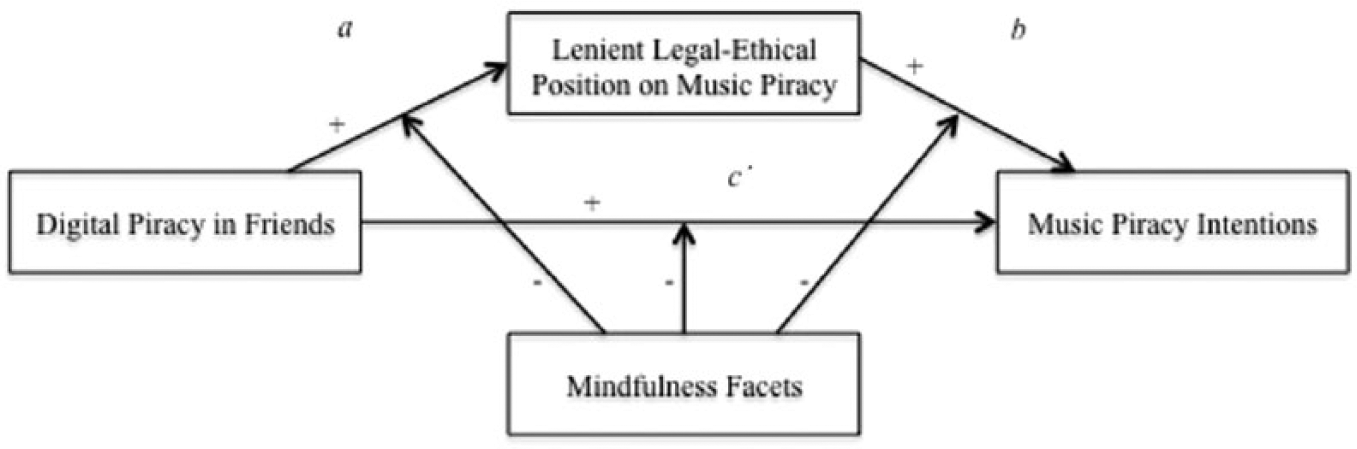
Hypothesized moderated-mediation: four facets of mindfulness (attention, present focus, awareness, and acceptance) respectively moderating (protecting against) a mediation process in which digital piracy in friends promotes a lenient legal-ethical position, which in turn fosters music piracy intentions in emerging adults.
Method
Sample and procedure
The sample consisted of 159 emerging adults (undergraduate students aged between 18 and 25 years) who attended a Canadian university located within a culturally diverse urban area in the province of Ontario. The mean age of participants was 19.09 years (SD = 1.41 years) and 122 were females and 37 were males. The ethnocultural composition of the sample was: Aboriginal/Native (n = 1), Asian (n = 11), Black (n = 4), Latino (n = 1), Middle Eastern/Arab (n = 10), Mixed (n = 8), Other (n = 3), and White (n = 121). Students were enrolled in different academic programs: Social Sciences (n = 41); Sciences (n = 29); Arts (n = 28); Psychology (n = 25); Health Sciences (n = 23); Engineering (n = 5); Management (n = 3); joint program (n = 3); not specified (n = 1); no answer (n = 1).
Research ethics review and approval were obtained for this study. Participants were recruited through a system of research participation at their university, which allowed them to be compensated for their voluntary participation by receiving an extra point in their introductory course in psychology. Participants provided informed consent on a self-report online survey that they filled out from their own personal computer in January and February 2013.
Measures
Digital piracy in friends (independent variable)
We assessed the number of friends that perpetrated digital piracy in one’s social network by using a 6-item measure adapted by Higgins, Fell, and Wilson (2006) from Krohn, Skinner, Massey, and Akers (1985). For instance, participants were asked how many of their best friends (male/female) performed digital piracy on the Internet. Participants provided their answers using a 5-point scale (1 = none; to 5 = all or almost all). Internal consistency for this scale was excellent (α = .96).
Intentions to commit music piracy (dependent variable)
We assessed participants’ intentions to commit music piracy from a validated 5-item scale by Morton and Koufteros (2008). Participants were asked the extent to which they agreed or disagreed with statements such as “It is likely that I would commit online music piracy”. They rated each item using a 7-point scale (1 = strongly disagree; to 7 = strongly agree). Internal consistency was also excellent for this scale (α = .94).
Lenient legal-ethical position towards music piracy (mediator)
We assessed participants’ lenient legal-ethical position towards music piracy by using a 7-item construct that Coyle et al. (2009) operationalized and validated as legal-ethical attitudes towards music piracy. Higher scores originally meant that participants considered music piracy to be an unethical and illegal act. For instance, participants were asked to rate whether they agreed or disagreed with the statement “I consider piracy of music to be unethical”. Participants rated each item using a 5-point scale (1=strongly disagree; to 5=strongly agree). For the purpose of this study, we reversed the scale so that higher scores would indicate a more lenient legal-ethical position towards music piracy. Internal consistency for this scale also revealed to be excellent (α = .90).
Mindfulness (moderator)
We assessed four facets of mindfulness with the 12-item Cognitive and Affective Mindfulness Scale-Revised (CAMS-R; Feldman et al., 2007). Participants were asked to rate how much different statements applied to them (e.g., “It is easy for me to concentrate on what I am doing”). They answered each item on a 4-point scale (1 = rarely/not at all; to 4 = almost always). Internal consistency was satisfactory for the scale (α = .71), however, it was lower for each subscale given the few items: attention (α = .69); present focus (α = .45); awareness (α = .64); and acceptance (α = .59). Feldman et al. (2007) also reported a similar trend for Cronbach’s alphas (ranging from .42 to .81) in their validation study. 1
Personality (control variables)
We measured personality traits from the Five Factor Model with the Ten-Item Personality Inventory (TIPI; Gosling, Rentfrow, & Swann, 2003). For instance, participants were asked to indicate to what extent “Extraverted – Enthusiastic” represented how they are in general in their life. They reported their answers on a 7-point scale (1 = disagree strongly; to 7 = agree strongly). Internal consistency was low for each subscale as it consisted of only two items: extraversion (α = .69); agreeableness (α = .30); conscientiousness (α = .41); emotional stability (α = .45); and openness (α = .20). In their validation study, Gosling et al. (2003) also noted low Cronbach’s alphas (ranging from .40 to .73).
Emotion regulation (control variables)
Emotion regulation was assessed using the 10-item Emotion Regulation Questionnaire (ERQ; Gross & John, 2003). For instance, participants were asked if they agreed or disagreed with statements such as “I keep my emotions to myself”. Answers were reported on a 7-point scale (1 = strongly disagree; to 7 = strongly agree). Internal consistency was satisfactory for the reappraisal (α = .82) and suppression (α = .79) subscales.
Time spent listening to music and Internet-related behaviors (control variables)
Participants were asked to indicate how many hours per week they spent: listening to music; using the Internet for non-academic purposes; downloading “stuff” on the Internet; on Internet social networks; and using a smartphone.
Sociodemographic characteristics (control variables)
Participants reported their gender (female or male), their age (years), and level of education as undergraduate students (1 = 1st year; 2 = 2nd year; 3 = 3rd year; 4 = 4th year).
Results
Preliminary analyses
At the univariate level, missing data ranged from 0% to 3.8%. From analyzing the pattern of missing values, Little’s MCAR Test indicated that these data were missing completely at random: χ 2 = 372.49, p = .43. Missing data was imputed through an Expectation-Maximization (EM) algorithm, notably because this modern method is more accurate than older ones such as mean substitution (Graham, 2009). Three multivariate outliers were detected (Mahalanobis distance) and thus 156 participants are part of all final analyses. Table 1 reports means and standard deviations, whereas Table 2 displays the inter-correlations among our 22 variables. The significant inter-correlations were mostly small to moderate. Many were primarily located among: the independent, mediator, and dependent variables; mindfulness facets; personality traits; and Internet-related behaviors.
Means (M) and standard deviations (SD) of 22 variables in the moderated-mediation models.
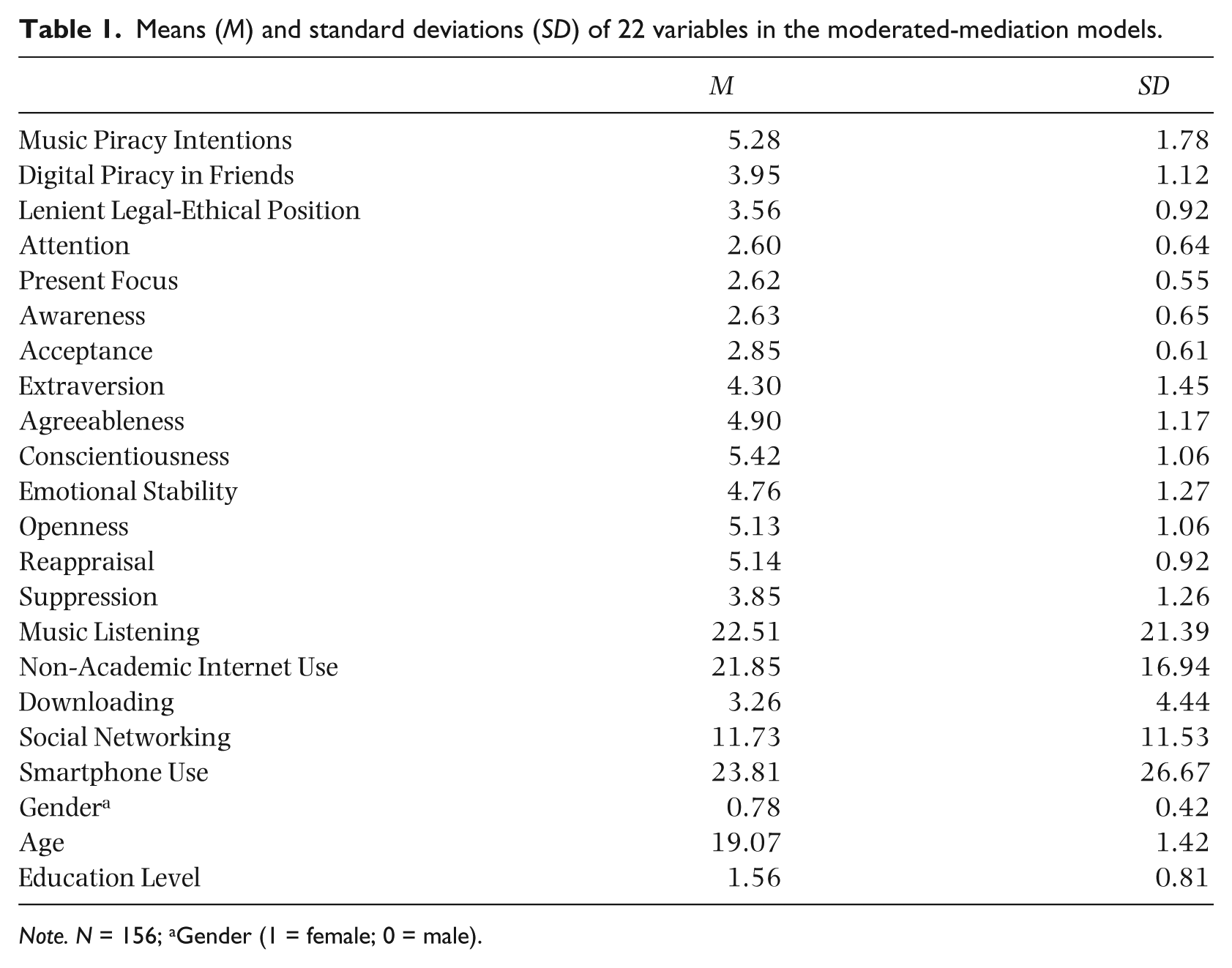
Note. N = 156; aGender (1 = female; 0 = male).
Inter-correlations (rs) among all 22 variables.

Note. N = 156; *p < .05; **p < .01; ***p < .001; ar = .156, p = .05.
r = .157, p = .05. cr = .155, p = .05.
1 = Music Piracy Intentions (MPI); 2 = Digital Piracy in Friends (DPF); 3 = Lenient Legal-Ethical Position (LLEP); 4 = Attention (AT); 5 = Present Focus (PF); 6 = Awareness (AW); 7 = Acceptance (AC); 8 = Extraversion (EXT); 9 = Agreeableness (AGR); 10 = Conscientiousness (CON); 11 = Emotional Stability (EMO); 12-Openness (OPEN); 13 = Reappraisal (REP); 14 = Suppression (SUP); 15 = Music Listening (ML); 16 = Non-Academic Internet Use (NAIU); 17 = Downloading (DWN); 18 = Social Networking (SN); 19 = Smartphone Use (SU); 20 = Gender (GN; 1 = female and 0 = male); 21 = Age (AGE); 22 = Level of education (EDUC).
Moderated-mediation analyses
Multiple regressions tested a series of moderated-mediation models in which four facets of mindfulness (attention, present focus, awareness, and acceptance) could respectively moderate a mediation process in which digital piracy in friends promotes a lenient legal-ethical position that fosters music piracy intentions. Each model controlled for extraversion, agreeableness, conscientiousness, emotional stability, openness, reappraisal, suppression, time spent listening to music, Internet-related behaviors (non-academic Internet use, downloading, social networking, smartphone use), gender, age, and level of education. A non-parametric bootstrapping method was used to generate robust estimations for direct (c’), indirect (ab), and conditional (moderated) effects among variables (Hayes, 2013; Preacher & Hayes, 2008). Given the relatively small size of our sample, we performed 50,000 bootstraps (random resamples) using the PROCESS SPSS analytical tool, which provides 95% bias corrected confidence intervals (CI) that indicate a significant indirect effect when lower limits (LL) and upper limits (UL) do not include zero (Hayes, 2013; Preacher & Hayes, 2008). As recommended by Hayes (2013), we report the unstandardized beta coefficients, especially given the use of bootstrapped confidence intervals in our mediation analysis. Nonetheless, standardized beta coefficients are also reported for each path in our moderated-mediation models (Figures 2, and 4 to 6).
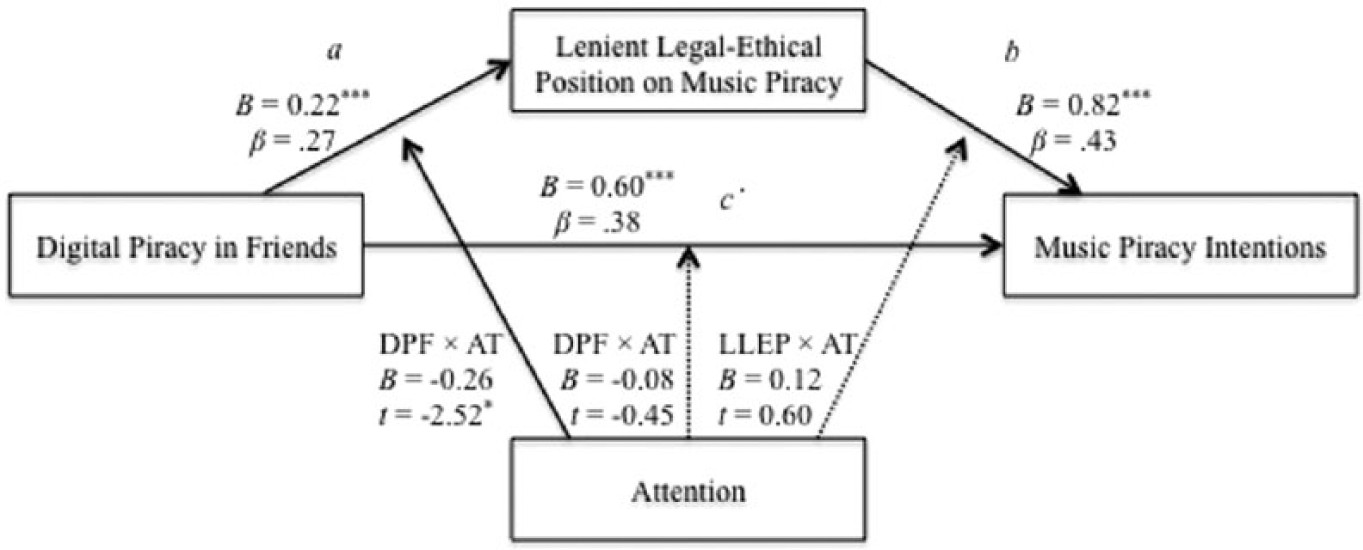
Moderated-mediation model A: testing if Attention moderates a mediation process in which Digital Piracy in Friends predicts a Lenient Legal-Ethical Position that, in turn, predicts music piracy intentions in emerging adults.
At the outset, as presented in Table 3, we performed a simple mediation model (with covariates, but without moderation) for which results indicated that digital piracy in friends had a positive indirect effect (ab) on music piracy intentions via lenient legal-ethical position: 0.2080; SE = 0.07; CI [0.0980; 0.3590]. Nonetheless, digital piracy in friends kept a positive direct effect (c’) on music piracy intentions: B = 0.5816; SE = 0.10; t = 5.55, p < .001; CI 95% [0.3744; 0.7888]. Although the causal steps strategy by Baron and Kenny (1986) is no longer deemed optimal to test mediation (Hayes, 2013; MacKinnon, Lockwood, Hoffman, West, & Sheets, 2002; Preacher & Hayes, 2004), our results would qualify as a partial mediation in traditional terms. Furthermore, this mediation might be small to medium in effect size. 2
Simple mediation: Digital Piracy in Friends predicting Music Piracy Intentions via Lenient Legal-Ethical Position.

Note. N = 156; *p < .05; **p < .01; ***p < .001; aGender (1 = female; 0 = male); beta coefficients are unstandardized.
In the moderated-mediation models, variables involved in the interaction terms were mean centered prior to analysis. As presented in Figure 2, results for the first moderated mediation revealed that attention moderated the relationship between digital piracy in friends and lenient legal-ethical position towards music piracy. At low levels of attention, the indirect effect (ab) was significant: 0.2876; SE = 0.11; CI 95% [0.1042; 0.5466]. However, at high levels of attention, the indirect effect (ab) was not significant anymore: 0.0523; SE = 0.09; CI 95% [-0.1135; 0.2752]. Hence, the indirect effect was blocked at path a, from digital piracy in friends to lenient legal-ethical position. We further delved into the significant moderation through simple slope analysis. As shown in Figure 3, results revealed that at low levels of attention, the relationship between digital piracy in friends and lenient legal-ethical position was positive and significant (B = 0.39, SE = 0.09; β = .47; t = 4.43, p < .001), whereas this relationship was not significant anymore at high levels of attention (B = 0.06, SE = 0.09; β = .07; t = 0.62, p > .05). Figure 2 also indicates that attention did not moderate the two other paths. Figures 4, 5, and 6 show that the three other facets (present focus, awareness, and acceptance) did not moderate any of the three possible paths in the moderated-mediation model.
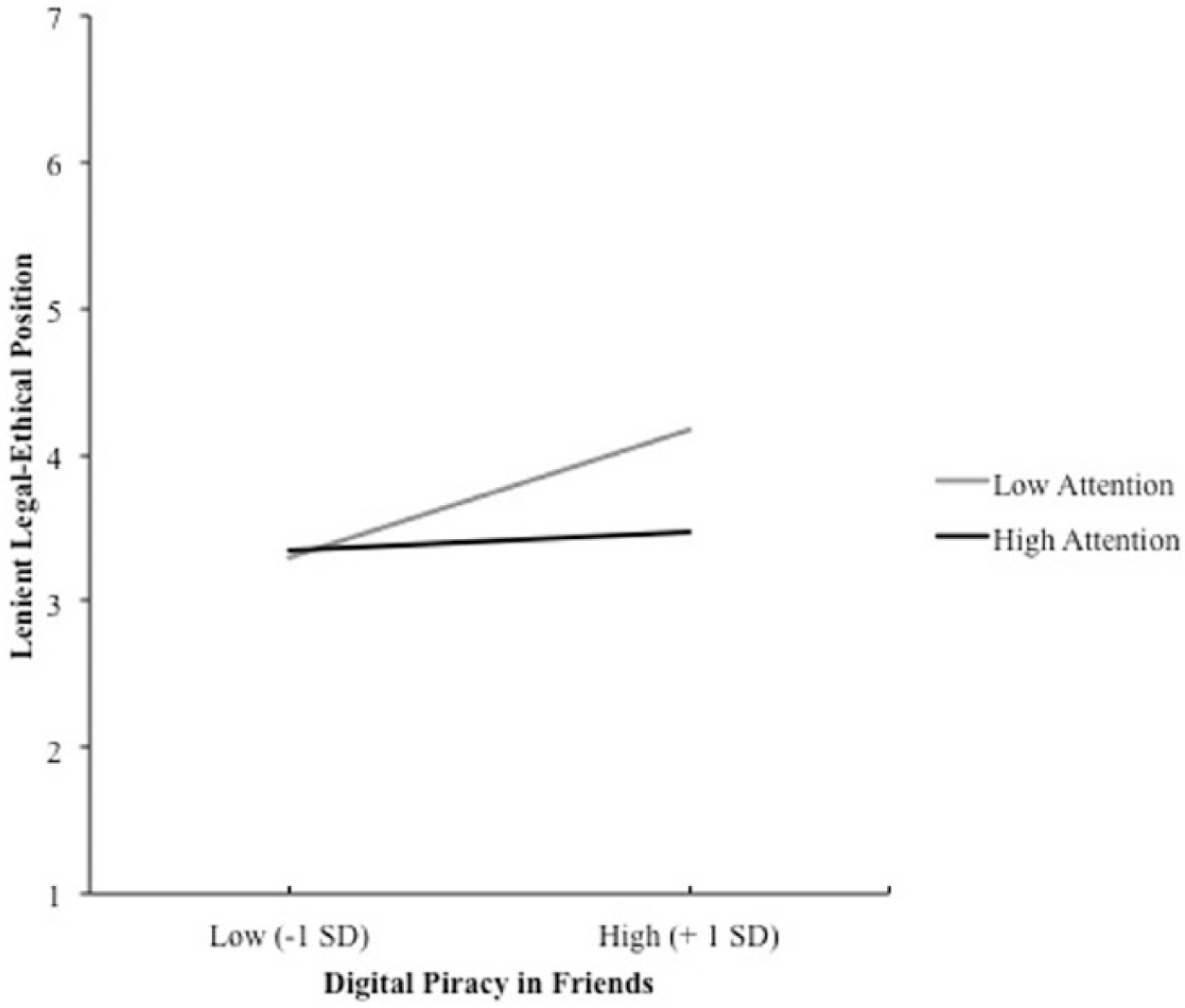
Simple slope analysis: Attention moderating (buffering) the link between Digital Piracy in Friends and Lenient Legal-Ethical Position.
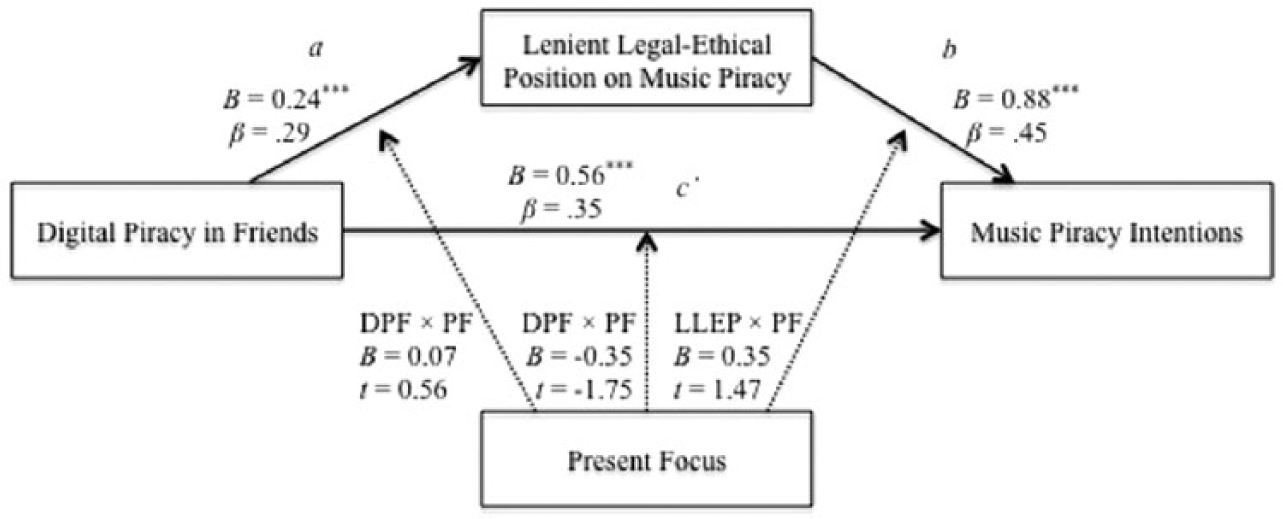
Moderated-mediation model B: testing if Present Focus moderates a mediation process in which Digital Piracy in Friends predicts a Lenient Legal-Ethical Position that, in turn, predicts music piracy intentions in emerging adults.
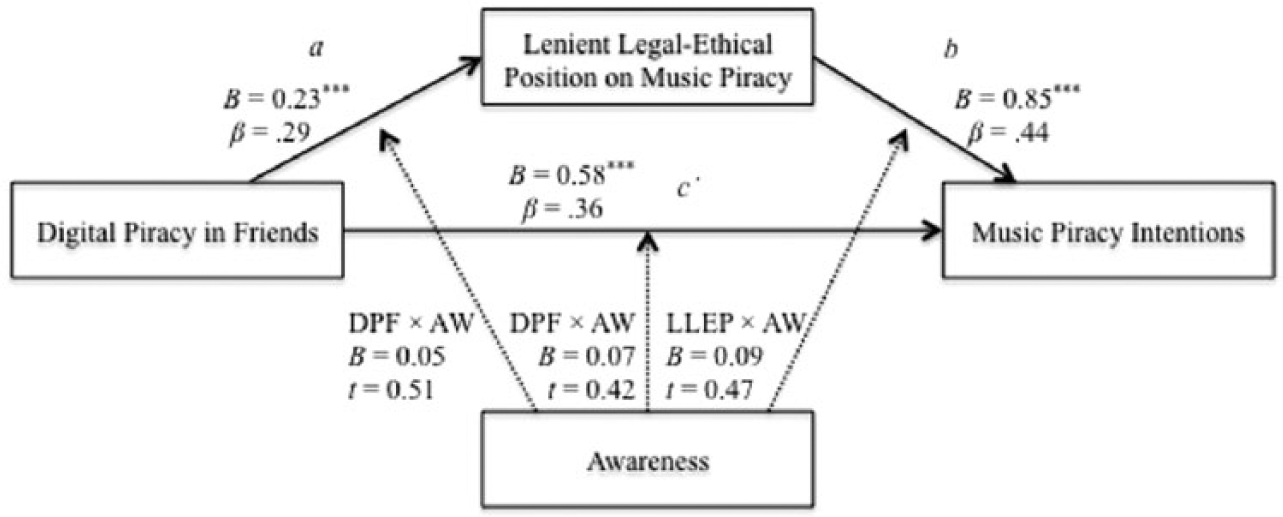
Moderated-mediation model C: testing if Awareness moderates a mediation process in which Digital Piracy in Friends predicts a Lenient Legal-Ethical Position that, in turn, predicts music piracy intentions in emerging adults.

Moderated-mediation model D: testing if Acceptance moderates a mediation process in which Digital Piracy in Friends predicts a Lenient Legal-Ethical Position that, in turn, predicts music piracy intentions in emerging adults.
Table 4 reports all effects for the 15 control variables in each of the four moderated-mediation models (A, B, C, and D). The vast majority of confounders were revealed not to be associated with either the mediator or the dependent variable. However, a pattern emerged in which time spent listening to music and on Internet social networks were both associated with less music piracy intentions, whereas time spent downloading material on the Internet was associated with more music piracy intentions.
Effects for the 15 control variables in the four moderated-mediation models (A, B, C, and D).
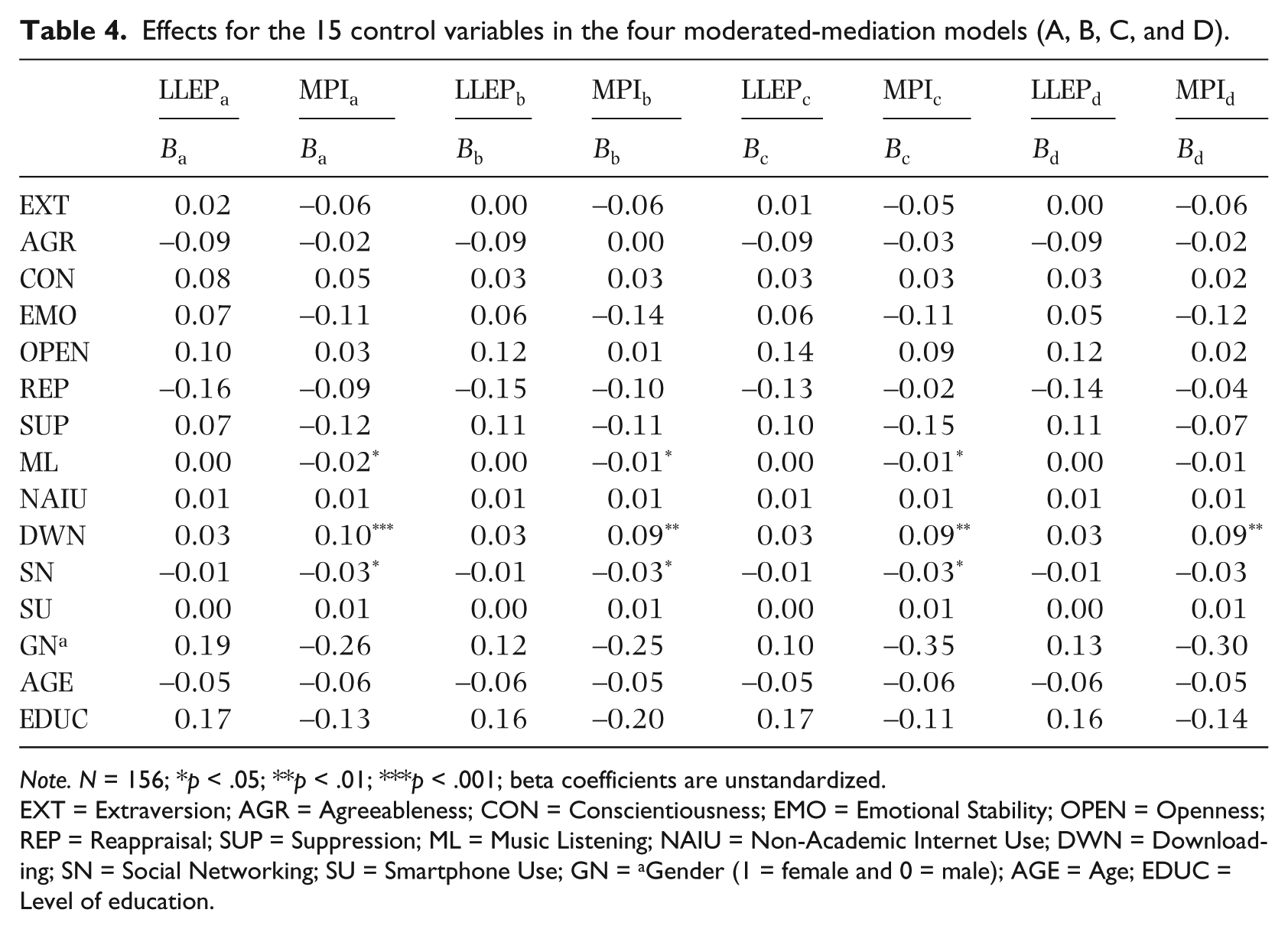
Note. N = 156; *p < .05; **p < .01; ***p < .001; beta coefficients are unstandardized.
EXT = Extraversion; AGR = Agreeableness; CON = Conscientiousness; EMO = Emotional Stability; OPEN = Openness; REP = Reappraisal; SUP = Suppression; ML = Music Listening; NAIU = Non-Academic Internet Use; DWN = Downloading; SN = Social Networking; SU = Smartphone Use; GN = aGender (1 = female and 0 = male); AGE = Age; EDUC = Level of education.
Lastly, a complementary moderated mediation revealed that the total scale of mindfulness did not moderate either: path a from digital piracy in friends to a lenient legal-ethical position (B = -0.07; t = -0.44, p > .05); path b from a lenient legal-ethical position to music piracy intentions (B = 0.12; t = 0.39, p > .05); or path c’ from digital piracy in friends to music piracy intentions (B = -0.15; t = -0.57, p > .05).
Discussion
We tested whether four facets of mindfulness (attention, present focus, awareness, and acceptance) could respectively moderate (mitigate) a mediation process in which digital piracy in friends promotes a lenient legal-ethical position that fosters music piracy intentions in Canadian emerging adults. Our findings support six conclusions that can guide future research.
First, digital piracy in friends may represent a potential risk factor that indirectly facilitates music piracy intentions via fostering a more lenient legal-ethical position toward music piracy. This mediated risk mechanism suggests that emerging adults who socialize with friends that commit digital piracy may internalize a lenient legal-ethical position that minimizes the unethical facet, criminal aspect, and legal liability of music piracy. In turn, this more lenient ethical reasoning may facilitate intentions to commit music piracy behavior. Our findings add to prior studies showing that various forms of legal and ethical positions towards music piracy can impact music piracy behavior (Coyle et al., 2009; Gopal et al., 2004; Sheehan et al., 2012; Wingrove et al., 2011). Future research should also investigate if and why it can be challenging to develop a clear and firm ethical stance on music piracy in emerging adulthood. Developmentally, emerging adults can display ambivalence in fully embracing adult roles and obligations (Arnett, 2007). Societally, media technology progressed faster than ethical principles and legal structures (Altschuller & Benbunan-Fich, 2009; Wingrove et al., 2011). Economically, emerging adults can deliberate that music piracy might have a differential impact (positive or negative) on different musicians, or even on artists versus the music industry at large (Jambon & Smetana, 2012; Piolatto & Schuett, 2012). Socially, the present study evidenced that emerging adults may be influenced by their friends’ digital behavior when developing an ethical stance on music piracy. This interpretation is consistent with the fact that emerging adults do care about whether their music piracy behavior conforms to social norms among peers (Levin, Dato-on, & Manolis, 2007).
Second, although we found a putative mediation mechanism of peer contagion, it is only partial because digital piracy in friends maintained a direct effect on music piracy intentions, over and above the mediating effect of a lenient legal-ethical position. This partial mediation points to the strength and complexity of a peer contagion effect as it probably involves more than one mediator (Dishion & Tipsord, 2011). Moreover, the effect size of this mediation process seems relatively small, or medium at best. Future studies may ultimately evidence a complete mediation if they include more mediators. These may include social learning mechanisms, such as imitation, modeling, and reinforcements from peers who engage in music piracy (Hinduja & Ingram, 2009). In all cases, our results are akin to classic findings about the risks that peer deviancy poses on increasing problem behaviors in youth (Andrews et al., 2002; Dishion & Tipsord, 2011). More specifically, our findings support previous studies indicating that peers exert a social influence on music piracy behavior during adolescence and emerging adulthood (Cheung, 2013; Hinduja & Ingram, 2009). Alternatively, it should also be considered that emerging adults in a given social network tend to share a significant degree of similarity in terms of musical behaviors, which is mainly produced by prior selection (i.e., social attraction) rather than socialization (i.e., social influence; Lewis et al., 2012). Therefore, perhaps the remaining direct effect of digital piracy in friends actually depicts that emerging adults had befriended peers that were already similar in digital piracy intentions. This alternative explanation is plausible as music piracy behavior can be motivated by the need to share music with friends in emerging adulthood (Sheehan et al., 2012). In sum, future longitudinal studies may determine if our indirect effect captured a secondary socialization process (i.e., social learning), whereas our direct effect reflected a primary selection process (i.e., social similarity) among friends.
Third, digital piracy in friends has an indirect effect that can be buffered by attention, which is a facet of mindfulness. Thus, attention seems to be a potential protective factor against the risk by which digital piracy in friends can promote a lenient legal-ethical position that fosters music piracy intentions. The mediated risk mechanism seems to be blocked at the level of the impact of digital piracy in friends on one’s own lenient legal-ethical position. It seems as though attentive emerging adults would be immune from the social influence that digital piracy in friends might have on one’s legal-ethical position towards music piracy. Research has only recently begun to examine moderators of peer contagion (Brechwald & Prinstein, 2011), but mindfulness is theorized to protect against deviant peer contagion because attention and awareness might mitigate automatic and implicit social influences (Dishion & Tipsord, 2011). Relatedly, mindfulness can even protect emerging adults from implicit priming of maladaptive social motives (Radel, Sarrazin, Legrain, & Gobancé, 2009). This study cannot confirm, however, if and how automatic and implicit social influences might have been neutralized by attention. We suggest that perhaps emerging adults high in attention are more self-regulated and attentive to developing their own personal ethical reasoning about music piracy, without being distracted by social norms from digital piracy in friends.
In other words, attention may immunize against peer-related social norms that spread through peer contagion because those attentive emerging adults might focus their attention on their personal opinion about music piracy, rather than spontaneously relying on what their friends seem to do or think. This assumption is compatible with the notion that mindful attention consists of abilities (cognitive flexibility and control) that can neutralize automatic and maladaptive cognitive and affective patterns (Kang, Gruber, & Gray, 2013). Therefore, perhaps attention represents a form of self-control, which is an ability that is associated with less music piracy behavior during adolescence and emerging adulthood (Cheung, 2013; Gunter, Higgins, & Gealt, 2010; Hinduja, 2012), but also that mitigates peer influence on delinquency (Meldrum, Miller, & Flexon, 2013).
Fourth, the three other facets of mindfulness (present focus, awareness, and acceptance) did not moderate any path in the partial mediation model. This was surprising, especially in the case of awareness as it is posited to mitigate automatic social influences underlying peer contagion (Dishion & Tipsord, 2011). In a recent review, Kang et al. (2013) conceptualized that awareness should enable individuals to be conscious of — and thus counter — automatic social inferences and bias (priming and stereotyping). In theory, awareness may enable one to be aware that digital piracy among friends does not automatically minimize its legal-ethical issues. Mindfulness is theorized to improve moral reasoning and ethical decision-making primarily from enhanced awareness of values (Shapiro et al., 2012). Herein, perhaps the protective effect of mindfulness did not reside in the capacity to be aware of implicit and deviant social norms, but rather in being attentive to the need of developing a personal and nuanced ethical judgment. Music piracy issues challenge the ethical reasoning of emerging adults (Altschuller & Benbunan-Fich, 2009; Coyle et al., 2009; Jambon & Smetana, 2012). As such, the ethical reasoning of emerging adults may benefit more from a focused attention on the multifaceted nature of music piracy, perhaps even more than simply being aware of one’s moral values, especially if these are still in development. Kang et al. (2013) also posited that present focus can promote meta-cognitive insight (de-centered views and non-elaborative processing), and that non-judgmental acceptance can prevent suppression and thought distortions. From this, coupled with our non-significant findings, it becomes increasingly unclear how present focus and acceptance could neutralize peer influence, but they may moderate consequences of music piracy intentions, such as guilt following intended or actual music piracy. Therefore, as our model pertained to antecedents of music piracy intentions, ultimately it seems coherent that we found no evidence of moderation effects from present focus and acceptance. Future studies should determine if their protective effects might still unfold during or following music piracy behavior.
Fifth, substantively, we found that mindfulness, as a global construct, did not moderate any relationship in our moderated-mediation model. This is not necessarily surprising given that three of the four facets of mindfulness did not yield moderated effects. Nonetheless, this study revealed that a given lower order factor (facet) of mindfulness could be more protective by itself than the higher order construct of mindfulness. In terms of mitigating risks of music piracy intentions, it might be that attention has a more specific protective effect than the whole construct of mindfulness. That said, psychometrically, Feldman et al. (2007) cautioned that using the four subscales of the CAMS-R separately could potentially increase the risk of Type II errors, which may partially explain our non-significant moderations for three subscales. Interestingly, their caution seems to pertain to main effects, while we found that using their total mindfulness scale may also lead to Type II errors in terms of overlooking significant interaction effects. In all cases, future research should try to use longer subscales of mindfulness (i.e., each with more items) as they may provide more reliability, construct breadth, and perhaps better capture significant interaction effects. Therefore, our non-significant moderations remain somewhat tentative and need replication with other mindfulness scales and subscales.
Sixth and last, although we controlled for 15 potential confounders (personality traits, emotion regulation, time spent listening to music, Internet-related behaviors, and sociodemographics), this study revealed that listening to music and Internet social networking were both linked to less music piracy intentions, whereas downloading behavior was associated with more music piracy intentions. Personality traits (Big 5), surprisingly, were not associated with music piracy intentions when considering other confounders, perhaps because our brief measure (TIPI) was not sensitive or specific enough. For instance, S. C. Brown and MacDonald (2014) used a more in-depth measure of personality traits (HEXACO PI-R), which revealed that pro-music piracy attitudes were associated with lower honesty-humility, lower conscientiousness, and higher openness. In their study, within honesty-humility, unfairness was particularly linked to pro-music piracy attitudes, a finding that they deem compatible with studies on moral reasoning and music piracy. Moreover, herein, emotion regulation was not linked to music piracy intentions, perhaps because the former might be more at play during or following music piracy behavior as it could involve mixed feelings (‘guilty pleasure’). Our findings indicated that non-academic Internet use or using a smartphone did not seem to be associated with music piracy intentions. Lastly, gender, age, and level of education were not related to music piracy intentions. Therefore, among our 15 putative confounders, neither the psychosocial nor the sociodemographic confounders seem to be associated with music piracy intentions. Rather, Internet downloading behavior in itself was linked to more intentions to download music without paying copyrights. This suggests that Internet downloading behavior and music piracy behavior share a distinctive relationship, but clarifying the unidirectional or bidirectional nature of this relationship necessitates more research. Interestingly, being more engaged in music listening as well as being more active on Internet social networks were both associated with less music piracy intentions. This finding is intriguing given the controversy surrounding music sharing websites, notably Peer-to-Peer file sharing. In our sample, keen music listeners and those who socialize online may have preferred to acquire music through legal means, perhaps out of respect for musicians or to display cultural capital. Alternatively, some of them might have underreported their music piracy intentions because of social desirability concerns about revealing intentions to commit a forbidden behavior.
Limitations
Several limitations also qualify our findings. Gender was considered as a control variable, but gender could not be analyzed further as most participants were female students. The sample had less ethnocultural diversity than one would expect in many urban Canadian communities. Our design was cross-sectional and correlational, which did not allow confirming risk and protective factors from either longitudinal or causal evidence. Of course, music piracy is determined by multiple factors, and one’s social network and ethical-legal position are only two of them. We were not able to consider that emerging adults reflect on music piracy by weighting other considerations, for instance fair profit distribution (artists vs. industry), fair market price, and promotion of new music through networking (Coyle et al., 2009; Jambon & Smetana, 2012). Therefore, future studies should further examine the extent to which a lenient legal-ethical position on music piracy may sometimes denote a more critical and nuanced reasoning about the legitimacy, fairness, and necessity of paying for copyrighted music. In all cases, scholars should not judge nor condemn emerging adults for their different opinions on music piracy. Rather, from a scientific standpoint, they should strive to better understand the nature and complex underpinnings of such opinions across different social, cultural, and developmental contexts. Although music piracy is an illegal behavior that involves money as it bypasses paying for copyrights, we did not examine if emerging adults’ income, personal finances, economic support from parents, savings, or individual budgetary priorities could also explain part of their music piracy intentions. Also, this study’s cross-sectional design makes it difficult to disentangle socialization processes from selection processes among friends in each modeled path. Notably, although we posited that our indirect effect probably involved a socialization process, only future longitudinal research may be able to rule out a selection process in this indirect effect. For instance, some emerging adults with a more lenient legal-ethical position may also tend to befriend peers that commit more digital piracy. Our assessment of digital piracy in peers might have also been biased to some degree by social desirability in participants and by their subjective estimations. Future studies could use implicit measures of music piracy intentions to complement our survey-based findings. Lastly, music piracy intentions did not provide an assessment of actual music piracy behavior, which is the actual illegal behavior that is of great concern for artists, the music industry, and legal authorities.
Conclusion
We found that mindfulness – but more specifically attention – can moderate a mediation process in which digital piracy in friends promotes a lenient legal-ethical position that fosters music piracy intentions in Canadian emerging adults. Mindfulness-based practices can be effective to treat various psychopathological symptoms (Khoury et al., 2013), including attention and impulsivity issues pertaining to problem behaviors in youth (Bögels et al., 2008). It is also among interventions that are recommended in university settings (Regehr et al., 2013), which are milieus that structure the social network of many emerging adults. Consequently, our findings may suggest that among the wider benefits of mindfulness, it could also partially contribute to preventing music piracy behavior in emerging adulthood.
Footnotes
Acknowledgements
We are pleased to thank Camille Blais-Rochette, Stéphanie Lucille Leon, Amélie Morinville, Muna Osman, and Natasha Plourde for their insightful comments on an earlier version of this paper.
Funding
This research received no specific grant from any funding agency in the public, commercial, or not-for-profit sectors.