



Abstract
This article addresses the problem of comparing individual creative processes in music composition, across aesthetic visions, research concepts, data collection and analysis methods. Eight professional composers are studied in a real-world setting in search of broad compositional activities that are both common to the composers studied and that are meaningful for individual compositional processes. To compare individual creative processes, the analytic route, specifically the last analysis phases of the research process, is made as transparent as possible. The need for a synthesis phase is clarified by presenting two visual syntheses, apart from four textual synthesis themes: an “events time line” – a general chronological account of salient compositional activities – and a “music in progress” visualization, displaying the development of the new composition.
To apply similar criteria in the analysis of eight creative processes, an analysis framework is proposed, consisting of four main compositional activities (planning, exploring, writing and rewriting) and three attributes (productivity, level of musical abstraction and creativity). The results of the study show how the eight processes are individually characterized by a specific configuration, that is, the four main compositional activities appear in a selective presence, chronological order and hierarchy. Although no activities or strategies common to all eight composers were found, some configurations were also recognized in creative processes outside the current study. Finally, indications are discussed that general models of compositional processes and actions, such as evaluating, may be related to specific configurations of the four main activities.
Since the millennium change, a new approach, building upon cognitive sciences, anthropology, music psychology and recent developments in qualitative research (Hesse-Biber & Leavy, 2008; Leavy, 2009), has emerged in studies of the creative process in music composition (CPMC). This new approach is based on a situated, contextualized view of creative practices, and focuses on studying experienced composers in a naturalistic, real-world setting, gathering a wide array of sources, often collected during or soon after the composition process, and valuing the experience of the composer as an important part and source of information on the creative process (CP). Most of the studies embracing this new approach have studied one or two composers. Currently, about nine professional composers have been studied since 2000 with a variety of real-time data obtained in a naturalistic setting. This tally includes the composers Philippe Leroux and Stefano Gervasoni (Donin, 2009, 2012; Donin & Féron, 2012; Donin & Theureau, 2007), an anonymous film composer (Collins, 2005, 2007), Michael Finnissy (Bayley & Clarke, 2009), Roger Reynolds (McAdams, 2004), an anonymous composer (Pohjannoro, 2014), Timothy Newman (Newman, 2008) and another anonymous composer and Joe Bennett (Bennett, 2012). 1
If purely individual explanations of creative acts are to be left behind – which otherwise risk bringing us back to myths of the Romantic Genius (Burnard, 2012a, 2012b) – these individual cases lead to pressing questions on comparability: How can we compare the results of naturalistic, data-rich studies of the CP? Can creative activities in composition be categorized? Is there a general distinction between macro and micro activities or are compositional activities at the forefront in some CPs, while having a less important (or even no) function in other ones?
In the 1980s and 1990s several studies to find categories of main creative activities were performed, but exclusively by using simplified composition exercises in a laboratory setting, with children or students as objects (see the review in Collins, 2001, 2005). Folkestad (1996), who elaborated a situated vision on music composition, studied children between 15 and 16 years old with at least one year of musical experience, while they were creating music on a computer. None of them had created music before the project. In his analysis two main categories of creating music – horizontal and vertical – are distinguished whereby horizontal creation starts by producing the melody and harmonies for the whole composition, with or without the computer. In the next phase arrangement and instrumentation is done, assisted by the computer equipment. In vertical music creation, however, the music is created section by section. Each section is completed before the next section is composed. In the horizontal strategy, composition and arrangement are separate processes, whereas in the vertical strategy they are integrated. Although the two categories may provide important insight into creative activities with children, it remains dubious whether they can be applied to professional creative practices. For example, in studies of professional composers (McAdams, 2004) and composers’ writings (Reynolds, 2002), planning and the systematic preparation of the writing process have been described as crucial in the act of composition.
The Germinal project from 1984 acted as a forerunner to a more naturalistic, group study of professional composers. Fourteen composers were invited to create a short electro-acoustic composition out of one given sound fragment in the computer studio of the Groupe de Recherche Musicale (GRM) (Chion & Delalande, 1986; Delalande, 2007). Using interviews as sources, Delalande (2007) summarized these findings in three compositional strategies in which chance discovery and the “singularity” (finding unique elements for a composition) discovered through listening are crucial. In electronic music (and computer music), a composer works directly with the sounding material. Sound samples are manipulated and composers can hear the results immediately or after some processing and editing has been done by the computer. Delalande’s focus on chance discoveries might be related to the directness of electro-acoustic composition. Therefore, it is uncertain to what degree Delalande’s insights are valuable for acoustic composition.
The first naturalistic group study, using a diverse range of sources, was conducted by Brown (2003) who studied five professional composers of computer-assisted music. Brown’s research questions focus on the interactive relationship between composer and computer and the author presents five modes of engagement based upon the main concept of engagement. 2 This, as the author explains, is related to the flow experience (Csikszentmihalyi, 1996) and is described as a “feature I have identified as being common to all the composers”, despite differences in equipment, musical style and social context (Brown, 2003, p. 241). The five modes of engagement (attending, evaluating, directing, exploring and embodying) are further refined by Brown and Dillon (2012), where they are presented as five modes of meaningful engagement with music composition in general, making these modes less computer-dependent. However, the link between the concept of engagement and the five modes is loose and not explained in detail. Moreover, the analysis path to arrive at these five modes is rather obscure.
The MUTEC project in which the CPs of nine composers were studied, was another group study with a general research framework to detect similarities and differences between the processes (Donin, 2012). The majority of these CPs were at least 20 years old and the data were not obtained in real time, with the exception of the studies on compositions of Stefano Gervasoni and Jean-Luc Hervé. Donin (2012), who was one of the principal investigators in the MUTEC project, attempts to detect common compositional activities in the CPs of the composers in the MUTEC study. These compositional activities are described as “broader and emerging issues in compositional cognition” (Donin, 2012, p. 19): Broadly speaking, the working methods of these composers can be split into two directions. In the first, synoptic planning, a composer defines the project around one or several global concepts that command the material’s characteristics. The piece’s form is designed around one or more charts upon which different projected variations (parametric, ontological, stylistic) are plotted on a time axis (metric or chronometric)…. The second direction is the primacy of heuristic ideation: a composition’s essential properties emerge throughout the writing process, as a result of recurrent or accumulated local compositional procedures, or as influenced by ideas (melodic, harmonic, parametric, organological) that operate continuously throughout every stage of writing. (Donin, 2012, p. 19)
The previous four group studies not only show different results in general composition activities but also different research approaches. Consequently, questions arise on the influence of research issues on the results. Individual studies of one or two composers further add to the complexity of comparing individual processes and finding general creative acts in music composition. For example, in the separate studies of Collins (2005, 2007), Donin (2012; see also Donin & Féron, 2012) and Pohjannoro (2014) there are different results that may be caused by different research approaches to the:
conceptual framework: the study of Collins is greatly influenced by problem-solving and stage theory; dual process theory is the main paradigm for Pohjannoro while (cognitive) activity and work-based approaches are an important – but flexible – framework for the studies by Donin;
data collection method: although the three authors use data-rich, real-time methods, Collins uses a speak-aloud protocol and immediately retrospective accounts, Donin employs “situation simulation interviews” and Pohjannoro relies on the Stimulated Recall Method;
style and aesthetic concepts: while a film composer is the object of Collins’ study, contemporary classical music (but in different European countries) is the main genre in Donin (2012) and Pohjannoro (2014).
These differences underline the importance of studying the CPs of several composers within a common research framework that is based on the more naturalistic and empirical approach since 2000. Moreover, if comparison of individual results is to become possible, more convergence – or at least transparency – in research issues seems to be necessary. In contrast with the extensive discussions on the design and data collection methods in studies of the CPMC and its potential influences on the obtained insights (Collins, 2007; Donin, 2012; Sloboda, 2001), less information is found in the literature on the way the data are analysed. Researchers using real-time, data-rich data collection methods often immediately move from the data collection to the analysis results or only give a brief description of the data analysis (Donin & Féron, 2012; McAdams, 2004). The article of Collins (2007) is an exception. Although the information on data analysis methods in real-time, data-rich studies of the CPMC is rather limited, some key issues are noticeable. Firstly, the analysis of text data is currently the most explicit and elaborated, presumably because coding already has a strong history in qualitative research. In creativity studies, examining the experience of composing and mainly relying on interviews (Katz, 2009; Nicholson, 1997), initial codes or themes are grouped together and made more abstract until satisfying general categories emerge. Consequently, the analysis of the diverse sketch material (and the integration with the text data) is less worked out and, as in Pohjannoro (2014, p. 183), mainly supports the textual analysis. It remains a challenge to develop an analysis of non-textual data and discussion about this analysis. This would also correspond better to the multimodal character of the CP, as it appears in the first vague phases (Nicholson, 1997, p. 270) or the musical imagery (Bailes & Bishop, 2012, p. 63).
Secondly, there is a lack of clarity concerning the need and form of a synthesis in the analysis phase. I refer to the creation of a chronological overview or summary of the events and music in a CP. The “synthesis” stage (Spencer, Ritchie, & O’Connor, 2003, p. 210) and its importance involve generating an overview and context within which the actual research questions can be answered. This is echoed by a remark of Collins (2007, p. 252) on his “structural mapping”, a graphical representation of the structure of the composition in the CP: The structural mapping exercise became integral to any increased understanding of the compositional processes undertaken by the composer, since it not only allowed an immediate overview, but also clarified complex moments in the verbal protocol, which were best represented graphically. (Collins, 2007, p. 252)
Although other literature (Donin, 2012, p. 17; Pohjannoro, 2014, p. 4) has stressed the role of an overview for an increased understanding, it is in Collins (2007) and Newman (2008) that detailed examples of such synthesis are found and that a transparent path is followed to design this synthesis. Moreover, McAdams (2004) has alluded to the important function of synthesis by presenting his chronological overview to help the reader to fully understand his study. To describe and explain dynamic phenomena in a naturalistic setting based on a situated vision of the CP, multiple contextual layers need to be taken into account. These layers consist of a huge amount of information and sources (amplified by the use of real-time data collection methods), too large to oversee if parts of this context are not synthesized in some way. Consequently, synthesis and the full display of the analytic routes may enhance the cross-sectional comparison of individual studies within a community of researchers.
The third key issue in the analysis phase is the underlying question: To which extent are the data retained in context?; or stated inversely: Starting from the data, how high should the level of abstraction be in the analysis and results? This issue is still largely undiscussed and unresolved, but it seems that the method of Collins, rooted in the cognitive “problem-solving” paradigm, explicitly seeks to propose an abstract model of the compositional process (Collins, 2007; Collins & Dunn, 2011) and enables one to lift the analysis to a higher level of abstraction. As expressed in the terminology of Lewis and Ritchie (2003, p. 264): Collins is involved in theoretical generalization and theory building, while Donin (2012) and Folkestad (1996) want (a part of) the analysis to take place with a strong link to the situation and only seek mild forms of representational generalization. Such a strong link with the (individual) situation is also part of the current study in which general and individual analyses are considered complementary. On the one hand, the cross-sectional analysis helps to detect truly diverging and characteristic processes in the individual cases; on the other hand, the individual analysis ensures that the detected common activities are not just present but also meaningful. Thus, in the current study the level of generalization is increased as long as it forms a substantial contribution to the individual interpretations.
To conclude: so far group studies of the CPMC have faced the problem of designing a common research framework, built upon the many different insights and approaches of previous group studies. More clarity on the analysis stages of the research is needed and the knowledge of the role of non-textual data, the formation of syntheses and the level of generalization in the analysis phases need to be further explicated and elaborated.
Research design and data collection method
In this article I focus on the comparison of CPs of professional, experienced composers, studied in a real-world setting in search of broad compositional activities that are both common to the eight composers studied and meaningful for the individual processes. Parallel to this, I also aim to make the analytic route used to compare these individual cases as transparent and explicit as possible. The underlying concept of this study views the CP as an act of situated cognition and situated learning (Bamberger, 2013; Burnard, 2012a; Folkestad, 1996, 2012). Within the holistic view of Folkestad (2012, pp. 195–196), the “total situation” – which he calls the context, including external conditions, the physical environment, the persons involved in the practice, and the cultural and historical background of these individuals – is dynamic, that is, the situation and the creative acts change and, consequently, so do the affordances. This underlying concept implies that the method to study the CPMC in a naturalistic setting is time-based and data-rich in this study: it requires a diverse range of sources, with information on the vision, ideas, music and products of the composer collected at different moments.
Figure 1 summarizes the research method in this study. On the right, five phases are shown (Data Sources, Triangulation & Coding, Synthesis Themes, Analysis Framework, Research Questions) to answer the main research question at the top: what are the main compositional activities and how important is their role in the CPs of each composer? In this article I mainly focus on the last three analysis phases and the general end results (not the individual analyses and interpretations) because they closely relate to the problem of generalizing and comparing various CPs. The first two phases – which are still related to the individual cases – are dealt with shortly. 3
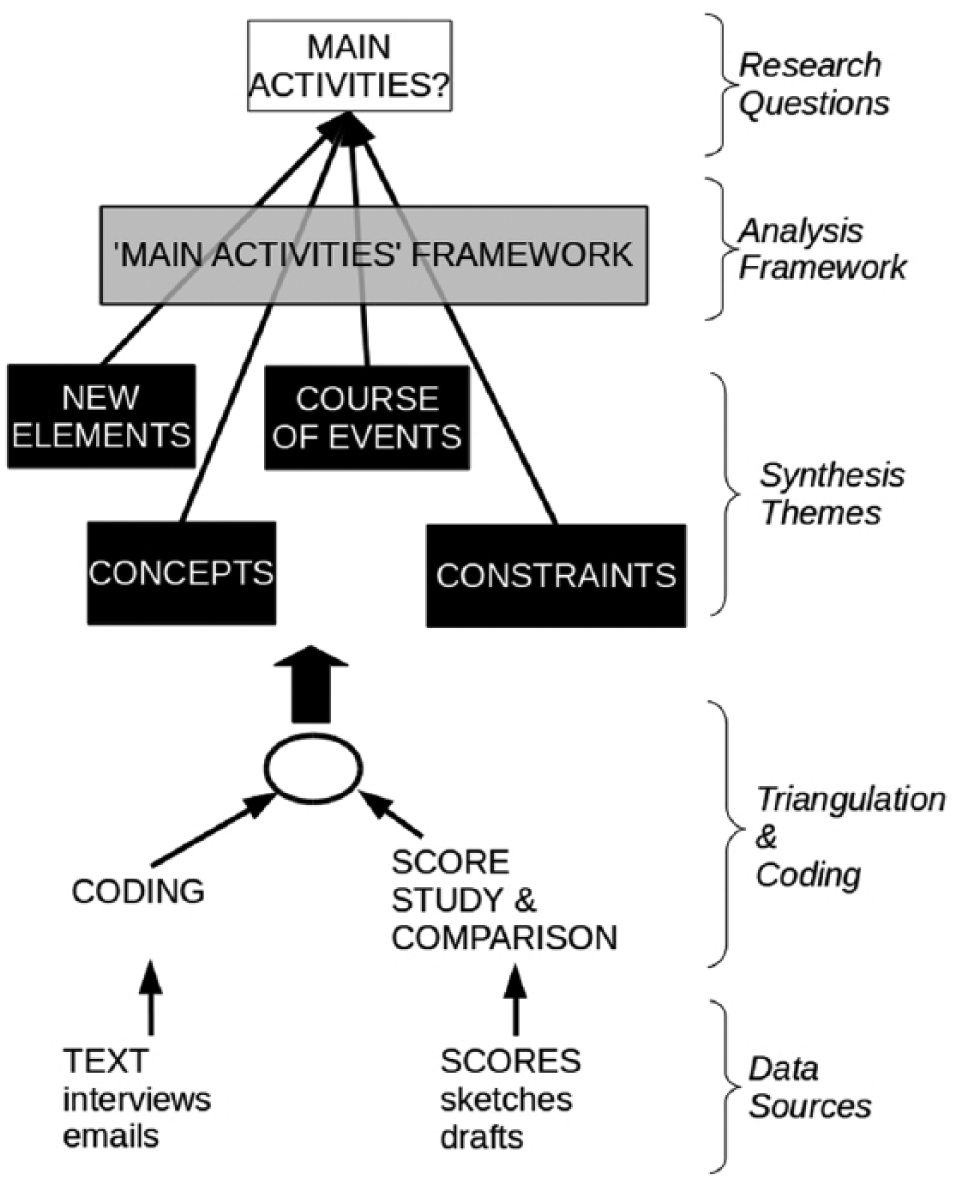
Research method in the study of eight composers.
Between 25 October 2011 and 30 November 2011, 24 composers were asked to participate in this study and compose a short composition for piano, flute and viola da gamba. A polyphonic task, that is, a requirement to compose this composition in such a way that the three voices would be as different as possible but still would be clearly perceived, was also part of the assignment. 4 All the composers contacted were selected because they had written contemporary classical or experimental acoustic music in the past and had substantial professional experience. Table 1 shows the composers’ full name and the number of years of activity. One composer chose to remain anonymous; his name is replaced by the fictitious name “Marc Cammeren”.
Professional experience of composers in the study of eight composers.
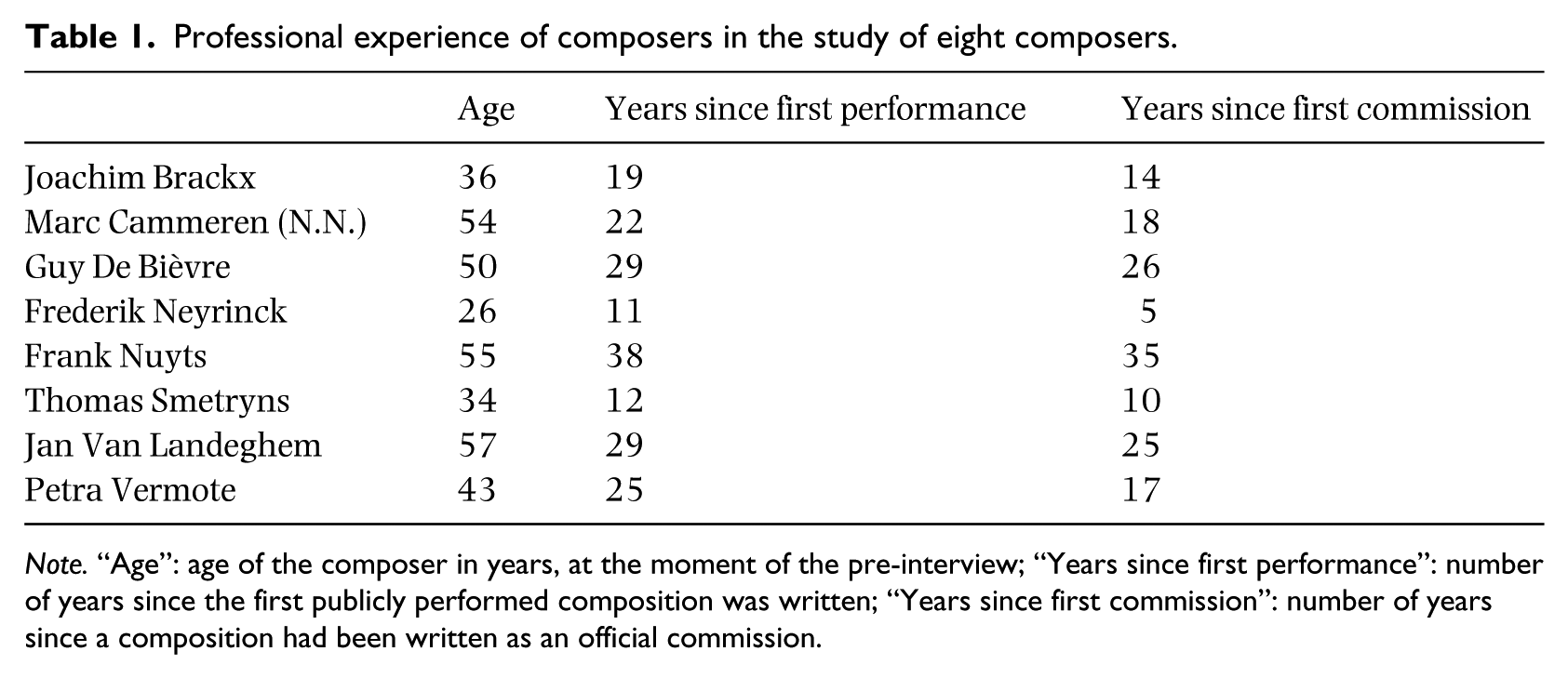
Note. “Age”: age of the composer in years, at the moment of the pre-interview; “Years since first performance”: number of years since the first publicly performed composition was written; “Years since first commission”: number of years since a composition had been written as an official commission.
The sources in this study consisted of the following.
A varying number of sketches, drafts, plans in paper or digital format per composer; these were obtained by asking the composers in advance to store their preparatory material. In two cases nine extra digital music notation files were retrieved from the backup folder of their notation software. Between the initial commission and the second interview, emails were sent by the composer concerning the short composition; these are also part of the sources.
Two semi-structured interviews per composer; the first one (the “pre-interview”) was made as soon as possible after the composer had notified the researcher that the composition was finished and before the performance of the short compositions took place in March 2012; the second one occurred after the first performance (the “post-interview”).
The final score of the short composition used for the performance.
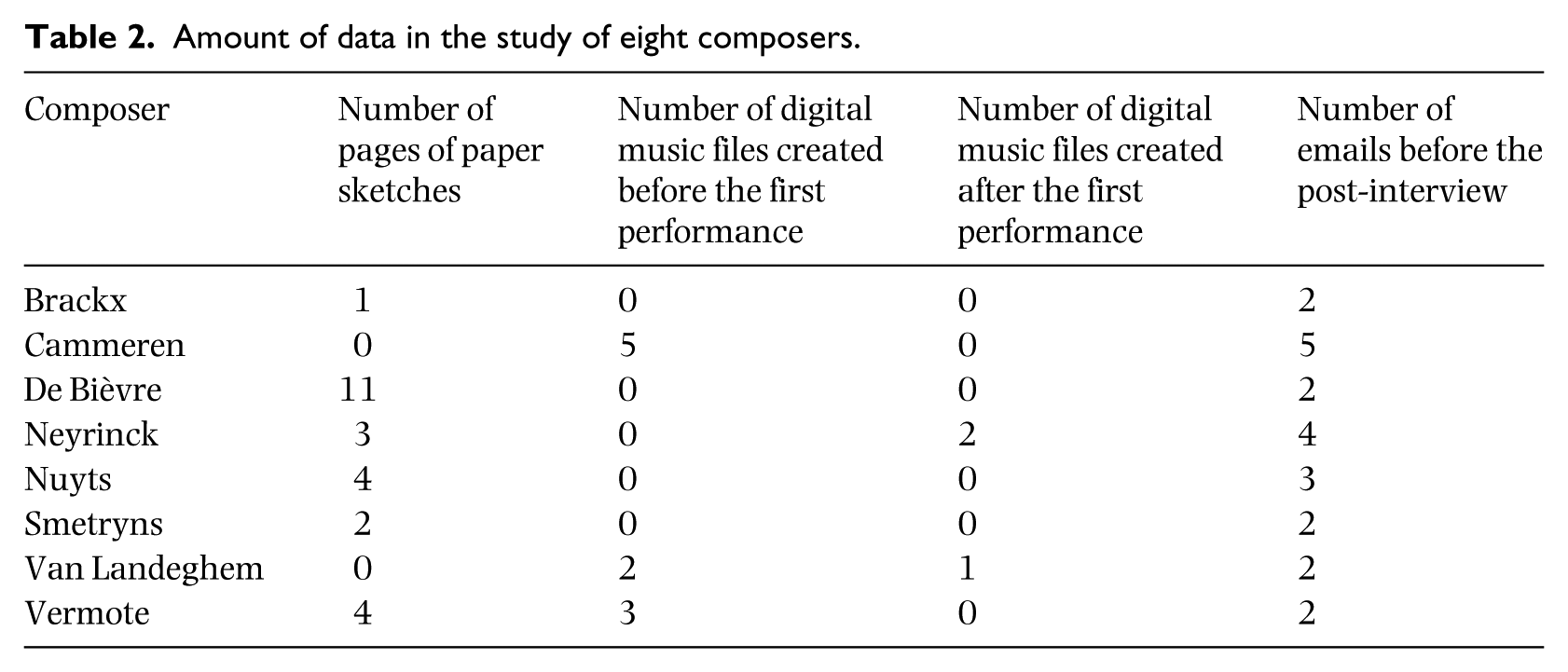
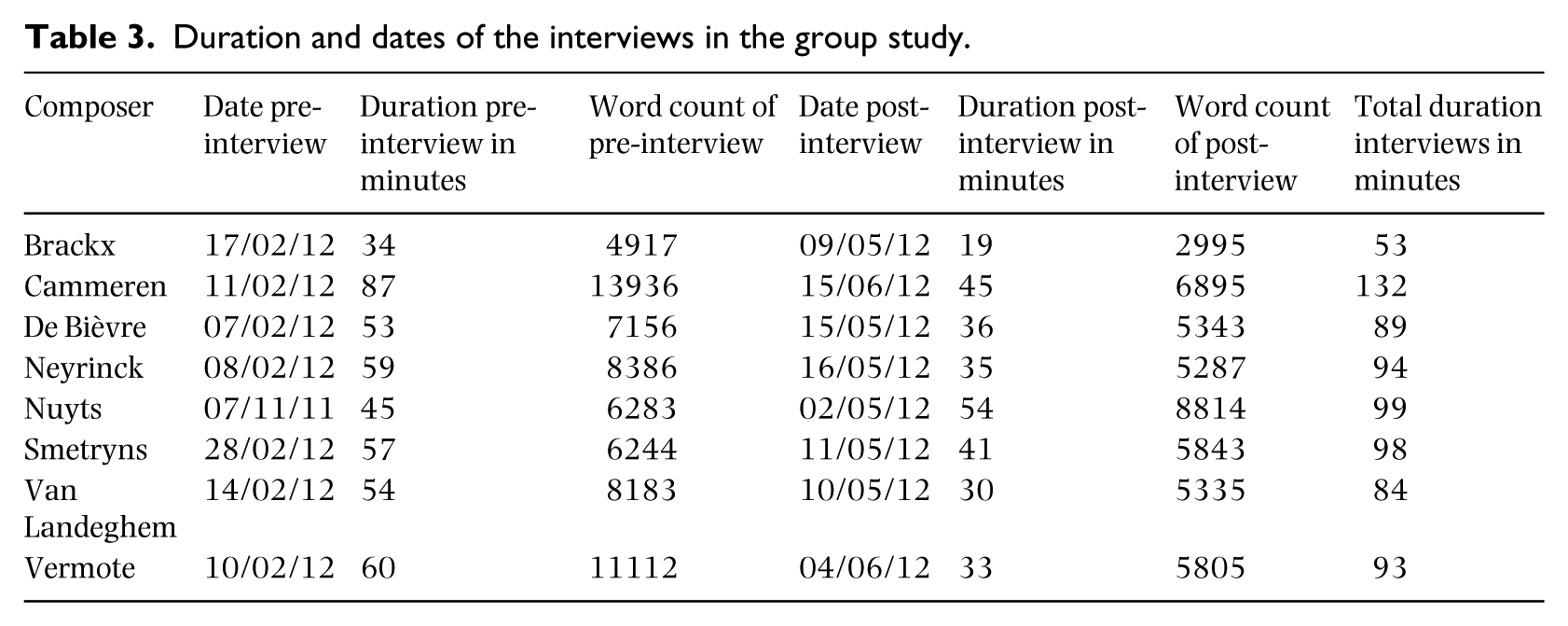
Table 2 presents an overview of the collected sketches and emails, while Table 3 shows the duration and number of words for the pre- and post-interviews. The amount and volume of the sources differ substantially from one CP to another, as seen in these two tables.
Amount of data in the study of eight composers.
Duration and dates of the interviews in the group study.
First analysis
In the following research phase the first analysis consisted of three research activities, which were performed simultaneously per composer. Each activity led to insights and results that enriched the other two activities. Firstly, the analysis of the text data was accomplished through a process of coding: the texts were read several times and fragments related to specific topics were indicated. The coding of the interviews was driven by the research and interview questions on the one hand and the emerging insights on the other. The latter originated from the composer’s words (in the interviews) or the ongoing analysis of the data. This combination of an inductive and deductive approach to analyse data is also found in the study of Pohjannoro (2014). Secondly, sketch analyses were performed by comparing successive music notation fragments, versions and scores. The comparison was completed by indicating all the changes, additions and omissions between a sketch and the one preceding it. The most important changes were listed and summarized in a text document. This analysis procedure is similar to Newman (2008, p. 134). Thirdly, there was a triangulation of sources: the various sketches, plans, interviews, emails, etc., were compared with each other to complement specific topics (e.g., the chronology of versions) and check their validity.
Creating syntheses in the analysis process
Based on the previous triangulation of data, a number of themes were reconstructed that were considered essential to find and interpret the main activities in each CP. These themes act as syntheses or summaries of information from the text data, scores or the triangulated information. There are four textual syntheses; these themes are as follows.
Course of events: a chronological reconstruction of the main activities, ideas and intentions for each composer. This “course of events” functioned as the first global overview of the CP through which many loose (research) remarks, problems and insights started making sense. Subsequently, the other themes – constraints, concepts, new elements – could be situated within this dynamic sequence of events and ideas.
Concepts: these are four summaries of the vision of the composer on: (1) their own music in general (both product, process and related activities); (2) the short composition; (3) the compositional procedures and techniques (both general and specific ones for the short composition studied); and (4) polyphony. 5
New elements: a list of elements (as part of the CP or the composition) that were considered new by the composer.
Constraints: the evolution of all kinds of restrictions and limitations in the CP.
A certain amount of overlap, specific for individual composers, was unavoidable in the description of these themes. For example, when the composer De Bièvre was talking about the creative input from the performers, his words were related to the themes course of events (as a description of an idea shaping the final composition), constraints (he considered not knowing the performers a limitation) and concepts (the role of the performer is crucial in his view on music in general and his short composition in particular). Moreover, not all the composers studied have a specific narrative about the four concepts. In fact, this is only the case with three composers (Van Landeghem, Nuyts and Cammeren). In the other cases concepts are fused together or are missing. For example, three composers (Neyrinck, Vermote and Brackx) had a mainly technical-musical view and their concepts on the procedures and techniques almost overlapped with their narrative on the short composition. Therefore, in the final analysis phases the reconstructed themes were treated flexibly and not as closed or fixed entities.
In addition to the four themes, two visual syntheses were created, both related to the course-of-events theme. The first visualization, the “events timeline” (see Figure 2), is a general chronological account of salient compositional activities and ideas that took place during the CP. The second visualization, the “music in progress” (see Figure 3), is based on the “structural mapping” of Collins (2007) and displays the development of the new composition starting from the moment the music was notated or made concrete. Examples of the two visualizations (of one composer’s CP) with an additional explanation are found in the Appendix (see Figure 2 and 3; an additional explanation of the two visualizations is found in the Appendix). These visualizations – and the related course-of-events theme – are built on the insight that some developments in the CP are more “factual” than others. Although in general the content of a CP is open for interpretation and too complex a phenomenon to be judged in terms of a “right” or “wrong” reconstruction of this process, these two developments can be evaluated as more or less correct. The reconstruction of a timeline of events and the progress of the music can both be validated by the data. The structural mapping of Collins (2007) was mainly a summary of the structure of the music produced by comparing the MIDI save-as files. However, in this study a triangulation of sources was necessary because these two “factual” developments did not coincide with one specific source (e.g., the digital or paper sketches). Another difference between the music in progress visualization in this study and the structural mapping proposed by Collins is related to the polyphonic character of the studied compositions. A version of such a composition simply cannot be represented by a horizontal line. Consequently, in this study the development of the music had to be presented as a sequence of rectangles, each showing one step in the development of the music.
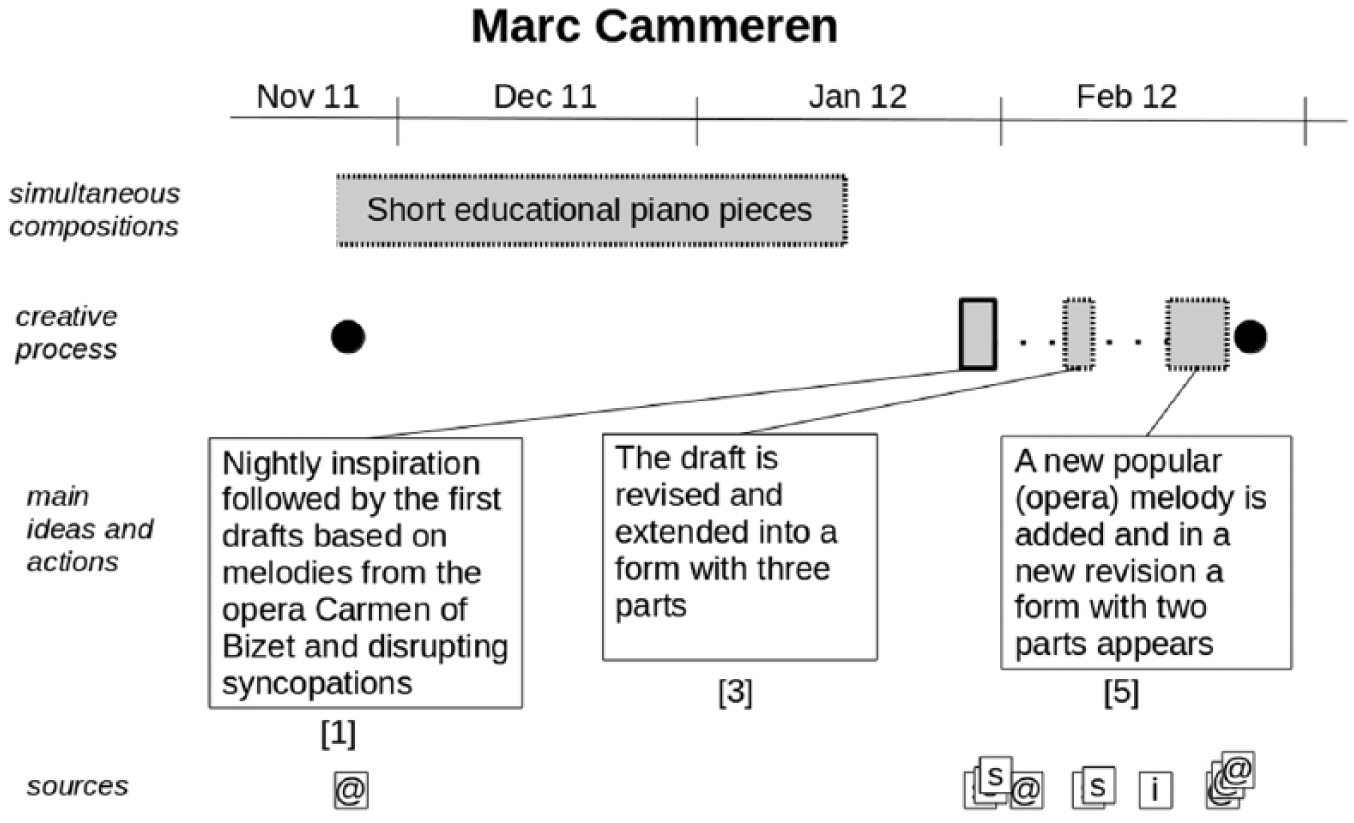
Events timeline in the creative process of Cammeren.
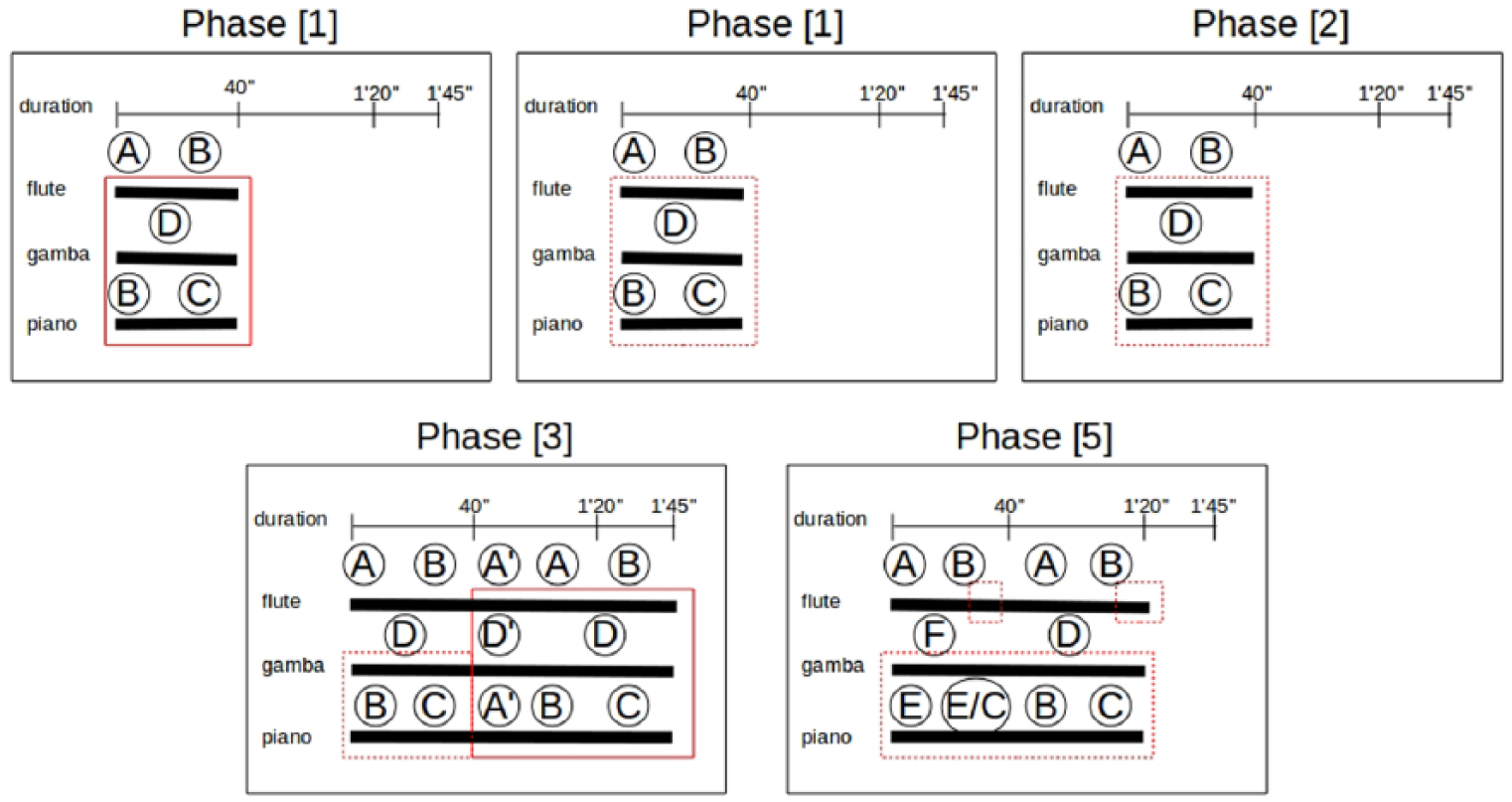
Music-in-progress visualization of the music in Cammeren’s creative process.
An analysis framework
At this point a common analysis framework was necessary to analyse the main activities – and the differences and similarities – in the eight studied CPs by the same criteria. This framework partly came into existence after rereading the sources and syntheses themes many times, and it is partly inspired by my own compositional experience and the existing literature, such as the distinctions made between the in-time and outside-time character of music in Craenen (2011), Frisk and Karlsson (2010) and Leroux (2010).
The analysis framework that I propose builds upon the difference between in-sequence and outside-sequence compositional activities from which four main activities are derived. There is a crucial difference between thinking/acting/creating outside the sequence of the new composition and in sequence, because music flows from one musical event to the next, fuses into a stream and thus creates a dynamic of its own. This sequence of events (the new composition) is unidirectional; the music is meant to flow in one direction from start to end. Although the fusion into a sequential stream is not equally strong in all music, 6 the tension between intentions and plans on the one hand, and the dynamics of the (created) music on the other, is present in many of the studied CPs. This dynamic is created from the moment music starts to take detailed shape and is made up of a sequence of musical events. Most music generates several temporal segmentations simultaneously: motives, phrases, sections, larger parts, etc. Any short musical opening statement is thus not just one linear sequence of musical events, but also a self-organization of temporal segmentations. It is perhaps this complexity of the musical language that creates the tension between thinking in sequence and outside sequence.
To clarify the distinction between the previous two categories, it should be noted they are not the same as real-time versus non-real-time. The “sequence” (from the term “in sequence”) refers not just to any sequence of musical events (of which the composer might be thinking), but rather to the sequence of musical events of the future new composition. Thus if a composer is imagining all kinds of musical ideas and images at the beginning of the CP but does not have a detailed idea (or draft) of the beginning (or any section) of the new composition, I interpret this activity as an outside-sequence activity. If I use the notion in sequence, in fact this always stands for “in a detailed sequence of the musical events of the new composition” because it is through a flow of concrete, musical events that a dynamic system is created, which might or might not be contrary to the composer’s intentions. The term “in a detailed sequence” implies that for the composer there are enough musical events to imagine, perform or notate this stream from one moment to the next.
The two categories of in-sequence and outside-sequence thinking are too broad and not sufficiently distinctive to provide meaningful criteria for the analysis of all CPs studied. Therefore four main compositional activities, which constitute the core of my analysis framework, are derived from the difference between in-sequence and outside-sequence thinking:
planning: an analytical activity, characterized by a degree of ordering or systematization of elements; this activity takes place outside the sequence of musical events of the new composition;
exploring: a more intuitive, heuristic or associative activity, taking place outside the sequence of musical events of the new composition;
writing: an activity producing a detailed sequence of musical events (for the new composition) without having a detailed future sequence; 7
rewriting: starting from an existing or composed stream of music, a composer rewrites and changes this existing music; thus, this activity takes place within a sequence of events at a point where the sequence not only has a past but also a future; the composer knows where the music came from and where it is heading.
Exploring and planning are considered outside sequence: they take place before the sequence of musical events is produced or as the composer steps outside this sequence of events. I consider the four proposed compositional activities to be crucial to the CP because the four activities are productive: they add something new (a music fragment, score, new version, visual plan, etc.) to the composition in development. If none of these four activities is present, no new composition can be made. If there is one common element to (professional) composition, it is the simple fact that, ultimately, composers produce music in whatever written or unwritten form they choose. My proposed activity framework is based upon productivity and consequently should fit a wide variety of CPs as an analysis tool. 8
How are these four main activities detected in the data? In general, the material traces (sketches, drafts, etc.) provide information on three out of four activities (planning, writing, rewriting); for example, the planning activity produces lists, plans and drawings with a systematic ordering of material. To detect the exploratory activities I mainly had to rely on both the material traces and the composer’s words, that is, the interviews and emails. Next, the information on an activity is triangulated with the reconstructed course of events and the music-in-progress visualization, because the development of the music is seen here in detail. By situating the activities within the dynamic development of the composition, the difference between in sequence and outside sequence can be detected. Consequently, there is a close relation between the real-time and data-rich collection method on the one hand and the framework to analyse and interpret the main activities on the other. This reflects the underlying theoretical framework of composition as a situated activity.
Attributes of the main compositional activities
By systematically searching for these four activities in the eight studied CPs, the selective presence, spent duration and chronological order of these activities were detected. This produced a first draft of a configuration of composition activities for each CP. Although this configuration disclosed a preliminary overview of similarities and differences between the processes, it does not directly contribute to discovering the importance and value of an activity. To interpret the individual processes consistently (based on the various sources) and meaningfully (i.e., distinguish main activities from less important ones), it became necessary to look at a number of attributes of the four main compositional activities. To avoid a unidimensional view of the importance of activities (e.g., a uniquely retrospective account), several attributes had to be taken in to account. In the following sections, I describe the three main attributes 9 and their relation with the previous steps in the research process. These attributes are generally found by revisiting the sources through the constructed synthesis “themes”. The description of each attribute is followed by an illustration of one main activity – rewriting – which displays this specific attribute. Next, I present the resulting, more complete configurations of the main activities and the comparison of all the CPs studied.
Productivity
The first attribute is the productivity of an activity, that is, the new elements that it adds to the composition in progress. Although all four compositional activities are productive to a certain degree, there are significant differences in the quality and quantity of results produced by an activity. Because the CP is a transformation from intangible and vague ideas to a more concrete piece of music, it is important to take both material and less tangible results into account. To detect the less tangible results, the concepts theme of the previous analysis phase proved to be of help while the constraints theme ensured that abandoned ideas were also taken into account.
The focus on the productivity and results of a compositional activity led to finding a specific form of rewriting which I labelled “scaffolded rewriting”. Preceded by a “simple” writing process in which a sequence of a limited set of parameters is notated, the rewriting gradually adds more features and layers on top of the initial layer. This form of rewriting only appeared in the CP of Nuyts. Firstly, this composer wrote a layer based on two parameters: harmony (chords) and harmonic rhythm. Next, the melodic patterns of each instrument were sought out and stacked on top of this first layer. The scaffolded rewriting (and the preceding simple writing) bears resemblance to the production of a compressed short score, known as the particella, found in sketch studies of composers such as Schubert and Wagner (Marston, 2001). It is also very similar to one of two compositional strategies defined by Folkestad (1996) as the horizontal strategy. The essential characteristic of the scaffolded rewriting (preceded by the simple writing) activity is the creation of a stripped-down, simplified sequence of music, which nevertheless contains enough musical events to produce a musical stream for the composer, followed by a process of addition and elaboration.
Level of musical abstraction
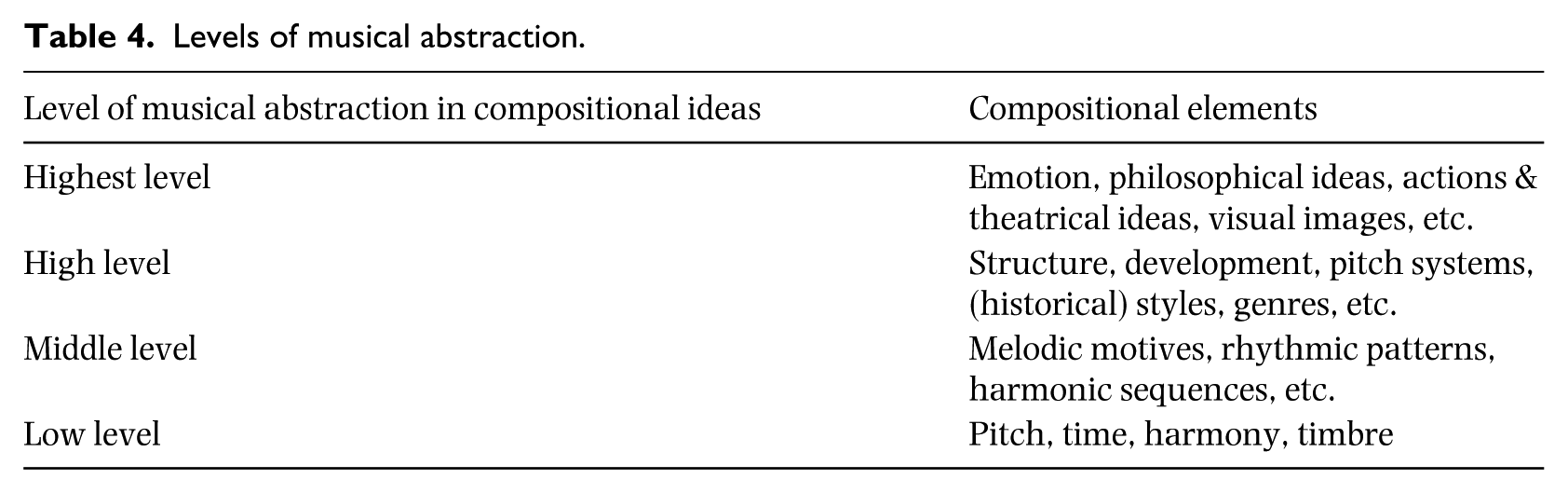
The next attribute of the main compositional activities is their level of musical abstraction. This concerns the size of ideas and material with which the composer is working while composing. The most abstract material – the highest level – contains extra-musical ideas or representations. By doing so the composer can deal with larger units of (vague, multimodal) “music”. In opposition to the abstract, extra-musical material are local, isolated musical parameters such as pitch or rhythm. In between these two extremes lies the high level of abstraction, which relates to long sequences and sections of strictly musical material and the mid-level of short sequences or fragments of one or several musical parameters. The designed gradation or level of musical abstraction in Table 4 is loosely based on a general taxonomy of musical parameters (Lesaffre et al., 2003; p. 638). The differences between the four levels are not to be interpreted strictly as overlaps can certainly occur. The gradations from low to high levels of abstraction have provided common criteria to further differentiate the detected four main activities. The object of the creative activities – the music – turned out to be surprisingly similar or different – in terms of musical abstraction – from one composer to another, or from one phase in a CP to another.
Levels of musical abstraction.
In this study, the rewriting mostly operated on low- and mid-level musical abstraction (in the CPs of Smetryns, Van Landeghem and Vermote). This “revising” consisted of adapting local characteristics of the composition by elaborating details, adding an instrument or a short section, etc. However, “structural rewriting” appeared in the CP of Cammeren: the form or structure of the new composition was created by rewriting and reordering existing or previously written music, thus in this case rewriting operated at a high level of musical abstraction. This stands in opposition to the other findings in this study where a structure or an overall form for the new composition was created by planning or writing activities. The first phase of the CP of Cammeren – during which he wrote the first version in a flash of inspiration – had set the major constraints of his future composition and provided him with a global idea. A wealth of details, fragments and sections became available through the writing process, but the sequence – and order of events – still had to be stabilized. Because there was no planning or exploration before the writing phase, the composer had to tackle two other problems (instrumentation and remaining close to the main idea of the first version), together with the creation of the structure. These problems were not solved sequentially but simultaneously by rereading, performing or overseeing the current version. The first version of Cammeren’s new composition consisted of one part; a later version (in phase [3], see the music-in-progress visualization in the Appendix) had three parts, while in the end there were only two. The structure was mainly built upon motives and themes (bundled in phrases and parts) and therefore recognizing the structural potential of a theme, by rereading and reflecting, was one of the main challenges during his rewriting activity.
The structural rewriting is also found outside this study in the CP of a piano work of the jazz composer Newman (2008). During an initial exploration phase he created loose fragments, harmonic and melodic ideas. In the following rewriting process these fragments were re-arranged and transition sections were produced. In the composer’s development of the form (the “compositional order” (Newman, 2008, p. 157) and the accompanying table (Newman, 2008, p. 179), which summarizes the consecutive structural changes), this form of rewriting is clearly visible.
Creativity
The next attribute is creativity, that is, the degree to which an activity stimulates the composer’s creativity and imagination. This attribute (and its detection) is related to the productivity attribute. If a compositional activity enhances the composer’s imagination and creativity, a high number of productive results can be found, including those that do not end up in the finished composition. However, the creativity attribute not only refers to the results of an activity, it is also a specific state of mind (as part of the activity) in which musical ideas, plans, versions and variations arise abundantly. The discourse of the composer – revealed through the interviews and the concepts theme – proved to be important to detect this state of mind.
Composers such as De Bièvre or Vermote hardly spoke of the rewriting activity and only mentioned it in a neutral way. On the contrary, there are two composers in this study whose rewriting activity bears many characteristics of the creativity attribute. 10 At several moments in the interviews the composers Cammeren and Van Landeghem raised ideas of how they could change, adapt and re-arrange their composition. Their words, enthusiasm and drafts testified to an openness of experience, which involved active imagination in order to find alternative “solutions” to the ones in the current version of the short composition. There are some differences between these two cases of creative rewriting, however. Although Cammeren was only interested in adapting the current short composition, Van Landeghem’s enthusiasm stretched across the boundaries to other compositions. In the first interview he brought up the idea to create six other trio pieces to form a multi-movement trio of which the short composition would be a part. In the second interview he again stated that his short composition and the 12-tone series had a lot of potential and that he was considering making a piano trio or piano quartet based on this material. Moreover, after he had finished his short composition, he rewrote and re-arranged this piece as a part within another composition in progress, a marimba concierto. The second difference between these two enthusiastic “rewriters” is the theorizing activity that accompanied the creative rewriting in Van Landeghem’s case. As a part of his enthusiasm for the extra affordances, he developed an elaborate discourse that stressed the systematized nature of these materials. Such theorizing was absent in Cammeren’s discourse where only a mild form of reflection took place (by repeatedly rereading and contemplating the current version).
Comparing the individual configurations of compositional activities
Similarities between the individual configurations
By taking the three attributes into account, a more complete picture of the configuration of compositional activities for each CP in this study can be rendered. This configuration characterizes the eight studied processes and a visualization figure was made to support this overview and compare the individual CPs (see Figure 4). Configuration stands for the following.
The selective presence of the four compositional activities. (Which activities are present and which are not?)
The sequential order in which the selected activities take place. (Is there an obvious sequential order? Are there interwoven activities?)
The hierarchical or equitable relationship between the activities. (Is there a dominant activity or not?)
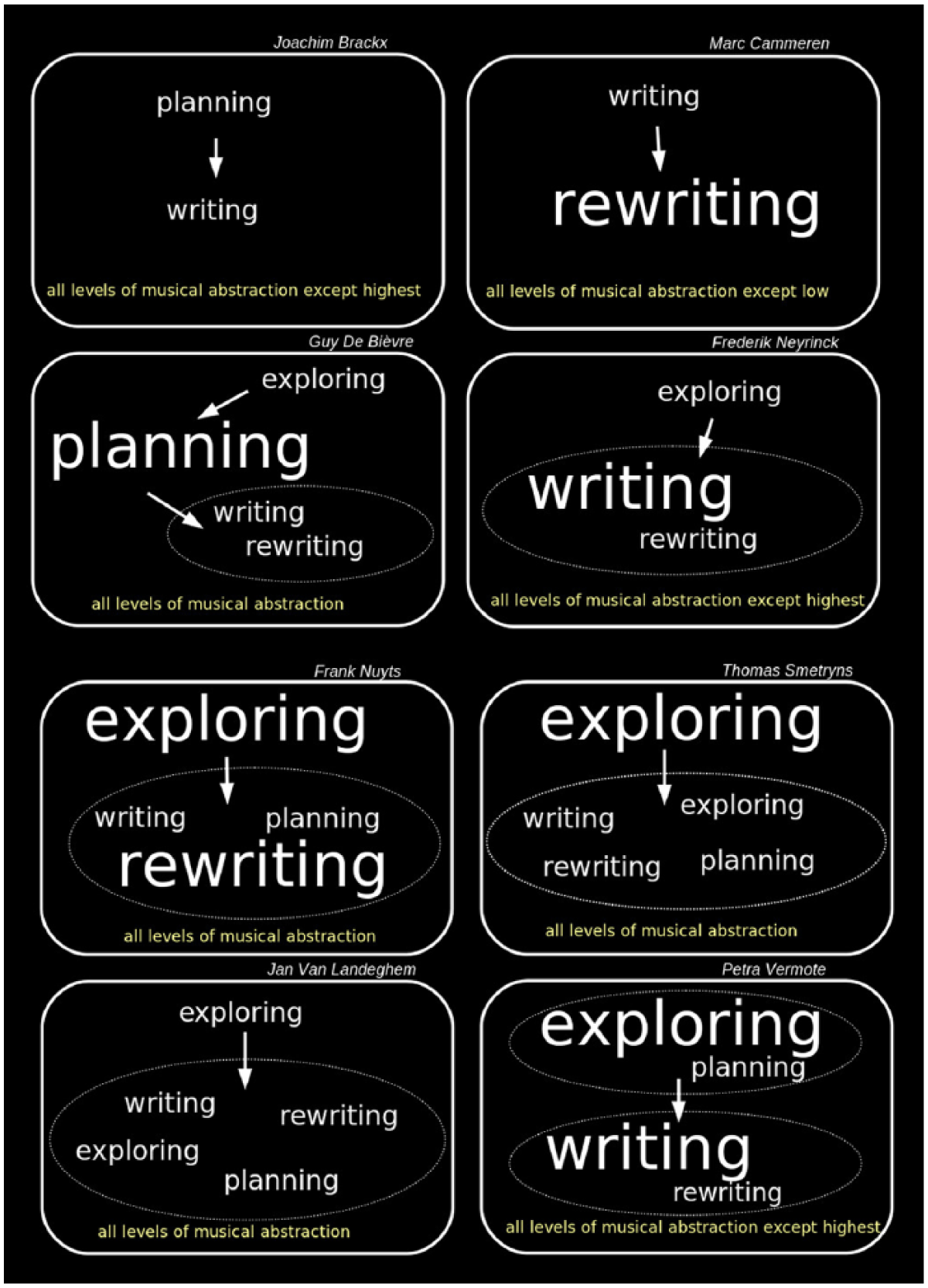
The configurations of the main compositional activities.
The sequential orders of the compositional activities in this study were not always strictly linear. Some activities are interwoven and occur rapidly after one another to form overarching clusters or groups of activities. For example, in the CP of the composers Vermote and Smetryns, the clusters mainly consist of alternating cycles of writing and rewriting; in other words, the writing process is repeatedly interrupted by local rewriting until the writing reaches the end of the composition. The overview of configurations also discloses equitable or hierarchical relations between the compositional activities. This relation was evaluated by examining the productivity and creativity attributes combined with the knowledge about the time spent on these activities (synthesis course-of-events theme). Thus, enduring (or often recurring) activities, which stimulate an intense state of creativity and produce many tangible and intangible results and changes, were considered as more important and dominant in contrast to less inspiring activities that produce a limited number of changes over a shorter period.
The overview of the eight individual configurations shows that no general strategies or categories of activities were found in this study. These results contradict the broad categories found in the literature, but at the same time the configurations of the main four activities encompass the existing categories from the literature. Folkestad’s distinction (1996) between horizontal and vertical music creation neglects the outside-sequence activities of exploring and planning, possibly because he studied young people. The horizontal strategy coincides with one specific configuration [simple writing → scaffolded rewriting], while the vertical strategy is similar to configurations where the writing dominates. Consequently, the exploring and planning activities, which are crucial in the CPs of Brackx, De Bièvre, Nuyts, Smetryns, Van Landeghem and Vermote, are given less attention in his distinction of the horizontal and vertical categories. Donin’s first direction (2012), the “synoptic planning”, focuses on the planning activity and presumes that this planning operates at a high level of musical abstraction (“global concepts” and “the piece’s form”). The second direction, the heuristic ideation, coincides with configurations in which writing is a dominant activity. Exploration and rewriting are given less attention and therefore cases in which these activities are dominant, such as Cammeren’s rewriting and Vermote’s and Nuyts’s exploration, would be hard to fit into one of Donin’s “directions”.
In the overview of configurations some features appear repeatedly (and one would be tempted to call them “general” features); but for all five “general” features exceptions are found and remarks can be added.
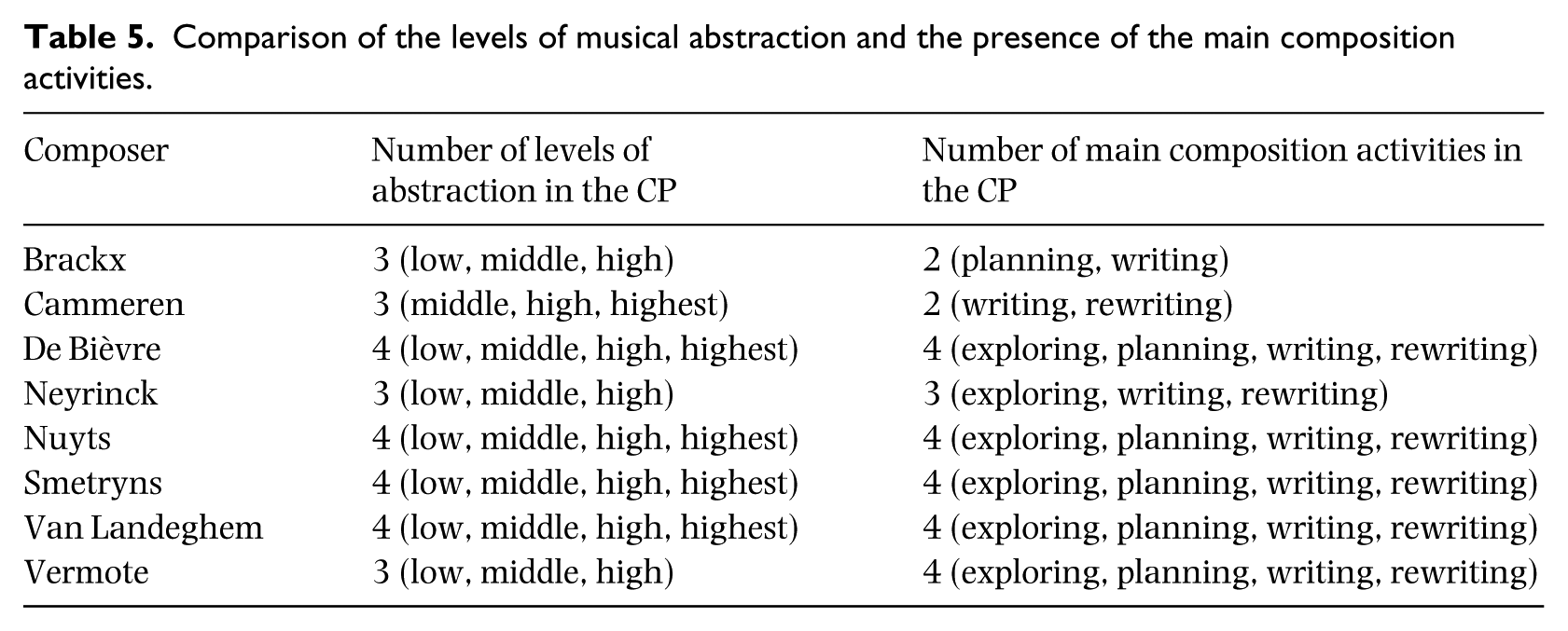
Firstly, in all the configurations of this study writing is present; it seems to be the most general activity, but its function is less productive and creative (i.e., not dominant) in the CP of De Bièvre. Beyond the current study, the self-study of Newman (2008) has shown that composing without the writing activity is also possible. The creation of a detailed sequence of musical events without having a detailed future sequence ahead – as I defined “writing” – is (almost completely) skipped in Newman’s CP by allowing a preliminary sequence (described as a “liquid” form) to emerge out of loose fragments, produced during the initial exploration phase and then gradually solidifying this sequence by moving and adapting sections and creating transitions (the rewriting activity). Secondly, exploration is often the first activity of the CP. This occurs in six out of eight cases, but both planning and writing also appear once as the initial activity. Thirdly, the outside-sequence activities – planning and exploring – occur mostly (in seven of the eight CPs) before the sequence of the new composition gets a fixed form and is written down. These activities are generally preparatory activities (in a strict chronological sense) for the writing or rewriting. But there is also one occasion where a composer – Smetryns – plans and explores after the sequence of the new composition has been elaborated in detail. Moreover, there is also one case in which the generation of the sequence and the planning activity occur simultaneously: in Nuyts’s CP both the elaboration of a numerical series (for the harmonic rhythm), its revision, and the sequence of chords (on which the new composition is based) and its revision are part of one intertwined process after which the (scaffolded) rewriting begins. Fourthly, in intertwined activities (“clusters”) the writing–rewriting pair is frequently found, but there is also one cluster (out of seven, in Smetryns’s CP) where exploration and planning appear together without the writing or rewriting activity. Finally, composers working at all levels of musical abstraction use all four compositional activities. This last “general” feature is based on counting the number of compositional activities in each CP and comparing them with the number of levels of musical abstraction (see Table 5). This finding clarifies how composers draw from a diverse range of compositional activities to handle different “sizes” of musical material, from isolated parameters – such as pitch or tone duration – to overarching, global ideas that relate music to emotions, physical actions or visual ideas. But again remarks have to be added to avoid misunderstanding this “general” feature. Firstly, there is no one-to-one, linear relation between an activity and a level of musical abstraction, that is, exploration, planning and rewriting operate at different levels in the individual CPs of my study. Secondly, again there is one exception – the composer Vermote – who uses all four compositional activities but does not work at the highest level of abstraction.
Comparison of the levels of musical abstraction and the presence of the main composition activities.
Differences between the configurations
Apart from the previous “generalizations”, the configurations of activities in the CPs are very diverse and disclose a rich and complex palette of strategies and practices of the eight composers. The differences are plentiful:
within the eight configurations no pair of configurations is identical; three configurations (Nuyts, Smetryns and Vermote) are quite similar: their CPs start with an extensive and dominant exploration phase, followed by a cluster of activities in which writing and rewriting appear;
each of the four main activities appears at least once as a dominant activity; in four cases there is one dominant activity, in two cases two, and there are also two CPs with equally important activities (without a dominant activity); 11
there are configurations with and without clusters of activities.
This diversity underlines the need for a case-specific analysis or interpretation in parallel with the general analysis based on the designed framework. In some cases the final individual analysis only required a deepening of the obtained insights from the configurations. Here a meaningful individual interpretation became visible through the overview of configurations; for example, the CP of Cammeren was highly characterized by the configuration [writing → rewriting] and his individual discourse on these two activities. In other cases, more detailed comparisons of specific activities and additional questions on the individual concepts or the external commission were required to arrive at a satisfying interpretation. For example, the CPs of both Smetryns and Vermote start with an extensive exploration phase that does not lead to a system or plan for the new composition. Questions were asked on how different the function and results of the exploring and subsequent writing activities were in both cases and to which extent the writing process did (or did not) build on the previous exploration. In the case of Vermote, I arrived at an explanation of the exploration as a strategy to become aware of the musical affordances, aesthetic preferences and compositional abilities in relation to the commission. The exploration functions as a preparatory exercise for the writing process, through which Vermote internalizes the main givens of the commission. In this way she reconciles an intuitive compositional style, characterized by a rich and abundant imagination, with the intention to stay close to the commission (see Roels, 2014, p. 145).
As a general methodological remark, I must add that the problem of finding a meaningful time period to study the CP (Deliège & Richelle, 2006, p. 3) also appeared in this study: the short composition of two composers – Neyrinck and Van Landeghem – was part of a larger cycle of works. In Neyrinck’s case, his short composition was situated at the end of a cycle. He re-applied many procedures and concepts from a preceding cycle of short piano solo works. The short composition of Van Landeghem was the starting point of a cycle-like process. It led to the rewriting of a larger marimba concierto based on the insights – specifically the 12-tone rows – gained in the CP of the short composition. He also integrated the whole short composition with a new instrumentation into this concierto (similar to “creative borrowing”; see Donin, 2012, p. 22). Therefore, the time frame of the configuration of compositional activities may not be as meaningful in these two cases as in the others. Some compositional activities might have appeared more outside this time frame and still have been closely linked to the CP of the short composition (Roels, 2014, pp. 133, 140).
The relation between macro- and micro-activities
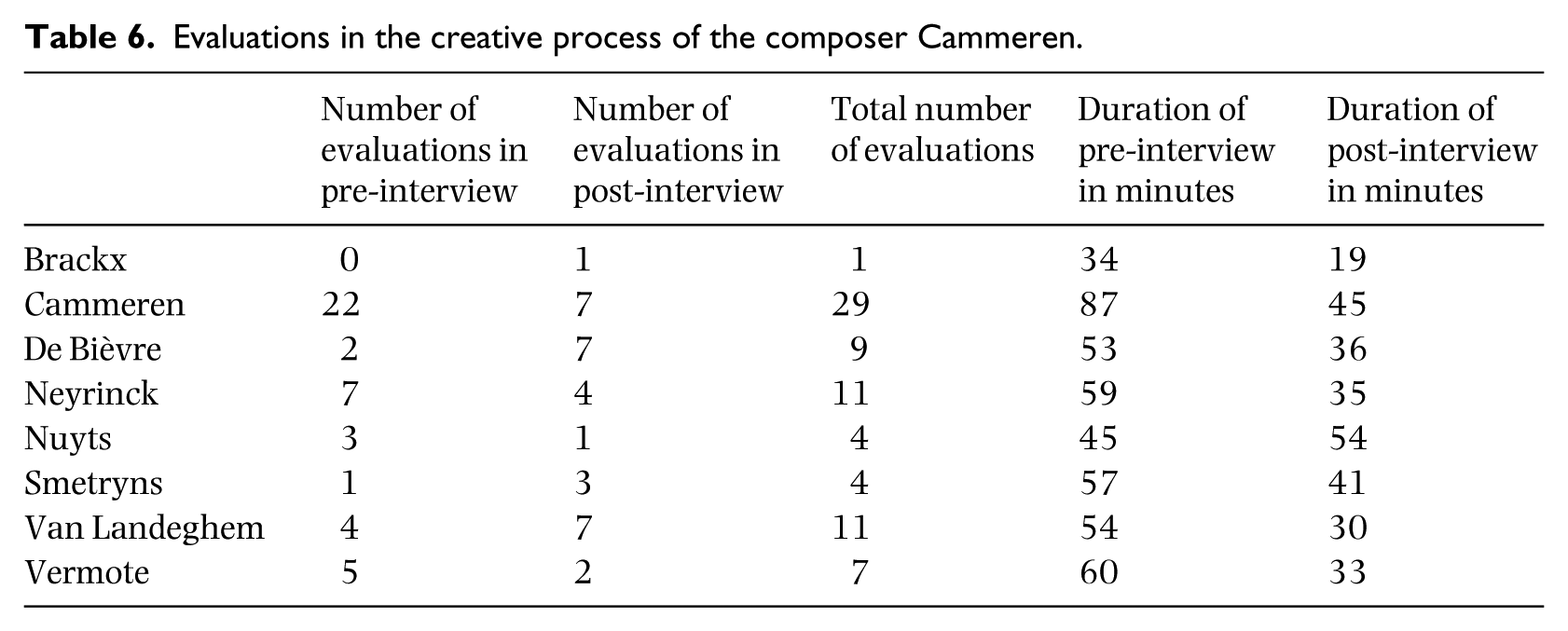
Although the overall picture of all CPs studied shows a wide variety of configurations and activities, within groups of specific configurations (e.g., configurations with one dominating main activity) there may be more similarities and relations with finer grained activities (listening, evaluating, etc.). The configuration [writing → rewriting] only appears once in the current study, in the case of Cammeren. There are indications that the CP of the film composer studied by Collins (2005, 2007) can also be classified by the same configuration. Similar to Cammeren, the film composer writes fast and intuitively, which reinforces the impression that the writing mainly delivers the material for the rewriting process. Collins (2005, p. 203) describes how the two major themes (for the composition) were composed within hours of each other on the first day, and the third theme was written before the studied CP and “imported”. Collins also notes “the composer’s reluctance to change, or possibly, abandon the two major themes” (2005, p. 203), which resembles the mystification of the writing process in Cammeren’s case – the writing is explained as a passive “reception” of the initial version during nightly inspiration – and the will to remain faithful to the first version. Moreover, the “structural rewriting” is highly present in the following phases of the CP of the film composer. Collins calls this “the convolution of thematic placement” and the rewriting is also visualized in his structural mapping (2007, p. 252). The film composer spends much time on moving sections (themes), deriving other sections from existing material and elaborating/adapting the instrumentation, phrasing and other forms of small-scale editing work. The similarity of the main compositional activities between the CPs of Cammeren and Collins’s film composer brings up the question of how general – or configuration-specific – the model proposed by Collins is. In the analysis of Cammeren’s process I have already stressed the handling of the structure problem, but I also found a high amount of evaluations compared to the other seven CPs in this study (see Table 6). “Evaluation” was defined as an activity by which the composer assesses his short composition (or related parts, changes or ideas) in basic categories – such as “good”, “bad” or “this doesn’t work” – without necessarily making the criteria explicit. Collins’s hypothetical model of the compositional process (2005, p. 207) emphasizes the recursivity of the problem-solving process and structure as one of the main problems to be solved. Collins’s detailed and complicated model may be caused by the specific configuration [writing → rewriting], which in Cammeren’s case was characterized by the high number of problems to be solved in the rewriting phase. These problems arose because there were no pre-writing activities and the writing activity itself occurred so fast and intuitively.
Evaluations in the creative process of the composer Cammeren.
Conclusions
The analysis framework in this study, consisting of four main compositional activities and three attributes, was designed to apply similar criteria in the analysis of a diverse range of CPs. It was part of a research phase during which the general and individual analyses of the studied CPs interacted with each other. Although the results obtained through the analysis framework did not disclose any general activities or strategies in all eight CPs, there were enough meaningful similarities to make the framework operative as an analysis tool to compare and relate interpretations of individual CPs to each other. However, in the cross-sectional analysis process the common framework needed to be complemented by a search for case-specific features and phenomena because the common elements were not sufficient to find all the meaningful activities. The eight CPs in this study were individually characterized and interpreted as consisting of a specific configuration, that is, the four main compositional activities appeared in a selective presence, chronological order and hierarchy. Some configurations were also recognized in CPs outside the current study and the relation between finer grained actions and specific configurations was discussed and is open for further research.
Multiple contextual layers need to be taken into account if more than one CP and its dynamic phenomena are analysed based on a situated vision. Therefore, this study paid much attention to the creation of syntheses as an integral phase of the research process. These summaries were partly text based but two additional visualizations were made, of which one is an elaboration of a model proposed by Collins (2005, 2007). These visualizations synthesize the timing of events and development of the music (for the new composition). Moreover, these visualizations are a first step towards incorporating the multimedia character of the CP in the analysis process. The music-in-progress visualization also proved important to apply the analysis framework and its distinction between in- and outside-sequence activities: the development of this sequence of musical events is visible in the music-in-progress visualization. Therefore, the proposed syntheses form a necessary foundation for the subsequent cross-sectional analysis process through the framework. The music-in-progress visualization, however, has one inherent limitation: because it summarizes the development of the realized, tangible music (of the new composition in progress), it is only informative and meaningful for those CPs in which writing and rewriting are dominant activities.
In the future there will hopefully be a balance between individual and group studies to research creative activities in a real-world setting. The current study has offered insights on both the research routes to arrive at comparisons and the results obtained through these comparisons. I hope this wide view is fruitful to researchers of the CPMC.
Footnotes
Appendix: Explanation of the figures
The visualization “events timeline” (see Figure 2) is organized along several horizontal layers or rows. Underneath the name of the composer there is a horizontal timeline, which represents the months from left to right during which the studied short composition was produced. All the layers underneath this timeline are organized according to this time direction. The following horizontal layer is called simultaneous compositions and it represents other CPs of compositions in the same period. Depending on the individual composer and the number of simultaneous processes, there can be one or more rectangles with the names of the simultaneous compositions. The next layer is called creative process and the two black dots (or filled circles) represent the beginning and end of the CP, that is, the date on which the composer received the commission and the date on which he sent the score that was used for the first performance. A dotted line in this layer indicates that, according to the composer, he was “thinking about” the new composition in this period. The rectangles represent actions or ideas that were reconstructed based on the interviews or other data. Rectangles with dotted lines stand for ideas without a clearly defined date, whereas solid lines indicate ideas that could be dated more precisely. The next layer, called main ideas and actions, contains short summaries of these ideas and actions. The numbers in parenthesis, such as [1], stand for the number of the phase (of the CP) as in the textual synthesis theme, the course of events. Finally, the last layer represents the data sources and their date. A “@” stands for emails, “s” for sketches or drafts and “I” for interview. An “s” with a strikethrough stands for sketches or drafts that got lost or that might have existed according to the composer but were not found.
The music-in-progress visualization (see Figure 3) is organized along three horizontal layers, representing the instrument parts in the short composition. Rectangles around a stave in such a part indicate that this part was newly written, while rectangles with dotted lines represent rewriting processes. The number between brackets (e.g., [3]) above the title refers to the phase of the CP, as in the events timeline visualization and the text-based course of events. The numbered phases enable the comparison of the two visualizations along the same time axis. Some of the composers use thematic material or sections; in these cases, the phrases or sections are indicated by letters (in circles).
The configuration visualization (see Figure 4) shows:
Funding
This research received funding from University College Ghent.